




Abstract
This study aimed at relating trust and psychological empowerment to Iranian English as a foreign language (EFL) teachers’ job satisfaction. Participants were 217 (117 females and 100 males) Iranian EFL teachers teaching in secondary school. Four dimensions of psychological empowerment (meaning, competence, self-determination, and impact), three faculty trust (trust in principal, trust in colleague, and trust in students and parents), and two aspects of job satisfaction (intrinsic and extrinsic) were measured. The collected data were analyzed by means of structural equation modeling (SEM) using the AMOS 20 program. Results indicated that psychological empowerment was directly related to job satisfaction; however, trust was indirectly related to job satisfaction through psychological empowerment. Assuming job satisfaction as the causing factor, results indicated that job satisfaction could be directly related to other two variables. Findings have valuable implications for secondary school principals and authorities of Ministry of Education in higher levels.
Introduction
In every organization and workplace, employees and workers’ satisfaction is considered as one of the major means for enhancing consistency and positive performance. The attempts for understanding employees’ and workers’ satisfaction have been overrun in many ways, among which, examining the relationships of their job satisfaction to other job- and nonjob-related variables are of significant ones. Job satisfaction as an indispensible part of work motivation (Moynihan & Pandey, 2007) and an indicator of teachers’ emotional and psychological health need to be considered by researchers. In this study, job satisfaction is approached as “the pleasurable emotional state resulting from the appraisal of one’s job as achieving or facilitating the achievement of one’s job values” (Lock, 1969, p. 316). Job satisfaction can be approached from both extrinsic and intrinsic perspectives (Travers & Cooper, 1993). Lock (1969) argues that overall job satisfaction is the sum of its different discriminable elements. Causes of job satisfaction do not reside in the job or solely in individuals but lie in the correlation between them (Lock, 1969). Therefore, job satisfaction in every workplace is the result of interaction between the person and his or her environment. Thiruchelvi and Supriya (2009, p. 110) view job satisfaction as “an appraisal of the perceived job characteristics, work environment, and emotional experience at work.” They stated that when employees talk of job satisfaction, it means that they are expressing their feelings about their job rather than their thoughts. According to Thiruchelvi and Supriya (2009), job satisfaction is affected by three main factors, namely, job-, organization-, and individual-related factors. Moynihan and Pandey (2007) hypothesized and confirmed that job satisfaction has had the greatest influence on organizations. They maintained that organizational variables such as job satisfaction can have direct effect on work motivation. Kwong, Wang, and Clifton (2010) stated that job satisfaction directly affect the work motivation and the performance.
Similar to other organizations and industries, educational setting is also faced with job satisfaction or dissatisfaction in both managers and teachers which, in return, affect their performance. Hence, educational systems and school administrators are trying to find ways for diminishing teachers’ dissatisfaction and enhancing their satisfaction through recognizing factors that correlate with teachers’ job satisfaction. As students expect their teachers to work hard and provide conditions in which they can cooperate and learn, teachers expect the school principals and colleagues to help and make effective cooperation (Van Maele & Van Houtte, 2012).
The meaningful relationship between job satisfaction and different aspects of schoolwork behaviors such as “productivity, absenteeism, turnover rates and intention to quit” (Koustelios & Tsigilis, 2005, p. 190) led to extensive research on job satisfaction in educational institutions. Koustelios and Tsigilis (2005) reported that job satisfaction was negatively correlated with burnout. Reviewing literature, as Mullock (2009) contends, shows that intrinsic factors such as teaching and working with young people, professional self-growth, recognition from parents or supervisors, autonomy, and supportive colleagues have been found as major sources of teachers’ job satisfaction.
According to Duffy and Lent (2009), teachers were among the populations that have received demanding attention. Satisfied teachers are more enthusiastically spending energy for teaching and educating students (Nguni, Sleegers, & Denessen, 2006). Cerit (2009) contends that teacher job satisfaction has positive effect on the quality of education. He found out that servant leadership behaviors of principals had significant effects on teachers’ job satisfaction in Turkey. He suggested that principals who contribute to intrinsic job satisfaction could increase teachers’ motivation to work zealously. Based on his findings, it could be concluded that principals’ efforts in providing an environment in which teachers can communicate easily with their colleagues could be an efficient way for enhancing teachers’ job satisfaction.
After reviewing literature, Buyukgoze-Kavas, Duffy, Güneri, and Autin (2013) summarized that demographic factors such as age, gender, and length of study have not shown significant relationship with teachers’ job satisfaction, while individual variables such as self-efficacy, positive affect, and environmental variables such as organizational support have indicated meaningful association with it. As a result, they hypothesized that job satisfaction could be significantly predicted by positive affect, goal progress, perceived organizational support, and self-efficacy. They also examined the possible job satisfaction differences between teachers of elementary, secondary, and high school levels. Results of their study indicated significant correlations between job satisfaction and the four variables. The results also showed that goal progress had the strongest association with job satisfaction among secondary teachers.
Skaalvik and Skaalvik (2011) examined the relations between school context variables, teacher job satisfaction, and motivation among Norwegian teachers to leave the teaching profession. They expected that teachers’ job satisfaction and dissatisfaction could predict their motivation to leave their profession. From Skaalvik and Skaalvik’s (2011) points of view, factors extrinsic to school and school-based factors (contextual factors at school) could directly and indirectly relate to the teachers’ job satisfaction, among which they focused on school-based factors. Through structural equation modeling (SEM) analyses they explored the relations between variables. Results of their analyses indicated that although the zero-order correlations demonstrated significant relationships between school context conditions and job satisfaction, the SEM analysis revealed that only “relations with parents and time pressure” were related to job satisfaction. However, they found that school context factors and job satisfaction relations were mediated through belonging and emotional exhaustion variables. Therefore, they suggested that school administrators should pay more attention to teachers’ feeling of belonging, emotional exhaustion, and job satisfaction. Self-efficacy was also found to be positively related to job satisfaction (Karabiyik & Korumaz, 2014). Travers and Cooper (1993) discovered that the management structure of the school and the lack of status and promotion were two job pressure factors regarded as significant predictors of job satisfaction. Having good cooperation with colleagues was also reported as an intrinsic factor for teachers’ job satisfaction (Ghenghesh, 2013). Praver and Oga-Baldwin (2008) too agree on the significance of intrinsic factors in teachers’ job satisfaction.
All in all, implications of the above-mentioned studies reveal that teachers’ job satisfaction cannot be attained simply. Many factors are involved in satisfying teachers that need to be examined simultaneously in order to gain insights on the antecedents of job satisfaction. These factors may be derived from the job itself, from the workplace environment, or from the managing systems administering the workplace. Finding the most plausible factors in this regard is a complicated task especially when researchers acknowledge that educational policies are periodically changing systems. However, as a matter of fact, some factors are considered as indispensible parts of members’ relationships in educational contexts. One of these factors is trust, which is required in facilitating relationships in every educational context. Another factor that is required to be illuminated in relation to job satisfaction is psychological empowerment. Both of which are elaborated on in relation with job satisfaction in the following sections.
Trust in Educational Setting
Trust is regarded as a vital element in every well-functioning organization (Tschannen-Moran & Hoy, 1998). From their perspective, defining trust is a complex task because of the subjectivity and inconsistency of the concept over the course of relationships in workplaces. However, they asserted that researchers need to investigate trust as a multifaceted construct in some specific contextual settings like schools. From their perspective, trust in schools should be viewed in association with different referent groups such as teachers, students, administrators, and organization. However, two particular aspects of trust are trust in the principal and trust in colleagues. They define trust in principal as the principal’s propensity for keeping his or her word and act in the best interest of the teachers, and trust in colleagues is seen as teachers’ reliance on each other. After a decade of research on trust in schools, Wayne Hoy and his colleagues (cited in Tschannen-Moran & Hoy, 1998) found that teachers’ trust in colleagues and principals are two outstanding elements of trust in a school setting.
Trust facilitates the individuals’ focus on the tasks, and hence, allows working and learning more effectively (Tschannen-Moran & Hoy, 1998). Rousseau, Sitkin, Burt, and Camerer (1998, p. 395) define trust as “a psychological state comprising the intention to accept vulnerability based upon positive expectations of the intentions or behavior of another.” Hoy and Tschannen-Moran (2003, pp. 185–186), after reviewing the extant literature on trust and analyzing myriad of definitions, defined trust as follows: “trust is an individual’s or group’s willingness to be vulnerable to another party based on the confidence that the latter party is benevolent, reliable, competent, honest, and open.” Based on this definition, Hoy and Tschannen-Moran (2003) stated that trust includes the following five facets: Benevolence: confidence that one’s well-being will be protected by the trusted party. Reliability: the extent to which one can count on another person or group. Competency: the extent to which the trusted party has knowledge and skill. Honesty: the character, integrity, and authenticity of the trusted party. Openness: the extent to which there is no withholding of information from others.
They also noted that trust is context specific and embedded in relationships. Hoy and Tarter (2004) stated that trust is the cornerstone of schools prosperity and success. They argued that trust is more used as an empty slogan in educational systems and among teachers and principals while it should be regarded as the main factor of organizational justice in schools. After an extensive review of literature, they found out that vulnerability, honesty, openness, benevolence, competency, and reliability are different aspects of trust that are reoccurring frequently in discussions and definitions about trust. From their perspective, all these facets are important and significant; however, their relative significance depends on “the situation, the nature of the interdependence, and the vulnerability of the relationship” (p. 254). But, in schools, all of these facts are important and influential. Hoy and Tarter (2004) proposed that faculty trust in principals and faculty trust in colleagues are two important aspects of organizational trust that generate justice and fairness in the schools and workplaces.
Regarding manager–employee relationships, two theoretical perspectives on trust in leadership (management) appeared in the literature: relationship- and character-based perspectives (Dirks & Ferrin, 2002). The former which is logically associated with cognitive definitions of trust emphasizes on relational issues and the latter which is logically associated with affective definition focuses on the leaders’ (managers’) characteristics (Dirks & Ferrin, 2002). Personal-oriented trust is connected with the psychology and social science approaches (Büssing, 2002).
Cook and Wall (1980, p. 39) stated that trust “refers, in the main, to the extent to which one is willing to ascribe good intentions to and have confidence in the words and actions of other people.” Trust between individuals and different groups in organizations and institutes is regarded as an important ingredient in holding long-term consistency of the organizations and the well-being of their members (Cook & Wall, 1980). In empirical investigation of trust, three main approaches have been proposed, namely, indirect measurement of trust, that is, using indirect methods for inferring trust from other forms of behavior; performance-dependent measurement of trust, that is, the level of performance is regarded as an index of trust between or within groups; and direct measurement of trust by means of a self-report scale (Cook & Wall, 1980). In this study, the third method would be used to measure the level of trust.
Trust in Management
Undoubtedly, management interventions are influencing organizational members and organizational outcomes (Cardy & Selvarajan, 2001; Porras & Silvers, 1991). Management intervention can appeare in various spectrums of approaches; however, Cardy and Selvarajan (2001, p. 346) emphasized that “any systematic approach to improving performance effectiveness in organizations would qualify as a viable example of a management intervention.” The intervention process starts from systematic changes in organizational setting, social factors, technology, and physical setting to the individual behavior changes and organizational outcomes (Cardy & Selvarajan, 2001). They pointed out that the central assumption in this regard is that any changes in management thinking and practice is a potent tool for changes in individual behaviors that would have corresponding changes in organizational outcomes. This postulation originated from cognitive models of behavior, which emphasize that altering changes in workforce environment would lead to appropriate behavioral changes (Hackman, 1981). However, some of the intervention by-products such as trust are not objectively observable but relate to individual behaviors and hence to organizational outcomes. Büssing (2002) stated that in majority of organizational settings wherein the employees are increasingly losing their confidence, certainties, and anxiously look forward to the future directions of the organizations, trust becomes an important element in understanding, describing, and explaining part of these concerning phenomena.
Van Maele and Van Houtte (2012, p. 880) stated that “one key characteristic of the quality of teachers’ social relationships within their workplace is trust.” Trust is also beneficial for the organizational effectiveness in various ways (Tschannen-Moran, 2001). Tschannen-Moran (2001) pointed out that high level of trust in organizations enable participants to work energetically in line with the purposes of organization rather than self-protection. He discussed that one may substitute rules and regulation for trust, but it is noted that proliferation of rules can be a serious obstacle to the organizational effectiveness. He stated that fostering an atmosphere of trust in schools will lead to improved effectiveness, open communication, student achievement, and genuine forms of collaboration between teachers, colleagues, and principals.
Dirks and Ferrin (2002) stated that the individuals’ trust in their leaders has been an important concept in applied psychology. Various studies including the concept of trust and its relations with job attitudes (i.e., job satisfaction, job commitment, intent to quit, goal commitment, and belief in information), organizational communication, and conflict management, across the disciplines of management and education, indicated its importance in human relations (Dirks & Ferrin, 2002). Ostensibly, scholars’ belief in the significant impact of trust on variety of variables in different organizations is the main reason for their interest in this concept. Dirks and Ferrin (2002) contended that individuals feel safe and positive when they trust in the manager, and they will likely be psychologically distressed if they have low level of trust in their leader. The implication is that high levels of trust in management strongly associated with high levels of job satisfaction, job commitment, and low intention of quitting (Dirks & Ferrin, 2002). They continued that “employees’ trust in their leaders will be influenced by the level of perceived fairness or justice in the organizational practices and decisions” (p. 614). Leaders’ tendencies to justice are regarded as a source of trust and fairness from the employees’ perspectives.
Dirks and Ferrin (2002) presented evidence for the moderator function of trust in relationship with various concepts. Srivastava (2013) too proposed the moderator role of trust between job satisfaction and job commitment. However, it seems that in Iranian educational system, trust can have a direct association role rather than a mere moderator. Büssing (2002) mentioned commitment and work involvement as some theoretical and empirical consequences of trust.
Adams (2004) stated that organizations often misinterpret trust in their interpersonal relations and ignore its facilitative power in individual and organizational learning. Likewise, Tschannen-Moran and Hoy (1998) proposed a concerted research effort to investigate trust in educational contexts. Thus, Van Maele and Van Houtte (2012) attempted to explore the association between teacher trust in students, parents, colleagues, and the principal and their job satisfaction. They also studied the role of faculty trust and teachers’ job satisfaction. Teaching experience as a moderator variable of the trust–satisfaction relationship has also been considered. The results of bivariate correlations among the teacher characteristics demonstrated positive but modest significant relationships between trust in different groups of school members and teachers’ job satisfaction. Also, they found that teachers’ characteristics associated with their job satisfaction. And finally, results of their study indicated that the association between trust dimensions and job satisfaction were not moderated by the years of experience at school. Generally, they found positive relationships between teacher trust and job satisfaction. As a result and based on the above-mentioned evidence, it was hypothesized that trust can promote Iranian teachers’ job satisfaction.
Psychological Empowerment and Job Satisfaction
Empowerment is conceptualized as the autonomy given to the employees in making decisions about how they do their duties and tasks (Ford & Fottler, 1995). Dee, Henkin, and Duemer (2003) stated that empowerment reinforces requisites for effective functioning including autonomy, knowledge, importance, and feedback. They argued that empowerment as a psychological construct has been less studied. Psychological approach of empowerment mainly concerns “intrinsic motivation rather than managerial practices used to increase individuals’ levels of power” (p. 258). In recent years, psychological empowerment has become an attractive topic for researchers in the educational area (Carless, 2004). Dee et al. (2003, p. 273) asserted that “empowered teachers with increased task motivation, enhanced feelings of meaning, and strong organizational commitment are the foundation of a dynamic school technology.” Blasé and Blasé (1996) through multidimensional view of empowerment categorized different aspects of empowerment under three general psychological dimensions, namely, relational, affective, and cognitive. These general dimensions were provided after considering teachers’ perceptions of principals’ characteristics associated with facilitative leadership and teacher empowerment. They categorized the teachers’ responses as follows: demonstrating trust in teachers, developing shared governance structure, encouraging and listening to individual input, encouraging innovation, creativity, and risk taking, giving rewards, and providing support. Principals’ personal traits such as caring, enthusiasm, optimism, honesty, and friendliness were also announced as the ingredients of empowerment. Through such strategies and traits, teachers demonstrated sense of satisfaction. It is also indicated that enabling teachers in developing themselves and holding this responsibility for doing so are regarded as the earlier stages of empowerment process. Teachers prefer to have autonomy for taking advantage of the opportunities that principals provide for them to advance their sense of empowerment.
Thomas and Velthouse (1990) defined empowerment in relation to the changes in cognitive variables, which are important in motivating employees and workers. They asserted that their model of motivational or psychological approach to empowerment focused on the individuals’ psychological and cognitive states experienced in their works. This theory puts emphasis on the employees’ perceptions of their power in coping with the events and people they encounter at workplace. It also tends to provide open communication, goal-oriented settings, and applicable feedbacks in order to increase job commitment and satisfaction. Based on this theoretical perspective, Thomas and Velthouse (1990) developed a model of empowerment with four dimensions, namely, meaning, competence, self-determination or choice, and impact.
Impact refers to the degree to which an individual can make a difference in terms of accomplishing the intended effects on the work environment (Thomas & Velthouse, 1990). In other words, impact is “the extent to which an individual can influence strategic, administrative, or operating outcomes at work” (Carless, 2004, p. 407). Competence refers to the degree to which an individual has the ability of performing the task skillfully (Thomas & Velthouse, 1990). Or, it is the individuals’ beliefs in their skills and abilities for performing the tasks competently (Carless, 2004). Meaning or meaningfulness concerns “the value of the task goal or purpose, judged in relation to the individual’s own ideals or standards” (p. 672). In other words, it includes the person’s intrinsic caring about a given task. And the last task assessment, choice, involves “causal responsibility for a person’s actions” (p. 673). They asserted that their model has provided task assessments related to intrinsic motivation and also presented a framework for examining the intervention role of empowerment. Likewise, Spreitzer (1995) has noted that psychological empowerment is a motivational construct manifested in four cognitive dimensions of meaning, competence, self-determination, and impact. The combination of these four dimensions creates the general construct of psychological empowerment, and absence of any dimensions eliminates the total degree of psychological empowerment (Spreitzer, 1995). It is also argued that the assumptions beyond the above-mentioned definition of psychological empowerment are as follows: (1) empowerment is shaped by a work environment and therefore it is not generalizable across situations, (2) empowerment is a matter of degree, and (3) empowerment is confined and specified to the work domain.
Thomas and Velthous’s (1990) model has been used in different studies. For instance, Carless (2004) tested the model in a study in which psychological empowerment mediated the relationship between the psychological climate and the job satisfaction. They found that meaning and competence dimensions of empowerment were largely responsible for the mediating effects of empowerment in the relationship between psychological climate and job satisfaction. He also reported that meaning and competence were the significant predictors of job satisfaction. Dee et al. (2003) found out that “meaning,” “self-determination,” and “impact” dimensions of empowerment had positive effects on teachers’ level of work commitment. Therefore, they suggested that teachers’ empowerment could be an important means for fostering teachers’ commitment and reducing teachers’ burnout and turnover.
Lee and Nie (2014) attempted to explore the mediated and predictive role of teachers’ psychological empowerment, and teachers’ perceptions of principal’s and immediate supervisor’s empowering behavior in association with teachers’ work-related outcomes in terms of organizational and professional commitment and job satisfaction. Results of their survey study indicated that four dimensions of psychological empowerment (i.e., meaning, competence, autonomy, and impact) had a mediation role in the relationships between work-related outcomes and teachers’ perceptions of immediate supervisor’s empowering behavior, but the three dimensions (i.e., meaning, autonomy, and impact) mediated the relationships between teachers’ perceptions of principal’s empowering behavior and their work-related outcomes. All in all, findings of related studies have revealed strong positive correlations between job satisfaction and two dimensions of psychological empowerment (i.e., meaning and self-determination), and inconsistent correlations with the other two dimensions (i.e., competence and impact; Wang & Lee, 2009). Thus, as Lee and Nie (2014) argue, it requires more empirical studies to clarify the relationships between teachers’ job satisfaction and teachers’ psychological empowerment. Likewise, Carless (2004) pointed out that evidence on the relative importance of different dimensions of empowerment is inconclusive.
As review of literature revealed, many researchers have emphasized the importance of psychological empowerment in educational settings. However, there has been little research in Iran, examining the plausible links between empowerment and related constructs such as job satisfaction. Therefore, one of the major aims of this study was to examine the relative importance of different dimensions of empowerment on English as a foreign language (EFL) teachers’ job satisfaction in Iran. Yet an understanding of the empowerment and job satisfaction has important implications. Theoretically, such knowledge would raise our understanding of the antecedents of job satisfaction. For the practical implication, it provides concrete recommendations about establishing a workplace in which EFL teachers can develop sense of satisfaction.
Statement of the Problem
Teaching process and learning outcome are placed in a continuum. Teachers as the cornerstones of this process are not holding an easy job. As the needs of society, expectations of school, perspectives of students change, teaching more and more become a demanding task (Tschannen-Moran, 2001). He stated that one way to prepare teachers for the challenge of adapting successfully to the changing expectations and needs of reform initiatives is to provide “opportunities to participate in dialogue with other teachers to support and challenge one another” (p. 311). This collaboration is highly valuable for teachers and “in order to reap the potential benefits of greater collaboration, they must trust their colleagues” (Tschannen-Moran, 2001, p. 311). Thus, teachers’ satisfaction is required to make them involve in such a tough task energetically.
Although most of the educators agree on the incredible roles of trust and psychological empowerment in fostering teachers’ satisfaction, a reliable educational research on the association between teachers’ trust and psychological empowerment and their satisfaction has not yet been conducted among EFL teachers in Iran.
EFL Teaching in Iran
In Iran, the Ministry of Education is the authority in setting policies for running the schools, defining curriculum for all levels, preparing textbooks used throughout the country, and administering nationwide university entrance examination. Educational organizations in each province organize the examinations at primary, secondary, and high school levels. Principals in each school mediate teachers and local educational organizations. Indeed, they are responsible for providing properties for schools through bureaucratic processes.
In the curriculum proposed by the Ministry of Education, teaching EFL begins in secondary (middle) stage at public and private schools. Those teachers who teach in this level are not usually allowed to teach in the high schools. However, the educational rules, pay, and fringe benefits are the same for all. The dominant theory underpinning English books of all grades has been structuralism and accordingly the teaching method in all classrooms was audio-lingual. However, during the last 2 years, some educational reforms involving changes in foreign language teaching policies, assessment systems, and EFL curricula have challenged the traditional teaching methods and imposed innovative theories and methods. The new curriculum is extensively emphasizing on communicative language teaching (CLT) approach and method in teaching English language. This drastic change has revolted the existing practices and teachers’ identities and increased the complexity of teaching EFL and responsibility of teachers. Within this new complex and, for some teachers, vague state, Iranian public and private school EFL teachers are reluctantly coping with parents and principals’ criticisms and somehow negative reactions, and sometimes casting doubt about their abilities and qualifications for teaching via CLT method. Given this instable working conditions, Iranian EFL teachers’ requirements for job satisfaction are needed to be foregrounded in order to create a permissible atmosphere in which they can operate perfectly. Therefore, this study set out to examine the relationship between Iranian EFL teachers’ trust, psychological empowerment, and their job satisfaction.
Studies Done in EFL Contexts
Praver and Oga-Baldwin (2008) believe that motivated and satisfied EFL/English as a second language (ESL) teachers will work hard, employ new and effective techniques and activities, and put energy for the sake of their students. Therefore, it is important that teachers become intrinsically and extrinsically motivated and satisfied. They pointed out that teachers’ working relationships in educational institutions are pertinent to job satisfaction. Cooperative and truthful nature of teachers’ relationships produce the same qualities in their relations with principals, students, and parents. According to Kassabgy, Boraie, and Schmidt (2001), goals directly related to teaching such as helping students to learn, having good relationships with others, and having a job by which teachers can help their students reach the best of their abilities were regarded as some important aspects associated with EFL teachers’ job satisfaction. In fact, they agree that intrinsic factors surpass extrinsic ones.
Griva, Panitsidou, and Chostelidou (2012) tried to identify the factors that affect EFL teachers’ motivation and professional satisfaction. Inadequate degree of job satisfaction on the part of language teachers was their motivation to do the study. They stated that job satisfaction as a multidimensional construct is alternatively affected by different aspects of the job, features of working conditions, and characteristics of the profession. Göker (2012) found that collective efficacy and job stress are regarded as two important sources of job satisfaction. Greek EFL teachers, as noted by Karavas (2010), were dissatisfied with governmental policies regarding improving their status, the salaries and promotional opportunities, and the physical working conditions of their schools, and they were satisfied with trying out new practices and innovative procedures, cooperation and helpful discussions with colleagues, and freedom in making extracurricular activities.
Purpose and Significance of the Study
This study seeks to examine the relationship between trust, psychological empowerment, and EFL teachers’ job satisfaction in Iran. It is hypothesized that trust and psychological empowerment are two significant factors in teachers’ job satisfaction. If the link between trust, psychological empowerment, and job satisfaction that have been reported in other studies also holds true for EFL teachers in Iran, it can have valuable theoretical and practical contributions. Principals who seek to improve educational outcomes through adapting teaching atmosphere to the changing expectations will attend more to the trust in schools. Administrators who concern about the teachers’ job satisfaction may do more to build trusting relationships with and between teachers. Tang, Kim, and Tang (2000) asserted that high pay does not guarantee job satisfaction. Intrinsic motivators are more effective. So, this study aimed at increasing the awareness of school principals, teacher training centers, and educational policy makers of the significant roles of trust and psychological empowerment at schools in order to contribute to the teachers’ job satisfaction, and, accordingly, their teaching outcomes. Findings of this study would provide insights into school principal’s understanding of teacher functioning and requirements. They need to view teachers as possessing valuable knowledge and experience to contribute to make applicable decisions, and, consequently, enhance teachers’ trust and job satisfaction.
Method
Participants
Two hundred and seventeen Iranian EFL teachers at secondary schools participated in this study. There were 117 males and 100 females with the age range of 22–51 years and average age of 31.12 years. Thirty-three participants had bachelor of arts degree, 168 master of arts, and 15 respondents were doctor of philosophy students. All the participants were warmly encouraged to participate in this study.
Instrumentation
To collect data for responding to the hypotheses of the study, the following measurement scales were used.
Measuring trust
The instrument used for measuring trust was devised by Hoy and Tschannen-Moran (2003). This instrument was prepared for measuring faculty trust among four referents, namely, students, colleagues, principal, and parents. The instrument is a refined version of the scale developed by Hoy and Kupersmith (1985) which used to measure faculty trust in colleagues and in principals. However, as Hoy and Tschannen-Moran (2003) asserted, since the items of the previous scale did not include competency or openness, new items were added to the existing ones to measure all the facets of trust. Also, sets of items were added for measuring faculty trust in students and in parents. The questionnaire was originally devised for measuring the overall trust in schools. However, in this study, the researchers asked the participants to assume teachers as EFL teachers teaching in Iranian secondary schools. Therefore, in this study, although the items seem to ask teachers’ overall perceptions of trust in schools, in fact, they answered the questions from their own perspective. The Trust Scale is a 6-point Likert-type scale sets from strongly agree to strongly disagree. Teachers were asked to indicate the extent to which they agree with the given items. Some sample items for each of the faculty referents are as follows: Teachers in this school trust the principal; Teachers in this school trust each other; Teachers in this school trust their students; and Teachers can count on parents in this school to support them.
After a pilot study, Hoy and Tschannen-Moran (2003) found that teachers did not distinguish between trusting students and parents. Hence, the two sets of items were combined into a single factor called “Trust in Clients.” The other two factors were “Trust in the Principal” and “Trust in Colleagues.” Results of factor loading were strong for the 26-item Omnibus T-Scale. The scale includes 8 items for Trust in the Principal, 8 items for Trust in Colleagues, and 8 items for Trust in Clients. To compute the average score of teachers in each subscale, the scores for items of each subscale were summed and divided by the number of items.
Hoy and Tschannen-Moran (2003) reported that the scale showed reliable measurement of three subscales of trust, that is, Trust in the Principal (α = .98), Trust in Colleagues (α = .93), and Trust in Clients (α = .94). They also examined the validity of the scale and reported high content, construct, and discriminant validity of the scale. The scale was tested in elementary and secondary schools and showed strong reliability and validity for measuring three subscales of trust in these schools. Other researchers also commented that the Omnibus T-Scale can reliably and validly measure the faculty trust (Smith & Flores, 2009). For this study, the estimated Cronbach’s α was .78 for the scale.
Measuring psychological empowerment
The 12-item, four-dimensional psychological empowerment scale developed by Spreitzer (1995) was employed for measuring Iranian EFL teachers’ psychological empowerment. The scale was used in many studies and researchers reported the strong validity and reliability of the instrument for the purpose of measuring psychological empowerment (Lee & Nie, 2014). Results of sample studies done by Spreitzer (1995) confirmed the validity and reliability of the scale. The sample item for meaning was “the work I do is very important to me,” for competence was “I am confident about my ability to do my job,” for self-determination was “I can decide on my own how to go about doing my work,” and for impact was “My impact on what happens in my department is large.” Estimated Cronbach’s α for this scale was .91.
Measuring job satisfaction
To measure job satisfaction, the scale developed by Warr, Cook, and Wall (1979) was used. The instrument reported to be a robust instrument which is psychometrically sound (Stride, Wall, & Catley, 2007). The instrument includes two indices, namely, intrinsic and extrinsic job satisfaction. Intrinsic job satisfaction concerns the affective reactions of persons in relation to the job-related features integral to the job itself (e.g., autonomy and opportunity to use one’s competence). Extrinsic satisfaction covers the job features external to the work (e.g., pay and hours of work). The scale has been used widely by researchers and practitioners across different fields of study specially education (Cooper & Kelly, 1993) and reported to be suitable for measuring teachers’ job satisfaction. It is a 7-point Likert-type response scale and consists of 15 items that covers two Intrinsic and Extrinsic job motivation subscales. To compute the degree of teachers’ satisfaction, each respondent’s score was computed by summing item scores divided by the number of items for each subscale. Estimated Cronbach’s α for this scale was .86.
Procedure and Data Analysis
In August 2014, the researchers contacted the office of secondary schools held in the educational organizations of different provinces in Iran and asked them for their cooperation in distributing questionnaires among EFL teachers. All of them cooperated and distributed the questionnaires among teachers. This process took about 45 days. Completed questionnaires were delivered in the early September.
To examine the hypotheses of this study, SEM was conducted using AMOS 21 statistical package. One of the major features of SEM is its applicability in fitting the hypothesized model for the collected sample data. Therefore, to check whether the proposed model for the relationship between psychological empowerment, trust, and job satisfaction is appropriate, goodness-of-fit measures in AMOS were used. The paths in the model (psychological empowerment job satisfaction, trust job satisfaction, and trust psychological empowerment) were analyzed to examine the significance of the relations. To evaluate the model fit, inferential goodness-of-fit index (GFI; χ2 value) and a set of descriptive and alternative indices are required to be carried out. The descriptive-fit indices are GFI and adjusted GFI (AGFI). Alternative fit indices are incremental fit index (IFI), comparative fit index (CFI), Tucker–Lewis index (TLI), and root mean square error of model approximation (RMSEA). According to Raykov and Marcoulides (2006), an RMSEA of less than .05 is indicative of a reasonable fit and for other above-mentioned indices, values greater than .90 is considered to be good.
Results
As Table 1 depicts, strong correlations were found between different variables of the study. The higher correlations were found between four variables of psychological empowerment (α ranged from .69 to .76). Extrinsic and intrinsic as two variables representing job satisfaction were also highly correlated (α = .75).
Pearson Correlations and Descriptive Statistics.
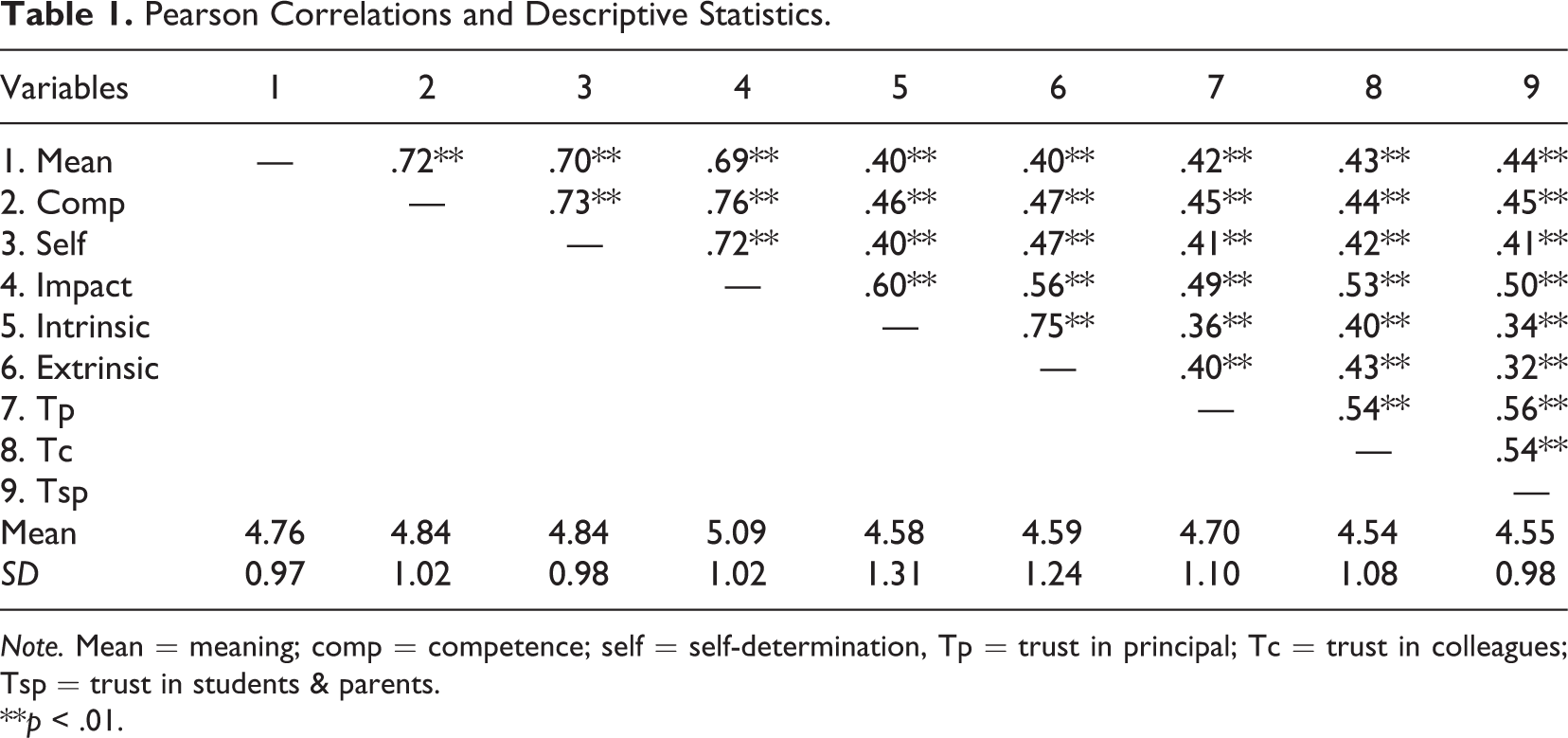
Note. Mean = meaning; comp = competence; self = self-determination, Tp = trust in principal; Tc = trust in colleagues; Tsp = trust in students & parents.
**p < .01.
To make further analysis of the relations between different variables of the study, SEM analysis for latent variables using AMOS 20 program was run. In the theoretical model given in Figure 1, psychological empowerment and trust were regarded as predictors of job satisfaction. Also, the role of trust in predicting job satisfaction was indirectly tested through psychological empowerment. Results indicated that the model had acceptable fit to the collected data, χ2(24, 217) = 40.89, TLI = .97, GFI = .95, AGFI = .92, CFI = .95, IFI = .98, RMSEA = .057, and χ2/df = 1.70. As it is shown in Figure 1, the analysis of model revealed significant direct relationship between psychological empowerment and job satisfaction (.48); however, the relationship between trust and job satisfaction was not significant (.24). Further analysis of the model indicated that trust indirectly related to job satisfaction through psychological empowerment. Looking at Table 1, it was shown that subscales of trust (Trust in Principal, Trust in Colleagues, and Trust in Students and Parents) were significantly correlated with Extrinsic and Intrinsic as subscales of job satisfaction. However, results of SEM analysis given in Figure 1 revealed no significant correlation between two scales. Likewise, the correlation between trust and psychological empowerment in the model was stronger than the one given in Table 1. These differences might be related to the measurement errors that SEM analysis handles more efficiently.
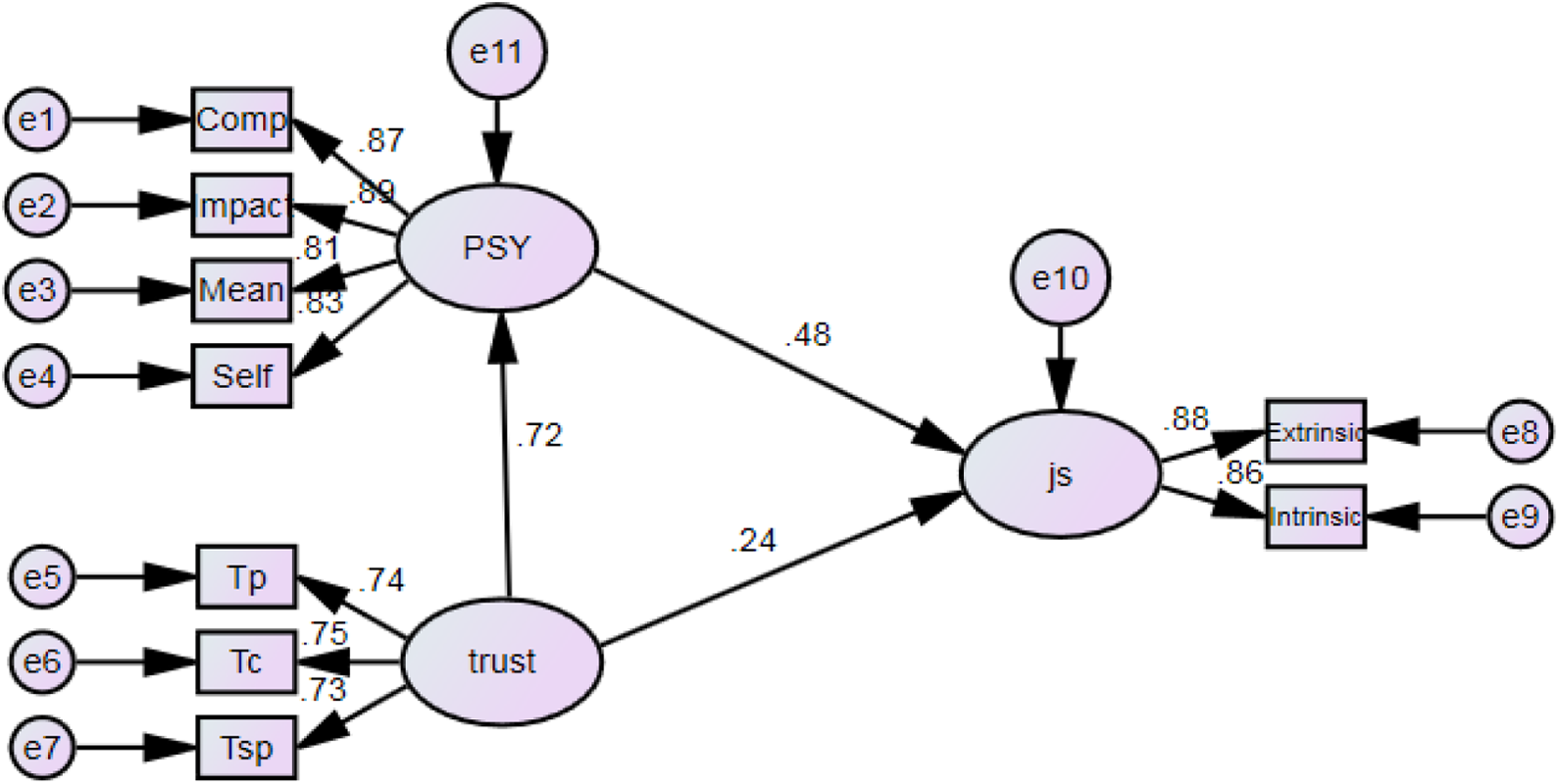
Structural model for the relations between psychological empowerment, trust, and job satisfaction. PSY = psychological empowerment; js = job satisfaction; mean = meaning; comp = competence; self = self-determination; Tp = trust in principal; Tc = trust in colleagues; Tsp = trust in students & parents.
Assuming job satisfaction as a causing factor, a new model was devised to see the relative association (see Figure 2). In this theoretical model, job satisfaction was regarded as direct predictor of trust as well as direct and indirect predictor of psychological empowerment. Similar to the first model, results indicated that the model had acceptable fit to the collected data; χ2(24, 217) = 40.89, TLI = .97, GFI = .95, AGFI = .92, CFI = .98, IFI = .98, RMSEA = .057, and χ2/df = 1.70. As it is shown in Figure 2, the analysis of model revealed significant direct relationship between job satisfaction and trust (.59) as well as job satisfaction and psychological empowerment (.35). Results also indicated significant relationship between trust and psychological empowerment (.52). Further analysis of the model indicated that job satisfaction indirectly related to psychological empowerment through trust.
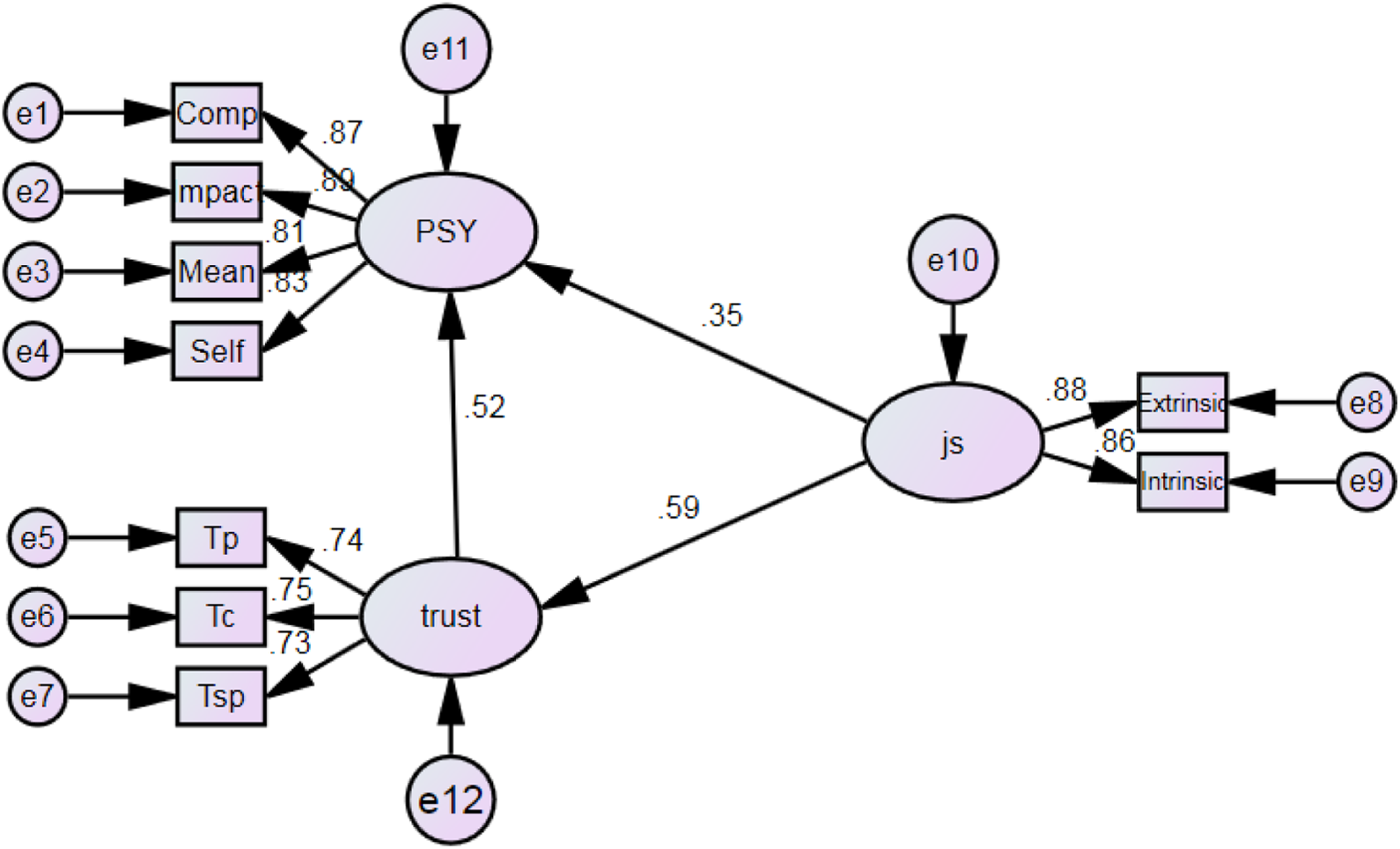
Structural model for the relations between job satisfaction, psychological empowerment, and trust. PSY = psychological empowerment; js = job satisfaction; mean = meaning; comp = competence; self = self-determination; Tp = trust in principal; Tc = trust in colleagues; Tsp = trust in students & parents.
Discussion
This study explored the relationship between trust, psychological empowerment, and Iranian EFL teachers’ job satisfaction. The underpinning hypothesis of this study predicted that the level of trust and psychological empowerment would be related to the level of job satisfaction. The primary analyses of correlations between subscales of three variables showed the strong relationships between them. Although initial premise of the study expected the stronger relationships between different subscales of psychological empowerment and trust with intrinsic job satisfaction, results indicated that subscales were correlated with both intrinsic and extrinsic job satisfaction.
SEM analysis of the structural model proposed for the relationship between psychological empowerment, trust, and job satisfaction confirmed that psychological empowerment dimensions could be effective in Iranian EFL job satisfaction (see Figure 1). Evans (1998) argued that psychological growth is at the heart of teachers’ job satisfaction. She stated that teachers would be satisfied whenever they would feel that they have contribution to the work improvement. So, managers need to know that in addition to the changes in organizational setting, technology, and physical setting, social factors such as human relations concerning the interpersonal relations and participative practices and quality of work life relating to promoting a favorable work environment that results in employee satisfaction, as noted by Cardy and Selvarajan (2001), could have potent association with teachers’ psychological empowerment, and hence with work outcomes. Therefore, ignoring these influential factors could potentially decrease teachers’ job satisfaction. Cerit (2009) reported that teachers participated in his study were not eager to act autonomously and participate in school decision-making processes. In contrast, however, this study indicated that Iranian EFL learners are encouraged autonomy and participation in making decision related to their teaching activities. This finding is corroborated the Blasé and Blasé’s (1996) findings. They emphasized the importance of different psychological empowerment dimensions that teachers identified with their job. Results of this study also strongly evidenced the significant role of psychological empowerment in relation to job satisfaction.
What the results of this study demonstrated in relation to the drastic role of intrinsic motivation factors in EFL teachers’ job satisfaction were also emphasized by Thomas and Velthouse (1990). They noted that intrinsically motivated people are not dependent on the supervisors’ presence or mediation of rewards, but they work flexibly, initiate new tasks, and pass over the obstacle in order to accomplish their goals. The strong direct relation of psychological empowerment and indirect association of trust with job satisfaction more ostensibly highlighted the important role of these two factors in Iranian secondary schools. Principals are the first authority of educational systems to which teachers can access. Therefore, through developing a sense of trust and involving teachers in making decisions about school, they can play an indisputable role in satisfying teachers. Edward, Green, and Lyons (2002) found out that happier and satisfied teachers in their profession were more empowered in their workplace. They suggested that principals are regarded as the important position for working toward fostering teachers’ empowerment and a safe climate in which they can work collaboratively and professionally. Principals can be a coordinator among teachers so that they can share their knowledge and use each other as reliable sources.
In contrast to the research hypothesis, trust as an important variable in relationships among teachers and their principal, colleagues, students, and parents did not correlate directly with job satisfaction. This may be related to the time and length of the relationship that EFL teachers have with the principal, colleagues, students, and parents in different secondary schools. Iranian EFL teachers must teach 24 hr a week so they usually teach in two or three schools every week. This limited relation may cause indirect effect of trust on job satisfaction and simultaneously make indirect correlate with job satisfaction through other factors. In this study, trust indirectly correlated with job satisfaction through psychological empowerment (.72). This strong relationship can be explained from social psychology perspective. Schlett and Ziegler (2014) reported that job satisfaction depends more on affection and less on cognition. However, Zalewska (2011) found out that though affective factors could have strong association with job satisfaction, cognitive–affective relationships contribute to better understanding of different forms of job satisfaction. When teachers trust in principals, colleagues, students, and parents, they tended to use their competence for impacting on the educational settings in which they are working. And, because of the trust, they feel free to engage in practicing innovative and applicable methods and procedures in classrooms. Creating such situations would help EFL teachers to be satisfied.
It can also be discussed that psychological empowerment could relate strongly to job satisfaction when EFL teachers trust in principals, colleagues, students, and parents. Therefore, different dimensions of psychological empowerment are settled through contextual factors such as trust. Even the autonomy that is given to teachers by managerial committee is related to the trust that teachers have in other members in educational settings. Understanding the role of trust in educational situations can enhance collaboration and cooperation.
Both empowering teachers and teachers’ trust in principals, colleagues, students, and parents involve risk taking. On one hand, engaging teachers in making decisions about schools and allowing them to work autonomously is regarded a risk for school management, and teachers’ willingness to trust in others is vulnerable, on the other hand. The end point of both may lead to job satisfaction or dissatisfaction. Findings of this study, however, revealed that if interpersonal trust appears to be present between members involved in managing schools and teachers, risk of empowering teachers could be minimized and presence of both empowerment and trust make satisfaction. Tschannen-Moran (2001) highlighted the importance of trust in establishing collaborative relationships. He suggested that collaboration and trust between teachers, parents, and principals are in line with the democratic aims of education. Tschannen-Moran (2001) argued that disappointing effects of collaboration between teachers, parents, and principals reported in the literature may derive from the fact that “teachers and parents have not felt that their participation was genuine” (p. 309). Principals, on the other hand, may assume that teachers and parents are not qualified and have not expertise to make joint decisions. However, Tschannen-Moran (2001) believed that engaging teachers and parents in decision-making processes when their opinions are productive and helpful produces beneficial outcomes.
As it was mentioned earlier, the primary concern of this study was to establish a model indicating the relationship between trust, psychological empowerment, and job satisfaction as the outcome variable. It was hypothesized that trust and psychological empowerment would directly relate to job satisfaction. However, the findings indicated that trust did not relate to the EFL teachers’ job satisfaction in Iran, but this variable indirectly and through psychological empowerment was related to job satisfaction. As it was expected psychological empowerment was directly related to job satisfaction.
In the second model, it was attempted to see whether job satisfaction can be a causing factor for psychological empowerment and trust. The outcome, as indicated in Figure 2, revealed interesting findings, that is, job satisfaction was significantly related to trust and psychological empowerment. It is an interesting finding since trust in the literature was mostly seen as a causing or mediating factor in relation to job satisfaction. So, findings of this study can add to the literature that trust can be both a constituting and constituted variable in educational settings and academic relationships. Satisfied teachers tend to establish a trusting relationship and environment with colleagues, principal, students, and parents. The model also confirmed that job satisfaction could have direct as well as indirect relationship with psychological empowerment. Indirect relationship through trust was stronger. It means that, in the case of assuming psychological empowerment as the outcome variable, trust could be the key factor.
Comparing results of two models, it can be concluded that in Iranian educational system trust is constituted through teachers’ satisfaction and, based on the findings, ignorance of teachers’ satisfaction might endanger trusting atmosphere in the Iranian educational settings, which can have critical consequences. It can also be concluded that psychological empowerment more strongly related to job satisfaction and it means that considering EFL teachers’ psychological empowerment need to be considered in priori. Of course, further studies are required to explore other factors related to job satisfaction through which trusting environment could be established to have happier and satisfied teachers.
The main contribution of this study in Iranian context is for educational ministry authorities and educational policy makers. They need to know that EFL teachers in Iran tended to be psychologically empowered and this tendency strengthened through trust in principal, colleagues, students, and parents. This means that unidirectional management of schools and dictating particular principles cannot lead to EFL teachers’ satisfaction. In fact, EFL teachers’ perspectives open up new horizons for defining job satisfaction in Iran. As it was discussed earlier, most of the rules passed in Iranian educational ministries tend to define job satisfaction from the financial and school properties points of view. Job satisfaction is tended to be defined based on the schools contextual factors and teachers’ income. Educational experts and inspectors are frequently emphasized on the lack of educational properties and suggest building new schools for improving educational outcomes. They believe that these are the main concerns of teachers and through establishing standard educational spaces, teachers will be satisfied and educational outcome will be improved. While results of this study revealed that teachers’ satisfaction might be achieved through contextual and physical factors, but psychological factors could have similar relations to teachers’ job satisfaction. These are among the factors that have assigned little significance in Iranian educational settings.
In sum, school principals and educational policy makers need to know that focusing solely on financial incentives is not sufficient for satisfying EFL teachers in Iran. Authorities in ministry of education should know that proving an environment full of trust, collaboration, autonomy, and healthy relationships is required for enhancing EFL teachers’ job satisfaction in secondary schools.
Limitations of the Study and Future Directions
Although in this study, it was attempted to shed light on some aspects of job satisfaction among Iranian secondary school EFL teachers, some limitations need to be taken into consideration. It should be noted that the findings of the study can only be generalized to the Iranian EFL teachers teaching at the secondary schools. To generalize findings of the study to high school level, further research needs to be conducted with a national representative sample of EFL teachers from high schools across different regions of the country. Through such a study, it can be realized what factors are more relevant to teachers’ job satisfaction in high school levels, and hence the similarities and differences of job satisfaction requirements across these two levels can be identified. Also, further research is required to focus on mediator variables between psychological empowerment, trust, and Iranian EFL teachers’ job satisfaction.
Footnotes
Declaration of Conflicting Interests
The author(s) declared no potential conflicts of interest with respect to the research, authorship, and/or publication of this article.
Funding
The author(s) received no financial support for the research, authorship, and/or publication of this article.