



Abstract
The goal of this study was to develop and test a theoretical model of Strategies for Coping with Career Indecision (SCCI). The proposed model consists of 14 categories that represent three major coping clusters—Productive coping, Support-seeking, and Nonproductive coping. The major concepts of the model were adopted from coping theories (Frydenberg & Lewis, 1993; Skinner, Edge, Altman, & Sherwood, 2003) and adapted to the context of career decision making. To test the proposed model, the SCCI questionnaire was developed and refined using data from 10 samples (N = 3,081). Study 1 reports the development of the SCCI and its psychometric properties using an additional sample of Israelis young adults deliberating about their career decisions (N = 460). Study 2a presents the results of a confirmatory factor analysis, based on American (N = 386) and Israeli (N = 819) samples of young adults. Study 2b tests the concurrent validity of the SCCI. The results from both the American and the Israeli samples supported the hypothesized distinction among the three major coping clusters; however, Support-seeking was associated partially with Productive coping and partially with Nonproductive coping. The implications for future research and career counseling are discussed.
Keywords
Career decisions are among the most important decisions individuals make throughout life (Lancaster, Rudolph, Perkins, & Patten, 1999). However, making such decisions is not only complex but also a stressful and confusing experience. Although some young adults make career decisions without any apparent problems, many others face difficulties during the decision-making process (Amir & Gati, 2006). Such difficulties can delay initiating the process, stop it in the middle, or lead to making a less than optimal decision (Gati, Krausz, & Osipow, 1996). Several studies have focused on various aspects of career decision-making difficulties, such as cognitive, emotional, and personality-related aspects, and researchers have developed taxonomies and appropriate diagnostic instruments (e.g., Brown & Rector, 2008; Gati et al., 1996; Germeijs & De Boeck, 2003; Kelly & Lee, 2002; Saka, Gati, & Kelly, 2008). Indeed, understanding the sources of career indecision is important because it allows career counselors to better match their counseling strategies to the major sources of their clients’ decision-making problems and foster more effective coping with these difficulties (Brown & Rector, 2008; Germeijs & De Boeck, 2003).
Naturally, most young adults who encounter difficulties in making a career decision try to cope with these difficulties in one way or another. Some individuals are likely to feel paralyzed or anxious and may use ineffective coping strategies, such as escape-avoidance behaviors (Larson & Majors, 1998; O’Hare & Tamburri, 1986), whereas others are more likely to use problem-focused coping activities, such as planning, taking direct action, or seeking help. Indeed, coping strategies have been studied extensively in various contexts and much is known about coping methods that are seen as more or less useful (Compas, Connor-Smith, Saltzman, Thomsen, & Wadsworth, 2001; Skinner, Edge, Altman & Sherwood, 2003; Zeidner & Saklofske, 1996). However, researchers have argued that the use and effectiveness of coping strategies may vary depending upon the type of stressor involved (DeLongis & Holtzman, 2005; Lazarus & Folkman, 1984). When career indecision as a stressor is considered particularly, current research on coping with this stressor is limited. Therefore, a stress-specific, rather than a general measure of coping might facilitate an understanding of how individuals cope with career indecision. How young adults approach this problem is of vital interest to career counselors for helping their clients deal better with the challenge of making career decisions more effectively. Therefore, this research is aimed at developing and testing a career decision-specific theoretical model and a corresponding measure for assessing Strategies for Coping with Career Indecision (SCCI).
Making decisions can be stressful for several reasons. Individuals are worried not only about having to make a decision but about making the right decision and about the negative outcomes that may occur if the wrong decision is made (Frydenberg, 2008). Indeed, several studies have focused on the importance of coping effectively with the challenges involved in this process (Frydenberg, 2008; Janis & Mann, 1977; Mann, Burnett, Radford, & Ford, 1997).
Coping can be defined as behavioral or cognitive efforts to manage situations that are appraised as stressful (Lazarus & Folkman, 1984). Beyond this general definition, there is little consensus about the conceptualization, structure, and measurement of coping (Compas et al., 2001; Skinner et al., 2003). Coping strategies have often been categorized as one of the following: (a) problem-focused or approach coping, in which active steps are taken to resolve a specific stressful situation or reduce its effects on the individual (Billings & Moos, 1981; Lazarus & Folkman, 1984); (b) emotion-focused coping, involving strategies aimed at regulating affect (Lazarus & Folkman, 1984; Parker & Endler, 1996); (c) avoidant coping, involving cognitive, emotional, or behavioral efforts directed away from the stressor (Billings & Moos, 1981; Endler & Parker, 1990); and (d) support seeking (Frydenberg, 2008; Frydenberg & Lewis, 1993).
Skinner and her colleagues (2003) reviewed research on stress and coping and identified over 400 ways of coping. Based on this review, Skinner et al. proposed a motivational theory of coping, organizing coping responses commonly described in the literature into 12 categories of strategies that were developed to deal with a wide variety of threats. Six of these strategies (self-reliance/regulation, support seeking, problem solving, information seeking, accommodation, and negotiation) are considered to be adaptive responses to stress (Zimmer-Gembeck, Lees, & Skinner, 2011). These six strategies are often included in measures of active and approach-oriented coping, which are typically associated with positive outcomes following stressful events (Compas et al., 2001). The other six strategies (delegation, isolation, helplessness, escape, submission, and opposition) are typically associated with distress and have often been included in measures of maladaptive coping (see Skinner et al., 2003, for a review).
Although numerous studies have focused on discovering and assessing various career decision-making–related problems, there are fewer empirical studies that have addressed the ways individuals cope with such difficulties (see Larson, Heppner, Ham, & Dugan, 1988; Larson & Majors, 1998; Larson, Toulouse, Ngumba, Fitzpatrick, & Heppner, 1994; Lee, 2005; O’Hare & Beutell, 1987; O’Hare & Tamburri, 1986; Phillips & Strohmer, 1983). Some of these researchers have used questionnaires from the field of coping with job stress and adapted them to situations specific to making a career decision (e.g., O’Hare & Beutell, 1987; O’Hare & Tamburri, 1986). Other researchers (Larson et al., 1994, 1988; Larson & Majors, 1998) have developed and used the Coping with Career Indecision Scale (CCI), which focuses on people’s coping appraisals under career indecision and includes the following four areas: subjective career distress and obstacles (i.e., negative feelings about the pressures or obstacles in decision making), active problem solving (i.e., feelings about lack of knowledge and information to solve the problem), academic self-efficacy (i.e., lack of general academic ability), and career myths (i.e., beliefs about the importance of making a choice and deciding on a career right away). This scale was, however, developed to distinguish among subtypes of students undecided about their future career; furthermore, it does not distinguish the factors preventing the individual from reaching a decision (i.e., career myths and career obstacles) from the strategies people actually use to cope with such factors.
In sum, we did not find a comprehensive model for mapping and describing ways of coping with career indecision. Moreover, research in the field highlights the need for a multidimensional approach for organizing and mapping coping categories (Connor-Smith, Compas, Wadsworth, Thomsen, & Saltzman, 2000; Schwarzer & Schwarzer, 1996; Skinner et al., 2003). Thus, the goal of this research was to develop a comprehensive theoretical model of SCCI based on the research reviewed previously, and to empirically test it using the SCCI questionnaire, in which the various coping strategies are represented by appropriate statements.
The Proposed Model of SCCI
Based on a combination and adaptation of Skinner et al.’s (2003) and that of Frydenberg and Lewis (1993) models of coping with stress to coping with career indecision, the proposed model is divided into three major clusters of strategies, namely, Productive coping, Support-seeking, and Nonproductive coping, when each of these clusters further divided into more specific categories. The proposed model, with its three clusters and 14 specific categories, is shown in Figure 1. The three major clusters were adopted from Frydenberg and Lewis (1993) who found that different coping strategies can be grouped into three styles that represent functional and dysfunctional aspects of coping. The functional styles are direct attempts to deal with the problem, with or without reference to other people, while the dysfunctional styles involve the use of nonproductive strategies.
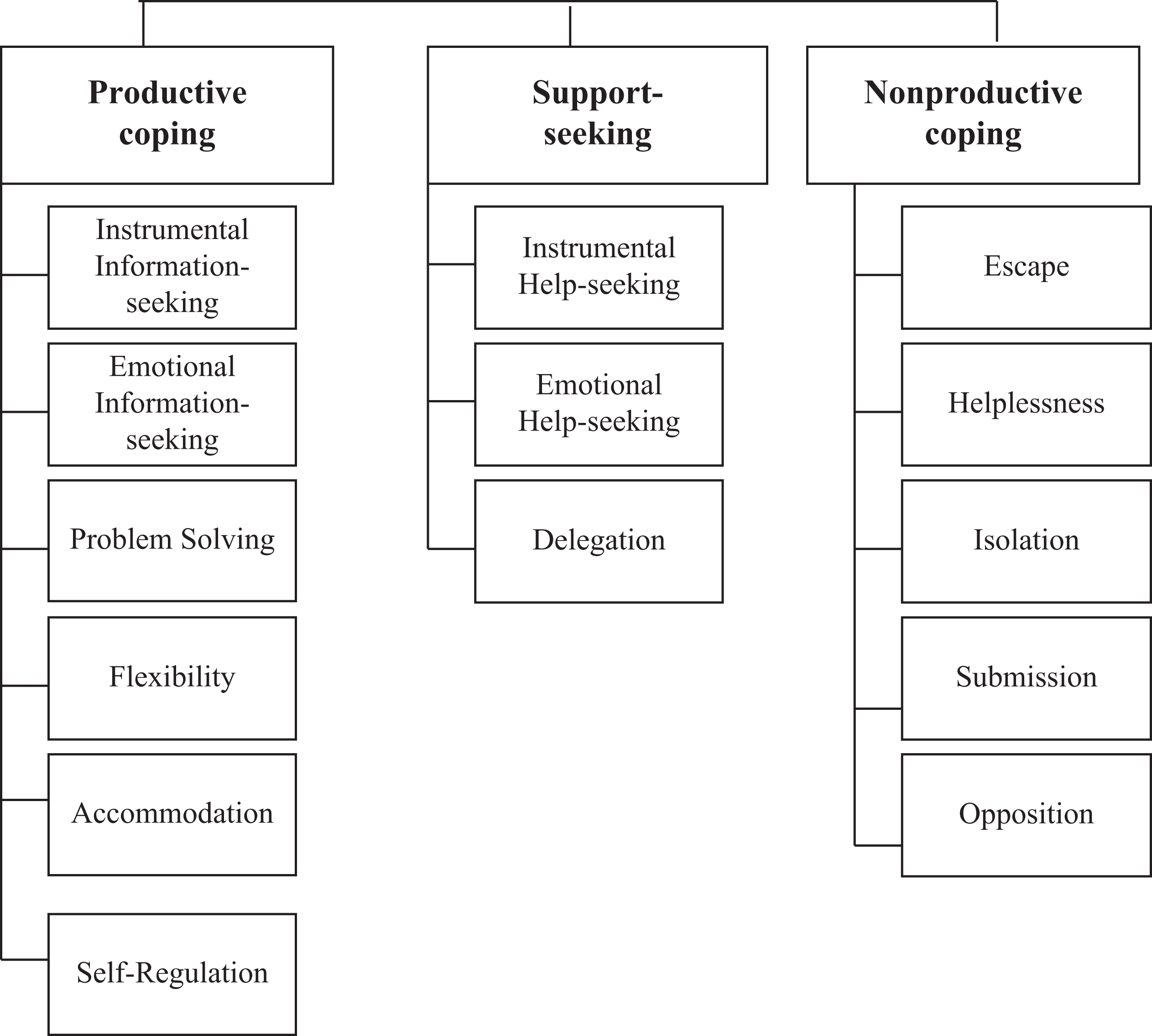
The model of strategies for coping with career indecision.
Twelve of the 14 coping strategies were adopted from Skinner et al.’s (2003) system. Skinner and her colleagues (2003) did not distinguish instrumental from emotional support-seeking behaviors, nor did they distinguish instrumental from emotional information-seeking, as they apparently assumed that these similar ways of coping are functionally equivalent. However, some researchers (e.g., Carver, Scheier, & Weintraub, 1989; Connor-Smith et al., 2000; Schwarzer & Schwarzer, 1996) have suggested that support seeking is a multidimensional construct in itself. For example, instrumental support assists in problem solving, whereas emotional support seeking may comfort the individual. In addition, a specific act of coping can serve different functions (Schwarzer & Schwarzer, 1996). For example, by seeking information a person can not only prepare for subsequent action or to solve a specific problem but also calm down and reduce stress. We therefore decided to distinguish these two functions and divide these two coping types (help seeking and information seeking) into two facets, namely, instrumental and emotional.
Productive Coping
The first major cluster, Productive coping, includes six categories of strategies that facilitate coping with career indecision, that is, (a) instrumental information-seeking, the active search for additional information relevant for making a career decision (e.g., I gather relevant and updated information about the occupations or careers I am interested in); (b) emotional information-seeking, the active search for information to reduce the uncertainty and anxiety involved in making a career decision, or to prepare oneself emotionally for making the decision (e.g., Searching for additional information about occupations helps me feel less stressed); (c) problem-solving, how much the individual invests in planning, analyzing the information systematically, and comparing the possible outcomes of the various alternatives (e.g., I weigh the alternatives I am considering in terms of their advantages and disadvantages); (d) flexibility, the extent to which the individual is willing to be flexible in his or her preferences and consider compromises in certain aspects or factors (e.g., I am willing to compromise on some of my preferences because I recognize the limitations of reality); (e) accommodation, the degree to which the individual finds a positive way of thinking about the challenge of making a career decision (e.g., I maintain a positive attitude toward the challenge of making a career decision); and (f) self-regulation, the extent to which the individual monitors and controls feelings and thoughts that impede making the decision (e.g., I am able to manage the concerns that make it harder for me to decide).
Support Seeking
The second major cluster, Support-seeking, includes three categories of strategies that involve others in coping with one’s career indecision, namely, (a) instrumental help-seeking, the degree to which the individual seeks others’ guidance, assistance, and advice to obtain instrumental tools for making the decision (e.g., I consult with others about the steps I should take to make my decision properly); (b) emotional help-seeking, the degree to which the individual seeks affective support and understanding from others to deal with the emotional consequences of career decision making such as anxiety, stress, worry, frustration (e.g., I ask others for help to alleviate my worries about the decision); and (c) delegation, the degree to which individuals ask others to make the decision or search for answers on their behalf, or shift responsibility to others (e.g., I ask other people to tell me which major, occupation, or career I should choose).
Nonproductive Coping
The third major cluster, Nonproductive coping, includes five categories of strategies that hinder coping with career indecision, that is, (a) escape, the individual’s intentional or unconscious attempts to get away from the process through cognitive or behavioral avoidance, denial, or wishful thinking (e.g., I find myself trying not to think about the decision I have to make); (b) helplessness, the individual’s feelings of being unable to do anything to advance the decision, including passivity, confusion, and pessimism (e.g., I feel helpless whenever I try to deal with the decision-making process); (c) isolation, the individual’s attempt to conceal their difficulties from others, and keep the feelings and worries associated with the decision to themselves (e.g., I do not want others to know how hard it is for me to cope with making a decision); (d) submission, the degree to which the individual focuses repetitively on the adverse or unpleasant features of career decision making, through rumination, rigid perseveration, intrusive thoughts, and worry (e.g., I constantly worry that my expectations for my chosen major or career will not be fulfilled); and (e) opposition, how much the individual blames others for making it harder to decide, or projects the causes of the difficulties onto them (e.g., I get annoyed by others around me because I feel they are making it harder for me to decide).
The Goals of the Present Research
The proposed model of SCCI was tested in two studies. In Study 1, we describe how the SCCI questionnaire was developed on the basis of 10 samples and then tested on an additional sample of Israeli young adults (N = 460) who were deliberating about their career choice. Next, Study 2a tests the SCCI using confirmatory factor analysis of data from an American sample (N = 386) and an additional Israeli sample of deliberating young adults (N = 819). Finally, Study 2b focuses on the concurrent validity of the SCCI, testing its associations with career decision status, level of decisional distress, and perceived decisional difficulties.
Study 1—Developing and Testing the SCCI Questionnaire
Study 1 focused on developing the SCCI questionnaire, which implements the proposed model. We empirically tested and refined it with 10 samples of individuals deliberating about making a career decision. We first describe the construction of the items and the scale and then report its psychometric properties and the results of cluster analyses of the scales and the items.
Questionnaire Construction
First, based on the above-mentioned theoretical definitions, as well as a review of the previous research on coping with stress and decision making, we created a preliminary list of 142 items for assessing specific SCCI (7–11 items for each of the 14 coping categories). Next, five graduate students in psychology and counseling were asked to classify the items into the three major clusters of the proposed theoretical model. The 46 items that were misclassified by three or more students were omitted. Then seven additional graduate students were presented with the definitions of the 14 coping strategies and were asked to classify the remaining 96 items into the 14 categories; 17 additional items were eliminated because they were classified into an incorrect category by four or more judges. The remaining 79 statements and an additional “warm-up” item (Choosing a major or career is among the things I have been thinking about recently) served as the basis for the first version of the questionnaire, which was uploaded to the Future Directions website (www.kivunim.com). Future Directions is a free, anonymous, noncommercial Israeli self-help site aimed at helping deliberating individuals make better career decisions.
We tested the first 79-item version of the questionnaire with a sample of 278 participants. The participants received individualized feedback describing their salient coping strategies and recommendations for ways of coping more effectively with the process. The feedback and recommendations were generated automatically and provided immediately after the questionnaire was completed. To test the psychometric properties of the questionnaire, we used various item-analysis methods, including factor and cluster analyses, item–scale versus item–other scale correlations, and the scales’ internal consistency reliabilities. About 20 items were eliminated from the first version on the basis of these analyses. This process was repeated for nine additional samples of young adults (with the number of participants ranging from 195 to 920; total N = 3,081). At each stage of refining the questionnaire, we revised items or eliminated the items that contributed least to each scale’s internal consistency reliability (17 items in total), until we had 3 items per category. In the following sections, we report the results based on an additional sample using the 10th version of the SCCI, with 45 items (3 items representing each of the 14 categories, one warm-up item, and two validity items).
Method
Participants
The participants were 460 young adults (aged 18–30) who filled out the 10th version of the SCCI, one of the assessments embedded in the Future Directions website, on their own initiative, in return for feedback describing their SCCI. The data of 72 additional individuals were excluded from the analyses because (a) they reported that they already knew what they wanted to study (n = 5; [see the details in Instruments]), (b) they filled out the SCCI in less than 180 seconds (n = 24), (c) their responses to the validity items were questionable (n = 25), (d) they reported that they had no difficulties in making a decision (i.e., indicated 1 or 2 on the 9-point Likert-type scale [see the details in Instruments]; n = 3), or (e) they reported a low level of stress (i.e., marked one or two on the 9-point Likert-type scale [see the details in Instruments]; n = 15). Of the 460 participants whose data were included in the analyses, 169 (36.7%) were men and 291 (63.3%) were women. The participants’ mean age was 22.8 (SD = 2.78) and mean years of education was 12.42 (SD = 1.32).
Instruments
Range of considered alternatives
The Range of Considered Alternatives (RCA) is a self-report measure that assesses how far individuals have narrowed down the range of occupational alternatives they are considering, reflecting their decision status (Gati, Kleiman, Saka, & Zakai, 2003). Specifically, participants are requested to choose one of the following statement which best describes their career decision status: (1) I do not even have a general direction; (2) I have only a general direction; (3) I am deliberating among a small number of specific occupations (majors); (4) I am considering a specific occupation (major), but would like to explore other options before I make my decision; (5) I know which occupation (major) I am interested in, but I would like to feel sure of my choice; or (6) I am already sure of the occupation (major) I want. The RCA has been found useful in measuring advancement toward a career decision (Saka et al., 2008) and assessing the effectiveness of career interventions (Gati et al., 2003). Those who marked Option 6, indicating that they are decided and not deliberating, were excluded from the analyses.
Perceived decisional difficulty and distress
To verify that the analyses are based on the responses of individuals who indeed had difficulty in making a career decision and felt stressed by the need to do so, we presented the participants with two questions. First, they were asked to report their degree of difficulty in making a career decision (How difficult is it for you to make a career decision?) on a 9-point Likert-type scale (1—not difficult at all, 9—very difficult). Second, they were asked to report their level of decisional distress (How stressful do you find the need to choose a major or a career?; 1—not stressful at all, 9—very stressful). Those who replied 1 and 2 to one or both of these questions were excluded from the analyses. Our final sample, therefore, includes only young adults who felt that they were coping with a stressful situation.
The SCCI questionnaire
The 10th version of the SCCI includes 45 items. The participants were asked to rate on a 9-point Likert-type scale the degree to which each item describes them (from 1—does not describe me at all to 9—describes me very well). The first item of the SCCI is a warm-up item: Choosing a major or career is among the things I have been thinking about recently. Two validity items were embedded in the questionnaire to ensure that individuals replied only after reading the items attentively and considering their responses (i.e., It is important for me to choose an occupation suited to my interests and abilities, It would not bother me if I chose an unsuitable occupation). The 45 items of the SCCI are listed in Appendix A.
Results and Discussion
The means, standard deviations, and Cronbach α internal consistency reliabilities of the 14 scales measuring the 14 coping strategies are presented in the left-hand side columns of Table 1. As can be seen, the reliabilities of the scales were adequate, considering the small number of items (3) per scale: The median Cronbach α was .83 (range .70–.90). The Cronbach α reliabilities of the three major clusters were high .86, .92, and .88, for Productive coping, Support-seeking, and Nonproductive coping, respectively. We then computed the correlations between each item and the 14 scale scores (with the item excluded from its scale score). The median of the 42 item–scale correlations was .70 (interquartile range .64–.75). The correlations between an item and its own scale were higher than the item’s correlation with another scale for all but 1 item; the only exception was item number 9 (from the problem-solving scale) whose correlation with its scale (.53) was similar to its correlation with the instrumental information-seeking scale (.54); both scales were in the Productive coping cluster.
Means, Standard Deviations, and Cronbach α Internal Consistency Reliabilities for the 14 Scales and the Three Clusters of the SCCI Questionnaire for the Israeli and American Samples.
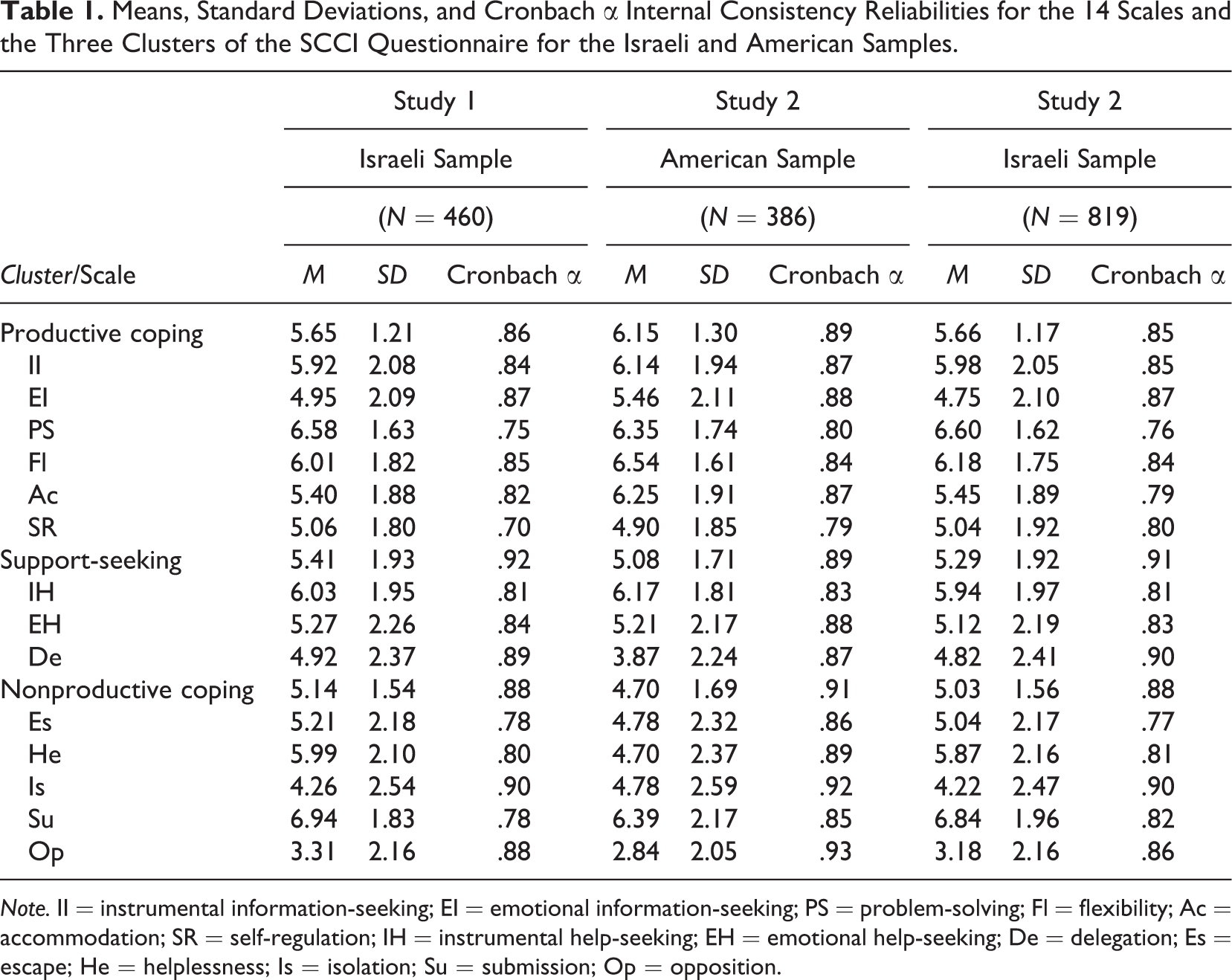
Note. II = instrumental information-seeking; EI = emotional information-seeking; PS = problem-solving; Fl = flexibility; Ac = accommodation; SR = self-regulation; IH = instrumental help-seeking; EH = emotional help-seeking; De = delegation; Es = escape; He = helplessness; Is = isolation; Su = submission; Op = opposition.
The matrix of intercorrelations among the 14 scales is presented in Table 2 (below the diagonal). The median of these correlations was .18 (interquartile range .03–.30), indicating that, in general, the 14 scales do indeed measure different constructs. However, the three scales of the Support-seeking cluster were highly correlated, namely, emotional help-seeking with instrumental help-seeking (r = .67) and with delegation (r = .73) and delegation with instrumental help-seeking (r = .59). This result is consistent with previous research (e.g., Carver et al., 1989; Walker, Smith, Garber, & Van Slyke, 1997), which found that the use of different types of support are often highly correlated. In addition, within the scales of the Productive coping cluster, there were a few high correlations, that is, problem-solving was highly correlated with instrumental information-seeking (r = .66) and self-regulation was highly correlated with accommodation (r = .56). As for the scales of Nonproductive coping cluster, helplessness was strongly associated with escape, isolation, and submission (.52, .50, and .58, respectively). These strong associations are not surprising in light of the conceptual meaning of the strategies. For example, as could be expected, helplessness (i.e., a set of actions organized around giving up or relinquishing control) was positively associated with the theoretically dysfunctional strategies (e.g., escape, isolation, and submission).
The Intercorrelations Among the 14 Scales of the SCCI Questionnaire in the Israeli (N = 460; below diagonal) and American (N = 386; above diagonal) Samples.
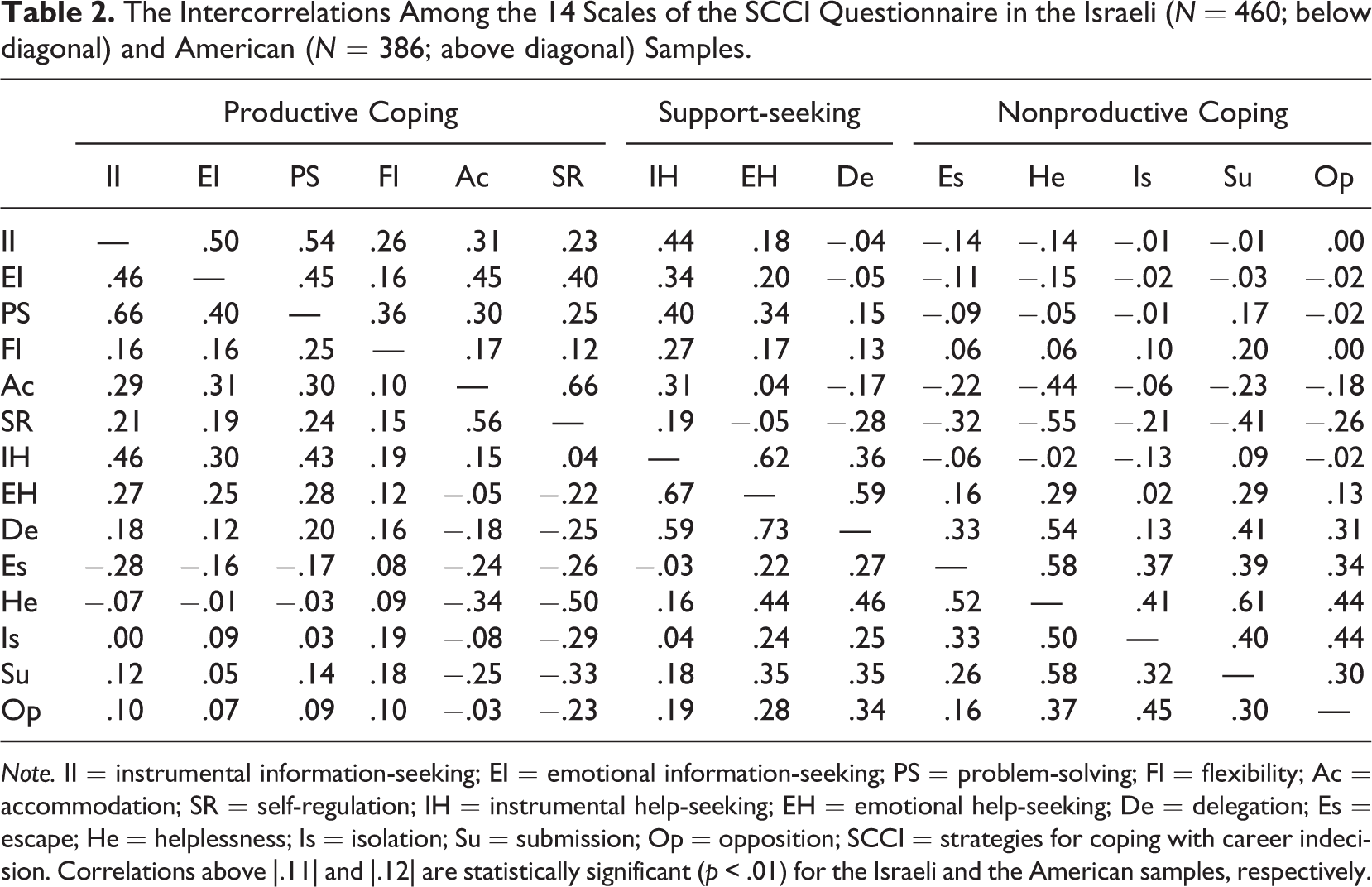
Note. II = instrumental information-seeking; EI = emotional information-seeking; PS = problem-solving; Fl = flexibility; Ac = accommodation; SR = self-regulation; IH = instrumental help-seeking; EH = emotional help-seeking; De = delegation; Es = escape; He = helplessness; Is = isolation; Su = submission; Op = opposition; SCCI = strategies for coping with career indecision. Correlations above |.11| and |.12| are statistically significant (p < .01) for the Israeli and the American samples, respectively.
To further explore the structure of the items and the scales, we carried out a cluster analysis on the intercorrelations among the 42 items using ADDTREE (Sattath & Tversky, 1977). This analysis made it possible to conduct an exploratory investigation of the empirical internal structure of the SCCI and create a visual display that would allow us to compare the structure with the proposed theoretical model. The clustering structure presented in Appendix B adequately summarizes the pattern of intercorrelations among the 42 items (the linearly accounted for variance was 85.9%). The result of the analysis is a hierarchical tree-shaped graph, where the variables are represented by the external nodes of the tree (i.e., the ends of the branches). In this clustering structure, the distance between any pair of variables is the length of the shortest path adjoining them. This scaling procedure is more robust and does not require such strong assumptions as Hierarchical Clustering or factor analysis (Sattath & Tversky, 1977). As can be seen in Appendix B, the 3 items that comprise each of 13 of the scales are clearly grouped into the expected cluster; however, Item 9, which represents the problem-solving strategy, was clustered with the three items of the instrumental information-seeking, which is an adjacent cluster, rather than with the other two items of problem-solving. We then analyzed the intercorrelations among the 14 scales. As can be seen in Figure 2a, the 14 scales are grouped into the three hypothesized major clusters, in accordance with the proposed theoretical model presented in Figure 1.
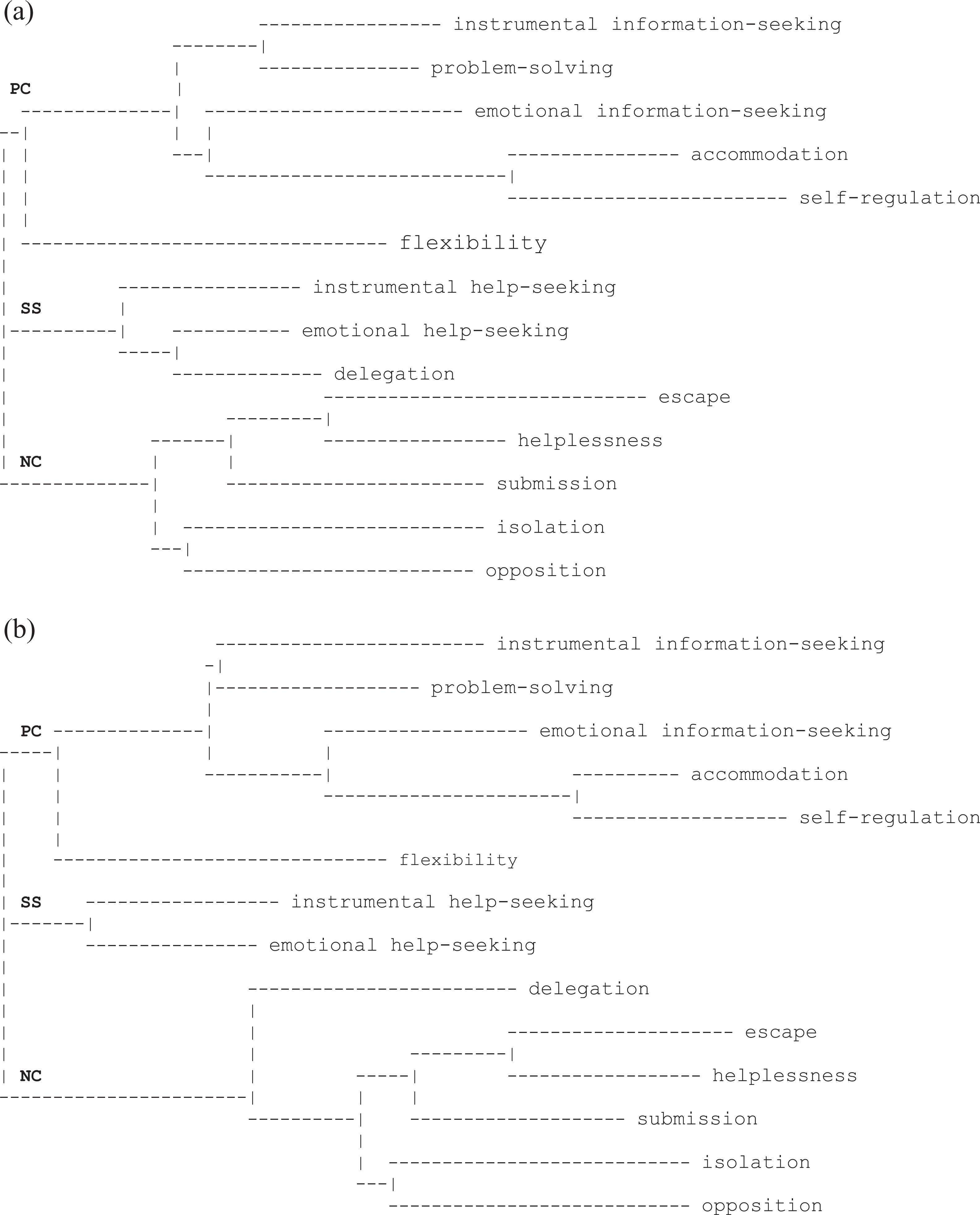
Cluster analysis of the 14 categories of the strategies for coping with career indecision (SCCI). (a). Israeli sample (N = 460; the linearly accounted for variance is 84.3%). (b). U.S. sample (N = 386; the linearly accounted for variance is 85.3%). PC = Productive coping; SS = Support-seeking; NC = Nonproductive coping.
In summary, we demonstrated that the SCCI has adequate psychometric properties, including good internal consistency reliabilities. In addition, the structure of the items and the scales was found to be highly compatible with the theoretical model. In Study 2a, we explored the structure of the SCCI by confirmatory factor analysis and in Study 2b we tested its concurrent validity.
Study 2a—Confirmatory Factor Analyses
The goals of this study were to test the hypothesized structure of the SCCI using confirmatory factor analysis by analyzing the responses of the two samples of young adults who filled out the English and Hebrew versions of the questionnaire, and to investigate the cross-cultural compatibility of the SCCI. We compared three models for the internal structure of the SCCI. The first model (labeled H: 42-14-3) represents the hypothesis that the 42 items can be clustered into 14 categories (scales) and that the 14 categories comprise three major clusters—Productive coping, Support-seeking, and Nonproductive coping. That is, the 14 first-level factors can be combined into three second-order factors. The second model (labeled A1: 42-14-2) represents an alternative hypothesis that the 42 items can be clustered into the 14 categories (scales) but that the 14 categories comprise only 2 major clusters, namely, Nonproductive and Productive coping, where delegation (from Support-seeking) can be regarded as a type of Nonproductive coping, while instrumental and emotional help-seeking (also from Support-seeking) can be regarded as types of Productive coping. The third model (labeled A2: 42-3) represents the hypothesis that the 42 items can be clustered into 3 major clusters (Productive coping, Support-seeking, and Nonproductive coping), but there is no benefit in organizing them into the 14 categories. We hypothesized that the 42-14-3 model, which corresponds to the theoretical model (Figure 1) and was supported by the cluster analysis in Study 1, would fit the data better than the alternative models.
Method
Participants
The American sample
The participants were 386 young adults (aged 18–30) who visited the www.cddq.org website (a free, anonymous, noncommercial self-help site, aimed at helping deliberating individuals make better career decisions) and filled out the fifth version of the English version of the SCCI on their own initiative, in return for feedback describing their SCCI. The data of the following individuals were excluded from the analyses because (a) they reported that were already certain about the field of study they would choose (n = 45), (b) they filled out the SCCI in less than 180 seconds, probably indicating that they answered without proper attention (n = 26), (c) their answers to the validity items showed that their responses were questionable (n = 35), (d) they reported that they did not find it at all difficult to make a career decision (their responses were 1 or 2 on the Perceived Decisional Difficulty question [see Study 1]; n = 14), or (e) they reported that making a career decision was not at all stressful (their responses were 1 or 2 on the Perceived Decisional Distress question [see Study 1]; n = 42). Of the 386 participants whose data were included in the analyses, 105 (27.2%) were men and 281 (72.8%) were women. The participants’ mean age was 23.73 (SD = 3.76) and mean years of education was 15.37 (SD = 2.40).
The Israeli sample
The participants were 819 young adults (aged 18–30) who filled out the SCCI on the Future Directions website, on their own initiative, in return for feedback describing their SCCI. The data of the following 145 individuals were excluded from the analyses because (a) they reported they already knew what they wanted to study (n = 9), (b) they filled out the SCCI in less than 180 seconds (n = 48), (c) their answers to the validity items showed that their responses were questionable (n = 50), (d) they reported they had no difficulties in making a decision (their responses were 1 or 2 on the Perceived Decisional Difficulty question, [see Study 1]; n = 6), or (e) they reported a low level of stress (their responses were 1 or 2 on the Perceived Decisional Distress question [see Study 1]; n = 32). Of the 819 participants whose data were included in the analyses, 304 (37.1%) were men and 515 (62.9%) were women. The participants’ mean age was 22.97 (SD = 3.04) and mean years of education was 12.51 (SD = 1.42), very similar to the characteristics of the Israeli sample in Study 1. However, the participants in the American sample were slightly older than those in the Israeli sample (M = 23.7 vs. 23.0, respectively; t [1203] = −3.76, p < .001, d = 0.22) and had more years of education (M = 15.4 vs. 12.5, respectively; t [1203] = −25.88, p < .001, d = 1.49).
Instruments
The SCCI questionnaire
The details of the Hebrew version of the SCCI are reported in the description of Study 1. The English version of the scale was based on the Hebrew version and verified by back-translation. The SCCI was first translated into English by an independent professional bilingual translator and then back-translated into Hebrew by another bilingual research team member. Finally, we made minor wording adjustments and created the final version of the SCCI. The English version of SCCI was first tested with an American Internet sample of young adults (N = 102). The items with the weakest psychometric properties were revised and refined, as in Study 1. This process was repeated with three additional samples of 116, 226, and 334 participants, respectively. In the following sections, we report the results based on the fifth English version of the SCCI.
Results and Discussion
Psychometric Properties of the SCCI
The means, standard deviations, and reliabilities of the English version of the SCCI are presented in the middle column of Table 1 and those of the Hebrew version are presented in the right-hand columns. As can be seen in Table 1, the internal consistency reliabilities of the 14 scales of the Hebrew version varied from .76 to .90, with a median of .83, similar to the reliabilities reported in Study 1. Furthermore, the Spearman rank-order correlation between the reliabilities across the 14 SCCI scales was .98 (p < .001), showing that those scales that had a higher Cronbach α in Study 1 were also those with a higher Cronbach α in Study 2a. In addition, the pattern of the intercorrelations among the 14 SCCI scales of the Hebrew sample in Study 1 was very similar to that of the Hebrew sample in Study 2a (r s = .98, p < .001). The internal consistency reliabilities of the 14 scales of the English version were slightly higher and ranged from .79 to .93, with a median of .87. The pattern of the Cronbach α reliability estimates of the English version was similar to that of the Hebrew version of the SCCI, as reflected in a Spearman rank-order correlation of .94 (p < .001) between the two sets of Cronbach α reliabilities across the 14 SCCI scales.
The Internal Structure of the English Version of the SCCI
We computed the correlations between each item and the 14 scale scores (with the item excluded from its own scale score). This analysis revealed that all items were more highly correlated with their own scale than with any other scale. The median of the 42 item-scale correlations was .75 (interquartile range .70–.79); the correlations between an item and any of the other scales were lower than .67.
The associations among the 14 coping categories, as reflected in the intercorrelations among the 14 scale scores, are presented in Table 2, above the diagonal. The median of these correlations was low—.16 (interquartile range –.04−.34). However, some pairs of scales were highly correlated, namely, instrumental information-seeking with problem-solving (.54); accommodation with self-regulation (.66); emotional help-seeking with both instrumental help-seeking (.62) and delegation (.59); and helplessness with escape, submission, delegation, and self-regulation (.58, .61, .54, and −.55, respectively). The pattern of the intercorrelations among the 14 scale scores of the English version was very similar to that of the Hebrew version of the SCCI, as reflected in a Spearman rank-order correlation of .93 (p < .001) between the two samples of Study 2a, across the 14 SCCI scales.
To explore the structure of the 14 strategies further, we carried out a cluster analysis on the intercorrelations among the 14 scales using ADDTREE (Sattath & Tversky, 1977). The empirical clustering structure of the 14 scales, presented in Figure 2b, adequately represents the pattern of intercorrelations among the 14 scales (the linearly accounted for variance is 85.3%). Generally, the structure of the scales corresponds with the proposed theoretical model, but one deviation from the original model emerged in the American sample: The delegation scale was included in the major cluster of Nonproductive coping instead of that of Support-seeking. One possible explanation for this deviation is that the American young adults, who were a year older and had more than 3 years of postsecondary education, were more aware of the dysfunctional nature of dependent help seeking than the Israeli sample. It is also possible that the American young adults live in a more individualistic culture that emphasizes personal achievement, independence, and autonomous help seeking rather than a dependent style of social support. In contrast, the Israeli cultural context is moderately collectivist (Scharf & Mayseless, 2010), with an emphasis on interdependence, family assistance, and community involvement.
Confirmatory Factor Analyses
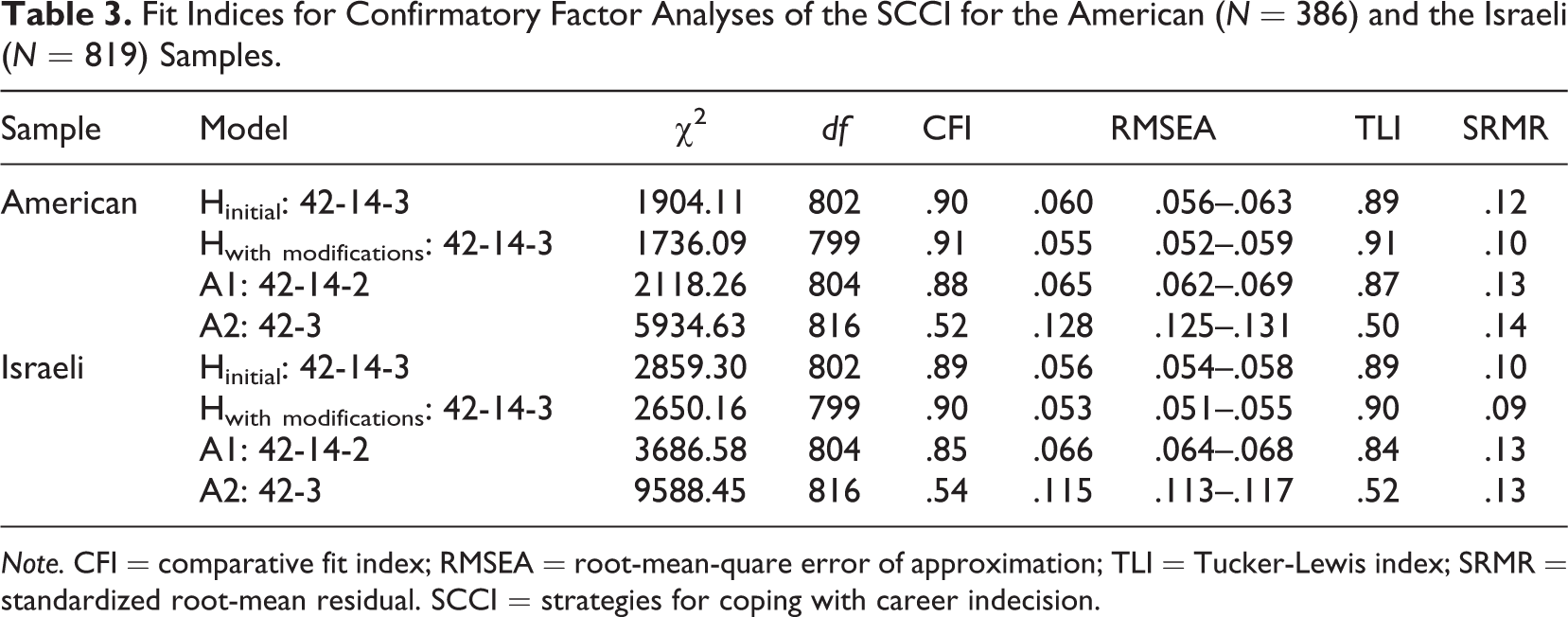
To test the hypothesis that the 42-14-3 model fits the data better than the alternative models, we carried out confirmatory factor analyses, whose results are summarized in Table 3. The top four rows summarize the analyses of the American sample, and the next four rows summarize the analyses of the Israeli sample. The models’ overall goodness of fit was evaluated with the following indices: (a) χ2 likelihood ratio statistic, (b) comparative fit index (CFI), (c) root mean square error of approximation (RMSEA), (d) the Tucker–Lewis index (TLI), and (e) standardized root mean residual (SRMR). A statistically insignificant χ2 suggests good fit, but χ2 is biased by large sample sizes, such as those in this study. CFI is less dependent on sample size, and values greater than .90 indicate an acceptable model fit (Hu & Bentler, 1995). Values of RMSEA equal to or less than .06 indicate a good fit (Hu & Bentler, 1999), but the RMSEA ignores the complexity of a model (i.e., a large number of estimated parameters) as is the case for the model tested in this study (42 observed variables, 14 first-order factors, and 3 second-order factors). The SRMR has also no penalty for model complexity and values of the SRMR less than. About 10 are generally considered favorable (Kline, 2005). TLI incorporates a correction for model complexity, and values greater than .90 indicate an acceptable fit (Bentler & Bonett, 1980).
Fit Indices for Confirmatory Factor Analyses of the SCCI for the American (N = 386) and the Israeli (N = 819) Samples.
Note. CFI = comparative fit index; RMSEA = root-mean-quare error of approximation; TLI = Tucker-Lewis index; SRMR = standardized root-mean residual. SCCI = strategies for coping with career indecision.
The American Sample
As can be seen in Table 3, the initially hypothesized 42-14-3 model fits the data better than either of the two alternative models (A1: 42-14-2 and A2: 42-3). This is reflected in the lowest χ2 (χ2 [802] = 1904.11, p < .001), χ2/df (2.37), RMSEA (.060), and SRMR (.12), and the highest CFI (.90) and TLI (.89). However, the overall fit of this model was still lower than desirable. To improve it, we examined the modification indices. We found that two first-order factors (i.e., delegation and emotional help-seeking) were positively associated with an additional second-order factor (Nonproductive coping) outside their original factor (Support-seeking). In addition, the instrumental help-seeking scale loaded positively on Productive coping, in addition to its predicted loading on Support-seeking. We therefore modified the initially hypothesized model by adding these three cross loadings.
As can be seen in Table 3, the goodness-of-fit statistics indicate that the modified model has a reasonable fit, considering its complexity (χ2 [799] = 1736.09, p < .001, RMSEA = .055, CFI = .91, TLI = .91, and SRMR = .10) and that this model fits the data significantly better than the initial hypothesized model, Δχ2 (3) = 168.02, p < .001. All 42 items (in the final model) had significant (p < .001) loadings on the 14 first-order categories (interquartile range .80–.87; median loading = .82). For Productive coping to instrumental information-seeking, emotional information-seeking, problem-solving, flexibility, accommodation and self-regulation, the standardized second-order loadings were .54, 64, .53, .25, .85, and .85, respectively. The loadings for Support-seeking to instrumental help-seeking, emotional help-seeking, and delegation were .72, .91, and .54, respectively. For Nonproductive coping to escape, helplessness, isolation, submission and opposition, the loadings were .66, .98, .48, .71, and .50, respectively. The loadings for Nonproductive coping to delegation and emotional help-seeking were .48 and .20. The loading for Productive coping to instrumental help-seeking was .34.
Low positive correlations were found between Support-seeking and Nonproductive coping (r = .21, p = .022) and between Support-seeking and Productive coping (r = .20, p = .027), while there was a highly negative correlation between Productive and Nonproductive coping (r = −.54, p < .001), as could be expected.
The Israeli Sample
As can be seen in the lower part of Table 3, the initially hypothesized H: 42-14-3 model fits the data better than either of the two alternative models (A1: 42-14-2 and A2: 42-3) for the Israeli sample as well. This is reflected in the lowest χ2 (χ2 [802] = 2859.30, p < .001), χ2/df (3.56), RMSEA (.056), and SRMR (.10), and the highest CFI (.89) and TLI (.89).To improve the overall fit of this model, we examined the modification indices. We found that, as in the American sample, delegation and emotional help-seeking load positively on both Support-seeking and Nonproductive coping, while instrumental help-seeking loads positively on both Productive coping and Support-seeking. We therefore modified the initial hypothesized model by adding these three additional cross loadings. The incorporation of these additional paths improved the model fit significantly (Δχ2 [3] = 209.14, p < .001); the fit indices of this model were χ2 [799] = 2650.16, p < .001, RMSEA = .053, CFI = .90, TLI = .90, and SRMR = .09. All 42 items in the modified model had significant (p < .001) loadings on the 14 first-order categories (interquartile range .73–.86; median loading = .80). For Productive coping to instrumental information-seeking, emotional information-seeking, problem-solving, flexibility, accommodation, and self-regulation, the standardized second-order loadings were .85, .52, .91, .32, .43, and .35, respectively. The loadings for Support-seeking to instrumental help-seeking, emotional help-seeking, and delegation were .80, .87, and .69, respectively. For Nonproductive coping to escape, helplessness, isolation, submission, and opposition, the loadings were .67, .92, .56, .65, and .56, respectively. The loadings for Nonproductive coping to delegation and emotional help-seeking were .39 and .30. The loading for Productive coping to instrumental help-seeking was .24.
Moderate to low correlations were found among the three major clusters, that is, r = .42 between Productive coping and Support-seeking, r = .20 between Support-seeking and Nonproductive coping, and r = −.13 (p = .004) between Productive and Nonproductive coping. These results show that the pattern of associations between the three major clusters support the claim that they tap different aspects of coping.
Tests of Measurement Invariance Across Samples
To test whether the hierarchical structure of the SCCI was equivalent across the American and Israeli samples, multiple group confirmatory factor analysis was performed. We first tested the configural invariance. In this model, the pattern of fixed and free factor loadings for the first- and second-order factor loadings was constrained to be same across groups, but different estimates were allowed for the corresponding parameters in the different groups. As recommended by Cheung and Rensvold (2002), the RMSEA (≤ .05), which is not affected by model complexity and is not sensitive to sample size, was used to indicate the configural model fit. This model then served as a baseline against which all subsequent models were compared. Traditionally, a change in chi-square (Δχ2) has been used to test the difference in fit between models; however, since this test is very sensitive to sample size and model complexity, Cheung and Rensvold (2002) proposed that a change in the CFI (ΔCFI ≤ .01) is a good indication of support for measurement invariance. The configural invariance model showed adequate data fit, χ2 (1598) = 4386.25, p < .001, CFI = .907, RMSEA = .038, 90% CI: [.037, .039]. We then tested its metric invariance by constraining the first- and second-order factor loadings to be equal across groups. The first-order factor loading invariance model displayed an overall good data fit, χ2 (1626) = 4442.43, p < .001, CFI = .906 (ΔCFI = .001), RMSEA = .038, 90% CI: [.037, .039]. These results indicate that the first-order factor loadings were equivalent across groups, based on the ΔCFI criterion. The first- and second-order factor loading invariance was then tested and again our results showed a good correspondence of the model to the data, χ2 (1643) = 4544.45, p < .000, CFI = .903 (ΔCFI = .003), RMSEA = .038, 90% CI: [.037, .040], indicating that the second-order factor loadings were invariant across groups, based on the ΔCFI criterion. Test of invariance of the second-order factor covariances was also supported, χ2 (1646) = 4548.43, p < .000, CFI = .903 (ΔCFI = .000), RMSEA = .038, 90% CI: [.037, .040], indicating that two groups have the same pattern of relationships among factors.
Cross-Cultural and Gender Comparisons
To test for cultural and gender differences, we carried out a two-way multivariate analysis of variance (MANOVA) with Gender (women vs. men) and Sample (American vs. Israeli) as the two between-subjects factors, and the 14 coping scale scores as the dependent variables. The results revealed no significant Sample × Gender interaction, Wilk’s Λ = .99, F(14, 1188) = 1.00, p = .449. However, the analysis did yield a significant main effect for Gender, Wilk’s Λ = .94, F(14, 1188) = 5.33, p < .001, η2 = .06 and for Sample, Wilk’s Λ = .82, F(14, 1188) = 18.10, p < .001, η2 = .18.
The results of the t test comparisons (with p < .003, after the Bonferroni correction) revealed gender differences in two coping categories. Women’s emotional help-seeking (M = 5.45, SD = 2.17) was higher than that of men (M = 4.57, SD = 2.09), t(1203) = 6.72, p < .001, d = .41), and women’s helplessness (M = 5.67, SD = 2.27) was higher than that of men (M = 5.15, SD = 2.29), t(1203) = 3.74, p < .001, d = .23.
Cross-cultural differences emerged in 7 of the 14 coping categories (after the Bonferroni correction was applied). As can be seen in Table 1, the American participants had higher scores on four coping categories, namely, emotional information-seeking, t(1203) = 5.50, p < .001, d = 0.32, flexibility, t(1203) = 3.47, p = .001, d = 0.20, accommodation, t(1203) = 6.88, p < .001, d = 0.40, and isolation, t(1203) = 3.67, p < .001, d = 0.21, whereas the Israeli participants had higher scores on delegation, t(1203) = 6.58, p < .001, d = 0.38, helplessness, t(1203) = 8.50, p < .001, d = 0.49, and submission, t(1203) = 3.59, p < .001, d = 0.21. These differences indicate that the participants in the two samples tend to employ different SCCI.
Study 2b—Concurrent Validity
To test the concurrent validity of the SCCI, we analyzed its associations with other career-related constructs—career decision status, perceived decisional difficulty, and perceived decisional distress. We tested the hypotheses that individuals who were undecided and those who expressed high degrees of difficulty and distress used more Nonproductive and fewer Productive coping strategies than those who were partially decided and those who expressed moderate degrees of difficulty and distress. We had no specific hypothesis regarding Support-seeking strategies.
Method
Participants and Data
We analyzed the data collected from the American and Israeli samples of Study 2a (N = 386 and 819, respectively).
Preliminary analyses
We assigned the participants to two groups according to their decision status, namely, Group 1 (undecided) included participants who did not yet have an occupational goal (Options 1 and 2) and Group 2 (partially decided) included participants who were considering a specific occupation but were not yet sure about it (Options 3, 4, and 5). The Israeli sample included 491 (60%) undecided and 328 partially decided participants; the American sample included 163 (42%) undecided and 223 partially decided participants.
Next, we divided the participants in each sample into two groups according to their reported degree of decisional difficulties. Participants with a high perceived degree of difficulty (i.e., those who replied 8 or 9) and those with moderate degree of difficulty (i.e., responses 3 to 7). Recall that we excluded from the analyses those who reported that they had no difficulties (1 or 2 on the 9-point scale). The Israeli sample included 502 (61%) participants with a high perceived degree of difficulty and 317 with a moderate degree of difficulty; the American sample included 169 (44%) participants with a high perceived degree of difficulty and 217 with a moderate degree of difficulty.
Then, we divided the participants into two groups according to their reported level of decisional distress, that is, those with a high level of distress (i.e., those who replied 8 or 9) and those with a moderate level of distress (i.e., responses 3 to 7). The Israeli sample included 477 (58%) participants with a high level of distress and 342 with a moderate level of distress; the American sample included 170 (44%) participants with a high level of distress and 216 with a moderate level of distress.
Differences between the samples
In addition to the greater age and number of years of education of the American sample (reported in Study 2a), the American sample included fewer undecided participants, χ2(1, 1205) = 33.21, p = .001, fewer participants with a high degree of difficulty, χ2(1, 1205) = 32.61, p < .001, and fewer participants with a high level of distress, χ2(1, 1205) = 21.28, p < .001.
Results and Discussion
First, we conducted a four-way MANOVA with Sample (Israeli vs. American), Decision Status (undecided vs. partially decided), perceived Decisional Difficulty (moderate vs. high), and perceived Decisional Distress (moderate vs. high) as independent variables and the three SCCI major cluster scores as the dependent variables. The results revealed significant main effects for Decision Status, Wilk’s Λ = .98, F(3, 1187) = 8.49, p < .001, η2 = .02, Decisional Difficulties, Wilk’s Λ = .99, F(3, 1187) = 4.08, p = .007, η2 = .01, Decisional Distress, Wilk’s Λ = .94, F(3, 1187) = 23.42, p < .001, η2 = .06, and Sample, Wilk’s Λ = .98, F(3, 1187) = 7.19, p < .001, η2 = .02. The Sample × Decision Status interaction effect was statistically significant but very small, Wilk’s Λ=.98, F(3, 1187) = 3.90, p = 009, η2 = .01. All other interaction effects were statistically nonsignificant (and all with η2 < .005).
Decision Status
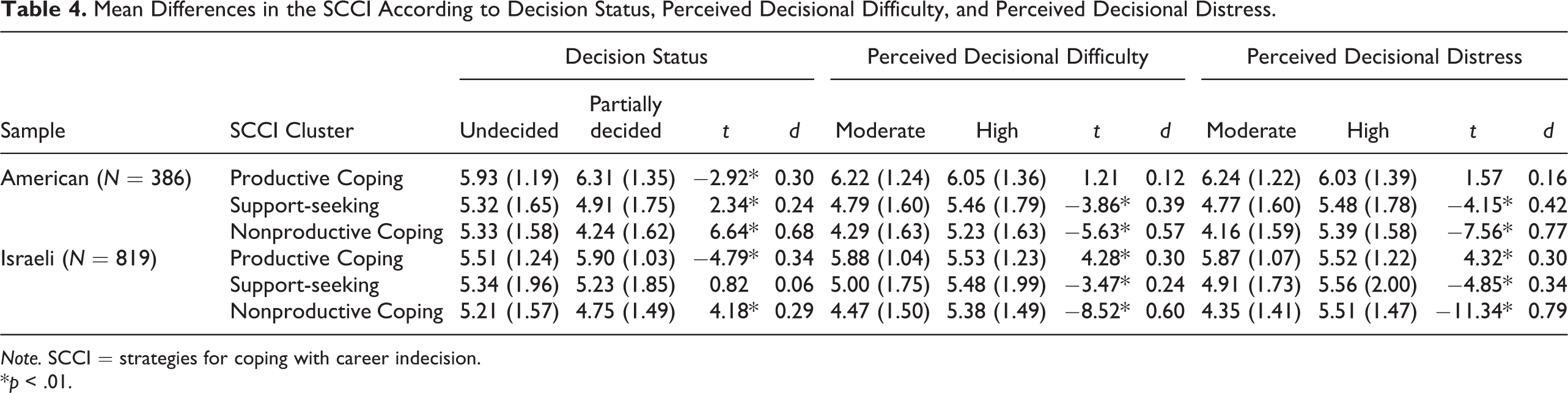
The left-hand side of Table 4 presents the means, standard deviations, the results of t-test analyses, and effect sizes of the differences between undecided and partially decided participants. As hypothesized, in both samples the undecided participants had higher Nonproductive coping scores and lower Productive coping scores than those who were partially decided. In addition, in both samples undecided participants sought support more than those who were partially decided, but this difference was statistically significant only in the American sample.
Mean Differences in the SCCI According to Decision Status, Perceived Decisional Difficulty, and Perceived Decisional Distress.
Note. SCCI = strategies for coping with career indecision.
*p < .01.
For the Sample × Decision Status interaction, the results of the analysis of variance indicated a significant effect only for Nonproductive Coping, F(1, 1204) = 9.99, p = .002, η2 = .008. Follow-up t-tests indicated that among undecided participants, there were no differences between the Israelis’ and the Americans’ use of Nonproductive coping strategies, t(652) = −0.86, p =.393, d = 0.07, whereas among partially decided participants the Israelis used Nonproductive coping strategies more than the Americans, t(549) = 3.86, p < .001, d = 0.33.
Perceived Decisional Difficulties
The middle columns of Table 4 present the differences between those with a moderate degree and those with a high degree of difficulty. In both samples, the participants with greater perceived difficulty had higher Nonproductive coping and Support-seeking scores than those with moderate difficulties. Although in both samples those with higher difficulty had lower Productive coping scores than those with moderate difficulty, this difference was statistically significant only in the Israeli sample (d = 0.30).
Perceived Decisional Distress
The right-hand side of Table 4 presents the differences between those with a moderate level and those with a high level of distress. As can be seen, in both samples, the participants with high level of distress had higher Nonproductive coping and Support-seeking scores than those with a moderate level of distress. While in both samples those with a high level of distress had lower Productive coping scores than those with a moderate level of distress, this difference was statistically significant only in the Israeli sample (d = 0.30).
Interestingly, across the six comparisons in Table 4, the mean effect size of the differences was much higher for the Nonproductive coping cluster scores (Md = 0.62, all six statistically significant difference) than for the Productive coping cluster scores (Md = 0.25, only three statistically significant). This difference in the effect sizes indicates that the use of Nonproductive coping strategies impedes career decision making to a greater degree than the use of Productive coping strategies facilitates it.
General Discussion
Due to the stressfulness of decision making, the ability to cope with stress is a core component of effective decision making (Frydenberg, 2008; Janis & Mann, 1977). However, career decision-making theories typically do not focus on the way individuals cope with the difficulties they face. The main goal of this study was thus to develop and empirically test a theoretical model of SCCI that were adopted from coping theory and adapted to career decision making. The proposed model consists of 14 categories that comprise three major coping styles—Productive coping, Support-seeking, and Nonproductive coping. To test the proposed model, we developed the SCCI questionnaire and tested it in two different social and cultural settings, that is, Israeli and American young adults deliberating about their future careers.
Generally, the analyses of the results for both the Hebrew and the English version of the SCCI supported the proposed model. However, these analyses revealed that in both samples delegation and emotional help-seeking were associated also with Nonproductive coping, whereas instrumental help-seeking was associated with Productive coping, in addition to their primary factor—Support-seeking. It seems that these three coping strategies serve multiple functions represented by the second-order factors, depending on the setting in which they are used (Lazarus & Folkman, 1984; Walker et al., 1997).
Previous research on coping has shown that dependent help seeking is not adaptive (Nadler, 1997; Newman, 2008; Skinner et al., 2003) because it means that individuals request assistance unnecessarily, without investing sufficient effort into resolving the problem on their own. Therefore, it is not surprising that delegation is associated with both Support-seeking and Nonproductive coping. In addition, the finding that instrumental help-seeking is associated with both Support-seeking and Productive coping is also consistent with previous research, which found that instrumental help seeking is often associated with task-focused coping (Tamres, Janicki, & Helgeson, 2002) and is effective for coping with many types of life events (Headey & Wearing, 1988).
Contrary to our expectations, emotional help-seeking was positively associated with both Support-seeking and Nonproductive coping. Indeed, the tendency to seek out emotional support may be either adaptive or maladaptive, depending on which other coping processes are being used (Carver et al., 1989; Zimmer-Gembeck & Skinner, 2008). On one hand, it is adaptive when one is reassured by obtaining this sort of support, as it can foster a return to problem-focused coping. On the other hand, emotional help-seeking can be maladaptive when used to focus on emotional distress and ruminate with others about difficulties and problems (Carver et al., 1989; Rose & Rudolph, 2006; Zimmer-Gembeck & Skinner, 2008). Future research may discover the situations when coping strategies associated with Support-seeking are adaptive and when they are not.
Moreover, in both samples flexibility had a low loading on the second-order factor (.32 in the Israeli sample and .25 in the American sample). This finding may indicate that this construct, which is associated with the willingness to compromise (Gati, 1993), may be more closely connected to one’s career decision-making style or profile (Gati, Landman, Davidovitch, Asulin-Peretz, & Gadassi, 2010) than to one’s ways of coping. Further research is needed to better understand the construct of flexibility and its associations with coping with career indecision and, if needed, make the relevant changes to this model.
Cultural differences between the two samples emerged in seven coping strategies. The Israeli sample scored higher on delegation, helplessness, and submission, whereas the American sample scored higher on emotional information-seeking, flexibility, accommodation, and isolation. These differences may be explained by differences in educational and sociocultural background. The Israeli sample included individuals who had not yet begun their postsecondary education, whereas the American sample included many individuals who had graduated from college or were about to graduate. Furthermore, Israeli young adults typically make their first major career decision after 2 or 3 years of mandatory military service and not in their second year of college, as most their American peers do. Moreover, many Israeli young adults take a year or two off after finishing their military service and work at temporary jobs to save money for a backpack trip of several months or even a year abroad (Scharf & Mayseless, 2010). These different personal experiences and sociocultural settings probably affect the young adults’ coping repertoire differently (Aldwin, 2004). Further research is needed to directly test how the sociocultural setting affects the coping repertoire of young adults with career indecision.
Gender differences emerged in two coping strategies—women’s scores were higher than men’s for emotional help-seeking and helplessness. These differences are compatible with findings from prior research on coping with stress, indicating that women profess less ability to cope and tend to seek social support more than men (Frydenberg & Lewis, 1999; Tamres et al., 2002). This finding can be explained by gender role socialization. Women are encouraged to turn to others for support during times of stress, whereas men are discouraged from seeking help and expressing feelings (especially problem-related feelings) because it is thought to signify weakness (Tamres et al., 2002). The finding that the women in our sample were more likely to report that they feel helpless in coping with career indecision warrants further consideration.
Finally, the preliminary concurrent validity evidence suggests that the SCCI is indicative of coping strategies. Specifically, the significant differences in the SCCI scores among individuals with different degrees of difficulties and different levels of distress, and between undecided and partially decided young adults, provide support for the scale’s validity.
Limitations and Future Research
There is a general consensus that the term “coping” refers to adaptively changing cognitive and behavioral efforts to manage psychological stress (e.g., Lazarus & Folkman, 1984). In our study, we did not investigate such changes. Cross-sectional methods provide only a static snapshot of a process that is dynamic and constantly in flux. Therefore, obtaining repeated assessments over a period of time in future research might allow us to start answering key questions about stress and coping over time.
Furthermore, not all undecided young adults experience the same sort of decision-making problems. Therefore, future research should aim at investigating which strategies are more effective than others for coping with specific difficulties. This can be done by finding associations between young adults’ sources of career indecision and their use of coping strategies. Coping effectiveness can also be investigated with longitudinal studies, using the individual’s advancement toward making a career decision as the criterion.
Another limitation involves the characteristics of our samples, which include only individuals who visited a career decision-related website on their own initiative. The participants were people who use the Internet to look for answers or for tools for solving their problems (Sagiv, 1999), and thus search actively for solutions. Therefore, it is important to extend the study and repeat the analyses with young adults, who have not yet begun their career decision making.
Future research should aim at providing additional support for the model and the SCCIs test–retest reliability and validity. This can be achieved by validating the SCCI with additional instruments that measure coping with career indecision (e.g., CCI, Larson et al., 1994), as well as other factors, such as career decision-making difficulties (CDDQ, Gati et al., 1996), emotional and personality-related career decision-making difficulties (EPCD, Saka et al., 2008), career decision self-efficacy (CDSE, Taylor & Betz, 1983), and career decision-making profiles (CDMP, Gati et al., 2010). More importantly, future research should test the predictive validity of the SCCI.
Counseling Implications
Career indecision leads many people to seek career counseling that requires counselors not only to understand the nature of their counselees’ indecision, but also to assess their repertoire of coping strategies, so as to provide recommendations for coping more effectively with these difficulties. The SCCI questionnaire fills a void, as it provides a new tool for assessing the way individuals cope with career indecision that complements other career decision-making measures (e.g., CDSE, Taylor & Betz, 1983; CDDQ, Gati et al., 1996, CDMP, Gati et al., 2010). Specifically, Phillips and Strohmer (1983) proposed that counselors designing interventions to assist individuals in their decision-making tasks should consider coping strategies as primary targets for change. We believe that the SCCI can provide career counselors with an initial diagnosis of how their counselees typically cope with the challenges of career decision making and make it easier to recommend ways of dealing more effectively with their difficulties.
Interestingly, we found that the inhibiting effect of using Nonproductive coping strategies was twice as large as the facilitating effect of using Productive coping strategies. Hence, if a counselee tends to use nonproductive coping methods such as self-blame, helplessness, or ruminative thinking, the counselor could discover them and initiate a discussion about whether or not they are helping the counselee regulate emotions and/or solve specific career problems. Thus, in addition to encouraging counselees to make use of productive coping strategies, counselors should provide their counselees with techniques for reducing the use of nonproductive ones.
Footnotes
Appendix A—List of items of the Strategies for Coping with Career Indecision questionnaire
Appendix B
Cluster analysis of the SCCI items (Israeli sample, N = 460; the linearly accounted for variance is 85.9%). The numbers represent the item’s location in the SCCI. PC = Productive coping; SS = Support-seeking; NC = Nonproductive coping.
Authors’ Notes
The authors thank Ruth Butler, Gali Rachel Cinamon, Nilly Mor, and Lilach Sagiv for fruitful discussions, and Naomi Goldblum, Shahar Hechtlinger, Dana Vertsberger, Nimrod Levin, Maya Perez, Michal Phillips-Bernstein, and Tirza Wilner for their helpful comments on an earlier version of this article.
Declaration of Conflicting Interests
The author(s) declared no potential conflicts of interest with respect to the research, authorship, and/or publication of this article.
Funding
The author(s) disclosed receipt of the following financial support for the research, authorship, and/or publication of this article: This research was supported by the Israel Science Foundation (Grant No. 380/12), the Samuel and Esther Melton Chair of the second author, and the Anna Lazarus Chair of the third author.