



Abstract
Character strengths are durable positive attributes that contribute to well-being in life and at work. They are also hypothesized to contribute to the growth and flourishing of individuals and organizations. However, their associations with work performance and counterproductive work behaviors have rarely been studied. The present study seeks to identify character strengths most highly associated with work performance and counterproductive work behaviors and explores the role of individuals’ sense of meaning at work and work orientation in mediating these associations. An international sample (N = 686) completed the measures of strengths endorsement, work performance, counterproductive work behaviors, sense of meaning at work, and work orientation. Results pointed to perseverance as most highly associated with work performance and most negatively associated with counterproductive work behaviors. These associations were mediated by working individuals’ sense of meaning at work and perceptions of work as a career and as a calling. These findings highlight the contribution of perseverance to work performance and counterproductive behaviors, beyond the role of other character strengths, and highlight work meaningfulness and work orientation as psychological mechanisms underlying its effects.
Keywords
“The brick walls are there to give us a chance to show how badly we want something.” “When things go wrong, don’t go with them.”
Introduction
Character strengths represent durable positive individual characteristics and are expressed through thoughts, feelings, and behaviors (Peterson & Seligman, 2004). They are hypothesized to facilitate the fulfillment and growth of individuals and the environments in which they flourish (Peterson & Seligman, 2004) and have been associated with several positive psychological conditions such as well-being (Seligman, 2011), positive affect (Littman-Ovadia & Lavy, 2012), and coping (Brooks, 2010). Character strengths are potentially relevant to various aspects of human lives (Peterson & Seligman, 2004), and in the present study, we focus on their relevance to work––a substantial area of human life, which provides vast opportunities for fulfilling individuals’ potential and for achieving a sense of purpose and meaning in life (Ryan & Deci, 2001).
The study of character strengths at the workplace is still in its initial stages, although some recent studies have addressed it (e.g., Forest et al., 2012; Littman-Ovadia & Steger, 2010; Peterson, Stephens, Park, Lee, & Seligman, 2010). A number of studies have linked strengths with positive experiences at the workplace (e.g., Harzer & Ruch, 2012; Peterson et al., 2010; Smith, 2011). Furthermore, some of these studies have identified specific strengths that best explain work satisfaction. For example, Peterson, Stephens, Park, Lee, and Seligman (2010) found that zest, hope, curiosity, gratitude, and spirituality are the strengths that best predict job satisfaction across diverse occupations, while in a study of adult employees from various occupations, Smith (2011) found that the strengths of zest, hope, and social intelligence are most highly associated with job satisfaction.
However, the effects of character strengths on actual work performance and counterproductive behaviors have rarely been studied (Engel, Westman, & Heller, 2012). Furthermore, character strengths comprise a wide array of individual characteristics (Peterson & Seligman, 2004), and the differential effects of specific strengths on individuals’ performance at work have only been examined in a handful of studies, most focusing on specific occupations. Peterson and Park (2006) briefly reported associations between teachers’ social intelligence and their students’ performance, and Lim and Kim (2014) found that restraint and interpersonal strengths predicted teachers’ personal teaching efficacy reports (whereas their intellectual and theological strengths did not). Engel, Westman, and Heller (2012) also provided support for positive effects of strengths on performance, but because they examined the specific link of signature strengths with work performance, it was not clear which strengths function as the source of these effects, as the configuration of signature strengths differs across individuals. So although there is initial evidence for the effects of strengths on work performance, and some indication of specific strengths driving these effects (e.g., zest was associated with fewer sick days ]Wrzesniewski, McCauley, Rozin, & Schwartz, 1997]), absent from the literature is a systematic examination of which specific strengths are the most important for work performance and counterproductive behaviors. In this study, we sought to identify the specific strengths driving the associations with work performance and work counterproductive behaviors.
Studies from the personality domain suggest that some personality dimensions are more critical to work performance than others. Specifically, upon examining the Big-Five personality traits, the strongest and most consistent (across diverse occupations) predictor of work performance was conscientiousness (Barrick & Mount, 1991).This association is likely due to associated characteristics of dependability, achievement orientation, and the tendency to be dutiful and responsible. Extraversion (the extent to which an individual is outgoing, energetic, joyful, and assertive) was linked to work performance only in jobs requiring interpersonal interaction, such as managerial positions (Judge, Bono, llies, & Gerhardt, 2002), and openness to experience (the extent to which an individual is imaginative and unconventional) was linked to career success only for jobs demanding creativity. Agreeableness, deemed advantageous because better work relationships, may facilitate better work performance and success (Seibert & Kraimer, 2001) and was found to be negatively associated with career success (Boudreau, Boswell, & Judge, 2001). This may be explained by the possibility that highly agreeable individuals may receive less responsibility as a result of being regarded as docile and easily manipulated.
Interestingly, the highest association between any character strength and a Big-Five personality dimension has been found between perseverance and conscientiousness (r = .66; Littman-Ovadia & Lavy, 2012), suggesting that perseverance may also be highly associated with the quality of work performance. Although, perseverance appears to be the most robust character strength that predicted academic achievement in middle school students and college students (Park & Peterson, 2009), there is no previous study that examined the effect of the strength of perseverance on work performance and counterproductive work behaviors. Thus, we hypothesized that:
A second issue requiring attention is identifying the potential mechanisms facilitating the effect of perseverance on work performance. In this study, we suggest that endorsing and using the personal strength of perseverance provide a sense of meaning and importance of work, which could function as the source of positive effect this strength has on work performance. This idea is based on a previous study, which showed that general strengths’ endorsement (not the endorsement of specific strengths) among employees was correlated with work meaning (defined as the sense that work is personally meaningful), which in turn was associated with job satisfaction (Littman-Ovadia & Steger, 2010).
Another indicator of workers’ feeling that their work is meaningful is work orientation, which can be defined as workers’ perceptions of their work as a job, a career, or a calling (Wrzesniewski et al., 1997). Associations between perceiving work as a calling (rather than as a job or as a career) and certain character strengths, as well as with work-related outcomes, have been suggested in previous studies (e.g., Elangovan, Pinder, & McLean, 2011), supporting the idea that work orientation may underlie the hypothesized link between perseverance and work performance. For example, Smith (2011) found that the strengths of self-regulation, zest, hope, love, honesty, and gratitude were associated with the perception of work as a calling. In turn, a greater sense of calling was related to various work outcomes, such as job satisfaction, career commitment, organizational commitment, and lower leaving intentions (Berg, Grant, & Johnson, 2010; Bunderson & Thompson, 2009; Duffy, Dik, & Steger, 2011; Peterson, Park, Hall, & Seligman, 2009; Wrzesniewski et al., 1997). Given that perceiving work as a calling is also associated with feeling that the work is meaningful (Dik & Duffy, 2009), we hypothesized that:
Method
Participants and Procedure
Participants were recruited over the Internet, through the Values in Action (VIA) website. Upon their completion of the VIA-120 Survey online, participants were invited to participate in a study of character strengths of working individuals. Interested participants were directed to a relevant consent form and then to an additional online questionnaire battery comprising a demographic questionnaire and the study measures, as described below.
The study’s sample comprised 686 working individuals (553 women, 133 men), that is, full-time hired employees (84.1%), part-time hired employees (4.5%), and self-employed (11.4%). Most participants held a university degree (82%), with the rest having postsecondary education (12%) and high school education (6%). Their mean age was 41.29 (SDage = 11.51). Most participants were living with a partner (48% married, 12.7% cohabiting), with a notable portion single (27%) or divorced (11.4%). About half of the participants (55.1%) had children. The international sample hailed from a wide variety of countries and continents. About half of the participants (56.7%) were from North America, 16.1% from Europe, 10.7% from the Far East, 9.2% from Australia, 4.3% from South America, and 3% were from Africa. The vast majority of participants were Caucasian (479), but the sample also included Latino (58), Asian (including Asian American/European, etc.; 58), and African participants (including African American/European, etc.; 31). Other participants reported various additional ethnicities (e.g., Native Americans, Arabs, and Pacific Islander) with very few participants (less than 1% of the sample) from each ethnicity.
Measures
Character strengths
The Values in Action Inventory of Strengths (VIA-IS; Peterson & Seligman, 2004) was used to assess participants’ character strengths’ endorsement. In the present study, we used a shortened version of 120 items (VIA-120; Littman-Ovadia & McGrath, in press), which comprises 5 items for each of the 24 strengths in the VIA classification. For example, creativity is measured by items such as “Being able to come up with new and different ideas is one of my strong points.” Ratings are recorded on a 5-point Likert-type scale ranging from 1 (not at all like me) to 5 (very much like me). Cronbach’s αs of VIA-120 scales are very similar to those of the original VIA-IS scales (mean α = .79 compared to mean α = .83; Littman-Ovadia & McGrath, in press). Validity coefficients of VIA-120 scales are very similar to those of the original VIA-IS scales (mean correlation of .39 to flourishing, compared to .43 in the original scales; mean correlations of .23 compared to .25 with life satisfaction; and mean correlations of –.22 compared to –.25 with depression; Littman-Ovadia & McGrath, in press). Internal consistencies of the 24 scales in the present study were satisfactory (Cronbach’s αs were .70–.88).
Work performance
Work performance was assessed with a self-report measure, following previous studies that have consistently confirmed the utility of such measures (see the meta-analysis of Gilboa, Shirom, Fried, & Cooper, 2008). Specifically, we used Williams and Anderson’s (1991) measure of In-role Behaviors, which comprises 7 items (e.g., “I adequately complete my assigned duties”), rated on a 5-point Likert-type scale ranging from 1 (strongly disagree) to 5 (strongly agree). In previous studies, Cronbach’s α for the scale was .93, and correlations with OCB-Organizational (OCB behaviors directed toward the organization as a whole) and OCB-Individuals (OCB behaviors directed toward other individuals at work) were .76 and .65, respectively (Turnley, Bolino, Lester, & Bloodgood, 2003). In the present study, the scale showed good internal consistency (Cronbach’s α = .86).
Counterproductive work behaviors
Counterproductive work behaviors were measured with the Counterproductive Work Behavior Checklist (CWB-C; Spector et al., 2006), which comprises 7 items describing counterproductive work behaviors that individuals can perform (e.g., “stayed home from work and said you were sick when you weren’t”). Items are rated on a 5-point Likert-type scale, indicating how often the behavior is performed, ranging from 1 (never) to 5 (every day). In the present study, the scale’s Cronbach’s α was .71. It should be noted that previous studies found high means similarity and high correlations between self-rated CWB-C measures (as the one used in this study) and coworker measures (Fox, Spector, Goh, & Bruursema, 2007).
Meaningful work
Meaningful work was assessed with the Meaningful Work Scale (MWS; Höge & Schnell, 2012). The scale comprises 6 items (e.g., “I experience my job as meaningful”), and participants’ agreement with each item is rated on a 5-point Likert-type scale ranging from 1 (not at all) to 5 (absolutely). The reliability of the English version of the MWS was high (Cronbach’s α = .93), and the correlations with life satisfaction, perceived supervisor behavior, work engagement, sense of calling, turnover intention, and relationships with colleagues were moderate to high, as expected for each construct (.33–.78; Boiman-Meshita, Littman-Ovadia, Lavy, & Schnell, in press). The scale showed good internal consistency in the present study (Cronbach’s α = .93)
Work orientation
Work orientation was measured with three distinct indices, based on The Work-Life Questionnaire (WLQ; Wrzesniewski et al., 1997). Specifically, participants were requested to rate the extent to which they perceive their work as a job, a career, and a calling. Responses to each question ranged from 1 (not at all) to 4 (very much). The three measures were somewhat correlated. Work as a job was negatively correlated with work as a career (r = –.15, p < .001), and with work as a calling (r = –.34, p < .001), and work as a career was positively correlated with work as a calling (r = .45, p < .001).
Results
Means and standard deviations of the study variables were in the expected range and are reported in Table 1.
Means and Standard Deviations of the Study Variables.

Associations Between Character Strengths and Work Performance/Counterproductive Work Behaviors
As a first step of examining Hypothesis 1, Pearson correlations between work performance/counterproductive work behaviors and all character strengths were assessed (Table 2). The results indicated that perseverance was the character strength with the highest, most significant association with both work-functioning measures. However, several other strengths also had highly significant associations with both work-functioning indices. A large portion of these associations (18 for work performance and 14 for counterproductive behaviors) remained significant even when applying the Bonferroni correction for the 48 correlation computations (which require p < .001).
Pearson’s Correlations of Character Strengths Endorsement With Work Performance and Counterproductive Behaviors.
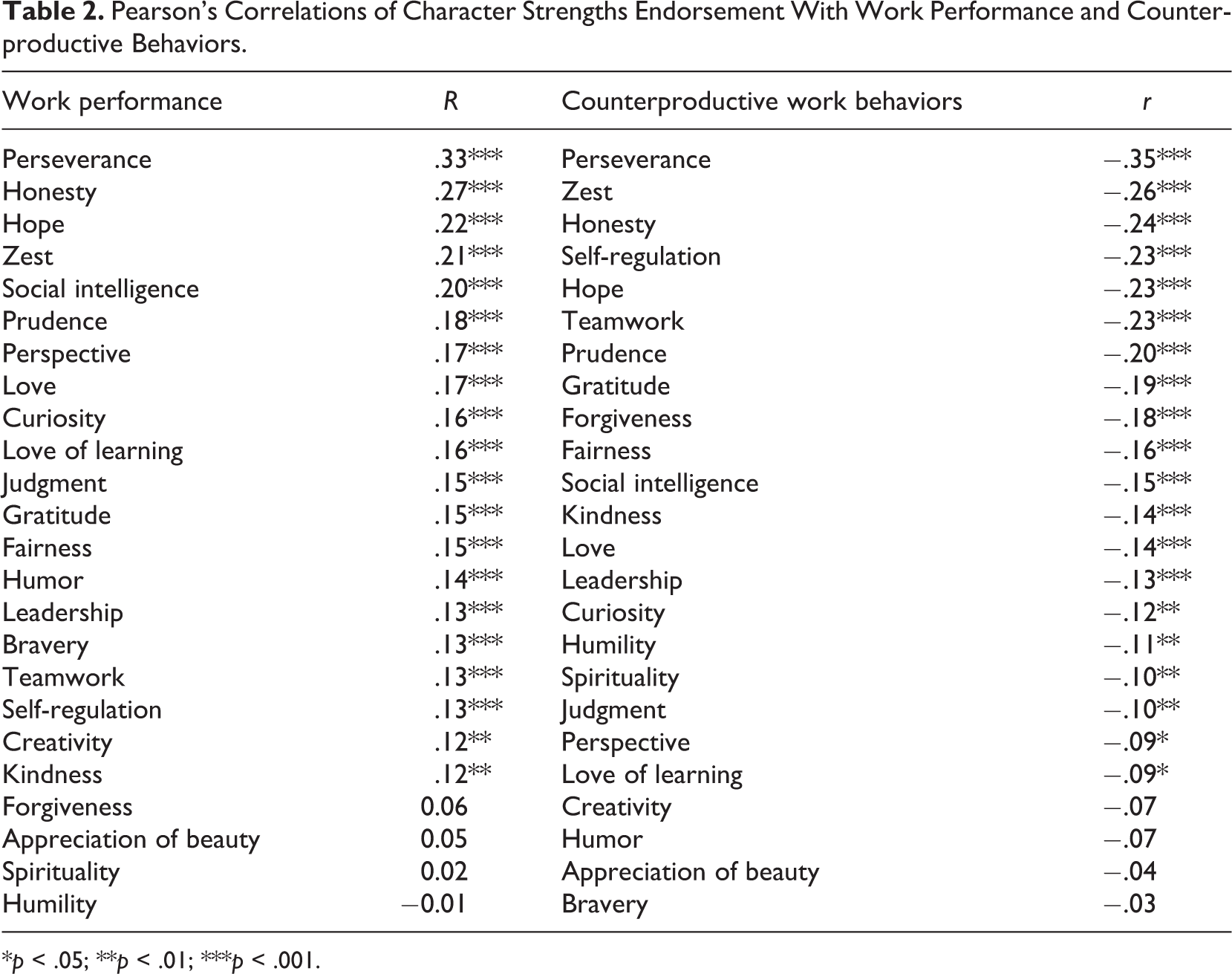
*p < .05; **p < .01; ***p < .001.
Thus, we conducted stepwise regression analyses, to further reveal the strengths that have the most salient unique contribution to explaining variance in work functioning; stepwise methods have been indicated as appropriate for this kind of exploratory analysis (Field, 2013, p. 323). This point requires some clarification. Stepwise regressions are usually considered the second best, and researchers usually try to avoid using them because they rely on the computer to select variables based purely on mathematical criteria and thus take “important methodological decisions out of the hands of the researcher” (Field, 2013, p. 323). However, they are still considered most appropriate for exploratory model building (Field, 2013, p. 323), exactly because they rely on the computer to make the decision, and choosing the most predictive set of variables based solely on mathematical considerations. The 24 strengths were entered as independent variables, and work performance (Table 3) and counterproductive work behaviors (Table 4) were entered as dependent variables, in two separate regressions. Results showed that perseverance constituted the highest and most significant contribution to explaining the variance of both dependent variables. Its contribution was maintained even when other significantly contributing variables were entered to the equations (Tables 3 and 4). Taken together, the results suggest that perseverance is most highly associated with work performance and most negatively associated with counterproductive work behaviors.
Stepwise Regression Coefficients Predicting Work Performance.

*p < .05; **p < .01; ***p < .001.
Stepwise Regression Coefficients Predicting Counterproductive Behaviors.

*p < .05; ***p < .001.
Mediating Mechanisms
In order to examine the role of work meaningfulness and work-centrality perceptions in mediating the effects of perseverance on work performance and counterproductive work behaviors (Hypothesis 2), we used the PROCESS code for SPSS 19 (Hayes, 2012, model 4; see Hayes, 2013 for details). This code enables using bias-corrected bootstrapping methods, which make no assumptions of normality (MacKinnon, Lockwood, & Williams, 2004) and which have been advised for this kind of examination (e.g., Fritz & MacKinnon, 2007). In the present analyses, we used 5,000 resamples. Specifically, we examined the role of meaningful work (Model 1), and the role of perceiving one’s work as a job (Model 2), a career (Model 3), and a calling (Model 4), in mediating the associations of perseverance with work performance (Table 5), and with counterproductive work behaviors (Table 6).
Mediation Models for the Associations of Perseverance With Work Performance, With Meaningful Work, and With Work Orientation Indices as Mediators.
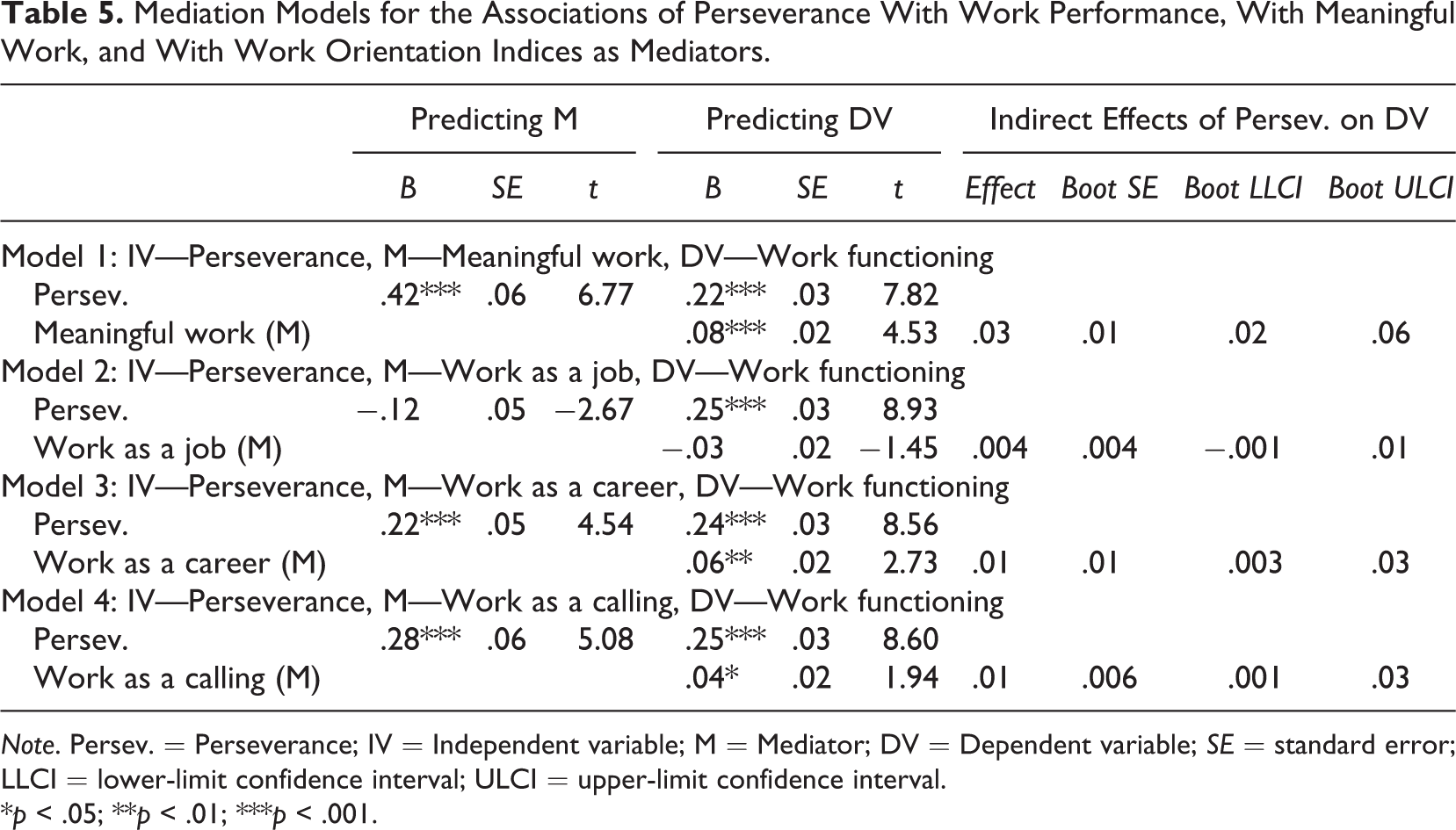
Note. Persev. = Perseverance; IV = Independent variable; M = Mediator; DV = Dependent variable; SE = standard error; LLCI = lower-limit confidence interval; ULCI = upper-limit confidence interval.
*p < .05; **p < .01; ***p < .001.
Mediation Models for the Associations of Perseverance With Counterproductive Work Behaviors, With Meaningful Work, and With Work Orientation Indices as Mediators.
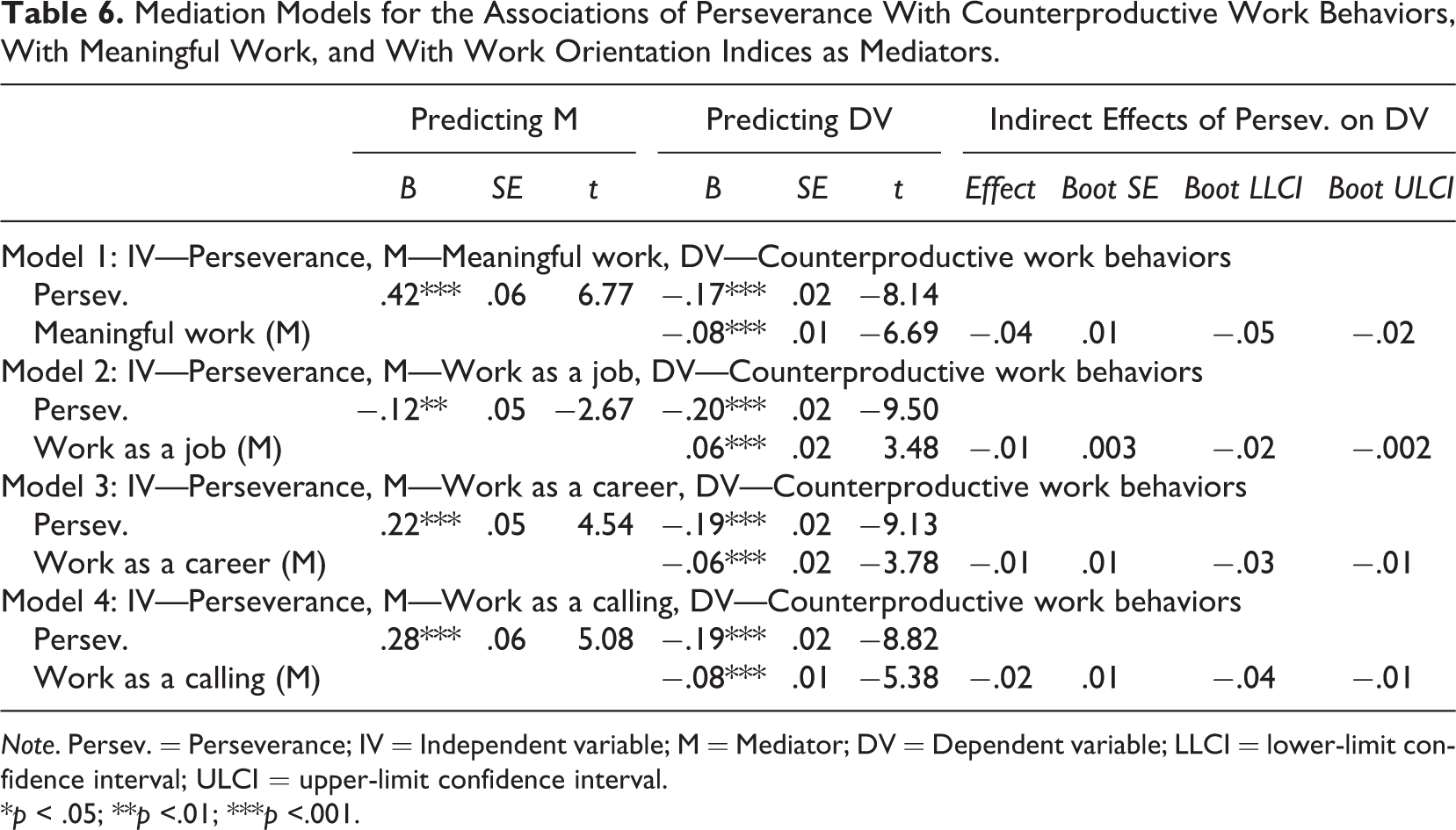
Note. Persev. = Perseverance; IV = Independent variable; M = Mediator; DV = Dependent variable; LLCI = lower-limit confidence interval; ULCI = upper-limit confidence interval.
*p < .05; **p <.01; ***p <.001.
The first set of analyses (Table 5) revealed three significant effects in mediation of the association between perseverance and work performance, showing that the confidence interval (CI) for the indirect effect did not include 0. In Models 1, 3, and 4, meaningful work, perceiving one’s work as a career, and perceiving one’s work as a calling mediated the association between perseverance and work performance (95% CIs were .02 and .06; .003 and .03; and .001 and .03, respectively). The mediation of perceiving one’s work as a job was not significant.
The second set of analyses (Table 6) revealed four significant effects in mediation of the association between perseverance and counterproductive work behaviors. Models 1, 2, 3, and 4 indicated that meaningful work, perceiving one’s work as a job, perceiving one’s work as a career, and perceiving one’s work as a calling mediated the association between perseverance and counterproductive work behaviors (95% CIs were [–.05, –.02]; [–.02, –.002]; [–.03, –.01]; and [–.04, –.01], respectively).
Taken together, the indirect effects analyses generally supported Hypothesis 2 and showed that work meaningfulness and orientation mediated the associations between perseverance and work-functioning measures.
Discussion
The present study explored as to which character strength is most positively associated with functioning at work and examined mechanisms through which this character strength affects work functioning. Findings pointed to perseverance as being a dominant predictor of work performance and counterproductive work behaviors. Findings also highlighted individuals’ sense of meaning at work, perceiving work as a career and as a calling as potential mediators of these associations.
Our finding that perseverance is a key indicator of work performance is congruent with findings based on the Big-Five model, which has provided a descriptive framework for much of the contemporary empirical work on traits predicting performance and success (Goldberg, 1990; John & Srivastava, 1999; McCrae & Costa, 1987). These findings showed that conscientiousness, which has been demonstrated as highly correlated with perseverance (Littman-Ovadia & Lavy, 2012), was essential to performance across different occupational domains. In a 1991 meta-analysis, Barrick and Mount concluded that conscientiousness related more robustly to work performance than did extraversion, openness to experience, neuroticism, or agreeableness (Barrick & Mount, 1991).
Another perspective on the role of perseverance in work outcomes draws from Duckworth, Peterson, Matthews, and Kelly (2007). They explored why most individuals make use of only a small part of their resources, whereas a few exceptional individuals push themselves to their limits. They presented grit as a key, positive trait, describing it as perseverance and passion for long-term goals. Their findings showed that grit was highly correlated with conscientiousness and demonstrated incremental predictive validity of success measures beyond IQ and conscientiousness. Their findings suggest that achieving challenging goals entails not only talent but also the sustained and focused application of talent over time. Perseverance, or grit, according to Duckworth et al. (2007) is a personal quality shared by the most prominent leaders in every field. Grit entails working strenuously toward challenges, maintaining effort and interest over years regardless of failure, adversity, and plateaus in progress. “The gritty individual approaches achievement as a marathon; his or her advantage is stamina. Whereas disappointment or boredom signals to others that it is time to change trajectory and cut losses, the gritty individual stays the course” (p. 1088). Furthermore, a prospective longitudinal study found that grit differentiated between effective and ineffective teachers (Duckworth, Quinn, & Seligman, 2009), potentially because it buffered against adversity generated by the rigors of teaching.
These ideas are also echoed in the mediation paths revealed in the present study. As hypothesized, work meaningfulness and centrality mediated the associations between perseverance and work functioning. It would seem that high-persevering workers not only invest more energy in a particular task at a given moment but do it with unvarying stamina over the course of years for pursuing their long-term goals. According to Duckworth et al. (2007), the key predictor of performance is a combination of working harder and longer without switching objectives. Therefore, the importance and centrality attributed to the work domain by highly persevering workers are the means by which they are able to “run a marathon” and achieve higher work performance and lower counterproductive work behaviors.
Limitations and Future Research
Although providing a novel link between the strength of perseverance and work functioning, this study suffers from some limitations. One limitation of this study is that all variables in the study were measured by self-reports, including the measures of work performance and counterproductive work behaviors. This means that the measures were susceptible to common method bias, social desirability, and even motivated efforts to exaggerate, at least to some extent (e.g., Frese, 1985). Although such self-report performance measures were highly similar (i.e., in the associations with other variables) to objective criteria and to supervisor reports (Gilboa et al., 2008), and self-reported counterproductive behaviors were highly associated with coworker reports of counterproductive behaviors (Fox et al., 2007), it would still be valuable to confirm the findings of the present study in other studies, using different measures of work-related behaviors and performance. A second potential limitation of this study is that approximately 30% of the participants’ native language was likely other than English, thereby possibly introducing some distortion in their responses. Finally, the cross-sectional nature of data collection does not allow for conclusions about causality: High performance may lead some workers to attribute it to their perseverance as well as high perseverant workers might believe that their work performance is higher. Studies that allow tests of causality, including measures of the development of work perseverance over time and additional measures of work performance, would be helpful in confirming the present results and their interpretations. Therefore, future studies should include additional measures of strengths and work performance (e.g., reports of partners, friends, and managers), longitudinal data and information about interventions targeting increased endorsement levels of perseverance and of the mediators (i.e., work meaning, work as a career or as a calling) and their effects on individuals’ work performance.
Practical Implications
Perseverance is considered a strength of courage, because it reflects the person’s quiet courage not to give up and continue to struggle, even in the face of difficulties and failure (Peterson & Seligman, 2004). In every occupation, job, and organization, perseverance may be as essential as talent to high performance and accomplishment. This conclusion has several practical implications. First, organizations should support workers who demonstrate exceptional commitment to a particular goal, task, or work role. Second, managers should encourage working not only with effort and intensity but also with passion, sense of meaning, purpose, and calling. Because these factors mediate the effects of perseverance, such action would be helpful in directing persistence in beneficial ways and gaining higher levels of functioning. Finally, counselors and educators should prepare youth to anticipate failures and misfortunes and point out that excellence in any discipline requires years and years of time on practice and encourage them to choose a career path which they would find meaningful. In some sense, the results of this study are optimistic because they point to motivational factors that can be developed and chosen as key to work functioning.
Footnotes
Acknowledgments
The authors would like to acknowledge the VIA Institute on Character for supporting this research project.
Declaration of Conflicting Interests
The author(s) declared no potential conflicts of interest with respect to the research, authorship, and/or publication of this article.
Funding
The author(s) received no financial support for the research, authorship, and/or publication of this article.