



Abstract
Youth are the future of a country and their workplace skills are vital for a society’s growth and development. Unattached youth, neither at school nor at employment, pose a great challenge to the society. This study examines the impact of certain factors on unattached youth workplace skill development. Using a group of 322 unattached Jamaican youth who were recruited by the Jamaican National Youth Service, this study investigates certain individual differences such as five personality factors (openness, conscientiousness, extraversion, agreeableness, and neuroticism), cognitive ability, and gender’s impact on workplace skills development among this group of Jamaican unattached youth using the multilevel modeling (MLM) analysis. The findings indicated that certain individual characteristics such as neuroticism and agreeableness have significant impact on their workplace skills development. Based on these results, career counseling and development should be considered to help unattached youth to develop their workplace skills to reach their potential.
Cognitive Ability and Personality as It Relates to Career Development
Ability and personality are two out of three (third, being interest) most studied constructs in relation to career development, specifically career choice, success, counseling, and assessments. According to Gottfredson (2003), “cognitive abilities are at least as important as vocational interests in career development” (p. 132) because of the construct’s ability to predict later job performance. Also, since cognitive abilities do not correlate highly with personality or interests, the intelligence construct provides valuable information that cannot be obtained through personality or interest inventories (Gottfredson, 2003). In further support of the importance of cognitive abilities, the gravitational hypothesis states that individuals will seek out employment that matches their cognitive abilities and the cognitive demands of the job. Therefore, individuals who have a lower level of general intelligence will gravitate toward jobs that are less cognitively demanding, while individuals with a higher level of general intelligence will gravitate toward jobs that are more cognitively demanding (Maltarich, Nyberg, & Reilly, 2010; McCormick, DeNisi, & Shaw, 1979). Lent, Brown, and Hackett’s (1994) Social Cognitive Career Theory (SCCT) suggested three areas of career development: self-efficacy, outcome expectations, and personal goals. Faulty self-efficacy beliefs or outcome expectations lead people to avoid certain career choices. The perceived higher level of barriers, the more likely an individual will avoid pursuing this certain area of career development and achieving goals (Lent, Brown, & Hackett, 1994). By providing proper counseling and training activities, clients will be able to reexamine their perceptions, reconsider their career choices, and gain a greater career success (Brown & Lent, 1996).
The big five personality factors are generally defined as neuroticism, extraversion, openness to experience, agreeableness, and conscientiousness (Costa & McCrae, 1992a). Judge, Higgins, Thoresen, and Barrick (1999) found that childhood and adulthood personality and cognitive abilities predicted career success over a period of 50 years. After accounting for general intelligence, high conscientiousness was predictive of career satisfaction, while low neuroticism, low agreeableness, high extraversion, high conscientiousness, and high cognitive ability were predictive of a prestigious or high status career. The five personality dimensions were also found to be significantly related to career decidedness, an adolescent career developmental task. In Lounsbury, Hutchens, and Loveland’s (2005) study, seniors in high school who scored low in neuroticism were more decisive in their career choices. Middle and high school student participants, who scored high on conscientiousness, openness, and agreeableness, also scored high on career decidedness. Previous literature has provided evidence that personality and cognitive abilities are related to various aspects of career development, but the authors were not able to find research relating personality and cognitive abilities to workplace skills development. This study fills the gap by investigating the relationship among gender, personality characteristics, general intelligence, and workplace skills among Jamaican youth.
Jamaican Unattached Youth
Youth unemployment is a main concern for developing and developed countries. According to Jamaica’s Ministry of Education, out of the 54,000 secondary students who graduated in 2007 … there were 38,000 (70%) students who were unemployed and not in the education system (Wilson, 2010). These students who were not in the labor force or in school are considered part of the unattached youth population. Officially, the Ministry of Education defines unattached youth as “young people between 15-24 who are not currently participating in formal education, technical/vocational training, the country’s National Youth Service Program and/or regular employment” (James-Wilson, 2005, p. 1).
Skilled workers in many countries are key to economic development and prosperity (Gray & Herr, 1998, p. 63); hence, the unattached youth population is of concern to Jamaica. A substantial portion of Jamaica’s population is not part of the workforce and may be too unskilled to positively affect the economy; therefore, research needs to examine factors that impact the skills development of the unattached youth. There are no prior studies that have researched these areas.
Current Study and Research Questions
The present study was designed to use longitudinal growth models to assess personality and certain individual differences on workplace skills in a sample of unattached youth in Jamaica. The intent of the current investigation was to provide an examination of the behavior and viability of certain growth-based approaches to measure the young research participants’ intake characteristics in relation to workplace skills development. The research questions are as follows: (a) Are the workplace skills related to certain individual characteristics such as the measured cognitive abilities and five personality factors (neuroticism, extraversion, openness to experience, agreeableness, and conscientiousness)? (b) Are the workplace skills related to selected group characteristics, such as gender? (c) To what degree do these factors impact individuals’ work skill change over time?
Longitudinal models of workplace skills growth better represent the time-dependent process of learning (Bryk & Raudenbush, 1988; Muthen & Curran, 1997; Seltzer, Choi, & Thum, 1998, 1999, 2000, 2003; Willett, 1988). Latent growth curve modeling (LGCM) became one of the important analytic methods for examining longitudinal data sets (Wu, West, & Taylor, 2009). Multilevel modeling (MLM) has been developed to examine the individual variation and growth over time, as well as group characteristics and treatment effects on individual growth. We will explore individual and group variations on the workplace skills of Jamaican unattached youth using the MLM frameworks in this study.
Method
Research Participants
Unattached youth in Jamaica were recruited by the Jamaican National Youth Service. The service notified all the youth about this research opportunity from all 13 parishes in Jamaica, which fully covers all the geographical areas in this country. There were 446 male and 305 female participants. The staff of this service interviewed each applicant to determine their eligibility. According to Fox (2004), the conservative estimates of unattached youth are about 140,000, about 29% of the total 480,000 youth population in Jamaica. The participants captured the population characteristics of unattached youth in Jamaica. Four waves of data were collected on the research participants during the first and the second year. This study researched 322 unattached youth that did not receive any career training or career educational program as a randomly selected group sample to study their workplace skills growth and the impacting factors on their workplace skills. The first test was conducted as soon as they were recruited. One month later, another testing was conducted. The third testing was in the sixth month and the final testing was conducted 1 year later. Because of the nature of the unattached youth, missing data did exist. Missing data were checked to see whether there was any missing data pattern. After checking through the missing data pattern, the data were missing at random except for two individuals’ data. These two individuals’ data were completely missing for the second, third, and fourth measurement periods. Thus, listwise deletion was used to delete these two individuals from the data list. Then full information maximum likelihood (FIML) was utilized to deal with the rest of the data with a few individuals missing information. A likelihood function for each individual was estimated by comparing two models, the unrestricted one and the specific one. Chi-square value was derived from the difference between these two models. All the data were used in this function. Furthermore, all analyses were based on the robust maximum likelihood statistics because of its ability to deal with missing data. “The FIML method uses all of the information of the observed data, including mean and variance for the missing portions of variables, given the observed portion(s) of other variables” (Wothke, 2000, p. 174). Therefore, FIML was used to estimate missing data. Table 1 displays the descriptive statistics regarding the sample with complete data information.
Descriptive Statistics of Shipley Scores, WSS T Scores, and Five Personality Factor Scores.

Note. WSS = Workplace Skills Surveys.
Instruments
Workplace skills
Workplace skills of the Jamaican youth were measured by the Workplace Skills Surveys (WSS), an instrument published by Industrial Psychology International (2000). The WSS short form (48 test items) measures whether adults and youth have the ability to “work effectively with others, understand time management techniques, interact with technology, show up for work, follow instructions, and demonstrate a host of non-technical skills that make the difference between success or failure on the job” (Workplace Skills Survey Manual, 2000, pp. 2–3). The WSS was administered in 20 min over four time points (August, September, March, and September of the second year) in a group format. Participants responded on a pull-apart WSS answer sheet that transfers their responses onto a scoring key. The scoring key provides a standardized T score for each participant. The WSS standardized T score has a mean score of 50 and standard deviation of 10. The maximum T score is 87 and the minimum is 1. The survey measures participant workplace skills in the areas of communication, adapting to change, problem solving, work ethics, technological literacy, and teamwork. The participants received a composite T score, representing their overall workplace skills. The Cronbach’s α reliability coefficient of WSS scores for current data is .86. The WSS was developed after several years testing on a statewide program on over 10,000 high school seniors and community college students; careful item analysis was used to establish test score’s reliability and validity. Both Kirnan (2007) and Sauser (2007) indicated the usefulness of the WSS.
Shipley scores
The Shipley-2 (Shipley, Gruber, Martin, & Klein, 2009), an updated version of Shipley Institute of Living Scale (SILS) test, was also administered to this group of Jamaican youth. The SILS, developed by Walter C. Shipley (1967), measures crystallized and fluid cognitive ability. It has two subscales: vocabulary and abstraction. SILS total scores were standardized in accordance with the age-referenced conversion table in the manual (Zachary, 1991). SILS has been used for more than 50 years to assess facets of intelligence and to establish its reliability and validity (Zachary, 1991). Several research studies provided support for SILS’ validity as a brief measure of intelligence (Martin, Blair, & Bledsoe, 1990; Watson et al., 1992). Research has also found that performance on the Shipley is significantly correlated with performance on the Wechsler Adult Intelligence Scale–Revised (Weiss & Schell, 1991; Zachary, Paulson, & Gorsuch, 1985). Concurrent, convergent, and divergent validity was also established as indicated by the research studies conducted by Naglieri and Bardos (1997) and by Lodge (2013). The Shipley-2 was used in this study with 40 vocabulary items measuring crystallized ability. To assess fluid ability, the new block patterns scale with 12 multiple-choice items were used. The composite score from Shipley-2 provides a brief and robust assessment of respondents’ overall cognitive ability. The Cronbach’s α for Shipley-2 is .89 from the current data set. The standardized Shipley cognitive ability scores were used as a predictor for WSS scores in the current study.
Five personality factors
The short form version of the Neuroticism-Extroversion-Openness–Five Factor Inventory (NEO-FFI; Costa & McCrae, 1992b) was used to measure the five personality dimensions among this group of Jamaican youth. Participants self-reported using a 60-item 5-point Likert-type scale (1 = strongly disagree; 5 = strongly agree). The NEO-FFI has been validated and used extensively in cross-cultural studies of both adolescents and adults (Bagby et al., 2007; Borman et al., 2006; McCrae et al., 2000). Hull, Beaujean, Worrell, and Verdisco (2010) examined the reliability and structural validity of the NEO-FFI scores at the item level in a larger sample of Jamaican young adults. The result indicated that there were some items in each of the five NEO-FFI personality domains that did not function well in the current sample. The Cronbach’s α is .61 for the data. Thus, 19 items that performed poorly were not examined in this study and only the remaining 41 items were retained in the current study as the five personality factor scores. The 41 items’ data resulted in a Cronbach’s α of .82.
Analyses
MLM techniques are very useful when examining data with sources of variability that are nested within one another. In this data set, time is nested within each participant, and participants nested within the group. Using MLM has great advantages over the classical multiple regressions. One of the assumptions when using multiple linear regression is that the residuals are independent and identically distributed. Such an assumption is violated because it is impossible for individual’s workplace skills development not to be related to one another over time. The time and group dependence is very likely for the individuals that belong to a given group. MLM also has advantages compared to the repeated measure ANOVA by not relying on the assumption of sphericity, and properly estimates standard error (Quene & Van den Bergh, 2004). So MLM techniques were utilized in this current study to examine the participants and group growth trajectories. It provided efficient estimation of individual growth trajectories by combining time series data with group information, thus providing estimated parameters for not only the participants but also the group growth rate. As Singer and Willett (2003) point out, the MLM model will help to answer two types of research questions: “level 1 questions about within-person change and level 2 questions about between-person differences in change” (p. 47). This two-level model in the current research study has time as Level 1 factor and individuals as Level 2. It examines certain factors’ impact on workplace skills change over time within each individual and between individual, capturing both the individual and group differences. It has advantages over the traditional multiple regression models on participating variance at different levels while taking both time and grouping level into consideration simultaneously.
Results
Unconditional Model (Model A)
This model provides information about how much variation in WSS T scores lies within and between individuals over time. The results indicated that the average workplace T score at the first measuring occasion was 41.92 (t = 95.75, p < .001) and participants were gaining an average 1.12 (t = 6.31, p < .001) per time during the study. Participants differ in their mean initial status of workplace T scores and growth rates.
The random effects showed that a significant variation existed among individuals in their WSS T scores at testing time zero. There was significant variation in participants’ growth rates. The covariance between τ00 and τ11 was −0.02 (p = .99). The intraclass correlation is an indication of the proportion of variance at the second level, and it can also be interpreted as the expected correlation between two randomly chosen individuals within the same group measure” (Hox, 2002, p. 42). It is a measure of effect size and power, which is similar to eta-squared. The interclass correlation for Model A is .63, which means 63 percent of variance in workplace skill T scores is between individuals. This also indicated the need to use the MLM approach instead of the traditional multiple regression approach.
Conditional Linear Model With Gender, Shipley and Personality as Covariates (Model B)
As the data analysis results shown in Table 2, the estimated mean intercept (β00) is 28.02, t = 4.79, p < .001, indicating there was a difference at participants’ initial workplace skills. Model B indicated the female and male participants have different starting points at their workplace T scores (β01 = −4.82, p < .001). This suggested, on average, female unattached youth score 4.82 lower than males in standardized T score of workplace skills. The 95% confidence interval gender fixed effect is from −6.57 to −3.06. Both females and males have similar growth patterns over time as indicated by the results. The Shipley score intercepts suggested the participants with different intelligence levels have different starting points at their workplace T scores (β02 = 0 .28, p < .001). This indicated youth with higher cognitive scores started at a slightly higher workplace skills level, or .28 standard unit, with a 95% CI level for Shipley fixed effect of [.21 to .35]. Among the five personality intercepts, neuroticism (β03 = 0.28, p = .02) has a negative impact on workplace T scores; the agreeableness intercept (β06 = −0.34, p = .004) also suggested that a one-unit increase on one’s agreeableness score would cause a .34 decrease of a standard unit for one’s WSS. The time slopes (β10 = 2.36, p = .35) showed overall participants’ workplace T scores did not change much over time. There were no interaction effects between predictors. About 21 percent more of the variance is explained in τ00 by adding gender, the Shipley cognitive scores, and the five personality scores as covariates into Model B compared with Model A.
MLM Workplace T Scores Models A and B.
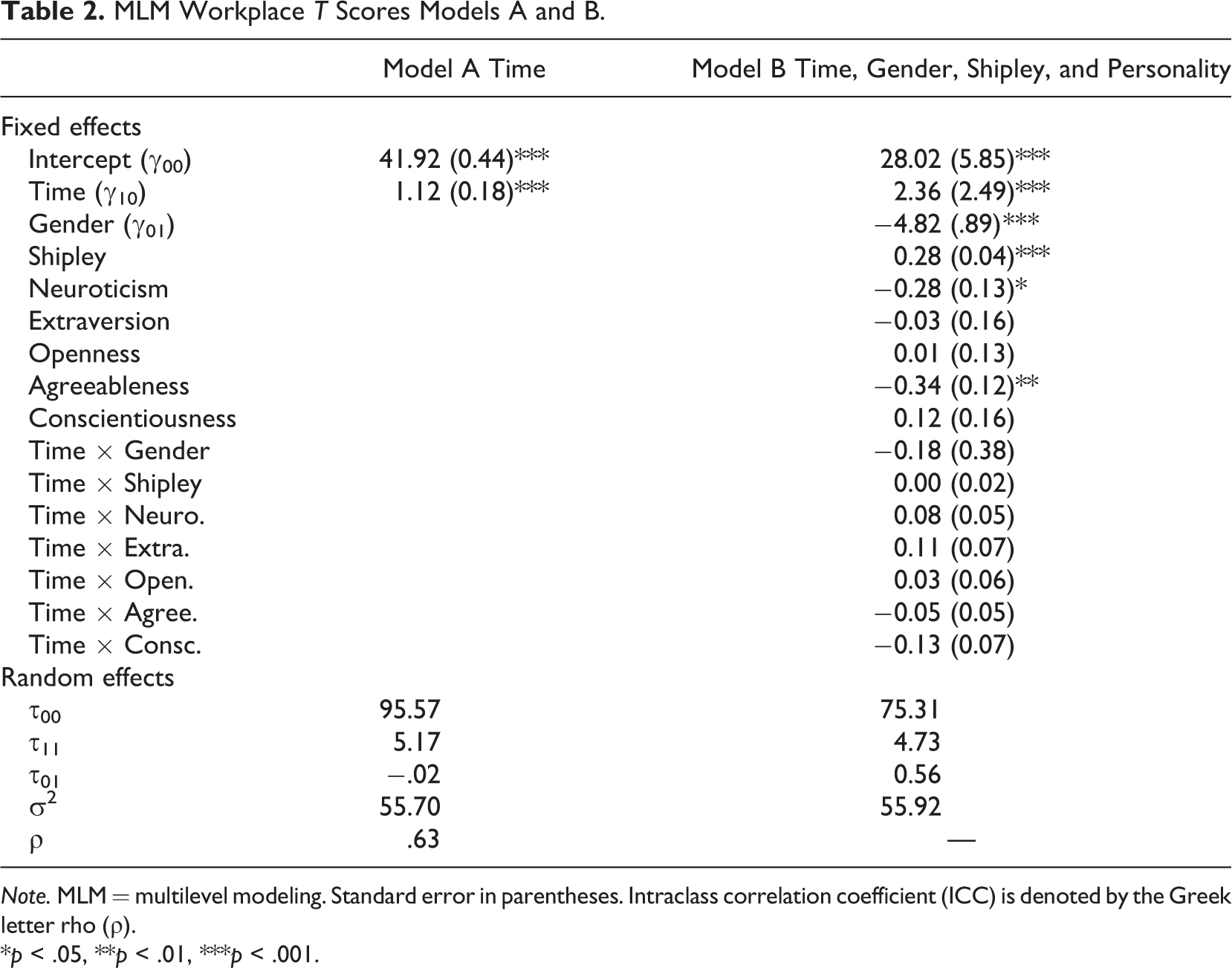
Note. MLM = multilevel modeling. Standard error in parentheses. Intraclass correlation coefficient (ICC) is denoted by the Greek letter rho (ρ).
*p < .05, **p < .01, ***p < .001.
Discussion
This research study is to examine what factors impact Jamaican unattached youth’s workplace skills. Unlike a traditional multiple regression approach, we applied LGCM using MLM, which accounted for within-individual and between-individual differences over time in workplace skills scores of unattached youth in Jamaica. Data analysis results suggest that the workplace skill estimates are related to gender, Shipley cognitive score, and certain personality factors such as agreeableness and neuroticism. As we can see from the model fit indices in MLM (Table 3), Model B’s fit indices were much smaller than the unconditional model A with neither predictors nor time differences. From the fixed effects and random effects, we notice Model B is a good model with useful predictors such as gender, cognitive abilities, and personality traits. In other words, gender, cognitive abilities, and personality traits played important roles in workplace skill development among this group of youth.
MLM Fit Indices, Model Comparison, and Summary.

Note. MLM = multilevel modeling; −2LL = −2 restricted log likelihoods, AIC = the Akaike information criterion, and BIC = Bayesian information criterion are measures of the relative quality of a statistical model for a given set of data. Given various models for the data, the optimal fitted model is the one with the minimum −2LL, AIC, and BIC values.
Workplace skills assessment scores were predicted by gender in these data. Male participants have a statistically significant higher workplace skills mean score than that of female participants. According to some longitudinal research studies, gender differences do exist. Lynn and Irwing (2004) conducted an intensive meta-analysis of 57 gender differences studies. The results indicated males have higher mean IQ scores than females from age 15 and older. Males outscored females by 5 points. In another study conducted by Irwing and Lynn (2005), their research sample of 17-year-olds also produced similar results. They concluded that “studies of older participants (over the age of 16) were more likely to yield a male than a female advantage” (p. 670). Lynn and Kanazawa (2011) “show that in later adolescence males surpass females in intelligence in this British sample” (p. 324). In this current research, males have better workplace skills assessment scores than females by 4.82 standardized T score (M = 50, S = 10) in their grand intercepts as indicated by the results of Model B. The advantages of measured male workplace skills are noticeable. In history and in many societies and cultures, the majority of the work force was comprised of men, and cultural expectations for men were high. Consequently, it is plausible that men tend to assume that they have a higher level of ability. Beyer’s series of studies (1990, 1998, 1999) consistently demonstrated that men exhibit hubris while women exhibit humility with regard to their self-estimated intelligence and cognitive ability. This present study again suggested the importance of eliminating females’ underestimated perceptions to increase their actual performance. More resources should be invested to help female Jamaican youth to increase their opportunity for growth and success.
Jamaican participants with higher cognitive abilities started higher at their workplace skills’ initial status, which is not surprising. However, the personality traits’ impact on workplace skill is noteworthy. Participants that scored high in neuroticism scored worse than others in workplace skills initial status. As we know from the previous research on the five personality traits, those who scored high in neuroticism were more emotionally reactive and vulnerable to stress (Goleman, 1997; Hettema, Neale, Myers, Prescott, & Kendler, 2006; Matthews & Deary, 1998). This study revealed that the workplace skills measurement scores of Jamaican unattached youth were negatively impacted by their nervousness and uneasy personality. It also suggested that Jamaican unattached youth who scored high in neuroticism might tend to underestimate their workplace skills and focus on their negative aspects and unfavorable environment. However, it is noteworthy in this study that those who scored high in agreeableness did not perform as well as others in their initial workplace skills scores. This could be due to the following: When they are more concerned and passionate about others, they become less involved in their self-workplace skills development. As well, they may have placed more emphasis on the success of the collective, more so than on individual success and skill development.
Conclusions
In conclusion, results from the study are important through the examination of personality and individual differences on the longitudinal workplace skill development of Jamaican unattached youth. Compelling evidence in the study suggests the importance of understanding essential factors that impact workplace skill development among the unattached youth. Specifically, female unattached youth in Jamaica especially need workplace skills training or counseling as the data revealed their reported low scores in workplace skills’ initial status. The study shed light on the pattern of gender differences, raising awareness of the need to help female unattached youth to refocus and reexamine themselves by providing positive role models, counseling on raising self-esteem regarding their cognitive abilities, and modifying self-efficacy perceptions for improved career choices. It will be beneficial for female youth to receive career development and training opportunities to reexamine career barriers, construct broader and more appropriate career goals, thus facilitating their career development at a higher level. The study also indicated the significant impact of cognitive abilities and personality traits on workplace skills scores. Organizing certain personality groups together and providing targeted trainings for developing workplace skills will be greatly beneficial. Since one’s level of cognitive abilities impacts one’s ability to respond to interventions, for example, interventions for youth with lower cognitive abilities will need to be more concrete and “hands-on.” Personality traits impact one’s response to interventions as well, for example, youth who are higher on neuroticism and nervousness will need to have their anxiety addressed earlier in the intervention process. In addition, Jamaican unattached youth with different personality types can be grouped together to refocus on the positive aspects of their workplace skills and raise their self-esteem and confidence. Trainings for these unattached youth should also be targeted at helping them to properly estimate their cognitive abilities and workplace skills, and providing personality-fit job counseling, thus helping them to actively seek out job opportunities while improving workplace skills at the same time. Further research in this area would be strongly recommended.
By examining the unattached youth workplace skills development longitudinally with various predictors, we hope to elucidate plausible reasons for both how and which specific individual characteristics impact workplace skills’ development, thus “opening the gates” for understanding personality and individual differences, using WSS in greater numbers, and with different groups, to improve knowledge of career development skills.
Given concerns about the growing number of unattached youth in Latin America and the Caribbean, we sought to determine which factors impact their growth and development and determine the extent to which these youth would remain unattached. These youth are experiencing rather normal adolescent developmental changes at this critical period in life where they are becoming independent young adults. It appears from our findings that some important personality traits and individual difference factors do indeed impact their work skills. Consequently, we will be able to provide opportunities to support these youth with interventions that ameliorate the difficulties they encounter during this period of adolescence to young adulthood. Unattached youth, as a group, are not entirely lost or divorced from society simply because of their status during a time that for many, attached or unattached, can be a rather tumultuous growth period.
Footnotes
Declaration of Conflicting Interests
The author(s) declared no potential conflicts of interest with respect to the research, authorship, and/or publication of this article.
Funding
The author(s) received no financial support for the research, authorship, and/or publication of this article.