



Abstract
Investigations of the link between the Big Five personality traits and vocational interests have typically found no consistent relationships between personality traits and Realistic interests. The present article uses intraindividual criterion profile analysis in two studies to identify patterns in the relationships between personality traits and Realistic interests not found by previous investigations. In the first study, personality scores from two inventories were used to predict Realistic overall, basic, and occupational interests for 574 adults. Realistic–Producing interests were driven by high intraindividual Openness and low Extraversion. Realistic-Adventuring interests were marked by low intraindividual Agreeableness and high Extraversion. The Intellect aspect of Openness, not the Experiencing aspect, drove the Openness–Producing relationship. In the second study, reanalysis of 19 additional samples from the literature confirmed the important role of Openness to Intellect, but not Experiencing, in driving Producing interests. Gender moderated profile pattern shapes. Generally, personality profile pattern, not absolute levels of traits, drove the validity of personality traits in explaining Realistic vocational interests.
Keywords
The United States, Western Europe, and other industrialized regions currently face an employment paradox—there is both a high rate of unemployment and a shortage of skilled laborers (Bureau of Labor Statistics, 2014a; ManpowerGroup, 2014; Mutikani, 2014). While many organizations have manufacturing, transportation, and other skilled “blue collar” trade positions available, they are faced with a lack of capable applicants. Concern over this so-called “skills gap” has led to the creation of community outreach programs aimed at encouraging young people to pursue skilled trade work and to many companies creating extensive in-house training programs for skilled workers. In addition, Congress and media icons have called for increased encouragement for individuals to pursue skilled labor careers (Rowe, 2014). Workplace researchers have also turned increasing attention toward understanding the nature of this skills gap and how to correct it (Cappelli, 2005; Menches & Abraham, 2007; Patterson, 2001; Rauschenberger, 2001).
Skilled trade work, including craftwork, construction, mechanical work, and machine operation, are classified as Realistic occupations in Holland’s vocational interest model (Holland, 1997). This category also includes jobs related to police and military work, farm and ranch labor, forest and wildlife management, and sports and other physically demanding activities. In general, individuals interested in these occupations prefer work that is hands-on, physical, practical, independent, and often outdoors (Holland, 1997). Although individuals may find these work characteristics satisfying, social stigma leads many young people to perceive trade work as being undesirable (Shanahan, Mortimer, & Krüger, 2002). As a result, young people and other individuals exploring potential careers may receive low scores for Realistic interests on vocational guidance measures that focus on self-ratings of interest in potential jobs (Crowley, 1981), limiting the practical utility of such tools for career guidance for low prestige Realistic occupations. By using alternative vocational guidance tools, such as assessments of broad personality traits (Costa, McCrae, & Kay, 1995), vocational counselors may be better able to identify individuals who might be successful and satisfied in skilled occupations.
The main objective of this article is to provide an in-depth examination of personality characteristics related to Realistic vocational interests in 2 studies and 20 samples, with special attention being given to skilled trade occupations within this domain. Such knowledge can inform career guidance efforts by helping counselors to avoid the influence of stigma in identifying individuals who may find skilled trade work meaningful and satisfying.
Gender and Realistic Interests
The trade skills gap is especially apparent with women. Women tend to be greatly underrepresented in the skilled labor force and in trade schools and other educational settings for skilled careers (Bureau of Labor Statistics, 2014b). This underrepresentation appears to stem from substantially fewer women applying for these positions than men, rather than from overt discrimination or adverse impact against women in employee selection (Gabriel & Schmitz, 2007; Hunter & Schmidt, 2000).
Women may be underrepresented in skilled trade applicant pools for a variety of reasons. First, women may be inherently uninterested in these occupations. A combination of biological and environmental influences leads women to have much lower levels of Realistic interests on average than men (Beltz, Swanson, & Berenbaum, 2011; Lippa, 2010; Su, Rounds, & Armstrong, 2009). However, women may also feel social pressure to avoid trade work. Sociocultural forces may lead women to fear ridicule if they choose a stereotypically masculine occupation (Gadassi & Gati, 2009), and male-dominated organizational cultures may exert a similar influence by making women feel uncomfortable, unwelcome, or unsafe (Ericksen & Schultheiss, 2009; King, Hebl, George, & Matusik, 2010; Mansfield et al., 1991; Padavic & Reskin, 1990). As a result, women may avoid skilled work, even if they have Realistic interests.
Whatever the source of the underrepresentation of women in skilled careers, closing the gap between the needs of the world economies for technical skills and the competencies of their labor forces will require encouraging more women to enter skilled trade fields (Menches & Abraham, 2007). If the personality traits that indicate strong interest in Realistic skilled trade work differ for men and women, vocational counselors should use different techniques to promote Realistic careers across genders. Thus, a thorough investigation of the relationship between broad personality traits and Realistic vocational interests requires consideration of the potential moderating role of gender.
Producing Versus Adventuring Interests
Most vocational interest research has been organized around Holland’s hexagonal theory (Holland, 1997). In this model, individuals’ vocational interests are conceived as combinations of six dimensions (Realistic, Investigative, Artistic, Social, Enterprising, and Conventional interests; RIASEC). These six factors are correlated, with their interrelations represented by their proximity on a circumplex or hexagon (Holland, 1997). Instruments designed to assess individuals’ interests in these six areas comprise some of the most commonly used tools in vocational guidance (Hansen, 2013).
In Holland’s theory, skilled trade occupations are classified as Realistic, and most major vocational interest inventories include measures based on this construct. The Realistic construct has received much criticism, however. Interests are organized in a continuous circle, rather than as a series of distinct points or types (Tracey & Rounds, 1995), and occupations falling into the traditional Realistic category may be widely distributed around the circle (Darcy & Tracey, 2007). During the development of the Campbell Interest and Skill Survey, items relating to physically competitive, high risk, and military activities did not load onto the same factor as items relating to construction, farming, and mechanical activities. As a result, Campbell separated the Realistic factor into two orientations—Producing and Adventuring (Campbell, 1995). Other developers of interest inventories have also found that Adventuring and Producing items load separately when enough items are included to represent both factors (Pozzebon, Visser, Ashton, Lee, & Goldberg, 2010). Scales measuring Adventuring interests are only weakly related to scales measuring Producing or Realistic interests, and they often are correlated more highly with Enterprising and Social interests (Campbell, Hyne, & Nilsen, 1992; Pozzebon et al., 2010; Savickas, Taber, & Spokane, 2002). These findings suggest that despite the superficial similarity of Producing and Adventuring occupations, they are largely separate factors, with Adventuring lying between Producing and Enterprising on the interest circumplex.
Personality and Vocational Interests
Researchers have investigated the relationship between the constructs of broad personality traits and vocational interests since the advent of applied psychology (cf. May, Hartshorne, & Welty, 1927). Although Holland’s hexagon has garnered the most attention in interest research, the hierarchical five-factor model (Big Five) has emerged as the dominant taxonomy of broad personality traits. The Big Five (Emotional Stability, Extraversion, Openness, Agreeableness, and Conscientiousness) occupy a central level of the trait taxonomy. Below this level, each trait can be divided into several correlated aspects and facets (cf. Connelly, Ones, & Chernyshenko, 2014; DeYoung, Quilty, & Peterson, 2007), which may show divergent relationships with other constructs and external criteria (e.g., Kaufman et al., 2014). Measures of the Big Five have proven useful for both career counseling (Reed, Bruch, & Haase, 2004) and personnel selection and placement (Barrick, Mount, & Judge, 2001).
There is substantial conceptual overlap between the domains of vocational interests and broad personality traits (Sullivan & Hansen, 2004). Some theorists have suggested that the overlap is so great that personality and interest inventories assess largely the same constructs (Hogan & Blake, 1999; Holland, 1997). However, the majority of vocational researchers and practitioners regard interests and personality as distinct personal characteristics (Barrick, Mount, & Gupta, 2003; Lent, Brown, & Hackett, 1994; Lippa, 2010; Pryor, 1982). This perspective takes support from findings of only moderate relationships between the Big Five personality traits and Holland’s interest factors (e.g., Extraversion with Social [ρ = .29] and Enterprising [ρ = .41] interests, Openness with Artistic [ρ = .39], and Investigative [ρ = .25] interests; Barrick et al., 2003). Other interest domains, including Realistic interests, are generally believed to be unrelated to broad personality traits.
Several recent studies have suggested that this conclusion that personality traits and vocational interests are essentially independent may be premature. While zero-order correlations between the Big Five and RIASEC factors are informative, they ignore the nuance and hierarchical complexity present in both domains. Several studies have found larger relationships between personality traits and vocational interests at lower taxonomic levels (i.e., personality facets, basic, and occupational interests; Larson & Borgen, 2002; Staggs, Larson, & Borgen, 2007; Sullivan & Hansen, 2004). For example, athletic interests show stronger relationships with Extraversion and Emotional Stability than do broad Realistic interests (Staggs et al., 2007). Focus on single personality trait–interest relationships also ignores the possibility of more complex relationships between an individual’s complete personality system and their vocational interests. Dilchert (2007) argued that individuals develop vocational interests as a result of their intraindividual configuration of personality traits, regardless of their absolute standing on individual traits. Individuals appear to consider careers primarily based on the most prominent, or cardinal (Allport, 1961), features of their personalities. For example, Dilchert (2007) found that individuals high on Extraversion and low on Agreeableness, relative to their standing on other traits, tended to be interested in leadership positions. Investigations of this nature can aid psychologists in vocational counseling by highlighting the value of the shape of an individual’s complete personality profile in driving their career interests.
The Present Studies
The present article presents two studies of the personality profile patterns associated with Realistic interests. In the first study, I follow the example of Dilchert (2007) to examine the nature of relationships between broad personality traits and Realistic interests at three levels—(1) overall interest in Realistic jobs, (2) interests in basic work activities that span many Realistic occupations, and (3) interests in a series of specific Realistic occupations. At each level, I use an intraindividual profile analysis technique to identify the configuration of personality traits within a person that is maximally related to each interest scale. I compare these patterns for different Realistic interests to determine whether a consistent profile pattern is related to interests across occupations and taxonomic levels. In light of frequently observed gender differences in levels and structure of Realistic interests and controversy regarding the validity of the Realistic interests construct, in my analyses I also consider whether personality profile patterns are consistent for Producing and Adventuring interests and across genders. In the second study, I replicate my analyses in 19 additional samples from the literature to examine the generalizability of the observed personality profile patterns.
By examining how the shape of an individual’s personality profile pattern is related to their vocational interests, regardless of their absolute level on any trait, this article explores how a person’s complete personality system might function as a whole to produce interest in particular kinds of work. To the extent that a consistent personality profile pattern is present across trade occupations, this research provides a valuable tool for appropriately guiding young people and career counseling clients to consider the skilled careers that are currently in high demand in many industrialized economies. Additionally, if any particular clusters of occupations deviate from the overall pattern for Realistic jobs, counselors will be further able to guide individuals toward the specific kinds of Realistic work that best match their personality profiles.
Study 1
Method
Sample
Participants were members of the Eugene-Springfield Community Sample, a sample of adults who were paid to complete a large number of psychological measures over several years (for details, see Goldberg, 1999). Lew Goldberg has made this sample widely available for personality research, and the diversity of measures taken by the sample makes it uniquely suited to examining the relationships among various individual traits. A subsample of 574 individuals completed an interest inventory and several Big Five personality inventories. This subsample was homogeneously Caucasian (97.9%, 559 individuals, with fewer than 1% of the present respondents reporting being Native American, Asian American, Hispanic, or of another ethnic group), was 56% female (321 individuals), and had a mean age of 51.5 years (SD = 12.4). The sample had a high level of education; 28.3% of the participants had some college education, 32.7% had a college degree, and 23.1% held a graduate degree. Most participants were employed (60.4%) or retired (21.2%). Specific occupational information was not available.
Measures
NEO Personality Inventory–Revised
Participants completed the 240-item NEO Personality Inventory–Revised (NEO PI-R), which assesses the normal-range Big Five personality traits. The NEO PI-R is one of the most widely used personality measures in research and applied psychology (Costa et al., 1995). Each NEO PI-R scale measures one Big Five domain broadly, though five of the six Openness subscales assess the Experiencing aspect (i.e., aesthetics and sensations). Only the Ideas facet scale measures the Intellect aspect (Woo et al., 2014).
Hogan Personality Inventory
The Hogan Personality Inventory (HPI) is a 206-item normal-range personality inventory that has been validated for predicting a variety of workplace criteria (Hogan & Hogan, 1992). Scores are reported for seven primary scales (Emotional Stability—Adjustment; Extraversion—Ambition, Sociability; Openness—Intellectance, School Success; Agreeableness—Likeability; and Conscientiousness—Prudence). The HPI measures Extraversion with two scales—Ambition (assertiveness and competitiveness) and Sociability (gregariousness and positive emotions). The HPI also has two Openness scales—Intellectance (imagination, curiosity, creativity) and School Success (desire for formal education and self-ratings of knowledge), both of which focus almost exclusively on the Intellect aspect of Openness (Woo et al., 2014).
Campbell Interest and Skill Survey
The Campbell Interest and Skill Survey (CISS) measures occupational interests (200 items) and self-rated abilities (120 items). Scores on the CISS are given for seven Orientation Scales (based on the RIASEC dimensions), 29 Basic Scales measuring interest in specific work activities, and 60 Occupational Scales (Campbell et al., 1992). The Orientation and Basic Scales were developed using factor analysis, while the Occupational Scales were constructed using empirical keying with occupational samples (Campbell et al., 1992).
The present study used interest scores for 21 Realistic scales. These scales include 2 Orientation scales (Producing and Adventuring), 8 Basic scales (Producing—Mechanical Crafts, Woodworking, Farming/Forestry, Plants/Gardens, Animal Care; Adventuring—Athletics/Physical Fitness, Military/Law Enforcement, Risk/Adventure), and 11 Occupation scales (Producing—Agribusiness Manager, Airline Mechanic, Carpenter, Electrician, Landscape Architect; Adventuring—Athletic Coach, Athletic Trainer, Fitness Instructor, Military Officer, Police Officer, Ski Instructor).While some of the selected Realistic occupations are more prestigious (e.g., Athletic Trainer and Military Officer), the majority consists of skilled trades and traditionally blue collar jobs. In the sample, all interest measures showed appreciable variability and spanned the full range of possible scores (e.g., Producing Orientation M = 51.3, SD = 10.4, range 28-74; Adventuring Orientation M = 47.1, SD = 11.0, range 28–75).
Analyses
Data were analyzed using criterion profile analysis (Davison & Davenport, 2002). A brief summary of the technique as it applies to the present study is provided below.
Finding the criterion profile pattern
The criterion profile pattern is the pattern of personality scores that is maximally related to an interest criterion. This pattern was found by regressing each Realistic interest onto a set of personality scale scores and subtracting the average across unstandardized regression coefficients from the coefficient for each scale. This pattern of deviations of each coefficient from the mean represents the configuration of personality traits that is most strongly related to each Realistic interest, independent of an individual’s absolute personality trait levels (Davison & Davenport, 2002). NEO PI-R and HPI scores were analyzed separately.
Confidence intervals were constructed around each trait in the criterion profile pattern using the standard error of the unstandardized regression coefficient (M. Davison, personal communication, June 1, 2013) and used to determine statistical significance and examine the relative heights of each trait in defining the profile pattern.
Profile pattern and level scores
The degree to which each individual’s personality profile matched the interest criterion pattern was measured using a pattern score, computed as the covariance between the criterion pattern and the individual’s personality scores. To reduce capitalization on chance, I cross-validated the criterion profile patterns before computing pattern scores (Davison & Davenport, 2002). The sample was randomly divided in half and the criterion profile patterns were estimated separately for each half. The patterns from each half sample were used to compute the individual pattern scores for the other half.
In addition to the pattern scores, a profile level score was also computed for each participant as the mean of their personality scores. This score represents the overall elevation of an individual’s personality profile. Scores on the Neuroticism scale of the NEO PI-R were reversed to make the level effect interpretable (Davison & Davenport, 2002).
Relative contributions of pattern versus level to criterion prediction
I examined the relative contributions of personality pattern and level to the relationship between personality traits and interests by regressing each interest scale onto individuals’ pattern and level scores. The correlations between the individual effects and the interest criteria were computed, as well as the increase in variance explained by one effect over the other. If the profile pattern accounts for more variance in interests than the profile level, this would indicate that individuals’ relative configuration of traits, not their absolute trait standing, drives the contribution of personality traits to Realistic interests (Davison & Davenport, 2002).
Results
Profile Predicting Producing Interests
Personality profile patterns for Producing Orientation and selected Basic and Occupational interest scales are shown in Figure 1. The results shown are illustrative of the patterns observed across Producing scales; additional results are available in the online supplement. 1 The plots in Figure 1 show that individuals with stronger Producing interests tended to have personalities characterized by very high Openness and, to a lesser degree, by low Extraversion, relative to their standings on the other Big Five traits.
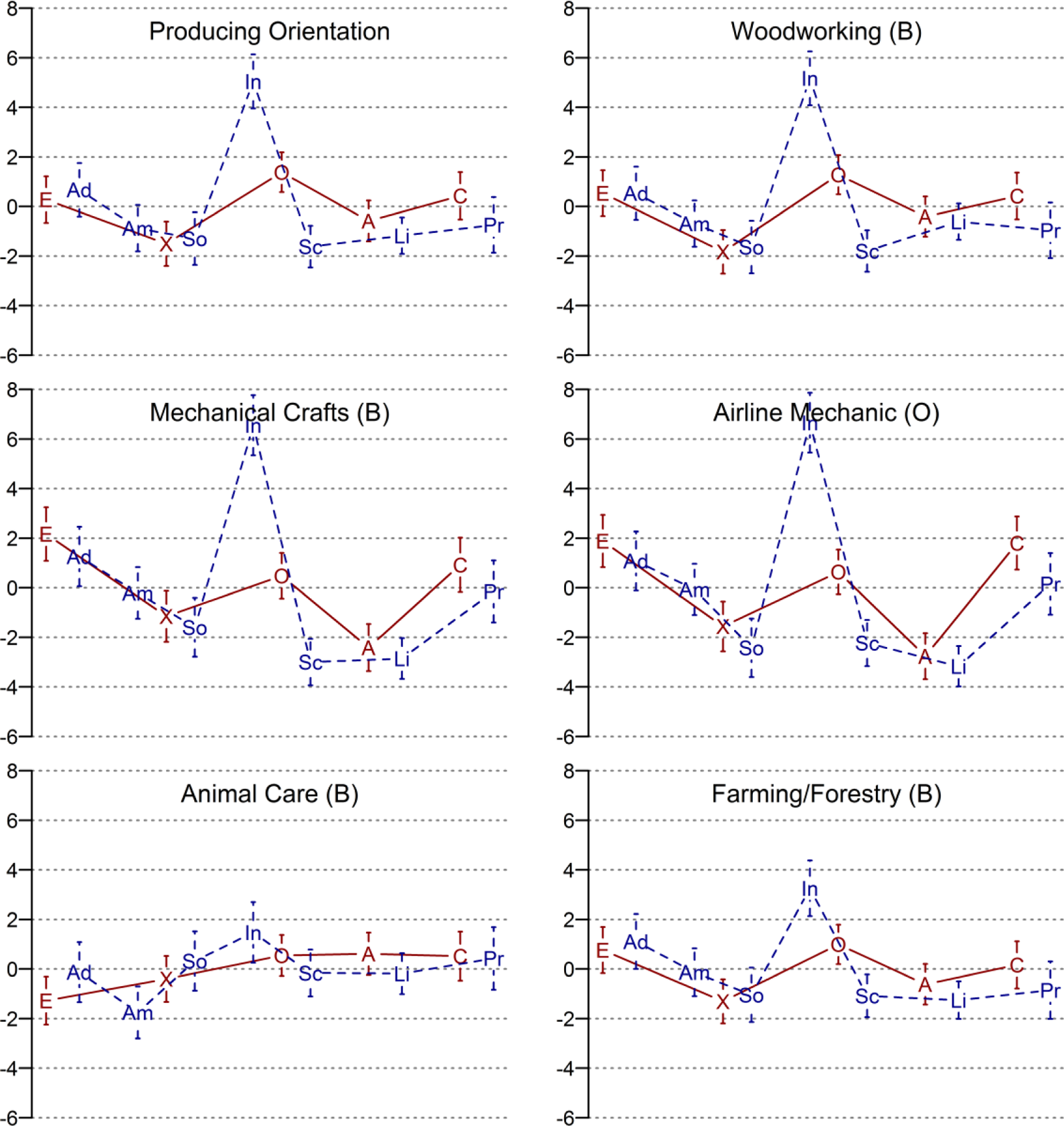
Personality criterion profile patterns for selected Realistic–Producing interest scales; B = Basic interest scales; O = Occupational interest scales; solid red line indicates NEO PI-R pattern; dashed blue line indicates HPI pattern; E = Emotional Stability; X = Extraversion; O = Openness; A = Agreeableness; C = Conscientiousness; Ad = Adjustment; Am = Ambition; So = Sociability; In = Intellectance; Sc = School Success; Li = Likeability; Pr = Prudence; criterion profile patterns for additional Realistic–Producing interests are available in the online supplement.
This profile pattern of high Openness and low Extraversion was consistent across personality measures. The two Extraversion and Openness scales of the HPI were differentially elevated in the Producing profile pattern, which was marked by relatively low Sociability (but not Ambition) and by very high Intellectance but relatively low School Success. The HPI profile was also much more pronounced than the NEO profile. This suggests that the Intellect aspect of Openness (which dominates the HPI Intellectance scale) drove the shape of this profile pattern, rather than the Experiencing aspect (which dominates the NEO Openness scale). 2 Thus, the results across the two inventories indicated that, in general, the personality profiles of individuals interested in Producing careers are marked by strong interest in solving problems and by low desire to interact with others socially or to pursue formal education.
Across Producing interests, profile patterns were more pronounced and prediction much stronger (see Table 1) for the HPI compared to the NEO. These differences likely stem from the divergent construct coverage of each inventory. The HPI scales are more narrowly focused than the NEO scales, measuring the facets of each domain believed to be most relevant for workplace criteria. To the extent that the specific constructs measured by the HPI are indeed the most relevant facets of the Big Five for Producing interests, prediction using profile patterns based on the HPI would yield more pronounced profiles, as was the case in the present results. For interest criteria where a broader range of facets underlie personality–interest relationships, one might expect the profile patterns for the NEO to be equally or more pronounced than those for the HPI.
Model Summaries for Predicting Realistic-Producing Interests.
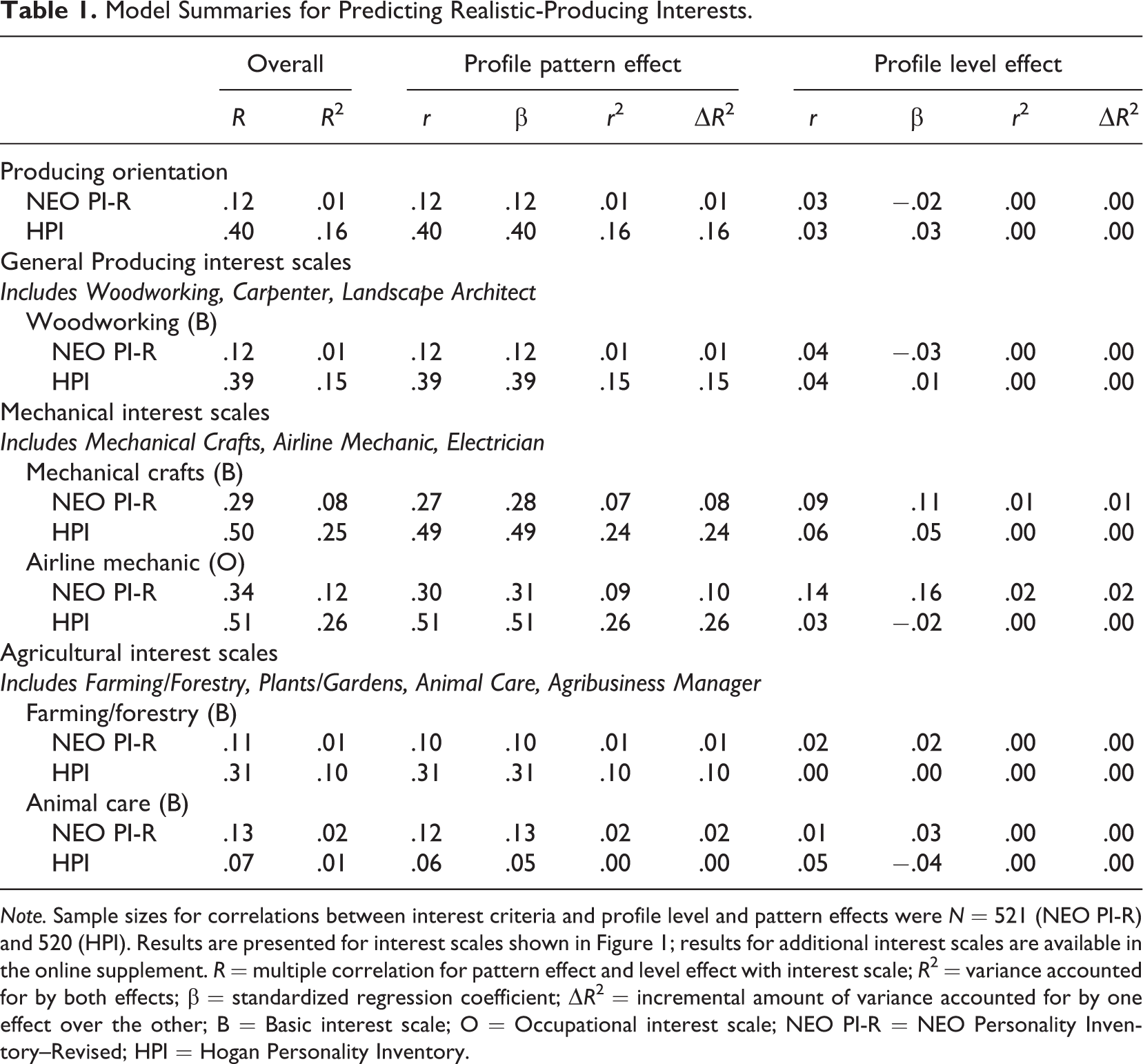
Note. Sample sizes for correlations between interest criteria and profile level and pattern effects were N = 521 (NEO PI-R) and 520 (HPI). Results are presented for interest scales shown in Figure 1; results for additional interest scales are available in the online supplement. R = multiple correlation for pattern effect and level effect with interest scale; R 2 = variance accounted for by both effects; β = standardized regression coefficient; ΔR 2 = incremental amount of variance accounted for by one effect over the other; B = Basic interest scale; O = Occupational interest scale; NEO PI-R = NEO Personality Inventory–Revised; HPI = Hogan Personality Inventory.
Personality profile patterns were generally consistent across Producing interests, though patterns for some occupations had unique features. For example, mechanical interests were marked by very high Intellectance and low Sociability, like general Producing interests, but also by intraindividually low NEO Openness and low Agreeableness. This pattern suggests that individuals interested in the function-oriented activities of mechanical work tend to gravitate toward solving problems, but away from aesthetics, feelings, and interpersonal sensitivity. Agricultural interest patterns had the same shape as general Producing interests but were less pronounced. These interests were also relatively poorly explained by broad personality traits, compared to other Producing interests (see Table 1). These flat patterns suggest that interests in agricultural careers are primarily driven by factors other than personality traits, such as environmental influences (e.g., being reared in an agricultural area, growing up in a family operating a farm).
Profile Predicting Adventuring Interests
An entirely different criterion profile pattern emerged for Adventuring interests, providing support for the notion that there is value in separating Realistic interests into both Producing and Adventuring interests. Profile patterns for selected Adventuring scales are shown in Figure 2. Results for additional Adventuring interest scales are available in the online supplement. Although Producing interests were marked by high Openness and low Extraversion, Adventuring interests were strongest in individuals with personality profiles marked by high Extraversion and low Agreeableness. The Extraversion peak took the form of Sociability for most Adventuring interests, but Ambition for military interests. Openness was also a positive marker trait for Adventuring scales emphasizing thrill-seeking (e.g., Ski Instructor), but a negative marker trait for athletics interests.
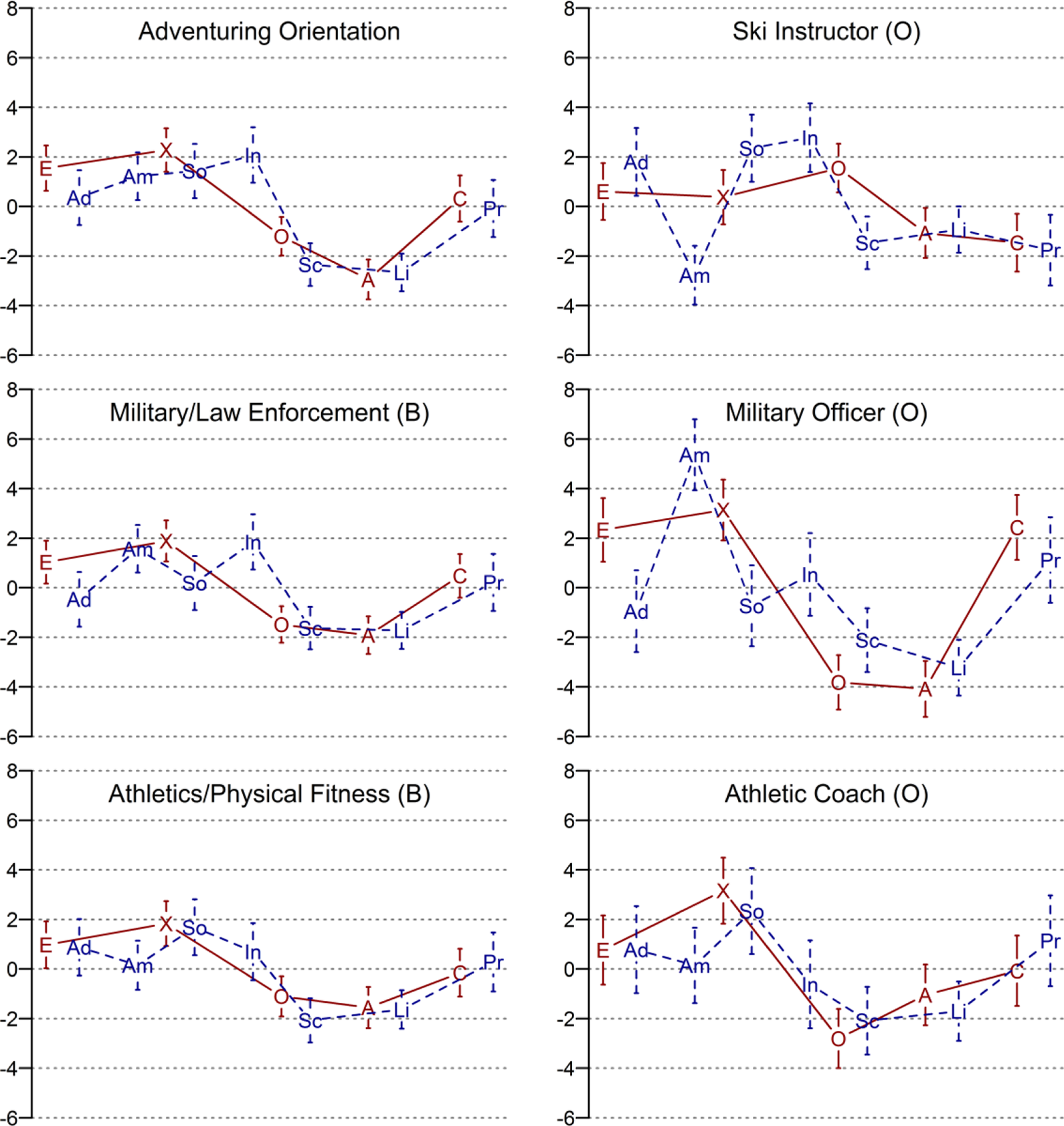
Personality criterion profile patterns for selected Realistic–Adventuring interest scales; B = Basic interest scales; O = Occupational interest scales; solid red line indicates NEO PI-R pattern; dashed blue line indicates HPI pattern; E = Emotional Stability; X = Extraversion; O = Openness; A = Agreeableness; C = Conscientiousness; Ad = Adjustment; Am = Ambition; So = Sociability; In = Intellectance; Sc = School Success; Li = Likeability; Pr = Prudence; criterion profile patterns for additional Realistic–Adventuring interests are available in the online supplement.
In contrast to Producing interests, Adventuring profile patterns were equally pronounced for the HPI and the NEO. Prediction was also equally strong for the NEO and the HPI for most Adventuring interests. That both the narrow HPI scales and the broader NEO scales yielded equivalent results suggests that while the profile patterns for Producing interests might stem from specific aspects or facets of the Big Five (especially in the Openness domain), the patterns for Adventuring interests are defined by the Big Five traits more broadly.
Variance Accounted for by Profile Pattern Versus Profile Level Effects
Results of the regressions of selected interest scores onto the profile pattern and level effects are presented for Producing and Adventuring interests in Tables 1 and 2, respectively. Generally, interests showed moderate to large relationships with the set of Big Five personality traits, especially with the HPI, though some interests (e.g., agriculture and law enforcement) showed smaller relationships.
Model Summaries for Predicting Realistic-Adventuring Interests.
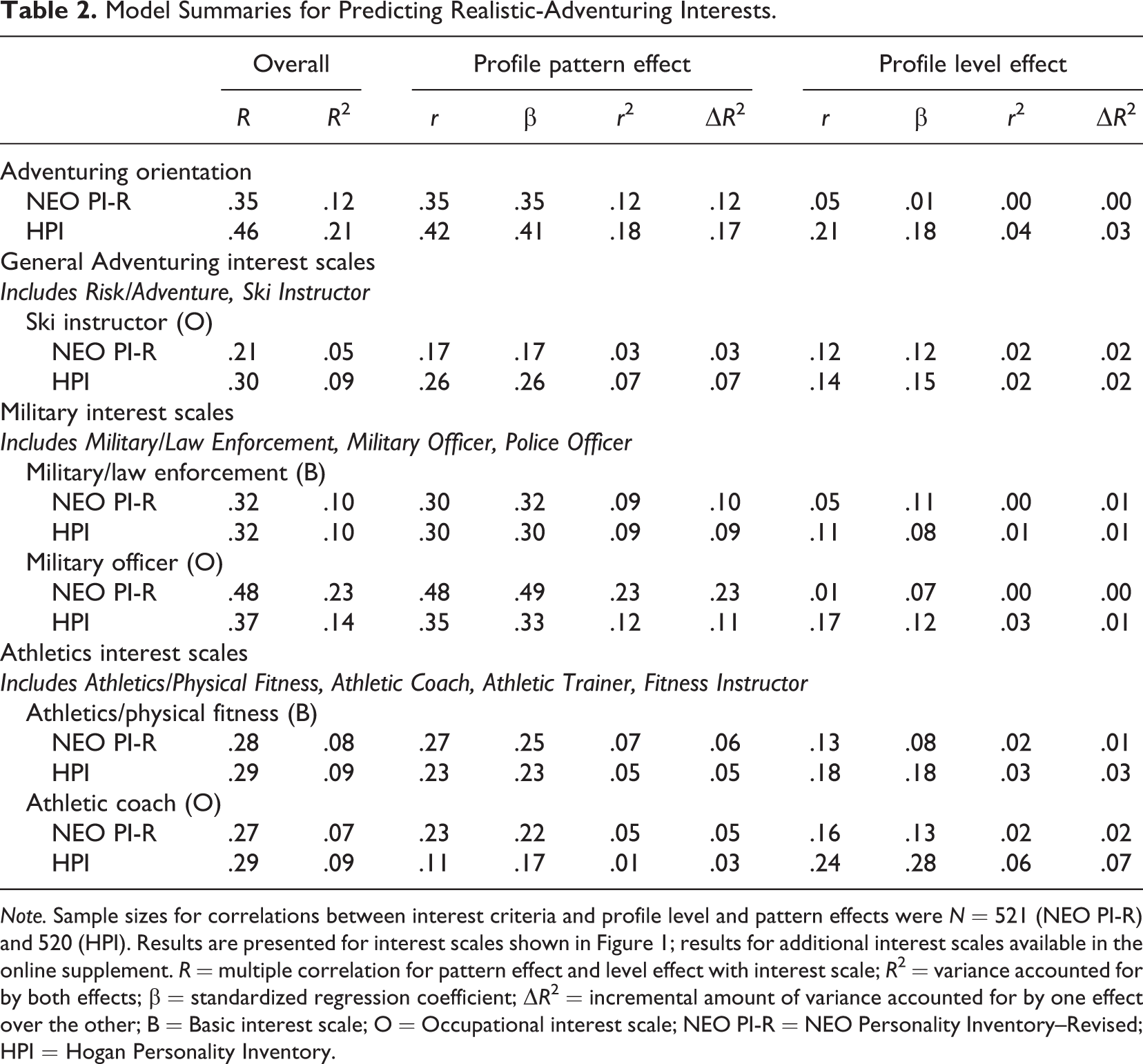
Note. Sample sizes for correlations between interest criteria and profile level and pattern effects were N = 521 (NEO PI-R) and 520 (HPI). Results are presented for interest scales shown in Figure 1; results for additional interest scales available in the online supplement. R = multiple correlation for pattern effect and level effect with interest scale; R 2 = variance accounted for by both effects; β = standardized regression coefficient; ΔR 2 = incremental amount of variance accounted for by one effect over the other; B = Basic interest scale; O = Occupational interest scale; NEO PI-R = NEO Personality Inventory–Revised; HPI = Hogan Personality Inventory.
Comparing the relative utility of personality profile pattern and level effects for explaining the relationship between personality traits and interests, across all levels of the interest hierarchy, results were consistently clear: For Producing and Adventuring vocational interests, the explanatory power of personality traits was driven by the pattern of traits within individuals; the level effect of personality independently explained virtually no variance in any of the interest criteria, and the pattern always explained substantially more variance (with the exception of the HPI for the Athletic Coach scale). Although correlations between profile patterns and interests tended to be around r = .20 to .40, correlations between profile level and interests rarely exceeded r = .10.
Gender Moderation
Given previous findings and practical implications of gender differences in Realistic interests, no investigation of the relationship of broad personality traits to these interests would be complete without investigating gender as a moderator of the personality profile patterns. All of the analyses were repeated separately for men and women. Profile patterns for men and women for selected interests are shown in Figure 3. Additional results are available in the online supplement.

Personality criterion profile patterns for Producing and Adventuring Orientation scales for men and women; solid red line indicates NEO PI-R pattern; dashed blue line indicates HPI pattern; E = Emotional Stability; X = Extraversion; O = Openness; A = Agreeableness; C = Conscientiousness; Ad = Adjustment; Am = Ambition; So = Sociability; In = Intellectance; Sc = School Success; Li = Likeability; Pr = Prudence; additional criterion profile patterns by gender are available in the online supplement.
Across Producing interests, the prominent peak for HPI Intellectance was present for all male and female profile patterns. A cardinal desire to solve problems was a key driver of Producing interests across genders. However, the place of NEO Openness in the Producing profile patterns was consistently different between women and men. NEO Openness showed a much more prominent peak in female profile patterns than in male profile patterns. Indeed, for many Producing interests, NEO Openness showed no peak at all (or even a small valley) for males. These results are consistent with previous findings showing that gender moderates the role of Openness in driving occupational choices (Woods & Hampson, 2010) and indicate that while men may be primarily drawn to Producing careers out of a desire to solve practical problems, women’s interest in Producing work may also stem from a desire for aesthetic fulfillment. This pattern also reflects that Artistic and Realistic interests tend to not be strongly differentiated in female samples (Armstrong, Hubert, & Rounds, 2003). Profile patterns for Adventuring interests were more congruent across genders.
Overall, moderation analyses revealed that the personality profiles characteristic of Realistic interests are remarkably consistent across genders. Producing interests are driven primarily by personal strengths for Openness to Intellect, with strengths for Openness to Experiencing contributing to interests only for women. Across genders, Adventuring interests are driven by personal strengths for Extraversion and weaknesses for Agreeableness. The overall consistency of profile patterns suggests that men and women experience similar self-evaluation processes as they develop Realistic career interests, and it supports the cross-gender construct validity of the Producing and Adventuring interest constructs.
Study 2
Method
The Eugene-Springfield Community Sample examined in Study 1 was highly educated. As a result, it may be that the prominent role of Intellect in driving Producing interests was idiosyncratic to this sample. To test this hypothesis, I searched the literature for studies reporting a full zero-order intercorrelation matrix for five-factor model personality traits and Realistic vocational interests. Only studies for which personality scales could be clearly mapped to the Big Five were included. This search yielded 16 studies across a broad range of educational levels, including high school students, college students in a variety of fields, medical students, and employed adults. Three studies separated results by gender; in the analyses below, I treat these as separate samples. Descriptions of these samples are given in Table 3.
Descriptions of Samples From the Literature Reanalyzed in Study 2 and Model Summaries for Predicting Realistic Interests.

Note. R = multiple correlation for pattern effect and level effect with interest criteria; R 2 = amount of variance accounted for by both effects; β = standardized regression coefficient; ΔR 2 = incremental amount of variance accounted for by one effect over the other; Int = Study used an Intellect-saturated Openness measure; Exp = Study used an Experiencing-saturated Openness measure.
aEhrhart and Makransky’s (2007) Openness scale includes mostly self-ratings of cognitive ability, similar to the HPI School Success scale.
For each sample, the content of the Openness measure used was evaluated by three subject matter experts and classified as measuring primarily Intellect or Experiencing, based on the descriptions provided by DeYoung, Quilty, and Peterson (2007). Agreement across raters was unanimous. Raters noted that while both aspects were represented in some Openness measures (e.g., the NEO PI-R), all measures more strongly emphasized one aspect than the other. The Davison and Davenport (2002) criterion profile analysis technique was used to identify the personality profile pattern associated with high Realistic interests in each sample.
Results
Summary statistics for each reanalyzed sample are shown in Table 3. Personality profile patterns for three largest samples using Intellect-saturated and Experiencing-saturated measures of Openness are shown in Figure 4. Profile patterns for the remaining samples are available in the online supplement. Overall, the profile patterns for Realistic interests were very similar to those found in Study 1 for Producing interests. When studies employed Openness measures emphasizing Intellect, the shape of the profile pattern tended to resemble the results for the HPI in Study 1—a strong peak for Openness (Intellect) and a slight valley for Extraversion, with substantial multiple correlations. The exception is Ehrhart and Makransky (2007), whose Openness measure included primarily self-ratings of cognitive ability, similar to the HPI School Success scale. The profile pattern for this sample showed no peak for Openness, as was observed for School Success in Study 1. When samples were assessed using an Openness measure emphasizing Experiencing, profile patterns resembled those observed for NEO Openness in Study 1, with substantially weaker or absent peaks for Openness. The importance of Intellect for Realistic interests was highlighted by the flat pattern for Birkman, Elizondo, Lee, Wadlington, and Zamzow (2008), whose Openness measure contained no Intellect items.
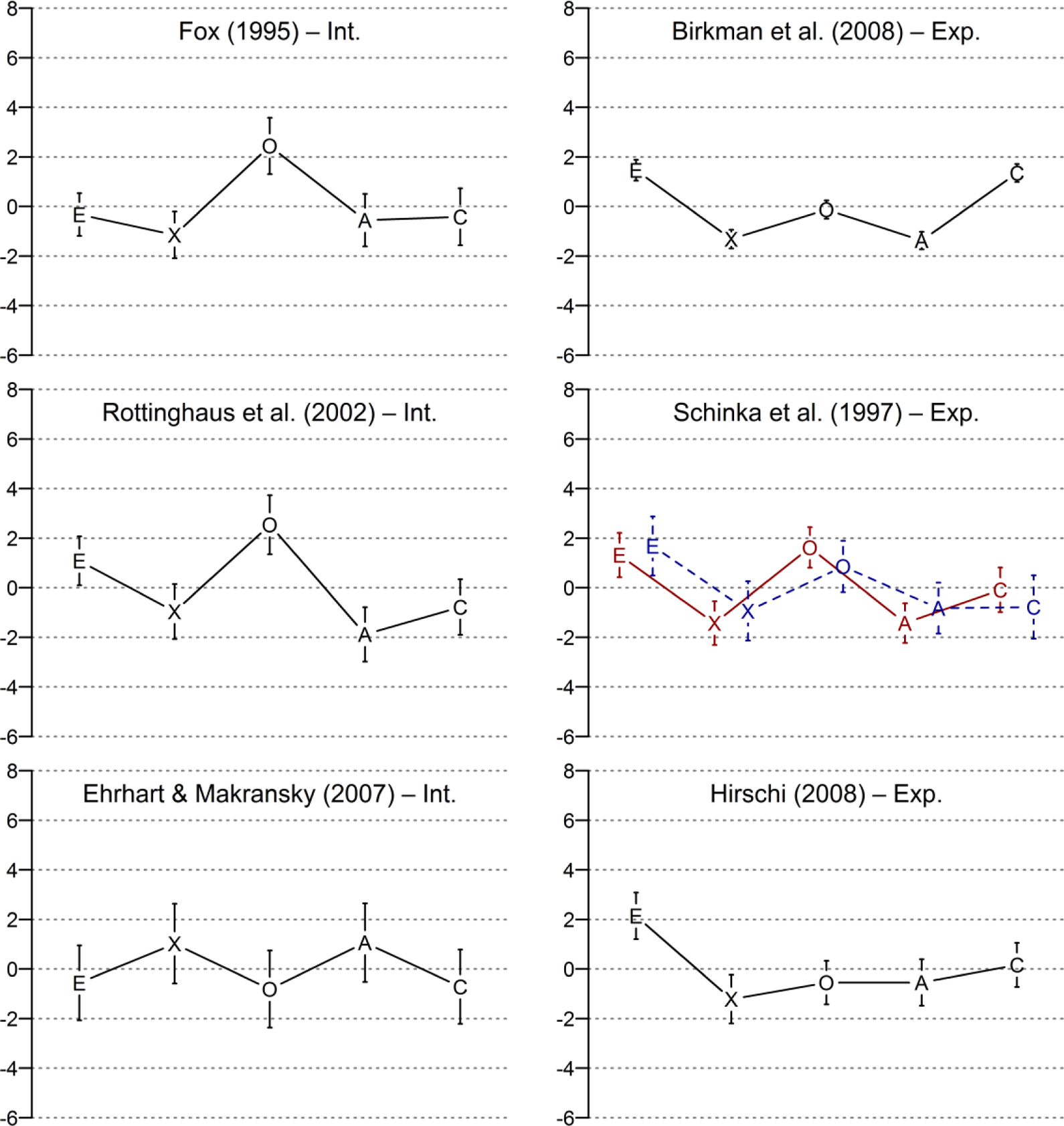
Personality criterion profile patterns predicting Realistic interests for selected samples from the literature reanalyzed in Study 2; Int. = Study used an Intellect-saturated Openness measure; Exp. = study used an Experiencing-saturated Openness measure; E = Emotional Stability; X = Extraversion; O = Openness; A = Agreeableness; C = Conscientiousness; for Schinka et al. (1997), solid red line indicates pattern for women and dashed blue line indicates pattern for men; personality criterion profile patterns for additional reanalyzed samples are available in the online supplement.
Discussion
The present study sought to determine whether interests in Realistic occupations were consistently related to a particular intraindividual pattern of intraindividual personality traits. Using a regression-based profile analysis technique (Davison & Davenport, 2002), I found that the relationships between the Big Five personality traits and both Producing and Adventuring occupational interests were driven by individuals’ pattern of relative trait levels, rather than their absolute trait standings. This technique allowed the respective contributions of personality profile patterns and absolute trait levels to be investigated independently of one another, contributing to a better understanding of the nature of the relationships between Realistic career interests and broad personality traits. That profile patterns drove the explanatory power in the relationship demonstrates that for an individual to be interested in Realistic occupations, it is more important that their relative personality strengths and weaknesses—the “peaks and valleys”(Dilchert, 2007) in their profile—match the shape of particular criterion patterns, rather than that their absolute standing on respective traits pass a threshold. Individuals’ occupational preferences are driven by desires to work in ways that match their natural habits (Barrick et al., 2003; Holland, 1997; Pryor, 1982). The results of the present study suggest that people identify these preferences in part by considering the most prominent features of their personality (their profile pattern), rather than by using their absolute levels of traits (their profile level).
For both Adventuring and Producing interests, consistent criterion patterns were found across personality and interest scales. Adventuring interests were marked by intraindividual high Extraversion and low Agreeableness. Producing interests were characterized by high intraindividual levels of Openness to Intellect and low Extraversion. Intraindividual high Openness to Experiencing also drove Producing interests for women. The divergent relationships for the aspects of Openness underscore the importance of considering personality–interest relationships at multiple theoretical levels (Staggs et al., 2007; Sullivan & Hansen, 2004). The emergence of consistent personality patterns relating to these occupations differs from previous results suggesting no relationship between Big Five traits and Realistic interests, highlighting the value of investigating relationships with all of the domains of the Five-Factor Model concurrently, rather than separately.
Producing and Adventuring Interests
Results of this research support previous work dividing Realistic interests into Producing and Adventuring orientations (Campbell, 1995), as both domains were associated with different personality profile patterns. The criterion pattern of personality traits identified for Adventuring interests was much more similar to the pattern for Enterprising interests (Dilchert, 2007) than it was to the pattern for Producing interests. Both Adventuring and Enterprising interests were both marked by high Extraversion and low Agreeableness. While occupations in these domains appear dissimilar when considered at face value, they share many common psychological features that may explain the similarity of their patterns. For example, both Adventuring and Enterprising occupations involve navigating intense, high-risk situations (though this risk is primarily physical for Adventuring occupations and psychological for Enterprising occupations). Future research into the nature of occupations and vocational interest should give careful consideration to the psychological demands of work in addition to surface-level job characteristics.
Gender and Realistic Interests
The present study found that the shapes of the profile patterns of personality traits for Producing and Adventuring interests were similar for men and women. Individuals, male and female, whose personalities are defined by curiosity and social withdrawal tend to be drawn to hands-on production-oriented careers, and both men and women whose personality profiles are marked by intraindividually strong disagreeableness and Extraversion tend to gravitate toward intense, adventure-oriented careers. This similarity means that guidance for Producing and Adventuring occupations based on broad personality factors can be similar for men and women and that the personalities of applicants to these positions will not likely systematically differ by gender. Where men’s and women’s criterion profile patterns do differ (the role of the Experiencing aspect of Openness), counselors can tailor their recommendations by considering their clients’ personality profiles with regard to the appropriate reference group.
Generating Interest in Skilled Careers
These results suggest a potential way for vocational and career counselors to promote interest in high demand, but socially stigmatized skilled trade occupations. Counselors in school and vocational settings might design targeted interventions and information campaigns promoting the benefits of skilled careers. These interventions could be designed to appeal to the personality patterns characteristic of interest in these occupations by highlighting the problem-solving, independence, and lack of postsecondary education requirements inherent in these careers.
Personality profile displays might also be used in client-focused career counseling. Due to the stigma attached to blue collar work, counseling clients may receive low scores for Realistic interests on interest inventories requiring respondents to self-rate interest in occupations or work activities (Crowley, 1981; Shanahan et al., 2002). When this may be a possibility, interest inventories can be supplemented with measures of Big Five personality traits. To the degree that individuals’ personality patterns resemble the criterion profile pattern for specific skilled careers identified in this study, counselors might highlight this fact and help them to explore whether a skilled trade is a fit for their talents and career goals. Broad personality measures have the advantage of asking about situations most people have experienced (e.g., “I feel comfortable in large groups”), rather than asking about activities with which individuals may have no firsthand experience (e.g., “I would enjoy building cabinets”), so this technique may be useful when clients are not familiar with the potentially appealing features of a skilled career.
The personality features associated with interest in skilled trades are not necessarily unique to these fields. For example, Intellect is frequently associated with interest and creativity in the physical sciences (Kaufman et al., 2014). As a result, it is important to consider that low HPI School Success, which measures interest in formal educational settings, is also a defining feature of the Producing interest profile. If clients display personality profiles characteristic of Producing interests (prominent curiosity, introversion), but are ambivalent about university education or appear to be considering a bachelor’s degree primarily because “everyone goes to college,” career counselors can help them to make potentially more fulfilling and rewarding career decisions by suggesting vocational or technical training as alternative options (Wonacott, 2003). Success in a career demands not only interest, but also appropriate levels of cognitive abilities and other personal characteristics (Ones, Dilchert, & Viswesvaran, 2012). By helping their clients to identify occupations that appeal to their interests and personality profiles and are a fit for their array of cognitive abilities, vocational counselors can have a positive impact on their career outcomes. For individuals with personalities defined by a desire to solve problems but without strong academic talent, a career in a skilled trade is likely to be an excellent fit.
Conclusions, Limitations, and Future Directions
The present study presents a new development in our understanding of the nature of interest in Realistic occupations. It is one of the first studies to consider the nature of the relationship between occupational interests and broad personality traits using multiple personality scales and levels of interest measurement. Additionally, it is the first study to take an intraindividual approach toward understanding the relationship between Realistic interests and broad personality traits, identifying systematic relationships not found in previous studies. Results were generally consistent across the samples examined in Studies 1 and 2. However, relatively few samples used Intellect-saturated measures of Openness and all of these were composed of undergraduate students. Additional studies using measures focused on this aspect in a wider range of samples are necessary to confirm the present findings.
The finding that occupational interests are driven by intraindividual configurations of personality traits mirrors recent findings from the ability literature that also showed individuals consider their relative strengths when making educational and occupational choices, irrespective of absolute ability levels (Kell, Lubinski, & Benbow, 2013; Wang, Eccles, & Kenny, 2013). Across trait domains, it seems that trait pattern, not level, drives occupational interests. Future research in vocational psychology should extend this multi-level, intraindividual approach, especially by considering how configurations of personality, ability, and other individual differences lead to occupational interest and choice. The present study is limited in examining only the relationship between personality profiles and Realistic interests. The potential benefits of personality profile-based career counseling will be strengthened if similar profile patterns are also shown to be associated with successful performance and satisfaction in these occupations. Such investigations will continue to better our understanding of the psychology of careers and will enhance occupational counselors’ ability to meet the changing demands of both the international economy and individual counseling clients.
Footnotes
Author’s Note
An earlier versions of this article was presented at the annual conference of the Society for Industrial and Organizational Psychology, Houston, Texas, April 2013.
Acknowledgments
The author would like to thank Lew Goldberg for kindly supplying the data for Study 1 and Deniz S. Ones, Stephan Dilchert, Mark Davison, Kevin Stanek, and Mike Wilmot for their valuable comments on earlier drafts of this article.
Declaration of Conflicting Interests
The author(s) declared no potential conflicts of interest with respect to the research, authorship, and/or publication of this article.
Funding
The author(s) disclosed receipt of the following financial support for the research, authorship, and/or publication of this article: This work was supported by the National Science Foundation through a Graduate Research Fellowship to the author.
Notes

References
Supplementary Material
Please find the following supplemental material available below.
For Open Access articles published under a Creative Commons License, all supplemental material carries the same license as the article it is associated with.
For non-Open Access articles published, all supplemental material carries a non-exclusive license, and permission requests for re-use of supplemental material or any part of supplemental material shall be sent directly to the copyright owner as specified in the copyright notice associated with the article.
