



Abstract
This is a first initiative to apply career exploration research to understand and assess a career intervention in Hong Kong. In responding to educational and social changes, a one-semester academic career course was designed to foster the participants’ career exploration in a public university in Hong Kong. Data were drawn from about 380 students enrolled voluntarily across three successive semesters in either the career course or another academic course unrelated to career development. The career course served as an intervention to enhance exploration for enrolled students, with students from an unrelated academic course in the same semester included as a comparison group. Pre- and post-assessments were conducted to assess the career course’s impact in terms of career decision making, career adaptability, and relational support. The reflection and discussion here focus on the course’s effectiveness and cultural appropriateness as a career intervention tool and its strategic value in higher education in Hong Kong and beyond.
The impacts of major types of interventions such as career groups or courses (e.g., Folsom & Reardon, 2003; Halasz & Kempton, 2000) have been investigated generally in the literature on career interventions. In this article, we aim to make a first endeavor to further examine the impact that a career course has in Hong Kong, based on research and theories of career exploration. The course, designed to meet the needs of university students amid educational and social changes, also addressed the general lack of research on career development in Hong Kong (Leung, 2002). Taking a contextual approach (e.g., Flum & Blustein, 2000), we propose that a career course intervention in Hong Kong will affect not only individuals’ career choices and decisions but also their understanding of and adaptation to the world of work. Here, we first review the literature on career exploration interventions and then evaluate a career exploration course for the higher education context in Hong Kong.
Hong Kong is a Special Administrative Region of China and a cosmopolitan city with a gross domestic product per capita of US$ 39,900 in 2014 (Hong Kong Trade Development Council, 2015). Higher education in Hong Kong has seen remarkable changes in the past few decades, many of which have posed new challenges and offered opportunities for career interventions targeting college students. In the 1990s, higher education in Hong Kong transitioned from an elite education to mass education following several years of rapid expansion. The percentage of people aged 17 to 20 entering university was only 8.6% in 1990—a number that quickly increased to 18.8% by 1996 (University Grants Committee, 1996). This increase meant that over 90% of the college students in Hong Kong were the first in their families to enter college (Armour, Cheng, & Taplin, 1999). However, as the number of college graduates increased, their individual competitiveness did not increase correspondingly. Lui and Suen (2005) argued that as colleges accepted more students, the relative quality of the students declined, explaining the sharp contraction in college graduates’ relative earnings over the 5 years following the expansion. University counselors and administrators have thus felt the need to enhance students’ employability with career education and services (e.g., Cheung, 2012; Fung & Wong, 2012). At present, Hong Kong is undergoing a major transition of higher education to 4-year university education from a 3-year British system, places in tertiary education will further be expanded, and the 4-year university education was aimed at producing graduates of higher quality (Education Commission, 2004). University curriculum has been revised to include elements of general education (e.g., Jaffee, 2012). Local universities have started to admit students for their 4-year undergraduate programs since 2012, and impacts are yet to be evaluated. There is a huge need to make career guidance an integral part of university education so as to prepare students for the world of work. Against this background of increasing needs and provisions, we generate research data to understand the impact of a career course in higher education in Hong Kong.
Career exploration has long been recognized as a crucial process of career development leading to various positive short- and long-term career outcomes, such as better career decision and clarity of vocational identity (e.g., Gushue, Clarke, Pantzer, & Scanlan, 2006). In Hong Kong, research efforts have been made to understand how far career exploration is related to individual and contextual factors. Career exploration was shown predicted by indigenous Chinese personality dimensions, mediated partially by vocational interests (Fan, Cheung, Leong, & Cheung, 2012). In a study of Chinese university students in Hong Kong, Cheung and Arnold (2010) found limited support for achievement motivation as an antecedent of career exploration, whereas relational support was significantly related to the latter. In Chinese societies, while students’ academic achievements are highly recognized by their families and significant others (e.g., Tao & Hong, 2000), extensive career exploration is not particularly encouraged. In this light, Hong Kong students with high achievement motivation are more likely to channel their energy into the pursuit of academic attainments than to engage in career exploration, and social support in the higher education setting is needed to motivate exploration behavior. Moreover, among university students, participation of career exploration activities was found to be associated with subsequent career outcomes of decision-making self-efficacy, amount of occupational information acquired, but not self-clarity and career decidedness, whereas relational support was associated with the outcomes of career decision self-efficacy, amount of occupational information, as well as career decidedness (Cheung & Arnold, 2014). The role of relational support in facilitating career development, as compared to career exploration, was clearly illustrated. Research in Hong Kong also examines career decision making in relation to both individual and social factors. The importance of developing career self-efficacy measurements and interventions (e.g., Yuen et al., 2005; Yuen, Gysbers, Chan, Lau, & Shea, 2010) has been emphasized, and effects of parental expectation on career decision-making difficulties were also established among local university students (Leung, Hou, Gati, & Li, 2011). In another local study, career interests of university freshmen were related to their respective parents’ vocational interests after controlling for factors of personality, gender, general mental abilities, and emotional intelligence (Wong, Wong, & Peng, 2011). In short, reflecting above studies, we would examine career exploration in Hong Kong from perspectives of both individual motivation and social support. Therefore, in assessing an intervention of career course, we propose to study changes in individual career decision self-efficacy and relation support of parents, teachers, and peers.
Impacts of Career Courses as Interventions
In terms of empirical data on career intervention outcomes, meta-analyses have found that such interventions have resulted in significant changes in career maturity, career certainty, and career-related skills (Oliver & Spokane, 1988; Whiston, Sexton, & Lasoff, 1998). Maguire (2004) proposed classifying career intervention outcomes into attitudes, decision-making skills, self-awareness, certainty of preferences, and transition skills. Previous work on career education courses have related them to improved career decision making (e.g., Fouad, Cotter, & Kantamneni, 2009; Johnson & Smouse, 1993; Jones, 1989; Peng & Herr, 1999; Savickas, 1990), reduced negative career thoughts (e.g., Reed, Reardon, Lenz, & Leierer, 2001), and career difficulties (Reese & Miller, 2006), as well as enhanced career decision self-efficacy (e.g., Reese & Miller, 2006). Hardesty’s (1991) meta-analysis of 12 studies revealed that career courses accounted for variance in both career maturity and career decidedness. In summary, research has supported the proposition that career courses result in better career decision making, as measured by scores on either cognitive or self-efficacy inventories. It should be noted that career courses are designed to serve different objectives, such as career decision making or career planning. We realized that if a career course is designed mainly to enhance career exploration, the outcomes should be examined not only in relation to progress in career decision making but also in relation to a better understanding of the various opportunities and wider environment, as well as connecting resource persons and social support.
What is career exploration and what is career exploration intervention? Blustein (1992) defined career exploration as encompassing “activities directed toward enhancing the knowledge of the self and the external environment that an individual engages in to foster progress in career development” (p. 261). According to Brown et al. (2003), the component of career exploration in an intervention consists of exploratory and information search activities that generally occur outside intervention sessions. From this definition, naturally, career exploration courses should include such component of career exploration as a primary focus in their design. Presently, career courses are commonly applied in higher education settings (e.g., Folsom & Reardon, 2003; Halasz & Kempton, 2000; Osborn, 2008).
Understanding and Adapting to the World of Work
From a contextual perspective, we are interested in the outcomes of career exploration courses on individuals’ career decision making (e.g., Tiedeman & Miller-Tiedeman, 1984) and beyond. Understandably, career exploration is often related to outcomes of decision-making progress (e.g., Cheung & Arnold, 2014), in terms of self-concept crystallization and vocational commitment (Blustein, Pauling, DeMania, & Faye, 1994). Recently, Porfeli and Skorikov (2010) distinguished between discursive and specific career exploration, with the former entailing broad learning about the world of work and the self and the latter involving the in-depth investigation of how an individual’s self-perceptions relate to his or her career prospects. In this light, while specific exploration is likely to lead to career decision making, discursive exploration may result in more information and additional career options to consider. If a career exploration intervention fosters discursive exploration, it may generate more career choices and information instead of narrowing into fewer options. Therefore, when we examine the impact of a career exploration intervention, we look beyond how people arrive at a specific choice to discover how they make sense of the surrounding environment, including the support and the constraints.
Moreover, because career exploration is regarded as “a process with critical life-long and adaptive functions” (Flum & Bulstein, 2000, p. 381), it may be related to adaptability, and empirical data on this relation are thus very desirable. From the perspective of career construction theory, career adaptability has been defined as “the readiness to cope with the predictable tasks of preparing for and participating in the work role and with the unpredictable adjustments prompted by the changes in work and work conditions” (Savickas, 1997, p. 254). In a recent development of the Career Adapt-Ability Scale (CAAS; Savickas & Porfeli, 2012), four psychosocial resources—concern, control, curiosity, and confidence—were proposed as the core aspects of career adaptive ability. To adapt, individuals must be concerned with and plan for a vocational future; gain a sense of control that reflects the subjectivity of self-governing and decisiveness concerning a vocational future; maintain the curiosity to explore their environment; and build self-confidence concerning the ability to solve concrete career problems. Recently, it is found that stories as a constructivist assessment can be employed to assess career adaptability in relation to fostering career exploration (Hartung & Borges, 2005). Moreover, career exploration was found positively related to subsequent career adaptability among Chinese university students in a longitudinal study (Guan et al., 2015). In this study, we shall examine how far a career exploration course as an intervention can enhance career adaptability.
Finally, the importance of interpersonal relationships is also receiving increased attention in general theory development and research in the area of career development (Blustein, 2001; Flum, 2001; Super, 1990). Theoretically and empirically, supportive interpersonal relationships are shown to help individuals cope with challenges to adaptive personal and career development (Bogenschneider, 1996; Rosenfeld, Richman, & Bowen, 2000; Wang, Haertel, & Walberg, 1994). In their meta-analysis study, Brown et al. (2003) found that attention to building support as an ingredient of effective career intervention. While the impact of interpersonal relations on career exploration has been established (e.g., Flum & Blustein, 2000), the need to foster supportive relations via intervention has also been addressed in theory (e.g., Blustein & Flum, 1999). Thus, empirical data are needed to established relational support as an outcome of career intervention. To summarize our discussion of career exploration research and the changing context in Hong Kong, we propose the following: First, as a career exploration intervention, the course will increase career exploration behavior and the amount of occupation information. Second, the course will enhance career decision making in terms of career decidedness and decision-making self-efficacy. Third, the course will result in career adaptability. Fourth, the course will increase career support from teachers, peers, and family, as participants connect themselves to different forms of relational support for their career development. The specific hypotheses are as follows:
Method
Research Design and Procedures
A nonequivalent comparison group design was adopted to assess the impact that the career exploration course had on students’ career exploration, decision making, and career adaptability. This design is characterized by an intervention group with individuals participating in the intervention, as well as a comparison group with individuals not participating in the intervention and statistically similar to the intervention participants (e.g., Kettner, Moroney, & Martin, 2013). By ensuring that the two groups are statistically similar, this design addresses and deals with the threats of internal validity. The intervention group consisted of students from different majors and years of study who voluntarily enrolled in a career exploration course in the General Education category in a public university in Hong Kong. The comparison group consisted of students enrolled in another course in the General Education category unrelated to career development in the same university. Both courses were delivered in 13 weekly 3-hr classes over an academic semester, open to all undergraduate students of the university to select voluntarily as an elective. The current study included samples from three semesters, each semester with one intervention group and one comparison group. In each group, the data were collected in the first week of class for the pretest and again in the last week class for the posttest. We collected 172 valid responses at pretest and 125 valid responses at posttest for the intervention group, and 218 valid responses at pretest and 86 valid responses at posttest for the comparison group. The basic demographic characteristics for the entire sample reported at pretest are presented in Table 1. From Table 1, it can be seen that the sample has a generally well-balanced distribution in gender, major, and age.
Summary of the Demographics for Intervention and Comparison Groups at Pretest.

Career Course Design
The course design was guided by two major aims: to enable students to understand and analyze career and career management issues in the 21st-century working world through contextual (sociology), organizational (organizational behavior), and individual (psychology) perspectives; and to facilitate students in discovering their vocational selves through workshop sessions on aptitude, personality, vocational interests, and life-long career development. To achieve these goals, various activities were integrated and implemented in the course, including lectures, career development workshops, guest seminars, and group projects. The activities were delivered over 13 sessions, once a week for 3 hr.
The students’ performance throughout the course was assessed from their group project presentation, two reflective writing assignments, and one short quiz. In the two writing assignments, the students reflected on vocational interests, personalities, career readiness, and life-long career management as covered in the career development workshops and guest seminars. The short quiz was designed to test their understanding of the theories and practices related to career development and management. Thus, in addition to assessing the students’ performances, these assignments helped students to consolidate what they had learned about themselves, careers, and world of work through the course sessions. The course was designed to stimulate and promote voluntary career exploration activities. First, it was designed as an elective course, which meant the choice belonged to the students who had individual needs, such as understanding different career options, facilitating the selection of a major of study, or preparing for graduate employment. Second, the course was designed to give students an optimal level of challenge in completing the career exploration tasks, such as interviewing alumni and reflection papers, to build their competence and confidence in career exploration. Third, the course helped the students connect with role models and career services in the university, providing them with opportunities to meet and learn from career advisors, student counselors, alumni, and professionals—both in class and beyond.
Measures
All of the measures were included in both the pretest and posttest. We used the English versions of all the measures. Since English is the official medium of instruction in Hong Kong universities, we believe that language will not pose a threat to the validity of the measures used.
Career exploration and amount of occupational information
Career exploration was assessed by the self-exploration and environment exploration scales of the Career Exploration Survey (CES; Stumpf, Colarelli, & Hartman, 1983). Environment exploration was defined as exploration activities related to occupations, jobs, and organizations in the past 3 months and self-exploration as activities of self-assessment and introspection in the past 3 months. The scale is a well-established measure in career exploration research (e.g., Bartley & Robitschek, 2000; Stumpf et al., 1983), with applications among college students in Hong Kong (Cheung & Arnold, 2010). Responses were given on a 5-point scale to reflect frequency of activity over the last 3 months. In this study, Cronbach’s α for the self-exploration scale was .70 and for environment exploration scale was .86. The amount of occupational information was assessed by the CES information subscale (Stumpf et al., 1983) comprising three items covering varied aspects of occupation information, including information on the job content of certain career area(s) the participants had investigated, jobs, organizations, the job market in general, and how the participants fit into various career paths in particular. The responses were given on a 5-point Likert-type scale ranging from 1 (limited information) to 5 (a lot of information), and Cronbach’s α for the subscale was .71.
Career decision making
The students’ career decision-making status was measured using the career decidedness subscale of the Career Decision Profile developed by Jones (1989). Their career decision-making confidence was measured by an item designed for this study. Cronbach’s α of the career decidedness subscale was satisfactory in Jones’s study (1989; α = .85) and in this study (α = .87). The construct validity of career decidedness was also established previously (Jones, 1989) with positive correlation to career salience and negative correlation to Slaney’s (1980) index of career indecision. The scale consisted of two statements regarding career decidedness and the participants responded by indicating the extent to which the statements matched themselves on a 5-point Likert-type scale ranging from 1 (strongly disagree) to 5 (strongly agree). The students’ career decision-making confidence was measured by 1 item in which the students were asked to indicate their overall confidence in making an effective career decision for themselves at present, ranging from 1 (no confidence at all) to 5 (full confidence).
Career adaptability
The students’ career adaptability was measured with the 24-item CAAS (Savickas & Porfeli, 2012). In previous studies, this scale was tested in more than 10 countries around the world, demonstrating satisfactory psychometric properties. The 24 items were designed to measure the four dimensions of concern, control, curiosity, and confidence, with 6 items for each dimension. The participants responded to the CAAS on a 5-point Likert-type scale ranging from 1 (not strong) to 5 (strongest). Though this study was the first time that this scale was used in the Hong Kong context, some initial findings suggested good reliability and validity of the scale. In this study, the Cronbach’s αs for the whole scale and the four subscales were relatively high: .84, .90, .89, .90, and .96, respectively. Also intercorrelations among the four subscales ranged from .68 to .81, demonstrating that the four subscales measured closely related but distinctive constructs. With respect to its construct validity, consistent with theory, the overall career adaptability score in the current study was positively related to self-exploration, r(388) = . 14, p <. 01; environment exploration, r(388) = . 22, p < . 01; and career decidedness, r(387) = . 13, p < . 01;, the application of which in the Hong Kong context were well established in previous studies (Cheung & Arnold, 2010, 2014).
Relational support
With reference to the conceptualization of social support presented by McGrath, Gutierrez, and Valadez (2000), we measured both the source and amount of social support for careers. Measures of relational support (Cheung & Arnold, 2010) comprise 3 items that, respectively, assess the career support provided by teachers, peers, and family (1 item for each type of relational support) were applied. The respondents were asked to “indicate the level of career support” they had received, respectively, from teachers, peers, and family, ranging from 1 (no support) to 5 (maximum support) on a Likert-type scale.
Results
To examine the similarities between the intervention and comparison groups at pretest, we tested whether the two groups showed significant differences in demographics and pretest variables. No significant differences were observed in age, F(1, 214) = .74, p > .05; gender, χ2(1, N = 216) = .68, p = .41; and major of study, χ2(5, N = 216) = 9.37, p = .10. The scores of pretest career measures from respondents of the two groups were compared and no significant differences were found. Although we cannot totally rule out other potential differences between the two groups, these results provided good support that the intervention group and the comparison group were comparable to a large degree. To test whether there were any systematic differences between those participants who responded in the posttest and those who did not, we also compared these two subgroups in terms of demographics and the pretest career measures. The results showed that there were no significant differences between the two groups, giving support that attrition biases were unlikely.
To examine the effectiveness of the career exploration course, two sets of analyses were performed. First, following the suggestion of Fitzmaurice, Laird, and Ware (2004), repeated measures analysis of variance (ANOVA) was performed to test the Group × Time interaction effect. A significant Group × Time interaction effect for a specific measure suggests that the effect of time on the measure depends on the group, implying that the size of change found in the measure is significantly different between the intervention group and comparison group. In such a case, it can be argued that changes in the intervention group’s measures are exclusively due to the intervention.
In performing repeated measures ANOVA for this study, the pretest and posttest scores of specific measures were treated as the within-subjects variables and the participation into either the intervention or comparison group as the between-subjects variable. Thus, to test the impact of the intervention on all of the measures in this study, 13 repeated measures ANOVAs were performed. The results, summarized in Table 2, suggest that after taking the career exploration course, the students experienced significantly increased self-exploration, F(1, 209) = 12.60, p < .001, η2 p = .06, and environment exploration, F(1, 209) = 16.0, p < .001, η2 p = .07, became more decided in occupational choices, F(1, 209) = 9.65, p = .002, η2 p = .04, and were more confident in making effective career decisions, F(1, 209) = 4.42, p = .037, η2 p = .02. In addition, the students reported more career support from teachers, F (1, 213) = 12.82, p < .001, η2 p = .06, and family, F (1, 213) = 7.27, p = .008, η2 p = .03, after taking the career exploration course.
Results of Repeated Measures ANOVAs, Contrast Analyses, and ANCOVAs.
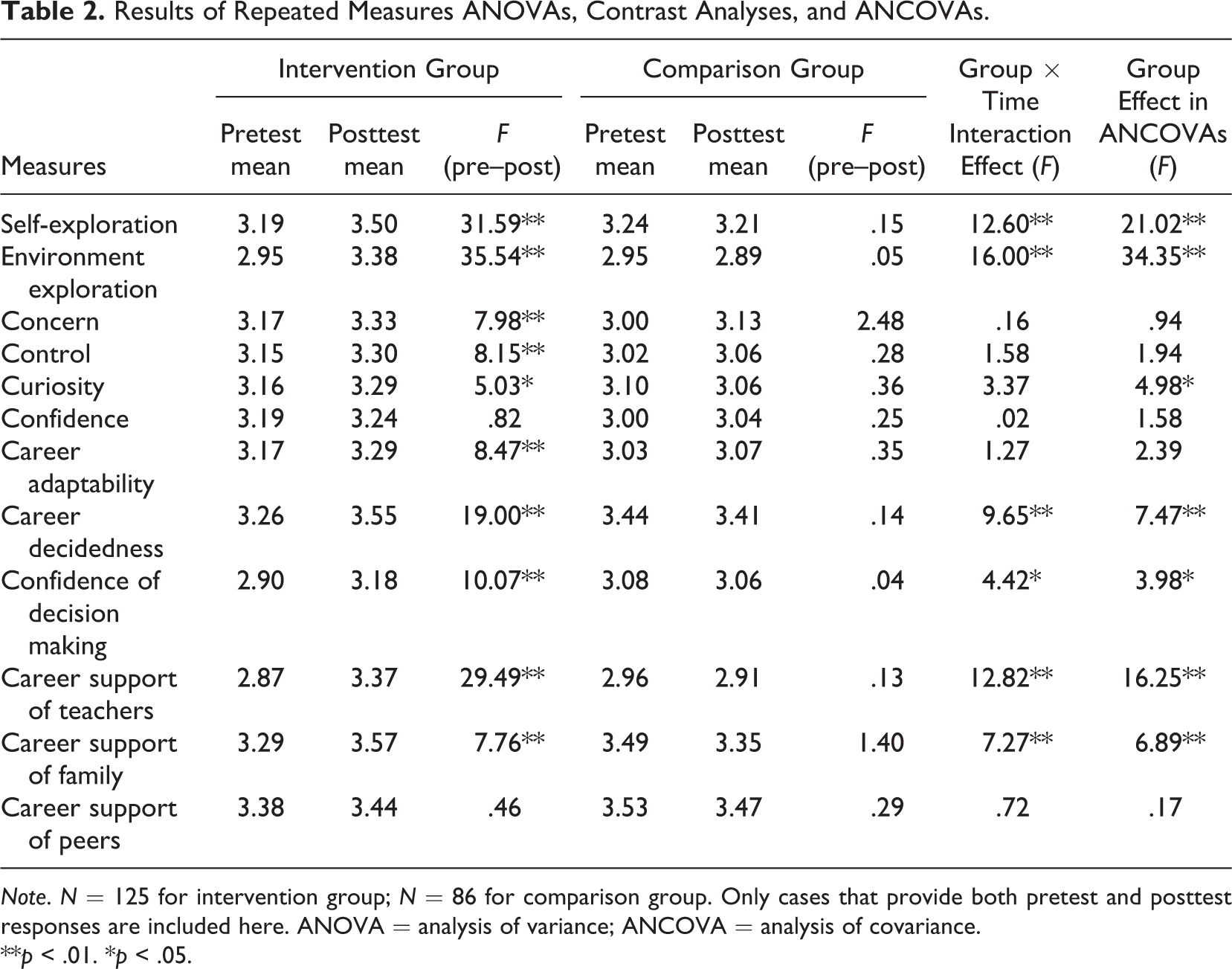
Note. N = 125 for intervention group; N = 86 for comparison group. Only cases that provide both pretest and posttest responses are included here. ANOVA = analysis of variance; ANCOVA = analysis of covariance.
**p < .01. *p < .05.
Hypothesis 1 stated that participation in a career exploration course increases students’ levels of career exploration activities and the amount of occupational information they receive. Hypothesis 2 stated that participation in such a course increases the students’ levels of career decidedness and decision self-efficacy. Both these hypotheses were supported by the results. Hypothesis 4 stated that participation in a career exploration course increases students’ levels of career support from peers, family, and teachers. The results indicated significant effects from parents and teachers, and Hypothesis 4 was thus only partially supported.
In addition, contrast analysis results were examined to assess the pretest–posttest changes in more detail for each group. These results are also summarized in Table 2, clearly indicating a different pattern of changes for the intervention and comparison groups. While most of the outcome measures (except for the confidence subscale of career adaptability and career support of peers) increased significantly upon posttest in the intervention group, no outcome measures showed significant change during the two measurement times in the comparison group. For the intervention group, the largest increases were in environment exploration, F(1, 124) = 35.54, p < . 001, η2 p = .22, and self-exploration, F(1, 124) = 31.59, p < . 001, η2 p = .20, followed by career support from teachers, F(1, 124) = 29.49, p < . 001, η2 p = .19, career decidedness, F(1, 124) = 19.00, p < . 001, η2 p = .13; confidence of career decision making, F(1, 124) = 10.07, p = .002, η2 p = .08, family, F(1, 124) = 7.76, p = . 006, η2 p = .06, and the control, F(1, 124) = 8.15, p = .005, η2 p = .06, concern, F(1, 124) = 7.98, p = .006, η2 p = .06, and curiosity, F(1, 124) = 5.03, p = .027, η2 p = .04, dimensions of career adaptability.
Results of these contrast analyses gave further support of Hypotheses 1, 2, and 4. Although Group × Time effect did not support Hypothesis 3, we saw from contrast analysis some potential for future investigation. The results suggested that the intervention group increased in three subscales and overall scores of career adaptability while the comparison group remained unchanged in all the dimensions. Had the intervention lasted longer, the intervention group might have shown larger increases in these dimensions, and assuming the changes in the comparison group remained unchanged, the Group × Time effect might become significant. Nevertheless, this is only a speculation for future studies to investigate.
Although we have found no significant differences between the intervention group and the comparison group in the tested demographic and preintervention career variables, we understand that for a nonequivalent comparison design, in the absence of a randomized control group, we need to rule out the threats to internal validity as far as possible. Therefore, we consider control for differences between the two groups that may potentially bias our conclusions. Among the demographic and pretest variables, we consider differences in gender, career decidedness, and confidence of career decision making between the two groups have the potential to bias our results. We had a higher percentage of female participants in the intervention group and women may report their career outcomes differently as compared to men. As participants in the intervention group scored lower in career decidedness and confidence of decision making, they may be more motivated to make changes in tested career outcomes. To control for these variables, we have performed analyses of covariance (ANCOVAs) for all posttreatment career scores. In each ANCOVA with a posttreatment career score as the dependent, gender, pretest career decidedness, pretest confidence of decision making and pretest score of the dependent were used as covariates, while the course participation (intervention vs. comparison) was entered as the independent variable. The results of the ANCOVAs, with career adaptability, career decision making, and relational support as dependents, detailed in Table 3, were consistent with what we found with the tests of repeated measures ANOVA reported earlier in Table 2, further supporting and reconfirming the results of hypotheses testing we have explained earlier.
ANCOVAs of Career Adaptability, Career Decision Making and Relational Support.

Note. N = 125 for intervention group. N = 86 for comparison group. DV = dependent variables; ANCOVA = analysis of covariance.
Examining further into subscales of career adaptability in the ANCOVA, we did find a difference for the curiosity dimension, as compared to results of ANOVA tests. The course effect on curiosity became significant (p = .027) after controlling for pretest group differences in gender, decidedness, and confidence of decision making. This result was not surprising considering the fact that in ANOVA Group × Time interaction effect (p = .070) was already close to the cutting off value of .05. Thus, in addition to the discussion about ANOVA results earlier, more understanding about the role of the career course in enhancing the dimension of curiosity was achieved. Results of all the ANCOVAs, including subscales career adaptability as dependent variables, were also summarized in Table 2 (last column) for further comparison.
Discussion
We proposed to design and assess an academic career course as a career exploration intervention. From a contextual perspective, we argued that career exploration can be fostered to help participants to make career decisions as well as understand and adapt to the changing world of work. In that light, we designed this study to assess the impact of a course aiming to foster active career exploration and information seeking behavior amid the educational and social changes in Hong Kong. The impact was evaluated by established career measures in a nonequivalent comparison group design. The implications are discussed as follows:
First, we found that the career course increased the participants’ levels of career exploration and amount of occupational information, which affirmed the course’s ability to successfully induce career exploration behavior. We demonstrated that it is possible to design and construct a theoretically driven career course to enhance career exploration behavior and favorable outcomes in enhancing career decision making and relational support to promote evidence-based career guidance practices (e.g., Baudouin et al., 2007) in Hong Kong. Our finding that the course effectively motivated career explorative behavior among the students was especially encouraging considering the specific cultural context of Hong Kong. In this study, we have demonstrated that a career course can be designed and implemented as an intervention to foster career exploration. Such interventions within the university can thus provide an affordable and accessible vehicle by which students will be motivated to engage in various career exploration activities while preparing to enter the world of work.
As Flum and Blustein (2000) conceptualized, career exploration is by nature an evolving process of gaining understanding about self and environment to progress in career development. Enhanced career understanding naturally increases career decidedness and decision self-efficacy. Although research on career exploration has been gaining momentum in the West, evidence of its impact on career decision making has not been conclusive. The study is a first endeavor to evaluate the effectiveness of a career exploration course on career decision making in the Hong Kong Chinese context. The course was designed to prompt students to explore different career options rather than focus on a specific career area, and we noted changes in both career decidedness and decision self-efficacy. The course’s impact on the students’ career decision making was also very encouraging. Although a career exploration intervention is supposed to enhance career decision making, this study provided data supporting specific outcomes that were in line with current research relating career exploration to career decision-making self-efficacy (e.g., Cheung & Arnold, 2014; Flum & Blustein, 2000). Thus, it was important to structure the intervention in a way that enhances confidence in career decision making, rather than pushing students to form a specific career choice. The students gradually developed the confidence to make better career decisions through a systematic and objective analysis of career information collected in class or through course assignments. The results suggested that the approaches taken in the course were successful in this point, as the course increased both the students’ career decision-making confidence and their career decidedness.
Attending to building support has been identified as an essential ingredient of effective career interventions (Brown et al., 2003), and we provided evidence that a career exploration course increased career support from the participants’ teachers and families. As we expected, the course also had a positive effect on the career support that students received from teachers and families, which are highly important in students’ career development, especially in a Chinese society. We argued that as students grew more concerned about and involved in career exploration, they would become more active in soliciting instrumental help, advice, or emotional support from their teachers or parents, and subsequently receive more career support. However, the course did not influence the career support students felt from their peers. This might have been due to the different roles played by peers, teachers, and parents in college students’ career development. Because most college students have relatively little experience with the world of work, they are more likely to turn to the more experienced teachers and parents for help. In this intervention, we helped students to connect with career advisors, academics, and administrators in the university, along with graduates in different career areas. Although career support was found to be conducive to career exploration, we established that career exploration intervention led to relational support. In cross-cultural studies, Hong Kong is typically classified as a society high in collectivism and power distance (Hofstede, 1984), in which social recognition and moral obligations to organizations are emphasized. Therefore, the support of parents and teachers plays a critical role in students’ vocational choices and behavior.
Although there was a posttest increase in career adaptability in the intervention group, it was not significant enough when analyzed together with the comparison group, probably because the course was designed with a special focus on career exploration, to the extent that other elements needed to boost career adaptability were missing. Alternatively, as Koen, Klehe, and Van Vianen (2012) suggested, the impact of a career adaptability intervention might not be limited to what was immediately apparent and their follow-up measures revealed changes until 6 months later. Thus, if we had followed up on our participants for a longer time, we might have seen significant changes. In accumulating data on adaptability, we found some initial evidence that represents a good start to further understanding the relationship. In fact, this is the first time that the CAAS (Savickas & Porfeli, 2012) has been applied in Hong Kong. The initial reliability and that obtained in this study were presented earlier. A full review of the construct’s use in Chinese societies is beyond the scope of this work. Suffice it to say, initial relations have been found between career adaptability and other established career variables of exploration, decidedness, and self-efficacy—all of which should encourage further studies in both theory building and intervention assessments.
Limitations
One limitation of our study is that all of the outcome measures were subjective self-report measures, which may have made our findings vulnerable to bias stemming from participants reporting higher scores in the posttest to compensate psychologically for the time and effort invested in the course. In the future studies, more objective measures could be used, such as behavioral observations by parents or peers or records of students’ participation and performance in mock interviews, internships, or other career-related activities.
We also readily recognize the limitations in our research design. Since participants of our course enrolled on voluntary basis, there’s always potential of selection bias that threats the internal validity of the study. However, we did find support of the comparability of our intervention group and comparison group since the two groups showed no significant differences in demographic and career variables. ANCOVA was further conducted for each posttest career outcome to control for potential threats of internal validity. Nevertheless, the best solution would still be a randomized control group design. To this end, we may use students in the waiting list of the career course as a better proximity for comparison group in future studies.
Another limitation is the need to follow up the participants for longer periods. Although our study was longitudinal, the 3-month period was still a relatively short time frame for us to make conclusive claims about the study’s effectiveness. We might have needed longer to see whether the course participants had really internalized career exploration as an attitude and cognitive habit to manage their careers that would benefit them throughout their careers. As discussed previously, following up for a longer time may have also allowed us to see whether the course had a significant effect on the students’ career adaptability, which would have added to the evidence supporting the intervention’s effectiveness.
Concluding Remarks
In response to the rapidly changing workplace, university students may engage in career exploration to prepare for graduate employment. According to Flum and Blustein (2000), in facilitating career exploration, it is highly desirable that exploration activities be self-determined or intrinsically motivated. In terms of social context, various social structures and network relationships such as those with family and peers facilitate, give approval, support, and access to occupational information. In this light, students’ awareness of and motivation for career exploration may also be different in different cultural contexts. We established the viability and effectiveness of a career course used as a career exploration intervention. The course was especially useful as an accessible means within a formal curriculum for students to engage and learn from exploration activities, develop competence to further explore, and connect themselves to social support and career services in higher education settings. In the Hong Kong society, where individual career exploration is not particularly encouraged and relational support facilitates career development, the course will be very relevant in motivating career exploration, enhancing career confidence and building up career support.
This intervention would be especially valuable in fostering career exploration in societies where the need is less recognized and social support for such behavior is weak. In certain countries, career services focus on reducing unemployment and put less emphasis on fostering career exploration. Under such circumstances, career exploration courses in higher education should be considered as viable and integral components of career services that prepare students to transition from education to the world of work. Further studies should thus focus on the impact of such courses in other cultural contexts in different parts of the world. Other studies could focus on assessing the impacts of career courses in universities in Hong Kong and beyond. For instance, Yang, Lee, and Ahn (2012) pinpointed the need to enhance career exploration when discussing the relative emphasis on services in South Korean career centers. To foster career exploration in a specific cultural context, practitioners are encouraged to consider career courses as interventions.
This study focused broadly on an intervention that fostered career exploration behavior. Future studies could look into how different intervention designs affect different outcomes. Indeed, we have pointed out that designs can focus on developing career adaptability rather than solely on exploration. Instead of exploration in breath, interventions could also focus on in-depth explorations (Porfeli & Skorikov, 2010), targeting certain professions or disciplines (e.g., Macera & Cohen, 2006).
Footnotes
Authors’ Note
Some initial findings of this article had been presented in the International Conference on Life Design and Career Counselling: Building Hope and Resilience in June 2013 in Padova, Italy.
Declaration of Conflicting Interests
The author(s) declared no potential conflicts of interest with respect to the research, authorship, and/or publication of this article.
Funding
The author(s) disclosed receipt of the following financial support for the research, authorship, and/or publication of this article: This study is funded by the Idea Incubator Scheme, City University of Hong Kong.