




Abstract
The aim of the present study was to present and test a model assuming that career-related variables might function as antecedents of workaholism—the tendency to work compulsively and excessively. More specifically, based on conservation of resource theory and social identity theory, the study tested whether personal (i.e., career insecurity, extrinsic career goals, and career commitment) and contextual variables (i.e., career barriers and perceived organizational support) are related to workaholism. We tested our assumptions by means of stepwise hierarchical regression analyses within a large sample of N = 685 scientists working in different occupational fields (e.g., social science, arts and humanities, economics, and science, technology, engineering, mathematics) in German research institutes and universities. The results showed that career insecurity, career barriers, career commitment, and extrinsic career goals were positively associated, and perceived organizational support was negatively associated, with workaholism. Furthermore, the set of analyzed career variables showed incremental validity and explained a significant portion of variance in workaholism beyond control variables (i.e., gender, age, work hours, and occupational field) and personality (i.e., extroversion, conscientiousness, and neuroticism).
Introduction
Recently, Sussman (2012) estimated that among U.S. adults, the average prevalence of workaholism is about 10%. Additionally, there exists a large absolute number of workaholics, not only in the United States but across the whole working world (Clark, Michel, Zhdanova, Pui, & Baltes, 2016; Ng, Sorensen, & Feldman, 2007). Moreover, workaholism is generally associated with negative consequences, such as reduced job and life satisfaction, and physical and psychological health complaints (Clark et al., 2016; Shimazu, Schaufeli, & Taris, 2010). Increased levels of burnout and counterproductive work behaviors are also assumed to be a consequence of workaholism (Clark et al., 2016; Sussman, 2012). Therefore, knowledge about antecedents of workaholism is important for the regulation of individual and organizational functioning and provides insights for the daily work of career counselors.
Compared to research on consequences of workaholism, there has been surprisingly scarce research on precursors of workaholism (Liang & Chu, 2009; Piotrowski & Vodanovich, 2006; Sussman, 2012). Up to now, researchers have mostly analyzed variables that are directly related to an individual’s job (e.g., job demands or working time) or stable individual differences (e.g., perfectionism or the Big 5) as antecedents of workaholism (Clark et al., 2016; Sussman, 2012). In a recent meta-analysis, a distinction between correlates and outcomes of workaholism was made (Clark et al., 2016). Correlates were classified into three categories: demographic variables, dispositional variables, and work domain. Within the category of work domain, which showed relatively consistent relations with workaholism, only a few variables were directly related to career development and, additionally, could be theoretically seen as antecedents of workaholism (e.g., managerial status and job centrality).
However, career-related variables may affect the inner drive (i.e., workaholism component of working compulsively; Schaufeli, Taris, & Bakker, 2008) and the duration and hardiness (i.e., workaholism component of working excessively; Schaufeli et al., 2008) of an individual’s work (Burke & MacDermid, 1999; Clark et al., 2016; Naughton, 1987; Ng et al., 2007). From a career perspective, workaholism might be an important means for coping with career stressors and might be shown by individuals to be a strategy for attaining personal career goals and career progress (Burke & MacDermid, 1999; Douglas & Morris, 2006). Therefore, it seems plausible that workaholism is affected by differences in variables that relate to an individual’s career motivation/career progress (e.g., career commitment and career goals) or that facilitate or hinder positive career development (e.g., career insecurity and career barriers; Ng et al., 2007).
Keeping these ideas in mind, this study has two main objectives. First, we wanted to expand the nomological net on antecedents of workaholism by building a model of how a set of personal (i.e., career insecurity, extrinsic career goals, and career commitment) and contextual (i.e., career barriers and perceived organizational support) career-related variables relate to workaholism. We decided to rely on both personal and contextual correlates to provide a more comprehensive and multifaceted understanding of how workaholism is facilitated (Liang & Chu, 2009; Ng et al., 2007; Piotrowski & Vodanovich, 2006). We decided to analyze career insecurity, extrinsic career goals, and career commitment because past research suggests that these variables exert strong motivational influences on an individual’s work investment (Blau, 1985; Colakoglu, 2011; Spurk & Abele, 2011). Career barriers and perceived organizational support represent constraining and supporting environmental factors (Hirschi & Freund, 2014; Rhoades & Eisenberger, 2002) and hence should directly be related to an individual’s work investment like working hours and workaholism. Importantly, the decision of these variables was based on two theories that have been used in recent research to explain heavy work investment and career development. First, we rely on the conservation of resource theory (Hobfoll, 1989), which has been used in the latest research to explain work engagement and objective and subjective career success (Gorgievski & Hobfoll, 2008; Ng & Feldman, 2014). Second, we build on social identity theory (e.g., Tajfel & Turner, 1985), which provides a reasonable framework to justify long work hours that are caused by strong career/occupational identities (Ng & Feldman, 2008).
Additionally, we wanted to analyze whether the assumed career-related predictors explain variance in workaholism above and beyond personality (i.e., extroversion, conscientiousness, and neuroticism). This is important to give a first impression whether stable personality characteristics or more malleable career domain–related variables exert stronger effects on workaholism. Furthermore, such an analysis will provide results that can be directly related to the management of workaholism within career development.
Workaholism: Definition and Etiology
Definition of workaholism
A frequently cited definition of workaholism stems from Oates (1971) who was among the first to mention the phenomenon. He described the typical workaholic as a person with an excessive need for working. These needs lead mainly to negative consequences because they create a noticeable disturbance with a person’s physical health, personal happiness, interpersonal relations, and/or social functioning. Spence and Robbins (1992) defined a workaholic as a person with three main properties. In comparison to others, the workaholic is (a) highly work involved, (b) feels compelled or driven to work because of inner pressures, and (c) is low in enjoyment of work. Within these and several other definitions of the concept (e.g., Ng et al., 2007; Schaufeli et al., 2008), Clark et al. (2016) identified similarities and differences. As a result, they defined workaholism as “an addiction to work that involves feeling compelled or driven to work because of internal pressures, having persistent and frequent thoughts about work when not working, and working beyond what is reasonably expected (as established by the requirements of the job or basic economic needs) despite potential negative consequences” (Clark et al., 2016, p. 5). Although workaholism can be studied and observed in normal working populations, there exists severe forms that have pathogenic components. Especially, the compulsive components have similarities to addictions (addicted to work) and have been seen as pathogenic in nature in former research (Schaufeli et al., 2008; Sussman, 2012).
We agree with this definition and conceptualize workaholism as working compulsively and excessively. Both components can be allocated to the above definition and have been frequently used in the latest research on workaholism (e.g., Schaufeli et al., 2008). Working compulsively refers to an individual’s inner drive to work and feeling propelled to work. When not working, feelings of guilt and discomfort occur. A constant need for working, despite not having fun, can also be seen as a cognitive component of workaholism (Schaufeli et al., 2008; Spence & Robbins, 1992). Working excessively can be described as working extremely hard over and above the degree that is expected by the employer or set by the employment contract. There are no specific assumptions about the motivation to do so. Therefore, it can be seen as the behavioral component of workaholism, which comprises behaviors such as simultaneously doing multiple tasks, working longer hours than colleagues do, spending more time at work than in other life domains, or always being in a hurry to get things done (Robinson, 1999; Schaufeli et al., 2008).
Etiology of workaholism
Conceptually speaking, there are only a few models about the inducement of workaholism (e.g., Liang & Chu, 2009; Ng et al., 2007; Piotrowski & Vodanovich, 2006). These models include personal factors (e.g., personality, self-esteem, and work values), sociocultural and work–family factors (e.g., learning experiences in childhood, conflicts at home, and economic situation), and work or organizational factors (e.g., competition at work, career systems, and stressors), which might lead to workaholism. Taken together, the models assume that workaholism is affected by multiple personal (stimuli, attributes, and processes within an individual) and multiple contextual (stimuli, occasions, and processes outside an individual) variables that facilitate or reduce workaholism.
Empirical studies on the origins of workaholism are scarce, too, but some of them have already provided important insight into the etiology of the phenomenon in more detail. For example, from a trait perspective, some studies have found that a tendency for controlling, achievement orientation, Type A personality, perfectionism, narcissism, negative affectivity, neuroticism, and extroversion were positively associated with workaholism (e.g., Clark et al., 2016; Sussman, 2012). Concerning personal and contextual work or organizational factors, it was shown that job demands, job centrality, time and organizational commitment, and managerial status are positively related to workaholism (Clark et al., 2016).
From a career perspective, some authors have paid attention to whether career-related variables might affect workaholism. Ng, Sorensen, and Feldman (2007) pointed out that career-related variables should be included in the nomological net of workaholism. Also, Naughton (1987) stated that besides stable individual differences, career-related variables should be related to the development of workaholism. Empirical research on these issues, however, has remained scarce (e.g., Burke & MacDermid, 1999; Ng et al., 2007). In the following, we will explain how the here analyzed set of career-related antecedents are related to workaholism.
Personal and Contextual Career-Related Antecedents of Workaholism
As outlined above, this study refers to conservation of resource theory and social identity theory to explain why individuals are particularly prone to show workaholism. Conservation of resource theory is useful in explaining relations of stress and resource loss/protection-related variables with workaholism (e.g., career insecurity, career barriers, and perceived organizational support). By contrast, social identity theory is well suited for explaining relations of career motivation and centrality with workaholism (e.g., extrinsic career goals and career commitment).
Career insecurity, career barriers, and perceived organizational support
Conservation of resource theory’s basic assumptions are that people have an innate and learned drive to accumulate, foster, conserve, and protect the quality and quantity of their resources. Conservation of resource theory refers to resources that are central to survival and well-being (e.g., trust, attachment to significant others, and self-esteem) or that are linked to the process of accumulating and maintaining key resources (e.g., money, credit, and career progress). According to conservation of resource theory, stress occurs when individuals’ key resources are potentially threatened with loss or actually are lost. In cases where resource threat or loss is experienced, the individual uses different coping mechanisms. One mechanism is to invest more time and energy in the same and/or other resources to protect oneself from so-called resource loss spirals (Gorgievski & Hobfoll, 2008; Hobfoll, 1989). Derived from conservation of resource theory, a threat of career-related resources (e.g., secure future career, employment, status, objective and subjective career progress, and developmental opportunities) can be seen as meaningful. Career resource threats are usually related to key life resources, such as money, prestige, social reputation, and self-concept.
Career insecurity is an individual’s expectation of insecure career development with cognitions about insecurity of the attainment of mid- to long-term career goals. Therefore, it can be interpreted as an inner person stressor (Colakoglu, 2011; Höge, Brucculeri, & Iwanowa, 2012). Career barriers are contextual stressors that hinder personal career progress, decisions, or plans (Hirschi & Freund, 2014; Swanson & Tokar, 1991). Frequent career barriers include family responsibilities, the hindering of other persons, or job market restrictions.
We argue that career insecurity and career barriers constitute personal and contextual threats that are according to conservation of resource theory strongly related to potential or actual resource loss. As a consequence of the stress resulting from career insecurity and career barriers, individuals are motivated to protect resources that are threatened by potential losses. One direct means of resource protection might be heavy work investments, such as working excessively, including tendencies to work without pleasure, which leads to working compulsively. Related to this, Sussman (2012) suggested that “at first workaholism does something for the employee and then later does something to the employee” (p. 13). From this perspective, workaholism is one way of accumulating and protecting career-related resources, and therefore, avoiding the loss of career-related resources. Providing further evidence for our assumptions, social cognitive career theory also conceptualized environmental barriers in relation to career development (Lent, Brown, & Hackett, 2000). It is argued that career barriers might have direct effects on learning experiences and career-related goals and actions. Moreover, barriers might be interpreted as a challenge by individuals, which in turn might foster invested energy to overcome these barriers. In sum, we state the following hypotheses:
Adding a further variable to our model, organizational support has been shown to be a relevant work- and career-related resource (e.g., Rhoades & Eisenberger, 2002). Perceived organizational support is the employees’ belief concerning “the extent to which the organization values their contributions and cares about their well-being” (Shanock & Eisenberger, 2006, p. 689). According to conservation of resource theory, support, in general, is a powerful resource that protects individuals from resource loss spirals (Hobfoll, 1989). Moreover, according to social cognitive career theory, support in general is a source for career confidence, and individuals who are confident about their career development might not rely on destructive forms of work investment compared to people who are less confident. Therefore, we assume that individuals with high perceived organizational support are not so heavily involved in destructive forms of high work investment. This assumption gets further support because it has been shown that perceived organizational support is associated with variables that affect workaholism. For example, perceived organizational support is negatively related to role conflict and role stressors (Rhoades & Eisenberger, 2002), which are both positively related to workaholism (Clark et al., 2016). Hence, perceived organizational support might reduce the hard work and obsessive cognitive tendencies of workaholism via mechanisms of reduced role conflict and role stressors. Furthermore, perceived organizational support is positively related to job security (Rhoades & Eisenberger, 2002), which might be negatively related to workaholism. In sum, we therefore state:
Career commitment and extrinsic career goals
Social identity theory postulates that salient identities are long lasting and have effects on a wide array of behaviors, specifically discretionary work behavior (Meyer, Becker, & Van Dick, 2006). Moreover, a salient career identity (i.e., identity related to career development in a chosen career track within one’s occupational field) shapes various life decisions, both career related and personally. Meyer, Becker, and Van Dick (2006) suggested that when identities are reinforcing, the resulting commitment to the relevant social groups—and the effort exerted on their behalf—will be especially high. Related to this, other researchers have stated that individuals are likely to spend more time on activities that validate and reinforce their salient social identities the most (e.g., Callero, 1985). Hence, salient career identities may lead to workaholism in order to validate the salient career identity, in which driven and excessive work plays a major role. According to Ng and Feldman (2008), all factors that increase the salience of one’s occupational identity are likely to be associated with workaholism.
Career commitment is a personal variable that was originally defined very broadly as “one’s attitude towards one’s profession or vocation” (Blau, 1985, p. 278). In this original definition, it can also be understood as occupational commitment or commitment to one’s profession. However, other authors have described career commitment slightly differently, as a strong involvement in the development of personal career goals and identification with and commitment to these goals (Collarelli & Bishop, 1990). We define career commitment more narrowly than occupational commitment—as commitment to career development in a chosen career track within one’s occupational field (e.g., pride about one’s own career development, importance of future career development; e.g., Felfe, Schmook, & Six, 2006). Individuals who are very committed to their career are usually willing to exert high levels of energy to it and are persistent in pursuing personal career goals (Goulet & Singh, 2002). Following, a chosen career or occupation is a very important part of life for individuals with strong career commitment. They should have a strong salient career identity, and according to social identity theory, should show more workaholism in order to validate the salient career identity. A similar reasoning was provided by the theory of work adjustment (Dawis & Lofquist, 1984), in the way that a value-reinforcer correspondence leads to more job satisfaction. According to this theory, individuals with high career commitment might show more workaholism, because workaholism functions as a reinforcer for associated values such as high work centrality. Supporting this reasoning, in two meta-analyses, Clark and colleagues (2016) and Ng and Feldman (2008) found that job centrality and work centrality, which are related to career commitment, revealed one of the strongest (positive) relationships with workaholism and hours worked, respectively. In sum, this leads to the following hypothesis:
As a final personal variable, extrinsic career goals can be defined as “the extent to which the individual’s career goals include extrinsically motivating attributes such as visible success, status and influence within the organization or society, and high financial rewards” (cf. Seibert, Kraimer, Holtom, & Pierotti, 2013, p. 171; see also Super, 1970). Extrinsic career goals can be seen as a central component of career identity and should be positively related to workaholism for two reasons. First, individuals with high extrinsic career goals usually also show high levels of work centrality and value all activities that potentially help to reach personal goals (Seibert et al., 2013; Spurk & Abele, 2011). Hence, individuals with higher extrinsic career goals should identify more saliently with their career, which then leads to more workaholism. Second, individuals with high extrinsic career goals might show higher levels of workaholism because working excessively and hard is one possible strategy to goal fulfillment and might also act as a reinforcer for values such as high salary or having a prestigious position. In light of this reasoning, Burke and MacDermid (1999) found that workaholics suggest that they will be extrinsically successful in their future career because of their hard work.
Incremental effects above personality
As stated above, theoretical models on the etiology of workaholism assume that the phenomenon is induced by multiple factors (e.g., Liang & Chu, 2009; Ng et al., 2007; Piotrowski & Vodanovich, 2006) and, hence, career-related variables should explain incremental variance beyond other variables. Specifically, researchers have assumed that stable personality traits are important to explain components of workaholism. Extroversion showed positive and stable relations to workaholism across several studies (Clark et al., 2016). Conscientiousness and perfectionism (as subcomponent of conscientiousness) as well as neuroticism also revealed positive relations to workaholism (Spence & Robbins, 1992; Burke, Matthiesen, & Pallensen, 2006). In sum, we additionally assume:
Method
Sample and Procedure
Data were collected as part of a research project focusing on different aspects of young scientists’ careers in Germany (i.e., research associates and postdoctoral researchers). Young researchers are especially drawn to work long hours and to show workaholism because of their job situation. In Germany, it is common to employ academic research staff on limited contracts, and competition is very high for obtaining a small number of tenure positions (Kreckel & Zimmermann, 2014). Höge, Brucculeri, and Iwanowa (2012) found that young scientists are prone to experience high levels of career insecurity. Spence and Robbins’ (1992) sample for the development of their workaholism measure included professors of social work. They found that professors show high work investments, especially in early career stages (e.g., as research associates). Taken together, we think that our study sample provides a highly relevant and well-suited background for analyzing associations of career variables with workaholism.
To get in touch with participants, we carried out extensive project marketing at colleges and universities (e.g., at registration offices for PhDs) via newsletters and e-mail distribution lists of graduate schools, research associations, and other organizations for employment of young scientists in Germany. One thousand and eleven researchers registered on the project website to participate in the study. Everyone was sent a personalized invitation for the online survey. Of those who received an invitation, 798 (78.93%) responded to the survey. We dropped 113 (14.16%) participants because they were unemployed, in parental leave, or in other employment settings (i.e., private industry) at the time of measurement, resulting in a data set with N = 685 participants. There was missing data on some variables in 151 cases. However, as recommended, we used a full information maximum likelihood (FIML) estimator instead of a listwise deletion approach. FIML estimations are based on less restrictive assumptions regarding missing values (missing at random) compared to other procedures, such as listwise deletion (Little & Rubin, 2002). FIML estimations are even recommended for missing data proportions of 25–50% (Enders, 2008; Enders & Bandalos, 2001).
The final sample for data analysis consisted of 685 scientists in Germany, of which 399 (58.20%) were female. The mean age was 32.44 years (SD = 4.74). Mean working time was 44.56 (SD = 9.98) hr per week, which is above the German average (contractual working time in the year 2014: M = 35.30 hr/week, which is below the European mean, Statistisches Bundesamt, 2015; overwork in the year 2014: M = 4.08 hr/month, Institute for Employment Research, 2015). The majority of young scientists worked at full state universities (80.10%), 13.40% at research institutes, and 5.40% at universities of applied sciences or private universities. More than half of the participants held a PhD (54.50%). Participants came from different occupational fields. The majority worked in science, technology, engineering, mathematics (STEM) fields (48.80%; e.g., mathematics, natural sciences, and engineering) and social and human sciences (41.99%; e.g., psychology, history, and literature). Another 9.21% indicated working as scientists in economics.
Measures
All study variables were measured by means of standardized questionnaires using a 6-point rating scale to indicate individual agreement (1 = totally disagree and 6 = totally agree).
Workaholism
We measured workaholism using a German version of the Dutch Work Addiction Scale (cf. Schaufeli et al., 2008). The scale consists of 10 items measuring working compulsively and working excessively. The scale showed good internal consistency (α = .81). For working compulsively, sample items were “I feel that there’s something inside me that drives me to work hard” and “I feel guilty when I take time off work.” Items, such as “I find myself continuing to work after my coworkers have called it quits” and “I stay busy and keep many irons in the fire,” were used to assess working excessively. Regarding the scales construct validity, former studies have shown that the two subscales are moderately to highly correlated and that they form the second-order construct of workaholism, which justified the calculation of an overall score. Moreover, the short scale showed similar results compared to the longer version in terms of convergent and discriminant validity to other constructs such as health, burnout, work engagement, and working time (Rantanen et al., 2015; Schaufeli, Shimazu, & Taris, 2009).
Career insecurity
We used a scale (German and English items available) developed by Höge et al. (2012) that assesses the construct by 4 items (“I am not sure whether I shall achieve my career aims,” “It is difficult for me to plan my professional future,” “I consider my professional development to be secure (recoded),” and “I often wonder how my career will develop”). The authors state that all items were carefully worded in a descriptive and nonevaluative way. Therefore, negative emotional states that accompany insecurity (e.g., concern and anxiety) were not included. The scale is one -dimensional and showed convergent associations to, for example, job insecurity, perceived job opportunities, and career adaptability (Höge et al., 2012; Spurk, Kauffeld, Meinecke, & Ebner, 2016). Cronbach’s α in the present study was .73.
Career barriers
Perceived career barriers were assessed by 5 items with the barriers subscale of the German language adaptation of the My Vocational Situation Scale (Hirschi & Freund, 2014; Holland, Daiger, & Power, 1980). The scale describes different barriers in career development (e.g., family duties or other external circumstances interfere with career plans). Sample items were “Significant others think my professional plans are inappropriate” and “Factors in my environment impede my career.” Internal consistency of the 5-item solution was good (α = .74). Support for construct validity of the scale was, for instance, indicated by expected correlations found in another sample (e.g., career readiness: r = −.26, p < .01 and career planning: r = −.14, p < .01; Hirschi & Freund, 2014).
Perceived organizational support
Four items of the short form of the Survey of Perceived Organizational Support (SPOS, Eisenberger, Huntington, Hutchison, & Sowa, 1986) were selected and applied in this study. These items capture the idea that the organization values employee’s contributions and cares about their well-being (Rhoades & Eisenberger, 2002). Internal consistency was high (α = .89). Sample items were “My work organization strongly considers my goals and values” and “My work organization really cares about my well-being.” The SPOS has been used in various studies (e.g., Armeli, Eisenberger, Fasolo, & Lynch, 1998), with expected relations to related variables speaking for a stable construct validity of the measure.
Career commitment
We used the subscale affective career commitment by Felfe, Schmook, and Six (2006) who adapted Allen and Meyer’s (1990) Scale of Organizational Commitment to the career context. Affective career commitment assesses how much someone is emotionally attached to his or her professional career and how much he or she identifies with it. Affective career commitment was measured by 5 items (e.g., “My career has great personal meaning to me” and “It is important for me to get ahead in my career”), which showed good internal consistency (α = .81). Construct and internal validity of the scale were shown by Felfe and colleagues in the validation study.
Extrinsic career goals
To measure extrinsic career goals, a 5-item scale developed by Seibert, Kraimer, Holtom, and Pierotti (2013) was applied. It refers to an individual’s goals related to specific career achievements, such as income and hierarchical position or power. Sample items were “I want a career that gives me high social status” and “My most important career goals are related to financial outcomes.” Internal consistency was good (α = .84). In the initial validation study by Seibert and colleagues extrinsic career goals were positively related, for instance, to career planning and promotions.
Personality
To measure extroversion, conscientiousness, and neuroticism in an economic way, we used the German version of the ten item personality inventory (TIPI-G; Muck, Hell, & Gosling 2007). The TIPI was developed in order to measure the Big 5 in an extremely brief manner. Every personality trait is assessed by 2 items, each comprising a pair of corresponding adjectives (e.g., “extroverted, enthusiastic” and “reserved, quiet” for extroversion). Internal consistency was good for extroversion (α = .85) and for neuroticism (α = .77). Conscientiousness (α = .59) showed a consistency below the generally accepted value of .70. However, these values are similar to other studies using the TIPI or the TIPI-G and are acceptable for the use of only 2 items on broad concepts (cf. Muck et al., 2007).
Control variables
We controlled for age (open question), gender (0 = male, 1 = female), and working hours (open question) because these variables were related to workaholism in former studies and represent important sociodemographic and work-related sample characteristics (Clark et al., 2016; Harpaz & Snir, 2003; Schaufeli, Taris, & van Rhenen, 2008). Moreover, we controlled for occupational field to account for specific sample characteristics. We combined categories to simplify analysis, and we differentiated between STEM fields (1 = mathematics, computer sciences, natural sciences, and engineering), social/human sciences (2 = social sciences and human sciences), and economics (3 = economics). The variable was afterward coded as a set of three dummy variables (all dummy variables: 0 = no membership in this group, 1 = membership in this group). We did not control for status (PhD vs. non-PhD) because this variable was highly correlated with age in our sample.
Data Analysis
First, we conducted confirmatory factor analyses (CFAs) to test for common method variance and conceptual differences among career predictor variables and the outcome variable. To test for common method variance, we computed Harman’s single-factor test (cf. P. M. Podsakoff, MacKenzie, & Podsakoff, 2012) using Mplus Version 7.2 (L. K. Muthén & Muthén, 1998–2012). We tested the fit of our research model (five separate career variables and workaholism) against other models by means of the χ2 difference tests (Kline, 2011). Additionally, we report the comparative fit index (CFI; Kline, 2011) and the root mean square error of approximation (RMSEA; Kline, 2011) for overall model fit evaluation. In general, models with a CFI greater than .90 and an RMSEA smaller than .08 indicate a good fit (Hoyle, 1995).
To assess the contribution of different career variables in explaining variance in workaholism beyond the controls and personality, we computed a stepwise hierarchical regression model again using Mplus. Control variables and personality variables were entered in the first two steps into the regression model. The set of career variables were entered in the third step to evaluate how much incremental validity the career variables had beyond the variables that were entered in the first two steps. As explained above, we used an FIML approach and also the maximum likelihood with robust standard errors estimator that is stable in case of violations against equal distributions of model variables.
Results
CFA
The results of Harman’s single-factor test (all items of all career variables and workaholism load on one single latent factor) with CFA revealed a low fit to the data, χ2 = 5,081.38, degree of freedom (df) = 483, RMSEA = .13, CFI = .39. The comparison of the latter model with a model that contained six factors (all career variables and workaholism as second-order factor) revealed a significantly worse fit of the single-factor model, Δχ2(10) = 3,816.60, p < .001. To show that the career variables are conceptually different, we compared the six-factor model with a two-factor model (all career variables build one factor, and workaholism another one). Again, the six-factor model, χ2 = 1,264.78, df = 473, RMSEA = .05, CFI = .91, showed a better fit to the data, Δχ2(14) = 3,354.52, p < .001. The latter comparison justifies the use of all career variables as separate predictors in the regression models.
Correlations
Table 1 displays the means, standard deviations, and zero-order correlations of the central study variables. On a bivariate level, the career-related variables were all significantly and in the expected direction related to workaholism (rs from −.16 to .29, all ps < .001). Predictor variables derived from conservation of resource theory were related to each other (rs from −.30 to .43, all ps < .001), and the predictor variables derived from social identity theory were positively related (r = .54, p < .001). Despite one correlation (extrinsic career goals and perceived organizational support), career commitment and extrinsic career goals were unrelated to the other three predictor variables. Women worked less than men, expressed higher values on extroversion, conscientiousness, and neuroticism, and lower values on perceived organizational support. Older people showed higher levels of career barriers but lower levels of perceived organizational support, career commitment, and extrinsic career goals. Personality was related to career insecurity, career barriers, and perceived organizational support but not to career commitment and extrinsic career goals.
Means, Standard Deviations, and Intercorrelations Among Study Variables.
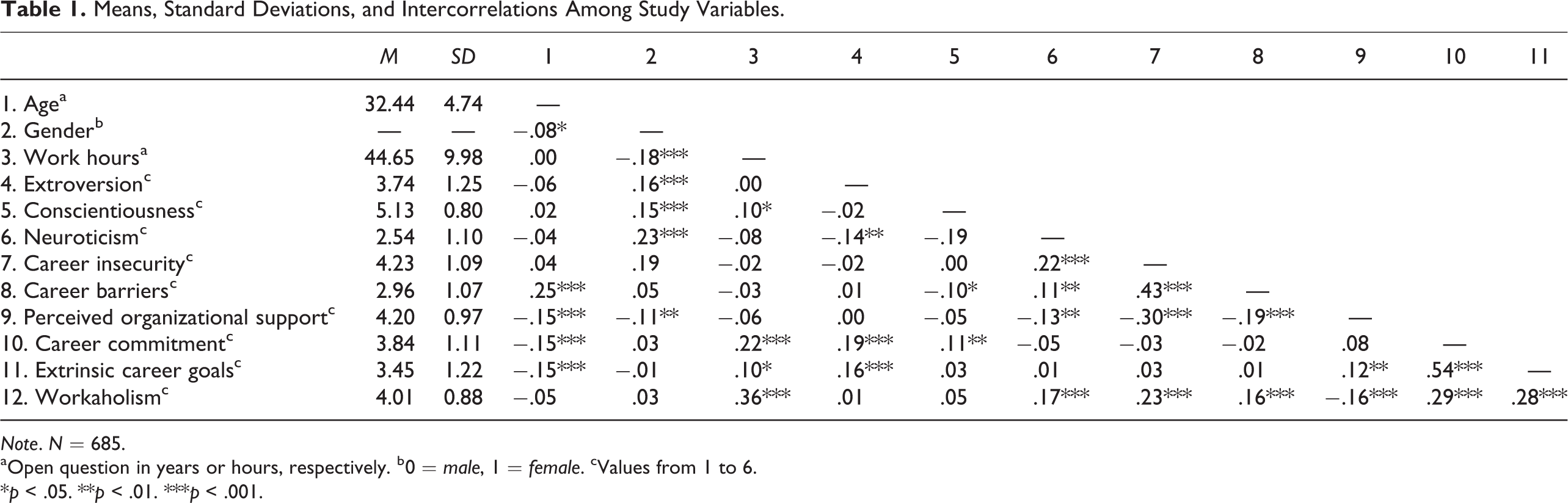
Note. N = 685.
aOpen question in years or hours, respectively. b0 = male, 1 = female. cValues from 1 to 6.
*p < .05. **p < .01. ***p < .001.
Hypotheses Testing
Results of the hierarchical regression analyses are presented in Table 2. We found a significant, positive relationship between career insecurity and workaholism (β = .13, p < .001). Thus, Hypothesis 1 was supported. As predicted in Hypothesis 2, we found that career barriers and workaholism were positively related to each other (β = .09, p < .05). Perceived organizational support was found to be negatively related to workaholism (β = −.10, p < .01). Thus, Hypothesis 3 was also supported. Confirming Hypothesis 4, career commitment showed a significant, positive relationship with workaholism (β = .13, p < .01). As Hypothesis 5 predicted, the regression coefficient of extrinsic career goals on workaholism was significant and positive (β = .15, p < .001). In sum, individuals who feel insecure about their career perceive more career-related barriers, identify with their career, and set themselves high extrinsic goals work more compulsively and excessively. However, individuals who feel supported by their organization work less compulsively and excessively.
Results of the Stepwise Hierarchical Regression Analysis Predicting Workaholism by Career Variables.
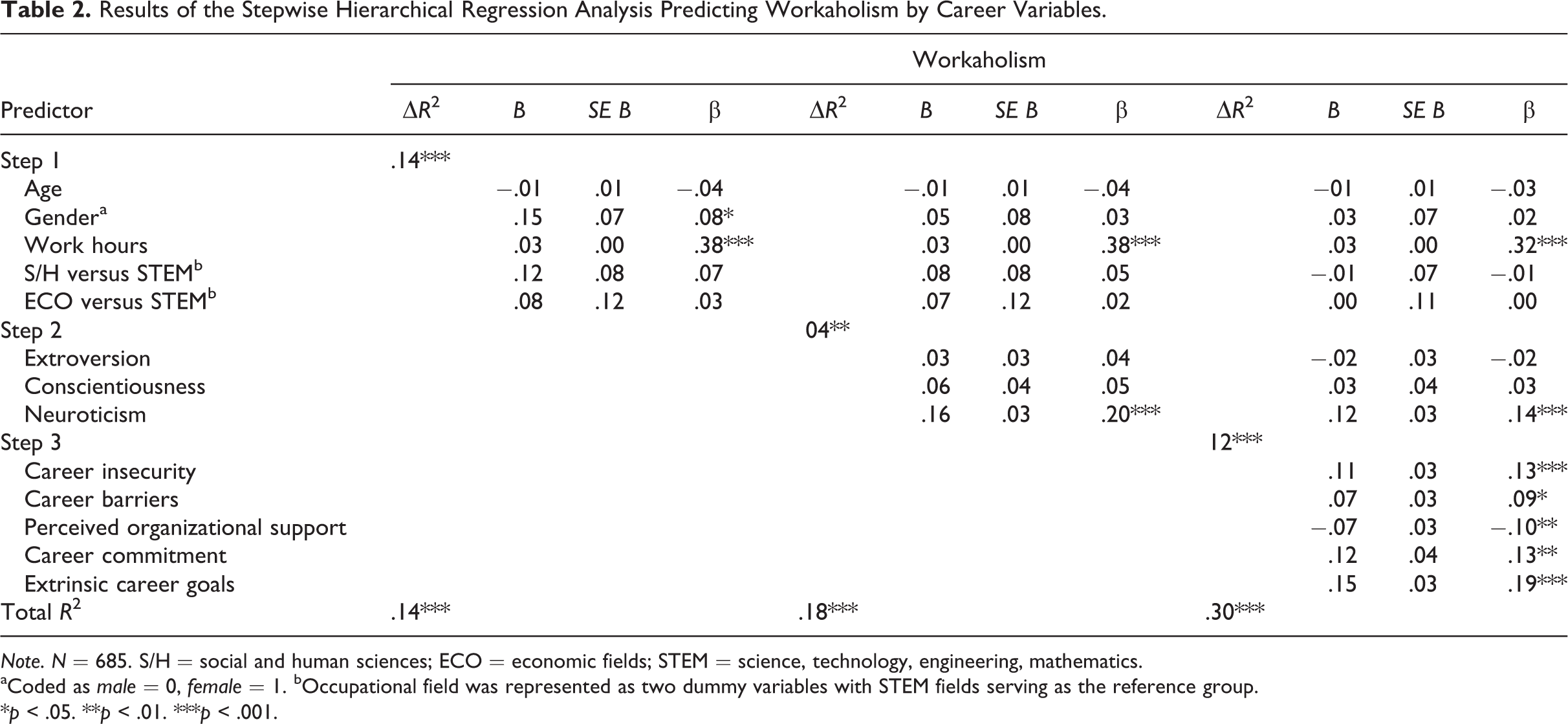
Note. N = 685. S/H = social and human sciences; ECO = economic fields; STEM = science, technology, engineering, mathematics.
aCoded as male = 0, female = 1. bOccupational field was represented as two dummy variables with STEM fields serving as the reference group.
*p < .05. **p < .01. ***p < .001.
We predicted that career variables explain unique variance over and above personality (i.e., extroversion, conscientiousness, and neuroticism) in workaholism. As can be seen in Table 2, entering career variables in the hierarchical regression at Step 3 significantly increased the amount of explained variance in workaholism (ΔR 2 = .12, p < .001). Thus, Hypothesis 6 was also supported. The set of career variables explained 12% of additional variance above and beyond controls and personality variables in workaholism. Finally, regarding effect size, we also calculated Cohen’s f 2, which is an accepted effect size calculation in multiple regression and is based on the explained variance of multiple predictors in the regression model (cf. Selya, Rose, Dierker, Hedeker, & Mermelstein, 2012). The f 2-value for the multiple regression of career variables beyond controls and personality was .14, which is located slightly below the lower bound of a medium effect size of .15 (Selya et al., 2012).
Additional Results
Regarding personality variables, the following effects were found in Steps 2 and 3 of the regression models. Extroversion and conscientiousness were neither related to workaholism at Step 2 nor at Step 3. We found significant positive effects of neuroticism on workaholism (Step 2: β = .20, p < .001; Step 3: β = .14, p < .01). Hence, neurotic people work more compulsively and excessively than nonneurotic people. Above control variables, extroversion, conscientiousness, and neuroticism explained 4% of variance in workaholism (ΔR 2 = .04, p < .01).
Regarding the control variables, in the first step of the regression, women showed higher values of workaholism than men (β = .08, p < .05). However, this effect disappeared in the second step after controlling for personality. Work hours were positively related to workaholism in all steps of the regression, with a stable positive effect in Step 3 (β = .32, p < .001). Interestingly, age and occupational field were not related to workaholism (first step: β = −.04, β = .07, β = .08, all ns, respectively).
Discussion
In this study, we tested whether personal and contextual career variables are related to workaholism. We built our assumptions upon a model on the basis of conservation of resource theory and social identity theory. Results provided support for our hypotheses and showed that career insecurity, career barriers, career commitment, and extrinsic career goals were positively, and perceived organizational support was negatively associated with workaholism. Moreover, the set of career variables explained a significant portion of variance in workaholism beyond controls and extroversion, conscientiousness, and neuroticism. This leads to a first implication that a career perspective on workaholism adds meaningful and independent insight to our understanding of workaholism.
Regarding conservation of resource theory, Gorgievski and Hobfoll (2008) already extended the application field of the theory from burnout to work engagement and explained how resource loss and resource gain might be related to working with engagement. Ng and Feldman (2014) applied conservation of resource theory to explain and test which variables are related to objective career success in terms of salary. In our study, we integrated and further extended earlier applications of conservation of resource theory to the field of careers and workaholism. Specifically, results of our study provide a first impression that conservation of resource theory is well suited to explain effects of career-related stressors (i.e., career insecurity and career barriers) and organizational career resources (i.e., perceived organizational support) on workaholism.
Regarding social identity theory, Ng and Feldman (2008) applied the theory to analyze a set of occupational variables (i.e., work centrality and organizational commitment) in relation to long work hours. We supplemented their reasoning by considering career identity a specific type of social identity and found comparable results. For example, the significant positive relationship between career commitment and workaholism may be partially based on the same psychological processes as the correlation of work centrality with long work hours in the study of Ng and Feldman (2008). In both cases, the results suggest that individuals work long hours (or compulsively and excessively) because of their occupational or career identity, which needs to be reinforced.
Because our study results also can be explained by career-related theories, namely, social cognitive career theory and theory of work adjustment, our study also makes a theoretical contribution to career research. To our knowledge, this is the first time that these two theories were conceptually and empirically related to heavy work investment. Assuming that a value-reinforcer correspondence might lead to heavy and sometimes destructive forms of work investment is meaningful and important, because it suggests that there might be potentially harmful consequences of such a correspondence. The finding that career barriers positively relate to workaholism can be explained by social cognitive career theory in the way that barriers can act as perceived challenges that motivate effort in career development. However, the theory also assumes that some people might react with lowered investment when experiencing barriers, specifically if barriers are not interpreted as challenge. Future research could investigate moderation variables for the relation between career barriers and workaholism, for instance, avoidance versus approach orientations.
With regard to former research on our predictor variables, our study provided also some new insights. It seems relatively clear that career insecurity is detrimental for well-being and positive career development (Höge et al., 2012; Spurk et al., 2016). Our study suggests that workaholism might be one explaining variable for other negative consequences of career insecurity. The same might be the case for career barriers. Regarding perceived organizational support, we could add another positive consequence (reduced workaholism) to the nomological net (Rhoades & Eisenberger, 2002). However, in case of career commitment and extrinsic career goals, our findings suggest that too much of a salient career identity might also be detrimental in terms of compulsive and excessive working, which in turn might lead too other negative long-term consequences. This finding fits well into other research that found that extrinsic career goals and materialistic life goals are negatively related to career and life satisfaction, respectively (Abele & Spurk, 2009; Kasser & Ryan, 1996).
In addition to the main findings of our study—that a set of career variables are associated with workaholism—we noticed results that are equally important for career and workaholism research. First, we found that the set of career variables explained a moderate amount of variance in workaholism beyond controls and personality (i.e., 12%), so that it seems to be meaningful to incorporate a broader career perspective in research about predictors of workaholism.
Second, contrary to other research (Clark et al., 2016), in our study, women showed slightly more workaholism than men (independently from work hours). However, this effect disappeared after including personality and career-related variables. This finding suggests that other correlates of gender are more important than gender itself. In light of this, women showed higher levels of neuroticism and lower levels of perceived organizational support. The latter two variables also showed significant relationships with workaholism.
Third, the career-related variables showed consistent relationships with age. It seems that older workers face disadvantages because of higher career barriers and lower perceived organizational support. Both should predestine them for more workaholism. However, older workers also showed lower levels of career commitment and extrinsic career goals. Both should lead to less workaholism. In sum, processes for and against workaholism might have been resulted in a nonsignificant correlation of age and workaholism in our sample.
Practical Implications
The results of our study provide some important insight that may be used for individual and organizational career management as well as for occupational health programs. Individuals should be aware of the fact that personal and contextual career variables might affect their workaholism cognitions and behavior. Although workaholism might be helpful in the short term for overcoming career obstacles and career insecurity, or for attaining personal career goals, in a mid- to long-term perspective, negative consequences emerge (Naughton, 1987; Ng et al., 2007). Therefore, individuals and career counselors should be aware of potential antecedents of workaholism with the aim to reduce workaholism by modulating the sources. Our findings suggest that interventions related to career stressors, career perceptions, and career attitudes might be fruitful for the treatment of workaholism (Naughton, 1987). This is especially important because context-dependent career-related variables usually are more easily changed compared to more stable personality characteristics, such as the Big 5 (Muck et al., 2007). Besides general career intervention strategies that tap the here identified antecedents (e.g., goal modulation and identity clarification), career intervention that are specifically fitted to the reduction of workaholism need to be developed and evaluated.
Organizations should also be aware of the possibility that the organizational environment and organizational career systems might affect the workaholism of their employees. This is important because frequent workaholic behavior and related processes might also affect organizational functioning via lowered employee performance, higher counterproductive work behavior, and health-associated productivity losses (Clark et al., 2016; Sussman, 2012). Organizational climate (e.g., competitiveness) and career tournament systems (e.g., “winner takes all” systems; Frank & Cook, 1995) might be influential factors on our studied career variables and could be considered for effective organizational interventions with the aim to reduce workaholism.
Limitations and Future Research
As the study is based on cross-sectional data, no assumptions of causality can be drawn from the results (Kline, 2011). This is an important issue, because we conceptualized a study that deals with precursors of workaholism. Therefore, we carefully based our assumptions on well-evaluated theories in this field. Both theories (conservation of resource and social identity) were already used to explain antecedents of work engagement and heavy work investments (Gorgievski & Hobfoll, 2008; Ng & Feldman, 2008). Nonetheless, it might be possible that workaholism also affects some of the analyzed predictor variables. For instance, it might well be that individuals with high workaholism also develop a higher career commitment. While this study cannot directly assess such possibilities, we provided a career-related extension of the nomological net of workaholism.
Although the constructs of workaholism and career-related variables included here, as well as personality, can be considered distinct from each other, common method bias cannot be ruled out because all variables were collected as self-report data at the same time (Podsakoff et al., 2012). Moreover, the internal consistency of conscientiousness was below .70. Although this is common in the use of the TIPI, we were not able to use longer personality measures because of space restrictions in the survey. Therefore, future studies with similar topics should include more reliable personality measures. Although we found effects of a set of career-related variables on workaholism that in sum formed an effect of medium size with regard to explained additional variance, the βs of the single career variable effects were rather small. However, because workaholism is a multidriven phenomenon, we did not expect large effect sizes.
In terms of generalizability, an extrapolation of the findings to other occupational groups should be avoided. However, it seems plausible that the here found effects are valid within other occupational groups with similar education levels (i.e., academics). Regarding the interpretation of our findings, the here used sample stemmed from a normal, nonclinical working population. However, some components of workaholism are related to psychopathology. In our study, it remains unclear if the analyzed antecedents also relate to severe, pathogenic forms of workaholism. Therefore, future studies could analyze career variables and workaholism in more specific samples, such as career counseling clients or samples with severe forms of workaholism.
Finally, regarding future research, we recommend to continue research on career-related outcomes of workaholism and to develop a comprehensive model of career variables and workaholism with predictors, outcomes, mediating, and moderating variables (e.g., Ng et al., 2007). It would be also interesting to further investigate these relationships in a longitudinal design, in order to analyze precursors and outcomes of short- and long-term effects. Moreover, for career research, it might be interesting to study moderating effects of career stage. For instance, it might be that workaholism relates differently to career variables in later career stages because intrinsic work orientations become stronger and working excessively obtains another meaning compared to the early career stage.
Footnotes
Acknowledgments
We would like to thank Anneke Dubbel, Luisa Barthauer, Vivien Estel, and the whole project team for their help in project work, data collection, and comments on previous versions of the article.
Declaration of Conflicting Interests
The author(s) declared no potential conflicts of interest with respect to the research, authorship, and/or publication of this article.
Funding
The author(s) disclosed receipt of the following financial support for the research, authorship, and/or publication of this article: This research was supported by a grant from the German Ministry of Education and Research (BMBF, Number: 16FWN005).