



Abstract
To examine the factors that keep prospective clients from pursuing career counseling, the career-planning belief model (CPBM), consisting of five career planning-related belief types that are based on the health belief model principles, and the accompanying Career-Planning Belief Questionnaire (CPBQ) were developed. Study 1 (n = 200) presents the development and the psychometric properties of CPBQ. In Study 2 (n = 330), confirmatory factor analysis indicated that the proposed model provided a good fit to the data. Additionally, the CPBM predicted intentions to seek career counseling: Higher anticipated effectiveness of career counseling, higher perceived severity of career-planning difficulties, and higher motivation to invest efforts in career-adjustment activities were positively associated with intentions to seek career counseling. Perceived benefits or obstacles to help seeking were not predictive of intentions. The findings suggest methods by which prospective clients may be encouraged to seek career counseling and implications for career counseling.
Choosing a career, a key developmental challenge during adolescence and young adulthood (Super, 1980), is considered a complex task, occasionally accompanied by distress and confusion (Fouad et al., 2006). Although some young adults make a career choice without any apparent problems, many others face difficulties prior to or during the decision-making process (Amir & Gati, 2006). Much of the confusion experienced in this process derives from an abundance of career alternatives and an exposure to an immense quantity of both relevant and irrelevant information (Levin & Gati, 2015). Although being undecided during young adulthood does not always require professional help (Krumboltz, 1992), it is still unclear why only a small fraction of those who experience career indecision seek professional help and utilize career counseling services (Fouad et al., 2006). This underuse of career counseling services occurs in spite of strong evidence supporting its effectiveness (Perdrix, Stauffer, Masdonati, Massoudi, & Rossier, 2012). Moreover, a recent study has reported that young adults are inclined to seek help from nonprofessional sources (such as parents and friends) rather than to approach career counseling professionals (Vertsberger & Gati, 2015). Unfortunately, the literature provides only scant insight regarding those factors keeping prospective clients from pursuing career counseling. The scarcity of such findings underscores the importance of understanding the reasons why many individuals who are experiencing career indecision do not use career counseling services. Such an understanding may enable us to design different psychoeducational interventions and marketing strategies, which could facilitate potential clients’ readiness to use career counseling services. In addition, study of precounseling variables might enrich the career counseling intervention itself (Rochlen, Mohr, & Hargrove, 1999).
Studies have shown that perceptions, beliefs, and attitudes have substantial importance for understanding intentions to seek out and engage in career counseling (Ludwikowski, Vogel, & Armstrong, 2009; Rochlen et al., 1999). However, to the best of our knowledge, a comprehensive model that maps and describes the relative impact of various types of beliefs and attitudes on seeking career counseling does not exist. The purpose of the current study was, then, to put forward a theoretically based model, comprised of career-planning–related beliefs that may predict intention to seek career counseling.
As career counseling and psychotherapy share many features (Spokane, 1991), a reasonable strategy for developing such a model would be to adopt principles taken from a popular evidence-based belief model used in the field of mental health––the health belief model (Rosenstock, 1974). Smith (2009) has claimed that applying this model to the problem of underutilization of mental health care services represents a creative and useful conceptual framework. This well-established sociocognitive model assumes a rational decision-making process when facing health-related problems, predicting help-seeking behaviors as well as adherence to treatment in personal counseling and psychotherapy settings. The rationale behind this model is that the individual’s motivation and decision of whether to act or to avoid any action to solve a health-related problem (physical or mental) is affected by the individual’s set of beliefs about the potential value and reward provided by that action (Becker, 1974). In the current study, we have applied the health belief model’s principles to a career developmental context, acknowledging both the features shared by career counseling and psychotherapy, as well as the career counseling’s distinctive aspects (Lewis, 2001).
The Health Belief Model and Help Seeking in a Mental Health Context
The health belief model (Rosenstock, 1974) comprises five health-belief types, assessing the likelihood of individuals to take action regarding a recommended health activity (i.e., professional help seeking and compliance to the treatment regimen). The beliefs are acquired on the basis of individuals’ perception of their personal vulnerability, the extent of threat perceived by a given condition, and the perceived reward associated with the problem’s removal (Becker, 1974; Rosenstock, 1974).
Accordingly, the health belief model proposes that five types of health-related beliefs would affect behavior when facing a health-related problem: (a) perception of the problem’s severity; (b) perceived benefits of solving the problem; (c) anticipated effectiveness of the intervention; (d) perceived obstacles involved in solving the problem, further divided into three categories: pragmatic (cost, distance, and time), self-exposure, and stigma associated with treatment; and (e) motivation to cope with the problem and improve health.
The health belief model’s principles have been tested and confirmed in numerous studies as predictors of health-related behaviors, specifically, help seeking and treatment compliance (e.g., Abraham & Sheeran, 2005). A recent review (Henshaw & Freedman-Doan, 2009) has demonstrated that the best predictors for seeking professional help in a mental health context are the perceived severity of the problem, the anticipated effectiveness of the intervention, and the perceived potential obstacles to obtaining the intervention. However, among individuals suffering severe symptoms, those having positive perceptions regarding the intervention outcome are more likely to engage in psychotherapy, than those holding negative perceptions, especially if potential obstacles are perceived as low. Similarly, a meta-analysis (Carpenter, 2010) has shown that the likelihood of subscribing to a preventive intervention is associated with the individual’s perception of problem severity, intervention effectiveness, and potential obstacles. Other recent studies have reported similar findings. For example, willingness to seek treatment for test anxiety was predicted by perceived treatment effectiveness and perceived potential obstacles (Markman, Balik, Braunstein-Bercovitz, & Ehrenfeld, 2011). A qualitative study using an in-depth interview technique (Akey, Rintamaki, & Kane, 2013) identified several factors explaining why individuals with eating disorders are unlikely to seek professional help. They found that intentions to engage in psychotherapy was lower for those denying having the problem (low perceived severity), those having doubts about the effectiveness of the proposed intervention, and those anticipating many obstacles, such as prejudice against psychotherapy or financial difficulties. To summarize, anticipating intervention effectiveness and potential obstacles have been shown to be the beliefs most predictive of the seeking of psychotherapy, while the effect of perceived problem severity may be contingent on how effectiveness and obstacles are perceived.
The Career-Planning Belief Model (CPBM) and Questionnaire
To the best of our knowledge, the health belief model principles have yet to be applied to the context of career development. Hence, the main goal of the present study was to propose a model that applies the health belief model’s principles to a career developmental context and to test the factors (beliefs) that may influence individuals’ intentions to pursue career counseling. Specifically, our objectives were to develop a CPBM and a psychometrically sound measure of these beliefs that would test the validity of the model. The model would consist of five types of career-health beliefs, reflecting the extent to which individuals are motivated to engage in career-health behaviors, such as planning their own career, and making efforts to attain career adjustment.
The proposed model, the CPBM, comprises five belief types, parallel to those of the health belief model: (a) perceived severity of career-planning difficulties––the individual’s subjective feelings of the severity of career decision-making problems; (b) perceived benefits of engaging in career-planning activities; (c) anticipated career counseling effectiveness; (d) perceived obstacles for seeking career counseling in terms of accessibility (distance and cost), self-exposure, and stigma; and (e) motivation to achieve career-adjustment (being motivated to invest efforts to achieve a successful and satisfying career). The Career-Planning Belief Questionnaire (CPBQ—see Method section) was developed to test the proposed model.
While previous studies have examined some of the components incorporated in the health belief model, researchers have not explicitly investigated career counseling utilization patterns within the health belief model framework. Balin and Hirschi (2010) have demonstrated that, generally, attitudes rather than personality were more predictive of help seeking and that career indecision was positively correlated with engaging in career counseling. However, Fouad and colleagues (2006) reported that students’ career decision-making difficulties were not associated with engaging career counseling services. With respect to the anticipated effectiveness of the career counseling experience, positive attitudes and values toward counseling were associated with intentions to seek career counseling (Di Fabio & Bernaud, 2008; Rochlen et al., 1999). Perceived obstacles have also been reported to be significant: For example, stigma associated with career counseling (Ludwikowski et al., 2009), excessive traveling distance to the career counseling center, and the cost of the intervention have been shown to attenuate participation in career counseling (Di Fabio & Bernaud, 2008).
To empirically investigate the proposed model, we conducted two studies. In Study 1, the development of the CPBQ and its psychometric properties are reported. Study 2 tested the structure and the concurrent validity of the CPBQ. A confirmatory factor analysis was used, and the concurrent validity against the intentions to seek career counseling was assessed.
Study 1: Development and Initial Psychometric Properties of the CPBQ
The CPBQ was constructed using two Israeli samples of freshman college students (N total = 367). The questionnaire was based on the five dimensions of the health belief model (Rosenstock, 1974) and on a review of previous research methods regarding health beliefs in the context of medical and psychological treatment. The actual CPBQ items were based primarily on items from the Test-Anxiety Belief measure (Markman et al., 2011). The items were adapted by two experts (career counseling psychologists) for the career-planning–related beliefs content and on several new items suggested by the two experts. This procedure generated an initial pool of 36 items for the five scales of the questionnaire, reflecting the five dimensions of the CPBM. After constructing the original items, 12 judges––career counseling graduate students––were presented with the definitions of the five belief categories and were asked to classify the items into these five categories; 6 items were revised and 2 were discarded due to a lack of consensus regarding their classification. This procedure was repeated with a second group of 10 graduate students; 4 items were revised and none discarded. The resulting 34 items served as the basis for the first version of the questionnaire, and the psychometric properties of this version was tested with a sample of 167 freshmen students.
The psychometric properties of the questionnaire’s initial version were evaluated by means of a factor analysis and the scales’ reliability coefficients. The principal components analysis, followed by varimax rotation, yielded five factors with Eigenvalues greater than 1.0, accounting for 58.0% of the total variance. Cronbach’s α for the subscales ranged from .58 to .85. Five items with the weakest psychometric properties were discarded on the basis of these analyses, yielding the 29-item final version. In the following sections, we report our findings, based on a second sample of additional 200 college freshmen, using the described 29-item version of the CPBQ.
Method
Participants
The responses of 200 participants were included in the analyses: 174 (87.4%) were women and 25 (12.6%) men (one participant did not indicate gender). The participants were students, ranging in age from 21 to 30 (M = 23.53; SD = 1.46). All participants were college freshmen, mostly Jewish and born in Israel, at a medium-sized public college, majoring in the behavioral sciences, and received course credits for participating in the study. Students having had prior academic study or significant work experience were excluded from the sample.
Measure
Career-planning beliefs
Career-planning beliefs were assessed using the 29-item CPBQ, comprising five subscales reflecting the five dimensions of the CPBM: (a) perceived severity of career-planning difficulties (5 items); (b) perceived benefits of engaging in career-planning activities (5 items); (c) anticipated career counseling effectiveness (7 items); (d) perceived obstacles for seeking career counseling in terms of accessibility, self-exposure, and stigma (8 items); and (e) motivation to achieve career adjustment (4 items). The 29 items of the CPBQ are reported in Table 1. Participants were asked to rate on a 6-point Likert-type scale the degree to which they agreed with each statement (1—totally disagree to 6—completely agree). Each of the five subscale scores comprised the mean of the ratings of the subscale items. Psychometric properties of the CPBQ are presented in the Results section.
Items, Factor Loading, Communality Estimates for the Career-Planning Belief Questionnaire.

Note. n = 200. Reversed items are 7, 10, 16, 19, and 28. The bold-face values represent factor loadings > .40.
Procedure
The participants signed up for the study via the Internet. They attended small-group data collection sessions (10–15 participants each), in which they gave informed consent, were presented with the study’s main goal: research focusing on attitudes toward career counseling. The participants completed the research questionnaire anonymously in the presence of a graduate research assistant. The assistant then gave participants documentation for their participation and provided a debriefing.
Results
Preliminary Analyses
A series of independent t-tests were performed to test for gender differences in the five CPBQ scales (Levene’s test for equality of variances indicated no significant differences across gender for all five scales). Gender differences (after the Bonferroni correction, corrected α = .01) were found only on the scale evaluating motivation to achieve career adjustment; in this scale, women reported higher motivation, M = 3.21, SD = 0.85, than did men, M = 2.76, SD = 0.72, t(197) = −2.48, p = .01, d = −0.35. In assessing gender differences among the five CPBQ scales, the Fisher r-to-z transformation revealed none in any of the scales (all p’s > .25). Therefore, the following analyses are reported across genders.
Psychometric Properties of the CPBQ
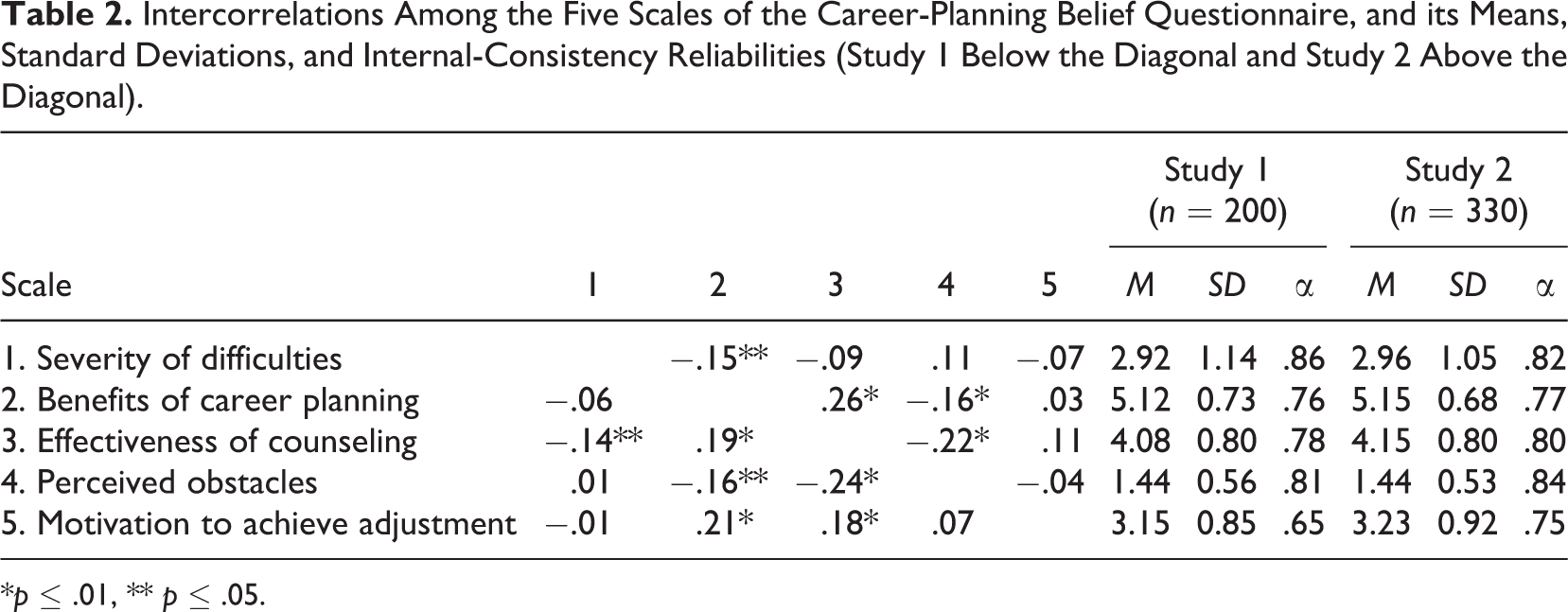
The means, standard deviations, Cronbach’s α internal-consistency reliability estimates for the five CPBQ scales are presented in Table 2. As can be seen, the reliabilities of the CPBQ scales were mostly acceptable (median = .78): .86 for the perceived severity of career-planning difficulties, .76 for the perceived benefits of engaging in career-planning activities, .78 for the anticipated career counseling effectiveness, .81 for perceived obstacles for seeking career counseling, and .65 for the motivation to achieve career adjustment. The matrix of intercorrelations among the five scales is also presented in Table 2 (below the diagonal). The median of the correlations among the scales was null—.00 (interquartile range −.15 to .18), indicating that the five scales did indeed measure distinct constructs.
Intercorrelations Among the Five Scales of the Career-Planning Belief Questionnaire, and its Means, Standard Deviations, and Internal-Consistency Reliabilities (Study 1 Below the Diagonal and Study 2 Above the Diagonal).
*p ≤ .01, ** p ≤ .05.
Exploratory Factor Analysis
To examine the structure of the scales, we submitted the 29 CPBQ items to a principal components analysis using varimax rotation, as the correlations among the factors were negligible. The initial estimation yielded eight factors with eigenvalues greater than 1, accounting for 66.4% of the total variance; however, a scree plot suggested five or six factors. Three criteria were used in selecting the final factor structure: (a) retaining factor loadings that exceeded .40 on only one factor, (b) retaining factors that comprised at least 3 items, and (c) factor interpretability. The eight-factor and the seven-factor solutions comprised fewer than 3 items loading on at least one factor; in the six-factor solution the reverse-coded items from the anticipated career counseling effectiveness scale loaded on the separated extracted factor. Therefore, the five-factor solution was chosen. Table 1 presents the varimax-rotated, five-factor solution with factor loadings ranged from .43 to .85, with all items loading on the theorized factor. The five-factor solution accounted for 54.2% of the total variance: 16.4% for the perceived obstacles for seeking career counseling, 12.3% for the perceived severity of career-planning difficulties, 11.1% for the anticipated career counseling effectiveness, 8.5% for the perceived benefits of engaging in career-planning activities, and 5.9% for the motivation to achieve career adjustment.
Item Analysis and Cluster Analysis
We computed the correlations between each item and the five scale scores (with the item excluded from its scale score). This analysis revealed that all items correlated higher with their own scale than with the remaining scales. The median of the 29 item-scale correlations was .52 (interquartile range .48 to .64), however 2 items had lower item-scale correlation coefficients (i.e., Item 18 from the motivation scale had a .32 corrected item-scale correlation coefficient and Item 8 from the perceived benefits of engaging in career-planning activities scale had a .28 corrected item-scale correlation coefficient).
To further explore the item and model structure, we carried out a cluster analysis on the intercorrelations among the 29 items, using ADDTREE (Version 1.3; Sattath & Tversky, 1977). The analysis indicated that the 29 items were perfectly grouped into the five predicted scales, with all 8 items of the three subscales of perceived obstacles grouped in one factor. In summary, Study 1 demonstrated that the CPBQ had adequate psychometric properties, including good internal-consistency reliabilities. In addition, the structure of the items and the scales revealed high compatibility with the theoretical model.
Study 2: The Relationship Between Career-Planning Beliefs and Intentions to Seek Career Counseling
The goals of Study 2 were (a) to test the factor structure of the CPBQ obtained in Study 1 with another sample, using a confirmatory factor analysis; (b) to evaluate the test–retest reliability of the CPBQ; and (c) to assess the predictive capacity of the CPBM and the CPBQ on which it was based, by testing the CPBQ’s concurrent validity with intentions to seek career counseling.
Relying on the presented empirical evidence, we hypothesized that the model and the CPBQ would predict individuals’ intentions to seek career counseling. More specifically, we expected that anticipated career counseling effectiveness would enhance such intentions and that the perceived obstacles for seeking career counseling would diminish these intentions. As for the effect of perceived problem severity on intentions to seek help, the evidence was equivocal, although generally positively, in its relation to help seeking (e.g., Carpenter, 2010). Moreover, some of the findings suggested that perceived problem severity interacts with anticipated effectiveness and perceived obstacles (see Henshaw & Freedman-Doan, 2009 for a review). Hence, we hypothesized that intentions to seek career counseling services would be predicted by perceived severity of career-planning difficulties and by its interaction with anticipated effectiveness and perceived obstacles. In addition, motivation to achieve career adjustment was expected to enhance intentions to seek career counseling because it reflects higher work-role salience, a factor positively associated with career proactive behaviors (Strauss, Griffin, & Parker, 2012). Finally, we had no specific hypothesis regarding the perceived benefits of engaging in career-planning activities.
Intentions to seek career counseling was measured by a single item that was constructed for the current study, posing a direct question to participants, pertaining to their intentions to seek help were they to have a career decision-making problem. The validity of this measure was examined against 3 items from the Perceived Value of Career Counseling subscale of the Attitudes Toward Career Counseling Scale (ATCCS; Rochlen et al., 1999), reflecting the willingness to use career counseling services when facing a career transition.
Method
Participants and Procedure
The responses of 330 participants were included in the analyses: 274 (83%) women and 56 (17%) men, ranging in age from 20 to 32 (M = 23.52; SD = 1.59); all were college freshmen majoring in the behavioral sciences and participated in the study for course credits. Most of the participants (86%—see Results) had yet to make a definite career choice (as determined by their career decision-making status, derived from their responses on the Range of Considered Alternatives question (Gati, Kleiman, Saka, & Zakai, 2003—see Measures)), and did not have prior academic education or significant work experience, in order to ensure a sample for whom career counseling is relevant. A subset of this sample (n = 115), having agreed to participate in an additional stage of the study, completed the CPBQ for a second time (also in the presence of a research assistant), 4 weeks later, to evaluate the measure’s test–retest reliability. The procedures used in Study 2 were identical to those of Study 1, except for those participants (n = 115) completing the CPBQ twice.
Measures
Career decision status
Career decision status was evaluated with the Range of Considered Alternatives (Gati et al., 2003), a self-report measure aimed at assessing the degree to which individuals have narrowed the range of considered occupational alternatives. The measure requires participants to select one statement from six alternatives which best describes their current career-decision status: (1) “I do not even have a general direction”; (2) “I have only a general direction”; (3) “I am deliberating among a small number of specific occupations”; (4) “I am considering a specific occupation, but would like to explore other options before I make my decision”; (5) “I know which occupation I am interested in, but I would like to feel more confident of my choice”; and (6) “I am already sure of the occupation I want.” The Range of Considered Alternatives has been found useful in measuring progress toward making a career decision (Saka, Gati, & Kelly, 2008).
CPBQ
The CPBQ is described in detail in Study 1, and its psychometric properties are presented in Table 2. As can be seen, Cronbach’s α internal-consistency reliability estimates for the five scales in the present study were mostly comparable to those for Study 1: The median of Cronbach’s α of the five scales for the present study (.80) was similar to that for Study 1 (.78).
Willingness to seek career counseling
This variable was assessed by 3 items from the Value of Career Counseling subscale (8 items) of the ATCCS (Rochlen et al., 1999). These 3 items explicitly address participants’ willingness to contact a career counseling center for counseling were they to face a career dilemma/transition/major choice: (1) “If I were having trouble choosing a major, I would not hesitate to schedule an appointment with a career counselor,” (2) “If a career-related dilemma arose for me, I would be pleased to know that career counseling services are available,” and (3) “If I was in a career transition, I would value the opportunity to see a career counselor.” While participants responded to all of the subscale’s 8 items on a Likert-type 5-point scale, ranging from 1 (disagree) to 5 (agree), willingness to seek career counseling was calculated on the basis of only these 3 items, where higher scores indicate greater willingness. In the current study, the total (8 item) Value of Career Counseling subscale scores and the 3 items were highly correlated (r = .90, p < .001). Rochlen, Mohr, and Hargrove (1999) reported that the Value of Career Counseling subscale has adequate internal-consistency and 3-week test–retest reliabilities (r = .86 and r = .80, respectively) and is significantly associated with attitudes toward seeking professional help (r = .34). The internal consistency of the 3 items in the current sample was .78.
Intention to seek career counseling
Participants received a brief printed description of a typical career counseling intervention in Israel: A career counseling regimen typically comprises one to three sessions with a career counseling psychologist and an option for a career testing and evaluation session. Career counseling is generally granted for a fee. Participants were asked to indicate whether they would use a career counseling center were they to experience difficulties in choosing a career (If you were to have difficulty in choosing a career, would you consider attending a career counseling center?). Response alternatives were “yes” and “no.” The Intention to Seek Counseling Scale appeared in a dichotomous format in order to induce the participants to take an unambiguous position (indeed, as many as 25% of the participants recorded a neutral rating [3] on the Willingness to Seek Career Counseling’s 5-point scale). The convergent validity of the intention scores against the willingness scores was adequate, implying the measure’s validity (the point-biserial correlation was high: r pb = .60, p < .001).
Results
Preliminary Analyses
Participants’ career decision status was derived from their responses on the Range of Considered Alternatives (Gati et al., 2003) and indicated that a large majority of them (about 86%) had yet to make a definite career choice. However, since career decision status and intentions to seek career counseling were not related, χ2(2, n = 300) = 1.19, p = .55, all participants were included in subsequent analyses.
Confirmatory Factor Analysis
To directly test the fit of the sample data to the five-component CPBM model, we conducted a confirmatory factor analysis using the maximum likelihood model of estimation. The following indices were used to provide evidence for the model fit: χ2 goodness-of-fit test (adjusted for df, χ2/df), root mean square error of approximation (RMSEA), comparative fit index (CFI), and standardized root mean square residual (SRMR). Good fit is indicated by an index value of .90 or above for the CFI, .08 or lower for the RMSEA, and .09 or lower for SRMR (Hu & Bentler, 1995, 1999). The findings revealed that the hypothesized five-factor model fit the data marginally, χ2(367) = 1,004.48, p < .001, χ2/df = 2.74, RMSEA = .073 (.067 to .078), CFI = .82, and SRMR = .07. To improve the model’s overall fit, we examined the modification indices. We found that an increase in fit could be achieved by adding three error covariances between: (a) Items 10 and 19 from the perceived severity of career-planning difficulties scale, (b) Items 1 and 22 from the perceived obstacles for seeking career counseling scale, and (c) Items 16 and 28 from the anticipated career counseling effectiveness scale. Inspection of these items indicated considerable overlap in item content, thus justifying the addition of these error covariances. The goodness of fit statistics indicate that the modified model has a good fit, χ2(364) = 691.57, p < .001, χ2/df = 1.90, RMSEA = .052 (.046 to .058), CFI = .91, and SRMR = .07, and that this model fits the data significantly better than the initial hypothesized model, Δχ2(3) = 312.91, p < .001.
All 29 items showed significant loadings (p < .001) on the five factors (interquartile range .54 to .76; median loading = .66). Significant positive correlations were found between the scales of perceived benefits of engaging in career-planning activities and the anticipated career counseling effectiveness (r = .30, p < .001), between the anticipated career counseling effectiveness and the motivation to achieve career adjustment (r = .19, p = .009), between the perceived benefits of engaging in career-planning activities and the motivation to achieve career adjustment (r = .15, p = .036), and between the perceived severity of career-planning difficulties and the perceived obstacles for seeking career counseling (r = .14, p = .030). In addition, significant negative correlations were found between the perceived obstacles for seeking career counseling and the perceived benefits of engaging in career-planning activities (r = −.20, p = .003) and between perceived obstacles for seeking career counseling and the anticipated career counseling effectiveness (r = −.21, p = .002).
Test–Retest Reliability of the CPBQ
First, the representativeness of the sample for whom test–retest data were collected (n = 115; 34.8%) in relation to the rest of the sample (n = 215; 65.2%) was examined. The analyses indicated that the two groups did not differ on gender composition, χ2(1, n = 330) = .02, p = .88; on their career decision status, χ2(2, n = 328) = 2.18, p = .34; on their willingness to seek career counseling, t(328) = −1.51, p = .13); or on their intentions to seek career counseling, χ2(1, n = 302) = 1.09, p = .30.
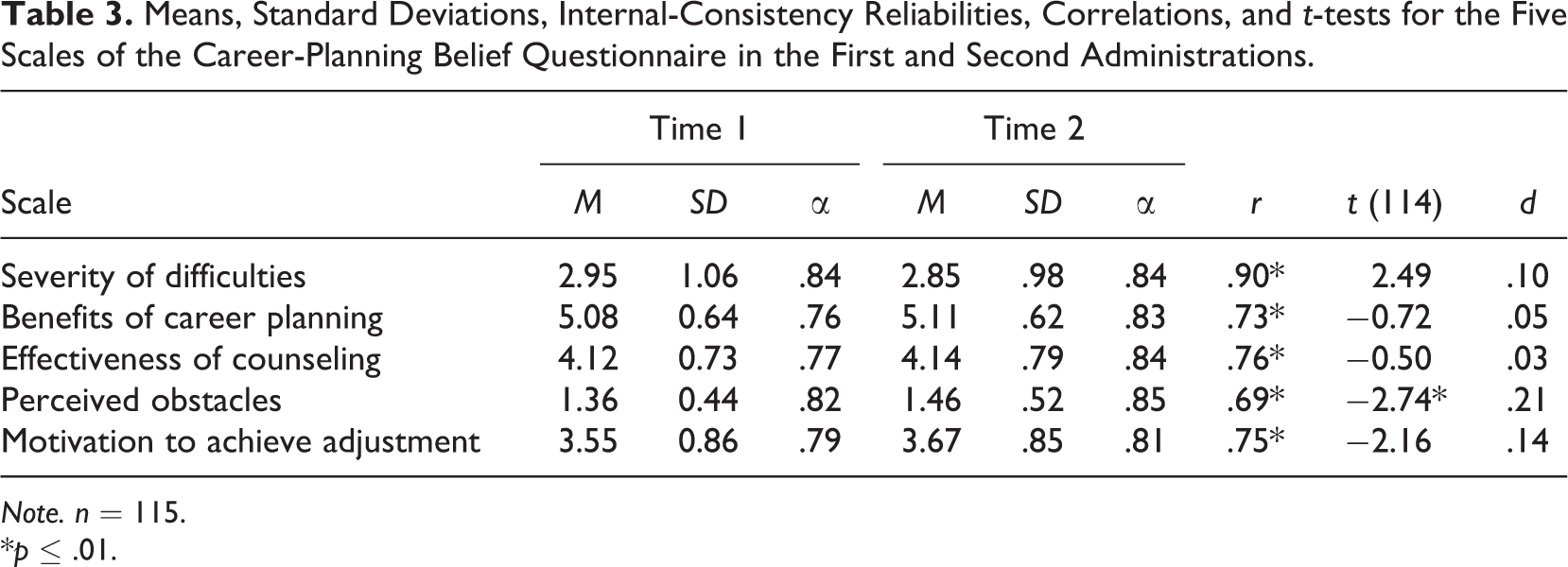
Table 3 presents the means, standard deviations, Cronbach’s α internal-consistency reliability estimates, the rank-order consistency, estimated by Pearson correlations, and the mean-level consistency as reflected by the t-test between the mean scores of the CPBQ scales for 4-week test–retest in a sample of 115 individuals. As can be seen, the test–retest rank-order consistency was high: .90 for the perceived severity of career-planning difficulties, .73 for the perceived benefits of engaging in career-planning activities, .76 for the anticipated career counseling effectiveness, .69 for perceived obstacles for seeking career counseling, and .75 for the motivation to achieve career adjustment. As for the mean-level consistency, no statistically significant differences (after the Bonferroni correction, corrected α = .01) emerged between the mean scores of the CPBQ scales for 4-week test–retest, except for the scale of perceived obstacles for seeking career counseling; the level of perceived obstacles was higher at Time 2 (M = 1.46) than at Time 1 (M = 1.36); t(114) = −2.74, p = .007, d = .21. We then computed the Pearson correlation between Time 1 and Time 2 across the five CPBQ scales for each participant. The median of these within-participant correlations was very high: .97 (interquartile range .94 to .99). These findings can be interpreted as supporting the test–retest reliability of the CPBQ scales.
Means, Standard Deviations, Internal-Consistency Reliabilities, Correlations, and t-tests for the Five Scales of the Career-Planning Belief Questionnaire in the First and Second Administrations.
Note. n = 115.
*p ≤ .01.
Concurrent Validity of the CPBQ
One hundred five participants (31.8%) reported that they would not attend a career counseling center were they to have career-decision difficulties, 197 (59.7%) responded positively, and 28 (8.5%) participants did not respond to the question and were discarded from this analysis.
A logistic regression analysis was performed (n = 302) to assess the predictive value of each of the five belief types of CPBM on intentions to seek career counseling (yes = 1, no = 0). In addition, and conforming to our hypotheses, two interaction terms––the perceived severity of career-planning difficulties with (a) the anticipated career counseling effectiveness and (b) the perceived obstacles for seeking career counseling––were added to this analysis. The logistic regression model was statistically significant, χ2(7) = 98.91, p < .001, indicating that the CPBM (belief types) reliably distinguished between those intending to seek career counseling and those not. The model explained 38.5% (Nagelkerke R 2) of the variance in intention to seek career counseling, and overall, correctly classified 75.8% of the cases.
Table 4 shows the logistic regression coefficients, Wald test, and odds ratio for each of the predictors. As expected, higher anticipated effectiveness of career counseling predicted a higher rate of intention to seek career counseling (Wald = 18.78). In addition, the perceived severity of career-planning difficulties distinguished between those who intended to seek career counseling from those who did not (Wald = 4.43), with those perceiving higher severity more likely to seek counseling. Moreover, the interaction between severity and effectiveness (but not obstacles) predicted intention to seek career counseling (Wald = 6.04). To investigate the meaning of this interaction, participants were divided into two groups, based on the median score (above or below the median) of one of the predictors––the anticipated effectiveness of career counseling––and then, the regression for each group was repeated without the interaction term. This analysis indicated that intentions to seek career counseling in the group anticipating counseling as effective was relatively high (about 85%), regardless of the degree of perceived severity of career-planning difficulties, β = .05, Wald (1) = .04, p = .848, Exp(β) = 1.05, whereas in the group that anticipated counseling as ineffective, the likelihood of intentions to seek counseling was contingent upon perceived severity of career-planning difficulties, so that seeking counseling became more likely as perceived severity increased, β = .45, Wald (1) = 7.38, p = .007, Exp(β) = 1.56.
Logistic Regression of Intentions to Seek Career Counseling With the Career-Planning Belief Questionnaire.

Note. n = 302. CI = confidence interval; SE = standard error.
Table 4 shows that, contrary to our expectations, the perceived obstacles for seeking career counseling did not significantly impact intentions to seek career counseling. Finally, higher motivation to achieve career adjustment (Wald = 7.10), but not perceived benefits, predicted a greater likelihood to seek career counseling.
Discussion
The findings of the current study support the evidence that perceptions, beliefs, and attitudes have a significant role in help-seeking–related behaviors (Ludwikowski et al., 2009; Rochlen et al., 1999). The hypothesized five-belief framework of the CPBM (grounded on the principles of the health belief model; Rosenstock, 1974) was confirmed. Moreover, the model suggests some new insights with respect to the differential effects of belief type on intentions to seek career counseling.
To empirically test the proposed model, the CPBQ was developed, and evidence on this measure’s structural and psychometric properties was obtained. Specifically, the findings support the theoretically based five-component model and demonstrate that CPBQ has adequate psychometric properties. Firstly, the five-factor structure of the original model (i.e., the health belief model; Rosenstock, 1974) was confirmed in Study 1 by means of exploratory factor analysis as well as by cluster analysis and was replicated in Study 2 by a confirmatory factor analysis. In addition, the five scales of the CPBQ had moderate to high internal-consistency estimates and high 4-week test–retest reliability. Therefore, CPBQ can be considered a promising tool for measuring career-planning beliefs and for evaluating their implications on career-related behaviors.
Indeed, the current findings demonstrate that overall career-planning beliefs predict intentions to seek career counseling (the CPBM explained 38.5% of the dependent variable’s variance). This is consistent with one of the original notions of the health belief model, by which certain beliefs may explain the failure of individuals to seek treatment (Rosenstock, 1974), and with previous empirical evidence on the predictive validity of this model for help–seeking–related behaviors in a mental health context (see Henshaw & Freedman-Doan, 2009, for a review). In addition, these findings expand our understanding of the differential effects of belief type on seeking career counseling and reveals which beliefs are the most critical. As expected, greater anticipated effectiveness of career counseling was a reliable predictor of higher intentions to seek career counseling. These findings are consistent with earlier reports pointing to a strong effect of anticipated treatment effectiveness on help-seeking behaviors in both a mental health setting (Akey et al., 2013) and a career counseling setting (Balin & Hirschi, 2010; Rochlen et al., 1999). Supplementing previous evidence (Balin & Hirschi, 2010; Vertsberger & Gati, 2015), the effect of perceived severity of career-planning difficulties on help-seeking intentions was significant, indicating that individuals experiencing career-planning difficulties are more likely to consider seeking help than those not experiencing such difficulties. This tendency is particularly prominent for those who do not anticipate career counseling to be effective. However, contrary to our expectations, perceived obstacles did not predict intentions to seek career counseling. As suggested by Ludwikowski, Vogel, and Armstrong (2009), the specific nature of career counseling may be less likely to elicit the adverse feelings (such as self-exposure or stigma) often characteristic of psychotherapy.
Finally, to the best of our knowledge, the role of motivation for having a satisfying career or of the perceived benefits of career planning on intentions to seek career counseling have yet to be investigated. The current findings indicated that higher motivation was associated with a greater likelihood of seeking career counseling, while the perception of benefits was not. This might indicate that being motivated to engage in proactive behaviors regarding career planning and work adjustment—a possible expression of high work-role salience––is more indicative of intentions to seek career counseling than merely imagining the benefits of having a rewarding career. Indeed, a high level of work-role salience has been shown to be related to career well-being (Noor, 2004).
To summarize, the CPBM can be regarded as a comprehensive sociocognitive framework for understanding the differential impact of career-planning beliefs on intentions to seek career counseling. However, we also need to acknowledge the unique features of the CPBM. Specifically, beliefs reflecting high motivation to become well adjusted in the world of work are crucial for seeking career counseling, in addition to perceived counseling effectiveness and problem severity.
Implications
As the CPBM is a sociocognitive model, implying a rational decision-making process in determining help-seeking–related behaviors, some of the model’s tenets could be incorporated into broader sociocognitive approaches to career development, such as the social cognitive career theory (SCCT; Lent, Brown, & Hackett, 2002). Accordingly, we suggest that the beliefs of the CPBM may be regarded as consequences of learning and modeling experiences (antecedents of perceptions and beliefs, according to SCCT), that along with self-efficacy (a major construct of SCCT) contribute to the inclination to perform SCCT-related behaviors, such as goal setting and actions taken to achieve these goals (e.g., intentions to seek professional help), and shape career adjustment. Indeed, Rosenstock, Strecher, and Becker (1988) have claimed that health self-efficacy––individuals’ expectations about their ability to influence their health condition––is an important factor (in addition to their health beliefs) in determining whether they will engage in help-seeking behaviors.
The conceptual framework of the CPBM can also contribute to the resolution and understanding of some of the capacities which may function as psychological resources in achieving career adaptability. Career adaptability is defined as the amount of individuals’ available resources (commitment, control, curiosity, and confidence) for coping with career-developmental tasks, occupational transitions, and work-related problems (Savickas & Porfeli, 2012). The CPBM beliefs, specifically positive perceptions of career counseling effectiveness and motivation to be well adjusted in the world of work, can be considered as elements comprising such resources, especially regarding commitment. Hence, we suggest that career adaptability might be enhanced when individuals in career transitions hold career-planning beliefs that encourage seeking professional help.
The current findings also have several practical implications. The CPBM may provide a useful framework for conceptualizing career counseling utilization by, for instance, offering career-undecided individuals accurate information regarding basic belief-related questions, such as: (a) How severe are my career-choice difficulties? (b) Will professional help increase my chances of making a good choice? and (c) How motivated am I to take action to succeed and be fulfilled in my career? These questions may be addressed by means of psychoeducational programs, whose aim would be to enhance individuals’ awareness of the severity of career-planning difficulties or of their level of motivation to be proactive in the process. In addition, interactive Internet questionnaires could be made accessible, and explanatory feedback could address individuals’ responses to statements regarding career-planning difficulties and low motivation. Finally, we recommend considering focused marketing strategies and instituting campaigns that may reinforce awareness of how career counseling can address the individual’s particular career needs.
The current findings may have implications for career counseling as well. The CPBQ can be used as a screening tool to evaluate career-planning beliefs and then highlight the particular beliefs of the prospective client that could hinder counseling outcomes.
Limitations and Future Research
Although the current findings extend and refine the previous literature, some limitations must be considered. First, while the conclusions are conceptualized in causal terms, the cross-sectional nature of the data does not warrant exclusively causal effects. A longitudinal study could better substantiate the reasoned causality of the current research, where the beliefs of the CPBM would be monitored over the course of the career-planning process, from early adolescence until a decision is taken and beyond. In addition, the relatively homogeneous sample––especially with respect to gender––could limit the generalizability of the findings and may also have had some consequences on the instrument’s development. All participants were middle-to-upper socioeconomic status Israeli students, mostly female, studying for their bachelor’s degree in the behavioral science program. Future research examining the variables in this study should strive for a more heterogeneous sample, given that gender, age, socioeconomic, and ethnicity differences play a role in help seeking (e.g., Balin & Hirschi, 2010; Henshaw & Freedman-Doan, 2009). Furthermore, the distinctive character of career development among Israeli young adults, due to the 2–3 years of compulsory posthigh school army service (Benjamin, Gati, & Braunstein-Bercovitz, 2011), would be another factor limiting the generalizability of the current sample. Another limitation of the CPBM is its lack of attention to emotional aspects of the decision to seek professional help, viewed by some as having an important role in the process (see Henshaw & Freedman-Doan, 2009, for a review). Therefore, further research should investigate emotional aspects (such as anxiety) in help-seeking behavior in the form of career counseling. Finally, the perceived obstacles score was relatively low overall, suggesting that obstacles were not a salient consideration in the participants’ view of help seeking, which may explain why it did not comprise a significant factor in the final model.
Further validation of the CPBQ with additional career-planning and career-adjustment instruments, such as the Career Adapt-Abilities Scale (Savickas & Porfeli, 2012) and the Career Decision Self-Efficacy Scale (Taylor & Betz, 1983), is also needed. Finally, although intentions have been identified as reliable predictors of behavior (Ajzen & Fishbein, 2005) and attitudes toward counseling predict willingness to use career counseling services (Di Fabio & Bernaud, 2008), we recommend that future research examine actual help-seeking behavior as the dependent variable.
Summary
Over the past decades, researchers have sought to understand the factors underlying the service gap phenomenon––the underuse of psychotherapy and counseling services by individuals in need of psychological help––(Raviv, Raviv, Vago-Gefen, & Schachter Fink, 2009). The need to improve appropriate utilization of career counseling is clear, and the application of the CPBM to the problem of underutilization of career counseling services seems to present a useful conceptual framework. Along with previous studies, the current findings support the substantial role of positive beliefs regarding career counseling in help–seeking–related behaviors. However, while career counseling has been conceived by various approaches as a passive activity of receiving career advice (e.g., Parsons, 1909), the current findings, along with contemporary theoretical approaches (e.g., goal setting in SCCT; Lent et al., 2002; and life designing in career construction theory; Savickas, 2005), suggest that proactive behaviors and high motivation to engage in them are significant for career planning (e.g., intentions to seek help). Finally, the current findings support the notion that career counseling-related variables share common aspects with personal counseling and psychotherapy, alongside those characteristics distinctive to career counseling.
Footnotes
Acknowledgments
The authors thank Itamar Gati and Benny A. Benjamin for their helpful comments on an earlier version of this article and Revital Gabai, Yael Peretz, and Adi Levy for their assistance in data collection.
Declaration of Conflicting Interests
The author(s) declared no potential conflicts of interest with respect to the research, authorship, and/or publication of this article.
Funding
The author(s) received no financial support for the research, authorship, and/or publication of this article.