



Abstract
This article reports the development and psychometric requisites of Design My Future, an instrument assessing future orientation and resilience. Three different studies involving Italian preadolescents were conducted. With the first, the items were developed and the factor structure verified; the second confirmed instrument’s multidimensional structure and evaluated its discriminant validity. The third study was conducted to verify the invariance of factorial structure across gender. Results provide strong psychometric support for Design My Future as a valid measure for analyzing middle school students’ thoughts about their future orientation and resilience and for career education and career counseling activities.
Preadolescents, differently from the past, are currently thinking of their future in a continuously changing context, where linearity of professional trajectories is not any more useful for future planning (Savickas et al., 2009). Additionally, according to international committees, such as the National Intelligence Council (2012), challenges they will be required to face are numerous and demanding due to consequences associated with economic crisis, the rise in urbanism, the aging of population, and the increase in migration flows. Furthermore, technology will be more and more characterized by merging of informatics, biology, materials sciences, and nanotechnologies whose potentials may radically change several aspects of our lives. These disciplines will provide a more accurate monitoring of both environment and individual’s health while increasing at the same time personal safety and taxing issues related to privacy matters. Companies will be, then, required to deal at the same time with a more complex computer competence, with multiethnic populations and with the progressive aging of the workforce (Parhizgar, 2013).
Preadolescents, who for the first time will approach the world of work and are, however, involved in planning their future, will be also required to be prepared to take into account these changes and face them accordingly and to anticipate nonlinear developmental trajectories (Savickas et al., 2009). Additionally, they should be prepared to face unexpected challenges and barriers, activate, and maintain energies and resources (Nota, Soresi, Ferrari, & Ginevra, 2014). According to the Life Design approach (Savickas et al., 2009), there is the need for new competencies, substantially different from the capacities and knowledge required in the past.
Two aspects of this approach, namely, future orientation and resilience are associated with future construct and nonlinear-based actions and planning. Some studies, in fact, evidenced the role which future orientation and resilience may play in promoting more adaptive developmental trends for preadolescents (Masten & Tellegen, 2012; Prenda & Lachman, 2001; Rutter, 2012). The propensity to think about what may happen seems to be then related to the ability of considering themselves as ready to face challenges and treats, without letting themselves be overcome by difficulties and, thus, working to construct their own future (Reivich, Gillham, Chaplin, & Seligman, 2013).
Moreover, future orientation and resilience are related to career adaptability, the set of attitudes and abilities that comprise concern about future, curiosity and exploration, self-efficacy toward personal possibilities, hope, and optimism (Nota, Ginevra, & Santilli, 2015; Savickas, 2013).
Due to the remarkable relevance of these two construct for preadolescents’ career construction, they will be then described more in depth.
Future Orientation
Although future is substantially nonpredictable, human beings have developed the ability to think about and put forward multiple possible future scenarios (Atance & O’Neill, 2001). Future orientation refers to thoughts, ideas, and feelings individuals have on their future (Stoddard, Zimmerman, & Bauermeister, 2011).
Future orientation skills develop throughout adolescence starting from 11 to 12 years old, together with an increase in independence, self-regulation, and personal identity. It is in this period of life that future goals become more detailed, and preadolescents start focusing on educational and professional goals, relating them to the real world (Arnett, 2000). Future orientation and thinking of possible futures are related to behavioral flexibility and more effective planning for achieving goals (Schacter, Addis, & Buckner, 2008). It seems, then, crucial in future decision making and an integral part of our self-construction (Conway, 2005).
Currently, environmental risk factors, such as the economic crisis experienced by Western industrialized countries, may inhibit the development of future orientation in preadolescents (Stoddard et al., 2011). According to Stoddard and colleagues (2010), for instance, lack of future orientation may lead to a lack of hope toward themselves and their future. Due to a limited future orientation, preadolescents may also perceive their actual behaviors as disconnected from their future goals, thus facilitating and fostering a propensity toward risk behaviors. Robbins and Bryan (2004) found that youths characterized by limited future orientation were more likely to use marijuana, had more alcohol-related problems, including higher frequency and quantity, and a limited perception of risks associated with alcohol and drug use behaviors (Steinberg, 2007). Additionally, Adelabu (2008) found that youths with lower levels of future orientation had lower academic achievement and school functioning than youths with higher future orientation. As far as gender is concerned, results in the literature suggest that boys and girls are characterized by similar values when taking into account their future orientation (Anthis, Dunkel, & Anderson, 2004).
Finally, preadolescents who are future oriented and link their future to past and present experience are more protected against impulsive and unhealthy behaviors because this attitude increases the ability to foresee negative consequences of their actions and behaviors (Luyckx, Lens, Smits, & Goossens, 2010) and hence to refrain from those actions. As such, these individuals both in academic achievements and in their careers tend to be more successful than present-oriented individuals (Simons, Vansteenkiste, Lens, & Lacante, 2004).
To measure future orientation, the Consideration of Future Consequences (CFC) Scale (Strathman, Gleicher, Boninger, & Edwards, 1994) and the Zimbardo Time Perspective Inventory (ZTPI; Zimbardo & Boyd, 1999) are generally referenced in the literature. Both instruments have been developed for adolescents or adults. The CFC is a 12-item scale that assesses the tendency to consider potential future outcomes of current behaviors. The 56-item ZTPI measures an individual’s preferred time perspective (past positive or negative, present fatalistic or hedonistic, and future). In addition, as far as we know, this ZTPI is the only instrument adapted to the Italian context (Laghi, Baiocco, D’Alessio, & Gurrieri, 2009) and available to assess time perspective in adolescents and adults.
Resilience
Resilience, as originally suggested by Holling (1973), refers to the return rate to equilibrium upon a perturbation to the capacity of ecosystems characterized by alternative attractors to persist in the original state subject to perturbations (Scheffer, 2009). More recently, Masten and Obradović (2006) defined resilience as the ability to resist or quickly recover strengths and energy and to “set themselves in motion” while challenges are threatening stability, vitality, and development.
Resilience has been then more frequently conceptualized as one of the competencies individuals will most require in our society in order to prepare themselves in facing emergencies or “turbulences” (Folke et al., 2010). Norris, Stevens, Pfefferbaum, Wyche, and Pfefferbaum (2008) consider resilience as a protective and helpful factor when facing risks. According to them, risk is a permanent condition; it requires, then, being aware that, although devoting considerable efforts, it will not always be possible to activate coping strategies in time and for any potential threat.
Nowadays, several threats and high levels of risks are related to social and work uncertainties, which motivate an attention to work resilience. Resilience is then considered not only in terms of propensity to face extraordinary and traumatic events, as it was the case in the past, but also as a useful means in order to face future uncertainties and challenges (Sapienza & Masten, 2011). Throughout development, hence also during middle school, preadolescents are expected to become more and more capable of taking into account risks and changes as specific aspects of the “at risk society” in which they live, as shown for instance by the capability of easily recovering when “things go wrong” (e.g. diseases, unforeseen situations, or failures) and considering themselves able to tackle everything that may happen, even under pressure to be able to concentrate (Theron & Donald, 2013). Additionally, according to Tusaie, Puskar, and Sereika (2007), 14- to 18-year-old adolescents’ thoughts show also a relationship between the resilience they perceive when facing adverse situations and their levels of optimism. More specifically, it seems that resilience in adolescents is partially related to positive responses to the ability of asking for support (Donald & Clacherty, 2005).
Several studies in the literature also evidence gender differences showing a higher level of resilience in boys (Connor & Davison, 2003; Yu et al., 2011). This difference might be easily associated with stereotypical context-related values according to which boys are forced to assume “never living up” behaviors or being otherwise considered of a low masculinity. Furthermore, resilient young people exhibit higher levels of adaptive competences: academic achievement, peer relations, and conduct such as compliance or following rules versus aggressive or disruptive behavior (Masten & Tellegen, 2012). Masten and colleagues, using age-appropriate instruments, measured the adaptive function of resilience and found that both adolescents and adults showing higher levels of resilience are characterized by higher levels of adaptive behavior in work, romantic relationships, parenting, and higher civic engagement (Masten & Osofsky, 2010; Masten et al., 1999).
Several quantitative instruments are referenced in the literature to assess resilience from childhood to adolescence (for more information see Windle, Bennett, & Noyes, 2011), and only two measures are available to the Italian context: The Italian version of the Resilience scale for Adolescents (READ; Hjemdal, Aune, Reinfjell, Stiles, & Friborg, 2007) developed by Stratta and colleagues (2013) for students aged from 18 to 20 years and the Dispositional Resilience Scale-15 (Bartone, 2007) for adults, adapted by Picardi et al. (2012). Most of the measures developed assess the ability to recover and cope with current difficulties and reflect a sense of personal agency in adolescents and adults so that Windle, Bennett, and Noyes (2011) highlight the absence of a conceptually sound and psychometrically robust measure of resilience for children and preadolescents (under 12 years old). Moreover, no one focuses on possible future difficulties and uncertainties.
Research Aims
There are several reasons for which we decided to develop a new measure.
First of all, no measure exists to assess both future orientation and resilience in one instrument with the preadolescent population. Taking into account suggestions on the relationship between future orientation and resilience (Folke et al., 2010), the evidence that adolescents are currently required to develop their future goals before the problem of choice is urgent and the emphasis of Life Design approach on prevention, we consider it particularly important to evaluate these two constructs in a single instrument, saving time.
Second, the few available measures to assess time perspective and resilience in the Italian context are adaptations of international assessment instruments. Developing a measure that assesses both constructs may be particularly important for Italian preadolescents, as they are required at 13 years old to make a decision about high school education. Generally, they have three options: lycee that prepares for college, technical schools, and vocational schools. A measure such as that proposed may help to identify those students who need support in their decision-making process and to implement preventive actions.
With the aim of developing an Italian measure that is closer to our context, three studies with three independent groups of preadolescents were conducted to assess the validation and the reliability of the instrument Design My Future. The first study was carried out in two phases, first, to develop statements to tap the construct and secondly, to verifying the instrument’s psychometric requisites, such as reliability and construct validity. The second study examined the factorial structure’s stability and the instrument’s discriminant validity. The third was intended to verify the factorial structure’s gender invariance.
Study 1: Scale Construction and Exploratory Factor Analysis
The first study’s goals were (a) to generate a range of items to represent the dimensions of future orientation and resilience in the first phase and (b) to examine factorial structure and reliability of the questionnaire Design My Future in the second phase.
Phase 1
To develop items that assess future orientation and resilience, we reviewed the literature by searching for relevant key words such as “future” “resilience” in PsycINFO and Web of Science databases. Thirty items were identified on the basis of the definition of the constructs focusing on future orientation and resilience. In the first steps, we created 15 items for the future orientation scale and 15 items for the resilience scale. Content validity of the items was assured by creating items that closely resembled existing items from established scales. Two independent expert raters, with experience in questionnaire construction and the constructs examined, evaluated the items in terms of clarity of wording, construct representativeness, and the extent to which item differences were clear. A 5-point scale was selected as the response format, with 1 indicating a low level (It describes me not at all) and 5 indicating a high level of future orientation and resilience (It describes me very well). A pilot study conducted on 20 (10 boys and 10 girls) middle school students (M age = 12.70, SD = .47) ensured items were appropriate and comprehension adequate for 13 items of the time perspective scale and 8 items for the resilience.
Phase 2
We anticipated a factorial structure representing the two dimensions, future orientation and resilience, and to achieve internal consistency indices of atleast .70 (Nunnally & Bernstein, 1994).
Method
Participants
Participants were 802 Italian middle school students, 449 boys and 353 girls, aged 11–14 years (M age = 12.83, SD = .49).
Instruments
The preliminary version of the 21-item Design My Future, developed as described earlier, was used to analyze future orientation and resilience.
Procedures
Design My Future was included in a survey administered to middle school students who voluntarily participated, with their parents signing the consent form for career counseling and vocational guidance activities which were implemented at middle school. They were also told their answers would be used to draw up personalized reports they would receive confidentially.
Results
Preliminary Analyses
An examination of the asymmetry and kurtosis values revealed all 21 items were satisfactory (all values were ≤1).
Construct Validity
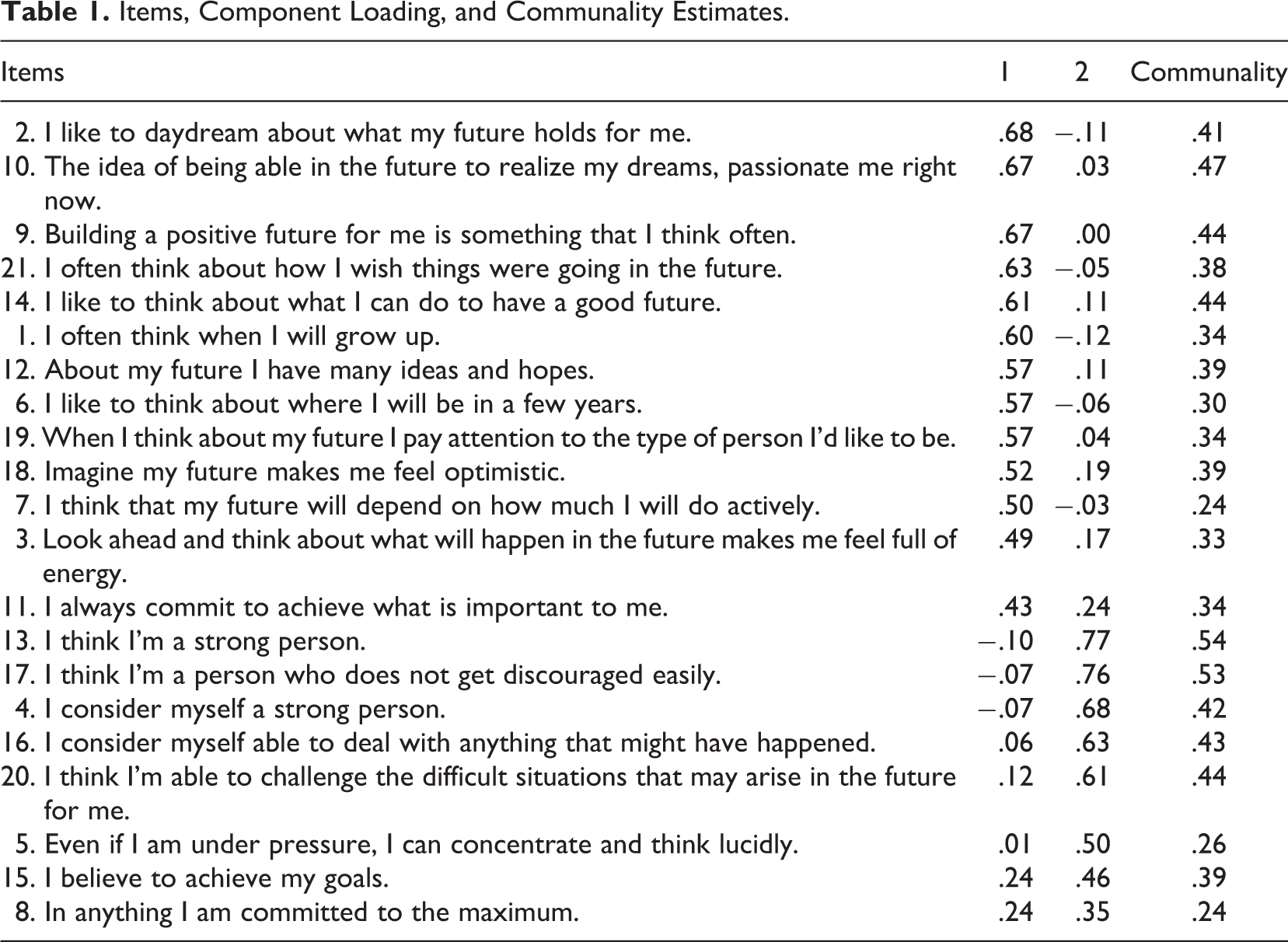
A principal axis factoring (PAF) analysis was conducted on the 21-item scale to estimate the number of factors. The factorability was supported by Bartlett’s test of sphericity, χ2(210, N = 802) = 5374.99, p < .0001, and the Kaiser-Meyer-Olkin measure of sampling adequacy of .93 (Tabachnick & Fidell, 2001). Parallel analysis (Horn, 1965) and scree analysis of the eigenvalues were used to determine the number of factors to extract from the data. Specifically, parallel analysis was conducted using 100 randomly generated samples composed of an identical number of participants and items as in the current study. Both the scree plot (Cattell, 1966) and parallel analysis tests (Horn, 1965) suggested an initial two-factor solution that was subsequently carefully examined with an EFA with an oblique rotation (direct oblimin) because factors were expected to be correlated. The final run of PAF on the two-factor oblique solution with 21 items accounted for 38.50% of total variance (see Table 1). The first factor was composed of 13 items, accounted for 22.79% of the variance, and referred to as future orientation. The second factor was composed of 8 items, accounted for 15.72% of the variance, and concerned resilience.
Items, Component Loading, and Communality Estimates.
Descriptive Information
Means and SDs of each factor were as follows: future orientation: M = 46.84, SD = 9.23; resilience: M = 26.12, SD = 5.41.
Floor and ceiling effects were analyzed with SPSS version 22 and considered to be present if more than 15% of the respondents achieved the highest or lowest possible score in each factor. None of the middle school students had a worst possible score for the factor future orientation and 7 (0.87%) had a maximum possible score; for the factor resilience, 1 (0.12%) middle school student had a worst possible score and 1 (0.12%) had a maximum possible score.
Intercorrelations Among Factors
The intercorrelation among the two factors was .56.
Internal Consistency
Cronbach’s α internal consistency reliability for the two factors were as follows: future orientation .88 and resilience .83.
Discussion Study 1
The preliminary analysis showed satisfactory discriminant validity for all items. Moreover, construct validity expectations were confirmed and the exploratory factor analysis identified two factors with factor loadings of >.35. The factors were strongly interrelated (.56) and showed good levels of internal consistency (.88 and .83). In addition, means and SDs suggested the absence of ceiling or floor effects, and SDs reflected variation in the adolescents’ responses around the midpoint (Terwee et al., 2007). Thus, the initial results from Study 1 suggested that Design My Future is a psychometrically adequate instrument with two distinct constructs and seem appropriate for use with a broad range of Italian preadolescents.
Study 2: Confirmatory Factor Analysis and Discriminant validity
The goals of Study 2 were (a) to test the multidimensional structure of Design My Future using confirmatory factor analysis with the maximum likelihood estimation method (K. Jöreskog & Sörbom, 2004) and (b) to evaluate its discriminant validity.
With respect to our first aim, we compared two models for Design My Future internal structure: the hypothesized model and one alternative model. The hypothesized model (H: 21-2) predicted that items clustered into two factors. The alternative model hypothesized that all 21 items corresponded to a single factor. We predicted that the 21-2 model would fit the data better than the alternative model.
Our second goal was to examine the discriminant validity of the instrument, as related to career adaptability and life satisfaction. More specifically, we predicted positive low or moderate correlations between future orientation and resilience with career adaptability and life satisfaction.
Method
Participants
The sample comprised 342 Italian middle school students, aged 11 to 14 years (M age = 12.53, SD = .76), made up of 178 (52%) boys and 164 (48%) girls. Students were involved using the same procedure adopted in Study 1.
Measures
The Satisfaction With Life Scale (SLS)
It is a 5-item scale used to assess global life satisfaction. Total score ranges from 5 to 25, with higher scores indicating greater satisfaction with life (Diener, Emmons, Larsen, & Griffin, 1985). An example of an item is “I am satisfied with my life.” In a study carried out to adapt and validate the Italian version of the scale, I. Di Maggio (2014) observed a monofactorial structure, accounting for 55.73% of the total variance and Cronbach’s α of .80. In this study, Cronbach’s α was .75.
Career Adapt–Abilities Scale (CAAS-Italy for pre-adolescents)
It consists of 24 items, the same as in the Career Adapt–Abilities Scale-International Form 2.0 and Italian-Form (G. Di Maggio, Ginevra, Nota, Ferrari, & Soresi, 2013; Savickas & Porfeli, 2012; Soresi, Nota, & Ferrari, 2012). Participants responded to each item on a scale ranging from 1 (not strong) to 5 (strongest). The 24 items combine into a total score indicating career adaptability and are also divided into four subscales that measure specific adapt–ability resources: concern (e.g., “Realizing that today’s choices shape my future”), control (e.g., “Counting on myself”), curiosity (e.g., “Investigating options before making a choice”), and confidence (e.g., “Working up to my ability”). The CAAS-Italy for preadolescents showed good reliability ranging from .69 to .81 for the four subscales and .91 for the total score. For this sample, Cronbach’s α were .80, .70, .73, and .80 for the four subscales, and .93 for the total score.
Procedure
The same procedure used in the first study was followed for Study 2.
Results
Confirmatory Factor Analysis
Following Hu and Bentler’ s (1999) and Schermelleh-Engel, Moosbrugger, and Müller’s (2003) suggestions, we examined multiple indices to assess the model’s fit to the data: the comparative fit index (CFI), the root mean square error of approximation (RMSEA), the nonnormed fit index (NNFI), and the standardized root mean squared residual (SRMR). The hypothesized two-factor correlated model (H: 21-2) showed good fit: χ2(188, n = 342) = 600.90; p < .001; CFI = .95; NNFI = .94; RMSEA = .06 (90% confidence interval [CI90] = [.06, .07]); SRMR = .06.
The alternative model (A2: 21-1) showed a fit of χ2(189, n = 342) = 1159.20, p < .001, CFI = .90, NNFI = .89, RMSEA = .10 (CI90 = [.10, .11]), SRMR = .075.
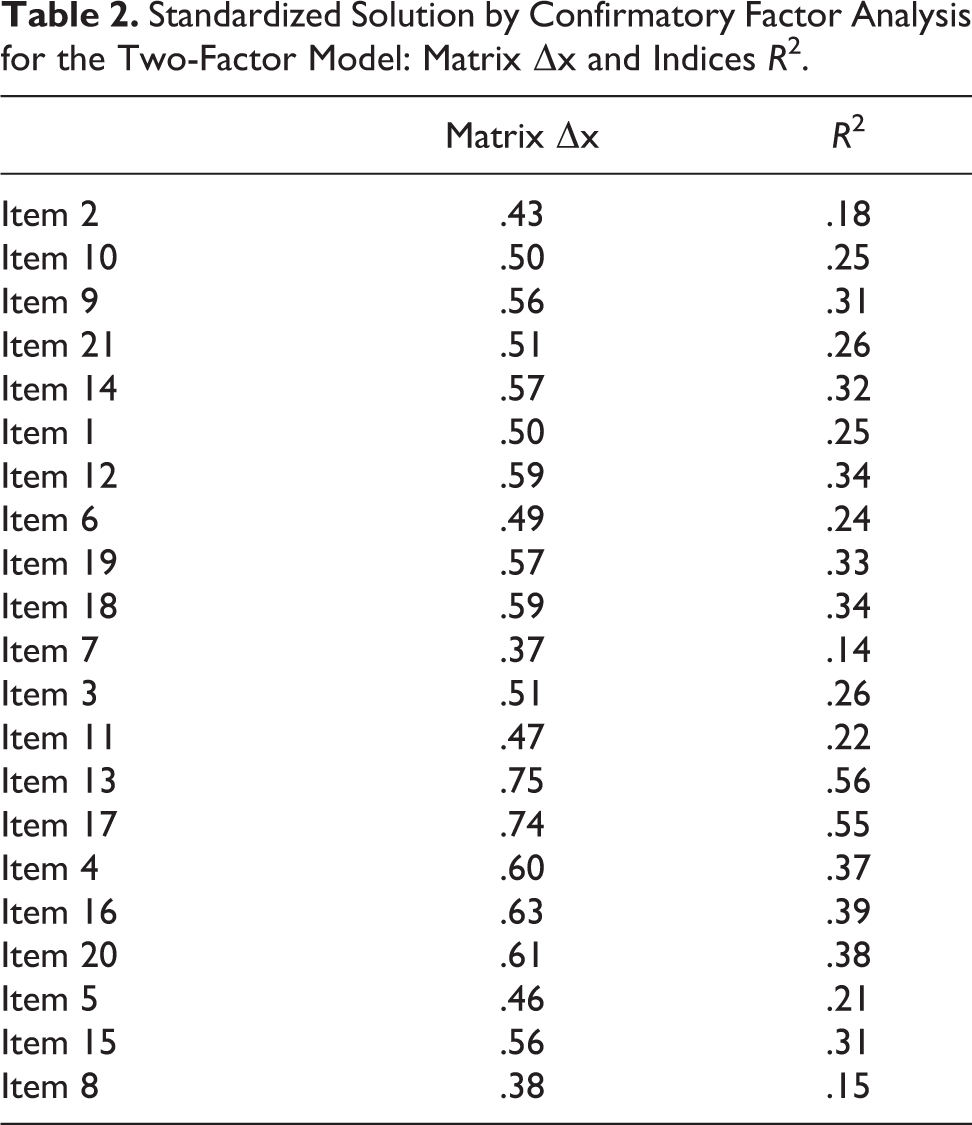
The hypothesized 21-2 model fits the data best because it had the lowest χ2, the highest CFI (.95), and the lowest RMSEA (.06). Regarding the hypothesized two-factor model, all of the factor loadings were significant (ranging from .37 to .75, p < .001), suggesting that the two factors were well represented by the items. The R 2 index indicates the squared multiple correlations and shows the amount of variance accounted for by each item (see Table 2).
Standardized Solution by Confirmatory Factor Analysis for the Two-Factor Model: Matrix Δx and Indices R 2.
Associations Between Design My Future, Career Adapt–Abilities Scale, and Satisfaction With Life Scale
Table 3 shows correlations among the instruments. As expected, future orientation and resilience were positively associated with life satisfaction and career adaptabilities. The discriminant correlations, however, varied enormously (range = .27–.45).
Correlations Among Design My Future, Career Adapt-abilities Scale, and Satisfaction With Life Scale.
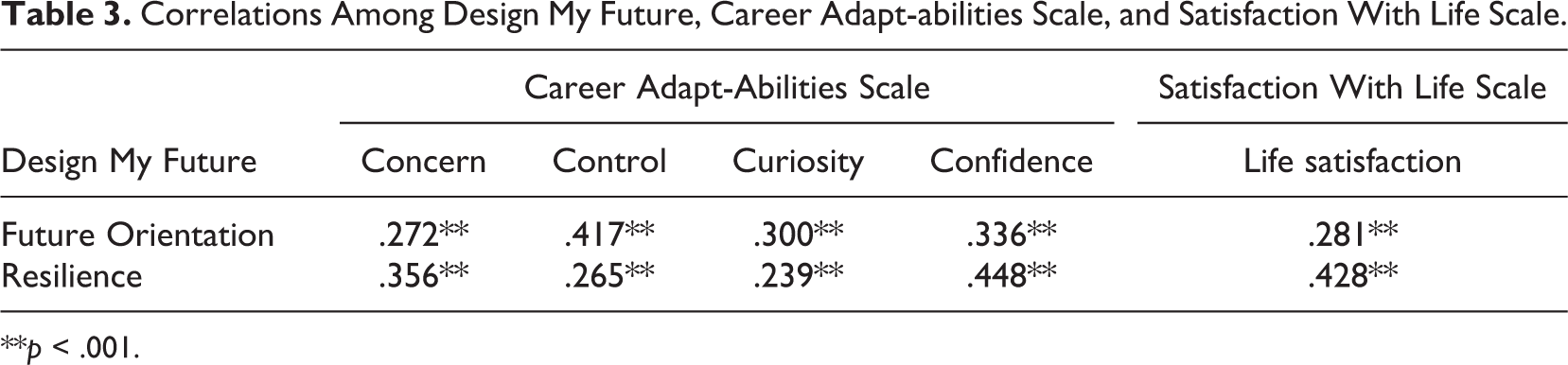
**p < .001.
Discussion Study 2
Study 2 was conducted to examine the stability of the 21-item factorial structure of Design My Future. The confirmatory factor analysis showed that the two-factor structure yielded in Study 1 was stable with another sample of Italian preadolescents. All of the factor loadings were significant and presented loadings of >.37, suggesting that the two factors were well represented by the items.
As regards discriminant validity, the correlation patterns were in line with our predictions as future orientation and resilience correlated with the Career Adapt–Abilities Scale and the Satisfaction With Life Scale. The correlation matrix also shows that, as expected, higher levels of future orientation and resilience were associated with higher levels of life satisfaction and career adaptability. These results, in line with Prenda and Lachman’s (2001) and Masten and Tellegen’s (2012) works, suggest that future orientation and resilience are related to career adaptability levels in dealing with transition and challenges and with the level of perceived life satisfaction.
Study 3: Examining Measurement Invariance Across Gender
A third study was conducted to analyze across-gender measurement invariance of Design My Future. Specifically, a multiple-group confirmatory factor analytic approach (K. Jöreskog & Sörbom, 2004) with a third sample of middle school students was carried out. We followed a hierarchical set of steps from a less restrictive model to a more restrictive one, to test measurement invariance, by starting from determination of a baseline model, then by adding equivalence constraints in the models across groups. It therefore resulted in nested models ranging invariance measurement level (Meredith, 1993): (a) configural factorial invariance, (b) weak or metric factorial invariance, and (c) strong or scalar factorial invariance. After ascertaining factorial invariance, we examined the homogeneity of variance and covariance, in order to verify if the entire covariance structure is invariant across groups and has the same parametric structure, then we examined the equivalence of the latent construct means to verify if means of factors are significantly different across groups (Little, 1997). With respect to latent means differences, in line with studies in the literature, we expected gender invariance for future orientation (Anthis et al., 2004) and gender variance on resilience, with boys perceiving higher levels of resilience than girls (Connor & Davidson, 2003; Newman, 2002).
Method
Participants
The total sample was composed of 560 Italian middle school students aged 11 to 14 years (M age = 12.97, SD = .51), made up of 280 boys and 280 girls.
Measures
Study 3 used the same instrument described in Study 1.
Procedure
Students were involved using the same procedure adopted in Study 1.
Results
Measurement Invariance
The initial model, freely estimated for both groups, revealed an acceptable fit χ2(376, n = 560) = 638.41; p <.001; CFI = .935; NNFI = .928; and RMSEA = .077 (CI90 = [.07, .08]). We then tested measurement invariance, equating the loadings and the intercepts. As shown in Table 4, no significant fit changes based on the RMSEA Model Test emerged. (The RMSEA value of the nested model fell within the 90% RMSEA confidence interval of the comparison model). Using the CFIΔ test, CFI changes were less than 0.01 when cross-group constraints were imposed (Cheung & Rensvold, 2002). These tests showed invariance of factors when measured across the two groups. Variance and covariance homogeneity across the two groups was not established. Finally, latent means invariance across boys and girls was not found. Further evaluation yielded significant differences in the latent factor means, as shown in Table 4. More specifically, boys showed higher levels of resilience than girls.
Fit Indices for the Nested Sequence in the Multiple Factor Analysis and Latent Mean Level Differences.
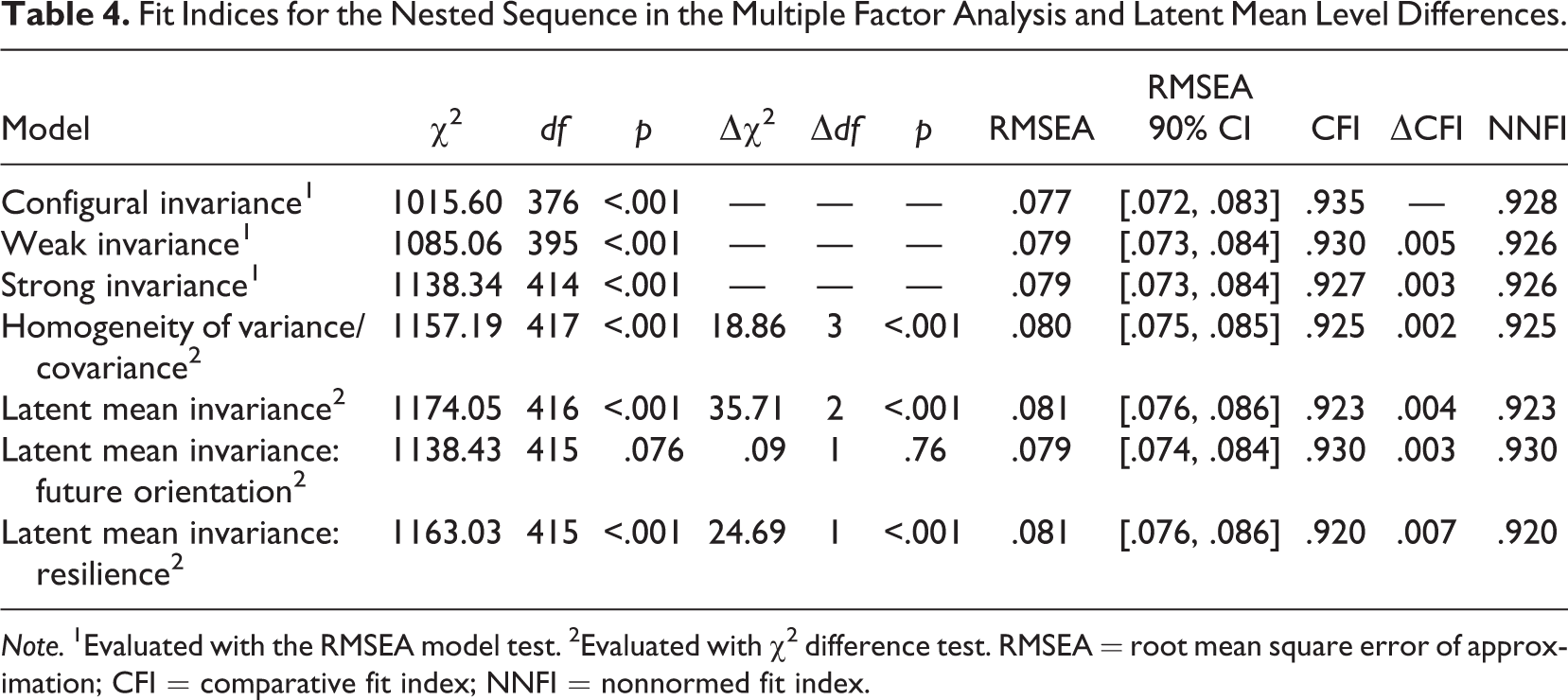
Note. 1Evaluated with the RMSEA model test. 2Evaluated with χ2 difference test. RMSEA = root mean square error of approximation; CFI = comparative fit index; NNFI = nonnormed fit index.
Discussion Study 3
The aim of this study was to analyze Design My Future across-gender measurement invariance. Specifically, we employed a multiple-group confirmatory factor analytic approach (K. G. Jöreskog, 1971) with a third sample of 560 Italian middle school students to assess whether future orientation and resilience were perceived in the same manner across gender. Results confirmed configural, metric, and strong invariance across genders, indicating that the Design My Future is measuring the same latent trait domains in boys and girls such that its structure appears to be the same across gender. Moreover, this suggests that the constructs’ variance, correlational, and mean-level differences could be meaningfully compared between boys and girls, with quantitative precision, because constructs were defined in the same operational manner for each group (Little, 1997). Although mean differences were observed, with boys reporting higher levels of resilience than girls, these reflect true differences and not a systematic artifact or bias of the measure itself. These results are in line with Newman’s (2002) and Connor and Davison’s (2003) researches where higher resilience and higher propensity to make more use of adaptive coping strategies were found in boys than in girls.
Overall, this factorial invariance adds important support for the validity of Design My Future as a self-report measure as it indicates that the scores assess the same latent constructs in boys and girls.
General Discussion
The combined results of the three studies provide very strong psychometric support for the questionnaire Design My Future. In the first study, content validity of the items was supported by reference to the literature, pilot testing, and use of expert raters. Construct validity of the scale was supported by EFA that showed a factor structure characterized by two-correlated subtest regarding future orientation and resilience. Moreover, it highlighted good reliability and moderate correlation between the two factors.
The confirmatory factor analysis runs in the second study with a new group of middle school students confirms the stability of the two-factor structure. Moreover, correlational analyses conducted with Career Adapt–Abilities Scale and Satisfaction With Life Scale showed future orientation and resilience as related but distinct from career adaptability and life satisfaction, suggesting that preadolescents with higher levels of future orientation and resilience are characterized by propensity to deal with transition and challenges and deal with satisfaction for their life (Masten & Tellegen, 2012; Prenda & Lachma, 2001).
Finally, in the third study, measurement invariance assumptions were tested. Specifically, results suggest that, although two constructs are perceived similarly by boys and girls, the mean on resilience across these groups differs and cannot be attributed to differences in unit of measurement and on intercepts of the regression equations of the observed variables on the latent factors across group. Moreover, in line with Newman’s (2002) and Connor and Davison’s findings (2003), boys presented higher ability than girls to deal with difficulties and uncertainties that they may experience in their futures.
Overall, the present study’s results provide new information about future orientation and resilience in Italian preadolescents. Specifically, the results obtained emphasize the importance of examining and studying future orientation and resilience in this developmental period, as they are associated with career adaptability and life satisfaction and play a relevant role in life designing. In this respect, the propensity to take time and think about the future and the ability to consider themselves as ready to face challenges and threats are useful to promote already in preadolescence more adaptive career development in current times (Masten & Tellegen, 2012).
Practical Implications
The questionnaire’s psychometric indices that were observed supports the use of Design My Future in counseling and career counseling activities designed to support preadolescents in the process of coconstructing and designing their paths and to promote personal and professional skills useful in the current world of work (Savickas et al., 2009). This instrument could be helpful in investigating thoughts, ideas, and feelings middle school students have about their future, their propensity to orient themselves positively toward the future and to think about several possible futures. It also could be useful in analyzing middle school students’ levels of resilience, or their ability to think about their readiness in facing challenges and threats and not being overwhelmed by them, for the benefit of their own future. It could also be used in pre- and post-test sessions to verify the effectiveness of career education programs aimed at strengthening the orientation to the future and resilience in middle school students. Finally, it could be used in research aimed at examining future orientation and resilience indicators, and psycho-social and professional issues in preadolescents.
Limitations and Directions for Future Studies
This study was limited in a number of ways. Firstly, we have no information about ethnicity of participants involved. Generally, 7% of the Italian middle school population has different ethnic backgrounds (e.g., students from Eastern European, North Africa, South America; MIUR, 2014), and further studies should also consider this variable. Secondly, convergent and incremental validity of the instrument was not tested, and additional research is needed to investigate the relations among this measure with others that assess future orientation and resilience. Thirdly, the fact that the questionnaire is based on self-reported information should not be underestimated, and multitrait multimethod matrix design should be used to examine how self-report and informant-report scores correlate. Finally, test–retest measures should be also introduced in further research studies.
Footnotes
Declaration of Conflicting Interests
The author(s) declared no potential conflicts of interest with respect to the research, authorship, and/or publication of this article.
Funding
The author(s) received no financial support for the research, authorship, and/or publication of this article.