



Abstract
Social cognitive career theory posits that proximal contextual support variables exert both direct and indirect effects on individuals’ career choice intentions. The purpose of this study was to test this proposition by examining the hierarchical structure of efficacy beliefs and their relations to students’ intentions to pursue careers in science. Data were collected from a sample of undergraduate students (N = 1,693) recruited from biology, chemistry, and physics courses. Results of multilevel modeling analyses indicated that aggregated peer science self-efficacy (PSSE) perceptions in the classroom were positively predictive of science career intentions (SCIs) while holding constant the Level 1 influence of science self-efficacy. Moreover, science interest was shown to mediate the relationship between PSSE and SCIs. Implications for career development research and practice are discussed.
Today, science, technology, engineering, and mathematics (STEM) careers are highly valued by society, and by all accounts, this trend in the desirability of STEM careers will continue (U.S. Bureau of Labor Statistics, 2014). This increasing emphasis on STEM careers is not an accidental one. Indeed, according to the National Science Board (2007), “in the 21st century, scientific and technological innovations have become increasingly important as we face the benefits and challenges of both globalization and a knowledge-based economy.” (p. 2) With the ubiquity of sophisticated “smart” technologies, questions about how to combat global warming while meeting growing energy demands, and increasing concerns about how to maintain global food and water security for future generations, one could argue that the development of a robust scientific workforce has not been as urgently sought after by policy makers since the space race of the 1950s and 60s.
National calls to guide students toward STEM careers have not gone unheeded. Educators have been striving to engage students in the science classroom, while vocational researchers have increasingly sought to understand which factors figure most prominently in the career decision-making processes of college students. Consequently, it is important that researchers gain a better understanding of the factors that lead students to follow paths toward STEM careers. Science courses (e.g., physics) are not just important for those majoring in science, they are often prerequisites for engineering and technology majors as well. Student’s perceptions of the psychological climates in these classrooms could be important determinants of whether they ultimately intend to enter STEM careers. Although we wish to emphasize the importance of science courses as gateways to a broad array of careers, our focus in this article is on students’ intention to pursue careers in science specifically. The purpose of this study was to address a gap in the literature by bringing further attention to the role of proximal contextual factors in the social cognitive career theory (SCCT; Lent, Brown, & Hackett, 1994, 2000) model. Specifically, we set out to examine whether peer science self-efficacy (PSSE) varies significantly across college science classes, and whether this between-group variation could account for changes in interest in, and intentions for, science careers.
SCCT
SCCT (Lent et al., 1994) aims to account for the social psychological processes underlying the academic- and career-related interests, goals, and behaviors that people consider. Drawing from Bandura’s (1986, 1997) social cognitive theory, SCCT describes the process by which human agency is influenced by both personal and environmental sources. As can be seen in Figure 1, SCCT allows for the possibility that group-level influences such as PSSE may determine one’s learning experiences at the individual level. The degree to which individuals learn both directly through mastery experiences and vicariously through parents, teachers, role models, and the like, is said to shape self-efficacy percepts, or beliefs about one’s ability to successfully perform a given task (Bandura, 1997). These learning experiences not only influence self-efficacy, but also what individuals might expect to attain as outcomes if they were to perform the same task in the future. In turn, self-efficacy and outcome expectations are theorized to foster the development of career interest and the establishment of goals, or intentions, to pursue particular careers. We focus in the current study on science career intention (referred to hereafter as SCI) as an outcome of interest because it is strongly associated with the enactment of behaviors that signal movement along a career path (e.g., choosing a major).
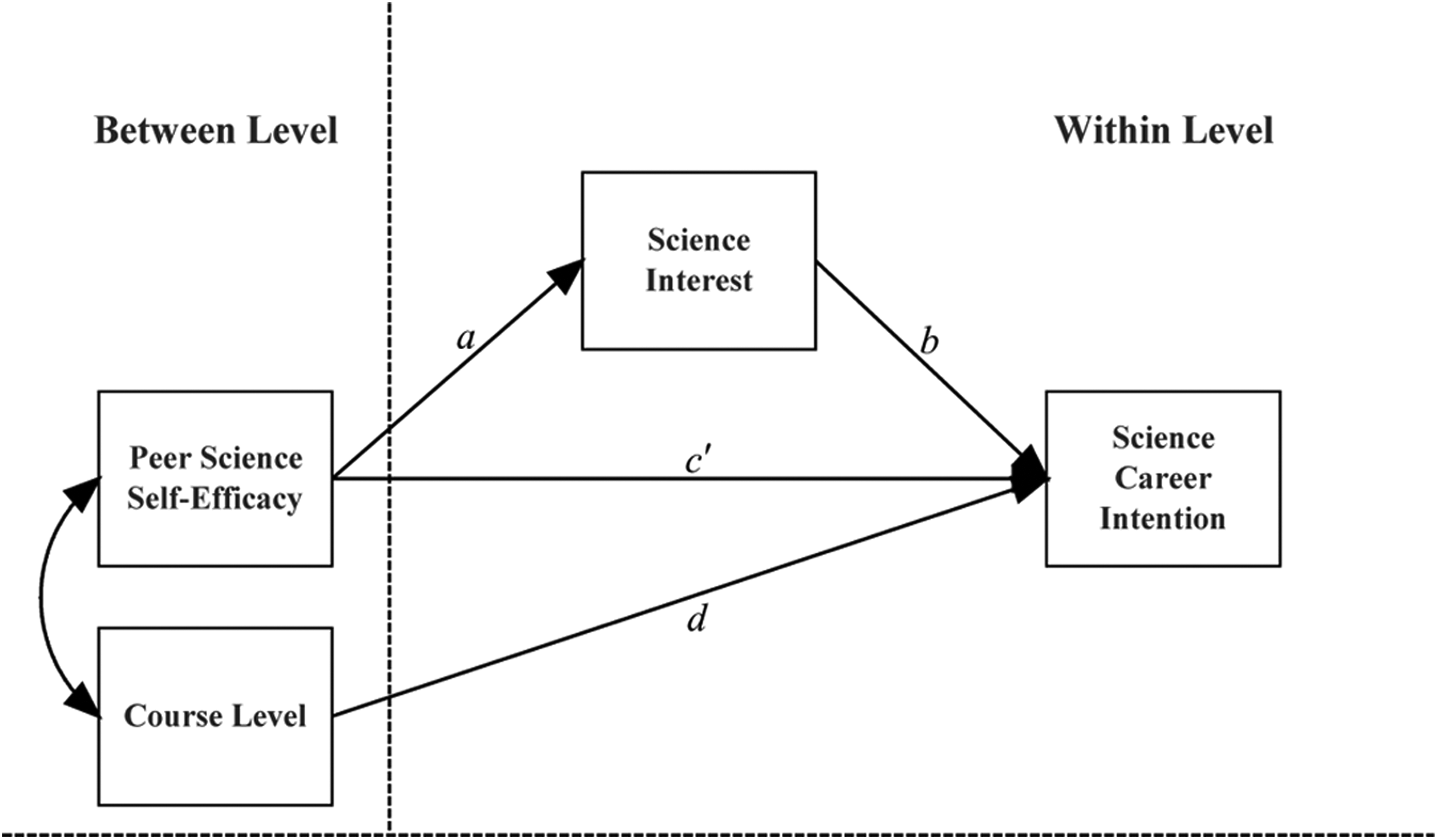
Diagram depicting the hypothesized-mediated relationship between collective science efficacy and science career intention while controlling for course level.
Research supports the theoretical propositions of SCCT, with career choice intentions being consistently and positively associated with self-efficacy (e.g., Dahling & Thompson, 2010; Deemer, Thoman, Chase, & Smith, 2014; Flores et al., 2014; Lent et al., 2003; Lent, Lopez, & Bieschke, 1993), interest (e.g., Garriott, Flores, & Martens, 2013; Lent et al., 2005; Navarro, Flores, & Worthington, 2007; Sheu et al., 2010), and outcome expectations (e.g., Byars-Winston & Fouad, 2008; Gainor & Lent, 1998). While these intrapersonal variables continue to warrant empirical consideration, researchers have begun to turn their attention to support variables in the SCCT framework since Lent, Brown, and Hackett’s (2000) call for further focus on the influential role of contextual factors in career decision-making processes. Contextual supports have been found to foster the development of science intentions both directly and indirectly through intervening variables. For instance, Inda, Rodríguez, and Peña (2013) obtained evidence of a direct relationship between contextual supports and engineering goals, as well as an indirect effect mediated by self-efficacy. Similarly, Lent, Lopez, Sheu, and Lopez (2011) found that both self-efficacy and vocational interest mediated the relationship between social support and major choice goals, with social support also being directly predictive of choice goals. However, some researchers have found that relations between contextual supports and barriers are mediated pathways only (e.g., Byars-Winston, Estrada, Howard, Davis, & Zalapa, 2010; Lent et al., 2005). Thus, additional research is needed to better understand the types of supports that produce these differential relationships. Further, researchers have suggested that supports may be of relatively greater importance than barriers (e.g., Garriott et al., 2013) and that investigating other types of contextual variables (e.g., Flores & O’Brien, 2002) would illuminate the complex interplay between individuals and their career environments.
PSSE
Individuals are by-products of the contexts in which they live (Bandura, 2000), thus contexts can be viewed as barriers or supports to academic and career development. A number of studies have focused on contextual affordances and their relations to self-efficacy and other outcomes outlined in the SCCT framework, including parental support (e.g., Byars-Winston & Fouad, 2008; Wright, Perrone-McGovern, Boo, & White, 2014), peer support (e.g., Fouad et al., 2010; Inda, Rodríguez, & Peña, 2013), and teacher support (e.g., Rowan-Kenyon, Swan, & Creager, 2012). However, while these supports have been shown to be influential in predicting increased vocational interest and goal intentions, the way in which they have been operationalized and measured has limited further extensions of SCCT research. Teacher and parent supports are higher level constructs, as students are nested within both teachers and parents. Similarly, the supports that students receive from their peers are often experienced in the context of group-level units such as classrooms, schools, teams, and work units. However, measurement of these constructs has typically taken place at the level of the individual, and as a consequence, researchers have not consistently taken into account the complex data structures that are typically encountered in contextual support/barrier research. Multilevel modeling techniques are ideally suited for this type of research because they take into account the hierarchical arrangement of group- and individual-level phenomena (Kahn, 2011).
According to Bandura (2000), collective efficacy represents “people’s shared beliefs in their collective power to produce desired results” (p. 75). Individuals who belong to groups that are bound by a collective purpose are likely to learn both directly and vicariously from other group members, and persuade others in the group that they are capable of performing to a desired standard of excellence (Bandura, 1997). Indeed, groups provide a rich source of comparative information that individuals may use to improve their own performance, and in turn share what they have learned by providing others with constructive but encouraging feedback. Groups thus provide social contexts well suited for the continuous exchange of motivationally relevant information that accelerates the development of efficacy percepts at rates that cannot be achieved in dyadic situations alone (e.g., peer–peer, instructor–student).
Bandura (1997) has noted that collective efficacy can be measured in two ways. One approach involves aggregating individual perceptions of the group’s ability to reach a common objective while the other calls for aggregating self-referent efficacy perceptions to the group level. Investigators have garnered empirical support for the group-referent construct as a significant predictor of such outcomes as neighborhood violence (Sampson, Raudenbush, & Earls, 1997) and school bullying (Williams & Guerra, 2011), as well as academic performance (Lent, Schmidt, & Schmidt, 2006) and achievement (Goddard, 2001). However, less is known about self-referent forms of group-relevant efficacy despite the fact that Bandura (1997) identified it as a legitimate alternative to group-referent perceptions of agency. To our knowledge, no previous empirical work has been done in this area, thus one aim of the current research was to examine the predictive utility of this type of efficacy within Lent et al.’s (1994) theoretical framework. We refer to our construct as PSSE to differentiate it from the group-referent form of efficacy.
Current Study
Considerable SCCT research has examined the influence of background contextual affordances, but less research has focused on the role that groups play as mechanisms in delivering the support needed to facilitate career choice behavior. Moreover, the research that has been conducted on proximal contextual supports has not consistently modeled the hierarchical nature of effects implied by the SCCT model. That is, research to date in this area has not fully taken into account the fact that individuals are nested within classrooms, work settings, and so on, and these groups exert important effects on individuals over and above their unique personalities, attitudes, and motives.
In the current study, we seek to extend previous SCCT research by conceptualizing and testing PSSE as a proximal contextual affordance in support of SCI. Two hypotheses were tested. First, PSSE was expected to be positively associated with SCI such that students in classes with higher PSSE would report higher levels of SCI. We tested this contextual effect (Raudenbush & Bryk, 2002) hypothesis while controlling for the Level 1 associations between SCI and both individual science self-efficacy (referred to hereafter as SSE) and science interest, as well as the nature of the courses students were enrolled in. We reasoned that course level would be important to control for because students enrolled in more advanced science classes should have stronger intentions to pursue science careers. Second, SCCT posits that interest mediates the relationship between self-efficacy and intentions at the individual level. However, given that past research shows that perceptions of the academic environment are positively associated with scientific interest (e.g., Kahn & Schlosser, 2010) and intrinsic motivation (Church, Elliot, & Gable, 2001), we hypothesized that interest would also mediate the cross-level relationship between PSSE and SCI. Course level was controlled for in the multilevel mediation model as well.
Method
Participants
A total of 1,722 college students enrolled at a large Midwestern university participated in the study. Twenty-nine cases were identified as having missing data (>90%) on nearly all measures and therefore removed from the data set, resulting in an N of 1,693. The sample mainly consisted of women (n = 984), with 704 identifying as male; 5 respondents did not indicate their gender. Participants ranged in age from 18 to 64 years with a mean age of 20.06 (SD = 2.71). Reported ethnicities were as follows: 74.6% identified as being White (n = 1,263), 13.8% Asian American (n = 234), 3.5% Latino/Latina (n = 59), 2.9% multiracial (n = 49), 2.2% African American (n = 38), 1.3% identified with some other race/ethnicity (n = 22), 0.6% Native American (n = 10), and 0.6% identified as being Arabic/Arab American (n = 10). Eight participants did not report their race/ethnicity. With regard to academic classification, 32.5% identified as being a sophomore (n = 550), 31.3% identified as being a freshman (n = 530), 20.1% identified as being a junior (n = 340), 13.6% identified as being a senior (n = 230), 1.9% identified as being a postbaccalaureate student (n = 32), and 0.4% identified as being a graduate student (n = 6). In order to maintain consistency with the courses from which participants were sampled (i.e., biology, chemistry, and physics), students in the life or physical sciences, engineering, mathematics, or technology majors were coded as STEM majors. Students in social sciences, humanities, business, and all other majors were coded as non-STEM majors. Thus, 57.4% of students reported that they were in a STEM major (n = 971), 29.8% reported that they were a non-STEM major (n = 505), and 12.8% did not report a major (n = 217).
Measures
Course level
Course level was operationally defined as the degree to which a class (i.e., section of a course) reflected more advanced versus intermediate and introductory material as indicated by its course number (i.e., 100-, 200-, 300- or 400-level); 100-level courses were coded as “1,” 200-level courses were coded as “2,” 300-level courses were coded as “3,” and 400-level courses were assigned a code of “4.”
SCI
A 4-item scale developed by Smith and Fouad (1999) was used to measure participants’ intention to enter a science career. Participants are asked to rate their response on a Likert-type scale ranging from 1 (very strongly disagree) to 6 (very strongly agree), with possible scores ranging from 4 to 24. Sample items include “I intend to enter a career that will use science” and “I am determined to use my science knowledge in my future career.” Past research has shown that the scale to possess strong reliability (α = .87; Smith & Fouad, 1999). Further, concurrent validity has been demonstrated with the original version of the scale through observed correlations with science interest (r = .45), self-efficacy (r = .44), and outcome expectations (r = .54; Fouad & Smith, 1996). Cronbach’s α in the current study was .84.
Science interest
An adaption of the 23-item Subjective Science Attitudes Change Measures (SSACM; Stake & Mares, 2001) was used to measure participants’ interest in science. The SSACM were initially constructed for use with high school students and their parents for the purpose of measuring the social, cognitive, and motivational effects of a science intervention program. The domains measured by the original SSACM include (a) increased science motivation (ISM), (b) increased science confidence (ISC), (c) increased science knowledge, and (e) new social niche. Factor analytic work by Deemer, Smith, Thoman, and Chase (2014) resulted in the identification of three constructs measured by the ISM and ISC items—SSE, science career identity, and intrinsic science interest. Four items measuring the latter construct were used in the present study. Participants respond to the statement, “My experiences in this class … ” on a Likert-type scale ranging from 1 (not at all) to 7 (a great deal). Possible scores range from 4 to 28, with higher scores denoting greater science interest. Sample items include “Have made science seem more interesting to me” and “Have made science seem more fun.” Evidence of concurrent validity of intrinsic science interest scores has been shown through a positive association with intrinsic motivation (Deemer, Smith, Thoman, & Chase, 2014). Cronbach’s α was .94 in the present study.
Student-level SSE
Student-level SSE was measured using the 5-item Confidence Learning Science (CLS) Subscale of the Science Motivation Questionnaire (SMQ; Glynn & Kobella, 2006). SMQ is a 30-item measure consisting of six subscales: (a) intrinsically motivated science learning, (b) extrinsically motivated science learning, (c) relevance of learning science, (d) responsibility for learning science, (e) CLS, and (f) anxiety about science assessment. Items are anchored to the statement, “When I am in a college science course … ”. Participants are asked to rate items on a Likert-type scale ranging from 1 (never) to 5 (always). Possible scores range from 5 to 25, with higher scores indicating greater SSE. Sample items include “I am confident I will do well on the science labs and projects,” “I believe I can master the knowledge and skills in the science course,” and “I am confident I will do well on the science tests.” Previous research suggests that CLS scores possess adequate internal consistency reliability (α = .89) and, supporting their concurrent validity, are positively predictive of science problem-solving ability (Taasoobshirazi & Glynn, 2009). The internal consistency reliability estimate for the CLS scale in the current study was .85. Additional evidence of concurrent validity has been demonstrated through a significant positive association between CLS scores and intentions to conduct undergraduate research (Deemer, Thoman, et al., 2014).
Classroom-level SSE
The PSSE variable was created by aggregating individual SSE scores to the classroom level. That is, group SSE means were computed for each classroom and used as Level 2 predictor variables.
Procedure
All data were collected during the spring and fall 2014 semesters using an online survey. To be included in the study, participants were required to be at least 18 years of age and enrolled in biology, chemistry, or physics courses. Courses targeted for sampling were chosen at random but equally distributed across course levels (i.e., 100-, 200-, 300-, and 400 level). Invitations to participate in the study were delivered via e-mail by the Registrar’s office to 11,995 students across 192 classes, yielding a response rate of 14.4%. The invitation contained a brief description of the study and a link to an informed consent web page for interested students. Participants were informed that their responses were anonymous and participation was voluntary. After participants electronically submitted their survey responses, they were directed to a web page where they could read a debriefing statement that described the purpose of the study. Participants received an electronic US$10 gift card as compensation for participating in the study.
Results
Descriptive Data
Most participants reported being in a 200-level class (44.5%) while 39.0% were students in 100-level classes, 12.5% were in 300-level classes, and 4.0% were in 400-level classes. The contextual effect analysis was conducted using restricted maximum likelihood estimation in HLM 7.01 (Raudenbush, Bryk, Cheong, Congdon, & du Toit, 1996–2013) and the multilevel mediation analysis was conducted using a maximum likelihood estimator with robust standard errors in Mplus 7.2 (Muthén & Muthén, 1998–2014). We chose this approach because it permits the analysis of variables that exist at both within- and between-class levels. A total of 81 cases were removed from the data set, given that HLM 7.01 uses listwise deletion when analyzing data files. Both analyses were therefore performed using an N of 1,612 with a mean cluster size of 16.28. Prior to conducting the substantive analyses, we explored the descriptive statistics to ensure there was no significant skewness or kurtosis on the outcome or predictor variables. All values were within appropriate limits as suggested by Tabachnick and Fidell (2013). A check of the residuals indicated no significant correlation between the Level 1 residuals and the SSE and science interest predictor variables. A histogram of the Level 2 residuals showed they were normally distributed. Additionally, the Level 2 predictors were not correlated with the Level 2 residuals (r = .00, ns). Means, standard deviations, and multilevel correlations are presented in Table 1. Of note among the correlations were those observed at the group-level between SCI and PSSE (r = .70, p < .001) and between SCI and course level (r = .37, p < .001). The latter correlation suggests that course level was an appropriate variable to control for. Level 1 descriptive statistics by gender and major type are reported in Table 2.
Correlations Among Student- and Classroom-Level Variables.
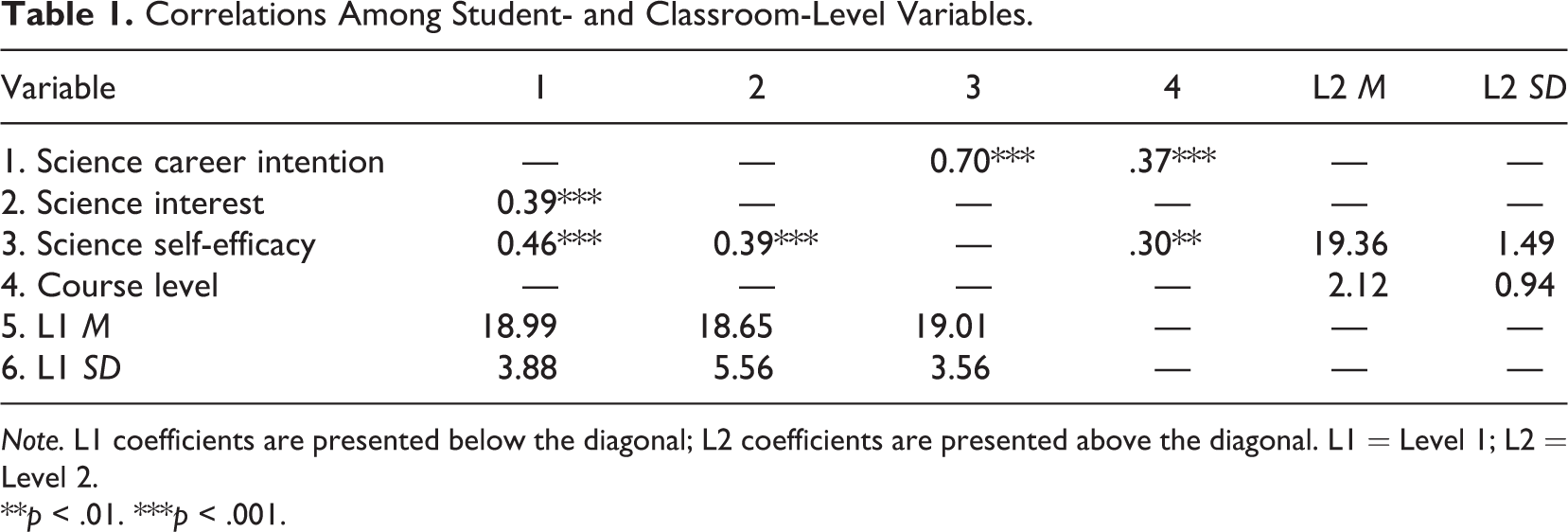
Note. L1 coefficients are presented below the diagonal; L2 coefficients are presented above the diagonal. L1 = Level 1; L2 = Level 2.
**p < .01. ***p < .001.
Raw Means and Standard Deviations by Gender and Major Type.
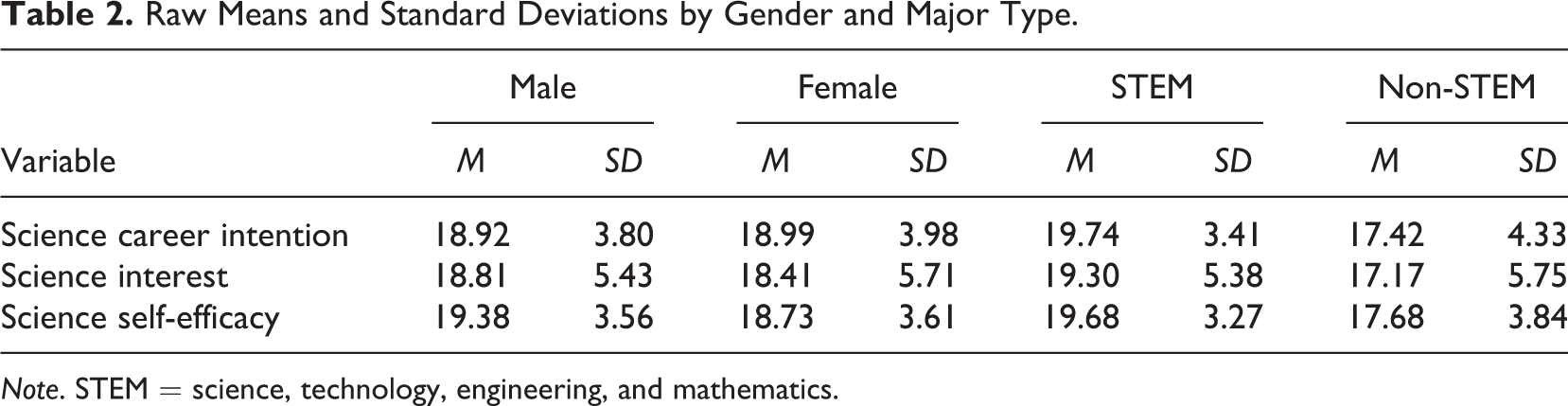
Note. STEM = science, technology, engineering, and mathematics.
Contextual Effect Analysis
We first estimated an unconditional model to determine whether there was enough between-class variation in SCI to justify the inclusion of Level 2 predictors in the model. Determining the intraclass correlation coefficient (ICC) is an important first step in the decision to analyze data using multilevel modeling. The ICC indicates whether or not there is enough variation to justify use of multilevel modeling. Hedges and Hedberg (2007) suggest that an ICC within the range of .05–.25 is appropriate for multilevel modeling. The ICC for SCI was found to be .148, χ2(98) = 325.95, p < .001, indicating that there was sufficient between-class variation to proceed with the analysis. SSE and science interest were estimated as Level 1 predictors and centered at their grand means. We reasoned that course level could potentially confound the results because students who take increasingly advanced science courses may be more likely to be committed to entering a science career. Therefore, we controlled for this variable to identify the unique effect of PSSE as a contextual variable. The Level 1 model was defined as:

SSE was aggregated to the mean of each classroom to create the PSSE variable at Level 2. Given that students are nested within courses, course level was conceptualized and estimated as a Level 2 control variable. Level 2 regression models were then constructed in which the SCI intercept (β0j ) and SSE slope (β1j ) were specified as outcomes. The SCI intercept was allowed to vary randomly across classes, whereas the PSSE and course-level slopes were fixed. The Level 2 model was defined as:

Results are presented in Table 3. Both SSE (γ10 = .39, p < .001) and science interest (γ20 = .16, p < .001) were significant Level 1 predictors of SCI. As hypothesized, PSSE was a significant positive predictor of SCI at the group level (γ01 = .34, p = .004) after controlling for the Level 1 contribution of SSE and the Level 2 effects of course level (γ02 = .30, p = .022). This indicates that students reported higher SCIs if they were enrolled in classes with higher average levels of SSE. Following Snidjers and Bosker’s (2012) forward steps approach to model specification, we separately estimated SSE and science interest as random Level 1 slopes and performed likelihood ratio tests to determine whether random slope models offered significant improvements over the fixed slope models. Results indicated that the random SSE slope model was statistically equivalent to the fixed SSE slope model, χ2(2) = .05, p > .500 (deviance = 8,080.33). Similarly, randomizing the Level 1 science interest slope did not result in improved model fit, χ2(2) = 4.04, p = .13 (deviance = 8,076.34). Overall, results indicated that the contextual effect of PSSE was not qualified by a significant cross-level interaction with either SSE or science interest.
Results of Multilevel Regression Analysis Predicting Science Career Intention (SCI).
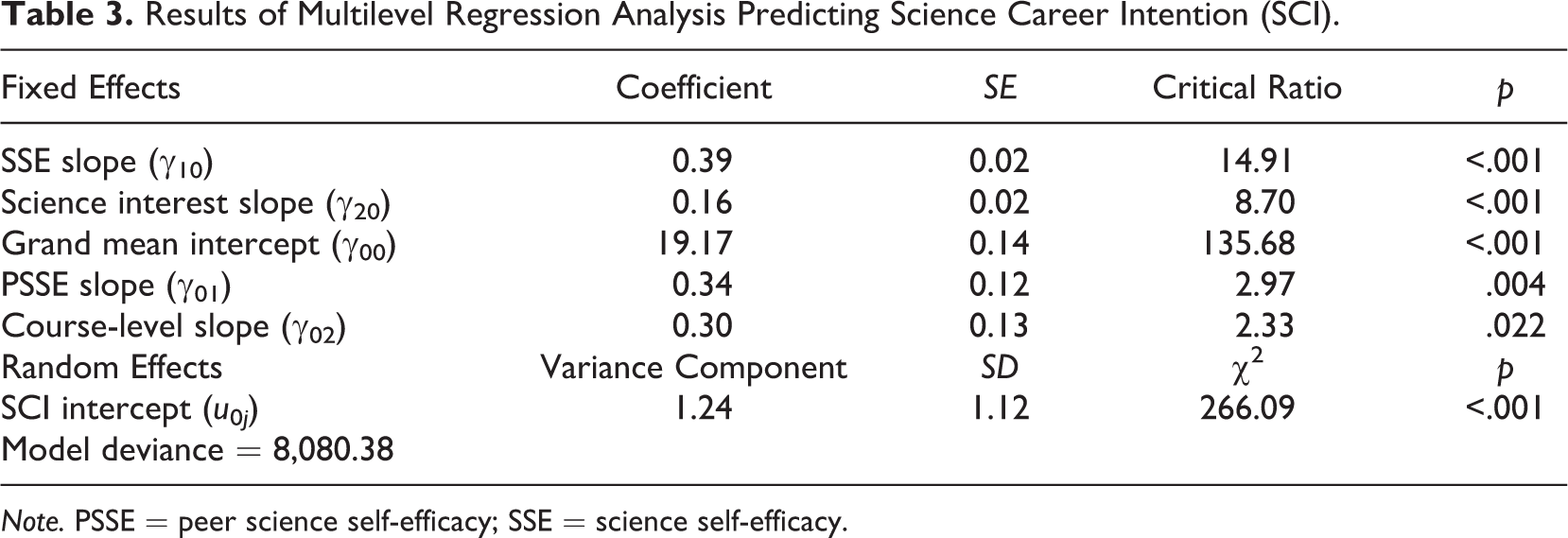
Note. PSSE = peer science self-efficacy; SSE = science self-efficacy.
Multilevel Mediation Analysis
Having shown that there is a significant cross-level PSSE-SCI relationship, we proceeded to test the multilevel mediation hypothesis. The model was tested using a maximum likelihood estimator with robust standard errors. SCI was regressed on science interest, PSSE, and course level with all Level 1 predictors centered at their grand means. ICCs were .18 for SCI and .11 for science interest, thus indicating there was enough between-class variability in these outcomes to proceed with the analysis. To test the mediation hypothesis, we estimated a 2-1-1 mediation model (Krull & MacKinnon, 2001) with random intercepts and fixed slopes. PSSE was estimated as a Level 2 predictor, science interest was specified as a mediating variable having variance at both the between- and within-group levels, and SCI represented the Level 1 outcome. Consistent with the contextual effect model, course level was again specified as a statistical control variable at Level 2 (see Figure 1). The reduced forms of the multilevel mediation equations are as follows:

Two approaches to identifying point estimates of mediation effects include the c − c′ method and the product of coefficients method. The former approach involves examining the magnitude of the total effect (c) on an outcome after partialing out the direct relationship (c′) between the predictor and the outcome, whereas the latter approach involves obtaining the product of the predictor–mediator (a) and mediator–outcome (b) coefficients. We chose to use the product of coefficients approach in the present study based on the results indicating that the ab estimator performs somewhat more efficiently than the c − c′ estimator under simulation conditions (Krull & MacKinnon, 1999).
Results are presented in Table 4. Fit indices for the model were as follows: χ2(7) = 1,170.00, p < .001, Akaike information criterion = 26,952.85, Bayesian information criterion (BIC) = 27,028.24, and sample size-adjusted BIC = 26,983.77. As expected, PSSE was a significant positive predictor of science interest at the classroom level (γ a = .76, p < .001), which in turn was a significant positive predictor of SCI at the individual level (β b = .28, p < .001). The association between course level and SCI was positive and significant (γ d = .31, p = .019), indicating that students were more likely pursue careers in science as they took more advanced classes. Despite these relationships, the direct association between PSSE and SCI remained robust (γ c ′ = .86, p < .001). Computation of the ab estimate yielded evidence of a significant indirect effect of collective science efficacy on SCI via science interest (γ a × β b = .21, p < .001), indicating that PSSE exerts both direct and mediated effects on students’ SCIs.
Results of Multilevel Mediation Analysis Predicting Science Interest and Science Career Intention (SCI).

Note. PSSE = peer science self-efficacy; SI = science interest; SSE = science self-efficacy.
Discussion
The purpose of this study was to investigate whether individuals’ SCIs varied as a function of group-level differences in PSSE across college science classes. Two hypotheses were tested. First, PSSE was expected to be a significant positive predictor of SCI after controlling for the individual-level contributions of SSE, science interest, and course level. Our second hypothesis posited science interest as both a predictor and an outcome by modeling this variable as a mediator in the contextual relationship between PSSE and SCI. Results indicated support for both hypotheses, thus replicating other research on contextual support variables in SCCT (e.g., Byars-Winston & Fouad, 2008; Dahling & Thompson, 2010). Considerable research had been conducted on background contextual affordances, but very little research had focused on the role of proximal contextual supports in fostering adaptive career decision-making. Some research has examined the supportive influence of teachers in the proximal environment (e.g., Fouad et al., 2010; Rowan-Kenyon et al., 2012), but SCCT researchers had not examined aggregate perceptions of efficacy beliefs as a group-level construct. Our results indicated that there existed significant variation in PSSE across classrooms and that this variation was a positive contextual predictor of SCI over and above the influence of participants’ individual SSE percepts. Thus, students in classrooms with higher overall PSSE were more likely to hold intentions to use their science skills later in their careers. This contextual effect was detected after also controlling for students’ individual interest in science and the level of the courses they were enrolled in.
Our findings represent an important extension of SCCT research, as previous research had not consistently demonstrated a link between a group-level support variable and choice intentions while simultaneously considering the powerful influence that individual interest in a career has on one’s vocational plans. It is reasonable to surmise that students with high SSE help to shape the classroom environment by implicitly serving as role models that others in a class may learn vicariously from. Behaviors of role modeling and vicarious learning among individuals may be observed by others in a class and ultimately adopted if they are seen as having some utility. Such behaviors may “spread” throughout the group through a process of social facilitation (Thorpe, 1956), ultimately fostering conditions for the development of efficacy beliefs, cohesion, and perceptions of person–environment fit among group members. It remains unclear as to which compositional (e.g., group size) and social characteristics define influential climates. Perhaps larger classrooms exert weaker efficacy effects than smaller classrooms because they have broader social networks over which efficacy percepts can be dispersed. Conversely, smaller classrooms, particularly those comprised of individual students with high SSE, may give rise to more concentrated and robust effects. The present study did not examine the role of such dimensions, therefore research focusing on these and other social-cognitive processes would be fruitful.
Our focus was on choice intentions for science careers; therefore, extending replications of the present findings to other STEM domains (e.g., engineering) as well as other vocational realms (e.g., humanities, business) would be important next steps. Moreover, we did not include individuals other than students who may have contributed to the formation of PSSE (e.g., professors, teaching assistants). Instructors represent perhaps the most influential socializing agent in the classroom as they provide course structure through written and verbal communications (e.g., course requirements, academic and behavioral expectations, etc.), and present nonverbal cues—intentionally or unintentionally—that may critically affect the development of collective attitudes. Thus, additional research utilizing a more comprehensive assessment of the science career environment would be beneficial.
Proximal contextual variables are not theorized to be directly predictive of interest in the SCCT model. However, individual self-efficacy is assumed to be directly linked to interest; therefore, we surmised that PSSE should also be predictive of science interest and SCI because agentic beliefs provide a foundation for reinforcement of task engagement, thus increasing the likelihood that one will continue to participate and develop interest in an activity (Bandura, 1982). Results of multilevel mediation modeling indicated that PSSE was a positive predictor of science interest, thus lending support to the idea that perhaps students in the sampled classrooms collectively created an incentive structure for science interest to develop. Incentives to engage with science more deeply are likely governed by reinforcement mechanisms in the classroom, namely, the encouragement and support students provide each other. Past related research involving graduate students has shown that training environments that are perceived as fostering social interaction and positive reinforcement among students and faculty (Gelso, 1979) are predictive of greater interest in research (Bishop & Bieschke, 1998; Kahn, 2001; Kahn & Scott, 1997).
Similar dynamics in undergraduate classrooms likely create opportunity structures for students to experience the intrinsic and extrinsic rewards of science which, when operant, incentivize behavior and increase the probability that interest will take root. As alluded to previously, the quality of the classroom culture depends largely on the pedagogical philosophy and attitudes of the course instructor; therefore, many of the collective efficacy-building efforts of students may be undermined if the instructor believes punitive measures are needed to ensure successful academic outcomes. However, given that PSSE was contextually related to both SCI and science interest, it appears that instructors did little to negate the positive development of PSSE. Again, however, more research needs to be conducted to confirm this. Overall, our findings suggest that classes that are characterized by high PSSE are more likely to facilitate individual students’ interest in science and intentions to pursue science as a career. Importantly, however, the direct relationship between PSSE and SCI remained significant even after estimating the indirect PSSE-interest-SCI chain of relationships. This finding replicates previous work demonstrating that contextual supports can affect changes in career choice intentions through multiple pathways (e.g., Garriott et al., 2013; Lent et al., 2005, 2011).
The present findings have implications for how science classroom environments can be composed and managed to maximize effects on SSE. Academic climate researchers typically focus on the relationship between the classroom environment and student-related outcomes in the near term—within a semester, grading period, or year—but our findings suggest that classroom environments may relate importantly to longer range outcomes in terms of facilitating career planning. Instructors at all levels of education would perhaps benefit their students by emphasizing the importance of believing in their science abilities, and helping their peers to develop similar beliefs through modeling efficacy behaviors. In addition to encouraging students to become peer educators, students could be encouraged to learn from their classmates both directly and vicariously. These efforts may yield increased efficacy levels for classrooms as collective units, providing rich academic climates that individual students can draw from as valuable resources for competence development.
This study is not without limitations. First, perhaps the most important limitation is that the study did not include science outcome expectations as a variable in the contextual effect and multilevel mediation models. We mentioned previously that extrinsic and intrinsic rewards instantiate interest and drive behavior in the short term, but it is the expectation that such rewards will be forthcoming in the future that sustains goal-related behavior. Future research on group-level contextual supports should model outcome expectations as a Level 1 predictor in order to maintain fidelity with the predictions of the SCCT model. Second, the intrinsic science interest measure used in the present study reflects more of a situation-specific attitude toward science rather than a global one. This raises questions about the stability of the measure, as students’ interest in science may rise and fall as a function of individual and contextual factors emerging over the duration of a semester. Moreover, additional research on the construct validity of intrinsic science interest scores is needed as the work reported by Deemer, Smith, et al. (2014) represents the only research conducted to date on this topic. Finally, the response rate of 14.4% does affect the generalizability of results. However, it should be noted that this type of response rate is not uncommon (e.g., Van Horn, Green, & Martinussen, 2009). In sum, the present findings highlight the utility of SCCT in explaining how individuals draw upon both personal and contextual sources of efficacy prior to making career-related decisions. They also add to the SCCT literature by demonstrating that group-level factors are as important as individual-level factors in facilitating career decision-making. With the recognition that individuals are nested within environments, it is important that SCCT researchers increase their efforts toward understanding how these contextual effects operate, and what elements are needed in the proximal environment to elicit and/or maintain movement toward adaptive career decisions and behaviors.
Footnotes
Authors’ Note
The data presented and views expressed in this article are solely the responsibility of the authors.
Acknowledgments
We wish to thank Jessi Smith and Dustin Thoman for their assistance with this project.
Declaration of Conflicting Interests
The author(s) declared no potential conflicts of interest with respect to the research, authorship, and/or publication of this article.
Funding
The author(s) disclosed receipt of the following financial support for the research, authorship, and/or publication of this article: This research was supported in part by National Science Foundation grant HRD-1331962.