



Abstract
In an attempt to better understand how a negative reputation may affect one’s career, a series of hypotheses which offer an overview of negative personal reputation are tested, utilizing both a lab and a field study. Based upon the existing theory, these hypotheses explore negative reputation in the context of employees in organizations, suggesting that although often negative reputations are undesirable, at times individuals may be motivated to develop such reputations because they may confer benefits to one’s career.
… it doesn’t matter what they say about you as long as they spell your name right … (Robert Passikoff)
In the majority of studies, these bodies of research reflect an accurate assessment of personal reputation. Indeed, employees with positive reputations often experience faster career advancement, expanded autonomy, and increased power (Zinko, Ferris, Humphrey, Meyer, & Aime, 2012). Likewise, in the managerial echelon, it has been proposed that those with positive reputations may gain slack resources for their departments or units (Ferris, Perrewé, et al., 2007). At the CEO level, researchers have suggested that a CEO’s positive reputation may influence factors such as stock prices, customer perception, and the overall morale of the organization (Hayward, Rindova, & Pollock, 2004). Due to the positive outcomes that have been associated with favorable reputations, current research regarding the building and maintaining of personal reputations has mainly focused on this construct in the context of “positive reputations” (e.g., Emelo, 2012; Francis-Smythe, Haase, Thomas, & Steele, 2013; Laird, Zboja, & Ferris, 2012).
Although this stream of positive reputation research does, in fact, address the majority of reputations consciously developed by individuals, one cannot simply assume individuals will automatically achieve positive reputations. Quite often in the workplace, individuals (intentionally or otherwise) develop negative reputations. Additionally, at times, it has been proposed that individuals may wish to have no reputation at all, to essentially stand “unknown” and remain part of the “out-group” in organizations (Brewer, 2001). This desire to be anonymous may go beyond simply introversion, and may, in fact, be driven by environmental factors (e.g., hostile environments; Mink, 2000). Likewise, although negative reputations are typically associated with deleterious consequences, there may be specific situations where an individual actually may desire to develop a negative reputation. For example, the study of inner-city gangs has shown us that youths wish to gain a reputation for being more destructive and cruel than those around them (Emler, 1984). Youths will often behave in a way that is counterproductive to their own well-being and safety, in an effort to establish their position among peers (Vogel, 2002). It has been theorized that it is often not the personality of the individual that drives them to destructive measures but rather the environment in which they exist (Hemmings, 2002).
When examining leaders, Ferris, Zinko, Brouer, Buckley, and Harvey (2007) proposed that at times, leaders may wish to perform strategic bullying (i.e., behaving in a manner that will develop a negative reputation) in order to gain positive outcomes. They presented a theoretical model that suggested that although bullying behaviors may affect others in a negative fashion (e.g., stress and job performance), such bullying may gain reputation and power. Remaining consistent with other fields (e.g., child psychology), Ferris and his colleagues stated that specific environments may dictate the prospect of rewards for negative actions. These environments include organizations that foster low control and high cooperation (Matthiesen & Einarsen, 2001), large bureaucracies (Salin, 2003), departments in which the managers are rule minded, and organizations that have highly charged political atmospheres (Ferris, Zinko, Brouer, Buckley, & Harvey, 2007). As many workplaces can be included among one of these environments, there exists a large potential for intentional, negative reputations.
Career counselors need to develop tools that will aid them in the examine workplace environments, with an understanding as to what sort of reputation needs to be developed by a client. Indeed, simple instructions of “be known for something good” may be highly inappropriate in certain contexts. The study presented provides tools for organizational analysis in that we distinguish the construct of reputation by giving identifiable factors in an organization that signify times when a negative reputation may be appropriate. We couch these findings in the existing reputation theory, so that counselors may better understand how reputations play out in organizations.
The Need for a New Taxonomy
Despite the substantial career implications of negative reputation, current research is woefully ineffective for understanding negative reputation, as it is based upon the assumption that everyone strives for a positive reputation (e.g., Bromley, 1993; Carroll, Green, Houghton, & Wood, 2003; Emler, 1994; Ferris, Blass, Douglas, Kolodinsky, & Treadway, 2003; Laird et al., 2012; Yu & Singh, 2000). Indeed, contemporary theory suggests that those who hold a negative reputation do so because of lack of social skills (Zinko, Ferris, et al., 2012), not due to an intentional aspiration to adopt a less than desirable reputation.
Likewise, the majority of current theory (e.g., derailment literature) suggests that if someone has a negative reputation, then negative career consequences will ensue (e.g., Kovach, 1986). This relationship is based upon the belief that personal reputations are one-dimensional, that individuals cannot be known in a negative light for one aspect, but still be successful because they are also recognized for positive factors. Actions viewed by one group in an organization as negative (e.g., a manager laying off a portion of his or her workforce) may be seen as positive by another group (e.g., shareholders seeing the layoffs as a positive measure of improving efficiency).
Finally, the current schema does not account for organizational conditions that may reward an individual with a negative reputation. Indeed, if an organization has a toxic environment where only managers who exploit their employees are able to excel, then astute managers will behave in a manner that will not only allot them a negative reputation but also reward them for doing so. Accordingly, the widely accepted premise from reputation theory that individuals always seek to develop a positive reputation may not be universally valid. Additionally, even those who do strive for a positive reputation may not achieve this goal. The concept of “reputation repair” cannot be fully realized until we understand the nature of negative reputation (i.e., as to assess and affect it, we must fully understand it). Therefore, a new paradigm needs to be developed, one in which negative reputations are understood, and their implications for career progression are theorized.
Study Overview
Responding to lingering calls to integrate existing theories (e.g., Goldkuhl & Cronholm, 2003) in order to better understand how constructs relate to career advancement, we propose a model that unifies personal reputation theory with derailment, bullying, and organizational culture. This is done by first defining personal reputation and examining the construct as a general construct. Next, in contrast to conventional studies focusing on reputation as a positive phenomenon, we draw theoretical focus to negative reputation. Then, we discuss aspects of negative reputation, ranging from the adverse effects of a negative reputation to circumstances when negative reputations may prove advantageous, to develop corresponding hypotheses. To test our predictions, we draw on an experiment and a field study. Finally, we discuss the relevance of our findings, as they relate to career development.
Personal Reputation
Personal reputation is defined as the following: Reputation is a perceptual identity formed from the collective perceptions of others, which is reflective of the complex combination of salient personal characteristics and accomplishments, demonstrated behavior, and intended images presented over some period of time as observed directly and/or reported from secondary sources, which reduces ambiguity about expected future behavior. (Zinko, Ferris, Blass, & Laird, 2007, p. 4)
Personal reputation is a phenomenon arising from social processes within a community of individuals, linking people to specific social identities. Regardless of whether an individual holds a negative or positive reputation, attributes and status are acknowledged through these links (Carroll et al., 2003). The interpretation of social behavior as self-presentation assumes that one of the major problems (or “social contingencies”; Tetlock, 1992) individuals face in social life is to “explain” themselves to their audiences. Because others cannot have direct knowledge of a person’s psychological attributes (i.e., intentions, feelings, motives) these qualities must be inferred from observed behavior (Goffman, 1959). Ferris and Judge (1991) argued this point by suggesting that reputation is an intentional effort at signaling. Furthermore, audiences will often share these events with other interested parties, potentially developing these observed behaviors into a specific reputation. Therefore, individuals will attempt to enact a reputation to make their intentions known (Emler, 1984).
Accordingly, there are two main reasons for engaging in reputation-building behavior. The first reason is to obtain rewards (Baumeister, 1982). If an audience controls rewards, it is often believed that a positive reputation with that audience will gain these rewards. In the case of negative reputations, if employees believe that development of a negative reputation may be beneficial to themselves or the organization, they may actively engage in actions that may result in the formation of a negative reputation (Crawshaw, 2010). The second reason for developing a reputation is a means of, or substitute for, self-fulfillment (Baumeister, 1982). Cohen (1959) suggested that individuals are motivated not only to become their ideal selves but also to convince others around them of this image.
Identity theory states that the self is composed of multiple identities that reflect the various, different social positions that an individual occupies within larger social structures. The meanings that these identities hold reflect individuals’ impressions of themselves (Stryker, 1980). Self-verification of these positions are confirmed when the social situation matches the identity. Cast and Burke (2002) suggested that these verifications give individuals feelings of competency and worth (the two dimensions of self-esteem). If employees feel that their beliefs and values are not aligned with those of the organization, they often will self-select out of the company (Ryan, Sacco, McFarland, & Kriska, 2000). Before these individuals decide to leave the organization, other manifestations of dissatisfaction often take place, such as voice (Zhou & George, 2001).
In such cases, repeated vocal resistance to the norms and values of an organization may result in a negative reputation being developed. This vocal resistance may deviate from organizational norms, but it may also be regarded as “constructive deviance” (Vadera, Pratt, & Mishra, 2013), as it may be a “principled organizational dissent” that “depart(s) from the norms of a referent group in honorable ways” (Spreitzer & Sonenshein, 2003, p. 209). As such, engaging in voice, whistle-blowing, or taking a public stance against workplace discrimination, bullying, and so on, while considered deviant, may have positive organizational and even societal outcomes.
Negative Reputation
It has been theorized that on rare occasions some individuals may wish to intentionally construct a negative reputation (Ferris, Zinko, et al., 2007). For example, at times, having a reputation as that of a bully may be advantageous to an individual. Ferris et al. explored this concept, suggesting that leaders who purposefully bullied employees would indeed have beneficial outcomes associated with such behaviors in certain situations. If a specific, low-performing individual is singled out and bullied by a manager, others in the workplace may improve their outputs in an attempt to avoid being treated in the same negative manner as that of the bullied employee. In this case, a negative reputation for bullying is developed for the purpose of controlling an audience (Harvey et al., 2007).
Observational learning theory suggests that an audience monitoring an interaction will scrutinize the behaviors of both the bully and the victim and alter their behaviors so that they will not become the next “target” (Bandura, 1971). This learning by observation allows the bully an opportunity to “signal” his or her desires to the group. Furthermore, those in the group who observed the incident may discuss the occurrence with others outside the immediate group. This discussion of the event, normally via gossip (Emler, 1984), allows a negative reputation to develop for the bully (Bailey, 1971).
A powerful, yet negative, reputation based upon coercive power may still be beneficial to an individual (Pfeffer, 1992). One may argue that other forms of power may be more advantageous (e.g., expert or referent power) but coercive power is, nevertheless, still often an effective form of persuasion. When linking power to personal reputation, Pfeffer suggested that those with a powerful reputation (even those known for coercive power) will often become more powerful as their reputations spread. This coercive power may be examined in the context of role theory (Katz & Kahn, 1978), such that as negative behavior becomes the norm for that individual, others may assign such performance and power to the role that the individual occupies within the organization (Tsui, 1984), thereby essentially legitimatizing the negative behavior.
Positive reputation has been shown to lead to increased autonomy. The mechanism behind this is that reputations are born of repeated actions; as such, audiences may predict future behavior based on consistent, past behavior (Zinko, Ferris, et al., 2012). This predictability leads to increased autonomy, as individuals are typically monitored less when their future actions appear reasonably certain (Eisenhardt, 1989). Similarly, as negative reputations are also based upon repeated actions, one could successfully predict the behavior of an individual with a negative personal reputation. Although this would likely lead to increased supervision, those with a negative reputation may sometimes enjoy a level of increased autonomy, but for an entirely different reason. Specifically, it has been suggested that others may attempt to limit their interactions with those who are considered negative individuals (Casciaro & Lobo, 2005). Therefore, because those with negative reputations may be shunned, they may also be granted a degree of autonomy due to the isolation imposed upon them (i.e., there are fewer people there physically observing the individual).
Although as stated above, there are specific times where an individual will intentionally wish to develop a negative reputation, one could surmise that most negative reputations are unintentional. However, regardless of intention, the impact of a reputation on an individual would not change. Reputation is a construct that is essentially an agreed upon, collective perception by others. Although one may affect one’s own reputation, the benefit, as well as the possible negative consequences, of a personal reputation is bestowed by the audience (Bromley, 1993). Thus, regardless of one’s knowledge of one’s own reputation, the rewards and sanctions based upon this reputation are essentially controlled by others.
A Question of Context
Just as in the case of positive reputations, when examining the concept of negative reputations context must also be considered. Indeed, those actions that will develop a reputation in one environment may fail to do so in another. Reputations are created and maintained, based upon deviations from norms, and these norms are determined by the group. If a “high-power distance” manager joins an organization known for high levels of camaraderie, that individual may develop a negative reputation for being aloof and aggressive. Likewise, if an organization is more stringent, to the point of being militaristic, a manager who is normally more open, sensitive, and caring toward his or her employees may develop a reputation for being “soft” and others may attempt to take advantage of that manager. In this context, the reputation for being open and caring has led to negative outcomes and as such can be construed to be negative in that organization. What norms a specific group holds as valuable will dictate how reputations develop, as it is discussed by others of repeated deviations from norms that construct reputations (Zinko et al., 2007).
Career Derailment and Success
Derailment refers to being involuntarily sidetracked, demoted, or fired. It also includes performance below the level of expected achievement or reaching that level only to fail unexpectedly (Lombardo, Ruderman, & McCauley, 1988). Existent literature suggests reasons for derailment that coincide with negative reputations. McCall and Lombardo (1983) proposed that derailment may occur for such things as insensitivity to others, having an abrasive style, being cold and aloof, and arrogance. Having a reputation for such behaviors will typically negatively impact an employee (e.g., Gentry, Ekelund, Hannum, & de Jong, 2007). Indeed, it has been proposed that protection of one’s reputation is vital to the success of an individual and that the failure to do so may cause derailment (Watkins, 2003). Therefore, one can surmise that just as having a positive reputation may advance one’s career, having a poor reputation will often derail individuals (Sutton, 2007). However, an employee may wish to develop a negative reputation for performing a certain dimension of one’s job in order to avoid some task that he or she considers to be unpleasant (Becker & Martin, 1995). Thus, an employee might cultivate a reputation for being an overall good performer but may “broadcast limitations.” For example, an office worker with above-average rated performance who normally is not required to do lifting as part of routine job duties may say, “I would really like to help you move those boxes, but I have a bad back” solely to avoid this undesired duty.
Likewise, when considering career success, negative reputation must be considered. Guan et al. (2012) showed that to achieve a successful career, individuals need to not only excel in their current work but also achieve career-related activities. Having a negative reputation may limit such opportunities and advancement. Although the traditional view of reputation does not fully address the complexity of personal reputations, it does provide a solid foundation for examining negative reputation. Indeed, if an individual is only known for negative characteristics, then the likely result would be eventual failure (Kovach, 1986). Therefore, we propose the following:
It has been shown that individuals in an organization rarely hold a single, unifying reputation throughout an organization (e.g., Zinko, Gentry, Hall, & Grant, 2012). As organizations are social arenas (Treadway, Hochwarter, Kacmar, & Ferris, 2005) and different subgroups in an organization hold different norms and values that may change over time, it is likely that individuals will be known for a variety of characteristics to various groups. Indeed, based upon unit performance, a manager may hold the reputation with top company executives as a superb employee, while simultaneously having a negative reputation with workers for being a bully or tyrant. The next section examines this concept of multiple reputations, within the context of negative reputations.
Contextual Norms
In exploring this concept, norms and values of the organization as well as the subgroups must be considered. Research suggests that often those in power (top management) care significantly more about task performance than the welfare of workers (Gutknecht & Keys, 1993). From this, one can surmise that top management will often not be as concerned with the behavior of individuals in the organization beyond the extent that it affects performance. If the individuals in question are outperforming their peers often, negative social behaviors will be ignored (Sutton, 2007).
Furthermore, with regard to the development and maintenance of personal reputation, negative behavior by those in levels below top executives may not often reach the executive level, as reputation is developed and solidified by not only deviations from norms but also by individuals discussing those deviations via gossip (Farley, 2011). As those lower in the organization do not regularly interact with upper management on a social level, there may not be an opportunity for the negative social reputation to solidify at the level of those who control the organization (Davis-Blake, Broschak, & George, 2003). Furthermore, even if the information did reach the executive level, it would still have to violate the values and norms of those at that level for a negative reputation to develop among the top executives (Zinko et al., 2007).
As such, behaving in a tyrannical way in order to get tasks completed in a way that is superior (in terms of quality or quantity) to other managers may cause an individual to develop a negative reputation among employees and possibly colleagues, but a positive reputation among upper management. This assessment is based upon deviation from norms on both levels (i.e., being tyrannical to employees but being exceptional with respect to performance to top management).
Making Sense of a Negative Reputation
In dealing with combining negative social reputations with successful performance, we propose that a synergetic effect may occur. Specifically, we argue that the individual will maintain a negative reputation (e.g., being a tyrant), but those who come in contact with this person will assume that because this individual remains in the organization, there must be “more to the story.” Thus, others will often assume that the individual is still in the position due to another reason (e.g., expertise, protection from powerful friends, etc.).
As discussed earlier, reputations are based upon the norms and expectations of the organization. When an individual violates those norms frequently enough, that individual becomes known for that repeated action (i.e., a reputation develops). Although these norms are needed for personal reputation development, they serve an additional purpose for the group: control (Cialdini, 2007). When one violates the norms of the group, the group reacts, often in the form of punishment toward the individual. Moreover, research suggests that the drive to punish the violating party is so strong that audiences will still do so even when it is not in their best interests (Fehr & Fischbacher, 2004). Therefore, if an individual has a negative reputation, that by definition was acquired by repeatedly violating group norms and values, one would expect that such an individual would be removed from the group.
Applying sense making (Weick, 1995), an individual new to the organization will attempt to “make sense” of the apparent discrepancy of someone who is known for negative things remaining part of the organization. Social norms dictate that if an individual is repeatedly performing an act that is contrary to the communal or organizational values, the group should react in a way to censure the actions of the individual. Because this has not occurred, a discrepancy exists. The uncertainty caused by this confounding situation will cause the individual to experience stress and attempt to cope with the situation by endeavoring to find a cause for the discrepancy (Lipshitz & Strauss, 1997).
Brilliant bastards
As stated earlier, individuals are not judged on task performance alone but also on social aspects. In fact, research suggests that often the social component (i.e., often expressed as political maneuvering) may be more important to success than actual task performance (Ferris, Treadway, et al., 2007). This reputation may range from outperforming all their colleagues (resulting in a reputation based on task performance) to hosting extravagant parties (resulting in a reputation based on social presence). Referred to as “competent jerks,” “talented jerks,” “brilliant bastards,” or “a bully and a superstar” (Sutton, 2007), the concept of the brilliant bastard in the workplace is not a new one (Casciaro & Lobo, 2005). This is the idea that an individual may excel at a task, but may be socially tyrannical.
Being a brilliant bastard connotes that an individual deviates from the norm in two different ways: First, he or she is seen as “brilliant.” This suggests a level of ability beyond that of an “ordinary” employee or manager. Second, this individual is seen as a “bastard,” implying that being such a person is a deviation from the norms (i.e., such behaviors are not the norm in the organization). Evidence of this can be seen when examining the behaviors of some of the most successful business people (e.g., Steve Jobs, Martha Stewart, and Donald Trump). Such leaders hold reputations for being both tyrants and brilliant business people (Simon & Young, 2005).
Assessing a brilliant bastard
Accepting that a negatively reputed individual is “part of the organization,” in violation of the norms and values of the group, and attempting to cope with the uncertainty of the situation may cause the individual to use “assumption-based reasoning” (Lipshitz & Strauss, 1997). This form of reasoning suggests that when presented with an uncertainty (such as why those in an organization would allow someone to remain regardless of their repeated, negative violations of the group’s norms), assumptions will be made in order to rationalize the situation and remove the stress caused by the uncertainty (Berger, 1986). In understanding the social norms, those coming in contact with the individual with the negative reputation would expect the audience to correct or censure that person (Cliffe, 2001). Because that did not occur, the individual may assume that the individual with a negative reputation is important to the organization in a different way, and therefore has value beyond that of a typical employee. Based upon this, the individual assessing the person with the negative reputation may revise their opinion of that reputation and assume that this individual is a brilliant bastard (Casciaro & Lobo, 2005) and as such may transfer forward this assessment to others who are new to the organization.
Intentionally Building a Negative Reputation
Those who are successful often become more powerful (Pfeffer, 1992). In doing so, those who are prosperous, yet retain a negative reputation, may see success as justification for their negative behavior (Crawshaw, 2010). Likewise, research suggests that certain organizations may provide an environment that not only enables individuals to build a negative reputation but may make such a reputation a necessity for career success. For example, some organizations are known for being “cutthroat” and as such, expect their executives to behave in such a manner. In order to be successful in an organization, typically one must abide by the norms and values of the organization (Chatman, 1989). If a new executive board takes over an organization and opts to reward those who are aggressive, then managers are expected to become aggressive to succeed, regardless of how this will affect their reputations with subordinates.
Although one may argue that environments that foster such behavior may not be common, research suggests that conditions such as low control, role conflict, dissatisfaction with management, high cooperation requirements (Matthiesen & Einarsen, 2001), power distance, and high levels of bureaucracy (Salin, 2003) may foster such atmospheres. Zinko, Ferris, Blass, and Laird (2007) applied Festinger’s (1954) social comparison theory to suggest that individuals will scrutinize their environments, examining the behaviors of others. They will assess the rewards those behaviors bring and attempt to emulate those behaviors in an attempt to gain similar rewards. If the rewards are granted to those who have a negative reputation, then these individuals will emulate the behaviors that reflect such a reputation.
Supeli and Creed (2013) showed that such value (i.e., and goal) congruence between employees and organizations tend to result in a good “fit.” This is reflected in role theory (Katz & Kahn, 1978), which suggests that as individuals take up positions in an organization, they are expected to engage in specific behaviors tied to that position. As such, if the culture associated with that role suggests that a reputation for negative behaviors is required (e.g., bullying, aloofness, etc.), then in order to be successful in that role, one may assume that he or she is also expected to develop such a negative reputation (Crawshaw, 2010).
Method
Plan of Action
A two-study method to test the hypotheses is presented. The first study will use vignettes in order to explore all hypotheses. Then, there will be an additional field study to achieve convergent validity for Hypotheses 1a and 1b (i.e., the two hypotheses that state that an individual may be known for something negative, but still be successful if they are also known for something positive).
Study 1
Consistent with the numerous management research studies (e.g., Andersson & Bateman, 1997), this study uses a scenario-based quasi experiment. This methodology is widely used because it allows the researcher to present a variety of scenarios to a subject, in order to garner the subjects’ opinions of each situation. It would be extremely difficult to test all hypotheses presented in a field study, as the participants would need to have experienced each situation in the recent past. Furthermore, if the events were naturally occurring, controls could not be applied to the study, and as such excessive noise would conflate results.
Participants
One hundred and eighty-eight “working adults” were asked to read four vignettes, containing gossip about managers at a “typical” organization. As reputations are based upon deviations from the norms of the relevant group, it was necessary for the participants to hold similar ideas about what constitutes a typical organization. Therefore, all data were gathered from organizations based in a single country (i.e., United States). This allowed a similarity of thought regarding norms and values, as all organizations operated within the context of American culture (i.e., something that could not occur as assuredly with an international sample; Rosenzweig & Singh, 1991).
The subjects for the study are working adults who were part-time master of business administration (MBA) students at a midsized university in the eastern United States. The average age of each participant was 30.40 years, and 47% of the sample was female. All were full-time employees, their professions ranging from entry-level workers to middle management. If the students did not wish to complete this task, they were given an option to opt out. All participants were required to fill out an online survey. Internet protocol address and time checks were performed to assure adhesion to the requirement on the part of the MBA students.
Measures
A series of vignettes were used to present scenarios to participants (see Appendix A for scenarios). All participants were asked to read the scenarios and then to answer one or more questions regarding each scenario.
Analysis and Results
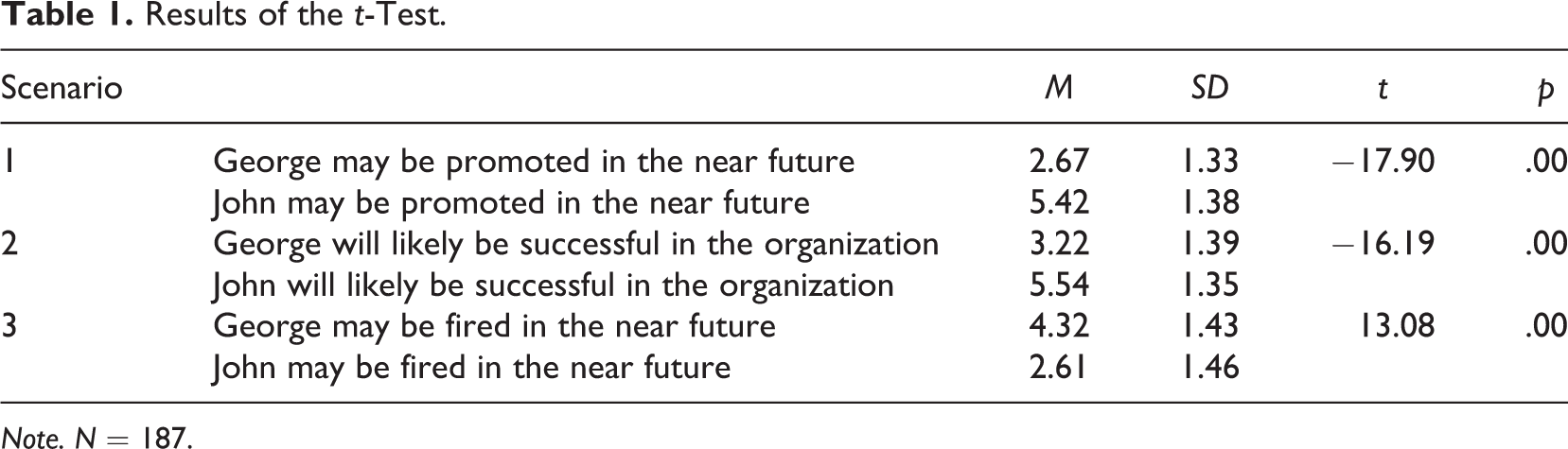
A paired t-test was run to show significant variations between the different scenarios. To test Hypotheses 1a and 1b, a vignette (Item 1, Appendix A) was read by the participants in which two individuals were seen as having a negative habit (a few times a month both show up to work wearing the same clothes as the day before, smelling of beer). One is said to be an “average worker” (i.e., George), while the other (i.e., John) solved several problems, saving the company millions. The participants were then asked how likely it is that each person will be promoted, be successful, or be fired in the future. Table 1 shows the results, which support Hypotheses 1 and 2 in that if an individual with a negative reputation is also known for something positive, then this individual may still remain successful. Although both individuals were known for something negative, one individual (i.e., John) was also known for exceling at his job. As such, this individual was seen as being much more likely to be promoted and be successful in the organization.
Results of the t-Test.
Note. N = 187.
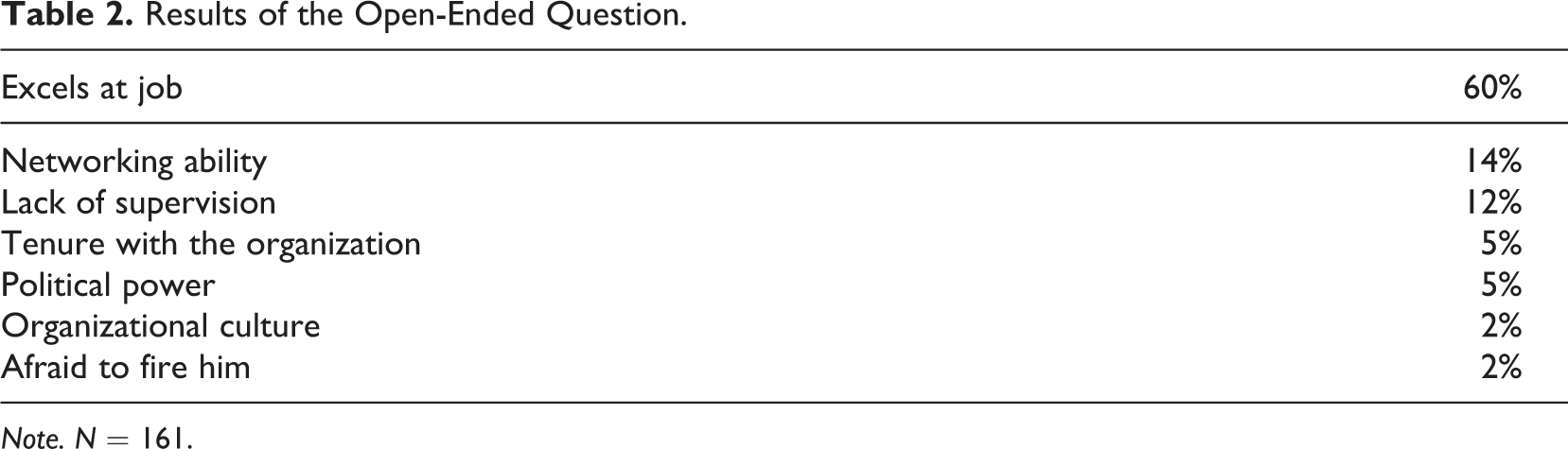
To test Hypothesis 2 (i.e., those who come in contact with an individual who has a negative reputation, yet remains in power, may assume that the individual is also known for positive characteristics), participants were next given a scenario (Item 2, Appendix A) which stated that they started a new job and were told by a reliable source that one of their new coworkers (i.e., Richard), was abusive to those around him, behavior that is not typically tolerated by the organization, and that he has been with the company for 5 years and continues to be promoted. The participants were then asked an open-ended question as to why they believed Richard was still with the organization. Table 2 shows the reported likely reasons. As expected, respondents assumed that this individual exceled at his job and therefore was able to continue with the organization regardless of his behaviors.
Results of the Open-Ended Question.
Note. N = 161.
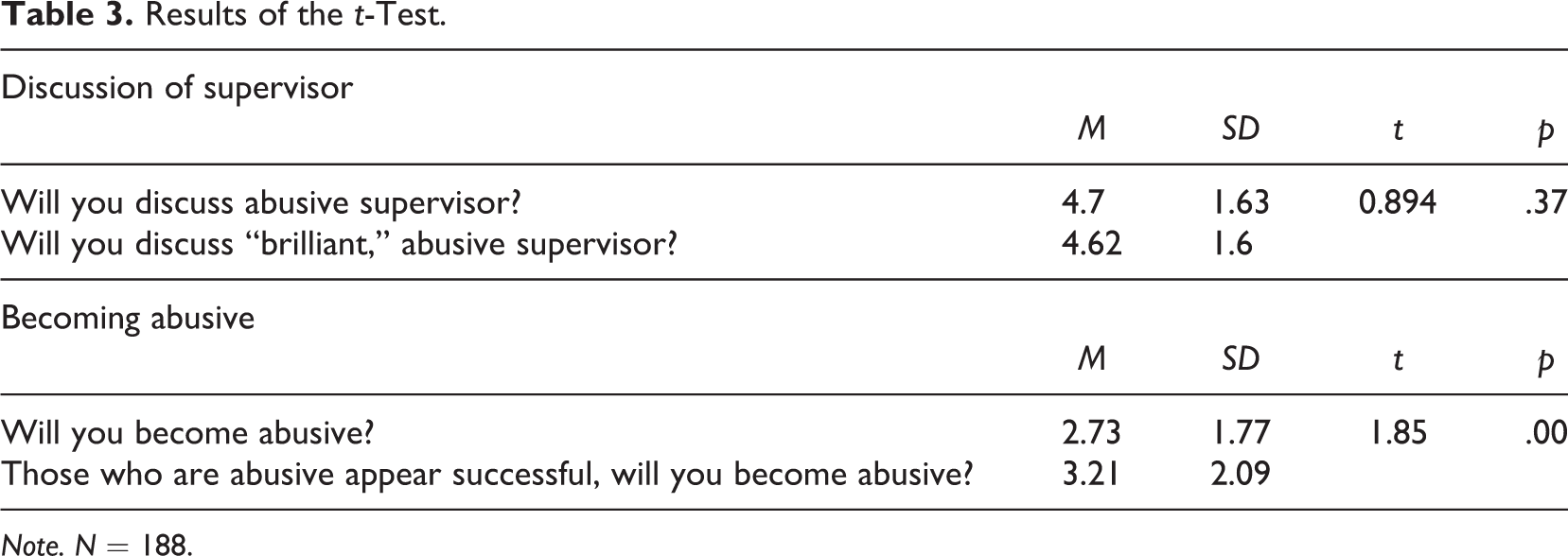
To test Hypothesis 3, a scenario (Items 3 and 4, Appendix A) was presented in which participants are asked how likely they might be to talk to a new employee about an abusive employee in the organization and were then asked if they would discuss the individual if the abusive worker was also considered brilliant and his contributions make the company an extra 1.2 million dollars a year. In both cases (i.e., both abusive alone and abusive and brilliant), on a Likert-type scale of 1–7 (1 = being very unlikely and 7 = being likely), Table 3 shows that these supervisors would be discussed more often than not.
Results of the t-Test.
Note. N = 188.
Finally, to test Hypothesis 4, subjects were asked if, upon starting a new managerial job at an organization in which the norm was for managers to be abusive, would they adopt abusive behavior patterns? They were then told that “nice” managers, typically did not last, and were asked if they would then become abusive (Items 5 and 6, Appendix A). The results in Table 3 show that subjects were more likely to become abusive if they saw that abusive managers were successful.
Study 2
In order to further test Hypotheses 1a and 1b, a field study was conducted in which the performance of two groups was measured. Research has shown that reputation can be divided into task, social, and integrity (i.e., a person is known for being socially popular, and expert at a task, or a person of integrity; Zinko, Gentry, & Laird, 2016). Likewise, an individual may hold different reputations at different levels of an organization (Ferris et al., 2014). Therefore, each subject had a total of six dimensions of reputation: three from their peers (social, task, and integrity) and three from the supervisor (social, task, and integrity).
To test Hypothesis 1a, we divided the subjects into two groups: one with all negative reputations and one with all positive, using an analysis of variance (ANOVA) to show the difference in success between the groups (i.e., success rated by perceived performance, as rated by their supervisor).
In order to test Hypothesis 1b, we again divided participants into two groups, analyzing them via an ANOVA. The first group had at least one dimension of their reputation at a negative level. The second group did not have any aspects of their reputation scored as negative. The groups were then compared to each other, to see if having a positive dimension would compensate for the effect on success of having negative dimension(s) of reputation.
Participants
Responses from 200 “working adults” were collected in the same manner as Study 1. The average age of the participants was 30.25 years, and 42% of the sample was female. Subjects were asked to nominate two individuals who did not see them on a daily basis to rate their reputation and to have their supervisor rate both their reputation and their performance.
Measures
Performance
Performance was measured using a 1–7 Likert-type performance scale developed by Williams and Anderson (1991). Sample items include “Adequately completes assigned duties” and “Meets formal performance requirements of the job.” Internal consistency reliabilities of .89 have been reported (i.e., Rupp & Cropanzano, 2002).
Reputation
Reputation is measured using the three-dimensional scale of Zinko, Gentry, and Liard (2016). The scale measures the dimensions of task, social, and integrity reputation. Zink et al. reported αs of .94, .94, and .95, respectively. Items include “This person is interested in everyone having a good time” (social), “This person is known to be an expert in his or her area” (task), and “This individual is seen as a person of high integrity” (integrity). As the scale is 7 point, those who were rated 1–3 on the scale were seen as possessing a negative and those who were 5–7 were seen as having a positive reputation.
Peer reputation was measured using two peers who do not see the subject on a daily basis. This was done to ensure that reputation was being measured, rather than simply observed behavior. Intraclass correlation coefficients were calculated to assure the agreement of the reputation (i.e., .88).
Results
The reliability of the scales reflected those of past researchers, with performance having an α of .87, and reputation consisting of task .92, social .90, and integrity .88. The results of the ANOVAs fully support Hypotheses 1a and 1b. To test Hypothesis 1a, all negative reputations (i.e., the subject’s scores for all three dimensions of reputation were 3 or below; M = 2.94, SD = 1.25, n = 38) and all positive reputations (i.e., the subject’s scores for all three dimensions of reputation were 5 or above; M = 6.62, SD = .56, n = 29, F = 216.21) were statistically different (<.01). Likewise, to test Hypothesis1b, one negative reputations (i.e., the subject’s score for one of the three dimensions of reputation was 3 or below, while the other two were 4 or above; M = 5.28, SD = 1.59, n = 32, F = 3.139) and no lows (i.e., the subject’s scores for all three dimensions of reputation were 4 or above; M = 5.94, SD = 1.45, n = 34) were not statistically different (.081). Although the samples are low, they are consistent with the current career research (e.g., Rehfuss & Di Fabio, 2012).
Discussion
There can be no doubt that in the majority of cases, most individuals will wish to develop a positive reputation. Likewise, it would be unusual for such individuals not to gain rewards for doing so. That being said, employees occasionally develop negative reputations. In some cases, such behaviors may align with the organization and as such benefit the individual. At other times, the outcome of a negative reputation may be disastrous. Regardless of the circumstances, negative reputations do occur. The results of such reputations are not widely understood, as the area has long been underdeveloped.
This analysis aimed at addressing this issue by adopting both an experiment and a field study. In doing so, we first confirmed the existing theory that states that most often a negative reputation is not in the best interest of an individual. It makes intuitive sense that individuals avoid developing a negative reputation. To date, however, this is the first study that empirically focuses on this concept. In doing so, we were able to establish a base line to explore other components of a negative reputation.
We next explored the idea that if a person holds a negative reputation, they may still be successful in an organization if they are known for something positive. This is particularly significant for those attempting to salvage a damaged career, because the data suggest that instead of simply attempting to “fix” a negative reputation (i.e., something that can be very difficult to do, as reputations can be quite static in nature, once established, Emler, 1994), such individuals may well be advised to instead focus on another dimension of reputation. Indeed, those who are not popular should consider focusing on becoming an expert in their field. Likewise, those who are not technically skilled may wish to develop a reputation as someone of high integrity and/or socially astute.
The option of having several different dimensions of reputation in which one can focus upon to be successful will make it easier for those with specific traits to be successful in organizations. Indeed, those who are introverted need not feel pressure to develop a social reputation, but rather may focus on task or integrity to be successful. Likewise, consistent with political skill research (Ferris, Treadway, et al., 2007), this study shows that one may be successful, even if they are not overly proficient at their job, by social maneuvering. Individuals need not develop “universal” reputations but rather simply excel in a specific area.
This research also shows that individuals who enter a setting that is one in which a negative reputation may result in rewards are likely to adapt their behavior to such an environment. In doing so, they may develop negative reputations within some groups in the organizations. Nevertheless, this may be what is needed to be successful. Employees may see the actions of a manager as negative, but these same actions may be vital to be a success in the eyes of company executives. Audiences evaluate the behaviors of an individual, based upon the norms and values of their group. In certain instances, negative reputations may be unavoidable. Those who wish to fast-track their careers need to consider not only their actions but how those actions will be received by different groups within the organization.
When considering the effects of negative reputation, this study takes the idea a step further in suggesting that at times, individuals may not only not wish to improve that aspect of their reputation but that promotion of a negative reputation may not always result in poor outcomes. Indeed, brilliant bastards are allowed benefits not allotted to other individuals. As individuals who are tenured in an organization hold a negative reputation, others will assume that there is a legitimate reason as to why the individual still maintains their position. Often, the assumption may be that the individual holds power or expertise that is not readily observed.
Limitations and Future Research
Although Study 2 was conducted in the field, not all of the hypotheses tested in the lab could be duplicated in the workplace. Further research into the area of personal reputation is needed. Likewise, due to the need to have a homogeneous sample when considering the norms and values of the workplace, the sample was gathered from a single country. One cannot assume that negative reputations will work the same in a more highly collective society. Finally, the issue of negative needs more examination in the context of the norms of an organization. One shortcoming of this study is how the values of organizations may change. What is seen as negative at one point in time may be seen as positive at a later date. Not only are reputations fluid in nature but also are the environments in which they operate.
Footnotes
Appendix A
Vignettes and items for the Study 1. All are based on a 7-point Likert-type scale, with the exception of a single open-ended item. 1. George and John both work in the IT (computer) department of this typical American, large corporation. According to your longtime colleague, whom you have lunch with every day, they both started 1 year ago, and a few times a month they both show up wearing the same clothes as the day before, smelling of beer. The company rolled out a new IT system in the last 6 months. Your friend tells you that George has done his job competently and is considered an “average worker.” John, on the other hand, has solved several problems with the new software that no one else has been able to figure out. Your colleague estimates that John has saved the company “millions in potential lost production,” due to his fixes to the software.
In your opinion, what will likely happen to these two employees?
(strongly disagree to strongly agree on the below items)
In your opinion, why might Richard still be with the organization? (open-ended question)
Declaration of Conflicting Interests
The author(s) declared no potential conflicts of interest with respect to the research, authorship, and/or publication of this article.
Funding
The author(s) received no financial support for the research, authorship, and/or publication of this article.