



Abstract
This study examined the relationship between parental support, engineering-related (realistic/investigative themed) learning experiences, self-efficacy, outcome expectations, and persistence intentions in a sample of first-generation college student (FGCS) engineering majors (N = 130). Parental support was assessed at the conclusion of an academic year and modeled as a predictor of other engineering-related variables assessed a year later using the social cognitive career theory framework. Results showed that parental support predicted realistic/investigative-themed verbal persuasion and vicarious learning, while realistic/investigative-themed performance accomplishments and physiological arousal predicted engineering self-efficacy. Realistic/investigative performance accomplishments also predicted outcome expectations. Self-efficacy and outcome expectations were predictors of engineering persistence intentions. Contrary to expectations, self-efficacy did not significantly predict outcome expectations. Mediation analyses revealed that the relationships of realistic/investigative-themed performance accomplishments and physiological arousal to persistence intentions were explained by self-efficacy. Results are discussed in terms of increasing retention of FGCS in engineering.
Keywords
More than half of projected job openings within science, technology, engineering, and mathematics (STEM) fields over the next decade will be in engineering and technology (Torpey, 2015). Careers in STEM typically offer higher starting salaries than careers in non-STEM fields and thus, potentially greater opportunities for social mobility (U.S. Department of Labor, 2014). Thus, researchers and policy makers have a vested interest in increasing the participation of women, people of color, and individuals from lower socioeconomic backgrounds in STEM fields and engineering, specifically (Chen & Soldner, 2013; Costello, 2012; National Science Foundation, 2015).
Students who are the first in their families to attend college—also known as first-generation college students (FGCSs)—complete bachelor’s degrees at approximately half the rate of their peers, leading to their underrepresentation in STEM careers (Engle & Tinto, 2008). FGCSs also leave STEM majors at higher rates than continuing-generation students (Shaw & Barbuti, 2010). Given FGCS’s increasing participation rates in postsecondary education (Davis, 2010) and their potential for contribution to the future U.S. workforce, it is critical that research examine factors that promote FGCS’s persistence in STEM fields. Research that specifically examines FGCS’s persistence intentions in engineering would be helpful, given the growth and relative prestige of these careers as well as research linking persistence intentions to actual persistence (Lent et al., 2003).
FGCSs and STEM Careers
FGCSs are underrepresented in STEM careers due to their disproportionate rates of college degree noncompletion as well as less advanced preparation in math and science, lower self-efficacy in math and science educational areas, and the increased financial burden of completing a degree in STEM (Chen & Soldner, 2013). For example, prior to college entry, approximately 22% of FGCS meet college readiness benchmarks for math, whereas 17% meet readiness benchmarks for science. These rates are close to half those of their continuing-generation peers in math (43%) and science (37%) areas (American College Testing [ACT], 2015). FGCSs are also less likely than their peers to have taken core courses in math and science, to express interest in STEM occupations upon high school completion, or to have good interest-major fit in engineering and other STEM fields (ACT, 2015).
The college experiences of FGCS may also contribute to their underrepresentation in STEM careers. For example, the middle-class independent norms characteristic of many higher education environments and STEM majors have been shown to negatively affect FGCS’s academic performance and emotional well-being (Stephens, Fryberg, Markus, Johnson, & Covarrubias, 2012). FGCSs also often face the challenges of balancing school and familial cultural contexts. Geographic as well as psychological distancing from family may occur for FGCS, as they become upwardly mobile in their pursuit of higher education (Ward, Siegel, & Davenport, 2012). Parents of FGCS may also be less likely to offer instrumental support related to college as a result of lower social capital (Davis, 2010). Although FGCS’s caregivers may be unable to provide support in the form of “college knowledge,” they may still provide academic and career-related encouragement. This form of support from family members may be important for FGCS, as they navigate postsecondary education.
Results of previous research has shown that parental involvement—measured by the degree to which parents discussed school-related matters with their children—accounted for a significant, but small proportion of variance in FGCS’s educational aspirations (McCarron & Inkelas, 2006). Another study found that family support in the form of understanding and ability to help with college-related problems did not predict FGCS’s grade point average, college adjustment, or college commitment above and beyond personal career motivation (Dennis, Phinney, & Chuateco, 2005). In the only study to examine FGCS’s experiences in engineering majors, researchers found that parents’ ability to understand the demands of an engineering degree or higher education played a major role in students’ academic persistence.
Clearly, more research is needed to understand factors that promote FGCS’s persistence intentions in engineering majors. We focused on parental support in this study, given the importance of family in FGCS’s academic and psychological adjustment to higher education. The form of parental support examined in this study specifically related to career encouragement and support, given FGCS may vary in the extent to which such support is offered by their caregivers (Ward et al., 2012). We also examined relationships between parental support and engineering academic experiences over time to investigate whether perceptions of parental support at the conclusion of an academic year may serve as a predictor of the quality of FGCS’s future learning experiences, and ultimately persistence intentions. This line of research may be relevant for college personnel seeking ways in which to increase retention of FGCS in engineering majors through systemic (e.g., family-based) interventions.
Theoretical Framework
Social cognitive career theory (SCCT; Lent, Brown, & Hackett, 1994, 2000) is a useful theory to apply to the educational and career development of FGCS (Gibbons & Shoffner, 2004). In particular, SCCT’s focus on reciprocal relationships between individual, contextual, and behavioral dimensions of career development makes it an ideal theoretical framework for FGCS, given the interplay between individual and contextual factors in these students’ educational experiences. The SCCT model depicts background contextual affordances as a predictor of learning experiences: performance accomplishments, verbal persuasion, vicarious learning, and physiological arousal (Lent et al., 1994). Background contextual affordances include supports that may encourage academic behavior and assume a distal role within the SCCT model (Lent et al., 2000). In a study of secondary students of color, the majority of whom were also prospective FGCS, results showed that parental support predicted math and science-related performance accomplishments, verbal persuasion, and vicarious influence, but not physiological arousal (Garriott et al., 2014).
Learning experiences are also proposed to predict both self-efficacy and outcome expectations within SCCT (Lent et al., 1994). Specifically, to the extent that a student has performed well, received positive verbal feedback on their skills, seen others like them successfully perform tasks, and experienced low levels of negative affect during their performance within a specific domain, the more likely they will be to express confidence in their abilities and perceive positive consequences of performing a domain-specific behavior (Lent et al., 1994). In a sample of undergraduate engineering majors, realistic and investigative-themed learning experiences predicted realistic and investigative self-efficacy and outcome expectations (Flores, Navarro, Lee, & Luna, 2014). Research with prospective FGCS found that investigative-themed performance accomplishments and vicarious influence significantly predicted self-efficacy while only performance accomplishments predicted outcome expectations in the domain of math and science (Garriott et al., 2014).
The SCCT model also assumes that self-efficacy will predict outcome expectations and that self-efficacy and outcome expectations will each predict goal intentions for activity involvement (Lent et al., 1994). Research with FGCS has shown that college self-efficacy predicts college outcome expectations (Garriott, Hudyma, Keene, & Santiago, 2015). Math/science outcome expectations, but not self-efficacy, have been shown to predict math/science intentions for prospective FGCS (Garriott, Flores, & Martens, 2013). Cross-sectional research with undergraduate engineering majors has revealed mixed support for the hypothesized relationships between self-efficacy, outcome expectations, and intentions. One study with Latino/Latina and White engineering students found that self-efficacy predicted outcome expectations and that both self-efficacy and outcome expectations predicted persistence intentions (Flores, Navarro, Lee, Addae, et al., 2014). In contrast, a study with a sample of students of color in science and engineering found that self-efficacy predicted outcome expectations, but goals were predicted only by outcome expectations and not self-efficacy (Byars-Winston, Estrada, Howard, Davis, & Zalapa, 2010).
In addition to direct relationships between variables in SCCT, Lent and colleagues (1994, 2000) proposed indirect relationships between background contextual affordances and self-efficacy as well as outcome expectations through learning experiences (Lent et al., 1994). Research with prospective FGCS has supported indirect links from parental support to self-efficacy through performance accomplishments and vicarious learning as well as parental support to outcome expectations through performance accomplishments. Research has also supported indirect effects from learning experiences to goals through self-efficacy and outcome expectations in the domain of math and science (Garriott et al., 2013; Garriott, Raque-Bogdan, Zoma, Macki-Hernandez, & Lavin, 2016). To date, no studies have examined links between parental supports and other SCCT-related variables in engineering majors over time.
The Present Study
Whereas SCCT has received empirical support with FGCS (Garriott et al., 2013, 2014, 2015) as well as engineering students (Flores, Navarro, Lee, Addae, et al., 2014; Flores, Navarro, Lee, & Luna, 2014; Lent et al., 2003), only one qualitative study has used the SCCT framework to examine FGCS in engineering majors. The lack of research on FGCS in engineering is concerning, as FGCS will constitute a larger proportion of students enrolled in postsecondary institutions over the next decade (Snyder & Dillow, 2015). Given high nonpersistence rates of FGCS and engineering majors (Davis, 2010; Marra, Rodgers, Shen, & Bogue, 2012), research that examines the persistence intentions of FGCS engineering majors can provide valuable information on factors related to their retention in engineering. Due to the unique role of parent support for this student group, parental support was included as a background contextual variable and examined at the first time point. Students’ engineering-related learning experiences (i.e., realistic/investigative themed), self-efficacy, outcome expectations, and persistence intentions were examined in relation to parental support a year later (see Figure 1). Consistent with SCCT, we hypothesized that:
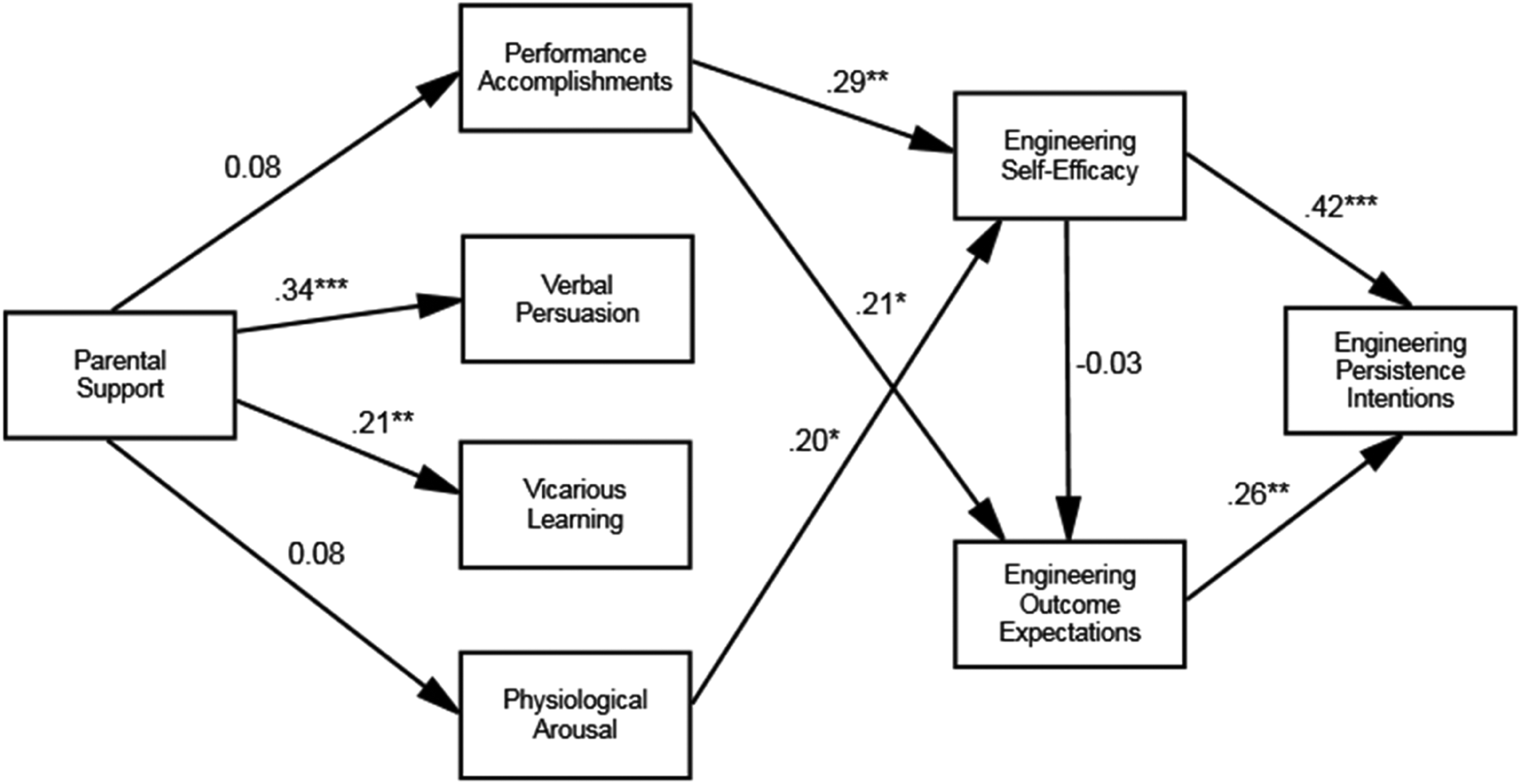
Hypothesized path model of FGCS’s engineering persistence intentions. Only statistically significant paths from learning experiences to self-efficacy and outcome expectations variables are presented to reduce visual clutter. All significance tests are one-tailed. All path coefficients represent standardized estimates. *p < .05. **p < .01. ***p < .001.
Method
Participants
One hundred thirty FGCS (n = 42 female, n = 88 male) who were attending a Hispanic-serving institution in the Southwest and majoring in engineering participated in the study. Of these participants, 91 (70%) identified as Latino/Latina, 30 (23.1%) identified as White, and 9 (7%) identified as bi- or multiracial. Twenty-five (19.2%) were in their first year of college, 36 (27.7%) in their second year, 43 (33.1%) in their third year, 22 (16.9%) in their fourth year, and 4 (3.1%) in their fifth or sixth year. The mean age of the participants was 21.86 years (SD = 3.94 years, range = 18–37). Of the engineering specialties represented, 31 (23.8%) were in aerospace engineering, 30 (23.1%) were in electrical and computer engineering, 22 (16.9%) were in mechanical engineering, 17 (13.1%) were in civil engineering, 12 (9.2%) were in chemical engineering, 11 (8.5%) were in engineering technology, 3 (2.3%) were in industrial engineering, 2 (1.5%) were in engineering physics, 1 (<1%) was in mechanical engineering technology, and 1 (<1%) was in civil engineering technology.
Instruments
Parent support
The Career Support Scale (CSS; Binen, Franta & Thye, 1995) was administered at Time 1 (T1) and was designed to measure the amount of perceived parental support and encouragement specific to career-related pursuits from parents. We used the 10-item modified CSS used by Flores and O’Brien (2002). Using a 5-point Likert-type scale ranging from 1 (almost never) to 5 (almost always), participants respond to questions based on the frequency of their experiences (i.e., “I feel encouragement from my parents to pursue my career goals,” “My parents agree with my career goals.”). High scores reflect strong levels of perceived support from parents. Prior research reported internal consistency coefficients for scores on the modified CSS that ranged from .70 to .76 (Flores, Navarro, Smith, & Ploszaj, 2006; Flores & O’Brien, 2002). Scores on this scale were positively related to career self-efficacy, interests (Flores et al., 2006), and goals (Flores & O’Brien, 2002). Scale scores demonstrated an internal consistency coefficient of .81 in the current sample.
Engineering-related learning experiences
The Learning Experience Questionnaire (LEQ; Schaub, 2004; Schaub & Tokar, 2005) was administered at Time 2 (T2) to assess the four learning experiences (i.e., performance accomplishments, vicarious learning, verbal persuasion, and physiological/emotional arousal) associated with the development of self-efficacy. The LEQ includes six subscales representing the Realistic, Investigative, Artistic, Social, Enterprising, and Conventional (RIASEC) Holland themes and four subscales for each source of self-efficacy. Sample items include “I have observed members of my family build things” (realistic vicarious learning) and “I was successful performing science experiments in school” (investigative performance accomplishment). There are 5 items per learning experience within each Holland theme, or 20 items for each Holland theme. Only the 40 items of the Realistic and Investigative subscales were used, as these two themes are most closely associated with engineering activities.
Participants were asked to refer to all of their prior educational experiences and to indicate their agreement with each item using a 6-point Likert-type scale ranging from 1 (strongly disagree) to 6 (strongly agree). Realistic and investigative items across each learning experience were averaged to obtain a single scale score. High scores indicate high levels of the specific type of engineering-related learning experience for the respective theme. Schaub (2004) reported internal consistency estimates for the four realistic sources of self-efficacy ranging from .77 to .91 and estimates ranging from .71 to .90 for the four investigative sources of self-efficacy. LEQ scores have been reported to have positive relations to corresponding RIASEC themes on measures of self-efficacy and outcome expectations (Williams & Subich, 2006). Realistic and investigative learning experience scores in the current sample produced αs of .77 for the Performance Accomplishments subscale, .86 for the Verbal Persuasion subscale, .77 for the Vicarious Influence subscale, and .81 for the Physiological/Emotional Arousal subscale.
Engineering outcome expectations
At T2, we used Lent’s 10-item engineering outcome expectations measure (Lent et al., 2003; Lent et al., 2005) to assess positive anticipated outcomes that students might expect from earning a bachelor’s degree in engineering (i.e., “receive a good job offer”). Participants responded to the Likert-type items using a scale ranging from 0 (strongly disagree) to 9 (strongly agree). High scores imply strong positive outcome expectations with regard to an engineering career. Previous studies indicated that the scale scores demonstrated good internal consistency ranging from .89 to .91 (Lent et al., 2003; Lent et al., 2005; Lent, Singley, Sheu, Schmidt, & Schmidt, 2007) with samples of engineering students. Scale scores correlated positively with measures of engineering-related self-efficacy, interests, and goals (Lent et al., 2003; Lent et al., 2005; Lent et al., 2013; Lent et al., 2007). The coefficient α for the current study was 90.
Engineering self-efficacy
We used Lent et al.’s (2005) engineering self-efficacy scale to assess participants’ confidence in their academic abilities in engineering at T2. The scale consists of 4 items (i.e., “excel in your engineering major over the next semester”) to which participants respond using a scale that ranged from 1 (completely unsure) to 10 (completely sure). High scores indicate high levels of engineering self-efficacy. Lent et al. (2005, 2007) reported coefficient αs ranging from .91 to .92 for scores on this measure with samples of college students enrolled in introductory engineering courses. Scale scores correlated positively with engineering outcome expectations (Lent et al., 2005, 2007), engineering interests and goals (Lent et al., 2005), and engineering goal progress and engineering academic satisfaction (Lent et al., 2007). The coefficient α in the current study was .90.
Engineering persistence intentions
A 4-item engineering goals scale (Lent et al., 2003) was used to assess participants’ academic persistence intentions in engineering (i.e., “I am fully committed to getting my college degree in engineering”) at T2. Responses range from 1 (strongly disagree) to 5 (strongly agree), with high scores reflecting strong intentions to pursue an engineering major. Scale scores demonstrated good internal consistency with samples of engineering students, with α coefficients ranging from .93 (Lent et al., 2005) to .95 (Lent et al., 2003; Lent et al., 2008). Lent and colleagues (2003, 2013) reported that engineering persistence intention scores were positively associated with engineering self-efficacy, outcome expectations, interests, and actual persistence. A coefficient α of .72 was found in the present sample.
Demographic survey
Participants completed a variety of demographic items to assess age, gender, self-reported race/ethnicity, engineering major, and year in college.
Procedures
In the Spring of 2011 (T1), engineering students enrolled in a Hispanic Serving Institution located in the Southwest were invited to participate in an online survey. Brief presentations were made in key engineering courses, flyers were posted around the college, and e-mails (including two follow-up reminder e-mails) were sent to engineering students to invite them to participate. To maximize the participation of women engineering students, 2 months after the data collection started, postcards were sent to all female students who had not completed the online survey at that time. A month later, phone calls and text messages were sent to the remaining female students. A year later, all participants from T1 were contacted via e-mail to participate in the second wave of data collection at T2. Postcards and phone calls were made to female participants to increase participation. The retention rate from T1 to T2 was 54%.
Results
Preliminary Analyses
Data screening
The Missing Values Analysis function in SPSS 22.0 was used to examine missing data. A total of 131 participants had some missing data, with 39.18% of values (i.e., items) missing within the data set. The percentage of missing data ranged from 0.4% to 47.2%. Attrition from T1 to T2 appeared to be the primary reason for missing data, with 115 participants only providing data at T1. Thus, data were retained for 135 participants who provided data at T1 and T2 and also identified as a FGCS. Data were next screened for univariate and multivariate outliers. Five cases had Mahalanobis distance values that exceeded the cut-off value of 22.458 and were removed from the data set, leaving a final sample of 130. No cases were deemed to be univariate outliers (z < |3|) and skewness (< |3|) and kurtosis (< |10|) values were deemed acceptable for primary analyses (Weston & Gore, 2006). Mardia’s coefficient was 28.69, indicating data were not multivariate normal. As recommended by Enders (2010), we compared participants who only completed data at T1 with those with complete data at both time points to determine whether data were missing completely at random or missing at random by creating a dummy variable for participants who completed or did not complete the parent support measure at T1 and T2. Results of an independent samples t-test showed that there were no significant differences on the parent support variable by missingness, t(243) = −.08, p = .934.
A path analysis was conducted to test the study’s hypotheses. The comparative fit index (CFI), root mean square error approximation (RMSEA), and standardized root mean square residual (SRMR) were examined to determine adequacy of model fit, with CFI ≥ .95, RMSEA ≤ .06, and SRMR values ≤ .05 representing close model-to-data fit (Kline, 2005).
Primary Analyses
See Table 1 for means, standard deviations, and correlations among the study variables.
Means, Standard Deviations, and Intercorrelations for the Full Sample.

Note. NS = not significant.
*p < .05. **p < .01. ***p < .001.
Testing the Path Model
MPlus 7.11 and full information maximum likelihood estimation were used to calculate unbiased parameter estimates with standard errors in the presence of missing data, and maximum likelihood estimation with robust standard errors due to nonnormal data (Enders, 2010). The hypothesized path model of engineering persistence intentions was tested with the full sample of 130 FGCS engineering undergraduates. Due to the implied directionality of SCCT hypotheses, one-tailed significance tests were used for individual paths within the model. Findings suggested an excellent fit to the data, Satorra–Bentler chi-square, χ2(7) = 6.79, p = .356, CFI = .99, RMSEA = .02, 95% confidence interval (CI) [.00, .11], SRMR = .03. Results demonstrated that T1 parent support positively and significantly predicted T2 engineering-related verbal persuasion and vicarious learning, but not T2 performance accomplishments or T2 physiological arousal. Positive direct relations also were found from T2 engineering-related performance accomplishments and physiological arousal to T2 engineering self-efficacy and from T2 engineering-related performance accomplishments to T2 outcome expectations. Further, T2 engineering self-efficacy and engineering outcome expectations were positively related to T2 engineering persistence intentions.
Contrary to expectations, T2 engineering-related verbal persuasion (β = .22, p = .074), vicarious influence (β = .05, p = .343), and physiological arousal (β = .01, p = .428) did not significantly predict T2 engineering outcome expectations. Furthermore, T2 engineering-related verbal persuasion (β = .04, p = .343) and vicarious influence (β = .02, p = .434) did not significantly predict T2 engineering self-efficacy. Overall, the relations within the hypothesized structural model explained a significant portion of variance in T2 engineering persistence intentions (27%) (see Figure 1 for standardized path coefficients).
Testing the indirect effects within the structural model
We used the RMediation (Version 1.1.4) statistical package to calculate indirect effects between variables in the model. The RMediation program uses a product of coefficients approach to testing indirect effects and has been shown to outperform bootstrapping methods when used in smaller samples (Tofighi & MacKinnon, 2011). Results demonstrated that only the indirect effect of T2 engineering-related physiological arousal on T2 engineering persistence intentions via T2 self-efficacy (estimate = .089; SE = .050; 95% CI [.001, .196]) and T2 engineering-related performance accomplishments on T2 persistence intentions via T2 engineering self-efficacy (estimate = .129; SE = .063; 95% CI [.024, .269]) were significant given that the 95% CIs did not include zero. Thus, T1 parent support had no indirect effects on T2 engineering self-efficacy or outcome expectations, and there were no significant indirect effects from the T2 learning experience variables to persistence intentions via outcome expectations.
Discussion
This study is the first to test SCCT in a sample of FGCS engineering students. It is also one of the few SCCT studies to examine parental support as a predictor of other SCCT-related constructs over time. Findings help extend the limited research that has been conducted with FGCS in engineering majors and inform what role family context as well as learning experiences may play in these students’ educational outcomes.
We expected that the SCCT model would provide an adequate fit to the data and that all variables would relate as posited in SCCT. These expectations were partially supported in that the model adequately fit the data and several paths were statistically significant. Parental support at T1 was a significant predictor of engineering-related verbal persuasion and vicarious learning at T2, suggesting that FGCS who feel supported at the conclusion of an academic year experience more frequent positive feedback and encouragement about their engineering-related skills and are more likely to have seen people they respect or can relate to perform engineering-related tasks in the future. Career-related encouragement and support from family could serve as a source of verbal persuasion for FGCS, who may receive encouragement about their performance in school from caregivers. This may be important for FGCS, as they sometimes experience “mixed messages” from family about attending school (Ward et al., 2012). Healthy relationships with caregivers could also encourage FGCS to seek out mentoring relationships with others who might provide vicarious learning opportunities. Contrary to previous cross-sectional research with prospective FGCS in the domain of math and science (Garriott et al., 2014), parental support did not predict engineering-related performance accomplishments. It is possible that the more advanced, and potentially challenging performance tasks associated with engineering majors explains the reduced strength of the relationship between parental support and performance accomplishments in this study. Additionally, parental support may play a different role for FGCS compared to their high school counterparts, given these latter students may have greater contact with their caregivers.
Performance accomplishments and physiological arousal predicted engineering self-efficacy, while performance accomplishments were the only learning experience variable that predicted outcome expectations. Other cross-sectional research with prospective FGCS found that math/science performance accomplishments and vicarious learning predicted math/science self-efficacy and that only performance accomplishments predicted outcome expectations (Garriott et al., 2014). It has been noted that compared to their peers, FGCS may struggle more with whether obtaining a college degree is “worth it” (Ward et al., 2012). Our findings and those of previous research suggest that of all the learning experience variables in SCCT, performance accomplishments may be key to fostering FGCS’s sense that obtaining a degree in STEM-related areas is worth the associated consequences. In contrast with previous research with FGCS in math and science domains (Garriott et al., 2014), physiological arousal predicted self-efficacy. The observed relationship between physiological arousal and self-efficacy in this study may reflect FGCS’s tendency to experience increased levels of stereotype threat and imposter syndrome within college classrooms (Davis, 2010). In terms of nonsignificant relationships between variables, it is also important to note that the sample in the present study included students who were further along in their academic careers and thus may have already had high levels of self-efficacy and outcome expectations. Therefore, the relatively high mean scores and range restriction of these variables (see Table 1) may have significantly attenuated their relationships with other variables in the study.
These statistical artifacts of our sample may also help explain the nonsignificant path coefficient between self-efficacy and outcome expectations. Previous research examining general college self-efficacy found it significantly predicted outcome expectations in a sample of FGCS (Garriott et al., 2015). Research in predominantly Black and White samples of undergraduate engineering majors has also supported links between engineering self-efficacy and outcome expectations (Lent et al., 2003; Lent et al., 2005). It is also possible that some of the subjective positive consequences of achieving an engineering degree, such as gaining respect from others and having a career that is valued by one’s family, may not be as directly linked to self-efficacy for FGCS. For example, while a FGCS may feel confident in their ability to succeed as an engineering major, they may not foresee some of the positive relational consequences of earning an engineering degree, given that their family or friends of origin may be unfamiliar with the specifics of engineering jobs.
Outcome expectations significantly predicted persistence intentions. This finding contrasts with research with predominantly White engineering students in which outcome expectations did not predict persistence goals (Lent et al., 2003). Additional research found that outcome expectations were a modest predictor of persistence goals for students attending a predominantly White, but not Historically Black Institution (Lent et al., 2005). These findings may be attributable to statistical artifact, given the present study did not include interests, as did the previous studies noted (i.e., Lent et al., 2003; Lent et al., 2005). Alternatively, it could be that perceiving positive consequences of earning a degree are especially salient for FGCS in engineering. Previous research with students of color in engineering also found that outcome expectations significantly predicted goals (Byars-Winston et al., 2010). The authors speculated that students’ pragmatic orientation toward earning a degree in engineering might have contributed to this finding (Byars-Winston et al., 2010). Similarly, students in our study may have viewed the consequences of earning an engineering degree as highly important. Others have suggested that FGCS may at times have to justify their decision to pursue higher education to themselves as well as others (Davis, 2010). Thus, outcome expectations may function as an important variable as FGCS consider their intentions to persist in engineering.
T1 parental support was not indirectly related to self-efficacy and outcome expectations through learning experiences. One explanation for this finding may be that while self-efficacy and outcome expectations were focused specifically on engineering in this study, learning experiences were measured more broadly within Realistic and Investigative Holland themes. However, significant indirect effects were found between engineering-related physiological/emotional arousal and persistence intentions through engineering self-efficacy as well as engineering-related performance accomplishments and persistence intentions through self-efficacy. Thus, self-efficacy appears to play an important role in explaining links from performance accomplishments and physiological/emotional arousal to persistence intentions for FGCS who are engineering majors.
Limitations
Although our findings offer novel information related to FGCS in engineering, several important limitations of our study should be noted. First, our sample size was relatively small, which may have had an impact on the observed strength of relationships between variables in this study. Participants in this study also represented a variety of class ranks. While FGCS make nonpersistence decisions at various stages of their academic careers, students in their fourth or fifth years of study may necessarily feel more committed to achieving a degree in engineering than their first- and second-year peers. This may have obscured measurement of persistence intentions in our study, as students at later stages of schooling may have been referencing previous, rather than future persistence behavior. Our sample was also predominantly Latino/Latina, which restricts generalizability of our results to students from other racial/ethnic groups.
Our assessment of parental support was also limited to one time point in the current study and all other relationships between variables were cross-sectional. It is possible that FGCS experience varying levels of parental support throughout their academic careers, which in turn affect their academic experiences and outcomes. Thus, our assessment of parental support in this study—although informative—may be an incomplete picture of how support from family influences FGCS’s academic experiences in engineering. Furthermore, the design did not allow examination of the temporal ordering of associations among learning experiences, self-efficacy, outcome expectations, and persistence intentions cannot be inferred.
Implications for Research and Practice
Results of the present study offer several potential directions for future research. Notably, the learning experiences predicted by parental support in this study were not directly or indirectly related to other academic and career-related criterion variables. Future research should attempt to replicate these findings with samples of FGCS engineering majors at earlier stages of their academic careers to test whether the maturity of our sample could explain these results.
Given inconsistent findings related to various forms of parental support and academic outcomes in the FGCS literature, future studies might also be directed at disentangling how different forms of family support relate to FGCS’s academic success and persistence intentions. Disparate findings in the literature may suggest that parental support for FGCS is multifaceted and relates differentially to academic outcomes based on the form of support being offered. Thus, multidimensional measures of parental support that capture both emotional and practical support for FGCS are needed for researchers to investigate potentially complex relations between support and academic success for this student group.
Additionally, we were unable to assess engineering-specific learning experiences in our study, given no measure of engineering learning experiences is currently available in the literature. Domain-specific engineering studies using the SCCT model would greatly benefit from measures of learning experiences that tap into engineering-specific sources of self-efficacy. Due to the intense learning environments common of engineering majors, engineering learning experiences may be strong predictors of engineering self-efficacy and outcome expectations. Future research with FGCS in engineering might also focus on the first-year experience for these students. While first-generation and engineering students make nonpersistence decisions throughout the course of their academic career, a large number of both these student groups make these decisions after the first year of college (Engle & Tinto, 2008; Marra et al., 2012). Longitudinal studies focused on this critical academic time period would add to understanding of FGCS’s persistence in engineering.
In terms of practical implications, our findings suggest that performance accomplishments and physiological arousal are important sources of self-efficacy for FGCS and are indirectly related to persistence intentions through this variable. College personnel—including counselors, advisors, and other faculty—should attend to FGCS’s experiences within the classroom and laboratory and how these might relate to their confidence in their ability to perform tasks required of engineering majors. Exploring how the environment of an engineering department might contribute to an FGCS’s performance anxiety and sense of accomplishment could be informative. Given significant relationships between self-efficacy, outcome expectations, and persistence intentions found in this study, engineering departments should ensure that in addition to feeling confident in their abilities, FGCS perceive positive consequences of achieving an engineering degree. It has been noted that FGCS may place greater emphasis on assisting and honoring family members as motivators for attending and persisting in college (Bui, 2002). Thus, attending to outcomes that may be more salient to FGCS could be an important area of focus.
Despite the limitations discussed earlier, this study adds to existing literature on FGCS’s persistence decisions in engineering majors. Findings from this study suggest that while parental support may provide a valuable source of positive feedback and encouragement, other performance-based and physiological/emotional learning experiences are precursors to FGCS’s self-efficacy and persistence intentions. Thus, focusing on these experiences might be a valuable area of intervention to enhance FGCS’s retention in engineering and in building a more diverse and stronger engineering workforce.
Footnotes
Declaration of Conflicting Interests
The author(s) declared no potential conflicts of interest with respect to the research, authorship, and/or publication of this article.
Funding
The author(s) disclosed receipt of the following financial support for the research, authorship, and/or publication of this article: This study was based on work supported by the National Science Foundation under Grant HRD-1036713.