



Abstract
Self-determination theory (SDT) was used to model the relations between environmental supports (i.e., administrative, departmental, personal and family) and well-being (i.e., teaching/service and global satisfaction) in 96 full-time non-tenure-track (NTT) faculty members, a growing population that has been underrepresented in the psychological and educational literature. Perceived relatedness and volitional autonomy were hypothesized to mediate the relations between the environmental supports and NTT faculty well-being. Results of path analysis indicated no significant direct effects for the environmental supports or volitional autonomy on well-being; perceived relatedness displayed significant direct effects on both indices of well-being. A bootstrap procedure yielded significant indirect effects for all environmental supports on well-being via perceived relatedness; administrative support displayed a marginally significant indirect effect via volitional autonomy. Results are discussed in terms of SDT and faculty well-being, and future directions for research are provided.
Keywords
The United States derives much of its intellectual vitality and ability to compete in the global marketplace from its institutions of higher education. This comes by way of both research productivity and the education of the next generation of the professional workforce. In order to execute these vital functions at an optimal level, colleges and universities require faculty who are satisfied in their positions. Strong relations have been found between job satisfaction and job performance in complex jobs (e.g., university faculty; Judge, Thorsesen, Bono, & Patton, 2001).
Well-being is a construct that encompasses positive functioning across life domains, and satisfaction with one’s work is commonly regarded as a key index of well-being (e.g., Horn, Taris, Schaufeli, & Schreurs, 2004). Thus, institutions of higher education have a vested interest in supporting the well-being of their faculty as a means to promote individual and institutional health and vitality. The extant literature has identified ways that institutions can support the well-being of tenured (T) and tenure-eligible (TE) faculty, but it has given less attention to non-tenure-track (NTT) faculty, who are increasingly shouldering the burden of undergraduate student instruction and advising (Schuster & Finkelstein, 2006). The present study utilized a novel conceptual framework to examine specific ways that institutions can better support full-time NTT faculty well-being (operationalized as job satisfaction), which in turn can help colleges and universities fulfill their teaching mission that is critical to the intellectual health of the United States. Moreover, the authors had access to one institution’s NTT faculty database concerning their experience in the workplace using the Collaborative on Academic Careers in Higher Education (COACHE) faculty job satisfaction survey (Benson, Mathews, & Trower, 2014). The COACHE has been used by administrators in over 250 universities and colleges to improve the academic workplace.
Non-Tenure-Track Faculty
While T/TE faculty remain central to most American colleges and universities and retain the majority of power in academic departments, their numbers have been in progressive decline. Rather, institutions are increasingly hiring more faculty off of the tenure track. In fact, NTT (also sometimes referred to as contingent) faculty make up approximately 60% of new full-time faculty hires (Schuster & Finkelstein, 2006). Despite the increasing role NTT faculty have been playing in higher education, until recently they have received little attention in the scholarly literature (Tam & Jacoby, 2009). Moreover, the work that has been done has lacked a strong theoretical basis in its investigation of NTT well-being.
NTT faculty are a heterogeneous group that play diverse roles in their academic institutions (e.g., Levin & Shaker, 2011). As such, it is difficult to make blanket statements about them; however, some key distinctions between NTT and T/TE faculty are that NTT faculty are typically not accorded the level of job security that their T/TE peers enjoy, and their efforts are typically concentrated on their institutions’ teaching missions (Baldwin & Chronister, 2001). Given these crucial differences between NTT and T/TE faculty, it is logical that they may have different needs and experience their work environments in different ways. The present study shines a needed light on the NTT faculty population using the conceptual lens of self-determination theory (SDT).
Self-Determination Theory
SDT (Deci & Ryan, 1985; Ryan & Deci, 2000) is a meta-theoretical approach to human motivation and personality, positing that intrinsically motivated work helps individuals actualize their tendency for growth, function optimally, and attain a state of well-being. This level of superior functioning is contingent upon three basic psychological needs (Ryan & Deci, 2000): perceived competence (a sense of self-efficacy or mastery), volitional autonomy (making one’s own work/life choices), and perceived relatedness (mutual caring, concern, and connection with others). A subtheory of SDT, cognitive evaluation theory (CET; Deci & Ryan, 1985), specifies that in many cases, these basic needs mediate the relation between various environmental supports and well-being (e.g., faculty satisfaction). CET most directly supported competence and autonomy as mediators, and a second SDT subtheory, organismic integration theory (OIT; Deci & Ryan, 1985), further explicated the potential for relatedness to mediate the relation between the environment and well-being. Taken together, these subtheories suggest that certain contextual factors (e.g., the climate in one’s academic department) may impact one’s sense of well-being both directly and indirectly through at least one of the psychological needs (e.g., perceived relatedness).
SDT researchers have generated several recent meta-analyses that show its three needs are robust predictors of outcomes such as physical and mental health (Ng et al., 2012), school performance (e.g., Hummel & Randler, 2012), and burnout (Li, Wang, & Kee, 2013). Additionally, empirical studies have validated the applicability of the SDT framework across diverse cultural and national groups (e.g., Sheldon et al., 2004). Of particular relevance to the present study, a recent empirical study found that the SDT needs are significant predictors of employee well-being in samples of French nurses (Gillet, Colombat, Michinov, Pronost, & Fouquereau, 2013). The SDT literature has not been extended to faculty well-being regardless of rank with the exception of Larson, Shelley, and Gahn (2015) who found that the SDT needs were predictive of well-being in T/TE faculty. The purpose of the present study was to apply SDT as the conceptual framework for predicting key indices of NTT faculty well-being.
Our SDT model of NTT faculty well-being, modeled after Larson and colleagues’ (2015) adaptation of Deci and Ryan (1985), is displayed in Figure 1. Consistent with the CET and OIT components of SDT, we hypothesized that environmental supports would predict well-being both directly and indirectly via the basic psychological needs (i.e., a partial mediation effect). We chose to focus on the SDT needs of volitional autonomy and perceived relatedness because of their conceptual significance to NTT faculty. That is, NTT appointments vary widely in the autonomy that they grant to faculty, and perceived relatedness is often challenged as they attempt to maintain meaningful relationships and a sense of connection in institutions that are typically oriented toward T/TE appointments (Baldwin & Chronister, 2001). Additionally, the data set we obtained did not include perceived competence.

The hypothesized mediation model.
The Relation of Environmental Supports and Faculty Well-Being
The first author searched the PsycINFO and Education Resources Information Center databases and found 80 peer-reviewed, empirical articles that examined faculty well-being which in this literature was primarily labeled as faculty satisfaction. Of those articles, 14 sampled part-time NTT faculty and only a qualitative study (Levin & Shaker, 2011) focused on full-time NTT faculty at 4-year institutions, the population of interest in the present study. While the authors also searched and consulted job satisfaction literature as it applies to the general population, these studies typically were not as germane to our research questions as those that were specific to faculty.
We now outline the evidence for the components of our model, highlighting findings specific to NTT faculty where possible. Also, the NTT quantitative literature is exclusively focused on part-time rather than full-time NTT faculty. It is imperative to bear in mind that while findings concerning T/TE faculty or university faculty as a whole may serve as an acceptable “starting point” for situating our understanding of full-time NTT faculty well-being in the absence of direct empirical data, they must be interpreted with caution given the unique nature of NTT appointments established earlier in this article.
Environmental supports and well-being
Departmental supports encompass various aspects of one’s academic department, including support from the department chair, recognition for one’s contributions and achievements, and support for both promotion and contract renewal. We found moderate to large effect sizes in the small number of studies that examined these factors. Brown and Moshavi (2002) surveyed department chairs and faculty (unspecified) and found a positive relation between chair behaviors and faculty satisfaction (r = .69, p < .001). Likewise, August and Waltman (2004) found relations with the chairperson to be a significant predictor of overall faculty (unspecified) satisfaction (β = .19, p < .05). Hoyt and colleagues (2008) found recognition to be a robust predictor of satisfaction (β = .40, p < .01) in a large part-time NTT sample. Chen, Beck, and Amos (2005) also found individualized consideration and contingent rewards (i.e., recognition) were positive predictors of Taiwanese nursing faculty satisfaction. Ott and Cisneros (2015) sampled NTT and T/TE faculty using COACHE data and showed recognition to be a significant predictor of job satisfaction for the NTT subsample. Through analysis of NTT focus group data, Waltman, Bergom, Hollenshead, Miller, and August (2012) found that a majority of participants identified unclear, inconsistent, or nonexistent policies related to contract renewal and promotion as a source of dissatisfaction.
Administrative supports include support received from deans and upper-level administration (e.g., provosts). The available literature has found moderate to large effect sizes for their relation with faculty satisfaction. For example, Eagan, Jaeger, and Grantham (2015) found working relationships with upper administration to be a significant predictor of satisfaction (b = 2.79, p < .001) in a large sample of part-time NTT faculty. Gormley (2003), in a conceptual review of nursing faculty satisfaction, cited correlations ranging from .69 to .80 for the relation between specific dean behaviors and faculty satisfaction. Larson et al. (2015) also found upper-level administrative support to be a significant, positive predictor of global satisfaction in T/TE faculty.
Personal and family supports encompass benefits and work–life balance. The available data regarding benefits and faculty satisfaction suggest a positive relation. Hoyt (2012) found that satisfaction with compensation was the single largest predictor of overall satisfaction (β = .42, p < .001) in a large NTT sample. Ott and Cisneros (2015) also showed benefits to be a significant predictor of faculty satisfaction. Waltman and colleagues (2012) found dissatisfaction with benefits to be a recurrent source of overall dissatisfaction for the NTT faculty in their focus groups. Work–life balance has been a more consistent predictor of faculty satisfaction, typically displaying medium effect sizes. For example, Moors, Malley, and Stewart (2014) found support for family to be positively related to T/TE faculty satisfaction (r = .47, p < .001), and Michel and Michel (2015) found work–family enrichment (r = .51, p < .001) and work schedule flexibility (r = .32, p < .001) to be predictive of satisfaction across faculty ranks. Providing qualitative support, Feldman and Turnley (2001) and Waltman and colleagues (2012) found scheduling flexibility (i.e., work–life balance) to be an emergent theme related to satisfaction in their NTT faculty samples. In short, it appears from the available empirical literature that environmental supports would relate to NTT faculty well-being.
What is noticeably absent in the above literature and in the conceptualization of these studies (e.g., Hagedorn, 2000) is the person’s translation of those various environmental factors. Deci and Ryan (1985) acknowledged the crucial impact that the perceived needs of the individual have in mediating the relation between contextual factors and well-being. The strength of the current study is the addition of these mediators to the prediction of faculty well-being.
Volitional autonomy and perceived relatedness as mediators of faculty environment and well-being
In the only study to date to use SDT as a conceptual framework for faculty well-being, Larson and colleagues (2015) examined the SDT needs as mediators of the relation between environmental supports and the well-being of T/TE faculty. Moreover, Larson and colleagues operationalized the constructs in Figure 1 using measures from the COACHE survey (Benson et al., 2014) which were modified to be used in the present study. Volitional autonomy partially mediated the relation between the environmental supports (administrative support, work–life balance support [i.e., personal and family supports], and both indices of well-being [i.e., teaching/service and global satisfaction]). Volitional autonomy fully mediated the relation between promotion and tenure support (similar to contract renewal for full-time NTT and part of departmental support) and both indices of faculty well-being. Perceived relatedness partially mediated the relation between work–life balance support and global satisfaction, one index of faculty well-being. Moreover, perceived relatedness fully mediated the relation between promotion and tenure support and global satisfaction.
One study provided additional support for the mediating effect of the SDT needs on the relation between environmental supports and work-related well-being in fields other than higher education. Gillet, Colombat, Michinov, Pronost, and Fouquereau (2013) found that environmental supports (e.g., procedural justice and supervisor autonomy support) predicted the job satisfaction of a sample of French nurses indirectly (i.e., a full mediation effect) via the SDT needs collapsed across all three needs. Finally, two studies using COACHE data but a different conceptual framework than SDT provided evidence that volitional autonomy and an aspect of relatedness, namely collegiality, moderately related to job satisfaction (Lawrence, Celis, & Ott, 2014; Ott & Cisneros, 2015), personal benefits, and an aspect of department support, namely recognition (Ott & Cisneros, 2015).
Taken together, evidence suggests that environmental supports and the SDT needs of volitional autonomy and perceived relatedness may play significant roles in predicting NTT faculty well-being. However, the various components of our model have never been examined together in the context of NTT faculty well-being; this study thus represents a novel contribution to the areas of NTT faculty well-being, faculty satisfaction, and SDT more broadly.
Hypotheses
The primary hypothesis for this study was that the partial mediation model displayed in Figure 1 would yield a good fit to the full-time NTT faculty sample. This was further divided into hypotheses that explain the direction of the direct and indirect effects.
Direct relations
We hypothesized the environmental supports (i.e., departmental support, administrative support, and personal and family support) would have significant, positive, direct relations with faculty well-being (Paths a through f). We also hypothesized that volitional autonomy and perceived relatedness would have direct relations with faculty well-being (Paths m through p).
Mediators
We hypothesized that the environmental supports would also have significant, positive, indirect relations with faculty well-being through volitional autonomy and perceived relatedness.
Method
Participants
The participants included 104 full-time NTT faculty at a large Midwestern university who responded to the 2013–2014 administration of the Harvard COACHE faculty job satisfaction survey (Benson et al., 2014). Faculty hired in the same academic year as the survey and faculty serving in a senior administrative position (e.g., dean, associate dean, provost) were excluded from the survey sample, per COACHE policy (COACHE, 2013). Eight participants were excluded from data analysis due to excessive missing responses. A sample size of 105 (5 participants for each of the 21 parameters) was recommended to provide adequate statistical power for path analysis (Hatcher, 1994).
Of the 96 participants included in our analyses, 86.5% identified as White (non-Hispanic), 4.2% as Black/African American, 3.1% as Latino/a, 2.1% as Asian, Asian American, or Pacific Islander, and 5.2% declined to identify with a race. The sample was 63.5% female. The mean age was 46.85 years (SD = 11.58). U.S. citizens comprised 93.8% of the sample, followed by 5.2% resident aliens, and 1% nonresident aliens. Science, technology, engineering, and mathematics (STEM) faculty represented 50% of the participants. Seventy-five percent of participants had fixed-term renewable appointments, 2.1% had fixed-term nonrenewable appointments, 10.4% had rolling appointments, and the remaining 12.6% of participants selected “other” or did not provide an appointment type. For the NTT faculty invited to participate at this institution (i.e., respondents and nonrespondents; N = 272), mean time in current position was 4.9 years, with a mode of 1 year; 62% had a terminal degree.
The COACHE
The COACHE survey is a secure, web-based instrument that takes approximately 25 min to complete. It was developed based on scholarly literature related to faculty job satisfaction, interviews with faculty across ranks, and focus groups with upper-level academic administrators. Its validity was also established using cognitive testing of diverse faculty across multiple types of institutions. The COACHE survey is widely used around the United States for the purposes of institutional improvement and higher education research (e.g., Lawrence et al., 2014; Ott & Cisneros, 2015), and it has been administered to more than 250 academic institutions since 2003 (COACHE, 2016).
The COACHE survey contains various demographic/background questions (e.g., race, gender, rank, etc.) and more than one hundred and seventy 5-point Likert-type items that are subdivided into various scales (benchmarks) pertaining to specific aspects of participants’ work (e.g., teaching, service, research, climate, satisfaction, etc.), with higher scores indicating greater agreement, satisfaction, clarity, and so on. These benchmarks have continually displayed good internal consistency (α = .70 to .95; COACHE, 2015); however, they are not conceptually consistent with SDT or oriented toward NTT faculty and were thus not used in the present study.
The following constructs as shown in Figure 1 were operationalized from the 2013 to 2014 COACHE survey using several steps. First, measures were adapted from similar measures developed from COACHE data sets that had included SDT or SDT-related constructs (i.e., Larson, Shelley, & Gahn, 2015; Lawrence et al., 2014; Ott & Cisneros, 2015). Second, item content unique to NTT faculty was included (e.g., contract renewal) and item content unique to T/TE faculty was excluded (e.g., tenure). Because full-time NTT faculty were asked fewer items than T/TE faculty, only three environmental COACHE measures were viable in this data set. Next, exploratory factor analyses were conducted on sets of items, and scales were constructed using items that had high factor loadings on a unitary factor. Finally, the internal consistency of those scales was also screened.
Departmental support
This measure includes items from two of Larson et al.’s (2015) scales, namely, department chair support and evaluation/recognition. It also shares items with a recognition scale (called feedback) used by two other COACHE studies (Lawrence et al., 2014; Ott & Cisneros, 2015). The scale consists of nineteen 5-point Likert-type items with higher scores indicating perception of more departmental support. The item content concerns: department chair’s pace of decision-making; department chair’s stated priorities; department chair’s communication of priorities to faculty; department chair’s fairness in evaluating work; recognition received from the department chair; recognition received from peers; recognition received (in general) for teaching, scholarly work, and service; the process, criteria, and standards for contract renewal and promotion. An example item stem was “My department head’s or chair’s fairness in evaluating my work.” The items loaded on a unitary factor with factor loadings ranging from .66 to .88, with the exception of 1 item loading .36 that was included due to its conceptual significance. The α in this sample was .96. This scale correlated with the two other environmental support scales in this sample at .45 and .33, suggesting they are distinct environmental factors. Scores on this scale also correlated strongly with the COACHE benchmarks for departmental leadership (r = .74, p < .01) and appreciation and recognition (r = .79, p < .01) in this sample. Additional initial estimates of convergent validity show that the original Larson et al. (2015) measures of chair support and evaluation/recognition correlated .97 and .82 with the COACHE benchmarks for departmental leadership and appreciation and recognition, respectively.
Administrative support
This scale was developed by Larson et al. (2015) and included nine 5-point Likert-type items with higher scores indicating more perceived administrative support. The item content concerns whether institutional priorities are acted upon consistently across all levels of leadership as well as the stated priorities, communication of priorities, and pace of decision-making of the president/chancellor, chief academic officer, and dean/division head. An example item stem was “My institution’s president’s/chancellor’s communication of priorities to faculty.” The items loaded on a unitary factor with factor loadings ranging from .61 to .87. The α was .93 in this sample, and this scale correlated .45 and .15 with the other environmental supports in this sample. Scores on this scale also correlated strongly with the COACHE benchmarks for senior leadership (r = .92, p < .01) and division leadership (r = .89, p < .01). Additional initial estimates of convergent validity show that the original Larson et al. (2015) measure for upper level administrative and dean support correlated .94 and .74 with the COACHE benchmarks for senior leadership and division leadership, respectively.
Personal and family supports
This measure was originally developed by Larson et al. (2015) and adapted for this NTT sample. This measure is also similar to a scale used by Ott and Cisneros (2015) labeled rewards. The measure includes seven 5-point Likert-type items with higher scores indicating more perceived personal and family supports. The item content concerns perceived compatibility of personal/family obligations and an academic career, ability to find balance in life, timing of meetings, health benefits, and retirement benefits. An example item stem was “My institution does what it can to make personal/family obligations (e.g., childcare or eldercare) and an academic career compatible.” In this NTT sample, the items loaded on a unitary factor with factor loadings ranging from .53 to .80 and an α of .82. This scale significantly correlated .33 and .15 with the other environmental supports in this sample, clearly showing the measure is distinct. In this sample, scores on this scale correlated strongly with the COACHE benchmarks for personal and family benefits (r
Volitional autonomy
Volitional autonomy was operationalized by modifying the Larson et al.’s (2015) Volitional Autonomy Scale. The scale is also almost identical to the autonomy scale used in two other COACHE studies (Lawrence et al., 2014; Ott & Cisneros, 2015). This scale contained six 5-point Likert-type items with higher scores indicating more perceived autonomy. The item content concerns discretion over committee work, equity of committee assignments, discretion over courses taught, equity of teaching workload, and input regarding departmental policies and institutional priorities. An example item stem was “The discretion you have over the content of the courses you teach.” The items in this NTT sample loaded on a unitary factor with factor loadings ranging from .41 to .69. The α was .79 in this sample and .78 in the Larson et al. (2015) sample. Volitional autonomy displayed moderate correlations with indices of well-being in two faculty samples: job satisfaction (labeled organizational commitment: r = .39, p < .001; Ott & Cisneros, 2015) and turnover intentions (r = .26, p < .001; Lawrence et al., 2014). Autonomy had an α of .62 in Ott and Cisneros (2015) and .72 in Lawrence et al. (2014). The NTT subsample reported less autonomy than T/TE faculty and those NTT faculty who intended to leave reported less autonomy than those who intended to stay (Ott & Cisneros, 2015). Asian international faculty who intended to leave also reported less autonomy than those intending to stay (Lawrence et al., 2014).
Perceived relatedness
Perceived relatedness was operationalized by modifying Larson et al.’s (2015) Relatedness Scale. The scale is an expansion of the shorter collegiality subscales reported by Ott and Cisneros (2015) and Lawrence et al. (2014) to include dimensions of relatedness content beyond collegiality (e.g., intellectual vitality and interaction). This scale included twenty 5-point Likert-type items with higher scores indicating more perceived relatedness. The item content included amount of professional and personal contact with peers across ranks, intellectual vitality and productivity of peers across ranks, how much peers “pitch in” when needed, promotion of diversity in the department, overall perceived collegiality of the department, perceived fit in the department, communication, conflict resolution, and engagement in dialogue with peers concerning student learning, teaching practices, and effective use of technology. An example item stem was “How well you fit in your department (e.g., your sense of belonging in your department).” The items loaded on a unitary factor with factor loadings ranging from .46 to .78. The α was .93 in this sample and .92 in Larson et al.’s (2015) T/TE sample. In their faculty samples, collegiality displayed modest correlations with job satisfaction (r = .28, p < .001; Ott & Cisneros, 2015) and turnover intentions (r = .24, p < .001; Lawrence et al., 2014). Collegiality had an α of .88 in both Ott and Cisneros (2015) and Lawrence et al. (2014). It also differentiated Asian international faculty who intended to stay from those who intended to leave (Lawrence et al., 2014). NTT faculty also reported less collegiality than their T/TE colleagues (Ott & Cisneros, 2015).
Faculty well-being
Two indicators of well-being were operationalized: teaching/service satisfaction and global satisfaction, both taken from Larson et al.’s (2015) study. The Teaching/Service Satisfaction Scale included six 5-point Likert-type items with higher scores indicating more satisfaction with the teaching and service roles. The item content included number of committees served, students advised, and courses taught; level of courses taught, class sizes, and quality of students taught. An example item was “Please rate your level of satisfaction or dissatisfaction with the following: The level of courses you teach.” In this sample, the items loaded on a unitary factor with factor loadings ranging from .38 to .74. The α was .72 in this sample and was .87 in Larson et al.’s (2015) T/TE faculty sample. Teaching/service satisfaction correlated .25 with global satisfaction in their study, suggesting they measure distinct constructs. Initial estimates of convergent validity show that the Teaching/Service Satisfaction Scale correlated .88 and .81 with the COACHE benchmark for Nature of Work–Teaching in this sample and in Larson et al.’s (2015) sample, respectively.
The global satisfaction scale was similar in content to the Job Satisfaction Blank (Hoppock, 1935) and included the 1-item job satisfaction measure used by Lawrence et al. (2014) and Ott and Cisneros (2015). It included four 5-point Likert-type items with higher scores indicating greater overall satisfaction with the job. The item content included overall satisfaction with the position, department, and institution. An example item was “If I had it to do all over, I would again choose to work at this institution.” The items loaded on a unitary factor with factor loadings ranging from .81 to .91. The α was .93 in this sample and was .88 in Larson et al.’s (2015) T/TE sample. No COACHE benchmarks pertained to global faculty satisfaction; however, the Global Satisfaction Scale correlated with the 1-item measure used by Lawrence et al. (2014) and Ott and Cisneros (2015) at .92 and .91 in the present study and in Larson et al.’s (2015) study, respectively.
Procedure
The data set used for this study was an archival faculty satisfaction survey that had been collected at this university from October 2013 through January 2014. At that time, full-time faculty (i.e., NTT and T/TE) were invited by the Provost’s office to complete the survey. They then received an e-mail from COACHE containing a unique link to the survey. COACHE subsequently sent three reminder e-mails to participants who had not yet responded. Finally, the Provost’s office also sent a reminder e-mail to participants who had not yet responded the day before the close of the survey. All full-time NTT faculty at the university not hired in the same academic year as the survey (N = 272) were invited to complete the survey and 38.2% completed the survey. Because all data received from COACHE were deidentified and the authors had no contact with participants, approval was not required from the authors’ institutional review board.
Results
Preliminary Analyses and Descriptive Statistics
Multiple steps were taken to manage missing data. First, respondents who completed the survey in an inordinately short time (i.e., more than 2 SD below the mode) or used an identical response pattern throughout the survey had been deleted by COACHE prior to release of the data to the authors. This cleaning resulted in an initial sample size of 104. Second, the authors removed items in which more than 20% of the data was missing and removed participants (n = 8) with extensive incomplete responses. Finally, participants’ responses on any construct in which more than 50% of the items were missing was omitted from the analysis.
Table 1 presents the means, SD, and correlations of the variables included in our analyses. Additionally, we examined whether scores on any of the predictor, mediator, or outcome variables significantly differed according to participant’s gender (male vs. female) or discipline type (STEM vs. non-STEM) using a series of 2 × 2 analyses of variance. Neither gender nor discipline had a significant main or interaction effect using a Bonferroni correction (p < .007) on any of the variables, so these demographic variables were not included in the path model.
Summary of Means, Standard Deviations, and Intercorrelations for All Studied Variables.
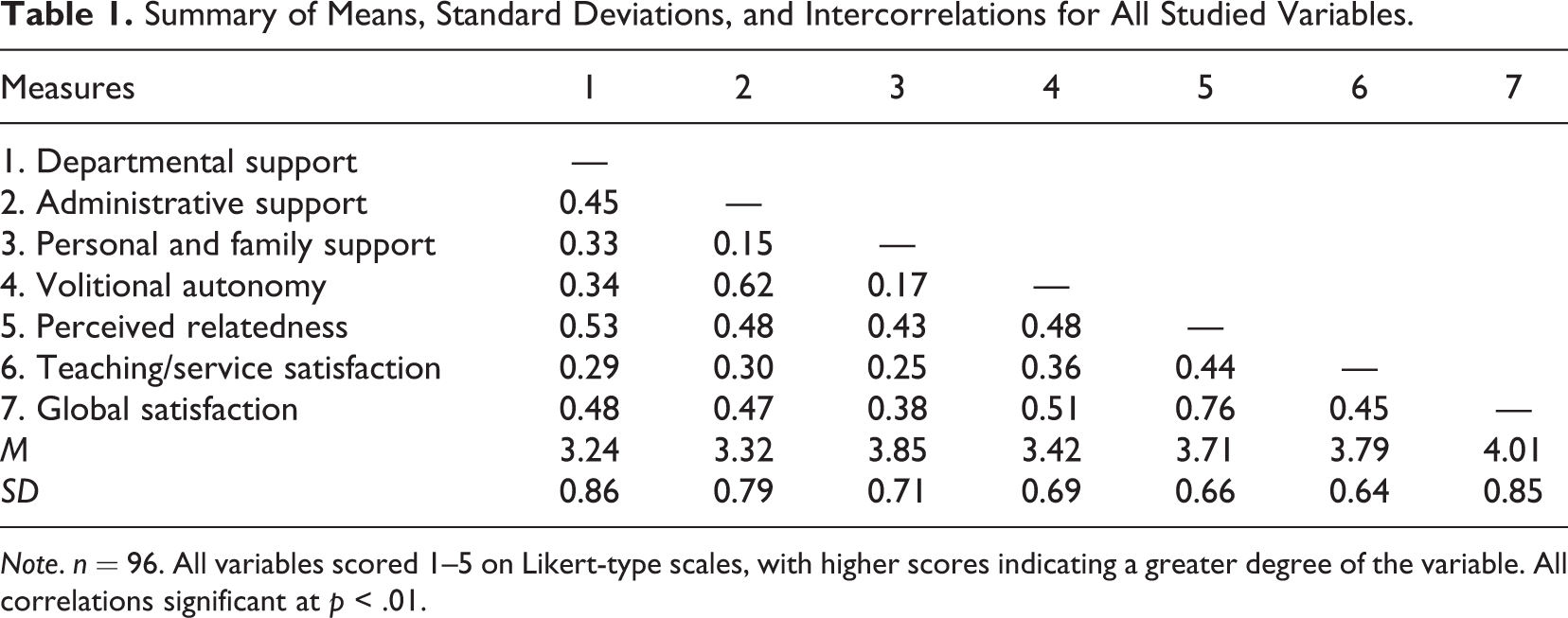
Note. n = 96. All variables scored 1–5 on Likert-type scales, with higher scores indicating a greater degree of the variable. All correlations significant at p < .01.
Path Analysis
The statistical software MPlus version 7.2 (Muthén & Muthén, 2012) was used to conduct path model analyses using full information maximum likelihood to estimate casewise parameters for missed items. The guidelines of Hu and Bentler (1999) were used to assess goodness of fit for the models. These included a comparative fit index (CFI) of .95 or greater, a root-mean-square error of approximation (RMSEA) or .06 or less, and a standardized root-mean-square residual (SRMR) of .08 or less.
Following the convention of Holmbeck (1997), we first tested the fully mediated model, as shown in Figure 2. Results indicated the fully mediated model was a good fit, χ2(6, n = 96) = 2.80, p = .83, CFI = 1.00, RMSEA < .01, SRMR = .02. Figure 2 contains the standardized β coefficients for the direct effects on the relation between each environmental support and NTT faculty well-being as mediated by volitional autonomy and perceived relatedness. Solid lines indicate significant direct paths, whereas dashed lines indicate insignificant direct paths. Each of the three environmental supports was significantly related to perceived relatedness. However, only administrative support was significantly related to volitional autonomy (β = .58, p < .001). Perceived relatedness was significantly related to both teaching/service satisfaction (β = .35, p < .001) and global satisfaction (β = .67, p < .001). Volitional autonomy was not significantly related to either type of satisfaction.

The fully mediated model. *p < .05. **p < .01. ***p < .001.
The second model we tested was the partially mediated (hypothesized) model, as shown in Figure 3. None of the environmental supports had significant, direct relations with either type of satisfaction. Otherwise, the same significant direct effects were observed as in the fully mediated model. This was a saturated model, so the fit was perfect by all indices. However, the nonsignificant χ2 difference test, Δχ2(6, n = 96) = 2.80, p = .83, indicated that the fully mediated and partially mediated models fit the data equally well.

The partially mediated model. *p < .05. **p < .01. ***p < .001.
Bootstrap tests using bias-corrected 95% confidence intervals were used to test the statistical significance of the mean indirect effects. The fully mediated model was chosen for this analysis because it was the more parsimonious of the two models. The calculation was repeated with 1,000 samples to yield parameter estimates for total and specific indirect effects. A confidence interval not containing 0 indicated that the mean indirect effect across the samples was significant (p < .05). Bootstrap analysis provided greater statistical power and did not make any assumptions regarding multivariate normality (Preacher & Hayes, 2008).
Table 2 presents the magnitude and statistical significance of the specific and total indirect effects of the environmental supports on NTT faculty well-being through volitional autonomy first and then through perceived relatedness using the bootstrapping procedure. Table 2 is organized so that the first six specific mean indirect effects reported concern the first mediator, volitional autonomy; the last six specific mean indirect effects reported concern the second mediator, perceived relatedness.
Bootstrap Analysis of Magnitude and Statistical Significance of Indirect Effects of Departmental, Administrative, and Personal and Family Support on NTT Faculty Well-Being (Satisfaction) Through Volitional Autonomy and Perceived Relatedness.
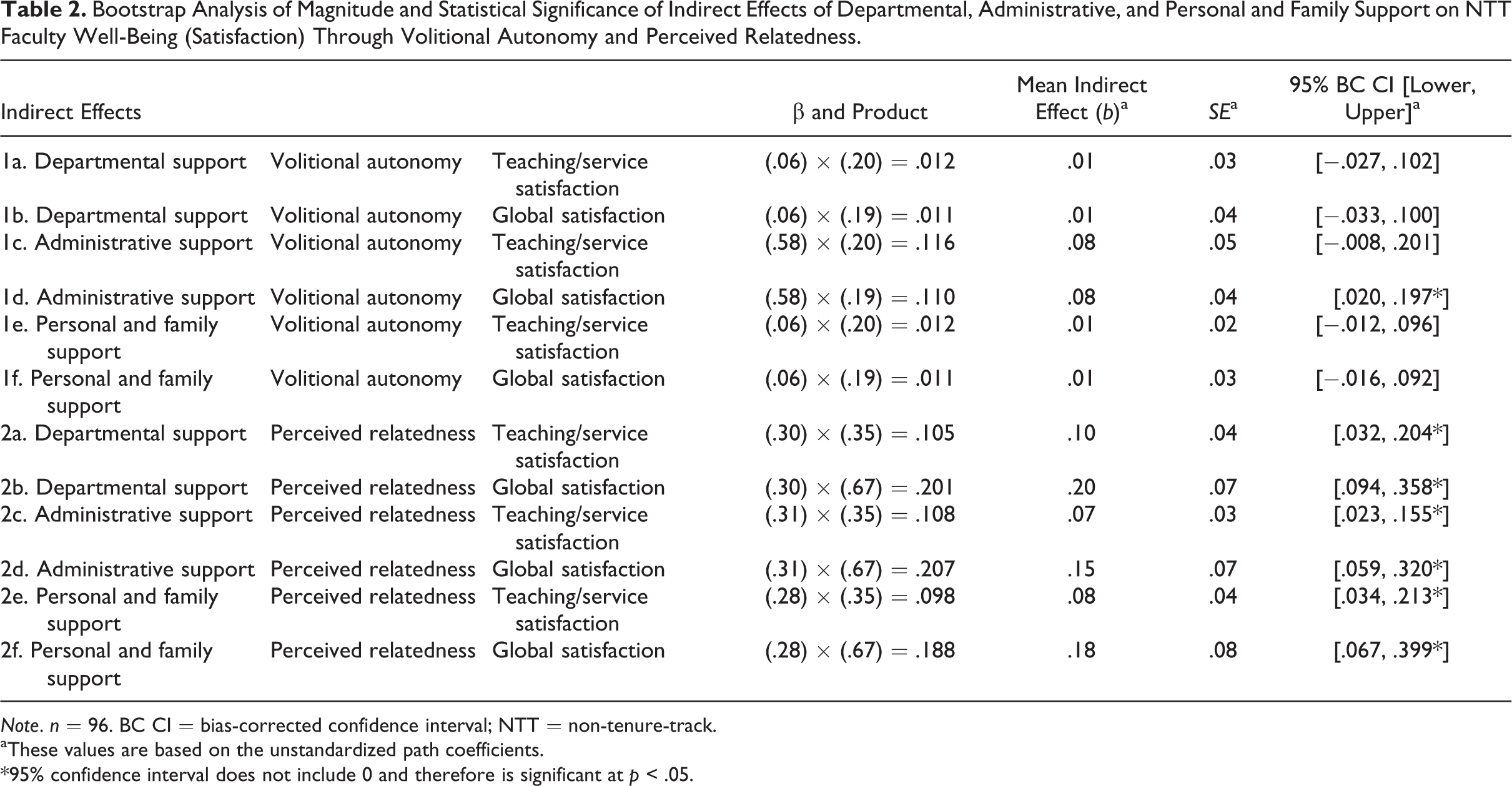
Note. n = 96. BC CI = bias-corrected confidence interval; NTT = non-tenure-track.
aThese values are based on the unstandardized path coefficients.
*95% confidence interval does not include 0 and therefore is significant at p < .05.
Of the six hypothesized paths using volitional autonomy as a mediator (Effects 1a through 1f in Table 2), volitional autonomy significantly mediated only the relation between administrative support and global satisfaction (Effect 1d). This is evidenced by the bias-corrected 95% confidence interval for its specific mean indirect effect not including 0. Perceived relatedness was a significant mediator of all six hypothesized paths between the three environmental supports and both outcome variables (Effects 2a through 2f).
Discussion
The major finding in this study was the robust role that perceived relatedness played as a mediator in the model. Perceived relatedness fully mediated all relations between the environmental supports and faculty well-being, which was consistent with the findings of Gillet and colleagues (2013), in which the combined SDT needs fully mediated the relations between the environment and well-being in their sample of nurses. As can be seen in Figure 3, our full mediation model explained a substantial percentage of variance in both indices of faculty well-being (i.e., 23% of teaching/service satisfaction considered a medium effect; 61% of global satisfaction considered a large effect; Cohen, 1992). This finding is consistent with SDT and its subtheories, specifically CET (Deci & Ryan, 1985) and OIT (Deci & Ryan, 1985). Moreover, these results support previous job satisfaction literature that used SDT as a conceptual lens (e.g., Gillet et al., 2013), and higher education literature that has suggested relatedness is a primary concern for NTT faculty (e.g., Baldwin & Chronister, 2001; Schuster & Finkelstein, 2006). This finding, combined with the moderate to strong direct effects perceived relatedness had on global satisfaction (β = .67, p < .001) and teaching/service satisfaction (β = .35, p < .001), suggests that relatedness is a critical lens through which NTT faculty interpret environmental supports and evaluate their well-being.
Given prior findings that have shown environmental supports were directly related to faculty satisfaction (e.g., Brown & Moshavi, 2002), we hypothesized that perceived relatedness would partially rather than fully mediate the relation between the three environmental supports and faculty well-being. However, the fully mediated model was a more parsimonious model than the hypothesized partial mediation model because none of the direct paths from the environmental supports to well-being were significant. A full mediation model is consistent with the finding from Larson and colleagues (2015) that showed that perceived relatedness fully mediated the relation between department chair support and global satisfaction in their T/TE faculty sample. However, it is inconsistent with Larson et al.’s findings that relatedness partially mediated the relation between evaluation/recognition and global satisfaction. Moreover, Larson et al. did not show relatedness to mediate the relation between environmental supports and teaching/service satisfaction.
Volitional autonomy was not as robust a mediator as perceived relatedness in our model, as only one of the six hypothesized indirect effects using volitional autonomy as a mediator was even marginally significant. That this path (administrative support → volitional autonomy → global satisfaction) was significant makes sense, given that administrative support was significantly related to volitional autonomy and that factors at the administrative level are more likely to impact broader aspects of well-being (i.e., global satisfaction), as opposed to more specific aspects (i.e., teaching/service satisfaction). The failure of volitional autonomy to mediate the relations of the other two environmental supports and faculty well-being in this sample may reflect that volitional autonomy simply isn’t as salient to NTT faculty well-being as it is to T/TE faculty well-being. Our findings are inconsistent with Larson and colleagues’ (2015) findings that volitional autonomy partially or fully mediated the relations between nearly all of their environmental supports and at least one of the indices of well-being in their T/TE faculty sample. Moreover, Ott and Cisneros’ (2015) NTT subsample reported less autonomy than T/TE faculty. Future researchers need to continue to examine the role of volitional autonomy in full-time NTT faculty samples.
Our direct relation hypotheses were partially supported. That is, the three environmental supports were significantly related to perceived relatedness and relatedness directly related to both indices of faculty well-being. These findings are consistent with other studies’ results that have shown collegiality (a component of relatedness) to moderately relate to faculty recognition and personal benefits (Ott & Cisneros, 2015) as well as job satisfaction (Lawrence et al., 2014; Ott & Cisneros, 2015). The three environmental supports being significantly positively related to perceived relatedness in this sample is also logical given that relatedness is an inherently interpersonal construct that is grounded in one’s environmental context (Baumeister & Leary, 1995). Moreover, relatedness is a significant challenge for NTT faculty compared to their T/TE peers because most institutions are oriented toward tenure-track appointments (e.g., Baldwin & Chronister, 2001), and these results suggest that the degree of relatedness NTT faculty experience mediates how their perceptions of the institutional environment relate to their well-being. Volitional autonomy’s failure to significantly relate to well-being was unexpected given previous findings (e.g., Ng et al., 2012; Ott & Cisneros, 2015) demonstrating that linkage with mental health indices.
The absence of any significant, direct relations between the environmental supports and faculty well-being is surprising because of other studies’ findings showing that linkage (e.g., Michel & Michel, 2015). However, these studies with the exception of Larson et al. (2015) did not include the SDT needs as mediators nor did they sample full-time NTT faculty with the exception of Ott and Cisneros (2015). Moreover, these results are conceptually consistent with the CET and OIT subtheories of SDT, which posit that the person’s interpretation of the environment is crucial in determining the environment’s ultimate impact on well-being; our results thus verify this central role of the person in that any relation between the environmental supports and well-being was fully mediated by the SDT needs of volitional autonomy and perceived relatedness.
Taken together, our results provide preliminary support for SDT as a model of NTT faculty well-being, although more research is needed to refine our model and apply it to larger and more diverse NTT faculty samples. In particular, the centrality of perceived relatedness was clear in our results. Finally, our results serve the important purpose of providing a clear theoretical framework for future researchers to use, going beyond previous conceptualizations (e.g., Hagedorn, 2000) to describe how the perceptions of the person impact the environment’s relation with faculty well-being; they also shed light on a population that has been underrepresented in the empirical literature.
Practical Implications
Full-time NTT faculty represent a unique, growing subpopulation of the American professorate whose efforts often concentrate on undergraduate instruction (Schuster & Finkelstein, 2006). As such, they have come to play a vital role in academic institutions’ teaching missions and consequently in the shaping of America’s future innovators, thinkers, and leaders. The present study used SDT as a theoretical framework for understanding the well-being of full-time NTT faculty at a large Midwestern university, and the results of our analyses suggest some specific areas on which institutions can focus resources to better support NTT faculty well-being, specifically satisfaction, which can consequently increase the teaching performance and reduce the turnover intentions of NTT faculty.
Deans and upper-level administrators need to be reminded that in addition to the policies they implement, the manner in which they are implemented and communicated down the institutional hierarchy can have a profound impact on the volitional autonomy and perceived relatedness of NTT faculty, which in turn can impact their well-being. Specifically, administrators need to implement policies designed to foster a greater sense of relatedness for NTT faculty. This could include ensuring adequate representation of NTT faculty in faculty governance and on relevant committees, providing department chairs with the ability to offer longer term contracts to senior NTT faculty and making explicit commitment to NTT faculty wellness and work–life balance. At the department level, department chairs need to voice that NTT faculty are valued members of the department, recognize NTT faculty for contributions to the department’s mission and excellence in teaching/service, and ensure NTT faculty are supported in navigating the contract renewal and promotion processes (e.g., mentoring).
There are also implications for NTT faculty themselves. Perhaps the most important is that NTT faculty cannot isolate themselves or be passive in pursuing well-being. To the extent it is possible, NTT faculty need to be active participants in their departments and in institutional governance. If barriers do exist, it behooves NTT faculty to join together for support and to form a collective voice to advocate for their needs through the proper channels. An equally important implication is the simple fact that, as this sample demonstrated, NTT faculty can attain well-being in their positions. This goes against the characterizations provided by some scholars (e.g., Bowden & Gonzalez, 2012) of NTT faculty as lacking satisfaction and commitment to their institutions and is consonant with previous findings (e.g., Antony & Hayden, 2011) that NTT faculty generally display overall satisfaction at similar levels to their T/TE peers.
Limitations
There are some important limitations of this study worth noting. First, because participants were all employed at the same institution, the results may not be generalizable to NTT faculty at other institutions, especially institutions that are not large, public universities. Second, our sample size (n = 96) may have limited our ability to detect more subtle effects in our sample, and the fact that our sample was predominantly European American precluded analysis of race/ethnicity as a moderator. Third, the SDT constructs were measured using a single instrument (i.e., the COACHE survey); future research would benefit from applying SDT to NTT faculty using other measures. Finally, because our design was not experimental, we cannot draw any causal conclusions regarding NTT faculty well-being.
Future Directions
As NTT faculty well-being and the application of SDT to faculty well-being are nascent areas of research, there are many fruitful lines of inquiry that can build upon the findings of the present study. First, it is imperative that future studies examine NTT faculty well-being across numerous institutions. Additionally, larger and more diverse samples will enable moderation analyses of various demographic variables (e.g., gender, race/ethnicity, discipline, citizenship status). Hierarchical linear modeling can also be used to examine effects at the individual and institutional levels. Second, it would be valuable to directly compare models of well-being for NTT and T/TE faculty using a technique such as structural invariance analysis. This would be particularly informative for higher education administrators in their efforts to develop policies that support faculty of all types and backgrounds. Third, future research should incorporate indicators of NTT faculty well-being other than satisfaction (e.g., turnover intentions, absenteeism, work-related stress, quality of life, etc.) to provide better coverage of the construct of well-being. Fourth, future researchers should adapt or create measures of perceived competence that are appropriate for NTT faculty. A final recommendation is to perform longitudinal research concerning the well-being of NTT faculty (and all faculty in general). Experimental research in this area is unlikely to be feasible or ethical (i.e., one would never assign a faculty member to an “unsupportive” condition), so observing faculty over time and relating changes in their environment to changes in reported well-being provides a viable alternative to draw more firm and useful conclusions. It would also provide a clearer picture than cross-sectional designs of how career stage interacts with the environment and psychological needs in predicting faculty well-being. As the NTT faculty population continues to grow, it is crucial that we continue to explore new ways to support their well-being and consequent contributions to the academy.
Footnotes
Authors’ Note
Any opinions, findings, and conclusions or recommendations expressed in this material are those of the authors and do not necessarily reflect the views of the National Science Foundation.
Acknowledgments
The authors would like to thank Mack Shelley, Sandra Gahn, and Meifen Wei for lending their expertise regarding statistical analyses and the higher education landscape.
Declaration of Conflicting Interests
The author(s) declared no potential conflicts of interest with respect to the research, authorship, and/or publication of this article.
Funding
The author(s) disclosed receipt of the following financial support for the research, authorship, and/or publication of this article: This research was supported by an EAGER grant from the National Science Foundation (Award # IIA-1449187).