



Abstract
The job characteristics model (JCM) predicts that task significance and work meaningfulness are related to greater job performance and that meaningfulness mediates the relation between task significance and job performance. However, these propositions have received limited attention, especially when linking meaningful work to job performance. Therefore, we tested claims from the JCM with a large, diverse sample of working adults using structural equation modeling. Results revealed that self-reported performance was significantly related to both meaningful work and task significance. Moreover, meaningful work fully mediated the relation between task significance and two measures of self-reported job performance. Limitations and implications for further research are discussed.
Investigating what makes work meaningful is important for both the personal well-being of workers and their job performance. One key driver of meaningfulness may be task significance, or the degree to which one’s work helps other people, which itself has been linked to higher job performance (Grant, 2007, 2008). Studies have consistently demonstrated that task significant work is especially meaningful (Allan, Autin, & Duffy, 2014; Humphrey, Nahrgang, & Morgeson, 2007) and scholars have asserted that meaningfulness mediates the relation between task significance and job performance (Hackman & Oldman, 1976; Humphrey et al., 2007). However, to date no studies have evaluated task significance, meaningfulness, and job performance in concert. Therefore, the current research expands upon previous studies by testing work meaningfulness as a mediator between task significance and job performance.
Theoretical Framework
The job characteristics model (JCM; Hackman & Oldman, 1976) identifies the conditions necessary for people to become intrinsically motivated and have high work performance. The model suggests that five job dimensions (skill variety, task identity, task significance, autonomy, and feedback) lead to three critical psychological states (meaningfulness, responsibility, and knowledge of results), which then lead to positive outcomes, such as high work performance and job satisfaction. Theoretically, workers experience job satisfaction because they care about their work, which starts a cycle of positive work motivation and performance. Of most relevance to the present study is task significance, the degree to which work is perceived as impacting other people’s well-being, both inside and outside of an organization. Task significance, along with skill variety and task identity, is proposed to generate a sense of meaningfulness at work, which then leads to internal work motivation, high job performance, job satisfaction, and low absenteeism/turnover. In the case of the JCM, meaningfulness is defined as work that employees perceive as worthwhile, important, or valuable (Pratt & Ashforth, 2003; Steger, Dik, & Duffy, 2012). Therefore, a fundamental hypothesis of this model is that meaningfulness mediates the relation between task significance and job performance.
Reviews and meta-analyses of the JCM have supported many of its claims (Fried & Ferris, 1987; Humphrey et al., 2007; Renn & Vandenberg, 1995), and researchers have updated and applied the model to contemporary issues, such as technologically advanced workplaces (De Varo, Li, & Brookshire, 2007; Gibson, Gibbs, Stanko, Tesluk, & Cohen, 2011; May, Gilson, & Harter, 2004). Moreover, the JCM’s hypotheses about meaningfulness have largely been supported. For example, meaningfulness relates more strongly to skill variety and task significance than other job dimensions (Fried & Ferris, 1987), and meaningfulness shows strong and consistent relations to job satisfaction and intrinsic work motivation (Fried & Ferris, 1987; Humphrey et al., 2007). Task significance is also a significant predictor of work meaningfulness above and beyond other personal and organizational variables (Schnell, Hoge, & Pollet, 2013), and meaningfulness mediates the relation between task significance and outcomes such as organizational commitment, internal motivation, and job satisfaction (Liden, Wayne, & Sparrowe, 2000; Renn & Vandenberg, 1995). Despite this body of evidence, no known study has evaluated meaningfulness as a mediator of task significance and job performance in isolation. For example, studies above often use the Job Diagnostic Survey (Hackman & Oldman, 1975), which lumps together job characteristics, and other meta-analyses have similarly combined JCM variables for mediation analysis (Humphrey et al., 2007). This makes it difficult to ascertain the strengths of the relations between task significance, meaningfulness, and subjective performance.
A growing body of research using controlled, experimental studies is also showing that task significance manipulations can increase job performance and productivity. Following from the JCM, Grant (2007) proposed a model for prosocial work motivation, which argued that the extent to which people feel motivated to engage in prosocial work is influenced by the nature of the contact with the people who benefit from their work. Specifically, greater frequency, physical proximity, duration, depth, and breadth of contact with beneficiaries in a work environment result in greater perceived task significance by employees, which subsequently increases job performance. Grant (2007) tested this model with call center employees who sought scholarship money from university alumni. Employees who interacted directly with students who benefitted from the scholarship donations earned 3 times as many donations from alumni than employees who did not interact with students beforehand.
Through a series of experiments, Grant (2008) replicated and extended these findings with lifeguards and different samples of fund-raising callers. He observed that increases in task significance led to large increases in objective job performance. However, Grant (2008) did not test if this effect was mediated by work meaningfulness and, rather, found perceived social impact and perceived social worth as significant mediators. Regardless, these findings do not preclude a role for meaningfulness, especially since perceived social impact and social worth may cause or be closely related to work meaningfulness (Allan et al., 2014; Rosso, Dekas, & Wrzesniewski, 2010), and meaningfulness may encompass other variables as the primary mechanism of action (Humphrey et al., 2007). However, as previously mentioned, no known studies have examined if work meaningfulness mediates the relation between task significance specifically.
Meaningful Work
Having a sense of meaningfulness is considered a fundamental component of human well-being, which has been linked to other psychological and physical health variables (Ryff & Singer, 1998; Zika & Chamberlain, 1992). Virtually all holistic conceptualizations of human flourishing, well-being, and happiness include reference to obtaining a sense of meaning in life (King & Napa, 1998; Ryff & Singer, 1998; Seligman, Parks, & Steen, 2004). Although comprehensive definitions of well-being have not necessarily included meaningful work, obtaining a sense of meaning at work may be critical for establishing a sense of overall life meaning and general well-being (Allan, Douglass, Duffy, & McCarty, 2016; Allan, Duffy, & Douglass, 2015; De Vogler & Ebersole, 1981; Duffy, Allan, Autin, & Bott, 2013; Steger et al., 2012). For example, people who say their work is meaningful report greater life satisfaction, positive affect, and life meaning as well as lower anxiety, hostility, and depression (Arnold, Turner, Barling, Kelloway, & McKee, 2007; Steger et al., 2012). In the work domain, they also report higher job satisfaction and are more likely to report feeling and living a calling (Duffy et al., 2013; Duffy, Allan, Autin, & Douglass, 2014; Steger et al., 2012). Therefore, meaningful work may be relevant for enhancing well-being and functioning in daily life.
Researchers have also consistently linked work meaningfulness to career variables that reflect dedication to one’s career and a willingness to put in extra effort. For example, meaningful work positively correlates with career and organizational commitment as well as intrinsic work motivation (Steger et al., 2012). People who report having meaningful work are more to likely sacrifice time and pay for their careers, and they hold their organizations to higher standards (Bunderson & Thompson, 2009). They also have lower withdrawal intentions, rates of absenteeism (Bunderson & Thompson, 2009; Steger et al., 2012), and higher levels of subjective and objective job performance (Harris, Kacmar, & Zivnuska, 2007). In short, meaningful work appears to be relevant for both personal well-being and variables related to job performance.
Several scholars have created theoretical frameworks to understand how meaningful work is created through personal and organizational means (Hackman & Oldman, 1976; Pratt & Ashforth, 2003; Rosso et al., 2010). Rosso, Dekas, and Wrzesniewski (2010) argued that the sources of meaningful work can be understood by the intersection of two dimensions: the self-other dimension and the agency-communion dimensions. The self-other dimension refers to whether work activities are directed toward the self or other people, and the agency-communion dimension refers to efforts to separate and expand the self or to connect and unite the self. These dimensions create four quadrants that represent different pathways to meaningfulness at work: self-connection, individuation, unification, and contribution. The contribution quadrant is most relevant to the present study. Contribution refers to the extent to which people perceive that they are making a significant impact on others. In other words, contribution is the same as task significance. Allan, Autin, and Duffy (2014) found some support for this claim by asking participants what makes their work meaningful. The largest category of responses reflected themes of helping others directly or contributing to the greater good. This result suggests that contribution may be particularly important for establishing a sense of meaning in one’s work. In sum, several overarching theories and associated research suggest that meaningful work may be fostered through prosocial activity and that engaging in meaningful work may promote job performance.
The Present Study
Building from the core tenants of the JCM and research on meaningful work, the aim of the current study was to evaluate whether meaningful work mediated the relation between task significance and self-reported job performance in a large sample of diverse working adults. Specifically, using structural equation modeling, we tested partial and full mediation models linking task significance to two indicators of job performance via work meaningfulness. Given previous theory and research (e.g., Humphrey et al., 2007), we proposed the following hypotheses:
Method
Participants
The sample consisted of 463 adults ranging in age from 18 to 65 (M = 31.88, SD = 9.66). In terms of gender, 40.4% (N = 187) identified as female, 58.7% (N = 272) as male, 0.4% (N = 2) as transgender, and 0.4% (N = 2) as other. In terms of race/ethnicity, most participants identified as White/Caucasian (N = 356, 76.9%) followed by Asian/Asian American (N = 38, 8.2%), Hispanic/Latino/a American (N = 29, 6.3%), African/African American (N = 27, 5.8%), Multiracial (N = 8, 1.7%), American Indian/Native American/First Nations (N = 2, 0.4%), Asian Indian (N = 1, 0.2%), Arab American/Middle Eastern (N = 1, 0.2%), and Other (N = 1, 0.2%). In terms of educational attainment, 0.4% (N = 2) of the sample had less than high school, 1.3% (N = 6) had some high school, 8.2% (N = 38) were high school graduates, 4.3% (N = 20) had trade or vocational school diplomas, 33.5% (N = 155) had some college, 41.3% (N = 191) had a college degree, and 10.6% (N = 49) had a professional degree. The sample captured 284 unique job titles with some of the most frequent job titles being sales assistant/associate (N = 18, 3.9%), administrative assistant (N = 13, 2.8%), customer service representative (N = 10, 2.2%), manager (N = 10, 2.2%), independent business owner (N = 9, 1.9%), cashier (N = 8, 1.7%), nurse (N = 8, 1.7%), and teacher (N = 8, 1.7%).
Instruments
Task significance
Task significance was measured with 4 items adapted by Grant (2008) from existing measures of task significance (Hackman & Oldham, 1975; Morgeson & Humphrey, 2006). Participants responded on a 7-point scale ranging from strongly disagree to strongly agree. Sample items include, “My job provides opportunities to substantially improve the welfare of other people” and “My job enhances the welfare of others.” Grant found the scale to correlate in the expected direction with helping behaviors and perceived social impact. He reported estimated internal consistencies of the scale ranging from α = .76 to α = .89. The estimated internal consistency in the present study was α = .93.
Meaningful work
Meaningful work was measured with 6 items used by May, Gilson, and Harter (2004). Participants responded on a 5-point scale ranging from strongly disagree to strongly agree. Sample items include, “The work I do at my job is very important to me” and “The work I do at my job is meaningful to me.” May et al. found scale scores to correlate in the expected direction with engagement, job enrichment, and work–role fit. They also reported an estimated internal consistency of α = .90. The estimated internal consistency of the present study was α = .96.
Presenteeism
Presenteeism was measured with the presenteeism question from the World Health Organization’s Health and Work Performance Questionnaire (Kessler et al., 2003). Presenteeism is measured with a single item, “On a scale from 0 to 10 where 0 is the worst job performance anyone could have at your job and 10 is the performance of a top worker, how would you rate your overall job performance on the days you worked during the past 4 weeks (28 days)?” The scale is then multiplied by 10 to create scores from 0 to 100. Kessler et al. (2003) found higher self-reported presenteeism scores relate to a greater likelihood of favorable rating from supervisors, as gathered from archival data.
Job performance
We measured self-reported job performance with the technical performance scale created by Abramis (1994). The scale consists of 4 items on a 5-point scale ranging from very poorly to exceptionally well. Each question begins with the stem, “In the last 7 days/week you worked, how well were you….” Sample items include, “handling the responsibilities and daily demands of your work?” and “performing without mistakes?” Abramis found the scale to positively correlate with social performance at work and job satisfaction. The authors reported an estimated internal consistency of α = .83. The estimated internal consistency in the present study was α = .84.
Procedure
This study used Mechanical Turk (MTurk) to collect data from a diverse sample of working adults. MTurk is an online participant source that allows people to complete surveys for compensation, although most respondents report completing surveys for enjoyment (Buhrmester, Kwang, & Gosling, 2011). Recent reviews and studies examining MTurk have concluded that it produces valid data that are comparable to laboratory and other Internet recruitment methods (Buhrmester et al., 2011; Sprouse, 2011). A link including an informed consent document and the survey itself was posted on MTurk, and in order to participate, participants had to (a) be over the age of 18, (b) reside within the United States, and (c) be employed at least part-time. Participants were given US$0.50 for completing the survey, which is consistent with typical amounts offered to participants on MTurk. In total, 511 people completed the survey. However, 35 people did not correctly respond to three validity questions, 6 people were unemployed, and 4 people were students. These participants were removed with three outliers described below to create the final sample size of 463.
Results
Preliminary Analyses
Task significance and meaningful work did not have extreme scores above 3.25 standard deviations from the mean. However, presenteeism had three extreme scores and subjective job performance had one extreme score. One case had two extreme scores, so three cases in total were deleted due to outliers. All study variables had absolute values of skewness and kurtosis less than 1 and appeared normally distributed on visually inspected histograms and boxplots.
Measurement Model
To evaluate the models, we used structural equation modeling with maximum likelihood estimation in AMOS 23.0 (Arbuckle, 2014). Indices of fit that minimized the likelihood of Type I error and Type II error were selected (Hu & Bentler, 1999). These were the χ2 test, the comparative fit index (CFI), and the root mean square error of approximation (RMSEA). A significant χ2 can indicate a poor fitting model, but this test is not reliable in larger samples (Tabachnick & Fidell, 2007). Criteria for the CFI and RMSEA have ranged from less conservative (CFI ≥ .90; RMSEA ≤ .10) to more conservative (CFI ≥ .95; RMSEA ≤ .08; Hu & Bentler, 1999; Quintana & Maxwell, 1999; Weston & Gore, 2006). However, criteria should not be used as strict cutoffs, and researchers should consider sample size and model complexity when judging the fit of models (Weston & Gore, 2006).
Before testing the structural mediation model, we tested a measurement model with all four study variables. The items for task significance, work meaningfulness, and subjective job performance were loaded onto their respective latent factors. Because presenteeism was a single item, it was included as a manifest variable. All variables were allowed to correlate. This model was a good fit to the data, χ2(85) = 404.02, p < .001, CFI = .94, RMSEA = .09, confidence intervals (CI) [.08, .10], and all indicators loaded on their factors with coefficients of .70 or higher. Table 1 depicts the factor correlations among study variables. All variables significantly correlated.
Descriptive Statistics and Factor Correlations of Study Variables.

*p < .05. **p < .01.
Structural Model
The structural model included work meaningfulness mediating the relation between task significance and both presenteeism and subjective job performance. As with the measurement model, all indicators loaded on their latent factors, except for presenteeism, which was represented as a manifest variable. We tested both partial and full mediation models. The partial mediation model included direct paths from task significance to presenteeism and job performance. This model had good fit to the data, χ2(85) = 404.02, p < .001, CFI = .94, RMSEA = .09, CI [.08, .10].
The full mediation model did not include direct paths from task significance to presenteeism or job performance, and it also had good fit, χ2(87) = 404.36, p < .001, CFI = .94, RMSEA = .09, CI [.08, .10]. Given that the change in χ2 between models was not significant, χ2(2) = .34, p = .16, we retained the full mediation model for parsimony. This model had a Mardia’s coefficient of 77.23, suggesting multivariate nonnormality. To control for problems with nonnormality, all parameter estimates were tested with bias-corrected CI and 5,000 bootstrapped samples. Figure 1 displays the final, structural model with bootstrapped and standardized regression coefficients. The final model explained 6% of the variance in both performance outcomes.
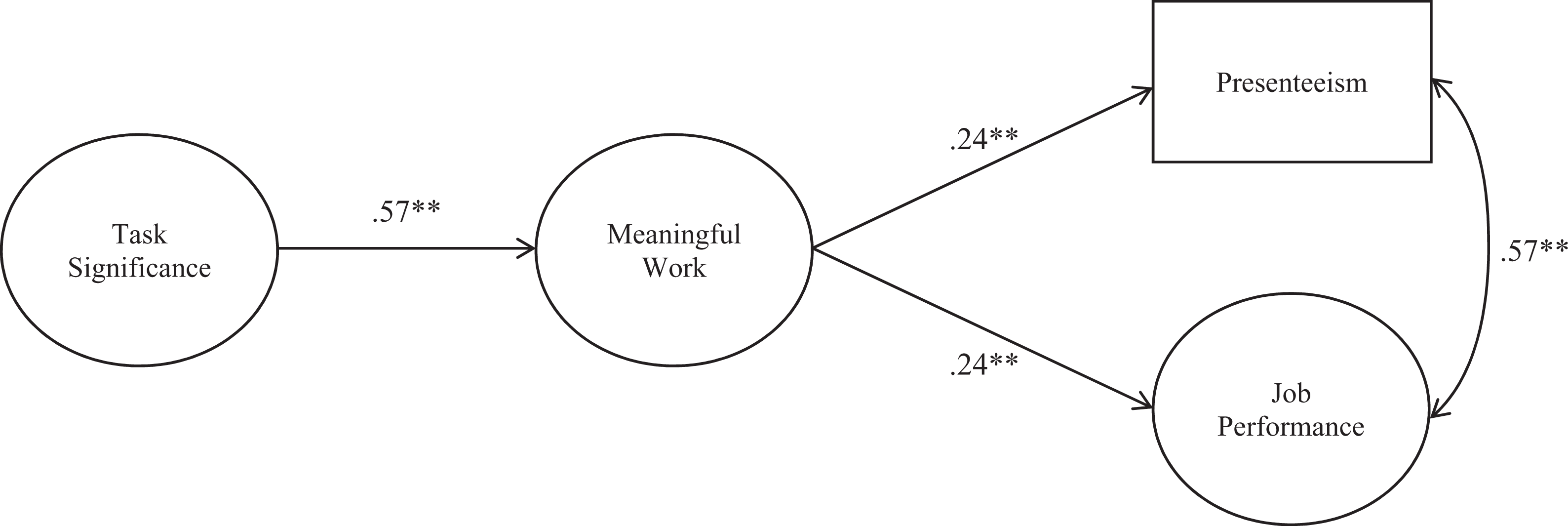
Full mediation model with standardized path coefficients.
Alternative Model
As an alternative model, we tested if paths ran from meaningful work to task significance and then to the performance variables. This model, χ2(87) = 426.27, p < .001, CFI = .94, RMSEA = .09, CI [.08, .10], had significantly worse fit than the original structural model, χ2(2) = 21.91, p < .001. Moreover, the model only explained 2% of the variance in the performance outcomes. Therefore, we retained the original model to test indirect effects.
Indirect Effects
We tested the two indirect effects from task significance to presenteeism and job performance via work meaningfulness. We used 5,000 bootstrapped samples with bias-corrected CI. Indirect effects are significant if their 95% CI does not include 0. The indirect effects of task significance to presenteeism via work meaningfulness, 95% CI [.77, 1.83], and task significance to job performance via work meaningfulness, 95% CI [.03, .08], were both significant.
Discussion
Obtaining meaningful work can be seen as an end in itself (Ryff & Singer, 1998; Zika & Chamberlain, 1992) and, according to the JCM, a potential precursor to more productive work (Hackman & Oldman, 1976; Humphrey et al., 2007). Additionally, both correlational and experimental studies have demonstrated links between viewing one’s work as socially significant and viewing one’s work as meaningful. Considering that experiencing meaningfulness in any domain is linked with greater domain specific and general well-being (Steger & Dik, 2010), these findings are important. In the current study, we built off this research by examining the hypotheses that meaningfulness would relate to performance and also explain the relation between task significance and self-reported job performance.
The current study revealed a strong link between task significance and meaningful work, suggesting that work that is perceived as improving the lives of others may be integral to feeling that work is meaningful. This corroborates several lines of theory and research, arguing that work is perceived as meaningful when it has a positive and prosocial impact on other people (Allan et al., 2014; Dik, Steger, Fitch-Martin, & Onder, 2013; Humphrey et al., 2007; Rosso et al., 2010; Schnell et al., 2013). For example, Schnell, Hoge, and Pollet (2013) found task significance to be the largest predictor of meaningful work out of several individual- and organizational-level variables. Despite this consistency, there may be some conceptual confusion over whether task significance is a cause of meaningful work or a component of meaningful work. For example, some conceptualizations of meaningful work have included contributing to the greater good as a core component (Dik et al., 2013; Steger et al., 2012). However, the high correlation may be due to task significance reliably leading to higher perceptions of meaningful work. Regardless, future research should continue to address this concern.
Meaningful work and task significance both had significant relations to the performance variables, although meaningful work’s correlations were larger. Again, this corroborates previous research linking task significance (e.g., Grant, 2008) and meaningful work (e.g., Harris et al., 2007) to high job performance. Although the task significance–performance literature is large and growing, relatively few studies have examined meaningful work and performance. Regardless, the few relevant studies have found small to moderate correlations between meaningful work and objective job performance and moderate to large correlations between meaningful work and subjective job performance (Harris et al., 2007). This is consistent with the present study, which found a small to moderate relation between the constructs. However, as popularity in the construct of meaningful work grows, future research should investigate how and for whom meaningful work and performance are related.
Meaningfulness also fully mediated the link between task significance and performance, suggesting that in terms of self-reported performance, people completing work task that positively impact others may be more likely to perform better at work because these tasks are perceived as meaningful. This finding supports the theoretical propositions made by the JCM (Hackman & Oldman, 1976) and previous meta-analyses finding meaningfulness to be an effective mediation between job characteristics and job outcomes, such as performance (Humphrey et al., 2007). However, it should be interpreted with caution, given the cross-sectional data used in the present study. Regardless, results from the study may mean that organizations can increase performance of their workers by helping them connect their work to the people it benefits (Grant, 2008). Moreover, findings suggest that the mechanism of this relation is meaningfulness.
Practical Implications
This study has several practical implications for business leaders and career development professionals. First, managers might help their employees connect their work to the people it benefits or put them in direct contact with the benefactors of their work (Grant, 2007, 2008). This may increase the perceived meaningfulness of their work and, subsequently, affect performance. There may be other opportunities to increase task significance and meaningfulness, such as increasing self-determination or work volition (Allan, Autin, & Duffy, 2016). Second, if clients are seeking more meaning or better performance at work, career counselors may similarly help them explore how their work positively benefits others. They may also discuss ways to craft their jobs to find more meaning in their work (Tims, Derks, & Bakker, 2016).
Limitations and Future Directions
The current study was cross-sectional, so casual inferences cannot be made. Future longitudinal and experimental research is needed to understand if meaningfulness mediates the relation between task significance and self-reported performance over time. Although the present study provides precedent for such studies, it does not establish sufficient evidence on its own. Second, the measure of performance used in the current study was subjective. Although subjective and objective measures of job performance have a moderate to large correlation, they are not interchangeable and may represent different constructs (Bommer, Johnson, Rich, Podsakoff, & MacKenzie, 1995). This is reflected by the different correlations between objective and subjective measures of job performance and meaningful work (Harris et al., 2007). Therefore, future studies should investigate the indirect effect from task significance to meaningful work to objective job performance.
Finally, the data were collected through an online survey collection website, making our sample a group of people who were interested in taking online surveys for payment. Although our sample was diverse in some ways (e.g., job title), it was restricted in others. For example, our sample was highly educated, which may reflect issues with who uses and has most access to the Internet (Rhodes, Bowie, & Hergenrather, 2003). Therefore, our results should be tested and replicated with samples that proportionally reflect different groups in the United States, and future studies should actively recruit members with diverse educational backgrounds, whether participants are being recruited online or from the community.
Footnotes
Declaration of Conflicting Interests
The author(s) declared no potential conflicts of interest with respect to the research, authorship, and/or publication of this article.
Funding
The author(s) received no financial support for the research, authorship, and/or publication of this article.