



Abstract
In this article, we draw insights from the employee–organization framework to test a model linking offered inducements and expected contributions to career commitment through organizational commitment. Data were collected from 396 full-time chemists and laboratory specialists who work in a large health-care organization in China. Results revealed that organizational commitment mediated the relationships between employee–organization framework (i.e., offered inducements and expected contributions) and career commitment. Moderated mediation analyses further revealed that the conditional indirect effects of offered inducements in predicting career commitment via organizational commitment were stronger for high as opposed to low expected contributions. Implications for theory and practice are discussed.
Keywords
Employment rates in the fields of science, technology, engineering, and mathematics (STEM) are projected to increase up to 3 times faster than in other occupations (National Science Board, 2016). By 2018, it is estimated that 9 of the 10 fastest growing occupations require mastery and high-level training in mathematics or science (Lacey & Wright, 2009). To address this demand, organizations have made considerable investment to bolster the recruitment and retention of STEM-qualified individuals. For instance, STEM workers are offered a higher average occupational wage compared to those in non-STEM fields (Langdon, McKittrick, Beede, Khan, & Doms, 2011). Despite efforts to attract STEM workers, their temporary and permanent departures from their careers remain progressive and persistent (Burke & McNeill, 2011; Marra, Rodgers, Shen, & Bogue, 2012). Indeed, the leaky pipeline metaphor is still a relevant description of the gradual exit of STEM workers at various points in their careers (Metcalf, 2010).
In China, innovation in science and technology is regarded as the driving force of economic development (Gao, 2013). While the participation of Chinese students and workers in STEM disciplines is substantially greater than in most Western countries (Gao, 2013), China faces widespread shortages in high-quality STEM human capital (Farrell & Grant, 2005). For example, only about 10% of engineering graduates from China have acquired adequate education and training to fulfill available STEM jobs, while many first-rate scientists leave China to pursue work opportunities elsewhere (Cao, 2008; Gordon, 2009). Indeed, career turnover and skill deficiencies contribute to large shortfalls in the Chinese STEM workforce (Lane & Pollner, 2008). As such, the eminent workforce upheaval and the changing employment conditions in China warrant a systematic empirical investigation to understand the factors that promote commitment among the Chinese STEM workforce.
Commitment can take various forms (Meyer, Becker, & Vandenberghe, 2004; Morrow, 1983) and can be directed to different foci (Cohen, 2003). Employment practices aimed at strengthening employees’ commitment are becoming less effective than ever before because labor force flows more frequently among organizations (Hess, Jepsen, & Dries, 2012) and employees no longer find it necessary to remain committed to a single organization for the entirety of their careers (Chang, 1999). As a result, commitment toward one’s organization may not be the single most important form of attachment (Cohen, 2011). For example, scientists often encounter interorganizational and occupationally focused career experiences that nurture their commitment to their organization, career, and professional community (Kidd & Green, 2006). Thus, we focus on two distinguishable, albeit related, forms of commitment: organizational commitment and career commitment.
Organizational commitment pertains to “the relevant strength of an individual’s identification with and involvement in a particular organization” (Mowday, Porter, & Steers, 1982, p. 27). Employees may develop commitment to their organization because they want to (affective commitment), need to (continuance commitment), and ought to (normative commitment; Allen & Meyer, 1990; Iverson & Buttigieg, 1999). Past research suggests that employees achieve higher levels of organizational commitment when they find opportunities for personal development, learning, and career advancement (Iverson & Buttigieg, 1999; Mathieu & Zajac, 1990; Meyer, Stanley, Herscovitch, & Topolnytsky, 2002; Weng, McElroy, Morrow, & Liu, 2010). In turn, these employees demonstrate greater career motivation, job involvement, and career commitment (Meyer et al., 2002). While organizational commitment is the most widely investigated form of commitment in the academic literature (for a review, see Meyer & Allen, 1997), considerable research has also been given to career commitment in the recent years (Goulet & Singh, 2002). Career commitment is generally understood as “one’s attitude towards one’s profession or vocation” (G. J. Blau, 1985, p. 278) or “one’s motivation to work in a chosen career role” (Hall, 1971, p. 59). In essence, career commitment pertains to an individual’s capacity to construct personally relevant career goals and to identify with and be involved in a series of work-related activities essential for career progression within a specific field of work. Thus, individuals who persevere in achieving their personal career goals despite the presence of challenges exhibit high levels of career commitment (Littman-Ovadia & Lavy, 2016).
Commitment develops through positive social exchange processes between organizations and their employees (i.e., quality of perceived work experiences; Meyer & Allen, 1991; Restubog, Bordia, & Tang, 2006). Indeed, Tsui, Pearce, Porter, and Tripoli (1997) developed the employee–organization (EOR) framework which argued that organizations create and define various types of employment relationships that reflect different forms of investments organizations make in their employees (i.e., offered inducements) and desirable work behaviors employees are expected to contribute to their organization (i.e., expected contributions). There is evidence to suggest that offered inducements and expected contributions support the formation of multiple forms of commitment. For instance, certain sources of exchange (e.g., money, opportunities for career progression) between the employee and the organization foster increased motivation to pursue career goals (G. J. Blau, 1988). Employment rewards such as generous pay and benefits contribute to greater socioemotional ties with the organization (Shaw, Dineen, Fang, & Vellella, 2009), translating into heightened commitment and employee retention (Hausknecht, Rodda, & Howard, 2008; Hom et al., 2009). Conversely, employees who perceive limited advancement opportunities in the organization exert no more than minimum work performance and they report greater turnover intentions (Shaw et al., 2009).
Despite extensive research, it remains unclear whether and how organizational inducements and expected contributions influence employees’ career commitment. The dearth of research in this area is somewhat surprising, given that organizational inducements and expected contributions can influence the nature and quality of employees’ commitment to their organization (Beck & Wilson, 2000; Tsui, Pearce, Porter, & Tripoli, 1997) and organizational commitment has been shown to relate positively to career commitment (Aryee & Tan, 1992; Weng et al., 2010). Thus, the purpose of the present study is to examine whether organizational commitment mediates the effects of offered inducements and expected contributions on career commitment. In addition, we investigate whether expected contributions moderate the effects of offered inducements on career commitment via organizational commitment, expecting offered inducements to have stronger effects when expected contributions are high. The proposed theoretical model is presented in Figure 1.
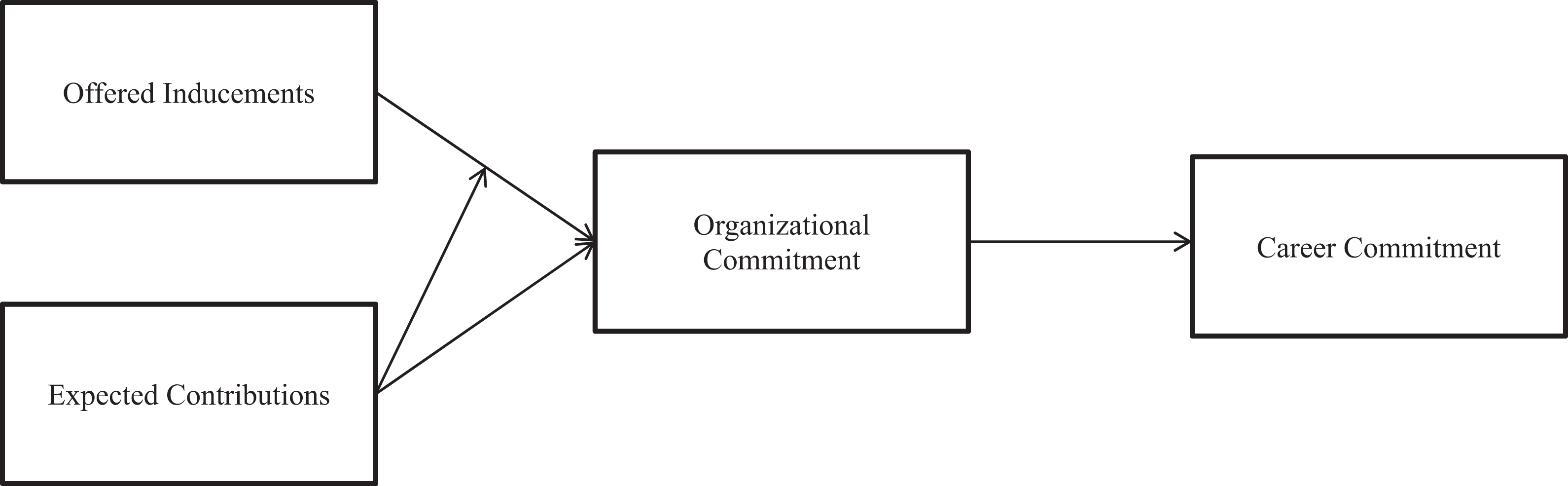
Proposed theoretical model.
By testing these empirical linkages, we make four contributions to the literature. First, we address the shortage of empirical studies that focus on the antecedents of career commitment by examining how offered inducements and expected contributions impact this form of attachment, indirectly via organizational commitment. An examination of the role of inducements and contributions broadens our theoretical understanding of factors that contribute to employees’ career commitment and the process by which they do so. Second, we investigate the interactive effects of offered inducements and expected contributions in predicting career commitment via organizational commitment. The interplay between inducements and expected contributions may influence how employees perceive their organization-focused exchange relationship and thus contribute to that relationship with more or less commitment (Tsui et al., 1997). Thus, the current research investigates whether and how inducements and expected contributions interact to influence career commitment via the mediating role of organizational commitment. Third, we adopt Tsui and colleagues’ (1997) EOR framework to enrich our theoretical understanding of career commitment formation. Studies that examined the antecedents of career commitment have largely adopted London and Mone’s (1987) career motivation theory, which suggests that situational (e.g., job fit, supervisor consideration and control) and individual (e.g., job involvement, job satisfaction) factors shape career decisions and actions. Building on London and Mone’s (1987) theory, we argue that organizational practices—in the form of offered inducements and expected contributions—can also boost career commitment, indirectly by facilitating positive employment relationships and organizational commitment. Finally, we investigate how offered inducements and expected contributions shape organizational and career commitment within the STEM context. Our focus on STEM workers addresses the increasing need to examine the role of context in shaping employee responses to various EOR strategies (Wright & Boswell, 2002). Below, we review social exchange theory (SET) which serves as our overarching theoretical framework. Next, we develop and formally test our hypothesized relationships, discuss our key findings, and highlight their theoretical and practical implications.
Theoretical Background and Hypotheses
SET posits that employees and organizations engage in a pattern of exchange to establish and maintain optimal employment relationships (P. M. Blau, 1964). Such relationships can be purely economic (i.e., short-term exchange process involving specified work roles and monetary rewards) or involve the exchange of economic and social resources (i.e., long-term exchange process involving permeable work roles and monetary rewards). Because employment relationships are contingent upon the reciprocity within the exchange, it is assumed that both employees and organizations will likely continue the equally beneficial relationship when mutual obligations are fulfilled (Song, Tsui, & Law, 2009). A balance in the social exchange relationship is achieved when employees and organizations return the benefits they receive (Shore & Barksdale, 1998). Employees who perceive that their organization is supportive are likely to feel obligated to exhibit positive work behaviors to create a balance in the employment relationship. In contrast, a lack of balance in the employment relationship weakens the pattern of positive exchange, which may hinder future fulfillment of mutual obligations. Employees will restore balance in the employment relationship by engaging in counterproductive work behaviors and withdrawing extra-role behaviors when they feel subjected to unfair treatment (Bordia, Restubog, & Tang, 2008; Lu, Capezio, Restubog, Garcia, & Wang, 2016; Zagenczyk, Restubog, Kiewitz, Kiazad, & Tang, 2014).
The employee–organization relationship is a form of social exchange relationship (Tsui et al., 1997) because both employees and organizations become exchange partners that are expected to reciprocate the benefits they receive. Employees and organizations trust that each party understands and will abide by the norms of exchange, that is, returning the goodwill and helpfulness they receive from each other (Cropanzano & Mitchell, 2005). Tsui and her colleagues (1997) proposed that organizations define the nature of the exchange by implementing a range of inducement strategies to elicit desired contributions from their employees. Employee contributions should be sufficient to sustain inducements, which in turn should be adequate to stimulate employee contributions.
From the above, organizations offer inducements (e.g., competitive compensation package, job security, opportunities to assume important responsibilities and participate in the decision-making process) to increase employees’ performance, commitment, and motivation. These inducements have implications for employees’ work behaviors and perceptions about their work (Zhang, Song, Tsui, & Fu, 2014), since they serve as reinforcement mechanisms that organizations use to promote employees’ overall motivation and career development. For example, employees who receive high levels of offered inducements are more likely to stay and contribute to their organization (Shaw et al., 2009). In contrast, employees who receive underwhelming levels of inducements are less willing to participate in organizational activities beyond their core job duties (Maertz & Campion, 2004).
Inducements and Career Commitment via Organizational Commitment
Organizational inducements and employees’ perceptions of their organizations’ readiness to reward work effort impact social exchange processes, thereby contributing to the development of organizational commitment (Avolio, Zhu, Koh, & Bhatia, 2004; Meyer & Allen, 1997; Sinclair, Hannigan, & Tetrick, 1995). The availability of inducements may increase employees’ motivation to pursue greater and more complex responsibilities within the organization (Aryee & Tan, 1992). Because the majority of employees intend to establish and maintain a productive and harmonious relationship with their organization, the strength of their career commitment is only relative to the level and range of inducements offered to them. The provision of high inducements reflects the willingness of organizations to invest in the career progression of their employees. In turn, employees respond to these inducements by carrying out additional responsibilities for the organization including those that may fall outside their immediate job functions (Hom et al., 2009). In contrast, employees who perceive that their current and potentially offered inducements are insufficient may seek other opportunities that offer greater inducements to satisfy their career goals.
Employees who receive meaningful offered inducements demonstrate greater identification with and involvement in the organization (Huselid & Day, 1991; Mathieu & Farr, 1991). This in turn enables them to develop and pursue their personal career objectives (Goulet & Singh, 2002). Organizationally committed employees are also likely to spend a considerable amount of time and effort acquiring relevant job information and mastering skills critical to their career advancement (G. J. Blau, 1985). Indeed, empirical evidence indicates that organizational commitment is related to a range of work outcomes, including increased career motivation (Cohen, 2011) and reduced negative career attitudes and turnover intentions (Shaw et al., 2009). In line with this reasoning, we propose that:
Expected Contributions and Career Commitment via Organizational Commitment
Expected contributions pertain to the work requirements assigned to employees (e.g., core job tasks in the employment contract) in exchange for the investments that organizations provide. Employees experience high levels of obligations when they have received beneficence from their organization (G. J. Blau, 1985). These expected contributions also include extra-role duties that organizations may require employees to perform (e.g., mastery of an organization-specific work technique and/or protocol). Organizations rely on the quality and intensity of contributions that employees make to satisfy organizational goals and needs. On the basis of the SET and EOR framework, expected contributions are externally induced mechanisms that organizations place on employees to reciprocate the organization’s inducements and to create a balance in the exchange relationship with the organization.
Empirical research examining employee–organization relationships indicates that the scope and magnitude of expected contributions signify an employer’s desire to develop and sustain a long-term relationship (G. J. Blau, 1988; Pearce, 1993; Tsui et al., 1997). Employers that institute high levels of expected contributions convey trust and confidence in their employees’ capacity to accomplish work (Zhang et al., 2014) and in the process support employees’ needs for approval, affiliation, and esteem (Meyer & Allen, 1997). Subsequently, those who perceive broad and open-ended expected contributions demonstrate a stronger sense of quasi-moral involvement (i.e., psychological commitment) to their organization (Pearce, 1993; Williamson, 1975). As a result, these employees display greater commitment and motivation to perform in-role and extra-role duties for the organization (Eisenberger, Huntington, Hutchison, & Sowa, 1986) in an attempt to reciprocate the positive social exchange. In other words, expected contributions are viewed favorably by employees, thus fostering their felt obligation to care about the organization and contribute to the implementation of its organizational goals. The fulfillment of these expected contributions signals employees’ belief and acceptance of the organization’s goals and values, willingness to exert effort for the organization, and a desire to continue organization membership (Mowday et al., 1982; Pearce, 1993). In doing so, employees become emotionally attached to their organization before desirable behaviors and attitudes toward their career can substantially emerge. Employees with high commitment regard the organization as an avenue for satisfying their career goals and ideals, which could precede the development of career commitment (Sinclair, Tucker, Cullen, & Wright, 2005). When employees identify and commit to their organization, they are likely to achieve their career goals and become more satisfied with their chosen career (Goulet & Singh, 2002). In addition, as employees become more involved in their organization, they are presented with a range of challenging job assignments that eventually enhance their capacity to meet their career objectives (Colarelli & Bishop, 1990). On the basis of this reasoning, we predict that:
Conditional Indirect Effect of Inducements via Organizational Commitment
In line with SET and the EOR framework, the level and breadth of offered inducements and expected contributions influence employees’ perceptions of the quality of their social exchange relationship with the organization (G. J. Blau, 1985; Cropanzano & Mitchell, 2005). Tsui and colleagues (1997) proposed that the interaction of offered inducements and expected contributions result in two balanced (mutual investment and quasi-spot contract) and two unbalanced (overinvestment and underinvestment) categories of employee–organization relationship. Specifically, a mutual investment relationship is established when high or broad inducements are combined with high or broad expected contributions, whereas a quasi-spot contract occurs when organizations provide low or narrow inducements in exchange of low or narrow expected contributions. By contrast, an overinvestment relationship exists when organizations provide high or broad inducements but expect low and narrow employee contributions, whereas underinvestment relationships arise when organizations distribute low or narrow inducements but demand high or broad contributions. A balanced interplay of offered inducements and expected contributions enhances the social exchange process that enables employees to establish and sustain commitment to their organization. Indeed, a combination of high levels of inducements and expected contributions reflects a well-matched person–environment fit that relates positively to employee motivation and positive work perceptions (Bergman, Benzer, Kabins, Bhupatkar, & Panina, 2013). However, unbalanced levels of inducements and contributions may hinder the development of a mutually beneficial social exchange relationship between employees and their organization (Shore & Barksdale, 1998).
In the context of the present study, we argue that expected contributions serve as a boundary condition on the impact of offered inducements on career commitment via organizational commitment. While offered inducements can be construed as reinforcement strategies to bolster organizational commitment, high expected contributions allow organizations to convey their confidence in the employees’ capacity to remain and advance in the organization. Indeed, the availability of high or broad contributions signals career growth opportunities within the organization, allowing employees to align their attitudes and adhere to organizational expectations so they can be considered for these opportunities in the future. Empirical studies confirm that employees are less likely to withdraw from their organization when their expected contributions are perceived to be meaningful, sufficient, and congruent with their career goals (Shaw et al., 2009; Weng & McElroy, 2012). Conversely, employees with low or narrow expected contributions may be forced to seek other employment opportunities that institute career-relevant roles and tasks despite the inducements afforded to them (Chang, 1999). Thus, we predict that:
Method
Participants and Procedure
Data were collected from full-time chemists and laboratory specialists in a large Chinese health-care organization which provides laboratory services (e.g., blood testing, drug testing, chemical analyses, etc.). All participants were assured of anonymity and confidentiality. We surveyed 593 employees and received 471 surveys, with a response rate of 79.42%. Upon completion, surveys were sent directly to the research team. Of the 471 surveys received, 75 were discarded due to a large number of missing responses. A total of 396 participants were included in the analysis. Fifty-five percent of the participants were women. Average age was 26.83 years. All the participants worked as chemists and laboratory specialists with an average organizational tenure of 2.81 years.
Measures
Unless otherwise specified, all items, except demographic variables, were measured on a 5-point Likert-type scale (1 = strongly disagree to 5 = strongly agree). The questionnaire was originally prepared in English and then back-translated into Chinese (Brislin, 1980).
Offered inducements
We measured perceived offered inducements using a 13-item scale developed by Jia, Shaw, Tsui, and Park (2014). Participants were asked to rate the extent to which their organization provides both economic and developmental rewards. An example of an economic reward is “This organization provides competitive salaries.” An example of a developmental reward is “This organization values employees’ suggestions on work.” In this sample, Cronbach’s α for the scale was .96.
Expected contributions
We measured expected contributions using a 14-item scale developed by Jia et al. (2014). Participants were asked to rate the extent of their contributions that are expected by their employing organization. Examples include, “My employer expects me to work seriously and accurately” and “My employer expects me to continuously improve work procedures and methods.” In this sample, Cronbach’s α for the scale was .96.
Organizational commitment
We measured the affective component of organizational commitment using an 8-item scale developed by Allen and Meyer (1990). Examples include, “I would be very happy to spend the rest of my career with this organization” and “This organization has a great deal of personal meaning for me.” In this sample, Cronbach’s α for the scale was .94.
Career commitment
We measured career commitment using an 8-item scale developed by G. J. Blau (1985). We slightly modified the items by replacing “nurse career” with “your present career.” Example items include, “If I had all the money needed, I would still work in my present career” and “My present career is my ideal vocation for a life work.” In this sample, Cronbach’s α for this scale was .96.
Control variables
Consistent with previous research on career commitment, we controlled for the effects of age, gender, and tenure. Age was controlled because there is evidence to suggest that younger individuals perceive greater uncertainty in their chosen career roles (Porfeli & Lee, 2012). Gender was controlled because past studies suggest that the attrition of women in STEM careers is greater than that of men (Glass, Sassler, Levitte, & Michelmore, 2013). Tenure was controlled because it is associated with the strength of motivation to work in a chosen vocation (G. J. Blau, 1985).
Results
Discriminant Validity of the Study Variables
Before testing the predicted relationships, we conducted a confirmatory factor analysis to examine the construct independence of our study variables. We followed the approach by Little, Cunningham, Shahar, and Widaman (2002) and created item parcels to improve the ratio of N relative to the number of parameters to be estimated. To do this, items were combined into parcels, where items with the highest factor loading are combined with the lowest factor loading, followed by the next highest and lowest factor loadings. We specified a four-factor model. Results showed that the four-factor model fits the data very well, χ2 = 459.78, df = 179, χ2/df = 2.62, root mean square error of approximation (RMSEA) = .06, goodness-of-fit statistic (GFI) = .90, Tucker-Lewis index (TLI) = .97, comparative fit index (CFI) = .97. All items were significantly loaded onto their respective latent factors. Supplementary analysis revealed that the three-factor model (combining offered inducements and expected contributions into Factor 1, organizational commitment into Factor 2, and career commitment into Factor 3; χ2 = 2,335.33, df = 182, χ2/df = 12.83, RMSEA = .17, GFI = .57, TLI = .79, CFI = .79, χ2 difference = 1,875.55, df = 3, p < .01), the two-factor model (combining offered inducements and expected contributions into Factor 1 and organizational commitment and career commitment into Factor 2; χ2 = 2,818.81, df = 184, χ2/df = 15.32, RMSEA = .19, GFI = .53, TLI = .71, CFI = .74, χ2 difference = 2,359.03, df = 5, p < .01), and the one-factor model (combining all constructs into one factor, χ2 = 4,650.21, df = 185, χ2/df = 25.14, RMSEA = .25, GFI = .38, TLI = .51, CFI = .57, χ2 difference = 4,190.43, df = 6, p < .01) had a worse fit to the data. These analyses provide support for treating offered inducements, expected contributions, organizational commitment, and career commitment as distinct constructs.
Zero-Order Correlations
The means, standard deviations, and bivariate correlations among study variables are reported in Table 1. Correlations were in the expected direction. For example, offered inducements were positively associated with organizational commitment (r = .52, p < .01) and career commitment (r = .46, p < .01). Similarly, expected contributions were positively related to organizational commitment (r = .33, p < .01) and career commitment (r = .34, p < .01).
Descriptive Statistics and Zero-Order Correlations of the Study Variables.
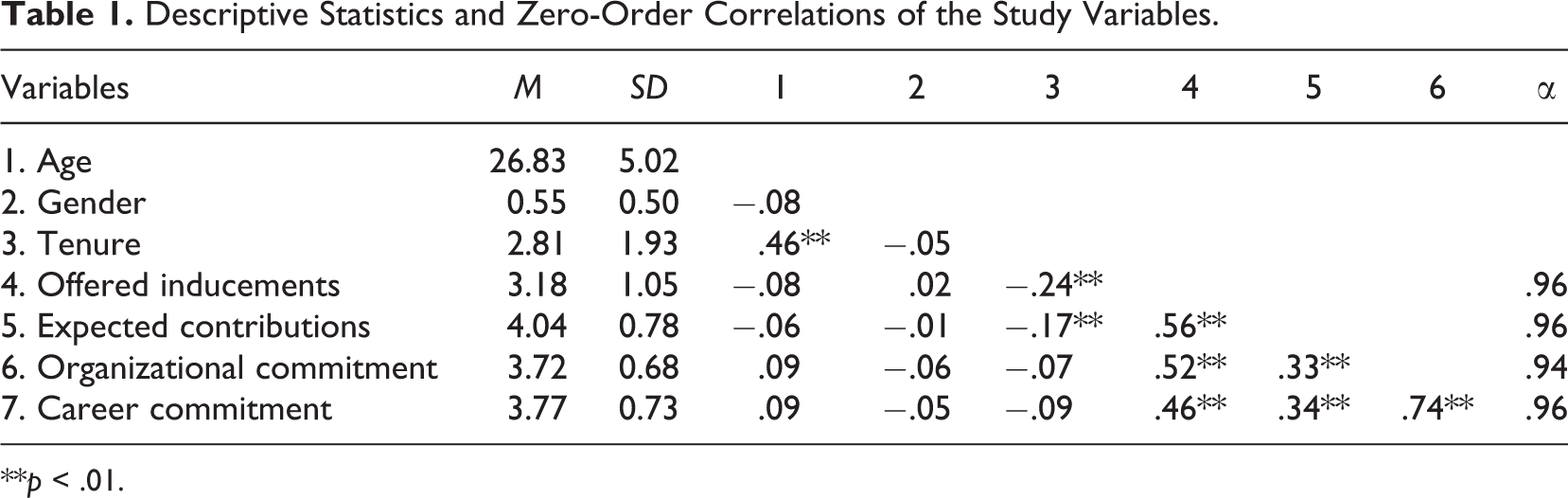
**p < .01.
Hypothesis Testing
Table 2 presents the results of the regression analysis. Hypothesis 1 proposed that organizational commitment mediates the relationship between offered inducements and career commitment, while Hypothesis 2 predicted that organizational commitment mediates the relationship between expected contributions and career commitment. We assessed these mediated relationships using Model 4 of PROCESS, for SPSS (Hayes, 2013). Using 5,000 bootstrap resamples, the indirect effect of offered inducements on career commitment via organizational commitment was significant (indirect effect = .24, boot SE = .02, 95% confidence interval, CI [.20, 29]). The direct effect of offered inducements on career commitment was also significant (B = .07, SE = .03, 95% CI [.02, .13]). Along similar lines, the indirect effect of expected contributions in predicting career commitment through organizational commitment was significant (indirect effect = .22, boot SE = .03, 95% CI [.15, .29]). The direct effect of expected contributions on career commitment was also significant (B = .09, SE = .03, 95% CI [.02, .16]). Given that the range of the CIs is positive and the lower bound does not include 0, Hypotheses 1 and 2 were supported.
Summary of Regression Analysis for the Mediating Role of Organizational Commitment Predicting Career Commitment.
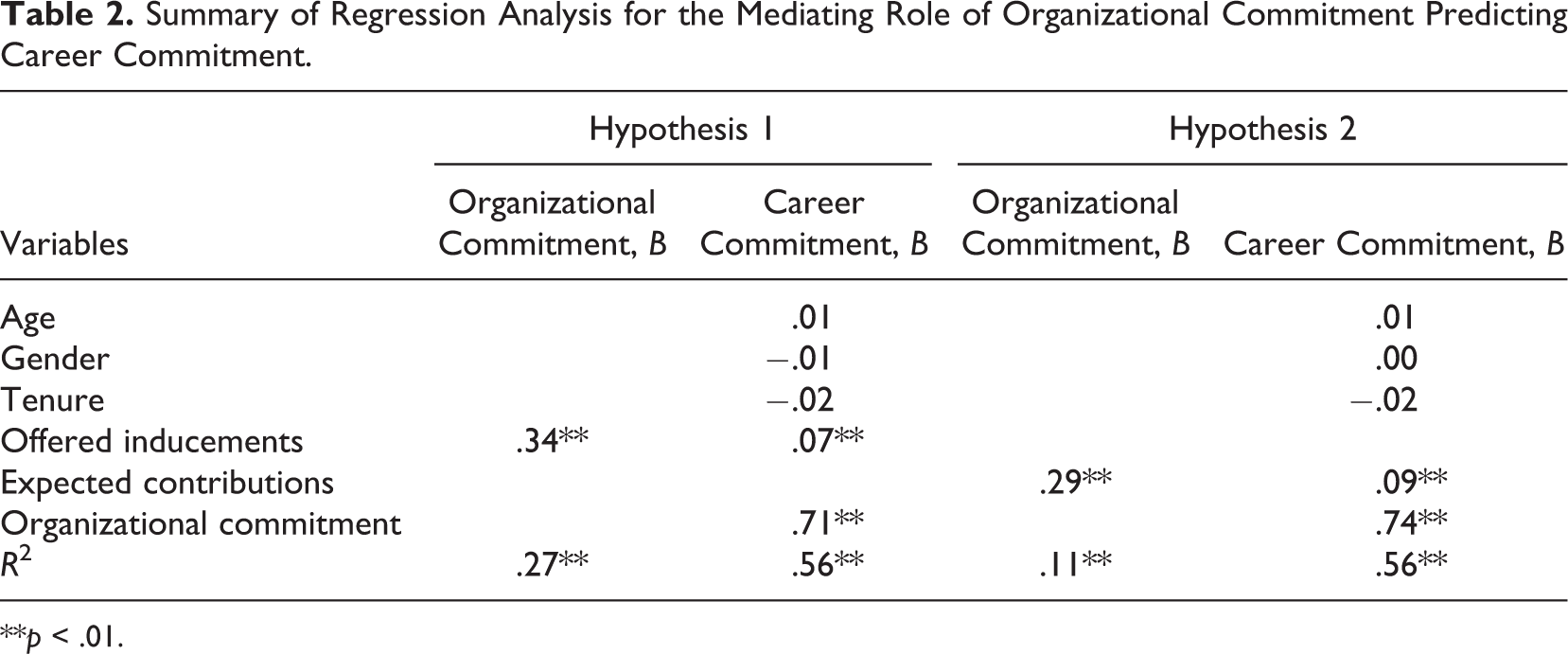
**p < .01.
Hypothesis 3 proposed that the conditional indirect effects of offered inducements in predicting career commitment via organizational commitment would be stronger for those employees with high as opposed to low expected contributions. This hypothesis reflects a first-stage moderated mediation model in which organizational commitment mediates the relationship between offered inducements and career commitment, with expected contributions moderating the path between offered inducements and organizational commitment. We conducted a moderated mediation analysis using PROCESS (Hayes, 2013). We first examined the moderating effect of expected contributions on the relationship between offered inducements and organizational commitment (i.e., first-stage moderation). The interactive effect involving offered inducements and expected contributions in predicting organizational commitment was significant (B = .09, SE = .03, 95% CI [.02, .15]). Next, we examined the conditional indirect effect. Results revealed that the conditional indirect effects of offered inducements on career commitment via organization commitment were stronger for high (indirect effect = .27, boot SE = .03, 95% CI [.21, .34]) as opposed to low (indirect effect = .17, boot SE = .03, 95% CI [.11, .23]) expected contributions. Hypothesis 3 was supported.
We also tested two alternative models. First, we examined a conditional direct effects model, in which expected contributions moderate the relationship between offered inducements and career commitment. While the conditional indirect effects of inducements on career commitment via organization commitment remained significant, the conditional direct effects of inducements was nonsignificant (B = .03, SE = .03, 95% CI [−.02, .09]). Second, we examined whether expected contributions served as a first- and second-stage moderator in the relationships among offered inducements, organizational commitment, and career commitment (see Table 3). Results revealed that the second-stage moderating effect of expected contributions was nonsignificant (B = .04, SE = .05, 95% CI [−.05, .14]). Overall, the alternative models were not supported, thus lending further support to our hypothesized model.
Summary of Regression Analysis for the First-Stage Moderating Effects of Expected Contributions.

**p < .01.
Discussion
Pattern of Results
The current study addresses the paucity of research on antecedents of career commitment. Findings demonstrated that organizational commitment mediated the relationship between offered inducements and career commitment (Hypothesis 1). In addition, the findings confirmed that organizational commitment mediated the relationship between expected contributions and career commitment (Hypothesis 2). Overall, these results suggest that when organizations provide high or broad offered inducements and expected contributions, it may foster psychological commitment to the organization, which in turn supports the development of career commitment.
Integrating SET and the EOR framework, the strength of employees’ commitment to their organization is contingent upon the degree of balance or imbalance in the exchange relationship (P. M. Blau, 1964; Cropanzano & Mitchell, 2005; Tsui et al., 1997). Employees who receive high or broad levels of offered inducements and career commitment may experience greater feelings of compatibility with their organization, leading to greater identification with and involvement in the organization. The magnitude of offered inducements and expected contributions shapes the nature of the social exchange between employees and their organization. Employees who receive high levels of inducements and expected contributions assume greater in-role and extra-role efforts to express desire to continue their organizational membership (Allen & Meyer, 1990). Indeed, our findings support prior research suggesting that an exchange relationship characterized by mutually high offered inducements and expected contributions supports the development of employee motivation, personal value, and meaningful work (Bergman et al., 2013; Zhang et al., 2014). In turn, employees are afforded a range of organizational opportunities that assist them in meeting their career objectives, acquiring career-relevant skills and information, and strengthening their chosen career role. Thus, the organization becomes an enabling context that institutes reinforcing mechanisms (i.e., inducements and expected contributions) to support employees’ career commitment (Colarelli & Bishop, 1990).
Subsequently, we also found evidence that the conditional indirect effects of offered inducements on career commitment via organizational commitment were significantly higher among employees with high as opposed to low levels of expected contributions (Hypothesis 3). Based on the SET and EOR framework, reciprocation is a natural process that occurs between organizations and employees (P. M. Blau, 1964). Under conditions where the organization supports employees’ career growth through greater expected contributions, employees are motivated to accomplish their tasks whether in-role or extra-role (Hom et al., 2009) and commit to their careers (Meyer & Allen, 1997), as opposed to when organizations exclude them from engaging in meaningful work activities (Goulet & Singh, 2002; Song et al., 2009). These findings may be explained by the psychological need of employees to feel valued, trusted, and depended upon by the organization (Shaw et al., 2009; Weng & McElroy, 2012). Regardless of the inducements offered to them, employees who face low expectations feel less valued and find less meaning in their work, thus driving them to seek other employment opportunities that are consistent with their personal career goals (Chang, 1999). This also points to the empowering role of the organization in strengthening organizational commitment and career commitment among employees. Specifically, the provision of meaningful inducements and expected contributions allows employees to identify with their organization’s goals, remain in the organization, and develop emotional attachment to their organization (Weng et al., 2010). In turn, this enables employees to develop more positive attitudes toward their career.
Implications for Theory and Practice
We should note that the current study differs in important ways from existing studies that tested the EOR framework. Our research presents a conceptual linkage between EOR and organizational and career commitment. Past studies have focused primarily on the effects of EOR on work productivity and turnover intentions and substantially ignored employees’ commitment to the organization and their careers. In the current study, we theorize the mediating role of organizational commitment between offered inducements and expected contributions on career commitment. That is, employees and organizations engage in a continuous pattern of reciprocal exchange which leads to greater levels of organization- and career-focused commitment.
Our study is among the first to make a systematic attempt to examine how STEM workers respond to offered inducements and expected contributions. Previous studies on the employee–organization relationship have been examined in the context of MBA students and middle- to top-level managers. We speculate that occupational differences may be a significant contextual factor that is likely to affect the extent to which employees perceive and respond to offered inducements and expected contributions. Indeed, recent studies suggest that advanced training and job tenure provide little support for commitment to STEM careers as they do for most employees in non-STEM fields (Glass et al., 2013). Studying the impact of employee–organization relationships on STEM workers then merits empirical investigation since a vast literature on career barriers in STEM suggests that unsupportive work environments may often hinder employees to participate in STEM activities (Metcalf, 2010; Xu, 2008). To our knowledge, the current study is the first to provide preliminary evidence about how the interaction of offered inducements and contributions encourages STEM workers to commit to the organization and subsequently to their careers.
The present research also adds to the growing body of literature focused on employment relationships between Chinese employees and organizations. The course of employment relationships in China is rapidly changing as job tenure and state benefits decline in government-owned organizations (Hom et al., 2009). Employment rewards and employee work commitment are among the most important management issues in China (Tsui, 2006). Thus, the findings of our study shed light on how perceived organizational practices influence organizational and career commitment among Chinese employees in STEM occupations.
The findings of our research have implications for management practice. First, our findings show that offered inducements and expected contributions motivate STEM employees to commit to their organizations and their careers. Hence, organizations must institute adequate and appropriate inducements and expected contributions to address the demands of both the job and employees in STEM fields. Consistent with previous studies, organizational management practices that reflect a balanced combination of offered inducements and expected contributions are generally associated with more favorable job attitudes and performance (Koh & Yer, 2000; Shaw et al., 2009; Tsui et al., 1997). Therefore, organizations should consider providing a range of meaningful opportunities for employees to obtain recognition and rewards for their involvement and contributions. As such, organizations must find ways to involve employees in relevant organizational projects and activities (i.e., through company-sponsored trainings, increased job autonomy and responsibilities, employment security) for them to assume that their organization is committed to fulfill its obligations and make a long-term investment in their careers. Employees may then express greater willingness to spend time and effort in developing their skills and abilities which would reduce any intention to withdraw from the organization and their careers (Aryee & Tan, 1992; Chang, 1999). For instance, a less circumscribed employment relationship may be more desirable for STEM workers given the informational and technical complexity inherent in STEM occupations. Succeeding in a STEM occupation may require employees to engage in a series of programmatic work activities that fall outside their core job functions. Organizations must then offer inducements that go beyond short-term monetary rewards (i.e., job security and wide opportunities for training and development) in exchange of broad obligations and contributions to sustain participation in activities that may lead to organizational and career commitment.
In a similar vein, organizations must not merely focus on providing inducements among their employees, but they must also adequately articulate the expected contributions and preferred work behaviors to foster a long-term employee–organization relationship (Tsui & Wu, 2005). Finally, it is important to consider that employees respond differently to offered inducements and expected contributions. Employees may differ in their willingness to assume obligations. Thus, organizations should carefully consider appropriate inducements and expected contributions to successfully deepen employees’ organizational and career commitment.
Limitations and Future Research Directions
Our research is not without limitations. First, we utilized a cross-sectional design which cannot sufficiently test the assumption underlying our prediction that offered inducements and expected contributions are causal antecedents of organizational and career commitment. While the results of our study are theoretically supported, confidence in the interpretation of the causal relationship of these constructs must await future research using longitudinal designs.
A second limitation involves the measurement of the study variables from the employee perspective, which may raise concerns about common method variance. Still, we believe that the employee perspective was the most appropriate source of measurement to quantify perceived offered inducements, expected contributions, organizational commitment, and career commitment, since these are all subjective perceptions. Also, we should note that complex interactions—such as what we found for the moderating effects of expected contributions—cannot easily be explained by common method variance (Brown, Ganesan, & Challagalla, 2001). Nevertheless, we recommend that future researchers consider collecting data from multiple sources to further substantiate our findings (Podsakoff, MacKenzie, Lee, & Podsakoff, 2003).
A third limitation involves the composition of our participants. Our study included full-time chemists and laboratory specialists employed in a single private organization, which may have implications for generalizability of our results. Our sample does not fully represent the STEM workforce. Employment relationships differ between private and public sector employees (Lewis & Frank, 2002), with private sector employees being more motivated by direct economic rewards and public sector employees preferring job security and recognition (Buelens & Van den Broeck, 2007). Similarly, temporary workers display lower levels of commitment and work engagement than permanent workers (de Gilder, 2003). Future research must attempt to confirm our results by replicating our study using a public sector organization and also greater variability in terms of the distribution of occupations and employees’ work status in STEM fields.
Finally, our data were collected in China, a collectivistic society where work contribution is often assigned and attributed to the group to which a worker belongs (Tsui, 2006). While a group’s collective effort is given high regard in China, Chinese people generally prefer individualized matrices for the allocation of monetary and socioemotional inducements (Chen, 1995). These cultural nuances may raise questions regarding the generalizability of our findings. However, given that an employee–organization relationship operates on the premise that organizations offer inducements in exchange of the employee’s contributions, we are optimistic that our findings may also be applicable to other cultural contexts (e.g., Korean; Shore, Bommer, Rao, & Seo, 2009; Singaporean; Koh & Yer, 2000; American; Shore & Barksdale, 1998).
There are several avenues for future research. First, future research should examine what specific forms of inducements (e.g., training, compensation, promotion) and expected contributions (e.g., task mastery, job rating, and performance) have greater explanatory power in predicting organizational and career commitment. For instance, far beyond the monetary rewards and level of expected contributions, it was found that the perceived quality of the work environment accounts for greater persistence among women in STEM careers than those with a managerial career (Glass et al., 2013). Thus, there may be value in assessing whether certain inducements and expected contributions evoke organizational and career commitment more strongly than others. In addition, it would be interesting to uncover other potential moderating variables and mediating mechanisms in the link between employee–organization relationships and employee commitment. Shore and Coyle-Shapiro (2003) argued that differences in individual characteristics and context may impact how favorably employees respond to various inducements and expected contributions. Since employees’ values and preferences differ within and across cultural contexts, their perceptions of favorable treatment and feelings of reciprocity in their organization-focused exchange relationship may also vary. In a sample of Chinese middle managers, Zhang, Song, Tsui, and Fu (2014) examined the impact of EOR on commitment among more traditional middle managers and their less traditional counterparts. They found that when organizations offer high levels of inducements, more traditional managers or those who adhere to authority reciprocate with stronger commitment, whereas less traditional managers do not attempt to reciprocate or recognize the inducements made. Likewise, Shore, Bommer, Rao, and Seo (2009) investigated the role of reciprocation wariness (i.e., fear of being exploited in the exchange relationship) among Korean employees. Their findings indicate that highly wary employees are more likely to interpret exchange relationships negatively and they express greater turnover intentions compared to less wary employees.
Moreover, although we found that inducements and contributions boost organizational commitment (and subsequent career commitment), they may have differential associations with outcomes worthwhile to explore. Certain types of expected contributions (e.g., working overtime or weekends) may not be beneficial in terms of building commitment. Furthermore, internally induced contributions (e.g., intrinsic desire to serve the organization to improve its human capital) and externally induced expected contributions (e.g., those specified by the organization) may have differential implications for how employees perceive and behave in their organization-focused social exchange. In addition, in a collectivistic society such as China, organizationally offered inducements resulted in higher perceived insider status (i.e., employees’ feelings of having obtained acceptance as a member of the organization), which in turn positively influenced discretionary work behaviors (Hui, Lee, & Wang, 2015). In a study involving Norwegian employees, organizationally offered inducements promote intrinsic motivation which enables employees to adopt more discretionary work behaviors (Kuvaas & Dysvik, 2009).
Finally, future research could examine the influence of the reciprocity schedule (i.e., the immediacy as to when parties return the favor) on the career commitment of employees (Hom et al., 2009). Because parties engaged in the social exchange may reciprocate inducements and contributions at any time often without explicitly specifying when to return the favor (Hom et al., 2009), we speculate that any delay in the reciprocity schedule may result in reduced commitment over time. We hope that the research presented here sheds some light on the role of employee–organization relationships in promoting organizational and career commitment and addresses the need for continued research on STEM workers.
Footnotes
Declaration of Conflicting Interests
The author(s) declared no potential conflicts of interest with respect to the research, authorship, and/or publication of this article.
Funding
The author(s) disclosed receipt of the following financial support for the research, authorship, and/or publication of this article: This research was supported by the National Natural Science Foundation of China (71472066) and the Australian Research Council (DP170101514).