



Abstract
The antecedents of voluntary employee turnover are well studied, but little is known about the consequences or outcomes of this voluntary job mobility. We address this gap through a survey study of 121 banking employees who have changed their employer in the last 3 years. We hypothesized that job change, whether self-initiated or imposed, may improve organizational commitment, work engagement, and well-being. These positive effects are expected when the job change is perceived as professionally and personally beneficial. Regression analyses revealed that employer change that is perceived as successful, whether voluntary or not, predicts an increase in general well-being, work engagement, and, to a lesser extent, affective organizational commitment. These results suggest that employer change may help employees to be more mobilized in their new work. Misconceptions about highly mobile employees and advantages of job change for both employees and organizations are discussed.
The notion of cradle-to-grave job security has not been relevant for decades (Mirvis, 1993). While employees used to hold one job and remain with one employer for a lifetime, careers have become progressively more fragmented by periodic transitions (Hall, 2002). Changing jobs has become the norm, and job stability has become an exception (Nicholson, 1996). At least in industrialized countries, job mobility—movement between jobs or organizations—has increased (Ng, Sorensen, Eby, & Feldman, 2007).
Job change may occur for organizational or individual reasons, highlighting an important distinction between, from one extreme, organizational adaption and, to the other, employees’ voluntary job change. In the first instance, faced with difficult financial circumstances and a competitive business conditions, organizations need to be able to rapidly adapt to changing market demands and unforeseen events. Employment practices that enable organizational survival through flexibility and efficiency include downsizing, restructuring, relocations, and use of contingent workers. These job changes are generally perceived as imposed and undesired for the employee. In the second instance, employees initiate their own job changes for several reasons including self-development, self-fulfillment, and improvement of quality of life (Carless & Bernath, 2007; Feldman & Ng, 2007). These job changes are generally perceived as voluntary and desired for the employee.
The increasing movement between jobs and organizations has led researchers to reconsider how they have conceived of careers. The traditional organizational career, characterized by a linear and predictable professional trajectory, has been progressively supplemented by new career conceptions (Briscoe, Hall, & DeMuth, 2006). Boundaryless and protean careers are both characterized by job mobility and career self-management (Arthur & Rousseau, 1996; Hall, 2002). This evolution of careers goes hand in hand with the evolution of the psychological contract (Hess & Jepsen, 2009) marked by a decrease over time of its relational component and an increase in transactional aspects. The perspective of the new psychological contract is more individualistic and instrumental than the psychological contract of old. Whereas job security was offered for loyalty, now employability is exchanged for performance (De Meuse, Bergmann, & Lester, 2001).
Studying job mobility is not a recent phenomenon. The majority of research has identified antecedents to voluntary job mobility but neglected its outcomes (Boswell, Boudreau, & Tichy, 2005). A great deal of attention has been paid to the antecedents of self-initiated employer change under the larger and better-known appellation “turnover.” However, consequences of turnover have been generally ignored, as most studies have positioned turnover as the conceptual end point of the investigation (Muchinsky & Morrow, 1980). Most research has examined the effects of attitudes such as organizational commitment and job satisfaction on job mobility but rarely have the effects of mobility on changes in these attitudes been studied. Studying the consequences of job mobility is especially important now due to recent changes in both American and European labor markets (Kalleberg & Mastekaasa, 2001). Given that job change is more common in today’s careers, it is important to understand how employees respond to their new jobs. Mobility has not the same significance for all of the people (Beaujolin et al., 2004; Schlossberg, 1981). Already in the 1980s, several authors (e.g., Lazarus & Folkman, 1984; Payne, Jabri, & Pearson, 1988; Schlossberg, 1981) highlighted the importance of taking into account the individual’s perception and evaluation confronted with professional situations such as transitions, in order to better understand their nature and effects. As pointed out by Bouffartigue and Pochic (2001), it is therefore essential to combine objective indicators of mobility with more subjective ones. Otherwise, Forrier, Sels, and Stynen (2009) consider that it is preferable to measure the voluntary dimension of mobility, not as a bipolar variable, but rather along a continuum. They also report that the perception of mobility as a successful career step is an interesting approach. Consider mobility from 2 subjective point of view along a continuum—a more or less voluntary mobility and a more or less successful mobility—could nuance the understanding of mobility effects on well-being at work. The purpose of this research is to address this gap by considering work-related and personal attitudes (affective organizational commitment, work engagement, and well-being), following an employer change and to answer the question: Are employees more mobilized in their new job after a job change?
Impacts of Job Mobility
Discussions on the impact of job change generally take into account the voluntary or involuntary aspect of the job change, in a dichotomous perspective, without any other nuance. It is generally concluded that voluntary job change leads to positive employee outcomes and involuntary or imposed job change leads to negative employee outcomes. Work experiences seem to become more positive over time for those who voluntarily changed jobs (e.g., Clarke, 1980; van der Velde & Feij, 1995). However, involuntary job change has overall negative consequences (Wanous, 1980) and may lead to discomfort and poor health (Kivimäki, Vahtera, Elovainio, Pentti, & Virtanen, 2003; Kivimäki et al. 2001). Other studies show that all job changes, regardless of reasons, result in positive experiences (Keller & Holland, 1981; Newton & Keenan, 1990; Nicholson & West, 1988), while some are less definite, concluding that involuntary job change has generally neither negative nor positive effects and does not have overall deteriorating effects (Van der Velde & Feij, 1995). We hypothesize that this conclusion applies also for voluntary job change: A new job, resulting from an individual choice or an organizational decision, may be either better or worse than the former.
Impact of Job Mobility on Organizational Commitment
While organizational commitment has been the focus as an antecedent to voluntary external job change (e.g., Allen & Meyer, 1996; Meyer, Stanley, Herscovitch, & Topolnytsky, 2002), few studies have investigated the consequences of job change on subsequent organizational commitment (e.g., Kalleberg & Mastekaasa, 2001; Kondratuk, Hausdorf, Korabik, & Rosin, 2004; Swaen, Kant, van Amelsvoort, & Beurskens, 2002). Although little empirical evidence has been accrued about the impact of job change on organizational commitment (Kondratuk et al., 2004), there has been a great deal of discussion about a potential decline in commitment to organizations due to the increase in job mobility (Pittinsky & Shih, 2004). Popular business and organizational literature often feed this debate. Pittinsky and Shih (2004) assume high mobility is associated with low organizational commitment because the construct is conceptually defined, operationalized, and researched in ways that exaggerate the supposition that organizational commitment and job mobility are inversely related. Nevertheless, their study reported a nonsignificant relation between current organizational commitment and past job changes or anticipated future job changes. They demonstrated that employees who moved frequently among organizations (mobility operationalized with the number of moves for both volitional and nonvolitional reasons) can be committed to an organization and do not report less loyalty or greater intention to quit than those who did not move as frequently. Others have reported that boundaryless and protean career attitudes (i.e., organizational mobility preference but not necessarily real mobility) are generally not significantly negatively correlated to organizational commitment (e.g., Briscoe & Finkelstein, 2009; Çakmak-Otluoğlu, 2012; Enache, Sallan, Simo, & Fernandez, 2011). These results suggest that these newer, nontraditional career orientations do not automatically result in less organizational commitment and thus defeat the stereotype.
Longitudinal studies have demonstrated an increase in organizational commitment after an employer change. Kalleberg and Mastekaasa (2001) reported higher organizational commitment after voluntary resignations and lower organizational commitment after involuntary layoffs. They specified that the effect of layoffs on commitment is stronger than the effect of resignations and they interpreted this result by the employees’ potential skepticism and unwillingness to commit themselves in employment relationships after being laid off. Similarly, without considering the voluntary dimension of the job change, Swaen, Kant, van Amelsvoort, and Beurskens (2002) found that affective commitment increased by 33.4% after a change of employer and decreased by 3% for nonmovers over the same period. Kondratuk, Hausdorf, Korabik, and Rosin’s (2004) longitudinal study confirmed this increase in affective organizational commitment and also indicated a decrease in normative organizational commitment after an external job change.
Knowing that Kalleberg and Mastekaasa (2001) found different results for voluntary (cf. “I quit”) and involuntary job change (because of closings or downsizing), we expect the voluntary dimension measured subjectively along a continuum, as suggested by Forrier et al. (2009), is not predictive of a change in attitudes such as organizational commitment. However, we think that job change perceived as successful—professionally and personally beneficial—is a key concept and will predict the impact of job change on attitudes.
Impact of Job Mobility on Work Engagement
Work engagement has rarely been studied in the context of job change. Some research has shown low work engagement as an antecedent to voluntary external job change (e.g., de Lange, De Witte, & Notelaers, 2008; Schaufeli & Bakker, 2004), but only de Lange, De Witte, and Notelaers (2008) and Equeter and Hellemans (2016) have investigated the impact of mobility on work engagement. The longitudinal study of de Lange et al. (2008) provided evidence that this work-related state of mind improves after an external mobility. Equeter and Hellemans (2016) focused on a specific mobility: the international mobility of researchers (at least 1 month abroad for strictly professional reasons during the last 3 years, without job change or affiliation change). They found that successful international mobility significantly and positively predicts an increase in researchers’ work engagement. We anticipate that the explanatory dimension of work engagement for other kinds of employees is also the appraisal of mobility—job change perceived as successful—instead of whether or not it was a voluntary job change.
Impact of Job Mobility on Well-Being
Consequences of job change on well-being have been rarely studied (Liljegren & Ekberg, 2009). While the relationship between downward or upward internal job change and health has been occasionally investigated, the relationship between external job change and health has been rarely studied (Liljegren & Ekberg, 2008). Most research considers well-being as an antecedent to external job change. An example is the study of the relationship between burnout and turnover (e.g., Barak, Nissly, & Levin, 2001; Lee & Ashforth, 1993; Liljegren & Ekberg, 2009; Schaufeli & Bakker, 2004). Low psychological well-being appears often to be the reason to change workplace (de Lang et al., 2008).
The impact of job change on well-being and health is unclear. On one hand, job change may be the source of many health and well-being-related costs (Parasuraman, Puhorit, Godshalk, & Beutell, 1996). On the other hand, job mobility appears to have positive effects on well-being and health. Longitudinal studies show external job change (with an objective perspective—the fact to having changed) reduces physical and emotional strain (de Croon, Sluiter, Blonk, Broersen, & Frings-Dresen, 2004; Swaen et al., 2002) and personal and work-related burnout (Liljegren & Ekberg, 2008, 2009). Liljegren and Ekberg (2008) found the predictive effects of job change are obvious for psychosocial health and burnout and negligible for physical health. Moreover, they reported they failed to confirm previous results of health as a predictor of job change, concluding that job change is a considerably more distinct predictor of well-being than well-being is a predictor of job change. Equeter and Hellemans (2016) highlighted that scientists at university report feeling better after making a long stay abroad, whether it was really desired or not. Based on these findings, we suggest that subjective perspective (the appraisal of mobility) could nuance the results: employees report a greater feeling of general well-being after a perceived mobility as successful even if it is an involuntary job change.
Method
Procedure and Sample
Employees of the Belgian bank sector who have changed employers during the last 3 years were invited to take part in the survey. There were 121 respondents: 26 (21.5%) working with their new employer since less than 1 year, 25 (20.7%) for 1–2 years, and 14 (11.5%) for 3 years. The sample included 73 (60.3%) males and 48 (39.7%) females. Ages range mainly between 25 and 45 years: less than 25 years (n = 3, 2.5%; 25–35 years: n = 52, 43%; 35–45 years: n = 37, 30.6%; 45–55 years: n = 25, 20.7%; and more than 55 years: n = 4, 3.3%). The majority had a bachelor’s or a master’s degree (high school: n = 14, 11.6%; bachelor’s degree: n = 33, 27.3%; master’s degree: n = 69, 57.0%; and postgraduate study: n = 5, 4.1%). A great part of the respondents had no manager responsibilities (n = 102, 84.3%)—the others was middle managers (n = 8, 6.6%), senior managers (n = 5, 4.1%), or outside hierarchical structure (consultant, advisor, etc.; n = 6, 5.0%). There is a balanced tenure distribution: 26 respondent (21.5%) have been working for less than 5 years, 25 (20.7%) from 5 to 10 years, 38 (31.4%) from 10 to 20 years, and 32 (26.4%) for more than 20 years. Almost all had a long-term contract (n = 111, 91.7%—others: n = 10, 8.2%) and worked full time (n = 118, 97.5%—others: n = 3, 2.5%). On average over the whole of their career, respondents have changed companies twice (M = 2.86, SD = 1.81), had two internal job changes not involving a hierarchical progression (M = 2.58, SD = 3.00), and had one hierarchical progression (M = 1.50, SD = 1.76). Finally, on average, their maximum stay in the same organization is 8.23 years (SD = 6.71).
Measures
Voluntary mobility was measured with the 4-item subscale of the Equeter and Hellemans’s (2016) Voluntary International Mobility Scale. We adapt the items to measure, not the international mobility, but the external mobility: the extent to which the job change is perceived as voluntary. All of the 4 items were used and adapted as follows: “This external change was initiated by myself,” “My company forced me to make this external change,” “I really wished to make this external change,” and “I had to do this external change.” The second and fourth items were reverse-scored. Responses were on a 5-point scale from 1 (strongly disagree) to 5 (strongly agree). The Cronbach’s α coefficient was .88.
Successful mobility was measured with the 6-item subscale of the Equeter and Hellemans’s (2016) Successful International Mobility Scale. We adapt the items to measure the extent to which the job change is perceived as successful, defined as professionally and personally beneficial, useful. All the 6 items were used and adapted as follow: “This external change had negative repercussions on my career,” “From a professional point of view, this external change appeared more constructive than unnecessary,” “From a personal point of view, this external change appeared more exhausting than fulfilling,” “It was good for me to change externally,” “Sometimes, I regret making this external change,” and “This external change had negative consequences on my private life.” Items 1, 3, 5, and 6 are reverse-scored. Responses were on a 5-point scale from 1 (strongly disagree) to 5 (strongly agree). The Cronbach’s α coefficient was .80.
Affective organizational commitment was measured with the 6-item subscale of the Meyer and Allen’s (1991) Organizational Commitment Scale. An example item is “I do not feel emotionally attached to this company.” Respondents were asked to indicate to what extent the feeling described has reduced or increased following their employer change. Responses were on a 5-point scale from 1 (strongly reduced) to 5 (strongly increased). The Cronbach’s α coefficient was .70.
Work engagement was measured by the short version of the Utrecht Work Engagement Scale (9 items; Schaufeli, Salanova, González-Romá, & Bakker, 2002). An example item is “I am enthusiastic about my job.” Respondents indicated to what extent the feeling described has reduced or increased following their job change. Items were scored on a 5-point Likert-type scale ranging from 1 (strongly reduced) to 5 (strongly increased). The Cronbach’s α coefficient was .93.
General well-being was assessed by the 5-item World Health Organization-Five (WHO-5) well-being index developed by the WHO (Bech, Olsen, Kjoller, & Rasmussen, 2003). Respondents were asked to indicate to what extent the feeling described has reduced or increased following their interorganizational mobility. It includes statements such as “I feel cheerful and in good spirits.” Items were scored on a 5-point scale ranging from 1 (strongly reduced) to 5 (strongly increased). The Cronbach’s α coefficient was .88.
Results
Descriptive Statistics
Table 1 reports means, standard deviations, and correlations of the measures. On average, respondents perceived their last job change as voluntary (M = 4.01, SD = 1.23) and successful (M = 3.84, SD = .086). However, the correlation between these two mobility dimensions is moderate (r = .23), highlighting the interest to distinguish and study both kinds of mobility.
Means (M), Standard Deviations (SD), and Correlations.
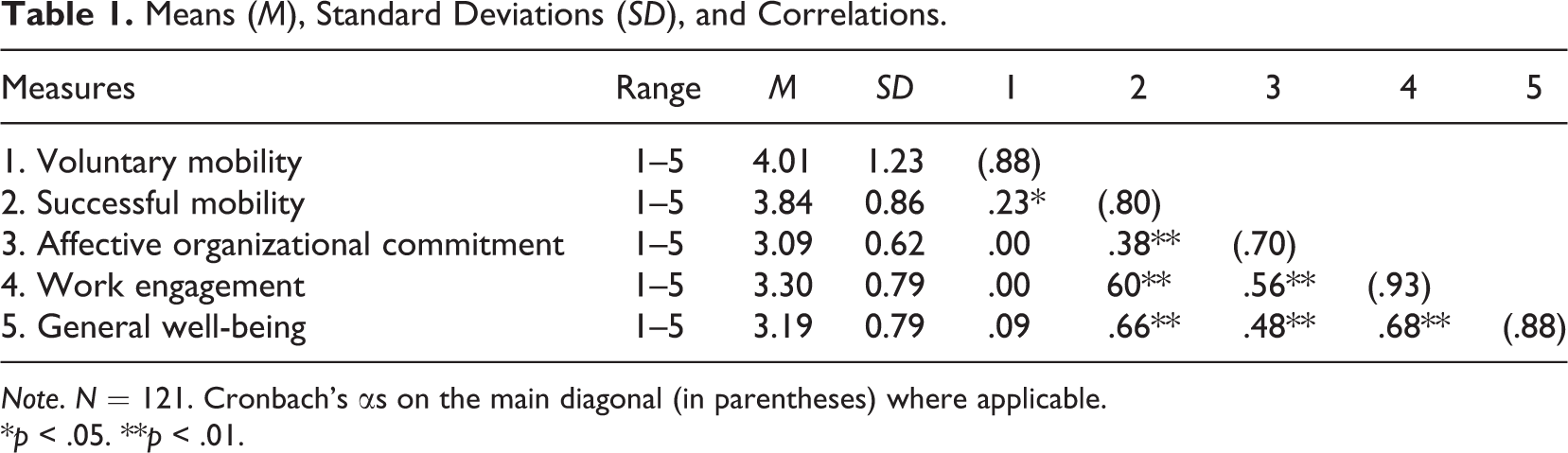
Note. N = 121. Cronbach’s αs on the main diagonal (in parentheses) where applicable.
*p < .05. **p < .01.
Verification of Hypotheses
To test our hypotheses, we used hierarchical linear regression analyses. Control variables of gender, age, education, and number of employer changes during the career were entered as the first step and voluntary mobility and successful mobility as the second step for each hypothesis (Table 2).
Results of Hierarchical Regression Analyses.

Note. N = 121. Standardized regression coefficients (β) are shown.
*p < .05. **p < .01. ***p < .001.
Regression coefficients of the second step show systematically that perceiving mobility as successful is a significant predictor of the increase in affective organizational commitment (β = .37, p = .000), work engagement (β = .61, p = .000), and general well-being (β = .66, p = .000). Ranging from .24 to .47, sizes of R 2 are considerable. Note that this positive effect of job mobility appears stronger on well-being and work engagement than on organizational commitment.
Conversely, as expected, the fact that mobility was voluntary or imposed does not seem to be predictive of the enhancement of these attitudes and states (p > .05). As shown in Table 1, these variables are even not significantly correlated. Hypotheses 1, 2, and 3 are consequently supported.
In addition, results indicated that the number of employer changes an individual has experienced over the whole of his or her career is predictive of the increase in affective organizational commitment (β = .27, p = .01). The more he or she had changed employers, the more he or she reported a rise of this form of commitment. In other words, highly mobile employees report a greater rise of organizational commitment than less mobile employees. To a lesser extent, education negatively predicts the improvement of work engagement following an external mobility (β = −.17, p = .03). However, the effect size is less important than those of the other predictors.
Discussion
There is relatively little research on how employees respond to their new job after an employer change. Nevertheless, our results provide confirmatory evidence that external mobility may improve organizational commitment (e.g., Kalleberg & Mastekaasa, 2001; Kondratuk et al., 2004; Swaen et al., 2002), work engagement (e.g., de Lange et al., 2008), and well-being (e.g., de Croon et al., 2004; Liljegren & Ekberg, 2008, 2009; Swaen et al., 2002). Therefore, it seems that job mobility may help workers to be more mobilized at work. And the increase in well-being after job mobility, even enforced, is an important result regarding health promotion.
As expected, the degree to which the job change is voluntary is not predictive of these outcomes. These variables are even not significantly correlated. Our research hypotheses were thus supported. Consequently, contrary to the commonly held ideas, it seems that even involuntary job change may generate these beneficial outcomes. Nevertheless, generalizations concerning effects of self-initiated or imposed job mobility should be avoided. The principal predictor of the improvement of general well-being, work engagement, and affective organizational commitment is the degree to which the job change is perceived as successful. In other words, a voluntary or enforced employer change will be followed by an enhancement of these states and attitudes if it is considered as professionally and personally beneficial.
Numerous reasons may explain this result. It could be the consequences of leaving an organization and switching from an unsatisfactory situation to a better one. The new job may be considered as a positive contrast compared to the former professional situation (Louis, 1980) in terms of better working conditions, improvement in quality of life, and a workplace that better meets the individuals’ development and advancement needs, for example. Furthermore, as suggested by Murrell, Frieze, and Olson (1996), job mobility may be personally more meaningful in terms of overall success since organizational structures became less hierarchical. In addition, the enhancement of organizational commitment, work engagement, and well-being following job mobility could be the consequences of entering a new organization with all the excitingly new aspects that this entails. Our results may be therefore explained by the honeymoon effect which refers to the trend whereby job satisfaction decreases substantially before a voluntary job change and increases after it (Boswell et al., 2005; Boswell, Shipp, Payne, & Culbertson, 2009; Chadi & Hetschko, 2014). The magic of the new generates a peak in job satisfaction level and gradually disappears. Adaptation and normalization take place a few months after the job change and job satisfaction returns progressively to its initial level or even lower (it is called hangover effect). The honeymoon–hangover effect may apply for other attitudes, but it is systematically associated with voluntary job change. The more voluntary the job mobility, the more likely improvement in job satisfaction is reported, and this positive effect disappears completely for involuntary job changes such as plant closures (Chadi & Hetschko, 2014). However, our study pointed out positive effects on employees from both voluntary and involuntary job change. This is not surprising, as Boswell, Shipp, Payne, and Culbertson (2009) argued, job mobility may stimulate positive attitudes in employees regardless of the reason for the job change because they need to make sense of a new job. Although voluntary and involuntary job mobility seem to have similar effects on employees, we suppose that the underlying process is probably different.
Our study indicates that the positive effect of successful job mobility is less pronounced on affective organizational commitment than on work engagement and well-being. This is probably due to the fact that the development of such emotional attachment to a particular organization takes time. Analyses also revealed that the number of employer changes an employee has realized over the whole of his or her career positively predicts the increase in his or her commitment to the new organization. Indeed, the positive effect of job mobility on organizational commitment is more considerable for highly mobile employees than on less mobile employees: The more employees had changed employers, the more they reported an increase in affective organizational commitment after their employer change. These results feed the debate about a supposed decline in commitment to organizations due to more frequent job mobility. The relation between job mobility and organizational commitment is not as clear-cut as the popular view might suggest: Job mobility is not necessarily related to a decay of organizational commitment. Employees, even those who moved frequently among organizations, seem to still be sensitive and interested in establishing committed relationships with the organization for which they work. This defeats the stereotype that highly mobile employees are less committed, less ethical, less loyal, more opportunistic, and more mercenary (Pittinsky & Shih, 2004).
Finally, it should be stressed that job mobility is often perceived as a threat. However, job mobility may offer to individuals more gains than costs. In addition, stability may be detrimental for both individuals and organizations. For example, it has been found that employees staying in their job, compared to those who had regularly changed jobs, may be less healthy, satisfied, and committed to the organization (e.g., Aronsson & Göransson, 1999; Breeden, 1993; Swaen et al., 2002; van der Velde & Feij, 1995; Vandenbrande, Coppin, & Van der Hallen, 2006).
Limitations and Future Research
Some caution is warranted in interpreting the results because measures were self-reported. Moreover, limitation of causal inferences is recognized as we collected cross-sectional data. Answers were retrospective, so recall biases can therefore occur. Answers were probably affected by respondents’ psychological and mental state and by explicit and implicit theories that influence the retrieval and interpretation of information (Pearson, Ross, & Dawes, 1992). According to the cognitive dissonance theory, the process of their mobility may be reinterpreted in order to eliminate contradictions felt between their beliefs, ideas, and values (Festinger, 1962). Moreover, knowing the consequences of an event transforms the judgment, the reasoning, and the affect toward it. For these reasons, respondents may have underestimated or overestimated a real change. However, as Person et al. (1992, p. 70) wrote, despite the limitations of retrospective studies, much can be learned from a careful analysis of their results. Finally, sample size may limit the generalizability of the findings.
Further research should continue to identify the consequences of job mobility on employees because changing jobs becomes more common and very little is known about it. As change and uncertainty can be perceived differently in another context (see Hofstede, Hofstede, & Minkov, 2010), it would be relevant to replicate our study in a—sociologically, economically, legally, and culturally—different environment in order to confirm and generalize our results. Replicating our study considering more information on the employer change could also be pertinent. It can be, for example, assumed that employer change including only a workplace change has different effects from an employer change including a workplace change, a sector change, and a function change because the individual’s adaptation required is more considerable.
Practical Implications and Conclusion
Antecedents of voluntary employee turnover are well studied, but little is known about the consequences of job mobility. Studying the consequences of job mobility is especially important now due to recent changes in labor markets. Traditionally, it is stated that external mobility is detrimental to organizations because of its costs. However, our results indicate that it may be beneficial for both individuals and organizations who welcome new employees.
Our results provide confirmatory evidence that self-initiated or voluntary employer change may improve organizational commitment, work engagement, and well-being. The degree to which the job change is voluntary does not seem to be predictive of the enhancement of these attitudes and states. Even involuntary job change may generate beneficial outcomes.
Moreover, our results show that the positive effect of employer change on organizational commitment is more pronounced for employees who moved frequently among organizations. These results feed the debate about a supposed decline in commitment to organizations due to more frequent job mobility: Job mobility is not necessarily related to a decay of organizational commitment.
Finally, the fact that individuals may feel better, more engaged, and more committed after an external mobility is undoubtedly highly desirable. As well-being, work engagement is conceptualized as an optimal functioning of the individual at work (Hallberg & Schaufeli, 2006). And both work engagement and affective organizational commitment have been recognized as being associated with several positive outcomes such as job satisfaction, performance, organizational citizen behavior, low level of absenteeism, and low turnover intentions (e.g., Bakker & Leiter, 2010; Meyer, Stanley, Herscovitch, & Topolyntsky, 2002).
Footnotes
Declaration of Conflicting Interests
The author(s) declared no potential conflicts of interest with respect to the research, authorship, and/or publication of this article.
Funding
The author(s) received no financial support for the research, authorship, and/or publication of this article.