



Abstract
Information-seeking is conceptualized by multiple career decision-making models but has received insufficient attention in the literature. This may be in part due to the difficulty in assessing the amount of information students have acquired about their chosen careers (i.e., their level of occupational knowledge). The present study, sampling 316 college students, modeled this process, with career exploration activities and occupational knowledge as exogenous variables. We expected both exogenous variables to directly and indirectly relate to career certainty and major satisfaction, with self-perceived occupational knowledge, occupational information self-efficacy (defined as the self-efficacy of seeking occupational information during the career decision-making process), and interest congruence acting as mediators. Results showed that career exploration activities indirectly related to the two outcome variables through both self-perceived knowledge and occupational information self-efficacy. Occupational knowledge only related to interest congruence; the latter did not relate to either outcome variable. This study was the first to objectively assess college students’ knowledge of the careers they were actively pursuing and the first to examine that construct along with other important career decision-making variables.
Keywords
The career decision-making process in college students is unique since these individuals generally have the freedom to pursue whichever careers they desire. The ideal outcome for these students is to have a career they find fulfilling and that ultimately provides them with high levels of vocational satisfaction. As they navigate this wide range of vocational choice freedom in search of satisfaction, it is important to understand how that process unfolds on a theoretical level. Many career decision-making models (e.g., Crites, 1976; Gati, 1986; Harren, 1979; Super, 1983) help explain how individuals narrow down career options in order to identify vocational goals. Generally speaking, these foundational models outline an ongoing evaluation process in which career decisions are constantly being reassessed, as individuals gain occupational information and self-awareness. During the middle phases in these models, individuals are gathering information about themselves and potential occupations, identifying which occupations might be appropriate and then narrowing down those occupations until ultimately one satisfying option remains. The model we put forth below and test through this study represents an amalgam of these middle phases of the career decision-making processes, which are characterized across specific theories by career information-seeking, integration of that information into self-information, and progress toward selecting a specific career to pursue.
Importantly, the role of information is salient throughout these middle phases of the career decision-making process. Expanding one’s awareness of information related to self and available occupations is required to make movement toward a specific career choice. However, information-seeking and how individuals use information to navigate the career decision-making process is not well understood in the literature. The purpose of this study was to examine these middle phases of gaining, using, and self-evaluating vocational information of the career decision-making process. We began this examination by shining a light on the roles of key variables in this process; namely, the exogenous variables our model, engagement in career exploration, actual occupational knowledge gained, and self-perceived occupational knowledge gained. These variables comprise activities students may engage in to obtain information useful to their career decision-making processes, followed by objective and subjective assessments of the knowledge they gained.
We included mediating variables in our model, occupational information self-efficacy and interest congruence, in order to account for additional processes contributing to the outcome variables of career certainty and major satisfaction. These two central outcome variables are critical for college students. Satisfaction with one’s major has been positively related to retention (Nauta, 2007) and grade point average (Leach & Patall, 2013; McIlveen, Beccaria, & Burton, 2013; Nauta, 2007), and career certainty has been related to retention (Restubog, Florentino, & Garcia, 2010) and described as the commitment individuals have in their decisions to pursue specific careers (Daniels, Clifton, Perry, Mandzuk, & Hall, 2006). All variables and their interrelations are presented in our model in Figure 1. The sections that follow provide further explanation of our model and included variables.
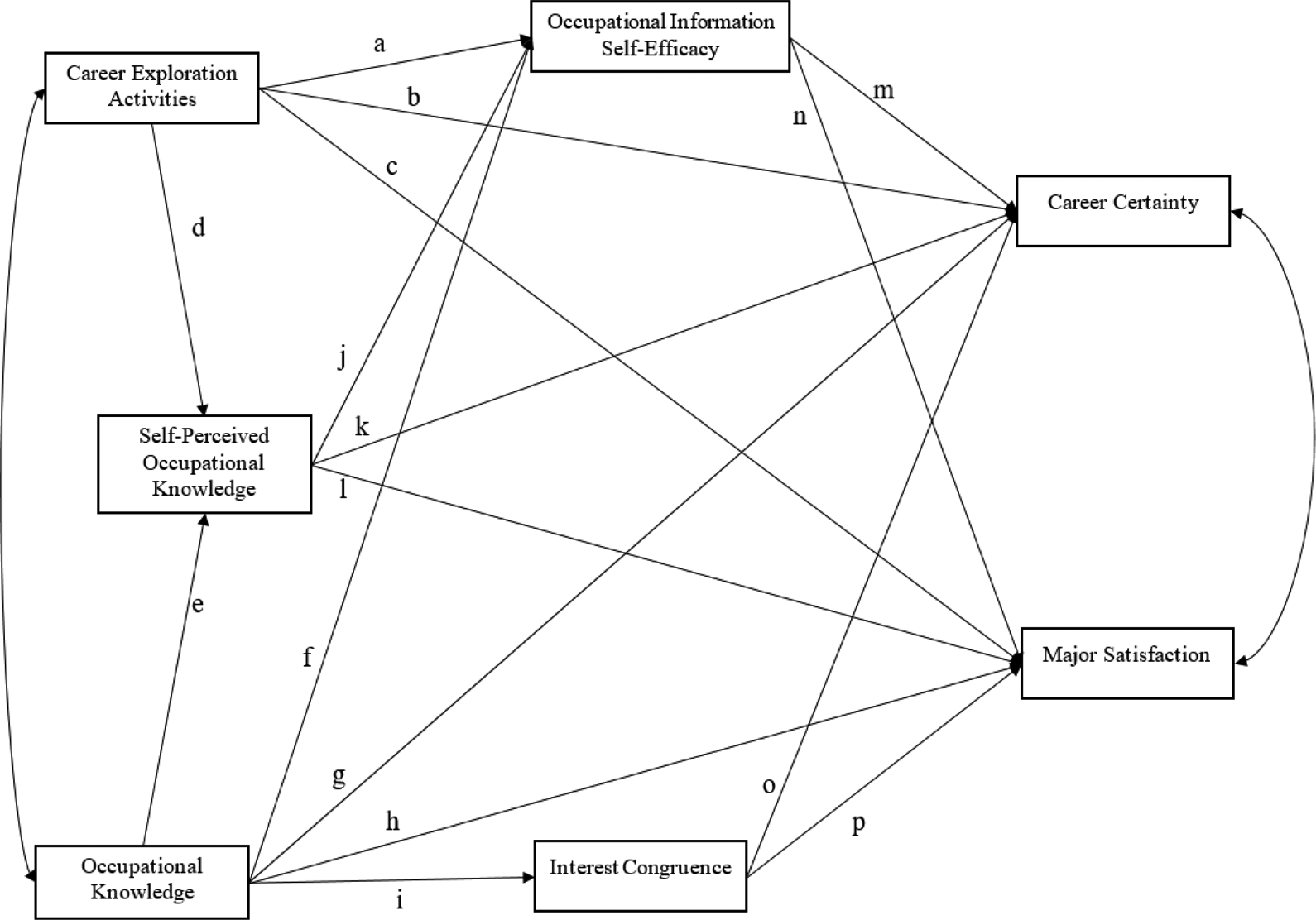
The hypothesized path model.
Relations of Exogenous Variables to Career Certainty and Major Satisfaction
A major construct involved in the career decision-making process is career exploration activities, the first exogenous variable in our model. The ability to engage in career exploration activities has been deemed a “fundamental competence” for individuals immersed in the career decision-making process (Blustein, 1997). Across multiple career decision-making models (Hirschi & Lage, 2007), it is asserted that students explore career options in a variety of ways (e.g., internships, career fairs, interacting with professionals), as they narrow their career options. For example, social cognitive career theory (SCCT) would identify career exploration activities as learning experiences that influence self-efficacy in seeking occupational information, choice goals, and choice actions (Lent, Brown, & Hackett, 1994). Career exploration activities have been the cornerstone of services offered at career centers for many years; however, the construct has been rarely examined. One older study showed that career exploration activities influenced career certainty and continuation in the educational major (Thomas & Bruning, 1984). A more recent study showed career exploration activities to be positively related to career decision-making self-efficacy and commitment to educational major (Germeijs, Luyckx, Notelaers, Gossens, & Voerschueren, 2012; Germeijs & Verschueren, 2009).
The second exogenous variable identified in our model is occupational knowledge. Occupational knowledge has been defined as the information one has about a career (Schmitt-Wilson & Welsh, 2012); when one has this accurate understanding, they are considered to be informed. Being informed about occupations has been emphasized as an important factor in the career decision-making process (Gati, 1986; Grotevant & Durrett, 1980; Hirschi & Lage, 2007; Super, 1983). For our purposes, we define occupational knowledge as objective knowledge, distinct from subjective knowledge that is self-perceived in nature. When students have sufficient accurate occupational information, they are able to make informed decisions regarding which career to pursue, and they understand the requirements needed to obtain their careers of interest, the daily activities and responsibilities of the jobs, and the types of environments they can work in. With this knowledge, students can evaluate the degree to which careers of interest will fit with their personal preferences.
Despite the conceptual link of a student’s occupational knowledge about their chosen career to important outcomes in the career decision-making process, the empirical evidence is lacking. This oversight seems to be due in part to a lack of adequate methods to assess occupational knowledge in one’s chosen career. The measures that do exist do not assess knowledge in one’s chosen career. Three general types of assessment exist in the literature: those that gauge self-perceived levels of knowledge, those that objectively test for general career information or relatively common-knowledge aspects of specific jobs, and those that objectively test specific jobs’ activities and responsibilities. All have inherent problems; namely, none are able to adequately and efficiently measure the accuracy of job-specific knowledge in terms of activities and responsibilities across students with a range of careers of interest. In this study, we assessed occupational knowledge of students’ chosen career using the extensive online database, O*NET (National Center for O*NET Development, 2003).
Two relevant studies provide indirect evidence that occupational knowledge about a chosen career indirectly relates to career certainty and major satisfaction. Pitt and Rarnaseshan (1995) showed that people who were less likely to quit a job compared to those more likely to quit reported more accurate, in depth, and relevant job information during their job interviews. Likewise, Thomas and Bruning (1984) showed that after obtaining accurate knowledge about teaching, student teachers who continued versus dropped out of the program reported significantly higher career certainty and career satisfaction.
Mediating Variables
The first two mediators in the model as shown by Figure 1 are anchored in the self; namely, self-perceived occupational knowledge and occupational information self-efficacy (defined as confidence of seeking occupational information during the career decision-making process). Occupational knowledge students have obtained is filtered through the self, as the students make appraisals of how much knowledge they have about their chosen careers. If they feel they have a lot of information about their chosen careers, their career decision-making self-efficacy may increase and they may experience more certainty about that choice. They may also experience more satisfaction with the accompanying educational major. In previous research, self-perceived knowledge has been shown to positively relate to career decision-making self-efficacy (e.g., Shivy & Sullivan, 2005) and career certainty (Multon, 1995; Westbrook, Elrod, & Wynne, 1996).
One of the most well-known career decision-making models, SCCT (Lent et al., 1994), places career decision-making self-efficacy in the center of the career choice model, asserting its role as a mediator between learning experiences and career choice. In this study, we focused specifically on the self-efficacy of seeking occupational information (occupational information self-efficacy), which is one important component of career decision-making self-efficacy (Betz, 2000). In SCCT, the learning experiences would include gaining occupational knowledge and engaging in career exploration activities. Previous research supports positive relations between career decision-making self-efficacy and career exploration (e.g., Cordeiro, Paixão, Lens, Lacante, & Luyckx, 2015; Germeijis & Verschueren, 2009), self-perceived knowledge (e.g., Shivy & Sullivan, 2005), career certainty (e.g., Restubog et al., 2010; Tracey, 2008), and major satisfaction (e.g., McLaren, 2014). Occupational information self-efficacy was not specifically reported in those studies.
The last mediator in the study is interest congruence. Interest congruence is defined as the degree to which a person’s interests match those of a given work environment (Spokane & Cruza-Guet, 2005). Holland (1997) posited that individuals naturally seek out work environments they believe will be compatible with their own interests, leading them toward occupational (and in this case, major) satisfaction and career certainty. Conceptually, one would expect increasing occupational knowledge to assist individuals in assessing which career will yield the highest congruence. Its relation to specific occupational knowledge is mostly conceptual, although levels of Realistic interests were associated with a specific Realistic job’s task knowledge in one study (Van Iddekinge, Putka, & Campbell, 2011). The link between congruence and career certainty has received some empirical support (Tracey, 2010), although its link to major satisfaction appears tenuous (Tsabari, Tziner, & Meir, 2005).
The Present Study
The overall purpose of the present study was to examine the roles of information-seeking and occupational knowledge in the career decision-making process. As Figure 1 illustrates, we placed occupational knowledge and career exploration activities as exogenous variables. We expected both exogenous variables to directly and indirectly relate to career certainty and major satisfaction through self-perceived occupational knowledge and occupational information self-efficacy. We expected occupational knowledge to relate directly and indirectly to career certainty and major satisfaction through interest congruence.
Hypotheses
The primary hypothesis for this study was that the model presented in Figure 1 would yield a good fit to the data. We hypothesized that the two exogenous variables would directly relate to both career certainty (Paths b and g) and major satisfaction (Paths c and h). We also proposed the following specific hypotheses regarding mediation.
Method
Participants
Data were collected from undergraduate students in introductory psychology courses at a large Midwestern university. Data from 357 participants were originally collected. Forty-one participants’ data were excluded due to incomplete data (n = 18), being under 18 years of age (n = 2), or not having identified a single career of focus (n = 21). The final sample consisted of 316 participants. Two hundred twenty-seven participants identified as female (71.8%) and 89 identified as male (28.2%). Participant ages ranged from 18 to 67 years (M = 19.36, standard deviation [SD] = 3.71). One hundred seventy-six participants were first-year students (55.7%), 75 were second-year students (23.7%), 39 were third-year students (12.3%), 13 were fourth-year students (4.1%), and 13 were beyond fourth-year status (4.1%). Two hundred thirty-seven participants had declared their majors at the time of the study (75%). A majority of the sample identified as European American (80.4%), 8.9% as international students, 4.7% as Pacific Islander/Asian American, 2.5% as Latino/Latina American, 2.2% as multiracial, and 1.3% as African American.
Outcome Measures
Career certainty
Career certainty was measured using the modified career certainty subscale, from the Career Decision Scale (Osipow, Carney, & Barak, 1976) in which 1 item was added. This is a 3-item 6-point Likert subscale that assessed the extent to which participants were certain about pursuing the career they indicated as their current career of choice. An example item is “I definitely want to pursue this career.” Mean scores were computed in which high scores indicated more certainty. The α in the present study was .92. Osipow (1980) reported a 2-week test–retest correlation of .82, and its validity has been well established (Betz, 1992; Osipow, 1980).
Academic major satisfaction
The Academic Major Satisfaction Scale (AMSS; Nauta, 2007) consists of six 5-point Likert-scaled questions, where a higher score indicates greater satisfaction with a major. The internal consistencies were α = .94 and α = .90 in the two samples used to develop the AMSS. Each item has an effect size of .5 or higher for predicting which students remain in their majors over a 2-year period. The AMSS has been positively associated with career decision self-efficacy (r = .45, p < .001), and negatively associated with career choice anxiety and generalized career indecisiveness, with rs of −.50 and −.30, respectively (p < .001). The α in the current study was .91.
Exogenous Variables
Career exploration activities
The Career Exploration Checklist (CEC; Pesch, 2014) was modeled after a similar measure called the In Depth Exploratory Behavior subscale from the Study Choice Task Inventory (Germeijs & Verschueren, 2006) and from career exploration activities described in the Career Decision Self-Efficacy Scale (CDSES) and career decision-making models (Crites, 1976; Gati, 1986; Harren, 1979; Hirschi & Lage, 2007). It was used to assess the extent to which participants have engaged in career exploration activities. This 17-item checklist asked each participant to indicate whether they had engaged in the various exploration activities (e.g., “Searched the Internet to learn about this career;” “Job shadowed someone who is employed in the career;” “Attended a career or job fair”) related to their chosen career. Responses were recorded on a 2-point scale, (0) never, (1) at least once. Sum scores were computed. The α in the current study was .84. Initial estimates of convergent validity showed that the CEC positively related to self-perceived occupational knowledge, major satisfaction, and career certainty in the current study.
Occupational knowledge
Three steps were involved to operationalize occupational knowledge for each participant’s career choice. First, we used the O*NET’s Detailed Work Activity database (National Center for O*NET Development, 2003) as the best objective measure of what a student’s identified career entails. The advantage of using this database is that all 974 O*NET occupations have unique importance ratings ranging from (0) not important to your current job to (100) extremely important your current job on the same 41 work activities. These importance ratings were developed by occupational experts and people actually working in those occupations. Average scores were generated from these occupational experts and random samples of workers’ responses (Research Triangle Institute, 2006). Examples of work activities include “thinking creatively,” “working with computers,” and “developing and building teams.” The 41 work activities importance ratings associated with the career that most closely matched the student’s chosen career were recorded.
Second, participants completed the Work Activity Importance Profile, which asked them to rate the degree to which each of the 41 work activities were important to their chosen identified career. Ratings were made on a 5-point Likert-type scale. Third, a Q correlation (Cronbach & Gleser, 1953) was derived. It is a standardized measurement of the agreement between a participant’s work activity importance ratings for his or her chosen occupation and the corresponding O*NET work activity ratings for the same occupation. This measurement is not descriptive of elevation differences between two profiles, but rather of differences in shape. Q correlations ranged from −1.00 to +1.00, with a value of −1.00 indicating an inverse correlation between the participant’s ratings and the experts’ ratings, 0.00 indicating no correlation between the participant’s ratings and the experts’ ratings, and +1.00 indicating a perfect correlation between the participant’s 41 ratings and the experts’ 41 ratings for the participant’s chosen career (Armstrong, Fouad, Rounds, & Hubert, 2010). Computed in this way, a score of +1.00 indicates the highest level of occupational knowledge, and as scores move further away from +1.00 they become associated with lower occupational knowledge.
Mediator Variables
Self-perceived occupational knowledge
The first author revised the knowledge about occupations and training subscale of the Career Decision Profile (CDP; Jones, 1989) in order to incorporate an additional item concerning daily activities involved in the chosen career. The mean score operationalized participants’ self-perceived occupational knowledge. Each participant was asked to rate their level of agreement with statements concerning their knowledge about their chosen careen using a 3-item, 6-point scale, with higher scores indicating more self-perceived knowledge. An example item is “I know the types of work activities I will be required to do in this job.” The α in the present study was .73. The CDP subscale positively related to self-efficacy beliefs in career planning and exploration, knowledge of self and others, and educational and vocational development as well as positive affect (Multon, Heppner, & Lapan, 1995) and negatively related to goal instability (Multon et al., 1995).
Occupational information self-efficacy
The occupational information self-efficacy subscale of the CDSES (Taylor & Betz, 1983) includes ten 5-point Likert items designed to measure one’s confidence that he or she will effectively seek out occupational information (Taylor & Betz, 1983). An example item is “How much confidence do you have that you could describe the job duties of the career/occupation you would like to pursue.” Mean scores were used, with higher scores reflecting stronger beliefs regarding one’s confidence in information-seeking. Internal consistency has been established for the subscale (α = .89), and it has been found to correlate strongly with the total score. The occupational information mean score has been shown to negatively correlate with career indecision (Taylor & Betz, 1983). The α in the current study was .84.
Interest congruence
Interest congruence is the degree to which a person’s Holland code matches that of a given work environment (Spokane & Cruza-Guet, 2005), or more specifically, the degree of similarity between one’s realistic, investigative, artistic, social, enterprising, and conventional(RIASEC; Holland, 1997) interest scores and the person’s chosen career RIASEC profile.
In order to measure interest congruence, three steps were taken. First, the participants’ six RIASEC interest scores were obtained using the O*NET Interest Profiler–Short Form (IP; Rounds, Su, Lewis, & Rivkin, 2010). The IP contains a 10-item 5-point Likert-type scale for each of the six interest domains in Holland’s (1997) hexagon. Higher scores indicated more interest. Rounds and colleagues reported internal consistency estimates ranging from .78 to .90, and test–retest reliability estimates ranging from .78 to .86. Furthermore, convergent and discriminant validity evidence was found with the RIASEC scales of the Interest-Finder (Wall & Baker, 1997). Correlations for same-named subscales ranged from .74 to .82, and from .12 to .48 for differing subscales. The α in the present study was .93.
Second, the person’s chosen career RIASEC profile was operationalized using the Occupational Interest Profiles for O*NET (OIP; Rounds, Smith, Hubert, Lewis, & Rivkin, 1999). The profiles are based on Holland’s (1997) RIASEC model and are thus comparable to the IP for individuals’ interests. Each of O*NET’s 974 occupational titles is paired with a RIASEC interest profile, with unique values for each interest type based on the occupation’s characteristics. Job incumbent interest profiles, discriminant function analysis, and expert judgments were used in determining interest profiles for each occupation. This system, created for organizing and describing occupations, has replaced the Dictionary of Occupational Titles for the U.S. Department of Labor and is currently the only comprehensive system available. Evidence for external and structural validity is presented in O*NET’s developmental report (Rounds et al., 1999).
Third, interest congruence was operationalized by computing a Q correlation (Cronbach & Gleser, 1953) to determine how similar the participant’s IP RIASEC interests were to the OIP RIASEC scores for their chosen career. Each participant’s interest profile across the RIASEC, measured by the IP, was correlated with the O*NET occupation profile for their chosen career. In the context of the present study, the Q correlation was supported as an appropriate measurement of congruence; it is consistent with Holland’s (1997) original conceptualization of congruence and measures the extent to which two interest profiles have similar shape (Armstrong et al., 2010). Validity for less stringent but more frequently used congruence calculations (e.g., 1-letter agreement, 2-letter agreement) are presented in the meta-analysis by Tranberg, Slane, and Ekeberg (1993). The specific congruence calculation method used in the present study has not yet been used in the literature but is more comprehensive, comprising scores on all six interest categories for both participants and careers. A Q correlation of +1.00 indicates the highest level of interest congruence, and as scores move further away from +1.00 they become associated with lower interest congruence.
Procedure
After receiving institutional approval, participants were recruited using the department’s online research participation system. Undergraduate students who opted to partake in the Qualtrics survey received one credit for participating. Students were first presented with demographic questions that included items asking each participant to provide the career they are pursuing or seriously considering pursuing. Subsequent pages of the survey presented participants with the Self-Perceived Occupational Knowledge Scale, Career Certainty Scale, AMSS, Occupational Self-Efficacy subscale, the CEC, O*NET IP, and the Work Activity Importance Profile. Upon reaching the end of the survey, participants were debriefed regarding the purpose of the study.
Results
Preliminary Analyses
SPSS version 20.0 and Mplus Version 7.4 (Muthén & Muthén, 2012) were used for data analysis. Fisher’s z prime (z′) transformations were conducted on the occupational knowledge Q score and the interest congruence Q score before running descriptive statistics and preliminary analyses (Cohen, Cohen, West, & Aiken, 2003). This transformation was statistically appropriate, given that the scores ranged from −1.00 to +1.00. The resulting distributions for these two variables are presented as z-scores, which were used throughout data analysis in place of the original Q scores. To calculate z-scores, the following equation was used: z′ = ½ (ln(1 + r) − ln(1 − r)), where r represents each individual’s Q score for the respective variable. This transformation adjusts the distributions to make them symmetrical and normalize the standard error, allowing for more accurate confidence intervals when estimating standardized β values in path analysis (Cohen et al., 2003). The ranges for objective occupational knowledge and interest congruence remain between −1.00 and +1.00, with scores near zero indicating no relation between participant and occupation profiles, and scores near +1.00 indicating greater similarity between the two profiles. Means, standard deviations, coefficient αs, and zero-order Pearson product moment correlations among the seven variables are presented in Table 1.
Descriptive Statistics and Variable Correlations.

Note. N = 316. Career exploration activities as measured by the Career Exploration Checklist (Pesch, 2014); occupational knowledge and interest congruence are measured by Q statistics that have been transformed into z-scores; self-perceived occupational knowledge as measured by the Self-Perceived Occupational Knowledge Scale (Jones, 1989); occupational information self-efficacy as measured by the Career Decision Self-Efficacy Scale (Taylor & Betz, 1983); career certainty as measured by the Career Certainty Scale (adapted from Osipow et al., 1976); major satisfaction as measured by the Academic Major Satisfaction Scale (Nauta, 2007). For all constructs, higher values indicate higher levels of the construct; for the Q statistics, values closer to +1 indicate greater match between student’s self-report and expert raters. Coefficient α is listed on the diagonal. All correlations greater than .11 are significant at p < .05.
Hypotheses
Our hypotheses were tested via path analyses in MPlus using full information maximum likelihood to estimate casewise parameters for missed items. We first analyzed the hypothesized model displayed in Figure 1, using the guidelines of Hu and Bentler (1999) to assess goodness of fit. These included a comparative fit index (CFI) of .95 or greater, a root mean square error of approximation (RMSEA) of .06 or less, and a standardized root mean square residual (SRMR) of .08 or less. Results indicated the hypothesized model was a good fit, χ2(3, N = 316) = 2.07, p = .56, CFI = 1.00, RMSEA < .01, SRMR = .01. Figure 2 contains the standardized β coefficients for the direct effects on the relations between the exogenous variables and career certainty/major satisfaction as mediated by self-perceived occupational knowledge, occupational information self-efficacy, and interest congruence. Solid lines indicate significant direct paths, whereas dashed lines indicate insignificant direct paths. Contrary to our primary hypotheses, neither exogenous variable displayed a significant direct relation with either outcome variable.

Hypothesized model results. Solid lines indicate significant paths; dashed lines indicate nonsignificant paths. *p < .05. **p < .01. ***p < .001.
Second, we analyzed a nested model in which all relations between the exogenous and outcome variables were fully mediated by self-perceived occupational knowledge, occupational information self-efficacy, and/or interest congruence. Figure 3 contains the standardized β coefficients for all direct paths in this model. This model also yielded a good fit, χ2(7, N = 316) = 8.50, p = .29, CFI = .99, RMSEA = .03, SRMR = .02. Results of a χ2 difference test indicated that this model and the hypothesized model fit the data equally well, χ2(4) = 6.11, p = .19. Because the nested model was the more parsimonious model, it was used to test the mediation hypotheses. Bootstrap tests using bias corrected 95% confidence intervals were used to test the statistical significance of the mean indirect effects. The calculation was repeated with 1,000 samples to yield parameter estimates for total and specific indirect effects. A confidence interval not containing 0 indicated that the mean indirect effect across the samples was significant (p < .05). Bootstrap analysis enhanced statistical power and obviated assumptions regarding multivariate normality (Preacher & Hayes, 2008).

Nested model results. Solid lines indicate significant paths; dashed lines indicate nonsignificant paths. *p < .05. **p < .01. ***p < .001.
Table 2 presents the magnitude and statistical significance of the specific and total indirect effects of the exogenous variables on career certainty/major satisfaction through the hypothesized mediators using the bootstrapping procedure. Table 2 is organized so that the first two specific mean indirect effects reported concern the first mediator, self-perceived occupational knowledge; the next four specific mean indirect effects reported concern the second mediator, occupational information self-efficacy; the final two specific mean indirect effects reported concern the third mediator, interest congruence.
Bootstrap Analysis of Magnitude and Statistical Significance of Indirect Effects of Career Exploration Activities and Occupational Knowledge on Career Certainty and Major Satisfaction Through Self-Perceived Occupational Knowledge, Occupational Information Self-Efficacy, and Interest Congruence.

Note. N = 316. SE = standard error; BC CI = bias-corrected confidence interval; Self-perceived occ. know. = self-perceived occupational knowledge; career exp. activities = career exploration activities; Occ. info. self-efficacy = occupational information self-efficacy .
aThese values are based on the unstandardized path coefficients.
*95% confidence interval does not include zero and therefore is significant at p < .05.
Self-perceived occupational knowledge significantly mediated the relation between career exploration activities and occupational information self-efficacy (Effect 1a; Hypothesis 1), as well as between career exploration activities and career certainty/major satisfaction (Effects 1c and 1d; Hypothesis 3). However, self-perceived occupational knowledge was not a significant mediator of the relations between occupational knowledge and occupational information self-efficacy (Effect 1b; Hypothesis 2) or occupational knowledge and career certainty/major satisfaction (Effects 1e and 1f; Hypothesis 4). Occupational information self-efficacy was a significant mediator of the paths between self-perceived occupational knowledge and both outcome variables (Effects 2a and 2b; Hypothesis 5), as well as between career exploration activities and both outcome variables (Effects 2c and 2d; Hypothesis 6). However, it failed to mediate the paths between occupational knowledge and either outcome variable (Effects 2e and 2f; Hypothesis 7). Interest congruence was not a significant mediator for either of its hypothesized indirect effects (3a and 3b; Hypothesis 8).
Discussion
This study has advanced our understanding of the information-seeking middle phase of the career decision-making process in at least five ways. First, the role of career exploration activities was shown to indirectly positively relate to two important career decision-making outcomes: career certainty and major satisfaction. Prior to this study, we had minimal information that career exploration activities related to commitment to one’s major (e.g., Germeijs & Verschueren, 2009).
Second, we also learned that self-perceived knowledge of the daily activities of one’s chosen career mediated the relation between career exploration activities and career certainty/major satisfaction. It seems that the more career exploration activities (e.g., internships, externships, career fairs) students engage in, the more they perceive themselves as knowledgeable about the daily activities of their chosen careers. This increase in self-perceived knowledge in turn relates to increased career certainty and major satisfaction. This finding supports prior research showing that self-perceived occupational knowledge relates to career certainty (e.g., Multon, 1995; Westbrook et al., 1996). Further, self-perceived occupational knowledge mediated not only the relation between career exploration and career outcomes, but it also indirectly related to those outcomes through confidence in seeking occupational information. This finding supports prior research as well (e.g., Shivy & Sullivan, 2005) and is consistent with the SCCT career choice model that presents self-efficacy as the mediator between learning experiences and career choice.
Third, these findings expand our understanding of the role of one context-specific aspect of career decision-making self-efficacy, specifically the confidence in seeking out occupational information. Occupational information self-efficacy fully mediated the relation of career exploration activities to career certainty/major satisfaction, and partially mediated the relation of self-perceived occupational knowledge to career certainty/major satisfaction. Consistent with the SCCT career choice model and prior research, one’s confidence in seeking occupational information positively relates to career certainty and commitment to one’s area of study (e.g., Germeijs & Verschueren, 2009; Germeijs et al., 2012). Occupational information self-efficacy also partially mediated the relation between self-perceived occupational knowledge and the two outcome variables. Feeling knowledgeable about one’s chosen career related to more confidence in information-seeking, which in turn led to more career certainty and major satisfaction.
Fourth, occupational knowledge related positively to interest congruence as hypothesized (Westbrook & Parry-Hill, 1973), providing preliminary evidence that the Work Activity Importance Profile was a valid measure of occupational knowledge. Students with more occupational information about their chosen careers were more likely to have RIASEC interest profiles that matched those of their chosen careers. This relation is consistent with Holland’s (1997) theory that knowledge of one’s career should facilitate one finding a match between work environment and their RIASEC interests. However, Holland’s model would also predict that interest congruence would positively relate to career certainty and major satisfaction, which was not supported in our findings. The null relation between interest congruence and major satisfaction is consistent with other nominal findings between interest congruence and job satisfaction (e.g., Tsabari et al., 2005), although a trend did emerge from the data (p < .08).
Finally, we learned that although occupational knowledge did positively relate to interest congruence as expected, it did not relate significantly to self-perceived occupational knowledge. As displayed in Figures 2 and 3, that path was nonsignificant. One explanation for the null finding is that the different methods of measurement (Q statistic and self-report) prevented statistical comparison. Moreover, the Q statistic was measured by examining the profile fit of self-other ratings across 41 work activities compared to the 3-item self-perceived occupational knowledge measure.
Occupational knowledge was also unrelated to other key career decision-making variables displayed in Figure 1. Occupational knowledge has been emphasized as an important factor in the prominent career decision-making models (e.g., Hirschi & Lage, 2007). Following these models, one would expect that increasing occupational knowledge would directly and indirectly lead to more career certainty and satisfaction with one’s major. Our null findings run counter to those reasonable assertions.
Implications
For career counselors, the findings of this study offer some hope and some concern. On the positive side, the more students in this study reported engaging in career exploration activities, the more they felt knowledgeable about their chosen careers, confident about seeking out information, and certain and satisfied with their career paths. These findings may suggest students are utilizing their career exploration experiences to make more informed career choices. Further, the more actual occupational knowledge students have concerning their chosen careers, the more their expressed interests may match the work environment of those careers.
On the other hand, students’ actual occupational knowledge of their chosen careers did not relate to their self-perceived knowledge, nor their confidence in seeking out occupational information in this study. It appears that these students are making career decisions, at least in part, based on beliefs about their levels of occupational knowledge and abilities to obtain occupational information, rather than objective facts. For a portion of these students, those beliefs appear to be inaccurate. Likely, this behavior will not have catastrophic consequences for most students once they finish their education and begin working; though for some overconfident individuals, entering the working world may be a different experience than they had been expecting. Their lack of previous knowledge may become apparent, and they may or may not feel satisfied with the choices they made. This latter scenario is supported by current rates of job dissatisfaction in the general working population, which was estimated at a striking 52.8% in 2011 (Ray & Rizzacasa, 2012). Of course, this rate included individuals working in all job levels, not just college graduates. However, even if the dissatisfaction rate were to drop to 20% for college graduates alone, it may signal that university programs and professionals are overlooking the need to guide students toward informed, thoughtful career decisions.
Limitations
An important limitation is related to the present study’s sample. Participants were recruited from a large Midwestern university, which resulted in a sample of mostly European American students who were 72% female. Only 19.6% of the sample identified as belonging to a racial or an ethnic minority group. This limitation requires that the present study’s results be interpreted with caution, as they may not be applicable to ethnically diverse samples. Also, the results may not apply equally to men as to women. Another limitation is that self-perceived occupational knowledge and career certainty were operationalized with 3 items; more items may have captured more aspects of the construct.
Future Directions
Given that the present study was the first of its kind in many respects, future researchers can build off of its findings in various ways. Initially, more research should be done using the Work Activity Importance Profiles in order to further examine its reliability and validity. In contrast, other forms of objective occupational knowledge could be examined that may provide more proximal assessments of college student knowledge (e.g., testing knowledge of one’s academic major, comparing personal work values to those fulfilled by careers of interest), potentially providing a more comprehensive picture of their occupational knowledge. Career certainty is another piece of the career decision-making process that could use additional research.
Types of careers being pursued by college students could provide additional information regarding the process of career decision-making. Prestige, aspiration levels, job availability, social exposure, and prospective financial rewards, among others, could be influencing students to pursue careers rather than job details, activities, and interest congruence. Overall, it appears that the career decision process in college students is complex and in need of further investigation.
Future research should also examine the present study’s findings in relation to more diverse groups of students in terms of ethnicity and year in school. Examining students longitudinally or cross-sectionally would be important in order to determine the nature of career certainty and interest congruence over time. In addition, longitudinal research could shed light on the utility of career certainty in predicting major at graduation or behavior after graduation, and whether students gravitate toward more congruent careers over the course of their educations.
Footnotes
Acknowledgment
We would like to thank Haley Groh for assistance in data entry.
Declaration of Conflicting Interests
The author(s) declared no potential conflicts of interest with respect to the research, authorship, and/or publication of this article.
Funding
The author(s) received no financial support for the research, authorship, and/or publication of this article.