



Abstract
The process by which information about social class and the world of work is transmitted between parents and adolescents within families was explored via Grounded Theory. Data were gathered from separate individual semistructured interviews with 18 participants (9 parents and 9 adolescents from the same family). The themes that emerged from the data are depicted by the grounded theory and reveal an interconnected storyline through which messages about social class and the world of work are communicated in explicit and implicit ways within parent–adolescent relationships. Within each of these themes, three similar subthemes further delineated the nature of these processes within the parent–adolescent dyads: shared emotional reactions between parents and adolescents, the process by which familial communication occurs within the parent–adolescent dyads, and the ways in which adolescents internalize messages from their parents and initiate their own self-learning. Limitations of this study and directions for future research are discussed.
Keywords
Career theorists (e.g., Roe, 1957; Super, 1957) have long been interested in understanding the role of parents and other familial factors (e.g., family composition, familial trauma, sibling support, familial social class, and neighborhood) in children and adolescents’ career development. Indeed, vocational psychologists have drawn from developmental theorists who posited that family relationships have important implications for children’s growth and life (e.g., Erickson, 1984) and from family systems theorists (e.g., Minuchin, 1974) who have long recognized that hierarchies within families have implications for individuals’ development and patterns of relating to one another. Because children and adolescents develop in a social world, their career development is impacted by their experiences and learning opportunities within that world (e.g., Roe, 1957). This includes things such as available opportunities, neighborhood, educational experiences, parental support, parental occupation, and familial social class.
Bowen Family Systems Theory (Brown, 1999), for example, purports that families are systems in which information is transmitted via complex interactions and in which the members are emotionally connected to, and interdepend on, one another. The theory posits that family members are deeply connected to and affected by their family system such that their thoughts, feelings, and behaviors are impacted by their experience within the family. Bowen contended that members of the family react to one another and attempt to appease and support one another so as to maintain stability within the system. Accordingly, when tension exists within the family, all members of the family feel the tension. Such tension may stem from familial stressors related to financial stability, relationship dynamics, and familial values (e.g., Erickson, 1984).
Drawing from this work, vocational psychologists have described the role of important others in children and adolescents’ career development. For example, in Social Learning Theory, Bandura (1986) contended that children’s development and sense of the world occurs within, and as a result of, their social context. Specifically, children and adolescents learn from others via observational learning, imitation, and modeling (Ormond, 1999). Children and adolescents are especially influenced by the behaviors of close adults, particularly their primary caregiver(s) (e.g., Bandura, 1986). Because primary caregivers (e.g., parents and legal guardians) provide the basis for learning and development, they are often considered to be a child’s most important relationship (e.g., Summers & Barber, 2010). The familial context, therefore, has important implications for adolescents’ educational and career development and the family is a mechanism by which information is transmitted within the family and internalized by adolescents.
Adolescent Career Development
Career development, or the process by which we plan for and manage our life, learning, and work (e.g., Super, 1957), and our understanding of work begins at an early age. Indeed, children as young as age 10 have been shown to be actively engaging in career exploration, as they begin to use their interests and aptitudes to guide what they learn in relation to the world of work (Hartung, Porfeli, & Vondracek, 2005). These early career experiences accumulate throughout development and into adolescence when young adults begin to establish their independence (e.g., Caspi, Wright, Moffitt, & Silva, 1998; Chickering, 1969). Adolescents begin to construct their understanding of the world of work based upon early interactions in the world and within their families. Early career experiences, therefore, impact an individual’s perceptions about the world of work long before that individual enters higher education or the labor force (e.g., McWhirter, 1997). Perceptions about the world of work and early career experiences have been posited to directly impact adolescents’ career decision-making, including when to enter the labor market, whether to complete high school, and whether to pursue post-secondary education (e.g., Kenny, Blustein, Chaves, Grossman, & Gallagher, 2003).
Parents or primary caregivers, in particular, have been shown to play an important role in adolescents’ career development (e.g., Summers & Barber, 2010). For example, results from a longitudinal study (Peterson, Strivers, & Peters, 1986) that followed low-income fifth- to sixth-grade elementary school students through early adulthood (i.e., elementary school, high school, early adulthood; M age = 21.2 years) demonstrated that participants most frequently identified parents as the person(s) who helped them to make educational and career decisions and guided their future career paths at each of the three stages of data collection. Although the list of influencers expanded during late adolescence to include peers, teachers, and other relatives, parents remained the most important influencer. Keller and Whiston (2008) extended this body of literature in their examination of the specific parental behaviors that contribute to career development among adolescents aged 11–15. Results demonstrated that perceived parental supportive behaviors explained significant variance in participants’ heightened career decision self-efficacy and that perceived parental support was more salient than perceived parental action in predicting levels of self-efficacy. In other words, these results suggested that adolescents were more likely to reap positive benefits from parents who showed interest in, and supported, their career plans than from parents who shared detailed information about specific careers.
A growing body of evidence suggests that the family has considerable influence on the process by which adolescents begin to assert their identities, as they explore and develop their career aspirations and expectations (e.g., Hartung et al., 2005). Familial factors have been demonstrated to relate to a variety of vocational development outcomes among adolescents. These include career interests, career aspirations, career self-efficacy, expectations to attend college, and outcome expectations (e.g., Ali & Saunders, 2006; Hartung et al., 2005; Keller & Whiston, 2008; Peterson et al., 1986; Whiston & Keller, 2004).
Familial Transmission of Social Class Information
Familial social class is one contextual variable that has been demonstrated to have implications for familial relationships and career development (e.g., Erickson, 1984; Lareau, 2002). Social class consists of both objective and subjective components. Objective components include income, education, or occupational status. The subjective component of social class refers to the meaning that individuals ascribe to their perceived social status when compared to others within their social context or on the stratification hierarchy (American Psychological Association [APA], 2007; Pieterse, Chung, Khan, & Bissram, 2013). Scholars (e.g., Furnham & Argyle, 1998) posit that money is intertwined with work beliefs, expectations, and values. Social class and perceptions about money have been conceptualized as learned, in part, within one’s family, and this socialization uniquely shapes our patterns of thoughts, feelings, and actions related to money and career development (e.g., Fiske & Markus, 2012). Indeed, Caspi et al. (1998) summarized results from their longitudinal study of childhood and adolescent predictors of youth unemployment in which they followed a sample from birth to 21 years by arguing that family and personal experiences at an early age shape future job outcomes.
Research has demonstrated that finances within family systems have implications for familial relationship functioning (e.g., Dubow, Boxer, & Huesmann, 2009; Duncan, Yeung, Brooks-Gunn, & Smith, 1998), physical and mental health (e.g., Adler et al., 1994; Frojd, Marttunen, Pelkonen, Von der Pahlen, & Kaltiala-Heino, 2006), and career- and education-related outcomes (e.g., Jackson, Brooks-Gunn, Huang, & Glassman, 2000). For example, data (e.g., Dubow et al., 2009; Duncan et al., 1998) have indicated that children and adolescents who grow up within family systems in which finances are strained and perceived to have negative effects on family functioning are affected by this experience. More recent data from a sample of 119 adolescents in the United States (Thompson, Nitzarim, Her, Sampe, & Diestelmann, 2016) demonstrated that higher levels of perceived financial stress and strain within the family related to lowered levels work hope or the presence of goals related to future work.
Summary and Purpose
Findings from this body of literature (e.g., Keller & Whiston, 2008; Peterson et al., 1986) highlight important aspects of the family context that relate to adolescents’ career development. Specifically, results suggest that information about social class and the world of work is passed within families and from parents to their offspring (e.g., Keller & Whiston, 2008). A growing body of research (e.g., Cinamon, 2001; Fiske & Markus, 2012; Thompson et al., 2016) has demonstrated that familial context has implications for how children and adolescents understand social class and the world of work. Although this research has contributed to our understanding of the importance of factors such as family financial insecurity, parental encouragement and support, and family work history for adolescents’ career development, the nature and process by which information is transmitted between parents and their children is not well understood (e.g., Otto, 2000; Whiston & Keller, 2004). This is likely due, in part, to the fact that questions of why and how information about social class and world of work is transmitted within the family and impacts development are difficult to define and study (e.g., Duncan et al., 1998). In addition, previous studies have examined these factors only from the perspective of one member of a family (e.g., adolescent; parent) rather than exploring the transactional nature of familial transmission of information. As such, our understanding of how this process of interfamilial communication unfolds is limited. The objective of this study was to explore how adolescents and parents communicate within the family system about messages related to the world of work, including career expectations and social class-related information in order to more fully understand how familial dynamics relate to adolescents’ career development.
Method
Rationale for a Grounded Theory
A Grounded Theory (GT; Glaser & Strauss, 1967; Strauss & Corbin, 1990) approach using a constructivist lens (Charmaz, 2006) was used to explore the transmission of information about the world of work and social class within the parent–adolescent family system. GT was selected because it offers a mechanism from which to explore the lived experiences of participants, including their values, beliefs, feelings, assumptions, and ideologies (Creswell, 2007). This approach allowed adolescent and parent participants an opportunity to share their narratives through the use of open-ended interviews. Interview questions were developed (see Appendix) to prompt exploration of participants’ own perceptions about how world of work and social class information is transmitted within the family system.
Participants
Nine sets of parent–adolescent dyads (18 participants in total) from a Midwestern state in the United States participated in the study. The caregivers’ age ranged from 34 to 53 (M = 44.44, SD = 6.67), and the adolescents’ age ranged from 14 to 17 (M = 15.25, SD = 1.16). Of the nine caregivers who participated, seven identified as mothers and two as fathers (seven identified as straight and one participant did not indicate). Among the adolescents, three identified as boys and six as girls (two identified as bisexual and seven as straight). Eight of the parents reported being married and one indicated that she is divorced but living with a partner. In terms of racial identity among the caregivers, four identified as White, two as Asian American, two as Black/African American, and one as Hispanic. Among the adolescents, three identified as White, three as Asian American, two as Black/African American, one as Hispanic, and one as Other. The caregivers’ job title ranged from Attorney-partner, audiologist, substitute teacher, test item writer, outreach specialist, and product technician. Four of the nine adolescents reported working outside the home between 1 and 18 hr per week (M = 8.25, SD = 7.14).
Two parents reported annual household incomes of less than $50,000, one estimated $50,000– $65,000, two indicated $70,000– $100,000, and three indicated US$120,000–$160,000. Parents identified the following labels to describe their social class category: “working class” (N = 1), “lower middle class” (N = 1), “middle class” (N = 3), and “upper middle class” (N = 2); two did not provide a response. Adolescents identified the following labels to describe their social class category: “working class” (N = 2), “middle class” (N = 5), and “upper middle class” (N = 2). With regard to education, four parents had a graduate or professional degree (i.e., masters, doctorate, and JD), two had a bachelor’s degree, two had a high school diploma, and one reported having no opportunity for formal education. Pseudonyms are used throughout to protect confidentiality.
Researchers
Given the focus within GT of researchers as instruments (Glaser & Strauss, 1967), potential researcher bias was considered at all phases of the research. Biases related to the researchers’ personal values as well as assumptions regarding anticipated results were noted and discussed at the start of the research project. The list of assumptions included (a) participants who agreed to participate would identify mostly as middle class and would not indicate high awareness of their social position and power within the community, (b) adolescents would lack insight into the importance/meaning of their parents’ work, (c) adolescents would indicate that messages from peers were more informative than messages from family, (d) parents and adolescents who identified as upper class would be less revealing of their social status and would attribute their success to their own personal characteristics, and (e) social class is more than just income and money. After completing two interviews, the research team realized that the adolescent participants from all social class backgrounds represented in this sample were insightful regarding their understanding of the economy and the world of work.
The first author is a 37-year-old associate professor of Counseling Psychology and a licensed psychologist. She grew up in a two-parent, lower middle-class family whose extended family was working class and poor. The second author is a 30-year-old Hmong American doctoral student who grew up in a working-class family whose parents emphasize the importance of hard work and education in order to advance her family and her community. The third author is a 30-year-old Jewish postdoctoral fellow who grew up in a two-parent, middle-class household with one parent who was continuously unemployed and between jobs. The fourth author is a 30-year-old European American female doctoral student. She grew up in single-parent, lower middle-class family. As a child, her mother worked multiple jobs in order to provide for her family and put herself through college. The fifth author is a 29-year-old Caucasian male doctoral student who grew up in the Midwest, in a divorced two-parent, lower middle-class family where both parents worked full time. His father was employed in working-class/blue-collar jobs, such as farming and as a union electrician, while his mother returned to school to pursue graduate studies.
Throughout data collection and coding, biases and assumptions among the researchers were revisited. For example, at the conclusion of each interview, the interviewer completed field notes indicating nonverbal observations during the interview, potential biases that emerged, and perceived rapport with the participant. This practice continued throughout data analysis by the team members keeping a detailed record of assumptions and biases that emerged in reaction to particular participants or to the content discussed during interviews. All team members were encouraged throughout to observe and verbalize their own assumptions and reactions and to engage in dialogue with fellow team members regarding additional assumptions and biases that emerged (some examples include: recognition of negative feelings toward a particular participant to which some researchers believed was entitled, realization that some of the adolescent participants had experiences that were quite different from the experiences of the researchers during their adolescent years, and noticing a tendency among some of the researchers to become side tracked by the gender dynamics discussed by two of the mothers regarding their relationships with their adolescent’s father). Consistent with Creswell’s (2007) recommendations, our constant evaluation and recognition of researcher biases and reactions contributed to a detailed audit trail.
Procedure
Participants were recruited via e-mail list servs to community organizations and flyers posted at local community centers, restaurants, and stores. Recruitment materials indicated that the study sought caregivers and their adolescents between the ages of 14 and 18 years to participate in in-person interviews in order to share their experiences related to their families and work. Participants were informed that interviews would occur individually (i.e., the parent and the adolescent would each be interviewed by one member of the research team in separate rooms at the same day and time). These inclusion criteria were selected in order to recruit a diverse group of adolescent–caregiver dyads. Specifically, we aimed to gather data from participants who were diverse in terms of gender, race/ethnicity, and self-identified social class in order to capture the broad experience of the intergenerational transmission of information within families. Interested participants contacted the research team via e-mail to express interest in the study.
The second author contacted the interested participants via phone for a screening. During the phone conversation, a brief description of the study was provided (i.e., we were seeking caregiver and adolescent dyads; each individual would participate in a separate interview with a member of the research team, and all interviews would be audio-recorded for purposes of the research study). After reviewing the details of the study, participants were then asked if they remained interested. In total, 18 individuals expressed an interest in the study, and all 18 completed an in-person interview. Interviews were completed in a mutually convenient public location that offered needed privacy (i.e., an office space on a university campus and a reserved room at a public library). Interview questions were similar but slightly different for the two groups of participants (i.e., adolescents and parents) in order to explore the unique components of each participant’s experiences (see Appendix for a full list of interview questions).
At the interview, participants were provided with a $15 gift card to their choice of two retailers: Target or Amazon. Given our understanding of the deep connections among members of a family system (e.g., Brown, 1999), interviews were conducted individually in order to allow adolescent and parent participants to respond openly and honestly to interview questions. Participants provided informed consent and completed a demographic questionnaire before proceeding with the interview. The demographic questionnaire assessed personal, familial, and financial information. For adolescents under age 18, the parent provided assent for participation. The interviews were audio-recorded and lasted 60–90 min. At the end, participants received a list of community and mental health resources. Interviews were conducted by the first three authors and were assigned based upon availability. The first author and the interviewer(s) welcomed all participants to the interview. The first author was physically present on-site for all interviews and debriefed with each interviewer immediately following each interview. She provided feedback and suggestions for future interviews and listened to the interviews via audio-recording to ensure the interviewers appropriately executed the interview protocol.
Interview Protocol
Open-ended questions and probes were developed based on prior research (e.g., Caspi et al., 1998; Cinamon et al., 2001; Thompson, Nitzarim, Her, & Dahling, 2013). Consistent with GT (Charmaz, 2006), the questions and probes developed as data emerged and the need for clarification of new subject matter became relevant. After the first dyad completed their individual interviews, the research team realized that the adolescent participant required additional probing in order to more fully flesh out the experiences. Subsequent interviews with adolescents made use of multiple probes (e.g., “Can you give me an example?”; “Will you tell me more?”; and “Will you say more about what you mean?”) and some further clarification of the questions (i.e., “Can you tell me about your relationship with the caregiver who is also completing the interview?”). The final lists of questions are in Appendix. Interviews were transcribed verbatim, and coding took place as interviews were completed to allow questions and probes to evolve throughout data collection.
Data Analysis
Data analysis was completed using methods described by Glaser and Strauss (1967) and explicated by Charmaz (2006). Interviews were coded in three phases that led to the emergence of core themes through an interconnected storyline. In the open-coding phase, research team members completed line-by-line analysis in which individual responses were coded into more concise statements and concepts that were very close to or used the participants’ words. All team members participated in the open-coding process and coded interviews independently. Team members then met to share codes, reflect upon implicit meanings of the emerging statements, and discuss potential biases. Next, the team moved into the axial phase where the open codes were placed into higher order categories (Glaser & Strauss, 1967). Three team members (i.e., the first, third, and fourth authors) created higher order categories that directly referenced the open codes. All higher order codes were merged, and data were grouped and arranged based on parallels and theoretical connections across the transcripts. All opinions regarding coding were included in the coding document rather than debating to consensus. This culminated in the construction of 73 distinct codes across the 18 transcripts. The final phase was selective coding, which involved combining and narrowing axial codes to be incorporated into a theoretical model (Glaser & Strauss, 1967). Selective coding began when it was apparent that new and unique themes within the data were no longer emerging (this occurred after coding 14 of the transcripts). At this point, we interviewed two more dyads in order to ensure that no new themes emerged from the data, as consistent with theoretical sampling. Team members examined the selective codes, revisited participants’ incidents within codes, and extrapolated the main themes that brought together the relationships and connections within the data. Throughout each phase, the team moved toward the development of a theory, and analysis shifted between levels of abstraction.
As noted, several techniques were implemented to maintain quality and rigor. Team members independently completed open and axial coding before meeting as a group, where codes were modified or added to satisfy all ideas. The team maintained a detailed audit trail that included meeting notes, field notes, and discussions of biases throughout data collection and analysis (Creswell, 2007). Audit materials were used throughout all stages of the analysis, as the researchers revisited field notes, notes, and transcripts in order to ascertain that the findings were consistent with participant words and were minimally influenced by researcher biases.
Results
The 18 participants represented 9 families from a Midwestern state. Participants embodied a range of social identities (e.g., race, gender, and family composition) and resided in different regional context (e.g., rural, suburban, and urban). The families also differed in their ability to access opportunities for education and work (e.g., college preparatory programs, and private high schools) and types of occupations held by parents. Despite their differences, stories converged across the 18 interviews with 9 parent–adolescent dyads.
The themes that emerged from the data are depicted by the GT (see Figure 1) and reveal an interconnected storyline through which messages about social class and the world of work are communicated in explicit and implicit ways within parent–adolescent relationships. Within families, parents were envisioned to have power, hold particular information, and offer direction to adolescents. The parents struggle, at times, to make decisions that they believe to be in the best interest of their adolescent and worry about how to best communicate information. This leads to the communication of mixed messages. For example, parents choose to withhold information about money and social class while simultaneously communicating to adolescents about the importance of making money in order to be successful. They similarly struggle to communicate messages about the future. On the one hand, parents want their adolescent to dream big, and, on the other hand, they worry about the state of the economy and their adolescent’s ability to be successful. The adolescents, in turn, internalize these mixed (and at times competing) messages. To make sense of the messages, they develop autonomy to filter through them and to find ways to gather new information on their own via self-learning. In other words, the adolescents feel connected with their parents and within their family and also find ways to assert their independence regarding their understanding of social class and the world of work.
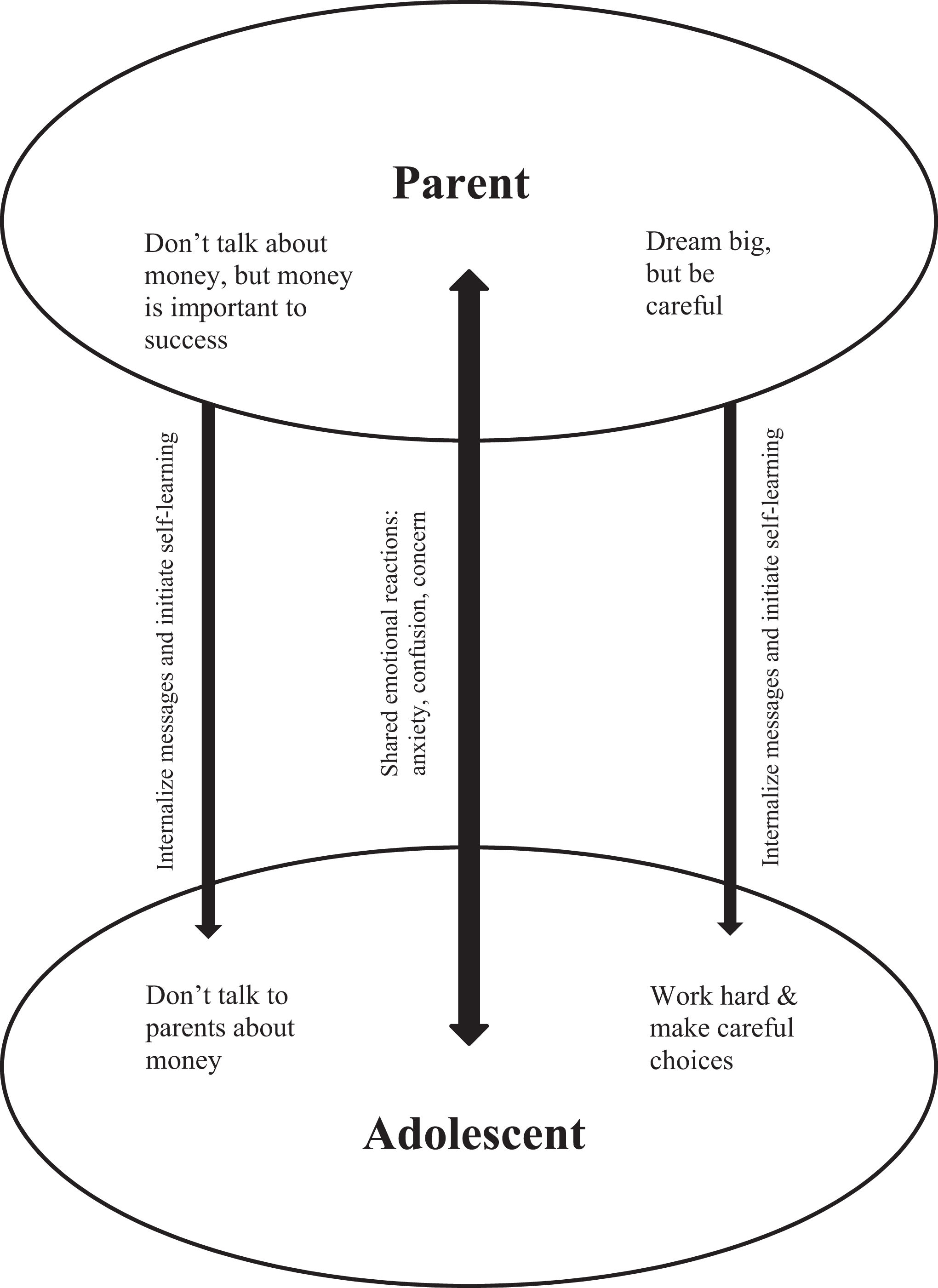
The process by which information about the world of work and social class is transmitted within parent–adolescent dyads.
In the sections that follow, we describe this grounded theory using participant examples. Specifically, we discuss the two main themes that emerged from the data: (a) the processes by which social class and world of work information is communicated within parent–adolescent dyads. Within each themes, similar subthemes emerged that describe the emotional reactions experienced by and passed within parent–adolescent dyads, processes by which messages are communicated from parents to adolescents, and the processes by which adolescents internalize parental messages and initiate self-learning in order to develop their own understanding.
Social Class and Money
The first theme that emerged across all interviews is that money and social class information is passed along from parents to adolescents within families. All of the participants expressed a sentiment that social class is a complicated topic and yet is intricately connected to hopes and concerns about the future world of work. Parent and adolescent participants shared varying emotional reactions regarding their understanding of social class and how information about money is and should be communicated. These conflicting emotions led to a process by which parents conceal or withhold information from adolescents. In response, adolescents shared their process by which they take it upon themselves to find ways to learn desired information.
Emotional reactions: Confusion and discomfort
A variety of emotional reactions were elicited during the interviews from both parent and adolescent participants, as they struggled to articulate their understanding of social class and its meaning in their lives. Indeed, a consistent theme that emerged across all 18 interviews and within each of the 9 families was a general sense that talking about social class and money in direct and explicit ways is perceived to be taboo. Many of the parents appeared uncomfortable when discussing the topic of social class and money. Some parents seemed confused by the very interview questions. For example, Paul (a father) noted that he did not understand the question of social class and money and could not describe what this meant to him. Other parents expressed feelings of discomfort related to talking about social class directly during the interview by stating that they did not want to talk about money. Discomfort among the parents also was evidenced by behavioral reactions (e.g., laughter, wringing of hands, and avoidance of eye contact), as questions about social class and money were raised in the interviews. The adolescents, on the other hand, appeared more at ease when discussing social class and money. They openly shared their concerns about financial insecurity, their perceptions of where they and their family stand in terms of social class, and their realization that financial stability is desirable. For example, Claudia (an adolescent) said it in this way, “Everybody wishes this, but it is like ‘Why can’t we be more well off to where money necessarily isn’t that much of an issue?’”
Sometimes, there were clear discrepancies in the ways that parents and adolescents responded to questions about social class in their separate interviews. For example, Emma (a mother) said it in this way, I don’t think I’ve ever had a conversation about our social class because I don’t look at our life in a social class. I can’t say I necessarily believe in that, I don’t think it equates to anything outside of how the government wants to put you in a box. There is lower class, there is working class, there is middle class, there is upper middle class and there is that 1%. You have got to love them. I understand what social class we are in. They usually all have the same things to do. They all revolve money but it is also usually titles too. It is like I understand what class I am part of. I am part of the working class.
Parental communication: Social class information is not explicitly shared
Although all nine parents acknowledged the relevance of money to work and to the messages that they share with their adolescents about their futures in relation to the world of work, none of them reported that they openly disclose specific social class-related information (e.g., salary, savings, bills, cost of homes, and price of cars) with their adolescents. Indeed, parents acknowledged that they intentionally withhold these types of financial information from their adolescents. Some of the parents shared that these behaviors are a result of the messages that they internalized about talking about money from their own parents. For example, Susie (a mother) acknowledged, “My parents never discussed money with me and my children do not know how much I make.”
When these parents opted to pass along social class and job-related information to their adolescents, they instead did so via implicit, implied, or assumed mechanisms. All of the parents reported their tendency to tiptoe around what to share, under which circumstances to share, and how to share financial information. Even those parents who described the importance of talking with their adolescents about the cost of heat, water, and grocery bills stated that they do not share information about their salary or the cost of their home with their children. Alan (a father) put it this way, “It doesn’t come to mind to tell my son about money. Sometimes I give him money for school trips or food, but I don’t talk to him about money.” In lieu of direct conversations, parents described ways that they share information indirectly at times (e.g., leaving bills on the kitchen counter, describing the need to work overtime in order to pay for a particular bill, and leaving checks out for the adolescent to see). For example, Alan said, “I don’t get direct deposit, so I come home with my paycheck and maybe they see. I put the paycheck on the table but I never tell them.”
Although all parents acknowledged they deliberately withhold information from their adolescents about money, several indicated that they sometimes feel conflicted about this decision. Specifically, several of the parents reported feeling unsure whether their decision to withhold this information from their adolescents was helpful. Some parents expressed their desire to share information about money-related matters as a way to share their successes and hard work. For example, Susie (a parent) stated, “I don’t like to talk about money but I’m proud of the fact that I just made 500 bucks.” Others described their desire to prepare their adolescent to understand financial issues but felt concerned about how much sharing is too much.
All nine adolescents corroborated these parent reports and articulated their belief that their parents deliberately withhold financial information. They universally expressed a sentiment that they had internalized from their parents: Direct conversations about money are not allowed. Most of them indicated that they do not bother to ask because they have received the message that their parents will not share such information. For example, Claudia said that she does not ask her mom or anyone else in her family how much money they make because “They [my parents] are going to be like: that is none of your business.” Sofia echoed this sentiment in her statement, We don’t talk much about social class or money. My parents talk about it amongst each other but they don’t like to talk about it in front of my brothers and I, I don’t know why, they just don’t. I feel like they think that it’s a private thing.
Adolescent internalization: Learn to acquire new information
Despite the withholding of information by parents, all nine adolescents expressed curiosity about familial social class and money. This curiosity had led them to become savvy in discovering ways to acquire desired information. Specifically, all of the adolescents discussed the ways that they have learned to “find out” social class-related information “on their own” terms so as to acquire knowledge that feels important and relevant to them and to their perceptions of the future in relation to decisions about work and life. Some of the adolescents described their tendency to pay close attention to their family’s lifestyle (e.g., type of home, neighborhood, type of car, and spending habits) when compared to peers in order to deduce their family’s social class. Other adolescents shared stories in which they listened for information about social class from parents via observing their parents discuss money or work. For example, Sophia described ways that she and her brother know about their family’s finances. She shared this story, Ugh. I notice when we have a like a really high bill because my parents get stressed. And then there are points in time like when if we are ever lower on money more than usual. I guess I should say that’s the only way that I can think of wording it. And I kind of notice because we start, like my parents start eating a lot of left overs and just, you know, we do try to find ways to conserve energy as best as we can. I notice when they are stressed because of money. They have a lot shorter of a temper, which I can definitely tell.
In combination, the adolescents described this “finding out” as a mechanism that provides a way to learn information that their parents withhold. One example of this type of exchange can be observed in the following story as told by the parent–adolescent dyad, Elise (mother) and Zack (son) in their separate interviews. During her interview, Elise said, “I didn’t tell him how much we paid for the house. It’s none of his business. We do tell him about the housing market in the area.” Elise explained that she talks to Zack about the cost of things, and that when she buys him something she explicitly shares how many hours Zack would have to work to make enough money to buy the item (Zack works part time at a restaurant). In his interview, Zack’s report was consistent with that of his mother. He said that his parents do try to get him to think about how much he would have to work to pay for particular items but that they will not share with him specific information about their salaries and will not tell him the amount of their mortgage or car payments. As a result, he decided to research on the Internet to figure out their worth. He reported that after a bit of online research, he had reached the conclusion that his parents’ house and car are “expensive” and that his parents “must make a lot of money” to be able to afford their lifestyle. He had concluded that his family is “upper middle class.”
Future Outlook
Participants’ understanding of social class and money was intertwined with their process of planning for, and thinking about, the future in relationship with career development. Parent and adolescent participants expressed anxiety, as they considered the future in terms of work and education. These emotional reactions contributed to a process by which they struggle to sort out seemingly competing messages and beliefs about the future within familial communications. Specifically, parents’ concerns about their adolescent’s futures contributed to their desire to encourage their adolescents to balance their hopes and dreams with the realities of the job market. The adolescents, in turn, had internalized these messages from their parents and simultaneously seek to develop their own understanding about how to be successful in the future.
Emotional reactions: Anxiety about the future
All of the adolescents and parents expressed anxiety related to the future. In most instances, both members of the parent–adolescent dyad independently shared similar stories about work or about life that illuminated the pervasiveness of these concerns. This included concerns about financial stability, the status of the job market and economy, and what it will take to “be successful” in the future. All of the parents communicated the belief that the job market does not look good. Katie (a mother) said it in this way, “I don’t think it’s gonna be easy for anybody to find a job like it used to be 10 years ago.” Elise (a mother) stated, “Having a bachelor’s degree today is like having a high school degree when my parents were young.” The negative perceptions of the job market communicated by parents mirrored those shared by the adolescents. All nine adolescents expressed anxiety as they talked about imagining their future lives and work. They acknowledged the less than ideal current and future state of the job market, as they considered what it would be like for them to search for a job. These concerns included such statements as: “the economy stinks” (Joe) and “I always thought I would get a job right away but it might be competitive” (Ashley). Claudia said it in this way, “I really hope the economy is not as bad as it is now! I really want a job.”
Parental communication: Balancing hopes with reality
This anxiety shaped parents’ impressions about how to communicate with their adolescents in order to encourage the greatest likelihood for success. Although each parent stated their desire for their adolescents to pursue their dreams in order to “do what [they] love,” they described the tension of holding this value along with their concerns for their adolescent’s future security and success in the world of work. As a result, they had internalized a belief that they need to urge their adolescents to be careful, make wise choices, and be realistic in setting expectations about what is possible in the future.
Many of the parents noted that these beliefs stem from their own world of work experiences. For example, several parents shared stories about the importance of persistence and careful decision-making to ensure their job security. Susie (a mother) said it in this way, “As far as the job market, it seems like it’s a little dicey out there.” As she described her own sense of job insecurity, she expressed her belief that she is prepared and has the resources needed should she lose her job unexpectedly. She said, “I have, you know, five arrows in my quiver and I know who I will call immediately.” She went on to explain that she communicated her belief in the importance of being prepared with her daughter as a way to encourage her to make careful career- and education-related decisions in order to set herself up for success.
Some parents noted their belief in the importance of their adolescent understanding the realities of their particular social context and the barriers that may thwart their ability to be successful in pursuing their passions. For example, Emma (a mother) described what she believes is the importance of teaching her daughter to “stay in your lane.” She worries that Claudia (her daughter) will set her hopes too high and will be disappointed by the realities of life, particularly life as an African American woman. She expressed her desire to encourage Claudia to pursue her passion and dreams while also worrying that dreaming too big may set her up for failure. In her interview, Claudia echoed this sentiment. She shared this message internalized from her mother: “She [my mom] just prepared me that I could be having a Ph.D. and work at McDonald’s, which would be extremely sad…Just don’t expect too much.”
Some parents described their tendency to communicate information about their own work and career histories in order to encourage their adolescents to strive for something better. For example, Laly (a mother) acknowledged that she and her husband work long hours to create stability and opportunities for their children. Laly stated: I started this job and I don’t think that it’s something that I enjoy. I mean, I’m not passionate about my job, but it pays the bills. With having to raise such a big family, I just focus more on making money for my kids…I’m just trying to make a living. I guess [my family] just want me to find like a good paying job that will be able to support me in the future. Because they’re always saying that they don’t want me to end up like them or they want me to have a better life than them. Because I have a big family and I know they struggle with money sometimes and they didn’t go to college so they want me to go to college and to have as much education as I can.
Adolescents internalization: Prepare for the future
Like Ashley and Claudia, the adolescents had heard these messages and integrated them into their understanding of what it will take to be successful. They shared similar expectations as their parents about what they anticipate to be challenging realities of the job market. Yet, they also held tightly to hope that they will be able to take initiative to learn information and make decisions to prepare themselves for success in the world of work. Sometimes, these decisions were consistent with the avenues suggested by their parents whereas other times they diverged from their parents’ messages.
Most of the adolescents explicitly described the warning messages they had heard from their parents about setting their future hopes too high. For example, several adolescents had concluded that they may be unable to pursue what they love if they want to give themselves the highest likelihood of success. Joe explained the tension between his dream of making it big as a musician and the more secure path of attending college and majoring in business; he had ultimately decided that finding success as a musician was unrealistic and the risk of pursuing this dream too great. Zack said, it perhaps more directly as he noted that he expects to start in a job that he “will not enjoy.” He had come to this conclusion in spite of the fact that he has had success in earning money by doing things that he does enjoy. Like Zack and Joe, many of the adolescents expressed their belief that they may need to choose between a job/career about which they feel excitement (e.g., fashion designer, astronaut, musician, photographer, wedding planner) and one that will allow them to make stable money or be a realistic option. For some, this meant choosing to pursue education in a high growth career area (e.g., nursing, engineering). Laura (whose father is a farmer and whose mother, Kara, is a homemaker) summarized her decision to become a nurse in this way, “Well, everyone’s been saying how nursing has been going up a lot, there is really not a lot of nurses…so I’m expecting to get a job easily.” In addition, many described that they have integrated their parents’ warning messages by determining ways to give themselves an advantage in their future education and careers. For example, they shared a sense that they need to study hard (e.g., “Finding a job might be easy or hard, but if I study hard it will be easier.”—Paul) and find ways to set themselves apart from peers by engaging in extracurricular activities (e.g., volunteer work, precollege programming).
As with their decision to find out social class-related information on their own, most adolescents reported their tendency to make career-related decisions that diverge from their parents. For some, this meant deciding to pursue particular pathways they believe will provide them with an edge in college admissions and job searches. Beth (an adolescent) described her decision to learn Japanese as providing a way to learn a skill that may increase her likelihood of future success. In his interview, her father Jon also talked explicitly about Beth’s decision to study Japanese. He shared his belief that she chose this entirely on her own and did so because of her perception that she will be better off in the future job searching if she is fluent in Japanese.
Adolescents diverged most from their parents in their beliefs about the promise of higher education. While all parents expressed their desire for them to pursue advanced degrees, most adolescents were skeptical of the promise of higher education. They noted challenges to this line of thinking, referencing warnings that an advanced degree does not guarantee a high paying job and that individuals should not expect too much from a college degree. For example, Zack reported hearing (from the radio and other news outlets) that a college degree does not help people get jobs anymore. He stated, “They are saying that it’s looking pretty bleak for jobs because the older working class isn’t moving on to retirement and it’s not allowing for the next generation to move in. It’s just there is a lack of jobs for people that have college degrees.”
Discussion
Themes from interviews with 18 participants representing 9 families within a 150-mile radius of a midsize Midwestern city revealed an interconnected storyline by which messages about the world of work and social class are communicated in explicit and implicit ways within parent–adolescent relationships. The grounded theory that emerged from the data describes how information is communicated by parents to adolescents and how adolescents internalize these messages and make decisions about how they choose to envision their futures. Parents and adolescents shared feelings of anxiety, confusion, and concern about social class and their future outlook. The communication of messages from parents to adolescents was challenging, at times, for parents who struggled to make sense of how to best prepare their adolescent for future success as well as for adolescents who struggled to internalize their parent’s messages while also coming to their own understanding of themselves in relation to the future. In terms of social class and money, parents and adolescents described the decision by parents to withhold some information from adolescents. In terms of future outlooks, parents and adolescents explained the ways that concerns about the future labor market translates into parents wanting to support and protect the adolescents. Adolescents discussed the processes by which they seek out social class and world of work information that they believe to be important and relevant to their futures. They break away from their parents’ expectations, form their own understanding of what they want to know, and find ways to gather that information.
Some of these themes are consistent with results from prior research (e.g., Keller & Whiston, 2008; Thompson et al., 2016) that have demonstrated that information about the world of work is passed from parents to their offspring and with literature (e.g., Hartung et al., 2005) describing the number of ways that adolescents are actively engaged in career development. They also are consistent with scholars who have suggested that beliefs and values about money are intertwined with work beliefs, expectations, and values (e.g., Furnham & Argyle, 1998). Findings from these interviews, however, extend those from prior research by deepening our understanding of how information about social class and the world of work is transmitted across parent–adolescent dyads within families.
Parents in this study described a number of ways in which they hesitated to discuss specific social class information with their adolescents. During the interviews, parents expressed discomfort when talking about social class-related information with the interviewer and when asked to articulate the extent to which they share specific money-related information with their adolescents. This level of reticence is particularly interesting to note given that all of the participants were told in the study recruitment materials that social class would be explicitly discussed during the interviews. The parents struggled to articulate their reasons for deliberately withholding particular social class-related information with their adolescent. As such, these results extend the conclusions from prior scholars (e.g., Tonigan & Hurwitz, 2014) that adults in the United States generally have difficulty talking about money by demonstrating that this reluctance to share specific money-related information exists even within families.
One potential interpretation of this finding is that it is an exemplification of how parents replicate power hierarchies within the family. Family systems theorists have long recognized the presence of hierarchies within families that are interwoven into patterns of relating to one another (e.g., Minuchin, 1974). Results from these 18 interviews suggest that these familial hierarchies are present when considering the topic of social class. The parents acknowledged that they purposefully choose not to share particular information with their adolescents. Some parents explicitly stated that they are repeating patterns learned within their own family system in which their parents also did not share such information. In this way, it seems as if deliberate decisions regarding whether or how to share such information may represent a mechanism to provide separation between the parents (one subsystem) and their offspring (a different subsystem).
Results from interviews with the adolescents also revealed that adolescents recognized that their parents deliberately choose to withhold information. All nine adolescents indicated that they acknowledged these boundaries and found their own ways to learn social class information that they determined to be important as they make sense of themselves and envision their futures. All nine adolescents in this study described ways in which they are observant and creative. They are aware of what parents share directly, share indirectly, and actively try to withhold. Noting their parent’s refusal to disclose certain money- and class-related information, the adolescents have found ways to use the resources at their disposal to learn information.
While more research (including longitudinal data) is needed to replicate and extend these findings, one interpretation is that familial structural dynamics may be changing in this rich information age. For example, it may be that efforts among the adolescents to procure social class and financial information represent a mechanism by which they are subtly pushing boundaries set around information exchange and familial hierarchical subsystems (e.g., Minuchin, 1974) within their families. Gaining this knowledge may provide a mechanism by which adolescents can begin to feel empowered with the information that they believe will be important for their understanding of themselves and their futures in relation to the world of work.
Themes from these interviews also revealed that the parents and the adolescents described the variety of messages that they have internalized about success in education, career, and life. Both parents and adolescents believe that navigating the labor market and securing jobs will be challenging. Parents held optimism for their adolescents’ futures, but this optimism was coupled with a belief that there are no promises for success in the future and that the current and projected future state of the economy is challenging (at best). The parents acknowledged that they are communicating messages that may be confusing to their adolescents—and many expressed feelings of discomfort about communicating such messages. They want the best for their adolescents and struggled to encourage their adolescent to be open to future possibilities while simultaneously preparing them for what they assume will be inevitable disappointment in the world of work. As a result, the parents appear to have internalized a belief that they must prepare their adolescents to be careful.
Adolescents heard these warning from their parents and determined that early preparation and building one’s resume with unique and high-demand skills represent important pathways to future vocational opportunities and, in turn, financial security. Yet, the adolescents differed from their parents in their views of the promise of higher education and what it will take to gain future success. While adolescents expressed increasing doubt about higher education as a guarantee to a secure and successful life, parents uniformly endorsed the importance of their adolescent earning (at least) a 4-year college degree.
This finding from the parents is not particularly surprising as education has long been assumed to lead to increased power and upward social class mobility (e.g., McNamee & Miller, 2009). Yet, the discrepancy between parents’ and adolescents’ interpretations of what it will take to attain future success highlights an important direction for future longitudinal research given that some recent trends in the labor market suggest that a college degree no longer carries a promise of forthcoming financial or job stability (e.g., Liu, 2011). As such, it seems that parental assumptions about the importance of an advanced education may not necessarily match the realities and demands of an increasingly restricted and global labor market. Further research is needed in order to better understand this mismatch and its implications for the transmission of career information from parents to their adolescents within families.
Finally, our decision to interview adolescents and parents separately was intentional so as to allow each group of participants an opportunity to share their lived experiences without worry about a need to censor their statements as a result of another family member being present in the room. Although parents and adolescents from the same family mostly corroborated one another’s reports (e.g., parents acknowledging that they do not share social class information and adolescents stating that their parents do not share such information), the stories shared by the adolescents were oftentimes more similar to those shared by other adolescents, and the stories shared by the parents were more similar to those shared by other parents than the stories shared within parent–adolescent dyads. This finding may make sense in the context of family systems theory (e.g., Minuchin, 1974) indicating that adolescents represent one subsystem and parents another and also point to the potential usefulness of collecting and analyzing data from parent–adolescent dyads in future vocational psychology research. As Ponterotto (2005) discussed the value of using dyads in qualitative psychotherapy research as a mechanism to isolate particular aspects of the therapeutic relationship, so too might research utilizing parent–offspring matched pairs provide important avenues that may allow us to deepen our understanding of familial relationships within the context of career development.
Limitations and Directions for Future Research
These results must be interpreted in light of limitations inherent to the sample as well as specific features of GT. First, participants self-selected to participate in interviews in which they knew that they would be asked to discuss social class and world of work information within their family. Despite the fact that our sample was diverse along a variety of dimensions (e.g., race/ethnicity, gender, and occupation), participants may have been primed to discuss the topics in a particular way. In addition, although the sample is comprised of families representing a variety of social identities, the majority of participants in this sample are upwardly mobile, and the parents reported being actively involved in their adolescents’ educational and vocational development. As such, the experiences described in these findings may not be representative of individuals who did not self-select to participate in the study or of families whose parents are not actively involved in their adolescent’s educational and career development.
Second, caution should be used drawing conclusions regarding identity characteristics or intersections among identities (e.g., familial social class, race and ethnicity, gender, and immigration status) or other factors that may have impacted the participants’ lived experiences. Some interesting preliminary findings emerged related to race and gender dynamics that may represent important directions for future research. For example, in each of their respective interviews, Claudia and her mother Emma referenced the fact that Claudia is an African American woman when discussing career development. In addition, all of the mothers in this study described their desire to share their identity as a working mother who is professionally successful and who also, at times, struggles to balance their professional success with parenting. Two of the adolescent boys (Zack and Joe) who identified as White and from upper class backgrounds expressed the highest degree of confidence in their belief that they will be successful in the future. Yet, the extent to which these beliefs may be related to race, class, and gender are unknown. Further research is needed in order to tease apart the extent to which these preliminary findings may or may not be related to identities and their intersections. Research that explores the extent to which some messages communicated within families (e.g., “stay in your lane,” “do what you love”) may be raced, gendered, and/or classed could represent fruitful avenues for future research.
With regard to the method, this study utilized a GT approach in order to understand the subjective lived experiences of 18 parent–adolescent dyads across 9 families. Although a desire to assume causality are not consistent with a qualitative approach, it is important to note this caveat given that we were attempting to explore how information about social class and the world of work is transmitted within families. As such, we interviewed parent–adolescent dyads individually (i.e., separate interviews with parents and adolescents) in order to understand how each member of the dyad understood their experiences. Future research that uses longitudinal data represents a useful next step in order to further examine these initial findings about the effects for adolescents of social class and world of work information passed from parents.
Footnotes
Appendix
Declaration of Conflicting Interests
The author(s) declared no potential conflicts of interest with respect to the research, authorship, and/or publication of this article.
Funding
The author(s) disclosed receipt of the following financial support for the research, authorship, and/or publication of this article: This research was partially supported by the Institute for Research on Poverty, University of Wisconsin−Madison.