



Abstract
Becoming assimilated into the social environment at an organization is critical and challenging to newcomers. The present study examined whether newcomers’ trait positive affectivity (PA) could predict social assimilation through proactive relationship building behaviors including general socializing, relationship building with boss, and networking. Participants in this three-wave survey study were 323 new employees in three organizations in China. Results based on structural equation modeling showed that newcomers’ trait PA at T1 (within 2 weeks postentry) was positively related to all three dimensions of relationship building behaviors at T2 (8 weeks postentry); however, only general socialization was found to mediate the relationships between PA and two social assimilation outcomes at T3 (14 weeks postentry), that is, social integration and affective organizational commitment. Theoretical and practical implications were discussed.
Keywords
When newcomers enter organizations, they go through organizational socialization processes, whereby they learn how to perform assigned tasks, adapt to new roles, identify with organizational culture, and become accepted members (Van Maanen & Schein, 1979). One of the challenges newcomers face in this process is becoming socially assimilated into the organizational environment (Morrison, 2002). Scholars have suggested that, to be considered a successful social assimilation, newcomers need to feel attached to their work group, as well as their organizations (Bauer, Morrison, & Callister, 1998; Feldman, 1981; Morrison, 2002). The former has been termed social integration, and the latter has been referred to as affective organizational commitment (Morrison, 2002). Newcomer socialization researchers have suggested that adapting to organizational social environment is often more complicated and challenging than adapting to tasks, because newcomers almost knew nothing about the social environment until they enter the organization (Van Vianen & De Pater, 2012). An effective strategy newcomers may use to facilitate social assimilation is to initiate relationship building behaviors toward organizational insiders (e.g., coworkers, supervisors, etc.; Ashford & Black, 1996), who play critical roles in newcomers’ successful adjustment (e.g., Korte & Lin, 2013). Empirical studies have shown that relationship building behaviors are positively related to newcomers’ socialization outcomes such as role clarity and job satisfaction (e.g., Gruman, Saks, & Zweig, 2006; Saks, Gruman, & Cooper-Thomas, 2011).
Given the importance of newcomer relationship building behaviors, researchers have begun to examine their antecedents. Although environmental factors such as organizational socialization tactics (Gruman et al., 2006) and task interdependency (Kammeyer-Mueller, Livingston, & Liao, 2011) can provide opportunities for newcomers to build relationships with insiders (Ashforth, Saks, & Lee, 1998), newcomers’ dispositions greatly determine whether they will take advantage of these opportunities. Not surprisingly, several individual factors have been found to predict newcomer relationship building behaviors such as job skill level (Wanberg & Kammeyer-Mueller, 2000), desire for control (Ashford & Black, 1996), self-efficacy (Gruman et al., 2006), extroversion, and neuroticism (Kammeyer-Mueller et al., 2011; Wanberg & Kammeyer-Mueller, 2000).
According to Parker, Bindl, and Strauss’s (2010) model of proactive motivation, there are three motivational pathways leading up to proactive behaviors in general: can do, reason to, and energized to. The can do pathway focuses on expectancy, where the main question is, “Can I do it?” The reason to pathway targets at the reasons enacting proactive behaviors, with the main question of “Should I do it?” Finally, the energized to pathway is associated with individuals’ affective traits and states, and the main question is, “Do I feel like doing it?” Parker et al. (2010) noted that previous empirical research on antecedents of proactive behaviors has mainly focused the two cognitive-based pathways (can do and reason to), with affective-based pathway (energized to) being severely understudied.
Parker et al. (2010) posited that trait positive affect (PA) could work through this energized to pathway to predict proactive behaviors. However, relevant empirical evidence has been very limited in the newcomer socialization literature. Thus, the first purpose of the present study is to fill this gap by examining the role of trait PA in predicting newcomer’s social assimilation through relationship building behaviors. Further, examining trait PA as an antecedent of socialization processes and outcomes addresses a call for the affective approach to newcomer socialization (e.g., Ashforth & Saks, 2002). Ashforth and Saks (2002) argued that newcomers not only “think” the way they fit in but also “feel” the way they fit in. Investigating the effects of trait affectivity represents an important step toward the affective approach to newcomer socialization, in that trait affectivity could greatly determine newcomers’ perceptions of the new environment, and their affective reactions to the environment (Ashforth & Saks, 2002). Thus, the second purpose of the present study was to add to the limited empirical base of the affective approach to newcomer socialization.
Figure 1 depicts our conceptual model in which trait PA is posited to be positively related to three dimensions of newcomer relationship building behaviors, which in turn are positively related to two social assimilation outcomes. In what follows, we first introduce the construct of trait PA and discuss its relevance in the newcomer socialization context. We then elaborate on specific relationships among various constructs in the model. Next, we present a three-wave field survey study conducted with a group of newcomers in three Chinese organizations that empirically tested the conceptual model.
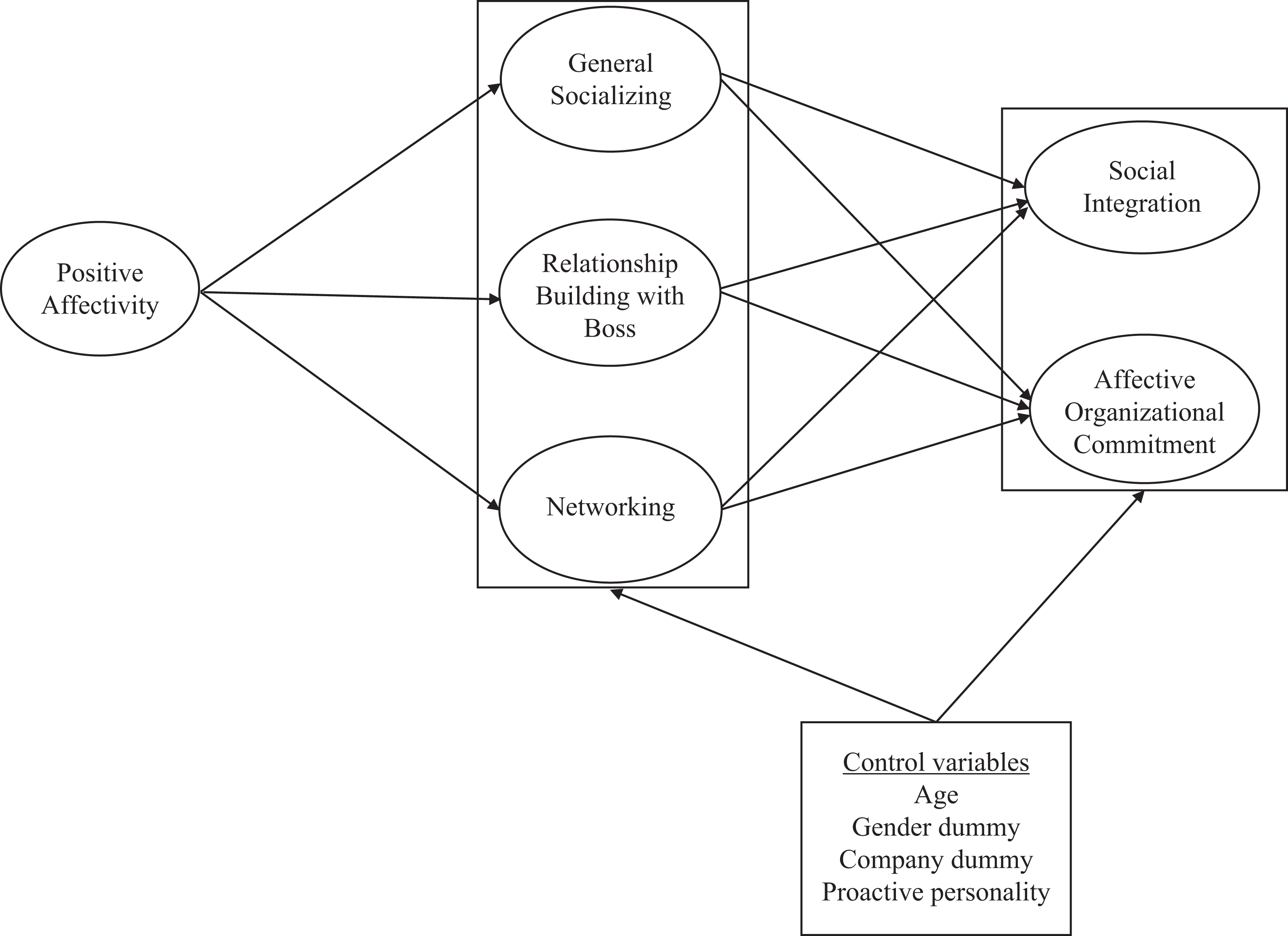
The hypothesized model.
Theory and Hypotheses
Trait Positive Affectivity
Humans experience broad ranges of feelings or affects. In addition to relatively short-lived emotional reactions and moods, individuals show certain dispositional, stable, and predictable reactions, called trait affectivity (Barsade & Gibson, 2007; Watson, Clark, & Tellegen, 1988). Trait positive affectivity (PA) refers to individuals’ stable tendencies to experience positive emotions (Watson et al., 1988). 1 People characterized by high trait PA tend to be cheerful and energetic and usually have positive moods across a variety of situations (Watson et al., 1988). We have chosen to focus on trait PA instead of state PA, primarily because state PA is relatively short-lived and highly influenced by the environment favors such as work events; so it doesn’t exert long-lasting effect on newcomers behaviors. In contrast, trait PA is more stable and may have lasting effects on newcomers.
Trait PA has been shown to influence individuals’ motivation, cognitive appraisals, and how they approach various situations (Baron, 2008; Elfenbein, 2007; Foo, Uy, & Baron, 2009). Empirical research conducted in organizational contexts has linked trait PA to a number of workplace constructs such as job performance (e.g., Staw & Cohen-Charash, 2005), job search (e.g., Turban, Lee, da Motta Veiga, Haggard, & Wu, 2013), creativity (e.g., Amabile, Barsade, Mueller, & Staw, 2005), turnover (e.g., Thoresen, Kaplan, & Barsky, 2003), and leadership (e.g., Fox & Spector, 2000), among others. Further, with the emergence of positive psychology, research on the role of PA in the workplace has attracted increasing attention during the last decade (for review, see Sekera, Vacharkulksemsuk, & Fredrickson, 2012).
Although some initial work has been done on trait PA in organizational settings, essentially no attention has been paid to trait PA of newcomers. We were only able to locate one empirical study by Ashforth, Sluss, and Saks (2007) who found that newcomer trait PA was positively associated with proactive behaviors (r = .45). However, these authors treated PA as a control variable, with no intention to fully explicate the role of PA during socialization processes. Moreover, they investigated the relationship between PA and proactive behaviors averaged across several dimensions and did not look at whether PA might have differential relationships with various types of proactive behaviors, and in turn, distal outcomes. The present study addressed these important issues.
From Trait PA to Relationship Building Behaviors
Relationship building behaviors are a typical proactive behavior, which has been defined as being anticipatory or future oriented, self-initiated, and about taking control to make things happen (Parker & Collins, 2010). Relationship building behaviors refer to initiating social interactions with other members in an organization (Bindl & Parker, 2010a), which can target coworkers in the same unit (i.e., general socializing), boss (i.e., relationship building with boss), and colleagues in different units (i.e., networking; Ashford & Black, 1996).
Individuals’ trait PA could promote relationship building behaviors via the energized to pathway (Parker, Bindl, & Strauss, 2010). The direct mechanism of the energized to pathway is that PA could activate an approach action tendency (Seo, Barrett, & Bartunek, 2004). In general, people with an approach orientation are more likely to engage in challenging events and initiate goal-directed behaviors; in contrast, people with an avoidance orientation are more sensitive to negative outcomes and more likely to engage in less threatening activities (Brockner & Higgins, 2001; Elliot & Church, 1997; Elliot & Thrash, 2002). Trait PA has been aligned with an approach orientation (Carver & White, 1994; Elliot & Thrash, 2002), and we argue that trait PA predisposes newcomers to view the organizational socialization processes from an approach orientation and subsequently engage in approach behavioral strategies.
Newcomers knew almost nothing about the social environment until they actually entered the organization; therefore, it takes them much time and energy to initiate and maintain social relationships with organization insiders. Furthermore, efforts to build relationships could bring frustration and depression whether they were met with rejection or tepid response. Newcomers with a high trait PA are approach oriented and view the social adaptation process as an opportunity instead of a threat. For instance, the social adaptation brings about opportunities to build new interpersonal connections. Furthermore, newcomers with a higher trait PA are more likely to expect successful outcomes, remain positive, and persist in their efforts following the possible negative outcomes of their proactive relationship building behaviors than their low trait PA counterparts (Fredrickson & Joiner, 2002). We therefore expected newcomers with a high trait PA to engage in more relationship building behaviors targeting coworkers, boss, and colleagues at different units than newcomers with a low trait PA. Thus,
From Relationship Building Behaviors to Newcomer Social Assimilation Outcomes
The present study focuses on two social assimilation outcomes. The first outcome, social integration, is defined as achieving acceptance and keeping good social relationships with organizational insiders (Morrison, 2002). The second outcome, affective organizational commitment, refers to an employee’s psychological attachment to, identification with, and involvement in the organization (Meyer & Allen, 1991). Social integration and affective organizational commitment have been routinely examined in socialization research as two important distal socialization outcomes (e.g., Bauer, Bodner, Erdogan, Truxillo, & Tucker, 2007; Gruman et al., 2006; Maier & Brunstein, 2001; Saks et al., 2011; Wanberg & Kammeyer-Mueller, 2000).
Relationship building behaviors have been theorized as a typical proactive person–environment (P-E) fit behavior (Parker & Collins, 2010), which refers to actions taken to change the compatibility between an individual’s attributes and the organizational environment. Researchers have noted that proactive P-E fit behavior is most relevant to newcomer socialization settings because they are common strategies newcomers use to fit in the new organization (Cooper-Thomas & Burke, 2012). We argue that relationship building behavior should promote both social integration and affective organizational commitment. Establishing relationships with coworkers (i.e., general socializing), boss (i.e., relationship building with boss), and colleagues in other units (i.e., networking) can help newcomers get familiar with other organizational members, which allows newcomers to obtain information about social norms and expectations (Joardar, Kostova, & Ravlin, 2007). Senior colleagues are likely to perceive newcomers who initiate social interactions as devoted organizational members and thus evaluate them more positively (Rink & Ellemers, 2009). Moreover, empirical findings revealed that it is possible for individuals to shape their social environment at work via their relationship building behaviors (Berg, Wrzesniewski, & Dutton, 2010). There is consistent empirical evidence that newcomers’ general socializing and relationship building with boss are positively related to social integration (e.g., Gruman et al., 2006; Saks et al., 2011). Although only a small number of empirical studies have looked at the influence of networking in newcomer settings, there is evidence that networking is effective in promoting social integration (e.g., Ashford & Black, 1996). Thus, we expected relationship building behaviors to be positively related to affective organizational commitment.
Relationship building behaviors can also help enhance newcomers’ affective organizational commitment. Newcomers who build more relationships at work will learn more about the social context (Sluss, Ployhart, Cobb, & Ashforth, 2012). For example, they are more likely to develop values, beliefs, and interpretations that are shared in the organization (Rentsch, 1990) and have higher access to job resources such as social norms, history, politics, or experiences shared through interpersonal communication (Morrison, 2002). Those processes help newcomers foster a sense of belongingness in the organization. In addition, those who build more social relationships will receive more support from colleagues (Scott & Judge, 2009), which in turn yields more affective social bonds (Heffner & Rentsch, 2001). There are empirical evidence supporting the positive links between relationship building behaviors and newcomer affective organizational commitment (e.g., Gruman et al., 2006; Saks et al., 2011). Thus, we expected relationship building behaviors to have positive associations with affective organizational commitment. Based on the above discussions, we propose:
We have argued that newcomer trait PA should be positively related to the three dimensions of relationship building behavior and that relationship building behavior should be positively related to two social assimilation outcomes. Combining these two sequential links, we posit that relationship building behaviors should mediate the relationships between trait PA and social assimilation outcomes. Thus, we propose the following two sets of mediation hypotheses:
Method
Sample and Procedure
We conducted a three-wave survey study to test the conceptual model. The research team approached a class of executive master of business administration students enrolled at the business school in a large public university at its Shenzhen campus (in a southern city) for potential data collection opportunities, in exchange of providing a free 2-hr newcomer orientation program. Three students who are human resources (HR) directors at respective organizations responded, because their organizations recruited more than 100 newcomers every year, and they were interested in understanding and facilitating newcomer adjustment in their organizations. The first organization was an information technology (IT) firm producing computers and smartphones, with the size of about 6,000 employees in its Shenzhen headquarter. The second organization was also an IT firm producing electronic components for TVs, computers, and smartphones, with size of about 8,000 employees in its Shenzhen headquarter. The third organization was a bank, which is one of the five largest commercial banks in China, with the size of about 4,500 employees in its Shenzhen branch. Participants were all graduate newcomers, which refer to newcomers who have just graduated from colleges and had no previous full-time work experience (Bauer et al., 2007). During the year, the present study was conducted, the two IT firms happened to hire computer and electronic engineers, and the bank happened to recruit bank hall managers and bank tellers. It should be noted that some prior newcomer socialization studies conducted in China also drew upon samples from similar organizations (IT and banks; e.g., Li, Harris, Boswell, & Xie, 2011; Yang, Hu, Baranik, & Lin, 2013).
The HR department of each organization helped the research team distribute the survey packages in an envelope to new employees. Interested new employees were instructed to complete the survey, place it in the envelope, seal it, and then return to a collection box at the HR department. Participants were told that the data would be used for research purposes only and that the HR department won’t use these data to make any personnel-related decisions. The surveys were anonymous. To match participants across multiple waves of surveys, they were asked to write down their noncompany e-mail address on each of the three surveys. After collecting the completed survey packages, the HR department of each organization sent them to the research team.
The Wave 1 survey packages were distributed within 2 weeks of newcomer entry. Of the 368 survey packages distributed, 323 completed surveys were returned, with a response rate of 87.7%. The Wave 1 survey included a demographic survey, a trait positive affectivity measure, and a proactive personality scale (a control variable). Approximately 6 weeks later (or 8 weeks postentry), 318 newcomers returned the completed Wave 2 survey, which asked them to report their proactive relationship building behaviors, with a response rate of 98.5%. Still another 6 weeks later (or 14 weeks postentry), 289 newcomers returned the completed Wave 3 survey, which assessed their social integration and affective organizational commitment, with a response rate of 90.1%. The overall response rate, calculated as the percentage of newcomers who were given Wave 1 survey and who completed all three waves of surveys, was 78.5%.
The entire data collection process spanned approximately 3 months postentry, which was a relatively short time period. However, previous empirical evidence suggested that newcomers’ early socialization experience is most critical during the entire socialization processes and that early adjustment outcomes largely determine subsequent adjustment outcomes (e.g., Adkins, 1995; Ashforth & Saks, 1996). Several previous empirical studies have also covered newcomers’ experience 2–4 months postentry (e.g., Ostroff & Kozlowski, 1993; Wang, Zhan, McCune, & Truxillo, 2011; Kammeyer-Mueller, Wanberg, Rubenstein, & Song, 2013). Thus, we have followed the common practice in newcomer socialization research.
The final sample consisted of 289 newcomers, of whom 90 newcomers were from the first IT firm, 95 newcomers were from the second IT firm, and the remaining 104 newcomers were from the bank. All participants were of the same ethnic group, Han Chinese. The mean age was 25 years (SD = 1.67), and 72.3% were men, and 36.7% were women. The composition of gender in the final sample was not surprising, as IT companies generally recruit more men newcomers than women newcomers. We did not provide another response option, such as transgender on the gender question. All participants had a bachelor’s degree and some had a master’s degree. All newcomers in this study were entry-level employees.
Attrition analyses indicated that participant attrition from Wave 1 to Wave 2 surveys was not associated with any of the study variables including all demographic variables (all ps > .05). Participant attrition from Wave 2 to Wave 3 surveys was significantly associated only with gender (χ2 = 7.99, p < .05)—women participants were slightly more likely to withdraw from the Wave 3 survey. Taken together, however, participant attrition did not seem a serious concern.
Measures
All measures used in the current study were originally in English. The back-translation technique (cf. Brislin, 1993) was used to translate the measures into Chinese (Mandarin). In the first step, a Chinese psychology graduate student studying in an U.S. university translated the original English items into Chinese. In the second step, an American graduate student studying in a Chinese university translated those Chinese items back into English. In the third step, all authors compared the original English items with the back-translated English items to see if there were any differences. When there was a difference, all authors discussed it, consulted an English professor in an U.S. university, and resolved the difference.
Trait PA
The 10-item PA Scale from Positive and Negative Affect Schedule (Watson et al., 1988) was used. The instruction asked participants to indicate how extensively they have experienced various moods in their everyday life. Participates responded on a 5-point scale from 1 (not at all) to 5 (extremely). Preliminary analyses indicated that the coefficient α was unacceptably low (.61), with 3 items (proud, attentive, and alert) having very low item–total correlations. Fan, Meng, Zhao, and Patel (2012) observed similar patterns in a sample of Chinese college students. Following Fan et al.’s (2012) practice, we removed these problematic items, with resultant scale having a coefficient α of .79. In support of the validity of the PA measure, Fan et al. reported that PA scores were positively correlated with scores in social self-efficacy, self-esteem, and life satisfaction.
Relationship building behaviors
Ashford and Black’s (1996) scale was used to measure newcomers’ proactive relationship building behaviors. The scale contained three subscales: general socializing (3 items), relationship building with boss (3 items), and networking (3 items). One sample item for the general socialization dimension was, “To what extent have you attended office parties?” One sample item for the relationship building with supervisor dimension was, “To what extent have you worked hard to get to know your supervisors?” One sample item for the networking dimension was, “To what extent have you tried to get to know as many people as possible in other sections of the company on a personal basis?” Participants were asked to report how frequently they had engaged in various relationship building behaviors after organizational entry on a 5-point scale from 1 (never) to 5 (always). A confirmatory factor analysis (CFA) indicated that the hypothesized three-factor model fit the data sufficiently well: χ2(df = 24) = 59.39; root mean square error of approximation (RMSEA) = .07, 90% confidence interval (CI) [.05, .10]; Tucker–Lewis Index (TLI) = .97; standardized root mean square residual (SRMR) = .04. For comparison purposes, we conducted another CFA in which all items were loaded on a single factor. Results showed that the one-factor model did not fit the data acceptably: χ2(df = 27) = 509.59; RMSEA = .24, 90% CI [.22, .26]; TLI = .60; SRMR = .10. A χ2 difference test comparing the one-factor model and the hypothesized three-factor model was significant: Δχ2(Δdf = 3) = 450.36, p < .01, confirming the hypothesized three dimension structure. The coefficient αs were .80, .87, and .82 for the general socialization, building relationships with boss, and networking subscales, respectively. In support of the validity of this measure, Fan, Yao, Lai, Hou, and Zheng (2017) found significant correlations between relationship building behaviors and theoretically relevant constructs (e.g., newcomer content mastery, r = .55, p < .01; newcomer stress, r = −.22, p < .01).
Social integration
Social integration was measured using Morrison’s (2002) 7-item scale. One sample item was, “With my coworkers I would be easily identified as ‘one of the gang.’” Items were rated on a 5-point scale ranging from 1 (strongly disagree) to 5 (strongly agree). Preliminary analyses showed that the coefficient α was on the borderline (.69), with 3 reverse-scored items showing very low item–total correlations. After removing these items, the resultant scale had an improved, acceptable coefficient α of .81. In support of the validity of this scale, Zou, Zheng, and Zhu (2011) reported significant correlations between social integration and several theoretically relevant constructs (e.g., newcomer role clarity, r = .30, p < .05; organizational commitment, r = .38, p < .01).
Affective organizational commitment
Affective organizational commitment was measured by a 6-item survey developed by Meyer, Allen, and Smith (1993). One example item was, “This organization has a great deal of personal meaning for me.” Items were rated on a 5-point scale ranging from 1 (strongly disagree) to 5 (strongly agree). The coefficient α was .80 in the current sample. Lu and Tjosvold (2013) found in a group of Chinese newcomers that affective organizational commitment had significant correlations with a few theoretically relevant constructs (e.g., intention to quit, r = −.74, p < .01; coworker relationships, r = .43, p < .01), thus providing validity evidence for the affective organizational commitment measure.
Control variables
To more rigorously test our hypotheses, four control variables were included in this study. First, proactive personality, which has been shown to positively predict proactive behaviors in previous research (e.g., Fuller & Marler, 2009; Parker, Williams, & Turner, 2006), was controlled. Proactive personality was measured by a 10-item survey developed by Seibert, Crant, and Kraimer (1999). One example item was, “No matter what the odds, if I believe in something I will make it happen.” Items were rated on a 7-point scale from 1 (strongly disagree) to 7 (strongly agree). The coefficient α was .81 in the current sample. Second, company affiliation was found to be associated with several variables in our model. Thus, we controlled for company affiliation using two dummy-coded variables (Company Dummy 1 and Company Dummy 2). Age and gender were also controlled since they showed significant correlations with at least one mediator or one outcome variable. Gender was dummy coded, with “0” representing men and “1” representing women.
Analytical Strategy
The proposed model was tested through structural equation modeling (SEM) using Mplus Version 7.0 (Muthén & Muthén, 1998–2012). First, parcels were formed for latent variables with more than 3 items. Then, the measurement model was examined in a CFA. Latent factors were allowed to be correlated. Next, the structural model was tested. Considering the common method effects among variables measured at the same time, as well as among variables with close conceptual relationships, the residuals of general socializing (T2), relationship building with boss (T2), and networking (T2) were allowed to be correlated with each other; the residuals of social integration (T3) and affective organizational commitment (T3) were also allowed to be correlated with each other. A full mediation model with no direct paths between PA and outcome variables was compared against a partial mediation model with the above direct paths added. All control variables were included in the SEM models, with paths linking them to all mediators and outcome variables. In testing mediation hypotheses, we used the model indirect command in Mplus and the bias-corrected bootstrapping procedure recommended by Preacher and Hayes (2008). Each mediation test was based on 5,000 bootstrap samples.
Results
The Measurement Model
Table 1 presents the means, standard deviations, reliabilities, and correlations among all study variables. Except for age, gender, and company affiliation, all study variables were measured by item scores based on Likert-type scales. Accordingly, they were treated as continuous variables and maximum likelihood estimator was used to estimate parameters. We conducted a CFA to test the measurement model, which yielded adequate fit: χ2(df = 168) = 258.673, p < .01; RMSEA = .043, 90% CI [.032, .053]; CFI = .97; TLI = .96; SRMR = .05.
Means, Standard Deviations, Coefficient αs, and Correlations.
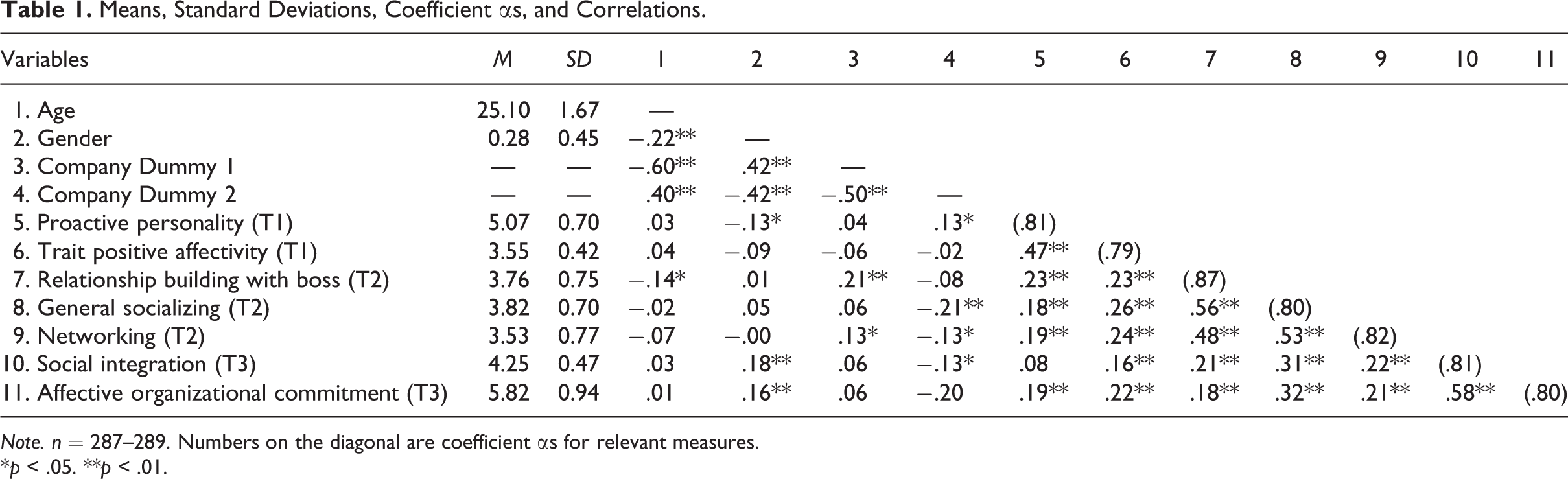
Note. n = 287–289. Numbers on the diagonal are coefficient αs for relevant measures.
*p < .05. **p < .01.
The Structural Model
We then tested the structural model by specifying various links among constructs based on our hypotheses. We specified links from PA to the three dimensions of relationship building behaviors and links from these three dimensions of relationship building behavior to social integration and affective organizational commitment. The full mediation model had adequate fit: χ2(df = 234) = 359.250, p < .01; RMSEA = .043, 90% CI [.034, .052]; CFI = .96; TLI = .94; SRMR = .05. We then tested the partial mediation model by adding two direct links from PA and social integration and affective organizational commitment. The partial mediation model also yielded acceptable model fit: χ2(df = 232) = 357.785, p < .01; RMSEA = .043, 90% CI [.034, .052]; CFI = .96; TLI = .94; SRMR = .05. However, a χ2 difference test comparing these two nested models was not significant: Δχ2 = 1.465, Δdf = 2, p = .75. Therefore, the full mediation model was retained as the final model. Figure 2 shows standardized path coefficients in the full mediation model.

The final structural equation modeling results.
A number of significant links were found associated with control variables. For instance, company Dummy 1 was significantly related to relationship building with boss (β = .21, p < .05) and social integration (β = .24, p < .05). Company Dummy2 was significantly related to general socializing (β = −.29, p < .01). Age had a significant link to social integration (β = .17, p < .05). Gender was associated with affective organizational commitment (β = .21, p < .01). However, no significant link was found between proactive personality and any of the endogenous variables.
As can be seen in Figure 2, the paths from PA and general socializing, relationship building with boss, and networking were all positive and significant (β = .26, .25, and .28, ps < .01, respectively), supporting Hypotheses 1a, 1b, and 1c. With respect to links between the three dimensions of relationship building behaviors and the two distal socialization outcomes, Figure 2 shows that general socializing was positively related to social integration and affective organizational commitment (β = .33, p < .05; β = .30, p < .05, respectively), supporting Hypotheses 2a and 2b. However, paths from relationship building with boss and social integration and affective organizational commitment were both nonsignificant (β = −.12 and .02, respectively, ps > .05), thus failing to support Hypotheses 3a and 3b. Networking was not significantly related to social integration (β = −.06, p = .36) and affective organizational commitment (β = −.05, p = .41). As such, Hypotheses 4a and 4b were not supported.
Next, we tested mediation hypotheses. Table 2 summarizes bootstrapping results. General socializing was found to mediate the PA–social integration relationship and the PA–affective organizational commitment link, as the 95% CIs of both indirect effects did not contain zero. However, relationship building with boss did not mediate the above links, nor did networking, as the 95% CIs of all these four indirect effects contained zero. Thus, Hypotheses 5a and 6a received strong support, whereas Hypotheses 5b, 5c, 6b, and 6c were not supported.
Bootstrapping-Based Mediating Analysis Results.
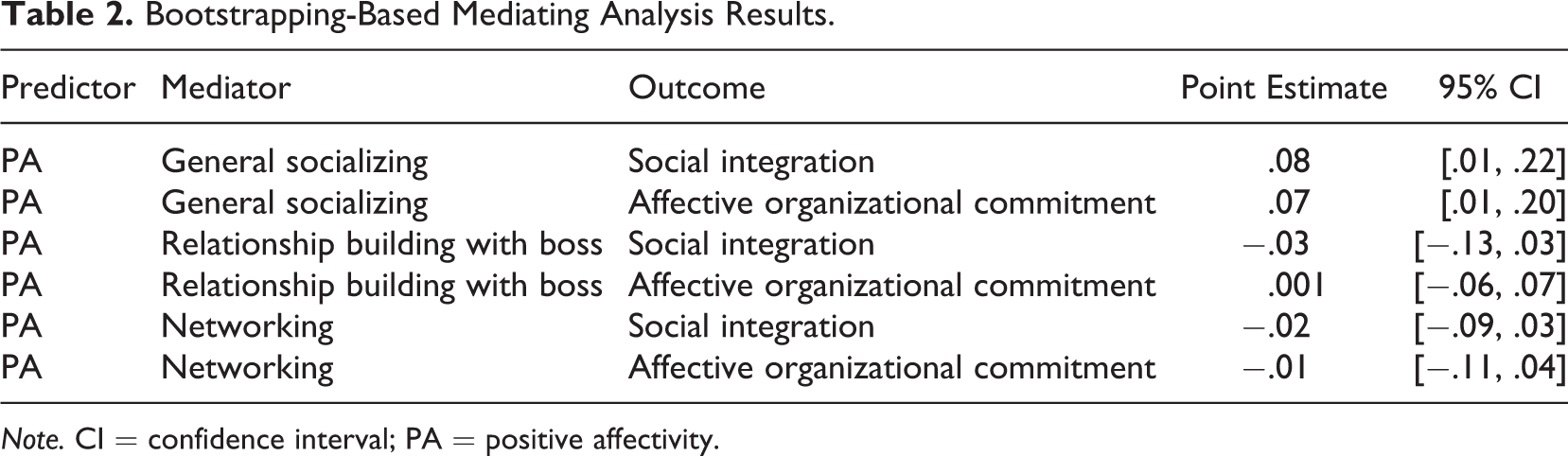
Note. CI = confidence interval; PA = positive affectivity.
Discussion
Newcomers’ trait affectivity should play a critical role in their organizational socialization processes. However, relevant research has been limited. The present study addressed the research gap by looking at the role of trait PA in newcomer settings. A theoretical model was proposed that newcomers’ trait PA would be related to their relationship building behaviors, and in turn, social integration and affective organizational commitment. Using a three-wave survey design, we collected data from 289 newcomers in three organizations in China. SEM was used to test the hypothesized model.
Summary of Major Findings
The SEM results showed that newcomers’ trait PA positively related to all three dimensions of relationship building behaviors: general socialization, socialization with boss, and networking. These findings supported Parker et al.’s (2010) proposition that trait PA should be an important antecedent of proactive behavior.
The results also showed that general socializing mediated, whereas socialization with boss and network failed to mediate, the relationships between PA and social integration and affective organizational commitment. These findings suggested that general socializing is more beneficial to newcomers than latter two relationship building behaviors during the first 3 months in these organizations. Indeed, during the very early socialization period, building relationship with coworkers, rather than with boss or colleagues in other units, might accord newcomers with more benefits, since newcomers usually spend most of their time with coworkers at work. These findings were inconsistent with previous research which reported significant links between relationship building with boss/networking and socialization outcomes (Gruman et al., 2006; Saks et al., 2011). The inconsistency could be attributed to the fact that in the present sample, the outcome variables were measured 3 months postentry; however, socialization processes probably take longer than 3 months to unfold. It is possible that newcomers need longer time to develop and then benefit from their relationship building behavior with boss and/or colleagues in other units than from their relationship building efforts with coworkers. Another explanation could be cultural differences. The beneficial effects of relationship building behavior with boss on social assimilation may be less pronounced in high power distance cultures like China than in low power distance cultures like many Western countries. In high power distance cultures, it takes longer time for followers to benefit from their relationships with boss.
Contributions
The present study made several contributions to the newcomer socialization literature. First, by examining the role of trait PA on newcomer socialization processes and outcomes, the present study addressed a recent call for studying newcomer adjustment from the affective perspective (Ashforth & Saks, 2002). Second, to our best knowledge, this was the first study that provided empirical support for the energized to pathway leading up to proactive behaviors hypothesized in Parker et al.’s (2010) model of proactive motivation. The present study also supported Park et al.’s speculation that trait PA is an antecedent of proactive behaviors. Third, the present study moved beyond Ashforth et al.’s (2007) study by revealing differential relationships between trait PA and distal socialization outcomes through three specific relationship building behaviors. Our findings implied that timing might be an important factor that may determine which specific relationship building behaviors may benefit newcomers at different time points. Finally, the present study extended findings in social psychological research that individuals’ positive affect promotes social activities (e.g., Bower & Forgas, 2001) to a real-world scenario that lasted approximately 3 months.
Limitations and Future Research Directions
The current study had several limitations. The first limitation was that we didn’t measure and control for baseline outcome variables in testing the conceptual model. Longitudinal design with repeated measures are preferred to a simple prospective design in establishing causal effects among variables. Future research should use repeated measures designs. The second limitation was that all variables in the present study were self-reported, which may be subjected to common method bias. However, the three-wave prospective design, to a certain extent, alleviated common method bias concern. Nevertheless, future research should collect multisource data, for instance, asking coworkers and boss to report newcomers’ relationship building behaviors or distal socialization outcomes.
The third study limitation was that the surveys captured newcomers’ experiences for only 3 months postentry. The general consensus among socialization scholars has been that newcomer socialization processes unfold during the first year (see Bauer et al., 2007); as a result, we might have missed some dynamics of proactive behavior and socialization processes. For example, as mentioned earlier, relationship building with boss may be related to socialization outcomes after newcomers have extended time periods within the organization (longer than 3 months). On the other hand, empirical evidence suggested that socialization effects on newcomers occur very early and remain relatively stable (e.g., Adkins, 1995; Ashforth & Saks, 1996). If so, it might make sense to examine newcomers’ socialization experience early. That said, future research should follow-up with newcomers for longer time periods.
The forth limitation concerned external validity. Because our sample was a convenience sample and participants were from two IT firms and a bank in China, our findings might not generalize to newcomers in other industries and other countries. Further, participants in the present sample were largely men (72.3%) and were graduate newcomers without prior full-time work experience, posing another threat to external validity. Future research is thus needed to replicate our findings in various newcomer populations and cultures. In addition, future research should investigate the effects of PA on other forms of proactive behaviors such as information seeking, feedback seeking, and job change negotiation (Ashford & Black, 1996).
Some studies have showed that trait PA can be categorized into activated PA (e.g., enthusiastic) and inactivated PA (e.g., content; Bindl & Parker, 2010b). Future research is needed to examine whether activated PA are more effective in promoting proactive behaviors than inactivated PA, because a high degree of activation increases the amount of effort put into a behavior (Brehm, 1999). Future research should also examine the role of both trait and state PA. Although state PA is less stable than trait PA, these two constructs may be connected, in that individuals with a high trait PA are more likely to experience high state PA across settings and over time. That is, state PA may mediate the effect of trait PA. Finally, future research should move beyond social assimilation outcomes and should examine whether and how trait PA may relate to job performance and turnover.
Practical Implications
Given the beneficial role of trait PA during newcomer socialization, organizations may consider selecting new employees based on their standings on trait PA. Further, although trait PA is stable and cannot be easily changed, state PA can be fostered through intervention programs. Organizations can help newcomers with low trait PA by implementing intervention programs that may promote newcomers’ state PA, and in turn, facilitates their adjustment in the new environment. In addition, our findings reiterated that organizational insiders are essential in helping newcomers adjust to the new environment. Thus, organizations should provide more opportunities for social interactions between newcomers and other newcomers and more experienced employees. We believed that to facilitate newcomers’ organizational socialization, both organizational and individual tactics should be considered.
Footnotes
Authors’ Note
Hairong Li, School of Psychological and Cognitive Sciences, Peking University and Department of Psychology, Auburn University; Jinyan Fan, Department of Psychology, Auburn University; Xiang Yao, School of Psychological and Cognitive Sciences, Peking University; Lu Zheng, Department of Psychology, Auburn University. This research was partially funded by a Talent Training and Support Infrastructure grant supported by National Training Foundation for Basic Sciences Talents awarded to the School of Psychological and Cognitive Sciences of Peking University, National Natural Science Foundation of China, Grant No. J1103602.
Declaration of Conflicting Interests
The author(s) declared no potential conflicts of interest with respect to the research, authorship, and/or publication of this article.
Funding
The author(s) disclosed receipt of the following financial support for the research, authorship, and/or publication of this article: This research was partially funded by a Talent Training and Support Infrastructure grant supported by National Training Foundation for Basic Sciences Talents awarded to the School of Psychological and Cognitive Sciences of Peking University, National Natural Science Foundation of China, Grant No. J1103602.