




Abstract
The aim of this study was to develop and test the psychometric properties of the Croatian paper-and-pencil and Internet versions of the Career Decision-Making Difficulties Questionnaire (CDDQ). The CDDQ is based on the theoretical taxonomy of difficulties in career decision-making and comprises three major clusters of difficulties: Lack of readiness, lack of information, and inconsistent information that are further divided into 10 specific types of difficulties. The paper-and-pencil version and the Internet version were filled out by 451 and 568 high school students, respectively. Both versions of the Croatian CDDQ showed to be reliable and structurally equivalent measures. A hierarchical cluster analysis and confirmatory factor analysis generally supported the three-cluster classification system of career decision-making difficulties, with the exception of the Dysfunctional Beliefs Scale that was not significantly associated with any of the other scales. The associations between the CDDQ Scales on the one hand, and two measures of career maturity—Student Career Construction Inventory and Career Decision-Making Self-Efficacy Scale—were moderate and negative and thus supported the concurrent validity of the CDDQ. The results suggest revising the dysfunctional beliefs subscale or using the CDDQ without this scale in counseling practice.
Background
Career Decision-Making
Career indecision and career decision-making were considered to be central research issues in vocational psychology at the end of the last century (Betz, 1992; Tinsley, 1992). This topic was frequently highlighted by theoreticians, researchers, and career counselors (Saka & Gati, 2007). In spite of the decline in research and publication activity on this topic during the 1990s (Kelly & Lee, 2002), the importance of career decision-making difficulties and high rate of career indecision problems make dealing with them an essential component of every career counseling approach. In career counseling practice, identifying the counselees’ difficulties in making career decisions is often the first step in helping individuals (Gati, Krausz, & Osipow, 1996). It is especially important for adolescents who are in the process of choosing their occupational or educational paths. Due to the complexity of the career decision-making task, many adolescents face difficulties before or during the decision-making process. Such difficulties, if not adequately dealt with, may prevent the individual from making the decision or lead to a less than optimal career choice (Amir & Gati, 2006).
Career decision-making is an aspect of the broader concept of career maturity, which refers to the individual’s readiness to make well-informed, age appropriate career decisions and to cope with career development tasks (Savickas, 1984). Crites (1976) proposed the career maturity model that encompasses important elements of career decision-making. The model consists of affective and cognitive dimensions, wherein the cognitive dimension is composed of decision-making skills, whereas the affective dimension includes attitudes toward the career decision-making process. Thus, career maturity and career decision-making are highly interrelated constructs. The stage of career maturity largely depends on the quality, timeliness, and easiness of career decisions an individual had made.
Historically, career decision-making was firstly related to person–environment fit paradigm, then shifted to career adaptability concept, and finally moved to postrational perspectives on career decision-making (Krieshok, Black, & McKay, 2009). Within the person–environment fit paradigm (Parsons, 1909), career decision-making was seen as ones’ ability to reasonably match a knowledge of self and knowledge of occupations in order to achieve the fit. The concept of career adaptability (Savickas, 1997; Super & Knasel, 1981) took into account modern, dynamic world of work and more flexible career paths. Career decision-making skills were seen as readiness to cope with unpredictable tasks and changes and continual need to respond to new circumstances and situations in work or working conditions (Savickas, 1997). The latest theories challenged the emphasis on rational model of career decision-making. They stressed the limitations of rationality due to decisions’ complexity, a number of choices and restricted cognitive capacity of an individual (Gati & Tikotzki, 1989). They also took into account the importance of unconscious and intuitive processes that play important role in career decision-making process (e.g., Kahneman, 2003).
In this article, we focused on taxonomy of career decision-making difficulties which rely on decision theory proposed by Gati, Krausz, and Osipow (1996). By the theory, there are few important and specific features of career decisions: (a) in career decision-making, there are numerous alternatives to select from; (b) there are many attributes or aspects of occupations that should be considered; and (c) the decision maker has to deal with uncertainty with respect to both personal characteristics and the nature of future career alternatives.
Taxonomy and Measurement of Career Decision-Making Difficulties
Gati et al. (1996) proposed the theoretical taxonomy of difficulties in career decision-making based on decision theory. The taxonomy includes three clusters of difficulties, further divided into 10 specific categories. The major difficulty cluster lack of readiness (LR) includes three difficulty categories that precede engagement in career decision-making: (a) lack of motivation to engage in the career decision-making process, (b) general indecisiveness concerning various types of decisions, and (c) dysfunctional beliefs (db) about career decision-making. The other two major difficulty clusters—lack of information and inconsistent information (II)—include difficulties that may arise during the process of career decision-making. Lack of information (LI) includes (a) lack of knowledge about the steps in career decision-making, (b) LI about the self, (c) LI about the occupations, and (d) LI about the ways of obtaining information. The II cluster includes (a) unreliable information, (b) internal conflicts—conflict within the individual, and (c) external conflicts—conflicts involving the opinions of other significant individuals.
The Career Decision-Making Difficulties Questionnaire (CDDQ; Gati, Krausz, & Osipow, 1996) was developed on the basis of this taxonomy and includes 10 scales corresponding to the ten difficulty categories. For the original scale, Gati et al. (1996) reported adequate test–retest reliability of the three major categories (.67, .74, and .72 for the three clusters, respectively) and for the whole questionnaire (.80) in an Israeli sample. The internal consistency of the CDDQ was also acceptable, with median Cronbach’s α for the 10 scales of .78 in the Israeli and .77 in the American sample, and Cronbach’s α for Composite Scale (CCα) for the total score of .95 in both samples. Using cluster analysis, Gati et al. (1996) found that the empirical structure of the 10 specific categories highly resembled the theoretical structure as well as the proposed taxonomy. The concurrent validity of the CDDQ was supported by the negative correlations between CDDQ Scales and Career Decision-Making Self-Efficacy (CDMSE; Osipow & Gati, 1998) and positive correlations with the Career Decision Scale (Lancaster, Rudolph, Perkins, & Patten, 1999; Osipow & Gati, 1998; Osipow & Winer, 1996). In addition to its English version, CDDQ was translated and adapted to more than 30 languages (Gati, 2013). Most of the studies have supported the concurrent, construct, structural, and cross-cultural validity of the CDDQ (e.g., Albion & Fogarty, 2002; Gati et al., 1996; Gati & Saka, 2001; Mau, 2004; Tien, 2005). However, studies reported somewhat lower reliability for the LR cluster, usually caused by the low internal consistency of the dysfunctional beliefs subscale (e.g., Creed & Yin, 2006; Gati et al., 1996; Gati, Osipow, Krausz, & Saka, 2000; Gati & Saka, 2001; Kelly & Lee, 2002; Lancaster et al., 1999). Research studies have confirmed equivalence of paper-and-pencil and online versions of CDDQ (Gati & Saka, 2001), which is particularly important as online career counseling is nowadays becoming very prominent way of helping clients developing their careers.
Research Goals
The aim of this study was to examine the reliability and construct validity of the Croatian version of the CDDQ. Adequate psychometric properties of Croatian version of CDDQ would approve its application on Croatian samples for exploring clients’ difficulties in career decision-making, which is important as in Croatia, we lack such an instrument. Croatia is a part of European cultural tradition and previous studies on Croatian samples have confirmed adequacy of various career-related measures developed in the United States or internationally, for example, Holland’s Self-directed Search (Šverko & Babarović, 2006), Tracey’s Personal Globe Inventory (Šverko, 2008), Values Scale (Šverko, Jerneić, Kulenović, & Vizek Vidović, 1995), and Career Adapt-Abilities Scale (Šverko & Babarović, 2016). We hypothesized that career decision-making difficulties are not more culturally sensitive than other career-related constructs, and therefore we expected to observe adequate psychometric properties of Croatian version of CDDQ, particularly when such strong cross-cultural universality of CDDQ was observed. In addition to previous studies that have explored and mainly confirmed cross-cultural adequacy of CDDQ, results of this study on Croatian samples will increase scientific knowledge on cross-cultural validity of CDDQ.
Main problems in this study were (1) to explore the structural validity of paper-and-pencil and online versions of CDDQ and (2) to test the construct validity of CDDQ by exploring its relations to career maturity. In order to address research problems, we applied paper-and-pencil and online version of CDDQ on two samples of Croatian 12th grade high school students. To test the structural validity, we compared paper-and-pencil and online versions to the theoretical model of career decision-making difficulties, expecting clear three-dimensional hierarchical structure of 10 career decision-making difficulties, and invariant of measurement method. To test the construct validity of the CDDQ, we applied Croatian versions of two well-known measures of career maturity: the CDMSE (Taylor & Betz, 1983) and the Student Career Construction Inventory (SCCI; Savickas & Porfeli, 2012), expecting negative relations between the CDDQ Scale scores and levels of career maturity, regardless measurement method.
Main research problems have been addressed through two validity studies: Study 1 in which paper-and-pencil version was administered and Study 1 in which Internet version of CDDQ was administered.
Study 1: Paper and Pencil Assessment
In Croatian schooling system, the tipping point for career decision-making is the age of 18 when students are finishing high school (12th grade). At that age, they need to decide about possible further education on a particular undergraduate university program or about choosing a particular job they would like to engage in. Therefore, we conducted a paper-and-pencil study on a sample of high school students of that age. The aim of this study was to explore the structural and construct validity of CDDQ. To test the construct validity of CDDQ, we also collected data using the SCCI, expecting negative correlations between CDDQ and SCCI Scales. Due to the content of the instruments, we expect the highest relations between SCCI subscale career decision-making and CDDQ subscales.
Method
Participants
The participants were 451 high school students enrolled in the 12th grade of grammar school (62.4% females). The sample consisted of seven grammar schools that differed according to level of prestige. The participants were predominately 18 years old (M = 18.04; SD = .36).
Procedure
The questionnaires were administered during the regular school classes by the researchers. The participation in the study was anonymous and voluntary, and feedback on students’ characteristics was offered as an incentive for the participation. Almost all of the students attended the classes filled out the questionnaires; the refusal rate was less than 5%.
Instruments
The Career Decision-Making Difficulties Questionnaire—Revised (CDDQ-R; Gati & Saka, 2001) is a 34-item questionnaire, comprising 32 difficulty items and two validity items not used in scoring. Respondents have to indicate their level of agreement to each statement on a 9-point Likert-type scale, with end points ranging from 1 = does not describe me to 9 = describes me well. Higher scores indicate greater career decision-making difficulties. CDDQ yields results on 10 career decision-making difficulties, three major difficulty categories (LR, LI and II), and the total difficulties score. The Croatian version of CDDQ-R was formed using the translation, review, adjudication, pretesting, and documentation system suggested by Harkness (2003).
The SCCI (Savickas & Porfeli, 2012) is a newly developed instrument that measures accomplishment of career construction tasks typical for five stages of a student’s career development: (a) self-concept crystallization (e.g., “Recognizing my talents and abilities”), (b) occupational exploration (e.g., “Learning about different types of jobs”), (c) career decision-making (e.g., “Planning how to get into the occupation I choose”), (d) skilling and instrumentation (e.g., “Beginning the training I need for my preferred job”), and (e) transition from school to work (e.g., “Making plans for my job search”). The 25 items present various career construction activities, and participants’ task is to indicate how much thinking or planning they have done about each activity, using a 5-point Likert-type scale (from 1 = I have not yet thought much about it to 5 = I have already done this). SCCI provides scores that reflect the accomplishment of the five career construction tasks, as well as a total score which represents the overall degree of vocational development. The adequate reliability and structural validity of SCCI were observed (Rocha & Guimarães, 2012; Savickas & Porfeli, 2012). In this study, the SCCI total score internal consistency was CCα = .89, and for five subscales it ranged from Cα = .72 for transition from school to work to Cα = .83 for career decision-making.
Results and Discussion
The paper-and-pencil Croatian version of the CDDQ-R showed mostly adequate reliability, both on the level of subscales, major difficulties clusters, and the total score. The internal consistency reliabilities of the subscales ranged from α = .58 for lack of motivation to α = .88 for lack of knowledge about the process, with the median of .74 (Table 1). The lowest reliability was observed for LR cluster (Cα = .61), reflecting the low intercorrelations among the three subscales, while the highest was found for LI cluster (Cα = .91).
Means, Standard Deviations, Reliabilities, and Means Differences of the CDDQ Scales in Paper and Pencil (Study 1; n = 451) and Online (Study 2; n = 568) Administration.

Note. CDDQ = Career Decision Difficulties Questionnaire total score; SCCI = Student Career Construction Inventory total score; CDMSE = Career Decision-Making Self-Efficacy Scale total score.
*Significant differences at the p < .003 after the Bonferroni correction for multiple comparisons.
The mean scores suggested that the most pronounced career decision-making cluster of difficulties was LR followed by LI (Table 1). On the subscales level, the most pronounced difficulties were general indecisiveness (M = 5.26), dysfunctional beliefs (M = 4.61), lack of knowledge about occupations (M = 4.38), and lack of knowledge about the career decision-making process (M = 4.33).
Moderate and positive correlations between the CDDQ Scales were found (see Table 2). The exception is the dysfunctional beliefs subscale which had negligible correlations with the other subscales (−.10 ≤ r ≤ .24), which can be partly attributed to the low internal consistency of the subscale (α = .62). The correlations between the three major clusters of difficulties were positive, moderate to high (.43, .44, and .70). The pattern of correlations was expected and generally supported the construct validity of paper-and-pencil Croatian version of CDDQ, except for the subscale of dysfunctional beliefs which had low reliability also in previous studies (e.g., Gati et al., 1996; Gati & Saka, 2001; Kelly & Lee, 2002).
Intercorrelations Among the CDDQ Scales in Paper and Pencil (Study 1; N = 451; Below Diagonal) and Online (Study 2; N = 568; Above Diagonal) Versions.

Note. LR = lack of readiness; LI = lack of information; II = inconsistent information; lm = lack of motivation; gi = general indecisiveness; db = dysfunctional beliefs; lp = lack of information about the process; ls = lack of information about the self; lo = lack of information about occupations; la = lack of information about additional sources of information; ui = unreliable information; ic = internal conflicts; ec = external conflicts; CDDQ = Career Decision Difficulties Questionnaire total score; SCCI = Student Career Construction Inventory total score; CDMSE = Career Decision-Making Self-Efficacy Scale total score.
The correlations between career maturity, as measured by SCCI, and three CDDQ major clusters of difficulties (Table 3) were as expected negative but low (−.10 to −.31). It suggested that students with higher career maturity faced slightly less career decision-making difficulties. The same relations were observed on the subscale level, as the CDDQ Scales correlated negatively with the SCCI total score. However, the Dysfunctional Beliefs Scale again showed departure from expectations, as it was weakly but positively correlated to career maturity. To additionally explore relations between CDDQ difficulties and SCCI career construction tasks, we examined the correlations between the five SCCI subscales, on the one hand, and the 10 scales of the CDDQ, on the other (see Table 3). As expected, most of the correlations were negative, low to moderate. The strongest negative associations were found between SCCI task of career decision-making and CDDQ Scales confirming the construct validity of both instruments.
Correlations Between the CDDQ Scales and SCCI Scales in Paper and Pencil (Study 1; N = 451; Upper Part) and Online (Study 2; N = 568; Lower Part) Administration.

Note. LR = lack of readiness; LI = lack of information; II = inconsistent information; lm = lack of motivation; gi = general indecisiveness; db = dysfunctional beliefs; lp = lack of information about the process; ls = lack of information about the self; lo = lack of information about occupations; la = lack of information about additional sources of information; ui = unreliable information; ic = internal conflicts; ec = external conflicts; SCCI = Student Career Construction Inventory.
To further explore the structure of the 10 CDDQ Scales, we carried out cluster analysis of 10 scales of the paper-and-pencil version of the CDDQ using ADDTREE(Sattath & Tversky, 1977). The clustering structure presented in Figure 1a adequately summarizes the pattern of intercorrelations among the 10 scales (the linearly accounted for variance was 95.5%). In this clustering structure, the similarity between scales is represented by the sum of the horizontal arcs connecting them. The long horizontal line for the Dysfunctional Beliefs Scale represents that this scale has low or negligible correlations with the other scales. As can be seen in Figure 1a, the four scales of LI were grouped together as expected. However, while the general indecisiveness and the Dysfunctional Beliefs Scale of the LR cluster were grouped together as expected, the lack of motivation scale was separate from them. Finally, the Internal Conflicts Scale was grouped with unreliable information, forming the II cluster, but external conflicts was a bit separated and closer to the LR cluster.

(a) Cluster analyses by ADDTREE of the 10 scales of the Career Decision-Making Difficulty Questionnaire—Paper-and-Pencil version (Study 1 [N = 451], linearly accounted for variance is 95.5%). (b) Cluster analyses by ADDTREE of the 10 scales of the Career Decision-Making Difficulty Questionnaire—Online version (Study 2 [N = 568], linearly accounted for variance is 97.3%). LR = lack of readiness; LI = lack of information; II = inconsistent information; lm = lack of motivation; gi = general indecisiveness; db = dysfunctional beliefs; lp = lack of information about the process; ls = lack of information about the self; lo = lack of information about occupations; la = lack of information about additional sources of information; ui = unreliable information; ic = internal conflicts; ec = external conflicts.
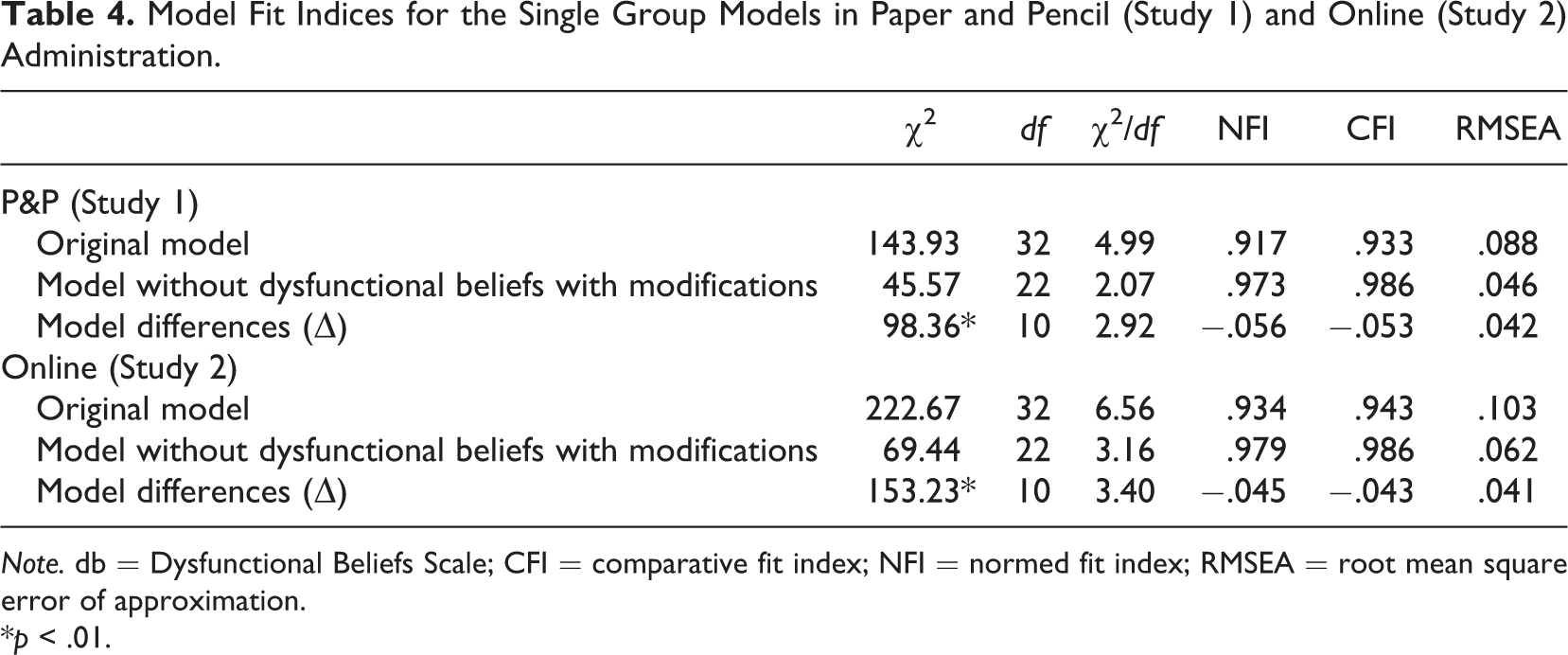
A confirmatory factor analysis (CFA) was conducted to examine directly whether the original three-factor structure of CDDQ adequately represents our data (Figure 2a). The fit indicators for the default model in Study 1 (Table 4) showed poor to mediocre data-model fit according to Hu and Bentler’s (1999) criteria. To improve the model, we examined the factor loadings of each item on its main factor, and dysfunctional beliefs subscale had low and insignificant loading (r = .03). Therefore, we excluded Dysfunctional Beliefs Scale from the CDDQ model. Furthermore, we consulted the proposed modification indices and included the covariance between two pairs of same factor variable errors in the model, which substantially improve the fit. The fit of the modified model (Figure 2b) significantly improved, and model-fit indices suggested very good fit of the modified model to the data in the paper-and-pencil version of the CDDQ (χ2 = 45.57, χ2/df = 2.07, comparative fit index [CFI] = .986, normed fit index [NFI] = .973, and root mean square error of approximation [RMSEA] = .042).

(a) CDDQ original structural model. LR = lack of readiness; LI = lack of information; II = inconsistent information; lm = lack of motivation; gi = general indecisiveness; db = dysfunctional beliefs; lp = lack of information about the process; ls = lack of information about the self; lo = lack of information about occupations; la = lack of information about additional sources of information; ui = unreliable information; ic = internal conflicts; ec = external conflicts. (b) CDDQ structural model without Dysfunctional Beliefs (db) Scale, with modifications. LR = lack of readiness, LI = lack of information; II = inconsistent information; lm = lack of motivation; gi = general indecisiveness; lp = lack of information about the process; ls = lack of information about the self; lo = lack of information about occupations; la = lack of information about additional sources of information; ui = unreliable information; ic = internal conflicts; ec = external conflicts.
Model Fit Indices for the Single Group Models in Paper and Pencil (Study 1) and Online (Study 2) Administration.
Note. db = Dysfunctional Beliefs Scale; CFI = comparative fit index; NFI = normed fit index; RMSEA = root mean square error of approximation.
*p < .01.
Study 2: Online Assessment
In the past two decades, computer-assisted career guidance systems (CACGS) have become common counseling tools. Clients prefer their self-administrative feature, the speed of the feedback and career advice they provide, and the easiness of retrieving information about the world of work. Today, the development of CACGS became easy and affordable, so the number of available counseling tools rapidly increased on the Internet. For that reason, it is crucial to evaluate psychometric properties of online instruments. The online version of CDDQ is available on www.cddq.org and previous studies confirmed its reliability, validity, and metric equivalence to paper-and-pencil version (Gati & Saka, 2001).
The aim of this study was to examine the psychometric properties of Croatian Internet version of CDDQ and to compare it to the paper-and-pencil version (data from Study 1). In order to test construct validity of online version of CDDQ, we have also developed the Internet versions of SCCI (Savickas & Porfeli, 2012) and CDMSE (Taylor & Betz, 1983). We expected structural equivalence of online and paper-and-pencil versions of CDDQ. We also expected negative correlations between CDDQ Scales and SCCI Scales, as observed in Study 1, and low and negative correlation between CDDQ Scales and CDMSE, as observed in previous studies (e.g., Creed & Yin, 2006; Vahedi, Farrokhi, Mahdavi, & Moradi, 2012).
Method
Participants
The participants were 568 high school students (71.7% females) enrolled in the 12th grade, mainly at the age of 18. The sample of secondary schools in the sample included students from grammar schools as well as students from technical and vocational high schools. These schools differ from those of Study 1 because it includes technical and vocational schools. Technical and vocational schools educate students for particular occupations and students are already directed to specific field of work or specific field of further education. Furthermore, this sample of schools better represents the population of Croatian high school students where most of them enroll technical and vocational schools.
Procedure
The participants were approached in their schools and were invited to participate in the online survey. Their participation was anonymous and voluntary. The data were collected through a secured website (www.putkarijere.hr), developed for longitudinal study of adolescents’ career transition. All the students received feedback on their characteristics automatically by the online system. The students were additionally motivated for participation by taking a part in a raffle with valuable incentives (smartphones, tablet computers, and laptops). The CDDQ, the SCCI, and the CDMSE were administered in the second wave of a longitudinal study, and the response rate was around 40%.
Instruments
The Croatian Internet versions of CDDQ, SCCI, and CDMSE were used. The CDDQ Internet version was identical to the paper-and-pencil version, which was described in Study 1. The SCCI online version was also identical to paper-and-pencil version (Study 1). The internal consistency reliability of SCCI online version in Study 2 was very good: The SCCI total score reliability was CCα = .93, and it ranged from Cα = .79 for transition from school to work to Cα = .89 for career decision-making.
The CDMSE (Taylor & Betz, 1983) assesses self-efficacy expectations associated with career decision-making. It consist of 50 statements, and respondents are asked to rate their confidence in being able to accomplish the described task, on a 10-point scale ranging from 0 (no confidence at all) to 9 (complete confidence). It has five scales: self-appraisal, gathering occupational information, goal selection, making plans for the future, and problem-solving. The CDMSE reflects both particular aspects and the general level of CDMSE. A higher score on the CDMSE Scales and the total score indicate higher CDMSE. Taylor and Betz (1983) reported high reliabilities for five CDMSE Scales ranging from .86 to .89 but also concluded that the existence of five distinct scales was not supported empirically by factor analysis. In our data, the five-factor structure of the CDMSE was also not supported by factor analysis, so in the analyses we used only the total score, which was found to be highly reliable (CCα = .94).
Results and Discussion
In the online study, the reliability of CDDQ Scales ranged from α = .64 for dysfunctional beliefs to α = .92 for lack of knowledge about the process, with the median of .79 (Table 1). The lowest reliability on the clusters level was found for LR, possibly affected by low reliability of the Dysfunctional Beliefs Scale. The major category LI appeared to be the most homogeneous cluster, with high reliability to all subscales (.78 ≤ α ≤ .92). It also should be noted that the Internet version of CDDQ had somewhat higher internal consistency of the scales comparing to paper-and-pencil version.
The mean scores of CDDQ Scales in online administration suggested that the most pronounced career decision-making difficulty was LR, followed by LI, similarly as in the paper-and-pencil study (Table 1). On the subscales level, the most pronounced difficulties were general indecisiveness concerning career decision-making, and dysfunctional beliefs about career choice. The relative salience of the 10 decision-making difficulties was highly similar in the online and the paper-and-pencil versions. The Spearman rank–order correlation across the 10 scales was ρ = .99.
Comparing the mean scores in the two studies (Table 1), it can be concluded that students that filled out the online version of CDDQ (Study 2) generally expressed more career-related difficulties. Although some of the differences were statistically significant, the effect sizes were generally low (d ≤ .25). However, the difference was noticeable for Dysfunctional Beliefs Scale (d = .58) and hence also for the major cluster of LR (d = .52). Interestingly, a noticeable difference was also found for the SCCI Scale (d = .54), with a higher mean SCCI score in the online version, reflecting that the participants in Study 2 accomplished more career construction tasks and seems to have somewhat higher level of career maturity.
The online study revealed moderate and positive intercorrelations between the CDDQ Scales. The exception is again the dysfunctional beliefs subscale which correlated with the other subscales weakly and negatively (Table 2). The correlations between the three major clusters of difficulties were positive, moderate to strong. The pattern of correlations was expected and generally supported the construct validity of CDDQ online versions, except for a subscale of dysfunctional beliefs. Comparing the intercorrelations between CDDQ Scales in Study 1 and Study 2, it could be observed that correlations were slightly higher in Study 2. It is likely that the higher reliabilities of the online versions can be attributed to more conscientious and motivated participants. However, the pattern of intercorrelations among the 10 subscales scales was similar for the paper-and-pencil and the online versions: The Spearman rank–order correlations between the two intercorrelation matrices were .95.
The correlations between online version of CDDQ, on one hand, and the SCCI, and CDMSE on the other, were negative and moderate both on the scales and clusters level, confirming the construct validity of CDDQ Internet version (Table 2). However, the dysfunctional beliefs again differed from other CDDQ Scales and correlated weakly and positively to career maturity measures. The correlations between SCCI subscales and CDDQ subscales again showed expected pattern of moderate negative correlations (Table 3). The highest correlations were observed between SCCI’s subscale of career decision-making and CDDQ Scales, confirming again the construct validity of the scales. The pattern of correlations was similar to those obtained in Study 1, but relations were more pronounced.
A cluster analysis of the intercorrelations among the 10-scale scores of the CDDQ Internet version is presented in Figure 1b. The clustering model adequately summarizes the pattern of intercorrelations, with linearly accounted for variance of 97.3%. The four scales of LI were grouped together as expected and as in Study 1. However, the II cluster was not clearly formed. The Internal Conflicts Scale was grouped with the four scales of LI cluster, while external conflicts and unreliable information were close to the three subscales of the LR cluster. The unique and distinct characteristics of Dysfunctional Beliefs Scale are represented by the long horizontal line.
The original three-factor structural model of CDDQ online version was directly tested using CFA (see Figure 2a). The CFA fit indicators for the original model showed a poor fit (Table 4). After applying the same modifications as in Study 1 (Figure 2a), the fit of the model significantly improved, and model-fit indices suggested acceptable fit in the online study (χ2 = 69.44, χ2/df = 3.16, CFI = .986, NFI = .979, and RMSEA = .062).
In order to assess the measurement invariance of the modified CDDQ model without Dysfunctional Beliefs Scale (Figure 2b) in paper-and-pencil and online versions, a Multi-Group Confirmatory Factor Analysis (MGCFA) was performed. We tested the typical sequence of nested and hierarchical ordered models by adding parameter restraints one at a time (Cheung & Rensvold, 2002; Vandenberg & Lance, 2000). If two nested models showed a decrease in CFI or NFI greater than or equal to .01 or an increase in RMSEA greater than or equal to .01, the more restrictive model should be rejected (Chen, 2007; Cheung & Rensvold, 2002). According to the MGCFA results (Table 5), the full measurement invariance of the modified CDDQ model in paper-and-pencil and online application was confirmed.
Measurement Invariance of the Reduced CDDQ Without Dysfunctional Beliefs With Modifications: Model Fit Indices for the Multigroup Model (P&P and Online Administration; Study 1 and Study 2).

Note. CFI = comparative fit index; NFI = normed fit index; RMSEA = root mean square error of approximation.
*p < .01.
General Discussion
Reliability and Validity of Croatian Version of CDDQ
The similar results of the paper-and-pencil and the online study show that the Croatian version of CDDQ is a reliable and valid measure of career decision-making difficulties for adolescents, but also suggested some possible modifications to the original CDDQ model. The observed reliability coefficients were adequate and similar to those obtained on the original CDDQ-R by Amir and Gati (2006) who reported the median subscale reliability of .72 and .90 for the total CDDQ score that is similar to our findings. Correlations between the CDDQ Scales on the one hand, and the two measures of career maturity (SCCI and CDMSE) were as expected negative and moderate and in line with findings from previous studies (Creed & Yin, 2006; Lancaster et al., 1999; Osipow & Gati, 1998; Osipow & Winer, 1996; Vahedi et al., 2012).
Structural analyses to some extent supported the proposed three-cluster structure but also suggested some possible modifications. In both studies, intercorrelations and cluster analysis showed that the most coherent cluster was LI, while II and LR were not as homogeneous. In cluster analysis, the Dysfunctional Beliefs Scale appeared distinct from all other scales of the CDDQ, as it had weak and even negative correlations with other scales. The Dysfunctional Beliefs Scale also distorted the original CDDQ model, which was observed in CFA. According to our data, in both studies a better model-data fit was observed after the exclusion of Dysfunctional Beliefs Scale. Therefore, our results suggest possible modification of CDDQ model by exclusion of the Dysfunctional Beliefs Scale because of its low reliability.
Observed Differences Between Paper-and-Pencil and Online Applications
The comparison of the mean scores on the CDDQ Scales between online and paper-and-pencil study showed that students that filled out the online version of CDDQ generally expressed more career-related difficulties. The most noticeable difference was found for Dysfunctional Beliefs Scale and consequently also for the major cluster of LR. A noticeable difference was also found for the SCCI Scale, reflecting that the participants in online study have somewhat higher level of career maturity. The situation where one group of students, at the same time, is more career mature, and also faces more career decision-making difficulties, may look controversial. However, taking into account differences in data collection method and related samples characteristics, it can be explained. Considering that in the paper-and-pencil study almost all students that attended school classes at the administration day were included in sample, whereas in the online assessment we had higher refusal rate and only students interested in the research and in their career transition filled out the online questionnaires. Therefore, we assume that participants in online study were more concerned about forthcoming career decisions they had to make. They were responsible and they actively dealt with career construction tasks. At the same time, they were aware of the decision-making difficulties they faced in this process, and therefore were motivated to fill out the questionnaire and to get feedback on their career-related characteristics.
Problems With the Dysfunctional Beliefs Scale
In both paper-and-pencil and online study, the Dysfunctional Beliefs Scale had low reliability, which contributed to lower reliability of the LR cluster. The low reliability of the Dysfunctional Beliefs Scale was also reported in Taiwanese (Tien, 2001), Slovenian (Pečjak & Zagoričnik, 2007), Chinese (Tien, 2005), Israeli (Gati et al., 1996; Gati & Saka, 2001), and United States samples (Gati et all, 1996; Kelly & Lee, 2002). Furthermore, some of the findings also show lower reliability for the LR cluster in different languages (Albion & Fogarty, 2002; Tagay, 2014; Vahedi et al., 2012). The Dysfunctional Beliefs Scale also appeared distinct from all other subscales in its original cluster and had low saturations with the designated factor. The similar problem with Dysfunctional Beliefs Scale occurred in Gati et al. (1996) research and authors attributed it to low reliability of the subscale.
As problems with Dysfunctional Beliefs Scale were observed in the original version of the CDDQ and in many versions in other languages, they are probably related to item content and not to cultural differences. It is obvious that dysfunctional beliefs about career decision-making, as measured by the CDDQ, are not a homogeneous set. It is possible that one dysfunctional belief (e.g., “I believe there is only one career that suits me”) can exist independently from another (e.g., “I expect that entering the career I choose will also solve my personal problems”). Therefore, we suggest reconsidering and adapting items of the dysfunctional beliefs subscale to make it more homogeneous or to use this scale on the item level in counseling practice. It is especially important to attend to dysfunctional beliefs in the career decision-making process, as it is one of the most pronounced career decision-making difficulties that adolescents confront, and it can be quite effectively resolved within career counseling process.
Prominent Career Decision-Making Difficulties of Croatian Adolescents
The most pronounced career decision-making clusters of difficulties of Croatian adolescents were LR and LI. The highest scores on these two categories were also found in other research (e.g., Albion & Fogarty, 2002; Amir & Gati, 2006; Gati et al., 1996; Pečjak & Zagoričnik, 2007). On the subscales level, the Croatian adolescents faced the biggest difficulties related to general indecisiveness concerning career decision-making, dysfunctional beliefs about career choice, lack of knowledge about occupations, as well as lack of knowledge about the career decision-making process. These results highly resemble the results obtained from Slovenian adolescents who were of the same age and have a similar cultural background as the students in our sample (Pečjak & Zagoričnik, 2007).
Concerning the type of the most pronounced career decision-making difficulties in our sample, we can identify two distinct sources of difficulties. The difficulties related to LI can be described as temporary or developmental indecisions and have been used to refer to the normative vocational development phase (Saka & Gati, 2007). Therefore, this type of difficulties could be resolved relatively easily for most adolescents (Meldahl & Muchinsky, 1997), and it reduces during the high school period (Babarović & Šverko, 2016). In contrast, the career indecisiveness that comes from emotionality and other personality-related sources are more chronic and pervasive, and therefore more problematic to deal with in the career counseling process (Saka & Gati, 2007). The general indecisiveness is one of the most prominent career decision-making difficulty for adolescents and young adults (Amir & Gati, 2006), and it was also found to be the most salient decision-making problem for Croatian adolescents. Thus, an early identification of career decision-making difficulties, by providing adolescents the opportunity to fill out the CDDQ and get their personal feedback, can help in timely and appropriate counseling intervention.
Study Limitations
The limitations of presented findings can be addressed to the gender misbalance in both studies and low response rate in Study 2. Further, participants in Study 1 were possibly less motivated for participation, as measures have been applied at regular school class, while in Study 2 only motivated participants decided to take part in the survey. Moreover, observed results were acquired on a specific age-group of adolescents who are in very turbulent career transition period and therefore their generalizability to students of different age needs to be tested in further research. Finally, further research is needed to provide information about counseling use of CDDQ and its practical validity and effectiveness.
Conclusions
To conclude, this study supports the reliability and the construct and structural validity of the Croatian version of the CDDQ for adolescents in its paper-and-pencil and online versions. We recommend its usage in career counseling practice on the total score level, the cluster score levels of LI and II, as well as on the nine scale score levels. For the subscale of dysfunctional beliefs, we recommend its usage on the item level.
Footnotes
Declaration of Conflicting Interests
The author(s) declared no potential conflicts of interest with respect to the research, authorship, and/or publication of this article.
Funding
The author(s) disclosed receipt of the following financial support for the research, authorship, and/or publication of this article: This work has been supported in part by the Croatian Science Foundation under the project number 1229.