



Abstract
In this research, we validated the French-language version of the Protean and Boundaryless Career Attitudes Scales and then investigated relationships among protean and boundaryless career orientations, proactive personality, career adaptability, and career satisfaction. Study 1 results demonstrated acceptable psychometric proprieties for the scales using an innovative translation (N = 49) and verification (N = 228) method. Study 2 answered how and to what extent protean and boundaryless career orientations are related to career satisfaction in a convenient and heterogeneous sample of employees (N = 234) in the French-speaking part of Switzerland. Correlational, regression analysis, and structural equation modeling techniques were used to test the hypotheses. Career adaptability mediated the positive relationship between protean and boundaryless career orientations and career satisfaction. These findings highlight the explanatory utility of career adaptability in relationships of protean and boundaryless career orientations to career satisfaction. Future research and career counseling implications also are discussed.
Keywords
The purpose of the present study is twofold: to provide a French-language version and psychometric proprieties for both the Protean Career Attitudes Scale (PCAS) and Boundaryless Career Attitudes Scale (BCAS) using a French-speaking Swiss student sample and to empirically investigate relationships among constructs of protean and boundaryless career orientations, proactive personality, career adaptability, and career satisfaction in a sample of employees.
Protean and boundaryless career concepts were developed to capture contemporary career mind-sets and attitudes involving cognitive, evaluative, and behavioral components. Protean individuals tend to form specific beliefs about their career, to pursue personal and desirable career goals and values, and to behave in ways consistent with their goals and values (Briscoe & Hall, 2006). Boundaryless individuals manage their career across organizational boundaries and tend to appreciate structures without traditional confines, to pursue career opportunities and relationships beyond a single employer or organization, and to physically move between jobs, firms, occupations, and countries (Sullivan & Arthur, 2006).
Both constructs have been compared to a traditional career model emphasizing vertical advancement and objective career reward (Sullivan, 1999). Protean and boundaryless individuals are contemporary workers who rely on personal career goals and values, take proactive initiatives and actions, and adapt to changing career environments to seek personal needs and intrinsic rewards. Researchers studying protean and boundaryless constructs have supported these basic tenets (e.g., Gubler, Arnold, & Coombs, 2014a, 2014b), and these concepts have proven their relevance in the career literature.
This work contributes to the career assessment literature by employing an extensive translation and test–retest process to ensure retention of meaning between versions. This work also contributes to the career literature by testing a process model that includes proactive disposition as an antecedent, career adaptability as a correlate, and career satisfaction as an outcome of protean and boundaryless orientations. We offer new results on incremental, direct, and indirect effects among construct relationships in the French-speaking Swiss career context.
Protean Career Orientation
Hall (1976) characterized individuals as protean when they no longer relied on their work organization to manage their careers. According to Hall, the protean career process accounts for all of a person’s varied educational experiences, training, work across organizations, and career changes. Hall further posited that “personal career choices and a search for self-fulfillment are the unifying or integrative elements in his or her life” (p. 201). Like the Greek god Proteus, protean individuals have the capacity to adjust the shape and form of their skills and adapt to market demands and change (Hall, 1996a; Sullivan & Baruch, 2009). Baruch (2004) underscored that protean careerists establish a contract with themselves rather than with their work organization, assuming total responsibility for their careers. In sum, protean careerists are individuals who value freedom and continuous learning, who seek professional commitment, who are more interested in intrinsic rewards than extrinsic, and who tend to pursue meaningful work to discover their true calling (Hall, 1996a, 1996b, 2004; Hall & Chandler, 2005).
Two meta-competencies may sustain the development of a protean career: adaptability and identity (Hall, 2002, 2004; Stauffer, Maggiori, Froidevaux, & Rossier, 2014). Adaptability refers to the motivation and capacity to learn and the ability to adapt to a changing environment (Hall, 2002; Stauffer et al., 2014). Here, identity refers to “the ability to gather self-related feedback, to form accurate self-perceptions, and change one’s self-concept as appropriate” (Briscoe & Hall, 1999, pp. 48–49). Successful protean careerists employ these meta-capacities to learn from their experiences and to develop new competencies on their own (Hall, 2004).
Briscoe and Hall (2006) comprehensively described protean career orientation by identifying its two dimensions: values-driven (VD), defined as “the guidance and measure of career success are sustained by an individual’s internal values,” and self-directed (SD) career management, defined as “the ability to be adaptive in terms of performance and learning demands” (p. 8). Individuals with a VD orientation generally rely on their own definition of career success and endorse personal, rather than organizational, values (Briscoe, Hall, & DeMuth, 2006). The SD dimension describes people who prefer to rely on themselves to make career decisions and plans rather than others, such as their employers, to do it for them.
Researchers have found positive relationships among measures of protean career orientation and career-related constructs, such as career satisfaction (e.g., Herrmann, Hirschi, & Baruch, 2015; Volmer & Spurk, 2011), job satisfaction (e.g., De Vos & Soens, 2008; Herrmann et al., 2015), career authenticity (e.g., Briscoe et al., 2006), and boundaryless career (e.g., Briscoe & Finkelstein, 2009). Segers, Inceoglu, Vloeberghs, Bartram, and Henderickx (2008) reported interesting findings between protean career orientation and demographic variables, such as gender, age, education, and culture.
Boundaryless Career Orientation
The boundaryless career orientation emphasizes a contemporary view of careers, wherein new types of careers surpass the borders of a single employer or organization. It underscores an open-minded attitude to the world of work (Briscoe et al., 2006). A boundaryless career can be defined as “one of independence from, rather than dependence on, traditional organizational career arrangements” involving “opportunities that go beyond any single employer” (DeFillippi & Arthur, 1996, p. 116). Arthur and Rousseau (1996) provided six specific ways in which boundaryless individuals focus meaningfully on their careers: (1) moving across the boundaries of separate employers, (2) drawing validation and marketability from outside their current employer, (3) nurturing external networks and perpetuating outside information, (4) breaking traditional organizational assumptions about hierarchy and career advancement, (5) rejecting existing career opportunities for personal or family reasons, and (6) personally interpreting meaning by perceiving a boundaryless future, regardless of structural constraints.
Early research on boundaryless career orientation primarily focused on physical mobility (Ng, Sorensen, Eby, & Feldman, 2007; Sullivan & Baruch, 2009) over psychological mobility (Sullivan & Arthur, 2006). Subsequently, Sullivan and Arthur (2006) provided a comprehensive model to better study the interplay between physical and psychological mobility. They conceptualized physical and psychological mobility along two interdependent dimensions, postulating that individuals can be both physically and psychologically mobile. Essentially, people can work with multiple employers and organizations and psychologically define or redefine the way they perceive and carry out their careers.
Psychological and physical mobility were reconceptualized as exhibiting two main characteristics: a boundaryless mind-set (BM), defined as “general attitude to working across organizational boundaries,” and organizational mobility preferences (MP), defined as “the strength of interest in remaining with a single or multiple employers” (Briscoe et al., 2006, p. 33). A person with a BM “is comfortable, even enthusiastic about creating and sustaining active relationships beyond organizational boundaries” (Briscoe et al., 2006, p. 31). Low MP emphasizes that individuals favor job security and long-term employment conditions ideally by remaining with a single employer. Researchers have shown positive relationships among boundaryless orientation and career-related outcomes, such as career authenticity (Briscoe et al., 2006); career competencies of knowing-how and knowing-why, career satisfaction (Colakoglu, 2011); and objective career success (Volmer & Spurk, 2011).
Career Adaptability
Savickas (2005, p. 45) defined career adaptability as “the attitudes, competencies and behaviors that individuals use in fitting themselves to work that suits them.” Savickas and Porfeli (2012) explained that adaptability reflects psychological resources or “transactional” capacities that may help individuals to deal with vocational and life challenges. They argued that these resources are psychosocially constructed and relevant in solving relatively “unfamiliar, complex, and ill-defined problems presented by developmental vocational tasks, occupational transitions, and work traumas” (p. 662).
The career adaptability concept (Savickas, 1997) was built upon Super’s (1980) vocational maturity work (i.e., an individual’s level of vocational development) and his life-span, life-space theory (Super, 1957, 1990). Savickas (2005) identified a set of specific Attitudes, Beliefs, and Competencies (ABCs) of career construction that serve vocational development and self-regulation. The ABC model comprises four resources or adapt-abilities: concern, control, curiosity, and confidence. Thus, in order to cope with their tasks of vocational development, individuals have to be concerned with their vocational future to prepare and plan their own career; to use self-discipline, effort, and persistence to take control of and be responsible for their career construction; to be curious about possible selves and future scenarios to explore and find information relevant to their career development; and to build their confidence to solve vocational tasks and to strive for career success in pursuing their career aspirations (Savickas, 2005).
To measure career adaptability, an international group of careers researchers developed and validated the 24-item Career Adapt-Abilities Scale (CAAS; Savickas & Porfeli, 2012) across 13 countries with 6 items on each of the four dimensions. Researchers have shown relationships among career adaptability and work- and career-related constructs, such as job satisfaction (e.g., Maggiori, Johnston, Krings, Massoudi, & Rossier, 2013), and have used career adaptability as a process variable to explain relationships between individual dispositions (e.g., personality traits) and career-related outcomes (e.g., work engagement; Rossier, Zecca, Stauffer, Maggiori, & Dauwalder, 2012). Johnston, Luciano, Maggiori, Ruch, and Rossier (2013) demonstrated the utility of career adaptability in explaining the negative relationships between career orientations, happiness, and work stress and Pouyaud, Vignoli, Dosnon, and Lallemand (2012) with career anxiety. Thus, it is worthwhile to consider career adaptability as a self-regulation process that facilitates the expression of career behaviors (Rossier, 2015). Furthermore, highly adaptive individuals tend to be proactive in their approach to work and life.
Proactive Personality
Individuals who have a proactive disposition tend to identify and create opportunities, show initiative, and persevere in an action until significant or meaningful change occurs (Crant, 1995). Proactivity is rooted in the interactionist perspective of psychological and organizational behaviors (Schneider, 1982) and emphasizes individuals’ capacity and readiness to create and control their environments. Crant (1995) showed that proactive individuals were more likely than others to act when situations were not to their liking. Proactive people create and influence work environments and situations in their favor, seek out organizations and jobs information when face with dissatisfaction, develop greater networking contacts, engage in more career planning, and persevere more in face of difficulties and obstacles (Seibert, Crant, & Kraimer, 1999), thereby being more likely than others to achieve objective and subjective career success.
Career Satisfaction
Subjective career success (i.e., career satisfaction) is defined as “the individual’s internal apprehension and evaluation of his or her career, across any dimensions that are important to that individual” (Van Maanen, 1977, p. 9). It results in feelings of satisfaction and accomplishment individuals have toward their careers and work experiences (Seibert et al., 1999). There has been greater interest in career satisfaction recently due to increased job market instability, the uncertainty of careers, and the difficulty in obtaining objective and desirable work-related outcomes (Dries, Pepermans, & Carlier, 2008; Heslin, 2005). Unlike traditional measures of career success based on objective criteria, such as earnings and promotions, subjective career success depends on individuals’ perceptions and meaning of their career success. Researchers have found positive correlations between career satisfaction and career self-efficacy beliefs (Lent et al., 2005) and career adaptability (Hirschi, 2009).
Overview of Studies and Hypotheses
In the first of two studies reported here, we aimed to evaluate the psychometric properties of a French-language translation of the PCAS and BCAS in terms of reliability and factor structure following Haccoun’s (1987) translation techniques and Vallerand’s (1989) recommendations. We tested the following hypotheses: that the French-language translation of these scales would achieve acceptable test–retest reliability coefficients (Hypothesis 1) and that this translation would reproduce the two-factor structure of the constructs and achieve acceptable internal reliability coefficients (Hypothesis 2).
In the second study, we tested the factor structure of the PCAS and BCAS in the newly validated French-language version. We evaluated their construct properties in relation to proactive personality, career adaptability, and career satisfaction using confirmatory factor analysis (CFA) and correlational and regression analyses. We tested the following hypotheses: The two-factor structure of both scales would be confirmed (Hypothesis 3); protean and boundaryless career orientations, career adaptability, proactive personality, and career satisfaction would be positively related (Hypothesis 4); protean and boundaryless orientations would be predicted by proactive personality (Hypothesis 5); protean and boundaryless orientations would predict career satisfaction (Hypothesis 6); and career adaptability would mediate the relationship between protean and boundaryless orientations and career satisfaction (Hypothesis 7).
Study 1: Scale Translation and Exploratory Factor Analysis (EFA)
Before testing relationships, we needed to examine the validity of the French-language translations of the PCAS and BCAS. To date, no other researchers have validated these scales in a French-speaking context.
Method
We followed Haccoun’s (1987) techniques to translate and Vallerand’s (1989) recommendations to assess the PCAS and BCAS’ stability and longitudinal consistency.
Translation Procedure and Participants
The first author (bilingual English–French) and the third author (French native speaker, advanced level in English) translated Briscoe, Hall, and DeMuth’s (2006) protean and boundaryless items and reached consensus on the preliminary version. All authors evaluated this version and reached consensus regarding wording and sentence structure for the final French-language version. A postdoctoral bilingual (French–English) researcher in vocational psychology then back-translated this version into English. Another postdoctoral native-English-speaking researcher compared the back-translation to the original English-language version of the scales, determined that there was adequate comparison, and concurred with the first author that no further adjustments were necessary.
To evaluate the equivalence between the protean and boundaryless French- and English-language scales, we invited bilingual individuals to take part in a test–retest survey, where both French and English scales were presented in random order. About half of the individuals were enrolled in advanced-level English courses at the (French-speaking) University of Lausanne, and the other half were personally invited by authors familiar with their advanced French–English skills (cf. Common European Framework of Reference for Languages, n.d.). Ninety-four participants completed the first assessment (T1). One month later, we sent a link to participate in the follow-up assessment (T2), where the same scales were presented in random order and in the opposite languages from the first presentation. Participants who completed both assessment phases were entered in a drawing to receive 1 of 10 vouchers worth 20 Swiss francs.
Forty-nine (52%) participants completed both surveys. At Time 1, the average age was 26.58 years (SD = 4.12). Most were female (72%). Using independent sample t tests, the participants who completed only T1 questionnaires were compared to respondents who completed both T1 and T2. No significant differences were found on either the protean or the boundaryless French- or English-language scales; thus, no selection bias was noted for participants who completed questionnaires at T1 and T2.
Validation Participants
A convenience sample was used to validate the French-language version elaborated herein. We contacted undergraduate and graduate students (approximately N = 500) through mass e-mailings and flyers and asked them to provide an individual e-mail address to participate in the study. We invited respondents to complete online survey questionnaires on “career preferences.” The survey opened to a consent form describing the study in generalities and assuring anonymity and confidentiality. Each participant generated a personal identification number to give consent. The consent page informed participants that they could withdraw from the study at any time and that they could receive personalized feedback on their career profile based on their responses to the questionnaires if desired.
A total of 228 (46%) respondents completed the survey. According to the demographic information, participant average age was 22.83 years (SD = 7.84), 79% were female, 77% were Swiss, and 93% were single. Undergraduate students represented 75% of the sample, and the remaining 25% were graduate students (master’s and PhD level). Most were enrolled in social and political sciences (70%), and the remainder was enrolled in business and economics (30%); 53% reported studying full time and the remaining 47% studied and worked part time.
Measures
Protean career orientation
We used our French-language translation (see Appendix Table A1) of the PCAS (Briscoe et al., 2006), consisting of 14 items that measure two distinct but related dimensions of SD career (8 items; e.g., “I am responsible for my success or failure in my career”) and VD career (6 items; e.g., “I navigate my own career, based on my personal priorities, as opposed to my employer’s priorities”). Responses were measured on a 5-point Likert-type scale (1 = to little or no extent, 5 = to a great extent). Briscoe et al. (2006) reported Cronbach’s αs of .75 (SD) and .70 (VD).
Boundaryless career orientation
We used our French-language translation (see Appendix Table A1) of the BCAS (Briscoe et al., 2006), consisting of 13 items measuring the two interrelated dimensions of BM (8 items; e.g., “I seek job assignments that allow me to learn something new”) and MP (5 reverse-scored items; e.g., “In my ideal career I would work for only one organization”). Responses were measured on a 5-point Likert-type scale (1 = to little or no extent, 5 = to a great extent). Briscoe et al. (2006) reported Cronbach’s αs of .87 (BM) and .74 (MP).
Analyses
Translation sample
Pearson product–moment correlations (two-tailed tests) were used in SPSS Version 22 to evaluate the test–rest reliability (i.e., equivalence) between the French- and English-language protean and boundaryless scales in the 49 respondents who completed the questionnaire at two measurement points. We calculated interlanguage correlations, test–retest intralanguage correlations, and test–retest interlanguage correlations to estimate the degree of stability and consistency between the French- and the English-language scales.
Validation sample
Then, we evaluated factor internal reliability and structural validity for both French-language PCAS and BCAS using Cronbach’s α internal consistency and EFAs. In the initial stage of EFA, we determined the number of factors to be retained by performing parallel analysis (Horn, 1965) using O’Connor’s (2000) Monte Carlo simulation and 95th percentile criterion. This analysis accounts for sampling error in extracting the number of factors. We also referred to Cattell’s (1966) scree test and the interpretability of the generated factors to confirm the factorial solution.
Based on results of the parallel analysis and Cattell’s criteria, we carried out a principal axis factoring to allow for extracting unique variance among items, with a promax oblique rotation to allow factor correlation. Item contribution was evaluated based on two criteria: that the item exhibited score loading of .40 or greater on its factor and a cross-loading smaller than .30 (e.g., Matsunaga, 2010). Then, we calculated Cronbach’s α coefficients for each factor, excluding only Item SD1, which did not meet these criteria.
Results
Scale Stability and Test–Retest Consistencies in the Translation Sample
Table 1 shows interlanguage (between languages), test–retest intralanguage (within the same language), and test–retest interlanguage correlations. The interlanguage correlations indicate the degree of stability and consistency of correlations between French- and English-language scales at one measurement time (T1 or T2). The test–retest intralanguage correlations indicate the degree of stability and consistency of both scales at two measurement times (T1 and T2). The test–retest interlanguage correlations compare the English- and French-language scales at T1 with the same scales at T2, providing a quality index for the translation process. These results confirm Hypothesis 1 that the scales would achieve acceptable test–retest reliability coefficients (see Table 1) and therefore could be used in cross-cultural research involving French-speaking participants.
Interlanguage, Test–Retest Intralanguage, and Test–Retest Interlanguage Correlations of the PCAS and BCAS and Subscales Across Two Time Points.
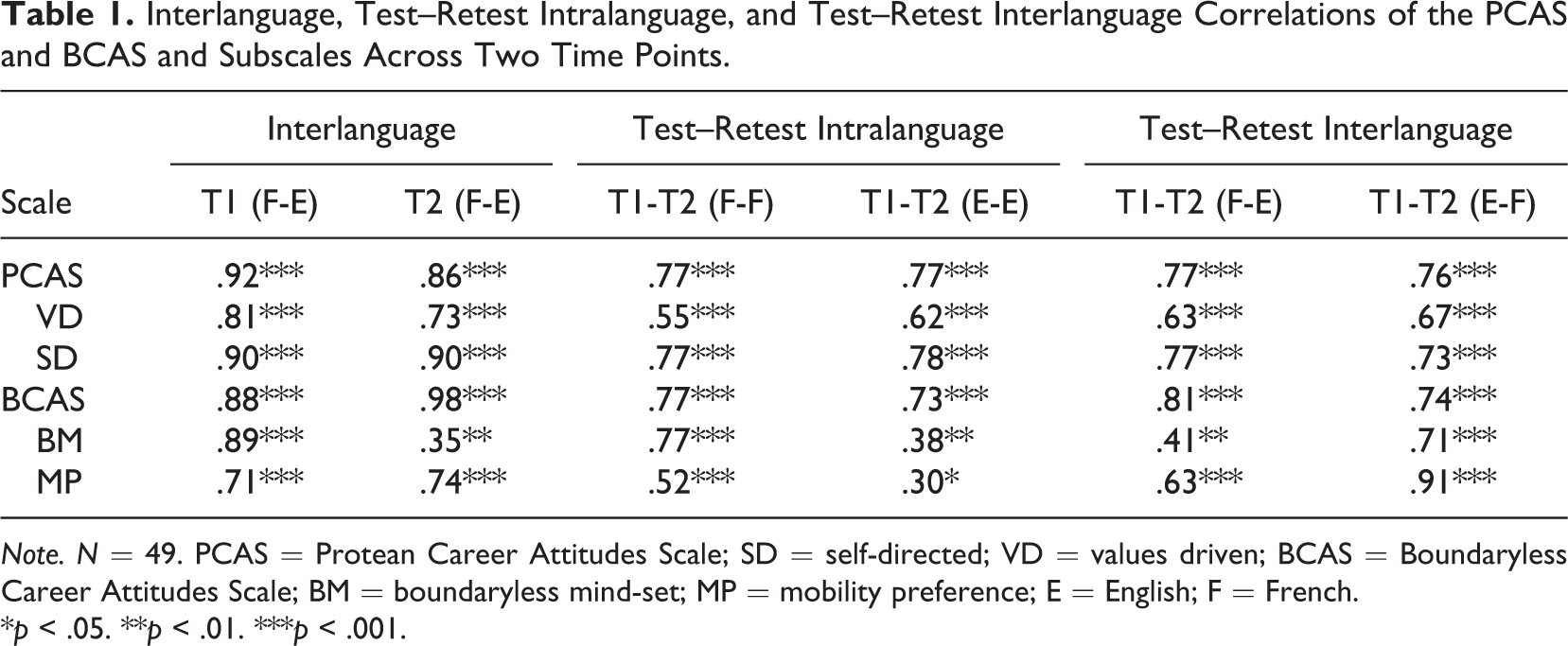
Note. N = 49. PCAS = Protean Career Attitudes Scale; SD = self-directed; VD = values driven; BCAS = Boundaryless Career Attitudes Scale; BM = boundaryless mind-set; MP = mobility preference; E = English; F = French.
*p < .05. **p < .01. ***p < .001.
Factorial Validity and Reliability in the Validation Sample
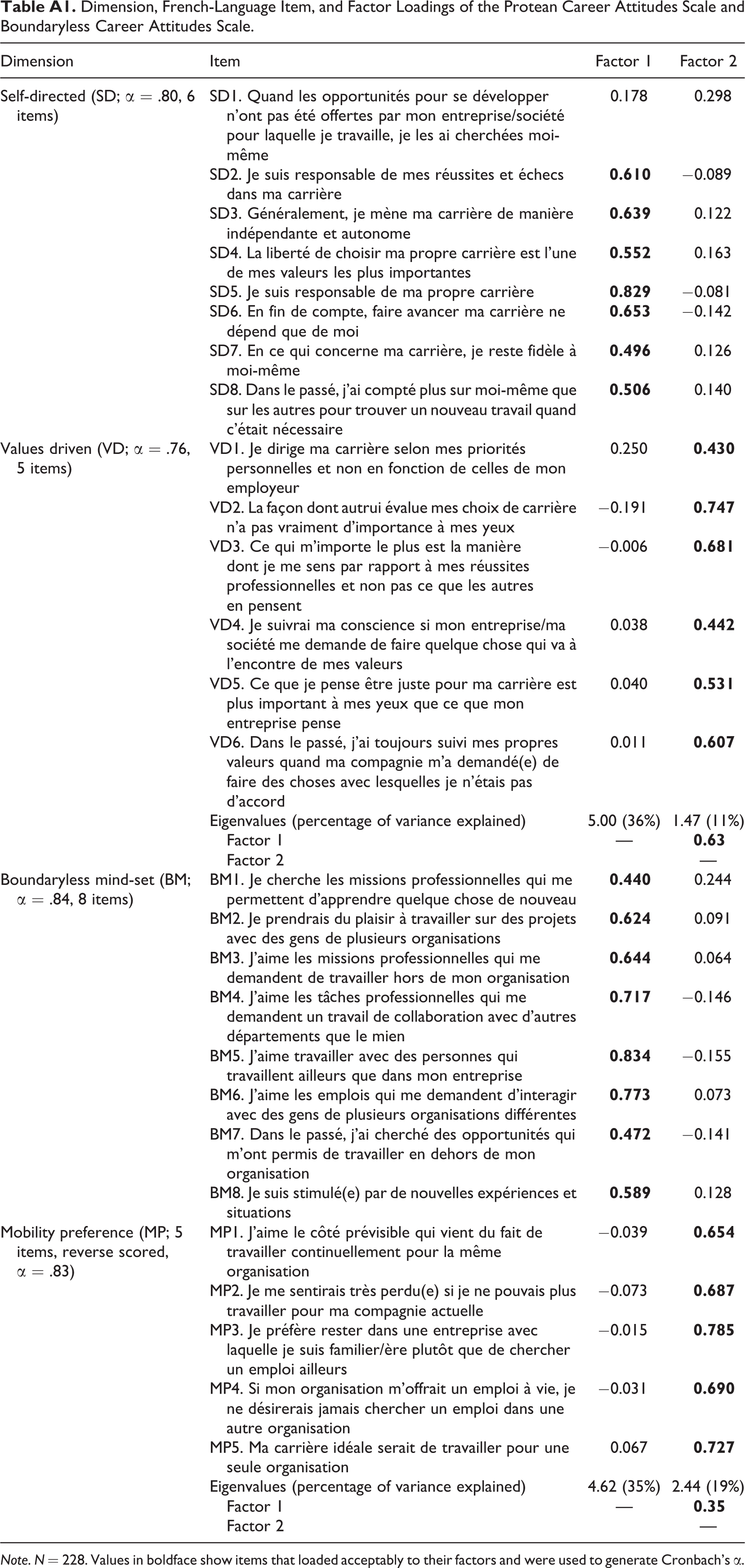
Examination of the extract eigenvalues obtained from the random correlation matrix in parallel analysis suggested retaining two factors for both protean and boundaryless scales. In addition, the scree plot confirmed a two-factor solution. The principal axis factoring with promax rotation for both protean and boundaryless scales restricted to two factors, yielding Kaiser–Myer–Olkin indices of .87 and .82, respectively, and a significant Bartlett’s test of sphericity (p < .001). This indicated good sample adequacy for factor analysis. Appendix Table A1 shows factor loadings for the two-factor solution and corresponding items. Cronbach’s αs calculated on retained items were satisfactory. These results confirmed Hypothesis 2 that this French-language translation would reproduce the two-factor structure of the constructs and achieve acceptable internal reliability coefficients.
EFA and CFA analyses yielded satisfactory results concerning the internal consistency, test–retest reliability, and structure validity of the scales, showing the adequacy of the French-language scales to measure protean and boundaryless career orientations (Hypotheses 1 and 2), further supporting Briscoe and colleagues’ (2006) validity study.
Study 2: CFA and Construct Validity
We aim to contribute to the explanatory utility of career adaptability to career satisfaction in the current career context through our process model. We framed protean and boundaryless career orientations as relatively stable career preferences that encompass beliefs, values, and attitudes that might influence career satisfaction, a general measure of subjective career success. We expect that career adaptability will explain the positive relationship between protean and boundaryless career orientations and career satisfaction. Personality traits may have some direct impact on state variables, such as career satisfaction, through the activation of self-regulatory processes, such as career adaptability. We postulate that some personality profiles can indirectly increase or decrease career satisfaction through increasing or decreasing career adaptability.
Method
Participants
Undergraduate students enrolled in a research methods class invited participants to take part in the study via e-mail or by posting invitations on a social networking site (i.e., Facebook). The survey invitation contained a brief description of the purpose of the study and a link to the questionnaire. The survey opened to a consent form describing the study in generalities and assuring anonymity and confidentiality. Each participant generated a personal identification number to give consent. The consent page informed participants that they could withdraw from the study at any time and that they could receive personalized feedback on their career profile if desired. The survey took participants about 20 min to complete. Because the sampling strategy cast a wide net for potential participants, the response rate cannot be precisely estimated. However, among the 333 individuals who started the questionnaire, only 234 (70%) who completed the entire survey were considered in the analysis.
This sample of 234 employees was bimodally distributed, where two thirds of the participants were from 16 to 35 years of age and one third from 36 to 65 years of age (M age = 35.62, SD = 13.27) from the French-speaking region of Switzerland. More than half of them were women (n = 129, 55%), and the majority was Swiss (87%). The majority reported working full time (73%); 39% were employed in the public sector, 55% worked in the private sector, and the remaining 6% were self-employed. The participants had worked an average of 8.97 years (SD = 5.00) with an organizational tenure of 6.99 years (SD = 3.00). Educationally, 5% completed only mandatory secondary school (11 years, ending at 15 years of age), 37% achieved a vocational education qualification thereafter, 9% a high school diploma, 5% a professional training/national certification qualification (i.e., brevet fédéral), 19% a bachelor’s degree, 21% a master’s degree, and 4% a doctoral degree. To better understand the Swiss educational context, 66% of students pursue vocational education after mandatory schooling. In 2015, an average of 14% completed vocational education training, 20% a high school diploma, and slightly greater than 33% requirements for entry into tertiary programs (Office Fédéral de la Statistique, 2017).
Measures
In Study 2, we employed the newly validated PCAS and BCAS from Study 1 and the following validated French-language instruments.
Career adaptability
We used the validated 12-item French-language version of the CAAS–Short Form (CAAS-SF; Maggiori, Rossier, & Savickas, 2017), consisting of four subscales with 3 items each measuring concern (e.g., “Thinking about what my future will be”), control (e.g., “Making decisions by myself”), curiosity (e.g., “Looking for opportunities to grow as a person”), and confidence (e.g., “Taking care to do things well”) on a 5-point Likert-type scale (1 = strongly disagree, 5 = strongly agree). Maggiori, Rossier, and Savickas (2017) reported Cronbach’s αs for concern, control, curiosity, and confidence of .81, .82, .77, and .83, respectively. The overall CAAS-SF score achieved a Cronbach’s α of .90.
Proactive personality
We used a validated French version (Laberge, 2004) of the Proactive Personality Scale–Short Form (PPS-SF; Bateman & Crant, 1993), consisting of 10 items (e.g., “I excel at identifying opportunities”) on a 7-point Likert-type scale (1 = strongly disagree, 7 = strongly agree). Bateman and Crant (1993) reported Cronbach’s αs of .89, .87, and .87 for the overall scores across three samples and Laberge (2004) reported Cronbach’s α of .82 in her overall sample.
Career satisfaction
We used the validated 5-item French version (Bravo-Bouyssy, 2005) of the Career Satisfaction Scale (CSS; Greenhaus, Parasuraman, & Wormley, 1990) to assess the degree to which employees felt satisfied with their career. Respondents indicated their agreement on career success, career progress, income, promotion, and development of skills using a 5-point Likert-type scale (1 = strongly disagree, 5 = strongly agree). An example item is, “I am satisfied with the progress I have made toward meeting my overall career goals.” In a sample of 1,628 managers, Greenhaus, Parasuraman, and Wormley (1990) reported a Cronbach’s α of .88.
Analyses
The protean and boundaryless two-factor model were then subjected to CFA using Mplus Version 7 (Muthén & Muthén, 1998–2012) and the maximum likelihood estimator and compared to alternative factor models. For factor identification, we fixed the coefficient of each first item to 1. Several fit indices were used to evaluate model fit (Hu & Bentler, 1999): χ2, the root mean square error of approximation (RMSEA), the standardized root mean square residual (SRMR), the comparative fit index (CFI), and the Tucker–Lewis index (TLI). To be considered good, RMSEA and SRMR model fit indices needed values of <.08, CFI and TLI of >.95, and χ2 per degree of freedom ≤3.
Hypothesis 4 was tested using descriptive and correlation analyses, and simple and hierarchical linear regressions were performed to test Hypotheses 5 and 6, respectively. To test Hypothesis 7, we conducted a bias-corrected mediation analysis following the bootstrapping approach with 1,000 bootstrapping samples using the PROCESS procedure (Version 2.14; Hayes, 2013). With this approach, we could evaluate specific direct and indirect effects on relationships between protean and boundaryless career orientations on career satisfaction through career adaptability.
Results
Structural Validity
We compared the protean and boundaryless two-factor models separately with a one-factor model including all items. The χ2 results presented in Table 2 generally show that the two-factor models provided a better factorial solution than the one-factor models for both protean and boundaryless scales. For the two-factor models, a better fit to the data was achieved when error terms with a modification index of higher than 20 were allowed to covary. Specifically, the CFA indexes for the PCAS reached good fit after having introduced error term covariations between Items VD2 and VD3 and between VD4 and VD6 (see Figure 1). Similarly, two error term covariations were necessary to reach good fit indexes on the BCAS: between Items BM1 and BM8 and between Items MP4 and MP5 (see Figure 2).
Fit Indices of CFA Models for Protean and Boundaryless Career Attitudes Scales.
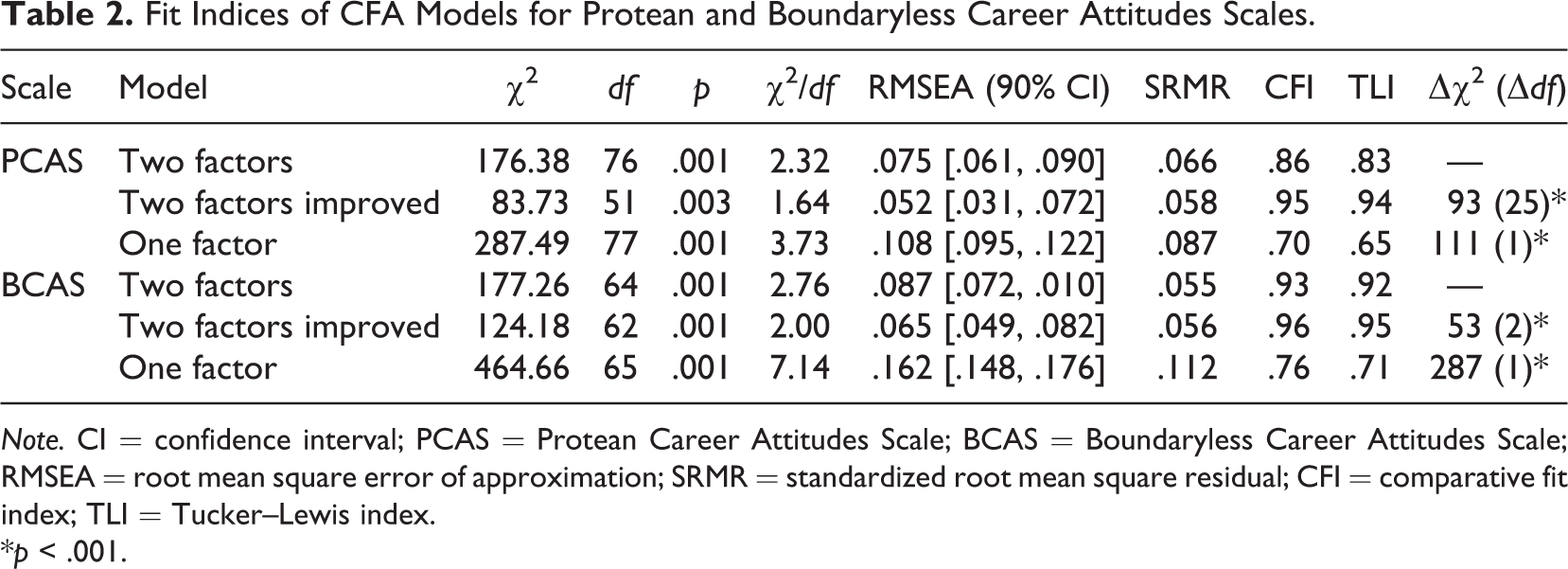
Note. CI = confidence interval; PCAS = Protean Career Attitudes Scale; BCAS = Boundaryless Career Attitudes Scale; RMSEA = root mean square error of approximation; SRMR = standardized root mean square residual; CFI = comparative fit index; TLI = Tucker–Lewis index.
*p < .001.
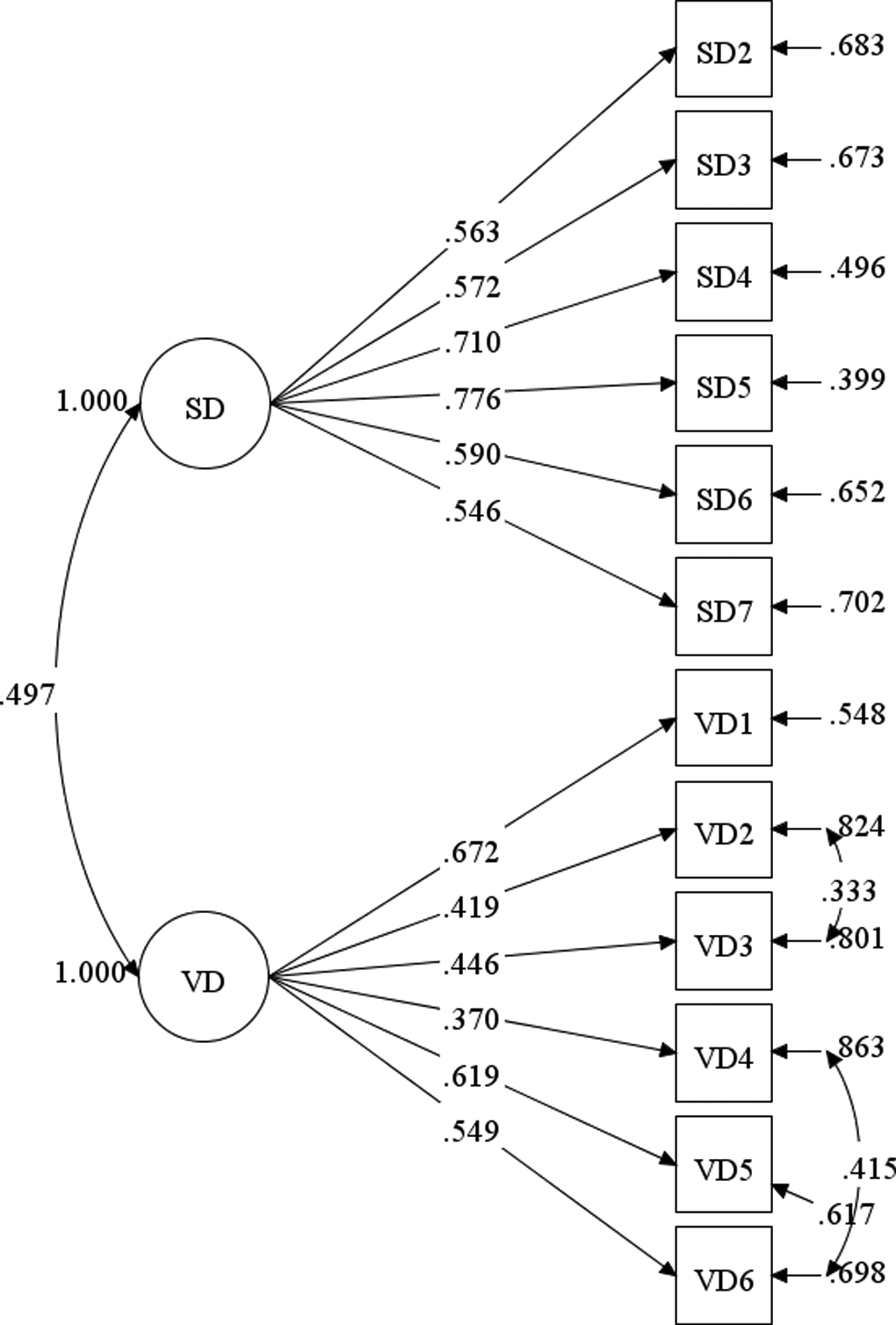
Standardized coefficients of the improved Protean Career Attitudes Scale structure. The confirmatory factor analysis indexes reached good fit after two error term covariations were introduced between Items VD2 and VD3 and between VD4 and VD6. Those items measure the same dimension (i.e., the Values-Driven Scale). Items SD1 and SD8 did not perform well and were, therefore, not retained in this model structure. SD = self-directed; VD = values driven.

Standardized coefficients of the improved Boundaryless Career Attitudes Scale structure. Two error terms covariations were necessary to reach good fit indexes concerning the Boundaryless Career Attitudes Scale between Items BM1 and BM8 and between Items MP4 and MP5. BM = boundaryless mind-set; MP= mobility preference.
Descriptive Analyses
Table 3 presents descriptive statistics, gender effect sizes, age point–biserial correlations, internal consistencies, skewness, and kurtosis for all measurements. Table 4 presents correlations between the PCAS, BCAS, PPS, CAAS-SF, and CSS subscales. These results partially confirm Hypothesis 4. Although protean career orientation, career adaptability, proactive personality, and career satisfaction were positively related, boundaryless career orientation was only significantly correlated with career adaptability and proactive personality. Correlations between PCAS, BCAS, and CAAS-SF subscales provide greater insight into the relative importance of each subscale in these relationships. Results indicate moderate positive relationships (r ≥ .30) between the control subscale and all of the PCAS subscales, and between the confidence and SD subscales. Additionally, similar correlations were found between the CAAS-SF and the BCAS, and the CAAS-SF and the BM subscale.
Descriptive Statistics.
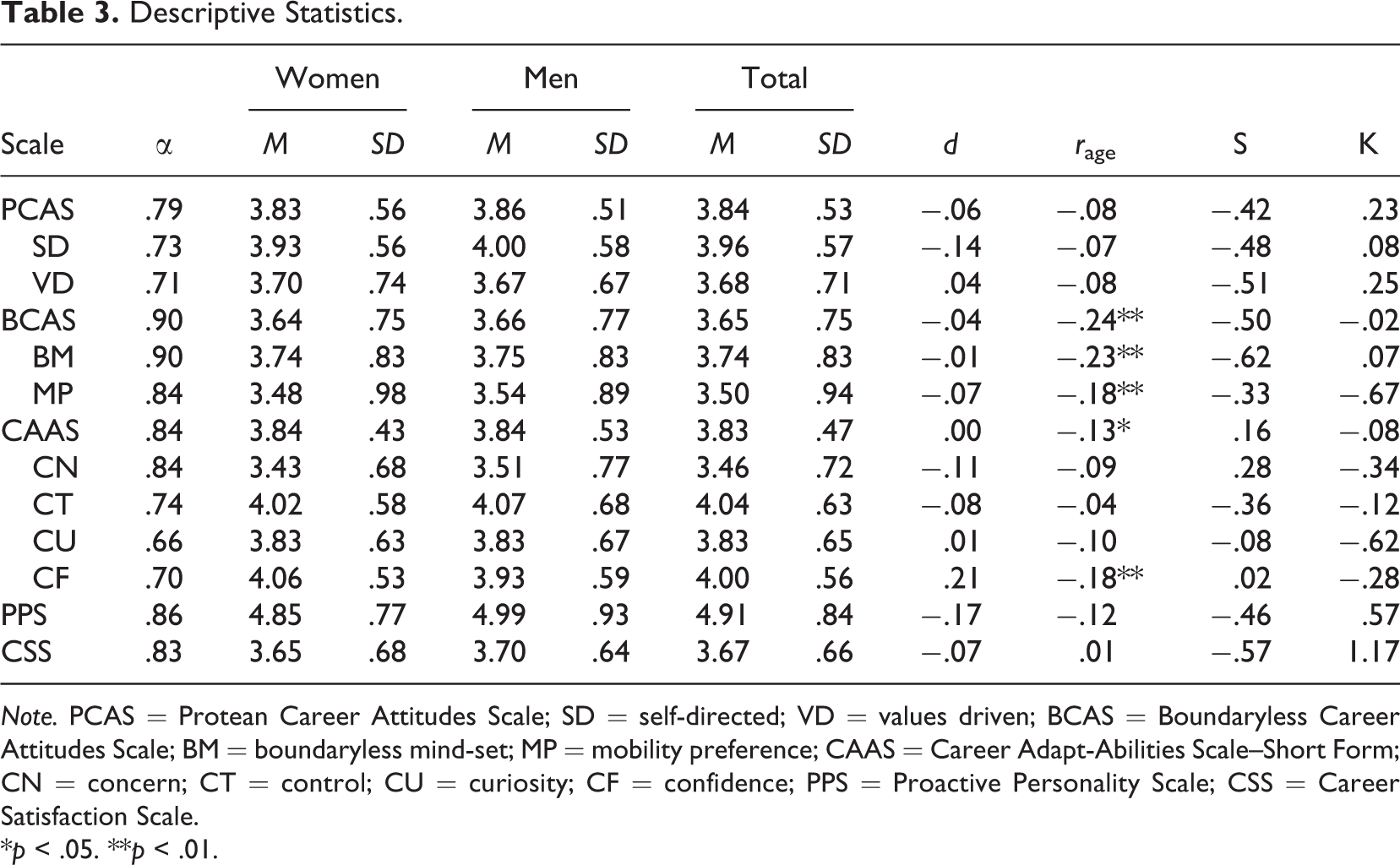
Note. PCAS = Protean Career Attitudes Scale; SD = self-directed; VD = values driven; BCAS = Boundaryless Career Attitudes Scale; BM = boundaryless mind-set; MP = mobility preference; CAAS = Career Adapt-Abilities Scale–Short Form; CN = concern; CT = control; CU = curiosity; CF = confidence; PPS = Proactive Personality Scale; CSS = Career Satisfaction Scale.
*p < .05. **p < .01.
Correlations Among Protean and Boundaryless Career Orientations, Career Adapt-Abilities, Proactive Personality, and Career Satisfaction.

Note. PCAS = Protean Career Attitudes Scale; SD = self-directed; VD = values driven; BCAS = Boundaryless Career Attitudes Scale; BM = boundaryless mind-set; MP = mobility preference; CAAS = Career Adapt-Abilities Scale–Short Form; CN = concern; CT = control; CU = curiosity; CF = confidence; PPS = Proactive Personality Scale; CSS = Career Satisfaction Scale.
*p < .05. **p < .01. ***p < .001.
Validity and Reliability
The structural validity of both the PCAS and the BCAS was tested in Study 1 using EFA in a sample of students and then confirmed in Study 2 using structural equation modeling in a sample of employees. We found strong psychometric support for both the French-language translations of these scales (see Appendix Table A1, Figures 1 and 2). EFA criteria supported the two-factor structure of both scales. However, Items SD1 and SD8 of the PCAS, the only ones worded in past tense, remained problematic in terms of factor contribution and representativeness. CFA yielded acceptable fit indices, close to good for the improved PCAS model and good for the improved BCAS model, showing evidence that the items appropriately measured the hypothesized constructs. Finally, Cronbach’s αs of the subscales were satisfactory, supporting the internal consistencies of both the PCAS and the BCAS.
Regression and Mediation Analyses
Simple linear regression analyses indicated that proactive personality significantly predicted both protean, F(1, 232) = 51.78, β = .43, p < .001, R 2 =.18, and boundaryless, F(1, 232) = 44.39, β = .40, p <.001, R 2 =.16, career orientations. After controlling for age, gender, and education, hierarchical regression analyses showed that protean (β = .25) and boundaryless (β = −.09) orientations significantly explained variance in career satisfaction beyond career adaptability, ΔR 2 = .05, ΔF(2, 227) = 7.13, p = .001. These results supported our hypothesis. However, only protean career orientation explained incremental variance over career satisfaction. Boundaryless career orientation did not positively impact career satisfaction when controlling for career adaptability.
We built a process model (Figure 3) to explore career adaptability as a mediator between protean and boundaryless orientations and career satisfaction. Results partially confirmed this mediating role; protean and boundaryless orientations still directly impact career satisfaction, although the bootstrap lower and upper interval confidents of indirect coefficients do not include a value of zero (see Table 5). Taken together, these results confirmed that proactive personality would predict protean and boundaryless career orientations (Hypothesis 5), that protean and boundaryless orientations would predict career satisfaction beyond the effect of career adaptability (Hypothesis 6), and that career adaptability would mediate the relationship, albeit partially, between protean and boundaryless orientations and career satisfaction (Hypothesis 7).
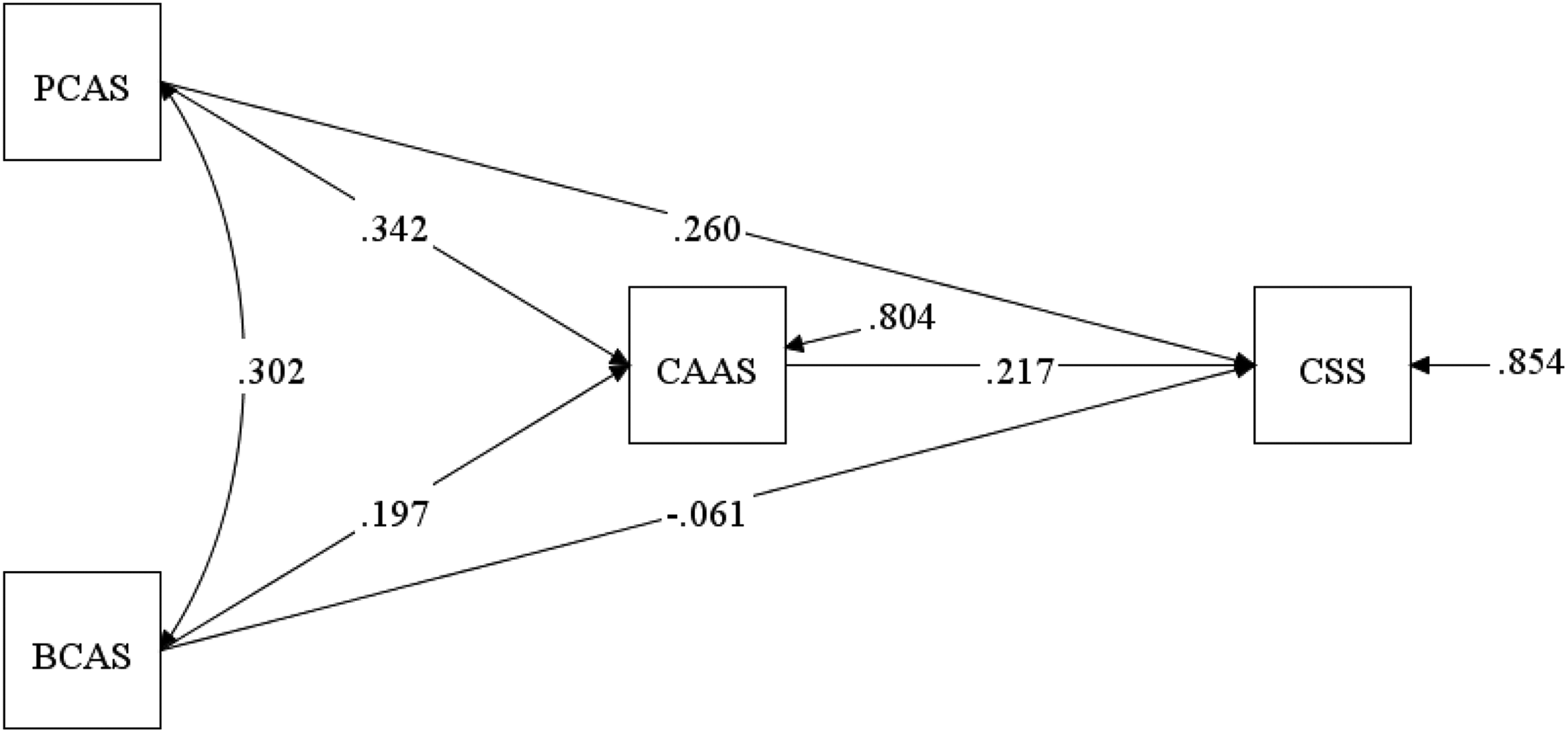
Standardized and significant coefficients of the process model in which career adaptability (Career Adapt-Abilities Scale–Short Form [CAAS-SF]) as a self-regulation process mediates the relationship between protean and boundaryless career orientations (Protean Career Attitudes Scale [PCAS] and Boundaryless Career Attitudes Scale [BCAS]) as relatively stable career preferences and career satisfaction (Career Satisfaction Scale [CSS]) as a general measure of subjective career success. Protean and boundaryless orientations significantly explained 20% of the variance in career adaptability. Additionally, protean and boundaryless orientations, mediated by adaptability, significantly explained 15% of the variance in career satisfaction.
Direct and Indirect Effects of Various Mediation Models on Career Satisfaction, Using PROCESS.
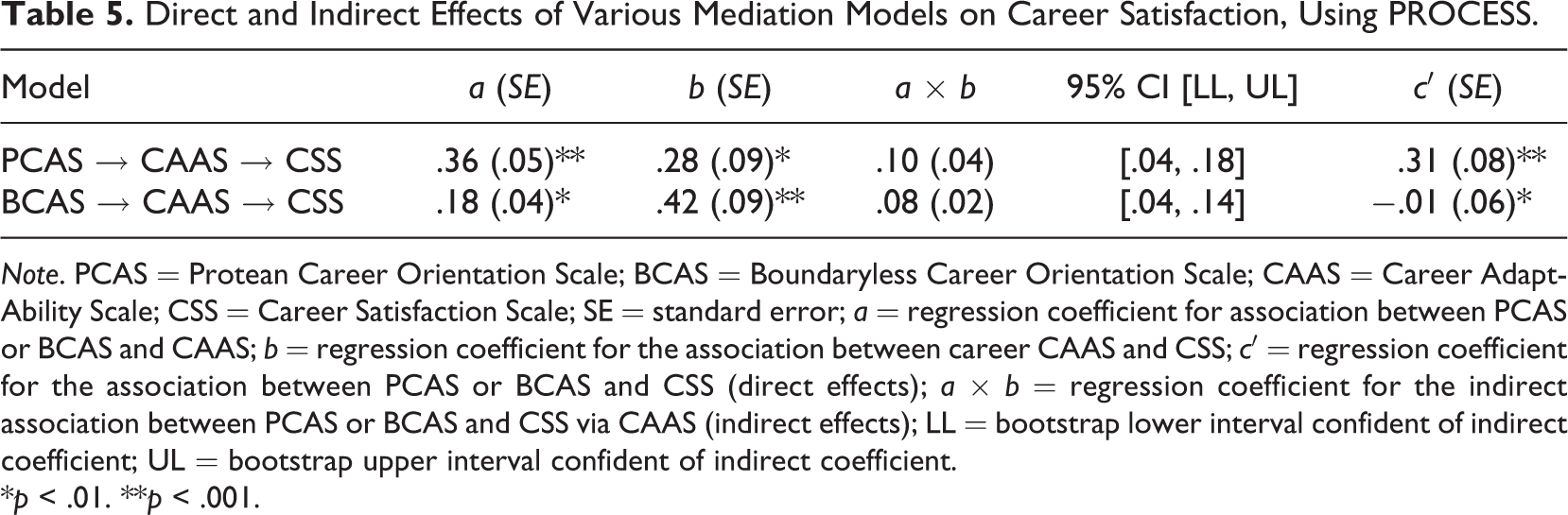
Note. PCAS = Protean Career Orientation Scale; BCAS = Boundaryless Career Orientation Scale; CAAS = Career Adapt-Ability Scale; CSS = Career Satisfaction Scale; SE = standard error; a = regression coefficient for association between PCAS or BCAS and CAAS; b = regression coefficient for the association between career CAAS and CSS; c′ = regression coefficient for the association between PCAS or BCAS and CSS (direct effects); a × b = regression coefficient for the indirect association between PCAS or BCAS and CSS via CAAS (indirect effects); LL = bootstrap lower interval confident of indirect coefficient; UL = bootstrap upper interval confident of indirect coefficient.
*p < .01. **p < .001.
General Discussion
Over the last two decades, scholars have proposed several career frameworks in attempts to capture changes occurring in the global world of work and career literature (Sullivan & Baruch, 2009). Contemporary careers researchers brought protean and boundaryless career orientations to the forefront to highlight individuals’ predominant role in choosing and managing their own careers. Individuals have been called to develop a sense of career adaptability to successfully navigate their own careers, making this meta-capacity a key component in modern career development and subjective career success.
The twofold aim of this research was to provide a French-language translation for the PCAS and BCAS and to empirically investigate relationships among protean and boundaryless career orientations, proactive personality, career adaptability, and career satisfaction. The results provided strong psychometric validity for the PCAS and BCAS translations, partially or fully confirming most of our hypotheses. In addition, results showed comparable structural patterns to the original version (Briscoe et al., 2006), the German version (Volmer & Spurk, 2011), and the Spanish version (Enache, González, Castillo, & Lordan, 2012). Similarly, slight adjustments had to be made to achieve better fit for the CFA models on the French- and Spanish-language versions, especially for the VD subscale. De Bruin and Buchner (2010) and Enache, González, Castillo, and Lordan (2012) found two factors on this subscale. It is possible that this dimension is contextually sensitive, and national or cultural values may impact the way people understand and respond to items.
Our findings demonstrated that career adaptability mediates the positive relationship of protean and boundaryless orientations to career satisfaction. These results suggest that protean and boundaryless careerists are satisfied with their career direction because they have developed psychological resources to cope with occupational challenges. Therefore, it is useful to consider career adaptability as a process in contemporary careers (Chan et al., 2015). Furthermore, we found significant positive relationships among the four constructs of protean and boundaryless orientations, career adaptability, and career satisfaction and, thus, confirmed what previous researchers posited (e.g., Cao, Hirschi, & Deller, 2013; Chan et al., 2015; Hirschi, 2009).
Limitations and Future Research
This research has limitations that may affect the generalizability of the results. First, the samples may not be representative of a working-adult population. Students comprised the validation sample in Study 1. Study 2 participants were relatively inexperienced, with about 7(±3) years’ tenure. This may explain why Items SD1 and SD8, written in past tense, did not perform well: Participants may not have had sufficient past perspective to answer accurately, or something was lost in the translation. Thus, researchers should seek a broader sample of workers at different career stages (early, mid, and late) with different backgrounds and work tenures.
Second, our research design was cross-sectional. Hence, the observed effects should not be taken as causal relationships. Longitudinal research designs are needed to investigate potential causal relationships among these variables. Notably, longitudinal studies could better respond to our and others’ assertions that individual characteristics, such as protean and boundaryless orientations and proactive personality, are stable across time, or how they change over time if they are not. Longitudinal studies may also test the potential contextual effects of career adaptability’s mediation role, for example, during professional transitions.
Finally, we used career adaptability as a mediator, but we did not evaluate alternative models using protean and boundaryless orientations as mediators. Protean and boundaryless orientations, together, may explain the positive relationship of career adaptability to career satisfaction, and future research could explore this. The relationship between protean orientation and career satisfaction depends largely on each scale’s dimensions, and further exploring these connections could provide a promising next step in this line of research.
Despite these limitations, researchers may benefit by adapting our model or testing new models to enhance understanding on how contemporary workers meaningfully carry out their careers. Career practitioners may use these findings to help their clients with career concerns.
Implications for Career Counseling Practice
Understanding more about clients’ career adaptability can clarify how exhibiting protean or boundaryless characteristics may influence their career satisfaction. Adaptability concepts could be useful in considering how clients could be helped toward increasing protean and boundaryless orientations and, therefore, experiencing greater career satisfaction. These concepts can work together seamlessly to help career counselors in treatment planning and implementation with clients. Exploring how clients set their career goals, how they respond to environmental controls and conditions, and which rewards are the most meaningful to them allows career counselors to co-construct meaningful interventions with their clients.
Career counselors can assess how their clients’ levels of adaptability resources (concern, control, curiosity, and confidence) may be useful in processing issues of work dissatisfaction from protean and boundaryless perspectives. Given that protean and boundaryless individuals are naturally concerned with planning their careers, career counselors can explore their values with them and how their current work situation(s) help them to meet their career goals and initiatives or not. Where work situations limit client mobility or fail to support client needs or goals, career counselors can help clients better understand what the work situations do offer them or to take a more proactive approach in exploring other situations to seek greater career satisfaction. When clients can create their own work environment or can have proactive influence over that environment, they are more likely to increase their sentiment of career satisfaction and success.
Exploring the resources that are present within current employment situations may help clients find more personal and intrinsic motivation to continue in that work. Counselors could encourage clients to take control of their needs and negotiate with their employers if leaving the company would not be possible or desirable for financial or family relocation reasons. Alternatively, if leaving is an option, counselors could help clients to increase client confidence in searching for other positions with another company that may be better able to help them meet their career needs and goals, thereby focusing their intervention on increasing clients’ physical mobility. Finally, career counselors can appeal to clients’ curiosity in considering how to apply their skill set in different professions or volunteer experiences and exploring the transferability of their skills to different domains, thereby exhibiting higher physical and psychological mobility.
Clients who exhibit fewer protean and boundaryless characteristics may also be able to increase career satisfaction through career counseling to increase their adaptability resources or be more proactive in their approach to seeking subjective career satisfaction. Boosting protean orientation, by helping the client to be more self-directed and less reliant on others in their perceptions, thereby guiding them to action steps (Briscoe & Hall, 2006), may be achieved by building clients’ confidence in themselves through exploring how they can solve their career dilemmas in ways that are consistent with their personal values. Helping clients realize that they take more proactive control over their perceptions and what they are willing to endure in a work environment can be liberating. Inspiring their curiosity through career-related website exploration and discussion about the transferability of their skill set to other jobs or fields can help clients begin to be more open-minded about a myriad of options available to them, including what they could negotiate in their current position. This open-mindedness may help increase their concern for their vocational future and encourage them to take steps toward planning alternative routes to career success, either physically, through job or career change, or psychologically, through (re)defining their own criteria for success. This (re)definition may include boosting proactivity through networking or persevering in face of difficulties (Seibert et al., 1999).
Conclusions
Individuals with protean and boundaryless attitudes are more adaptable in their thinking and ability to leverage psychological and systemic resources to meet the demands of their vocational challenges and environments. In this study, adaptability, acting as a mediator, was useful in understanding the career satisfaction of protean- and boundaryless-oriented individuals. Better psychometric understanding of this relationship can help career counselors translate client scores on validated instruments into meaningful treatment plans and co-constructed interventions. These interventions can be tailored to help clients increase adaptability, protean, boundaryless, or proactive personality characteristics to encourage greater self-determination in their career paths and greater career satisfaction outcomes.
Footnotes
Appendix
Dimension, French-Language Item, and Factor Loadings of the Protean Career Attitudes Scale and Boundaryless Career Attitudes Scale.
| Dimension | Item | Factor 1 | Factor 2 |
|---|---|---|---|
| Self-directed (SD; α = .80, 6 items) | SD1. Quand les opportunités pour se développer n’ont pas été offertes par mon entreprise/société pour laquelle je travaille, je les ai cherchées moi-même | 0.178 | 0.298 |
| SD2. Je suis responsable de mes réussites et échecs dans ma carrière |
|
−0.089 | |
| SD3. Généralement, je mène ma carrière de manière indépendante et autonome |
|
0.122 | |
| SD4. La liberté de choisir ma propre carrière est l’une de mes valeurs les plus importantes |
|
0.163 | |
| SD5. Je suis responsable de ma propre carrière |
|
−0.081 | |
| SD6. En fin de compte, faire avancer ma carrière ne dépend que de moi |
|
−0.142 | |
| SD7. En ce qui concerne ma carrière, je reste fidèle à moi-même |
|
0.126 | |
| SD8. Dans le passé, j’ai compté plus sur moi-même que sur les autres pour trouver un nouveau travail quand c’était nécessaire |
|
0.140 | |
| Values driven (VD; α = .76, 5 items) | VD1. Je dirige ma carrière selon mes priorités personnelles et non en fonction de celles de mon employeur | 0.250 |
|
| VD2. La façon dont autrui évalue mes choix de carrière n’a pas vraiment d’importance à mes yeux | −0.191 |
|
|
| VD3. Ce qui m’importe le plus est la manière dont je me sens par rapport à mes réussites professionnelles et non pas ce que les autres en pensent | −0.006 |
|
|
| VD4. Je suivrai ma conscience si mon entreprise/ma société me demande de faire quelque chose qui va à l’encontre de mes valeurs | 0.038 |
|
|
| VD5. Ce que je pense être juste pour ma carrière est plus important à mes yeux que ce que mon entreprise pense | 0.040 |
|
|
| VD6. Dans le passé, j’ai toujours suivi mes propres valeurs quand ma compagnie m’a demandé(e) de faire des choses avec lesquelles je n’étais pas d’accord | 0.011 |
|
|
| Eigenvalues (percentage of variance explained) | 5.00 (36%) | 1.47 (11%) | |
| Factor 1 | — |
|
|
| Factor 2 | — | ||
| Boundaryless mind-set (BM; α = .84, 8 items) | BM1. Je cherche les missions professionnelles qui me permettent d’apprendre quelque chose de nouveau |
|
0.244 |
| BM2. Je prendrais du plaisir à travailler sur des projets avec des gens de plusieurs organisations |
|
0.091 | |
| BM3. J’aime les missions professionnelles qui me demandent de travailler hors de mon organisation |
|
0.064 | |
| BM4. J’aime les tâches professionnelles qui me demandent un travail de collaboration avec d’autres départements que le mien |
|
−0.146 | |
| BM5. J’aime travailler avec des personnes qui travaillent ailleurs que dans mon entreprise |
|
−0.155 | |
| BM6. J’aime les emplois qui me demandent d’interagir avec des gens de plusieurs organisations différentes |
|
0.073 | |
| BM7. Dans le passé, j’ai cherché des opportunités qui m’ont permis de travailler en dehors de mon organisation |
|
−0.141 | |
| BM8. Je suis stimulé(e) par de nouvelles expériences et situations |
|
0.128 | |
| Mobility preference (MP; 5 items, reverse scored, α = .83) | MP1. J’aime le côté prévisible qui vient du fait de travailler continuellement pour la même organisation | −0.039 |
|
| MP2. Je me sentirais très perdu(e) si je ne pouvais plus travailler pour ma compagnie actuelle | −0.073 |
|
|
| MP3. Je préfère rester dans une entreprise avec laquelle je suis familier/ère plutôt que de chercher un emploi ailleurs | −0.015 |
|
|
| MP4. Si mon organisation m’offrait un emploi à vie, je ne désirerais jamais chercher un emploi dans une autre organisation | −0.031 |
|
|
| MP5. Ma carrière idéale serait de travailler pour une seule organisation | 0.067 |
|
|
| Eigenvalues (percentage of variance explained) | 4.62 (35%) | 2.44 (19%) | |
| Factor 1 | — |
|
|
| Factor 2 | — |
Note. N = 228. Values in boldface show items that loaded acceptably to their factors and were used to generate Cronbach’s α.
Acknowledgments
The authors wish to gratefully acknowledge Dr. Christina Györkös and Dr. Claire S. Johnston for their expertise in the back-translation and translation verification processes.
Declaration of Conflicting Interests
The author(s) declared no potential conflicts of interest with respect to the research, authorship, and/or publication of this article.
Funding
The author(s) received no financial support for the research, authorship, and/or publication of this article.