



Abstract
A Rasch validation was performed on the Tims, Bakker, and Derks’s Job Crafting Scale (JCS) in the South African working context. The JCS, which has been linked to employee well-being and career-related outcomes, continues to be the most widely used measure of job crafting behavior. Data obtained from the JCS generally showed good fit to the Rasch model. Four items were flagged during the analysis for displaying misfit (1 item) or differential item functioning (3 items), warranting further research attention. The study disclosed the dimensionality of the JCS, the hierarchical ordering and fit of the items, the functionality of the response format, and the ability of the JCS to measure invariantly across men and women, yielding new and interesting insights into the psychometric properties of the scale. The study contributes to research concerning the validity of the JCS in a non-European context, particularly through the use of Rasch analysis as a validation technique.
Employee well-being plays a critical role in the success and longevity of an organization and the employee’s ability to function in the workplace. While traditionally it was thought that the well-being of employees was the sole responsibility of the organization, modern times suggest that the job incumbent plays just as important a role in fostering their own well-being as does the organization for which they work (Slemp & Vella-Brodrick, 2014; Tims, Bakker, & Derks, 2013). A particular type of employee behavior that has come under interest in this regard, and which positively influences the work-related well-being of employees, is job crafting.
Wrzesniewski and Dutton (2001) originally defined job crafting as “the physical and cognitive changes individuals make in the task or relational boundaries of their work” (p. 179). Despite the growing body of literature that recognizes the importance of job crafting behavior in promoting the work-related well-being of employees (Berg, Dutton, & Wrzesniewski, 2013; Tims et al., 2013; Vogt, Hakanen, Brauchli, Jenny, & Bauer, 2016) and their career-related development, skills, and capacities (Plomp et al., 2016), there remains a paucity of empirical investigations that focus explicitly on the design of the instruments used to capture such organizational behavior, specifically in non-European contexts such as South Africa.
Accordingly, the aim of this study is to investigate and report on the psychometric properties of the most widely used measure of job crafting behavior, namely, the Job Crafting Scale (JCS; Tims, Bakker, & Derks, 2012). To date, the JCS has not undergone any rigorous psychometric evaluations nor has it been subjected to any advanced statistical validation techniques. Existing research, using traditional exploratory and confirmatory factor analytic approaches, merely reports on the factor structure and reliability of the scale as well as the various types of construct validity that it has (e.g., Chinelato, Ferreira, & Valentini, 2015; De Beer, Tims, & Bakker, 2016). The present study provides a more detailed analysis of the JCS by adopting what Tennant, Mckenna, and Hagell (2004) refer to as a more modern psychometric approach, which presents itself in the form of Rasch measurement model applications (Rasch, 1960). Tennant and Conaghan (2007) state that the Rasch measurement model is now firmly established as the standard for modern psychometric evaluations of outcome scales [and] performing Rasch analysis provides a powerful tool for bringing together key issues such as unidimensionality, category ordering, and DIF [differential item functioning] within the framework of measurement science. (p. 1361)
The value of applying the Rasch measurement model in investigating the psychometric properties of the JCS cannot be overstated. First and foremost, Iramaneerat, Smith, and Smith (2008) note that observations of phenomena (e.g., job crafting) in the social sciences are commonly made on ordinal scales, making them inappropriate for parametric statistical testing due to the nonlinearity of the data. Thus, prior to evaluating the performance of a measurement instrument that uses an ordinal scale, such as the JCS, it is important that the raw ordinal data be transformed to linear (equal interval) measures, as working with ordinal (nonlinear) data may lead to inaccurate statistical conclusions being made (Boone, Staver, & Yale, 2014). The Rasch measurement model provides a powerful tool for transforming ordinal data into linear equal-interval measures (Fisher, 1995; Linacre, 2016a), allowing for more accurate statistical interpretations to be made. Secondly, by subjecting the JCS to a Rasch analysis, a number of key measurement issues that have not yet been reported on to date may be uncovered, including but not limited to the hierarchical ordering of the scale items, the suitability of the rating scale, and the degree to which the items work invariantly across men and women.
Conceptualizing Job Crafting Behavior
Job crafting, a proactive self-initiated form of workplace behavior, involves employees making changes to certain aspects of their job with the aim of improving the overall fit between their own personal characteristics and the characteristics of the job itself (Berg, Grant, & Johnson, 2010). It is considered proactive in that employees are required to take their own initiative in shaping their job boundaries as opposed to management dictating how the job should be done, which is why job crafting has been referred to as a bottom-up approach to job redesign (Tims & Bakker, 2010). According to Wrzesniewski and Dutton (2001), employees may engage in three forms of job crafting behavior, namely, task, relational, and cognitive crafting. Task crafting involves making changes to the content, scope, or number of tasks one performs; relational crafting involves exercising discretion over the amount of social interaction one engages in at work; and cognitive crafting involves changing the way in which one perceives the job.
Since Wrzesniewski and Dutton first introduced the notion of job crafting, major theoretical advancements have been made in the field that have expanded upon its definition. Accordingly, job crafting can be explained from a job demands-resources (JD-R) theory perspective (Bakker & Demerouti, 2017; Demerouti, Bakker, Nachreiner, & Schaufeli, 2001). The JD-R model postulates that job characteristics can be separated into two distinct categories, job demands and job resources. Job demands (e.g., work pressure, role conflict) are those aspects of the job that are physically, psychologically, and emotionally taxing and which are linked to a number of physiological and psychological costs, whereas job resources (e.g., social support, performance feedback) are those aspects of the job that stimulate personal growth and development and which mitigate the negative effects of job demands (Demerouti et al., 2001). Using the JD-R model as their theoretical basis, Petrou, Demerouti, Peeters, Schaufeli, and Hetland (2012) defined job crafting as the proactive behaviors employees engage in that comprise seeking job resources, seeking job challenges, and reducing job demands. Similarly, Tims, Bakker, and Derks (2015b) referred to job crafting as the self-owned actions that employees use to balance their level of job demands and job resources with their own personal preferences, needs, and abilities. Given the many benefits that it affords employees, job crafting has received considerable research attention over the past decade. Recent longitudinal findings have shown that job crafting can reduce job boredom, increase work engagement, and improve employee performance (Harju, Hakanen, & Schaufeli, 2016; (Tims, Bakker, & Derks, 2015a). Tims, Derks, and Bakker (2016) also found that one can increase their person–job fit through job crafting, while Wrzesniewski and Dutton (2001) state that job crafting can enhance the meaning derived from one’s work.
Gender differences in job crafting behavior
The question of whether men and women engage differently in job crafting behavior remains largely unanswered. To our knowledge, only Slemp and Vella-Brodrick (2013) have yielded empirical information in this regard, where they found that working women scored higher on relational crafting than working men. Petrou, Demerouti, and Schaufeli (2016) controlled for gender differences in their study, as they believed that some employees may be more sensitive to adapt to change via job crafting behavior as a result of their gender roles. While little is known about the relationship between gender and job crafting, inferences may be drawn from previous research concerning other forms of organizational behavior. For example, a recent study among Japanese surgeons found that men and women differ in their working styles, with women more likely to work less hours and be part-time employees than men (Kawase et al., 2018). Research has also found that women engage more in organizational citizenship behavior (Cameron & Nadler, 2013), report higher turnover intent (Huffman, Casper, & Payne, 2014), and progress differently in their careers when compared to men (Fernando & Cohen, 2014). Taken together, it is not unreasonable to expect men and women to differ in how they craft their work.
When speculating about gender differences in job crafting behavior, the possible influence of workplace oppression needs to be considered. Not only is oppression of women evident in the workplace (Mujtaba & Sims, 2011) but the circumstances women face in the workplace is often ascribed to a system of oppression (Intemann, 2010). Radhakrishnan (2009), for example, argues that women may compromise their careers to comply with behavioral and social expectations such as performing more feminine and softer job roles (Fernando & Cohen, 2014), taking up care roles in their personal lives (Bosch, Geldenhuys, & Bezuidenhout, 2018), and engaging in more “domestic yielding” and “submissive behavior” (Zaikman & Marks, 2017, p. 409), all of which may pose implications for how women craft their work and feel toward job crafting behavior in general.
The JCS
Tims, Bakker, and Derks (2012) developed the JCS for the purpose of quantitatively measuring job crafting behavior, since at the time, they believed that the job crafting literature was predominantly qualitative in nature and that a generic JCS was lacking to quantify the phenomenon. They conducted three consecutive studies to develop and validate the JCS where aspects such as factor structure, construct validity (i.e., criterion and convergent validity), and scale reliability were explored. The final result was a 21-item scale measuring four independent job crafting dimensions, namely, increasing structural job resources (e.g., “I make sure that I use my capacities to the fullest”), increasing social job resources (e.g., “I ask others for feedback on my job performance”), increasing challenging job demands (e.g., “I regularly take on extra tasks even though I do not receive extra salary for them”), and decreasing hindering job demands (e.g., “I try to ensure that my work is emotionally less intense”). The Cronbach’s α coefficients for the four dimensions ranged from .75 to .82 (Tims et al., 2012). Research has found that increasing job resources and challenging job demands are related to positive work outcomes such as work engagement and job performance (De beer et al., 2016; Tims et al., 2015a), while decreasing hindering job demands is related to negative work outcomes such as coworker conflict and job burnout (i.e., cynicism; Tims et al., 2012; Tims, Bakker, & Derks, 2015b). The JCS employs a 5-point frequency rating scale (i.e., 1 = never, 2 = seldom, 3 = regularly, 4 = often, 5 = very often).
Since its development, the JCS has become the most distinguished measure of job crafting behavior in the organizational behavior literature. Its popularity and high frequency usage among researchers may be attributed to its sound psychometric properties and the fact that it was built upon a solid theoretical framework, namely, the JD-R model (Demerouti et al., 2001). Moreover, unlike other job crafting measures that have been tailored for specific occupations (e.g., Leana, Appelbaum, & Schevchuk, 2009), the JCS provides a generic measure of job crafting that can be applied across different occupations and industries (Tims et al., 2012). With that said, the JCS is most often applied in Western and European contexts, which begs the question of whether the instrument can be used to measure job crafting within the South African context. In their limitations, Tims et al. (2012) noted that all participants in their study were Dutch and resultantly their findings cannot be generalized to other national contexts. They continued to add that it will be fruitful for future researchers to use the JCS in other countries to determine whether the scale works invariantly for different samples that fall outside of the Netherlands, providing good reasoning for our current validation of the JCS in the South African context.
Job crafting in South Africa
Often referred to as the “rainbow nation,” South Africa is a country well-known for its rich ethnic and multicultural diversity. In comparison to the Netherlands that has one official language (i.e., Dutch) and considered to be a feministic society, South Africa is home to a staggering 11 official languages, four main ethnic groups (i.e., Black African [80.2%], White [8.4%], Mixed Race [8.8%], Indian/Asian [2.5%]), and considered to be a predominantly masculine society (Central Intelligence Agency (CIA), 2018; Hofstede Insights, 2018). Despite its potential and wide-spread offerings, job crafting research within South Africa remains in its infancy. Consistent with international findings, however, the few research studies that have been conducted in South Africa have yielded promising findings. For example, De Beer, Tims, and Bakker (2016) found that job crafting predicted job satisfaction among a sample of miners and manufacturers. Peral and Geldenhuys (2016), in a study among high school teachers, found that job crafting was positively related to psychological meaningfulness and work engagement. Lastly, Bell and Njoli (2016) showed that employees’ personality traits have important implications for job crafting behavior.
Research Objective
Extant research concerning the validity of the JCS has all relied upon classical test theory approaches to validation (e.g., Chinelato et al., 2015; De Beer et al., 2016). Moreover, there is little known about the ability of the JCS to measurement invariantly across men and women. Using an item response theory (IRT) approach to validation (van der Linden & Hambleton, 1997), the aim of the research is to determine whether the psychometric properties of the JCS adhere to the parameters imposed by the Rasch (1960) measurement model. We achieve this aim by inspecting the dimensionality of the JCS, the optimality of the 5-point frequency rating scale, the reliability of the instrument, and the degree to which the JCS items measure invariantly across men and women.
Method
Participants
To participate in the study, individuals were required to have a minimum of 1 year’s work experience in a South African organization, have a good command in English, and be willing to participate in the research. The final sample comprised N = 318 working individuals (57% women, 43% men) of which most were full-time employees (90%). In terms of ethnicity, 74% identified themselves as White, 16% as Black/African, and the remaining 10% as either Indian or Mixed Race. English (71%) was the home language predominantly spoken by the participants, followed by Afrikaans (13%) and a variety of other traditional African languages such as IsiZulu (4%), Xitsonga (3%), Sesotho (2%), and isiXhosa (2%). Although the participants spoke a number of different home languages, English is the lingua franca (i.e., common language) for conducting business in South Africa. Therefore, having a sample that consisted of working individuals, we were able to ensure that our participants could answer the survey. Respondents were aged between 22 and 68 years (M = 35.53, SD = 11.30) and had an average organizational tenure of 6 years (SD = 7.26). The sample represented a diverse range of industries such as education, banking, information technology, marketing, and business consulting. With regard to highest education level obtained, 37% held a postgraduate degree (i.e., honor’s, master’s, and doctorate), 21% held a bachelor’s degree, and the remaining participants possessed a matric (16%), diploma (20%), or grade 10 equivalent (5%).
Research Procedure
A quantitative cross-sectional survey design, using Google Forms, was used to recruit the sample. An online survey was created containing a biographical information section as well as the 21-item JCS. The link to the survey was distributed via e-mail to South African working individuals who were within the social and professional networks of the researchers. Key contacts (i.e., CEOs, HR managers) within South African organizations, whose relationships had previously been established, were also e-mailed the link to disseminate among their working staff and to any other working individuals who they thought might be interested (i.e., snowball sampling). To increase the reach of the survey and possible variability in the sample, the link to the survey was posted on a social (Facebook®) and professional (LinkedIn®) networking site that invited individuals to participate. Upon accessing the link, participants encountered a preface to the questionnaire, which explained the purpose of the study and the anonymous, confidential, and voluntary nature of it. Recurring e-mails were sent to participants to remind them to participate. The data collection period ran for 3 consecutive months, and the final data set was captured and password protected. The study was approved by the Ethics Committee.
Analysis
A Rasch analysis was performed on the 21-item JCS using Winsteps® (Version 3.92.1.0; Linacre, 2016b). The Rasch (1960) model proposes that an individual’s response to any item is a function of (1) their standing on the latent trait and (2) the difficulty of the item. Not only should individuals with higher trait levels obtain higher item scores than those with lower trait levels but an item’s location on the latent trait should be independent of the particular group of persons who were used to calibrate the items (Wright & Masters, 1982). The Rasch Andrich Rating Scale model was used, as it constrains the category thresholds to be equal across all items, is more restrictive in nature, and is best suited for polytomous data that have the same response categories across all items (Andrich, 1978; Bond & Fox, 2007). Dimensionality was investigated through a principal components analysis of the residuals and inspection of the eigenvalues. Eigenvalues greater than 2 for the first contrast suggest the presence of a secondary dimension (Linacre, 2016a). To determine data–model fit, inspection of the summary fit statistics was undertaken. In particular, the mean infit and outfit mean square (MNSQ) statistic, which have shown to be relatively insensitive to sample size (Smith, Rush, Fallowfield, Velikova, & Sharpe, 2008), was examined for both the persons and items. The infit MNSQ is an inlier-pattern-sensitive statistic, while the outfit MNSQ is an outlier-sensitive fit statistic, both having an expected Rasch score of 1 (Linacre, 2016a). Values substantially greater than 1 suggest underfit (i.e., unexplained noise or variance in the data), and values substantially less than 1 indicate overfit (i.e., these data are predicted too well by the model; Linacre, 2016a).
Rating scale functionality was assessed through observation of the category probability curves, frequencies, fit statistics, and the ordering of the Andrich thresholds and category measures. Proper category functioning is said to be evident when the categories display distinct peaks in their probability curves, capture a sufficient number of individual responses (i.e., > 10 responses), when their fit statistics are within good range [0.5, 1.5], and when their thresholds and measures are properly ordered, that is, they increase monotonically across the rating scale (Bond & Fox, 2007; Linacre, 2016a). We looked at the item locations (measures) and fit statistics (infit and outfit MNSQ) to determine the hierarchical ordering and fit of the items, respectively. Item fit between 0.70 and 1.30 logits were considered acceptable (Adams & Khoo, 1995; Wilson, 2005). Visual comparisons between the observed and expected item characteristic curves (ICCs) were also conducted to screen and identify potential misfitting items (Bond & Fox, 2007; Tennant & Conaghan, 2007). The person reliability and person separation index (PSI), as well as Cronbach’s α, were used to report on scale reliability. Linacre (2016a) suggests that low person separation (i.e., index < 2, person reliability < 0.80) implies that the scale does not perform effectively in discriminating between individuals with high and low trait levels, respectively. To ensure that the 21 items worked invariantly across men and women, a pairwise differential item functioning (DIF) analysis, using the Bonferroni correction method, was conducted. The Bonferroni correction method ensures that the cumulative Type 1 error is below .05 (Field, 2009). DIF contrasts (values > .50) and significance values (p < .05) were inspected for indications of DIF. The Rasch procedure for detecting DIF has shown to be reliable even when groups are relatively small (i.e., N = 100–200; Schulz, Perlman, Rice, & Wright, 1989).
Results
Dimensionality
The principal components analysis of the residuals revealed that the raw variance explained (32%) by the 21 items was only 3 times larger than the explained variance of the first contrast (11%, eigenvalue = 4.19), suggesting a noticeable secondary dimension among the items (Linacre, 2016a). This provided sufficient evidence to analyze each of the four job crafting dimensions separately. Later, inspection of the dimensionality maps for each of the four job crafting dimensions showed that the unexplained variance of the first contrast all produced eigenvalues less than 0.2, indicative of unidimensionality and allowing for further analyses on a scale-by-scale basis.
Data–Model Fit
The summary infit and outfit MNSQ values for all the job crafting dimensions were all close to the Rasch-expected one, indicative of good model fit. Specifically, for increasing structural job resources, the mean infit and outfit MNSQ values for persons were 0.97 (SD = 1.01) and 0.95 (SD = 1.00), respectively, and the mean infit and outfit MNSQ values for the 5 items were 0.99 (SD = .32) and 0.96 (SD = .32), respectively. For increasing social job resources, the mean infit and outfit MNSQ values for persons were both 1.00 (SD = .88), and the mean infit and outfit MNSQ values for the 5 items were 1.00 (SD = .10) and 1.00 (SD = .14), respectively. In terms of increasing challenging job demands, the mean infit and outfit MNSQ values for persons were 0.99 (SD = .81) and 0.98 (SD = .80), respectively. For the 5 items comprising this dimension, the mean infit and outfit MNSQ values were 1.00 (SD = .15) and 0.98 (SD = .13), respectively. Lastly, for decreasing hindering job demands, the mean infit and outfit MNSQ values for persons were 1.00 (SD = .89) and 0.99 (SD = .87), respectively, and in terms of the 6 items comprising this dimension, the mean infit and outfit MNSQ values were 1.00 (SD = .05) and .99 (SD = .06), respectively.
Rating Scale Analysis of the JCS
The JCS employs a 5-point frequency rating scale to measure job crafting behavior, namely, that is, 1 = never, 2 = seldom, 3 = regularly, 4 = often, 5 = very often. Upon inspection of the category probability curves (Figure 1), each of the five categories displayed distinct peaks with four clear thresholds separating the categories, suggesting that each category was most probable of being selected at some point along the underlying construct and that each category explained some unique variance of the job crafting behavior being measured.
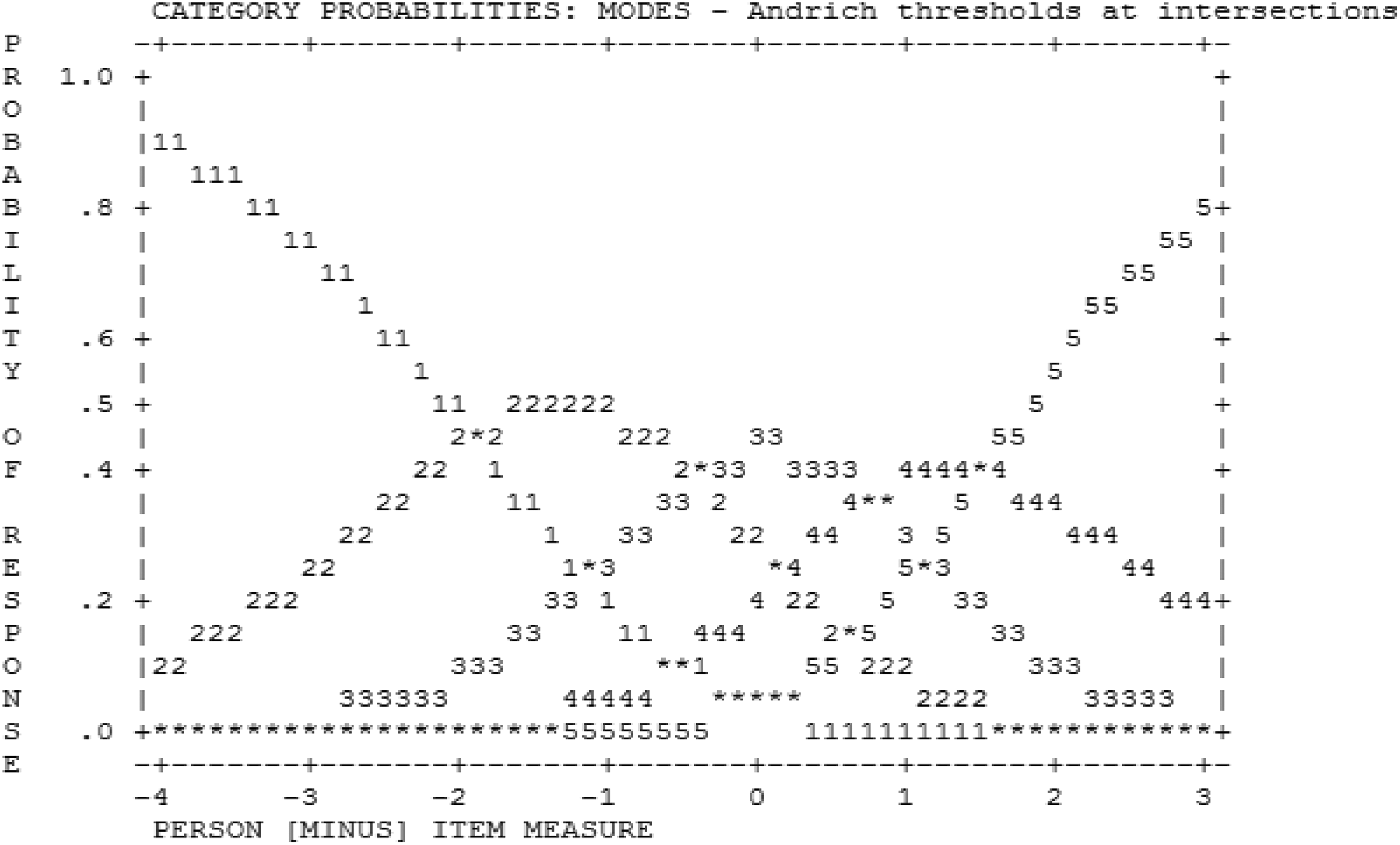
Category probability curves and thresholds for the 21-item Job Crafting Scale.
Table 1 further reports on the frequencies, fit statistics, Andrich thresholds, and category measures for each of the five response categories. The frequency of responses in each of the five categories (1–5) across the 21 items was as follows: Categories 1 (9%), 2 (26%), 3 (31%), 4 (21%), and 5 (13%). Linacre (2016a) recommends that each category should have a minimum of 10 responses, which in this case all the categories met this criteria. The categories produced satisfactory fit with an infit MNSQ ranging from 0.88 to 1.15 and an outfit MNSQ ranging from 0.87 to 1.14. Looking at the Andrich thresholds and category measures, the values increased monotonically across the rating scale, indicative of proper category functioning.
Category Frequencies and Fit Statistics for the 21-Item JCS.
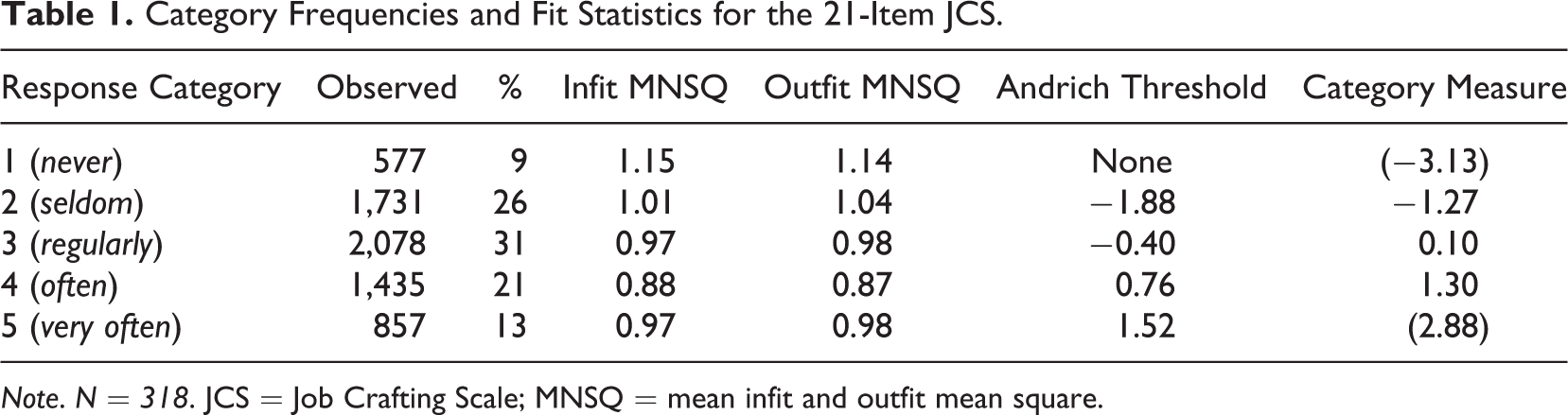
Note. N = 318. JCS = Job Crafting Scale; MNSQ = mean infit and outfit mean square.
Item Ordering and Fit Statistics
The first step in investigating item fit began by inspecting the ICCs to see whether the 21 items adhered to Rasch model curve expectations. An item would be considered misfitting if it’s observed ICC deviated substantially (outside the 95% confidence interval) from its theoretical (expected) curve. Upon initial observation, JCS7 (“I decide on my own how I do things”—increasing structural job resources), JCS3 (“I ask colleagues for advice”—increasing social job resources), JCS16 (“When there is not much to do at work, I see it as an opportunity to start new projects”—increasing challenging job demands), and JCS8 (“I try to ensure that I do not have to make many difficult decisions at work”—decreasing hindering job demands) appeared to show some misfit. For these items, there were noticeable discrepancies between their observed and expected ICCs. That is, individuals were not endorsing these items as expected. Specifically, persons with lower levels of the underlying dimension were scoring higher than expected and vice versa. While the ICCs pointed to the potential misfit of these items, further inspection of the item fit statistics was needed to confirm the misfit. Table 2 contains the item locations, standard errors, and fit statistics for each of the 21 items after three problematic cases were removed from the analysis (these individuals produced extreme and unexpected responses that caused some item misfit).
Item Fit Statistics for the Four Job Crafting Dimensions.
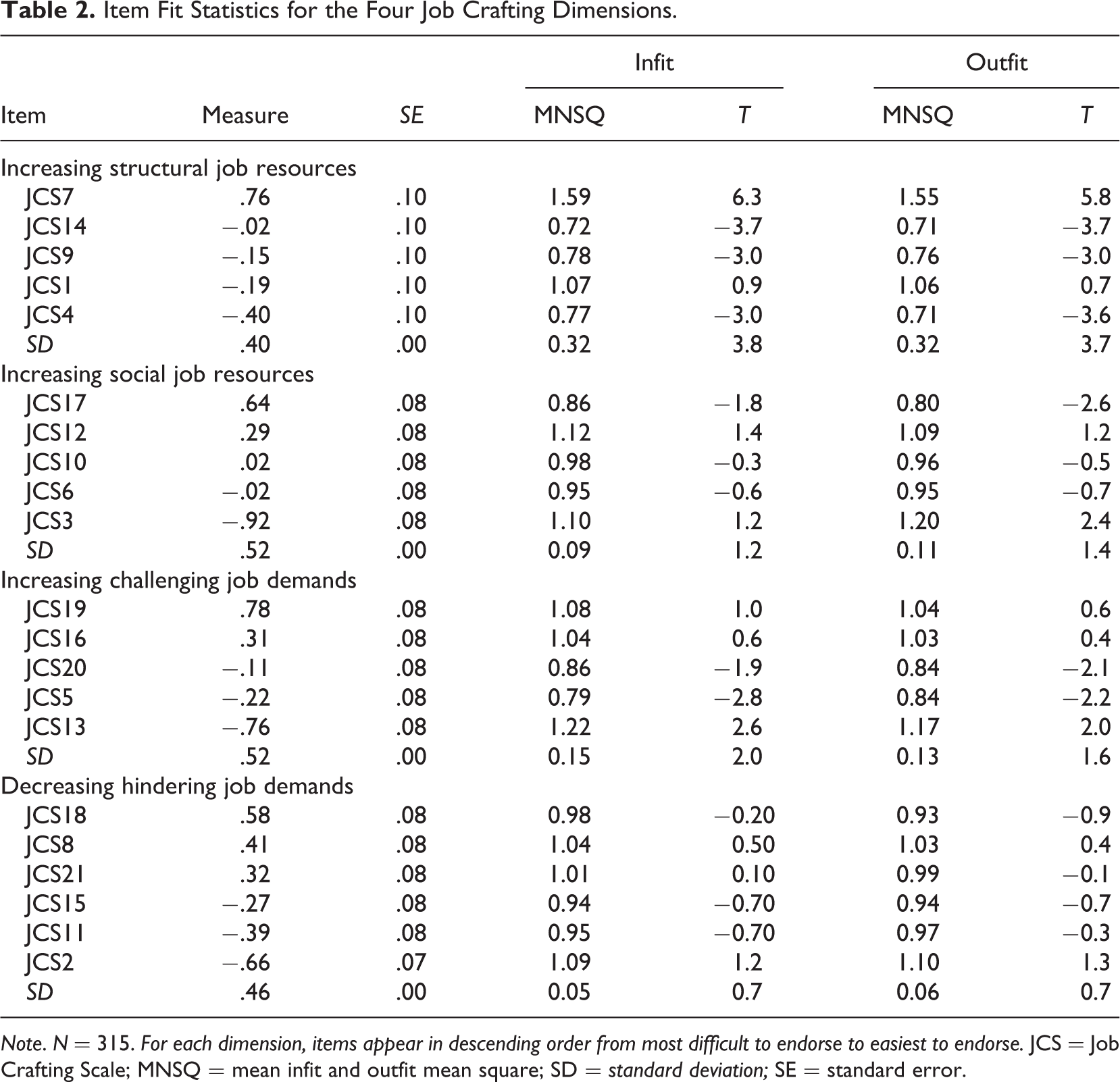
Note. N = 315. For each dimension, items appear in descending order from most difficult to endorse to easiest to endorse. JCS = Job Crafting Scale; MNSQ = mean infit and outfit mean square; SD = standard deviation; SE = standard error.
Table 2 shows that for increasing structural job resources, JCS7 was the most difficult item for the sample to endorse (δ = .76), while JCS4 (“I try to develop myself professionally”) was the easiest (δ = −.40). For increasing social job resources, JCS17 (“I ask my supervisor to coach me”) was the most difficult item to endorse (δ = .64), while JCS3 (“I ask colleagues for advice”) was the easiest (δ = −.96). For increasing challenging job demands, JCS19 (“I try to make my work more challenging by examining the underlying relationships between aspects of my job”) was the most difficult item to endorse (δ = .78), whereas JCS13 (“I regularly take on extra tasks even though I do not receive extra salary for them”) was the easiest (δ = −.76). In terms of decreasing hindering job demands, JCS18 (“I make sure that my work is mentally less intense”) was the most difficult item to endorse (δ = .58), whereas JCS2 (“I manage my work so that I try to minimize contact with people whose problems affect me emotionally”) was the easiest (δ = −.66).
With respect to item fit, Table 2 shows that the infit MNSQ ranged from 0.72 to 1.59 and the outfit MNSQ ranged from 0.71 to 1.55 across the 21 items and four job crafting dimensions. All the items, except for JCS7 (infit MNSQ = 1.59, outfit MNSQ = 1.55), showed acceptable fit, as they were all well within the desired fit range. The item fit statistics of JCS7 confirms the misfit that was previously identified through inspection of its ICCs. With the aim of improving the fit of JCS7, we decided to remove persons (N = 10) who showed excessive misfit; however, the fit of the item failed to improve and was thus removed for further analysis. In terms of items JCS3, JCS8, and JCS16, which were previously flagged for potential misfit, there was no supporting statistical evidence to discard these items, as their fit statistics were satisfactory.
Reliability and Separation Statistics
Reliability analysis found all four job crafting dimensions to show good internal consistency and person separation. The reliability and separation statistics for each dimension were as follows: Increasing structural job resources (person reliability = .81, PSI = 2.07, a = .84), increasing social job resources (person reliability = .80, PSI = 2.02, a = .83), increasing challenging job demands (person reliability = .79, PSI = 1.92, a = .81), and decreasing hindering job demands (person reliability = .78, PSI = 1.86, a = .81).
DIF
Two groups of individuals were included in the DIF analysis, men (N = 125) and women (N = 175). The DIF summary showed significant probability values for 3 items (JCS1, JCS13, and JCS19), indicating that these items do not work invariantly for the two groups. For JCS1 (t = 3.21, p = .0015, DIF contrast = .64), men scored higher than women given the same location on increasing structural job resources, with men finding this item more difficult to endorse than women. For JCS13 (t = 3.52, p = .0005, DIF contrast = .60), men scored higher than women given the same location on increasing challenging job demands, with men also finding this item more difficult to endorse than women. Lastly, for JCS19 (t = −3.37, p = .0008, DIF contrast = .57), women scored higher than men given the same location on increasing challenging job demands, with women finding this item more difficult to endorse than men. The graphs displaying the size of the DIF measures for the 3 items are available from the corresponding author upon request.
Discussion
Using Rasch analysis, we set out to investigate and report on the psychometric properties of the most widely used measure of job crafting behavior, namely, the JCS (Tims et al., 2012). The instrument was analyzed with respect to its dimensionality, category functioning, item fit, reliability, and the ability to measure invariantly across men and women. In summary, the results indicated (1) that the JCS is indeed multidimensional, (2) that persons use the 5-point frequency rating scale as expected, (3) that there is only a single item that does not accord with Rasch model fit expectations, (4) that there are 3 items that are bias for men and women, (5) and that the four job crafting dimensions produce good reliability and person separation scores. A detailed discussion of the findings are presented in the paragraphs that follow.
Dimensionality of the JCS
A requirement of Rasch measurement is unidimensional scaling (Bond & Fox, 2007; Boone et al., 2014). That is, the scale under investigation should measure a single attribute at a time. The principal component analysis of the residuals for the full 21-item JCS showed multidimensionality, supporting structural claims made by Tims et al. (2012) and providing sufficient statistical evidence to perform separate analyses for each job crafting dimension, respectively. Rasch model fit analysis for each job crafting dimension (i.e., increasing structural job resources, increasing social job resources, increasing challenging job demands, and decreasing hindering job demands) showed good model fit, providing further support for the validity and unidimensionality of each dimension.
Functioning of the 5-Point Rating Response Format
Of particular interest to the researchers was the suitability of the 5-point frequency rating scale in capturing job crafting behavior. For categories to function effectively, they need to capture both high and low levels of the underlying construct (Wilson, 2005), which in this case they did. Results showed that participants used the full range of the 5-point frequency rating scale when responding to the items. The categories displayed acceptable fit, and their thresholds were properly ordered (i.e., they increased monotonically across the rating scale). In sum, the 5-point response format conformed to a Guttman structure and provides a suitable categorization scheme for measuring individuals’ job crafting behavior.
Item Fit
Given that the Rasch model is a theoretical ideal, one can almost always expect some degree of misfit (Linacre, 2016a). It is thus essential to specify a priori the degree of misfit tolerable and that which may potentially degrade measurement. Formal fit statistics showed 1 item belonging to increasing structural job resources, namely, JCS7 (“I decide on my own how I do things”), to be a poor fitting item. Ironically, the participants also found this item to be the most difficult to endorse. It is possible, as others have suggested (Bond & Fox, 2007), that the misfit of the item is due to its content or wording. The item description asks respondents to rate how often they decide on their own how to do “things,” which seems somewhat vague as the term “thing” does not refer to anything specific. Because social contexts are heavily influenced by spoken language (Holtgrave & Kashima, 2007), it is possible that South African employees may find it difficult to relate to a broad term such as “things” without any context provided. Reliability analysis showed that the removal of this item increased the person reliability and separation for this dimension, and we thus recommend that the item either be set aside or rephrased to “I decide on my own how I do my work,” to provide context for employees, particularly in multicultural societies.
Measurement Invariance
One of the most crucial features of fundamental measurement is that an instrument works invariantly for all individuals irrespective of group membership (Zumbo, 1999). An item is said to present DIF if it is more discriminating or difficult for one group than for another (Nunnally & Bernstein, 1994). Results showed that DIF or item bias was present for items JCS1, JCS13, and JCS19, suggesting that these items do not work in the same way for men and women. Given the dearth of empirical evidence regarding gender differences in job crafting behavior, we can only speculate about the findings.
For items JCS1 (“I make sure I use my capacities to the fullest”) and JCS13 (“I regularly take on extra tasks even though I do not receive extra salary for them”), men found this item more difficult to affirm than women. Regarding the former, research has found that men believe in their capability to do their work more so than women (Heilman, Block, Martell, & Simon, 1989), which may explain why they found it more difficult to relate to this particular item since they do not question their ability to perform the job. With regard to the latter item, it is possible that the oppressive influences felt by women in the workplace (see Mujtaba & Sims, 2011; Robinson, Dryden, & Gomez, 2011) and the biased societal views of women having to perform “softer” and more feminine jobs (Fernando & Cohen, 2014) have led to them feeling compelled to constantly prove themselves. In the context of the item, it would mean women taking on extra workload regardless of the monetary attachments; hence, why they found it easier than men to relate to and subsequently endorse this item. It could also just be that women engage more in organizational citizenship behavior (extra-role behavior) than men (Cameron & Nadler, 2013) and therefore taking on extra tasks is not unusual for them.
Conversely, in terms of item JCS19 (“I try to make my work more challenging by examining the underlying relationships between aspects of my job”), women found this item more difficult to endorse than men. We postulate that because working women have multiple roles (e.g., family and household roles) to fulfill, they are not overly concerned about making their job more challenging, since they already face enough challenges. For example, while gender roles have slowly become more egalitarian, findings still point to women having the responsibility for the majority of parenting and household tasks (Maintier, Joulain, & Le Floc’h, 2011) and having to perform care roles (Bosch et al., 2018). It is not surprising then that research has found women to experience more work–family conflict than men (Griep et al., 2016; Koura, Sekine, Yamada, & Tatsuse, 2017). Despite these possible explanations, limited empirical findings have indeed confirmed gender differences in job crafting behavior (specifically relational job crafting; Slemp & Vella-Brodrick, 2014), and it may just be that men and women simply place emphasis on different aspects of their jobs and careers.
Practical Implications and Contributions
Apart from 1 item (JCS7), the JCS is a reliable measure that can be used to measure job crafting within the South African context. Researchers are however cautioned against using items JCS1, JCS13, and JCS19 if the purpose of the research is to compare men and women on job crafting behavior. The study showed that IRT applications, such as Rasch, can be used to gain new and interesting insights into existing measurement instruments. For example, we illustrated how Rasch can be used to hierarchically organize items along a single-trait continuum from easiest to most difficult to endorse, which could inform computer adaptive testing practices. We also showed how one can investigate the functionality of rating scales to see whether they actually perform well in capturing the underlying construct of interest, which may be useful in the early stages of scale development (Boone et al., 2014).
The study is the first to validate the JCS from an IRT perspective in general and the first to fit the JCS to the Rasch measurement model in particular. We contribute to research surrounding the validity of the JCS and answer calls made to test the functioning of the scale in other national and non-European contexts (Tims et al., 2012). The study further contributes toward the understanding of how men and women relate to job crafting behavior and possibly addresses a gap in research by shedding light on our understanding of job crafting based on gender. Lastly, we add to the small body of job crafting research that has been conducted within the South Africa context.
Limitations and Recommendations for Future Research
The study has some limitations worthy of noting. The first pertains to the ethnic makeup of the sample. Although this study provides us with important information on the measurement of the JCS in a multicultural context, the sample was predominantly White. We encourage future researchers to broaden the cultural representations (i.e., Black/African, Indian/Asian, and Mixed Race) of their samples in attempts to replicate the findings. The next limitation deals with the adequacy of the sample size for conducting DIF tests. While the Rasch model has proven to be reliable in detecting DIF with small samples (Schulz et al., 1989), DIF results are indeed sample-size dependent (Linacre, 2016a). Researchers aiming to investigate the ability of the JCS to measure invariantly across men and women, and any other demographic variable for that matter, should consider using larger sample sizes. In the same breath, we encourage job crafting researchers to explore the role of gender and its association with job crafting behavior to further our understanding of job crafting from a gendered perspective. Lastly, the findings were based on data obtained from South African employees, and caution should thus be taken in attempts to make generalizations.
Conclusion
This study set out to investigate the psychometric properties of the JCS among a sample of South African employees. It is the first study to employ an IRT approach to validating the JCS. Results showed that the JCS fits well to the Rasch measurement model and indeed displays good psychometric properties. The rating scale performed excellently in capturing responses to job crafting behavior. A few items, however, warrant further research attention.
Footnotes
Declaration of Conflicting Interests
The author(s) declared no potential conflicts of interest with respect to the research, authorship, and/or publication of this article.
Funding
The author(s) received no financial support for the research, authorship, and/or publication of this article.