



Abstract
Surveying a diverse sample of working adults, the current study examined the role of socioeconomic privilege in workers’ desire for and experience of meaningful work. First, we tested for differences across social status groups in desire for and experience of meaningful work, finding that, although desire for meaningful work was consistent across groups, experience of meaningful work was more likely to be endorsed by those who identified with higher social status. Building off this finding, we examined the moderating role of basic need satisfaction in the link between desire for and experience of meaningful work, finding survival and self-determination need satisfaction to be significant moderators. Results suggested that meaningful work is desired consistently across social status groups and that socioeconomic privilege may play a significant role in one’s experience of meaningful work via satisfaction of basic needs.
Vocational researchers have demonstrated the importance of meaningful work for positive functioning in occupational and general well-being (Allan, Batz, Sterling, & Tay, 2018). Scholars have made strides in defining the construct as well as understanding predictors and outcomes of meaningful work. Knowledge generated from this literature has provided a solid foundation for the generation of further empirical study as well as practical application through individual career counseling and organizational interventions. Previous research, however, has tended to focus on career trajectories consistent with middle- or upper-middle class, college-educated adults (Blustein, 2001). Specifically, congruent with the bulk of vocational research over the last century, many of these studies have operated under the assumption that workers have resources to act volitionally when seeking and obtaining work (Blustein, 2006). Furthermore, previous studies have failed to examine potential differences in salience of meaningfulness for workers across the spectrum of social and economic privilege. In the current study, we aim to explore how socioeconomic privilege relates to meaningful work. Specifically, we aimed to test the extent to which people across social class backgrounds endorse desire for and experience of meaningfulness at work as well as test the moderating roles of basic need satisfaction in predicting meaningful work.
Meaningful Work
Scholars from multiple disciplines, including psychology, theology, and philosophy (e.g., Hardy, 1990; May, Gilson, & Harter, 2004; Steger, Dik, & Duffy, 2012), have studied meaningful work and offered differing definitions of the construct. For example, the terms “meaning” and “meaningfulness” have often been used interchangeably, despite being distinct constructs (Rosso, Dekas, & Wrzesniewski, 2010). Specifically, “meanings” are created from a process of meaning-making—a cognitive mechanism whereby people construe, interpret, and understand their experiences (Wrzesniewski, Dutton, & Debebe, 2003). Meaning-making is an important part of having meaningful work, but current conceptualizations of meaningful work go beyond this component. Specifically, “meaningfulness” refers, in part, to the degree to which people find significance and value their work (Lips-Wiersma, Wright, & Dik, 2016). Early conceptualizations of meaningful work were primarily unidimensional and directly captured workers’ perceptions that their work is worthwhile, important, or valuable (Pratt & Ashforth, 2003). More recently, scholars have developed broader, multidimensional conceptualizations that bring together aspects of the self (e.g., self-actualization) with aspects of being other-oriented (e.g., helping others) as well as capturing meaning-making (e.g., Steger et al., 2012). Therefore, for the purposes of the current study, we define meaningful work in line with these multidimentional conceptualizations, namely, that meaningful work is a multidimensional construct encapsulating personal growth, meaning-making, and contributions to the greater good (Steger et al., 2012).
Studies demonstrating outcomes of meaningful work have shown the potential for this construct to inform individual and organizational interventions. People who experience their work as meaningful are more likely to report greater engagement at work, job satisfaction, organizational commitment, and better job performance and lower withdrawal intentions (Allan et al., 2018). Researchers have also demonstrated implications of meaningful work beyond the confines of one’s occupational world. For example, previous studies have found people who experience their work as meaningful tend to experience general life meaning, life satisfaction, and overall well-being (Erdogan, Bauer, Truxillo, & Mansfield, 2012; Steger & Dik, 2009; Steger et al., 2012).
In a meta-analysis by Allan, Batz, Sterling, and Tay (2018), each of the abovementioned correlations was tested using meta-analytic methods. They found that, over 44 studies, work-related well-being factors (e.g., work engagement, commitment, and job satisfaction) had strong correlations with meaningful work, and general well-being variables (e.g., life satisfaction, life meaning, general health) had moderate to strong relations. Given the consistent finding that meaningful work is a key factor in positive outcomes at and outside of work, this construct may provide fruitful pathways to promoting well-being.
Previous scholarly work has critiqued predominant conceptions of meaningfulness within the scientific and philosophical literature as biased by elitist perceptions of what type of work is considered valuable by societal norms (Lair, Shenoy, McClellan, & McGuire, 2008). Previous studies suggest that the meaning one construes from their work is shaped by their social context and changes as societal perceptions shift (Barrett & Dailey, 2018; Florian, Costas, & Kärreman, 2018). Similarly, researchers have questioned the applicability of meaningful work across social stratifications (Lair et al., 2008; Lips-Wiersma et al., 2016). From this perspective, workers who struggle to meet basic survival needs may not have time or energy to concern themselves with issues of meaningfulness.
Contrary to this perspective, some scholars have theorized meaningfulness to be a universal human need (Frankl, 1959; Stillman & Baumeister, 2009), and several studies have found that people across socioeconomic statuses (SES) and job positions experience meaningful work (Ashforth & Kreiner, 2013). From this perspective, people desire and strive for meaningfulness despite their contexts, and one’s experience of meaningfulness may even be facilitated by suffering (Frankl, 1959). In the current study, we aim to empirically explore these previous theoretical arguments and test the claim that people desire meaningful work across socioeconomic contexts.
Theoretical Framework
In conceptualizing the role of socioeconomic privilege in experiencing meaningful work, we draw from the Psychology of Working Theory (PWT; Duffy, Blustein, Diemer, & Autin, 2016). The PWT is a vocational theory that frames work as a pathway to various aspects of well-being, including meaningful work. The PWT was developed, partially, in response to the assumption of personal choice within the vocational literature. The PWT proposes that most people around the globe have restricted occupational choice and thus are limited in their ability to choose work that is meaningful. Further, the PWT expands the scope of vocational psychology to include macro-level factors (e.g., globalization, large-scale economic conditions; Blustein, 2006). Thus, the PWT provides a comprehensive framework for explaining vocational outcomes based on complex interactions between broad sociological and within-person psychological factors. For example, historical oppression, systemic discrimination, and cultural racist attitudes may intersect on the level of the individual to create external barriers and internalized negative beliefs about oneself and occupational choices within an African American individual. Conversely, limited experiences of oppression and systems that support the success of one’s identity group may result in facilitative structures and internalized positive beliefs about one’s self and occupational choices in White men.
Within the PWT, a primary antecedent of meaningful work is decent work. Decent work is work that provides adequate compensation, access to health care, adequate free time and rest, protections from physical and psychological harm, and values that complement family and social values (Duffy et al., 2016). Thus, work contexts that meet these minimum standards are those that are most likely to provide workers with a sense of fulfillment at work.
Duffy and colleagues propose three sets of universal human needs that provide optimal conditions for both meaningful work and general well-being (Blustein, 2006; Duffy et al., 2016). First, they propose basic survival and power needs. This set of needs encompasses not only needs for physical survival (e.g., food, housing) but also access to opportunity structures that act as pathways to those physical needs (e.g., social capital, education). Second, they propose social contribution needs. This set of needs reflects connection with and participation in one’s larger community. Work may provide social contribution needs by allowing workers to feel that they are making a positive difference and serving their communities. Finally, Duffy and colleagues (2016) draw from Self-Determination Theory literature to propose self-determination as a third set of needs that mediate the relationship from decent work to meaningful work. This set of needs reflects the internalized goals and self-directed behavior that come from fulfillment of needs for autonomy, competence, and relatedness. Together, fulfillment of these three sets of needs—survival, social contribution, and self-determination—is thought to underlie the mechanism through which decent work becomes meaningful.
Past research has provided empirical support for notion that basic need satisfaction may create pathways to meaningfulness. For example, past studies have consistently demonstrated that self-determined behavior (e.g., pursuing intrinsic goals, living out a calling) positively predicts meaningful work (Allan, Autin, & Duffy, 2014, 2016; Steger et al., 2012). Regarding social contribution, a core component of meaningfulness as defined across the literature is feeling connected to something larger than oneself and seeing one’s work as helping others (Rosso et al., 2010). Furthermore, past research has shown that having a greater sense of connection to the people who benefit from one’s work predicts one’s experiencing that work as meaningful (Grant, 2012). Finally, although research examining survival needs and work meaning is sparse, studies have shown that those in lower paying jobs and those with restricted access to economic and social capital are less likely to experience fulfillment in their work (Clark, Oswald, & Warr, 1996; Duffy & Autin, 2013).
Some models of need satisfaction theorize that lower order needs must be met before one can turn their attention to satisfying higher order needs. Contrary to these hierarchical models of need satisfaction (e.g., Maslow, 1943), the PWT conceptualizes basic needs as related, yet independent, coexisting constructs. This would suggest that frustration of survival needs would not preclude one from seeking to satisfy social contribution or self-determination needs, as is hypothesized by hierarchical models. In fact, according to this perspective, satisfaction of needs for social contribution and self-determination may buffer the negative impact of frustration of survival needs.
As we explore the link between socioeconomic privilege and meaningful work in the current study, we operate under the assumption—supported by previous empirical findings (Allan et al., 2014, 2016)—that class-based marginalization prevents people of lower social class backgrounds from engaging volitionally to pursue decent work and, in turn, impedes fulfillment of basic needs. Thus, the PWT is an ideal framework from which to conceptualize meaningful work in the context of socioeconomic privilege.
Operationalizing Socioeconomic Privilege
We conceptualize socioeconomic privilege as the benefit from one’s hierarchical standing within a society based on social identity, economic factors, and access to diverse forms of capital. Thus, one’s level of privilege has drastic implications for their level of power and number of resources with which to navigate their vocational landscape. Socioeconomic privilege is often studied from a lens of social class and classism. Previous literature has conceptualized social class in both objective and subjective terms (Diemer & Ali, 2009; Liu, Soleck, Hopps, Dunston, & Pickett, 2004). Objective measures of privilege include income, occupational prestige, and educational attainment (which together make up SES). Subjective measures of privilege place a greater emphasis on the internal, psychological experience of class and classism and are referred to as subjective social status (SSS). Social class scholars have critiqued vocational research for its inattention to subjective experiences of class and highlight the limitations of objective measures of social class (Liu & Ali, 2005; Liu et al., 2004). For example, objective measures fail to capture indicators of wealth such as savings, debts, and credit. Additionally, subjective social class is often not directly tied to income, education, and occupational prestige, but rather the social, human, and cultural capital inherent in economic cultures (Liu et al., 2004).
Previous research has shown subjective experience and resulting conceptions of social class tend to be better predictors of psychological variables than objective predictors of SES (Adler, Epel, Castellazo, & Ickovics, 2000). SSS has been found to predict positive vocational outcomes (e.g., Autin et al., 2017; Metheny & Mcwhirter, 2013) as well as physical and psychological functioning (e.g., global physical health, stress response, life satisfaction; Adler et al., 2000, 2008). Given these findings, along with the emphasis of the PWT on the subjective marginalized experience of the individual worker, we use SSS as one operationalization of socioeconomic privilege in the current study. Another indicator we will use is survival need satisfaction. Given that survival need satisfaction reflects both biological needs and access to power and opportunity structures within one’s society, this construct appropriately captures one’s level of socioeconomic privilege. Finally, because the PWT (Duffy et al., 2016) suggests that socioeconomic privilege is a primary driver in satisfaction of social contribution and self-determination needs in the work context, we will use these two variables as indirect indicators in the current study.
Socioeconomic Privilege and Meaningful Work
Although research examining meaningful work from the context of socioeconomic privilege is limited, a handful of studies have examined these constructs. Lips-Wiersma, Wright, and Dik (2016) examined differences across workers of differing occupational prestige levels: white-, blue-, and pink-collar workers. This study not only examined amount of meaningfulness experienced by workers but the importance that meaningfulness held to these workers. Results showed that white-collar workers experienced higher levels of meaningful work across all dimensions than blue- or pink-collar workers. Results regarding importance of meaningfulness were mixed. Contrary to hypotheses, researchers found that two of their proposed dimensions of meaningful work (“serving others” and “expressing one’s full potential”) were valued more highly by white-collar workers than by blue- and pink-collar workers. Consistent with hypotheses, no group differences were found for the dimensions of “unity with others” and “development of the inner self.”
Results from this study highlight the influence of work context on desire for and experience of work meaning. However, given that the study only focused on occupational prestige, it leaves much to be explored, specifically how a more holistic, subjective experience of social class might impact findings. First, the analysis of workers by occupational group highlighted differences based on work context but limited authors’ ability to draw conclusions specifically about socioeconomic privilege. Second, the authors used the Comprehensive Meaningful Work Scale (CMWS; Lips-Wiersma & Wright, 2012), which includes four subscales examining specific job context factors that contribute to meaningful work rather than tapping into more general, person-centered experiences of meaningful work. Although specific factors measured by the CMWS are indeed important for teasing out aspects of work environments that promote decent work, a measure with broader items tapping into one’s general sense of meaningful work may provide a different perspective.
In another study examining social class differences in experiencing meaningful work, Allan, Autin, and Duffy (2014) found that, although people with higher social class backgrounds were more likely to report their work as meaningful, they reported similar sources of meaningfulness, with helping others being the most commonly endorsed. The authors also explored the mechanism underlying the link from social class to meaningful work. They found that work volition, or one’s perceived freedom of work choice, mediated the relation, suggesting that social class influences one’s experience of meaningful work via differential access to occupational choice. This suggests that, although access to meaningful work may vary across social class groups, mechanisms through which meaningfulness is experienced are consistent across groups.
Another study by Allan, Autin, and Duffy (2016) extended these findings by incorporating motivation as another link in the chain from social class to meaningful work. Specifically, they examined the mediating role of intrinsic, extrinsic, and amotivation in the prediction of meaningful work from social class and work volition. Findings indicated that intrinsic motivation was the strongest direct predictor of meaningful work, with strong, positive predictive power. Extrinsic motivation and amotivation had weak, but significant, negative relations. The authors noted that these findings speak to the importance of socioeconomic privilege in internalizing work behaviors to be congruent with one’s self-determined goals and, in turn, to experience their work as meaningful. Furthermore, given that self-determination needs (autonomy, competence, and relatedness) are antecedents of intrinsically motivated behavior, it is likely that these needs would play a key role in predicting meaningful work.
The Present Study
The aim of the present study was to explore the relation of socioeconomic privilege to work meaning. We asked two primary questions: (1) Does one’s SSS relate to their desire for and experience of meaningful work? (2) Does satisfaction of one’s basic needs moderate the relation from desired meaningfulness to experienced meaningfulness at work?
Regarding our first research question, previous studies have demonstrated that people who report higher levels of socioeconomic privilege tend to endorse greater meaningfulness in their jobs (Allan et al., 2014, 2016). We hypothesize that the present study will replicate these results, with those endorsing high levels of SSS also endorsing high levels of meaningful work (Hypothesis 1). The only study that we identified that examined one’s valuing of meaningful work showed mixed results, with no difference in importance of meaningfulness for some facets of meaningful work, but greater importance among white-collar workers for others. We hope to build upon this previous study in two primary ways. First, by focusing on a subjective measure of social status, we aim to examine desire for work meaning on a more holistic level, capturing social status from a psychological lens rather than the narrow, objective measure of occupational prestige. Second, we aim to tap into general experiences of desire for and access to meaningful work by using a general, face-valid measure.
Based on partial empirical support for similarities in valuing meaningful work, previous research showing similarities in sources of meaningfulness among workers across diverse social class backgrounds (Allan et al., 2014), and theoretical underpinnings for universality in desire for meaningfulness (Frankl, 1959; Stillman & Baumeister, 2009), we hypothesize no significant differences in desire for work meaning across social class backgrounds (Hypothesis 2).
Regarding our second research question, we examined satisfaction of survival, social contribution, and self-determination needs as moderators of the relation from desire for work meaning to experience of work meaning. As suggested by previous research, people of all levels of socioeconomic privilege may desire meaningful work, but people of higher socioeconomic privilege tend to experience more meaningful work (e.g., Allan et al., 2014). This suggests that there may be potential moderators in the link between desire for and experiencing of meaningful work. This, along with previous research and theory suggesting a key role of need satisfaction in predicting meaningful work, informs our prediction that survival, social contribution, and self-determination needs will moderate the relation between desire for meaningful work and experience of meaningful work (Hypotheses 3–5).
Method
Participants
This study consisted of 350 full-time employed adults ranging in age from 18 to 71 years (mean age = 39.39 years, SD = 11.55). Participants self-identified as White/European American/Caucasian (n = 244, 69.7%), Black/African American (n = 49, 14.3%), Hispanic/Latina/o American (n = 61, 17.4%), Asian/Asian American (n = 19, 5.4%), American Indian/Native American/First Nation (n = 6, 1.7%), Asian Indian (n = 3, .9%), Arab American/Middle Eastern (n = 1, 0.3%), Pacific Islander (n = 1, 0.3%), and Other (n = 5, 1.4%). Participants self-identified as women (n = 284, 81.1%), men (n = 61, 17.4%), transgender (n = 2, <1%), and genderqueer (n = 1, <1%). Participants’ highest level of education completed was as follows: some high school (n = 9, 2.6%), high school graduate (n = 100, 28.6%), trade/vocational school (n = 14, 4%), some college (n = 61, 17.4%), associate’s degree (n = 31, 8.9%), bachelor’s degree (n = 82, 23.4%), and professional degree (n = 53, 15.1%). Participants reported current social class was as follows: lower class (n = 18, 5.1%), working class (n = 141, 40.3%), middle class (n = 133, 38.0%), upper middle class (n = 41, 11.7%), and upper class (n = 14, 4%). Participants reported an average SSS score of 5.36 (SD = 1.61) on a scale from 1 (lowest) to 10 (highest). A wide range of occupations representing service, manufacturing, health care, education, and construction industries were reported.
Procedure
After receiving institutional review board approval, we used online resources to generate a questionnaire and recruit participants. Specifically, we used Qualtrics (January 2018), an online survey generator to create an online questionnaire. We also used Qualtrics’ recruitment services in which Qualtrics collects data for the researcher. Qualtrics reached out via e-mail to potential participants from a database of those who previously indicated they would like to be contacted with opportunities to participate in research studies and provided them with information about expected survey length and available incentives. Qualtrics compensated participants with cash, airline miles, gift cards, redeemable points, sweepstakes entrances, and vouchers. Recruitment criteria included being over 18 years old and employed full-time. We made intentional efforts to recruit a sample that was reflective of the U.S. population with regard to social class and race/ethnicity.
Instruments
SSS
We measured social class using the MacArthur Scale of SSS (Adler et al., 2000). This item presents participants with a picture of a ladder and the following instructions: Think of this ladder as representing where people stand in our society. At the top of the ladder, are the people who are the best off, those who have the most money, most education, and best jobs. At the bottom, are the people who are the worst off, those who have me least money, least education, and worst jobs or no job.
Work Need Satisfaction Scale (WNSS)
Satisfaction of survival, social contribution, and self-determination needs were measured by the WNSS (Autin, Duffy, Blustein, Gensmer, & Douglass, 2019). The 20-item scale consists of two subscales measuring survival and the social contribution need fulfillment and three subscales measuring aspects of self-determination—autonomy, competence, and relatedness (five 4-item subscales in total). Participants were presented with the stem “My work allows me to:” and asked to respond on a 7-point Likert-type scale ranging from 1 (strongly disagree) to 7 (strongly agree). Example items include “Have the resources to pay for adequate housing for my family” and “Feel like I am doing something important for my community.” In the initial validation study, the scale was shown to correlate in expected directions with decent work, job satisfaction, and life satisfaction. Estimated internal consistency reliability for subscales in the validation study ranged from .82 to .95. In the current study, internal consistency reliability estimates for subscales ranged from .82 to .94.
Work meaning
The extent to which participants experienced their work as meaningful was measured with the 10-item Work as Meaning Inventory (WAMI; Steger et al., 2012). The scale consists of three subscales: positive meaning, meaning-making, and greater good motivations. Sample items include “I have found a meaningful career” and “The work I do serves a greater purpose.” Participants responded to items on a 7-point Likert-type scale ranging from 1 (strongly disagree) to 7 (strongly agree). In the initial validation study, Steger, Dik, and Duffy (2012) found the scale to positively correlate with career commitment, presence of life meaning, job satisfaction, and perceiving a calling. Steger et al. (2012) also reported high internal consistency reliability (α = .93) for the scale. In the present study, the estimated internal consistency was α = .91.
The extent to which participants’ desired work meaning was measured with an adapted version of the WAMI. Using original WAMI items as our foundation, we adapted each item to reflect a desire for work meaning versus experience of work meaning indicated in the original scale. For example, the WAMI item, “I have found a meaningful career” was adapted to “I want a meaningful career.” Other sample items include, “I desire work that serves a greater purpose” and “I desire work that helps me better understand myself.” Just as in the original WAMI, the Desire for Work as Meaning Inventory (WAMI-D) contained three subscales representing positive meaning, meaning-making, and greater good motivations. There was 1 item on the WAMI that could not be adapted to reflect desire for work meaning; thus, this item was not adapted, leaving only 9 items on the WAMI-D. Estimated internal consistency reliability on the WAMI-D was α = .92.
Analytic Procedure
To examine desired and experienced work meaning with regard to SSS differences, we examined group differences in desired and experienced meaningfulness using a one-way multivariate analysis of variance (MANOVA). Specifically, we examined group differences between those endorsing lower, middle, and upper social status backgrounds. We determined these groups by dividing the total sample into those who fell 1 SD below (n = 57), within 1 SD of (n = 177), and 1 SD above (n = 91) the mean of the MacArthur scale. We tested survival, social contribution, and self-determination need fulfillment as moderators in the link from desired work meaning to experienced work meaning using the SPSS PROCESS macro (Version 3.2 Hayes, 2018). This macro tests the significance of interaction effects, which is an established way to examine moderation hypotheses (Frazier, Tix, & Baron, 2004). Using standardized scores for all variables, we ran a separate regression testing for moderation effects of each of the three needs on the relation from desired work meaning to experienced work meaning.
Results
Preliminary Analyses
Only four cases in the data set had missing data, and <2% of all data were missing. Thus, the missing data were assessed to be negligible, and we used listwise deletion for individual analyses. Skew and kurtosis statistics for all variables under study fell within ±2, indicating normal distributions (Weston & Gore, 2006). Additionally, a visual inspection of the data indicated no outliers. Thus, the data were not transformed and no cases were excluded. Given the overrepresentation of women in our sample, we tested for gender differences on all variables. There were not enough participants in transgender, genderqueer, and other gender groups to statistically test for differences; thus, we ran an independent samples t test to assess potential differences between participants identifying as men and women; no significant differences were found on any study variable. Correlations between all variables were in the expected directions. Correlations and descriptive statistics can be found in Table 1.
Descriptive Statistics and Correlations for All Study Variables.

Note. SSS = subjective social status; WAMI = Work as Meaning Inventory; WAMI-D = Desire for Work as Meaning Inventory; SDT = Self Determination Theory.
*Correlation is significant at the .05 level. **Correlation is significant at the .001 level.
MANOVA and Social Class Correlations
Results from a one-way MANOVA omnibus test for desired and experienced work meaning suggested that the overall model was significant, F(4, 642) = 7.12; p < .001; Wilks’s Λ = 0.92,
Means, Standard Deviations, and Between-Subjects Effects for Experienced and Desired Work Meaning.
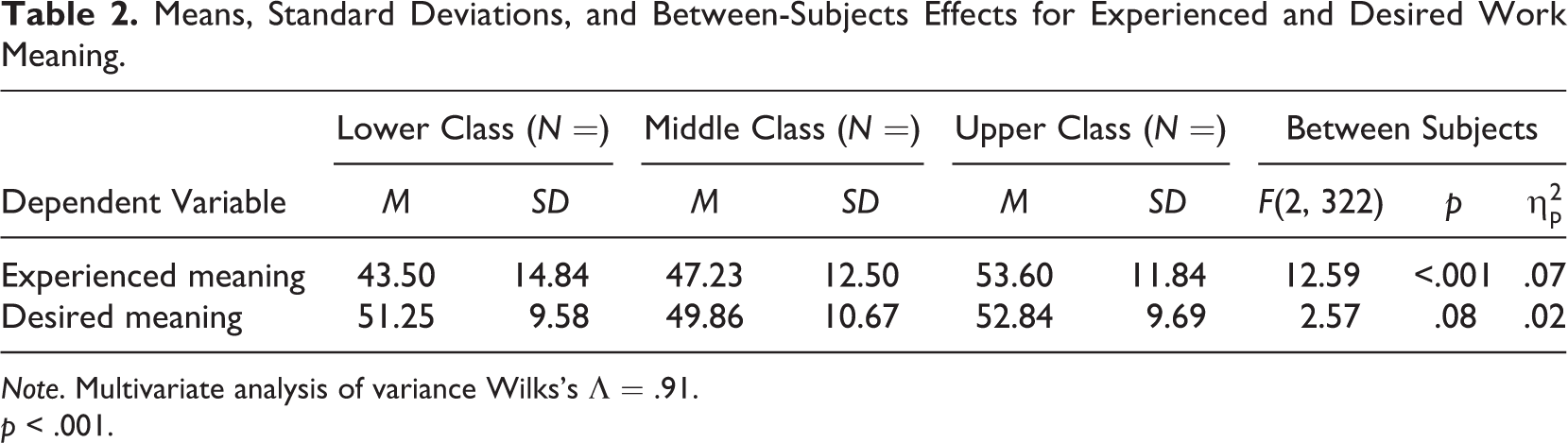
Note. Multivariate analysis of variance Wilks’s Λ = .91.
p < .001.
Moderation Analyses
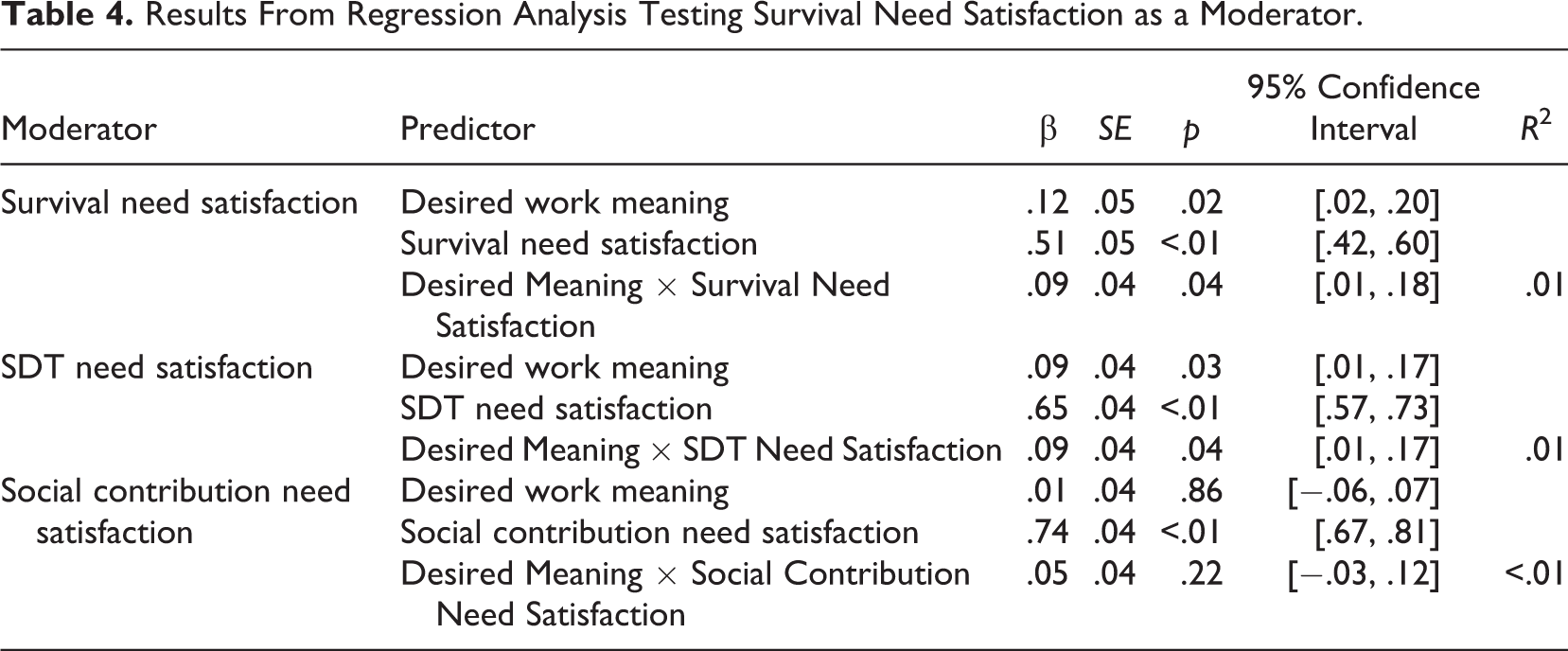
In the regression analysis examining the moderating effect of survival need fulfillment in the relation between desired work meaning and experienced work meaning, the product term explained a significant increase in variance in experienced work meaning, ΔR 2 = .01, F(1, 341) = 5.45, p < .05, as compared to desired work meaning alone. In the regression examining the moderating effect of social contribution need fulfillment in the relation between desired work meaning and experienced work meaning, the variance explained by the product term was not significant. In the regression examining the moderating effect of self-determination need fulfillment in the relation between desired work meaning and experienced work meaning, the product term explained a significant increase in variance in experienced work meaning, ΔR 2 = .01, F(1, 346) = 4.61, p < .05, as compared to desired work meaning alone (see Table 4). Thus, results indicated that survival and self-determination need fulfillment had a significant moderating effect such that the positive relation between desired work meaning and experienced work meaning was stronger when respondents reported greater need fulfillment (see Figures 1 and 2), whereas social contribution was not found to have a significant moderating effect.

Visualization of tests of the link from desired to experienced meaningful work as moderated by survival need satisfaction. Moderate, low, and high survival need satisfaction was calculated by sorting data into those that fell within 1 SD of the mean, 1 SD below the mean, and 1 SD above the mean, respectively.

Visualization of tests of the link from desired to experienced meaningful work as moderated by self-determination need satisfaction. Moderate, low, and high survival need satisfaction was calculated by sorting data into those that fell within 1 SD of the mean, one standard deviation below the mean, and one standard deviation above the mean, respectively.
Within-subjects Effects for Experienced Work Meaning.

Results From Regression Analysis Testing Survival Need Satisfaction as a Moderator.
Discussion
The aim of the current study was to examine desire for and experience of meaningful work in the context of socioeconomic privilege. Drawing from the PWT (Duffy et al., 2016), we examined (a) differences in desire for and experience of meaningful work by social class and (b) moderating effects of basic need satisfaction in the link from desire for to experience of meaningful work among a diverse sample of working adults.
First, results showed that although workers across different social class backgrounds endorse desire for meaningful work equally, those of higher social class backgrounds are more likely to access meaningful work. The differences by social class group in experience of meaningful work is consistent with previous findings that those in higher prestige jobs, with higher income, and from more privileged social class backgrounds are more likely to endorse their work as meaningful. Interestingly, our results showed that differences in experienced meaning were significant between the upper social class group and middle/lower social class group; differences between middle- and lower-class groups were nonsignificant. This is consistent with the PWT hypotheses that the resources one needs to volitionally pursue meaningful work tend to be confined to the most privileged in society and that satisfaction of basic needs directly predicts work fulfillment (Duffy et al., 2016). Our preliminary interpretation of this finding is that being from a higher social status background allows one to satisfy basic survival and psychological needs and to choose meaningful work via financial, educational, and social resources.
The nonsignificant relation from social class to desired work meaning is consistent with previous theories hypothesizing desire for meaningfulness as universal regardless of social context. It is also consistent with previous empirical findings that people across social classes report similar sources of meaningfulness (Allan et al., 2014) and that people across income and education levels are equally as likely to feel called to a particular occupation (Duffy & Autin, 2013). This nonsignificant finding, however, is inconsistent with previous research showing that people from higher prestige occupations are more likely to endorse desire for certain aspects of meaningful work (i.e., serving others and expressing one’s full potential; Lips-Wiersma et al., 2016). It is important to note that Lips-Wiersma and colleagues’ (2016) study only examined occupational prestige rather than the broader construct of SSS. This relatively narrow focus may have precluded important subjective factors in workers’ experience of their own social standing. For example, a worker who identifies as a queer person of color in a white-collar occupation may experience themselves as at lower social standing than a white, heterosexual, cis-man in a blue-collar occupation; as such, important indicators of social privilege were likely not captured in their study. Similarly, the focus on occupational prestige may have resulted in conflation between social class factors and occupational group contexts (e.g., job tasks, organizational culture).
Second, differences in definition and measurement of meaningful work may partly explain inconsistent findings. For example, the construct of “expressing one’s full potential” is not specifically addressed within the WAMI; rather, the WAMI assesses for broader perceptions of meaningful work through general, face-valid questions (e.g., “I have found a meaningful career”). Similarly, several items on the CMWS address specific work-context factors (e.g., “We talk about what matters to us”), whereas the WAMI focuses on the individual’s general evaluation of their work as meaningful. Differences in findings may shed important light on the question of social class differences in desire for meaningful work. We speculate that the basic desire for a sense of meaningfulness is consistent across social class backgrounds; however, it may be that desire for specific pathways to meaning across occupational contexts may differ based on social class group. For example, Lips-Wiersma and colleagues’ (2016) finding that those with higher prestige occupations endorse a greater desire for expressing one’s full potential may be because of differing values across occupational contexts (e.g., blue collar vs. white collar). Specifically, the authors speculated that workers in blue-collar occupations may adjust their value of certain pathways to meaning to accommodate the opportunities afforded by their context. That is, workers may devalue pathways to meaning that are less accessible (e.g., expressing one’s full potential) and heighten their valuing of those that are more accessible (e.g., developing the inner self). Thus, although pathways to meaningful work may differ, the overarching desire for meaningful work may be consistent across social class groups.
Disparities between social class groups in access to meaningful work, despite equal desire for it, suggest that meaningful work is, to a degree, a privilege afforded to those with greater access to economic, educational, and social resources. Building on these findings, results showed that self-determination and survival need satisfaction significantly moderated the link from desired to experienced meaningful work. Specifically, the positive relation between desire for meaningful work and experienced meaningful work was stronger for people who were moderate or high in basic or self-determination need fulfillment. Taken together, this suggests that people who have a desire for meaningful work are more likely to access it when their basic survival and self-determination needs are met. Framed from the PWT, the desire for meaningful work may be independent of social class; however, those who are able to obtain decent work, which is a result of structural privileges and access to resources, may be more likely to experience meaningful work because decent work allows fulfillment of physical and psychological needs. Therefore, the desire for meaningful work may only translate into experienced meaningful work for those who are meeting basic survival and self-determination needs through. This result is consistent with previous empirical findings that workers with lower income and education levels are less likely to feel satisfied with their jobs (Clark et al., 1996) and less likely to live out a perceived calling (Duffy & Autin, 2013; Duffy et al., 2013). Likewise, findings are consistent with previous studies showing self-determined behavior to be highly predictive of perceptions of meaningfulness (Allan et al., 2016). Findings from the current study provide empirical support for a core assumption of the PWT—that basic need satisfaction afforded by decent work is a primary driver of fulfillment with one’s work (Duffy et al., 2016).
An unexpected finding was that social contribution need satisfaction did not moderate of the link from desire for and experience of meaningful work. This may be due to the conceptual overlap between work meaning, as measured by the WAMI, and social contribution. Specifically, the WAMI includes contributions to the greater good as a subscale, which may reflect the same underlying construct as social contribution. Thus, social contribution may be better viewed as a component of meaningful work rather than a moderator of meaningful work.
Practical Implications
Results of the current study have several practical implications for career counselors. First, results suggested that meaningful work is salient for people across social class groups. Thus, we recommend that counselors working with individuals from diverse social class groups explore desire for meaningful work and, if appropriate for the individual, means of accessing meaningful work. Second, results suggest that those with limited socioeconomic privilege may face more barriers in accessing meaningful work. Thus, it is important for counselors to recognize contextual factors that may impact clients’ ability to access work that they find meaningful. Those with greater access to resources likely have greater freedom to choose their work; thus, it may be most appropriate to focus on identifying what such individuals are passionate about and creating an action plan (e.g., picking a major, obtaining internships) to pursue that path. Although these steps may also be appropriate for individuals with limited socioeconomic privilege, such individuals may require focus on barriers and how to overcome them. One way to facilitate this kind of conversation is to engage the client in discussion about systems of privilege and oppression to promote critical consciousness—an oppressed person’s critical analysis of their sociopolitical context and subsequent engagement in ameliorating inequalities (Diemer, Rapa, Park, & Perry, 2017). Research has shown that increased critical consciousness is predictive of positive educational and career outcomes (e.g., Diemer & Hsieh, 2008), partially because it increases one’s sense of agency within their environment.
Limitations and Future Directions
The present study has a number of limitations that might guide future research. First, although our sample was representative in terms of racial identity and social class, there was an overrepresentation of women. Although preliminary analyses suggested no significant differences across genders in the current study, future researchers might strive for a more representative sample. Second, although SSS provided the present study with several strengths, it will be important in future studies to examine the impact of objective indicators. Further, future research might benefit from examining both objective and subjective indicators together to determine amount of independent variance explained by each. Third, it will be important for future researchers to more closely examine discrepant results between the present study and Lips-Wiersma et al. (2016). Although the authors of the present study speculate discrepancies are a result of differences in definition and measurement of meaningful work, this will need to be confirmed in future studies. If the current authors’ speculation is confirmed, it will be important to further understand how workers across social status groups conceptualize and act on different pathways to meaningful work. Fourth, social identities that are intimately tied with social class were not examined in this study. Ali, Fall, and Hoffman (2013) provide a detailed review in which gender, ethnicity, and immigration status are woven into the fabric of one’s subjective experience of social class. These aspects of identity are inherently tied to one’s status in society. As such, future studies might utilize an intersectional lens to understand how social class might interact with other identities to influence workers’ desire for and experience of meaningful work.
Conclusion
The current study examined the role of socioeconomic privilege in workers’ desire for and experience of meaningful work. Specifically, we examined desire for and experience of meaningful work across social class groups. We found that, although desire for meaningful work was consistent across social status groups, those who endorsed higher SSS were more likely to report meaningful work. We also examined the moderating role of basic needs in the link from desire for and experience of meaningful work, finding survival, and self-determination need satisfaction as significant moderators. Results suggested that meaningful work is desired across social status groups and that socioeconomic privilege may play a significant role in one’s experience of meaningful work via satisfaction of basic needs.
Footnotes
Declaration of Conflicting Interests
The author(s) declared no potential conflicts of interest with respect to the research, authorship, and/or publication of this article.
Funding
The author(s) declared the following potential conflicts of interest with respect to the research, authorship, and/or publication of this article: University of Florida (Open Funder API).
