



Abstract
Career calling is a positive construct that describes how much individuals see their work as a meaningful and consuming passion, experienced as a transcendent summons, that defines their identity, their life’s purpose, and contributes to the common good. Somewhat surprisingly, recent research suggested that calling fosters workaholism. In a cross-sectional study (N = 235), we investigated obsessive and harmonious passion as mediators and moderators of the relation between calling and workaholism. Results suggested that the relation between calling and workaholism is completely mediated by obsessive passion and partially mediated by harmonious passion. In addition, we observed that obsessive passion moderates the relation between calling and workaholism, such that when obsessive passion is high, calling protects individuals from workaholism. These results put into question the so-called dark side of calling.
Daily experience confirms that our natural tendency is to perform gratifying, personally meaningful, and absorbing activities more frequently and for longer. Yet there is a limit to how long we can, and should, keep doing the same activity. Beyond that limit, fatigue sets in and oversaturation may occur (Karsten, 1928; Pillsbury, 1922). These factors decrease performance and the value of the activity engaged in. Unfortunately, there are conditions under which the individual feels compelled to undertake an activity because of uncontrollable internal pressures to persist in it despite the negative consequences. In the work context, this maladaptive behavior is called workaholism (Clark et al., 2016; Oates, 1971), and scholars have suggested that the experience of a calling, ostensibly a positive state, may increase the chances of developing workaholism (Berkelaar & Buzzanell, 2015; Bunderson & Thompson, 2009; Clinton et al., 2017; Keller et al., 2016). In this study, we investigate the conditions that influence the sign and the intensity of the relation between calling and workaholism.
Workaholism: Predictors and Outcomes
Workaholism is “an addiction to work that leads to many negative individual, interpersonal, and organizational outcomes” (Clark et al., 2016, p. 1836). Workaholic individuals are compelled to work, feel preoccupation and loss of self-control. They work too much, beyond what is needed or expected from them, and they do so because they feel that engaging in work activities is the only way they have to relieve the emotions of anxiety and guilt that they feel when they are not working. They keep working despite negative consequences such as health problems or a deterioration of their private life (Ng et al., 2007; Sussman, 2012). A key aspect of workaholism is that individuals engage in work activities because of an internal compulsion, and not because of external pressure (such as financial problems or pressure by their supervisors), or an internal passion or love for their work (Clark et al., 2016). In the present study, workaholism is defined by two components: working excessively (WE) and working compulsively (WC; Schaufeli et al., 2008), with the latter more conceptually critical than the former.
There are both dispositional and situational factors that increase the likelihood of developing workaholism. Among the former category, perfectionism, nondelegation, and Type A personality are all strongly related to workaholism (Clark et al., 2016). Perfectionism (ρwp = .55) drives people to set high standards for themselves, exaggerate the discrepancy between their performance level and expectations, and avoid delegating work to others (nondelegation, ρwn − d = .41). The Type A cluster of personality (ρwTA = .43) involves hostility, competition, and impatience (Spence et al., 1989). Among the factors that increase the chances of WE and WC, the literature showed that individuals with high levels of obsessive (but not harmonious) passion tend to work more and to experience difficulties in detaching from work. The size of this relation is probably the highest among workaholism and its predictors (r = .67, Birkeland & Buch, 2015, Study 2; r = .58, Lajom et al., 2018). Work domain factors that predict the occurrence of workaholic behavior are work overload (ρwo = .52), work role conflict (ρwc = .43), and job involvement/centrality (how important work is to one’s identity, ρwi = .53). The latter is closely related to perceiving a calling toward work, and it informs on the possible relation between the two constructs.
The definition of workaholism that we proposed at the beginning of the paragraph, on which the literature on workaholism converges (Clark et al., 2016), stresses the importance of negative outcomes. Workaholism was indeed found to be related to job stress (ρws = .55), work–life conflict (ρwc = .47), marital disaffection (ρwd = .55), and burnout (ρwb = .40).
Career Calling and Workaholism
Career calling is a multidimensional construct that describes affective, motivational, spiritual, and identity-related facets of the relation between individuals and their specific life or work domains (Dalla Rosa, Vianello, & Anselmi, 2019). According to Hall and Chandler (2005), perceiving one’s career as a calling is the deepest form of satisfaction or psychological success. Many definitions of calling have been proposed. Thompson and Bunderson (2019) identified 14 distinct definitions that lie on a continuum between the “neoclassical” and the “modern,” which respectively put greater emphasis on the outer requirements of duty and destiny or on the inner requirements of passion and enjoyment. These authors advocate for an integration of the two approaches, stating that most researchers from one end of the continuum would agree that the other end is also key in understanding the nature of calling.
In this article, we adopt a multidimensional conceptualization of calling that integrates both ends of the spectrum and considers seven subcomponents of calling. According to this approach, calling is defined as a pervasive and profound passion (pervasiveness and passion), experienced as a transcendent driving force (transcendent summons) to engage in a domain of activities that defines the individual’s identity and contributes to the individual’s life purpose (purposefulness). Individuals with a calling are willing to sacrifice time and energy in order to pursue it, and they believe that what they do is directly or indirectly helping others (prosocial orientation). These components are measured by the Unified Multidimensional Calling Scale (UMCS; Vianello et al., 2018), which synthesizes the many facets of calling that have been previously proposed (Bunderson & Thompson, 2009; Dalla Rosa et al., 2014; Dik & Duffy, 2009; Dik et al., 2012; Dobrow & Tosti-Kharas, 2011; Hagmaier & Abele, 2012; Hall & Chandler, 2005; Praskova et al., 2015; Wrzesniewski et al., 1997). The theoretical and measurement models behind the UMCS underwent extensive validation (Dalla Rosa, Vianello, Galliani, et al., 2020; Vianello et al., 2018). Across two studies on both students (N = 5,886) and employees (N = 205), Vianello et al. (2018) found evidence that the seven factors of the UMCS can be seen as facets of the same construct and that the UMCS measurement model is invariant across time and calling domains. Furthermore, the authors showed that the seven facets have very different relations with correlates and outcomes of calling, suggesting that the use of facets instead of a single composite score of calling allows observing nuances that would otherwise go unnoticed.
Indeed, the relation between calling and workaholism may be specifically due to three of these seven components: identity, pervasiveness, and sacrifice. The relation between workaholism and job centrality (how important work is to one’s identity) has already been observed (Clark et al., 2016). It seems reasonable to hypothesize that these results would generalize to the identity facet of a calling. When an individual feels called to a work or a domain of activities, thoughts about the work or domain pervade all other areas of life. The continued presence of the calling in one’s consciousness might serve as a fertile ground for the failure of self-control and self-regulation strategies that defines workaholic individuals. In addition, having a calling may lead the individual to sacrifice other areas of life in pursuit of that calling (Bunderson & Thompson, 2009; Duffy & Dik, 2013). Consistent with this prediction, it has been shown that individuals with a calling tend to work more (Clinton et al., 2017; Keller et al., 2016).
Yet there is a clear discrepancy between the two constructs: Calling is ultimately positive, whereas workaholism leads to many negative outcomes, both at the personal and social levels. Workaholic individuals work to relieve the negative emotions they experience when not working. Instead, calling is a path that leads individuals to a deeply meaningful, gratifying, and fulfilling sense of self-actualization and self-transcendence (Dalla Rosa et al., 2017; Thompson & Bunderson, 2019; Vianello et al., 2019).
Workaholics work obsessively and excessively, but they do not love their job (Graves et al., 2012). In contrast, people with a calling not only love their work and feel a meaningful passion for it, but they also derive from it a positive personal identity. It might seem unlikely that a sense of calling will develop around work that causes the individual serious suffering and unpleasant feelings rather than pleasure, meaning, and a sense of purpose.
Researchers have already investigated the relation between calling and workaholism. Although the first study on this topic found no significant relations (Duffy et al., 2016; r = .09, N = 362), subsequent studies have observed reliable effects on larger samples. Wilson (2018), in research that tested whether workaholism mediates the effect of calling on mental health symptoms, identified the largest effect currently presented in the literature. This author documented positive relations between three components of calling (transcendent summons, purposeful work, and prosocial orientation) and two components of workaholism (WE and WC). The relation between calling and WC was approximately the same across these three components of calling (r = .26, N = 518). Hirschi et al. (2019) found small, yet significant, positive relations between calling and workaholism (r = .11, N = 770). Also, Keller et al. (2016) found a small positive relation between calling and workaholism (r = .10, N = 812), which disappeared after controlling for age, gender, working hours, competitive climate, and future orientation. On the other hand, Lajom et al. (2018) found a negative nonsignificant relation (r = −.09, N = 150). We quantitatively summarized these five studies reporting correlations between calling and workaholism using a random effects meta-analytic model (inverse variance weights, DerSimonian–Laird estimator). The weighted average effect is significant and homogeneous across studies after accounting for sampling error: ρ = .11, 95% confidence interval [CI] = [.02, .19], τ = .00, I2 = 28.14, Q(4) = 5.57, p = .09.
Drawing from both theoretical and empirical work investigating the positive and negative outcomes of calling, the work as calling theory (WCT; Duffy et al., 2018) suggests that calling can be linked to greater workaholism because “some individuals may rationalize unhealthy levels of investment in their work as necessary or even praiseworthy, given the societal and/or personal value of what they are trying to accomplish” (p. 430). In addition, the WCT states that the negative outcomes of calling, including workaholism, may arise for some individuals in some conditions. In so stating, the WCT suggests the presence of moderators. Given that the relation between calling and workaholism is both theoretically and empirically unclear, in this study, we explore whether this relation can be explained by work passion and specifically by obsessive passion (OP), one of the stronger dispositional predictors of workaholism.
Passion for Work
The dualistic model of work passion (DMP) was first introduced by Vallerand et al. (2003). These authors define passion as a “strong inclination toward a self-defining activity that people love, find important, and in which they invest time and energy” (Vallerand et al., 2003, p. 98). They found evidence that two components of passion (harmonious and obsessive) are associated with different determinants, outcomes, and psychological processes. Harmonious passion (HP) is adaptive and leads people to freely engage in the work they love. OP is less adaptive and involves an uncontrolled pressure that forces the individual to engage in the work they love (Vallerand, 2010).
OP is conceptually close to workaholism. Both constructs are concerned with being compelled to work, but while employees with high levels of OP are obsessed with the content of their job, workaholics are addicted to working, irrespective of the specific activities that their work entails. In addition, passion refers to the relation individuals have with their work, whereas workaholism refers to behavior. Finally, workaholic individuals do not necessarily love their work. OP is best seen as a predictor of workaholic behavior: The rigid persistence that OP entails can lead the person to persevere in the passionate activity despite the negative consequences experienced, eventually leading to addiction. In contrast, individuals who experience HP toward their work have the capacity to control and moderate the amount of time they spend working; they do not feel compelled to work but rather they freely choose to do so. Birkeland and Buch (2015, Study 2) observed a correlation between OP and workaholism of r = .67, and for the same correlation, Lajom et al. (2018) reported r = .58. HP was found to be negatively related to workaholism by Birkeland and Buch (2015, Study 1), r = −.15, and by Lajom et al. (2018), r = −.18.
Work passion is also related to calling (Lajom et al., 2018). Both constructs refer to activities that people love, are regularly engaged in, and that define their identity. Yet individuals with high levels of calling feel that they are driven to the calling domain by something greater or beyond themselves (transcendent summons), that being engaged in the calling domain gives them a sense of purpose (purposefulness), and that their activities in the calling domain are useful to others or to a greater good (prosocial orientation). These components of calling are not present in the definition of work passion. Specifically, HP is different from calling because individuals can enjoy their work, find it important, and invest time and energy in it without perceiving to be meant or called to do that work or without deriving meaningfulness and other-oriented values or goals from their work. Most importantly, OP is different from calling because it is an uncontrolled compulsion that leads people to engage in the passionate activity even when they should not: OP takes up disproportionate space in the person’s identity and causes conflicts with other areas of life. In line with these assumptions, Lajom et al. (2018) found calling to be positively related with HP (r = .19) and not related with OP (r = −.06).
The Present Study
The type of passion individuals develop for their work can be used to explain how and under which conditions perceiving a calling influences workaholism. In this study, we investigated two competing hypotheses regarding whether HP and OP act as mediators or moderators of the relation between calling and workaholism. This study provides insight on the potentially negative effects of calling (the so-called dark side) and offers an in-depth analysis of the somewhat counterintuitive psychological mechanism underlying the link between having a calling and being addicted to work.
The DMP suggests that passion develops when individuals identify a preferred activity, between alternatives, which is in line with their preferences and interests and is highly valued. The type of passion is determined by the internalization of the activity representation in individuals’ identity: Autonomous internalization leads to the development of HP, whereas a controlled internalization leads to OP. Individuals who experience a calling have already identified a preferred activity that is relevant for the purpose of their life. Therefore, they are likely to develop a specific type of passion for their work, which, in turn, affects the likelihood of developing workaholism. Individuals who perceive their work as a calling may experience workaholism because they are consumed by their work and are unable to disconnect from it when needed (OP). Hence, the relation between calling and workaholism may be mediated by OP.
Conversely, individuals may be less inclined to develop workaholism because they are able to detach themselves from their work and enjoy other aspects of their lives (HP). HP may be related with lower levels of workaholism, such that individuals who perceive their work as a calling may develop a HP for their work that can reduce the likelihood of developing workaholism. The relation between calling and workaholism may be mediated by HP. In line with this reasoning, we propose the following hypothesis:
The MacArthur approach (Kraemer et al., 2008) imposes the eligibility criterion of temporal precedence to establish whether a variable is a potential moderator or mediator: A mediator must follow which it mediates and a moderator must precede that which it moderates. To our knowledge, no studies have analyzed the temporal precedence between calling and passion. Therefore, there is no empirical support for work passion to follow calling (which is one criterion to establish mediation), and we cannot exclude the possibility that passion works as a moderator that precedes (or simultaneously develops with) calling, modulating its effects on other variables.
Indeed, the WCT suggests that the relation between a calling and its negative outcomes may be moderated by individual and environmental factors. For instance, Duffy et al. (2018) suggested that neuroticism, perfectionism, and need for achievement may enhance the possibility of developing workaholism in individuals who experience a calling for their work. People with an OP for their work tend to overvalue, rigidly persist in, and overidentify with their work, hence they may be more likely to develop workaholism. Following this reasoning, OP may enhance the possibility of developing workaholism in individuals who are strongly attached to their work and are vulnerable to the risks associated with overinvesting in their work because of their calling. Hence, we propose the following hypothesis:
Contrary to OP, HP is expected to weakly protect from workaholism. People with a HP for their work are able to focus on the task at hand, are in control of their work, and tend to experience positive outcomes both during and after work. Therefore, we do not expect HP to affect the magnitude or the direction of the relation between calling and workaholism. These observations lead us to propose the following hypothesis:
Method
Participants
The sample comprised 235 Italian workers (81.8% females). Their mean age was 36.61 (standard deviation [SD] = 10.80) and ranged between 21 and 63 years. Participants’ education levels varied between high school (14%), bachelor’s degree (9%), master’s degree (13%), postgraduate degree (6%), vocational education or training (57%), and others (1%).
With regard to professional roles, 37% of the participants were social workers, 20.9% were nursing assistants, and 8.5% were administrative assistants and staff. Other occupations involved in the sample were blue-collar employees (2.6%), managers (2.6%), waiters (2.6%), researchers (2.6%), product and graphic designers (2.1%), accountants (1.7%), sales assistants (2.1%), and other (17.4%; e.g., human resource specialist, copywriter, business consultant, social media strategist). Participants’ level of seniority in their organization ranged from 0 to 37 years (M = 8.62, SD = 8.28). On average, participants had worked in their professions for 11.06 years prior to the data collection (SD = 9.92, min = 1, max = 37).
Procedure
Private and public organizations were asked to collaborate in this research project by providing access to their employees. Two specifically trained master students directly contacted the employees from all the collaborating organizations asking them to fill out a survey about attitudes toward work. Participation was completely voluntary; no incentives were provided to respondents or organizations. Data were collected by means of a paper-and-pencil survey. The first page of the survey informed participants regarding the goals of the study, their rights, and that the data would be anonymized and used exclusively in an aggregated form for scientific purposes according to the European Union regulation (General Data Protection Regulation n. 2016/679) and the Italian law (Legislative Decree n. 196/2003). Anonymized data, analysis codes, and outputs of this study are publicly available on the Open Science Framework: https://osf.io/bawfk/.
Measures
Calling
We assessed the presence of a calling with the UMCS (Vianello et al., 2018). The UMCS consists of 22 items divided into seven subscales that measure passion, purposefulness, sacrifice, pervasiveness, prosocial orientation, transcendent summons, and identity. Examples of items include “I am passionate about my work” (passion), “My work helps me live out my life’s purpose” (purposefulness), “I can deal with many sacrifices to keep doing my work” (sacrifice), “Even when I am not working, I often think about my work” (pervasiveness), “I am always trying to evaluate how beneficial my work is to others” (prosocial orientation), “I believe that I have been called to pursue my current line of work” (transcendent summons), and “My work will always be part of my life” (identity). The scale was validated in a sample of Italian college students and adult workers. Scores to the calling scales showed good internal consistency (α = .93 on both samples) and measurement invariance across time and study domains. In past research (Vianello et al., 2018), the UMCS demonstrated good internal and external validity, evidenced by relations in the expected directions with concurrent measures of perceiving a calling and with outcomes of perceiving a calling such as living a calling, intention to continue studying, and academic satisfaction. Items were answered on a 7-point Likert-type rating scale, with 1 being strongly disagree and 7 being strongly agree. In the current study, internal consistency of scale scores was excellent for both the calling composite score (α = .95) and for all subscale scores (α ranged between .93 and .84).
Workaholism
We assessed two dimensions of workaholism: WE and WC. The Italian version of the Dutch Work Addiction Scale (DUWAS) was adopted (Balducci et al., 2015; Schaufeli et al., 2009). The scale comprises 10 items, such as “I seem to be in a hurry and racing against the clock” (WE) and “It is important to me to work hard even when I do not enjoy what I am doing” (WC). The scale was rated on a 7-point Likert-type response format ranging from 1 (strongly disagree) to 7 (strongly agree). The scale was found to be invariant across the Italian and Dutch samples (Balducci et al., 2015). The Italian version of the DUWAS shows good internal consistency for the total scale score (α = .82) and an adequate internal consistency within the two subscale scores (α = .74 in both). The test–retest correlation shows moderate stability over 1 year (WE: r = .62; WC: r = .54). The subscales show a pattern of correlations in the expected direction with job demands, number of hours worked, psychological, and physical strain reactions. In the current study, internal consistency was very good for both the total score (α = .87) and for the two subscale scores (WE: α = .86; WC: α = .80).
Passion at work
We measured passion at work with the Italian version (Dalla Rosa & Vianello, 2019) of the 12-item scale developed by Marsh et al. (2013). The scale was translated into Italian using the back-translation method (Brislin, 1970). This scale, based on the DMP (Vallerand, 2010; Vallerand et al., 2003), measures HP and OP by means of 6 items for each component. Responses were collected on a 7-point scale from 1 (strongly disagree) to 7 (strongly agree). Examples of items are “My work is in harmony with the other activities in my life” (HP) and “I have difficulties controlling my urge to do my work” (OP). The Italian version of the scale shows evidence of reliability, convergent, and discriminant validity. The subscales showed a pattern of correlations in the expected direction with attitudinal and behavioral outcomes such as positive and negative affect, meaningful work, occupational commitment, work–life conflict, workaholism, work satisfaction, and turnover intentions (Dalla Rosa & Vianello, 2019). Cronbach’s αs of .90 and .93 were found in the present study for participants’ scores at the HP and OP scales, respectively.
Results
Preliminary Analyses
Table 1 shows the means, SDs, internal consistencies, and correlations for all variables included in the study. Skewness and kurtosis levels did not exceed 2, hence scores on all variables did not deviate significantly from normality on these two indicators. Calling was positively related to both HP and OP, but the correlation between OP and calling was stronger. Both calling and OP were positively related to workaholism, whereas HP was negatively related to workaholism. The highest correlations were observed between calling and OP (r = .57) and between OP and workaholism (r = .52). These correlations were far from perfect, suggesting that the three measures were tapping distinct constructs.
Descriptive Statistics, Correlations, and Internal Consistencies for All Variables.
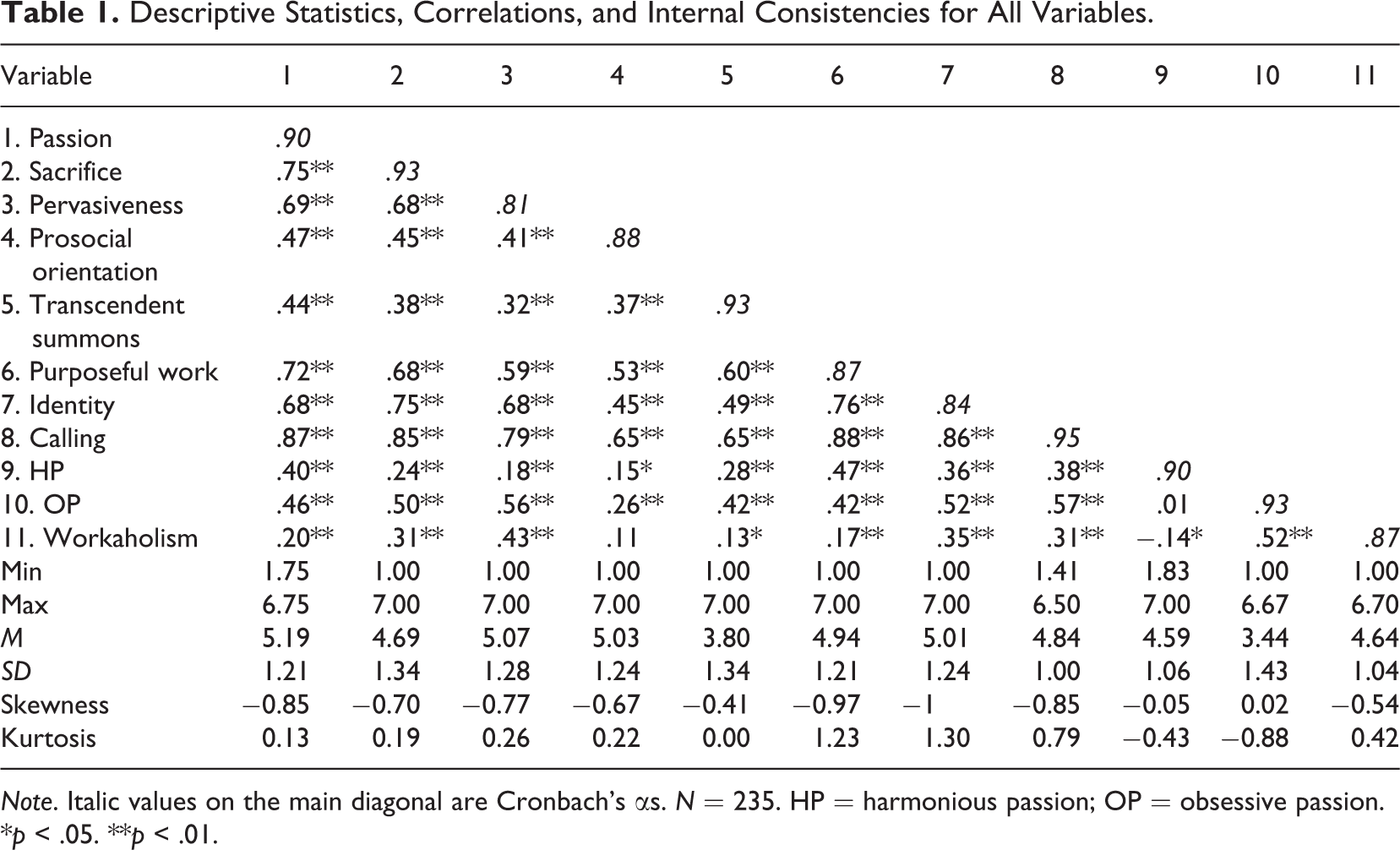
Note. Italic values on the main diagonal are Cronbach's αs. N = 235. HP = harmonious passion; OP = obsessive passion.
*p < .05. **p < .01.
The correlation between calling and workaholism, r = .31, 95% CI [.19, .42], was higher than the meta-analytic average effect observed in previous studies, ρ = .11, 95% CI [.02, .19]. Adding the present study to the meta-analysis (random effects model) conducted on all previous studies, the meta-analytic average effect increases to ρ = .14, 95% CI [.05, .22], but heterogeneity is still very low and nonsignificantly different from zero, τ = .00, I2 = 32.16, Q(5) = 7.37, p =.09.
According to theory and empirical evidence, the link between calling and workaholism is due to the pervasiveness, sacrifice, and identity dimensions of calling. The stronger correlations were found between workaholism and pervasiveness (.43), between workaholism and sacrifice (.31), and between workaholism and identity (.35). Pervasiveness, sacrifice, and identity were also found to be the stronger correlates of OP (.56, .50, and .52, respectively).
Before testing the hypotheses, we analyzed whether calling and passion could be considered distinct constructs. We compared the fit of a model in which nine first-order factors (specifically, the seven facets of calling, OP, and HP) loaded onto one second-order latent factor, χ2 = 1,251.87, degrees of freedom (df) = 510, comparative fit index (CFI) = .87, root mean square error of approximation (RMSEA) = .08, standardized root mean square residual (SRMR) = .09, Akaike information criterion (AIC) = 22,190.85, with an alternative model in which the nine first-order factors loaded onto two different second-order factors, namely calling (saturated by seven first-order factors) and passion (saturated by two first-order factors), χ2 = 1,234.52, df = 509, CFI = .88, RMSEA = .08, SRMR = .08, AIC = 22,172.66. The latter model presented a better fit to the data (Δχ2 = 17.35, Δdf = 1; p < .001), confirming that the constructs are distinct and can be analyzed separately. A small misspecification is present in both models and evidenced by the CFI. This situation does not weaken the validity of the comparison and may be due to the low correlation (−.01) between HP and OP and to the complexity of both models (34 items, 9 first-order latent variables, and 1 or 2 second-order factors; Kenny & McCoach, 2003).
Mediation Analysis
To test the first hypothesis according to which HP and OP mediate the relation between calling and workaholism, the four steps suggested by Baron and Kenny (1986) were applied with Ordinary Least Squares regression analysis. Specifically, we tested the presence of the following criteria: a significant correlation between the independent and dependent variables (Step 1, Path c) and between the independent variable and the mediator (Step 2, Path a), a statistically significant relation between the mediator and the dependent variable controlling for the independent variable (Step 3, Path b), and a reduction of the correlation between the independent and dependent variables
Recent approaches to mediation analysis suggest basing the inference about the indirect effect not on the statistical significance of the paths that define it (Steps 2 and 3) but on an explicit quantification of the indirect effect itself. Hence, for testing the significance of the indirect effect, we used bias-corrected CIs estimated using the PROCESS 2.13 macro for SPSS (Preacher & Hayes, 2004).
In the first step, we found that the effect of calling on workaholism, ignoring OP (total effect, Path c), was statistically significant, B = .32, SE = .07, β = .30, p ≤ .001, 95% CI [.18, .43]. In the second step, we analyzed the association between OP and calling. The regression coefficient of the relation between calling and OP (Path a) was statistically significant, B = .81, SE = .08, β = .57, p ≤ .001, 95% CI [.46, .67]. In the third step, to test whether OP was related to workaholism controlling for calling, workaholism was regressed simultaneously on both calling and OP. The effect of OP on workaholism, controlling for calling (Path b), was statistically significant, B = .37, SE = .05, β = .51, p < .001, 95% CI [.37, .64]. This third regression equation provided an estimate of the relation between calling and workaholism, controlling for OP.
To establish whether OP completely mediates the relation between calling and workaholism, the correlation between calling and workaholism should turn to zero when controlling for OP. Step 4 of the analyses revealed that, controlling for OP (direct effect, Path c′), calling was not a significant predictor of workaholism, B = .02, SE = .07, β = .02, p = .78, 95% CI [−.12, .15]. The indirect effect
The same procedure described above was adopted to test HP as a mediator of the relation between calling and workaholism (H1b). Calling had a positive effect on HP (Path a), B = .40, SE = .06, β = .38, p < .001, 95% CI [.26, .50]. The effect of HP on workaholism, controlling for calling (Path b), was negative and statistically significant, B = −.29, SE = .06, β = −.30, p < .001, 95% CI [−.42, −.17]. The relation of calling with workaholism controlling for HP (direct effect, Path c′) was positive and statistically significant, B = .43, SE = .07, β = .42, p < .001, 95% CI [.29, .54]. The indirect effect (Path ab) of calling on workaholism was negative (β = −.11, SE = .03) and statistically different from zero, as evidenced by a 95% bias-corrected CI that was entirely below zero [−.18, −.06]. The indirect effect (−.11) and the direct effect (.42) are statistically significant but opposite in direction, which suggests the presence of a competitive mediation (Zhao et al., 2010) of HP. A competitive mediation indicates that a portion of the positive effect of calling on workaholism is suppressed by HP because career calling leads to greater HP, which in turn has a negative effect on workaholism. Standardized estimates are reported in Figure 1.
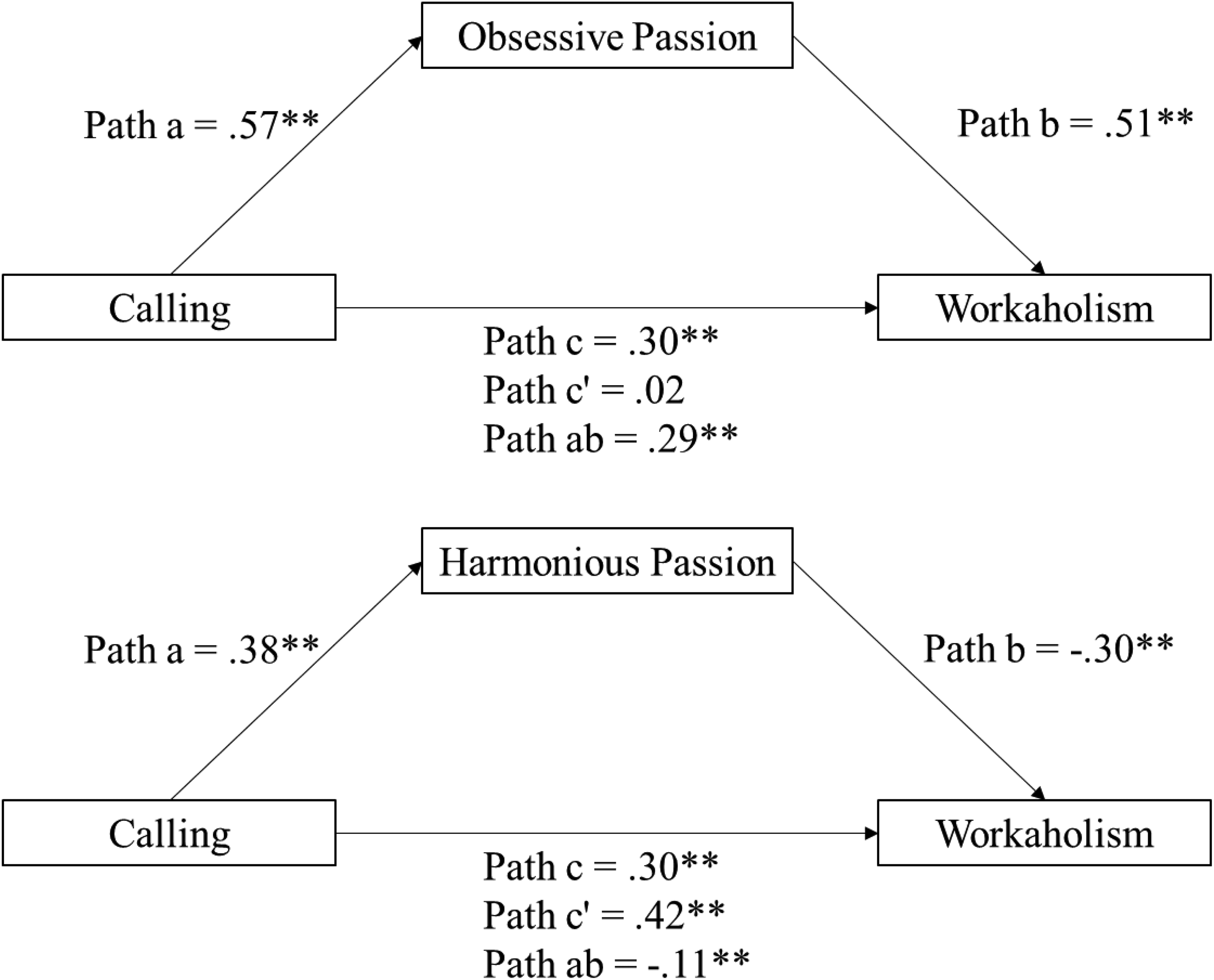
Standardized regression coefficients for the total (Path c), direct (Path c′), and indirect (Path ab) effects of calling on workaholism as mediated by obsessive passion (first panel) and harmonious passion (second panel). **p < .001.
Moderation Analysis
To test H2, according to which OP moderates the effect of calling on workaholism, we estimated a model in which workaholism was regressed on calling, OP, and an interaction term representing the product of OP and calling. To test H3, we ran a second model using HP as a moderator. The PROCESS 2.13 macro for SPSS was used to estimate bias-corrected and bias-accelerated 95% CIs around regression parameters and to conduct simple slope analysis (Hayes, 2012). We standardized scores of variables before computing the interaction term and testing our hypothesis to favor interpretability and to reduce multicollinearity between the independent variables and their product term (Finney et al., 1984; Tabachnick & Fidell, 2013). Significant two-way interaction effects were graphically represented by means of the interactive utility developed by McCabe et al. (2018).
As shown in Table 2, calling was significantly related to workaholism, and OP moderated this relation, β = −.21, SE = .06, 95% CI [−.32, −.09]. Figure 2 presents the relation between calling and workaholism at different levels of OP (1 SD and 0.5 SD below the mean, at the mean, and 0.5 SD and 1 SD above the mean). Contrary to H2, we observed that the slope representing the linear relation between calling and workaholism was steeper and negative (vs. positive) when OP is moderate to high (>0.5 SD). The effect of calling on workaholism was null or nonsignificant when OP was 0.5 and 1 SDs below the mean, β = .03, 95% CI [−.1, .16] and β = .13, 95% CI [−.01, .28], respectively.
Moderation Effects of OP and HP on the Relation Between Calling and Workaholism.

Note. CI = confidence interval; OP = obsessive passion; HP = harmonious passion. ΔR2 = R2 increase due to interaction.
*p < .001.
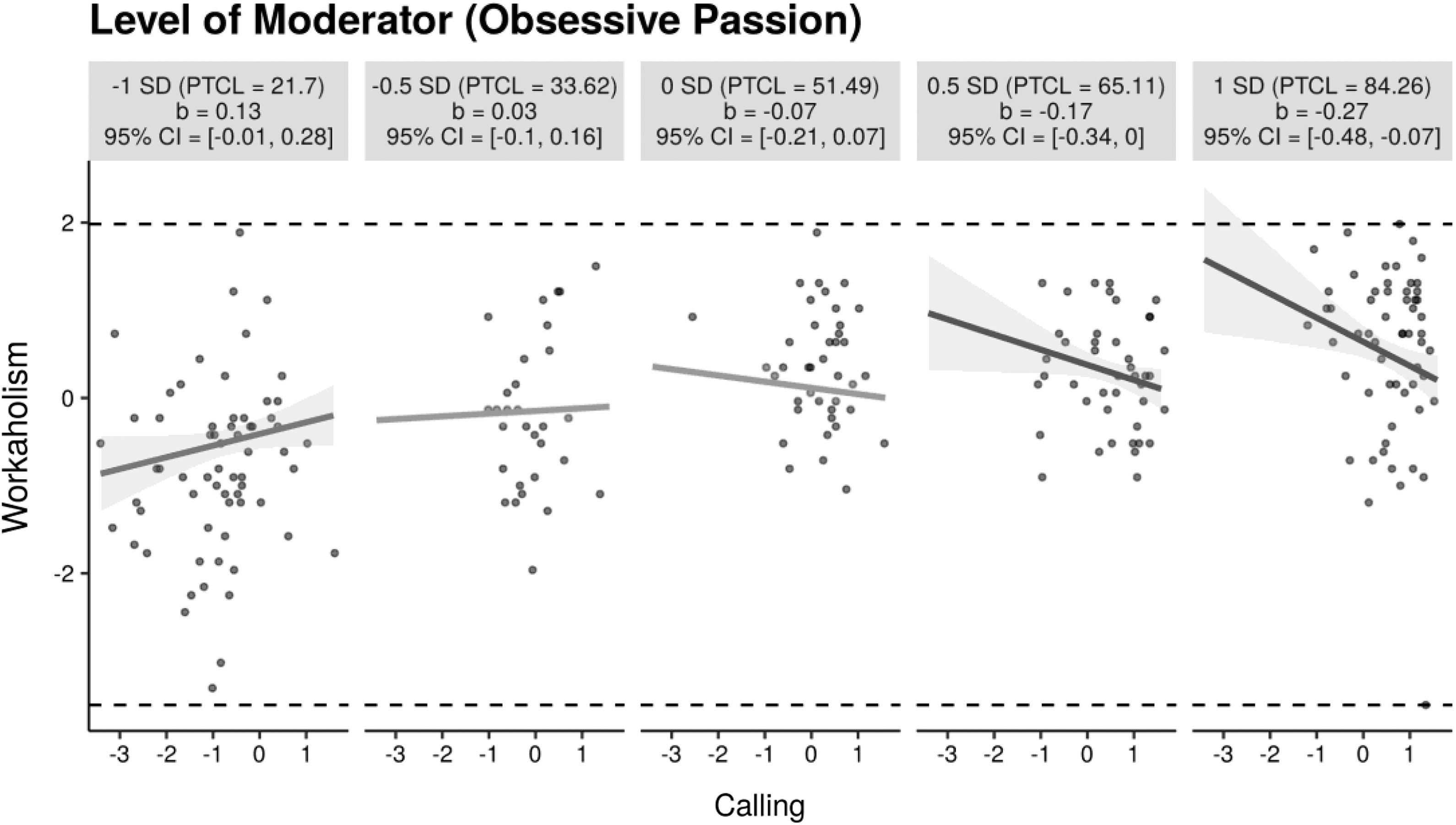
Two-way interaction of obsessive passion and calling in the prediction of workaholism. Simple slopes are provided for levels of the moderator 1 SD and 0.5 SD below the mean, at the mean, and 0.5 SD and 1 SD above the mean. Each graphic shows the computed 95% confidence region (shaded area), the observed data (gray circles), and the maximum and minimum values of the outcome (dashed horizontal lines). The x-axes represent the full range of calling. CI = confidence interval; PTCL = percentile.
In sum, calling has either a null or a negative effect on workaholism when the effect of OP is accounted for. We hypothesized that, at high levels of OP, the relation between calling and workaholism would be positive and stronger (H2). Contrary to our expectation, we observed that when OP is high, having a calling reduces workaholism. Adding HP as a predictor of workaholism (β = −.17, p = .005) did not change the effect of OP (β = .47, p < .001), calling (β = .03, p = .70), and their interaction (β = −.19, p < .001) on workaholism.
When different facets of calling were included in the regression model instead of the overall calling score, differences between the interaction effects were trivial. Specifically, OP moderated the relation between all dimensions of calling except for the effect of prosocial orientation on workaholism, β = −.09, 95% CI [−.19, .02], SE = .06, ΔR2 = .01, F(1, 231) = 2.31, p = .13. When controlling for all other direct and moderated effects in the model, transcendent summons (β = −.21, p = .003) and purposeful work (β = −.14, p = .04) had significant negative effects on workaholism. Pervasiveness (β = .14, p = .04) had, instead, a significant positive effect on workaholism.
To test H3, we analyzed the moderation effect of HP on the relation between calling and workaholism. Our hypothesis was that HP does not affect the magnitude and direction of the relation between calling and workaholism. The main effect of HP on workaholism was negative and statistically significant, β = −.30, p < .001, and the main effect of calling was positive and statistically significant, β = .42, p < .001. The interaction effect was not statistically significant (β = .01; SE = .05; t = .17; p = .87). According to H3, HP does not moderate the relation between calling and workaholism, which is always positive across all levels of HP.
Discussion
Given the increasing theoretical and practical interest in the role played by calling in the quality of working life, it becomes important to explain when and how a calling is related to negative consequences. In the present study, we tested the competitive hypotheses of OP and HP for work as mediators or moderators of the relation between calling and workaholism. The results of the mediation analysis suggest that the positive and individually detrimental relation between calling and workaholism is fully mediated by OP and partially mediated by HP. When controlling for OP, the relation between calling and workaholism completely disappeared, suggesting that the relation between calling and workaholism may be spurious. If it is true that workers perceiving a calling are more likely to develop an addition to work, it is also true that this relation is actually due to the variance that both calling and workaholism share with OP, which may then be regarded as the actual predictor of workaholism. Calling fosters workaholism if, and only if, it increases OP. We also found that HP acts as a suppressor variable in the relation between calling and workaholism: An increase in calling determines an increase in HP, which in turn leads workaholism to decrease. The higher both calling and HP are, the lower workaholism is experienced by the individual. Taken together, the results of our mediation analyses highlight the importance of experiencing high HP and low OP in order for working adults who perceive a calling to be less vulnerable to workaholism.
The moderation analyses showed that calling operates differently in some individuals than in others based on their level of OP for work. Specifically, the relation between calling and workaholism was stronger and negative for higher levels of OP and small or close to zero for lower levels of OP. For those individuals who perceive an uncontrollable desire to engage in the work they love, higher levels of calling are related with lower levels of workaholism. Hence, our results suggest that calling serves as a protective factor that reduces the risk of developing an addiction to work. Working individuals are more likely to develop workaholism when their OP for work is not integrated by the sense of purpose, enjoyment, prosocial orientation, and transcendent meaning that constitute a calling. For individuals with a low level of OP, calling has no relation with workaholism. Although this result disconfirms our second hypothesis, it is consistent with the notion that calling is an important personal resource that can support individuals, especially when they have reduced personal resources or are going through hard times. Indeed, the relation between calling and job and life satisfaction was found to be greater for individuals working in difficult conditions (Duffy et al., 2016) and individuals with lower levels of core self-evaluations (Duffy, Allan, & Bott, 2012). Calling was also found to be more strongly related with effective job-search behaviors for job seekers with low or average levels of optimism, self-esteem, and perseverance (Dalla Rosa, Vianello, Galliani, & Duffy, 2020).
To summarize, HP was found to be a mediator, but not a moderator, of the relation between calling and workaholism. This result is in line with our first and third hypotheses and supports the notion that HP decreases the chances of developing workaholism among individuals with a calling. Regarding OP, our results support both competing accounts of mediation and moderation. The absence of empirical evidence regarding the temporal precedence between calling and OP limits the ability to draw conclusions about which hypothesis is more reasonable. The link between calling and workaholism was found to be completely explained by OP, such that calling has no direct effect on workaholism. On the other hand, the effect of calling on workaholism was found to be different across levels of OP, such that it is negative and significant at high levels of OP. We think that these two different accounts of the relation between calling and workaholism are reasonable and somehow point to a similar interpretation. The experience of having a calling is not directly related with workaholism, at least when OP is low, and protects individuals from workaholism when OP is high. Indeed, the trivial size of the direct effect of calling on workaholism when controlling for OP is consistent with the null effect of calling at low levels of OP.
It has been argued that, for some individuals and under certain conditions, calling may foster an unhealthy attachment and involvement at work (Duffy et al., 2018) due to the societal and personal values linked to the professional role and the strong ties between having a calling and the individual’s willingness to make sacrifices. In line with this argument, previous research found empirical evidence of a small but significant positive association between calling and workaholism. Contrary to these expectations, we observed that the relation between calling and workaholism is zero when OP is controlled for and that calling has beneficial rather than detrimental effects in individuals who are at risk of developing workaholism due to their levels of OP.
A similar buffering effect of calling was identified by Duffy et al. (2016) in the relation between burnout (a possible negative outcome of calling according to the WCT) and job satisfaction and by Creed et al. (2014) in the association between academic stress and burnout. Additionally, there is extensive evidence that the direct relation between calling and burnout is negative (Creed et al., 2014; Gong et al., 2013; Hagmaier & Abele, 2012; Hagmaier et al., 2013; Jo et al., 2018; Vercambre et al., 2009; Yoon et al., 2017). To the best of our knowledge, there is no empirical evidence of a positive association between calling and burnout.
Taken together, these results offer an interesting perspective on the two sides of the relation between calling and workaholism and provide useful insights for the study of the hypothesized dark side of calling (e.g., Bunderson & Thompson, 2009; Cardador & Caza, 2012; Vinje & Mittelmark, 2007). It is possible that previous research showing positive associations between calling and workaholism would have shown a different picture if OP was controlled for. Given the empirical evidence currently available, we think it would be reasonable to infer that the dark side of calling is related to the experience of searching for a calling (Dik et al., 2012; Praskova et al., 2015) or to the experience of unfruitfully pursuing a calling (Duffy et al., 2016; Gazica & Spector, 2015), rather than to the presence of a calling itself. Individuals who are searching for a calling are less decided and comfortable in making career choices and less clear about their interests and abilities (Duffy & Sedlacek, 2007). Individuals who are unable to live their calling may feel stressed and dissatisfied (Berg et al., 2010; Gazica & Spector, 2015). Our speculation is that search for a calling may be positively related with OP and more strongly related with workaholism than the presence of a calling. The experience of unfulfilled psychological needs (i.e., need for autonomy, competence, and relatedness) is one of the mechanisms that intensifies the suboptimal and controlled internalization processes that lead to OP. When psychological needs are frustrated in one life domain, people are more likely to engage in compensatory behavior, such as rigidly engaging in activities that may provide a sense of structure and security (Lalande et al., 2017; Tóth-Király et al., 2018). In line with this reasoning, individuals might invest an excessive amount of time and energy in work activities to compensate for the absence of a calling and to find meaning in their work.
Implications for Research and Practice
This study provides useful suggestions for the development of theories on calling and future research directions. Our results, together with the bulk of prior research that has been accumulating over the years, suggest that the so-called dark side of calling may have been overstated. Further evidence is needed on the dynamics between calling and negative outcomes. We suggest researchers to investigate mediators and moderators of the relation between calling and its supposedly negative consequences such as workaholism, burnout, and organizational exploitation. At the same time, we urge future research to routinely control for the effect of confounding variables such as OP and HP. Failure to do so may result in misleading interpretations and ineffective or counterproductive suggestions to practitioners.
Understanding the implications of perceiving a calling leads to important insights for employees and for employers who care about well-being at work. The results of this study suggest that the concepts of calling and HP could be included in the positive psychology approach to the treatment of workaholism (Andreassen et al., 2014). Since workaholics seek and experience little pleasure in life (Killinger, 1992; Porter, 2004), interventions may focus on emphasizing positive emotions, engagement, and meaning in the individual’s life (Burnwell & Chen, 2008). Perceiving a calling and HP are related to psychological well-being, vitality, pleasure, and satisfaction in life and at work. An intervention aimed at clarifying the value, the purpose, and the meaning that individuals attribute to their work and at helping them to cultivate both their calling and a harmonious integration of their work into their identity will be likely useful in the treatment and prevention of workaholism. In addition, according to the positive psychology approach to the treatment of workaholism, applying one’s central character strengths (signature strengths) at work represents a way of increasing pleasure (Burnwell & Chen, 2008) and is found to be related to the experience of having a calling (Harzer & Ruch, 2012).
At the organizational level, it may be useful to work on the distinction between workaholism and work engagement, which is strongly and positively related with calling. Employers may foster the development of a calling by offering opportunities to clarify their vocational identity, by favoring experiences in different work contexts through job rotation, and by establishing rules and procedures that reward work engagement and enjoyment (Dalla Rosa, Vianello, & Anselmi, 2019). The results of this study highlight that higher levels of calling are important because they prevent workaholism when OP is high. Hence, one more strategy that employers may want to pursue is favoring the development of a healthy attachment to work. OP (vs. HP) is developed when the individual experiences lower levels of acceptance and self-worth (Vallerand, 2010). As a consequence, a healthy, flexible, and secure working environment in which the work and opinions of employees are valued could be effective in raising HP and prevent compulsions (Vallerand, 2010).
Limitations and Future Directions
The main limitation of this study is its cross-sectional nature, which prevents any causal inferences regarding the direction of the relations between passion, calling, and workaholism. In this study, we investigated whether passion mediates or moderates the relation between calling and workaholism. However, a cross-lagged test between calling and OP over time would provide stronger evidence of whether OP is better conceptualized as an outcome of calling or as a factor that influences its level and its relation with other variables. It is possible that our results will not be replicated if time is added to the study design. Among many scenarios, it might be that OP and workaholism temporally precede the development of a calling. Such a situation would change the interpretation of our results, suggesting, for instance and purely speculatively, that the lack of workaholism is a necessary condition for a calling to be developed. We hope future research will investigate the reciprocal longitudinal effects between passion, calling, and workaholism.
In this study, we observed a stronger relation between calling and workaholism compared to the meta-analytic average effect observed in previous studies. This difference may be due to the measure of calling we employed, which is more reliable than measures used in previous studies (Hirschi et al., 2019; Lajom et al., 2018; Wilson, 2018), and covers a wider range of facets than other measures. Both the variance of a distribution of scores and their reliability increase the correlations than can be observed between two sets of scores. Yet higher effect sizes can also be due to differences between samples. If this is true, the generalizability of our results may be limited.
Although neither in this study nor in the literature a significant relation between gender, calling (Creed et al., 2014; Dobrow & Tosti-Kharas, 2011; Keller et al., 2016), work passion (Vallerand, 2010), and workaholism (Clark et al., 2016) has been observed, it must be noted that participants in the present research were mostly women, whereas previous studies were more gender-balanced. In addition, workers in the social welfare system were overrepresented in our sample compared to previous studies. Finally, it is possible that cross-cultural differences exist between the countries in which the relation between calling and workaholism has been investigated, namely Italy, Germany, and the United States. Hence, future studies are expected to confirm or disconfirm these results with a larger and gender-balanced sample.
Finally, we did not investigate the social and environmental predictors of workaholism. Peer competition, work overload, work role conflict, and higher job demands could all support the development of workaholism (e.g., Clark et al., 2014; Ng et al., 2007; Schaufeli, 2016; Schaufeli et al., 2008) and interfere with the beneficial effects of calling and HP. For instance, Keller et al. (2016) observed higher workaholism among employees who worked in a competitive climate and perceived a high level of calling. Keller et al. (2016) suggested that working conditions that threaten the fulfillment of one’s calling may foster unhealthy behaviors, such as workaholism, among employees with a calling. To provide a more nuanced perspective on the relation between calling, passion, and workaholism, future studies are encouraged to consider both personal and situational antecedents of workaholism.
Conclusions
OP and HP were investigated as mediators and moderators of the relation between calling and workaholism. We observed that the relation between calling and workaholism completely disappears when OP is controlled for. HP partially mediates the relation between calling and workaholism. Finally, we showed that calling serves as a protective factor in individuals who experience a stronger OP for work. These results call for more research on the supposed dark side of calling and offer a useful point of view to employers who want to build a healthy work environment.
Footnotes
Authors’ Note

Declaration of Conflicting Interests
The author(s) declared no potential conflicts of interest with respect to the research, authorship, and/or publication of this article.
Funding
The author(s) disclosed receipt of the following financial support for the research, authorship, and/or publication of this article: This work has been financially supported by a departmental grant awarded to the second author (VIAN_AFAR18_01).