



Abstract
This meta-analysis examined the association between two types of difficulties in career decision making—indecision and indecisiveness—and four types of self-evaluations: generalized self-efficacy, process-related self-efficacy, content-related self-efficacy, and self-esteem. Analyses were conducted on data from 86 studies (N = 54,160): Process-related self-efficacy showed stronger negative associations with career indecision than did generalized self-efficacy, content-related self-efficacy, or self-esteem. In contrast, self-esteem showed stronger negative associations with indecisiveness than with career indecision. The second part of this meta-analysis focused on differential associations between two types of self-evaluations (process-related self-efficacy and self-esteem) and the three major clusters of difficulties in career decision making (lack of readiness, lack of information, and inconsistent information). Based on 19 studies (N = 7,953), the findings showed that process-related self-efficacy was strongly and negatively associated with lack of information and inconsistent information. In contrast, self-esteem was only weakly related to the three major clusters of difficulties in career decision making. In showing that each type of self-evaluation was more strongly associated with certain types and causes of difficulties in career decision making, the present article highlighted the importance of self-evaluations in the career decision-making process.
Difficulties experienced during the process of making career decisions can jeopardize the quality of and the satisfaction from career choices, consequences that can impair job attainment and even overall well-being (Creed et al., 2005; Feldman, 2003). Considering the implications of difficulties in career decision making, the career counseling literature has sought to classify them. The terms career indecision and indecisiveness have been distinctively used to refer to two types of difficulties that individuals experience in the process of career decision making. Career indecision is usually considered a normative developmental phase in career decision making, primarily encompassing cognitively related difficulties. Indecisiveness, in contrast, is typically regarded as a more chronic state in the individual, related to emotional and personality-related difficulties (Gati, 2013). Self-evaluations are among the constructs that have been shown to be critical factors for career choice and development and have been the most studied in relation to career decision-making difficulties. Self-evaluations refer to individuals’ global and situational evaluations about themselves and their own abilities. Global evaluations, such as general self-efficacy and self-esteem, are often considered to be more personality related (e.g., Judge & Bono, 2001; Judge et al., 1997), whereas situational evaluations, such as process and content-related self-efficacy, are frequently viewed as dynamic cognitive processes (e.g., Lent et al., 1994).
In a meta-analysis incorporating 12 studies, Choi et al. (2012) showed that career indecision was highly correlated with career-decision self-efficacy. This meta-analysis, the first in the field, firmly established the association between these two concepts. However, it addressed only one type of self-evaluation (career-decision self-efficacy) concerning career indecision, whereas other studies have shown that self-esteem also serves as a protective factor not only against career indecision (e.g., Faurie & Gicaometti, 2017; Marcionetti, 2014) but also against indecisiveness (e.g., Bacanli, 2006; Santos, 2001). Moreover, Choi et al. (2012) limited their investigation of career indecision to studies using the Career Decision Scale (CDS; Osipow, 1987), a unidimensional measure of career indecision. However, most recent studies addressing career indecision have used the Career Decision-making Difficulties Questionnaire (CDDQ; Gati et al., 1996), which is a multidimensional measure, reflecting the position that the individual’s level of indecision is determined by various sources of difficulties in career decision making (Kulcsár et al., 2020).
Based on social cognitive career theory (SCCT; Lent et al., 1994) that links difficulties in career decision making to self-evaluations, the goal of the present meta-analysis is to expand our understanding of this relation by examining two possible associations: (1) the association between two types of difficulties in career decision making (career indecision and indecisiveness, assessed by both unidimensional and multidimensional measures) and four types of self-evaluations (generalized self-efficacy, process-related self-efficacy, content-related self-efficacy, and self-esteem) and (2) the association between three major clusters of difficulties in career decision making (lack of readiness, lack of information, and inconsistent information) and two types of self-evaluations (process-related self-efficacy and self-esteem). At a time when frequent and rapid socioeconomic changes increasingly make choosing a career more of a challenge (Guichard, 2015), it is essential to pursue efforts to better understand the subtle implications of the critical factors involved in the career decision-making process.
Types and Causes of Difficulties in Career Decision Making
Career indecision
Career indecision is defined as experiencing difficulties in the process of making career-related decisions (Penn & Lent, 2019). Early approaches (e.g., Crites, 1969) conceptualized indecision as the difficulty a person encounters when choosing a course of action regarding an occupation or training (Osipow, 1999). Hence, individuals were considered to be either decided or undecided. The CDS is the most accurate unidimensional instrument developed to assess indecision. Later, Gati and colleagues (1996) refined the definition of indecision as a state that can arise from encountering various kinds of difficulties prior to or during the career decision-making process. They interviewed experienced career counselors to determine the most frequent difficulties encountered by career clients. Their responses, combined with theoretical considerations, led to the development of a taxonomy of career decision-making difficulties comprising 10 categories that were further gathered into three major clusters: lack of readiness (lack of motivation, general indecisiveness, and dysfunctional beliefs), lack of information (lack of knowledge about the career decision-making process, and lack of information of the self, of the options, and of the ways to obtain additional information), and inconsistent information (unreliable information and internal and external conflicts). This taxonomy led to the development of the CDDQ, a multidimensional instrument, which has been translated into many languages across more than 50 countries (Gati, 2013). Recently, the structural validity of the CDDQ has been supported across seven countries, gender, and age (Levin et al., 2020).
In general, career indecision, regardless of the measure used to assess it, has been associated with several individual characteristics including personality traits (Martincin & Stead, 2015), vocational interests (Atitsogbe et al., 2018; Burns et al., 2013), core self-evaluations (Di Fabio & Palazzeschi, 2012), and emotional intelligence (Di Fabio & Saklofske, 2014). Other associated personal characteristics include dynamic processes such as career decision-making self-efficacy (Choi et al., 2012) and career adaptability (Rudolph et al., 2017).
Moreover, the three major clusters of the CDDQ have been shown to be quite distinct and to assess the various causes of the difficulties experienced in career decision making (Levin et al., 2020). Nevertheless, the few studies that investigated the association of individual characteristics and the three clusters of the causes of indecision yielded mixed results. For example, Di Fabio et al. (2015) found that the same two Big Five personality traits—extroversion and neuroticism—were associated with all three clusters. However, Udayar et al. (2018) showed a direct impact of emotional intelligence on the lack of readiness, whereas it affected only the lack of information and inconsistent information when mediated by career adaptability, indicating a relatively closer relationship between stable individual differences and the lack of readiness.
Indecisiveness
Several authors have pointed out that career indecision, as a normal stage in human development, should be distinguished from indecisiveness, which is a trait-like form of indecision that persists over time and situations (Gati, 2013; Osipow, 1999). Indecisive people are “individuals who seem to have difficulties in making all sorts of life decisions, whether they are of great or little significance” (Crites, 1969, pp. 305–306). Similar to career indecision, indecisiveness has been approached from both unidimensional and multidimensional perspectives. A unidimensional measure yields an overall level of indecisiveness, with individuals considered to be more or less indecisive (Germeijs & De Boeck, 2002). Alternatively, a multidimensional measure yields ratings of multiple potential causes of indecisiveness that are presumed to be related to emotional and personality characteristics (Saka & Gati, 2007). For example, pessimistic views, anxiety, and self-concept and identity have been identified as the three major causes of indecisiveness, together determining the global level of indecisiveness (Saka & Gati, 2007).
Various instruments have been developed to assess indecisiveness, such as the Indecisiveness Scale (IS; Frost & Shows, 1993; Germeijs & De Boeck, 2002) and the Emotional and Personality-related Career Difficulties questionnaire (EPCD; Saka & Gati, 2007). The Career Indecision Profile (CIP; Hacker et al., 2013) measures both career indecision and indecisiveness. Indecisiveness has been found to be mainly and strongly associated with dispositional characteristics such as personality traits and core self-evaluations (Di Fabio & Palazzeschi, 2012; Di Fabio & Saklofkse, 2014; Gati et al., 2011) but less is known about its association with more situational constructs.
Both unidimensional and multidimensional measures of career indecision or indecisiveness can be expected to yield total scores that do not differ substantively. For this reason, in the meta-analysis, we considered all measures of career indecision and of indecisiveness regardless of whether the measure was unidimensional or multidimensional.
Self-Evaluations: Self-Efficacy and Self-Esteem
Self-evaluations, which refer to individuals’ global and situational evaluations about themselves and their abilities, have long been linked to well-being, motivation, behavior, and performance in career and work settings (Chen et al., 2004). Research has shown that self-evaluation constructs are also critical to career decision making (Betz, 2001; Jiang, 2015; Niles et al., 2010). Two of the most widely studied self-evaluation constructs are self-efficacy and self-esteem. Indeed, when people have to make a career decision, they often evaluate whether they can execute the required actions and perform them well (self-efficacy; Bandura, 1986) and whether they feel good about what they believe about themselves (self-esteem; Rosenberg, 1979). These two constructs could be considered as the two sides of the same coin: (1) the evaluation of one’s ability in a specific area (i.e., self-efficacy) and (2) the global evaluation of one’s self-worth (i.e., self-esteem).
Self-efficacy
Self-efficacy refers to “people’s judgments of their capabilities to organize and execute courses of action required to attain designated types of performances” (Bandura, 1986, p. 391). SCCT suggests that the relationship between personal characteristics (e.g., personality) and career-related outcomes such as indecision is mediated by self-efficacy. Self-efficacy is typically assessed using questions such as “Am I capable to do this?” (Lent et al., 1994, p. 83). Only individuals who believe that they have the capacity to make a career decision are likely to initiate the required actions. Thus, self-efficacy can be described as a dynamic set of self-beliefs that facilitate or impair the performance of a behavior more adapted to the environment (Rossier, 2015). According to its object, self-efficacy can be related to a particular process or content or can be generalized.
Process-related self-efficacy
Process-related self-efficacy refers to the self-belief in one’s ability to use adequate strategies for successfully navigating a process, such as the career decision-making process. It is thus assessed using questions such as “How much confidence do you have that you could make a career decision and then not worry whether it was right or wrong?” (from the Career Decision-making Self-Efficacy scale–Short Form, CDSE-SF; Betz et al., 1996) or “How confident are you in your ability to identify and evaluate your career values?” (from the Career Search Efficacy Scale, CSES; Solberg et al., 1994).
Content-related self-efficacy
Content-related self-efficacy refers to the self-belief in one’s ability to perform in a specific academic area or job. It is assessed using questions such as, “Am I able to interpret statistical information?” (from the Task-Specific Occupational Self-Efficacy Scale; Osipow & Rooney, 1989) or “Do I feel prepared for most of the demands in my job?” (from the Short Occupational Self-Efficacy Scale; Rigotti et al., 2008). Content-related self-efficacy was initially conceptualized in Bandura’s social cognitive theory and was used in the development of SCCT (Betz, 2007; Lent & Brown, 2006). However, self-efficacy related to the career decision-making process has gained increased attention in the career literature in recent years. Although SCCT highlights the key roles of both types of self-efficacy, it also acknowledges the importance of personality-related self-evaluations, such as generalized self-efficacy and self-esteem, in the career decision-making process (Lent et al., 1994).
Generalized self-efficacy
In the core self-evaluation theory (Judge et al., 1997), generalized self-efficacy is established as one of the four indicators of core self-evaluations, along with locus of control, neuroticism, and self-esteem. Contrary to SCCT, which considers self-efficacy to be relatively malleable and domain-specific, generalized self-efficacy is posited as a trait-like self-belief about one’s ability to cope with different demanding or novel situations (Schwarzer & Jerusalem, 1995). It is thus assessed by questions such as “Can I handle the situations that life brings?” (from the Generalized Self-Efficacy Scale; Judge et al., 1998). Generalized self-efficacy is both conceptually and empirically distinct from self-esteem, though the two types of self-concept are highly correlated (Chen et al., 2004). For example, Betz and Klein (1996) found that generalized self-efficacy is more strongly associated with content-related self-efficacy than with self-esteem.
Self-esteem
Whereas self-efficacy is a judgment of confidence in one’s abilities and reflects questions of capabilities, self-esteem refers to an individual’s perception of their value as a person and reflects questions of feelings (Schunk & DiBenedetto, 2016). Indeed, self-esteem relates to “how a person generally or most typically feels about him- or herself” (MacDonald & Leary, 2012, p. 354). Whereas self-efficacy is a type of self-evaluation that may vary over time and situation, self-esteem is generally considered stable and akin to a personality trait. It involves questions such as, “How much do I like or approve of myself in general?” (Lent & Fouad, 2011, p. 75). This construct has been mostly assessed using Rosenberg’s Self-Esteem Scale (e.g., “I have a positive attitude toward myself”; Rosenberg, 1979).
Career Indecision, Indecisiveness, and Self-Evaluations
SCCT (Lent et al., 1994) is one of the theories that explain the link between self-evaluations and difficulties in career decision making. This theory suggests that the relation between rather stable personal characteristics (e.g., personality) and career-related outcomes (e.g., career indecision) is mediated by more dynamic regulatory processes such as process-related or content-related self-efficacy. As for self-esteem and generalized self-efficacy, these personal characteristics may be indirectly associated with career indecision. Therefore, a direct––and thus, a stronger––association between career indecision and process- or content-related self-efficacy could be expected, whereas an indirect––and thus, a weaker––association could be expected between career indecision and self-esteem/generalized self-efficacy. Regarding indecisiveness, in Saka and Gati's (2007) EPCD taxonomy, self-esteem was identified as one of the 11 causes of difficulties leading to indecisiveness, with process- or content-related self-efficacy having only a limited role in regulating such associations. Hence, according to this taxonomy, the association between self-esteem and indecisiveness is stronger than that between process-/content-related self-efficacy and indecisiveness.
In light of the reviewed studies, it is not surprising that most previous studies have focused on the association between career indecision and career decision self-efficacy (see Choi et al., 2012, for a meta-analysis) or between career indecisiveness and self-esteem (Lo Cascio et al., 2016; Saka & Gati, 2007; Santos & Gonçalves, 2017). Career decision self-efficacy was found to be a better predictor of career indecision than was self-esteem (e.g., Creed et al., 2004; Perte, 2013; Smith & Betz, 2002) and a better predictor of career indecision than of indecisiveness (e.g., Di Fabio et al., 2013). Personality-related self-evaluations such as generalized self-efficacy and self-esteem appear to be more closely related to indecisiveness (Di Fabio & Palazzeschi, 2012). However, to date, no previous study has compared the associations of different types of self-evaluations with career indecision and career indecisiveness to understand the role of each type of self-evaluation on the career decision-making process. Similarly, little is known about how different types of self-evaluations are related to the specific causes of difficulties in career decision making, such as those assessed by the CDDQ.
Therefore, the goal of the present meta-analysis was to investigate the associations between individuals’ career decision-making difficulties and self-evaluations by examining how different types (career indecision and indecisiveness) and causes (lack of readiness, lack of information, and inconsistent information) of career decision-making difficulties are associated with different types of self-evaluations (generalized self-efficacy, process-related self-efficacy, content-related self-efficacy, and self-esteem).
Based on SCCT, we expect a stronger association between process- or content-related self-efficacy and career indecision than between generalized self-efficacy or self-esteem and career indecision. As indecisiveness is a trait-like form of indecision, we expect a stronger association between career indecisiveness and generalized self-efficacy or self-esteem than between career indecisiveness and process- or content-related self-efficacy. Regarding the specific causes of difficulties in career decision making, whereas each of the three clusters of difficulties is expected to be strongly associated with process- and content-related self-efficacy, an even stronger association is expected between lack of readiness (partly due to indecisiveness) and generalized self-efficacy/self-esteem.
Method
Literature Search
To estimate the overall strength of the associations between the different types and causes of career decision-making difficulties and self-evaluations, we conducted a literature search of all the empirical studies (both published and unpublished) conducted until August 2018 that included the measurement of career indecision/indecisiveness and of self-efficacy/self-esteem, with the first search performed on PsycINFO. To retrieve all of the relevant studies that investigated the association between all types of self-efficacy and career indecision, indecisiveness, or both, we sought abstracts comprising the possible combinations of “career indecision” OR “career decision-making difficulties” OR “CDDQ” OR “career indecisiveness” OR “EPCD” AND “self-efficacy” as keywords. To collect all the empirical studies that investigated the association between self-esteem and career indecision, indecisiveness, or both, we used the following combination of terms: “career indecision” OR “career decision-making difficulties” OR “CDDQ” OR “career indecisiveness” OR “EPCD” AND “self-esteem.” After having identified a core body of articles, we scanned the references of these articles to retrieve additional studies that were not identified using the first search strategy. Moreover, we searched for additional studies on Science Direct, ERIC, and Google Scholar, using the same keywords.
Criteria for Inclusion
The initial search, using PsycINFO, yielded 154 studies (see Figure 1). We sequentially applied the following inclusion criteria for the selection of studies in the meta-analysis: (1) studies examining the relationship between at least one type of difficulty in career decision making and one type of self-evaluation. Accordingly, we excluded 51 studies that did not measure the constructs of interest. (2) Further excluded were 11 unpublished papers due to our inability to access the actual paper or reach the authors. (3) We included studies appearing in languages that we master (i.e., English, French, and Italian). For studies appearing in unfamiliar languages, we contacted the authors to provide the information of interest in English. Thus, three articles were excluded because of language issues (one in Greek, one in Korean, and one in Chinese) and the unreachability of their authors. (4) Excluded were studies on adults not in education or training, as only two studies were conducted with this population; therefore, we included only studies whose samples were recruited in middle school (Grades 7–9), high school (Grades 10–12), vocational training, or college/university. (5) We included only studies that provided Pearson’s r correlation between the constructs of interest; other types of statistical tests were also acceptable if convertible to a correlation coefficient. In cases where correlations were not reported in the article (relevant to 14 articles), we contacted the authors by email to obtain this information. For four articles, the data could not be retrieved due to the passage of time, and for 11 articles, the authors were unreachable. Following these efforts, these 15 studies were excluded. (6) We included 12 longitudinal or intervention-based studies but only the data derived from the first wave of measurement or prior to the intervention to avoid biases stemming from a career intervention. For an additional longitudinal study, we accepted the second wave of measurement because one of the constructs was assessed only during the second wave, and no intervention was implemented during the time lag. (7) Finally, to avoid double counting, we excluded seven papers because their data were derived from samples already reported in other identified papers.
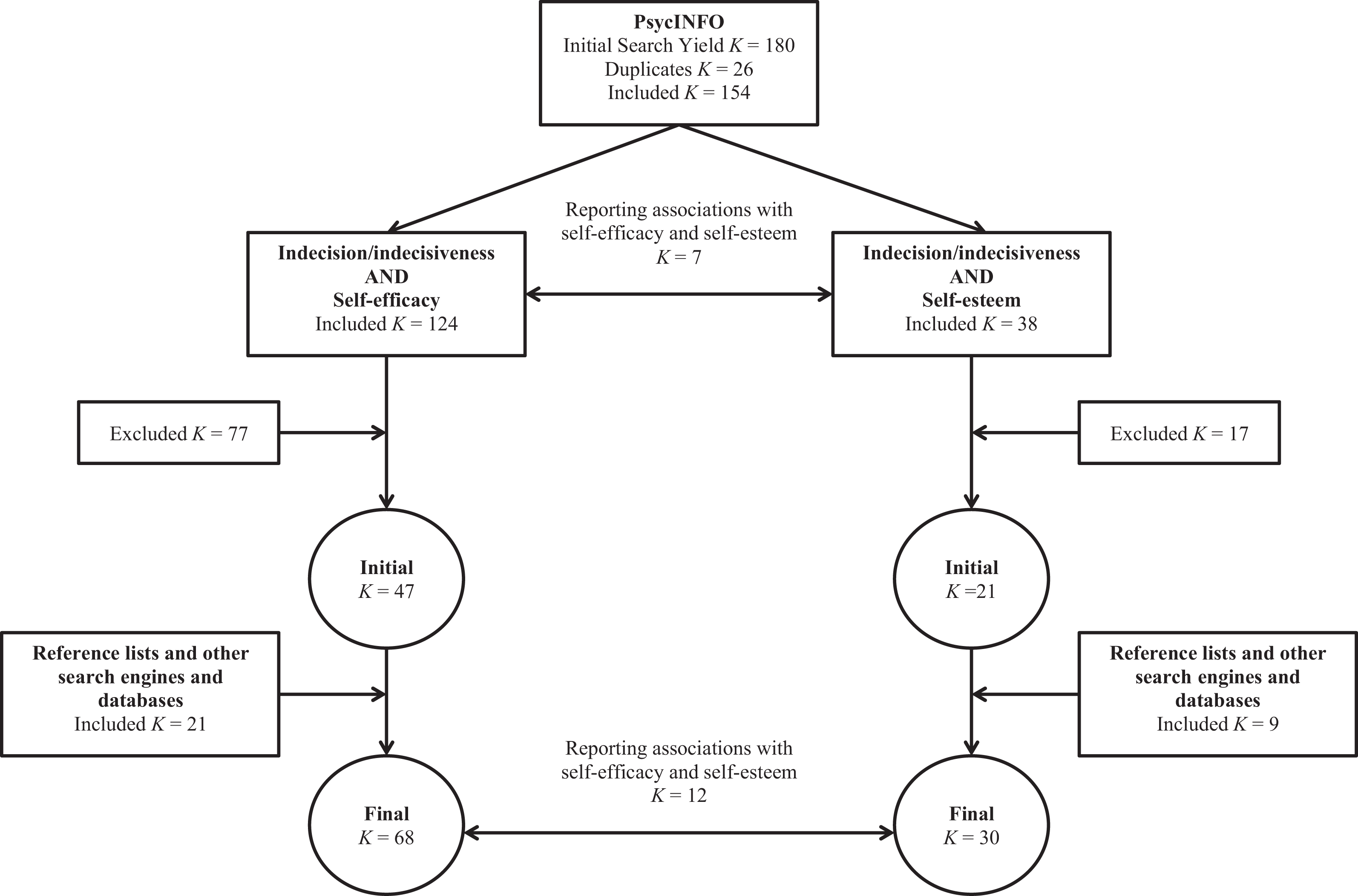
Literature search and retained studies.
After applying these inclusion criteria, we retained 47 studies that examined the relationship between career indecision/indecisiveness and self-efficacy; 7 of these studies also examined the relationship between career indecision/indecisiveness and self-esteem, and 14 other articles examined only the association between career indecision/indecisiveness and self-esteem. Based on these criteria, and using the other search strategies mentioned above, we added 25 additional studies examining the link between career indecision/indecisiveness and self-efficacy; 5 of them also examined the link between career indecision/indecisiveness and self-esteem.
In sum, a total of 86 studies were included in our meta-analysis (see Online Appendix S1 for further detail). Twenty-five of them included more than one study, and some of them reported more than one association of interest. In these cases, we included the statistics of all the associations. The sample size of the studies ranged from 30 to 7,418. The selected papers were published from 1981 to 2019 in the following journals: Journal of Career Assessment, Journal of Vocational Behavior, Journal of Career Development, The Career Development Quarterly, Journal of Counseling Psychology, European Journal of Psychological Assessment, L’Orientation Scolaire et Professionnelle, Procedia: Social and Behavioral Sciences, Chinese Journal of Clinical Psychology, British Journal of Guidance and Counselling, NACADA Journal, Journal of Adolescence, Personality and Individual Differences, The Journal of Positive Psychology, International Journal for Educational and Vocational Guidance, Current Psychology: A Journal for Diverse Perspectives on Diverse Psychological Issues, The Counseling Psychologist, Journal of Psychology in Africa, Horizons of Psychology, Perceptual and Motor Skills, Journal of Deaf Studies and Deaf Education, The Canadian Journal of Career Development, Romanian Journal of School Psychology, Polish Psychological Bulletin, Revista Brasileira de Orientação Profissional, Análise Psicológica, Kuram ve Uygulamada Eğitim Bilimleri, Swiss Journal of Psychology, and Psychological Reports.
Statistical Procedure
To conduct the analyses, data of the 86 retained studies were coded by two of the authors. The following study information was coded by the two raters: the authors’ names, study’s year of publication, sample size, types and causes of career decision-making difficulties (based on the scale used to measure them; see Online Appendix S2), types of self-evaluations (based on the scale used to measure them), and the correlations between the variables of interest. The initial interrater reliability coefficients ranged from 0.86 to 1.00. Incidents of disagreement were discussed between the two raters until agreement was reached.
Using the package metafor for R (Viechtbauer, 2010), we first computed the effect size and variance in each study based on the correlation coefficient and then calculated the weighted mean of these effects. Forest plots were used to summarize this information. To test different models, we fitted random-effects models to our data and carried out meta-regression analyses. Following these steps, we conducted a sensitivity analysis to identify potential outliers and influential studies. A study is considered an outlier when a studentized deleted residual is larger than 1.96. It is not unusual to find k/10 studentized deleted residuals larger than 1.96 in a meta-analysis (Viechtbauer & Cheung, 2010). A study is considered influential if at least one of the following is true: (a) The absolute difference in fits (DFFITS) value (a measure of how much an observation influences its fitted value) is larger than 3√(p/(k−p)), where p is the number of parameters, and k is the number of studies or (b) when Cook’s distance is larger than
Most meta-analyses use the fixed-effects model or the random-effects model (Borenstein et al., 2009). The fixed-effects model estimates a single effect that is considered common to all studies included in the meta-analysis. With this model, we assume that all of the differences in the observed effects are due to sampling error. In contrast, the random-effects model estimates a mean of the distribution of effects, which implies the presence of between-studies variance (Borenstein et al., 2009). For the current meta-analysis, we chose to use the random-effects model to estimate the weighted mean effect size (Fisher’s r to z transformation), using the restricted maximum likelihood estimator. This model also provides statistics such as the heterogeneity of effects sizes Q (the true dispersion is exactly zero) and the extent of heterogeneity I2 (proportion of observed dispersion that is real).
Meta-regression
To compare the effect sizes of different associations, we first estimated the weighted mean of the effect sizes between difficulties in career decision-making and self-evaluations, regardless of their types and then conducted a meta-regression (Borenstein et al., 2009). Statistically, we thus examined the interaction effects between the following two moderating variables: (1) the type of career decision difficulty (indecision vs. indecisiveness) and (2) the type of self-evaluation (process-related self-efficacy, content-related self-efficacy, general self-efficacy, and self-esteem). Testing these interaction effects allowed us to compare the six different associations (only few studies reported correlations between indecisiveness and content or generalized self-efficacy, so these relationships were not included in this meta-analysis).
Subscales analysis
Meta-regression was also used to test the moderating effect of two types of self-evaluations (process-related self-efficacy vs. self-esteem) on each of the three major CDDQ clusters. Only two of the four types of self-evaluations were used for this part of the meta-analysis because only process-related self-efficacy and self-esteem were previously studied in relation to the three major CDDQ clusters more than once. As only very few studies had investigated the association between the clusters of causes of EPCD (a measure of career indecisiveness) and self-evaluations, we were unable to conduct a meta-regression to test it.
Results
Types of Difficulties in Career Decision Making and Self-Evaluations
The association between the two types of difficulties in career decision-making (career indecision and indecisiveness) and all four self-evaluations together was negative and associated with a medium effect size, N = 54,160, k = 113, Q = 1,514.58, df = 112, p < .001, I2 = 91.08%, τ2 = .022, and
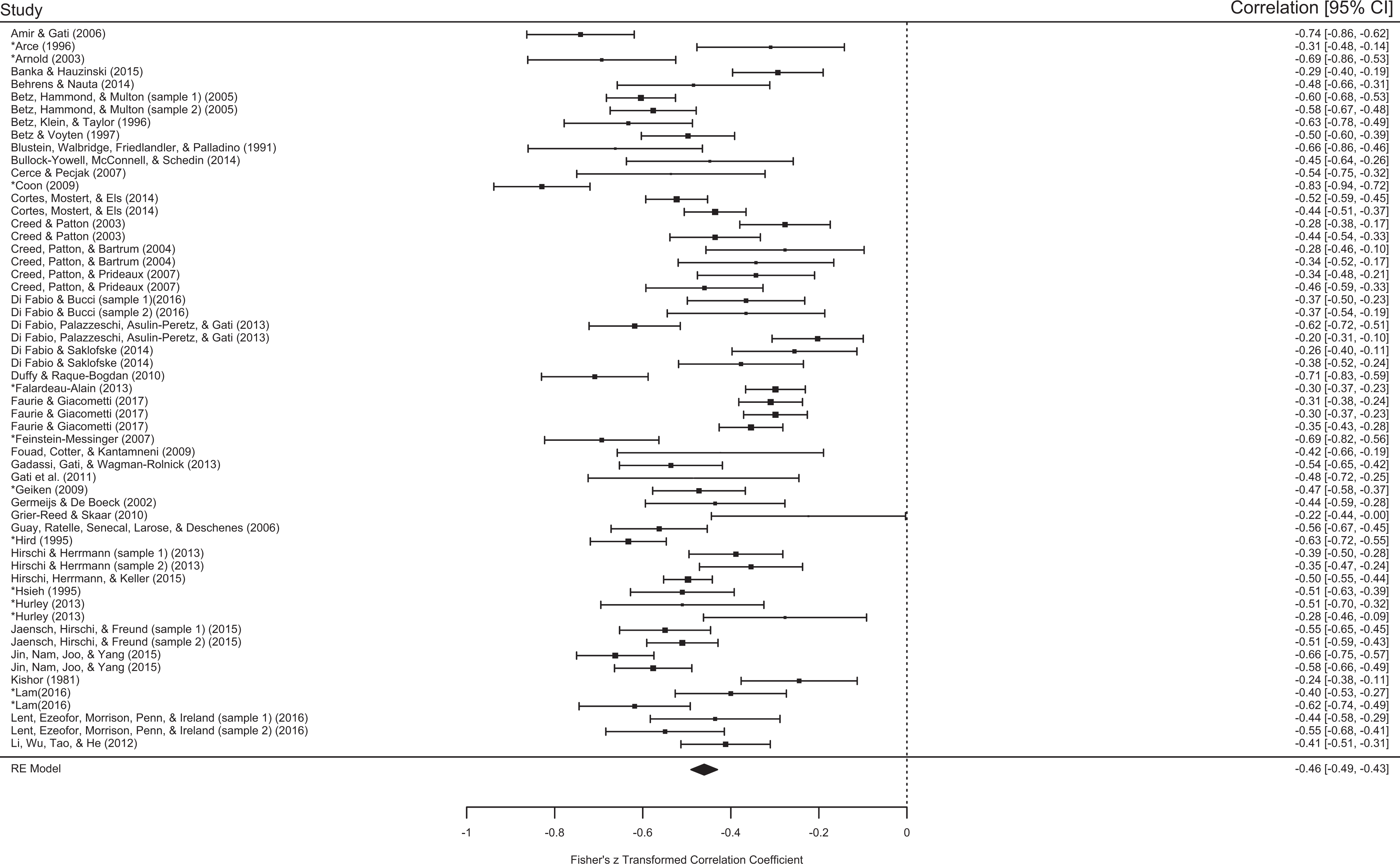
Forest plot of the effect sizes between the difficulties in career decision making and self-evaluations. Note. N = 54,160, k = 113. *Unpublished studies.
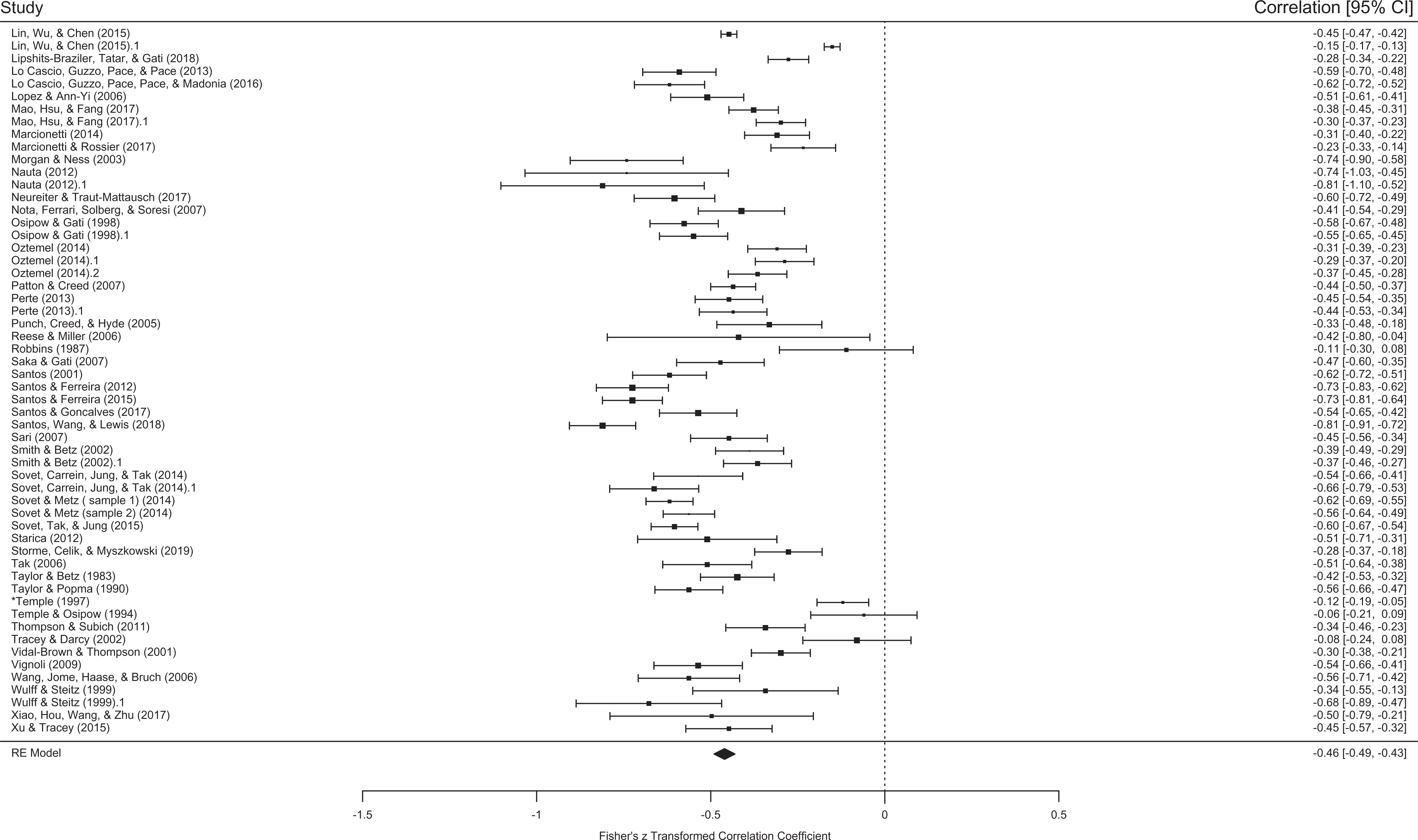
The sensitivity analysis showed that six studies (Coon, 2009; Lin et al., 2015; Santos et al., 2018; Temple, 1997; Temple & Osipow, 1994; Tracey & Darcy, 2002) emerged as outliers due to their large standardized residual. Although extreme, all of these studies were not considered to be influential according to the DFFITS statistics and Cook’s distance. For this reason, we decided to include these studies for the subsequent analyses. Moreover, excluding extreme data is not always recommended because such data may carry important information for the meta-analysis and should be carefully scrutinized (Viechtbauer & Cheung, 2010).
These six outlier studies explained only 4.5% of the total between-studies heterogeneity. The reported correlations between career decision-making difficulties and self-evaluations in both Coon’s (2009) and Santos and colleagues’ (2018) studies were the highest of all the reviewed studies. The correlations reported by the other four studies were the lowest. The high correlation between career indecision and self-efficacy found in Santos and colleagues’ (2018) study may be attributed to the fact that the authors presented a bivariate correlation after having partialed out the effects of age, gender, nationality, education strata, and mode of study. Lin and colleagues (2015) used a substantial sample (N = 7,418) and did not use the usual questionnaire to assess the different constructs. Indeed, they used only 2–3 items to assess career indecision and self-efficacy, yielding a Cronbach’s α of under .80. Tracey and Darcy (2002) did not use items directly assessing generalized self-efficacy but instead used another questionnaire in which some of the competence-related items have been demonstrated to be highly correlated to generalized self-efficacy, such that they could be used as a proxy of this construct. This use of a competency-based measure could explain their finding of a nonsignificant correlation between career indecision and generalized self-efficacy.
To determine whether our data indicate the existence of publication bias, we examined the funnel plot of effect sizes dependent on standard errors. Furthermore, we used Egger’s test to evaluate the asymmetry of this funnel plot. Figure 3 shows that the effect sizes are generally distributed fairly symmetrically around the mean weighted effect size. However, some of the effect sizes were outside the delimited area (95% CI). This suggests a possible publication bias due to the between-studies heterogeneity. Egger’s test confirmed the existence of this asymmetry, t(111) = −4.12, p < .001. Nonetheless, the impact of this bias on the global effect proved to be insubstantial since by reestimating the value of the effect size once the bias has been corrected using the trim-and-fill method, the global effect remained significant (z = −26.14, p < .001). The estimated bias was 0.03, which indicates that it is rather small. The new funnel plot indicated that 12 studies need to be added on the left side of the plot (Figure 2) to offset the suppression of the most extreme results on the other side.
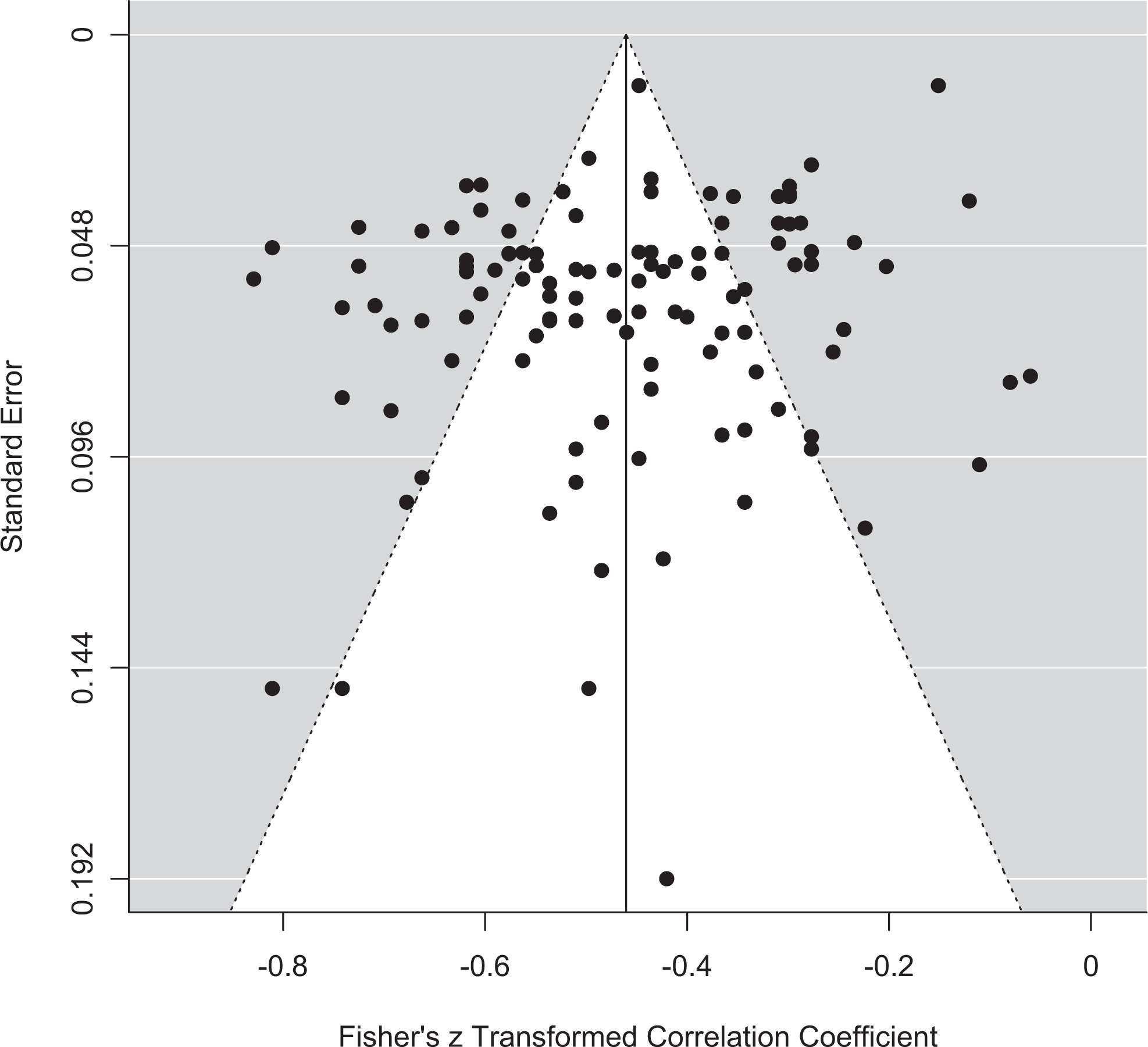
Funnel plot of studies investigating the association between difficulties in career decision making and self-evaluations. Note. Funnel plots indicate the observed effect sizes on the x-axis against their corresponding standard errors (in decreasing order) on the y-axis. The vertical line shows the global mean effect size based on the model. A 95% confidence interval is drawn around this value.
Meta-regression
The interaction effect of the two moderators—the type of difficulty and the type of self-evaluation—on the association between difficulties in career decision making and self-evaluations was statistically significant (Qregression = 1,077.93, df = 6, p < .001). Studies focusing on career indecisiveness and self-esteem showed a significantly higher correlation (
Effect Sizes for Correlations Between Difficulties in Career Decision Making and Self-Evaluations.
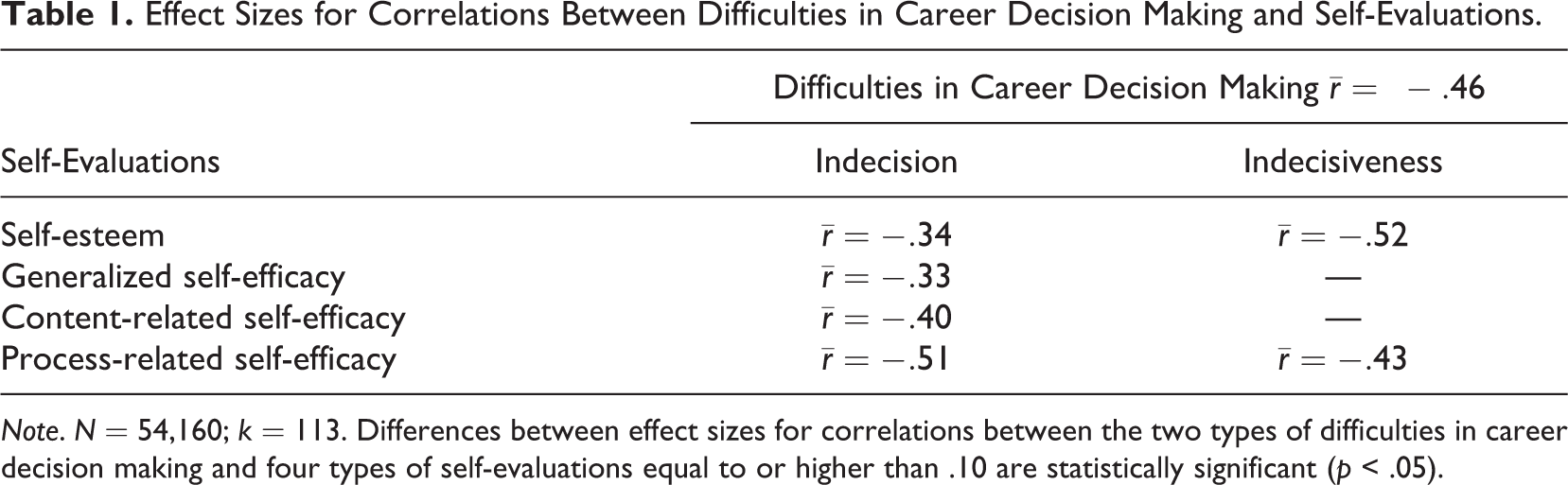
Note. N = 54,160; k = 113. Differences between effect sizes for correlations between the two types of difficulties in career decision making and four types of self-evaluations equal to or higher than .10 are statistically significant (p < .05).
Causes of Difficulties in Career Decision Making and Self-Evaluations
To investigate the associations between the three major CDDQ clusters (lack of readiness, lack of information, and inconsistent information) and the two types of self-evaluations (process-related self-efficacy vs. self-esteem), the analyses were carried out on 19 of the 30 studies that used the CDDQ.
The results showed that lack of readiness negatively correlated with self-evaluations, N = 7,953, k = 19, Q = 182.99, df = 18, p < .001, I2 = 89.64%, τ2 = .021,
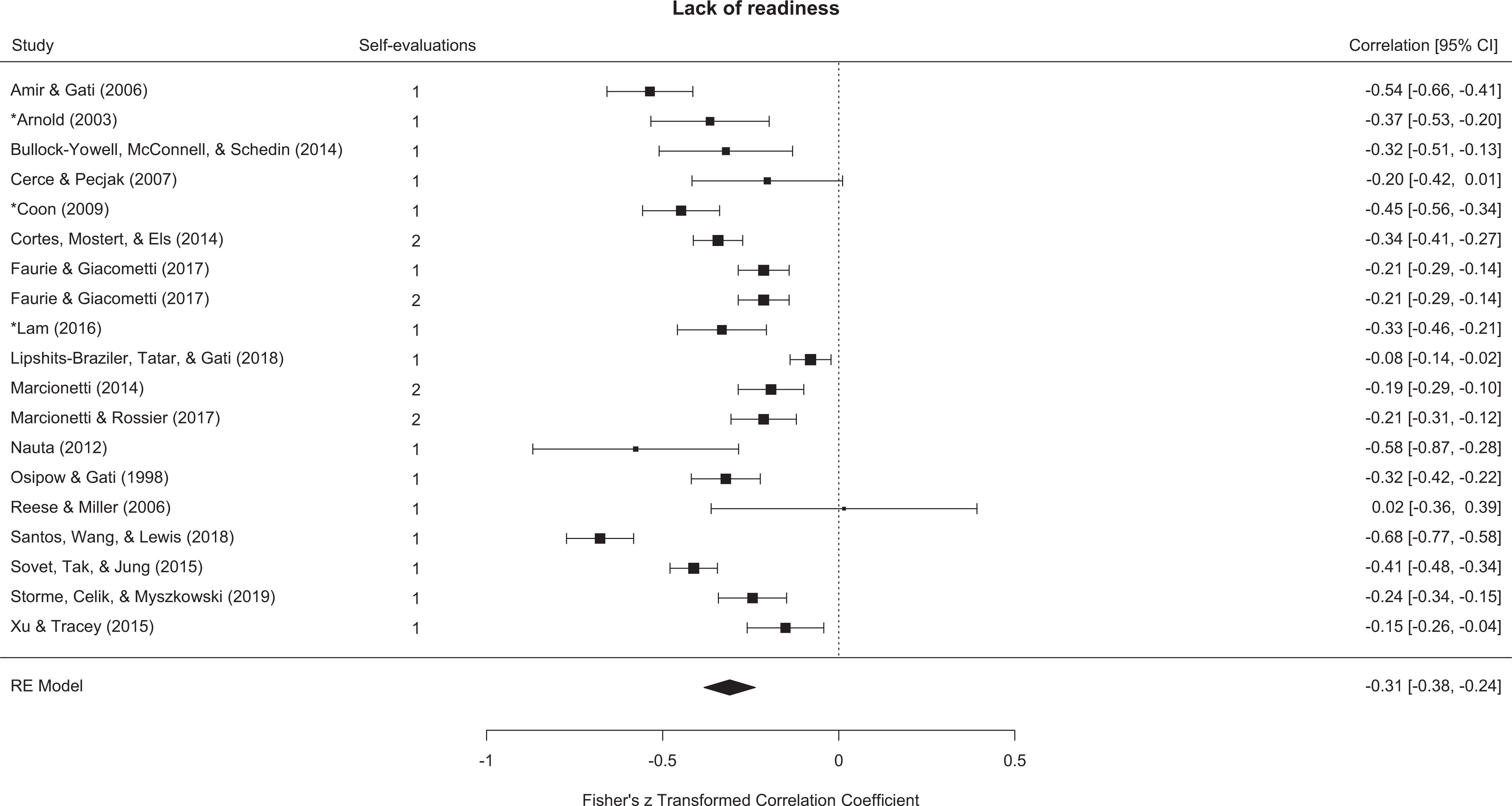
Forest plot of the effect sizes between lack of readiness and self-evaluations. Note. N = 7,953, k = 19. *Unpublished studies. Type of self-evaluation: 1 = process-related self-efficacy, 2 = self-esteem.
The sensitivity analysis showed that one study (Santos et al., 2018) emerged as an outlier due to its large standardized residual and was also influential according to the DFFITS statistics. The explained between-studies variance by this study was a negligible 5.8%. The reported correlation between lack of readiness and self-evaluations in this study was the strongest (r = −.59, n = 427) among the studies using the CDDQ. Meta-regression results showed that the type of self-evaluation (process-related self-efficacy vs. self-esteem) did not explain the between-studies heterogeneity (Qregression = 1.06, df = 1, p = .302). The association between lack of readiness and process-related self-efficacy (
Concerning the lack of information cluster, the results showed that it was negatively correlated with self-evaluations, N = 7,953, k = 19, Q = 261.16, df = 18, p < .001, I2 = 93.24%, τ2 = .034,
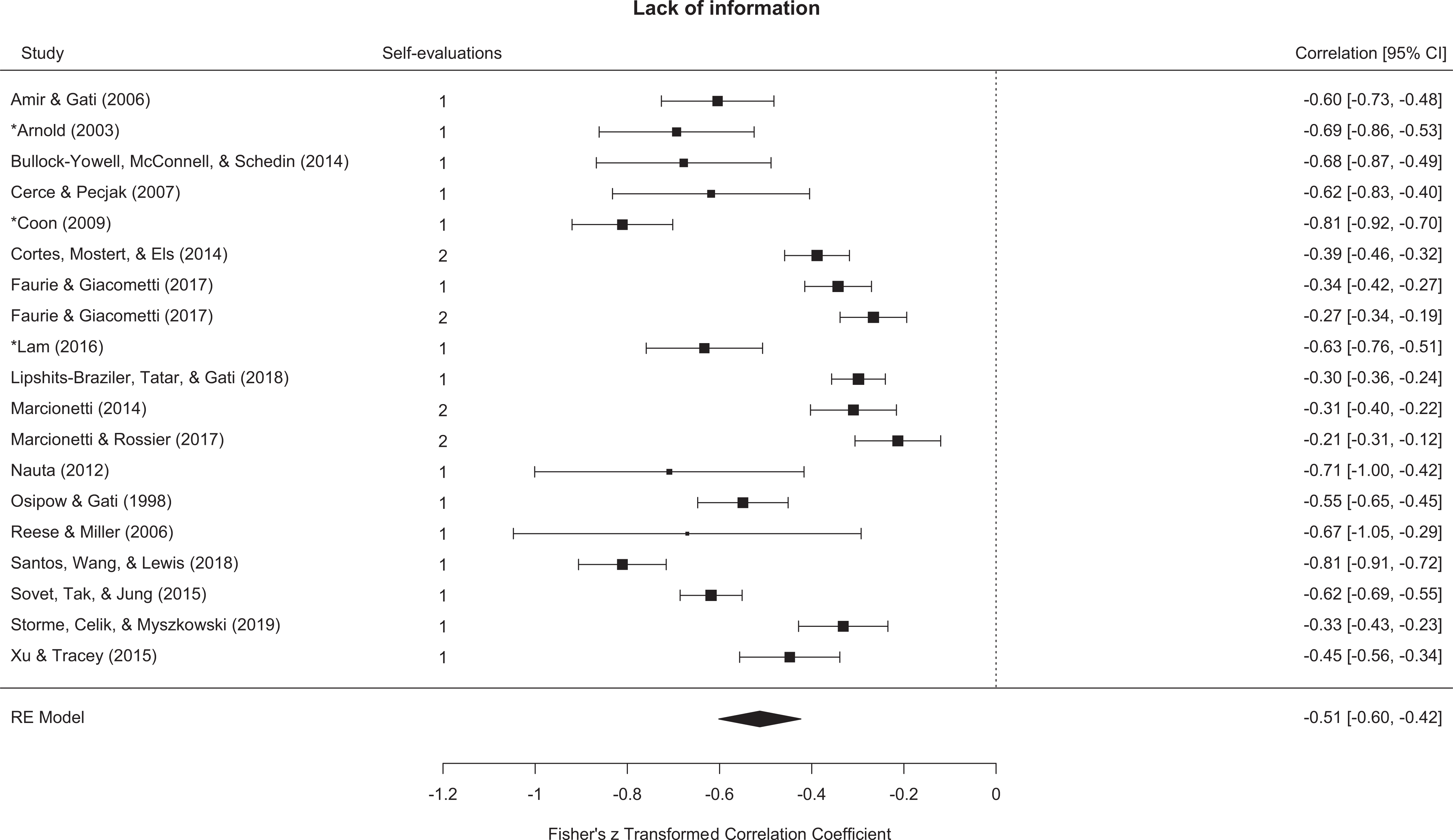
Forest plot of the effect sizes between lack of information and self-evaluations. Note. N = 7,953, k = 19. *Unpublished studies. Type of self-evaluation: 1 = process-related self-efficacy, 2 = self-esteem.
Effect Sizes for Correlations Between CDDQ Clusters and Types of Self-Evaluations.
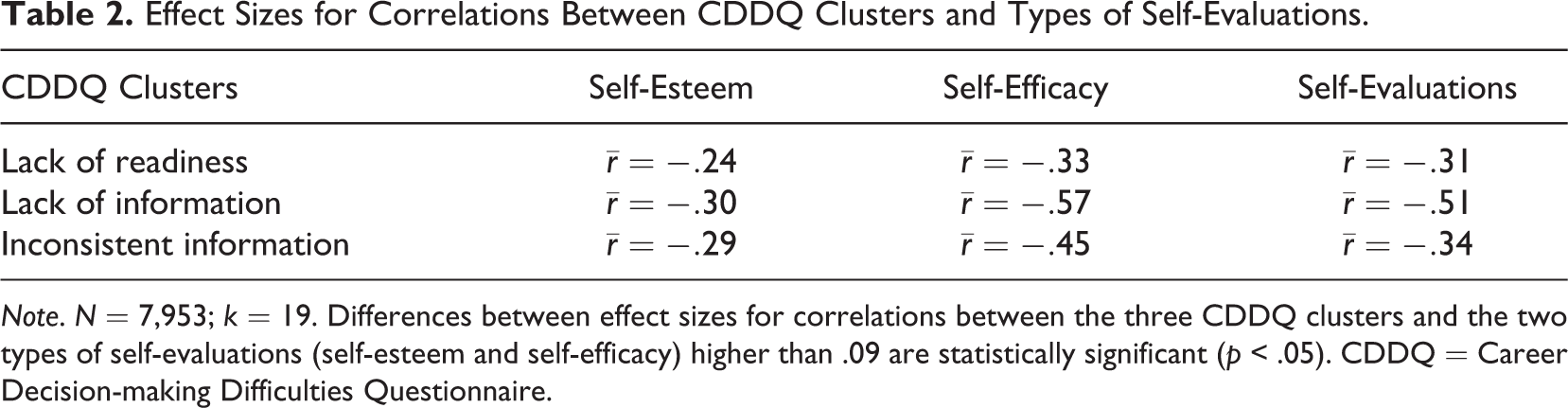
Note. N = 7,953; k = 19. Differences between effect sizes for correlations between the three CDDQ clusters and the two types of self-evaluations (self-esteem and self-efficacy) higher than .09 are statistically significant (p < .05). CDDQ = Career Decision-making Difficulties Questionnaire.
Finally, the results showed that the inconsistent information cluster negatively correlated with self-evaluations, N = 7,953, k = 19, Q = 139.92, df = 18, p < .001, I2 = 89.09%, τ2 = .020,

Forest plot of the effect sizes between inconsistent information and self-evaluations. Note. N = 7,953, k = 19. *Unpublished studies. Type of self-evaluation: 1 = process-related self-efficacy, 2 = self-esteem.
Discussion
The primary aim of the present meta-analysis was to expand our understanding of the associations between career indecision and indecisiveness on the one hand and four types of self-evaluations––generalized self-efficacy, process-related self-efficacy, content-related self-efficacy, and self-esteem—on the other. The findings showed that these types of self-evaluations were differently associated with the types (career indecision and indecisiveness) and causes (lack of readiness, lack of information, and inconsistent information) of difficulties in career decision making.
Types of Difficulties in Career Decision Making and Self-Evaluations
The analyses of associations between the two types of difficulties in career decision making and the four types of self-evaluations indicate that generalized self-efficacy, content-related self-efficacy, and self-esteem were all negatively and moderately correlated with career indecision. Moreover, all three types of self-evaluations showed lower correlations with career indecision than with process-related self-efficacy, pointing out a more distal association of these three self-evaluation types with career indecision. These results confirm our hypotheses and are compatible with SCCT, suggesting a direct and stronger effect of regulatory processes than the effect of personal dispositions on career-related behaviors (Lent et al., 1994). The self-belief in one’s ability to use adequate strategies for successfully navigating a career decision-making process indeed emerged as the strongest covariate of career decision. Thus, whether career decision-making difficulty was measured unidimensionally or multidimensionally, the construct remains strongly related to career decision-making self-efficacy.
What is new and has only been shown by this meta-analysis is that whereas three types of self-evaluations were less strongly associated with career indecision than was process-related self-efficacy, they were still related to it, highlighting their importance in the career decision-making process. As pointed out in Jiang’s study (2015), personality-related global self-evaluations (generalized self-efficacy and self-esteem) have been found to be less strongly associated with career indecision than situational self-evaluation (i.e., process-related self-efficacy). Content-related self-efficacy, also considered a situational self-evaluation, appears to be as moderately correlated as the personality-related self-evaluations with difficulties in career decision making. This leaves room for further investigation of its true nature and to establish its role in the career decision-making process more accurately.
Results also showed that, as hypothesized, self-esteem is strongly and negatively associated with indecisiveness: The higher the level of self-esteem, the lower the level of indecisiveness. Self-esteem seems to be a key factor protecting against indecisiveness and, conversely, lack of self-esteem appears to be one of the main difficulties causing career indecisiveness, a finding consistent with Saka and Gati’s (2007) taxonomy of emotional and personality-related aspects of career decision-making difficulties. In Saka and Gati’s framework, self-esteem comprises one of the factors leading to indecisiveness. It is noteworthy that, while highlighting a strong association between self-esteem and indecisiveness, our findings do not imply any causality effects. Nonetheless, a vicious circle of causality can be posited: Whereas low self-esteem could lead to indecisiveness, indecisiveness could engender low self-esteem. Indeed, when individuals struggle to make decisions in all aspects of their life, indecisiveness may hinder them in actualizing their potential and may diminish their sense of self-worth. Thus, low self-esteem may be not only a cause of emotional and personality-related career decision-making difficulties but also a consequence of these difficulties.
Finally, our results showed that process-related self-efficacy was similarly crucial in predicting indecisiveness than career indecision. This finding implies that career decision-making self-efficacy could be activated not only to overcome momentary difficulties related to the career decision-making process but also to overcome more chronic difficulties in making decisions. Although the importance of process-related self-efficacy in career indecision has been well acknowledged (Choi et al., 2012), the current meta-analysis highlights its importance in indecisiveness as well.
Causes of Difficulties in Career Decision Making and Self-Evaluations
Our findings showed that process-related self-efficacy was more strongly and negatively associated with lack of information and inconsistent information than was self-esteem. Self-efficacy seems to play an important role in the cognitive aspects of career decision-making difficulties occurring during the career decision-making process. Both process-related self-efficacy and self-esteem showed low to moderate associations with the lack of readiness cluster and were not distinguishable. A closer look at the 10 items and three subscales of the lack of readiness cluster (lack of motivation, indecisiveness, and dysfunctional beliefs) reveals that this cluster consists of disabling cognitive, emotional, and relational evaluations regarding the career decision-making process (Rochat, 2019a). The mixed nature of these components can explain why the associations between the different types of self-evaluations are less consistent for this cluster. Specifically, this unexpected finding may be attributable, at least partly, to the relatively lower internal-consistency reliability of this cluster (e.g., Levin et al., 2020). As the lack of readiness cluster is comprised of three distinct difficulty categories, the correlations between them are consistently lower than they are between the categories comprising the lack of information and the inconsistent information clusters. Future studies should examine the three scales of the lack of readiness cluster separately to determine how each scale relates to each type of self-evaluation. A closer look at the item levels may also be of interest, as each of the CDDQ’s items represents a different difficulty (Rochat, 2019a).
Recently, Kulcsár and colleagues (2020) proposed a theoretically derived taxonomy for classifying constructs and assessments of the career decision-making process. They classified lack of career decision-making self-efficacy as one of the challenges that may emerge prior to engaging in the process of making a career decision and hence may prevent the process from beginning. They considered this to be one of the indicators of individuals’ lack of readiness in career decision-making. Again, although no causality effects could be tested in this meta-analysis, the strong associations found between process-related self-efficacy and the lack of information and inconsistent information clusters show that career decision-making self-efficacy could also play a major role in how individuals approach and manage their career decision-making process.
Limitations and Future Research
Although this meta-analysis provides important insights into the associations between the types and causes of career decision-making difficulties, on the one hand, and the different types of self-evaluations on the other, some shortcomings need to be considered. Notwithstanding the large number of studies we included in this meta-analysis, the constructs were not equally represented, as most of the studies investigated only the association between career indecision and process-related self-efficacy. Several studies also investigated only the association between career indecisiveness and self-esteem. Generalized self-efficacy and content-related self-efficacy were clearly underrepresented in the reviewed studies, which likely affected the power of the results. Hence, future studies should also consider types of self-efficacy other than process-related self-efficacy and investigate their association with both career indecision and indecisiveness.
Although the multidimensionality of career indecision and indecisiveness is well acknowledged, many studies still investigate them as unidimensional constructs and use only their derived total scores. Indeed, although several studies have investigated the association between self-evaluations and the EPCD, we could not examine their relationship further through this meta-analysis because of the lack of consideration for the multidimensionality of this scale in several previous studies. Future research should take into consideration each difficulty cluster and investigate the role of self-evaluations at the cluster level. This could contribute, for example, to a better understanding of the relationship of the CDDQ’s lack of readiness cluster with various self-evaluation types.
Considering the importance of all four types of self-evaluations in career decision making, it would be valuable to investigate how these interact to predict career indecision or indecisiveness. Wulff and Steitz (1999) conducted one of the rare studies on the associations among self-esteem, process-related self-efficacy, and career indecision. Their study revealed that self-esteem did not have a direct effect on career indecision, and its impact was entirely mediated by career decision-making self-efficacy. The SCCT model (Lent et al., 1994) could be used to explain this mediation hypothesis. Indeed, self-esteem or generalized self-efficacy could be viewed as a personal disposition that may affect career decision-making self-efficacy that, in turn, may lead to career indecision. Future studies should focus on the mechanism that links these constructs to better understand the role of each in facilitating the career decision-making process.
Implications for Practice
Being cognizant of the association between the types and causes of difficulties in career decision making and the different types of self-evaluations could first help career counselors understand the severity of the situation described by a client during an intake interview. This implies that career counselors should ask their clients how confident they feel about themselves in general, about the career decision-making progress, or about a specific, targeted goal. For example, they may ask their clients to rate how confident they feel about a specific task on a 10-point scale, ranging from 1 (not at all confident) to 10 (completely confident; e.g., Miller & Rollnick, 2013). The client’s responses to these questions may help the counselor determine whether the career client is mostly dealing with developmental career indecision or is more likely to present more severe issues of indecisiveness. Once the type of difficulty is identified, career counselors should help their client work in parallel on their self-efficacy and self-esteem, such as through the use of strengths and qualities assessment (Rochat, 2019b). Increasing clients’ career-decision self-efficacy is especially likely to help them successfully proceed through the various phases of the career counseling process, whereas enhancing the individual’s self-esteem could primarily help them deal with decision-making difficulties they could encounter in their everyday life (Rosenberg et al., 1989).
Conclusion
The present meta-analysis showed that different types of self-evaluations––process-related self-efficacy, content-related self-efficacy, generalized self-efficacy, and self-esteem––were all significantly associated with career indecision and indecisiveness, not only at the global level but also at the specific level of the causes of career decision-making difficulty. Process-related self-efficacy had the strongest negative association with career indecision, whereas self-esteem had the strongest negative association with indecisiveness. This meta-analysis thus highlighted the importance of self-evaluations in career decision making, protecting against not only developmental career indecision but also chronic emotional and personality-related career decision-making difficulties.
Supplemental Material
Supplemental Material, Suppl_Appendix_1 - Difficulties in Career Decision Making and Self-Evaluations: A Meta-Analysis
Supplemental Material, Suppl_Appendix_1 for Difficulties in Career Decision Making and Self-Evaluations: A Meta-Analysis by Shagini Udayar, Nimrod Levin, Yuliya Lipshits-Braziler, Shékina Rochat, Annamaria Di Fabio, Itamar Gati, Laurent Sovet and Jérôme Rossier in Journal of Career Assessment
Supplemental Material
Supplemental Material, Suppl_Appendix_2 - Difficulties in Career Decision Making and Self-Evaluations: A Meta-Analysis
Supplemental Material, Suppl_Appendix_2 for Difficulties in Career Decision Making and Self-Evaluations: A Meta-Analysis by Shagini Udayar, Nimrod Levin, Yuliya Lipshits-Braziler, Shékina Rochat, Annamaria Di Fabio, Itamar Gati, Laurent Sovet and Jérôme Rossier in Journal of Career Assessment
Footnotes
Declaration of Conflicting Interests
The author(s) declared no potential conflicts of interest with respect to the research, authorship, and/or publication of this article.
Funding
The author(s) disclosed receipt of the following financial support for the research, authorship, and/or publication of this article: The contribution of Shagini Udayar and Jérôme Rossier was made partly within the framework of the National Centre of Competence in Research-LIVES financed by the Swiss National Science Foundation (grant no 51NF40-160590); Itamar Gati was supported partly by the Samuel and Esther Melton Chair.

Supplemental Material
The supplemental material for this article is available online.
References
Supplementary Material
Please find the following supplemental material available below.
For Open Access articles published under a Creative Commons License, all supplemental material carries the same license as the article it is associated with.
For non-Open Access articles published, all supplemental material carries a non-exclusive license, and permission requests for re-use of supplemental material or any part of supplemental material shall be sent directly to the copyright owner as specified in the copyright notice associated with the article.
