



Abstract
Career commitment refers to one’s emotional attachment to one’s career rather than to one’s current working organization. While career commitment has been studied for decades as an important construct in applied psychology research, robust conclusions about its antecedents have not been drawn by empirical research. To address this issue, this research presents the results of a meta-analytic review of the antecedents of career commitment based on data from 156 individual studies (N = 58,651) conducted between 1980 and 2019. A total of 52 latent antecedents were captured and categorized into five different groups, and the strength, direction and heterogeneity of the relations between career commitment and its antecedents were meta-analytically investigated. Our findings revealed that while individual attributes (e.g. age) alone were weak predictors of career commitment, psychological (e.g. job satisfaction) and organizational factors (e.g. organizational career growth) exhibited medium effect sizes. In addition, among job-related factors, autonomy demonstrated a relatively strong influence on career commitment. The implications are elucidated for researchers and practitioners in the light of these key findings.
Due to the rise of globalization and the development of new technology, knowledge and skills, the world economy, and industries that comprise it, have been undergoing profound transformations (Shah, 2011). To address the uncertainty associated with change, companies continue to down-size, out-source or layoff staff. For the past four decades, employees have realized that their tenure within an organization is no longer guaranteed and that they are expected to take major responsibility for their career development, leading to a change in the nature of employees’ psychological contract (Fu, 2011). That is, contemporary employees may develop more commitment to their own careers than to the companies for which they work (Y. Kim et al., 2012). When establishments have become powerless to offer job security, emotional attachment to an intrinsically defined career can be a crucial source of occupational meaning and continuity (Aryee et al., 1994; Colarelli & Bishop, 1990). Thus, from a social perspective, individuals’ career commitment may be beneficial to maintaining social stability, diminishing industry turnover rates and perhaps raising gross domestic product (Mathieu & Zajac, 1990). Career commitment therefore is receiving increased attention from vocational psychologists.
Aryee and Tan (1992) point out that career commitment has relevance to the practical concerns of both individuals and management. For example, since a career includes the series of discrete but interrelated positions occupied by an individual from adolescence to retirement (Colarelli & Bishop, 1990), it is widely believed that affection for and commitment to a vocation (as a substantial life domain) is a salient antecedent of life satisfaction (Demirtas & Tezer, 2012). Career commitment has a positive effect on career success, since it offers individuals perseverance in developing skills and chasing vocational goals. Career commitment is vital also because, as a predictor, it is closely associated with several workplace outcomes, both behavioral and attitudinal. Research illustrates that individuals who are highly committed to their careers demonstrate less intention to leave their careers and jobs (Weng & McElroy, 2012) and exhibit more willingness to self-sacrifice (Fu, 2011), greater productivity (Mrayyan & Al-Faouri, 2008) and better work-related well-being (Duffy et al., 2011).
Considering these potential benefits, scholars from a broad range of disciplines (e.g. information technology, health, education and public service) have empirically investigated the determinants of career commitment. Despite the undoubted contributions made by individual studies to the examination of the antecedents of career commitment, their methodologies and results were subject to various constraints that are unavoidable in individual studies, such as sampling bias, limited sample sizes and measurement error, leading to some inconsistent results, or even contrary findings. For example, the work of Satoh et al. (2017) revealed a correlation of 0.19 between age and career commitment, while this correlation was not significant in the study by Parasuraman and Nachman (1987). Another example is while several studies found a positive relation between educational level and career commitment (Benligiray & Sonmez, 2013; Weng & McElroy, 2012), a negative linkage was detected by Okurame (2012). Besides, as individual studies, most them have adopted a partial focus point, failing to establish a thorough explanatory model on the antecedents of career commitment.
Given these flaws among individual studies, a meta-analytic review of the extant empirical research is needed to shed light on the variety of factors boosting career commitment. According to H. Kim and Kao (2014), meta-analysis is not only a systemic review device (e.g. a summary of determinants or outcomes of a certain construct), but also provides a powerful way in which to address the constraints of individual studies (e.g. measurement unreliability and selection bias) by combining and synthesizing the quantitative results of multiple research findings. Indeed, meta-analysis has been employed to examine career commitment in the past. In their meta-analytic review, Jones et al. (2006) briefly introduced different types of work-related commitment and particularly focused on the antecedents of career commitment. However, their research did not follow a formal systematic review procedure, nor did it present the magnitude of corrected effect size of predictors. Another study by Katz et al. (2019) meta-analytically tested only the association between age and career commitment.
To date, the meta-analytic review by Lee et al. (2000) seems to be the first and perhaps the only systematic quantitative synthesis of the myriad determinants of career commitment. In this old review, a list of 30 possible antecedents was presented based on a review of 76 individual studies. Nevertheless, Lee et al. (2000) only examined whether personal and job-related variables could be applied to predict career commitment and did not take into account the effects of organizational and environmental factors. In sum, the work of Lee et al. (2000) demonstrates the feasibility of performing quantitative reviews of individual works, but their results were based on data from over 20 years ago and failed to provide robust support for a comprehensive model of the predictors of career commitment.
Cognisant of the importance of career commitment to individuals, organizations and society, and the paucity of review studies on this construct, the present study aims to make up for this deficiency with a particular focus on the antecedents of career commitment by conducting a meta-analysis of the extant individual studies. The primary purpose of the study is to investigate the magnitude, direction, and heterogeneity of the effect sizes of career commitment’s critical predictors using meta-analytical techniques.
The present work contributes to the literature and practice in the following ways. First, we contribute beyond the review of Jones et al. (2006) by statistically synthesizing prior empirical data to provide a more accurate estimate of associations between career commitment and its predictors. Second, in contrast to Lee et al. (2000), our work includes additional studies published between 1999 and 2019, offering a more updated review of the literature. Further, besides investigating the relations of career commitment with individual and job-related factors, our study also includes psychological, organizational and environmental factors as further latent determinants – none of the extant meta-analytic studies have investigated such a wide range of antecedents of career commitment. In doing so, the current review highlights some factors that have often been examined as predictors of career commitment as well as several important but less-studied determinants, providing a reference and identifying avenues for future empirical research. Last, by updating work in this field, the present study also seeks to offer practitioners with a clear and comprehensive understanding of the multilevel determinants of career commitment as well as several insights into employees’ career development and management.
Career Commitment
Career Commitment and Other Forms of Work Commitment
According to Morrow (1983), work-related commitment is composed of organizational commitment, job involvement, work-ethic endorsement and career commitment. Although different types of work-related commitment are linked with each other theoretically, many occupational psychologists have pointed out that career commitment, because of its self-interested nature, is fundamentally distinguishable from others (Hall, 1971). Indeed, the discriminant validity of career commitment from measurements of organizational commitment and job involvement has been captured by a good deal of empirical studies (e.g. Gebbels et al., 2020; Lapointe et al., 2019). According to Colarelli and Bishop (1990), in contrast to career commitment, organizational commitment should be viewed as loyalty or emotional attachment to the current working organization rather than to the vocation.
Moreover, job involvement refers to being committed to a comparatively immediate set of objective work tasks, while career commitment “involves a longer perspective and is related to the subjective (or internal) career envisioned by the individual” (Colarelli & Bishop, 1990, p. 159). Goulet and Singh (2002) stress that an individual can feel committed to a job and not have emotional attachment to his/her career. For example, an employee may enjoy a computer software development role but have the long-term career goal of becoming a systems architect. Similarly, work-ethic endorsement entails a person’s ethical beliefs about how well a person should perform his or her job, rather than his or her career (Blau, 1985b).
While it should be noted that in previous research on commitment the terms “career,” “occupation” and “profession” have, to some extent, been used interchangeably (Arora & Rangnekar, 2015; Lee et al., 2000), in the present work, we have used “career” for the following reasons. First, “career commitment” is more applicable to employees from divergent jobs/occupations than “professional commitment,” as Colarelli and Bishop (1990) argue that both professional (e.g. lawyers and engineers) and non-professional employees can exhibit commitment to their chosen careers. Besides, it is believed that the focus of “occupational commitment” is comparatively narrow as it relates only to an individual’s emotional attachment to the specific line of work in which he/she is engaged at a particular time (Weng & McElroy, 2012), whereas “career commitment” can be employed to examine the commitment to a concatenation of separated but related occupations held during his/her work life (Noordin et al., 2002). Nevertheless, consistent with Lee et al. (2000), when assessing prior studies for inclusion in the present review, we checked the use of the terms “occupational,” “professional” and “career” commitment and gave attention to the related construct that researchers investigated in order to maximize our potential samples.
Conceptualization and Measure of Career Commitment
Career commitment is not a new construct. Blau (1985a) defined career commitment as “one’s attitude toward one’s profession or vocation” (p. 278) and initially created a reliable measurement of career commitment thatdemonstrated discriminant validity from other work commitment concepts (Singhal & Rastogi, 2018). In Blau (1985a), withdrawal cognitions were employed to explain career commitment; for example, employees with a low degree of career commitment may tend to show a high level of career withdrawal cognitions. One sample item from the measure is “I like this vocation too well to give it up—Blau’s (1985a) results demonstrated that his measurement of career commitment showed a different relation to withdrawal cognitions than measurements of job involvement and organizational commitment. However, what he fails to do is to empirically and conceptually draw a distinction between career commitment and career withdrawal intentions (Katz et al., 2019).
In order to get a deeper understanding of an employee’s tie to his or her career, drawing from Meyer and Allen’s (1991) conceptual model of organizational commitment, Meyer et al. (1993) extended the model to career commitment. As they emphasized, since it is widely acknowledged that commitment is a complex and multifaced construct, it is reasonable to argue that employees may develop emotional attachment to their working organization or career for various reasons. Meyer et al. (1993) divided those reasons into three themes: affective (want to stay), continuance (need to stay), and normative (ought to stay) commitment. Their results showed that these three types of occupational commitment were significantly distinguishable from each other. Nevertheless, Blau (2003) commented that the main weakness of the study of Meyer et al. (1993) was the failure to conduct formal tests to capture significant differences in associations of different commitment components to other variables in order to provide more robust support for the discriminant validity of each of these three types.
Cognisant of Blau’s (1985a) limitations, the main aim of Carson and Bedeian (1994) was to develop a new measurement of career commitment that can conceptually and empirically extricate overlap between career commitment and withdrawal cognitions. Drawing on London’s career motivation theory, Carson and Bedeian (1994) defined career commitment as one’s motivation to work in a chosen career (London, 1983) rather than intention-to-remain in one’s vocation (see Blau, 1985a). Consistent with London (1983), Carson and Bedeian (1994) theorized career commitment with three aspects: career resilience (the persistence component of commitment, especially when facing discouraging circumstances), career planning (one’s motivation to advance his/her career or set up career-related goals), and career identity (the extent to which persons define themselves by their work). All three aspects were integrated into the measure of overall career commitment. The findings of Carson and Bedeian (1994) provide reliability and discriminant validity evidence for their measure, but the researchers themselves acknowledged that, as with Blau (1985a), their results also exhibited construct contamination (e.g. high correspondence between their measurement and career change intentions).
Whereas Blau (2003) praised Meyer et al.’s (1993) contributions toward measuring career commitment, he questioned whether the dimensionality of career commitment can be further distinguished, especially “whether continuance occupational commitment is unidimensional” (Blau, 2003, p. 470). Drawing on Meyer et al.’s (1993) three-type occupational commitment model and Carson et al.’s (1995) career entrenchment measurement, Blau (2003) developed an expanded four-component model of career commitment. In contrast to Meyer et al. (1993), his model further separated continuance career commitment into two forms, namely accumulated costs and limited alternatives career commitment. The longitudinal results of Blau (2003) provided both reliability and validity support for his model (affective commitment, normative commitment, accumulated costs and limited alternatives). However, one of the limitations with his study is that it does not confirm whether each form was differentially associated with outcomes of career commitment (e.g. career change cognitions) for extra support for the discriminant validity of each of the four components (Blau, 2003).
In sum, while each above-mentioned conceptualization or measure of career commitment may have its constraints, they were those most widely employed, assessed and cited by researchers in vocational research over past 50 years. Indeed, career commitment has been defined and measured in several different ways. However, regarding the definitions and measures of career commitment, these scholars share a common view that career commitment refers to an individual’s attitudes toward his/her vocation, or an individual’s willingness to keep membership in an occupational field, or an emotional linkage between an individual and his or her vocation. In the present review, our view is in line with that of these vocational psychologists. In the following section, we will introduce our classification of the antecedents of career commitment.
Antecedents: Five Categories
Previous studies have revealed that employees’ career commitment can be explicated by a wide range of antecedents. Based on existing theories and preceding empirical studies/reviews on career commitment, we group them intod five categories, such as individual characteristics, psychological factors, job-related factors organizational factors, and environmental factors.
Consistent with previous reviews by Jones et al. (2006) and Lee et al. (2000), which have demonstrated the impact of individual characterizes on career commitment, we consider such attributes (e.g. demographic and human capital factors) to be a category of career commitment determinants. For example, the human capital theory (Becker, 1983) indicates that humans vary regarding the investment they make in improving their competencies and capabilities (Mamman et al., 2018). And according to this theory, older, more educated workers and individuals with longer career tenure might have more accumulated job experience and knowledge. It thus can be claimed that such employees might be more committed to their career than younger and less educated workers and those with shorter career tenure because of their cumulated investments in their career, stronger career identity and greater opportunities in the marketplace (Lee et al., 2000). However, regarding other individual attributes (e.g. gender, marital status), to our knowledge there is no explicit theory that explains their associations with career commitment. Hence, in the current study, the relations of individual attributes with career commitment are investigated from an exploratory perspective.
A good deal of research has linked some psychological factors, such as job satisfaction and self-efficacy, to career commitment. Indeed, as Fredrickson’s (2001) broaden-and-build theory stated, positive emotions create a flourish not only in the present, but also over the long term. It is highly possible that employees’ affection toward their job may not only further their emotional attachment toward their current employer, but also their career over the long term. Moreover, according to Bandura’s (1986) social cognitive theory, before doing a given task, people first cognitively process the challenges related to the task and then consider their ability to deal with the challenges. It is reasonable to suppose that individuals with more self-efficacy would have more willingness to constantly develop their vocational skills and remain in their career even when faced with obstacles (Niu, 2010). In contrast, employees with less positive psychological capital (e.g. hope) may leave their career if they encounter work-related challenges.
Drawing upon prior reviews (e.g. Jones et al., 2006; Lee et al., 2000) that have shown a link between job-related factors and career commitment, in the present study, job attributes were regarded as another group of antecedents of career commitment. Several theories could be employed to explain the correlations between these factors and career commitment. For example, the job demands-resources (JD-R) model has been widely utilized as a theoretical framework to understand how job-related factors (job demands and job resources) affect employees’ work outcomes as well as their occupational well-being (Demerouti et al., 2001). According to Wendsche and Lohmann-Haislah (2017), job demands are job-related attributes (e.g. workload, job insecurity) that need constant physical and psychological effort and therefore are related to occupational stress, work exhaustion and career change (see Carless & Arnup, 2011). Contrarily, job resources refer to job characteristics (e.g. autonomy, supervision support) that can promote task accomplishment, diminish job demands and ultimately boost subjective career success (e.g. subjective well-being, see Reis et al., 2000). It is thus sensible to examine the effects of job-related factors on career commitment.
Social exchange theory posits that relationships between employees and organizations are established and maintained based on the norm of reciprocity (Homans, 1958); in other words, by exchanging currencies, either tangible (e.g. rewards) or intangible (e.g. trust), in ways that are beneficial to both parties that are involved (Kuvaas et al., 2017). Employee commitment to their work thus can be considered as a key work attitude that is an individual’s response to their treatment by the organization. Drawing upon such theory, prior empirical studies have revealed that perceived organizational career growth, support and ethical climate not only stimulate employees’ work-related attitudes (e.g. organizational commitment; Weng et al., 2010) but also their vocational attitudes (e.g. career commitment; Weng & McElroy, 2012) by enhancing their positive expectations of career development (Guan et al., 2015). Organization-related factors (e.g. pay, organizational career growth, organizational justice) therefore are expected to be a category of career commitment predictors.
Steffy and Jones (1988) argue that if it is accepted that workplace factors can influence employees’ off-the-job life, it is appropriate to assume that environmental factors (family, community, social factors) may affect organizational and vocational attitudes. This premise is in line with the spillover theory (see Crouter, 1984), which implies that employees transmit feelings and behaviors generated by their workplace into their off-work life and vice versa. For example, research has found that off-the-job positive experiences (family support) can be brought into the workplace and can impact their perceptions of career success (Amin et al., 2017). Besides, the role theory (see Kahn et al., 1964) also stresses that the amount of time available to employees is fixed and that they therefore experience time limits within which to satisfy the demands of various roles. Spousal understanding has been found to be effective in helping employees achieve work-life balance, leading to more positive attitudes toward their chosen career (Ocampo et al., 2018). It is thus safe to say that categories of determinants of career commitment should also include environmental factors.
Methodology
Literature Search
A systematic and iterative search was conducted to identify relevant studies for our meta-analysis. Firstly, computer-based searches scanned three electronic databases (EBSCOhost, Web of Science and Google Scholar). Four key terms were used for searching: “career commitment,” “occupational commitment,” “vocational commitment”
and “professional commitment.” To increase efficiency, we limited our search field options to “Title/Abstract.” The reference list of each study found through this process that met our inclusion criteria was then manually searched to identify additional papers using the same keywords applied in the computerized searches. In addition, following best practices for conducting meta-analytic studies (Hunter & Schmidt, 2004), we also sought to detect as much unpublished research as possible. For example, we endeavored to solicit unpublished research from researcher networks, but without success. However, unpublished dissertations, theses and conference papers obtained from the three databases were retained to lessen publication bias.
Criteria for Inclusion and Exclusion
To be considered for inclusion, a study must have fulfilled the following conditions: published after 1980 because, as a construct, career commitment was not theorized until the early 1980s (London, 1983), and the first measurement scale for career commitment was also not established until the same decade (Blau, 1985a). empirical research, based on either cross-sectional, longitudinal or experimental data, measuring career commitment quantitatively. measured career commitment with more than one item and with respect to either: overall commitment to a career using the measures proposed by Blau (1985a) and Carson and Bedeian (1994); or different forms of career commitment (e.g. affective commitment, normative commitment, commitment to accumulated career investment) using the measures developed by Meyer et al. (1993) or Blau (2003); or an alternative scale (e.g. self-developed measures) which could be directly mapped onto the conceptual frameworks of the above-mentioned studies and their relevant measurement items. focused on career commitment, which was applied as an outcome variable, and presented a measure of the linkage between career commitment and its predictor(s). provided correlation coefficients (or any other statistical association that can be converted to an r value) between each determinant and career commitment.
Studies were excluded if they met any of the following conditions: were not written in English; were secondary research (e.g. reviews, news articles, and editorials); focused on other types of work commitment (e.g. organizational commitment); applied career commitment as a predictor or a moderator; were based on student samples rather than samples of working employees; failed to report data needed to calculate effect sizes.
Study Selection
The process of study selection was based on Kitchenham’s (2004) and Ghapanchi and Aurum’s (2011) guidelines and is illustrated in Figure 1. In the first selection iteration, Step 1 yielded 3711 potential journal articles, conference papers and dissertations/theses from EBSCOhost (number of studies [K] = 751), Web of Science (K = 609) and Google scholar (K = 2,351). Of this number, 2,757 papers were excluded after screening titles in Step 2 (K = 954). The abstracts of these 954 remaining studies were then reviewed (382 papers were excluded in this step, K = 572). In Step 4, we checked the full text to identify inappropriate studies (470 papers were excluded in this step, K = 102). In sum, our first iteration resulted in 102 studies. The reference lists of these 102 studies were then mined for additional studies (Step 5), and Steps 2–4 were performed again for any that fulfilled the initial selection criteria.

The process of study selection.
In the second iteration, we initially obtained 5,598 studies from the references lists of the papers remaining at the final step of the first iteration. Of these, 4,871 studies were excluded based on their titles (K = 727) in Step 2. Next, after a more thorough review of the abstracts of these 727 articles, we further excluded 472 studies (K = 255) in Step 3. By reading the full text, among these 255 papers, only 54 studies were found which met the inclusion criteria (201 studies were excluded in Step 4). In total, the sample in the present review consisted of 156 papers with 102 from iteration 1 and 54 from iteration 2. Among them, the majority were journal articles (K = 139). The non-journal studies included seven unpublished dissertations/theses and 10 papers published in conference proceedings.
Two of the authors of the current study (the first author and corresponding author) performed the study selection process described above using the inclusion and exclusion criteria. While decisions regarding inclusion criteria a, b, d and e were clear-cut, criteria c sometimes needed a judgment call. As Lee et al. (2000) did, two of the authors worked together to determine whether studies that employed measurements of career commitment other than those of Blau (1985a, 2003), Carson and Bedeian (1994) and Meyer et al. (1993) could be included in our review. Specifically, we made our decisions with respect to criteria c by scrutinizing the definition of career commitment described in each work and then discussing if the definition could be mapped onto one of the theoretical models of those studies listed above. In addition, if authors published different studies with the same data set, only the one that applied the larger sample size was included. Most studies that failed to be included in our samples were either qualitative studies, utilised a non-employee sample, did not clearly report the association between career commitment and its determinants (e.g. the absence of r) or examined career commitment as an antecedent or a moderator.
Coding Procedure
To maximise efficiency, Microsoft Excel 2019 was employed for recording coded data. The coding process was carried out by two of the authors of the current study (the first author and the corresponding author). Codes that obtained 100% agreement from both coders were logged in the database; inconsistencies were then addressed through re-examination of the original document and discussion with the third author when necessary. The following are the main steps involved in our coding process: Firstly, we coded each study for specific study characteristics, including year of publication, type of publication, source name and research design. Then, we coded the relation between career commitment and the predictor(s) per study. The instrument applied to examine career commitment as well as the instrument(s) used to measure the predictor(s) were also coded for each study. In order to conduct the meta-analysis, statistical information was coded for each individual study, such as sample size, scale reliabilities of all recorded variables and correlation coefficients. Contextual information (e.g. occupational sectors, the country in which the study was conducted) was retrieved from each study.
Special attention was given to the following issues. First, regarding coding the associations between career commitment and the antecedents, we focused on relations for overall career commitment. Specifically, consistent with Katz et al. (2019), relations were either directly coded from individual research examining career commitment as an overall construct or combined from dimension-level (e.g. affective, normative, continuance career commitment) relations utilizing composite formulae suggested by Hunter and Schmidt (2004). In both situations, these relations demonstrate the connection between a combination of career commitment components and a given antecedent.
When it was found that a study reported a range of sample sizes, the lowest number was documented. In addition, consistent with Lapierre et al. (2016), regarding longitudinal studies, where career commitment and the predictor(s) were measured over several time points, only the correlation coefficients from the time point with the largest number of respondents were recorded. However, if the number of respondents at each time point was the same, we averaged the effect sizes.
Several samples failed to provide reliability information for career commitment or the antecedents. In these instances, the sample size weighted average reliability was calculated from the remaining studies which employed similar measures and reported information (Lapierre et al., 2016). Consistent with H. Kim and Kao (2014) and Lapierre et al. (2016), demographic variables (age, education, tenure and years in profession) were taken to be utterly reliable, and therefore a Cronbach’s alpha coefficient of 1 was adopted for each demographic variable. Considering secondary sampling error (see Hunter & Schmidt, 2004), only combined correlations that had been respectively drawn from five or more individual studies were further analyzed and interpreted.
Data Analysis
Since the present study was mainly aimed at examining the relations between career commitment and its antecedents, Pearson’s correlation (r) was applied as the effect size index when combining data across individual studies (Risco et al., 2017). The mean effect size was initially calculated for each independent and dependent variable combination.
In addition, with the aim of obtaining the unbiased correlation (average corrected correlation), effect sizes from the individual studies were aggregated following the meta-analytical procedures outlined by Hunter and Schmidt (2004), since their approach allowed us to correct for sampling error and measurement error (unreliability of the measurement scale) using the Cronbach’s alpha values and sample sizes reported in each sample. The 95% confidence interval (CI) of each corrected effect size was inspected to determine whether the corrected effect was statistically significant. A mean corrected correlation was deemed to be significant if zero was not included in its 95% CI (Hunter & Schmidt, 2004). The magnitude of the associations (corrected effect sizes) between career commitment and the antecedents was appraised based on Cohen’s (1988) criterion, where |ρ|≤ 0.3 is considered of low magnitude, 0.3 <|ρ|≤ 0.5 medium, and |ρ| > 0.5 high. Regarding the direction of an association, a correlation of −1 < ρ < 0 means a negative relation, while 0 < ρ < 1 indicates a positive relation (Cohen, 1988).
Two methods were employed to examine the heterogeneity of effect sizes. First, for each combination, an 80% credibility interval was calculated to inspect the variance of effect sizes across individual studies attributable to moderators. Whitener (1990) suggested that if a credibility interval is large and includes zero, it is likely that potential moderators are operating in the relation. Following Martincin and Stead (2014) and Risco et al. (2017), we also reported the Q-statistic for each corrected correlation, which illustrated the likelihood of unexplored systematic variance across the studies. When a Q-statistic is significant, evidence is provided that moderators are present (Hunter & Schmidt, 2004).
Results
Sample Descriptions
The sample sizes varied across the individual studies (K = 156), ranging from below 30 to above 2,800 (M = 376). Overall, 20 (13%) studies were published from 2000 to 2009, and 118 (76%) were published from 2010 until 2019. Most samples were from China (18%), 17% were from the U.S., 8% were from Nigeria, 7% were from India, and the rest were from other countries. More than half of the studies (52%) were conducted on employees from either the educational industry (e.g. teachers; 28%) or the healthcare industry (e.g. nurses; 24%). Blau’s (1985a) scale (28%) was the most popular instrument to measure career commitment (Cronbach’s alpha M = 0.80), followed by Meyer et al.’s (1993; 12%; Cronbach’s alpha M = 0.81) and Carson and Bedeian’s (1994) scales (11%; Cronbach’s alpha M = 0.81). In terms of research design, the great majority were cross-sectional studies (94%), and only nine longitudinal studies (6%) were included in our sample.
Antecedents of Career Commitment
In order to address RQ1, the determinants of career commitment from our samples were summarized and then categorized into five domains based on their names and meanings (individual characteristics, job-related factors, psychological factors, organizational factors, and environmental factors; see Figure 2). We aggregated data from 156 studies (cumulative sample size [N] = 58,651) to investigate the correlations between these factors and career commitment (RQ2), and the results of the meta-analyses are presented in Table 1. As mentioned, due to potential secondary sampling error, the results of any combined correlations of less than five individual studies are not presented or further interpreted. For each meta-analytic relation, we reported the total number of studies (K), the cumulative sample size (N), the mean correlation (r), the average corrected correlation (ρ), the 95% CI, the 80% CR and the Q-statistics. Prior to interpreting these results, the confidence interval of each antecedent was inspected to ensure it did not contain zero.
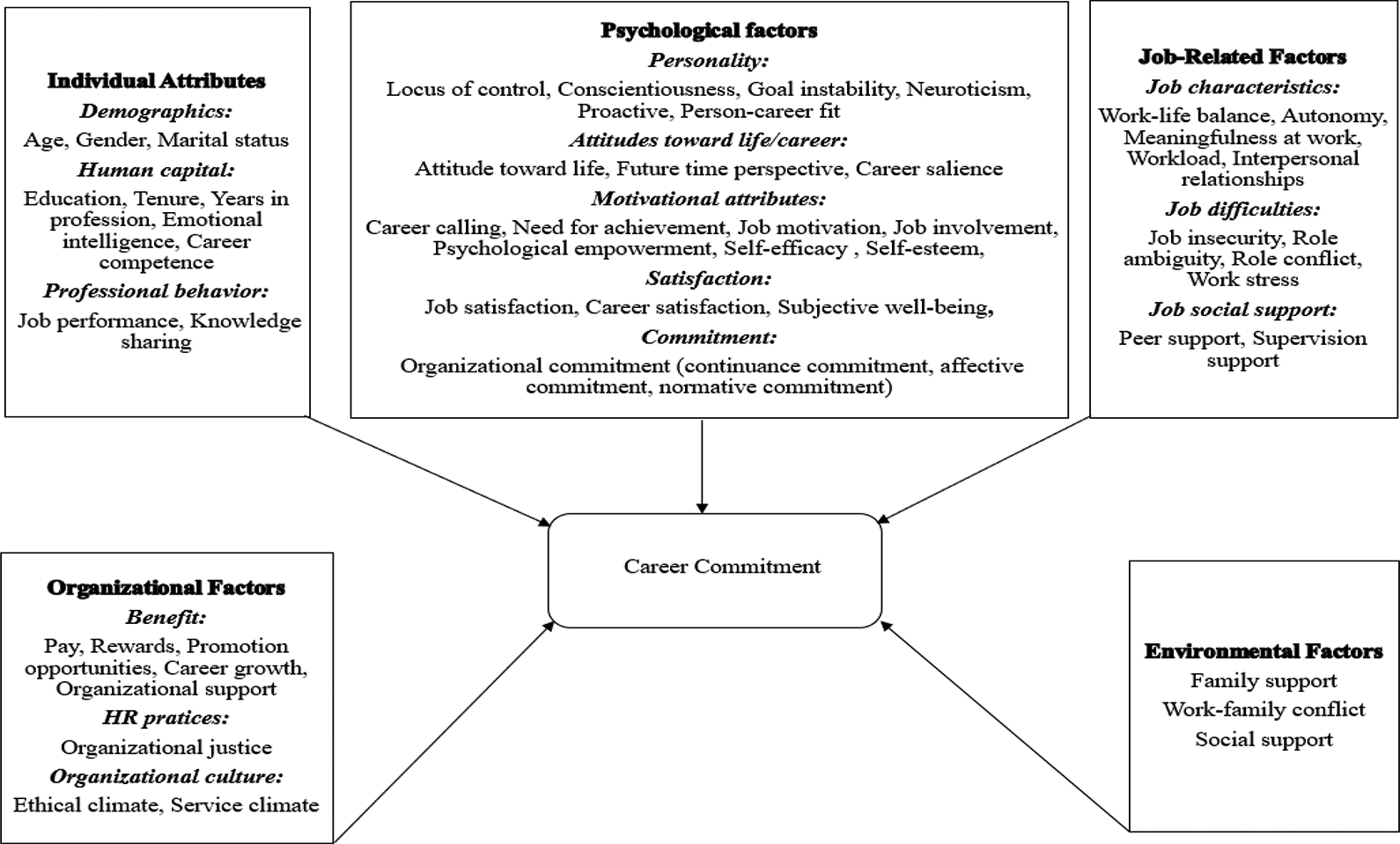
Five categories of antecedents of career commitment.
Factors listed in different categories*.
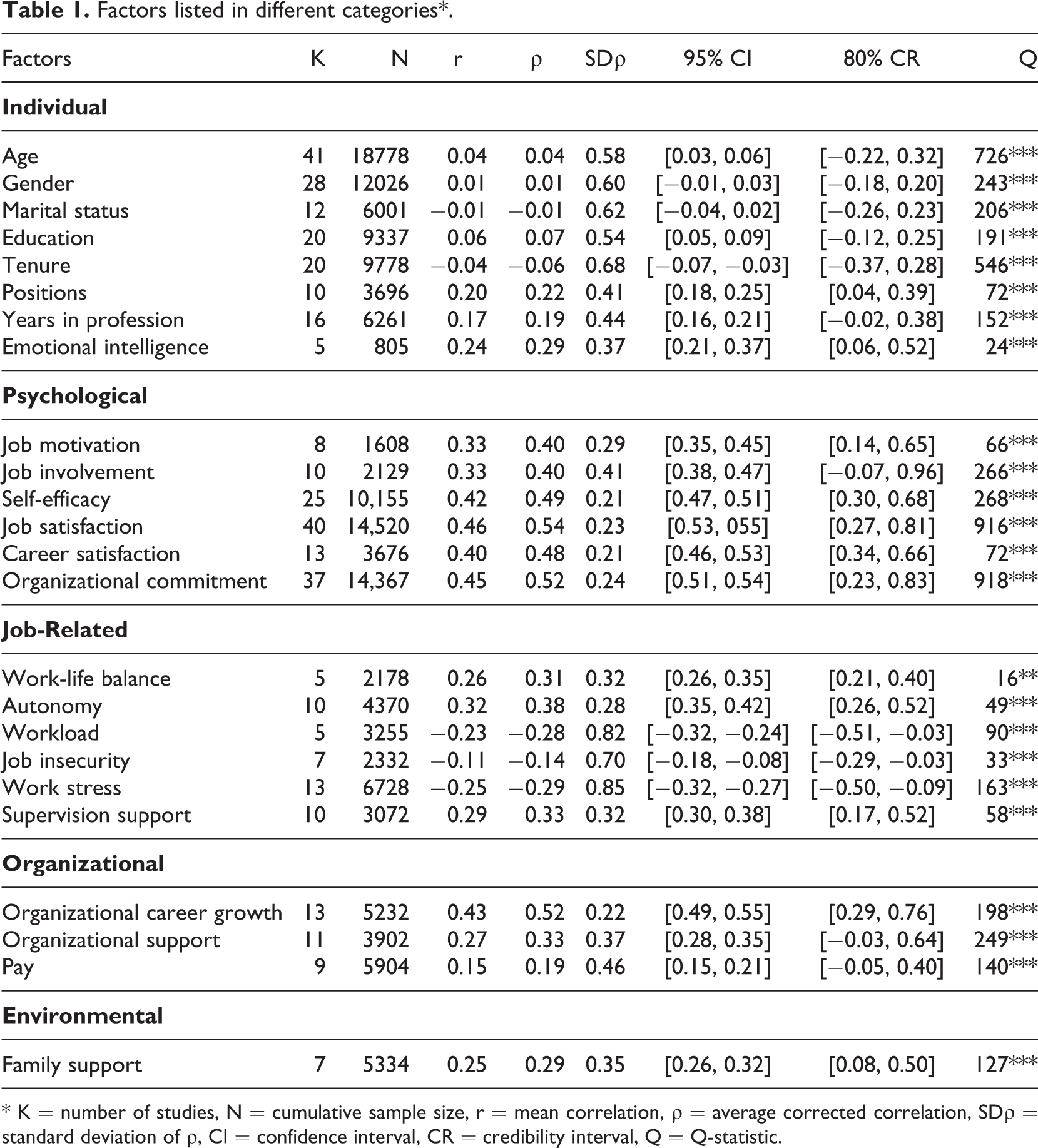
* K = number of studies, N = cumulative sample size, r = mean correlation, ρ = average corrected correlation, SDρ = standard deviation of ρ, CI = confidence interval, CR = credibility interval, Q = Q-statistic.
Individual attributes
The relations between individual attributes and career commitment were meta-analytically explored based on 21,760 respondents from 53 different samples. Among the individual characteristics studied in our samples, the variables with five or more studies involved age, gender, martial status, education, tenure, job position, years in profession and emotional intelligence. As shown in Table 1, the individual characteristics did correlate with career commitment, but the effect sizes were of small or medium magnitude, ranging from 0.01 to 0.29. Except for martial status and tenure, all the individual attributes had a positive effect on career commitment. Associations between age and career commitment were available from 41 individual studies; the results of our meta-analyses, however, showed a correlation of ρ = 0.04 only. Among these individual characteristics, emotional intelligence (ρ = 0.29) was discovered to be the strongest predictor. The Q-statistics related to each of these individual attributes were significant and the credibility intervals were wide and/or contained zero, suggesting significant heterogeneity among effect sizes for the relations between these individual attributes and career commitment.
Psychological factors
The correlations between psychological factors and career commitment were meta-analytically investigated based on 36,078 respondents from 96 different samples. Apart from motivation (K = 8), all the psychological factors shown in Table 1 were each drawn from 10 or more individual studies. The results of the meta-analyses revealed that all the psychological factors each had a moderate positive correlation with career commitment; the effect sizes ranged from 0.40 to 0.54. The psychological factors most strongly correlated to career commitment were job satisfaction (ρ = 0.54), organizational commitment (ρ = 0.52) and self-efficacy (ρ = 0.49). Job satisfaction was not only the strongest predictor among the psychological factors, but was also the most frequently studied factor (K = 40). Other frequently studied psychological variables included organizational commitment (K = 37), and self-efficacy (K = 25). Statistically significant Q-statistics were obtained for all the psychological factors presented in Table 1, reflecting significant heterogeneity among effect sizes for the relations between these psychological factors and career commitment.
Job-related factors
The associations between job-related factors and career commitment were meta-analytically examined based on 14,346 respondents from 36 different samples. As shown in Table 1, career commitment positively correlated with work-life balance, autonomy and supervision support, yet it was found to a have weak negative correlation with factors related to job difficulties, such as job insecurity, work stress and workload. Autonomy (ρ = 0.38), supervision support (ρ = 0.33) and work-life balance (ρ = 0.31) had moderate effect sizes in relation to career commitment. Among the job-related factors, work stress (K = 13), autonomy (K = 10) and supervision support (K = 10) were the most frequently studied variables. Statistically significant Q-statistics were obtained for all the job-related factors presented in Table 1, reflecting significant heterogeneity among effect sizes for the relations between these job-related factors and career commitment.
Organizational factors
The linkages between organizational factors and career commitment were meta-analytically studied based on 11,582 respondents from 28 different samples. Among the organizational factors studied in our samples, the factors with five or more studies only involved organizational career growth, organizational support and pay. Thirteen studies demonstrated organizational career growth-career commitment correlations, yielding a mean corrected correlation of 0.52. The correlation between organizational support and career commitment was examined across 11 studies and yielded an average corrected correlation of 0.33. Both these two factors were found to increase career commitment, and both corrected effect sizes were of medium magnitude. While pay was also found to enhance career commitment, its effect size was small (ρ = 0.19). The Q-statistics related to these three factors were significant and the credibility intervals were wide and/or contained zero, suggesting significant heterogeneity among effect sizes for the relations between these organizational factors and career commitment.
Environmental factors
Although the variables related to family support (K = 7), work-family conflict (K = 4) and social support (K = 2) were all classified as environmental factors, only family support was investigated by five or more primary studies and was thus eligible to be included in the meta-analyses. The connection between family support and career commitment was meta-analytically researched based on 5,334 respondents from seven samples. Results suggested that family support demonstrated a weak positive effect on career commitment (ρ = 0.29). The Q-statistics related to family support were significant and the credibility interval was wide, suggesting significant heterogeneity among effect sizes for the relation between this environmental factor and career commitment.
Discussion
The present study meta-analytically reviewed the 1980–2019 empirical literature on career commitment. The main objectives of this work were to summarize the multilevel antecedents of career commitment and to examine the strength, direction and heterogeneity of the overall associations between these latent predictors and career commitment. Key findings are discussed below.
Research Implications
The present review is one of the first attempts to comprehensively and meta-analytically summarize the antecedents of career commitment. Considering that the more samples reviewed, the richer the result, compared to Lee et al. (2000; K = 76, 30 predictors) and Jones et al. (2006; K = 35, 22 predictors), the present review, being comprised of 156 individual studies and capturing 52 determinants, provides the literature with an updated and more wide-ranging “big picture” regarding the antecedents of career commitment. Another critical research implication from the present study is that, compared to previous individual studies, this meta-analytic work presents more generalizable components, which could be of value to researchers wishing to establish a more solid theoretical framework for career commitment.
While there has been a great deal of conjecture as to age differences in perceptions of career commitment, evidence provided by individual studies is mixed. Drawing upon Becker’s (1983) human capital theory, some researchers believed that age should be positively associated with career commitment since, compared with young employees, older workers spend more resources (e.g. time, money and effort) on their careers, so they have clearer professional paths and career identities, better positions and less career alternatives (Cherniss, 1991; Colarelli & Bishop, 1990). In line with previous meta-analytic research (e.g. Katz et al., 2019; Lee et al., 2000), our results provide support for this argument, but the effect size was very small (ρ = 0.04). Similarly, in line with the literature (e.g. Carson & Bedeian, 1994; Colarelli & Bishop, 1990; Weng & McElroy, 2012), this study only revealed a weak association (ρ = 0.07) between education level and career commitment. The lack of a direct effect of individual factors on career commitment may be viewed as a hint that some variables that mediate or moderate the effect of individual factors may exist.
The analysis of the relations between psychological factors and career commitment offers insights into the nature of career commitment. In accord with several previous meta-analytic studies on work commitment (e.g. Brown, 1996; Lee et al., 2000; Mathieu & Zajac, 1990), the results of the present study indicate that career commitment positively correlated with job involvement (ρ = 0.40) and organizational commitment (ρ = 0.52). First, this finding further supports the idea of Hall (1971) that while divergent forms of work commitment may be associated with each other, career commitment is different from others. Second, conceptually, it implies whereas an individual’s loyalties toward his/her career and employer may conflict under certain circumstances, there is a substantial likelihood that career commitment, job involvement and organizational commitment are compatible and may develop simultaneously based on common experiences at work (Lee et al., 2000; Mathieu & Zajac, 1990). In other words, the development of career commitment may be contingent on job-related and organizational factors, which also to some extent supports our classification of the antecedents of career commitment.
With regard to the influence of job-related factors on career commitment, as predicted, job resources (e.g. autonomy) was positively associated with career commitment while job demands (e.g. workload) demonstrated a negative impact, corroborating the notion of the JD-R model (Demerouti et al., 2001). It is also interesting to note that apart from autonomy (ρ = 0.38) supervision support (ρ = 0.33) and work-life balance (ρ = 0.31), all job attributes included in our analysis showed only limited effects on career commitment (ρ < 0.3). These results suggest that the effect of situational factors on career commitment may not be direct but mediated by other variables (e.g. job satisfaction, ρ = 0.54; organizational commitment, ρ = 0.52). More discussion on the effect of job-related and organizational factors is presented in the practical implication subsection.
The present analysis also revealed that family support had a statistically significant positive relation with career commitment (ρ = 0.29). This finding provides support for Crouter’s (1984) spillover theory, which holds that there is no distinct boundary between family and work life. It highlights the possibility that behaviors and attitudes (e.g. emotions) from family life can be transferred to the work domain. It is also in agreement with the notion of Lee et al. (2000) that the conceptualization of career commitment should extend beyond the borders of the establishment. Further examination of the correlations of career commitment with extra-organizational factors thus would be worthwhile. Based on our review findings, a number of suggestions for future research are provided in the following subsection.
Future Research
The current review also provides some suggestions for future research. It is interesting to note that 75% of our samples were from studies published after 2010, indicating that although awareness of career commitment is not recent (1980s), only in the past 10 years have studies of career commitment gained momentum. This might also reflect that career commitment is worthy of scholarly consideration and has gradually received more investigative attention from contemporary academics and practitioners. We also found Blau’s (1985a) career commitment measurement scale was the most frequently used measure among the samples, with a high average reliability score. Future studies attempting to investigate career commitment might refer to this finding when designing or selecting their instruments.
The proposed model supports the proposition that individual characteristics, psychological factors, job-related factors, organizational factors, and environmental factors are significantly related to career commitment. In particular, the present results underscore the effects that psychological (e.g. job satisfaction, organizational commitment and self-efficacy) and organizational factors (e.g. organizational career growth) have on career commitment, since each of these factors demonstrated a medium positive-effect size. This finding is important since it may serve as a basis for future studies that may want to employ these relatively stronger predictors with proven validity in forecasting employees’ career commitment.
Moreover, in reviewing the individual studies concerning the determinants of career commitment, some voids in the literature became more evident. First, we were unable to learn much about the relation of career commitment with several variables such as career calling, interpersonal relationships and work-family conflict since they were not studied frequently enough (K < 5) to be included in our meta-analyses. There were also some factors with relatively large effect sizes (e.g. job motivation, autonomy, family support), but that have received less attention in contrast to other highly influential factors. Besides, it could be claimed that a majority of studies on career commitment to-date have centerd on its positive antecedents (e.g. self-efficacy) rather than the negative determinants (e.g. work-family conflict) since in our samples, the negative variables with five or more studies only involved workload, job insecurity and work stress. Consequently, there is abundant room for future primary studies to focus on the determinants that were not identified in this review (particularly negative factors) or the variables that were relatively less examined.
Especially, our findings suggest that the impact of environmental factors have been overlooked, since among all the categories the environmental group contained the fewest factors – only three. It is surprising and regrettable to highlight this gap, which was previously pointed out by Lee et al. (2000) in their meta-analytic review on occupational commitment about 20 years ago. There was some evidence to suggest that employee career commitment/change can be affected by economic conditions. For example, Carrillo-Tudela et al. (2014) observed that career change declined during recessions, perhaps because fewer jobs were available. Given that a strong negative association between career commitment and career change was found in Duffy et al. (2011), it is reasonable to assume that there may be a tie between career commitment and economic status. Thus, we encourage more research aimed at examining the effects of macro environmental factors on career commitment, such as government policies, economic situations and culture.
A considerable heterogeneity was found for most of the examined relations between career commitment and its antecedents. There is therefore a compelling need for future research to consider various boundary conditions that accentuate or attenuate career commitment. For example, further studies might want to explore whether situational variables (e.g. organizational and environmental factors) may interact with factors in the other categories (e.g. individual factors) to influence career commitment. We hope that further investigation of conditional effects that may influence the strength of relations between career commitment and the antecedents can make contributions toward clarifying why many of the latent antecedents in the present study were associated with significant Q-statistics.
Furthermore, in terms of research design, little work (K < 15) examined determinants of career commitment on the basis of longitudinal data. Since it is widely accepted that the development of career commitment is a gradual progression (Lopez, 1994; Nägele & Neuenschwander, 2014), more longitudinal studies should be undertaken to investigate its temporal nature. For example, in both Maanen’s (1975) and Maia and Bastos’ (2015) longitudinal studies on newcomers’ organizational commitment, a significant decline in newcomers’ emotional attachment to their employer over time was captured. Given the relatively strong relation (ρ = 0.52) between organizational commitment and career commitment identified in the present review, it would be worthwhile to explore how career commitment develops over different career stages and how the connections between career commitment and its antecedents change over time. There is also a paucity of experimental studies on the predictors of career commitment. For example, to the best of our knowledge, studies concerning managerial/work-design interventions aimed at enhancing career commitment are rare.
In addition, around half of our samples were conducted in Asian countries (e.g. China) or the U.S., suggesting that a possible area of future research would be to examine this topic in divergent geographic areas and cultural contexts. Regarding occupational sectors, the studies included in our review tend to focus on employees (professional workers) from educational or healthcare sectors. Further research, therefore, needs to be done to thoroughly assess whether the associations between career commitment and its predictors may differ from one industry to another or between professionals and non-professionals.
Practical Implications
The review findings have a number of important implications for practice. First, regarding career commitment according to individual attributes, our findings reveal that it was more pronounced for older employees, the more educated, those with high emotional intelligence, those with a shorter tenure length those who held higher job positions, and those who had spent longer periods in their career. This information can be used by human resources managers to adjust their recruitment policies and employee retention programmes aimed at identifying employees likely to have a stronger career commitment.
We particularly want to highlight the negative relation found between tenure and career commitment. This finding accords with those of previous studies (e.g. Carson & Bedeian, 1994), which showed that while newcomers demonstrated more commitment to their career, their career commitment decreased with time. This may also support Popoola and Oluwole’s (2007) argument that work experience early in one’s career performs a crucial role in the development of career commitment. According to Benligiray and Sonmez (2013), a career plateau is believed to be partially responsible for a decline in career commitment. Thus, it is recommended that managers may need to be cautious of the potential change in newcomers’ career commitment over time and provide them with more support regarding training, career guidance and development when they reach a career plateau (Benligiray & Sonmez, 2013).
Among the psychological factors, job satisfaction demonstrated the strongest positive correlation with career commitment (ρ = 0.54). The effect of job satisfaction is perhaps one of the most thoroughly examined issues in the career commitment literature. Consistent with the literature (e.g. Sorensen & McKim, 2014), our findings yielded that there was a moderately strong association between job satisfaction and career commitment. Indeed, employees who are satisfied with their job are expected to be more internally motivated to deliver their work to a high standard and perform more organizational citizenship behavior (see broaden-and-build theory; Fredrickson, 2001; Tsai & Wu, 2010). Therefore, these employees are more likely to be promoted and to realize their career aspirations, and in turn, become more committed to their careers (Goulet & Singh, 2002). According to the dual-factor theory, regarding maintaining employee satisfaction, the first step is to meet their requirements for hygiene factors (e.g. pay, rewards, work conditions, company policies, and relationships with management) that prevent them from feeling dissatisfied (Herzberg et al., 1959). It is also important to meet employees’ growth needs, such as a sense of responsibility, a sense of achievement, recognition for their efforts, and career advancement opportunities.
In the literature, career commitment and autonomy have been shown to be positively related (Bogler & Somech, 2004; Littman-Ovadia et al., 2013). Significant support for this relation was also observed in our research. In an organization with high levels of autonomy, employees typically have strong power to make their own decisions. In this type of environment, high levels of autonomy can be viewed as a cue that the firm has high trust in an individual’s job competency (B. C. Kim et al., 2011). As a result of feeling trusted and competent, employees may realise a greater sense of acceptance, self-efficacy and self-esteem, and in turn become more dedicated to their jobs and careers (see social cognitive theory; Bandura, 1986; Niu, 2010). In light of this finding, managers should attach great importance to building a trusting relationship with their employees and may also need to establish low-power-distance working conditions that make employees feel valued and grow their self-esteem. This is achievable through transparent empowerment policies and open communication that shows managers are willing to provide their subordinates with adequate authority and necessary support.
Our findings also draw our attention to the importance of organizational career growth. In line with Weng and McElroy (2012), we found organizational career growth was positively associated with career commitment. In their study of organizational commitment, based on social exchange theory (Homans, 1958), Weng et al. (2010) observed that career growth played an important role in enhancing employees’ organizational commitment. It is possible that, from an individual’s perspective, the more career growth opportunities they are given, the more they believe they are viewed by their organization as a valuable stakeholder. Similarly, the positive effect of organizational career growth on vocational commitment can be explained by the fact that career growth is a manifestation of the development of professional skills and the realization of career goals, which will ultimately increase their expectations of future career development. In order to promote career advancement in the workplace, the literature indicates that leaders should place emphasis on the following aspects: Consistent training, aimed at career skill accumulation, is needed rather than providing training for employees only at the beginning of their employment. Training content should also be updated regularly (Ismail et al., 2015). Managers and supervisors should be encouraged to adopt transformational or coaching leadership styles (Ismail et al., 2015) and to help their subordinates develop a clear career path (Diemer & Blustein, 2007). Feedback and incentives need to be linked to career goals as well as expertise acquisition so that employees can be made aware of their career progress (Weng & McElroy, 2012).
Limitations
Several limitations of this meta-analytic review need to be acknowledged. According to Arthur et al. (2001), ideally, the overall number of studies included in a meta-analytic review should be above several hundred. Thus, while the present work obtained a sample of over 150 individual studies, the validity of results may still be constrained by our sample size. Specifically, several variables in this study were less well-examined than others, particularly for some of the job-related and environmental variables, since the number of studies available for each of these factors was below 10. Hunter and Schmidt (2004) argue that if a pooled estimate is calculated based on a sample size of less than 10, this can be called a very small meta-analysis, and the results must be interpreted with caution.
According to Risco et al. (2017), sample size may have an influence on effect size heterogeneity; namely, when an effect size is calculated from a small number of primary studies, the homogeneity of the effect size is likely to be decreased. To some extent, this could be used to explain why some variables (K < 10) had significant Q-statistics, meaning that the accuracy of between-study variance may be affected by second-order sampling error. In addition, due to growing concern about this topic, there are potentially as yet unpublished studies, as well as research overlooked during data collection despite the systematic and rigorous study selection process. For these reasons, this review was unable to encompass all the possible antecedents of career commitment. Future meta-analytic work with broader samples may help to address the above flaws.
It should be also acknowledged that since so few unpublished works were included in our samples, our results might also be affected by publication bias, namely the file-drawer problem. This issue may happen as studies with non-significant findings are less likely to be published or submitted than research with significant findings. Several meta-analysis experts, however, have pointed out that the file-drawer issue generally may not cause rising/falling biases in the estimation of effect size (e.g. Lee et al., 2000). Besides, in the present work, the stability of each effect size was checked by scrutinizing its 95% confidence interval, which is believed to be an effective way to reduce publication bias (Young et al., 2004).
Since the quality of any meta-analysis is determined by the information provided in the primary studies (Eby et al., 2013), the constraints affiliated to the individual studies that compose the present review may, therefore, also apply to this study. For instance, there was a considerable shortage of longitudinal studies in our samples, preventing us from drawing any causal inferences for the effect estimates reported in this work.
We also acknowledge that a few studies met our inclusion criteria but were excluded because they were not written in English. Further reviews that take the findings from non-English literature into account are required to confirm the validity of our effect estimates. In addition, although the antecedents in this work were categorized with reference to prior research, it should be acknowledged that there might be alternative views on how these factors can be classified. We call for more research aimed at systematically exploring and classifying the antecedents of career commitment. Future reviews might also develop a deeper understanding of the consequences of career commitment. Despite these limitations, this review provides a valuable updated starting point for identifying the determinants of career commitment.
Footnotes
Declaration of Conflicting Interests
The author(s) declared no potential conflicts of interest with respect to the research, authorship, and/or publication of this article.
Funding
The author(s) received no financial support for the research, authorship, and/or publication of this article.
