



Abstract
A growing body of evidence supports critical consciousness as a developmental asset for young people, including its benefits for educational and vocational outcomes. National dynamics and policies in the U.S., such as restricting immigration and asylum, have raised the salience of critical consciousness as a protective factor for the career development of Latinx immigrant youth. In this manuscript, we first review the nature and benefits of critical consciousness for Latinx immigrant youth. We then highlight how college and career readiness (CCR) and the components of critical consciousness (CC) can be simultaneously fostered among Latinx immigrant high school students, drawing upon our own work in the context of an afterschool program. We introduce a framework to illustrate this integration, and describe a series of intervention activities and processes designed to simultaneously build CC and CCR. Finally, we provide recommendations and describe caveats and challenges to developing classroom-based career education curricula that integrate CCR and CC.
Keywords
Sociopolitical development refers to a process by which individuals progress from uncritical perceptions of the world as fair and just, to a recognition of how injustice and oppression shape human experiences, together with an ability to address injustice (Watts et al., 2003). Sociopolitical development culminates in critical consciousness (CC), or the awareness of systemic inequity and action needed to address these issues (Freire, 1970). There is some variation in how CC is defined and operationalized, with general consensus on its key components of critical awareness, critical agency, and critical action (Diemer et al., 2015; McWhirter & McWhirter, 2016). Critical awareness refers to awareness of inequity and injustice that comes from learning and reflection about the world, and more specifically, the systems and structures that perpetuate oppression. Critical agency (sometimes referred to as political efficacy) refers to a sense of commitment and capacity to do something in response to oppression. Critical action (or critical behavior) refers to translating agency into concrete behaviors, for example, by joining a group that is dedicated to naming and countering injustice.
In recent years considerable attention has been dedicated to establishing CC as a developmental asset with particular benefit for marginalized youth (Diemer et al., 2016; Heberle et al., 2020). Educational and vocational outcomes have been a key focus area within the CC literature. CC has been associated with better employment and education outcomes (Diemer, 2009), and academic achievement, educational outcome expectations and plans (Luginbuhl et al., 2016; McWhirter & McWhirter, 2016; Seider et al., 2020). Cadenas et al. (2020) found that undocumented immigrant students’ critical agency and vocational outcome expectations served as protective factors to resist everyday discrimination while supporting their psychological wellbeing. Furthermore, CC predicts positive social-emotional functioning in youth (Heberle et al., 2020), which is critical to college and career readiness. Growing evidence regarding the potential of CC to enhance the academic and career development of marginalized youth is directing attention to how this asset might be fostered.
The aims of the present manuscript are threefold. First, we argue that contemporary national dynamics make CC an especially salient developmental asset for supporting the career development of Latinx immigrant youth. Currently, however, there is little guidance for curricula that engage CC to foster career development. As such, our second aim is to provide a framework to support the development of interventions that simultaneously promote college and career readiness (CCR) and CC. We align elements of a comprehensive definition of CCR with the three components of CC (critical awareness, agency, and action) in the service of Latinx immigrant youth. Third, we use this framework, and draw upon our own work with Latinx immigrant youth described elsewhere (McWhirter et al., 2019), to illustrate specific activities to simultaneously foster CC and CCR with Latinx immigrant youth. In so doing, we hope to prompt the development and testing of interventions that combine CCR and CC, not only with Latinx immigrant youth, but with other populations as well. Such an endeavor is consistent with Solberg et al.’s (2020) call for programs that “empower(ing) youth by helping them become critically conscious of the inequities in resources from macrosystemic, mesosystemic, and microsystemic levels that contribute to unequal access to range and quality of learning and workforce development opportunities” (p. 14).
Anti-Immigrant Context and Consequences
The 2016 U.S. presidential campaign and election ushered in heightened levels of anti-immigrant and anti-Latinx sentiment, with notable increases in overt racism within schools, as well as higher anxiety and lower sense of safety among Latinx students (Costello, 2016; Sondel et al., 2018; Wray-Lake et al., 2018). The Trump administration called for an end to birthright citizenship, characterized Latinxs of Mexican heritage as “criminals,” attempted to revoke the protections afforded to undocumented immigrants by the Deferred Action for Childhood Arrivals (DACA) program (Eskenazi et al., 2019), and enacted approximately 400 policy changes designed to greatly reduce legal immigration, eliminate asylum at the southern border, restrict humanitarian benefits, and expand enforcement and detention (Pierce & Bolter, 2020). The sociopolitical climate of hostility has generated significant anxiety in immigrant communities (Eskenazi et al., 2019), with Latinx immigrants and undocumented youth experiencing increased trauma regarding family separation, greater fear of deportation, more isolation, and stronger uncertainty about their futures (Nienhusser & Oshio, 2019; Stafford et al., 2019) along with increased cortisol levels (Zeiders et al., 2020). These complex stressors operate across levels of the ecology, and will not be ameliorated by a change of administration alone.
Anti-immigrant policies and experiences pose a risk to the health and well-being of Latinx youth, especially those who are undocumented (Yoshikawa et al., 2016), and threaten their educational trajectories. Youth impacted by anti-Latinx and anti-immigrant policy and rhetoric experience more significant academic underperformance relative to peers (Bean et al., 2015; Sulkowski, 2017), more frequently consider dropping out of school (McWhirter et al., 2018), and skip more classes (Barajas-Gonzalez et al., 2018). Immigration enforcement actions are associated with higher anxiety, lower school attendance and parent involvement, and declines in school performance (Gándara & Ee, 2018). Latinx high school students who anticipate problems associated with their immigration status have lower vocational outcome expectations and anticipate more external barriers to their post-secondary plans (McWhirter et al., 2013). In conjunction with other ongoing systemic barriers (e.g., the new “Juan Crow,” see Madrigal-Garcia & Acevedo-Gil, 2016), the current sociopolitical context constrains access to higher education and careers for Latinx immigrant young people with and without documentation (Barajas-Gonzalez et al., 2018; Enriquez, 2017; Gándara & Ee, 2018).
Enhancing Critical Consciousness
Fostering CC can contribute to positive youth development and simultaneously promote system changes (Christens et al., 2016) that can help counter the anti-immigrant political climate for Latinx immigrant youth. CC can alter the developmental trajectory of marginalized youth by mitigating the negative effect of oppressive social barriers on health, educational, and career outcomes (Diemer et al., 2016). Strategies for fostering CC include engaging in group dialogue centered on experiences of marginalization and oppression within larger social systems, encouraging critical questioning, and fostering a collective identity (Diemer et al., 2016; Watts & Hipolito-Delgado, 2015). For example, after a series of facilitated discussions about the election of Donald Trump, participants in an afterschool program designed to foster CC demonstrated critical reflection and critical action (Kennedy et al., 2019).
A theoretical model of the process by which critical consciousness develops was offered by Watts et al. (2003). Their theory of sociopolitical development (SPD) posits a five-stage model (Acritical, Adaptive, Precritical, Critical, and Liberation) describing how individuals move from acritical acceptance of a status quo, in which individuals are responsible for their circumstances, to liberation, in which they recognize the systemic and structural constraints of the status quo and act to transform injustice in their lives and in their communities (Watts et al., 2003). SPD culminates in liberation, or critical consciousness. Though outlined as a linear stage model progressing from awareness and reflection to action, Watts et al. (2003) argued that the process of SPD unfolds more dynamically. Watts and Flannagan (2007) described an interactive process toward liberation in which social analysis (i.e., critical awareness) and social involvement (i.e., critical action) mutually influence each other, mediated by a youth’s sense of agency and the resources (e.g., adult mentors and models) or opportunity structure to which the youth has access. Research findings generally support a process in which the components of critical awareness, agency, and action develop in interaction with each other, rather than in a particular order, though critical action is less likely to be incorporated into interventions (Watts & Hippolito-Delgado, 2015). The theory of SPD provides a foundation for the development of CC interventions (Freire, 1970; Watts et al., 2003).
In a 20-year review of CC research, Heberle and colleagues (2020) indicated that most CC interventions for children and adolescents occurred in schools, and were either integrated into classroom curricula or were offered outside of regular core instruction in afterschool, weekend, or summer programs. Classroom interventions during the school day predominantly focus on increasing awareness about systemic injustices. Interventions that occur during out-of-school time often utilize youth participatory action research (YPAR) or service learning to enhance critical reflection and critical action among students, and often target historically marginalized student populations (youth of color, LGBTQ youth; Heberle et al., 2020). None of the CC interventions reviewed were specifically designed to enhance CCR. We propose that enhancing CC and CCR in tandem, and within the regular curriculum, can maximize reach and impact of this developmental asset.
College and Career Readiness and Critical Consciousness
Preparing all students to be ready for postsecondary employment and/or higher education has been the focus of federal legislation for several decades, most recently in the 2015 Every Student Succeeds Act (ESSA; U.S. Department of Education, 2020). This includes undocumented students, whose right to K–12 education was established in Plyler v. Doe (1982). College and career readiness (CCR) is multidimensional, typically described in terms of academic and non-academic skills, and definitions vary by state (Monahan et al., 2020). One of the most comprehensive definitions, offered in the state of Oregon, operationalizes CCR in two categories: Learning strategies, thinking skills, and academic knowledge, with 14 specific elements, and transition skills and workplace behaviors, with 16 elements (Mishkind, 2014). In theory, graduating high school seniors who manifest each element are prepared to begin and navigate postsecondary education, training, and employment.
Much of the preparation for college and career can be conceptualized in terms of (a) knowledge of self, systems, and the world (i.e., awareness), (b) developing a sense of self-efficacy for pursuing postsecondary work and education goals (i.e., agency), and (c) translating knowledge, experiences, and skills into successful engagement with current and future environments (i.e., action). Building upon this notion, we suggest that the elements of CCR can be integrated with promotion of CC through incorporation of social, political, and identity-based content that addresses inequity and injustice. Such integration can serve as a foundation to curricular interventions designed to simultaneously foster both. In the following sections, we propose how critical awareness, critical agency, and critical action, respectively, can be fostered while promoting specific CCR elements.
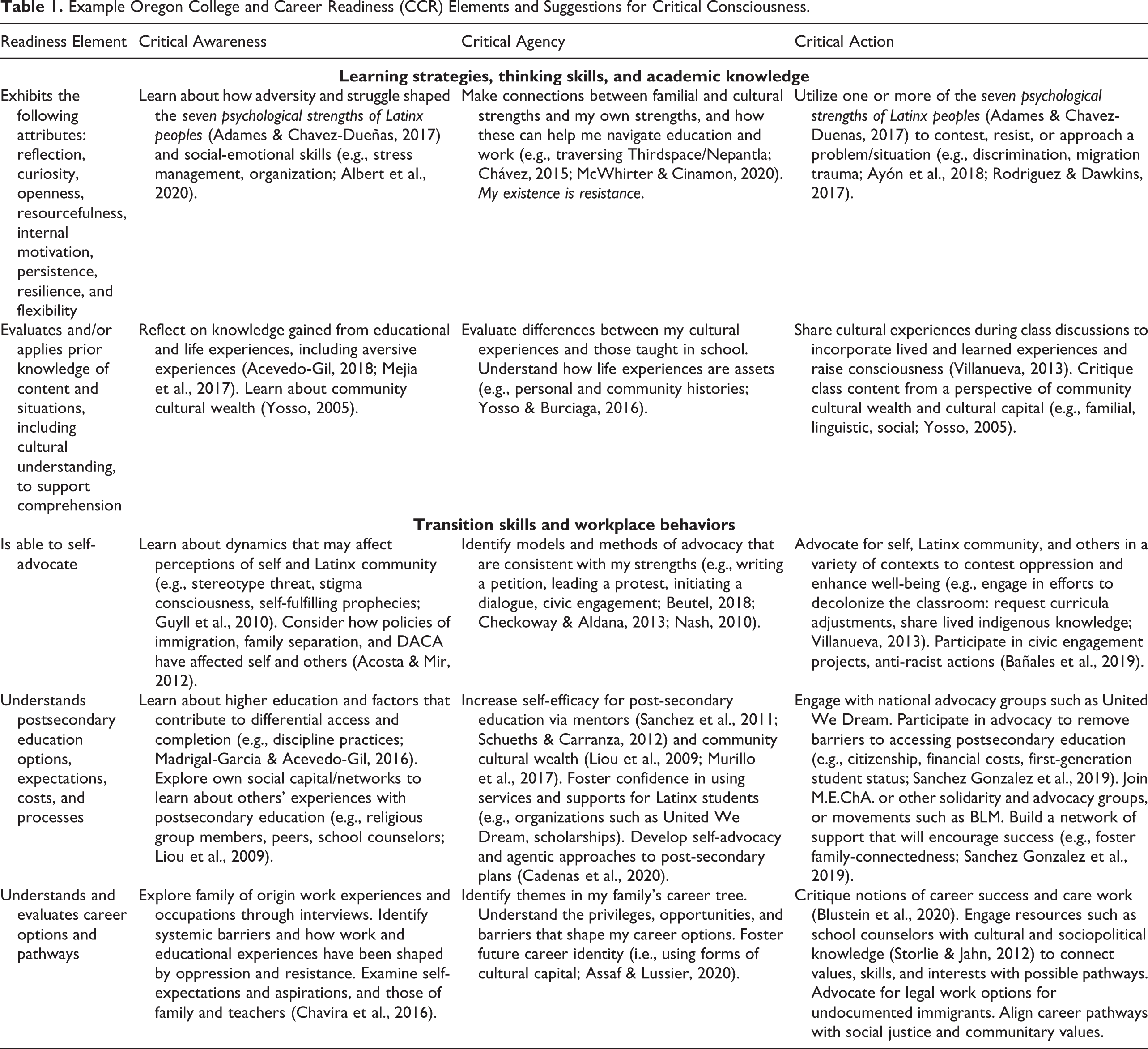
The impetus for our proposed framework comes from our experience working with Latinx high school students in an afterschool program we developed and conducted for a number of years. The program serves immigrant and Spanish-speaking high school students through academic support (e.g., tutoring, study skills), career exploration, and promoting the development of critical consciousness (e.g., enhancing cultural pride, collective identity, leadership, and advocacy skills). The development, aims, components, and evaluation of this program have been described elsewhere (McWhirter et al., 2019). In the present manuscript, we build upon our experiences with that program to create explicit links between five example CCR elements and components of CC (see Table 1), and offer the basis for developing a curriculum that could be offered to all students in the context of regular career education. An expanded table with all 30 elements of the Oregon CCR definition is provided as an online supplement.
Example Oregon College and Career Readiness (CCR) Elements and Suggestions for Critical Consciousness.
Critical Awareness and CCR
College and career readiness traditionally is viewed through an individualistic lens, reflecting the dominant neoliberal perspectives within career guidance (Hooley et al., 2017). Introducing students to the concepts of decent and precarious work (Blustein et al., 2020) and care work (Richardson, 2012) can engage them in reflection on the nature and structure of work, and how some inequalities are maintained by myths of rugged individualism and meritocracy. Awareness can be promoted via critical analysis of education systems, such as Madrigal-Garcia and Acevedo-Gil’s (2016) “new Juan Crow.” Fostering critical awareness helps students understand larger contextual factors that shape differential access to the opportunity structure and broadens their level of analysis from individual responsibility and deficits to systemic constraints and collective assets. For example, the dynamic intersections of U.S. dependency upon immigrant labor, attitudes toward immigrants, and immigration policy over past decades can be reviewed as a context for understanding the seven psychological strengths of Latinx peoples (determination, hope, adaptability, strong work ethic, connectedness to others, collective emotional expression, and resistance; Adames & Chavez-Dueñas, 2017). Understanding these strengths as well as community cultural wealth (e.g., familial capital, resistant capital; Yosso, 2005) can help students recognize CCR qualities (e.g., resourcefulness, persistence) that are already present within their communities, their families, and themselves.
We foster critical awareness of settler colonialism within our own afterschool program every November as we present contemporary indigenous perspectives that challenge the dominant culture Thanksgiving narrative (e.g., Plymouth Area Community Television [PACTV], 2016). Students react, reflect, and explore other examples of how indigenous people are erased by and resist colonialism. This facilitated dialogue helps students evaluate and apply prior knowledge and sources of information. Students are challenged to distinguish between opinions, interpretations, and facts and to critique messages from the media and their school about the history of Thanksgiving, while constructing their own arguments, all of which foster CCR.
Providing students with culturally-congruent immersive experiences (e.g., mentorship, field trips; Albert et al., 2020) can increase their understanding of systemic barriers, while showing them that there are multiple pathways to the same goal (Guyll et al., 2010; Liou et al., 2009). In the context of our afterschool program, participants interviewed the authors and Latinx undergraduate program tutors, for example, about their education pathways as Latinx and/or first-generation college students. Critical awareness was supported by learning how their mentors navigated structural barriers, and how the collective efforts of Latinx communities often contributed to their academic success. The Latinx high school students also share their own experiences, and through reflection and dialogue, locate these experiences within a larger historical and sociopolitical framework. Each fall, a Mexican immigrant admissions counselor from a local university visits with our students. He integrates his family’s immigration story and pathways through higher education with the provision of practical information about postsecondary education options, expectations, costs, and processes, and does so in a way that centers the academic and career opportunities and assets of Latinx immigrants. These activities enhance critical awareness and also contribute to critical agency.
Critical Agency and CCR
Students’ sense of motivation and capacity to make a difference in their own and others’ lives nurtures and is nurtured by critical awareness and critical action (Diemer & Rapa, 2016; Godfrey et al., 2019). Our goal is to promote both self- and collective efficacy, as a contrast with neoliberal individualism. Our consistent attention to cultural assets, attributes, and values supports the development of agency. We engage sources of self-efficacy (e.g., vicarious learning, social persuasion, and performance accomplishments; Bandura, 1986) to promote students’ confidence in their own and their communities’ capacity to persist, resist, and thrive (“si se puede”). For example, after students review bilingual definitions of the seven psychological strengths of Latinx peoples (Adames & Chavez-Dueñas, 2017), they discuss in small groups how these strengths are manifested in their own lives. They create family trees or genograms that identify how family members (living and dead, and including non-blood related “chosen” family) exemplify and utilize these strengths (Chávez, 2015). Students generate additional strengths and discuss which ones most contribute to their sense of individual, collective, and cultural identity. The result is a sometimes breathtaking constellation of student-produced examples that transform daily activities into acts of cultural strength and resilience. Students come to appreciate how they and their communities navigate challenges to achieve individual, familial, and community goals (Cooper, 2014; Kasun, 2016). This process of reflection and dialogue attends to CCR elements such as analyzing complex, real world scenarios, reinforcing the importance of personal and academic integrity and ethics, supporting their ability to work with others from various cultures, fostering awareness of workplace behaviors and occupation-specific skills (e.g., adaptability, code-switching, advocating for rights without getting fired), and highlighting their connection to models of positive values such as caring, equity, integrity, honesty, responsibility, and restraint.
Each spring our Latinx immigrant students visit our university, participate in a college class or workshop, engage with a panel of Latinx undergraduate students and a multicultural support counselor, and tour the campus. These encounters include explicit attention to Latinx strengths, community cultural wealth, and connections between home and school cultures, and reinforce attributes such as curiosity and internal motivation. We aim to help students see their experiences as assets and to identify how their individual and cultural strengths can help them navigate education and work (Yosso & Burciaga, 2016). This includes finding themes that connect their familial career and work history with their own aspirations, and identifying supports and services (e.g., mentors, tutoring, guidance counseling, scholarships) within their schools and community networks can help them clarify and achieve their post-secondary goals (Assaf & Lussier, 2020; Cadenas et al., 2020; Schueths & Carranza, 2012). Developing students’ skills for communicating with different audiences and for different purposes, via writing, speaking, or other means (e.g., performing or visual arts), helps prevent constricted views of their competencies while increasing their means by which to engage with and affect others. Overall, exposure to models and methods of confronting inequality and advocacy, from Gloria Huerta and Lin Manuel Miranda to Dreamer activists and MEChistas (members of Movimiento Estudiantil Chicano de Aztlán) on our campus, further nurtures students’ capacity to respond to oppression as they expand their academic and professional competencies.
Critical Action and CCR
Translating critical awareness and agency into concrete actions that counter inequity and injustice can also be integrated with CCR. While the targets of critical action include oppressive and inequitable systems, structures, policies, and processes, we also highlight the importance of interpersonal critical action that, for example, names and counters daily experiences of stereotypes and microaggressions (Bañales et al., 2019; Watts & Hippolito-Delgado, 2015). Thus, critical action takes place in students’ classrooms, hallways, workplaces, and living rooms. We conceptualize critical action quite broadly in our present framework, in recognition of the multifaceted constraints and the variety of stakeholders in school settings.
Students learn to advocate for themselves and work effectively with others by experimenting with strategies for addressing problems proximate to their daily experiences as Latinx immigrant students, for example, personal and bystander experiences of interpersonal racism, gender-based harassment, and homophobia. They utilize sources of cultural capital (e.g., indigenous knowledge, language; Yosso, 2005) to resist messages of deficiency and bridge the gap between lived and learned experiences at home and in school. Students exhibit key CCR attributes as they use cultural capital and psychological strengths to approach problems, explore possibilities, and construct goals (Assaf & Lussier, 2020).
Critical action includes efforts to decolonize education, such as sharing alternative perspectives on American sociopolitical history, and joining groups or movements that promote positive identities, engage in anti-racist actions, and advocate for change, such as M.E.Ch.A., Black Lives Matter, and Dreamer groups. Our annual screening of the documentary Precious Knowledge (McGinnis & Palos, 2011) connects students with Latinx high school student activists attempting to preserve Mexican American studies courses in their district. The New York Times Magazine 1619 Project podcasts and readings illuminate the pervasive effects and untold histories of U.S. slavery and can be engaged to support each component of CC.
Using resources and tools from national advocacy groups (e.g., United We Dream), students learn about options for their lives after high school, such as financial resources and scholarships for undocumented students, and state policies that make college more accessible. Students are more likely to enroll in college when they have strong college knowledge (Sanchez Gonzalez et al., 2019), but practices of tracking, disproportionate discipline, and exclusion of English learners from college preparatory coursework decrease access to such knowledge (Madrigal-Garcia & Acevedo-Gil, 2016). Participatory action research (PAR) projects (e.g., Cammarota & Romero, 2011) and youth-led or YPAR projects (Irizarry, 2011; Welton, 2011) could be incorporated into curricula as a means of engaging students in analyzing and contesting inequitable and deleterious school policies and practices.
Additional Activities Supporting CCR and CC
In this section we provide more examples that emphasize CCR elements across the three components of critical consciousness, in order to build upon the framework provided in Table 1. One important area of focus is building CCR skills for tasks such as resume preparation, college essay writing, interviewing, and tracking and reflecting on progress toward short-term and long-term educational and vocational goals. We support critical awareness as we teach these skills by, for example, discussing how classism, racism, and lack of understanding of the sociopolitical context of the Northern Triangle and Mexico (Brenden et al., 2017) may lead to assumptions that all students learn these skills at home. We enhance critical agency by identifying important, yet often overlooked, strengths and assets relevant to resumes, essays, and interviews, such as bilingualism, practical problem-solving, and skills acquired via unpaid care work. We break down new skills (interviewing, advocacy behaviors) into small steps, connecting the skills with community cultural wealth and past accomplishments, practice the skills, and provide feedback.
In the domain of financial literacy, we seek to raise critical awareness about the ways in which institutions (e.g., universities, loan lenders) perpetuate the racial wealth gap through tuition hikes, harmful student loan servicing practices, and failure to address racist ideologies upon which universities were founded (UnidosUS, NAACP & Center for Responsible Lending, 2019). Students’ critical agency is supported by learning options for responding to such oppressive practices, including making informed decisions about which institution to attend and options for financing college. Conversations about budgeting highlight the challenges surmounted by low income families and the ingenuity often utilized to reduce costs and stretch limited finances, supporting critical agency. Students learn about the importance of qualities such as timeliness and consistency through conversations connecting homework habits with grades, and connecting these attributes with Latinx service-leadership and community engagement.
We seek to promote strong positive cultural identities while fostering CCR and CC. Many activities emphasize the cultural importance of storytelling and the development of a personal and collective narrative. Students interview family members about their immigration journey to the U.S., share these stories, and discover differences and similarities in their families’ resiliencies, barriers, and histories. We utilize the structure of a poetry workshop (Cammarota & Romero, 2006) to build upon these narratives. Based on the Where I’m From series by poet George Ella Lyon (1999) and a template by poet Levi Romero (n.d.), students add phrases such as a description of home, a favorite food, or a familiar smell. The result is a powerfully evocative series of poems that capture snapshots of each student’s life: “Soy de tortillas hechas a mano de mi abuela y el espíritu guerrero de mi abuelo…soy de mis raíces y orgullosamente de Guatemala.” 1 As they engage in cultural storytelling and construct their personal narratives, students relate and respond to individuals from various cultures, experience a sense of support and empowerment, and apply prior knowledge of content and situations to support comprehension (e.g., they adjust pre-existing conceptualizations of their peers and facilitators). This method of storytelling or testimoniando supports cultural identity development as students co-construct their histories, while also refining speaking, literacy, and writing skills (Cammarota & Romero, 2006; Saavedra, 2011). Daily recitation of In Lak’ech Ala K’in (You are My Other Me; Valdez, 1973), a poem inspired by Mayan tradition, reinforces the interconnectedness of everyone’s lives (Acosta & Mir, 2012).
In winter of 2020 we invited our students to engage with us in a YPAR project. We began with conversations about research ethics, critically reflecting on how researchers are depicted, the power of researchers to use and pathologize the communities they study, and the power to understand and engage community assets to solve problems and create change. We aimed to enhance a sense of agency among our participants, emphasizing their role in shaping the research. Next, through two semi-structured group interviews, we provided opportunities for students to analyze complex, real-world scenarios and to work as a team, while critiquing systems of oppression and articulating ways in which their school could be more welcoming to Latinx students. This project was temporarily halted due to pandemic-related school closure.
Implications for Research and Policy
After-school program participation is constrained by work schedules of parents and students, home responsibilities such as caring for siblings, transportation difficulties, and participation in other extracurricular activities. The integration of CCR and CC into career education curricula would extend its potential beyond a small target population to all students. Further, we suggest that school districts with existing or under-development ethnic studies curricula would provide a promising context for launching such an initiative.
Ethnic studies curricula can foster critical consciousness by illumination and analysis of systemic inequities as well as strengths and assets of cultural groups, yielding to positive academic outcomes for Latinx and other youth (Cammarota, 2016; De los Rios et al., 2015, 2016; Dee & Penner, 2017; Tintiangco-Cubales et al., 2015). For example, the Mexican American/Raza Studies (MAS) program in the Tucson Unified School District improved participants’ standardized test scores, high school graduation and college matriculation rates, and decreased disciplinary action (Cabrera et al., 2014). MAS coursework, grounded in critical theory, fostered critical consciousness as systemic oppression was examined, interrogated, and contested (Cabrera et al., 2014; Cammarota & Romero, 2014). Though MAS was banned by Arizona legislation, the academic benefits of ethnic studies have prompted state efforts to develop K-12 ethnic studies curricula (e.g., see the California Department of Education [2020] model curriculum proposal). The benefits of critical consciousness and the national interest in supporting college and career readiness make curricula that integrate CCR and CC a promising advocacy target for educational policymakers, and one that is especially well-suited to districts with ethnic studies curricula.
The development and empirical evaluation of CCR/CC curricula may be approached from a variety of theoretical frameworks. Sociopolitical development theory (Watts & Flanagan, 2007; Watts et al., 2003) provides a framework for conceptualizing the development of CC, but does not offer scaffolding for supporting CCR. For developing activities and evaluating specific outcomes targeting CCR and CC, social cognitive career theory (SCCT; Lent et al., 1994, 2000) is useful for its explicit attention to contextual factors that constrain and facilitate the development of education and career interests, goals, and accomplishments. Further, a key SCCT construct, self-efficacy expectations, is amenable to intervention through learning experiences that provide opportunities to attempt and succeed at tasks, experience support and encouragement, and observe role models (Bandura, 1986; McWhirter et al., 2000). Other theoretical frameworks with potential utility for developing and evaluating CCR/CC curricular interventions include Critical Race Theory (Bernal, 2002; Dixson & Anderson, 2018; Yosso, 2005) and Self-Determination Theory (Deci & Ryan, 2000; Luginbuhl et al., 2016; Niemiec & Ryan, 2009).
The exemplarian action research model is one mechanism for promoting wide-scale change toward equitable opportunities for underserved and minoritized student groups. Solberg et al. (2020) describe exemplarian action research as an effort among researchers, practitioners, and policymakers to reach a collective understanding of an issue faced by a marginalized group, and to create and implement new practices that generate system level changes toward equity. The integration of CCR with CC within career education curricula could be the basis for exemplarian action research. Key outcomes of value to stakeholders, in addition to the significant benefits of college and career readiness and critical consciousness, could include lower dropout, higher engagement, and stronger academic performance (Cabrera et al., 2014; Dee & Penner, 2017) and increased home-school communication and engagement (Rodriguez, 2016). The next step in an exemplarian action research model would be to engage educational policymakers with the new curricula and champion its adoption within public school systems.
Caveats and Challenges
One consideration in the development of curricula to enhance critical consciousness is that raising critical awareness does not automatically lead to critical agency or action. For example, anger about injustice may motivate adolescents to engage in interpersonal anti-racism action, but may deter them from engaging in communal/political anti-racism action (Bañales et al., 2019). Anger toward social injustices may fail to result in critical action when young people do not have faith that equity or justice can be restored, or do not experience self-efficacy in their capacity to enact social change (Bañales et al., 2019). Further, the combination of low sociopolitical efficacy with high critical reflection may be detrimental to adolescents’ academic and socioemotional well-being (Godfrey et al., 2019). This highlights the importance of attention to all three components of critical consciousness, scaffolding, and opportunities to process and act upon learning (Bañales et al., 2019; Godfrey et al., 2019).
The activities described in this article illustrate the integration of CCR and CC in the context of our after-school work with Latinx immigrant high school students. Working with a particular group of marginalized students provides rich opportunities to foster CC regarding the injustices and contexts most salient to that group. However, our students are not homogenous. While they face many common challenges and structural injustices, there is significant background and cultural variation even among those with similar national origins. To foster critical awareness, critical agency, and critical action in classrooms with even greater diversity, and fewer common barriers, will be challenging and require skill. For this reason, we view high schools with ethnic studies programs to be ideal settings for the initial development of CCR/CC curricula. Competence in ethnic studies pedagogical practices will be an important asset for development and implementation of this work (Rodriguez, 2016; Tintiangco-Cubales et al., 2015; Villanueva, 2013).
Critical consciousness of systemic and structural inequities associated with race and racism does not imbue critical consciousness of ableism, sexism, classism, homophobia, transphobia, or the ways in which these systems co-create intersectional oppression and resistance across contexts and time (Collins, 2019). Attention to a broader range of injustices and resistance must be incorporated into a school-wide curriculum. Such efforts will be more effective when the community cultural wealth of stakeholders is recognized and incorporated (Kasun, 2016; Yosso & Burciaga, 2016).
Finally, Godfrey and Burson (2018) contend that advancing scholarship on critical consciousness must include greater attention to intersectionality, especially given that oppression and privilege are not anchors of a single continuum (Collins, 2019). Further, they highlight the importance of focusing on systems that marginalize rather than individuals or groups who are marginalized. This perspective may be especially salient for efforts to foster critical consciousness within the curriculum. The degree to which students with greater levels of privilege can develop critical consciousness remains a topic of discussion (Diemer, 2020). Our stance is that the integration of CCR and CC has potential benefit for all students, including those who profit, often unknowingly, from systems that marginalize their peers. As such, building upon the foundation provided in Table 1 is an important next step toward developing and testing career education curricular interventions that support CCR and CC in all students.
Conclusion
College and career readiness is a key goal of K–12 education, and critical consciousness is a developmental asset for youth. Our goal in the present article was to illustrate possibilities for the simultaneous fostering of CCR and CC in the context of a particular marginalized population, Latinx immigrant youth. Such a framework could be broadened to serve all high school youth in the context of regular career education curriculum. We hope that this framework contributes to efforts to develop and evaluate curricular interventions that lead to critically conscious high school graduates who are college and career ready.
Supplemental Material
Supplemental Material, sj-pdf-1-jca-10.1177_1069072720987986 - College and Career Ready and Critically Conscious: Asset-Building With Latinx Immigrant Youth
Supplemental Material, sj-pdf-1-jca-10.1177_1069072720987986 for College and Career Ready and Critically Conscious: Asset-Building With Latinx Immigrant Youth by Ellen Hawley McWhirter, Christina Cendejas, Maureen Fleming, Samantha Martínez, Nathan Mather, Yahaira Garcia, Lindsey Romero, Robert I. Ortega and Bryan Ovidio Rojas-Araúz in Journal of Career Assessment
Footnotes
Declaration of Conflicting Interests
The author(s) declared no potential conflicts of interest with respect to the research, authorship, and/or publication of this article.
Funding
The author(s) received no financial support for the research, authorship, and/or publication of this article.

Supplemental Material
Supplemental material for this article is available online.
Note
References
Supplementary Material
Please find the following supplemental material available below.
For Open Access articles published under a Creative Commons License, all supplemental material carries the same license as the article it is associated with.
For non-Open Access articles published, all supplemental material carries a non-exclusive license, and permission requests for re-use of supplemental material or any part of supplemental material shall be sent directly to the copyright owner as specified in the copyright notice associated with the article.
