




Abstract
Drawing from Psychology of Working Theory (PWT), the current study sampled 254 college students from impoverished families in China and examined their perceptions of access to future decent work as predicted by subjective social status and marginalization and mediated by work volition and career adaptability. As impoverished college students are socioeconomically disadvantaged and thus cannot afford college expenses, understanding their perception regarding future careers echoes the call for renewing the focus on equity and diversity within vocational psychology. Findings supported subjective social status as an indirect predictor of perceptions of future decent work via work volition. Work volition and career adaptability directly predicted perceptions of future decent work. Additionally, there is a significant conditional indirect effect between subjective social status, work volition, and perceptions of future decent work. Specifically, the effect was only significant for first-year students. Overall, this study adds new evidence on the applicability of the PWT among student populations. Implications for career researchers, vocational counselors, and student affairs professionals are provided.
Keywords
Many workers around the globe face precarious work arrangements, earn delayed wages, and work under unsafe conditions, despite international efforts to uphold the human right to work with dignity, equality, and safety (International Labor Organization (ILO), 2015). Workers in precarious employment—usually those from lower socioeconomic backgrounds, or marginalized groups such as people with disabilities, refugees, and transgender people—have been underrepresented in career development and vocational psychology research (Garriott et al., 2017). Despite a renewed attention to social justice and increased publication on multiculturalism from vocational scholars in recent years, literature regarding the equity at work settings of underrepresented populations remains scant (Garriott et al., 2017). Psychology of Working Theory (PWT; Duffy et al., 2016) advanced the multicultural research by shifting research attention to the contextual forces on individuals’ access to decent and equitable work among underrepresented groups, such as gender and sexual minorities (Smith et al., 2020), racial and ethnic minorities (Douglass et al., 2019), and workers with Chiari malformation (Tokar & Kaut, 2018). However, research on the impact of contextual factors on future decent work perceptions among underrepresented student populations remains scarce (except for Kim et al., 2019; Ma et al., 2020a). Since it is imperative to complement the PWT research that is largely restricted to working adults, the current study investigated whether and how impoverished students’ subjective social status and experienced marginalization were related to their perceptions of obtaining decent work in the future within the Chinese context.
Barriers for Impoverished Chinese College Students
In the current study, we use the culturally-specific term of “impoverished students” (贫困生). In Chinese, “贫(pin)” means being economically constrained, “困(kun)” means being socially disadvantaged, and “生(sheng)” means a student. Thus, impoverished students are not only economically constrained, but also lack social resources such as Hukou (residence permit) in cities and Guanxi (links to influential people). According to the Ministry of Education (MOE), they often have survived traumatic life events (e.g., natural disaster, anthropogenic hazard), have parents who are unable to work (e.g., due to disability), have high debt, and live in remote areas (MOE, 2018). Thus, many cannot afford their tuition fees and living expenses. Data from the Chinese College Student Survey (CCSS) suggests that 21.8% of college students are unable to afford college expenditure (Li et al., 2013). They have to rely on financial aid such as state scholarships and loans, on-campus part-time job opportunities, tuition waivers, support for freshmen, and a Green Channel (deferred payment of tuition) for freshmen (MOE, 2018). In 2018, 3.84 million impoverished students received student loans amounting to 27.5 billion Chinese Yuan (CNY) (MOE, 2018). Due to financial pressure, impoverished students are more likely to face underemployment and are more constrained in their freedom of work choice (Glyde, 1977). As job applicants, they take less search risk by accepting a job more quickly (Ji, 2020). There is also a tendency to accept a job offer (in a hurry) once an opportunity arises rather than forgoing income while waiting for a job that reflects their actual training, or to continue the search for a potentially higher-paying job (Ji, 2020).
In addition to being economically disadvantaged, they are socially disadvantaged. They face labor mobility barriers including Hukou. 1 As prospective job candidates, their rural Hukou hinders the route into employment in cities (Song, 2014; Wang & Moffatt, 2008), where decent jobs are usually available. It is difficult to register for a Hukou in bigger cities (Chan & Buckingham, 2008), and few organizations are willing to facilitate the process for acquiring the residence permits (Chen & Hoy, 2011). More importantly, they lacked Guanxi, which has been called the principal means of “channeling individuals into work units” and “the lifeblood of direct individual job application” (Bian, 1994, p. 979). Decent jobs in China are normally jobs in resource-rich state sectors, the government department, or large industrial enterprises (Bian & Huang, 2015). The lack of connection to a significant individual who may revise some requirements in order to match the available job to the candidate’s qualification, or discretely assign their “acquaintance” (e.g., children of alumni) to the vacancy (Bian & Huang, 2015) implies unfair competition to secure decent, equitable and meaningful employment.
Only about 7% of impoverished students reach a Chinese university because of high drop-out rates starting in middle school, often to earn income for their struggling families (Li et al., 2015). Since impoverished students are a minority in the university, when they live and study with their counterparts from more privileged or well-to-do backgrounds, these students are more likely to realize the impact of the contextual constraints on their future careers. Thus, understanding the impoverished college students’ perception regarding their future career is a critical scientific and social justice question.
Psychology of Working Theory and Decent Work
The current study applied a modified version of the PWT model to examine this population. PWT was developed to facilitate an understanding of how contextual factors (e.g., social and/or economic constraints) predict peoples’ vocational and overall well-being outcomes (Duffy et al., 2016). Specifically, decent work is the vocational outcome which refers to quality jobs with characteristics such as safe working conditions, sufficient rest time, adequate compensation, health care coverage and having job values that match family values (Duffy et al., 2017). Within PWT, economic constraints and marginalization are hypothesized to predict decent work both directly and indirectly via work volition and career adaptability (Duffy et al., 2016).
The importance of expectations of future work in predicting attainment outcomes is well-documented (e.g., Lent et al., 2002; 2017), especially for those from minoritized groups (e.g., Feliciano & Rumbaut, 2005). Because of this, along with the fact that our sample population was largely unemployed due to their student status, we measured future decent work perceptions. The future decent work perceptions construct was recently tested within the Korean culture and has been supported among junior college students (Kim et al., 2019) and first-generation college students (Ma et al., 2020a). The current study aimed to add evidence on the antecedents of future decent work perceptions by testing it among impoverished undergraduates at a 4-year university.
Subjective Social Status
Another modification we made to the study was examining subjective social status as a predictor instead of economic constraints. Subjective social status refers to one’s perceived relative standing in a society (Adler et al., 2000). It encompasses one’s perceived economic standing, but also captures the social implications of this. We decided that this would be the most appropriate predictor among the Chinese student population for two reasons. First, getting into college is a turning point for impoverished students (Xu, 2018); it marks a major shift in resources and social capital, and for many, it may begin a shift in their perceived social status. It is likely that future perceptions of decent work are influenced more by the prospect of these resources than solely economic standing in the present. Second, the Chinese conceptualization of impoverished students includes not only economic constraints, but also social disadvantages. Thus, economic constraints could only capture one’s financial limitations while subjective social status better captures one’s subjective sense of socioeconomic privilege.
Existing literature indicates that students with lower subjective social status are less volitional and adaptable in their careers (Autin et al., 2017), thereby perceiving less occupational engagement in the future (Kim et al., 2019). With a lower standing in society, impoverished students’ socioeconomic pressure prevents them from freely choosing preferable and meaningful jobs in the labor market. Their felt uncertainty about the future (e.g., holding out from taking a job offer) may diminish the perceived possibilities of obtaining future decent work even further. More importantly, decent work is often available off-farm, where lack of Hukou becomes an obstacle. We thus expect that socioeconomic privilege (i.e., subjective social status) influences impoverished students’ perceived equal access to decent work in the future.
Marginalization Experiences
Marginalization refers to “the relegation of people (or groups of people) to a less powerful or included position within a society” (Duffy et al., 2016, p. 132). Unlike subjective social status, which captures one’s owned socioeconomic resources (such as Hukou and Guanxi in the Chinese context), marginalization captures one’s lifetime experiences of being excluded by various community settings due to a specific identity or life history (Duffy et al., 2019). Many impoverished students grow up as left-behind children 2 (LBC) due to parental absence or migration, and experience marginalization (Ling, 2015). LBC are considered as a highly marginalized and disadvantaged group and experience isolation (Hong & Fuller, 2019). Being left-behind has an impact on their academic performance, educational attainment, and well-being (Hong & Fuller, 2019). Similarly, students who grew up from other marginalized backgrounds (e.g., rural migrant families, displaced families, the unemployed, and family members with disabilities) are also likely to experience unfavorable events and social oppression (Duffy et al., 2020). We expect the impoverished students to encounter various oppressive situations and have marginalized identities (e.g., orphans) which impede their career development and diminish their confidence in securing decent work in future.
The Mediating Role of Work Volition and Career Adaptability
Work volition represents a person’s perceived capability to freely choose a career path despite constraints (Duffy et al., 2012). Work volition was proposed as a mediating mechanism that explains why disadvantaged people perceive less access to decent work in the PWT model (Duffy et al., 2016). Specifically, people from marginalized backgrounds experience more career barriers that limit their power to freely match their preferences with potential career opportunities, thereby causing them to feel less likely to obtain decent work (Duffy et al., 2016). Previous research has indicated that volition is a critical variable linking students’ oppression and privilege with various outcomes such as career decision self-efficacy, career adaptability, and academic satisfaction (Autin et al., 2017; Jadidian & Duffy, 2012). Thus, we expected that it would mediate the relations from subjective social status and marginalization to future decent work perceptions among impoverished students, who are constrained by social standing and marginalized life histories.
Career adaptability represents a person’s capacity for exploiting resources needed to tackle current and anticipated vocational demands (Savickas & Porfeli, 2012). Adaptable individuals tend to feel more capable of dealing with challenges, and thus are more likely to be promoted at the workplace (Chan et al., 2016). PWT scholars hypothesize career adaptability as a mediator that explains why disadvantaged people are less likely to access decent work (Duffy et al., 2016). The more constraints people face (e.g., an unsupportive climate, a low-ranking position), the less flexibly people use external resources to cope with vocational tasks (Chan & Mai, 2015; Smith et al., 2020). Thus, the less likely it is for them to secure decent work (Duffy et al., 2016). Empirical results on the mediating mechanism of career adaptability have been inconsistent. For example, whereas career adaptability significantly mediated the link between Chinese vocational school students’ economic constraints and their future decent work perceptions (Ma et al., 2020b), this finding was not supported among Korean vocational schools (Kim et al., 2019). Given the inconsistency of empirical findings, we based our hypotheses regarding career adaptability on the original PWT tenets. Thus, we expected that career adaptability would mediate the relationships between contextual constraints (i.e., social status and marginalization) and future perceptions of securing decent work.
The Moderating Role of Proactive Personality and College Year
We also proposed two moderators: proactive personality and college year. Bateman and Crant (1993) defined proactive personality as the tendency for a person to feel less constrained by external forces and to actively initiate changes in their environment. Proactive personality was proposed in the PWT to buffer against the pitfalls of one’s disadvantaged background (Duffy et al., 2016), although the moderating role of proactivity in existing literature is inconsistent. While proactive personality functioned as an enhancing role in facilitating high social status people to secure decent work among Chinese urban workers (Wang et al., 2019), it was not supported as a moderator among racial and ethnic minorities in the US (Douglass et al., 2019). Since proactive undergraduate Chinese students tend to have higher self-esteem and can envision a clearer future work self that assists in development of adaptabilities (Chan & Chan, 2021), and since proactive students tend to seek potential opportunities, positively change the environment around them, pursue future achievements, and receive more job offers (Brown et al., 2006), we contended that impoverished students facing various background constraints may still feel volitional (e.g., seek equitable job opportunities when treated unfairly at the workplace) while at the same time being adaptable (e.g., able to overcome vocational obstacles in an unfavorable work climate) in pursuing future decent and equitable work. In other words, proactivity may buffer the influence of contextual constraints on work volition and career adaptability and subsequent perception about securing decent work in the future.
Additionally, students tend to mature in terms of career planning, maturity, and exploration as a function of the years they spend in college (Healy et al., 1985; Liu et al., 2017). Senior students may have visited a number of career fairs, met potential employers, seen vocational counselors, and done various internships (Tracey et al., 2006); they tend to be more in touch with the reality of life and the labor market (Hou et al., 2012), and to set their career goals and prepare themselves for obtaining various job opportunities (Liu et al., 2017), while junior students may have yet to settle into activities such as a career exploration routine. As senior students engage in more career exploration activities, including initiating conversations with knowledgeable individuals in interested career areas (Guan et al., 2015; Jiang et al., 2019), they may not feel hindered by their background constraints when making future career decisions. Even though they may lack certain socioeconomic privilege, their concern for their career and preparation for tomorrow (Savickas, 2013)—along with their realistic plans to attain the future career (Taylor et al., 1998), their accumulated knowledge about the labor market, and their various job skills acquired during college—may help enable them to freely choose a career trajectory, successfully adapt to a changing environment, and thus obtain sufficient access to decent work after graduation. In other words, the impact of contextual constraints on work volition, career adaptability and subsequent future decent work securement would be buffered among the senior students.
The Current Study
With the aim to examine the predictor portion of the PWT model among impoverished college students in China, a total of 18 hypotheses were proposed as follows: Students’ subjective social status negatively correlates with marginalization (hypothesis 1), and positively predicts work volition (hypothesis 2), career adaptability (hypothesis 3), and future decent work perceptions (hypothesis 4). Students’ marginalization negatively predicts work volition (hypothesis 5), career adaptability (hypothesis 6), and future decent work perceptions (hypothesis 7). Work volition positively predicts career adaptability (hypothesis 8). Both work volition and career adaptability positively predict future decent work perceptions (hypothesis 9, 10). As for the indirect paths, the links of subjective social status (hypothesis 11, 12, 13) and marginalization (hypothesis 14, 15, 16) with future decent work perceptions are mediated by work volition and career adaptability, and serially mediated by work volition and career adaptability. Finally, proactivity (hypothesis 17) and college year (hypothesis 18) buffer the effect of contextual constraints in the PWT model.
Method
Participants
The final sample consisted of 254 valid questionnaires. Among them, 137 (53.9%) students were male, and 104 (40.9%) were female, while 13 (5.1%) did not respond. Most students were from the rural areas of China (68.9%). Approximately half of the respondents (52.8%) were from households with annual income below 8,000 CNY (1,200 USD), while the remainder (47.2%) were from households with annual income ranging from 8,000 CNY (1,200 USD) to 14,000 CNY (2,100 USD). Table 1 shows the demographics of the sample.
Demographics of Respondents.
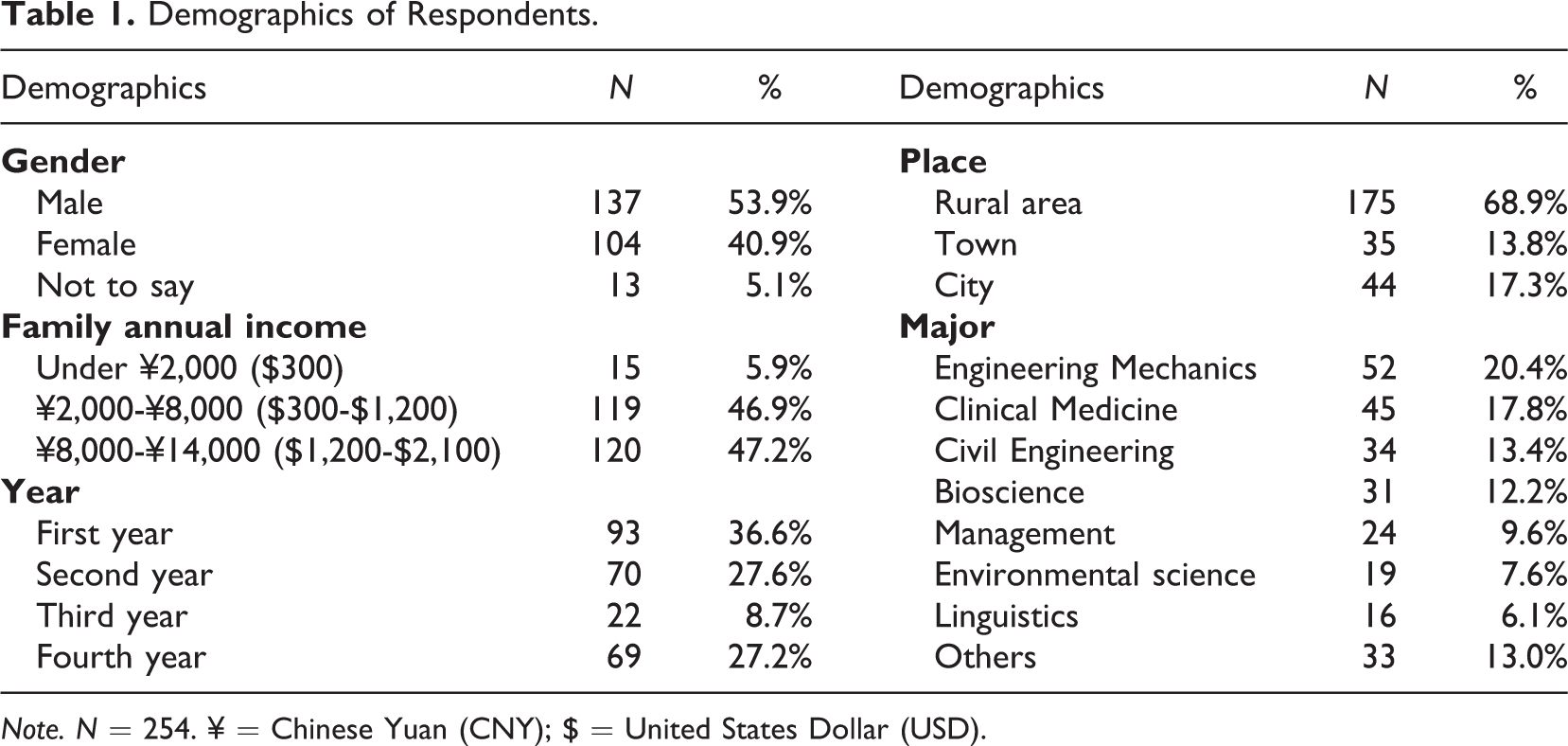
Note. N = 254. ¥ = Chinese Yuan (CNY); $ = United States Dollar (USD).
Procedure
Data for the current study were collected from undergraduate students enrolled in a 4-year university in the central region of China. After establishing contact with a key person in the institution who agreed to assist with the data collection, a thorough briefing was conducted. The key contact, who managed student affairs, then posted the announcement on bulletin boards around the campus. All students were reached but only impoverished students were invited to use the survey link. The announcement had a brief introduction of the research project and criteria for participants: 1) full-time and 2) impoverished students whose family annual income is below 14,000 CNY (2,100 USD). Eligible participants were first pre-selected by screening questions and then given an online survey link. The questionnaire contained an information page with informed consent. All the participants were informed that the information collected will be kept confidential and they were allowed to withdraw at any time. In return for their participation, the respondents were offered a free career counselling slot where they were given guidance on career development.
Instruments
Brislin (1970)’s back-translation procedures were followed to generate the Chinese versions of the scales for this study. Specifically, the translated scales included Lifetime Experiences of Marginalization Scale (LEMS), Work Volition Scale-Student Version (WVS-SV), and Future Decent Work Scale (FDWS); while the existing Chinese version of Subjective Social Status (SSS), Career Adapt-Abilities Scale (CAAS), and proactivity were adopted for the current study.
Subjective social status
Subjective social status was assessed with the MacArthur Scale of Subjective Social Status (Adler et al., 2000). This measurement tool has been shown to reliably predict people’s psychological (e.g., stress; Adler et al., 2000) and vocational outcomes (e.g., meaningful work; Autin & Allan, 2020), and it has been applied to student samples (Autin et al., 2017). Respondents were presented with a picture of a 10-rung ladder and were asked to read the following sentences: “Think of this ladder as representing where people stand in our society. At the top of the ladder are the people who are best off, those who have the most money, most education, and best jobs. At the bottom are the people who are the worst off, those who have the least money, least education, and worst jobs or no job.” They were then instructed to mark where they fell on the ladder, ranging from 1 (bottom rung) to 10 (top rung).
Marginalization
Marginalization experiences were measured with the newly developed 3-item Lifetime Experiences of Marginalization Scale (LEMS; Duffy et al., 2019). The participants were instructed to rate items after reading the definition of marginalization: “By marginalized, we mean being in a less powerful position in society, being socially excluded, and/or having less access to resources because you are a member of a specific group, have a specific identity, or life history.” A sample item was: “During my lifetime, I have had many interpersonal interactions that have often left me feeling marginalized” (1 = strongly disagree, 7 = strongly agree). The LEMS was found to have high reliability in previous studies (e.g., α = .95; Douglass et al., 2019). The Cronbach’s alpha for this study is 0.93. The factor loadings of the Chinese version are shown in Appendix A.
Work volition
Work volition was measured with the 7-item volition subscale of Work Volition Scale – Student Version (WVS-SV; Duffy et al., 2012). A sample item was: “Once I enter the work world, I will easily find a new job if I want to” (1 = strongly disagree, 7 = strongly agree). The WVS-SV was adequately reliable in the original study (α = .70). In the current study, two items related to “change jobs” and “discrimination” were dropped due to factor loadings below 0.7; the remaining 5-item scale showed high reliability (α = .90). The factor loadings of the Chinese version are shown in Appendix B.
Career adaptability
Career adaptability was measured with the 24-item Career Adapt-Abilities Scale–China Form (CAAS-China; Hou et al., 2012; Savickas & Porfeli, 2012). All four dimensions of CAAS-China were assessed, including concern, control, curiosity, and confidence. Sample items include: “Thinking about what my future will be like,” “Making decisions by myself,” “Observing different ways of doing things,” and “Overcoming obstacles” (1 = strongly disagree, 7 = strongly agree). The reliability was shown to be high in Hou et al.’s (2012) study (α = .92). The Cronbach’s alpha for this study is 0.94.
Future decent work perceptions
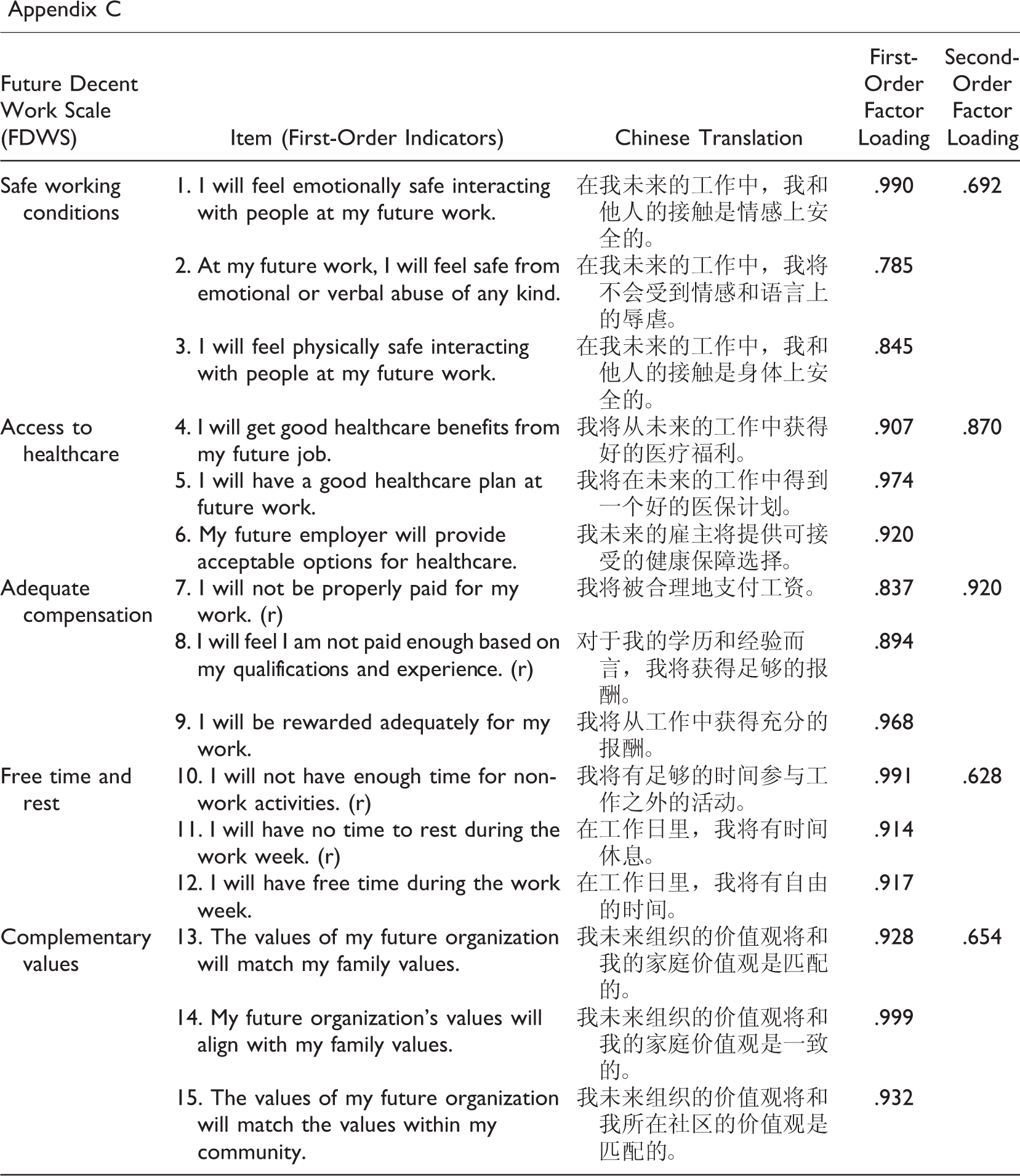
The future decent work perceptions of students were adapted from the newly developed 15-item Future Decent Work Scale (FDWS; Kim et al., 2019). Sample items include: “I will feel emotionally safe interacting with people at my future work” (1 = strongly disagree, 7 = strongly agree). The FDWS reliability was high in the original study (α = .91). The Cronbach’s α for this study is 0.86. The factor loadings of the Chinese version are shown in Appendix C.
Proactivity
Proactivity was measured with the 10-item shortened version of Bateman and Crant’s (1993) proactive personality scale. A sample item was: “No matter what the odds, if I believe in something I will make it happen” (1 = strongly disagree, 7 = strongly agree). This shortened scale has good reliability in previous studies (e.g., α = .84; Wang et al., 2019). The Cronbach’s α for this study is 0.92.
Results
Data Screening and Preliminary Analyses
IBM SPSS 24 was used to conduct the preliminary analyses. As there was no missing data (all questions were designed as compulsory items), we directly examined for outliers and distributions. SPSS outputs showed that only 2 univariate outliers and no multivariate outliers were detected; we retained them as the results showed no difference with and without them. The values of skewness and kurtosis of all study variables were under 1, suggesting a normal distribution (Weston & Gore, 2006).
Model Testing
We used structural equation modeling (SEM) in Mplus 8.3 (Muthén & Muthén, 1998–2017) with maximum likelihood estimation to test our models. Subjective social status was modeled as an observed variable, while marginalization, work volition, career adaptability and future decent work perceptions were loaded as latent variables. The following model-to-data fit indices were chosen: χ2/df, comparative fit index (CFI), Tucker–Lewis index (TLI), root mean square error of approximation (RMSEA), and standardized root mean residual (SRMR). Recommended values for adequate fit have ranged from more to less conservative (from CFI
Measurement Model
We tested the factor structures of the FDWS with three models—namely, a bifactor model, a higher order model, and a correlational model. Confirmatory factor analysis results show that the correlational model and the higher order model are an acceptable fit to our data, but the bifactor model is not ((81) = 369.660, p < .001, CFI = .937, TLI = .919, RMSEA = .118, 90% CI [.106 .131], p < .001, and SRMR = .190). Since future decent work perceptions are examined as a whole construct rather than differentiated as subscales in the following SEM analyses, we retained the higher order model: (85) = 251.584, p < .001, CFI = .964, TLI = .955, RMSEA = .088, 90% CI [.075 .100], p < .001, and SRMR = .065. A measurement model was then conducted to report the correlations among latent constructs and to assess the goodness of fit of the observed indicators on their respective latent variables. The model showed an adequate fit to the data: (1019) = 1995.775, p < .001, CFI = .927, TLI = .923, RMSEA = .061, 90% CI [.057 .065], p < .001, and SRMR = .062. Table 2 shows the descriptive statistics and intercorrelations of study variables.
Descriptive Statistics and Correlations of Study Variables.
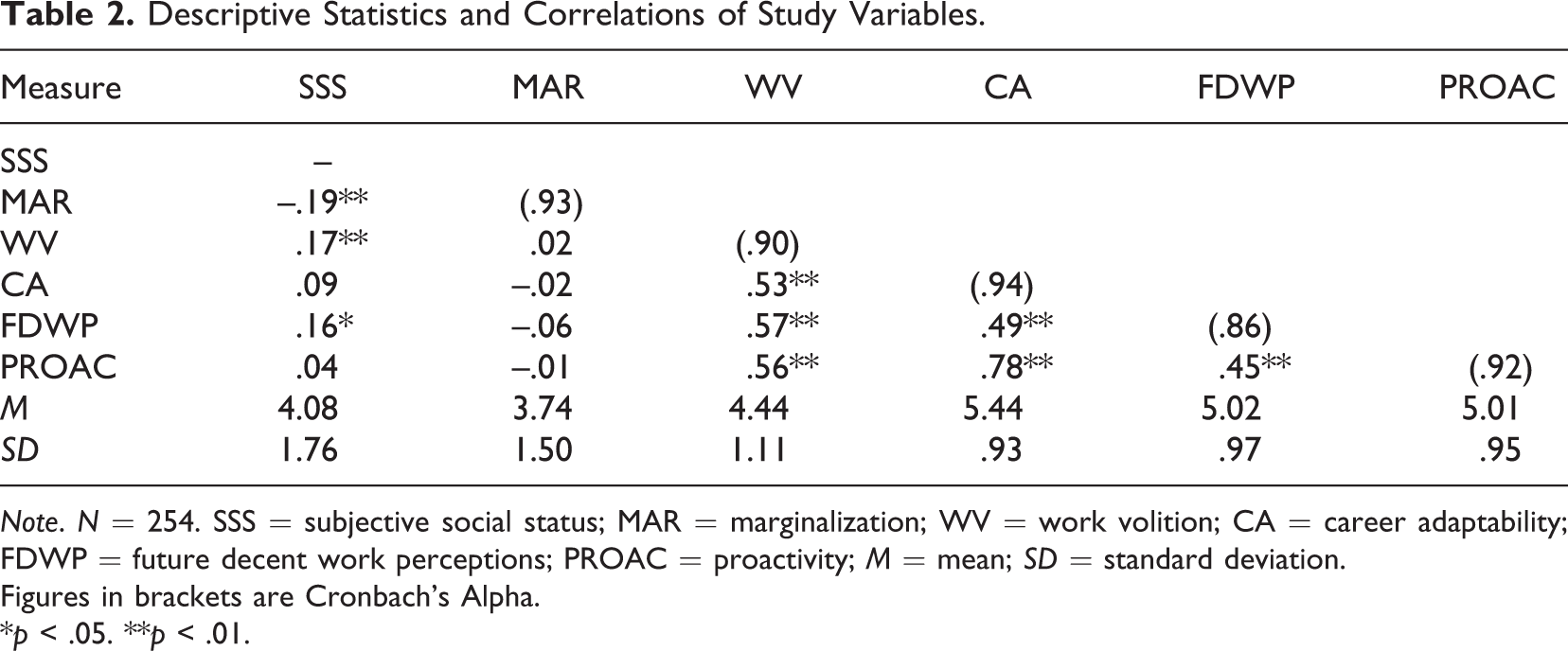
Note. N = 254. SSS = subjective social status; MAR = marginalization; WV = work volition; CA = career adaptability; FDWP = future decent work perceptions; PROAC = proactivity; M = mean; SD = standard deviation.
Figures in brackets are Cronbach’s Alpha.
*p < .05. **p < .01.
Structural Model
The structural model was constructed to test the hypotheses including all direct and indirect paths. The model fit statistics indicated an adequate fit to the data: χ2(1,062) = 2029.802, p < .001, CFI = .928, TLI = .923, RMSEA = .060, 90% CI [.056 .064], p < .001, and SRMR = .061. Figure 1 shows that around half of the model paths were significant. Subjective social status and marginalization experiences were significantly correlated (p < .01; hypothesis 1). The direct path from subjective social status to work volition (p < .01; hypothesis 2) was significant, but the paths from subjective social status to career adaptability (ns; hypothesis 3) and future decent work perceptions (ns; hypothesis 4) were not significant. As for marginalization experiences, the direct paths from marginalization experiences to work volition (ns; hypothesis 5), career adaptability (ns; hypothesis 6) and future decent work perceptions (ns; hypothesis 7) were all non-significant. Both work volition (p < .001; hypothesis 8) and career adaptability (p < .01; hypothesis 9) were significantly positively related to future decent work perceptions. Moreover, work volition significantly predicted career adaptability (p < .001; hypothesis 10).
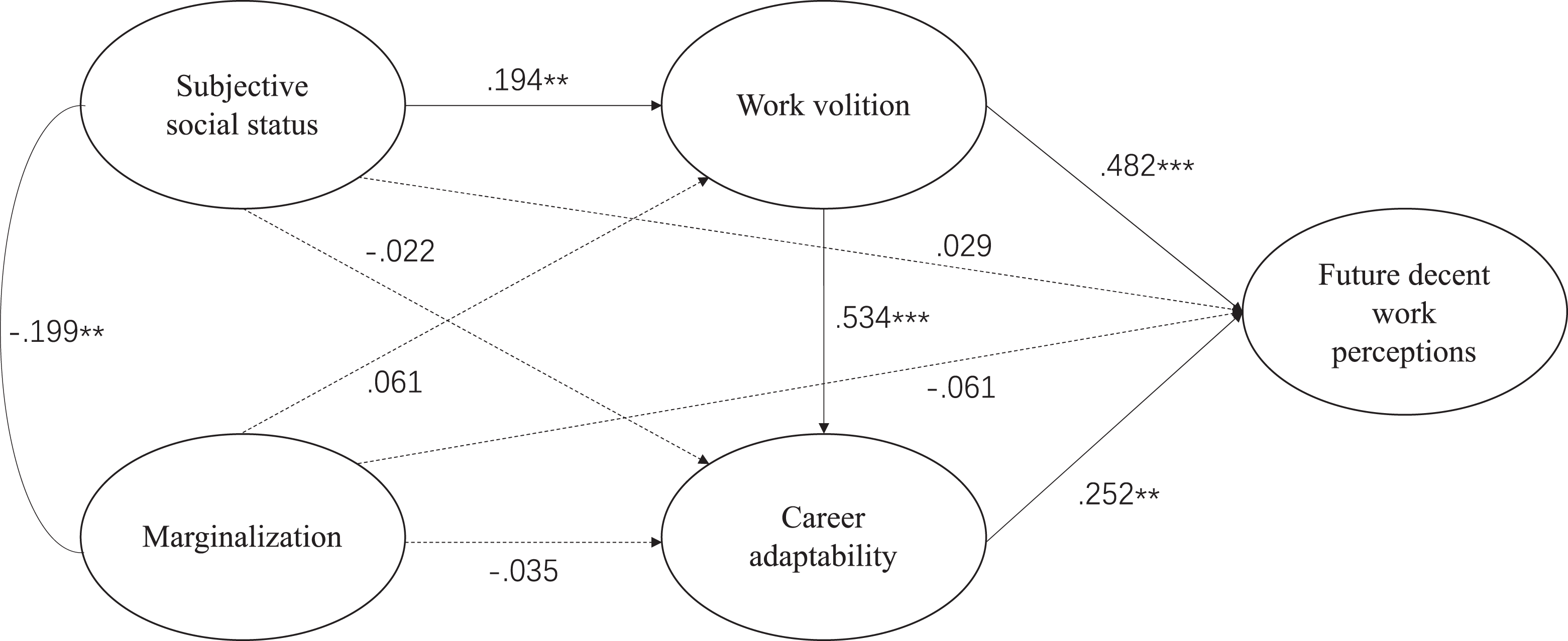
The SEM result of the structural model. Note. *p < .05. **p < .01. ***p < .001.
In order to test indirect relationships in the model, the current study adopted 1,000 bootstrapping samples and bias-corrected confidence intervals (Shrout & Bolger, 2002). There were two significant indirect relationships: first, subjective social status had a significant indirect impact on future decent work perceptions via work volition (β = .094, SE = .033, 95% CI [.030 .161]; hypothesis 11). Second, subjective social status showed a significant indirect relationship with future decent work perceptions via work volition and subsequent career adaptability (β = .026, SE = .012, 95% CI [.036 .052]; hypothesis 13).
Moderation and Moderated Mediation Model
Next, we examined whether proactivity or college year buffered the association between subjective social status, marginalization, and criterion variables in the modified PWT model. Until recently, the latent variable approach to specifying complex interaction effects (i.e., moderated mediation) has not been well developed to make it widely available, hence most of the previous studies primarily rely on a regression-based approach because of the computational complexity, large sample size requirements, and lack of convergence of latent interactions (Sardeshmukh & Vandenberg, 2017). In the present study, PROCESS 2.13 macro for SPSS was used to conduct the test of moderation effects (Model 1) and first-stage moderated mediation effects (Model 7) through 5,000 bootstrapping samples (Hayes, 2018). Also, the PROCESS macro is especially useful for comparing the slopes of different categories when the moderator (i.e., college year) is multi-categorical (Hayes & Montoya, 2017). Our moderation and moderated mediation model results showed that proactivity was not a significant moderator in the modified PWT model, while college year had moderating effects on 1) the relationship between subjective social status and work volition, and 2) the mediated relationship among subjective social status, work volition, and future decent work perceptions.
Following the steps recommended by Hayes and Montoya (2017), college year (Year 1 to Year 4) was input as a multi-categorical moderator using indicator coding. Results from the PROCESS macro (Model 1) showed that subjective social status significantly predicted work volition among the freshmen (b = .220, p < .001), but the relationship was much weaker among the senior students. The interaction between subjective social status and Year 4 was significantly and negatively related to work volition (βSSS ×year4 = −.210, p < .05). However, the variance of work volition explained in this multi-categorical moderator model only increased by 2.3% compared to the unconstrained model. Figure 2 shows the simple slopes of the moderating effect of college year between subjective social status and work volition.

Simple slope analysis of the moderating effect of college year between subjective social status and work volition. Note. SSS = subjective social status.
Also, the moderated mediation results from the PROCESS macro (model 7) showed that college year significantly weakened the mediating relationship among subjective social status, work volition and future decent work perceptions (see Table 3). Under the buffering effect of college year, only freshmen felt constrained by their subjective social status (b = .110, 95% CI [.046, .177]), while the indirect association between subjective social status and future decent work perceptions became small and not significant among students in other years. The difference in indirect effects between freshmen and senior students as suggested by the index of moderated mediation was significant (indexyear4 = −.107, 95% CI [−.193, −.022]). The multi-categorical moderator model explained 33.2% of variance in future decent work perceptions.
Moderated-Mediation Results for SSS × College Year on FDWP Through WV.

Note. SSS = subjective social status; FDWP = future decent work perceptions; WV = work volition.
CI = confidence interval.
*p < .05.
Discussion
In answering the call for validating the PWT model with diverse samples (Duffy et al., 2016), and to examine the complex propositions within the PWT context, data was collected from impoverished college students in China. Overall, the results confirmed five interesting findings and added new insights to the PWT. First, work volition was a significant mediator linking students’ subjective social status and their future decent work perceptions. Specifically, students from low social status felt less volitional when making occupational choices and thus perceived less possibility of obtaining decent work in the future. Lacking confidence in future decent work securement among impoverished students is reasonable given that they face many mobility constraints (e.g., no Hukou) and have no Guanxi that could otherwise provide them with good employment opportunities (Ren & Chadee, 2017); hence they can only access less prestigious jobs in the job market.
Second, work volition and career adaptability serially mediated the relationship between subjective social status and future decent work perceptions. As expected, students with low subjective social status perceived limited freedom in their career choices. This low sense of control regarding future careers further hindered their willingness and abilities to develop self-regulatory career strengths (e.g., curiosity, flexibility, sociability), thereby decreasing their competitive advantages in the labor market. This finding is similar to the observation by Autin and colleagues (2017) who indicate that one’s disadvantaged social status could impede their work volition and subsequent career adaptability. Consequently, these students are likely less able to attain vocational achievements in the future.
Third, marginalization experiences were not a significant predictor of future decent work perceptions, whether directly or indirectly. As impoverished students are usually from marginalized backgrounds (e.g., left-behind children, the disabled, orphans), we used LEMS to understand their discriminated experiences as a whole, and at their intersections of identities (see Duffy et al., 2020, for a similar concept). The results revealed that the intersecting form of marginalization experiences did not predict the students’ work volition, career adaptability, and future decent work perceptions. These results could be due to the students’ college education. Specifically, the advantages of getting a college education could have equalized the disadvantages brought by the students’ oppressive life histories, thus enabling them to expect a fulfilling career future. Moreover, the impoverished students in this study could have experienced marginalization in different forms and strength; their experiences might not similarly predict their career-related capabilities and career trajectories after graduation. Future research could examine the influences of marginalization experiences using samples with specific discriminated identities (e.g., a group of left-behind children).
Fourth, college year is a significant moderator in the PWT model. Specifically, college year serves as a buffer in the relationship between subjective social status and work volition. Compared to the freshmen, senior students reported significantly weaker impact of their subjective social status on work volition. It may be that senior students are more mature (Healy et al., 1985), and less inhibited by socioeconomic constraints when they become “more in touch with life” (Hou et al., 2012, p. 691) compared to their honeymoon year as freshmen. It may also be the reality of looking ahead to the future that pushes the senior students to be more prepared and more confident (Liu et al., 2017), in spite of their disadvantaged backgrounds. Moreover, college year moderated the mediating relationship among subjective social status, work volition, and future decent work perceptions. Subjective social status strongly predicted future decent work perceptions among the freshmen, but it could not predict the perceptions among senior students. This interesting finding could be due to senior students engaging in significantly more career planning and career exploration activities than students in their junior years (Nevill & Super, 1988). They might have learnt more career decision-making skills than freshmen students (Liu et al., 2017), accumulated knowledge and information about preferred occupations (Healy et al., 1985), and know more people working at attractive workplaces and talk to them to learn more about available job vacancies (Guan et al., 2015; Jiang et al., 2019), which may facilitate their efforts to find better ways to secure decent work in the future. With regard to proactivity, there is no evidence on its moderating role for buffering the negative influence of students’ background constraints. This finding is similar to Douglass and colleagues’ (2019) results. They found that while the respondents could be inclined to show proactivity, they may not actually engage in proactive behaviors such as searching for jobs or managing their careers (Valls et al., 2020). Thus, their tendency to be proactive might not be enough to weaken the negative influence of their background constraints on their future career.
Lastly, we translated and tested three scales (FDWS, WVS-SV, LEMS) within the Chinese context. These scales demonstrated internal reliability, although the LEMS lacked predictive validity. It could be that the LEMS measured students’ experienced lifetime constraints, while receiving a college education presented the students a new environment to re-evaluate their vocational privilege; hence the lifetime experiences might not effectively predict their current capacity or future career outcomes. Instead, their feelings about the present socioeconomic situation (i.e., their subjective social status) served to better predict their future career. Moreover, the original scale was developed in the Western context for working populations. Hence, the adapted version for the current study may not have adequately captured the Chinese students’ perceptions. Future research could develop an emic measurement tool using exploratory studies in the Chinese context.
Practical Implications
Constrained by their backgrounds, impoverished college students may have limited financial and social resources to act volitionally when choosing jobs after graduation. In order to prepare these young adults to obtain meaningful and quality jobs, various social support and vocational interventions should be implemented. First, based on the finding that limited socioeconomic privilege undermines the confidence of impoverished students in obtaining decent work in the future, governments and colleges should launch special funds targeting impoverished students to reduce their financial burden so that they can spend more time in preparing themselves with necessary skills and searching for preferable jobs. Second, since many impoverished students could not afford a smart phone or laptop, let alone college expenses, they have less access to information. Student mentors in high schools or colleges should disseminate clear information regarding funding programs while encouraging eligible students to apply for scholarships, sponsorships, or suitable education program. For example, high school mentors or teachers could encourage impoverished graduates to study agriculture-related programs or attend (some) vocational schools where tuition and books are reimbursable (MOE, 2018). Qualified students should also be motivated to apply for the tuition-free educational programs in the teacher-training colleges (MOE, 2018) so that they do not need to worry about the tuition. More importantly, they will be gainfully employed upon graduation since the teacher-training colleges would arrange for them to work at partner schools.
Third, impoverished students in our sample faced intersecting forms of oppression; they might be a left-behind child or orphan. As LBC and orphans grow up without much parental care, they tend to be guarded and not discuss much about their life, career planning, job search skills or job seeking process (Jia & Tian, 2010). As few colleges pay adequate attention to effective career planning or provide comprehensive career guidance programs (Sun & Yuen, 2012), teachers and career counsellors can demonstrate care and concern towards such students so that they may be more willing to listen to suggestions about attending internship programs in different organizations, or engaging in self-initiated career planning activities such as networking and talking to industry experts. Counsellors can also encourage students to obtain various vocational certificates (e.g., chartered financial analyst, national judicial examination certificate) before graduation so that they are more competitive in the labor pool. Additionally, the career development center in colleges may conduct career development education for the students (Kenny et al., 2019). The career development center can also prepare students to reject damaging stereotypes in the labor market (Kenny et al., 2019). More importantly, interview preparation workshops should be conducted to help students identify their unique strengths and overcome potential challenges during job interviews.
Limitations and Future Directions
The current study has some limitations. First, the cross-sectional study design cannot confirm causal relationships in the PWT model. A longitudinal research design is recommended to further explore the dynamic career trajectories of impoverished college students (Autin et al., 2017). Future research that compares vulnerable students’ career-related capabilities and perceptions before, during and after Covid-19 could contribute to the PWT (Blustein et al., 2020; Kantamneni, 2020). For example, would the Covid-19 crisis influence students’ work volition, career adaptability, and perceived access to future decent work? Are there factors (e.g., internal locus of control, college support) buffering the influences?
Second, data collected from one source, and from a single region, limited the generalizability of the findings. Future studies should recruit students from different regions, especially areas where young people are living in deep poverty or facing extraordinary barriers. Data could also be collected from more diverse populations, such as impoverished students enrolled in elite universities, left-behind children in rural areas, migrant children 3 and orphans. Comparisons of their perceptions may provide further insights currently lacking in this study. Furthermore, qualitative data may offer further insights on the PWT, since people living in some rural and pastoral areas may only expect a secure job; or they are willing to work long hours to earn a pittance instead of pursuing decent work, due to family obligations.
Finally, contextual variables such as Guanxi and related job search behaviors (e.g., searching potential job opportunities, preparing job skill examinations) were omitted. This information could offer valuable insights to the PWT. Future research might attempt to include other culturally contextual variables for examining the cross-cultural applicability of the PWT. Moreover, unfolding whether actual career planning or career exploration behaviors could serve as a moderator in buffering the impact of impoverished students’ socioeconomic constraints would be fruitful.
Conclusion
The current study contributed to the PWT by examining its complex propositions with impoverished college student populations in China. Work volition was a significant mediator of the relationship between students’ subjective social status and perceptions of future decent work. Work volition and career adaptability directly predicted perceptions of future decent work. The results also demonstrated the moderating role of college year in buffering the adverse impact of students’ limited socioeconomic privilege on their perceptions of future decent work. Practical insights were given. Future research may examine further the factors that can mitigate students’ background constraints to securing future decent work.
Footnotes
Appendix
Appendix C
| Future Decent Work Scale (FDWS) | Item (First-Order Indicators) | Chinese Translation | First-Order Factor Loading | Second-Order Factor Loading |
|---|---|---|---|---|
| Safe working conditions | 1. I will feel emotionally safe interacting with people at my future work. | 在我未来的工作中,我和他人的接触是情感上安全的。 | .990 | .692 |
| 2. At my future work, I will feel safe from emotional or verbal abuse of any kind. | 在我未来的工作中,我将不会受到情感和语言上的辱虐。 | .785 | ||
| 3. I will feel physically safe interacting with people at my future work. | 在我未来的工作中,我和他人的接触是身体上安全的。 | .845 | ||
| Access to healthcare | 4. I will get good healthcare benefits from my future job. | 我将从未来的工作中获得好的医疗福利。 | .907 | .870 |
| 5. I will have a good healthcare plan at future work. | 我将在未来的工作中得到一个好的医保计划。 | .974 | ||
| 6. My future employer will provide acceptable options for healthcare. | 我未来的雇主将提供可接受的健康保障选择。 | .920 | ||
| Adequate compensation | 7. I will not be properly paid for my work. (r) | 我将被合理地支付工资。 | .837 | .920 |
| 8. I will feel I am not paid enough based on my qualifications and experience. (r) | 对于我的学历和经验而言,我将获得足够的报酬。 | .894 | ||
| 9. I will be rewarded adequately for my work. | 我将从工作中获得充分的报酬。 | .968 | ||
| Free time and rest | 10. I will not have enough time for non-work activities. (r) | 我将有足够的时间参与工作之外的活动。 | .991 | .628 |
| 11. I will have no time to rest during the work week. (r) | 在工作日里,我将有时间休息。 | .914 | ||
| 12. I will have free time during the work week. | 在工作日里,我将有自由的时间。 | .917 | ||
| Complementary values | 13. The values of my future organization will match my family values. | 我未来组织的价值观将和我的家庭价值观是匹配的。 | .928 | .654 |
| 14. My future organization’s values will align with my family values. | 我未来组织的价值观将和我的家庭价值观是一致的。 | .999 | ||
| 15. The values of my future organization will match the values within my community. | 我未来组织的价值观将和我所在社区的价值观是匹配的。 | .932 |
Acknowledgments
The authors would like to thank Prof. Ryan Duffy and Prof. Patton Garriott for their comments on an earlier version of this manuscript.
Declaration of Conflicting Interests
The author(s) declared no potential conflicts of interest with respect to the research, authorship, and/or publication of this article.
Funding
The author(s) received no financial support for the research, authorship, and/or publication of this article.
