



Abstract
This study used the Social Cognitive Career Theory—Career Self-Management Model (SCCT-CSM) to understand the process by which background variables impact students of color’s intentions to persist in college. Findings from 329 students of color revealed that perceived social status related positively to self-efficacy for self-regulated learning, that increased experiences of racism related negatively to self-efficacy for self-regulated learning, and that self-efficacy for self-regulated learning related positively to intentions to persist in college. Further, self-efficacy for self-regulated learning mediated the relationship between perceived social status and persistence intentions among this sample of college students of color. Lastly, SEM analyses provided support for several pathways of the SCCT-CSM model with students of color. Limitations of the current study are discussed. Implications and future directions for practice and research are presented.
Keywords
Students of color at predominately White institutions (PWI) face harsh environments and realities that impact their ability to finish college (Banks & Kohn-Wood, 2007; Fischer, 2007). Students of color report experiencing an adverse academic climate and poor learning environments, which may contribute to lowered intentions to persist toward degree completion (Fischer, 2007). The percentage of students of color enrolled in higher education institutions is increasing (Ginder et al., 2015). These numbers, coupled with the realities that students of color face on campuses, highlight the importance of understanding factors contributing to their retention in higher education. The Social Cognitive Career Theory Career Self-Management (SCCT-CSM) model offers a framework by which to explore some of the process aspects of educational and career development relevant for students of color. SCCT-CSM is concerned with such questions as how individuals make decisions, choose to pursue goals, and manage multiple roles under varying environmental conditions (Lent & Brown, 2013).
Social Cognitive Career Theory Career Self-Management (SCCT-CSM)
SCCT-CSM focuses on the process aspect of career development and was developed to address the changing nature of the world-of-work and addresses the dynamic ways people adapt to routine career tasks and unique challenges within and across the educational/vocational field (Lent & Brown, 2013). SCCT-CSM emphasizes the importance of process-oriented cognitive person variables (self-efficacy beliefs and outcome expectations) that are posited to mutually interact with personal goals (Lent & Brown, 2013). SCCT-CSM centralizes aspects of human diversity by including distal and proximal antecedents that mutually interact with and influence one another in their relationship to career development (Lent et al., 1994, 1996). Distal antecedents include person inputs (e.g., race and ethnicity) and background contextual affordances (e.g., access to recourses) and proximal antecedents include environmental and personal circumstances (e.g., experiences with discrimination) that facilitate or frustrate people’s ability to adapt to career events (Lent & Brown, 2013). Limited research has examined SCCT-CSM’s pathways in the context of understanding college students of color’s intentions to persist toward degree completion.
The purpose of this study was to examine some of SCCT-CSM’s proposed pathways with a particular focus on the process aspect of educational development (see Figure 1) among college students of color attending PWIs. We examined perceived social status as a distal antecedent and experiences with racism as a proximal antecedent that relate to students’ self-efficacy to self-regulate learning as a process-oriented cognitive person variable. We then examined how these variables relate to intentions to persist toward degree completion.
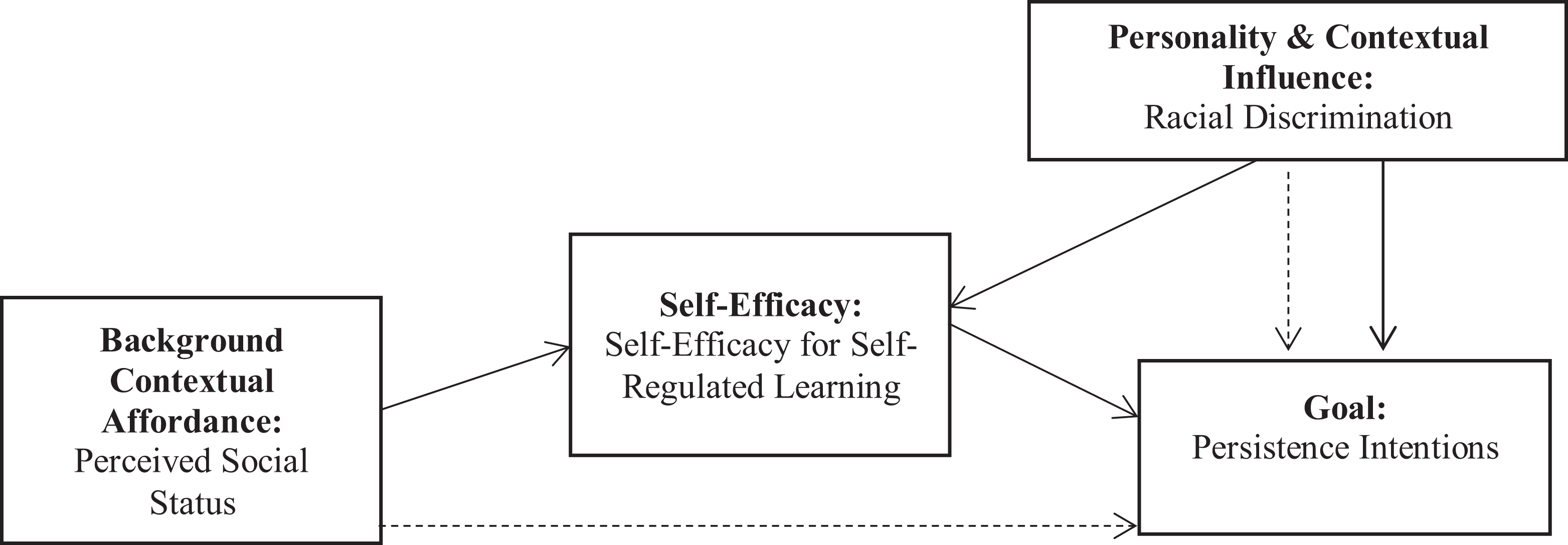
Proposed model.
Goal: Persistence Intentions
A student’s intention to finish college is a type of process-oriented educational goal that has particular relevance to students of color. Tinto’s (1993) integration theory is one of the most widely cited theories of college students’ persistence and it depicts the degree of fit between the student and the college environment. According to Tinto’s theory, students’ intentions to persist signify their commitment to graduate, which depends upon social and academic integration (Tinto, 1993). In other words, intentions to persist represent the outcome of a continual decision-making process by which students decide to continue toward degree completion.
Research has shown a gap in college degree attainment between White students and students of color (DesJardins et al., 2002). This gap is particularly troublesome because it has implications for individuals’ long-term social mobility (Carter, 2006) as the attainment of a postsecondary degree often contributes to higher net incomes among individuals who are members of underrepresented racial and ethnic groups (Malveaux, 2003). As such, scholars (e.g., Carter, 2006) have argued that it is especially important to understand persistence intentions among students of color. Prior research has demonstrated that a variety of non-cognitive factors relate to students of color’s intentions to persist, including college self-efficacy, intellectual phoniness (i.e., feeling like an imposter), and social support (Gloria & Ho, 2003).
To date, much of the persistence intentions literature has focused on an assessment of the degree of fit between student and institutional characteristics (Kahn & Nauta, 2001). This study extended prior research by examining factors that may relate to how students of color adapt to their surroundings and make decision in order to persist within a PWI. Rather than simply relying on an assessment of the degree of fit between students and institutional characteristics, we examined persistence intentions among students of color as an educational goal that is related to intrapersonal and interpersonal factors.
Distal Antecedent: Perceived Social Status
Perceived social status (PSS) has been conceptualized within an SCCT framework as a personal and contextual input that captures an individual’s cultural context and socialization experiences (Thompson & Dahling, 2012). PSS is “an assessment of one’s internalized social status identity” (Thompson & Dahling, 2012, p. 352) that taps individuals’ access to opportunity structures within society (Fouad & Brown, 2000). Attending to PSS is important given its implications for students’ ability to engage in educational and career development opportunities.
Prior research has demonstrated that PSS relates to a variety of contextual variables and career development outcomes (e.g., Thompson & Subich, 2011). For example, Thompson and Subich (2006) found that college students who reported greater PSS indicated greater self-efficacy in their abilities to complete career decision-making tasks. In addition, Thompson (2013) found that lower PSS and more experiences with personal and systemic classism were related to lowered outcome expectations among Native American college students. Yet, no research to date has examined the relationship of PSS to persistence intentions as a process-oriented educational goal among students of color.
Cognitive-Person Variable: Self-Efficacy for Self-Regulated Learning
Students’ self-efficacy for self-regulated learning was examined as a cognitive-person variable, theorized to facilitate or frustrate an individual’s progress toward goals (Lent & Brown, 2013). SCCT-CSM emphasizes the process aspect of career development by focusing on adaptive behaviors, and one type of adaptive educational behavior is self-regulation (Lent & Brown, 2013). Self-regulated learning (SRL) is comprised of metacognitive, motivational, and behavioral strategies that students use to acquire academic skills (Zimmerman, 2008). As such, self-efficacy for SRL taps student’s perceived capability to engage in goal setting, planning, and organizing during academic studying (Bandura, 1989). Individuals with higher SRL efficacy beliefs are posited to direct their learning processes, apply strategies to achieve their goals, and utilize self-regulation to motivate their efforts to accomplish goals (Bandura, 1996; Zimmerman, 1989). Self-efficacy for SRL has been shown to contribute to students’ motivational beliefs and success in meeting academic goals (Zimmerman, 1989; Zimmerman et al., 1992).
To date, research examining self-efficacy for SRL has been confined to samples of Kindergarten through high school students (e.g., Zimmerman et al., 1992). This study is the first to examine the relationship of self-efficacy beliefs for SRL to persistence intentions among college students of color. It is essential to examine self-efficacy for SRL among college students because studying at the collegiate level differs from that of earlier schooling (Zimmerman & Kitsantas, 2007). College students are expected to manage their learning independently with limited direct feedback about their performance. Examining self-efficacy for SRL is especially important among students of color because evidence suggests that students of color are more likely to enter universities with less academic preparation as compared to their White peers (Strayhorn, 2011). Their academic preparation level, combined with challenges related to attending a PWI, may contribute to lowered beliefs in their abilities to regulate or manage their academic performance and persist through degree completion.
Taken together, research has demonstrated that PSS relates to college students’ educational and vocational development (e.g., Thompson & Subich, 2011) and that self-efficacy beliefs for SRL have implications for children’s motivation to pursue educational goals (e.g., Zimmerman et al., 1992). Yet, no research has examined the relationship of PSS to self-efficacy beliefs for SRL or intentions to persist toward degree completion among college students of color. Based upon prior findings and SCCT-CSM’s proposed pathways (depicted in Figure 1), these hypotheses were proposed:
Proximal Antecedent: Experiences of Perceived Racial Discrimination
Racial discrimination is conceptualized as a proximal variable within SCCT-CSM. Proximal variables include subjective psychological environmental factors that emphasize opportunities, resources, barriers, or affordances (Lent et al., 1996). Proximal variables, including exposure to discriminatory practices in the work or school environment, are posited to directly and indirectly relate to self-efficacy beliefs and goals (Lent & Brown, 2013). Racial discrimination is defined as any negative or harmful conduct (verbal or physical) directed at individuals due to their race, ethnicity, or national origin (Karlsen & Nazroo, 2002). Research has documented that college students of color who attend PWIs contend with racism experiences daily (Fischer, 2007; Reynolds et al., 2010). Results from a study of African American college students demonstrated that 98.5% of the participants reported having experienced a discriminatory event in the past year (Prelow et al., 2006). Another investigation (Hwang & Goto, 2008) showed that more experiences of racial discrimination was associated with heightened psychological distress, suicidal ideation, and depression symptoms among a sample of Asian American and Latinx college students.
The more students of color experience a negative or hostile campus environment, the more likely they are to leave that institution (Fischer, 2007; Reynolds et al., 2010). Experiences of racial discrimination have been demonstrated to negatively affect student’s academic self-concept, or beliefs that they can complete college (Reynolds et al., 2010). Although not yet examined, it seems likely that racism experiences will relate negatively to students’ intentions to persist in college.
In addition, racism experiences are posited to impact students’ self-efficacy beliefs for SRL. Steele and Aronson’s (1995) seminal work on stereotype threat demonstrated that students’ awareness of negative stereotypes against their group tend to evoke anxiety and, consequently, undermine their performance. Affective states, particularly anxiety, have been shown to undermine college students’ ability to monitor and regulate their learning (Zimmerman, 1989). Thus, racism experiences seem likely to influence students of color’s ability to use a variety of self-regulated learning strategies such as goal setting, planning, and organizing in academic contexts, thereby impacting their overall self-efficacy beliefs for self-regulated learning. According to SCCT-CSM’s pathways, experiences with racism would be proposed to frustrate the link between students’ self-efficacy for SRL and intentions to persist in college. Based on prior research (e.g., Reynolds et al., 2010; Steele & Aronson, 1995) and SCCT-CSM’s pathways, the following hypotheses were proposed:
Method
Participants
A total of 329 undergraduate students who self-identified as students of color attending a PWI in the Midwest participated in the study. Seventy-nine individuals clicked on the survey link and provided consent but did not complete the survey, resulting in an 80.6% completion rate. The majority (N = 242; 73.6%) were women and 78 (23.7%) were men. Three individuals identified as Queer, three as Non-Binary, two as “fluid gender” and one as transgender. The majority (N = 267, 81.2%) identified as Straight. Ninety-nine (30.1%) identified as Asian, Asian American, or Pacific Islander; 94 (28.6%) as Hispanic, Latin@, Latinx, or Chican@; 49 (14.9%) as two or more races; 47 (14.2%) as Black or African American, 32 (9.7%) as Biracial; three (1%) as American Indian/Native American; and five (1.5%) as “other race or ethnicity” including “Middle Eastern/Central Asian,” “Afro-indigenous/Central American.” Fifty-three percent identified as first-generation college students (N = 176).
With regard to academic class standing, 73 (22.2%) participants were freshman, 85 (25.8%) were sophomores, 66 (20.1%) were juniors, and 101 (30.7%) were seniors (4 did not report class standing). The majority (93.9%) were full-time students and 187 (56.8%) reported being currently employed. Students ranged in age from 18 to 49 (M = 20.69, SD = 3.27) and most reported a “B” average (M = 3.22, SD = .42, range = 2.0 – 4.0).
Participants reported the combined annual income of the person(s) who raised them as follows: $0–$19,000 (N = 33; 10.1%), $20,000-39,000 (N = 65; 19.7%), $40,000–$59,000 (N = 68; 20.6%), $60,000–$79,000 (N = 41; 12.5%), $80,000–$99,000 (N = 34; 10.4%), $100,000–$119,000 (N = 30; 9.1%), $120,000–$199,000 (N = 28; 8.4%), and $200,000 and above (N = 27; 8.2%). In terms of social class, participants were asked to “think about their past and present experiences” and to “pick the label that best describes their perceived social class.” Forty-one participants identified as lower class (12.5%), 89 as working class (27.1%), 69 as lower-middle class (21.0%), 79 as middle class (24.0%), 43 as upper-middle class (13.1%), and six as upper class (1.8%; two did not indicate their social class).
Measures
Perceived social status
The Differential Status Identity Scale (Brown et al., 2002, DSIS) was used to tap participants’ perceived social status (PSS). The DSIS was developed to assess three facets of social status proposed by Rossides (1990, 1997) and consists of 60 items including four subscales: economic resources-amenities, economic resources-basic needs, social power, and social prestige. Participants are asked to compare their level of each of the four dimensions of social status relative to “the average US citizen.” Item responses are obtained using a 5-point Likert-type scale ranging from −2 (very much below average for the economic resources and social power subscales or much less for the social prestige subscale) to +2 (very much above average or much more).
The two economic resources subscales include 30 items that ask participants to identify how they perceive their relative ability to engage in behaviors that require economic resources such as: “going to the dentist,” “providing children with outside educational and recreational activities,” and “traveling for leisure.” The social power subscale, has 15 items that asks individuals to comment on their perceived relative ability to “gain high-profile positions of employment,” “have an influence on public policy,” and “have access to a fair trial.” Finally, the social prestige subscale consists of 15 items asking individuals to identify to what extent they feel valued regarding their “ethnic group,” “physical ability,” and “neighborhood.” Items were summed for each subscale. The total score across subscales was used, with higher scores reflecting higher PSS. Previous research has demonstrated evidence for convergent, discriminant, and criterion validity (Thompson & Subich, 2006, 2007). High internal consistency reliability of the DSIS total and subscale scores (alphas ranged from .92 to .98) for college student samples has been demonstrated (e.g., Metz et al., 2009; Thompson & Subich, 2006).
Racial discrimination
The General Ethnic Discrimination (GED) Scale (Landrine et al., 2006) was used to tap students’ experiences with perceived racial discrimination. The GED is a global measure of discrimination and was modified from the Schedule of Racist Events to include all ethnic groups. The GED consists of three subscales: recent racist events (18 items), lifetime racist events (18 items), and the appraisal of stress associated with each event (17 items). Each subscale is one-dimensional and the GED has been demonstrated to have high one-month test-retest reliability (r = .95–.96; Landrine et al., 2006) across ethnic and racial groups. Landrine et al., (2004) reported the following alphas across various ethnic groups, including: Whites = .91–.92, African Americans = .93–.95, Latinos = .93–.94, and Asian Americans = .91–.94. The GED has been demonstrated to have adequate convergent validity as a measure of discrimination (Landrine et al., 2006).
To reduce the risk of multicollinearity (Moradi & Subich, 2003), participants only completed the recent racist events subscale designed to tap experiences with discrimination in the past year. The recent racist events subscale uses a 6-point Likert-type scale for exposure to discrimination ranging from never to almost all the time. Items are summed to produce a total score. A sample is, “How often have you been called a racist name?” Higher scores on the recent discrimination subscale indicates more experiences of racial discrimination.
Self-efficacy for self-regulated learning
The Self-Efficacy for Learning Form-Abridged (SELF-A, Zimmerman & Kitsantas, 2007) was used to assess participants’ perceptions of their ability to cope with academic problems using a variety of SRL strategies such as studying, note taking, and test taking (Zimmerman & Kitsantas, 2007). Zimmerman and Kitsantas (2005) developed the SELF scale to assess self-efficacy for SRL following Bandura’s (2006) recommendations. The 19 item SELF-A is a shorter version of the 57-item SELF.
Items are descriptions of situations such as: “When a lecture is especially boring, can you motivate yourself to keep good notes? and “When another student asks you to study together for a course in which you are experiencing difficulty, can you be an effective study partner?” Respondents indicate their level of agreement on a scale ranging from 0 to 100 points in 10-unit increments ranging from: 0 (definitely cannot do it), 30 (probably cannot do it), 50 (maybe), 70 (probably can), and 100 (definitely can do it). Higher scores represent higher levels of self-efficacy beliefs for SRL. The internal consistency reliability coefficient for scores on the SELF-A was α = .97 in a sample of college students (Zimmerman & Kitsantas, 2007). Evidence for concurrent, convergent, and predictive validity has been demonstrated across high school and college samples (e.g., Zimmerman & Kitsantas, 2005, 2007, 2014).
Academic persistence intentions
The Persistence/Voluntary Dropout Decision (P/VDD; Pascarella & Terenzini, 1980) scale was used to tap persistence intentions. The P/VDD contains 30 items rated on a 5-point Likert-type scale ranging from 1 (strongly disagree) to 5 (strongly agree). Items tap five subscales: intellectual development, peer-group interactions, interactions with faculty, institutional commitments, and goal commitments. Responses are summed and averaged to reflect overall academic persistence intentions. A sample item is “It is likely that I will register at this university next fall.” Scores range from 30 to 150, with higher scores indicating more positive intentions toward persisting to degree completion.
Pascarella and Terenzini (1980) reported alphas ranging from .71 to .84 in a sample of college students. Internal consistency reliability estimates within samples of students from specific racial or ethnic groups also have been demonstrated to be high (e.g., Senghkammee et al., 2017). Evidence for validity has been supported by its positive association with cultural congruity and negative relationship with stress among samples of college students from a variety of racial and ethnic backgrounds (e.g., Gloria & Ho, 2003).
Procedure
After IRB approval, participants were recruited via university list servs that included a description of the study, criteria for participation, a link to the survey, information about the incentive for participation, and the researchers’ contact information. Prospective participants were required to be enrolled as undergraduate students and to self-identify as a student of color. Upon completing the online survey at their leisure, participants were provided with the opportunity to enter their contact information into a separate database. Contact information was entered into a drawing to win a $10 gift card to Amazon.com (one participant of every ten was randomly selected). All participants were provided with a resource list for academic support, mental health services, and employment and career resources.
Results
Management of missing data
Missing data were handled via two methods. For the correlational analyses, a pairwise deletion method was used where only cases with missing data on variables involved in a statistical procedure were removed (Cheema, 2014). Pairwise deletion was selected to maximize all data available to assess for the strength of relationships between variables and to increase power in the analyses (Peugh & Enders, 2004). As depicted in Table 1, missing data for the correlational analyses ranged from a 0% missing for self-efficacy for SRL to 19.4% missing for PSS total score. For the structural equation modeling (SEM) analyses, missing data were handled using a full information maximum likelihood (FIML) method. Maximum likelihood estimates a likelihood function for each individual based on the variables present so that all available data can be used to estimate the model (Cheema, 2014). This method is recommended for SEM models as it has been shown to produce unbiased standard errors of parameter estimates (Cheema, 2014; Enders, 2013).
Descriptive Information and Correlations for Study Variables.

Note. Perceived Social Status = PSS; Self-Regulated Learning = SRL; Persistence Intentions = PVDD.
*p ≤ .05. **p ≤ .01. ***p ≤ .001.
Descriptive Statistics and Correlations
All scales exhibited acceptable internal consistency reliabilities (Nunally, 1978) that ranged from .89 to .97 (see Table 1) that were comparable to those demonstrated in prior research (Landrine et al., 2006; Pascarella & Terenzini, 1980; Thompson & Subich, 2006; Zimmerman & Kitsantas, 2007). Mean values, standard deviations, and bivariate correlations for the observed scale scores for the primary variables are presented in Table 1. The pattern of intercorrelations indicated initial evidence to support the study’s hypotheses, with the exception of the relationship between racial discrimination and persistence intentions. In particular, students’ self-efficacy for SRL significantly related to persistence intentions and PSS and PSS significantly related to racial discrimination. The bivariate relationship of racial discrimination and persistence intentions, however, was non-significant.
Structural Equation Modeling (SEM)
A priori power analysis for SEM with 4 latent and 4 observed variables was conducted and indicated that a sample size of 209 would be sufficient using α = .05, a power of .80 and a medium effect size of .25 (Soper, 2017); thus, the current sample provided sufficient power. The hypothesized structural model was estimated using the ‘lavaan’ package in R (Rosseel, 2012). Direct, indirect, and total path coefficients were estimated. Standard SEM modification procedures were employed to examine the possibility of improving model fit. The chi-square statistic was utilized as a means to accept or reject the null hypothesis that there were no differences between the model and the data. The comparative fit index (CFI) and Tucker-Lewis index (TLI) were used as metrics of fit relative to a baseline model (with completely uncorrelated variables). The root mean square error of approximation (RMSEA) was used to index the extent to which the model approximately fit the data and the Bayesian Information Criterion (BIC) was employed as a metric of the model’s predictive accuracy.
Model identification
Model identification prior to data collection helps to determine whether or not the specified model can be tested; having an overidentified model in SEM is critical to assess whether the data fit the specified model (Weston & Gore, 2006). Several parameters were used to inform the hypothesized structural model. Lent and Brown’s (2013) theoretical framework aided in specifying the hypothesized relationships (see Figure 1). Evidence from the counting and recursive rules indicated that the model is overidentified. In other words, the number of parameters did not exceed the sum of the exogenous and endogenous variables. The paths between the endogenous and exogenous variables are unidirectional, indicating the endogenous variables could not predict the exogenous variables.
Multivariate normality
A multivariate normality analysis was executed in the R statistical software environment (R Development Core Team, 2014) to determine whether the data met the assumptions of multivariate normality. Using the Mardia multivariate normality test, results indicated that the skewness of 4496.51 (p = 0) and small sample skewness of 4,555.34 (p = 0) and Kurtosis of 29.14 (p = 0) do not follow a multivariate normal distribution. One can conclude that this multivariate dataset deviates from normality and that results need to be interpreted with caution, given the violation of basic SEM assumptions.
SEM model testing
Total z-scores and z-subscores were calculated for the variables included in the measurement model. Exploratory Factor Analysis (EFA) was used to assess the item loadings and factor structure for each variable. Results from the EFA revealed a single factor structure for racial discrimination (TLI = .829, RMSEA = .111, BIC = -192.43). All items loaded onto the single factor; item loadings ranged from .56 to .79. A single factor structure was also revealed for self-efficacy for SRL (TLI = .811, RMSEA = .10, BIC = -171.17); item loadings ranged from .37 to .79. These findings were consistent with expectations from prior research (Landrine et al., 2006; Zimmerman & Kitsantas, 2007). EFA results revealed a four-factor structure for PSS, with a mediocre fit (TLI = .796, RMSEA = .082, BIC of −4,716.88). Item loadings ranged from .32 to 1 and items loaded onto the PSS subscales consistent with prior research (Thompson & Subich, 2007). For persistence intentions, EFA revealed a five factor structure with a mediocre fit (TLI = .865, RMSEA = .066, BIC = −1,035). Item loading ranged from .17 to 1 and tapped the five subscales of the P/VDD (Pascarella & Terenzini, 1980). Based upon these findings, we proceeded with the SEM model (see Figure 1) with self-efficacy for SRL and racial discrimination as observed variables indicated by all items, PSS as a latent variable indicated by four parcels, and persistence intentions as a latent variable indicated by five parcels.
Next, the hypothesized measurement model was assessed using FIML to manage missing data and Robust Maximum Likelihood (MLR) to handle data non-normality. The model fit the data adequately based on the accepted parameters of fit indices of the hypothesized model (Robust χ2[1, N = 370] = 84.77, df = 41, p = 0), the CFI estimate (.975), the TLI estimate (.967), and the RMSEA (.057; 90% CI = .041, .074). The null hypothesis of the hypothesized model was rejected, indicating that the implied theoretical model significantly produced the sample variance-covariance relationships in the matrix. Next, the expected parameter changes (EPC) and measure invariance (MI) for paths not included in the measurement model were analyzed to determine if the fit of the model would improve after accounting for these additional paths. Upon inspection, no additional paths were added to the model given the small changes to the BIC after including these paths. Given that best practices warn against making changes to the measurement model because measurement issues should be resolved first through EFAs (Kaplan, 2009), no model modifications were made. Findings demonstrated that the model fit the data. Direct, indirect, and total effects were used to examine hypotheses, and results are depicted in Figure 2.
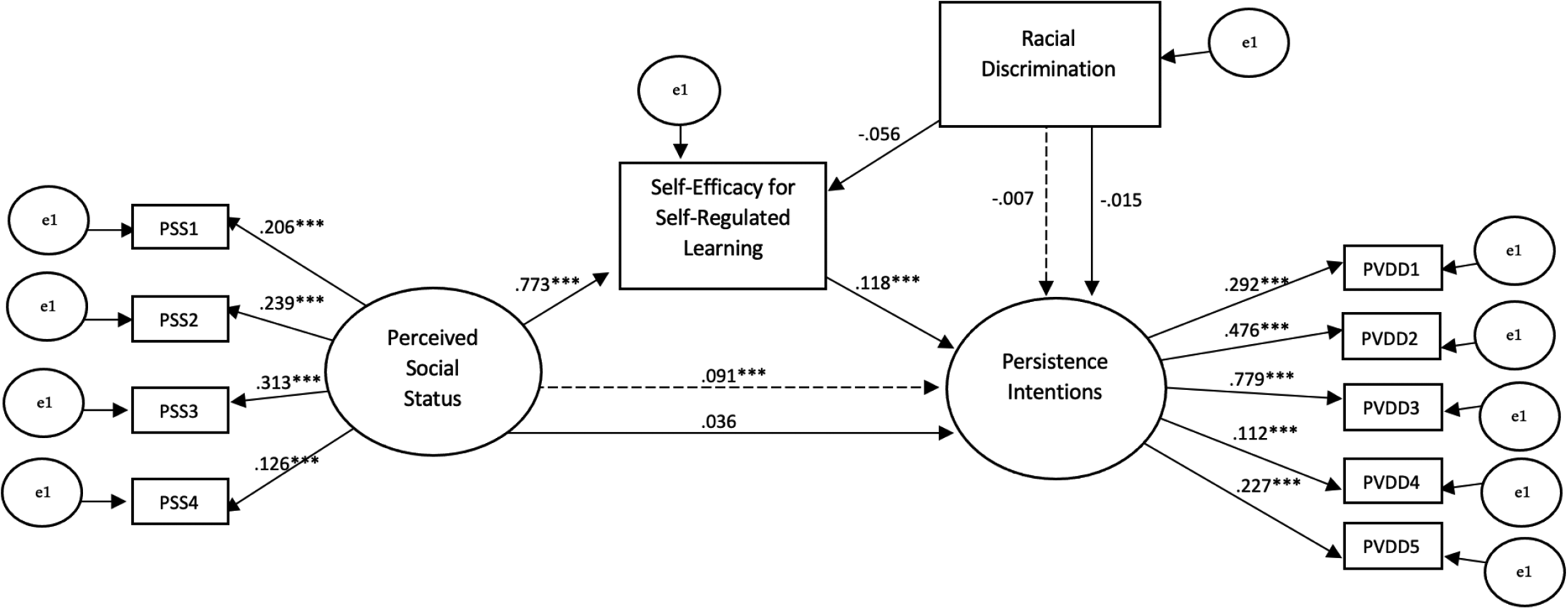
Evaluated model with SEM loading. The 19 items from the SELF-A scale loaded onto the self-efficacy for self-regulated learning variable and the 18 items from the GED loaded onto the racial discrimination variable. The four subscales of the DSIS loaded onto the Perceived social status variable and the five subscales of the P/VDD loaded onto the persistence intentions variable. *p < .05. **p < .01. ***p < .001.
SEM results: Perceived social status as a predictor
The direct path from PSS to self-efficacy for SRL was significant (b = .773, SE = .124, p < .001) with a medium to large effect size, thereby supporting Hypothesis 1. Consistent with Hypothesis 2, the direct path between self-efficacy for SRL and students’ persistence intentions was small but significant (b = 0.118, SE = .021, p < .001). In addition, consistent with Hypothesis 3, the indirect effect from PSS to persistence intentions as mediated through self-efficacy for SRL was significant (b = .091, SE = .023, p < .001) with a small effect. Finally, the total effects of PSS on persistence intentions was small and significant (b =. 127, SE = .033, p < .001). Results from the direct, indirect, and total effects for PSS to self-efficacy for SRL and persistence intentions supported the hypothesized model and the hypothesized relationships among these variables.
SEM results: Racial discrimination as a mediator
The pathways between experiences with racial discrimination and self-efficacy for SRL (b = −.056, SE = .128, p = .649) and between experiences with racial discrimination and persistence intentions (b = −.015, SE = .032, p = .648) were not significant, indicating that Hypotheses 4 and 5 (respectively) were not supported. The indirect effect from experiences with racial discrimination to persistence intentions as mediated by self-efficacy for SRL also was not significant (b = −.007, SE = .015, p = .658) indicating that self-efficacy for SRL did not partially mediate the relationship (contrary to Hypothesis 6). Lastly, the total effects of experiences with racial discrimination on students’ persistence intentions were evaluated and experiences with racial discrimination did not significantly predict persistence intentions (b = −.021, SE = .035, p = .539). Taken together, results demonstrated that the hypothesized relationships among experiences with racial discrimination, self-efficacy for SRL, and persistence intentions were not supported.
Discussion
This study utilized SCCT-CSM (Lent & Brown, 2013) to examine relationships among perceived social status (PSS), self-efficacy beliefs for self-regulated learning (SRL), experiences of racial discrimination, and persistence intentions among college students of color. Self-efficacy for SRL is an adaptive process-oriented career variable that students employ to adjust to and thrive within higher education and was examined as a mediator of the relationships between perceived social status (a person input) and experiences with racial discrimination (a contextual affordance) and intentions to persist. Results revealed that the data fit the hypothesized structural model, and findings demonstrated mixed support for hypothesized relationships.
Consistent with hypotheses and the pathways posited in SCCT-CSM, PSS directly related to self-efficacy for SRL. Although prior evidence suggests that PSS relates to other types of self-efficacy beliefs (i.e., career decision self-efficacy beliefs and college self-efficacy beliefs; Aguayo et al., 2011; Thompson & Subich, 2006) among samples of diverse college students, this study was the first to examine its relationship to self-efficacy for SRL among a large sample of college students of color. Results also revealed a significant direct relationship between self-efficacy for SRL and persistence intentions, which is consistent with SCCT-CSM’s theorized pathways (Lent & Brown, 2013) and with meta-analytic findings documenting the links among academic self-efficacy beliefs and college performance (Robbins et al., 2004). Although prior research supported the relationship of self-efficacy for SRL to academic achievement with children and early adolescents (DiFrancesca et al., 2016; Zimmerman, 2008), these are the first findings to demonstrate the positive relationship of self-efficacy for SRL and persistence intentions among college students of color.
Next, results demonstrated that PSS had an indirect effect on students’ persistence intentions via self-efficacy for SRL and that the total effect of PSS on students’ persistence intentions revealed that PSS is a predictor of persistence intentions. As such, results suggest that students of color who reported higher levels of PSS based on access to economic resources, social power, and social prestige were more confident in their ability to self-regulate their learning and apply strategies to motivate their intentions to persist in college.
Taken together, these findings highlight the critical role of PSS to intentions to persist in college among students of color. While past retention efforts have often focused on racial and ethnic identity (e.g., Byars-Winston et al., 2016), results from this study demonstrate the importance of centralizing social status identity in retention efforts. Results also confirmed the mediating role of self-efficacy for SRL in the relationship between PSS and persistence intentions among students of color, suggesting that students who feel more confident in their ability to engage in SRL strategies (such as goal setting, planning, and organizing) may be more likely persist in college. This is an important finding as self-efficacy is a malleable trait. As such, interventions can be designed to help boost students’ self-efficacy beliefs for SRL, which subsequently may contribute to their persistence toward degree completion (see Implications for Practice section for potential directions for interventions).
Experiences with Racial Discrimination
The set of findings related to experiences with racial discrimination was largely inconsistent with hypotheses and the pathways posited within SCCT-CSM. While experiences with racial discrimination was negatively related to self-efficacy for SRL at the bivariate level (consistent with expectations), this pathway was non-significant within the SEM model. Further, the relationship between experiences with racial discrimination and persistence intentions was non-significant and there was no evidence for the indirect pathway between experiences with racial discrimination and persistence intentions via self-efficacy for SRL or for the total effect from experiences with racial discrimination on students’ persistence intentions.
Although these findings are unexpected, it is important to contextualize them in lieu of measurement and conceptual considerations. First, given that research on race dialogues in higher education have illustrated the presence of social norms governing how and when individuals are willing to talk about race (Sue, 2013), it is important to consider the ways that responses may have been impacted by students’ feelings of safety or interest in disclosing their experiences. Sue (2013) highlighted ways in which race talk violates the politeness protocol, a ground rule suggesting that “potentially offensive or uncomfortable topics should be avoided, ignored, and silenced” (p. 666). Such societal norms may dissuade some students from completing research on these topics and may hinder students of color from fully disclosing their experiences. Indeed, 16% of participants in this sample did not complete the GED. Future research would benefit from using alternative designs (e.g., daily diary study, longitudinal designs) to better understand student’s experiences with racial discrimination.
Second, our reliance upon the reported experiences of racism in the past year subscale of the GED may have failed to capture the impacts of racism among this sample of students of color. Using the stress subscale of the GED may have yielded a different pattern of findings. In other words, students’ appraisal of stress associated with racism may have a differential impact on their desire to persist toward degree completion at a PWI than the frequency with which they experienced racist events over the past year.
Next, given that this study’s purpose was to gain insight into all students of color’s higher education experiences, future research is needed in order to understand within and between group similarities and differences. The aggregation of data in this study may mask within-group differences and obscure understanding of intersectionality among participants. Although sample characteristics are consistent with national data showing that the majority of students of color in postsecondary institutions identify as Asian and Hispanic (U.S. Department of Education, 2018), it is critical to note that findings from this study do not represent all students’ experiences (especially Black, African American, Native American, or American Indian students). It is possible that different groups of students of color may experience the effects of racism differently (Landrine et al., 2006). Scholars have noted that some individuals internalize experiences with “isms” as cultural strengths (Pearson & Bieschke, 2001) and that a positive racial/ethnic identity may buffer against the negative effects of racism (Bryant, 2011). Students also may use “cognitive flexibility,” or the awareness that there are other alternative perspectives about an event or interaction, to buffer the deleterious effects of racism (Gloria et al., 2017, p. 72). Future research is needed to explore the extent to which students may utilize cognitive flexibility and draw upon cultural strengths in the face of racism in order to draw motivation to persist to degree completion. Indeed, at a theoretical level, SCCT acknowledges that not all contextual barriers impede individuals’ vocational processes at all moments. Rather, the deleterious effects may depend, in part, of various intrapersonal and interpersonal factors (Lent et al., 1996). For example, experiences with racial discrimination may be less likely to negatively affect the intent to persist toward degree completion among students with high levels of racial regard, cognitive flexibility, self-esteem, or critical consciousness.
Although these pathways were not statistically significant in the structural model, it is important to note that racial discrimination experiences are common among students of color and have implications for their experiences in higher education (Fischer, 2007; Reynolds et al., 2010). Research has demonstrated that experiences of racial discrimination negatively predicted academic performance among samples of students of color (English et al., 2016) and that lowered academic performance could be a precipitator of dropout (Adelman, 2006). Future research, therefore, is needed to examine potential within and between-group differences in relationships among racial discrimination experiences, academic performance, and persistence intentions within particular student groups and across specific types of institutions.
Limitations and Directions for Future Research
Findings should be considered within the context of limitations to the sample and design. First, the sample was recruited from a large PWI in the Midwestern U.S. and we used a cross sectional design with self-report data collected via an anonymous online survey. As such, it was not possible to conduct a non-bias analysis to determine whether there were differences among those who participated in the study versus those who did not. The majority of the participants identified as women (N = 242; 73.6%) with most reporting a “B” average GPA (M = 3.22, SD = .42, range = 2.0–4.0). The extent to which the results and interpretations of these data are generalizable to all students of color, including men, students who are struggling academically, and students attending college in other geographic regions or at different types of institutions (e.g., 2-year colleges, historical minority-serving institutions) is questionable. For example, differential rates of persistence have been documented across institution type (Carter, 2006). In addition, although women’s rates of participation in this study are consistent with national data indicating that college enrollment rates are higher for women than for men (U.S. Department of Education) as well as enrollment data at the PWI from which the sample was recruited, caution is needed when applying the findings to men of color given gender differences in experiences highlighted in prior research (Sengkhammee et al., 2017). Future research is needed to explore the relationships in this study within specific groups of students of color.
Finally, more research is needed to examine how PSS may impact college experiences. As compared to research on racial and ethnic identity (Phinney, 1992), less attention has been devoted to understanding students of color’s identity relative to their PSS. Fouad and Brown (2000) argued that race and social class are inextricably intertwined. Therefore, it is important to centralize both identities in future research in order to more fully understand the factors that impact students of color’s persistence. Future research also is needed to understand how other social class-related constructs (e.g., parent occupation, family debt or wealth, neighborhood context; Diemer & Rasheed Ali, 2009) may relate to the variables in this study.
Implications for Practice
A central finding from this study is that self-efficacy for SRL appears to have implications for students of color’s intentions to persist in higher education. Higher education institutions are encouraged to implement programming tailored and designed to boost students of color’s self-efficacy for SRL by focusing on ways to increase students’ coping strategies relative to their academic difficulties. For example, workshops that teach students to build upon and enhance their SRL strategies (e.g., goal setting, studying, note-taking, and time management) could be developed and incorporated into first-year curriculum to set students on a track toward graduation early in their college career. A critical step in developing interventions also includes incorporating assessments of self-efficacy for SRL. Baseline information about students levels of self-efficacy for SRL would provide instructors and career counselors with knowledge about the specific SRL strategies that may be most beneficial to foster.
Another central finding highlights the importance of PSS and its relationship to SRL and persistence intentions. Administrators, faculty, and staff need to attend to students of color’s economic resources, social prestige, and social power that have implications for their ability to access opportunities or acquire skills prior to entering college and throughout their tenure as students. Career counselors are encouraged to carefully consider how students of color’s perceived social status identity and social class experiences (in this sample, PSS positively and significantly related to self-reported combined family income [r = .54, p < .001] and social class identity [r = .57, p < .001]) affect their college experience. This includes consideration of students’ confidence in managing their learning, overall motivation to persist, and external obstacles that may thwart their ability to do so (e.g., financial insecurity, familial obligations).
When engaged in career assessment, career practitioners are encouraged to explore student of color’s perceptions of their social status that may impact their responses to career inventories or exercises. For example, students who have not yet had access to participate in specific career-related learning opportunities may report lowered interests in particular career domains (e.g., science) that reflect lack of opportunity rather than actual interests or potential. Rather than assume that career areas are outside of students’ interests, career counselors are encouraged to consider such findings alongside social class experiences and to identify opportunities for students to gain access to career-related opportunities. Finally, the finding that students with lower PSS may feel less confidence in their ability to regulate their learning highlights the likelihood that self-doubt takes a cognitive toll and may undermine students’ beliefs about what it takes to be successful and perform academically. Group level interventions designed to equip students with strategies and tools to succeed in college, such as psychoeducation workshops on coping strategies and study skills training, may be beneficial.
Footnotes
Declaration of Conflicting Interests
The author(s) declared no potential conflicts of interest with respect to the research, authorship, and/or publication of this article.
Funding
The author(s) received no financial support for the research, authorship, and/or publication of this article.
