



Abstract
We applied the social cognitive model of career self-management (CSM) to the study of proactive career behavior, referring to workers’ active attempts to guide their own career development. Within the CSM framework, proactive behavior is conceived as a key agentic ingredient linking cognitive, social, and personality mechanisms with a variety of career advancement and sustainability outcomes. A sample of 511 early to mid-career adult workers in the U.S. completed an online survey including measures of proactive career behavior, self-efficacy, and outcome expectations; proactive personality; supervisory support; and three positive career self-management outcomes (perceived career success, growth in work rewards, and job marketability). We tested measurement and structural models, respectively, examining the factor structures of, and hypothesized paths among, the constructs. These models offered good overall fit to the data and were found to be invariant across gender. We consider the implications of the findings for future inquiry on career sustainability from a social cognitive perspective.
Test of a Social Cognitive Model of Proactive Career Behavior
Proactivity has become a common theme within the career literature over the past few decades (Crant, 2000; Parker & Collins, 2010; Strauss et al., 2012). Responding to rapid economic, technological, and societal developments affecting the workplace, scholars of career development, organizational behavior, and management have increasingly focused on concepts and strategies that may be used to help workers remain afloat amidst a sea of potentially disruptive change. Much of this disruption is driven by macro-level forces (e.g., off-shoring, corporate mergers, advances in artificial intelligence, an economic recession, a worldwide pandemic) that are beyond the control of individual workers (Hirschi, 2018; Lent, 2018). The long-term appraisals of these shifts vary markedly, ranging from the specter of a “robot apocalypse” to more hopeful scenarios in which technology and other workplace changes will create at least as many jobs as they eliminate (Brynjolfsson & McAfee, 2014; Ford, 2015; Frey & Osborne, 2013; Friedman, 2016).
Students preparing for an uncertain work future, and workers trying to forestall or cope with work instability, do not have the ability to reshape the larger economic landscape. Their challenge is to find ways to exercise the measure of personal agency they possess to generate and respond to opportunity, even if the outcomes of their efforts cannot be foretold. This agency can be manifested in a proactive stance toward one’s career, characterized by “taking initiative in improving current circumstances or creating new ones… challenging the status quo rather than passively adapting to present conditions” (Crant, 2000, p. 436). Proactivity in the career literature has been conceptualized and operationalized in myriad ways. For example, some work has conceptualized it as a relatively stable trait, proactive personality (Seibert et al., 1999), while other work has focused on the more malleable behaviors through which people can pursue their career objectives (Strauss et al., 2012). Likewise, some research has focused on proactive behaviors, such as voice (Van Dyne & LePine, 1998) or taking charge (Morrison & Phelps, 1999), that enable people to perform their work and serve their organizations more effectively (Morrison & Phelps), while another focus has been on the “career initiative” behaviors that workers employ specifically to protect and advance their careers (Claes & Ruiz-Quintanilla, 1998; Parker & Collins, 2010).
Proactivity as trait and behavior have most often been studied in the organizational psychology and management literatures. A parallel, largely separate track of study in the vocational psychology literature has involved the social cognitive career self-management (CSM) model (Lent & Brown, 2013), which focuses on the conceptually related construct of adaptive career behavior, its social cognitive and personality predictors, and career-enhancing outcomes. The distinct nature of these literatures represents a long-observed tendency for organizational and vocational scholars to focus on similar topics but from divergent perspectives, producing separate islands of inquiry on career behavior (Savickas, 2001). Many authors have noted this long lasting disciplinary split and have urged greater efforts at convergence and cross-fertilization of these differing perspectives on career behavior (e.g., Hackett et al., 1991).
The current article aims for convergence in at least two ways. First, we seek to integrate study of proactive career behavior within the framework of the CSM model and, second, we aim to examine proactive personality and proactive career behavior as complementary aspects of career self-management that may benefit workers as well as work organizations. For example, displaying proactive traits and engaging in proactive behaviors, such as voluntary skill development, can strengthen the worker’s job marketability and earnings. Such behaviors can also have obvious benefits for organizations (e.g., enhanced work performance), contributing to a virtuous cycle of person-environment interaction that further promotes individuals’ work adjustment and organizational productivity. In fact, Parker and Collins (2010) referred to the sort of career initiative behaviors of interest in our study as aspects of “proactive person-environment fit behavior.” Though we note these mutual benefits of proactive career behavior, our primary concern in this study will be on the motivation for, and outcomes of, proactive behaviors that can explicitly aid workers’ own career advancement and preservation, apart from their potential organizational contributions.
Defining and Measuring Proactive Career Behavior
In a comprehensive review of the literature on proactive behavior in organizations over 20 years ago, Crant (2000) observed that, though the topic has received much attention from scholars, it has not produced “an integrated research stream … There is no single definition, theory, or measure driving this body of work; rather, researchers have adopted a number of different approaches toward identifying the antecedents and consequences of proactive behavior, and they have examined them in a number of seemingly disconnected literatures” (p. 435). Despite a great deal of valuable scholarship on work proactivity over the intervening years, Crant’s (2000) observation still appears to have a good deal of currency. For example, the behaviors of interest in the current study have been variously termed, among other things, proactive career behaviors (Claes & Ruiz-Quintanilla, 1998), enacted aspirations (Tharenou & Terry, 1998), career initiative (Parker & Collins, 2010), career engagement (Hirschi et al., 2013), and career competencies (Blokker et al., 2019). While different researchers have operationalized proactive career-enabling behaviors somewhat differently, the content overlap among their measures is often notable.
For the purposes of this study, we will adopt Parker and Collins’ (2010) definition of proactive career initiative behavior as the “individual’s active attempts to promote [their] career rather than a passive response to the job situation.” We will operationalize this concept with the proactive career behavior scale used by Claes and Ruiz-Quintanilla (1998), which borrows from earlier measures and has been adopted by a number of subsequent researchers (e.g., Strauss et al., 2012). The scale includes career planning, proactive skill development, career consultation, and network-building subscales. Though they do not constitute an all-inclusive set of career management strategies (many workers undoubtedly call on additional strategies, such as job-crafting, ongoing career exploration, preemptive job searching, and career change), they could be considered a fairly common and representative group of behaviors that can be intentionally used to help preserve and advance one’s career prospects.
A Social Cognitive Perspective on Proactive Career Behavior
Though the diversity of approaches to the study of proactive career behavior has clearly produced a fruitful stream of inquiry, we are mindful of Crant’s (2000) depiction of it as a literature lacking integration. In addition to Crant’s own effort at organizing this literature, other researchers have made notable efforts to classify and integrate a number of disparate approaches to the study of proactive workplace behaviors (e.g., Parker & Collins, 2010). In this article, we will use the CSM model (Lent & Brown, 2013) as a theoretical framework for conceptualizing proactive career initiative behaviors, their predictors, and their outcomes. We think the CSM model offers a viable approach for organizing at least a portion of the inquiry on proactive career behaviors, including efforts to understand how these behaviors can be acquired and modified and toward what ends, complementing studies that have explored their correlates more empirically than theoretically.
As the most recent of the five models of social cognitive career theory (SCCT; Lent et al., 1994; Lent & Brown, 2008 ), the CSM model was designed to help explain how people help to guide their own educational and career behavior throughout the lifespan, including processes involved in career preparation, entry, adjustment, change, withdrawal, and renewal. Brown and Lent (2019) recently reviewed the growing base of research on the CSM model, which has included applications to career exploration and decision-making (Lent et al., 2016), multiple role management (Roche et al., 2017), job search behaviors (Lim et al., 2016), management of sexual identity in the workplace (Tatum et al., 2017), and retirement planning (Penn & Lent, 2021).
Building on Bandura’s (1986) general social cognitive theory, SCCT highlights three central social cognitive mechanisms: self-efficacy, outcome expectations, and goals. Self-efficacy is defined as judgments of one’s ability to organize and execute behaviors required to perform particular tasks. Outcome expectations are beliefs about the consequences of performing certain behaviors or courses of action. Goals refer to the intention to engage in a particular activity or to perform it at a specified level of competence. As shown in Figure 1, self-efficacy and outcome expectations are hypothesized to predict career-related goals and, along with goals, to prompt corresponding adaptive behavior, such as engaging in career exploration activities which, in turn, enable more ultimate outcomes (e.g., higher levels of career decidedness, lower levels of decisional discomfort). Model of career self-management. Adapted from “Towards a unifying social cognitive theory of career and academic interest, choice, and performance,” by R.W. Lent, S.D. Brown & G. Hackett, Journal of Vocational Behaviour, 45, p. 93. Copyright 1993 by R.W. Lent, S.D. Brown & G. Hackett. Reprinted with permission.
As also shown in Figure 1, the CSM model features additional influences on career development, such as environmental, personality, and learning mechanisms. For example, environmental variables, often operationalized as supports and barriers (Lent et al., 2000), are posited to predict self-management outcomes both directly and indirectly via their linkages to the social cognitive variables. Personality factors also play important roles in the prediction of career outcomes within the model, with their specific pathways depending on the personality factor and the relevant career process under consideration. For example, persons high in conscientiousness are more likely to set specific goals for career exploration and decision-making and to transform these goals into actions (Lent & Brown, 2013).
Building Proactive Behavior into the CSM Model
The present study applies the general CSM model to engagement in proactive career initiative behaviors (e.g., career planning) and includes social cognitive, contextual, and personality variables that have been shown to predict goal-directed behavior in other applications of the model (Brown & Lent, 2019; Lent & Brown, 2013). In particular, we examine the roles that self-efficacy, outcome expectations, contextual supports, and the trait of proactive personality play in relation to enactment of career initiative behavior and to its theorized outcomes. Consistent with the CSM model, we posit, as shown in Figure 2, that proactive career behavior will be predicted by corresponding measures of proactive self-efficacy and outcome expectations; trait tendencies toward proactivity; and environmental (supervisory) support for one’s career development. In addition to their direct links to proactive career behavior, the model implies a number of relationships among the predictors, as shown on the left side of Figure 2. For example, self-efficacy and outcome expectations are each likely to be predicted by favorable levels of trait proactivity and supervisory support, and self-efficacy is assumed to relate to proactive behavior partly through its linkage to outcome expectations (e.g., higher self-efficacy is associated with more optimistic outcome expectations). Model of career self-management as applied to proactive career behaviours. Note. S = Career Satisfaction, R = Organizational Rewards, M = Job Marketability. *p < .05, 1-tailed.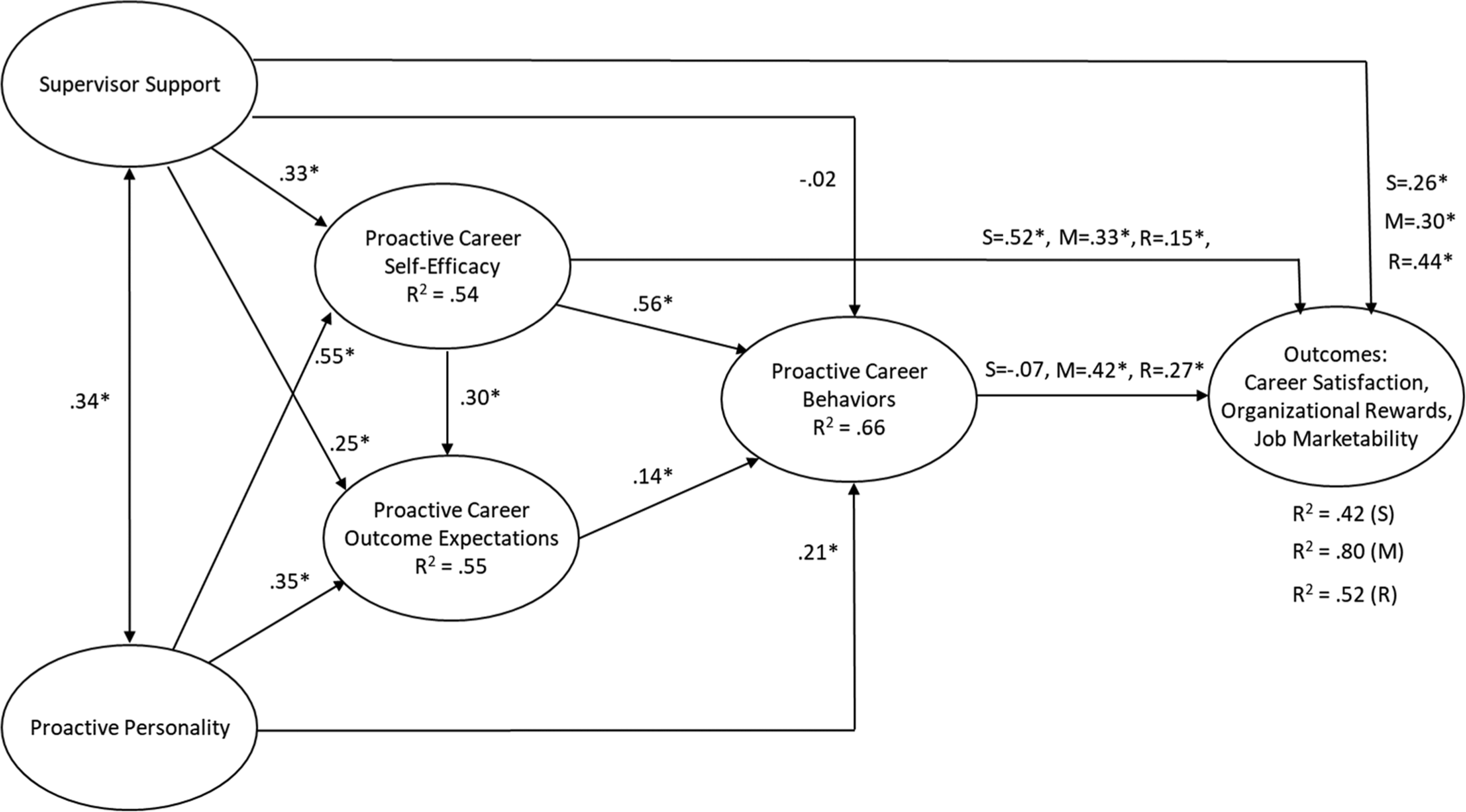
Engagement in proactive career behavior, along with self-efficacy and supervisory support, is also expected to directly predict a variety of beneficial affective, cognitive, and behavioral outcomes. In our adaptation of the CSM model, we selected several variables to represent the positive outcomes of engaging in proactive career behavior: career satisfaction, organizational rewards, and perceived marketability. Specifically, greater involvement in proactive career behavior is, we posit, likely to predict higher levels of career satisfaction, an indicator of subjective career success (Ng & Feldman, 2014); attainment of tangible work reinforcers, such as promotions and pay raises (Weng & McElroy, 2012); and perceptions that one has viable employment options apart from one’s current job (Eby et al., 2003).
Prior research has established significant bivariate relationships between selected variables in Figure 2. For example, Fuller and Marler (2009) reported significant meta-analytic correlations of proactive personality to career satisfaction (0.31), to various measures of career self-efficacy (0.56), and to career initiative behaviors (0.35). Correlations of proactive personality to two indicators of objective career success, salary (0.14) and promotions (0.11), were also significant but smaller in magnitude. Ng and Feldman (2014) reported meta-analytic correlations of an aggregate measure of subjective career success (which included career satisfaction) with measures of career-related supervisor support (0.55) and organizational support (0.45). Hirschi et al. (2013) found that occupational role self-efficacy partially mediated the relation of proactive personality to proactive behaviors. Barnett and Bradley (2007) reported that career initiative behaviors mediated the relationship between proactive personality and career satisfaction. Proactive personality and career satisfaction have also been found, respectively, to produce relationships of varying magnitude with internal and external job marketability (Eby et al., 2003).
The Present Study
This study was designed to extend prior research by assessing the tenability of a CSM-derived model of the relationships among a theory-based set of predictors and outcomes of proactive career behavior. We should note that SCCT’s models are designed to be tested with social cognitive variables that match one another along relevant dimensions, such as content and domain-specificity (Lent & Brown, 2006). Because we could not locate existing measures of self-efficacy and outcome expectations that were adequately tailored to the measure of proactive career behavior used in this study, we preceded model testing with a measure development phase involving initial validation of self-efficacy and outcome expectation scales linked to proactive career behaviors. This phase included additional measures (e.g., occupational role self-efficacy, negative career outlook) for validity estimation purposes.
We subsequently used the domain-specific social cognitive measures to test the CSM model. In addition to providing an omnibus test of the model, we examined invariance of the model across gender. We did not have specific hypotheses about model fit differences by gender but were interested in a preliminary exploration of the model’s range of generalizability, treating possible gender differences as an empirical question. The sample contained roughly equal and adequate numbers of men and women for invariance testing (relative sub-sample sizes for other possible demographic group comparisons were less adequate). Given the complexity of the larger CSM model presented in Figure 1 and the early stage of research applying it to proactive career behaviors, we streamlined the model test in a few ways, in particular, by limiting the number of theory-relevant predictors (e.g., goals were not included) and by examining the tenability of the relationships among the variables with a cross-sectional design. Such model streamlining has been common in other initial applications of the CSM model to different aspects of career development (e.g., Tatum et al., 2017).
Method
Participants
The sample consisted of 511 adult workers (248 women, 263 men) who completed an online survey. Their mean age was 34.91 years (SD = 5.49). All participants reported being currently employed full-time (i.e., at least 40 h per week) within an organizational setting (i.e., not self-employed). We selected workers in the age range of 25–44 years, which conforms to Super’s Establishment stage, a period characterized by active efforts at career stabilization, consolidation, and advancement for many workers (Hartung, 2021). In terms of race/ethnicity, they identified as 66% White or European American, 12% Black or African American, 11% Latinx, and 9% Asian/Pacific Islander American, with 1% or fewer identifying as multiracial, Native American, or other ethnic groups. They were distributed throughout the U.S., with most living in the Mid-Atlantic, Southeast, and Midwest (22%, 21%, and 20%, respectively). In terms of education, 40% had a 4-year college degree, 27% a graduate or professional degree, 9% a 2-year college degree, and 24% a high school degree. They represented a wide range of (mostly white collar) occupations, with the largest groupings including information technology (16%), health (10%), education and training (9%), finance (7%), and manufacturing (7%). Annual salaries ranged from less than $15,000 (1%) to $200,000 or more (4%), with about half of the sample earning between $25,000 and $74,999 per year. Data were gathered within the first year of the COVID-19 pandemic.
Procedure and Instruments
Participants were individuals who had signed up to complete online surveys through Qualtrics Research Services (QRS). They received a modest incentive, such as credit toward gift cards, for their participation. Samples recruited through QRS have been shown to be reasonably representative of U.S. population demographics (Boas et al., 2018). To participate, respondents completed a university approved informed consent form and indicated that they were at least 25 years old and currently working at least 40 h per week. They were then provided access to the survey, which included two validity items used to screen out inattentive respondents. QRS also used bot detection to prevent non-human responses and IP address checks to prevent multiple responses from the same participant. We retained data only from participants who had responded appropriately to the screening mechanisms (e.g., passing both validity items) and who completed all demographic items, allowing us to confirm their fit to the sampling parameters (e.g., full-time workers). Total scale scores were calculated by summing item responses and dividing by the number of items on each scale.
Proactive Career Behavior
Proactive career behavior was measured with a 12-item scale containing items culled from prior studies by Claes and Ruiz-Quintanilla (1998) and Strauss et al. (2012). The scale was designed to assess four types of proactive career behavior: Career planning (e.g., “I am planning what I want to do in the next few years of my career”), proactive skill development (e.g., “I develop knowledge and skill in tasks critical to my future work life”), network-building (e.g., “I am building a network of contacts or friendships with colleagues to obtain information about how to do my work or to determine what is expected of me”), and career consultation (e.g., “I seek advice from my supervisor[s] or colleagues about additional training or experience I need in order to improve my future work prospects”). Items were rated along a 5-point scale, from strongly disagree (1) to strongly agree (5). Strauss et al. included three items on each subscale, finding that each item loaded on one of four first order factors which, in turn, loaded on a common second order factor. They reported internal consistency reliability values for total scale scores ranging from 0.80 to 0.92. They also found that the scale correlated moderately to strongly with several variables reflecting an orientation toward career salience, commitment, and aspirations.
Self-efficacy and outcome expectations
The self-efficacy and outcome expectation scales were designed to assess beliefs, respectively, about one’s ability to successfully perform proactive career behaviors and about the positive outcomes that may result from their use. According to SCCT measurement guidelines (Lent & Brown, 2006), social cognitive career measures should be designed to match behavioral criteria of interest in terms of content, context, and temporal frame of reference. We, therefore, developed items to reflect the same four subscales contained in the proactive career behavior scale, albeit with different instructional sets, item wording, and scale verbal anchors. To minimize linked measurement concerns, we presented the self-efficacy and expected outcome items in random order whereas, consistent with Strauss et al. (2012), the proactive behavior scale’s items were presented in fixed order (e.g., all career planning items, followed by all skill development items).
Self-efficacy items were preceded with the stem, “How much confidence do you have in your ability to…” A sample self-efficacy for career planning item was, “Make a plan for your career for the next couple of years.” Self-efficacy items were rated on a 5-point scale, from no confidence at all (0) to complete confidence (4). The stem for outcome expectation items was, “If you were to do each of the following activities, how useful do you think it would be for your career advancement or security?” A sample outcome expectation regarding career planning item was, “Spend time on career planning activities.” These items were rated on a scale from 1 (mostly useless) to 5 (mostly useful). Factor structures, internal consistency reliability values, and validity estimates for the self-efficacy and outcome expectation scales are reported in the Results section, below.
As an aid to assessing the validity of the self-efficacy scale, we included the 6-item version of the Occupational Self-Efficacy Scale, which reflects confidence at performing one’s work role (Rigotti et al., 2008). The scale asks participants to indicate their degree of agreement, from strongly disagree (1) to strongly agree (6), with items such as, “I feel prepared for most of the demands in my job.” Rigotti et al. reported that the occupational self-efficacy scale produced internal consistency reliability estimates of 0.85 and above, and small to moderate relationships with measures of job satisfaction, organizational commitment, job insecurity, and work performance across five samples. We reasoned that proactive career self-efficacy would relate at least moderately to self-efficacy regarding work role performance.
To estimate the validity of the proactive outcome expectation scale, we included the Negative Career Outlook scale (Rottinghaus et al., 2012), which reflects a trait tendency to perceive one’s career future in pessimistic terms (e.g., “I doubt my career will turn out well in the future.”). The four statements on the scale are rated along a 5-point continuum, from strongly disagree (1) to strongly agree (5). Rottinghaus et al. reported alpha coefficients of 0.77 and 0.89 for scale scores in different samples, and also found that it correlated negatively with measures of career agency, support for career goals, career decision self-efficacy, and trait optimism. We anticipated that, as a trait aspect of future career expectations, the negative outlook scale would produce small to moderate negative correlations with outcome expectations for performing proactive career behaviors.
Support
Support was measured with Greenhaus et al.’s (1990) perceived supervisory support scale, which reflects the degree of career support workers receive from their immediate supervisor. It includes nine items (e.g., “My supervisor takes the time to learn about my career goals and aspirations.”) to which participants respond on a scale from 1 (strongly disagree) to 5 (strongly agree). Greenhaus et al. reported that scores on the scale yielded an alpha coefficient of 0.93 and correlated moderately with career satisfaction, perceived organizational acceptance, and discretion over the performance of one’s job.
Proactive personality
Proactive personality is considered a stable disposition to engage in proactive behavior, show initiative, and persevere at change efforts. We assessed it with the 10-item Proactive Personality Scale (PPS; Seibert et al., 1999), a briefer version of the original Bateman and Crant (1993) scale. A sample item is, “I am constantly on the lookout for new ways to improve my life.” Participants indicate their degree of agreement with each statement on a 7-point (1 = strongly disagree; 7 = strongly agree) scale. The original measure correlated positively with the traits of extraversion, conscientiousness, and need for achievement. Seibert et al. reported that the short form of the PPS correlated very highly with the original version of the scale. They also found that it correlated with career satisfaction and indicators of objective career success and yielded an alpha estimate of 0.86.
Career satisfaction
Greenhaus et al.’s (1990) scale is a 5-item measure of satisfaction with one’s career progress, which is often viewed as an indicator of subjective career success (Seibert et al., 1999). It includes items such as, “I am satisfied with the progress I have made towards meeting my overall career goals,” which are rated along a 5-point, strongly disagree (1) to strongly agree scale (5). Greenhaus et al. reported an internal consistency estimate for scale scores of 0.88 and found that it related positively with measures of organizational acceptance, job discretion, and supervisory support.
Organizational Rewards
The Organizational Rewards subscale of the Organization Career Growth Scale is a 7-item measure of employees’ success within a given organization as reflected by their progress at earning promotions and pay increases (Weng & McElroy, 2012). Participants indicate their level of agreement with the items, such as, “my salary is growing quickly in my present organization,” using a 5-point scale (1 = strongly disagree, 5 = strongly agree). Weng and McElroy found that subscale scores produced an internal consistency reliability value of .85 and correlated positively and moderately with affective occupational commitment and career goal progress, and negatively and more modestly with turnover intentions.
Job Marketability
Perceived marketability was measured with two 3-item scales, reflecting participants’ estimates of their marketability both within and outside of their current work organizations (Eby et al., 2003). Sample items include “There are many opportunities available for me in my company” (internal marketability) and “I could easily obtain a comparable job with another employer” (external marketability). Item responses are made along a strongly disagree (1) to strongly agree (5) scale. Eby et al. reported that scores on the internal and external scales yielded alpha coefficients, respectively, of 0.73 and 0.74 and intercorrelated moderately. Both scales were also found to produce small correlations with proactive personality and medium to large correlations with measures of career satisfaction and identity. Using a German version of the scales, Spurk et al. (2016) reported that both scales correlated moderately to strongly and inversely with measures of job and career insecurity.
Data Analysis
We first assessed the psychometric properties of the new measures of self-efficacy and outcome expectations prior to using them in model testing. Data from the first 200 participants were analyzed in the measurement development phase, providing initial estimates of reliability and validity for the novel scales. This phase included a factor analysis to test the factor structure of proactive behavior and its companion scales (self-efficacy and outcome expectations), followed by calculation of internal consistency reliability coefficients, descriptive statistics, and intercorrelations among the new and more established scales used to represent the CSM model. As part of the validity assessment, we also examined the utility of the new social cognitive measures in explaining unique variance in proactive career behavior while controlling for more global traits (proactive personality, negative outcome beliefs), supervisory support, and self-efficacy linked to general occupational role performance.
In the second, model testing phase of the study, data from the remaining 311 participants were used to assess the tenability of the posited measurement and structural models. The measurement model tested a correlated 8-factor representation of the CSM model variables, while the structural model examined hypothesized path relationships among the variables, as portrayed by Figure 2. Model testing employed the MLM estimation procedures of Mplus 8.4 (Muthén & Muthén, 1998-2019). Hu and Bentler’s (1999) 2-index method was used to assess adequacy of model-data fit. Using this method, fit may be considered adequate if (a) SRMR values ≤ .08 and (b) CFI values ≥ .95 or RMSEA values ≤ .06.
Results
Initial Measurement Validation
We first examined the factor structures of the proactive behavior, self-efficacy, and outcome expectation scales. Strauss et al. (2012) had found support for a higher order structure of the proactive behavior items, with four first order factors (career planning, career consultation, skill development, and network-building), each of which loaded highly on a single second order factor. Using confirmatory factor analysis (CFA), we tested this structure by setting (a) each item to load on its corresponding subscale (or facet) and (b) each subscale to load on a common, second order factor. This model produced good fit to the data, SRMR = .07, RMSEA = .05 (90% CI = .02, .07), CFI = 0.97, Satorra-Bentler (S-B) χ2 (50) = 71.11, p < .05. All items were found to load substantially on their subscale (range = 0.61–0.84), and the four subscales each loaded highly on the second order proactive behavior factor (range = 0.52–0.93). These results thus replicated the factor structure obtained by Strauss et al.
Because the self-efficacy and outcome expectation scales had been designed to parallel the four-facet content of the proactive behavior scale, we subjected each of them to an identical higher order CFA. Both analyses yielded support for the higher order structure: for self-efficacy, SRMR = 0.04, RMSEA = 0.06 (90% CI = 0.03, 0.08), CFI = .97, S-B χ2 (50) = 80.40, p < 0.01; for outcome expectations, SRMR = 0.05, RMSEA = 0.06 (90% CI = 0.03, 0.08), CFI = 0.95, S-B χ2 (50) = 81.94, p < .01. Item-subscale loadings for self-efficacy ranged between 0.57 and 0.78; for outcome expectations, the range was 0.54–.83. Loadings of the subscales on the second order factor ranged between 0.89 and 0.95 for self-efficacy and between 0.68 and 0.90 for outcome expectations. Thus, the findings suggest that the proactive behavior, self-efficacy, and outcome expectations scales may each be represented by four first order factors and one second order factor.
Correlations, Means, Standard Deviations, and Internal Consistency Estimates for Measure Development Phase.

Note. N = 200; correlations
As expected, the proactive career self-efficacy and outcome expectation scales were substantially interrelated and both correlated moderately to strongly with the measures of proactive career behavior, supervisory support, proactive personality, and occupational role self-efficacy; they also produced small to moderate negative correlations with negative career outlook, suggesting that those possessing higher levels of proactive career self-efficacy and outcome expectations were less likely to hold pessimistic appraisals of their career futures. Both new social cognitive measures also produced mostly moderate to strong correlations with the criterion variables: career satisfaction, organizational rewards, and internal and external job marketability.
As an initial examination of the incremental utility of the new self-efficacy and outcome expectation scales, we predicted proactive behavior using a two-step hierarchical regression. Proactive personality, negative career outlook, occupational role self-efficacy, and supervisory support were entered at the first step, and proactive self-efficacy and outcome expectations were entered at the second step. The equation accounted for 42% of the variance in behavior at the first step and an additional 12% of the variance at the second step; however, only proactive self-efficacy (0.47) and proactive personality (0.33) produced significant beta weights at the final step of the equation. Collectively, these findings offer initial psychometric support for the new scales, especially proactive career self-efficacy.
Measurement and Structural Model Tests
To reduce the number of parameter estimates in relation to sample size in testing measurement and path models at the latent variable level, we represented each theoretical construct with subscales or item parcels. Specifically, proactive personality traits, supervisory support, career satisfaction, and organizational rewards—each of which had been shown to yield single-factor structures in prior research—were modeled with three item parcels apiece, with parcels created using the balancing method of Little et al. (2013). Job marketability was represented by its two subscales, internal and external marketability. Consistent with the higher order CFA findings, the proactive behavior, self-efficacy, and outcome expectations constructs were each indexed by their four parallel facets (career planning, skill development, career consultation, and network-building); we allowed the matching facets to covary across the three constructs to take their content similarities into account.
Measurement Model
We first performed a test of the measurement model, representing proactive personality, self-efficacy, outcome expectations, behavior, supervisory support, and the three outcomes (career satisfaction, organizational rewards, and job marketability) as eight correlated factors. This model offered good fit to the data, SRMR = 0.05, RMSEA = 0.05 (90% CI = 0.05, 0.06), CFI = 0.96, S-B χ2 (259) = 492.21, p < .001. All indicators loaded highly on their corresponding constructs (range = 0.65–0.93) and the constructs were significantly interrelated, with latent variable correlations ranging between 0.34 (career satisfaction with outcome expectations; supervisory support with proactive personality) and 0.84 (job marketability with organizational rewards).
Because the proactive behavior, self-efficacy, and outcome expectations measures each referenced a similar set of behaviors, we also tested a 6-factor alternative model in which the parcels corresponding to these three constructs were set to load on a common factor, with each of the remaining constructs modeled as before. This model variation was intended to test the possibility that proactive behavior, self-efficacy, and outcome expectation represented a singular underlying dimension. This model yielded significantly poorer fit than did the 8-factor model, supporting the conception of proactive behavior, self-efficacy, and outcome expectation as three distinct but interrelated factors: SRMR = 0.06, RMSEA = 0.08 (90% CI = 0.08, 0.09), CFI = 0.89, S-B χ2 (272) = 840.46, p < .001; ΔS-B χ2 = 347.68 (13), p < .001. Scales corresponding to each factor yielded reliability coefficients that were comparable to those obtained with the first sub-sample (e.g., reliability estimates for self-efficacy and outcome expectations in the second sub-sample were, 0.89 and 0.88, respectively).
Structural Model
A path analysis was next performed to test the hypothesized paths among the constructs, as shown in Figure 2. This analysis indicated that the model offered good fit to the data, SRMR = 0.05, RMSEA = 0.06 (90% CI [.05, .06]), CFI = .95, S-B χ2 (265) = 511.96, p < .001. While this model portrayed the links from proactive personality to the criterion variables as indirect only (via support, self-efficacy, and behavior), we tested an alternative structural model in which proactive personality was linked to the criterion variables both directly and indirectly. The direct plus indirect effects model produced fit indices very similar to those of the indirect effects-only model: SRMR = 0.06, CFI = 0.95, RMSEA = 0.05 (90% CI [0.05, 0.06]), S-B χ2 (262) = 509.18, p < .001. It did not, however, significantly improve upon the fit of the indirect effect models (ΔS-B χ2 = 2.89 [3], p = .41), and the three direct paths from proactive personality to the criterion variables were all small and non-significant. The indirect-effects-only model may therefore offer an adequate and more parsimonious rendering of model relationships.
The structural coefficients, shown in Figure 2, indicate that supervisory support and proactive personality were, as predicted, linked to self-efficacy and outcome expectations which were, in turn, predictive of proactive career behavior. Proactive personality also produced a direct path to proactive behavior but, contrary to expectations, the direct path from support to proactive behavior was not significant. Most of the direct paths to the three criterion variables from behavior, self-efficacy, and support were significant and of small to moderate magnitude. However, the path from proactive behavior to career satisfaction was not significant. The model accounted for substantial amounts of the variance in proactive behavior, self-efficacy, and outcome expectations, as well as in the career satisfaction, organizational rewards, and job marketability criterion variables (R2 values, respectively, were 0.54, 0.55, 0.66, 0.42, 0.52, and 0.80).
Invariance Across Gender
We next examined the invariance, or generalizability, of the measurement and structural models across gender. Given the promising findings in the split samples, we used the full sample (N = 511) in the invariance analyses. Measurement (metric) invariance was assessed by comparing a model in which the factor loadings were allowed to vary by group with a model in which factor loadings were constrained to equality across gender. In testing for structural invariance, we compared the fit of a model in which both the factor loadings and structural paths were constrained to equality across gender with a model in which the loadings were constrained, but the structural paths were allowed to vary by group. We found that the constrained and unconstrained measurement models did not differ significantly in model fit, ΔS-B χ2 = 18.90 (18), p = .40. Likewise, the constrained structural model did not yield significantly different fit compared to the version in which the paths were free to vary by gender, ΔS-B χ2 = 19.71 (19), p = .41. This pattern of findings suggests that both the factor loadings and structural paths were reasonably similar across our sub-samples of women and men.
Discussion
Adapting the CSM model as a theoretical framework, we hypothesized that proactive behavior, operationalized with a commonly used measure (Strauss et al., 2012), would be predicted by proactive personality, self-efficacy, outcome expectations, and supervisory support. We also examined the nature of the relationships among the predictors of proactive behavior and, in turn, three outcomes reflective of career progress and sustainability. This broadened, multivariate focus was intended to extend prior research that has tended to view proactive behaviors either as ends in themselves or as correlates of a host of individual variables, without necessarily clarifying how such constructs may jointly function within a larger self-management system.
In order to test the hypothesized linkages among the variables, we first developed and examined the psychometric properties of measures of self-efficacy and outcome expectations linked to proactive career behaviors. Consistent with SCCT measurement guidelines (Lent & Brown, 2006), the new measures were designed to parallel the content of the proactive behavior measure, yet with differently worded items, scaling formats, and instructional sets. The measures were administered to a sample of adult workers in the establishment (early to middle) stages of their careers, as defined by Super’s developmental theory (Hartung, 2021). Findings indicated that the measures yielded adequate reliability and validity estimates in our first sub-sample of participants. In particular, the new scales exhibited a higher order factor structure that resembled that of the more established proactive career behavior scale, with items loading on four subscales or facets (career planning, skill development, career consultation, and network-building), each of which loaded on a common second order factor. Consistent with expectations, the self-efficacy and outcome expectation scales correlated with one another, with proactive behaviors, and with measures of trait (negative career outlook, proactive personality) and more global occupational role self-efficacy. The new self-efficacy measure also offered incremental utility in predicting proactive behaviors.
Based on these promising initial findings, we used data from the second sub-sample to test (a) measurement models specifying the factor structures of the full set of theoretical variables and (b) structural models reflecting the hypothesized relationships among the variables, as portrayed in Figure 2. Results of the measurement model test offered support for an 8-factor representation of the variables, with all indicators loading on their corresponding latent factors and moderate to large relationships among the factors. This model provided significantly better fit to the data than did an alternative measurement model portraying behavior, self-efficacy, and outcome expectations as indicators of a single factor.
The structural model test also offered good fit to the data, indicating overall support for the hypothesized paths among the theoretical variables. In particular, proactive personality and supervisory support for workers’ career development were each predictive of self-efficacy and outcome expectations which, in turn, predicted engagement in proactive career behaviors. The covariance among proactive personality and supervisory support, and path between self-efficacy and outcome expectations, were also significant. The former bivariate relation is consistent with the assumption that those with proactive trait tendencies may be inclined to enlist the career-enabling support of their supervisors and/or that supervisors are likely to support workers who display such tendencies.
The path from self-efficacy to outcome expectations is consistent with the social cognitive hypothesis that stronger efficacy percepts serve to inform positive outcome expectations, which join self-efficacy and proactive personality as predictors of adaptive career behavior (Lent & Brown, 2013). Contrary to expectations, however, the direct path from supervisory support to proactive behavior was not statistically significant. It may be that supervisory support plays more of an indirect rather than direct role relative to proactive behavior by promoting the self-efficacy and outcome expectations that are, in turn, linked to engagement in proactive behavior.
Support was also found for nearly all of the hypothesized direct paths from the predictors to the three outcome variables. In particular, proactive behavior, self-efficacy, and supervisory support each contributed significantly to the prediction of organizational rewards and perceived job marketability. Career satisfaction was, however, predicted significantly only by self-efficacy and support but not by proactive behavior. It may be that being satisfied with one’s career progress is more a reflection of perceiving oneself as efficacious and feeling well-supported by one’s environment than it is a function of displaying proactive behaviors. The model accounted for large portions of the predictive variance in each of the endogenous variables.
In addition to the target structural model, which modeled the pathway from proactive personality to the outcomes as being indirect only (through behavior and other antecedent variables), we tested a model in which proactive personality was linked to the outcomes both indirectly and directly. This alternative model, while producing adequate fit to the data, did not improve upon the fit of the target model, and none of the direct personality-to-outcome paths were significant. These comparative model results suggest that the relation of proactive personality to the outcome variables may be explained by other predictors in the model, especially self-efficacy for, and engagement in, proactive behavior. Finally, results of multiple-group analyses indicated that the measurement and structural models were invariant across gender. In other words, the underlying structure of the measures and the relationships among the variables were similar for the sub-samples of women and men.
On balance, the current findings are consistent with prior research that has linked proactive personality traits and measures of proactive career behavior to one another; to features of the work environment, such as supervisory support; to various indicators of self-efficacy; and to relevant career outcomes, such as career satisfaction and job marketability (Eby et al., 2003; Fuller & Marler, 2009; Ng & Feldman, 2014). The findings also extend prior research in several ways. In particular, in response to earlier criticisms about the theoretically disjointed nature of research on career proactivity (Crant, 2000), we examined a theory-derived set of variables and explored the ways in which they may interrelate and jointly predict indicators of beneficial career progress (e.g., Barnett & Bradley, 2007). We also extended Hirschi et al.’s (2013) findings by studying self-efficacy as a mediator of the relationship between proactive personality and proactive career behavior, using a self-efficacy measure specifically tailored to proactive behavior and an expanded set of predictors and criterion variables. In addition, our study provided a novel test of the CSM model, which offers a potentially unifying bridge between disparate disciplinary perspectives on adult career development (e.g., Hackett et al., 1991; Savickas, 2001).
Limitations and Implications for Practice and Future Research
The study’s limitations should be considered in the context of efforts to interpret or generalize its findings; they also have important implications for future research. First, though the sample was geographically diverse and reasonably representative of U.S. working adults in terms of race/ethnicity, gender, and income level, the participants were mainly employed in white collar jobs and the method of recruitment (via an online research panel) required internet access and was prone to self-selection bias.
We also restricted the sample to workers at early to mid-career stages. While career proactivity and sustainability are likely to be relevant across the career lifespan, we reasoned that Establishment stage workers might be likely to be especially active at positioning themselves for career growth and advancement. Consistent with this assumption, the recent “Great Resignation” phenomenon appears to have been largely driven by job turnover among mid-career employees between 2020 and 2021 (Cook, 2021). Despite the relevance of proactivity to mid-career workers, future research should test the model with younger and older workers as well. Also, although we found invariance of model fit across gender in our sample, it would be valuable to test the CSM model’s generalizability in relation to a wider range of worker characteristics and contextual affordances (e.g., race/ethnicity, occupational type and level, educational level, and socio-economic status). It is likely that certain contexts, such as low-skilled employment, afford much less opportunity to engage in the sort of proactive behaviors we studied than do other, more resource-rich contexts.
Second, while we preceded model testing with a measure development and validation phase by splitting our sample, our measures of self-efficacy and outcome expectations had not been employed in prior research. We designed them to be consistent with SCCT measurement guidelines (Lent & Brown, 2006), including tailoring their content to parallel that of the previously established career initiative measure, and the new scales were found to yield promising reliability and validity estimates. However, the reference to common behaviors across the behavior, self-efficacy, and outcome expectation measures likely elevated their correlations, though not to the extent that they could not be differentiated from one another (see Lent & Brown’s, 2006, discussion of linked measurement issues). Still, there is need for future research to confirm the adequacy and predictive utility of the novel measures in independent samples.
Third, the measure of supervisory support we used may have captured only a portion of the career development support that workers receive. It did not, for example, assess support from fellow workers, mentors, or friends and family members. While supervisory support has produced stronger relationships to subjective career success/satisfaction than have measures of support from mentors and from more general sources of workplace support (Ng & Feldman, 2014), it would be valuable to examine additional aspects of environmental support in future research applying the CSM model to proactive career behavior engagement.
Fourth, to facilitate this study of proactive career behaviors from a social cognitive position, we streamlined the CSM model test in several ways, for example, by including only one aspect of personality and by omitting goals as a theorized antecedent of behavior. We also did not include other model elements, such as experiential/learning sources of self-efficacy and outcome expectations (cf. Ireland & Lent, 2018). These source variables (e.g., personal performance accomplishments, modeling) are particularly important to study because of their relevance to the design of interventions to promote career self-management.
Parenthetically, we should note that the proactive behavior measure we employed contains only a sampling of the behaviors that workers may use to protect and advance their career options. Future research might examine the extent to which this measure overlaps with or is distinct from other measures of career proactivity, exploration, engagement, and related constructs. Such research might address concerns about construct proliferation in the career literature (Brown, 2015) and also identify areas of convergence between vocational and organizational psychology inquiry on proactivity and career self-management. In this regard, the CSM model could be used as an integrative framework for studying additional ways in which workers may seek strategically to advance or sustain their career options (e.g., engagement in organizational citizenship, job-crafting, self-advocacy, and proactive job searching).
Fifth, the findings are limited by the cross-sectional nature of the study’s design. Paired with the measure development aspect of this study, the cross-sectional design was intended to build a foundation for further CSM-based study of proactive career behavior. Though the network of hypothesized paths we observed was largely consistent with the data, this does not constitute evidence of causation or temporal precedence. Longitudinal studies, especially those containing at least three time points, will provide more rigorous tests of mediation and temporal precedence; and experimental and theory-based intervention studies could also provide targeted tests of the model’s causal assumptions and yield a stronger foundation for its extension to practice. Sixth, the study was conducted within the first year of the COVID-19 pandemic. It is unclear what impact the pandemic may have had on the observed model relationships, but the findings do need to be interpreted in the context of the ongoing pandemic and the uncertainties and stresses it adds to career development.
Finally, all of the study’s measures involved self-report and tapped only the worker’s perspective. While predictors like self-efficacy and outcome expectations necessitate subjective appraisals because individuals are the ultimate arbiters of their own beliefs, it would be valuable to include study of variables that can be assessed from external or inter-subjective perspectives. For example, though we asked participants to report on their progress at receiving organizational rewards, such as promotions and pay raises, it would be useful to gather data on objective indicators of career success as well in future studies applying the CSM model to proactive career behaviors and their outcomes. Existing research suggests that proactivity indices are likely to yield stronger relationships to measures of subjective than objective career success (Fuller & Marler, 2009). This should not be too surprising because individuals are able to define the terms and standards of their success when it is assessed subjectively. In addition, no matter how well performed, workers often have little control over the linkage of their proactive behaviors to objective outcomes. For example, a worker who does “all the right things” is still subject to the appraisals of supervisors, organizational policies and biases, and the availability of resources for pay raises, promotions, and other rewards.
The present findings need to be replicated and extended in order to strengthen their implications for practice. However, they tentatively suggest that use of proactive behaviors—and the organizational supports and person factors (e.g., self-efficacy, proactive traits) that enable their use—may promote a variety of positive outcomes, at least from the worker’s perspective, such as an enhanced sense of job marketability. However, related to our above observation about the tenuous link between proactive career behaviors and indicators of objective success, an important caveat is that proactive behavior engagement is ultimately a matter of doing what one can to manage one’s career prospects, albeit with no certainty that it will protect one’s job or advance one’s career. In other words, career sustainability may be a critical aspiration for most workers but it is, unfortunately, not a given.
In sum, the current study extended the social cognitive CSM model to the prediction of proactive career initiative behavior and to beneficial outcomes associated with engagement in these types of behavior. We found support for most paths in the model, which may offer a promising approach to studying the predictors and outcomes of proactive career behavior. Further study of the model in the context of proactive career behavior may help to integrate an extremely important yet largely fragmented area of inquiry (Crant, 2000)—one that extends across several psychological specialties and other fields, such as education—and enable the design of theory-based strategies that career counselors and organizational practitioners can employ to support workers’ efforts at career persistence and advancement.
Footnotes
Acknowledgments
We thank Professor Steven D. Brown for his helpful measurement consultation and comments on an earlier draft of this article.
Declaration of conflicting interests
The author(s) declared no potential conflicts of interest with respect to the research, authorship, and/or publication of this article.
Funding
The author(s) received no financial support for the research, authorship, and/or publication of this article.
