




Abstract
Career construction theory proposes that high career adaptability leads to positive adaptation outcomes during career transition. However, the specific pathways of how this happens remain underexplored. Drawing on the career construction model of adaptation, we hypothesized that career decision-making self-efficacy mediates the link of career adaptability with vocational identity clarity and life satisfaction as two measures of adaptation outcomes. We conducted a three-wave survey with an initial sample of 3126 Czech upper-secondary vocational graduates transitioning from vocational school to the labor market. Structural equation modeling revealed that career decision-making self-efficacy fully mediated the relationship between career adaptability before graduation and vocational identity clarity 20 months later. In contrast, the mediation effect of career decision-making self-efficacy on the relationship between career adaptability and life satisfaction was not supported. Additionally, in contrast to the previous literature, career adaptability was not directly related to vocational identity clarity and life satisfaction. Nevertheless, our findings demonstrated a positive long-term association of career adaptability with adaptation outcomes within the working life domain. Practical implications and future directions are discussed.
Keywords
After completing upper-secondary vocational education, graduates face one of the most challenging career tasks: transitioning to tertiary education or the labor market. However, vocational programs are not academically oriented, and vocational students are usually trained to perform specific jobs. Thus, vocational skill-based tracks qualify students to enter the labor market, limiting their access to tertiary education in many countries (see OECD, 2020, Figure B7.2 for more details). Besides, in countries with school-based vocational education, graduates have a higher risk of unemployment and unskilled employment compared to general-education graduates (Cedefop, 2018). As such, vocational graduates need skills enabling them to adapt to changing career contexts.
Research suggests that career adaptability increases the chance of mastering career transitions because career adaptability can promote a successful transition adaptation with positive effects on both career and life outcomes, such as vocational identity clarity and increased life satisfaction (Rudolph et al., 2017a; Savickas, 2013; Savickas et al., 2009; Savickas & Porfeli, 2012). Vocational identity clarity and life satisfaction are important indicators of successful career adaptation (Rudolph et al., 2017a). Career adaptability should facilitate the development of a clear vocational identity that enables the implementation of individual vocational self-concepts in occupational roles and helps create meaning in careers (Savickas, 2002, 2005, 2013). Moreover, successful engagement with vocational challenges is regarded as a core developmental task in young adulthood and a major source of meaning in life (e.g., Skorikov & Vondracek, 2011); as such, career adaptability has been linked with general life satisfaction (Konstam et al., 2015; Santilli et al., 2017).
According to the career construction model of adaptation (Rudolph et al., 2017a; Savickas, 2013; Savickas et al., 2009; Savickas & Porfeli, 2012), the associations between career adaptability and adaptation outcomes (such as vocational identity clarity and life satisfaction) are partially mediated by adaptive responses. Adaptive responses involve individuals’ adaptive behaviors and beliefs in dealing with career development tasks and changing career conditions (Hirschi et al., 2015; Savickas, 2013; Savickas & Porfeli, 2012). Among various adaptive responses, self-efficacy beliefs are presumed to be a key factor in career adaptation processes (Betz, 2004; Hirschi et al., 2015). Specifically, career decision-making self-efficacy is particularly relevant for career preparation, entry, adjustments, and changes across career paths, because it captures individuals’ confidence in using the necessary strategies for successfully navigating a career decision-making process (Hirschi et al., 2015; Lent & Brown, 2013).
In a systematic review of career adaptability literature, Johnston (2018) noted that only limited attention was given to the mediating role of adapting responses in examining the associations between career adaptability and adaptation outcomes, thus preventing a refinement of the adaptation sequence as proposed by the career construction model of adaptation. For example, to our knowledge, only one cross-sectional study has explored the mediating effects of career decision-making self-efficacy in the relationship between career adaptability and academic satisfaction in a sample of undergraduate students (Duffy et al., 2015), and the mediating effect cannot be conclusively supported with a measurement from a single time point (Maxwell et al., 2011). Generally, most existing studies on the relationship between career adaptability and adaptation outcomes are cross-sectional (Rudolph et al., 2017a). However, career adaptation is a developmental process that evolves over time (Savickas, 2005, 2013); therefore, adaptability resources are associated not only with concurrent adaptation outcomes but also with accompanying changes in adaptation outcomes. Thus, longitudinal research with multiple measurement points would be particularly valuable in examining the developmental trajectories of career adaptation sequences and especially in identifying causal relations in the positive effects of career adaptability resources and adapting responses on the adaptation outcomes over more extended time frames. Additionally, many researchers who studied the long-term effect of career adaptability did not include participants who were undergoing an actual career transition (e.g., Urbanaviciute et al., 2019). Nevertheless, career adaptability is presumed to be important, especially during career transitions (Savickas, 2013); thus, studying this context is particularly critical.
To address the mentioned issues, the present study employed a three-wave longitudinal study conducted over a 20-month period to examine the long-term associations of career adaptability with the adaptation outcomes of vocational identity clarity and life satisfaction and the mediating role of career decision-making self-efficacy in these associations among vocational graduates undertaking a career transition. As such, this study is intended to contribute to the existing literature in several ways. First, we examined the longitudinal relationships between career adaptability and both career and life adaptation outcomes (Rudolph et al., 2017a). Second, this is the first study to integrate career decision-making self-efficacy as a mediator of the relationships between career adaptability and adaptation outcomes. Third, we investigated a sample of vocational graduates in an actual career transition. Thus, this study empirically tests the career construction model of adaptation (Rudolph et al., 2017a; Savickas, 2013; Savickas et al., 2009; Savickas & Porfeli, 2012) and contributes to a better understanding of the process by which career adaptability leads to successful adaptation over time. Moreover, investigating vocational graduates in an actual career transition can provide practical implications to help vocational students navigating career challenges and transitions.
Career Adaptability, Adaptive Responses, and Adaptation Outcomes
The career construction model of adaptation (Savickas, 2013; Savickas & Porfeli, 2012; Savickas et al., 2009; see also Hirschi et al., 2015; Rudolph et al., 2017a) differentiates between adaptivity (adaptive readiness), adaptability resources (career adaptability), adapting (adaptive responses), and adaptation (adaptation outcomes). Career adaptability is conceptualized as a set of psycho-social resources for coping with developmental vocational tasks, participating in working life, and adapting to changes in both the labor market and working conditions. Career adaptability is reflected in individuals’ attitudes, behaviors, and competencies (Savickas, 2002), which consist of four dimensions—concern for the future (planning, being planful), control (decision-making, being decisive), curiosity (exploring, being inquisitive), and confidence (problem-solving, being productive)—all of which ensure the best match between individuals and work requirements. Career adaptability resources, developed from adaptive readiness, are proposed to positively influence adapting responses, which in turn positively influence adaptation outcomes.
At first, the development and use of career adaptability resources are influenced by adaptivity (i.e., stable, context-general, and trait-like psychological characteristics that involve readiness and willingness to adapt to career changes) and can be measured in various ways, including indicators of a proactive personality, big five personality characteristics, or career optimism (Rudolph et al., 2017a). Next, career adaptability resources in terms of concern, control, curiosity, and confidence affect adaptive responses. Adaptive responses involve adaptive behaviors and beliefs that people use to deal with career development tasks and changing work and career conditions (Hirschi et al., 2015; Savickas, 2013; Savickas & Porfeli, 2012). Adaptive responses stand for performing adaptive behaviors, usually measured as career planning or career exploration, when dealing with career tasks. Moreover, in addition to behaviors, self-efficacy beliefs also represent instances of adaptive reactions to career challenges or changes because they epitomize confidence in one’s ability to address career demands (Hirschi et al., 2015; Savickas, 2013; Savickas & Porfeli, 2012). Finally, adopting and applying these adaptive responses leads to successful adaptation outcomes (Savickas, 2013; Savickas & Porfeli, 2012). Adaptation outcomes are indicated by the goodness of fit between the person and the environment, and are typically measured in terms of development, commitment, satisfaction, and success (Hirschi et al., 2015). In their meta-analysis, Rudolph et al. (2017a) classified adaptation outcomes as career and life outcomes. They argue that due to spillover effects from work to other life domains (e.g., Erdogan et al., 2012), successful adaptation to career tasks is reflected in various career variables (e.g., employability, income, vocational identity) as well as in general well-being variables (e.g., life satisfaction, positive and negative affect). Since our participants’ career transitions included school-to-work transitions and transitions to tertiary education, we could not focus on career adaptation outcomes such as employability, income, and job satisfaction as adaptation outcome variables. Instead, we sought career adaptation outcomes, such as vocational identity clarity, that could facilitate suitable person-career fits in times of frequent changes and decreasing organizational guidelines for career transitions.
Vocational Identity Clarity as Career Transition Adaptation Outcome
In this paper, we first focus on the adaptation outcomes of vocational identity clarity. Vocational identity is broadly defined as the conscious awareness of oneself as a worker in terms of the importance of work and one’s perception of occupational interests, abilities, goals, and values, and the structure of meanings in which such self-perception is linked with career roles (Ibarra & Barbulescu, 2010; Skorikov & Vondracek, 2007). The concept of vocational identity that we use in our study is more specifically defined as “the clear and stable picture of one’s goals, interests, and talents” (Holland, 1997, p. 5). Within Holland’s concept, vocational identity refers specifically to vocational identity clarity.
Because career adaptation aims to align a worker’s personal needs with environmental demands and opportunities, adaptation outcomes are indicated by the goodness of fit between the person and the environment (Savickas, 2013; Savickas & Porfeli, 2012). In this line of thinking, vocational identity clarity represents an adaptation outcome because it represents individuals’ abilities to realize how their vocational self-concept fits into work roles, resulting in satisfying career decisions (Savickas, 2013; Super, 1990). Individuals with a strong vocational identity clarity have a greater chance of identifying suitable occupational options for themselves, while the lack of vocational identity clarity leads to career indecision and career confusion (Holland, 1996).
It has been proposed that vocational identity clarity emerges by developing and applying various career adaptability resources, such as curiosity or concern (Savickas, 2013; Skorikov & Vondracek, 2011). For example, showing curiosity towards different career options promotes the process of forming a clear vocational identity because it provides young people with the opportunity to explore their interests and become aware of their strengths, and it influences the type and number of career activities in which they choose to engage (Gushue et al., 2006a, 2006b). By showing concerns for career development, young people can become more self-aware about their likes and dislikes (Zikic & Hall, 2009). Recognizing one’s interests, abilities, and preferences promotes vocational identity development and enables young people to select realistic educational and career pathways (Marco et al., 2003; Savickas, 2013; Super, 1990). However, the link between career adaptability and vocational identity clarity has not yet been examined longitudinally or in an actual career transition. Building on the theoretical and empirical arguments presented above, we propose:
Career adaptability is positively related to increased vocational identity clarity among vocational graduates during their career transition period.
Life Satisfaction as Career Transition Adaptation Outcome
The second adaptation outcome included in the present study was life satisfaction, which is considered a key indicator of general well-being. Life satisfaction refers to the cognitive or judgmental process in which individuals assess the quality of their lives as a whole based on a series of personally set criteria (Diener, 2000; Pavot & Diener, 2008). The career construction model of adaptation (Rudolph et al., 2017a; Savickas, 2013; Savickas et al., 2009; Savickas & Porfeli, 2012) views life satisfaction as an important adaptation outcome. It is assumed that due to the spillover effects from work to nonwork roles, successful career adaptation should positively influence both career and nonwork outcomes (Rudolph et al., 2017a). Especially after vocational graduation, the transition from education to work and a career is a major life task (Arnett, 2014; Kvasková et al., 2022). In this developmental period, having more career adaptability resources may augment perceived career possibilities and opportunities, increase the capacity to cope with obstacles and challenges, and improve the chance of successfully reaching personal goals (Konstam et al., 2015; Santilli et al., 2017). All these factors should contribute to greater life satisfaction.
The beneficial role of career adaptability in life satisfaction has been empirically supported in cross-sectional research and meta-analyses (e.g., Ghosh et al., 2019; Ginevra et al., 2018; Konstam et al., 2015; Maggiori et al., 2013; Rudolph et al., 2017b). However, in her systematic review of the career adaptability literature, Johnston (2018) noted that a limited number of longitudinal studies had explored the relationship between career adaptability resources and general well-being. Although some longitudinal studies have been published since then (Marcionetti & Rossier, 2021; Urbanaviciute et al., 2019), they provided contradictory results. More concretely, Urbanaviciute et al. (2019) demonstrated a positive cross-lagged effect from career adaptability to life satisfaction in a sample of employed adults who participated in a survey 2 years apart. Their results indicated that a well-developed baseline level of career adaptability was generally associated with greater adaptation in various situations and thus allowed individuals to foster and maintain their life satisfaction over time. On the other hand, Marcionetti & Rossier, 2021 could not confirm a longitudinal association between career adaptability and life satisfaction in adolescents. Hence, the question of whether career adaptability has long-term positive implications beyond the working domain is unclear. Because a further investigation is needed to explore the long-term relationship between career adaptability and life satisfaction, especially during career transitions, we decided to examine the predictive effect of career adaptability on life satisfaction among vocational graduates:
Career adaptability is positively related to increased life satisfaction among vocational graduates during their career transition period.
Career Decision-Making Self-Efficacy as a Linking Mechanism
According to the career construction model of adaptation (Rudolph et al., 2017a; Savickas, 2013; Savickas et al., 2009; Savickas & Porfeli, 2012), individuals who use their career adaptability resources to engage in adaptive responses when dealing with career developmental tasks have a greater chance to achieve successful adaptation outcomes. The theory described adaptive responses, such as adaptive behaviors pertaining to career planning or career exploration, and beneficial attitudinal responses, such as self-efficacy beliefs (Hirschi et al., 2015; Savickas, 2013; Savickas & Porfeli, 2012). Self-efficacy is a pivotal factor in career adaptation processes (Betz, 2004). It motivates people to set challenging goals and influences their effort and persistence in goal pursuit (Bandura et al., 2001). Moreover, the negative perception of oneself in terms of low self-efficacy beliefs impedes the active exploration of career options and career planning (Creed et al., 2007; Lent et al., 2017; Rogers et al., 2008). We decided to examine the career decision-making self-efficacy as a mediator of the association between career adaptability and adaptation outcomes (i.e., vocational identity clarity, life satisfaction).
Career decision-making self-efficacy refers to the level of confidence that individuals feel regarding their ability to successfully perform the tasks necessary to make career-relevant decisions (Taylor & Betz, 1983). Career adaptability resources are presumed to support engaging in career planning, taking control of the career development process, exploring career opportunities, and forming positive expectations for the future. As such, career adaptability can increase individuals’ abilities to successfully be involved in tasks related to career decision-making (Guan et al., 2013). Career adaptability resources, especially confidence characterized by problem-solving, tenacity, and persistence, could promote higher career decision-making self-efficacy to pursue career goals (Savickas & Porfeli, 2012). Indeed, empirical studies have supported positive associations between career adaptability resources and career decision-making self-efficacy (e.g., Guan et al., 2016; Hou et al., 2019; Kim & Lee, 2018). As such, we predict that:
Career adaptability is positively related to career decision-making self-efficacy among vocational graduates during their career transition period. Career decision-making self-efficacy could promote vocational identity clarity because it helps individuals develop and implement their vocational self-concept in occupational roles (Savickas, 2002). More concretely, self-efficacy beliefs influence the development of interests, goals, and actions in a particular domain (e.g., Brown & Lent, 2016; Lent, 2013; Lent et al., 1994, 2002). For example, vocational inclinations can only become career interests to the extent that people believe they can perform the tasks required in a given occupation and do not perceive any overwhelming obstacles to their success. Further, interests typically inform choices and actions; as such, individuals develop goals for their chosen occupations. Finally, self-efficacy affects occupational and academic performance in important ways by influencing how much effort will be expanded and how long a person will persist in an activity in the face of obstacles (Lent et al., 1994). Therefore, individuals with high career decision-making self-efficacy have greater confidence in their ability to decide on a personally suitable career and have an easier time reinforcing their vocational identity. Conversely, those with low self-efficacy are more likely to question themselves and their vocational choices and struggle to find their vocational identity (Gushue et al., 2006a, 2006b). A significant relationship between career decision-making self-efficacy and vocational identity has been empirically supported among high school students and college students (Gushue et al., 2006a, 2006b; Hammond et al., 2010; Hirschi et al., 2017; Jo et al., 2016; Koumoundourou et al., 2012; Li et al., 2019). For instance, Gushue et al. (2006a, 2006b) found out that high school students who have greater self-confidence in making career-related decisions are also likely to have a clearer sense of their interests, abilities, and goals. Although career decision-making self-efficacy has often been regarded as a predictor of vocational identity (e.g., Gushue et al., 2006a; Koumoundourou et al., 2012), cross-sectional designs cannot truly reveal the dynamics of the career adaptation process (see Skorikov & Vondracek, 2011, for a review). Furthermore, only one cross-sectional study so far examined the mediating role of career decision-making self-efficacy in the associations between career adaptability and adaptation outcomes (Duffy et al., 2015). Specifically, Duffy et al. (2015) showed that career decision-making self-efficacy mediated the link between career adaptability and academic satisfaction. Based on the theory and prior research, we predict that:
Career decision-making self-efficacy is positively related to vocational identity clarity among vocational graduates during their career transition period.
Career adaptability has an indirect positive effect on vocational identity clarity through career decision-making self-efficacy among vocational graduates during their career transition period. Research has also shown that general self-efficacy might influence life outcomes, including life satisfaction (e.g., Azizli et al., 2015; Lent et al., 2005; Moksnes et al., 2019). However, research on the associations between career decision-making self-efficacy and life satisfaction is lacking. For example, drawing on the social cognitive career theory, Jiang et al. (2017) argued that individuals with a higher level of career decision-making self-efficacy are more confident in their ability to make career-related decisions and overcome obstacles in the career domain. As a result, those with higher career decision-making self-efficacy tend to feel more comfortable and less stressed during the career decision-making process. Thus, career decision-making self-efficacy might positively affect life satisfaction because of the favorable emotions and individuals’ contentment as they cope with career-related tasks (cf., Azizli et al., 2015; Lent et al., 2005). In this line of thinking, researchers (Creed et al., 2003; Jiang et al., 2017) confirmed a positive relationship between career decision-making self-efficacy and life satisfaction among high school and university students who had difficulties envisioning and planning their career paths. In addition, Rudolph et al. (2017a) meta-analysis suggested that career adaptability may influence life satisfaction directly and indirectly through adaptation responses, including career decision-making self-efficacy. Marcionetti & Rossier (2019) confirmed the relationship between career adaptability and general self-efficacy over time. However, they found no longitudinal effect of general self-efficacy on life satisfaction. Also, the mediating role of career decision-making self-efficacy in the longitudinal associations between career adaptability and life satisfaction has not been thoroughly examined yet. Building on the career construction theory of adaptation (Rudolph et al., 2017a; Savickas, 2013), we predict that:
Career decision-making self-efficacy is positively related to life satisfaction among vocational graduates during their career transition period.
Career adaptability has an indirect positive effect on life satisfaction through career decision-making self-efficacy among vocational graduates during their career transition period.
Present Study Context
To evaluate the proposed hypotheses, we conducted a 2-year longitudinal study among a large and diverse group of Czech vocational graduates from a wide range of fields. Vocational students and apprentices in the Czech Republic usually end their education between the ages of 18 and 19 with an apprenticeship certificate or a school graduation certificate. Both certificates allow direct access to the labor market. Graduates who have obtained only an apprenticeship certificate are not permitted to enroll in university and non-university tertiary education. Therefore, many vocational graduates do not pursue tertiary education but seek to enter employment directly upon graduation (Hlad’o et al., 2019). Specifically, approximately two-thirds of graduates with a vocational education apprenticeship and more than one-third of graduates with a school graduation certificate enter the labor market after graduation (Chamoutová et al., 2019). Although graduates are a risk population in terms of unemployment in many European countries, the situation of Czech vocational graduates in the last few years has been atypical due to economic growth and the long-term decline in the number of graduates for demographic reasons (Vojtěch et al., 2021). Thus, participants in the present study had a high chance of embarking on a career corresponding to their expectations after completing vocational education. However, the unemployment rate of graduates is rising again; in April 2021, it was 9.0% for graduates with an apprenticeship certificate and 6.3% for graduates with a school graduation certificate.
Method
Participants and Procedure
A three-wave longitudinal study was conducted. We emailed the headteachers of all the public vocational upper-secondary schools (ISCED 353, 354) in two regions of the Czech Republic to request their participation in our research. Forty-four schools agreed to participate, and students were contacted during the last term of their final school year. The first wave of the data collection took place in March and April 2018, approximately 2–3 months before students graduated from vocational school (T1). A trained teacher administered the questionnaires in group settings in classrooms during school lessons and provided the participants with the necessary assistance. Data were collected using either web-based or paper-and-pencil forms. Participation in the research was voluntary, and 3126 students completed the survey at T1 when we collected data on career adaptability, career decision-making self-efficacy, and vocational identity clarity. The second wave of data collection took place in February and March 2019, approximately 10 months from the first measurement point (T2). At T2, we collected data on career decision-making self-efficacy, and life satisfaction. To increase response rates, questionnaires were sent to participants through email and via postal mail to the addresses stated in the informed consent obtained at T1. They could choose whether to complete the questionnaires in an online or printed form (a return envelope and prepaid postage were included). Furthermore, to increase the response rate, at each measurement point, participants could participate in a lottery to win small prizes, such as cinema tickets, t-shirts, sweatshirts, and the like. At T2, 512 participants completed the survey (response rate 16.4%). In the third wave, we collected data on vocational identity clarity, and life satisfaction. The data collection took place in December 2019 and January 2020, about 20 months after the first measurement point (T3). The distribution of questionnaires followed the same procedures as in the second wave of data collection. The questionnaires were returned by 328 participants, accounting for 63.2% of participants who completed the survey at T2 (total response rate of 10.5%). The three measurement points in our study were chosen deliberately. The data collection started at the time (T1) when the participants usually knew whether they wanted to enter the labor market, continue their education, or choose another career path. Data collection at T2 (10 months after graduation) and T3 (20 months after graduation) corresponded to regular statistics in the Czech Republic (e.g., Vojtěch et al., 2021) that identify the employment situation of vocational school graduates and survey (e.g., Trhlíková, 2018) the educational and career paths of Czech vocational graduates. Thus, it was possible to explore the career adaptability of the participants in our study in the context of their changing occupational or educational status.
Sample Description.

Note. T1 – before graduation from vocational school, T2 – 10 months from the first measurement point, T3 – 20 months from the first measurement point.
Measures
Career adaptability. Career adaptability was assessed using the Czech form of the Career Adapt-Abilities Scale (CAAS-Czech; Hlad’o et al., 2020) developed by Savickas and Porfeli (2012). The instrument contains four subscales measuring the level of career concern (e.g., “Becoming aware of the educational and career choices that I must make”), career control (e.g., “Taking responsibility for my actions”), career curiosity (e.g., “Investigating options before making a choice”), and career confidence (e.g., “Overcoming obstacles”). Each subscale comprises six items evaluated on a 5-point Likert scale ranging from 1 (not strong) to 5 (strongest). The scores on the four subscales are summed into a total score that indicates general career adaptability (higher scores refer to higher career adaptability). The CAAS-Czech has good psychometric properties, and the factor structure is comparable to other language versions (Hlad’o et al., 2020). In the present study, the McDonald’s ω internal consistency estimate of the total score was .94 at T1, indicating excellent reliability. CAAS modeled as a second-order factor loading onto four subfactors also had a reasonable fit (T1: χ2(276) = 1780, p < .001, RMSEA = 0.047 [90% CI = 0.045–0.049], TLI = 9.902, SRMR = 0.040), providing further evidence of its validity.
Vocational identity clarity. Vocational identity clarity was measured using the Czech version of the Vocational Identity Scale (VIS; Jörin et al., 2003). The instrument was developed by Holland et al. (1980) and later adapted by Jörin et al. (2004) to assess the capability to make career decisions based on understanding one’s abilities, skills, talents, and personality characteristics. The scale consists of seven items (e.g., “I am not yet sure which occupations I could perform successfully”) rated on a 3-point scale ranging from 1 (very true) to 3 (very untrue). Higher scores indicated higher vocational identity. Studies that used the Czech version reported high reliabilities (e.g., Cronbach’s alpha .85 and .88; Kvitkovičová et al., 2017). In the present study, the McDonald’s ω internal consistency estimates were .84 at T1 and .86 at T3, indicating good reliability. A single-factor VIS model also had a reasonable fit (T1: χ2(14) = 208.51, p < .001, RMSEA = 0.068 [90% CI = 0.060–0.076], TLI = 0.956, SRMR = 0.032), providing evidence of its validity.
Life satisfaction. Life satisfaction was measured with the Czech adaptation (Blatný et al., 2004; Lewis et al., 1999) of the Satisfaction with Life Scale (SWLS; Diener et al., 1985). The SWLS is a 5-item self-reported tool designed to assess an individual’s general satisfaction with life. The items (e.g., “In most ways, my life is close to my ideal” and “So far I have gotten the important things I want in life”) are rated on a 7-point Likert scale ranging from 1 (strongly disagree) to 7 (strongly agree). The overall score can range from 5 to 35, with higher scores indicating greater life satisfaction. This tool is widely used in international research with various groups of participants to assess life satisfaction, which is a component of subjective well-being. The instrument has good psychometric properties. Cronbach’s alpha internal consistency reliabilities ranged from .79 to .89 in various studies (Blatný et al., 2004; Pavot & Diener, 1993, 2008). In the present study, the McDonald’s ω estimates were .87 at T2 and .88 at T3, indicating good reliability. A single-factor SWLS model also had a reasonable fit (T2: χ2(5) = 19.19, p < .001, RMSEA = 0.075 [90% CI = 0.041–0.112], TLI = 0.976, SRMR = 0.025), providing evidence of its validity. The borderline RMSEA estimate is because the RMSEA was penalized for complexity in relation to the model’s low degrees of freedom.
Career decision-making self-efficacy. We used the Czech version of the Career Decision Self-Efficacy Scale-Short Form (CDMSE-SF; Betz et al., 1996; Kvasková & Almenara, 2019). The CDMSE-SF is a 25-item scale measuring five subscales (self-appraisal, gathering occupational information, goal selection, planning, and problem-solving) on a 5-point Likert Scale ranging from 1 (no confidence) to 5 (complete confidence). However, the five-factor structure has not been confirmed by Creed et al. (2002). In other studies (e.g., Geisinger, 1994), the total score of the CDMSE-SF is usually computed by summing the confidence ratings for all 25 items. The Czech version of the full instrument has good reliability and validity. Kvasková and Almenara (2019) reported a Cronbach’s alpha coefficient of .94. However, in the present study, the internal structure of the full measure was not supported (T1: χ2(275) = 6081, p < .001, RMSEA = 0.086 [90% CI = 0.084–0.088], TLI = 0.820, SRMR = 0.053). Hence, we decided to use a revised version of the CDMSE-SF scale that consists of items 1, 4–6, 13, 15, 17, 21–23. The shortened scale had a reasonable fit (T1: χ2(35) = 444.36, p < .001, RMSEA = 0.063 [90% CI = 0.058–.068], TLI = 0.952, SRMR = 0.030) and reliability (T1: ω = .88, T2: ω = .89). It also adequately covers the CDMSE construct in terms of content. To establish convergent validity, we used the full measure at T1 and estimated its correlation with the revised scale as r = 0.97.
Results
Descriptive Statistics and Correlations
Descriptive statistics and correlations among variables.
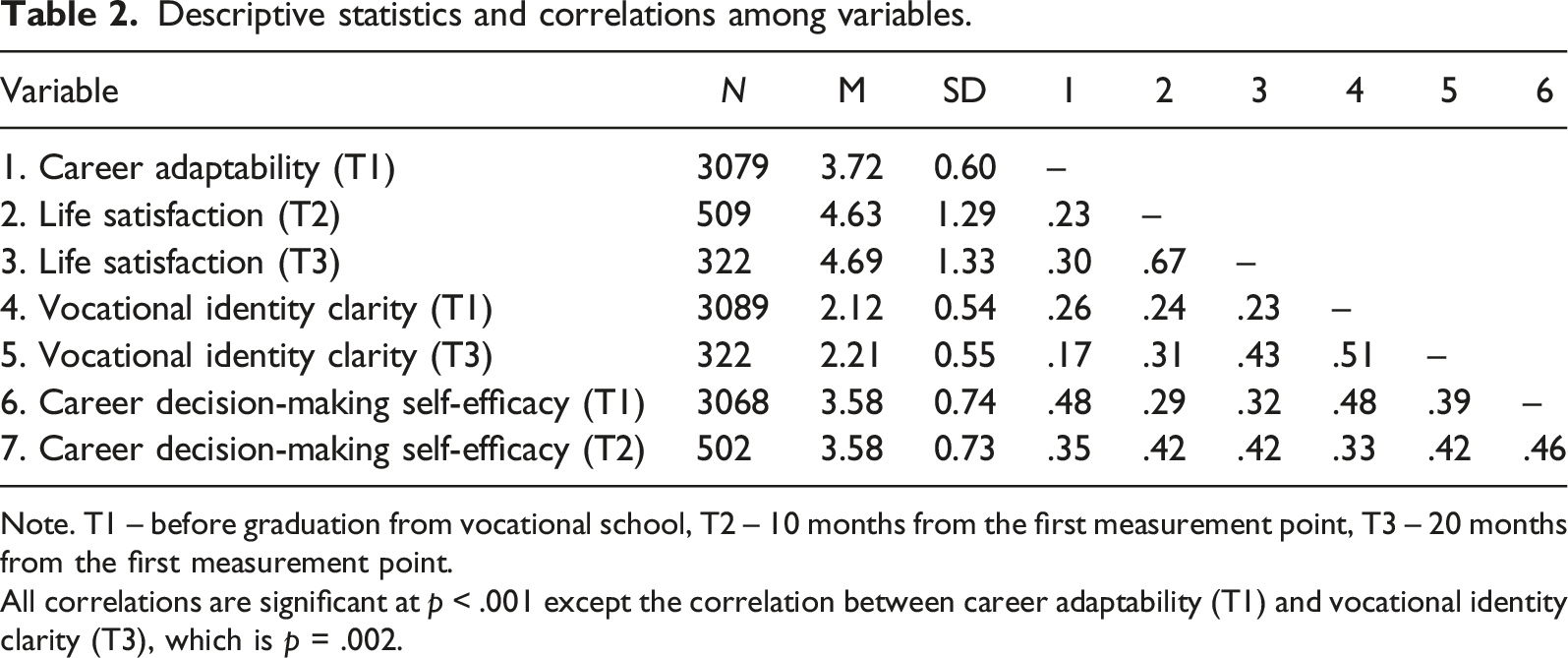
Note. T1 – before graduation from vocational school, T2 – 10 months from the first measurement point, T3 – 20 months from the first measurement point.
All correlations are significant at p < .001 except the correlation between career adaptability (T1) and vocational identity clarity (T3), which is p = .002.
Longitudinal Measurement Invariance Analyses
Invariance analysis
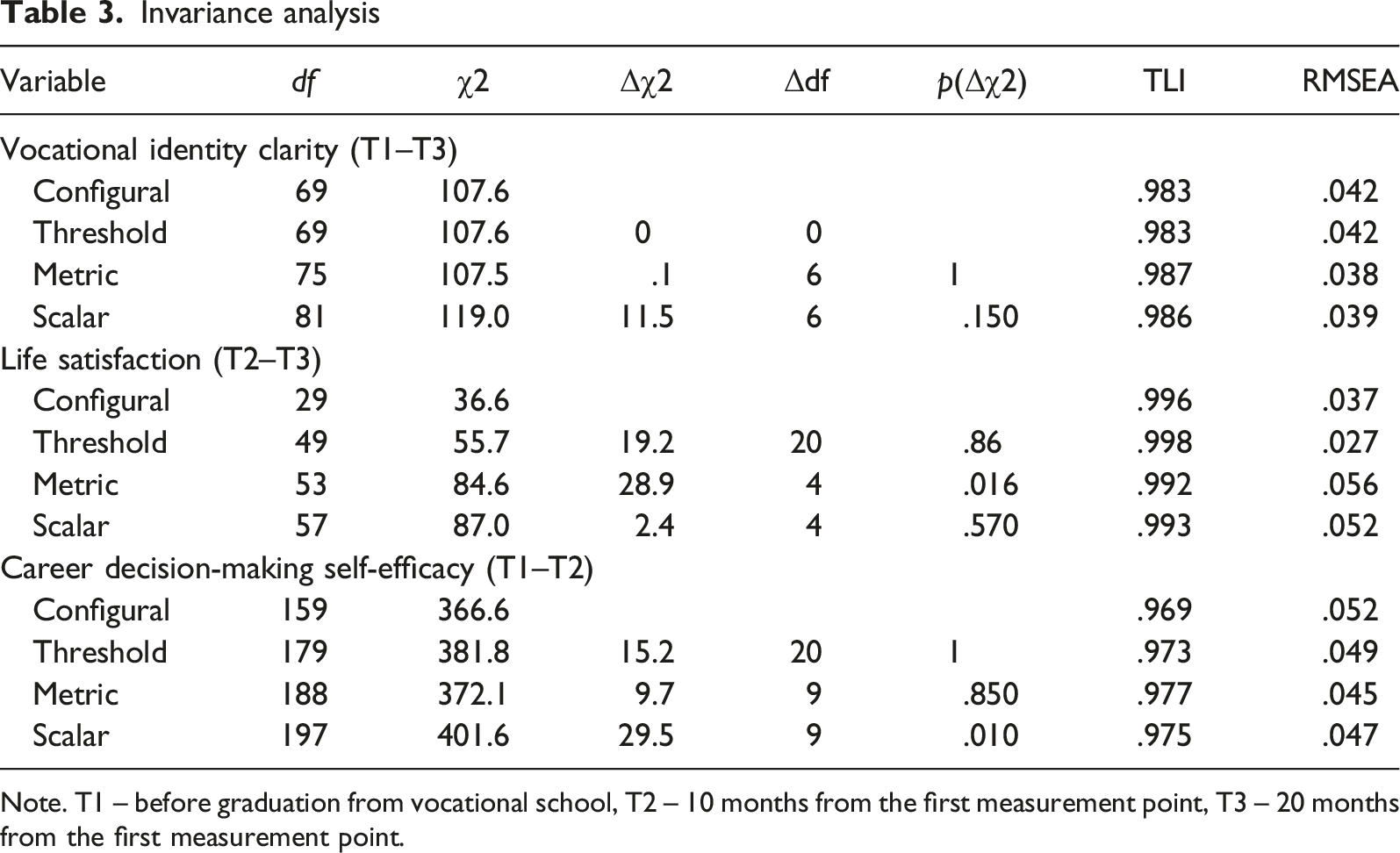
Note. T1 – before graduation from vocational school, T2 – 10 months from the first measurement point, T3 – 20 months from the first measurement point.
Even though the goodness of the fit significantly decreased in some of the individual steps, as indicated by the LRT, the TLI and RMSEA changed by less than .01, and in some cases, the fit indices improved. The significant increases in chi-square value thus seemed to be due solely to the large sample size. In all other measures, the chi-square difference was not significant, and again, the TLI and RMSEA changed by less than .01 and even improved in some cases. Therefore, we could support scalar invariance for career adaptability, career decision-making self-efficacy, vocational identity, and life satisfaction measures.
Hypotheses Testing
The hypotheses were tested using the structural equation modeling. Each latent variable had a single indicator based on manifest scores computed as the mean of item responses. Given the large number of variables in our model, a single indicator was used for each of the latent variables. A single indicator is considered sufficient for many structural equation models and offers several advantages over multiple indicators, which can introduce additional problems, especially for complex models (Hayduk & Littvay, 2012) like ours. This procedure was also appropriate due to the established scalar time-invariance of the measures. To account for imperfect reliability of the scale scores, residual variances of the manifest variables were fixed to (1-scale reliability)*scale variance (Brown, 2006; Hayduk, 1987). McDonald’s total omega was used as the reliability estimate.
Career Adaptability as a Predictor of Vocational Identity Clarity and Life Satisfaction
We tested a structural model where career adaptability at T1 predicts career decision-making self-efficacy at T2, which, in turn, predicts vocational identity clarity and life satisfaction at T3. In addition, we assessed the direct effects of career adaptability at T1 on the two adaption outcomes (i.e., vocational identity clarity and life satisfaction) at T3. To assess change in the outcome variables over time, we controlled for their respective levels at T1 for career decision-making self-efficacy and vocational identity clarity and at T2 for life satisfaction. The disturbances of T2 and T3 latent variables were free to covary.
Model parameters.

Note. CAAS – career adaptability, CDMSE – career decision-making self-efficacy, VIS – vocational identity clarity, SWLS – life satisfaction. T1 – before graduation from vocational school, T2 – 10 months from the first measurement point, T3 – 20 months from the first measurement point.
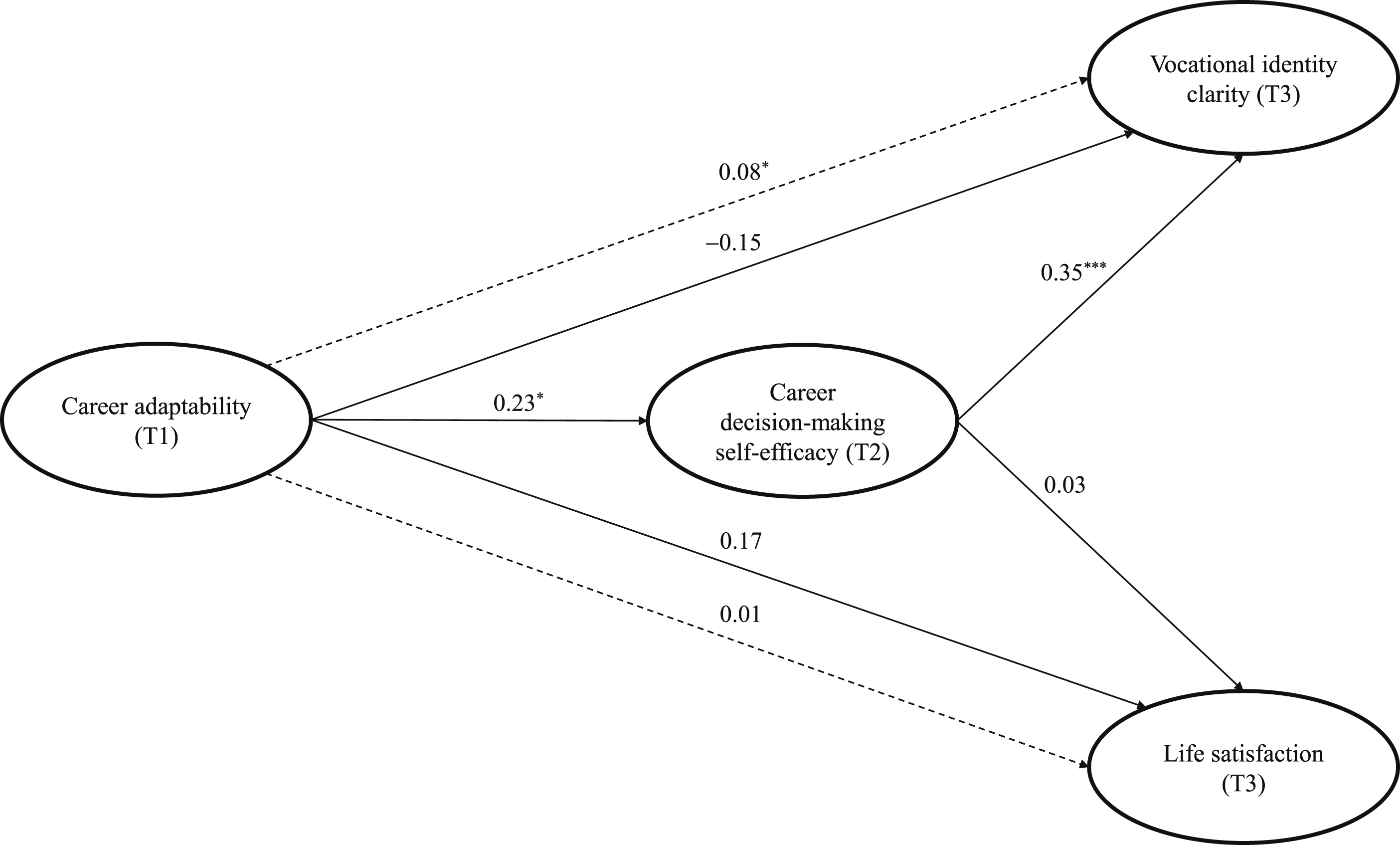
The model demonstrating relationships between variables. Note. Bold lines indicate direct paths between different constructs; dashed lines indicate indirect paths. *p < .05, *** p < .001.
The direct path between career adaptability at T1 and vocational identity clarity at T3, when controlling for vocational identity clarity at T1, was non-significant (β = −0.15, p = .061), refuting Hypothesis 1. However, career adaptability at T1 positively predicted career decision-making self-efficacy at T2 (β = 0.23, p = .010) when controlling for career decision-making self-efficacy at T1, supporting Hypothesis 3. Career decision-making self-efficacy at T2 in turn positively predicted vocational identity clarity at T3 (β = 0.35, p < .001) when controlling for vocational identity clarity at T1, supporting Hypothesis 4. The indirect effect of career adaptability at T1 on vocational identity clarity at T3 was statistically significant (β = 0.08, p = .031), supporting Hypothesis 5. The model explained 43% of the variance in vocational identity clarity at T3.
Paths to and from life satisfaction were weak and non-significant. More specifically, controlling for life satisfaction at T2, career adaptability at T1 (β = 0.17, p = .078) did not predict life satisfaction at T3, refuting Hypothesis 2. Moreover, career decision-making self-efficacy at T2 did not predict life satisfaction at T3 (β = 0.03, p = .775), refuting Hypothesis 6. Indirect effect of career adaptability at T1 on life satisfaction at T3 through career decision-making self-efficacy at T2 was non-significant (β = 0.01, p = .775), refuting Hypothesis 7. The model explained 54% of the variance in life satisfaction at T3, but this was mostly due to the stability of life satisfaction, which explained 51.1% of the variance.
Additionally, because the individual dimensions of career adaptability (i.e., concern, control, curiosity, and confidence) represent relatively distinct aspects of career adaptability and because of possible differences in the associations between the individual dimensions of career adaptability and the career decision-making self-efficacy, vocational identity clarity and life satisfaction variables, we decided to perform post-hoc analyses (supplementary tables are available from the corresponding author upon request) that examined individual dimensions of career adaptability. None of the single career adaptability dimensions was a significant predictor of career decision-making self-efficacy, and there were no significant indirect effects for any career adaptability facet. This is in line with the hierarchical measurement model of CAAS (Hlad’o et al., 2020), in which the four individual dimensions act more as facets through which career adaptability manifests rather than as full-fledged dimensions/factors measured with acceptable reliability. It suggests that the associations observed in our main model hold for career adaptability as an integrative construct rather than its specific facets. This also indicates that the single indicator approach we employed for the main model did not obfuscate the multi-faceted nature of the predictor.
Discussion
This was the first study to examine the longitudinal associations of career adaptability with the adaption outcomes of vocational identity and life satisfaction in the career transitions of vocational graduates and to investigate the mediating role of career decision-making self-efficacy in these associations. Our findings showed that career adaptability resources during vocational school positively predicted adaptive responses, which in turn positively related to adaptation outcomes after the transition. Specifically, our findings showed that career decision-making self-efficacy fully mediated the association between career adaptability and vocational identity. However, our study did not show long-term positive effects of career adaptability on life satisfaction. The findings of our study provided mixed support for the career construction model of adaptation (Rudolph et al., 2017a; Savickas, 2013; Savickas et al., 2009; Savickas & Porfeli, 2012), and they are further discussed.
Career Adaptability, Career Decision-Making Self-Efficacy, and Vocational Identity Clarity
According to the career construction model of adaptation (Rudolph et al., 2017a; Savickas, 2013; Savickas et al., 2009; Savickas & Porfeli, 2012), there is a direct link between career adaptability and adaptation outcomes and this link is partially mediated by adapting responses. While our study results did not support direct positive associations between career adaptability and increased vocational identity clarity in vocational graduates during their career transition period, our study elucidates the process that might underlie the relationship between career adaptability and vocational identity clarity. In line with previous research (e.g., Gushue et al., 2006a; Hirschi et al., 2017; Hou et al., 2019; Kim & Lee, 2018; Li et al., 2019), our findings substantiated the assumptions that career adaptability is positively related to career decision-making self-efficacy and that career decision-making self-efficacy is positively related to vocational identity clarity among vocational graduates during their career transition period. Furthermore, vocational graduates’ career decision-making self-efficacy fully mediated the relationship between career adaptability before graduation and vocational identity measured 20 months later. Expanding upon previous cross-sectional studies that linked career adaptability with vocational identity clarity (Gushue et al., 2006a, 2006b), our study suggests that during career transitions, career adaptability increases vocational students’ self-efficacy beliefs, which allow them to build a clear vocational identity. Following Duffy et al. (2015), we highlighted the mediating role of career decision-making self-efficacy in the link between career adaptability and adaptation outcomes. However, we employed a longitudinal design to examine the associations between career adaptability and vocational identity clarity. Hence, our findings extend previous research on the associations between career adaptability and adaptation outcomes.
Thus, our study provides empirical support for the career construction model of adaptation (Rudolph et al., 2017a; Savickas, 2005, 2013; Savickas et al., 2009; Savickas & Porfeli, 2012), proposing that those who use their career adaptability resources to engage in adaptive responses when dealing with career developmental tasks have a greater chance of achieving successful career adaptation outcomes. More concretely, our results emphasize the importance of self-efficacy beliefs as an attitudinal adaptive response that helps people to deal with career transitions. First, career adaptability resources contribute to the level of confidence that vocational graduates feel regarding their ability to successfully perform the tasks related to career decision-making. Further, those career decision-making self-efficacy beliefs influence the development of career interests, abilities, and goals, and as such, reinforce vocational identity clarity. Vocational identity clarity is an important adaptation outcome and a career meta-competency that might successfully guide vocational graduates through their career transitions (Hall, 2004; Hirschi et al., 2017). We thus believe it is crucial to identify processes that facilitate successful career adaptation. Accordingly, we can conclude that during a career transitional period, supported by career adaptability, career decision-making self-efficacy contributes to forming a clear and stable vocational identity.
Career Adaptability, Career Decision-Making Self-Efficacy, and Life Satisfaction
While we demonstrated that a higher level of career adaptability in vocational graduates is significantly related to an increased vocational identity after graduation through career decision-making self-efficacy, our study did not show a long-term positive effect of career adaptability on adaptation outcomes beyond the domain of working life. Specifically, career decision-making self-efficacy did not mediate the relationship between career adaptability and life satisfaction. These results differ from previous empirical studies reporting the positive relationship of career adaptability (e.g., Bölükbaşı & Kırdök, 2019; Ghosh et al., 2019; Ginevra et al., 2018) and career decision-making self-efficacy (e.g., Creed et al., 2003; Jiang et al., 2017) with life satisfaction. These differences could be due to previous studies’ cross-sectional nature (e.g., Ghosh et al., 2019; Ginevra et al., 2018; Jiang et al., 2017; Konstam et al., 2015; Maggiori et al., 2013; Santilli et al., 2017). As such, our results are consistent with those of Marcionetti & Rossier (2021), who did not find the longitudinal effect of career adaptability or general self-efficacy on life satisfaction.
Considering a positive cross-lagged effect from career adaptability to life satisfaction among employed adults in the study of Urbanaviciute et al. (2019), we believe vocational graduates’ diverse life situations might play a role in this relationship. For example, unemployment may cause lower life satisfaction because of economic stress, social stigmatization, and several psychological needs that cannot be fulfilled (see Ervasti & Venetoklis, 2010; Stam et al., 2016, for more detail). Likewise, other domains outside the work, such as relationship status and satisfaction with relationship status, may influence life satisfaction (Adamczyk, 2017; Adamczyk & Segrin, 2015). In their review of the life satisfaction literature, Erdogan et al. (2012) pointed out that life satisfaction could be viewed as a function of stable personality traits. For example, some studies concluded that job satisfaction does not predict life satisfaction when controlling for the effects of personality and nonwork satisfaction (e.g., Rode, 2004).
Limitations, Future Directions, and Practical Implications
The present study’s results and conclusions need to be considered in light of the limitations that inform directions for future research. First, the present study’s findings relied solely on self-report measures that reflect how vocational graduates perceive and evaluate themselves, their career adaptability, career decision-making self-efficacy, vocational identity clarity, and life satisfaction. The responses might also be upward biased due to social desirability effects (Proctor et al., 2009). Thus, future research could benefit from incorporating multiple methods and linking self-report instruments with participants’ actual behaviors and outcomes. Second, it is important to highlight the relatively high attrition rate. The first wave of data collection (T1) took place directly at the school (during school lessons). This was, in our opinion, a strong motivator to participate in the study at the first wave. However, after graduating from vocational school and obtaining a new status (e.g., tertiary or non-tertiary studies, employment, entrepreneurship), the study may no longer have been that interesting for the participants. In addition, we addressed the participants in the second and third waves after a relatively long time (10 and 20 months from the first data collection) and individually (through email or a letter). We took this into account in our research methodology—we prepared a lottery incentive, and the online form had two email reminders. Unfortunately, the response rate was still low. Third, one strength of the present study was its longitudinal design. Nevertheless, the research design we used had some limitations. To optimize the time for completing the questionnaires, we did not measure all of the variables in each of the three waves. Thus, even though we used a longitudinal design and controlled for base-levels in the variables, different relations might be possible (for example, life satisfaction or vocational identity clarity could also predict an increase in career decision-making self-efficacy). Fourth, our sample consisted of only Czech upper-secondary vocational graduates. To increase our findings’ generalizability, scholars should replicate our results with more diverse samples (e.g., ethnicity, cultural context, developmental stage, school system, level and type of education, and work status). Finally, the present study included career decision-making self-efficacy as a mediator. Other variables might also mediate the relationship between career adaptability adaptation outcomes. Additional factors might also mediate the potential effects of career adaptability on life satisfaction. Previous research revealed that future orientation (Bölükbaşı & Kırdök, 2019; Cabras & Mondo, 2018; Santilli et al., 2017), courage (Ginevra et al., 2018), life meaning, and work volition (Buyukgoze-Kavas et al., 2015) mediate the relationship between career adaptability and life satisfaction. Zhou and Lin (2016) also demonstrated that social support played a moderating role in the relationship between adaptability and life satisfaction. Following the career construction model of adaptation (Rudolph et al., 2017a) studies could focus on other possible adaptive responses as mediators of this relationship.
In practice, our study’s results provided empirical support for the beneficial effect of a higher level of career adaptability in vocational graduates before their graduation on their successful career adaptation 20 months after graduation. This result makes a strong case for implementing the assessment and training of career adaptability resources into career counseling for vocational students, especially before their career transition period. A high number of vocational graduates have difficulty entering the world of work in contemporary European societies, with about 12% of young Czech vocational graduates between the ages of 15 and 29 being neither in education, employment, or training (Eurostat, 2021) and yet there remains a lack of specific guidelines for how to support vocational graduates in their career transitions. Our study suggests that it could be beneficial to measure individuals’ adaptability resources and identify the need to design appropriate interventions to promote them. As suggested by Savickas (2013) and further supported by Nota et al. (2014) and Koen et al. (2012), career adaptability resources can be strengthened through training interventions. In this line of thinking, it would be useful to design training in various career adaptability activities, such as exploring possible career selves and career options, making plans and decisions to pursue chosen career options, and developing tactics to overcome possible career obstacles to promote career adaptability resources (Rossier, 2015). A previous study on Czech vocational graduates showed that using career guidance services positively predicted career adaptability (Hlad’o et al., 2019). As such, we would like to encourage the use of career counseling services in vocational graduates who are about to make their career transitions and advocate its focus on career adaptability.
Conclusion
Building upon the career construction model of adaptation, the present study employed a longitudinal design to examine the associations between career adaptability and two types of successful adaptation outcomes, vocational identity clarity and life satisfaction, in actual career transitions of vocational graduates. We thereby specifically focused on the mediating role of career decision-making self-efficacy in these associations. Study results revealed that career decision-making self-efficacy fully mediated the relationship between career adaptability before graduation and vocational identity clarity 20 months later. On the other hand, our study did not show a long-term positive effect of career adaptability on adaptation outcomes beyond the domain of working life since career adaptability did not contribute to life satisfaction neither directly nor indirectly through career decision-making self-efficacy. As such, it provided mixed support for the career construction model of adaptation and aspires to stimulate more longitudinal research focusing on the developmental process of career adaptation with specific groups undergoing career transitions.
Footnotes
Declaration of Conflicting Interests
The author(s) declared no potential conflicts of interest with respect to the research, authorship, and/or publication of this article.
Funding
The author(s) disclosed receipt of the following financial support for the research, authorship, and/or publication of this article: This study is an outcome of the research project Career adaptability of vocational upper-secondary school graduates during the school-to-work transition [grant number GA18-07537S] funded by the Czech Science Foundation.
