



Abstract
Drawing on the career construction theory model of adaptation, this meta-analytic structural equation modeling (MASEM) examines the effects of proactive personality on the subjective career success of adolescents and emerging adults. We identified 46 studies that covered 52 independent samples and 24,092 participants through literature retrieval. Based on these studies, we created an integrative model linking proactive personality with career adaptability, student career construction, and subjective career success. The results of the meta-analysis showed that all bivariate relationships among proactive personality, career adaptability, student career construction, and subjective career success were significantly positive. The results of the MASEM indicated that career adaptability intervened in the relationship between proactive personality and subjective career success, but student career construction, as a suppressor, carried out the negative association between proactive personality, career adaptability and subjective career success in the sequence of adaptation. We also discuss the research implications and provide directions for future research.
Keywords
The constantly changing dynamics of environments make careers unpredictable, and individuals are increasingly responsible for their own successful career development (Haenggli et al., 2021). Career construction theory explains the interpretive and interpersonal processes through which individuals construct themselves, impose direction on their vocational behavior, and create meaning in their careers (Savickas, 2013). In addition, pursuing harmony between one’s inner needs and outside opportunities is the focus of career construction theory. Meanwhile, subjective career success is regarded as an important adaptation outcome in implementing a self-concept in work roles. Career construction theory characterizes adaptation outcomes as resulting from adaptive readiness, adaptability resources, and adapting responses (Savickas, 2013). The career construction model of adaptation (Savickas & Porfeli, 2012; Savickas, 2013) outlines the process of the preparation for, entrance into, participation in, and exit from different work roles by the sequence of people’s integration. Moreover, career adaptability is one of the contributors to the successful adaptation of vocational development tasks (Savickas, 2005), mobilized by adaptive readiness indicated by proactive personality, cognitive flexibility, and the Big Five personality. It conditions adapting responses indicated by student career construction to produce adaptation outcomes indicated by success, satisfaction, and well-being (Savickas, 2013; Savickas et al., 2018). The four dimensions combine to form an optimal sequence for making occupational and bridging transitions (Savickas et al., 2018).
Adolescents and emerging adults from the early teens through the twenties (ages 14–24) are commonly regarded as individuals at the career exploration stage (Hartung, 2013; Super, 1990), with unpredictable educational and vocational pathways (Savickas, 2002). Their success in adapting to vocational tasks could result in a more effective function in the student role. It also lays a richer foundation for the establishment task in the next career stage (Savickas, 2002) and a successful transition into the labor market. Individuals in their late teens and early twenties engage in a long period of exploration (Arnett, 2015). Research has shown that career identity exploration has two sides, positively related to openness and curiosity in emerging adults (Luyckx et al., 2006), as well as anxiety and depression in late adolescence (Luyckx et al., 2008). Identity exploration requires the abandonment or suspension of existing commitments (Grotevant, 1987). Lack of commitment to important career issues in late adolescence due to instability and uncertainty may induce a sense of confusion and disequilibrium, which in turn lead to maladaptive aspects of psychosocial functioning, such as anxiety and depression (Schwartz et al., 2009). Career construction theory (Savickas, 2013) proposes that successful adaptations are expected for those who are willing or ready to change and able to deal with vocational challenges and difficulties, demonstrating behaviors that address changing conditions. Does the optimal sequence for making occupational and bridging transitions (Savickas et al., 2018) reduce individuals’ sense of confusion and disequilibrium, and enable them to achieve a positive subjective experience during the career exploration stage? Extant research on subjective career success from a career construction perspective has focused primarily on employees (e.g., Fiori et al., 2015; Johnston et al., 2016; Haenggli & Hirschi, 2020). Thus, for adolescents and emerging adults in early career construction, the formation mechanisms of their subjective career success deserve further attention.
The objective of this research is threefold. The first is to examine the relationship between proactive personality and subjective career success among adolescents and emerging adults and delve into the intervening mechanism between them from a career construction perspective. Proactivity is considered an important individual resource to cope with complex and challenging career roles (Berg et al., 2010). Highly proactive people can intentionally influence their social environments by identifying and pursuing opportunities, showing initiative, and generating constructive changes (Bateman & Crant, 1993; Seibert et al., 1999). Prior studies have taken broad-based multivariate approaches to examine the mechanisms by which proactive personality is related to subjective career success (e.g., Seibert et al., 1999, 2001; Yang & Chau, 2016). Moreover, meta-analytic studies have been conducted to reveal the bivariate relation between proactive personality and subjective career success (Ng et al., 2005; Ng & Feldman, 2014; Zhou et al., 2015). The career construction model of adaptation assumes that individuals with the willingness to change (adaptive readiness) have a high level of adaptability (adaptability resources). They perform career construction behavior (adapting responses) and consequently achieve adaptation outcomes, as indicated by success, satisfaction, and well-being (adaptation results) (*Savickas et al., 2018; Savickas & Porfeli, 2012). In the sequence model of adaptation, proactive personality is an indicator of adaptive readiness, and subjective career success is an indicator of adaptation outcomes (Savickas & Porfeli, 2012). However, there are still no conclusions on the underlying mechanism of how proactive personality contributes to subjective career success among adolescents and emerging adults in career construction theory.
The second objective of this study is to test whether there is a positive effect of student career construction on adaptation outcomes among adolescents and emerging adults. There are three main developmental career tasks of crystallizing, specifying, and implementing the vocational self-concept in the exploration stage (Savickas, 2002). Completing these tasks associated with the exploration stage can build a foundation for future success in the establishment stages (Super et al., 1996). Career construction is essentially the process of developing and implementing vocational self-concepts in an occupational role (Savickas, 2002). Student career construction involves actual behaviors that characterize career construction among adolescents and emerging adults involved in planning, exploring, deciding and implementing an occupational choice. Some studies have reported that student career construction as an adapting response can enhance students’ adaptation outcomes, such as identity commitment among high school, college, and graduate students (Savickas et al., 2018), study engagement in adolescence (*Šverko & Babarovic, 2019), and happiness among high school students (*Yıldız-Akyol & Öztemel, 2021). Other research, however, has reported no significant relationship between student career construction and academic engagement among university students (Merino-Tejedor et al., 2016) and study satisfaction in adolescence (*Šverko & Babarovic, 2019) in the career construction model of adaptation. Overall, previous empirical studies demonstrate equivocal patterns in the relationship between student career construction and adaptation outcomes.
The third objective of this study is to explore the effect of career adaptability on multidimensional subjective career success among adolescents and emerging adults, instead of general adults. Career adaptability is an important antecedent of subjective career success (Savickas, 2013). Existing research generally operationalizes subjective career success in a unidimensional manner, which has verified career satisfaction as an outcome of career adaptability (Rudolph et al., 2017). The multidimensional conceptualization of subjective career success represents individuals’ meaning of career success in diverse tasks (Shockley et al., 2016). Comprehensive operationalization of the concept facilitates a better understanding of subjective career success in a systemic manner. For students, subjective career success means the experience of achieving personally meaningful developmental outcomes about learning, education and other domains, such as love, play and community (Hartung & Taber, 2008). Thus, it is necessary to define their subjective career success as various facets. Career adaptability refers to coping strategies of growth and change in developmental tasks and role transitions. It entails concern, control, curiosity, and confidence. The four dimensions deal with all developmental tasks or problems associated with each stage and are beneficial for individuals to achieve adaptive goals. The extent to which an individual achieves his or her adaptive goals should be related to his or her subjective career experience. How do adolescents and emerging adults deal with exploratory developmental tasks and achieve adaptive goals to gain multidimensional subjective career experience from a career construction perspective? The answer has not been clarified yet.
Theoretical Review and Hypotheses
Proactive personality is defined as an individual’s stable disposition toward enacting or changing his or her environment (Bateman & Crant, 1993). People with proactive personalities are likely to seize opportunities to change circumstances (Bateman & Crant, 1993). Previous research has found that individuals with proactivity can manage changes and respond to uncertainties in their own careers (Fugate et al., 2004; Seibert et al., 1999). Therefore, it is critical for individuals to achieve adaptive outcomes and career success in their career development. Subjective career success reflects individuals’ perceptions and feelings about their extrinsic careers; it is more aligned with the career outcome of person-environment harmony from the perspective of career construction. Subjective career success is most commonly conceptualized as career satisfaction (e.g., Greenhaus et al., 1990) or perceived career success (e.g., Turban & Dougherty, 1994). To more comprehensively represent the meaning of career success, this concept recently was verified to be multidimensional, including multiple evaluations and experiences (Shockley et al., 2016). Proactive personality is associated with high satisfaction through seeking opportunities, taking action, and creating meaningful change. Empirical investigations have demonstrated that proactive personality is related to satisfaction with learning, education and social opportunities among students (Lee et al., 2014), as well as academic satisfaction (Ma et al., 2020). Previous research has suggested that proactive personality significantly predicts multiple career experiences among adolescents and emerging adults. Proactive personality is the proximal determinant of an individual’s emotional response to his or her career. Therefore, compared with objective success, proactive personality is more likely to predict subjective career success for adolescents and emerging adults. Thus, we present the following hypothesis:
Career adaptability refers to an individual’s self-regulatory psychological resources to cope with transitions in one’s occupational roles (Savickas & Porfeli, 2012). In career construction theory, adolescents and emerging adults should approach the tasks of the exploration stage in preparation for the future, controlling and taking responsibility for their own career construction, displaying curiosity to explore possible self and career opportunities in the future, and strengthening their confidence to solve problems encountered in pursuing their aspirations. As the core concept of career construction theory, career adaptability has been operationalized by an international measure called the Career Adapt-Abilities Scale (CAAS), which consists of four dimensions: concern, control, curiosity, and confidence (Savickas & Porfeli, 2012). These four dimensions represent general adaptive resources and strategies addressing critical tasks, transitions, and traumas. Individuals with proactive personalities display more career initiative in coping with career tasks in transitions. Prior studies have suggested that proactive personality is an important antecedent to self-adjustment in career development (Seibert et al., 2001) and can improve one’s career adaptability (Savickas & Porfeli, 2012). Students with proactive personalities are inclined to take the initiative to improve their adaptive abilities and skills (Cai et al., 2015; Guan et al., 2017). Thus, we expect proactive individuals to be more responsive in developing their career resources for adaptability at the career exploration stage. Thus, we propose the following hypothesis:
A meta-analysis suggested that, compared with human capital, psychological capital could explain more variance in subjective career success (Zhou et al., 2015). As an individual’s psychosocial resources for coping with career tasks and preparing for future professional roles (Savickas, 2013), career adaptability enables individuals to identify the opportunity for transition and make self-regulation according to the surrounding environment to achieve person-environment harmony. Career adaptability has been found to be a potent indicator of subjective career success for adolescents and emerging adults, such as the quality of life (Wilkins et al., 2014), academic satisfaction (Duffy et al., 2015), and life satisfaction (Ginevra et al., 2018; *Parola & Marcionetti, 2021) among students.
Thus, we propose the following hypotheses:
Student career construction is a process that characterizes career construction among adolescents and emerging adults and comprehensively represents adapting responses in the career exploration stage (Rocha & Guimarães, 2012; *Savickas et al., 2018). It covers a set of vocational thoughts and behaviors that address changing career conditions and help make occupational choices, such as exploring, planning, deciding, and implementing (Savickas et al., 2018). The most comprehensive model on student career construction was developed by Savickas and his colleagues (Savickas et al., 2018), who take into account four dimensions of career construction: crystallizing, exploring, deciding, and preparing. The four dimensions interrelate to constitute a continuum reflecting a particular career construction task during the exploration stage of a career. As a psychosocial construct of self-regulation resources for dealing with changes, career adaptability shapes constructive activities addressing changing conditions (Savickas & Porfeli, 2012). It has been found that students' career adaptability is positively related to their particular adapting responses, such as career planning and career exploration (*Hirschi & Valero, 2015) and student career construction (Merino-Tejedor et al., 2016; Savickas et al., 2018). Therefore, we propose the following hypothesis:
As actual behaviors dealing with career choice construction tasks, student career construction results in fitness between individuals and their professional positions during the career exploration stage (Savickas et al., 2018). It has been found that planning and exploration, as dimensions of student career construction, are related to skill development (*Taber & Blankemeyer, 2015) and academic satisfaction (Perera & McIlveen, 2017) among students. Overall, student career construction is related to study engagement in adolescence (*Šverko & Babarovic, 2019) and happiness among high school students (*Yıldız-Akyol & Öztemel, 2021). Therefore, we propose the following hypothesis:
Student career construction represents more specific forms of adapting responses and serves as a mediator between career adaptability (as a more specific form of adaptability resources) and vocational identity (as a more specific form of adaptation results) (Savickas et al., 2018). In addition, prior studies have found that student career construction is a mediator between career adaptability and study engagement in adolescence (*Šverko & Babarovic, 2019) and happiness among high school students (*Yıldız-Akyol & Öztemel, 2021). Therefore, combined with Hypothesis 2, we propose the following:
Method
Literature Search Procedures
We adopted the MASEM method (Viswesvaran & Ones, 1995; Bergh et al., 2016; Liu, Jiang, Shalley, Keem, & Zhou, 2016) to explore the relationship between proactive personality and subjective career success, and the mediating roles of career adaptability and student career construction among them. Meta-analytic structural equation modeling (MASEM), as a methodological and statistical approach, allows a study to estimate the unique relations among variables in the model and to estimate the fit of the model to the data more accurately when all relevant variables are included (Cheung, 2014). It facilitates the evaluation of the complete career construction theory model of adaptation and tests how well the hypothesis model fits the published data.
To identify studies that could provide effect size estimates of the relations that were used in our model tests, we searched Web of Science and Google Scholar for field studies published in English before May 2021 with the following keywords: “career adaptability” and “career adaptabilities scale”.
Study Characteristics.

We first coded the data included in this study. As recommended by Lipsey and Wilson (2001), we developed a coding instruction regarding sample information (e.g., age, size and country of the sample), variables included in this study, their reliabilities, and the product-moment correlation coefficient (r) among variables. Two of the authors used the coding instruction to code each construct of the included studies independently. Agreement between the two coders was 91%, and consensus was reached by discussion.
Operationalization of Variables
In the meta-analysis, the operationalization of variables had to be guided by theory (Viswesvaran & Ones, 1995). Similar variables in concept are usually combined during the coding process (Viswesvaran et al., 1999). In the literature, there is the bandwidth-fidelity dilemma (BFD), which suggests a trade-off between the bandwidth and its fidelity for a measure (Cronbach & Gleser, 1957). Previous research (Hogan & Roberts, 1996; Schneider et al., 1996) also supported that predictors and criteria should be aligned in terms of breadth and fidelity. Therefore, in the present study, conceptually similar variables are combined, taking into account width and accuracy in the operationalization of variables. The specific operationalizations are as follows:
Proactive personality
Proactive personality refers to the dispositional tendency of an individual who takes the initiative across a range of activities and situations (Crant, 2000). We operationalized it as proactive personality and proactivity.
Career adaptability
Career adaptability is a self-regulation strength to cope with vocational development tasks, occupational transitions, and work traumas. We included studies with measures developed by Savickas and Porfeli (2012) or international versions thereof.
Student career construction
Student career construction refers to adapting responses in the process of career choice at the career exploration stage, including career planning, career exploration, occupational choice, and implementation (Savickas et al., 2018). We included studies that often measured career planning, career exploration, and student career construction.
Subjective career success
Subjective career success is a multidimensional evaluation of career facets. It was operationalized as an individual’s subjective apprehension and evaluation of achieving personally meaningful career outcomes, including authenticity, growth and development, influence, meaningful work, personal life, quality work, recognition, and satisfaction (Shockley et al., 2016). We included studies that often measured quality of life, life satisfaction, meaning in life, academic satisfaction, academic major satisfaction, study satisfaction, calling, employability skills, and graduate employability capacities.
To replicate and extend the meta-analytic results in the future, we provide a list, as shown in the Appendix A, that includes the overall variables used in the meta-analysis, the categorizations of constructs, and the number of samples it was in.
Meta-analysis Procedure
We first calculated the correlations between career adaptability and all other variables used in the meta-analysis by following Schmidt and Hunter’s meta-analysis technique (Schmidt & Hunter, 2015). For unreliability in the measurement of career adaptability and other variables of interest, we corrected each correlation by adopting the alpha values (α) reported in each primary study (Koh et al., 2019). When no alpha value was reported for a particular scale in a study, an average alpha value was calculated from the remaining studies using the same scale (e.g., Judge & Ilies, 2002). The mean α of proactive personality, career adaptability, student career construction and subjective career success was 0.83, 0.90, 0.88 and 0.85, respectively. The missing artifact values were estimated by inserting the mean value across the studies where information was not given. For studies that contained multiple measurements, such as longitudinal studies, we averaged the correlations associated with the same measures. Then, to composite the effect size of career adaptability and correlated variables, we combined the correlations among individual studies using the formula (Formula (1)) provided by Schmidt and Hunter (2004) and calculated one effect size for each relationship within each study.
Meta-Analystic Correlations between Variables.

Note. ȓ = sample size weighted mean observed correlation;
Path-analytic Procedures
Meta-analytic Correlation Input Matrix for the Variables.
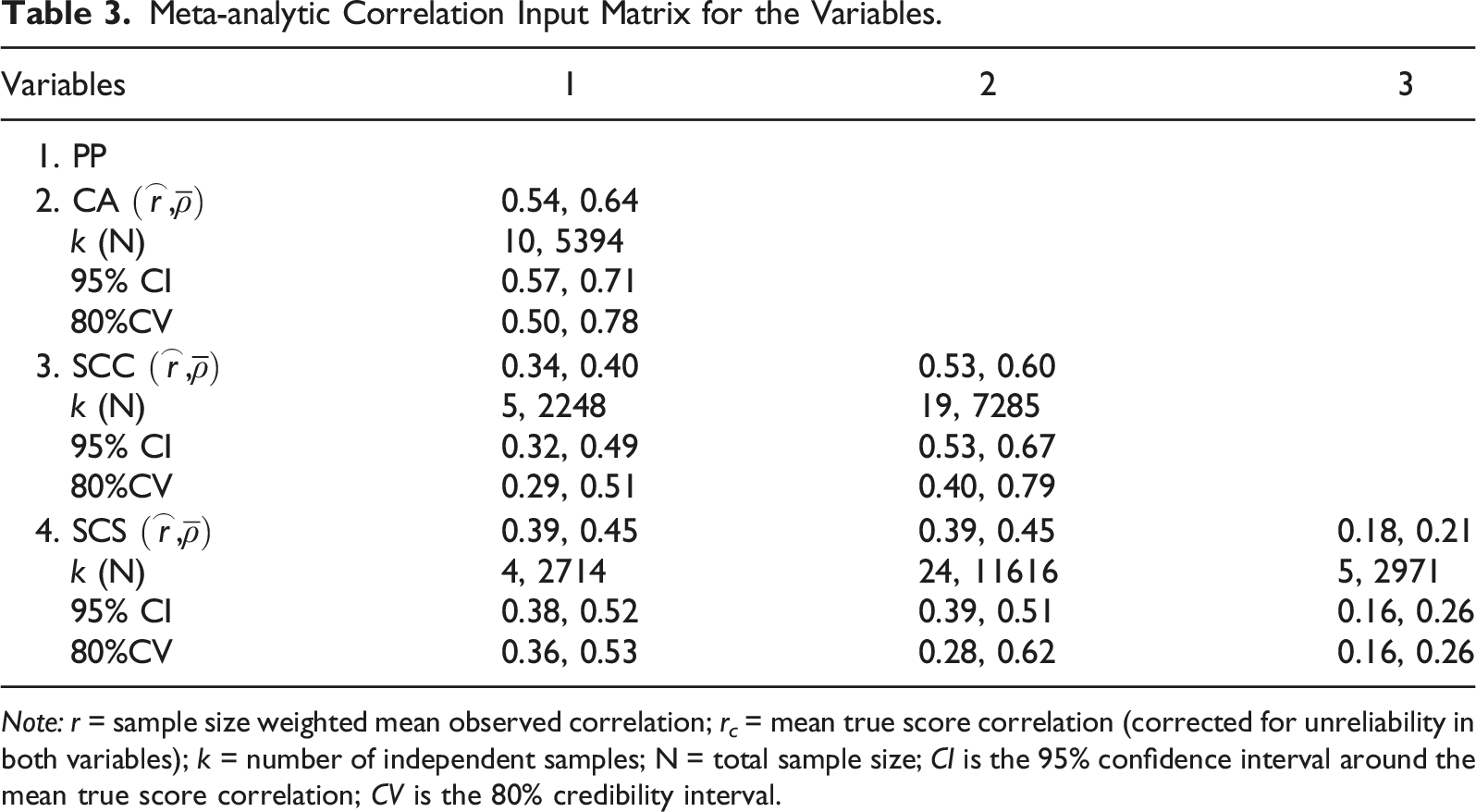
Note: r = sample size weighted mean observed correlation; r c = mean true score correlation (corrected for unreliability in both variables); k = number of independent samples; N = total sample size; CI is the 95% confidence interval around the mean true score correlation; CV is the 80% credibility interval.
Fit Statistics for Models.
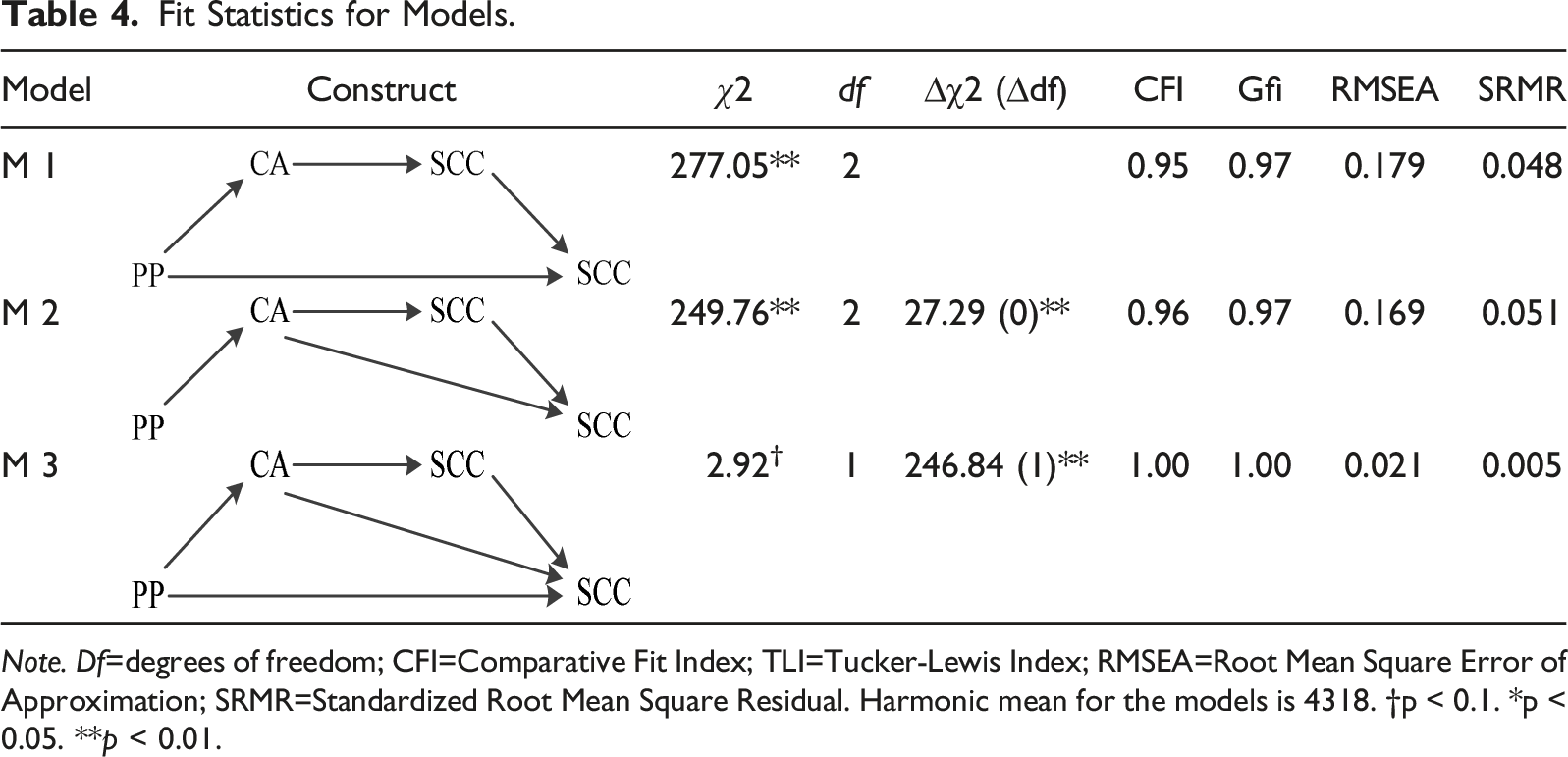
Note. Df=degrees of freedom; CFI=Comparative Fit Index; TLI=Tucker-Lewis Index; RMSEA=Root Mean Square Error of Approximation; SRMR=Standardized Root Mean Square Residual. Harmonic mean for the models is 4318. †p < 0.1. *p < 0.05. **p < 0.01.
According to the research hypotheses, 3 models were created (see Table 4) to test how proactive individuals affect subjective career success through career adaptability and student career construction. M1 assumed that the influence of proactive personality on subjective career success includes direct and indirect paths; that is, proactive personality can directly affect subjective career success and affect subjective career success through serial mediators of career adaptability and student career construction. M2 assumed that the influence of proactive personality on subjective career success includes indirect paths; that is, proactive personality can affect subjective career success through partial mediation of career adaptability and serial mediators of career adaptability and student career construction. M3 assumed that the influence of proactive personality on subjective career success includes direct and indirect paths; that is, proactive personality can directly affect subjective career success and affect subjective career success through partial mediation of career adaptability and serial mediators of career adaptability and student career construction.
Results
Bivariate relationships
Table 2 presents the meta-analytic results for bivariate relationships between career adaptability and proactive personality, student career construction, and subjective career success. The average corrected correlations were significant, as their 95% CIs did not include zero. Statistical artifacts of the corrected correlation accounted for less than 75% of the variance in the relationship between proactive personality and career adaptability (9.98%), the relationship between student career construction and career adaptability (7.15%), and the relationship between subjective career success and career adaptability (10.14%), indicating that moderators exist in these relationships. Table 3 presents a corrected correlation matrix including all variables. A range of significant and positive effect sizes for the relationship of all variables is shown in Table 3.
MASEM results
To test the hypotheses rigorously, we examined the path weights from MASEM. The regression weights provide an effect size accounting for the relationships of all variables rather than the singular relationship between two variables. Model 3 is a significantly better fit than Model 2, ∆χ2 (1) = 246.84, p < 0.01. The goodness-of-fit indices for the hypothesized Model 3 analysis are χ2 = 2.92, df =1, p < 0.1, CFI = 1.00, TLI = 1.00, RMSEA = 0.021 and SRMR = 0.005. Thus, Model 3 is proven to be an excellent-fitting model in this dataset (see Table 4). We considered the chi-square as a secondary index of fit because the index is very sensitive to large sample sizes and usually rejects well-fitting models with large sample sizes, as in this study (see harmonic means in Table 4) (Brown et al., 2008). However, we used the chi-square to calculate the difference tests to compare the fitness of nested models that contain the concerned variables.
Standardized Path Coefficients for Model 3
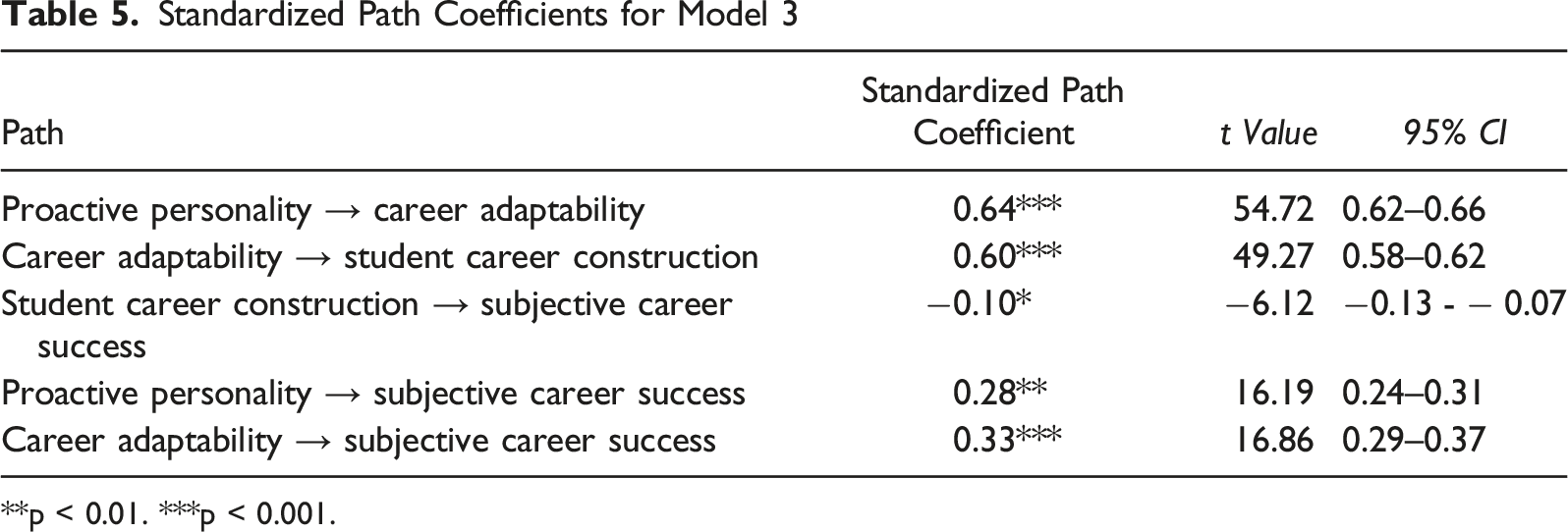
**p < 0.01. ***p < 0.001.

Structural paths for the effects of proactive personality on subjective career success. **p < 0.01. ***p < 0.001.
The product-of-coefficients approach is the appropriate strategy of analysis when the hypothesis of mediation includes multiple potential mediators and is a useful way to evaluate the hypothesis of multiple mediations when a large sample is available (Preacher & Hayes, 2008). Thus, the product-of-coefficients approach was used to examine the mechanism of proactive personality influencing subjective career success through career adaptability and student career construction.
First, to test the total indirect effect by investigating whether career adaptability and student career construction could transmit the effect of proactive personality to subjective career success, a formula for total indirect effect (Preacher & Hayes, 2008) and data in Table 5 were used to calculate the total indirect effect (total indirect effect = 0.17). The multivariate delta method was employed to test the significance of the total indirect effect, Z = 11.28, p < 0.01. According to the test results, it is plausible that proactive personality has indirect effects on subjective career success through the mediation of career adaptability and career construction.
Second, to test the specific indirect effects associated with each of the assumed mediations between proactive personality and subjective career success, the formula for specific indirect effect and data in Table 5 were used to calculate the specific indirect effect of career adaptability and student career construction, and the multivariate delta method was employed to test the significance of the specific indirect effect. The indirect effect of proactive personality on subjective career success via career adaptability is significant and positive (indirect effect = 0.21, Z = 15.98, p < 0.01), supporting Hypothesis 4. The indirect effect of proactive personality on subjective career success via sequential career adaptability and student career construction is significant but negative (indirect effect = − 0.038, Z = − 2.57, p < 0.05). Thus, Hypothesis 7 is not supported. The results suggest that once proactive personality and career adaptability are accounted for, student career construction may in fact be associated with decreased subjective career success.
Discussion
Drawing from the career construction theory model of adaptation, this paper conducted a meta-analysis to empirically examine the impact of proactive personality on subjective career success. In particular, we explored the theoretical explanations for subjective career success during individuals’ career exploration stage from a career construction perspective. Consistent with prior studies, the relationships between proactive personality, career adaptability, and subjective career success were found to be positive and significant. However, our results yielded an unexpected finding—that the effect of student career construction on subjective career success was not positive when also considering proactive personality and career adaptability. That is, student career construction, as a suppressor, carried out the negative association between proactive personality, career adaptability and subjective career success.
We found that proactive personality has a direct effect on subjective career success. This is consistent with the finding of a prior meta-analysis study that indicated that proactive individuals are more likely to enhance their subjective positive evaluations of their careers (Ng et al., 2005). In addition, the relationship between proactive personality and subjective career success is partially mediated by career adaptability, which is consistent with expectations and empirical results based on career construction theory (Nilforooshan, 2020; Savickas, 2013 ). It demonstrates the capacity of career adaptability to act as a process variable that translates individual characteristics to one’s perceptions of success.
The result that student career construction did not produce a positive path to subjective career success is surprising and inconsistent with expectations based on career construction theory (Savickas, 2013) and some empirical findings. Our MASEM analysis results indicated that the positive bivariate relationship between student career construction and subjective career success turns out to be weakly negative in the integrative model. The career construction model of adaptation assumes that adapting responses are facilitated by adaptability resources and that they further foster optimal adaptation results. Previous studies found that student career construction as an adapting response can enhance students’ adaptation outcomes, such as identity commitment among high school, college, and graduate students (Savickas et al., 2018), study engagement in adolescence (*Šverko & Babarovic, 2019), and happiness among high school students (*Yıldız-Akyol & Öztemel, 2021). In addition, other researchers have found different results among student samples. For instance, there is no correlation between student career construction and academic engagement (B = − 0.06, p = 0.399) (Merino-Tejedor et al., 2016) or study satisfaction in adolescence (*Šverko & Babarovic, 2019). Therefore, previous empirical findings are mixed, which implies that researchers need to further explore the mechanisms in an integrative manner.
The indirect effect of proactive personality on subjective career success was found to be −0.038 (p < 0.05) when student career construction was included as a mediator. However, the indirect effect increased to 0.17 (p < 0.01) when student career construction was dropped from the model. The result points to a possible suppression effect of student career construction in the relationship. Although researchers in general found a positive effect of proactivity and career adaptability on subjective career success (e.g., Lee et al., 2014; Ramos & Lopez, 2018; *Santilli et al., 2016), this may not always be the case when proactive people with psychosocial resources deal with career construction tasks during the exploration stage.
One explanation for the above finding is that student career construction may involve uncertainty, which leads to unpleasant affect and in turn decreases individuals’ subjective meanings of education and training experiences. The theory of career construction conceptualizes career development as a process in which the self and society act together, driven by adaptation to an ever-changing environment (Savickas, 2005). Individuals are able to gather career-related information and then make career plans and decisions through emotional assessments based on self and environmental information (Zikic & Hall, 2011). Information with uncertainty, ambiguity, and incoherence characteristics may serve as a trigger for negative emotions, especially in early career decision-making (Zikic & Hall, 2011), which can lead to a meaningless career experience.
There might be other possible explanations. The result may relate to findings from Luyckx et al. (2008), where those with ruminative exploration suffered from anxiety and depression emotion in forming identity commitments. Career exploration in career construction activities may negatively influence the subjective career success during the exploration stage. Student career construction consists of four activities that form a continuum of dealing with a career construction task across planning, exploring, deciding, and implementing. Although the four activities belong to the exploration stage, it is likely that relative weights of each activity are not balanced (Rocha & Guimarães, 2012). Career exploration is a principal activity during the exploration stage (Savickas, 2005). Indeed, many young people do not make commitment about what they want and stand strong in adult commitment until age 25 or later (Arnett, 2000). Some individuals with a ruminative type of exploration characterized unproductive, passive, and repetitive focus on the self (Treynor et al., 2003), they stuck in thought about their own interests and options of changing environment. Their commitment is constantly adjusting and changing under the function of continuous exploration, which in turn leads to maladaptive aspects of psychosocial functioning, such as anxiety and depression (Schwartz et al., 2009), then results negative career experiences.
In sum, the results indicate significant positive bivariate relationships among proactive personality, career adaptability, student career construction, and subjective career success. The MASEM results specified the intervention mechanisms through which proactive personality, as an adaptivity variable, affects subjective career success, as an adaptation variable. The results also reveal that we should pay greater attention to the role of student career construction as a mediator in the career construction theory model of adaptation and thus should be delved into in future research.
Theoretical Implications
This research contributes to career construction theory in several ways. First, we conduct a theoretical review and meta-analysis to empirically identify an integrated model that includes career adaptability and student career construction as mediators reported in previous studies. In this way, we advance the understanding of the career construction model of adaptation. A previous meta-analytic study based on career construction theory reported the bivariate relations among sets of variables within the career construction model of adaptation (Rudolph et al., 2017); however, it did not sufficiently investigate the entire network of pathways. More specifically, it found that adaptivity led to adaptation results via career adaptability, but it did not address the positive linkages between adapting responses and adaptation results. The findings of this study expand the career construction model of adaptation and identify a weakly negative relationship between student career construction as an adapting response and subjective career success as an adaptation result in the model.
Second, we clarify the precise effect of student career construction in the career construction model of adaptation by overarching the multiple empirical studies and thus enrich career construction theory. The bivariate relationship between student career construction and subjective career success is significantly positive, but the effect of student career construction on subjective career success turns out to be weakly negative in the integrative model. Moreover, the indirect effect via the sequential mediation of career adaptability and student career construction was found to be significantly negative statistically. These results identified the suppression effect of student career construction as an adapting response in the career construction theory model of adaptation. This finding suggests that student career construction may not bring only positive career outcomes as adapting responses dealing with the career choice construction tasks during the exploration stage. Student career construction is process-oriented developmental construction (Savickas, et al., 2018), studies on student career construction should take a more complex perspective instead of a single positive view. We encourage researchers to reconsider the role of student career construction in the sequence of adaptivity-adaptability-adapting-adaptation to better understand its functioning.
Third, we explore the intervening mechanisms through which proactive personality impacts subjective career success, particularly at the career exploration stage. We found that career adaptability is a robust mediator between proactive personality and subjective career success. The findings provide a better understanding of the intervening mechanisms between proactive personality and subjective career success and a richer explanation of individual differences related to subjective career success.
Practical Implications
The present study provides a valid framework for predicting and promoting subjective career success at the exploration stage for career education and career consulting. On the one hand, as shown in the results, proactive personality may enhance career adaptability, which in turn increases individuals’ perception and emotional experience of their career. Therefore, it might be used as a template to design interventions facilitating transitions at school, such as training courses on university to workplace transitions. Counseling should at first foster the career adaptability of individuals during the exploration stage through career interventions. Considering that individuals with high proactivity have higher career adaptability and subjective career success, career counselors and educators should pay more attention to individual differences in proactivity to guide individuals in achieving subjective career success in transitions.
On the other hand, our results suggest that when individuals have not proactivity and resources to manage change, their adaptive response may result in weakly negative perception and emotional experience of their career. Counselors should pay attention to individuals with lower subjective career success during the career exploration stage. Given the weakly negative effect of student career construction on the experience of the career, it is critical to address barriers during the process of career construction. Career counselors and educators may implement interventions of self-regulation skill toward them to improve their ability to regulate negative emotions and their flexibility in tolerating ambiguity and uncertainty. Practitioners can also provide the client guidance in deciding among many potential alternatives.
Limitations and Future Directions
Prior research on career planning and career exploration has tested a circumscribed set of adapting responses. Hence, our meta-analysis combined the effect sizes of these studies and included them in student career construction. As no study has reported raw data to compare the nature of career planning, career exploration, and student career construction, we could not examine their external validity. Thus, in future studies, their nature should be examined and compared in the career construction theory model of adaptation.
We limited the meta-analysis to the intervening mechanism between proactive personality and subjective career success. Statistical artifacts of the corrected correlation accounted for less than 75% of the variance in the relationship between career adaptability and proactive personality, student career construction, and subjective career success, indicating that possible moderators existed in these relationships. Researchers have identified age and the professional situations affecting the relationships between career resources and well-being outcomes (Zacher & Griffin, 2015; Johnston et al., 2016). Previous research has revealed that family factors (Guan et al., 2015) and education environment (Tian & Fan, 2014) influence career adaptability for students. This study was conducted with samples of individuals at the exploration stage. The context also may affect the relationships among the four variables in this research. However, there are no reported raw data to examine the effect of the environment, as prior studies rarely considered the influences of the environment. In addition, we included these relationships based on both cross-sectional and longitudinal designs, which weakens the tenability of causal inferences, as suggested by the career construction model of adaptation. Thus, future research should examine the boundary conditions (e.g., sample characteristics, contextual factors, and design methods) of the sequential relationships among proactive personality, career adaptability, student career construction, and subjective career success.
One unexpected result of the MASEM analysis is the weakly negative effect of student career construction on subjective career success in the sequential model of adaptation. Prior studies reported no significant role of student career construction on academic engagement among university students (Merino-Tejedor et al., 2016) and a positive relationship with identity commitment (Savickas et al., 2018) and happiness among high school students (*Yıldız-Akyol & Öztemel, 2021). The mixed results of student career construction indicate that there is a possible curvilinear or more complex relationship with adaptation results. Future studies can identify the potential inverted U-shaped or more complex relationship of student career construction with adaptation results in person-oriented longitudinal studies.
Conclusion
In sum, the present study represents a quantitative summary of the underlying mechanisms between proactivity and subjective career success based on the sequence of adaptation in career construction theory. The results confirm previous studies on the positive relationships between proactivity, career adaptability, and subjective career success. However, we found that student career construction has a weakly negative relationship with subjective career success in the sequence of adaptation. Our findings illustrate the complexity of the construction process in achieving meaningful career outcomes. The results also suggest that future empirical research is needed to understand the dynamic phenomenon of meaningful career development for individuals at the career exploration stage.
Footnotes
Acknowledgments
The authors would like to thank Wang Meifang for her valuable suggestions and comments to improve the paper.
Declaration of Conflicting Interests
The author(s) declared no potential conflicts of interest with respect to the research, authorship, and/or publication of this article.
Funding
The author(s) disclosed receipt of the following financial support for the research, authorship, and/or publication of this article: This work was supported by National Natural Science Foundation of China; 71871025, 71802023.

Appendix
Characteristics of Combined Variables included in the Hypothetical Models
Hypothetical Path
k
N
Variable Name
Measure
k
N
Variable Name
Measure
k
N
PP-CA
10
5394
Proactive personality
Proactive personality scale (Bateman & Crant, 1993)
9
4332
Career adaptability
Career adapt-abilities scale (Savickas & Porfeli, 2012)
10
5394
Proactivity scale (Frese et al., 1997)
1
1226
CA-SCC
19
7285
Student career construction
Career planning scale (Gould, 1979); career exploration scale (Hirschi, 2009)
2
1576
Career adaptability
Career adapt-abilities scale (Savickas & Porfeli, 2012)
19
7285
Career exploration scale (Stumpf et al., 1983)
5
1342
Career planning scale (Gould, 1979)
3
765
Career planning thinking and planning scale (Greenhaus, 1971), career exploration scale (Stumpf et al., 1983)
1
49
Student career construction inventory (Savickas & Porfeli, 2012)
1
577
Student career construction inventory (Savickas et al., 2018)
7
2976
CA-SCS
24
11,616
Subjective career success
Quality of life scale (Soresi & Nota, 2003)
2
1004
Career adaptability
Career adapt-abilities scale (Savickas & Porfeli, 2012)
24
11,616
Global life satisfaction (Diener, Emmons, Larsen, & Griffin, 1985)
9
5234
Academic satisfaction scale (Lent, Singley, Sheu, Schmidt, & Schmidt, 2007; Schmitt, Oswald, Friede, Imus, & Merit, 2008)
5
2764
Employability skills scale (communication, problem solving, and team work skills)
1
191
Calling scale (Dik, Eldridge, Steger, et al., 2012)
2
667
Academic major satisfaction scale (Nauta, 2007)
2
960
Graduate employability capacities scale (Coetzee, 2010)
1
332
Meaning in life scale (Steger et al., 2006)
1
165
Study satisfaction scale (Šverko & Babarović, 2008)
1
299
SCC-SCS
5
2971
Subjective career success
Student career construction inventory (Savickas et al., 2018)
2
852
Student career construction
Study satisfaction scale (*Šverko & Babarovic, 2019)
1
299
Work exploration scale (Akkermans et al., 2013)
1
672
Academic major satisfaction scale (Nauta, 2007)
1
672
Career planning scale (Gould, 1979)
1
113
Skill development scale (Penley & Gould, 1981)
1
113
Proactive career behaviors scale (Hirschi, Freund, & Herrmann, 2013)
1
1334
Satisfaction with life scale (Diener et al., 1985)
1
1334
Academic satisfaction scale (Schmitt et al., 2008)
1
553
PP- SCS
4
2714
Proactive personality
Proactive personality scale (Bateman & Crant, 1993)
4
2714
Subjective career success
Learning satisfaction scale (Baldwin et al., 1997)
1
159
Calling scale (Dik & Steger, 2008)
1
1156
Academic satisfaction scale (Lent et al., 2007)
1
1062
Satisfaction with life scale (Diener et al., 1985)
1
337
PP-SCC
4
1943
Proactive personality
Proactive personality (Bateman & Crant, 1993)
4
1943
Student career construction
Career exploration scale (Stumpf et al., 1983)
1
305
Career planning (Gould, 1979); career exploration (Hirschi, 2009)
1
1226
Career planning scale (Gould, 1979)
1
363
Student career construction inventory (Savickas et al., 2018)
1
49