




Abstract
Vocational psychology has devoted limited attention to factors that promote or hinder the career development of musicians. We combined features of social cognitive career theory’s (SCCT) well-being and choice models to examine the experiences of musicians at a formative point in their career development – the first few years of college, during which many would-be musicians either reaffirm or abandon their career paths. Consistent with SCCT, we posited that academic satisfaction and stress would be predicted by favorable levels of self-efficacy, outcome expectations, social support, goal progress, and trait negative affect. We also expected that satisfaction and stress levels would, along with self-efficacy and outcome expectations, predict intentions to persist in undergraduate music majors. Participants were 260 first- and second-year undergraduate music majors. The hypothesized model and a slightly revised version (which added a direct path from goal progress to persistence intentions) produced good fit to the data and accounted well for variation in academic satisfaction, stress, and persistence intentions.
Keywords
Access to music education has become increasingly narrowed in the United States in recent years, with significant funding cuts to music and other arts programs (Rabkin & Hedberg, 2011). Moreover, availability of music education at the K-12 level is unevenly distributed across social groups, with poorer and minority children often receiving more limited access to music education programs (Survey of Public Participation in the Arts, 2008). At the post-secondary level, roughly two percent of students enrolled in higher education are music majors (The College Music Society, 2015). Those who remain in the music educational pipeline often face mixed support within familial, academic, and social circles. For instance, many music majors contend with comments such as, “And what’s your backup plan?”, or “What will your day job be?” It may not be surprising that up to half of music education majors withdraw from this path prior to degree completion (Gavin, 2010). Those who go on to pursue music careers often face such continuing career obstacles as work instability and insufficient compensation and benefits (Bureau of Labor Statistics, 2022).
While the recent literature in career development has tended to devote a great deal of coverage to students and adult workers in science, technology, engineering, and mathematics (STEM) fields (e.g., Fouad & Santana, 2017), there has been much less empirical attention to those in the arts, such as music students and professional musicians (Brown & Alley, 1983; Gavin, 2010). Despite well-intentioned efforts at educational inclusivity, such as expanding the STEM umbrella by using slogans such as “STEAM” (science, technology, engineering, arts, and mathematics; Catterall, 2017), there remains a compelling need to better understand the factors that inhibit and facilitate the educational progress of those aspiring to music and other careers in the arts (Zander et al., 2010).
The current study used social cognitive career theory (SCCT) as a framework for understanding the academic satisfaction, stress, and intended persistence of students during the first 2 years of their undergraduate music programs, a key decisional period for many music majors. For example, the music performance requirements that are common to most types of music majors may provoke a good deal of stress, with 57% of former music students citing these requirements as the reason for withdrawing from a music major (Gavin, 2010). SCCT helps to capture the complex relation among cognitive, behavioral, and contextual factors that influence the development of career interest, choice, and performance behaviors (Lent et al., 1994). The social cognitive model of well-being, one of five SCCT models, reflects a unifying theoretical approach to help understand the interplay of variables related to academic or job satisfaction and stress (Lent & Brown, 2008).
A meta-analysis by Sheu et al. (2010) found that the SCCT interest/choice model is broadly applicable to Holland’s (1997) Artistic theme interests and choices. However, this study did not disaggregate the findings based on specific types of artistic activities. Likewise, a more recent meta-analysis offered support for the SCCT well-being model in general samples of students and workers (Sheu et al., 2020), but did not examine the model’s validity in specific academic or occupational fields, such as music. Although it is tempting simply to assume that such macro-level findings apply to music majors, generalizability is ultimately an empirical matter. In the present study, we combined features of both the SCCT well-being and choice models to study the academic experiences of music students. Given the distinctive features (e.g., performance requirements) and stresses of the music curriculum (Gavin, 2010; Zander et al., 2010), we reasoned that social cognitive elements, such as self-efficacy, outcome expectations, and supports, may be particularly relevant predictors of the academic satisfaction and persistence intentions of music majors.
SCCT and the Academic Well-being of Music Majors
The SCCT well-being model, shown in Figure 1, contains several predictors of academic satisfaction and stress. Specifically, students are assumed to experience more satisfaction and less stress to the extent that they perceive they are making progress toward their academic goals (goal progress), have confidence in their academic and barrier-coping capabilities (milestone and coping self-efficacy), maintain optimistic beliefs about the outcomes of pursuing their degree programs (outcome expectations), believe they have adequate support to pursue their academic goals (environmental support), and possess beneficial personality and affective traits (e.g., low levels of negative affectivity). In the case of music majors, strong efficacy beliefs, positive outcome expectations, and goal progress may help to nurture satisfaction, reduce stress, and motivate persistence despite challenging academic conditions and an uncertain occupational outlook. Social supports are seen as providing a potent interpersonal substrate for developing and maintaining resilient beliefs about the self and about what one’s efforts can accomplish. Integrative model of well-begin under normative life conditions. Adapted from “toward a unifying theorctical and practical perspective on well-begin and psychosocial adjustment.” by R.W. Lent 2001. Journal of Counsling Psychology, 51, p. 500. Reprinted with permission . PA–positive affect; NA–negative affect; GSE–generalized self-efficacy.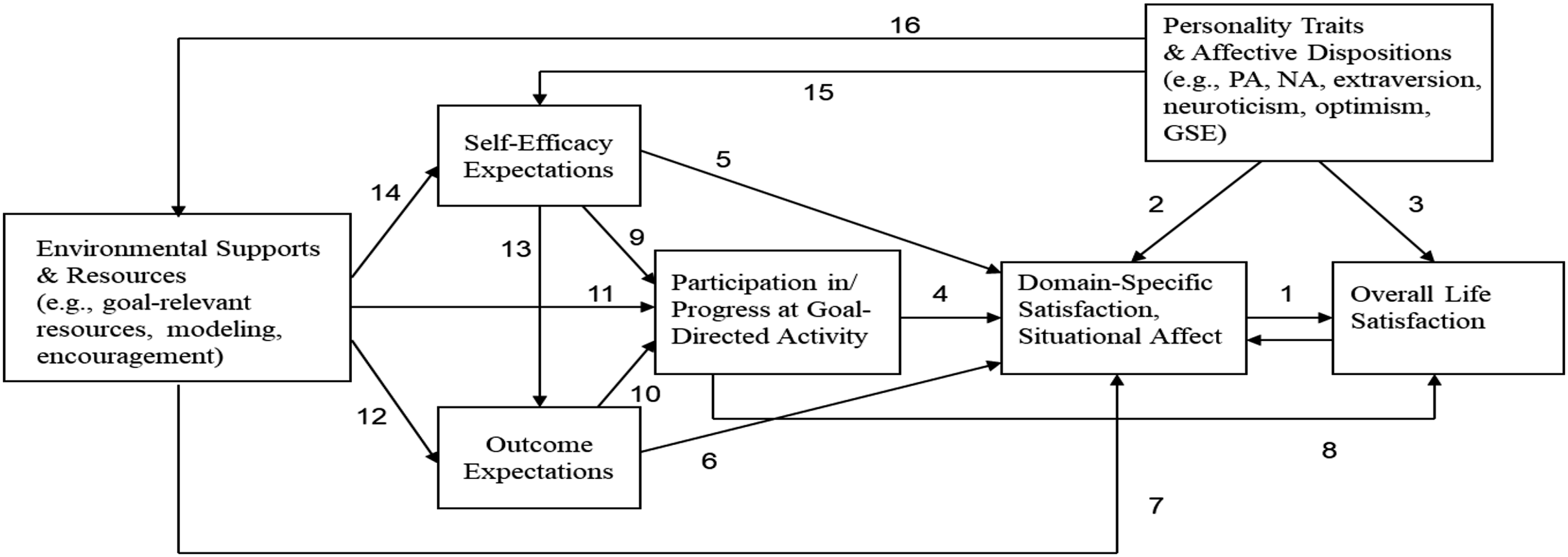
Lent’s (2004) general model of normative well-being defines positive domain well-being in relation to both domain satisfaction and (low levels of) distress. Research on the model has sometimes focused on domain satisfaction alone and sometimes on both domain satisfaction and stress (e.g., Lent et al., 2012). Findings have indicated that academic stress and satisfaction are related to one another (Lent et al., 2012) and that self-efficacy and support are predictive of both academic satisfaction and stress (Lent et al., 2011). Positive domain well-being has also been found to relate positively (and negative domain well-being, negatively) to overall life satisfaction (Sheu et al., 2020). In addition, domain and life satisfaction have been shown to correlate highly with personality variables such as extraversion, neuroticism (Diener et al., 1999), and positive affectivity (e.g., Lent, 2004; Lent et al., 2005; Sheu et al., 2020).
The well-being model has been examined in both cross-sectional and longitudinal studies, including samples of college students (Singley et al., 2010), graduate students transitioning to full-time work (Abele & Spurk, 2009), and employed adults (Verbruggen & Sels, 2010). A strength of the model is its ability to be modified in order to address unique aspects of particular careers or educational domains and to accommodate culture-specific predictors of well-being (Sheu et al., 2020). Although some studies have applied the model to college students in specific educational domains, primarily engineering (Lee, et al., 2015; Lent et al., 2003, 2007), most research employing the model with college students has involved heterogeneous samples of academic majors (e.g., Lent et al., 2005). In addition to research with U.S. college students, the model has been tested in a variety of other countries, such as Portugal (Lent et al., 2009, 2012), Taiwan (Sheu et al., 2014), Mozambique, and Angola (Lent et al., 2014).
Persistence intentions have most often been studied as an indicator of choice goals in the SCCT choice model (Lent et al., 1994). However, some research has examined the extent to which satisfaction and/or stress – elements of the SCCT well-being model – add to the prediction of persistence intentions in hybrid model tests combining features of both models (e.g., Lent et al., 2007; Morris & Lent, 2019). For example, several studies have found that self-efficacy, outcome expectations, and academic satisfaction jointly predicted intentions to persist in engineering majors (Lent et al., 2013); such intentions have, in turn, been linked to subsequent behavioral persistence (Lee et al., 2015; Lent et al., 2003, 2016). However, the current study is the first of which we are aware to study the hybrid well-being/choice model specifically with music majors. Considering the high discontinuation rates in many music degree programs, it may be useful to examine the extent to which social cognitive variables, individually and collectively, predict students’ intentions to persist in undergraduate music programs.
The Present Study
The purpose of this study was to apply SCCT to the academic adjustment of undergraduate music majors, where adjustment is defined in terms of academic satisfaction and stress, as well as the desire to remain within the music curriculum. Consistent with SCCT’s well-being model (see the paths in Figure 1), we posited that higher levels of academic satisfaction (and lower levels of academic stress) in music majors would be predicted by academic and coping self-efficacy, positive outcome expectations, perceived goal progress, social support, and relatively low levels of trait negative affect. Satisfaction and stress were, in turn, expected to predict intentions to persist in one’s music major, along with self-efficacy and outcome expectations. We also anticipated that the predictors would be interrelated among themselves such that (a) negative affectivity would (negatively) predict perceptions of social support and self-efficacy; (b) social support would predict self-efficacy, outcome expectations, and goal progress; (c) self-efficacy would predict outcome expectations; and (d) both self-efficacy and outcome expectations would predict goal progress. Parenthetically, consistent with theory and research (e.g., Bandura, 1997) that has conceptualized self-efficacy as a multidimensional construct, we included two aspects of self-efficacy (related to academic milestone completion and barrier coping) in our hypothesis testing. Likewise, in accordance with the SCCT well-being model, we included measures of both positive (academic satisfaction) and negative (academic stress) aspects of domain well-being (Lent & Brown, 2008).
Method
Participants
Participants were 260 students at college/university (81.1%, n = 210), community college (12.7%, n = 33), and conservatory (6.2%, n = 16) music programs who completed an online survey of music students’ academic adjustment. They ranged in age from 18 to 42 (M = 20.21, SD = 2.66) years old. The sample included mostly male (44.8%, n = 116) and female (46.3%, n = 120) participants, with some participants identifying as transgender male (1.9%, n = 5), transgender female (1.5%, n = 4), gender non-binary/nonconforming (4.2%, n = 11), and “other” (1.2%, n = 3). Participants identified as White/European American (73.7%, n = 191), Hispanic or Latino/a (10%, n = 26), Asian/Pacific Islander (6.6%, n = 17), multiracial (4.6%, n = 12), Black/African American (3.9%, n = 10), Native American (0.8%, n = 2) and “other” (0.4%, n = 1). They reported roughly average socioeconomic status (M = 4.90, SD = 1.65) as measured by the MacArthur Scale of Subjective Social Status (Adler, 2000).
Participants’ areas of study included music education (39.3%, n = 102), general music (20%, n = 52), music performance (15.3%, n = 40), music therapy (9.2%, n = 24), music production/technology/recording technology (4.25%, n = 12), composition (6.95%, n = 18), sacred music (1.93%, n = 5), commercial music (0.77%, n = 2), musicology (0.77%, n = 2), and conducting (.03%, n = 1). Their primary instrument families consisted of strings (20.4%, n = 53), brass (19.2%, n = 50), piano (16.9%, n = 44), and voice (16.2%, n = 42). Because data gathering occurred during the COVID-19 pandemic, participants were asked to report the extent to which they felt the quality of their education had been affected by the pandemic. A small percentage (3.9%, n = 10) felt the quality of their education was “not at all affected”; the remaining participants perceived their education to have been “slightly affected” (20%, n = 52), “somewhat affected” (21.5%, n = 56), “moderately affected” (33.1%, n = 86) and “extremely affected” (21.2%, n = 55) (M = 3.48, SD = 1.15).
Measures
Lent et al. (2005) developed a set of social cognitive measures to study the academic satisfaction of a general sample of college students. We adapted these measures in two ways for current purposes. First, to emphasize domain specificity, some items were modified or added to refer to the context of music majors and their performance requirements rather than academic majors generally. Second, an effort was made to reduce linked measurement concerns (Lent & Brown, 2006) by editing or deleting items across measures that contained very similar content (e.g., academic milestone self-efficacy items that referred to confidence at being able to persist at one’s major were eliminated because of the similarity of their content to intended persistence items). Items were reviewed by a panel of two undergraduate music students and four music educators, and their suggested edits were incorporated. The scales were presented in randomized order, followed by a set of demographic and academic status questions (e.g., type of music program and institution in which they were enrolled). Scale scores were calculated by summing item responses and dividing by the number of items on each scale.
Self-efficacy
Two aspects of self-efficacy were assessed: academic milestone self-efficacy and academic coping self-efficacy. The former was measured with a 4-item version of a scale developed by Lent et al. (2005). The original scale was edited so as to retain items that referred to academic performance (without reference to persistence) and to music majors specifically rather than academic majors generally. Participants responded by indicating how confident they were in their ability to perform behaviors that are required for academic success (e.g., “complete performance requirements of your music major satisfactorily”). Confidence ratings were made along a 10-point scale, ranging from 0 (no confidence at all) to 9 (complete confidence). The milestone self-efficacy scale yielded an internal consistency estimate of .88 in Lent et al. (2005) and .91 in the present sample.
Coping self-efficacy was measured with an 8-item version of Lent et al.’s (2005) original 7-item scale, which asks participants to indicate how confident they are in their ability to cope with barriers often faced by students while pursuing an undergraduate degree (e.g., “cope with a lack of support from professors or your advisor”). Ratings were made along a 10-point scale, from 0 (no confidence at all) to 9 (complete confidence). The coping self-efficacy scale yielded an internal consistency estimate of .85 in Lent et al. (2005) and .87 in the present study. Lent et al. (2005) also reported that the academic milestone and coping self-efficacy scales were related to one another and to measures of relevant academic outcomes.
Outcome Expectations
Outcome expectations were measured with a 9-item version of the academic outcome expectations scale used by Lent et al. (2005). The measure lists positive outcomes that may arise from completion of an undergraduate degree, such as “receive a good job (or graduate school) offer.” Participants respond by indicating how much they agree with each statement (0 = strongly disagree, 9 = strongly agree). The internal consistency estimate of this measure was .91 in the Lent et al. (2005) study and .87 in the current study. This measure has been found to correlate with academic satisfaction, environmental support, and persistence intentions (Lent et al., 2015). The current version was supplemented with values statements judged to reflect common motivations of music majors (e.g., “do work that makes use of my abilities and talents”).
Environmental Support
Support was measured with a 10-item version of the academic support scale developed by Lent et al. (2003, 2005). The modified scale asks students about their access to resources that may aid in their academic progress (e.g., “[I] get encouragement from my friends for pursuing my music major”). Participants indicate how much they agree with each statement (1 = strongly disagree, 5 = strongly agree). In this study, “intended major” was replaced by “music major.” The scale has been shown to correlate moderately to strongly with measures of self-efficacy, outcome expectations, goal progress, and domain satisfaction (Lent et al., 2005, 2007). The internal consistency estimate found in Lent et al. (2005) was .81. In the current study, the alpha coefficient was .80.
Negative Affect
Dispositional affectivity was measured with a brief version of the negative affect scale of the Positive and Negative Affect Schedule (I-PANAS-SF; Thompson, 2007; PANAS; Watson et al., 1988). This measure asks participants to rate the extent to which they generally experience five negative feelings (e.g., “afraid) on a 1 (never) to 5 (always) point scale. The 5-item version of this scale has produced an internal consistency estimate of .74 (Thompson, 2007). The correlations between the short (I-PANAS-SF) and longer (PANAS) versions of the negative affect scale were reported as .95 by Thompson (2007). Negative affect has been found to relate to measures of life and domain satisfaction, self-efficacy, and environmental supports in prior studies (e.g., Lent et al., 2017; Sheu et al., 2020). In the current study, coefficient alpha was .76.
Academic Goal Progress
Academic goal progress was measured using a 4-item version of Lent et al.’s (2005) scale. We deleted three items judged to overlap with the content of the milestone self-efficacy and persistence intentions scales. The retained items asked participants how much progress they felt they were making toward their academic goals (e.g., “learning and understanding the material in each of your courses”) along a scale from 1 (no progress at all) to 5 (excellent progress). Items including the phrase “my major” were modified to read “my music major.” Lent et al. (2005) reported that the original scale produced an internal consistency estimate of .86 and that it correlated as expected with measures of academic self-efficacy, outcomes expectations, and domain satisfaction. We obtained an internal consistency value of .76 for the shortened version of the scale.
Academic Satisfaction
Academic satisfaction was measured with a 9-item version of the original 7-item academic satisfaction scale (Lent et al., 2005). This measure asked students to report how satisfied they feel with their academic experiences in music (e.g., “I enjoy the level of intellectual stimulation in my music courses”). Participants indicated their level of agreement with each statement from 1 (strongly disagree) to 5 (strongly agree). Lent et al. (2005) reported an internal consistency value of .87 and found that the scale correlated with measures of positive affect, intended persistence, and overall life satisfaction. The two items we added to the scale were designed to reflect the performance aspect of music programs (e.g., “I like how much I have been learning in my private lessons”). In the current study, the alpha coefficient was .83.
Perceived Stress Scale
Academic stress was measured with the Perceived Stress Scale (PSS; Cohen et al., 1983), which was modified by Lent et al. (2009) to link stress experiences to academics; the current version further added the academic context of music. The measure asks participants to reflect on their thoughts or feelings within the past month (e.g., “How often did you feel that academic difficulties in your music major were piling up in such a way that you could not overcome them?”). Participants indicate their responses from 1 (never) to 5 (very often). Consistent with Lent et al. (2009), two items were reversed coded such that higher total scores reflected less perceived stress. Cohen et al. (1983) found that the PSS correlated with indicators of general distress (e.g., depression) and physical problems. In two studies with a Portuguese college student sample, Lent et al. (2009) obtained internal consistency estimates of .75 and .76. In the current study, the alpha coefficient was .67.
Intended Persistence
Students’ intentions to persist at their music major were measured with the 4-item intended persistence scale of Lent et al. (2003), with items slightly modified to refer to “music major” rather than the more general “academic major.” Participants were asked to report their level of agreement with such statements as “I plan to remain enrolled in my music major over the next semester” on a scale from 1 (strongly disagree) to 5 (strongly agree). The scale’s internal consistency was estimated at .95 in two previous studies (Lent et al., 2003, 2007). It has also been found to yield medium to strong correlations with academic domain social cognitive measures (Lent et al., 2005) and with actual behavioral persistence (Lent et al., 2003). The scale produced an alpha coefficient of .85 in the current study.
Procedure
In order to participate in the study, respondents were required to be (a) at least 18 years old, (b) enrolled at a college/university, community college, or music conservatory, and (c) registered as a sophomore or second-semester freshman undergraduate music major. The class year restriction, similar to criteria used in recruiting engineering students in prior SCCT research (e.g., Lent et al., 2003, 2013), was designed to ensure that students had ample time to assess their capabilities in relation to environmental demands. We also focused on students in their first 2 years of music studies based on the assumption that there might be less variability in more advanced students’ persistence intentions given the substantial educational, financial, and social commitments they have already made.
After receiving Institutional Review Board approval, participants were recruited via advertising on the social media sites Reddit and Facebook targeting online groups geared towards undergraduate music majors (e.g., “Music Therapy Students/Interns Community” Facebook page, “r/violinist” Reddit page), and via professional music organizations with student participation (e.g., National Association for Music Education, Music Teachers National Association). Permission of group moderators had been obtained. Professors and department chairs of a variety of music programs across the U.S were also contacted via email and were asked to forward the survey to their students.
The link available through social media and email correspondence directed students to a site where they could obtain more information about the study. If interested individuals met the survey’s criteria, they were directed to a consent page explaining the nature of the study and were informed that they could withdraw from the study at any time by closing their browsers. If they indicated their consent, they then proceeded to the online Qualtrics survey. Participants were entered into a raffle for a small financial incentive (one $10 Amazon gift card per every 10 participants) upon completion of the study. Steps were taken to prevent bot responses and to reduce inattention. For example, respondents had to complete a Captcha question before beginning the survey. The “Prevent ballot box stuffing” option was selected to prevent multiple responses from the same respondent. Two validity check items (both of which needed to be completed successfully) were included in the survey to help screen out inattentive respondents.
Results
Of the 899 individuals who began the survey, data from 639 were eliminated based on inattentive responding criteria (e.g., failing to complete and pass both validity checks, overly brief response times, irrelevant open-ended responses, evidence of straight-lining responses) or because they had stopped responding before reaching the demographic questions at the end of the survey, which did not allow us to confirm their status as music majors. Application of these screening criteria produced a sample of 260 participants with complete data. Parenthetically, Weston and Gore (2006) had recommended a minimum sample size of 200 for use with structural equation modeling, and Hu and Bentler (1999) reported that the 2-index fit criterion we used tends to perform adequately with samples of N ≤ 250, particularly when robust estimation procedures are employed. Though most of the scale scores were distributed normally, four scales yielded negative skew and positive kurtosis values above 1 (milestone self-efficacy, outcome expectations, academic satisfaction, and intended persistence); however, their non-normality was not considered extreme, based on Weston and Gore’s guidelines. Moreover, the maximum likelihood estimation procedures we employed are considered robust to non-normality (Muthén & Muthén, 1998).
Correlations, Means, Standard Deviations, and Internal Consistency Estimates.
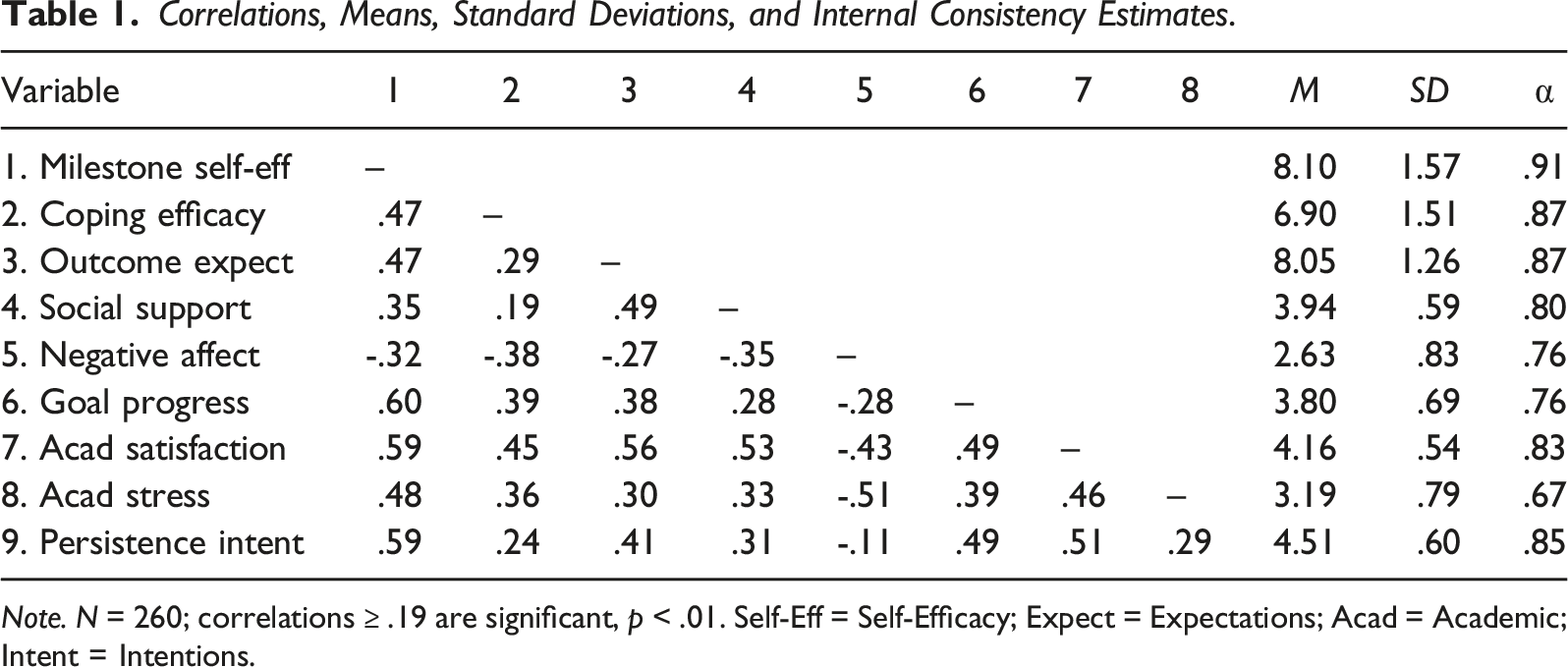
Note. N = 260; correlations ≥ .19 are significant, p < .01. Self-Eff = Self-Efficacy; Expect = Expectations; Acad = Academic; Intent = Intentions.
Measurement and Structural Model Analyses
In order to test the theoretical model at the latent variable level and reduce the number of parameter estimates in relation to sample size, we used Little et al.’s (2013) balancing method to create three item parcels representing each variable. In particular, the items of each scale were subjected to single factor exploratory factor analyses using principal axis factoring and oblimin oblique rotation. Items were then assigned to parcels based on the relative size of their factor loadings. For example, the items with the highest and lowest loadings on a given factor are paired together in the first parcel, the next highest and next lowest loading items are paired in the second parcel, and so forth. Measurement and structural model tests were conducted with the MLM estimation procedures of Mplus 8.6 (Muthén & Muthén, 1998–2019). Hu and Bentler (1999) have suggested use of a 2-index criterion for assessing adequacy of model-data fit: SRMR ≤.08 in conjunction with RMSEA ≤ .06 or CFI ≥.95. Other writers have suggested somewhat more liberal criteria, such as CFI values ≥.90, as indicating adequate fit (Weston & Gore, 2006).
We first performed a set of measurement model tests to assess the parcel-factor loadings and relationships among the constructs. The target measurement model assumed that a correlated 9-factor model would provide good fit to the data. Results were consistent with this assumption: SRMR = .06 and RMSEA = .06, 90% CI (.05, .06), though CFI (.93) was < .95; Satorra-Bentler (S-B) χ2
We also tested an alternative measurement model to further examine the distinctiveness of particular theoretical variables. Namely, a 6-factor model was tested in which the milestone self-efficacy, goal progress, and intended persistence parcels, each of which involve perceptions of academic behavior (i.e., future performance capabilities, current academic progress, future academic intentions), were all set to load on a common academic performance perceptions factor and the other variables were modeled as before (i.e., as distinct but correlated factors). This model produced less optimal fit indices (SRMR = .07, RMSEA = .08, 90% CI [.07, .09], CFI = .86; S-B χ2 = [303] = 781.85, p < .001) and fit the data significantly less well than did the 9-factor model, ΔS-B χ2 = 203.18 (15), p < .001. These results suggest that milestone self-efficacy, goal progress, and persistence intentions comprise distinct though related constructs. Therefore, their interrelations are not likely to merely reflect linked measurement procedures.
We next performed a structural model analysis to test the hypothesized paths among the constructs. This analysis indicated that the target model offered adequate fit to the data, SRMR = .06, RMSEA = .06 (90% CI [.05, .07]), CFI = .93, S-B χ2 (293) = 544.70, p < .001. The structural path coefficients, shown in Figure 2, offered support for most of the hypothesized relations among the variables. (Note that self-efficacy and well-being are both shown in single ovals for visual simplicity in the figure; each of them was, in fact, modeled with two distinct latent factors in the analyses.) In particular, milestone self-efficacy was, as expected, predicted by both support and negative affect and was, in turn, predictive of outcome expectations, perceptions of academic goal progress, both indicators of well-being (satisfaction and low levels of stress), and intended persistence. However, coping efficacy, outcome expectations, and goal progress were not as consistently linked to the other variables. For example, coping efficacy was uniquely predictive of satisfaction but not of outcome expectations, goal progress, or level of stress. Moreover, coping efficacy yielded a significant but negative path to persistence intentions, which was likely due to statistical suppression (i.e., there was a positive relation between the two variables at the bivariate level in the measurement model test, but the coping efficacy-persistence intention relation became negative in the presence of the other predictors). Structural path coefficients for the full sample. Note. ASE = Academic Self-Efficacy; CSE = Coping Self-Efficacy; Sat = Satisfaction; Str = Stress. Self-efficacy and well-being were each modeled as two separate latent factors; they are shown in single ovals here to avoid visual clutter. *p < .05.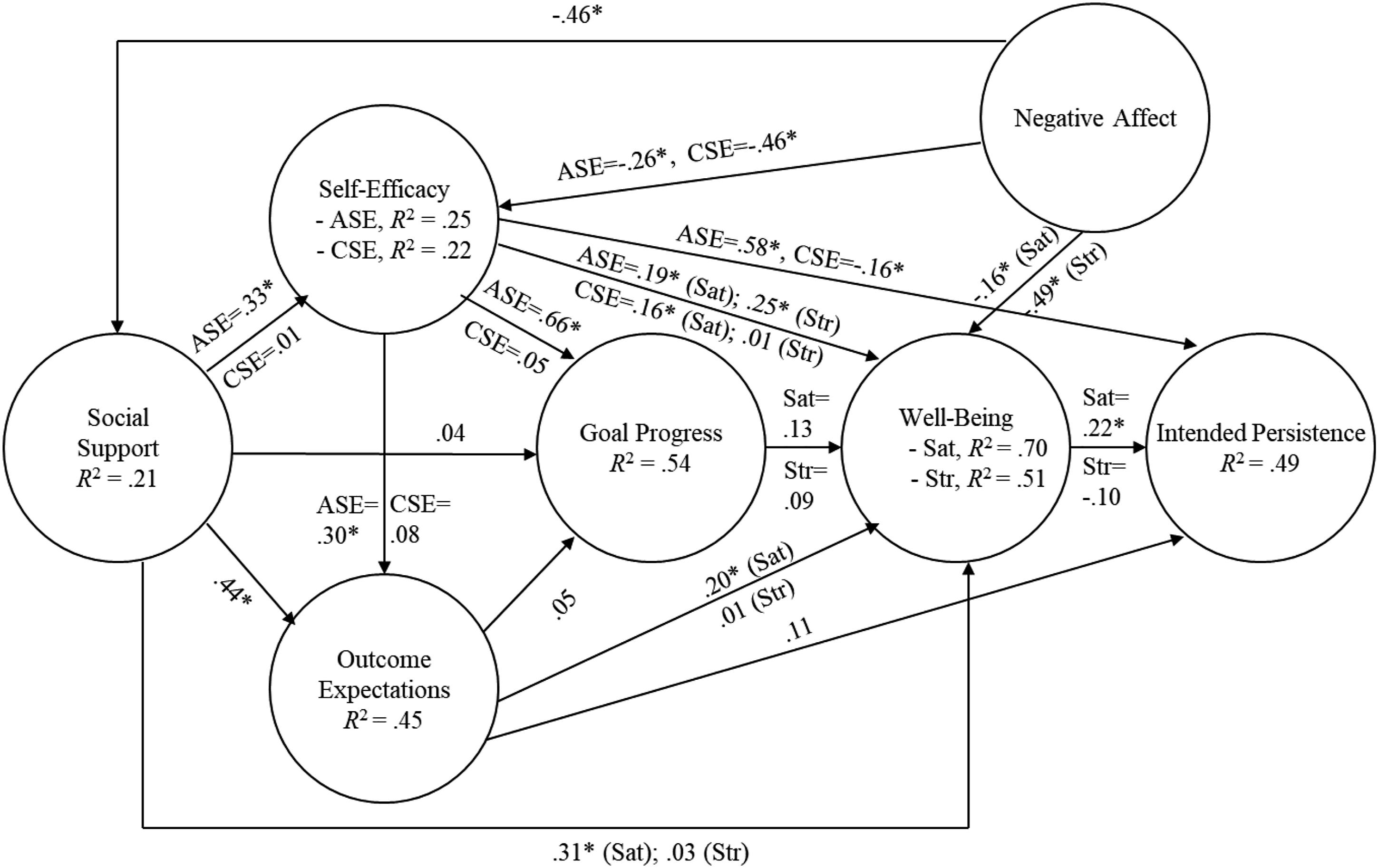
Contrary to expectations, goal progress did not uniquely predict either indicator of well-being; and satisfaction, though not stress, significantly predicted persistence intentions. Negative affect contributed, as expected, to the prediction of both satisfaction and stress; it was also linked to perceptions of support and to both forms of self-efficacy, with higher levels of negative affect associated with lower levels of perceived support and less favorable perceptions of academic capabilities and coping efficacy. Support was linked to satisfaction but not stress. On balance, the predictors accounted for substantial amounts of the variance in satisfaction (70%), stress level (51%), and intended persistence (49%).
We also tested an alternative structural model, examining the possibility that goal progress contributes directly and uniquely to the prediction of persistence intentions. This additional direct path seemed plausible because goal progress may function as a proxy for past academic success, which has been linked to academic persistence in engineering students. This model variation also produced adequate fit to the data: SRMR = .06, RMSEA = .06 (90% CI [.05, .06]), CFI = .93, S-B χ2 (292) = 535.23, p < .001. In fact, it provided significantly better fit (ΔS-B χ2 = 6.56 [1], p < .05) and accounted for 3% more of the variance in intentions than did the target model; the goal progress to persistence intentions path coefficient was .32 (p < .001).
Discussion
The current study addressed a theoretical and practical need to better understand the academic adjustment of undergraduate music majors – a portion of the college population that has been understudied within career development research, despite their high level of major turnover change. As in prior research with STEM majors (e.g., Lent et al., 2016) and sexual minority students representing a variety of academic majors (Morris & Lent, 2019), we examined academic persistence intentions using theoretical elements adapted from SCCT’s well-being and choice models. Our central hypotheses were that intentions to remain in music would be predicted by students’ domain satisfaction, low levels of stress, self-efficacy regarding academic milestones and coping capabilities, and outcome expectations. We also examined the predictors of domain satisfaction and stress, as posited by the well-being model (Lent, 2004).
Our findings offered support for a measurement model representing the SCCT predictor and outcome variables as nine distinct but interrelated constructs. Results of a structural model test offered general support for the hypothesized paths among the constructs. In particular, music students were more likely to intend to persist in their degree programs to the extent that they felt satisfied with the environment of their major and perceived themselves as efficacious at meeting its academic and music requirements. Though not many prior studies have examined the linkage of satisfaction to persistence intentions using an SCCT framework, there has been a good deal of research linking self-efficacy beliefs both to academic satisfaction (Sheu et al., 2020) and to academic persistence intentions (Lent et al., 2015). Our findings add to the literature by suggesting the utility of SCCT as a framework for understanding the satisfaction and persistence intentions of music students, extending inquiry that has largely focused either on STEM students or more heterogeneous samples of college majors.
Contrary to hypotheses, persistence intentions were not uniquely predicted by outcome expectations or by perceived stress. It may be that music students’ outcome expectations are dampened by an understanding of the career challenges that may lie ahead in their pursuit of a music career and that they are also well aware of the stresses that accompany music performance requirements. For these reasons, outcome expectations and stress levels may not function as uniquely useful predictors of persistence goals. Rather, motivation to persist in music may be aided more by satisfaction with one’s engagement in the music environment and, even more so in our sample, by a strong sense of efficacy in one’s capability to succeed as a music major. These interpretations are offered tentatively, subject to future replication and extension efforts.
In addition to the prediction of persistence intentions, we examined the network of variables predicting music majors’ well-being, as indexed by satisfaction and perceived stress. Satisfaction was well predicted by both milestone and coping self-efficacy as well as by outcome expectations, the experience of social support, and low levels of negative affect. Stress, on the other hand, was predicted substantially by negative affect and significantly, but more modestly, by milestone self-efficacy. In other words, there were fewer notable predictors of stress than of satisfaction, but milestone self-efficacy and negative affect were predictive of both outcomes. Satisfaction and stress both involve representations of affective experiences, and both have been linked to measures of trait negative (and positive) affect in prior research on the SCCT well-being model (Sheu et al., 2020).
Contrary to meta-analytic findings (Sheu et al., 2020), prior goal progress was not uniquely predictive either of satisfaction or stress in our sample after controlling for the other predictors. It is not clear to what extent this lack of predictive utility may be due to the unique features of music majors’ academic experiences, characteristics of our sample, or other methodological considerations. However, it is noteworthy that, in testing our alternative structural model, we observed that goal progress did produce a significant unique path to persistence intentions. It may, therefore, be that perceptions of past goal progress as a music major offer a valuable additional motivator for continuing in the music curriculum, above and beyond the motivation provided by milestone self-efficacy and domain satisfaction. Students may reason that their prior progress is likely to betoken future success at degree completion.
Finally, relations among the predictors of well-being and persistence intentions were generally consistent with predictions. For example, negative affect was significantly related to both forms of self-efficacy and social support, with lower levels of negative affect associated with higher self-efficacy and support. Likewise, outcome expectations were well-predicted by the combination of milestone self-efficacy and social support, and goal progress was strongly linked to milestone self-efficacy. However, paths to and from coping efficacy were generally low and non-significant, apart from the path from negative affect to coping efficacy. Thus, although coping efficacy did contribute uniquely to satisfaction, its predictive contribution to the model was generally more modest than was that of milestone self-efficacy.
Limitations and Directions for Research and Practice
Efforts to interpret and generalize the findings should be mindful of several limitations. First, the study’s cross-sectional, correlational design precludes the ability to make causal inferences. Use of longitudinal models, especially cross-lagged designs, could lead to more accurate understanding of the temporal interplay among the predictor and dependent variables. Second, in an effort to enhance the domain specificity of the assessment, we used slightly tailored social cognitive measures to accommodate the music performance context. Though such modifications are fairly common in SCCT research, and though our measurement model test produced adequate fit to the data, it would be useful to assess the measures’ psychometric properties, including their temporal stability, in future research. Parenthetically, we should note that one of our measures, the Perceived Stress Scale, yielded an alpha coefficient slightly below .70. However, latent variable modeling offered a control for measurement unreliability.
Third, the measures all relied on self-report, raising concerns about mono-method and mono-source bias. While most of the constructs we studied, like self-efficacy, are expressly designed to capture participants’ experiences and expectations from their own perspectives, it would be useful to study behavioral outcomes that are assumed to follow from the well-being and choice models, such as actual (vs. intended) persistence in music majors (cf. Lent et al., 2016). Fourth, the study is subject to self-selection bias. Undergraduate music majors were recruited through social media and email solicitation, which may have produced a sample that is relatively highly invested in their pursuit of a music degree. This may have accounted for the non-normal distributions of the milestone self-efficacy, outcome expectations, academic satisfaction, and intended persistence scores.
Fifth, other features of the sample should be noted, such as inclusion of students from a wide range of music majors and types of educational institutions, yet limited representation of students from particular racial/ethnic minority groups. Though sample heterogeneity may be useful in initial research applications of the social cognitive model, it would be useful to study the model’s utility in particular subgroups of music students, such as racial/ethnic minorities and those enrolled in music conservatories. It should be noted that our sample consisted of only 6.2% conservatory music students. Relative to college and university settings, conservatories tend to provide a greater focus on music performance, to place less emphasis on general education, to be more competitive, and to attract students who begin their musical study earlier in life (Valenzuela et al., 2020) and report higher self-efficacy for musical learning (Ritchie & Williamson, 2012).
Our study’s focus on freshman and sophomore students (the years in which core music classes are typically scheduled) was intended to allow a focus on the common educational experiences of music majors. At the same time, our sample included a variety of music majors, such as music education (i.e., teaching), music therapy, and music performance. While these majors typically include such common elements as music theory, private lessons, and ensemble requirements, they may also attract students with a wide range of characteristics, capabilities, and expectations. Another source of variability involves students’ choice of instrument, which may introduce differential levels of stress and competitiveness (e.g., orchestras employ many more string players than pianists; voice majors often contend with the stress of vocal fatigue). Finally, this study was conducted during the COVID-19 pandemic, which may have exacerbated students’ levels of stress, reduced normal sources of peer and faculty support, posed barriers to music rehearsal and, perhaps, diminished satisfaction with the educational experience.
Despite these limitations, the current study is noteworthy in its focus on a relatively malleable set of predictors that could be used to inform interventions to facilitate the academic well-being of music students. For example, interventions could be designed to increase self-efficacy for academic milestones (e.g., passing juries and recital requirements), with a focus on relevant sources of self-efficacy beliefs. Such experiential sources might include exposure to coping models, provision of mastery experiences (and attention to how they are processed cognitively), and efforts to reduce excessive performance anxiety (Lent et al., 1994). The results also highlight the potential of interventions aimed at promoting social support and positive yet realistic outcome expectations.
In sum, this study advances the literature on SCCT by focusing on students preparing to enter music careers – an understudied and under-appreciated group that is central to American cultural life. Our findings suggest that the hybrid social cognitive model we employed may help to explain the well-being and persistence intentions of students at a formative stage in their career journey. We hope this study will help to spark additional research, using SCCT and other theoretical perspectives, aimed at better understanding and supporting the educational and career development of musicians. It would be especially useful to extend career theory to study of the well-being and career adjustment of professional musicians and those in allied music careers (e.g., music therapy, music education) subsequent to graduation and formal career entry.
Footnotes
Declaration of Conflicting Interests
The author(s) declared no potential conflicts of interest with respect to the research, authorship, and/or publication of this article.
Funding
The author(s) received no financial support for the research, authorship, and/or publication of this article.
Author note
This article is based on the first author’s master’s thesis, performed under the second author’s supervision.
