



Abstract
While research has identified a five-factor model of career decision-making difficulty based on meta-analytical evidence and cross-cultural comparison, the field lacks an elaborated theoretical account of the joint operation of the five decision difficulties. The current study drew on the dual-process theory of career decision-making (DTC) to examine the interplay of the five decision difficulties in predicting career decidedness in the Chinese context. Study 1 developed and validated measures of decision ambiguity, advance in narrowing down, and career decidedness in a sample of Chinese college students (n = 180). Study 2 examined the structural model using another sample of Chinese college students (n = 408). Focusing on the relations of the five major decision difficulties to career decidedness, the results did not support the standalone mechanism of confusion management but supported the standalone mechanism of ambiguity management. Additionally, the results supported the crossover mechanism from confusion management to ambiguity management and the crossover mechanism from ambiguity management to confusion management. The results not only shed light on the role of each difficulty but also offer evidence for the interplay of key DTC macro elements. The practical implications based on the joint operation of the five decision-making difficulties are discussed.
Career decision-making, which denotes a process of choosing one’s educational or occupational area, is a central developmental task (Gati & Kulcsár, 2021; Xu, 2021a). However, this process is challenging, particularly for adolescents and young adults (Kulcsar et al., 2020; Xu & Bhang, 2019). Recently, Xu and Bhang (2019) synthesized the literature about career decision-making difficulties and revealed five major decision-making difficulties across cultural contexts. Although this five-factor model has strong empirical underpinnings, it was mainly derived from empirical exploration and lacks a theory-based explanation of how these five factors interact with one another in the career decision-making process. However, the joint operation of the five difficulties in the entire decision process is an important area for the theory and practice of career decision-making because it not only explains how the five difficulties affect the career decision-making process but also illuminates why the five difficulties are particularly important. Although research has explored the issue (Lent et al., 2019) based on social cognitive career theory (SCCT; Lent & Brown, 2013), SCCT does not focus on specifying the career decision-making process. By contrast, the dual-process theory of career decision-making (DTC; Xu, 2021a; 2021b) delineates the arrangement of key components in the career decision-making process and likely can better explain the joint operation of the five decision difficulties. Thus, based on the DTC, the focus of the present study was to specify and examine the interrelated roles of the five decision-making difficulties in predicting a key marker of the career decision-making process, career decidedness, in the Chinese context.
Career decision-making in China was historically directed by family interests, gender-/class-related norms, and national needs (Xu et al., 2014). Although this process is still subject to family and social expectations, it increasingly values and allows for individual agency, which is likely attributable to China’s Westernization and economic growth in recent decades (Hou & Leung, 2011; Xu et al., 2022). Like their counterparts in developed Western countries, Chinese students face common decision-making difficulties, such as general anxiety, need for information, and a lack of motivation. However, the collective decision-making process, rapid socioeconomic transformation, and relatively low income per capita in China could elevate difficulty in reconciling conflicting voices and in understanding complex and unpredictable vocational information (Xu et al., 2022). Thus, career decision-making has been an important and challenging task for Chinese students, and understanding the interplay of decision-making difficulties also has important practical implications.
Career Decision-Making Difficultiess
Although career decision-making has been widely acknowledged as an important developmental task, it is a difficult, if not daunting, process due to situational and inherent challenges (Kulcsar et al., 2020; Xu & Bhang, 2019). To help people handle such difficulties and facilitate their career decision-making, the field has devoted great effort to identifying major decision-making difficulties and developing related assessment tools. While past research identified decision-making difficulties based on different theoretical focal areas, such as in the Career Decision Difficulties Questionnaire (CDDQ; Gati et al., 1996) and the Emotional and Personality Career Difficulties Scale (EPCD; Saka et al., 2008), more recent research began to extract and summarize key decision-making difficulties based on existing research to pursue a comprehensive and yet parsimonious taxonomy of career decision-making difficulties. The pursuit of such a comprehensive taxonomy evolved through the development of the Career Indecision Profile (CIP; Brown et al., 2012; Brown & Rector, 2008) and currently arrived at an integrative five-factor model (Xu & Bhang, 2019).
In the development of the CIP model, Brown and colleagues (Brown et al., 2012; Brown & Rector, 2008) used powerful meta-analytic strategies to extract decision-making difficulties and revealed a four-factor structure in the U.S. Their four-factor model consists of neuroticism/negative affectivity, choice/commitment anxiety, lack of readiness, and interpersonal conflicts. Among the four factors, neuroticism/negative affectivity refers to general negative affect and emotional instability; choice/commitment anxiety refers to difficulty in committing to a single career choice; lack of readiness refers to a tendency to disengage from the career decision-making process; and interpersonal conflicts refer to disagreement from important people in life. However, research has shown a cross-cultural variation of the CIP model across Western and Eastern contexts in that while the four-factor model holds in Western contexts (e.g., Italy and Iceland; Abrams et al., 2013; Carr et al., 2014), a revised five-factor CIP model, which separates choice/commitment anxiety into need for information (or lack of information) and choice/commitment anxiety, is more valid in Eastern contexts (e.g., South Korea and China; Abrams et al., 2014; Roche et al., 2017). Recently, Xu and Bhang (2019) summarized the literature progress pertaining to career decision-making difficulties and particularly compared the CIP, the CDDQ, and the EPCD models. Based on their conceptual comparison and empirical reanalysis, they concluded that the revised five-factor CIP model could serve as a normative taxonomy of career decision-making difficulties, while the original four-factor CIP model represents a parsimonious version of the five-factor model specific to Western contexts.
Although the five-factor model comprehensively captures important career decision-making difficulties, it heavily relied on empirical data to extract underlying difficulties, which is not without limitations. One of the most important limitations concerns the model’s limited theoretical capacity in delineating the interrelationships of the five difficulties. In other words, it remains unclear how these five difficulties interact with one another in the career decision-making process. Without knowing their interrelated roles, decision-makers and practitioners hardly know (1) the direct causes and consequences of each difficulty and (2) when they should focus on which difficulty. Essentially, Xu and Bhang’s (2019) integrative model sheds light only on the separate roles (as opposed to the joint operation) of the five difficulties, which limits the systematicity and depth of counseling and educational practice on career decision-making. To be fair, research has taken an initial step to address the theoretical limitation of the five-factor model of career decision-making difficulties. Specifically, Lent et al. (2019) adopted the career self-management model of SCCT (Lent & Brown, 2013) to explain the joint operation of the original four factors of the CIP model in the U.S. and supported the utility of a SCCT-oriented model in explaining the roles of the four difficulties relative to one another in career decision-making.
However, one could argue that SCCT is mainly focused on predicting decision-making outcomes through social cognitive mechanisms as opposed to describing the interaction of key component within the career decision-making process. One notable consequence is that the SCCT-oriented model essentially centers only on one difficulty (i.e., lack of readiness, which operationally refers to a lack of decision self-efficacy) with other factors as either background predictors or outcomes. In other words, although the SCCT-oriented model successfully mapped major difficulties on a theory, its theoretical account of the joint operation of these difficulties does not fully specify their roles in the key components of career decision-making. This level of role specificity regarding decision difficulties was helpful when no such theory-oriented models existed but certainly can be improved for a more nuanced understanding of how major decision difficulties interact with one another in career decision-making. To date, several key theoretical and practical questions remain unclear. For example, why are the five difficulties identified in Xu and Bhang’s (2019) model particularly important? How can alleviating one difficulty impact other difficulties? Thus, to enhance counseling and educational practice that focuses on alleviating career decision-making difficulties, it is imperative to use a theoretical framework that focuses more heavily on the career decision-making process to examine the joint operation (as opposed to separate roles) of the five major decision difficulties. This was the purpose of the current study.
Viewing Difficulties within the Dual-Process Theory of Career Decision-Making
We draw on the dual-process theory of career decision-making (DTC; Xu, 2021a; 2021b) to conceptualize the interrelationships of the five difficulties in the career decision-making process because this theoretical framework offers an elaborated account of key processes in career decision-making. The DTC resulted from a synthetical and critical reflection of the career decision-making literature (Blustein et al., 2019; Krieshok et al., 2009; Lent & Brown, 2020; Savickas, 2015). While Parsons’ (1909) three-step model (including its contemporary derivatives, such as Gati and colleagues’ prescreening, in-depth exploration, choice model; Gati, 2013) continues serving the field as a guiding framework, a growing body of literature has drawn attention to the limitations of the Parsonian framework in the current psychosocial context of career decision-making. Xu (2021b) outlined three key challenges that conflict with Parsons’s model’s implicit goal (i.e., a clear optimal career choice). First, individuals hardly have full psychological capacity and complete information to compute the best choice. Second, residual, but very real, social suppressive structures in the world of work compromise individual volition and create dilemmas. Last, the digitalization of work has been changing occupational profiles and employment arrangement, which elevates future unpredictability. All these challenges highlight a fact that is underrecognized by the Parsonian framework: decision uncertainty regarding which educational or occupational direction is the “right” one cannot be practically eliminated. Based on this new premise, the DTC highlights differentiating and managing two types of uncertainty: state uncertainty that can be removed (termed confusion) and inherent uncertainty that cannot be removed (termed ambiguity).
Following the establishment of the theoretical framework of the DTC, Xu (2021a) proposed a predictive model of the DTC (see Figure 1), which involves confusion and ambiguity management as two key blocks linking psychosocial backgrounds of career decision-making to decision-making outcomes. The predictive model in its entirety addresses both the content and process levels of career decision-making; however, we focused on the process aspect of this model because decision-making difficulties mainly interfere with the decision progress. In each confusion and ambiguity management, the predictive model highlights two precipitating factors and an intermediate outcome. In confusion management, the predictive model highlights the adequacy of decision information and the adaptiveness of the approach to matching information (termed matching orientation) as precipitating factors for advance in narrowing down career options. In ambiguity management, the predictive model highlights the extent of decision ambiguity and the adaptiveness of the approach to reduce the threat of ambiguity (termed containing orientation) as precipitating factors of reactions toward commitment. The two distinct intermedia outcomes, advance in narrowing down and reactions toward commitment, reflect the distinction between confusion and ambiguity management in that while narrowing down options can be achieved through effective information collection and processing, commitment entails a higher level of exclusivity in the decision product and cannot be achieved without processing the inevitable ambiguity. Predictive Model of Dual-Process Theory.
Notably, according to the DTC (Xu, 2021a; 2021b), confusion and ambiguity management both uniquely contribute to final decision-making outcomes (e.g., decidedness) because they address two distinct, integral components of career decision-making. However, they could also influence each other in that the information foundation established in confusion management helps reduce distress in computing ambiguity, while tolerance of ambiguity helps motivate people to accumulate and process information in confusion management. Therefore, focusing on the two macro management components, the DTC further establishes four propositions to describe their standalone and reciprocal effects: (1) confusion management is a key process affecting decision outcomes, (2) ambiguity management is a key process affecting decision outcomes, (3) confusion management affects ambiguity management, (4) and ambiguity management affects confusion management. Xu (2021a) reviewed decades of research on career decision-making and found that while evidence for different parts of the predictive model varies in terms of strength, the validity of the predictive model is generally supported.
Based on the predictive model of the DTC, we mapped major decision-making difficulties on key career decision-making components (see Figure 2). Notably, we focused on the five difficulties identified in Xu and Bhang’s (2019) integrative indecision model because the current research focused on the Chinese context. We viewed lack of readiness, neuroticism/negative affectivity, and interpersonal conflicts as motivational, emotional, and interpersonal challenges, respectively, that compromise the psychosocial foundation of career decision-making. However, while lack of readiness and neuroticism/negative affectivity likely build maladaptive foundations for both confusion and ambiguity management, interpersonal conflicts likely interfere mainly with ambiguity management because it could directly elevate lingering uncertainty about the “right” choice but does not necessarily limit the extent of information collection. Because need for information/lack of information indicates the inadequacy of decision information, it represents an important aspect of decision information that forecasts advance in narrowing down. Together, need for information/lack of information and advance in narrowing down fall within confusion management of the DTC. Last, commitment/choice anxiety represents negative reactions toward choice commitment, which could result from elevated decision ambiguity. Together, decision ambiguity and commitment/choice anxiety fall within ambiguity management of the DTC. Notably, none of the five difficulties addresses how individuals match information or regulate ambiguity; thus, they do not tap into matching or containing orientations. Dual-Process Model of Decision Difficulties with Standardized Coefficients.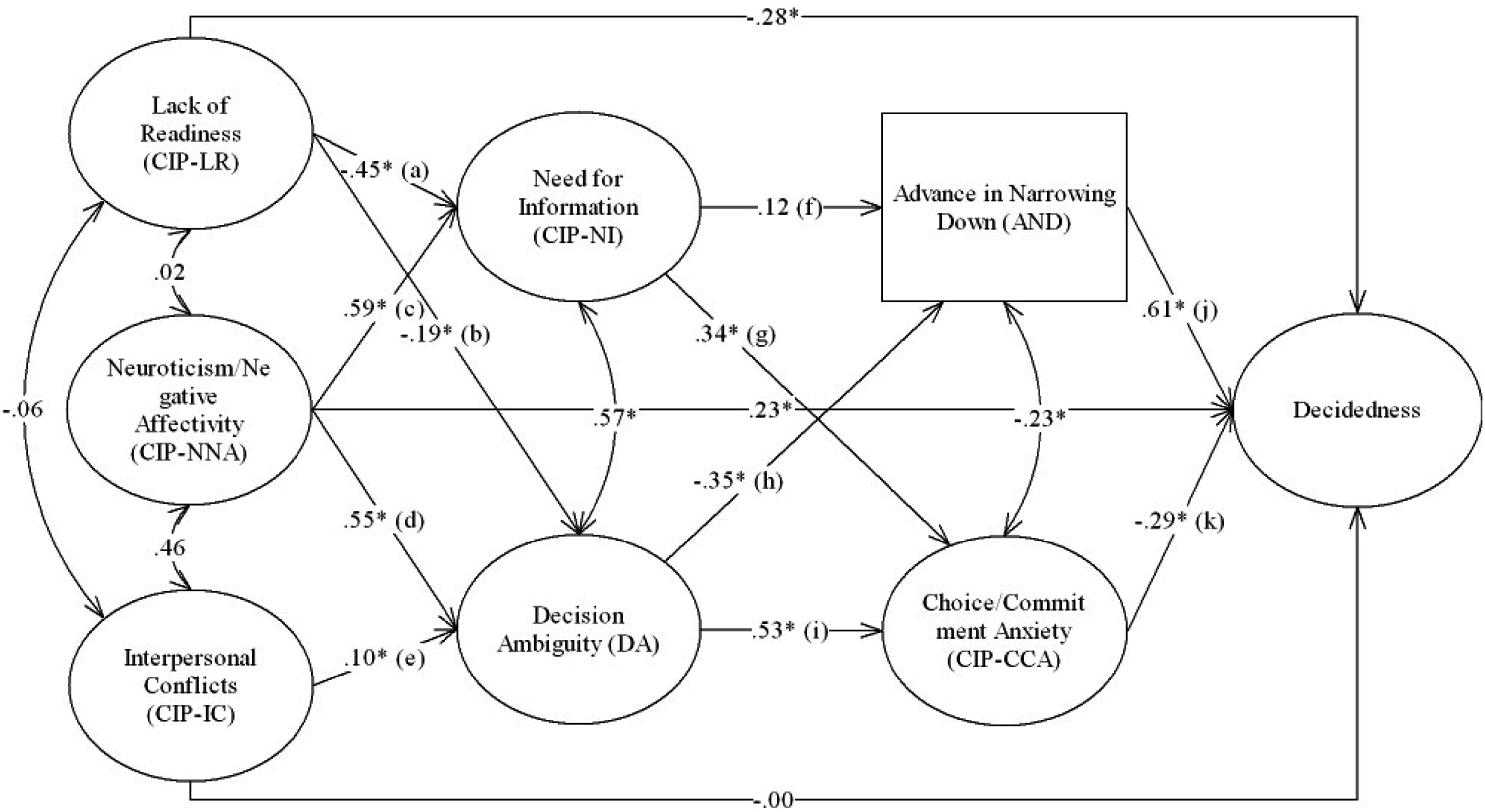
Based on the correspondence between the five difficulties and the DTC predictive model, we drew on the four propositions of the DTC and proposed a structural model regarding the interplay of the five difficulties. Concerned with the standalone mechanisms of confusion and ambiguity management, we hypothesized that (Hypothesis 1) lack of readiness and neuroticism/negative affectivity negatively predict career decidedness sequentially through need for information and advance in narrowing down (Paths a and c→f→j) and (Hypothesis 2) lack of readiness, neuroticism/negative affectivity, and interpersonal conflicts negatively predict career decidedness sequentially through decision ambiguity and choice/commitment anxiety (Paths b, d, and e→i→k). Concerned with the crossover mechanisms of confusion and ambiguity management, we hypothesized that (Hypothesis 3) lack of readiness and neuroticism/negative affectivity negatively predict career decidedness sequentially through need for information and choice/commitment anxiety (Paths a and c→g→k) and (Hypothesis 4) lack of readiness, neuroticism/negative affectivity, and interpersonal conflicts negatively predict career decidedness sequentially through decision ambiguity and advance in narrowing down (Paths b, d, and e→h→j). Because there is no measure for decision ambiguity and there are no Chinese measures for advance in narrowing down and career decidedness, we first developed and validated Chinese measures of decision ambiguity, advance in narrowing down, and career decidedness in Study 1. In Study 2, we examined the hypothesized structural model, which includes four hypothesized mediation mechanisms and residual, direct predictions of background predictors for career decidedness.
Study 1. Scale Development and Validation
Study 1 validated the Chinese measures of decision ambiguity, advance in narrowing down, and career decidedness using well-established Chinese measures of career indecision and career decision-making self-efficacy. Career indecision and decision-making self-efficacy were chosen because they are important components in career decision-making and are theoretically expected to be associated with decision ambiguity, advance in narrowing down, and career decidedness.
Methods
Participants and Procedures
The study participants consisted of 180 college students from a university in Beijing, China with a mean age of 20.86 years (SD = .89). Of the participants, 29.4% (n = 53) identified as man, 68.9% (n = 124) identified as woman, and 1.7% (n = 3) identified as gender nonbinary. They reported an array of academic majors, including business and finance, accounting, data science, and information technology. In terms of social economic status (SES), they indicated a mean of 4.70 (SD = 1.70) on a ladder representing SES in China, which ranges from 1 (worst off) to 10 (best off). After obtaining institutional review board approval, we disseminated an online survey that included demographic questions and research questionnaires in the Chinese university. We invited voluntary college students to participate. All participants’ responses remained confidential and anonymous.
Measure
Decision ambiguity
We developed the Decision Ambiguity Scale (DA; in Chinese) to measure the extent to which participants experienced ambiguity in career decision-making. Following Worthington and Whittaker’s (2006) recommendation, we developed items of the DA first based on a review of relevant literature on career decision-making and ambiguity management, particularly the Career Decision Ambiguity Response Scale-Revised (CDAR-R; Xu & Tracey, 2015, 2017). The CDAR measures evaluations of and responses to decision ambiguity that results from informational inaccessibility, complexity, inconsistency, and unpredictability. Although there are four domains of ambiguity, research has shown that individuals did not perceive the four ambiguity domains as separate entities; rather, their ratings were grouped by the nature of responses to ambiguity (e.g., preference, acceptance, and aversion; Xu & Tracey, 2015, 2017). Thus, while we borrowed 12 descriptions of the four domains of ambiguity in the CDAR and developed four additional items (to enhance content representativeness), we anticipated a unidimensional structure in the DA. Using the CDAR descriptions of ambiguity helped strengthen the content validity and representativeness of the DA. The final scale comprised 16 items in total and four items for each domain of ambiguity. We deemed this number of items appropriate due to the expected unidimensional structure of the scale and the common scale length for a unidimensional brief scale in the field (Tracey, 2010; Xu & He, 2022). We consulted with the developer of the CDAR-R and a career practitioner in China to ensure the comprehensibility and content adequacy of items. Example items included “Some decision-related information is just beyond my reach”, “Multiple options seem equally appealing to me”, and “Things related to my decision making cannot be predicted clearly.” Participants rated each item on a 7-point Liker scale ranging from 1 (strongly disagree) to 7 (strongly agree). High total scores indicated greater extent of decision ambiguity.
In the current study, the DA had an alpha coefficient of .87, supporting the interconnections of ambiguous scenarios. We additionally conducted exploratory factor analysis (EFA) using principal axis factoring. Although eigenvalues suggested a four-factor structure, this four-factor structure did not correspond to the four domains of ambiguity, exhibited moderate between-factor correlations (.35–.50), and appeared virtually uninterpretable. Thus, we opted to stick with the unidimensional structure of the DA. We examined the factor loadings of all items in the unidimensional solution and found that all items except one exhibited loadings greater than .40.
Advance in narrowing down
We used the Chinese version of the Ranges of Considered Alternatives (RCA; Saka & Gati, 2007) to measure advance in narrowing down career options. The RCA was developed to measure how far individuals have narrowed down the range of options they are considering, and participants were instructed to choose an option out of six that represents their status the best. The options vary by the scope of considered alternatives, ranging from “I do not even have a general direction” to “I am deliberating among a small number of specific careers (majors)” and to “I am already sure of the career (major) I will choose”. Although the RCA has only one item, it appeared to be the most appropriate measurement tool in the field that focuses on advance in narrowing down. Research has supported its validity in that it was positively associated with career decidedness and dysfunctional career decision-making beliefs (Hechtlinger et al., 2019; Saka & Gati, 2007). Using the standard back translation procedure, we translated the English RCA to Chinese.
Career decidedness
We used the Chinese version of a career decidedness scale that has been used in previous research (Lent et al., 2019; Xu, 2021c) to measure career decidedness. The English version of the career decidedness scale comprises three items from the career indecision literature. Two sample items were “How decided about your overall career direction are you at this point in time” (ranging from completely undecided to very decided) and “I have narrowed my career options down to a general occupational field that I intend to enter, for example, engineering, literature, or the social sciences” (ranging from strongly disagree to strongly agree). Participants rated each item on a 6-point Likert scale. Higher total scores indicated greater career decidedness. Lent et al. (2019) reported an alpha coefficient of .81 for the English version of the scale and found support for its validity in its positive association with career decision-making self-efficacy. Using the standard back translation procedure, we translated the English version of the scale to Chinese. The current study revealed an alpha coefficient of .77.
Career indecision
We used the Chinese version of the CDDQ (Hou, 2010) to validate the DA, the RCA, and the decidedness scale in the Chinese context. The Chinese version of the CDDQ was translated from the English CDDQ based on the standard translation-back-translation procedure and has been well-validated in China. The original 44-item CDDQ (Gati et al., 1996) consists of a 10-item subscale regarding lack of readiness, a 17-item subscale regarding lack of information, and a 17-item subscale regarding inconsistent information. We used the subscales of lack of information and inconsistent information in this study because the subscale of lack of readiness in the CDDQ typically showed a marginally adequate internal reliability (Xu & Bhang, 2019). Two sample items were “I find it difficult to make a career decision because I don’t know what careers will look like in the future” and “I find it difficult to make a career decision because I still do not know which occupations interest me”. Participants rated each item on a 9-point Likert scale ranging from 1 (does not describe me) to 9 (describes me well). Higher subscale scores indicated greater indecision due to the corresponding difficulty. Research has reported alpha coefficients of .93 and .91 for the two subscales and supported the validity of the Chinese CDDQ in its associations with career exploration, cultural-value conflicts, and parental expectations (Leung et al., 2011; Xu et al., 2014). The current study found alpha coefficients of .96 and .92 for the two subscales of the CDDQ.
Career decision-making self-efficacy
We used the Chinese version of the Career Decision Self-Efficacy Scale-Short (CDSE-SF; Long, 2003) as another criterion to validate the DA, the RCA, and the decidedness scale in the Chinese context. The Chinese version of the CDSE-SF was developed based on the 25-item English version of the CDSE-SF (Betz et al., 1996) and has been well-validated in the Chinese context (Guan et al., 2016; Long, 2003). The CDSE-SF measures self-efficacy for five skill domains that are deemed important for career decision-making (Betz et al., 1996). Two sample items were “Find out the employment trends for an occupation over the next 10 years” and “Choose a career that will fit your preferred lifestyle”. Participants rated each item on a 5-point Likert scale ranging from 1 (no competence at all) to 5 (complete competence). Higher total scores indicated greater career decision-making self-efficacy. Research has reported an alpha coefficient of .94 for the Chinese CDSE-SF and supported the validity of the scale in its associations with career adaptability and parental support (Guan et al., 2016; Long, 2003). The current study revealed an alpha coefficient of .93.
Results
Means, Standard Deviations, and Correlations of Variables in Study 1.

Note. N = 180; ** p < .01.
Study 2. Testing the Interplay of Decision Difficulties
Study 2 tested the hypothesized model. To strengthen the tenability of our conceptual model (particularly given the cross-sectional nature of data), we additionally examined an alternative structural model based on SCCT (see Figure 3), which features lack of readiness (operationally addresses a lack of decision-making self-efficacy) as the central mechanism explaining the predictions of the three background factors (i.e., neuroticism/negative affectivity, interpersonal conflicts, and decision ambiguity) for the intermediate outcomes (i.e., need for information, choice/commitment anxiety, and advance in narrowing down) and final decidedness. This alternative model was derived from Lent et al.’s (2019) SCCT-oriented model of career indecision and added variables new to this study. Specifically, the alternative model (1) incorporates the roles of lack of readiness, neuroticism/negative affectivity, interpersonal conflicts, choice/commitment anxiety, and decidedness in Lent et al.’s (2019) study, (2) considers decision ambiguity as a contextual variable of social cognitive learning, and (3) conceptualizes advance in narrowing down as an intermediate performance outcome following decisional agency. Alternative Structural Model.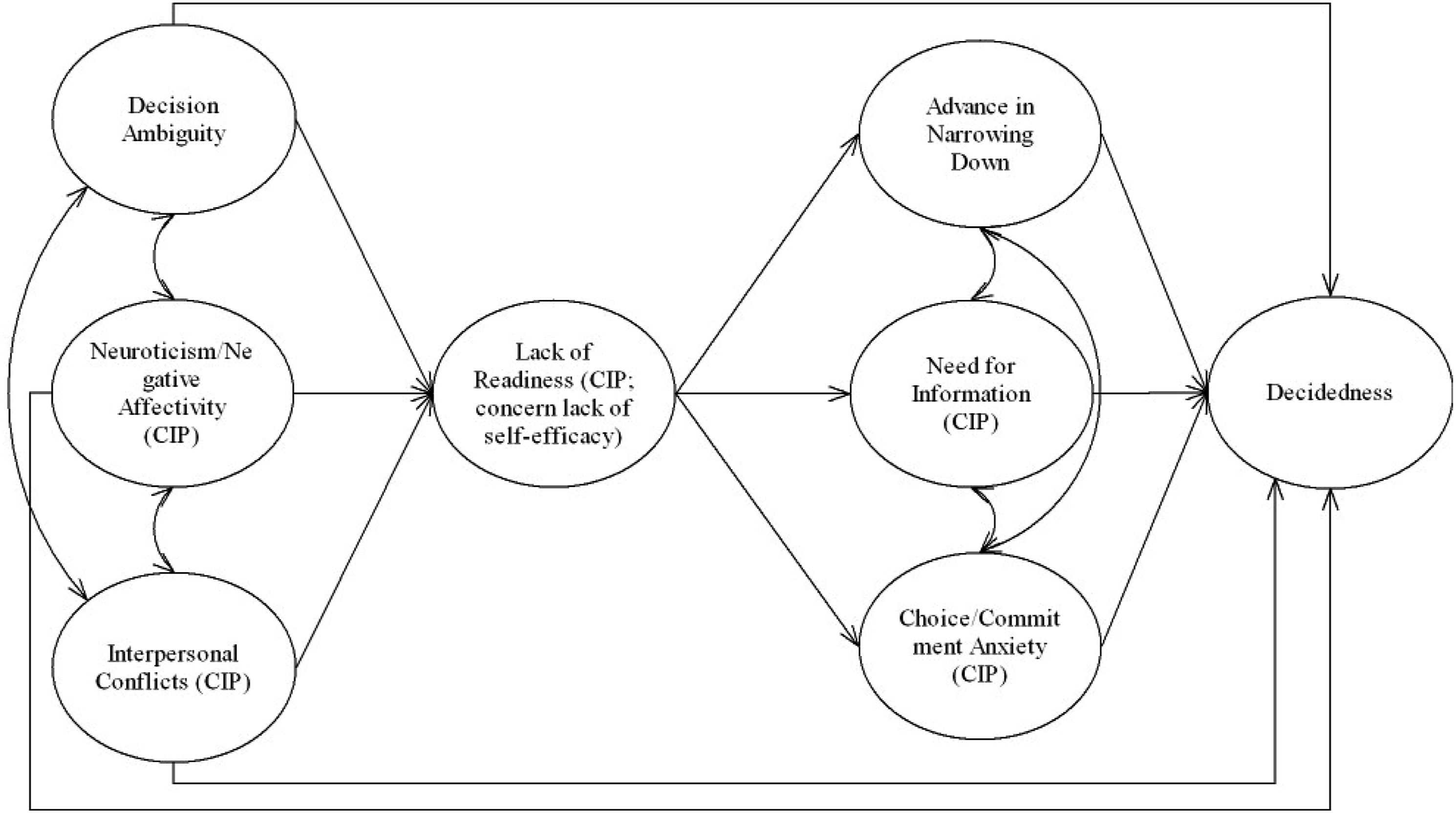
Methods
Participants and Procedures
The study participants consisted of 408 college students from universities across China with a mean age of 20.45 years (SD = 2.94). Of the participants, 29.9% (n = 122) identified as man, 69.6% (n = 284) identified as woman, and .5% (n = 2) identified as gender nonbinary. They reported a variety of academic majors, including business and finance, accounting, data science, information technology, psychology, Japanese, and law. In terms of SES, they indicated a mean of 4.86 (SD = 1.81) on a ladder representing SES in China, which ranges from 1 (worst off) to 10 (best off). After obtaining institutional review board approval, we disseminated an online survey that included demographic questions and research questionnaires through social media and professional networking in China. We invited voluntary college students to participate and offered interpretations of their career decision-making difficulty scores. All participants’ responses remained confidential and anonymous throughout the study.
Measures
Career decision-making difficulties
We used the Chinese version of the CIP-65 (Roche et al., 2017) to measure the five aspects of career decision-making difficulty: neuroticism/negative affectivity (NNA), need for information (NI), choice/commitment anxiety (CCA), lack of readiness (LR), and interpersonal conflicts (IC). The Chinese version of the CIP-65 was developed through a translation-back-translation procedure on the English, 65-item version of the CIP (Hacker et al., 2013). Sample items were “I often feel like crying”, “I need more information about occupations in which I might be successful”, “I am uncomfortable committing myself to a specific career direction”, “I will be able to find a career that fits my interests”, and “I’d be going against the wishes of someone important to me if I follow the career path that most interests me” for NNA, NI, CC, LR, and IC, respectively. Participants rated each item on a 6-point Likert scale ranging from 1 (completely disagree) to 6 (strongly agree). Higher scores indicated higher levels of difficulty. Roche et al. (2017) reported alpha coefficients ranging from .79 (IC) to .91 (CCA) in a Chinese sample and found support for the structural validity of the scale in the Chinese context. The current study revealed alpha coefficients of .94, .84, .91, .90, and .87 for NNA, NI, CCA, LR, and IC, respectively.
Decision ambiguity
We used the 16-item Decision Ambiguity Scale (DA) developed in Study 1 to measure the extent to which participants experienced ambiguity in career decision-making. In the current study, the DA had an alpha coefficient of .88.
Advance in narrowing down
We used the Chinese version of the Ranges of Considered Alternatives question (RCA) that was validated in Study 1 to measure advance in narrowing down.
Career decidedness
We used the three-item Chinese version of the career decidedness scale that was validated in Study 1 to measure career decidedness. The current study revealed an alpha coefficient of .84.
Analysis
We used latent variable structural equation modeling (SEM) in Mplus 8 to examine the hypothesized mediation model involving the five aspects of career decision-making difficulty, decision ambiguity, advance in narrowing down, and career decidedness. The latent approach to SEM enabled us to examine structural relationships free of measurement errors. Given the number of items (speaking to model complexity) and the current sample size, it was necessary to use a parceling strategy to control Type I error and ensure an adequate parameter-observation ratio (Marsh et al., 2004). The parceling strategy was also acceptable because of the unidimensional status of all the variables (see the structural analyses regarding the CIP and our pilot EFT regarding decision ambiguity; Hacker et al., 2013; Xu & He, 2022). We used a loading-balanced approach by assigning pairs of items with opposite loading rankings to parcels (Little et al., 2002). We built three parcels for each of the five career decision-making difficulties. Similarly, we built four parcels as the indicators of latent decision ambiguity. We used the three items of career decidedness as indicators of latent career decidedness. Because the RCA has only one item, it directly entered the structural model.
Following Hu and Bentler’s (1999) and Kline’s (2015) recommendations, we employed the following criteria holistically to evaluate the model-data fit of the measurement, structural, and alternative models: robust χ2, comparative fit index (CFI) > .90, root mean square error of approximation (RMSEA) < .08, and standardized root mean square residual (SRMR) < .08. We adopted robust maximum likelihood (ML) parameter estimation in Mplus 8 to reduce the vulnerability of results to potential nonnormality. Finally, based on Cheung and Lau’s (2008) simulation research, we used a bias-corrected bootstrapping mediation analysis with 1000 replications to examine the four mediated predictive paths. The dataset reported no missing values.
Results
Means, Standard Deviations, and Correlations of Variables in Study 2.
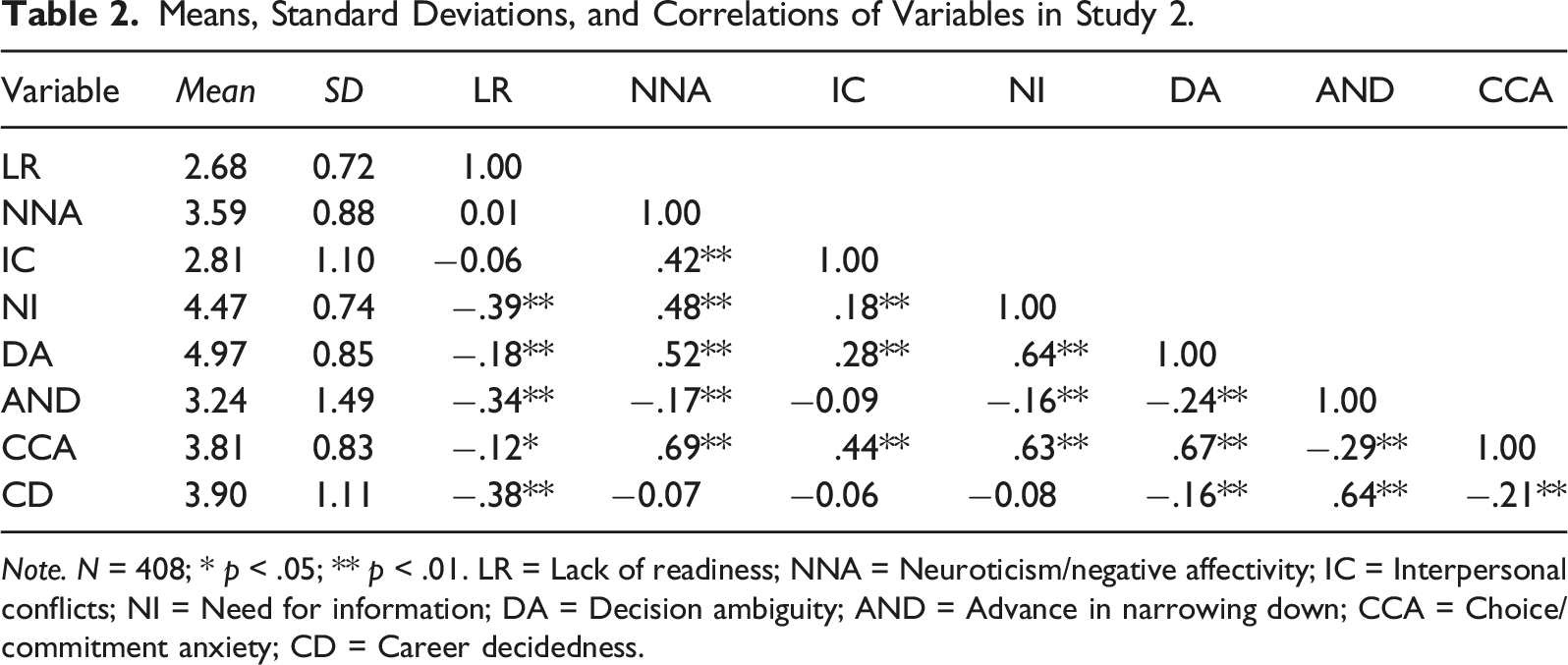
Note. N = 408; * p < .05; ** p < .01. LR = Lack of readiness; NNA = Neuroticism/negative affectivity; IC = Interpersonal conflicts; NI = Need for information; DA = Decision ambiguity; AND = Advance in narrowing down; CCA = Choice/commitment anxiety; CD = Career decidedness.
Summary of Mediation Analysis in Study 2.

Note. N = 408; * p < .05. LR = Lack of readiness; NNA = Neuroticism/negative affectivity; IC = Interpersonal conflicts; NI = Need for information; DA = Decision ambiguity; AND = Advance in narrowing down; CCA = Choice/commitment anxiety.
Discussion
To seek a theory-based explanation of the interplay of major decision-making difficulties, the current study drew on the DTC and examined a mediation model involving five decision difficulties in the Chinese context. Focusing on the relations of lack of readiness, neuroticism/negative affectivity, and interpersonal conflicts to career decidedness, the results did not support the mediation of need for information and advance in narrowing down (Hypothesis 1) but supported the mediation of decision ambiguity and choice/commitment anxiety (Hypothesis 2), need for information and choice/commitment anxiety (Hypothesis 3), and decision ambiguity and advance in narrowing down (Hypothesis 4). Contrary to our anticipation, lack of readiness positively predicted decidedness through the three supported mechanisms. These results offer rich implications for the theory, research, and practice pertaining to career decision-making in general and decision-making difficulty in particular.
The Interplay of the Five Decision-Making Difficulties
The three supported mechanisms shed important light on how the five difficulties might interact with one another in predicting career decidedness. The mediation of decision ambiguity and choice/commitment anxiety (see Hypothesis 2) suggests that individuals suffering from negative affectivity and disagreement of important people tend to encounter ambiguity in career decision-making and consequently experience anxiety in committing to a single career direction, which could hinder achieving decidedness. This finding resonates with the DTC’s proposition on the role of ambiguity management, indicating that difficulty in ambiguity management could impede career decision-making. The mediation of need for information and choice/commitment anxiety (see Hypothesis 3) suggests that individuals suffering from negative affectivity and disagreement of important people tend to encounter informational deficit and consequently experience anxiety in committing to a single career direction, which could hinder achieving decidedness. This finding resonates with the DTC’s proposition on the crossover mechanism of confusion management → ambiguity management, indicating that difficulty in confusion management could lead to difficulty in ambiguity management. The mediation of decision ambiguity and advance in narrowing down (see Hypothesis 4) suggests that individuals suffering from negative affectivity and disagreement of important people tend to encounter ambiguity in career decision-making and consequently struggle in narrowing down alternatives, which could hinder achieving decidedness. This finding resonates with the DTC’s proposition on the crossover mechanism of ambiguity management → confusion management, indicating that difficulty in confusion management could lead to difficulty in ambiguity management.
Although lack of readiness predicted career decidedness through the same three mechanisms, its predictive direction is contrary to our expectation. We anticipated positive relations of lack of readiness to need for information and decision ambiguity because lack of readiness reflects a motivational challenge in career decision-making and could give rise to challenges in the career decision-making process (Lent et al., 2019; Xu & Bhang, 2019). However, although the overall relation of lack of readiness to decidedness remained negative, the negative predictions of lack of readiness for need for information and decision ambiguity suggest that individuals suffering from a lack of decisional motivation tend to experience less informational deficit and ambiguity. Notably, this finding resonates with the negative correlation of lack of readiness and need for information in South Korea (Abrams et al., 2014). Echoing Abrams et al.’s (2014) interpretation, we speculate based on the evidence in China and South Korea that a lack of decisional motivation might defer career exploration in cultural contexts emphasizing academic performance (Lee & Larson, 2000) and consequently could prevent individuals from realizing information deficit and ambiguity. By contrast, career exploration might be a more normalized task in Western educational contexts, and elevated readiness to engage in career decision-making could help harness the benefits of exploratory activities that exist on- and off-campus. Based on the cross-cultural variation, we further suspect a generalizable curvilinear relation between decisional motivation and information deficit and ambiguity in that increasing engagement might initially exacerbate information deficit and ambiguity due to enhanced exposure to decision information but could later alleviate information deficit and ambiguity due to deepened processing of information. This motivation-oriented speculation is worth examination in the future.
The nonsignificant relation between need for information and advance in narrowing down is also interesting and somewhat counterintuitive. At the surface level, the result indicates that for Chinese college students, information deficit does not present a barrier in narrowing down career options; rather, decision ambiguity functions as a major barrier limiting the progress of narrowing down career options. It was unlikely that this finding resulted from a conceptual or empirical overlap between need for information and decision ambiguity because they both uniquely predicted choice/commitment anxiety in this study. We suspect two reasons. Conceptually, while the current study did not involve matching orientations, it is possible that matching orientations in collectivistic cultures might reduce the importance of need for information. For example, because the cultural norm of career decision-making in China emphasizes authority perspectives (e.g., parents and teachers; Xu et al., 2014), individuals might narrow down options based on authority perspectives despite that they personally experience a lack of information. It would be interesting for future research to examine this moderation mechanism. Methodologically, the current result might be attributable to the psychometric limitation of the RCA. Although the one-item RCA has shown adequate validity (e.g., Hechtlinger et al., 2019; Saka & Gati, 2007), it essentially capitalizes on one item and does not control for potential measurement error. Thus, to cross-validate the current model, one direction for future research is to refine the measure of advance in narrowing down by developing more items. Additionally, it should be noted that the RCA could be confounded by career decidedness, particularly in the last option of the RCA question. In fact, the RCA was often used to differentiate career decision status (Hechtlinger et al., 2019; Saka & Gati, 2007), which was implicitly based on the Parsonian conceptualization that narrowing down options to a single one is the normative career decision-making process. Thus, we encourage future research to refine the measure of advance in narrowing down by minimizing wording that could overlap with decidedness so that the measure can better align with the DTC.
Implications for Theory, Research, and Practice
Perhaps one of the most important implications of the current study is that it supports the correspondence between the five decision-making difficulties and the two processes in the DTC and thus sheds light on the roles of the five decision-making difficulties within career decision-making. The results suggest that lack of readiness, neuroticism/negative affectivity, and interpersonal conflicts function as psychosocial backgrounds for career decision-making, while need for information function and choice/commitment anxiety function as challenges in confusion and ambiguity management, respectively. In comparison to the SCCT-oriented models in this study and Lent et al.’s (2019) study, the current DTC-oriented model further specifies the roles of the five difficulties in the different components of career decision-making. This enhanced level of specificity regarding the roles of decision difficulties can help answer at least two questions that probably fall out of the scope of SCCT. First, the current model helps explain why these five difficulties function as major difficulties in career decision-making. As shown by this study, the five difficulties either act as motivational, emotional, or interpersonal backgrounds of career decision-making or correspond to key elements in confusion and ambiguity management. Thus, their importance is now backed by their important theoretical roles in career decision-making. Second and relatedly, the current model provides a theory-based perspective regarding what difficulty might be missing from Xu and Bhang’s (2019) integrative model of career decision-making difficulty. Notably, decision ambiguity, according to the current model, could be another major difficulty but has not been acknowledged in the integrative model. Because the integrative model (and the CIP framework; Brown et al., 2012; Brown & Rector, 2008) was primarily developed through empirical exploration and the Decision Ambiguity Scale was first developed in this study, it is no surprise that decision ambiguity does not appear in Xu and Bhang’s (2019) integrative model. However, we encourage future research to examine this construct in relation to career decision-making, which could help refine the taxonomy of career decision-making difficulty.
By anchoring the five decision difficulties in the DTC framework, the current results regarding the joint operation of the five difficulties offer additional support for the DTC. As Xu (2021a) noted in his review of evidence, past research on career decision-making tended to focus on separate sections of the DTC and fell short of examining the dynamic interplay of confusion and ambiguity managing within the decision-making background. The current study, to our knowledge, is the first in the field to investigate the interplay of all three key macro components of the DTC: psychosocial background, confusion management, and ambiguity management. Thus, moving beyond previous research, the current study offers valuable evidence for the whole structural arrangement of the DTC and directly supports the four DTC propositions regarding confusion and ambiguity management. However, it should be noted that matching and containing orientation in the DTC were not examined in this study because they do not correspond to any of the five difficulties. It would be interesting for future research to additionally include constructs related to matching and containing orientation (e.g., decision-making style and ambiguity aversion; Gati et al., 2010; Xu & Tracey, 2015) and examine a more complete DTC model.
The current study provides practical implications for career decision-making in China or more generally speaking, cultural contexts where the integrative five-factor model of decision-making difficulty holds. Given the joint operation of the five difficulties, practitioners can first consider helping individuals regulate their emotions and reconcile different perspectives to build an emotional and interpersonal foundation. Based on this foundation, helping individuals collect information and mitigate (not necessarily eliminate) ambiguity could help individuals narrow down career options and cultivate emotional readiness for commitment to a career choice. Progress in these two processes could eventually help individuals decide. This interventional flow could be implemented not only in individual counseling but also in structured group intervention. From the perspective of case conceptualization and problem solving, when individuals have trouble with a particular element (e.g., committing to a choice), practitioners can use the DTC-oriented model as a map to locate primary precipitating barriers (e.g., need for information and decision ambiguity) and identify intervention strategies. In addition, although the primary purpose of the current study was not scale development, we developed the Decision Ambiguity Scale to enable our structural examination. Given the role of decision ambiguity portrayed by this study, the new scale can function as a useful clinical tool to screen out at-risk clients/students and facilitate case conceptualization.
Limitations and Suggestions for Future Research
Several limitations need to be noted when interpreting the results. First and foremost, the current study relied on cross-sectional data to examine the hypothesized mediation model. Although the model was specified according to the DTC and examined in a comparative fashion, a cross-sectional analysis of mediation involves conceptual and methodological challenges. For example, while the mediation model implies causality, the temporal sequence of the focal constructs cannot be fully established with only cross-sectional data. Additionally, a cross-sectional examination of mediation does not always generate the same results as a longitudinal examination (Maxwell & Cole, 2007). Thus, we encourage future research to build on our initial evidence and collect multi-wave data to further examine the hypothesized structural model.
Second, the current study focused on the interplay of the five difficulties in predicting only career decidedness. While career decidedness is an important and common concern for clients, decidedness itself is not the ultimate goal of career counseling or development. Rather, helping individuals fulfill their needs and achieve career and life goals is as important as, if not more important than, helping individuals achieve decidedness. Therefore, it is meaningful for future research to expand the scope of decision outcomes and examine how decision-making difficulties interact with one another in predicting career choice, choice behaviors, and even career satisfaction. Last, while we found initial psychometric evidence for the scale of decision ambiguity in the Chinese context, it is necessary to cross-validate this scale and potential consider a cross-cultural validation of the scale in Western contexts. It is also important to note that the validity of the decision ambiguity scale could influence the results in other areas of the model as we estimated the model as a whole. Thus, more evidence about the decision ambiguity scale can help strengthen the validity of the model.
Conclusions
While research has meta-analytically revealed a five-factor model of career decision-making difficulty (Xu & Bhang, 2019), the field lacks an elaborated theoretical account of the joint operation of the five decision difficulties. The current study draws on the DTC and supports three mechanisms that link difficulties in decision-making backgrounds to career decidedness. The results not only shed light on the role of each difficulty in career decision-making but also offer evidence for the interplay of key DTC macro elements. In conclusion, the current study makes a major contribution to the theory and practice of career decision-making by explaining how the identified decision difficulties interact with one another, justifying the importance of the identified difficulties, and illuminating difficulty that might be missing from the current taxonomy.
Footnotes
Declaration of Conflicting Interests
The author(s) declared no potential conflicts of interest with respect to the research, authorship, and/or publication of this article.
Funding
The author(s) received no financial support for the research, authorship, and/or publication of this article.
