



Abstract
The development pattern of career adaptability has an important influence on individual mental health and career outcomes. Based on career construction theory, our study explored the development characteristics of the career adaptability of college students during the school-to-work transition and discussed how the notions of future work selves and core self-evaluation affect the development trajectories and development patterns of career adaptability. Our study investigated 429 college graduates at an interval of 6 months over the course of 1 year. The results indicated that the graduates had a positive career adaptability trajectory during the school-to-work transition. There were three different development patterns: rapid growth group, growth group, and stationary group. Future work selves predicted career adaptability positively and dynamically. A higher core self-evaluation predicted a higher initial level of career adaptability and a slower development speed. Our study has important implications for enriching career construction theory and career counseling practice.
Keywords
Introduction
School-to-work transition is a period during which individuals proceed through full-time education or training and finally enter into paid employment and establish themselves in a labor market career (Schoon & Bynner, 2019). The COVID-19 pandemic has put great pressure on graduates in the school-to-work transition (Donald et al., 2021; Miani et al., 2021). The lost opportunities in training (Crismon et al., 2021; Miani et al., 2021), the severe job market (Crismon et al., 2021; Wanberg et al., 2020), and the uncertainty of career development (Lechner et al., 2016) make it very difficult for college graduates to adapt to the transition from school to work. Given these conditions, graduates need to have a high level of career adaptability to cope with career changes in the school-to-work transition (Savickas & Porfeli, 2012).
Career adaptability, defined as an individual’s level of readiness and resources to cope with current and upcoming career development tasks, career transitions, and personal trauma (Savickas, 2005), is important for graduates for adapting to career transition (Koen et al., 2012). It comprises four adapt-ability resources: preparing for what may happen in the future (concern), taking responsibility for shaping self and the environment (control), thinking about the self in various situations and roles (curiosity), and having the self-efficacy to undertake activities needed to pursue aspirations (confidence) (Savickas & Porfeli, 2012). These four career adaptability resources can help individuals shape adaptive strategies and actions, to achieve adaptation goals and complete career transition (Savickas & Porfeli, 2012). Career adaptability can explain how individuals experience important career transitions, such as the school-to-work transition (Koen et al., 2012; van der Horst et al., 2021) or the transition from being employed to losing a job (Klehe et al., 2012; Konstam et al., 2015). Career adaptability is formed by the dynamic construction of individuals within their environment by the use of dynamic development and plasticity (Savickas, 2013). Individuals who constantly improve their career adaptability can deal with various difficulties when facing career transitions, and they can also make full preparations for major career challenges they may face in the future. In contrast, the decline in career adaptability may lead to stagnation in career development and depression (Shulman et al., 2014). Therefore, it is necessary to explore what development pattern exists in the school-to-work transition of college graduates’ career adaptability.
According to career construction theory, individual construction is the main process used to develop career adaptability (Savickas, 2013). On the one hand, college students’ self-awareness of vocational roles can be conveyed through the notion of future work selves. The future work self originates from the individual’s possible self, which is a positive component of the possible self about work and the concrete representation of the job created in individual minds (Strauss et al., 2012; Taber & Blankemeyer, 2015). This kind of representation may become clearer over the process of gradually gaining work experience and may provide a goal for individuals in developing their career adaptability. Therefore, future work selves may influence career adaptability dynamically.
On the other hand, the notion of capitalization can explain how core self-evaluation affects career development. Capitalization means that individuals with a positive self-concept can make better use of their advantages, realize the enlargement of their advantages, and use their accumulated advantages to achieve greater success (Judge & Hurst, 2007). Individuals with high core self-evaluation, who think highly of their abilities and values, actively seek out positive information to prove that they are competent people (Swann, 1992). And they are more likely to use the positive image generated by identity construction to develop themselves and improve their career adaptability (Li & Nie, 2010). Future work selves and core self-evaluation jointly form a steady role in helping individuals build positive selves and develop career adaptability (Guan et al., 2017; Xu & Yu, 2019). Therefore, future work selves and core self-evaluation may be important factors that affect the development of career adaptability.
Drawing on the career construction theory, the present study focused on the career adaptability development characteristics of college students during the school-to-work transition. First, our research aimed to identify the development trajectories of the career adaptability of graduates in the school-to-work transition and to distinguish latent groups by their levels of career adaptability development. Second, we analyzed the influence of future work selves and core self-evaluation on career adaptability development and class by conditional latent growth modeling and logistic regression.
Literature Review
Career Construction Theory
Career construction theory has served as a useful meta-theoretical perspective for explaining dynamics in vocational behavior across the lifespan (Savickas, 1997; 2005; 2013). The process of individual construction focuses on how individuals actively adapt to the environment and develop their initiative (Cai et al., 2015). Combined with identity and a purposeful dynamic process, individuals can construct valuable career themes for their careers (Savickas & Porfeli, 2012). For each individual, life is a grand narrative of their working life, revolving around important life themes in different environments. Individuals are self-centered in the process of their career development, play a role (self as actor), exert their initiative (acting as agents), and write career stories (self as author) (Savickas, 2013). Therefore, from the perspective of individual construction, career construction theory explains how individuals construct their careers in a dynamic environment through a unique career narrative.
To explore the process behind identity transformation, Grotevant (1987) developed the process model of identity construction, namely the identity construction framework. According to the framework of identity construction, the generation of a possible self might be an important mechanism of identity exploration, which will evolve and change during the development process (Markus & Nurius, 1986). A positive possible self reflects the inconsistency between present and future and requires individuals to develop their abilities to acquire new identities (Oyserman & Destin, 2010). The framework of identity construction interprets the process behind the transformation of identity. Through actively exploring the choice of identity and the joint action of internal and external factors, individuals finally complete the identification of identity transformation (Grotevant, 1987). Therefore, the introduction of the identity construction framework will help to analyze the development of individual career adaptability during the school-to-work transition.
Developmental Characteristics of Career Adaptability
Career adaptability is a dynamic and plastic psychological structure (Savickas, 2013; Spurk et al., 2019). Negative development or stagnation of career adaptability leads to depression, poor task performance, and low job satisfaction (Fiori et al., 2015; Haynie et al., 2020; Xu et al., 2020). Articulating developmental trends for career adaptability can predict and improve negative results (Shulman et al., 2014; Zacher, 2015). Therefore, it is of great value to explore developmental trends for career adaptability.
The school-to-work transition is a major career change faced by college students. They will experience a series of career challenges, such as identity change, the establishment of new interpersonal relationships, and adaptation to a new environment (Schoon & Bynner, 2019). Career adaptability development during this transition has an important effect on coping with career challenges and adapting to career paths (Pastore & Zimmermann, 2019).
Career adaptability may rise or fall as time progresses (Autin et al., 2017; Negru-Subtirica et al., 2015). Individuals with a high initial level of career adaptability have a downward trend in multiple dimensions, such as career curiosity and career concern (Johnston, 2018; Koen et al., 2012). Meanwhile, there are individual differences in this downward trend in different situations (Spurk et al., 2019). Factors like social status and vocational identity may affect the development and change of career adaptability. First, students with high social status are more likely to endorse higher levels of career adaptability (Autin et al., 2017). Second, lower vocational identity predicted higher career flexibility and self-doubt, which may lead to lower career adaptability and reflected in career concern, career control, and career self-confidence (Negru-Subtirica et al., 2015). However, previous longitudinal studies on career adaptability have focused on adult learners (Parmentier et al., 2019), adolescents (Negru-Subtirica & Pop, 2016; Negru-Subtirica et al., 2015), and undergraduates (Autin et al., 2017). For college graduates in the school-to-work transition, the trajectory of their career adaptability is unclear. Therefore, it is necessary to explore the development level and growing trend of graduates’ career adaptability during the school-to-work transition.
According to career construction theory, when individuals experience transition events, career information and experience that they acquire can help them establish career significance and affect career adaptability (Savickas, 2013). In the school-to-work transition, individuals receive a large amount of career information when seeking jobs (Guan et al., 2017), and they further enrich their work experience through intern work (Ocampo et al., 2020) until they officially become “professionals”. The acquisition of experience and skills has significance for career adaptability development, which leads to dynamic changes in career adaptability during this transition. Therefore, career adaptability develops constantly during the school-to-work transition.
There may be potential subgroups among the trends operative in career adaptability development during this transition. If the career lacks development prospects, graduates are more likely to make the transition from school to work as a compromise and thus have no incentive to improve their adaptability (Koen et al., 2012). On the contrary, individuals may actively pursue career goals. In this case, their career adaptability has a positive development trend, which is consistent with the findings of Zacher (2014). Meanwhile, because of the influence of national employment policy and the marketing environment for graduates, the career adaptability development patterns of graduates may differ (Schoon & Heckhausen, 2019). Accordingly, we present the following hypothesis:
The Influence of Future Work Selves on Career Adaptability Development
Based on the individual construction perspective, we can further analyze which factors lead to changes and developmental differences in career adaptability during the school-to-work transition. Individuals constantly obtained experience in the process of developing and constructing their identities. In this way, they can form a clear possible self-image, which makes individuals aware of the differences between their real selves and future selves, thereby encouraging individuals to make progress (Dunkel & Anthis, 2001). Possible selves are expressed as future work selves at work (Strauss et al., 2012). Future work selves reflect graduates’ vision, which refers to their self-representation of the future image concerning occupational hopes and ambitions (Strauss et al., 2012). Future work selves are activated during the school-to-work transition and help individuals establish vocational roles (Guan et al., 2017).
Future work selves encourage individuals to actively pursue development, which may be reflected in changes in career adaptability. In the process of individual construction, career adaptability is an important ability for realizing future selves (Savickas et al., 2009). First, the four dimensions of career adaptability—career concern, career control, career curiosity, and career confidence—are oriented toward individuals’ futures (Savickas, 2013), which are closely related to the future tendencies of future work selves (Taber & Blankemeyer, 2015). Second, future work selves are the future image of individuals’ occupations. Future vision provides goals and foundations for career adaptability development (Mohammed & Marhefka, 2019; Savickas & Porfeli, 2012). Current research has suggested that future work selves are positively correlated with career adaptability (Cai et al., 2015), which has also been verified among college students (Guan et al., 2017). Therefore, during the development of career adaptability, dynamic future work selves may positively predict career adaptability and provide a future vision for the formation of career adaptability. At the same time, based on the assumption that there are potential group differences in career adaptability development, future work selves actively predict the positive development of graduates. Accordingly, we present the following hypothesis:
The Influence of Core Self-evaluation on Future Work Selves and Career Adaptability
Future work selves and career adaptability, as factors in the developmental process of dynamic construction, may have individual differences. According to the perspective of individual construction, self-perception and future vision are integrated to shape the significance of career adaptability development (Savickas et al., 2009). The way individuals perceive their role in the process of career development might determine whether they can integrate their future vision into their career stories. As the most extensive and basic self-perception of individuals, core self-evaluation may play an important role in promoting individual development (Judge et al., 1998).
Judge et al. (1997) proposed the concept of core self-evaluation, which refers to the most basic evaluation and estimation of individuals’ ability and value. Core self-evaluation is stable for a long time whether in school or the workplace (Judge & Kammeyer-Mueller, 2011). It is an important factor affecting individual development (Rudolph, Lavigne, & Zacher, 2017; Yoo & Lee, 2019; Zacher, 2014). Based on capitalization, individuals with high core self-evaluation can expand existing resources and promote their development (Judge & Hurst, 2007) and tend to process positive information (Judge et al., 1998). Recent research has shown that core self-evaluation positively predicts changes in career adaptability during the school-to-work transition and is positively related to the concept of future orientation (Hirschi et al., 2015; Zacher, 2014). Overall, individuals with high future work selves will have a higher level of career adaptability, and individuals with high core self-evaluation will exhibit rapid development based on their current career adaptability. At the same time, based on the assumption that there are potential group differences in career adaptability development, core self-evaluation actively predicts which groups exhibit positive development. Accordingly, we present the following hypothesis:
Based on these hypotheses, Figure 1 shows our research model. Conceptual model.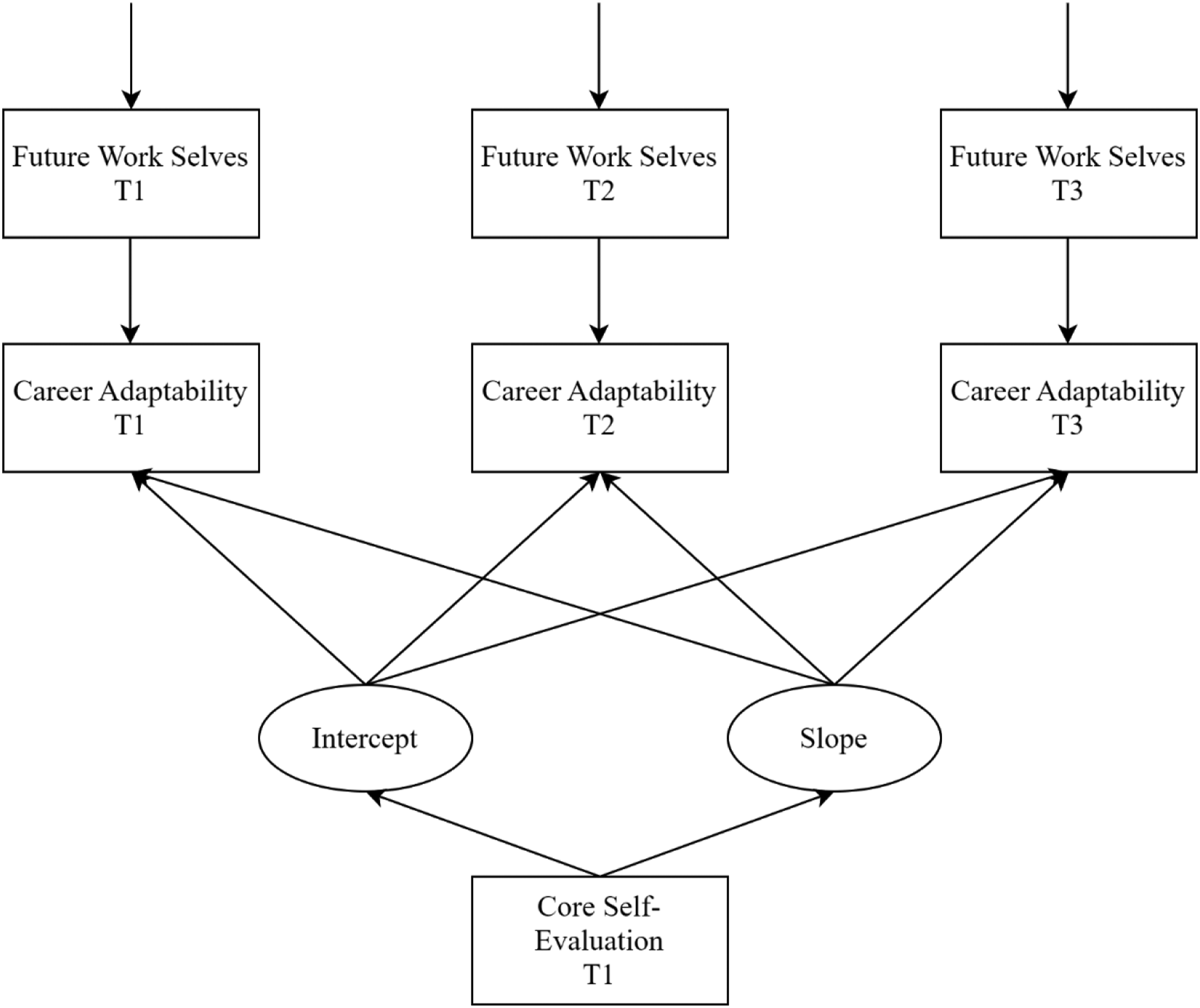
Method
Participants and Procedures
The sample consisted of 500 graduates from a university. The survey was first collected in May 2019. Chinese college students usually graduate at the end of June, and those who choose to work usually have their final jobs confirmed by May. The second data collection was in November 2019. May-November is an important period for graduates to transition from interns to full-time employees. To ensure the same time interval, the third data collection was in May 2020. The 1 year period from May 2019 to May 2020 reflects the development of graduates’ career adaptability from students, interns to full-time employees. Of the 500 participants, 470 participated at T2 (response rate = 94%), and 429 participated at T3 (response rate = 85.8%).
Independent samples t-tests showed no significant differences between those who dropped out and the retained participants concerning career adaptability (p > .05). Core self-evaluation is a relatively stable personality trait that will not easily change with time (Ferris et al., 2011; Xu & Yu, 2019). Therefore, core self-evaluations were collected at T1. Future work selves were collected from T1 to T3. Independent samples t-tests showed no significant differences between those who dropped out and the retained participants concerning core self-evaluation (p > .05) and future work selves (p > .05).
In the graduate sample, the average age of participants was 22.72 years (SD = 1.07), and 63.60% of participants were male. 79.25% of participants majored in engineering, 14.45% majored in arts, and 6.29% majored in science. Regarding annual household income, 51.06% of participants had an annual household income between 0–100,000 CNY, 36.88% had an annual household income between 100,000–200,000 CNY, 9.66% had an annual household income between 200,000–400,000 CNY and 2.36% had an annual household income over 400,000 CNY. Graduate students in our sample worked in different organizational types, including private enterprises (40.09%), government (2.6%), state-owned enterprises (18.65%), foreign-funded enterprises (11.19%), self-employment (1.17%), and others (17.48%).
Measures
Career adaptability was measured with the Chinese version (Hou et al., 2012) of the 24-item Career Adapt-Abilities Scale (CAAS; Savickas & Porfeli, 2012). Hou et al. (2012) took Chinese university students as their sample population and made a Chinese form of CAAS. The Cronbach’s α of the scale was .89, which indicated that the scale is suitable for Chinese college students. This measure assesses the extent of career concern (e.g., “Thinking about what my future will be like”), career curiosity (e.g., “Becoming curious about new opportunities”), career control (e.g., “Making decisions by myself”) and career confidence (e.g., “Solving problems”). The scale demonstrated high reliability across the three measurement periods from the sample (α = .91, .95, and .93).
Future work selves were measured with the four-item Chinese version (Guan et al., 2014) developed by Strauss et al. (2012). A sample item is “The future is very easy for me to imagine.” The scale demonstrated high reliability across the three measurement periods from the sample (α = .73, .86, and .89).
Core self-evaluation was assessed with the twelve-item Chinese version Du et al. (2012) developed by Judge et al. (2003) to assess core self-evaluation. A sample item is “I am confident I get the success I deserve in life”. The scale demonstrated adequate reliability (α = .69).
Response options ranged from 1 (strongly disagree) to 5 (strongly agree) for all instruments.
Analytical Strategy
To test Hypotheses 1, unconditional Latent Growth Modeling (LGM) was applied to explore the development trajectories of the career adaptability of graduates in the school-to-work transition. Latent growth factors represent change through the estimation of a latent intercept (i.e., initial level) and latent slopes (i.e., rate of change), which can reflect growth patterns. The variance of intercept and slope reflects the difference of variables among individuals. To further identify relatively homogeneous subgroups with distinct development trajectories of career adaptability within a heterogeneous population, Latent Class Growth Modeling (LCGM) was applied to explore different latent classes (Jung & Wickrama, 2008; Muthén, 2006; Nagin & Odgers, 2010). LCGM can reflect the differences of variables and their development trends at three or more time points, which cannot be achieved by repeated-measures analysis of variance. LCGM can also distinguish different potential change categories and individual differences in development trends (Andruff et al., 2009), rather than assuming that the development trends of the population are homogeneous in a multilevel model. Therefore, LCGM was applied to explore the development trends and patterns of career adaptability.
To test Hypotheses 2 and 3, conditional LGM was applied to explore the influence of core self-evaluation and future work selves on career adaptability development. Conditional LGM can explore the influence of different types of independent variables on developmental variables by adding constant covariates or time covariates. Since the potential classes of career adaptation development are categorical variables, the general linear regression is not applicable (Edgerton et al., 2015; Liu, 2007). Therefore, logistic regression was used to explore the impact of core self-evaluation and future work selves on potential classes of career adaptability development.
Results
Descriptive Statistics
Descriptive Statistics and Intercorrelations.
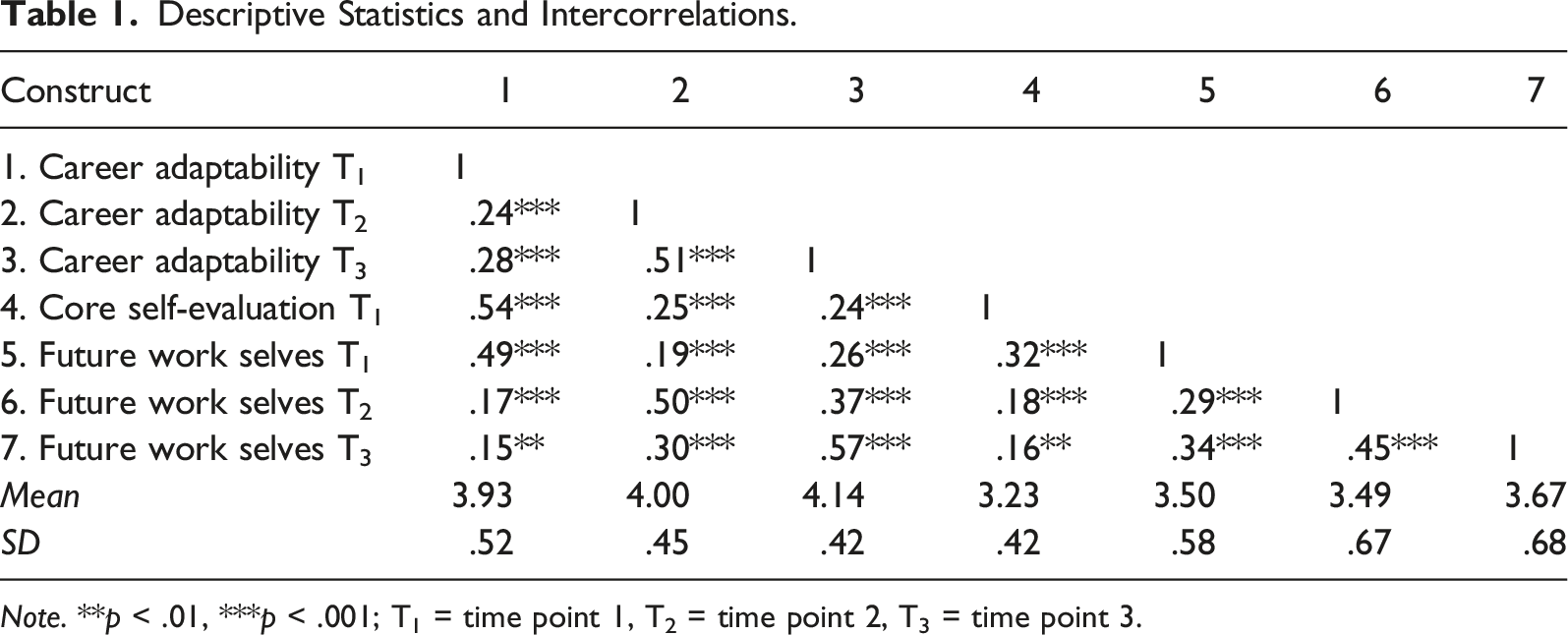
Note. **p < .01, ***p < .001; T1 = time point 1, T2 = time point 2, T3 = time point 3.
The Trajectory of Career Adaptability Development
To assess model fit, we used the normed chi-square (χ2; insignificant p-values), comparative fit index (CFI > .96), Tucker-Lewis index (TLI > .96), root mean square error of approximation (RMSEA < .07) and standardized root mean square residual (SRMR < .08) (Hair et al., 2019). The LGM model demonstrated a satisfactory fit to the data, 𝜒2 = 2.59, p = .11, CFI = .99, TLI =.97, RMSEA = .06, SRMR = .02.
Results of unconditional LGM showed that the intercept (M = 3.91, p < .001) and the mean value of the slope (M = .11, p < .001) of career adaptability were significant, which indicated that overall career adaptability showed a significant positive linear development during the school-to-work transition. The variation of intercept (σ2 = .05, p < .05) was significant, indicating that the initial level of career adaptability showed obvious individual differences. The variation of slope (σ2 = .02, p > .05) was not significant, indicating that there is no significant difference in the development rate of career adaptability between individuals.
Latent Class According to the Trajectory of Career Adaptability Development
The LCGM contains different classes for determining the optimum trajectory classes. Several indicators were used to evaluate the parsimony of LCGM including Akaike’s Information Criterion (AIC), Bayesian Information Criterion (BIC), and sample-size adjusted BIC (aBIC). A lower AIC, BIC, or aBIC value indicates a better fit (Nylund et al., 2007). Entropy is a measure of classification accuracy, ranging from 0 to 1. When the entropy is ≥.80, the accuracy of classification is as high as 90% (Nylund et al., 2007). For the LCGM, the best fit was determined by the model with the lowest AIC, BIC, and aBIC, entropy ≥.80, and a p-value < .05 for the LMR and BLRT (Jung & Wickrama, 2008). In addition, the Lo-Mendell-Rubin likelihood ratio test (LMR) and Bootstrapped Likelihood Ratio Test (BLRT) were used to compare the differences between models. A significant LMR and BLRT result indicates that the mixture model with k classes fits the data better than the simpler k-1 class model (Finch & Bronk, 2011).
Determining the Number of Latent Classes According to the Development Trajectory of Career Adaptability.
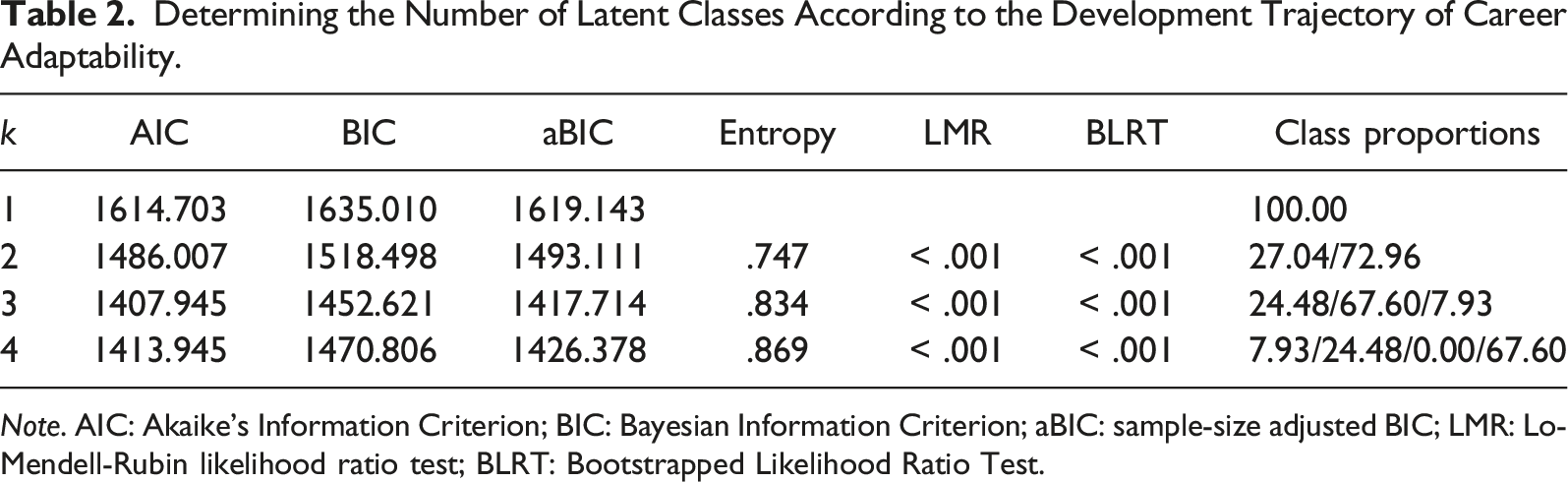
Note. AIC: Akaike’s Information Criterion; BIC: Bayesian Information Criterion; aBIC: sample-size adjusted BIC; LMR: Lo-Mendell-Rubin likelihood ratio test; BLRT: Bootstrapped Likelihood Ratio Test.
The sample sizes in the three latent groups were 105, 290, and 34. For individuals in each category, the probability of correct classification into the corresponding group was over 80%, which indicated that the three classes obtained by LCGM were credible. The table of the average classification probability is available from the first author upon request. Group 1 was characterized by highest initial career adaptability (intercept = 4.11, p < .001) that subsequently increased (slope = .29, p < .001). Therefore, Group 1 was named the “rapid growth group”. Group 2, which was named “growth group”, began with career adaptability values between Group 1 and Group 3 (intercept = 3.90, p < .001) and exhibited a relatively modest increase compared to Group 1 (slope = .05, p < .001). Group 3, which was named “stationary group”, began with the lowest career adaptability score of the three classes (intercept = 3.41, p < .001) and maintained this level over time (slope = .02, p = .65). Heterogeneous groups exhibit developmental changes in individual career adaptability during the school-to-work transition, and there are significant differences in development level and growing trends among different groups. Thus, Hypothesis one was supported. The figure of different potential development patterns is available from the first author upon request.
Analysis of Conditional Latent Growth Modeling of Career Adaptability
We controlled for demographic variables (Gender: 1 = male, 0 = female; Subject: 1 = engineering, 2 = science, 3 = arts; Enterprise: 1 = private, 2 = government agency, 3 = state-owned enterprise, 4 = foreign-funded, 5 = self-employed, 6 = army, 7 = others; Annual household income: 1 = 0–100,000 CNY, 2 = 100,000–200,000 CNY, 3 = 200,000–400,000 CNY, 4 = more than 400,000 CNY). Previous research has suggested that these variables could affect individual career trajectories and career-related decisions (Brown & Lent, 2016). In addition, whether individuals were working during the transition from school to work was also key to career development (Shulman et al., 2014). In our study, information concerning job-seeking status information during school (1 = in contract signing, 2 = in internship, 3 = in job hunting, 4 = others) and employment status after graduated (1 = employed, 2 = unemployed, 3 = pending employed, 4 = others) were also included in the model as control variables.
To illuminate the effects of future work selves and core self-evaluation on the development of career adaptability, conditional LGM was established by introducing future work selves as an independent variable that changed over time and core self-evaluation as a constant independent variable. The results showed that the model demonstrated good fit (𝜒2 = 2.90, df = 1, CFI = .97, TLI = .93, RMSEA = .07, SRMR = .06), and the effect of each control variable was not significant. Future work selves at each time positively predicted career adaptability at the corresponding time (T1: β = .30, p < .01; T2: β = .30, p < .01; T3: β = .31, p < .01). The results showed that future work selves significantly predicted changes in career adaptability during the school-to-work transition and positively improve individuals’ career adaptability. Hypothesis two was therefore supported. Core self-evaluation was positively correlated with intercept (β = .42, p < .01) and negatively correlated with slope (β = −.14, p < .01). Results showed that in the process of career adaptability development, the higher the core self-evaluation was, the higher the initial level of career adaptability during the school-to-work transition. However, the higher the core self-evaluation, the slower the development of individual career adaptation. Hypothesis three was partially supported.
Logistic Regression Analysis
Logistic Regression Results.

Note. **p < .01.
Discussion
Our study found that in China, the career adaptability of graduates who accomplished the school-to-work transition showed a linear growth trend in total. Through latent class analysis, we found that differences in career adaptability development effectively produce three groups: the rapid growth group, growth group, and stationary group. Among those groups, the faster the growth of career adaptability, the higher the initial level of career adaptability. Compared with the stationary group and the growth group, the rapid growth group showed significant positive development in the level of career adaptability. Compared with previous research, our study did not find any groups with negative career adaptability development, which may be because our study has a relatively sufficient sample size compared with existing research (e.g., Koen et al., 2012). In contrast, college graduates had a wider range of career choices. Employment pressure also caused them to invest more energy in the process of career transition. Additionally, the growth trend of career adaptability in the school-to-work transition was consistent with the research on individuals working in internship roles conducted by Ocampo et al. (2020), which showed that individuals interacted with dynamic career transition situations and that their career adaptability was developed during this interaction process. According to career construction theory, the interaction between humans and the environment provides a great deal of experience and information to individuals, which allows them to actively develop their career adaptability to cope with the changes in the real situation (Savickas, 2013).
Our study found that future work selves were key to positively influencing career adaptability development during the school-to-work transition. For individuals, future work selves at school were different from those referenced in the workplace. As an individual’s work experience increases, the positive image of the future work self will be activated to varying degrees, thus becoming clear (Zhang et al., 2016). The results showed that after employment, the future work selves of individuals improved overall. Additionally, future work self positively affected career adaptability at each stage. More importantly, future work selves played a vital role in predicting whether individuals belonged to groups who demonstrated rapid growth in career adaptability. The results showed the importance of identity construction in improving career adaptability, especially during the critical stage of career transition (Dunkel & Anthis, 2001; Rudolph, Lavigne, Katz, & Zacher, 2017). From the perspective of identity construction, future research can explore how the various identities (vocational role, family role, and social role) possessed by individuals jointly construct their careers and affect their career adaptability and long-term career outcomes.
Individuals with high core self-evaluation could develop more slowly without distinguishing among heterogeneous groups. Previous research indicated only that core self-evaluation had a positive effect on career adaptability (Rudolph, Lavigne, & Zacher, 2017; Zacher, 2014). In our study, although the positive effect was effective for the long-term development of individuals’ career adaptability, the effect was weak. This result may be related to the school-to-work transition. To complete the development task, the individual’s career adaptability needed to have a high initial level. Even if core self-evaluation had a positive effect on career adaptability development, the effect would not be particularly large. These results are in accordance with the study of Ocampo et al. (2020). In addition, from the perspective of capitalization, high core self-evaluation was conducive to a willingness to accumulate advantages and pursue positive development (Judge & Hurst, 2007). This kind of positive effect needs to be discussed over a longer period. For example, after working for 3 years or even 5 years, the individual’s career adaptability and change in adaptation should be re-evaluated. The advantage accumulation effect may be more obvious.
After distinguishing among heterogeneous groups, it was found that individuals with high core self-evaluation were more likely to belong to the growth and rapid growth groups. The results showed that it is very worthwhile to distinguish among developmental groups. Research on heterogeneous groups that does not make distinctions concerning the development of career adaptability may not be able to understand the developmental differences among groups. Core self-evaluation could distinguish whether individuals were willing to actively develop themselves in support of the prediction of development groups. In contrast, future work selves can only distinguish between groups with stable and rapid career adaptability. The results helped answer the important question raised by career construction scholars concerning why there are different development groups in the context of career adaptability (Johnston, 2018).
Theoretical and Practical Implications
Our study enriched the literature concerning individual differences in career adaptability development, providing empirical evidence in exploring career adaptability development patterns. Different patterns of career adaptability development are research fields to which researchers pay close attention (Johnston, 2018). However, for a specific career transition period, previous research has not explored possible development trajectories and heterogeneous development groups. Exploring the development patterns among heterogeneous groups in the school-to-work transition was helpful for researchers to establish a holistic theory of career adaptability development from the perspective of the whole life view.
Drawing upon identity construction theory, our study explained the role of future work selves and core self-evaluation in career adaptability development, which enriched the ability of career construction theory to explain career adaptability development. Previous research mostly analyzed the influence of adaptive characteristics on career adaptability development from the perspective of career adaptability in career construction theory (Hirschi et al., 2015). However, it is also important to explore the individual differences in career adaptability development. Our study provided a better explanation for how career adaptability develops and why there are different development patterns, thus providing a reference for theoretical development.
Our study explored the influence of future work self on the development of career adaptability and the development differences caused by core self-evaluations, which provided explanations for the development mechanism of individual career adaptability during the school-to-work transition and provided theoretical support for the heterogeneity of longitudinal trajectories of career adaptability.
Practically, our study provided a reference for establishing career development consultations and interventions for school-enterprise cooperation. Exploring changes in career adaptability during the school-to-work transition and making clear how college students experience changes in vocational roles and working situations in the current Chinese social environment can provide a reference for schools to formulate career counseling and guidance programs. Schools and enterprises can also build specific cooperative training programs to suit the characteristics of college students’ career adaptations and changes and realize an efficient new generation of human resources management.
Limitations and Future Directions
Our study has some limitations. First, although the standard lower bound for Cronbach’s α is .60 (Hair et al., 2019), the reliability of core self-evaluation in our study is still relatively low. Second, the samples of our study were mostly science and engineering students, and there was a certain bias in the sample distribution, which limited the generalization of the conclusion. Third, the LGCM divides the developmental trajectories of career adaptability into three groups. There were 34 people in the “stationary group”, which may have influenced the power to detect significant differences. Finally, our study introduced identity construction theory to explain career adaptability development. However, career adaptability development can be analyzed from other perspectives, such as that of trait activation theory or person-environment fit theory. Other variables and theories can be further introduced in future research to explain individual and group differences in career adaptability development.
Conclusions
In the school-to-work transition, the developmental characteristics of individuals’ career adaptability showed a positive development trend, which can be divided into three groups: rapid growth group, growth group, and stationary group. Specifically, groups with higher career adaptability in school will also develop rapidly after entering the workplace.
Future work selves positively predicted career adaptability in the school-to-work transition. Individuals with high future work selves were more likely to belong to the rapid growth group concerning career adaptability. Future work selves were key to dynamically predicting the level of career adaptability. Core self-evaluation positively predicted career adaptability development in the school-to-work transition. Individuals with high core self-evaluation were more likely to belong to the rapid growth group and growth group for career adaptability.
Footnotes
Declaration of Conflicting Interests
The author(s) declared no potential conflicts of interest with respect to the research, authorship, and/or publication of this article.
Funding
The author(s) received no financial support for the research, authorship, and/or publication of this article.
