



Abstract
The concept of a professional skills and abilities mindset denotes beliefs that professional skills and abilities are either malleable (growth mindset) or are uncontrollable and difficult to change (fixed mindset). Based on the career construction theory, we argue that employees’ professional skills and abilities mindset represents an indicator of adaptive readiness that predicts career adaptability and adaptive responses in terms of learning and career engagement. Across four studies (total N = 709), we developed the 6-item professional skills and abilities mindset scale. Study 1 establishes a two-factor structure, satisfactory psychometric properties, and convergent validity. Studies 2 and 3 provide evidence of the criterion validity of the growth but not the fixed mindset subscale for career engagement and learning through career adaptability. Study 4 establishes moderate retest reliability across four weeks. This research establishes a previously neglected predictor of career-related resources and behaviors. Findings can inform vocational consulting and coaching.
Keywords
In today’s world of work, organizational structures and technology change rapidly. In this environment, organizations have to continuously adjust their working procedures to remain competitive, and employment contracts have become more flexible (Gonzalez Vazquez et al., 2019). Facing these conditions, employees across various age groups and occupational sectors are required to continuously master new roles, take responsibility for learning new skills, and proactively develop their careers (van der Horst & Klehe, 2019). Employees’ level of preparedness to cope with present and future career changes and to adapt to new conditions is captured by the concept of career adaptability (Hirschi et al., 2015; Savickas, 1997). Career adaptability is embedded in the career construction theory, which posits that employees with a high level of career adaptability are more likely to engage in career-related behaviors as compared to those low in career adaptability (Savickas, 2005). However, not everyone is equally well equipped to develop high levels of career adaptability (Rudolph et al., 2017), and some organizations have raised concerns that part of their workforce lacks sufficient resources to adapt to a changing world of work (Gonzalez Vazquez et al., 2019). Why do some employees develop adaptability resources and adaptive behavioral responses, while others are less likely to do so?
We argue that employees’ beliefs or mindsets about the malleability of professional skills and abilities function as a promising but, so far, untested predictor of their career adaptability. Our argument is based on the mindset framework (Dweck & Leggett, 1988; Dweck & Yeager, 2019), which holds that people differ in their implicit assumptions about the malleability of human attributes and abilities. These assumptions, in turn, affect the way people construe and deal with the tasks they encounter in situations where these attributes or abilities matter. Some individuals might believe that professional skills and abilities are flexible and can be well influenced and developed at any age (i.e., indicative of a growth mindset), while others might think that professional skills and abilities are static and difficult to change over time (i.e., indicative of a fixed mindset).
The goal of the present research is twofold. First, we aim to develop and validate a scale to assess the construct of employees’ professional skills and abilities mindset. Following the rationale that growth and fixed mindsets should not be conceptualized along a dichotomy, but that “people can ‘have’ both mindsets” (Murphy & Reeves, 2019, p. 3), we conceptualize growth and fixed mindsets as two separate dimensions. In other words, people may believe that professional skills and abilities are at the same time largely set but also amenable to some change.
Second, we integrate the mindset concept into the career construction theory (Hirschi et al., 2015; Savickas, 2005) by conceptualizing it as an indicator of employees’ readiness and willingness to deal with career- and work-related tasks and challenges. Employees with a strong growth mindset, who are driven by the belief that professional skills and abilities can be improved throughout the career, should be willing to actively approach challenges. Therefore, they are likely to acquire adaptability resources for coping with current and anticipated career-related challenges. As a consequence, they may seek out learning opportunities and proactively engage in their career development. Conversely, employees who believe that professional skills and abilities are a matter of innate talent that barely improve during adulthood reflect a low readiness and willingness to fulfill challenging professional tasks, and they should be less likely to acquire adaptability resources and engage in proactive career behaviors and learning. By linking the mindset concept with the career construction theory, our research adds to the career management literature, which lacks a systematic perspective of the antecedents of career adaptability (Johnston, 2018). Furthermore, although research on the role of mindset beliefs in organizational settings has been increasing (Murphy & Reeves, 2019), we still lack knowledge of the role of adults’ mindsets in learning and career management (Caniëls et al., 2018; Han & Stieha, 2020). By developing a valid scale, the present study facilitates such knowledge gains through future research that tests the assumptions embedded in the career construction theory and other career management and development models (Lent & Brown, 2013; Rudolph et al., 2017). Finally, the development of a professional skills and abilities mindset scale and the knowledge gathered from our study have important implications for practitioners who wish to support employees in their career management.
Mindset Theory and the Concept of Professional Skills and Abilities Mindset
Mindset beliefs refer to a general worldview that influences how people perceive themselves and others (Murphy & Reeves, 2019). According to mindset theory (Dweck, 1999; Dweck & Leggett, 1988), individuals differ in their implicit theories or beliefs about the malleability of humans’ abilities and traits. While those with a growth mindset view attributes as malleable and cultivable, those with a fixed mindset believe that certain human attributes are unmodifiable and cannot develop across time (Brandstätter & Bernecker, 2022; Dweck & Yeager, 2019). Different views on the dimensionality of mindsets prevail in the literature. Mindset beliefs have previously been considered as uni-dimensional, being represented on a single continuum ranging from a growth to a fixed mindset (Burnette, 2013; Dweck et al., 1995). Some studies using factor analysis have challenged this assumption and provided support for growth and fixed mindsets being negatively related but separate constructs (e.g., Karwowski, 2014; Kunz et al., 2020; Tempelaar et al., 2015); and this perspective is widely advocated in the recent literature (Lüftenegger & Chen, 2017; Murphy & Reeves, 2019). Research also provides support for the domain specificity of mindsets. That is, people can hold different mindsets across various domains that are not necessarily related, including, among others, intelligence (Dweck, 1999), creativity (Karwowski, 2014; O'Connor et al., 2013), willpower (Job et al., 2010), the modifiability of memory in older adults (Plaks & Chasteen, 2013), and dementia (Kunz et al., 2020, 2022).
In the current paper, we apply the mindset concept to the domain of professional skills and abilities. Skills relate to the procedural knowledge required to successfully perform certain tasks. Examples are problem-solving, technical, and social (e.g., empathic listening) skills. Abilities are the more general capacities or propensities of an individual that reflect a more innate potential or develop early in life. Individuals with a certain ability are more likely to develop proficiency across various specific tasks. Examples are multi-tasking, spatial orientation, verbal, and mechanical aptitude (Brannick et al., 2012; Fleishman & Reilly, 1992). Accordingly, we define a professional skills and abilities growth mindset as an individual’s belief that work-related skills and abilities can be actively influenced or changed through effort, motivation, or support throughout one’s career. A professional skills and abilities fixed mindset is defined as a worldview according to which an individual believes that people lack the capability to significantly control, change, or improve their professional or work-related skills and abilities during their career. In other words, professional skills and abilities would be largely a matter of innate talent or early socialization, and no further development is possible during adulthood.
Professional Skills and Abilities Mindset as an Indicator of Adaptive Readiness
Previous literature has shown that people’s mindsets have important implications for their motivation, behavior, and performance (Burnette, 2013; Dweck & Yeager, 2019; Heslin et al., 2020; Job et al., 2010). Research on the role of mindsets about intelligence and talent in the work context has revealed that growth mindset beliefs in particular are associated with some organizational outcomes, such as employee performance, leadership, and workplace engagement (Caniëls et al., 2018; Han & Stieha, 2020; Murphy & Reeves, 2019).
In the present paper, we investigate whether beliefs about the malleability of professional skills and abilities predict people’s adaptability resources and behaviors in the domain of career management. Career adaptability has frequently been noted as a key psychological resource necessary for successful career development (Johnston, 2018; Rudolph et al., 2017; Savickas, 1997). Career adaptability is multi-dimensional; it is conceptualized as individuals being concerned about their professional future, taking control and responsibility regarding their careers, showing curiosity through exploring possible future work selves, and being confident about their abilities at times when setbacks occur (Johnston, 2018; Rudolph et al., 2017; Savickas, 1997). Career adaptability is embedded in the career construction theory of adaptation (Savickas, 2005), which postulates that individual differences in people’s adaptive readiness or adaptivity (i.e., psychological characteristics that involve the readiness and willingness to adapt to career changes) predict the availability of adaptability resources (Hirschi et al., 2015; Rudolph et al., 2017). Previous research has identified characteristics such as core self-evaluations, proactive personality, and cognitive ability as indicators of adaptive readiness (Rudolph et al., 2017).
We argue that an individual’s professional skills and abilities mindset represents another indicator of adaptive readiness. Specifically, people with a strong growth mindset who believe that professional skills and abilities can be actively influenced and developed should be more willing to fulfill career development tasks (e.g., master new professional roles). Consequently, they should be more likely to take responsibility for their careers by setting career goals and developing strategies to achieve them, and should develop confidence in their career and professional development. In contrast, we expect that people with a strong fixed professional skills and abilities mindset are less “ready” to tackle career changes. As a consequence, they might experience lower levels of control over and limited confidence in their skills and abilities. They should also be less concerned about preparing for their future through active engagement in career-related behaviors and be less curious about exploring future career options.
The career construction theory of adaptation further assumes that people’s adaptive readiness influences their responses through career adaptability resources. Adapting responses can be conceptualized as career management behaviors, such as proactive career engagement, exploration, and learning (Johnston, 2018; Rudolph et al., 2017). In line with this perspective, we argue that career adaptability provides an underlying mechanism through which a professional skills and abilities mindset can influence learning and career engagement as key indicators of adapting responses. Learning relates to the extent to which professional knowledge and skills are updated and expanded (Hirschi et al., 2018), while career engagement entails the extent to which individuals engage in various self-initiated career behaviors (Hirschi et al., 2014). Employees who view professional skills and abilities as malleable should be more eager to invest in and expand their skills and abilities through learning and proactively engage in their goals as a result of their adaptability resources, while we expect the opposite effect for individuals with a strong professional skills and abilities fixed mindset.
To test the incremental validity of the newly developed concept of a professional skills and abilities mindset, we expect this personal characteristic to explain variance in career adaptability and the resulting career management behaviors when accounting for established predictors of career adaptability. Employee self-esteem—the overall evaluation of one’s self-worth (Robins et al., 2001)—is such an established predictor of career adaptability (Rudolph et al., 2017). We hypothesize that the effect of a professional skills and abilities mindset on career management behaviors through employee career adaptability holds when accounting for individual differences in self-esteem.
Overview of the Present Studies
The scale development was realized in close collaboration with two Dutch organizations that offer training and coaching interventions for employees who see the need to improve their employability. The organizational partners noted that employees’ implicit beliefs about the malleability of their professional skills and abilities might be an important factor in determining their openness to career-related interventions and their adaptive responses to work-related changes. At the same time, they pointed to the lack of a measurement deemed valid, feasible, and easily applicable. To address this gap, we developed and validated the professional skills and abilities mindset scale across four studies (Carpenter, 2018; Hinkin, 1998). In Study 1, we developed the items, conducted an explorative factor analysis, and examined the scale’s convergent validity. The aim of Study 2 was to confirm the scale’s factor structure and evaluate its criterion-related validity in a cross-sectional study by investigating the relationships with career adaptability and learning. Study 3 aimed at demonstrating the appropriateness of the two-factorial structure in a specific sample of employees for whom career adaptability resources and career management behaviors should be specifically salient, given that their jobs were negatively affected by the COVID-19 pandemic. We conducted a three-wave study to test the direct and indirect effects model of professional skills and abilities on learning and career engagement through career adaptability, controlling for individual self-esteem, to study the scale’s criterion and incremental validity. Finally, in Study 4, we aimed to explore the test-retest reliability of our measure.
We describe each study in more detail below. The scales and study materials for all studies were presented in English. We relied on English-speaking participants recruited by the panel company Prolific (Palan & Schitter, 2018). The studies were conducted in 2020 and 2021 and were approved by the ethics committee of the Department of Psychology at the University of Groningen.
Study 1
Step 1: Scale Development
Professional Skills and Abilities Mindset Scale: Standardized Item Factor Loadings, Communalities and Corrected Item-total Correlation (Study 1) with all Eight Items and Standardized Item Factor Loadings Based on Confirmatory Factor Analysis (Study 2) with the Final Six-Item Scale.
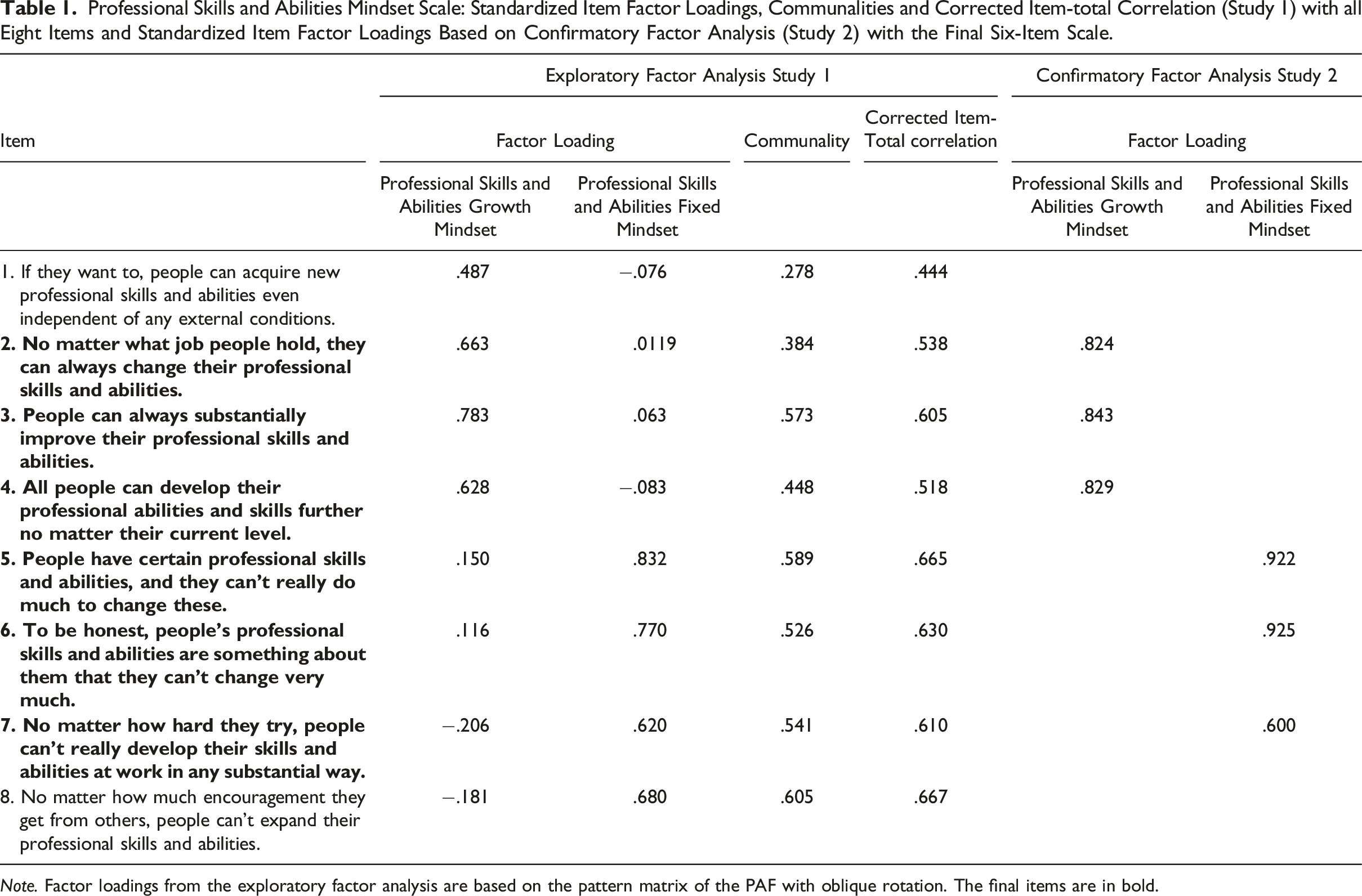
Note. Factor loadings from the exploratory factor analysis are based on the pattern matrix of the PAF with oblique rotation. The final items are in bold.
Step 2: Exploratory Factor Analysis and Convergent Validity Testing
We collected empirical data to test the item factor structure and the scale’s convergent validity (Carpenter, 2018; Hinkin, 1998). Specifically, we expected the professional skills and abilities mindset to be conceptually similar but theoretically different from internal work locus of control (i.e., an employee’s belief that they have control over their work environment; Spector, 1988), positive attitudes toward learning and development (i.e., positive feelings and thoughts regarding active participation in career-related learning activities; Maurer et al., 2003), and learning goal orientation (i.e., the desire to improve competencies and acquire new skills; Vandewalle, 1997). People with a strong growth mindset tend to believe in an individual’s ability to control events and take responsibility for their behavior and set and pursue learning goals, whereas people with a strong professional fixed mindset are more likely to believe that their lives are controlled by outside forces and are less open to participate in professional learning activities (Burnette, 2013; Heslin et al., 2020; Murphy & Reeves, 2019). Still, the concept of a professional skills and abilities mindset differs from these related concepts as it represents a person’s general worldview that is not only directed toward people’s appraisals of the malleability of their own professional skills and abilities, but also covers their appraisals of others’ plasticity of skills and abilities. This, in turn, influences how they perceive others. Accordingly, we expected positive (for growth mindset) and negative (for fixed mindset) relationships of moderate size with these concepts.
Procedure and Participants
A sample of full-time employees was invited to participate in this study. The participants were offered £1.36 for the completion of the questionnaire, which took on average 12 minutes to complete. Of the 200 participants who completed the questionnaire, six participants were dropped because they failed the attention check item, leaving a final sample of 194 participants (50.5% female; mean age = 34.4 years, SD = 9.3). Most of the participants had obtained a college degree (65%) and they held different types of jobs such as occupational therapist, electrician, business analyst, marketing assistant, and teacher. Their mean organizational tenure was 6.6 years (SD = 6.8).
Measures
We measured professional skills and abilities mindset with the eight newly developed items (Table 1). Work locus of control was assessed with the eight-item scale by Spector (1988). An example item is “People who perform their jobs well generally get rewarded.” (5-point scale ranging from 1 = strongly disagree to 5 = strongly agree; Cronbach’s α = .76). High scores reflect a high internal work locus of control, while low scores reflect a low internal (i.e., high external) work locus of control (Wang et al., 2010). Attitudes towards learning and development was assessed with the eight-item scale by Maurer et al. (2003). An example item is “I feel favorably toward the idea of improving my career skills.” (5-point scale ranging from 1 = strongly disagree to 5 = strongly agree; Cronbach’s α = .85). We measured learning goal orientation with four items from Vandewalle (1997). An example item is “I enjoy challenging and difficult tasks at work where I’ll learn new skills.” (5-point scale ranging from 1 = strongly disagree to 5 = strongly agree; Cronbach’s α = .82). Moreover, we measured core demographic variables, such as age, gender, educational degree, and supervisor status to explore their relationships with the mindset concept.
Analyses and Results
Professional Skills and Abilities Mindset Scale: Item and Scale Analysis
We ran a principal axis factor (PAF) analysis that seeks to identify latent constructs based on the shared variance among variables. Non-orthogonal (oblique) rotation with the Promax method was used because we expected that two interrelated factors were retained. The Bartlett’s test of sphericity was significant (χ2 (28) = 526.298, p < .001) and the Kaiser-Meyer-Olkin (KMO) measure was adequate with an index of .77, confirming that the data were suitable to proceed with the PAF (Tabachnick et al., 2007). Based on the screeplot and eigenvalues greater than 1.0, two negatively related factors (r = −.45) were retained that explained 49.3% of the variance. We evaluated the items based on multiple criteria: communalities, item factor loadings, potential cross-loadings, and scale parsimony (Carpenter, 2018; Hinkin, 1998). The communalities were above .38 for all items except for Item 1 (.28) (Table 1). The items loaded as expected on their respective factors. Item 1 showed the lowest factor loading (.49). We found no evidence for major item cross-loadings. The structure matrix revealed that the correlations between the items and their respective factors varied between .52 and .76; the lowest correlation was found again for Item 1 (.52). Based on these results, we decided to remove Item 1 from our scale (Hinkin, 1998; Tabachnick et al., 2007). Cronbach’s α for the three-item professional skills and abilities growth mindset scale was .72 and it was .82 for the four-item fixed mindset scale. 1
Convergent Validity
Correlations, Means, and Standard Deviations of the Study Variables (Study 1).

Note. N = 194. Gender was coded 0 = female, 1 = male. Educational degree was coded 0 = below university level degree, 1 = university level degree. Supervisor status was coded 0 = no, 1 = yes.
aBased on three items.
bBased on four items.
cHigh scores indicate internal work locus of control. * p ≤ .05. ** p ≤ .01.
Study 2
The goals of Study 2 were to confirm the factor structure of the mindset scale and to test its criterion validity based on Hypotheses 1 and 2.
Participants and Procedure
We recruited a heterogenous sample of 200 full-time English native speakers to participate in this cross-sectional study. Participants were offered £1.87 for completion of the survey. The survey took them approximately 15 minutes to complete. Nine participants were dropped because they failed one or more out of the three attention check items, leaving a sample of 191 individuals (47.1% female; mean age was 34.7 years, SD = 9.2). The majority of the participants were living in the United Kingdom. Most of the participants had obtained a college degree (68.6%). Their mean organizational tenure was 5.1 years (SD = 5.5). Frequently mentioned jobs were sales manager, teacher, engineer, and technician.
Measures
Professional Skills and Abilities Mindset
We used the 7-item version of the new mindset scale from Study 1. Its factor structure was tested by means of a confirmatory factor analysis (CFA) using Mplus 8.5 (Muthén & Muthén, 1998-2017). We assumed at least decent fit for models with a comparative fit index (CFI) above .90, root-mean-square error of approximation (RMSEA) values smaller than .08, and root-mean-square residual (SRMR) values up to .08 (Hu & Bentler, 1998; Kline, 2015). The analysis revealed that the items loaded on their corresponding factors, but the model fit of the hypothesized factor structure (three items for growth and four items for professional skills fixed mindset) was poor (χ2 = 65.260, df = 13, p <.001, CFI = .934, RMSEA = .145, SRMR = .066), mainly due to the large RMSEA score. An examination of the modification indices revealed that Item 8 loaded on both the growth and the fixed mindset factors and its error term correlated significantly with the one from Item 7. There were no cross-loadings for the other items. Consequently, we decided to remove Item 8 from the scale. Running the CFA again with the six-item solution, produced a good model fit (χ2 = 12.211, df = 8, p = .142, CFI = .994, RMSEA = .052, SRMR = .033), and this model fitted the data better than a one-factorial model (χ2 = 216.730, df = 9, p < .001, CFI = .681, RMSEA = .348, SRMR = .0.152; Δχ2 = 204.519, Δdf = 1, p < .001). The standardized item factor loadings ranged between .60 and .93 (see Table 1). The fixed and growth factors correlated with r = −.54 (p < .001). Cronbach’s α of the three-item professional skills and abilities growth mindset scale was .87 and it was .85 for the three-item fixed mindset scale. 2
Career Adaptability
Career adaptability was measured with the 12-item Career Adapt-Abilities Scale–Short Form (CAAS-SF) (Maggiori et al., 2017). Participants first read the following instruction: “Different people use different strengths to build their careers. No one is good at everything, each of us emphasizes some strengths more than others.” They were then asked to rate how strongly they have developed certain abilities that referred to the four career adaptability dimensions of concern (e.g., “Thinking about what my future will be like.”), control (e.g., “Taking responsibility for my actions.”), curiosity (e.g., “Looking for opportunities to grow as a person.”), and confidence (e.g., “Taking care to do things well.”). The participants provided their answers on a 5-point scale ranging from 1 (not strong) to 5 (strongest). The Cronbach’s α for career adaptability as a composite score was .88.
Learning
The three-item learning scale from the career resources questionnaire (Hirschi et al., 2018) was used to assess employees’ learning on the job. An example item is “I continuously develop my work-related abilities”. The participants rated the items on a 5-point scale ranging from 1 = strongly disagree to 5 = strongly agree. Cronbach’s α was .87.
Control Variables
We controlled for participants’ age, gender, educational degree, and supervisor status because evidence suggests that these variables are associated with career adaptability (Hou et al., 2012; Rudolph et al., 2017; Zacher, 2014a).
Statistical Analysis and Results
Correlations, Means, and Standard Deviations of the Study Variables (Study 2).

Note. N = 187-191 (pairwise deletion). Gender was coded 0 = female, 1 = male. Educational degree was coded 0 = below university degree, 1 = university degree. Supervisor status was coded 0 = no, 1 = yes. 5. Professional skills and abilities growth and fixed mindsets were measured with three items respectively. Career adaptability is treated as a composite score based on the aggregated item scores of all four dimensions (Guan et al., 2018; Zacher, 2014b). * p ≤ .05. ** p ≤ .01.
Next, we employed structural equation modeling (SEM) in Mplus 8.5 (Muthén & Muthén, 1998-2017) to test the direct and indirect relationships proposed in Hypotheses 1a – 2b. We estimated a path model that included all latent variables: the two mindset dimensions (growth and fixed), career adaptability as a second-order concept (with the four lower-order factors loading on the higher-order adaptability factor), learning, and the demographic control variables as manifest variables. The analysis was conducted with maximum likelihood estimation and standard errors calculated based on nonparametric bootstrapping with 10,000 iterations (Lai, 2018).
Figure 1 depicts the standardized path coefficients and the variance explained in the mediator and outcome variables. The control variables did not significantly predict any of the variables in the model and are not displayed in Figure 1. Professional skills and abilities growth mindset (β = .49, p < .001, 95% CI = .32 to .66) but not fixed mindset (β = .01, p = .907, 95% CI = −.17 to .22) predicted career adaptability, which positively predicted employee learning (β = .63, p < .001, 95% CI =.44 to .77). This supports Hypothesis 1a but not Hypothesis 1b. The indirect effect was positive and significant for growth mindset (β = .31, p < .001, 95% CI = .20 to .45), but not for fixed mindset (β = .01, p = .910, 95% CI = −.11 to .14). This supports Hypothesis 2a while Hypothesis 2b could not be supported. The overall model fit was acceptable (χ2 = 412.856, df = 247, p < .001, CFI = .918, RMSEA = .059, SRMR = .058). Structural Equation Model (Study 2). Note. Calculations are based on N = 191. Standardized coefficients are shown. To enhance clarity, the measurement model, including the four lower-order factors for career adaptability and the demographic control variables, is omitted from the figure. 95% CI = 95% Bootstrap confidence interval based on 10,000 samples. **p < .01.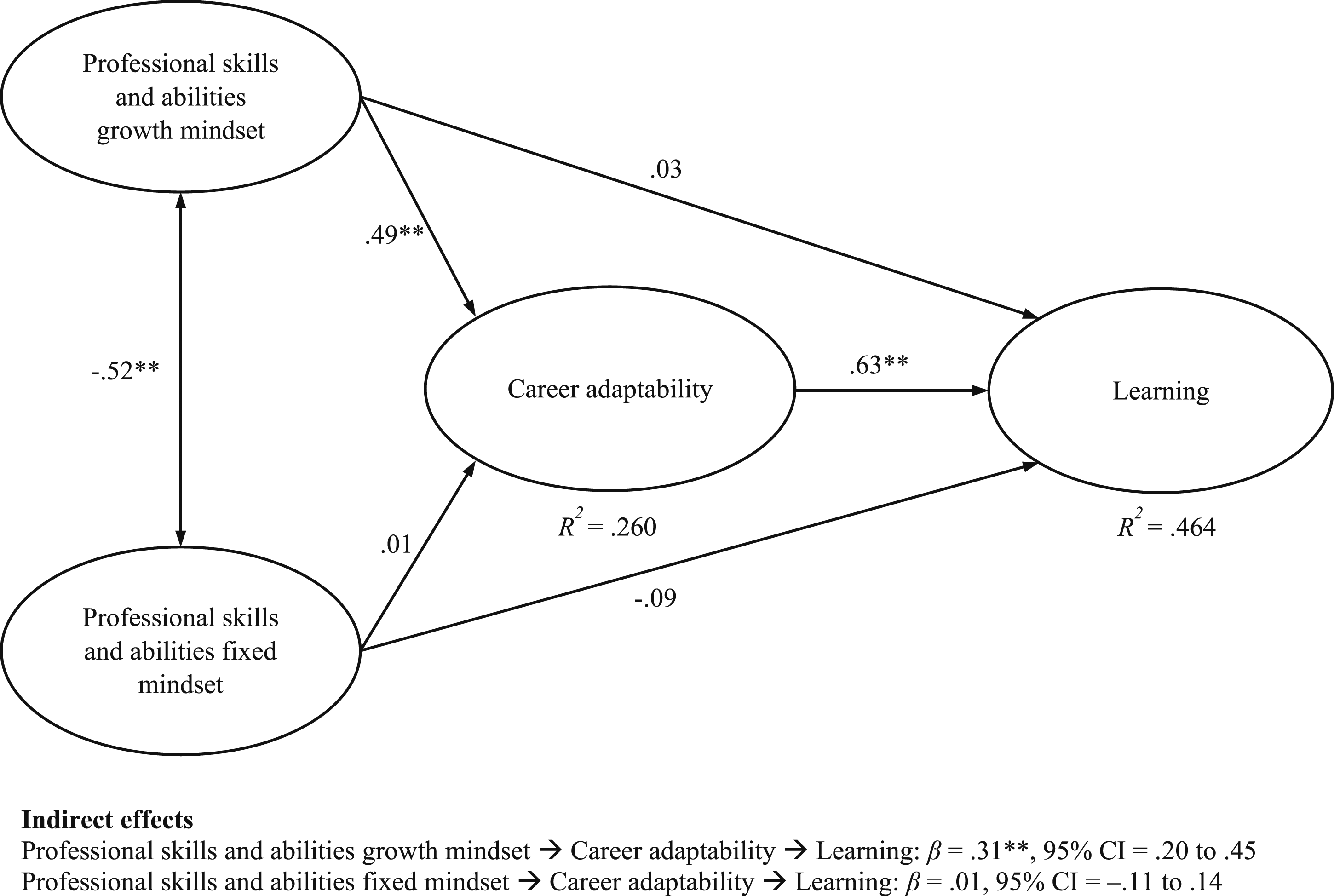
Study 3
After having reduced the item pool of the professional skills and abilities mindset scale by two items, one goal of Study 3 was to retest the factorial structure of the six-item measure. Second, apart from learning as an outcome, we examined the indirect effects of employees’ professional skills and abilities mindsets on career engagement. Third, we tested the incremental validity of the mindset construct on career adaptability and the two career management behaviors above and beyond self-esteem as an established indicator of adaptive readiness and predictor of career adaptability (Rudolph et al., 2017). Finally, we conducted this study as part of a larger project in a sample of participants whose jobs were negatively affected by the COVID-19 pandemic, thus making adaptive career resources, career management behaviors, and the role of professional skills and abilities mindset more salient. Specifically, we recruited part- or full-time employees whose work hours had been reduced as a result of the pandemic crisis (e.g., they changed from full-time to part-time work, from part-time to fewer than part-time hours, or their jobs had been suspended [e.g., unpaid leave or furloughs]). We conducted a three-wave study with time lags of four weeks to separate the measurement of the criterion, mediator, and outcome variables as a potential remedy to reduce the influence of common method bias (Podsakoff et al., 2003).
Procedure and Participants
At Time (T) 1, 352 individuals (all English native speakers) participated in the online survey and all passed the attention check items. Five participants were excluded because they worked self-employed while this study was focused on employees. The remaining 347 participants were approached one month later to complete the T2 survey. At T2, 306 employees provided data (response rate of 88.2%). Five participants failed at least one attention check item and were deleted. The remaining 301 participants were invited one month later to complete the final T3 survey, and 228 participated (response rate 75.8%). The participants were reimbursed £1.75 for completing the T1 survey (approximate completion time was 13 minutes) and £1.40 for each of the T2 and T3 surveys (approximate 10 minutes completion time), respectively. Data of two participants were excluded because of at least one failed attention check item, thus, leaving a sample of 226 study participants. Of these 226 participants, we excluded 28 individuals whose job status changed throughout the measurement period. Thus, the final study sample consists of 198 employees (66.8% female) who experienced a change in job status as a result of COVID-19, who participated in all three waves, and whose job status did not change across the three-months measurement period. Their mean organizational tenure was 5.8 years (SD = 5.7). We did not find differences with regard to the demographic and mindset variables between respondents who completed all three waves and those who did not. The participants’ ages ranged from 18 to 74 years (M = 38.2 years, SD = 13.3). The majority of respondents (56%) held a university degree.
Measures
Professional Skills and Abilities Mindset
We used the 6-item scale to assess the growth and fixed mindset at T1. The fit of the two-factor model was acceptable (χ2 = 17.022, df = 8, p = 0.030, CFI = .978, RMSEA = .076, SRMR = .055) and this model fitted better than the alternative one-factor model (χ2 = 191.689, df = 9, p < .001, CFI = .558, RMSEA = .321, SRMR = .171; Δχ2 = 174.667, Δdf = 1, p < .001), which replicates the finding from Study 2. The standardized factor loadings ranged from .53 to .93. The professional skills and abilities fixed and growth factors correlated with r = −.27 (p = .034). Cronbach’s α were .81 for the growth mindset and .78 for the fixed mindset dimension.
Self-esteem
At T1, the participants rated the single item “I see myself as someone who has high self-esteem” on a 7-point response scale ranging from 1 (strongly disagree) to 7 (strongly agree). Self-esteem as a global concept has been successfully measured with this single item in previous research (Fisher et al., 2016; Robins et al., 2001).
Career Adaptability
Career adaptability was measured at T2 with the same 12 items as in Study 2 (Maggiori et al., 2017). Cronbach’s α was .89 for the overall career adaptability scale.
Learning
Learning was measured at T3 with the same three items as in Study 2 (Hirschi et al., 2018), but this time, the participants indicated their learning on the job across the past four weeks. Cronbach’s α was .90.
Career Engagement
We used the nine-item scale by Hirschi et al. (2014) to assess career engagement at T3. The participants were asked to what extent they engaged in career-related behavior during the past four weeks. An example item is “I developed plans and goals for my future career” (5-point scale from 1 = not at all to 5 = to a very great extent; Cronbach’s α = .92).
Control Variables
Again, we controlled for participants’ age, gender, educational degree, and supervisor status (Hou et al., 2012; Rudolph et al., 2017; Zacher, 2014a).
Statistical Analysis and Results
Correlations, Means, and Standard Deviations of the Study Variables (Study 3).
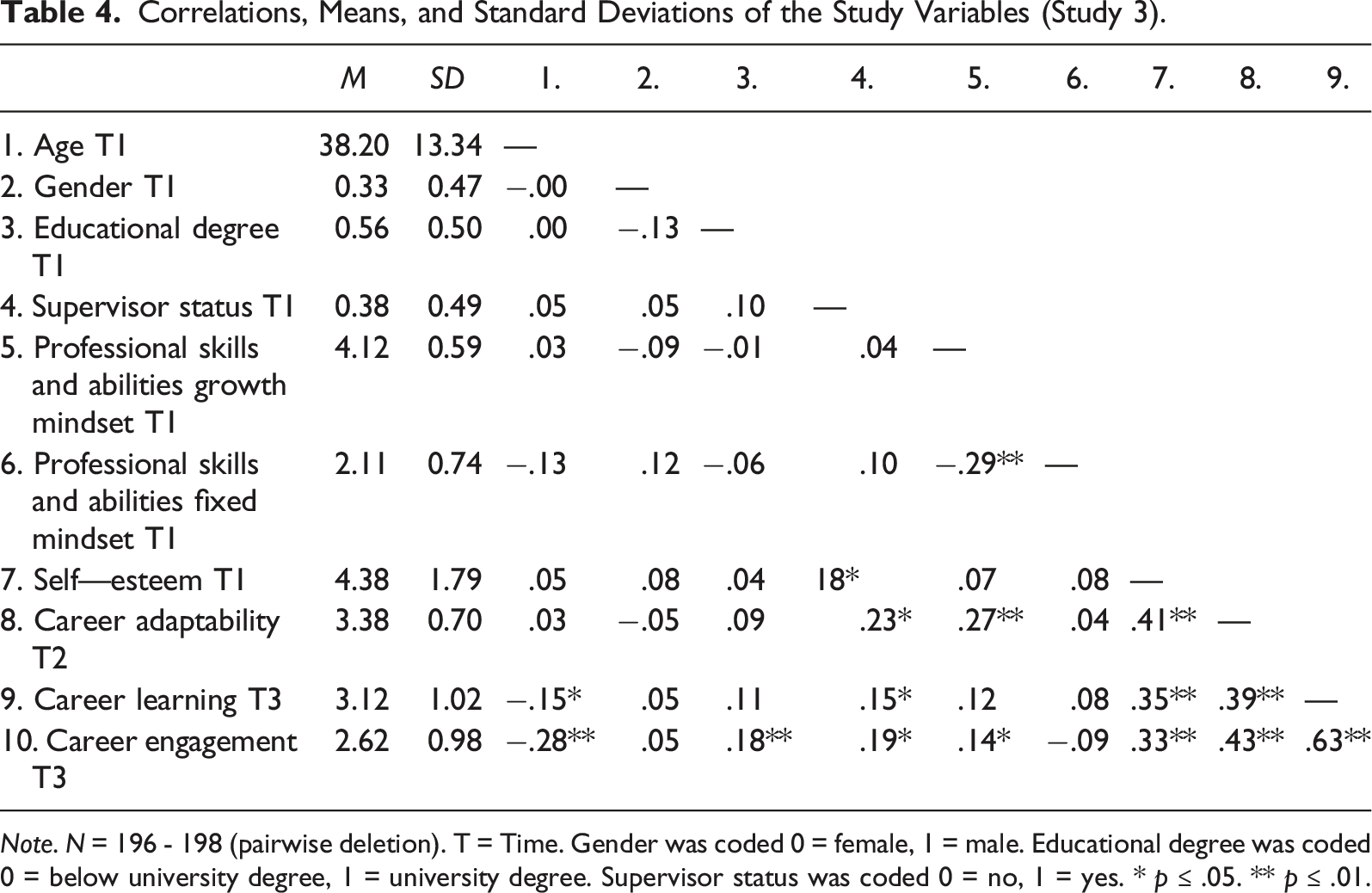
Note. N = 196 - 198 (pairwise deletion). T = Time. Gender was coded 0 = female, 1 = male. Educational degree was coded 0 = below university degree, 1 = university degree. Supervisor status was coded 0 = no, 1 = yes. * p ≤ .05. ** p ≤ .01.
The hypotheses were tested based on SEM with maximum likelihood estimation by means of nonparametric bootstrapping (Lai, 2018). Apart from the manifest control variables, the constructs were treated as multi-indicator latent variables. In line with Hypothesis 1, professional skills and abilities growth mindset T1 predicted career adaptability T2 positively (β = .38, p < .001, 95% CI = .20 to .56). Unexpectedly, the effect from fixed mindset T1 on career adaptability T2 was also positive and significant (β = .23, p = .025, 95% CI = .03 to .44). This coefficient might be interpreted as a statistical artifact arising from the fact that the intercorrelation between the growth and fixed mindsets was stronger than the correlation between either the growth or the fixed mindset T1 with career adaptability T2. The bivariate correlation between fixed mindset T1 and career adaptability T2 was non-significant (Table 4).
Overall, these results support Hypothesis 1a but not 1b. Professional skills and abilities growth mindset T1 was indirectly and positively related to both learning T3 (β = .20, p = .004, 95% CI = .15 to .69) and career engagement T3 (β = .17, p = .006, 95% CI = .14 to .72) through career adaptability T2, thus, supporting Hypothesis 2a. The indirect effects of professional skills and abilities fixed mindset T1 on learning and career engagement at T3 were not significant. Hypothesis 2b could not be supported.
To test Hypotheses 3a and 3b, we ran a second model with self-esteem T1 as additional predictor of career adaptability. The results are illustrated in Figure 2. Self-esteem was positively and significantly related to career adaptability T2, and to learning and career engagement at T3 (see Figure 2). Supporting Hypothesis 3a, the results revealed that professional skills and abilities growth mindset T1 significantly predicted career learning T3 (β = .15, p = .011, 95% CI = .10 to .55) and career engagement T3 (β = .13, p = .021, 95% CI = .09 to .61) through career adaptability T2 above and beyond employee self-esteem T1. Hypothesis 3b could not be supported: the indirect effects of professional skills and abilities fixed mindset T1 on learning and career engagement at T3 through career adaptability T2 above and beyond employee self-esteem T1 were not significant (see Figure 2). We found no direct effects from growth and fixed mindsets at T1 on learning and career engagement at T3. Age was negatively related to career engagement T3 (β = −.32, p < .001, 95% CI = −.45 to −.10) and learning T3 (β = −.20, p = .005, 95% CI = −.34 to −.05). Supervisor status was positively related to career adaptability T2 (β = .18, p = .020, 95% CI = .03 to .33) while the other demographic variables were unrelated to any of the study variables. . The fit of the overall model including all study variables was acceptable (χ2 = 866.045, df = 522, p < .001, CFI = .900, RMSEA = .058, SRMR = .075). Structural Equation Model (Study 3). Note. Calculations are based on N = 197. Standardized coefficients are shown. To enhance clarity, the measurement model, including the four lower-order factors for career adaptability and the demographic control variables, is omitted from the figure. 95% CI = 95% Bootstrap confidence interval based on 10,000 samples. *p < .05. **p < .01.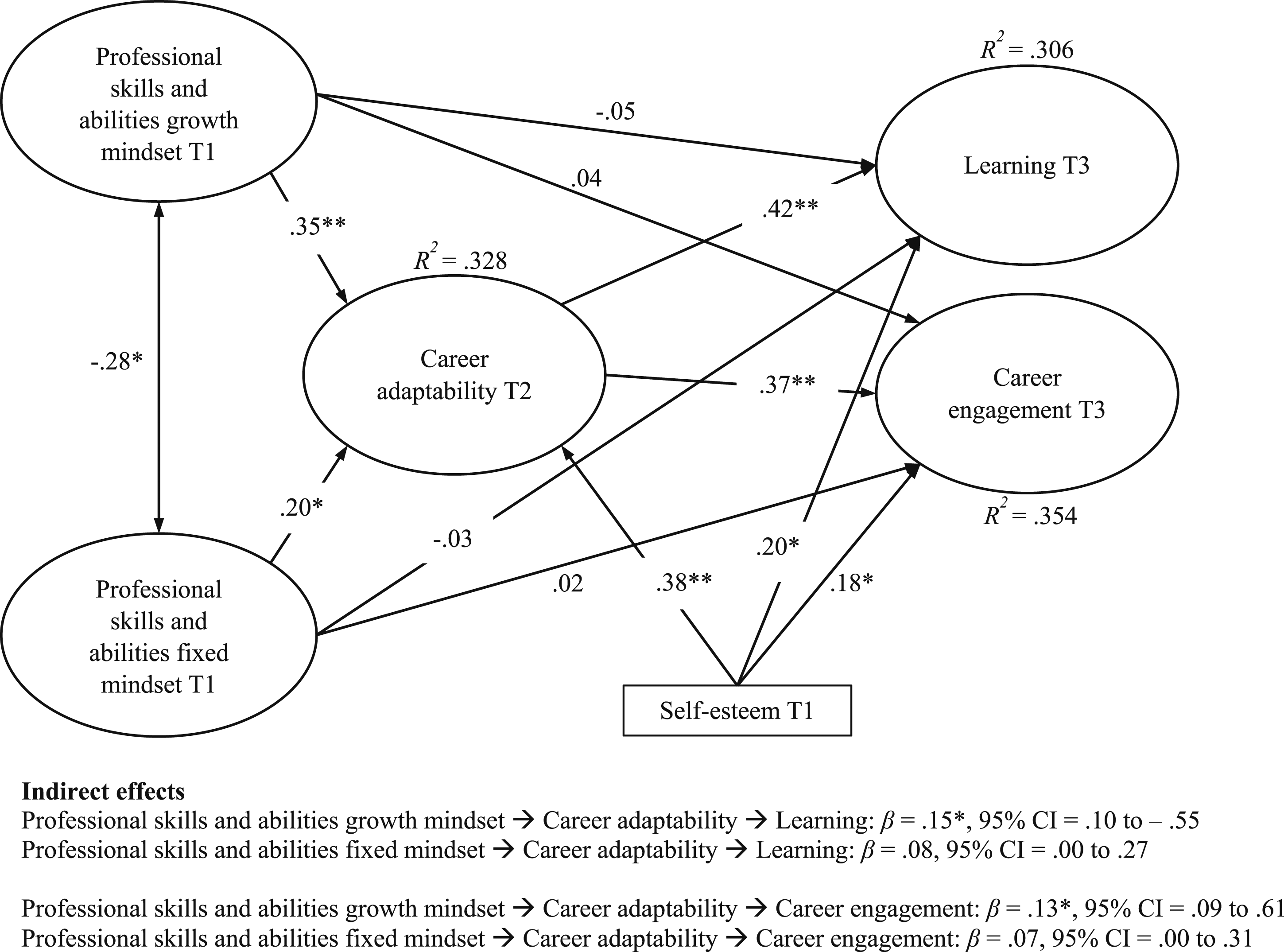
Study 4
The goal of Study 4 was to assess the test-retest reliability of the newly developed professional skills and abilities mindset scale. Research suggests that people’s mindsets are relatively stable, yet still open to change during shorter periods of time (e.g., due to situational influences) or in the longer term through education (Crum et al., 2013; Han & Stieha, 2020; Sisk et al., 2018). Accordingly, we expected the test-retest reliability of the mindset scale to be moderate across a period of four weeks with correlations that may fall in the range of what has been reported by previous validation research on mindset constructs in other domains (e.g., test-retest correlations of r = .40 to .70; Crum et al., 2013; Rammstedt et al., 2021; Weiss & Diehl, 2020).
Participants and Procedure
A heterogeneous sample of 200 individuals were invited to take part in the study and 191 of those completed the survey (95.5% response rate). The study participants from the first wave were invited one month later to fill in the T2 survey. The final sample consisted of 126 individuals (65.9% female) who participated in both waves (response rate of 66%). The participants were reimbursed £1.23 for completing the two surveys (10 minutes completion time), respectively. Participants’ mean age at T1 was 34.61 years (SD = 9.52), and 78 (61.9%) held a university degree. Their organizational tenure was 6.13 years (SD = 5.08) 3 . There were no significant differences between completers and participants who provided incomplete data in terms of their professional skills and abilities mindset or demographic variables.
Measures and Results
Correlations, Means, and Standard Deviations of the Study Variables (Study 4).

Note. N = 126. Gender was coded 0 = female, 1 = male. Educational degree was coded 0 = below university degree, 1 = university degree. Supervisor status was coded 0 = no, 1 = yes. Professional skills and abilities growth mindset scale: 3 items. Professional skills and abilities fixed mindset: 3 items. * p ≤ .05. ** p ≤ .01.
The test-retest reliability was .43 for professional skills and abilities growth mindset and .55 for the fixed mindset scale. These results reveal that the mindset scale was of moderate stability across a one-month period. The relationships with demographic variables were small (see Table 5). Participants’ highest educational degree was negatively related to professional skills and abilities fixed mindset at T1 but not at T2. Females reported higher growth mindset at T1, but not at T2, and participants with supervisor responsibilities reported a higher professional skills and abilities growth mindset at T2 only.
Overall Discussion
The concept of malleable and fixed mindsets about intelligence or talents has become increasingly popular in the media and non-scientific press as a way to understand individual differences in proactive behavior in achievement situations. So far, however, most research on the mindset concept has been conducted in the context of school education. Given the increasing awareness in the contemporary career landscape that it is important to continuously learn and develop one’s competencies throughout adulthood, a promising direction is to also apply the mindset concept to the context of career management. Based on the notion that mindsets are domain-specific, we set out to develop the concept of professional skills and abilities mindset, and to initially validate a short scale to measure it in research and practice.
Concept and Measurement of Professional Skills and Abilities Mindset
Building on the original intelligence mindset scale (Dweck, 1999), we developed a short and reliable six-item measure, with satisfactory psychometric properties, capturing both growth and fixed mindsets about professional skills and abilities. The results across all four studies clearly suggest that a professional skills and abilities mindset is a two-dimensional concept. In other words, people can simultaneously hold both growth and fixed mindsets about their professional skills and abilities. For example, an employee may generally have a professional skills and abilities growth mindset, but may believe that for certain groups (e.g., older workers who are dismissed) or in some situations (e.g., when organizational change is implemented with less time for employees to adjust or when many changes are introduced simultaneously in the organizational context), there is less control over the development and a fixed mindset would be activated. Nevertheless, most people probably lean towards one of the mindsets, as there was a small to moderate negative bivariate correlation between the two dimensions (ranging between r = −.29 and −.48). This finding aligns with some previous research, which yielded correlations between −.02 and −.78 (Kunz et al., 2020; Lüftenegger & Chen, 2017; Tempelaar et al., 2015) and perspectives on the conceptualization of mindsets as bi-dimensional (Lüftenegger & Chen, 2017; Murphy & Reeves, 2019), but it differs from earlier conceptualizations of mindset as a uni-dimensional construct (Burnette, 2013; Dweck et al., 1995).
We conceptualized a professional skills and abilities mindset as an individual difference factor that should reflect individuals’ readiness and willingness to fulfill career-related tasks and predicts the availability of adaptability resources (Hirschi et al., 2015; Rudolph et al., 2017). In line with this, we found our mindset measure to be moderately stable across a time interval of four weeks. Compared to other relevant individual difference factors in the career construction theory of adaptation (Savickas, 2005), such as core self-evaluations, proactive personality, and cognitive ability as indicators of adaptive readiness (Hirschi et al., 2015; Rudolph et al., 2017), professional skills and abilities mindsets are somewhat less stable. Nevertheless, the identified test-retest correlations of .43 and .55 are largely similar to findings by Rammstedt et al. (2021) on the retest-reliability of the intelligence mindset (which was .45 in an adult sample over a 4-month time lag). The moderate test-retest stability supports the argument that mindsets are malleable and open to perceived external changes and experiences (Rammstedt et al., 2021; Yeager & Dweck, 2020), for example, through training interventions (Sisk et al., 2018). A large body of research attests to the fact that people can move towards a fixed or growth mindset, triggered by situations, events, and information in the local environment (Murphy & Reeves, 2019). For example, in work situations where people’s mindset beliefs become salient, receiving critical feedback or witnessing unexpected success in others may trigger shifts in mindsets about professional skills and abilities (Murphy & Reeves, 2019).
The pattern of correlations with related measures (internal work locus of control, attitudes toward learning and development, and learning goal orientation) in Study 1 generally supported the convergent validity, with most relationships being small to moderate in size. Relationships were generally slightly stronger for the growth mindset than the fixed mindset dimension, and a professional skills and abilities fixed mindset was found to be unrelated to learning goal orientation. These results suggest that the construct of professional skills and abilities mindset is related but not redundant with existing measures that have also been studied as individual difference predictors of career adaptability resources (Rudolph et al., 2017). Mindset beliefs thus cover an additional and, so far, unexplored aspect of people’s career construction process, that is, their ‘naive models’ of the changeability and plasticity of professional skills and abilities, which guide the way information about the self is processed and understood (Mangels et al., 2006; Molden & Dweck, 2006).
Few Demographic Variations
Regarding demographic differences, we found across all four studies that professional skills and abilities mindsets are unrelated to age. This is important in light of meta-analytic evidence that older workers are less interested than younger workers in training and development activities (Ng & Feldman, 2012). Apparently, older workers’ relative disinterest in developmental activities is not due to their beliefs that skills are generally fixed in working life. Instead, personal and social experiences (e.g., slower training progress due to cognitive aging or perceptions of ageism in the company) may feed into older workers’ relative disengagement from learning and development. For the other demographic variables, findings were less consistent. In single studies, supervisor status was positively related to a growth mindset (Study 4) and negatively related to a fixed mindset (Study 2), a higher educational degree was negatively related to a fixed mindset (Study 4), and being female was positively related to a growth mindset (Study 4) and negatively related to a fixed mindset (Study 2). However, these effects could not be replicated in other studies. Overall, small coefficients and inconsistent relationships indicate that, on average, employees do not fundamentally differ in growth and fix mindset based on these demographic characteristics. This is similar to other research on intelligence mindsets (Rammstedt et al., 2021).
From Mindsets to Career Adaptability, Learning, and Career Engagement
One of the core contributions of our study was the integration of the mindset concept into the career construction theory of adaptation (Hirschi et al., 2015; Savickas, 2005) by conceptualizing the professional skills and abilities mindset as an indicator of employees’ adaptive readiness and establishing the role of mindset in career adaptability, learning, and career engagement. Our findings demonstrate that a professional skills and abilities growth mindset is predictive of career adaptability and, through this pathway, nourishes learning and career engagement. Thus, in line with the career construction theory (Rudolph et al., 2017; Savickas, 2005), career adaptability acts as important underlying mechanism; there were no direct effects of a growth mindset on learning and career engagement as indicators of adapting responses. Moreover, we could demonstrate incremental validity in predicting these outcomes above and beyond self-esteem. Individuals with a growth mindset who believe that professional skills and abilities can be altered by making an effort, are motivated to give their best and to improve their skills and abilities (Yeager & Dweck, 2012). Thus, by altering mindsets, it may be possible to trigger change in actual career behavior. However, based on our study, we cannot yet make this causal claim, as it would require a properly designed intervention study.
Although findings for the growth mindset were clear and robust, we could not establish criterion validity for professional skills and abilities fixed mindset. There was also a lack of direct associations between the fixed dimension and career-related outcomes. Possibly, fixed mindsets are only relevant in certain situations and for immediate outcomes, such as regulatory strategies when facing setbacks and failure. In prior studies on the concept of dementia mindsets, the fixed mindset was unrelated to occupational well-being of professional caregivers, but it did predict their emotions and behavior in response to challenging care situations with dementia patients (Kunz et al., 2020, 2022). Specifically, when confronting patients who showed behavior that challenges, caregivers with a fixed dementia mindset reported reduced positive emotions and low person-centered care (i.e., an adaptive response to change the situation). We may expect similar responses for a fixed mindset for other professional skills and abilities. When employees encounter work situations in which their skills and abilities do not suffice, a fixed mindset may lead to negative emotions and a lack of problem-focused coping.
Limitations and Implications for Future Research
This research has several limitations. First, all studies are based on single-source self-report methodology, which is particularly problematic in case of indirect effect hypotheses. Given the limitations of this methodology, we cannot rule out the influence of common method bias (Podsakoff et al., 2003). However, we also included a three-wave longitudinal study to reduce such bias.
Second, scale validation is an ongoing process and further studies should be conducted to support the scale’s validity. For instance, research should test the retest reliability across longer periods (e.g., several months, a year) in a larger sample for a more reliable stability calculation. Future studies should investigate the incremental validity of professional skills and abilities mindset above and beyond other relevant career adaptive responses, such as personality factors (i.e., proactive personality, conscientiousness), optimism, and cognitive ability (Johnston, 2018; Rudolph et al., 2017) as well as the more established intelligence mindset concept. We would expect that the professional skills and abilities mindset (rather than the broader intelligence mindset) taps into the same construct domain and might thus be a better predictor of specific and equally narrowed professional or career-related outcomes (Hogan & Roberts, 1996). Moreover, our studies are based on Western, highly educated samples. To examine the cross-cultural validity of our scale and assess its equivalence across educational groups, further research should test the generalizability of our findings to other samples.
Practical Implications and Conclusion
The knowledge gathered from our research offers practical contributions to the fields of career or vocational consulting, coaching, and personnel development. Our new measure could prove to be a valuable tool for organizations to support their employees’ career adaptability, learning, and career engagement, as well as for career coaching. This is particularly important in situations of organizational change, where employees must employ adaptive responses and take on responsibility for managing their own learning. Specifically, our parsimonious mindset measure could be used by practitioners as a screening instrument to identify employees who doubt the possibility of professional learning and development. Accordingly, organizations can first focus their intervention efforts on shifting employees’ mindsets (Heslin et al., 2020; Murphy & Reeves, 2019), in order to make them more receptive to the organizational change. Likewise, career coaches could use cognitive strategies to change their coachees’ professional skills and abilities mindsets in order to boost the effectiveness of career engagement interventions. Examples are to reinforce coachees’ growth mindsets by framing the development of professional skills and abilities as a process, highlighting the making of mistakes as a learning opportunity instead of a failure, and encouraging coachees for their effort and persistence when learning new skills instead of focusing on innate talent (Dweck et al., 1995; Heslin et al., 2020).
Footnotes
Declaration of Conflicting Interests
The author(s) declared no potential conflicts of interest with respect to the research, authorship, and/or publication of this article.
Funding
The author(s) received no financial support for the research, authorship, and/or publication of this article.
