



Abstract
The purpose of the present study was to examine the career aspirations of Indian female undergraduate students, by utilizing a theoretical framework integrating Attachment Theory and Social Cognitive Career Theory (SCCT). Data were collected from 157 female Indian undergraduate students at a Liberal Studies college in India to study the contribution of self-reported maternal and paternal attachment security in predicting career aspirations. In particular, the mediating effects of student-reported self-esteem and career decision self-efficacy were examined in the relationship between their perceptions of maternal and paternal attachment security and career aspirations. Secure attachment to mothers, but not fathers, was found to relate to self-esteem and career decision self-efficacy, which in turn predicted career aspirations. Findings from the study contribute to the literature on career aspirations of women in India and lend support for the integration of attachment theory and SCCT. Future research and practical implications of these findings are discussed.
Keywords
Introduction
Even with the growing emphasis on women’s career development, it is still common to note gender segregation across the world in terms of pay equity and roles in the workplace (Yayla-Kullu & McMurray, 2019). In India, even though there has been a substantial increase in women’s enrolment in higher education (Period Labour Force Survey, 2017–18), only a minority of women hold senior management roles or leadership roles as compared to men with similar educational qualifications (Basu, 2018). Thus, increases in the number of women pursuing higher education has not resulted in a proportionate increase in gainful employment or leadership opportunities for women in India.
Studies have addressed several reasons for these discrepancies, including barriers such as work-role conflict, family responsibility, workplace discrimination, gender stereotyping, societal expectations, and career trade-offs faced by Indian women (Buddhapriya, 2009; Naqvi, 2011). In India, research on women’s career development has largely stemmed from the disciplines of economics and organizational behaviour, and has focused on the significance of contextual factors (e.g., class, gender, colourism) more so than personal factors (e.g., self-efficacy, gender role attitude, work role salience). In addition, only a few studies have examined career aspirations in young women (Beaman et al., 2012; Kang & Kaur, 2020; Reddy & Rajaram, 2015; Sims & Hirudayaraj, 2015) and no study to date has incorporated personal and relational factors in understanding career aspirations of young women. As a first step in including relational and personal factors in the study of career development among women in India, the present study sought to examine Indian women’s career aspirations through the lens of two psychological theories, Attachment Theory (Ainsworth, 1989; Bowlby, 1973) and Social Cognitive Career Theory (SCCT; Lent et al., 1994).
Theoretical Underpinnings
Social Cognitive Career Theory
Historically, career development theories have been interested in the person-environment fit in shaping career development, with an emphasis on how person-level attributes (such as interests and values) interact with the environment. More contemporary career development theories move away from the notion of this person-environment fit being stable and the individual’s role as somewhat passive, to a more dynamic understanding of the interplay between person, relational, contextual factors in shaping career development. SCCT (Lent et al., 1994) is extensively recognized for its utility in the study of complex intersecting career-related variables, particularly in diverse populations (e.g., Gregor et al., 2019; Kim et al., 2016). Drawing from Bandura’s (1986) social cognitive theory, SCCT posits that self-efficacy, outcome expectations, and goals, play a pivotal role in shaping career development. According to the SCCT interest model, learning experiences, which are a result of personal inputs and environmental factors, contribute to self-efficacy and outcome expectations, which then contribute to career-related goals. A strength of SCCT lies in its applicability and the ability to incorporate a range of psychological phenomena in its model.
Within the SCCT framework, person level inputs (e.g., personality, gender, predispositions) are conceptualized as interacting with background environmental influences (e.g., career role models, parental relationships) and proximal level influences (e.g., supports and barriers) to eventually shape career development (Lent & Brown, 2013). To further explain the development of this self-system, Wright and Perrone (2008) have recommended utilizing attachment theory to examine how emotional bonds lay the foundation for the ways in which one navigates experiences that shape several aspects of career development. In particular, attachment theory can offer a useful way to examine how the emotional bonds formed with parents can contribute to person level inputs (Wright et al., 2017).
Attachment Theory
Attachment theory is widely researched with a large body of evidence suggesting that the emotional bonds formed with early caregivers carry forward into adulthood impacting several domains in one’s life. Repeated experiences with attachment figures lead to the development of internal working models, or mental representations of how one views self and others. In adulthood, internal working models are frequently assessed through the use of an empirically supported two-dimensional model of attachment (Fraley et al., 2015), attachment anxiety and avoidance. Attachment anxiety is characterized by hypervigilance and concern around the responsiveness of others, whereas attachment avoidance is signified by a tendency to withdraw from interpersonal relationships (Shaver & Mikulincer, 2007). Higher levels of attachment anxiety and/or avoidance are reflective of attachment insecurity and negative internal working models, whereas lower levels of attachment anxiety and/or avoidance signify positive internal working models and attachment security. This two dimensional model of adult attachment has been studied in terms of attachment to parental figures and romantic partners, and found to affect several aspects of one’s life (Brennan et al., 1998; Fraley et al., 2015).
In regards to how attachment security impacts career development, Wright and colleagues (e.g., Wright & Perrone, 2008; Wright & Perrone, 2010; Wright et al., 2014; Wright, 2017) have argued for the inclusion of attachment as a relational variable that should be considered within the SCCT framework, and have demonstrated direct empirical support for this notion. For example, there is evidence that secure attachment to parents relates to aspects of students’ career development, such as career exploration and planning (Boerchi et al., 2019; Vignoli et al., 2005) and self-efficacy pertaining to career decisions and tasks (O’Brien et al., 2000; To et al., 2021; Wolfe & Betz, 2004). In particular, Wright and Perrone (2008) suggest that attachment security would reflect in individuals’ ability to be more willing to approach and participate in learning experiences to progress career development, rather than experiencing distress or avoiding such experiences. Moreover, To et al. (2021) found in a recent meta-analysis that parental cognitions, parenting behaviors, and parent-child relationship quality were associated with the career development of their children. These authors reason that secure relationships with parents might allow students to experience emotional support, which in turn would contribute to greater confidence in and commitment towards career decision making.
A small body of literature on parental attachment and career development suggests both similarities and differences in the ways maternal and paternal attachment relate to career development variables. Findings from two studies on female students in particular suggest that secure attachment to mothers is positively related to career commitment and career orientation (Blustein et al., 1991; O’Brien, 1996). In a study of American undergraduate students, Lease and Dahlbeck (2009) found a positive relationship between secure maternal attachment and women’s career self-efficacy, whereas O’Brien et al. (2000) found a positive relationship between young women’s secure attachment to fathers and career self-efficacy, which in turn contributed to their career aspirations. Possible reasons for these discrepancies might have to do with differences in the ways male and female students experience attachment bonds with their mothers and fathers. Still, the body of research on the differences in maternal and paternal attachment in relating to career development remains limited, and further research is needed to support and understand these differences. In the present study, we expect maternal and paternal attachment to relate to career development variables in similar ways.
In addition to the limited understanding of the differences in attachment to maternal and paternal figures in contributing to aspects of career development, there is also paucity of research on the role of attachment in the development of career aspirations among young women. Thus, the current study seeks to explore the potential direct and indirect relationships between attachment and career aspiration as explained through serial mediation. In particular, utilizing both SCCT and attachment theory frameworks, we expect an individual’s attachment patterns to their mothers and fathers to contribute to career aspirations through the development of self-esteem and career decision self-efficacy.
Career Aspirations
Gregor and O’Brien (2016) defined career aspirations as the degree to which individuals wish to occupy leadership positions, achieve recognition, or pursue continuing education in their chosen career. A number of studies have supported the predictive value of career aspirations in attaining social status, higher earnings (Ashby & Schoon, 2010), securing professional careers (Schoon & Polek, 2011) and investing in continuing education (Schoon & Parsons, 2002). In India, studies on career aspirations have focussed on specific training environments (e.g., dentistry trainees, medical school students) and women at work, with interest in workplace discrimination and the effects of the glass ceiling (e.g., Datta & Agarwal, 2017; Srinivasan et al., 2013). Career aspirations have also been examined in specific populations such as Manipuri youth (Ningthoujam et al., 2019) and adolescents living in rural areas of West Bengal (Beaman et al., 2012). In an attempt to fill a gap in the literature in examining internal and psychological forces influence on career aspirations, Kang and Kaur (2020) studied occupational self-efficacy, proactive personality, work role salience, and gender role attitude as predictors of career aspirations in a sample of women working in banks and the insurance sector. Their findings indicated positive correlations among gender role attitude, occupational self-efficacy, proactive personality and work role salience with career aspirations.
No studies to date have examined career aspirations among undergraduate female students in non-professional academic institutions in India. Undoubtedly, undergraduate years entail a unique set of experiences that can shape career aspirations (Stringer & Kerpelman, 2010; Tsui et al., 2019). In Western countries, studies on career aspirations of undergraduate student populations highlight the role of perception of barriers, competence assessments, self-differentiation and domain specific self-efficacy, such as career decision self-efficacy and college self-efficacy, as possible predictors of career aspirations (Gregor et al., 2019; Middleton, 2017). Thus, it seems pertinent to continue to understand the factors influencing the career aspirations of young women in India. We also expect this study to add to the global body of literature on career aspirations by offering an integration of the self (or person-level) variables and relational (or other-level) variables by including elements of SCCT and attachment theory.
Self-Efficacy
Self-efficacy has been extensively studied in career literature. A central component of SCCT, career-related self-efficacy derives from Bandura’s (1986) definition of self-efficacy as a dynamic set of beliefs about one’s capability to complete a task or perform in a specific domain. Career Decision Self-Efficacy (CDSE) refers to a person’s set of beliefs pertaining to their ability to make career decisions (Betz & Hackett, 1981), and is especially relevant for the undergraduate population, as they navigate career and life transitions. CDSE has been shown to be a major indicator of several career related outcomes (see review by Choi et al., 2011), including career aspirations (Gregor et al., 2019; Raque-Bogdan & Lucas, 2016), and thus, we expected CDSE to relate positively to career aspirations in our study.
Given its predictive value to career related outcomes, research has also focused on factors that contribute to the development of CDSE. As indicated earlier, the literature on SCCT points to both person-level and contextual factors in affecting CDSE. SCCT suggests that person-level inputs including predispositions such as attachment patterns influence learning experiences pertaining to career decisions, thereby predicting the extent to which a person is high or low in CDSE. In terms of attachment theory, it is expected that individuals who are high on attachment security will be able to effectively explore their environment and engage in learning experiences that enhance career decision self-efficacy (Wright & Perrone, 2008). A small body of research has provided support for the link between attachment security and greater levels of CDSE (El-Hassan & Ghalayini, 2019; Wolfe & Betz, 2004; Wright et al., 2014). Consistent with this literature we expected attachment security to relate positively to career decision self-efficacy. Further, we expected that the relationship between attachment and career aspirations will be mediated through career decision self-efficacy.
Self-Esteem
Along with the domain specific self-efficacy, we aimed to tease apart the mechanisms at play between attachment and CDSE further by incorporating self-esteem in our model. As indicated earlier, internal working models of the self and others are key components of attachment theory. One way in which self-schemas can be examined is by assessing levels of self-esteem, defined as the extent to which one thinks of themselves as worthy (Baumeister et al., 2003). The relationship between attachment security and self-esteem is well established empirically (Sroufe, 2005; Wilkinson, 2004), and thus we expected attachment security to parental figures to relate to higher levels of self-esteem in the present study.
In the career literature, the distinction between CDSE and self-esteem has been highlighted, with Lent and Fouad (2011) noting that the two are distinct on dimensions such as global and trait (self-esteem) versus specific and state (self-efficacy). A few studies have provided further support for this distinction, with findings indicating a small positive relationship between self-esteem and CDSE (e.g., Betz & Klein, 1996). Park et al. (2018) found that self-esteem was positively related to CDSE in a sample of Korean undergraduate students who were studied longitudinally. Moreover, a meta-analysis examining predictors of CDSE found that self-concept variables including self-esteem correlated with higher CDSE (Choi et al., 2012). Thus in the present study, we expected self-esteem to relate positively to CDSE. Only a handful of studies have examined the relationship between self-esteem and career aspirations with varying results (e.g., Khampirat, 2020; Shirima et al., 2021). In the present study, we expected self-esteem would not relate to career aspirations directly, but rather the relationship between self-esteem and career aspirations would be mediated through CDSE. It makes conceptual sense that CDSE would be one possible mechanism through which a higher sense of self-concept would relate to career goal setting.
Present Study
The present study sought to utilize attachment theory and SCCT by examining the direct relation between parental attachment and career aspirations, as well as the mediating role of self-esteem and self-efficacy on this effect. In doing so, this study attempts to address the following limitations in the literature on career aspirations of young women in India. First, in most studies, constructs are studied independently rather than as part of clear underlying theory. Second, studies have primarily focused on the role of contextual factors rather than personal/psychological factors in impacting career development in women. Third, studies have examined career aspirations primarily in professional training programs and working populations, and thus several other populations of young female students remain underrepresented in literature. Our study attempts to address these gaps by utilizing the theoretical frameworks of attachment and SCCT to examine the influence of personal and relational factors on career aspirations in a sample of undergraduate female students in India.
Several specific hypotheses were made. For our first hypothesis, we expected maternal and paternal attachment to positively and directly relate with career aspirations, consistent with previous literature (Blustein et al., 1995; Blustein, et al., 1991). Our second hypothesis stated that attachment to maternal and paternal attachment figures would be directly positively related to self-esteem and career decision self-efficacy as literature supports the important role of early relationships on feelings of esteem and efficacy in young adults (Kocayörük & Şimşek, 2015). Our third hypothesis predicted that self-esteem would be positively related to career decision self-efficacy consistent with previous literature (Park et al., 2018; Thompson et al., 2019). Our fourth hypothesis was that career decision self-efficacy would positively relate to career aspirations, as this link is well established in the literature (Tang et al., 2008). Finally, in our fifth hypothesis, we predicted serial mediation, with two indirect effects of maternal and paternal attachment on career aspirations through self-esteem and career decision self-efficacy (see Figure 1). Multiple mediation model.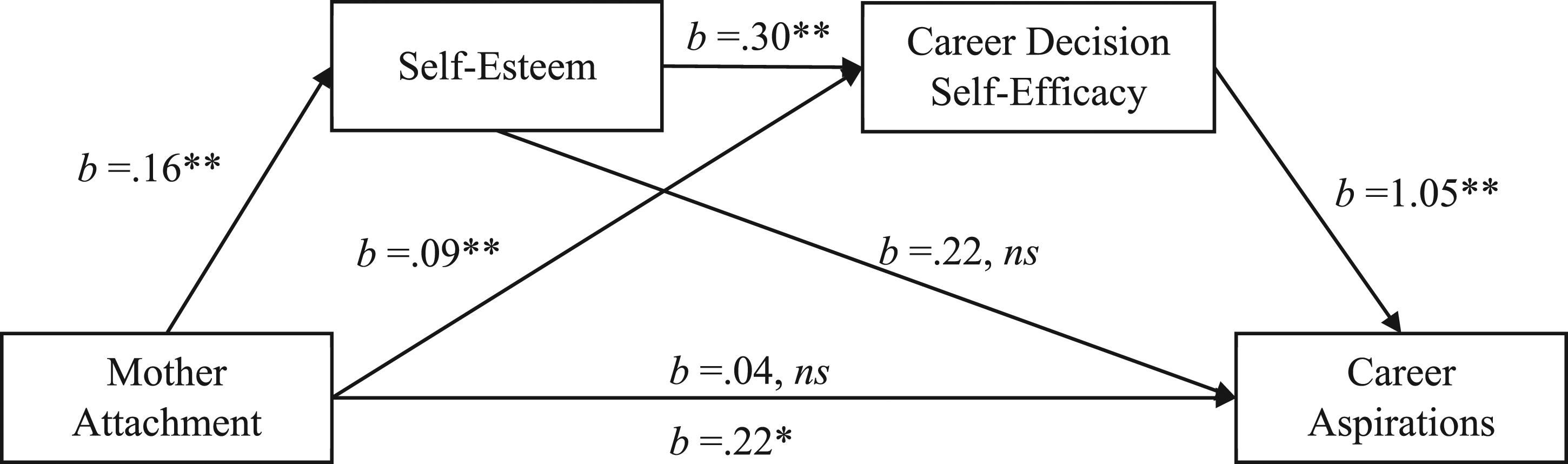
Method
Participants
Participants completed the online survey using surveymonkey. The eligibility criteria specified that participants needed to be above 18 years of age, proficient in English, Indian citizens and enrolled full-time as undergraduate students at a liberal arts university in North India. Of the 333 participants who accessed the survey, 41 of whom did not meet the eligibility criteria. From the remaining 294 participants, entries for 66 participants were removed as data for more than 20% of the items was missing (following the recommendation by Parent, 2013). For the present study, we retained responses from participants who identified as female, as they were the focus of the current study. The final sample consisted of 157 Indian female participants. The average age of participants was 19.42 years (SD = 1.05; range 18–22 years). The majority of participants (N = 116; 73.88%) identified as heterosexual, 12 (7.55%) identified as bisexual, seven (4.4%) as queer, one (.63%) participant identified as lesbian, and the remaining 21 (13.38%) did not disclose their sexual identity. Sixty-six (42.04%) students were in their first year of undergraduate study, 47 (29.94%) in their second year, 34 (21.66%) in their third year, and 10 (6.37%) in their fourth year. In terms of their major, most students (N = 67; 42.68%) indicated psychology as their major. With respect to future career choices, 41 (26.11%) students indicated that they would like to become psychologists, 22 (13.83%) students mentioned a career in academia and research and 29 (17.38%) students mentioned careers in the media, public policy, data science and entrepreneurship.
All participants indicated that their mother/mother-like figure was alive. Approximately half of the students reported that their mothers had completed post graduate degrees (N = 70; 44.03%), and were working professionals (N = 89; 55.97%). Almost all participants (N = 154; 98.11%) indicated that their father/father-like figure was alive. The majority of students reported that their fathers had completed a postgraduate degree (N = 79; 49.69%), and were employed (N = 138; 86.79%).
Procedure
Following IRB approval, a recruitment email was sent to the entire undergraduate student body of a mid-sized liberal arts university in Northern India. In addition, researchers also sent an additional round of emails to students enrolled in 37 courses (including a mix of introductory and advanced level courses) at the university. One reminder was sent to these students a week after the first email. Data were collected over the spring semester of 2019. Participants could choose to enter their names to win a lottery of one out of 10 Amazon gift cards worth 1000INR (13 USD). Some students were also able to receive research course credit by participating in this study.
Measures
Career Aspirations
The 24-item Career Aspiration Scale- Revised (CAS-R) was developed by Gregor and O’Brien (2016) to assess the extent to which individuals value their careers and aspire for leadership, achievement and continuing education in their chosen profession. Participants rated items on a 5-point Likert scale ranging from 0 (not at all true of me) to 4 (very true of me). The measure has three subscales representing each domain (leadership, achievement and education) and can also be used as a total score. Example items include, “I want to be among the very best in my field,” and “I will always be knowledgeable about recent advances in my field.”
Support for the reliability of the total score has been found with populations of US women employed in higher education (α = .91; Gregor et al., 2021) and demonstrated validity (in its relation to achievement motivation, work role salience, and willingness to compromise career for future family in theoretically predicted ways; Gregor & O’Brien, 2016). The psychometric properties and factor structure of the CAS-R have been analysed in non-Western student populations including Korean undergraduate women (Kim et al., 2016) and Thai undergraduate students (Kunchai et al., 2021). In the current study the Cronbach’s alpha for the total score on the CAS-R was .90.
Parental Attachment
The Experiences in Close Relationships- Relationship Structures (ECR-RS) Questionnaire, developed by Fraley et al. (2011) was used to measure maternal and paternal attachment. The ECR-RS consists of 9-items to measure attachment avoidance and anxiety. It is also possible to obtain a single score of attachment security/insecurity by combining the two scales. In the present study, we utilized a total score on attachment security, for maternal and paternal attachment, obtained by reverse coding and combining the two scales, such that a high score on the measure indicated higher levels of attachment security. Participants responded to items on the scale for both their maternal and paternal figures on a 7-point rating scale ranging from 1 (strongly disagree) to 7 (strongly agree). Example items include, “I find it easy to depend on this person,” and “I don’t feel comfortable opening up to this person.”
The ECR-RS has been extensively used globally with adolescent and young adult populations to study attachment anxiety and avoidance in close relationships, including mother/mother-like figure and father/father-like figure (Moreira et al., 2014; Rocha et al., 2017; Wright et al., 2014), and has demonstrated adequate reliability for both the anxiety and avoidance subscales (alphas ranging from 0.75 to 0.94). Additionally, the ECR-RS is found to relate to loneliness, social support and symptoms of anxiety and depression (Fairchild & Finney, 2006; Fraley et al., 2011). The Cronbach’s alpha scores for maternal attachment security and paternal attachment security in the current study were .91 and .92, respectively.
Career Decision Self-Efficacy
The 8-item Brief Decisional Self-Efficacy Scale (CEDSE-BD; Lent et al., 2016) was used to measure career related decisional self-efficacy in the present study. Students were asked to indicate their degree of confidence on a 5-point Likert scale ranging from 0 (no confidence at all) to 4 (complete confidence). An example of an item is, “Cope with the disappointment if your first choice does not work out.” Higher scores represent stronger beliefs in one’s ability to engage in career exploration. The CEDSE-BD has also been used successfully with Western and non-Western populations. For example, Wang et al. (2018) studied the factorial structure and validity of a Chinese version of the CEDSE-BD among 640 undergraduates across two Chinese universities and found the Cronbach alpha to be .88, and had relationships with outcome expectations and proactive personality in the expected directions. In the present study, Cronbach’s alpha for CEDSE-BD was .91.
Self Esteem
The Rosenberg’s Self Esteem Scale (RSES; Rosenberg, 1965) was utilized to measure an individual’s global self-esteem. The RSES consists of 10 items, rated by respondents on a 4-point scale ranging from 1 (strongly disagree) to 4 (strongly agree) on statements that pertain to general feelings about themselves. Higher scores represent greater levels of self-esteem. An example item is, “I take a positive attitude toward myself. The RSES has been validated across the globe with adolescents and young adults. Schmitt and Allik (2005) simultaneously administered the RSES across 53 countries (including India) and found support for the reliability and validity of the measure across countries with individualistic and collectivistic cultures. The Cronbach’s alpha for the translated version (Hindi) of the measure utilized for the Indian sample in Schmitt and Allik’s (2005) was reported to be .81. In the current study, Cronbach’s alpha for the RSES was found to be .91.
Demographic Questionnaire
Participants completed a demographic form that included items on the year of undergraduate education, age, gender, sexual orientation, relationship status and education status of parents/parent like figures and their parents' current occupational status.
Results
Sample Sizes, Means, Range, Standard Deviations and Correlation for and Among Variables.

Note. **p ≤ .01 *p ≤ .05.
The hypothesized model was tested using Hayes’ (2018) PROCESS macro for SPSS. PROCESS uses ordinary least squares regression to generate model coefficients and estimates conditional, indirect, and direct effects for moderation and mediation analyses (Hayes, 2018). In the current study, model six was used to test the hypothesized serial mediation (Figure 1). Indirect effect estimates were made using percentile bootstrapping with 10,000 bootstrapped samples, consistent with the recommendations of Hayes and Scharkow (2013). Ninety-five percent confidence intervals were used with confidence intervals not including zero indicating a significant indirect effect. Assumptions of linearity, homoscedasticity, and independence were met. Bootstrapped confidence intervals do not assume normality in the distribution of the indirect effect (ab; Hayes, 2018).
Figure 1 contains unstandardized regression coefficients for each path in the model. Together, the predictors in the model accounted for 20% of the variance in career aspirations (F = 13.57, p < .01). Results for each path provide partial support for hypotheses one and three and full support of hypotheses two, four, and five. Although there was a significant total effect of maternal attachment on career aspirations (b = .22, SE = .10, 95% CI [.02, .42], p = .03), contrary to our first hypothesis, there was not a significant direct effect of maternal attachment on career aspirations when controlling for the mediators in the model (b = .04, SE = .10, 95% CI [−.15, .24], p = .67). Hypothesis two was fully supported as there were direct positive relationships between maternal attachment and both self-esteem (b = .16, SE = .05, 95% CI [.06, .26], p = .001) and career decision self-efficacy (b = .09, SE = .03, 95% CI [.02, .16], p = .01). Hypothesis three was fully supported as there was a direct positive relationship between self-esteem and career decision self-efficacy (b = .30, SE = .05, 95% CI [.19, .40], p = .001), but not with career aspirations (b = .22, SE = .16, 95% CI [−.09, .54], p = .16). The results fully supported hypothesis four as career decision self-efficacy directly and positively related to career aspirations (b = 1.05, SE = .23, 95% CI [.60, 1.49], p = .001). Lastly, serial mediation was supported as maternal attachment had an indirect effect on career aspirations through self-esteem and career decision self-efficacy (95% CI = .011, .13) providing support for hypothesis five.
Discussion
In the present study, we attempted to address the limited understanding of the personal and contextual factors shaping career aspirations among young adults in India by integrating attachment theory and SCCT in studying the career aspirations of Indian female undergraduate students. Our findings largely supported our hypotheses surrounding the indirect relationship between maternal attachment and career aspirations, and the mediating role of self-esteem and self-efficacy. These results highlight that the emotional bonds formed with maternal figures can contribute indirectly to vocational development, and help to support the recommendations of Wright et al. (2017) for the inclusion of attachment variables in understanding the personal inputs theorized in SCCT. However, contrary to our expectations, maternal attachment did not directly predict career aspirations. Moreover, paternal attachment did not relate with any variables of interest, suggesting a differential impact of caregiver relationships on the career development of young women in India.
The Role of Maternal Attachment, Self-Esteem and Career Decision Self-Efficacy
Our expectation of maternal attachment security relating to career aspirations was partially supported. Student perceptions of attachment security to mothers or maternal figures did not contribute to career aspirations directly, but rather secure attachment to mothers or maternal figures was positively related to career aspirations only in the presence of self-esteem and self-efficacy. In other words, students’ experience of secure attachment relationships with their mothers did not bear upon their interest in pursuing education, leadership roles and recognition in their chosen career field directly, but rather through how they felt about themselves and their belief in their ability to make career decisions. In the extant literature, the relationship between attachment security and career aspirations are somewhat mixed, with a few studies indicating a positive direct relationship between the two variables (Fiebig, 2008), and others suggesting that the relationship between attachment and career aspirations is best understood through the presence of mediating variables (O’Brien, 1996; O’Brien et al., 2000). In our study, similar to Rainey and Borders’ (1997) and O’Brien’s (1996) study, it appears that secure attachment to mothers relates to career aspirations in the presence of other young adult and adolescent characteristics.
In line with our second hypothesis, secure attachment to mothers or maternal figures was positively related to both reports of self-esteem and career decision self-efficacy. In regards to self-esteem, this positive relationship is well established theoretically and empirically, and thus our finding is consistent with the current literature (Sroufe, 2005; Wilkinson, 2004). Similarly, students reporting greater attachment security to their mothers/maternal figures were also more likely to report believing in their ability to make decisions about their career. A possible interpretation of this finding is that a stronger maternal attachment provides experiences for the individual to feel secure and encourages independence, which translates into decisions about their careers, thereby contributing to greater levels of CDSE. This is in line with the findings of Wright and Perrone (2008) who highlight a review of research establishing a link between attachment and career decision self-efficacy among adult and student populations. Our findings also supported our third and fourth hypotheses, which predicted that self-esteem would relate positively to career decision self-efficacy, and career decision self-efficacy would relate positively to career aspirations, respectively. Consistent with previous literature (Betz et al., 1996; Park et al., 2018; Thompson et al., 2019), self-esteem and career decision self-efficacy appear to be related, such that students reporting greater self-esteem were also more likely to report believing in their ability to make career decisions. Also as expected, career decision self-efficacy is related positively to career aspirations. The relationship between career decision self-efficacy and career aspirations is well established among Western populations (Gregor et al., 2019; Middleton, 2017). Our results suggest that for our sample of Indian female undergraduate students, the belief in their ability to make career decisions is positively associated with their interest in pursuing education, leadership roles and recognition in their careers.
Finally, in order to test the mechanisms at play between attachment and career aspirations, our fifth hypothesis predicted serial mediation with maternal attachment predicting career aspirations through self-esteem and career decision self-efficacy. Our model supported this hypothesis. Based on these results, we can conjecture that secure attachment to mothers may foster a healthy sense of self-esteem through positive internal working models of the self. In turn, this sense of self-esteem may also contribute to a sense of confidence in one’s ability to make career-related decisions further leading to a wish to occupy leadership positions, achieve recognition, or pursue continuing education in their chosen career.
The Role of Paternal Attachment
Contrary to our expectations, secure attachment to paternal figures did not relate to student reports of career-decision self-efficacy, self-esteem, or career aspirations in the present study. This is surprising, as a small body of literature has supported the relationship between attachment to fathers and career development variables (Emmanuelle, 2009; O’Brien et al., 2000). On the other hand, some authors have also noted that the influence of the same-gender parent on career development tends to be greater than the opposite-gender parent, especially in the case of daughter-mother versus daughter-father dyads (O’Brien et al., 2000; Young et al., 1988). This also appears to be the case in our sample, with the attachment between mother and daughters being closely related to career development variables. The present study is the first to examine the relationships between parental attachment and career development variables in India, and thus further research is needed to replicate these findings to arrive at more robust conclusions on the role of paternal attachment in relating to female students’ career development.
From an Indian context, these findings on both maternal and paternal attachment are important in that they add to our currently limited understanding of women’s career aspirations. Women’s career development in India is largely examined through the disciplines of economics and organizational behaviour, and our results point to the importance of integrating relational and self-variables in studying women’s career development. Furthermore, the current study supports the application of attachment theory and SCCT frameworks in the study of career aspirations for the Indian female college student population. Moreover, our results indicate that along with contextual factors such as work-role conflict, family responsibility and conforming to societal expectations previously examined as barriers to the career development of women in India (e.g., Buddhapriya, 2009; Chawla & Sharma, 2016; Naqvi, 2011), it is also important to attend to the maternal emotional bonds and self-esteem experienced by young women in efforts to strengthen their CDSE and career aspirations. Ultimately strengthening and building career aspirations among female college students might be one way to work on reducing the gender gap noted in leadership positions in India.
Implications for Practice
Results from the present study support the utility of using attachment theory and the SCCT model in examining the career aspirations of Indian female college students. Our results suggest that attempts to build on the career aspirations of female college students should include tending to their attachment in significant relationships, self-esteem, and the sense of confidence they experience in making decisions about their careers. For example, college counselors could use therapy to explore the role of parental figures, and the attachment to mothers in particular, in shaping students’ self-esteem and career decision self-efficacy, in efforts to build on students’ insight and self-understanding in these areas.
Attachment patterns in relationships are known to be somewhat stable in adulthood. Still, there may be ways to facilitate secure attachment relationships for college students, which in turn could help them in developing positive personal characteristics that may aid in vocational development. For example, college counselors may act as a secure attachment figure for clients (Mallinckrodt, 2010) while working on career development and personal concerns. College counselors can also work collaboratively on clients’ internal working model of themselves, in efforts to build on self-esteem. Research suggests that corrective emotional experiences in therapy can help client’s change the ways in which they view themselves and the world, setting them up to build more positive attachment relationships with others and improve on their self-esteem (Hill et al., 2012; Roghanchi et al., 2013).
Past research also suggests professor-student and advisor-student relationships might reflect attachment patterns associated with primary caregivers during childhood and predict academic outcomes (Creasey et al., 2009; Han et al., 2017; Van Ryzin, 2010). Thus, the findings from the present study may also have implications for faculty members, mentors and advisors working with undergraduate female students in tending to their self-esteem, career decision self-efficacy in efforts to build on career aspirations.
Finally, efforts to work on career decision self-efficacy can also move beyond the domain of college counselling. For example, skills-based interventions and seminars could be implemented by career advising centres to facilitate career exploration and build confidence in making decisions regarding one’s career (Gregor et al., 2019). Efforts in these domains may help to expand the options that young women see as career possibilities post-graduation, and help to close some of the gender employment gaps in India.
Limitations and Future Directions
Findings from the present study need to be understood in the context of its limitations. First, there are some limits to the generalizability of our data. The sample was collected from a single liberal arts institution in Northern India. Thus, our findings may not generalize to other educational institutions in India. In addition, undergraduate students pursuing liberal studies education in India typically include students from upper and upper-middle socio-economic backgrounds, and thus the career development and attachment experiences of students from low-income backgrounds may have been underrepresented in our study. Relatedly, the majority of participants in the study were also enrolled in a Bachelor of Arts program majoring in Psychology. Therefore, some caution is necessary in generalizing these findings to students who might opt for other subjects or programs. Future research is needed to replicate these findings across geographical locations, institutions, and diverse student populations in India. In addition, data collection occurred during the covid-19 pandemic, which could have had a potential impact on student responses. It would be helpful to compare the findings from data collected once the pandemic ends to assess the impact of the pandemic on students’ attachment relationships and career development variables.
Second, the present study used self-report measures and thus the findings are based on subjective experiences of the participants. Third, our model included only self-esteem and career decision self-efficacy and it would be helpful to explore and add other proximal and contextual factors (e.g., learning experiences, interests, outcome expectations) that would impact career aspirations to this model. To our knowledge, the present study is the first to incorporate relational/personal variables in the study of women’s career development in India. A meaningful next step would be to integrate the current literature on contextual factors along with attachment experiences, self-esteem and CDSE in the study of career aspirations among Indian women.
Finally, the study utilized a cross-sectional design. While we have offered a predictor model based on past theoretical and empirical literature, our design limits us in drawing clear causal inferences. It will be helpful for future research to utilize longitudinal designs to highlight the causal relationships and the changes across time among attachment relationships, self esteem, career decision self-efficacy and career aspirations.
To conclude, our findings provide further support for the integration of attachment theory and SCCT as proposed by Wright and Perrone (2008). In line with the model, it appears that incorporating attachment relationships as person-level inputs can help in further understanding the predictors of vocational outcomes such as career aspirations. In our study especially, it appears that female students’ perceptions of their attachment to mothers contributes to their sense of self-esteem, career decision self-efficacy, which in turn predict their career aspirations. These findings suggest the importance of relationships in predicting future wishes and aspirations related to one’s career, and may be used to help reduce some of the differential career outcomes for women in India.
Footnotes
Declaration of Conflicting Interests
The author(s) declared no potential conflicts of interest with respect to the research, authorship, and/or publication of this article.
Funding
The author(s) disclosed receipt of the following financial support for the research, authorship, and/or publication of this article: This study received support from the A.T.E. Chandra Foundation, Mumbai, India.
