



Abstract
Psychology of working theory (PWT) emphasizes the role of contextual constraints in career development, as well as promotive factors that might be cultivated to navigate these constraints. Although PWT has implications for promoting youth career development, most research has focused on college students and working adults. We interviewed 12 youth residing in a Latinx community with a high level of poverty and attending a well-resourced private high school with a high degree of college acceptance to explore developmentally and culturally relevant promotive factors that might inform the extension of PWT for youth. Analyses conducted through Consensual Qualitative Research revealed a strong sense of purpose and hope that were grounded in family, school, and workplace supports. Participants reported critical awareness of societal inequities and a focus on challenging inequity through hard work rather than societal change. We discuss implications for extending PWT theory, research, and intervention with Latinx youth.
Keywords
Introduction
Young people now confront numerous challenges associated with rapid changes in the world of work and growing economic inequality that limit access to decent work and overall well-being (Kenny et al., 2019). For those in low-income communities, these challenges are often compounded by experiences of marginalization based on race, ethnicity, religious affiliation, and other social identities (Blustein, 2013). Despite significant strides over the past decade, persons of Latinx descent continue to be challenged in accessing educational and work opportunities and remain underrepresented among graduates of four-year universities, graduate training, and professional occupations in the United States (Azmitia, 2021; NCES, 2022). Structural inequalities related to societal discrimination, poverty, residential segregation, xenophobia and neighborhood safety can undermine educational and career expectations and hopes for the future among Latinx youth residing in low-income communities (Azmitia, 2021; Cabrera, 2022).
A growing body of research has identified an array of developmental and contextual assets that can enable Latinx youth to adapt resiliently and excel in school and work settings despite adverse life experiences (Azmitia, 2021). Indeed, Latinx families and culture offer multiple strengths that can promote resilience in the face of adversity (Cabrera et al., 2022). In this study, we seek to extend the psychology of working theory (PWT; Duffy et al., 2016) to the study of Latinx adolescents as informed by an understanding of culturally and developmentally relevant factors that might promote resilience and be relevant for career development intervention. Such factors might suggest additions to the PWT model that could be explored in further research.
Theoretical Framework
The psychology of working theory (PWT; Duffy et al., 2016) highlights the role of economic constraints and social marginalization in impeding access to decent work among adult populations. While PWT emphasizes the necessity for macro-level change to reduce structural barriers and foster equity (Blustein et al., 2019), the theory also recognizes promotive factors for their potential to facilitate access to decent work despite barriers. Promotive factors can function both as protective factors that mitigate risk through an interactive effect and as compensatory factors that exert direct effects on outcomes independent of the level of risk (Zimmerman et al., 2013). In specifying an empirically testable model of PWT for emerging and working adults, Duffy et al. (2016) identified work volition and career adaptability as promotive factors that are negatively impacted by economic constraints and marginalization but have positive direct effects on access to decent work and life satisfaction. Three additional promotive factors, including proactive personality, social support, and critical consciousness (CC), were postulated as protective factors that could mitigate the negative effects of economic and social marginalization.
PWT has been studied mostly with college students and working adults, with existing research affirming the negative relationship of economic constraints and marginalization with decent work and the positive contributions of work volition and career adaptability to decent work (Duffy et al., 2020). Existing research also supports the usefulness and cultural responsiveness of the PWT model for Latinx adults in the workforce (Autin et al., 2021), but has not been fully assessed with Latinx youth to date. The extension of PWT with adolescents is important, as young people are already engaging in decision-making about their future educational and career goals and taking steps toward those goals (Lapan, 2004). Furthermore, perceptions of barriers in adolescence can limit academic motivation and attainment, thus making it harder for young people to attain decent work without sufficient training or post-secondary education (Kenny et al., 2019; McWhirter et al., 2019).
Extending the Model
In recognition of the value of PWT for high school youth, scholars (Kenny et al., 2022; Masdonati et al., 2022) have begun to consider factors that might be developmentally relevant for this age group. Experiences in school are recognized as a precursor for later access to decent work (Duffy et al., 2022). In this study, we draw from the original PWT model (Duffy et al., 2016) and research in vocational psychology and youth development to explore promotive factors that may be developmentally and culturally relevant in expanding PWT for adolescents, especially those who self-identify as Latinx. Given the importance of high school success for eventual access to decent work, we focus on promotive factors that are proximal to the current educational pursuits, goals, and career plans of high school students.
Preliminary research affirms some elements of the PWT model for youth. For example, one quantitative study with a diverse sample of high school age youth (Kenny et al., 2022) found support from teachers, proactive personality, and critical motivation to be positively associated with student work volition and career adaptability. Recognizing the positive role of support from family, mentors, and school connectedness in the academic and career development of Latinx high school students (Flores & Obasi, 2005; Flores & O’Brien, 2002; McWhirter et al., 2019), we expect social support to be an integral component of PWT for Latinx youth. In addition to school and family support, we seek to explore youth perceptions of supportive adults in a work-based learning setting, based on previous evidence linking social support from workplace supervisors with academic motivation and work hope among Latinx youth (Kenny et al., 2010; 2022).
We also explore CC, which was included in the adult PWT model based upon research documenting positive associations between CC and indices of positive academic and vocational development among marginalized youth (Duffy et al., 2016). Research focusing on CC among adolescents and college students has grown rapidly with some research documenting its benefits for the academic and career progress of Latinx high school (McWhirter & McWhirter, 2016) and college students (Cadenas, 2018). Despite these promising results, some research has also found critical awareness to be negatively related to student well-being and academic motivation, especially among younger adolescents and when critical motivation and efficacy for social change are low (Godfrey et al., 2019). Consequently, we respond to the call for more research on the nuances of critical consciousness development in adolescence (Diemer, 2020; Heberle et al., 2020) by exploring Latinx students’ critical awareness and efficacy for social change.
We seek to identify additional promotive factors that may be developmentally and culturally relevant for Latinx high school students. McWhirter et al. (2021) maintain that efforts to promote college and career readiness among Latinx youth should emphasize cultural strengths and the development of critical consciousness. With concern for promoting social justice and access to decent work among marginalized high school youth, Solberg et al. (2021) suggest that quality career programs need to promote hope, purpose, and future readiness. Based upon interviews with Latinx immigrants, Garcini et al. (2022) described resilience as entailing purpose, meaning, and hope. Drawing on these perspectives, we chose to explore youth purpose and hope as promotive factors that may be complementary to the PWT framework and relevant for high school students. These are not intended to be exhaustive of factors that might be included in extending PWT to Latinx youth or to replace constructs in the existing model, but to explore what might be additional developmentally and culturally relevant factors that could expand PWT and be assessed through further research.
Purpose represents a strength-based construct that focuses on the importance of both short-term and enduring goals that have personal meaning, entail contribution to the world beyond the self, and help young people to connect their present efforts with their future lives (Damon et al., 2003). Purpose has been positively associated with youth resilience and a variety of psychological assets, including motivation, optimism, prosocial intentions, positive affect and academic persistence (Bronk et al., 2020; Liang et al., 2017a). Although research with Latinx youth is limited, evidence suggests that purpose can be compromised by adversity, but can also support youth in navigating social and economic adversity (Bronk et al., 2020; Liang et al., 2017a; 2017b). Further research is needed, however, to understand the meaning, importance, and development of purpose among specific groups of diverse adolescents, including Latinx youth (Sumner et al., 2018).
Hope is an additional strength-based construct that is developmentally relevant in conceptualizing how youth set goals and sustain motivation as they confront obstacles and challenges (Snyder et al., 1991). Evidence supports the cultural relevance of hope for Latinx youth based upon prior research connecting hope with positive academic, behavioral, and health outcomes (Bahena, 2020; Lorenzo-Blanco et al., 2022) and associations with academic motivation and adaptive career planning among Latinx students participating in work-based learning (WBL; Kenny et al., 2010; Medvide & Kenny, 2020). Like purpose, hope can be conceptualized as a promotive factor that can be undermined by adversity, but also supports school engagement and fosters adaptive goal-directive behaviors (Kenny et al. 2019; Medvide & Kenny, 2020). School engagement and academic achievement create a foundation for career exploration and work volition, which promote access to decent work in adulthood (Kenny et al., 2019).
The Present Study
This study seeks to explore developmentally and culturally relevant promotive factors for extending the PWT model to promote the career progress of high school students, especially those identifying as Latinx. The extension of PWT for Latinx youth is important given the economic constraints and marginalization experienced in this community and the critical educational and career planning decisions that occur in the high school years. We interview adolescents, most self-identifying as Latinx, who reside in a low-income community but attend a well-resourced, private faith-based college preparatory high school where all students engage in a work-based learning program and earn acceptance to college. We thus give voice to a group of adolescents who demonstrate resilience as exemplified by their attendance in a selective college preparatory high school. Consistent with the PWT model, we explore social support and CC as promotive of educational and career planning, but also seek to explore gaps in the literature by attending to youth’s critical awareness and motivation for social change and perceived support through WBL programs. We also explore youth purpose and hope as potentially relevant additions to the PWT model for high school youth, which we view as proximal to school motivation, academic success, and career progress throughout adolescence.
Method
Participants
Participant Demographic Data.
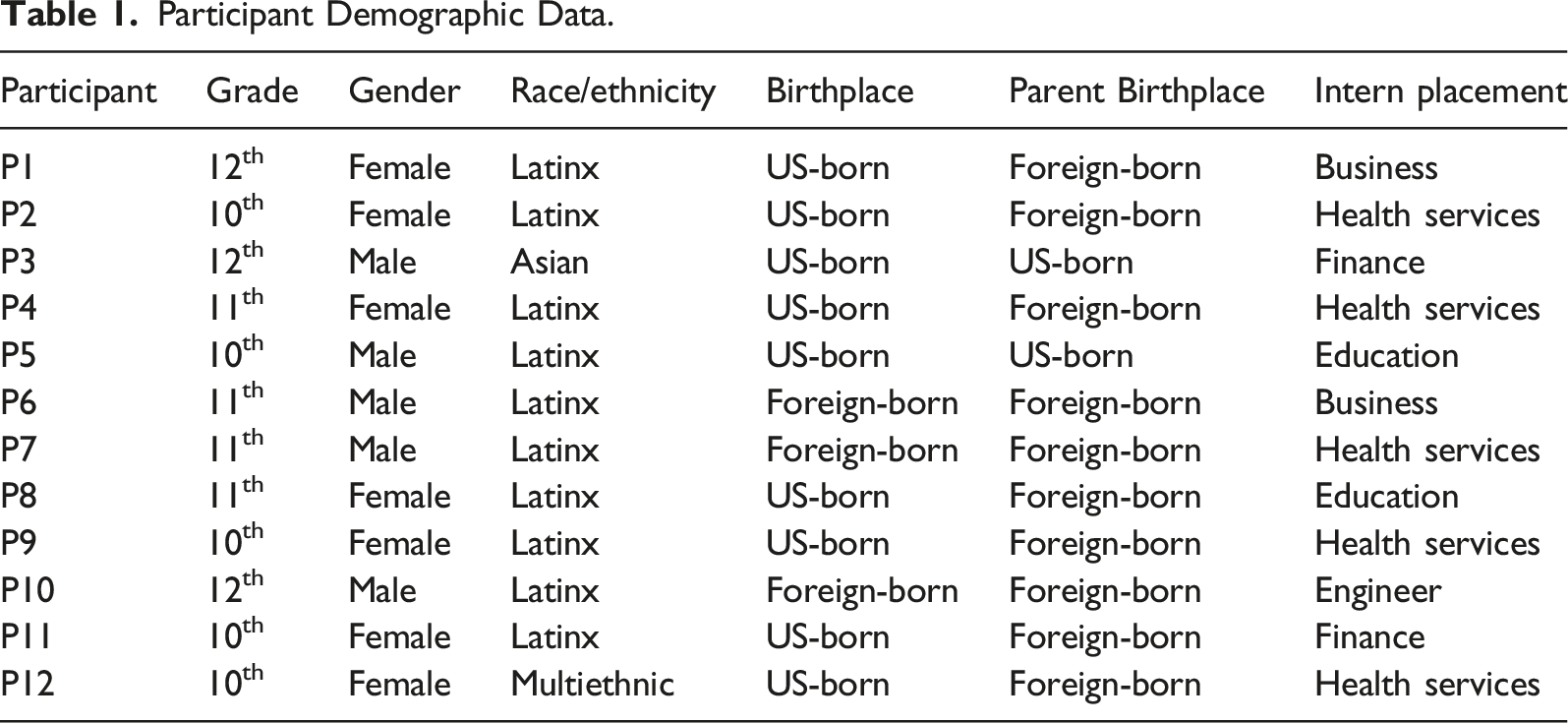
Participants were recruited from a Catholic high school in a Northeastern US city where 80% of residents identify as Latinx (Dominican, Puerto Rican, Central and South American). The school is part of a national network of college preparatory high schools known for its WBL program. All students spend one full day per week in the WBL placement across the four years of high school, which helps to offset student tuition costs. The school admits students based on a review of attendance records and grades in 7th and 8th grade to assess skills and motivation for college preparatory studies. Students are not required to be Catholic, but be open to faith-based education. All 287 students in this high school qualified for free or reduced-cost lunch, with the average reported family income at $35,700. The school reports a 100% acceptance rate for 2 and 4-year colleges.
Interview Protocol
A semi-structured four-part interview was designed from literature on youth purpose (Liang et al., 2017a), hope (Snyder et al., 1991), PWT (Autin et al., 2019; Blustein, 2019), and our previous research with WBL programs. Based upon protocols assessing youth purpose (Liang et al., 2017a), we first asked students about their goals (e.g., What is your big purpose or goal for the current and next school year? For your life as an adult? Why important to you?) and about the people and experiences that have been important in shaping their goals (e.g., Are there certain people or experiences that helped you to determine where you’re going?). Participants were also queried about potential challenges and barriers they might encounter and what motivates them to pursue their goals in the face of barriers (e.g., Most students also have worries about their future. What do you worry about? Some young people identify obstacles related to family, finances, and larger political and social issues. Do you think that any of these will be of concern for you? How do you get around obstacles?). The next section of the interview drew from research on contextual sources of hope (Medvide & Kenny, 2020), including questions about students’ experiences of hope (e.g., Describe a time when you felt hopeful? When you felt hopeless? What made you feel that way? What helped you to overcome hopelessness?). The third part of the interview focused on the WBL experience (e.g., What have you learned through your WBL? discovered about yourself? Is there anything about the WBL that you would want to change?). The final part of the interview included questions about economic and social inequality drawn from interviews developed for PWT studies of working adults (Blustein, 2019) and immigrant young adults (Autin et al., 2019) (e.g., Many people are discussing economic inequality-- that some people have and earn a lot more money than others. What your thoughts are about inequality? The American Dream is the idea that anyone can achieve prosperity if they work hard. Do you think that is true? Do you think it’s harder for some people than others? If so, why might that be?) (A copy of the full interview is available from the first author).
Procedure
All 277 students enrolled in the school were invited to participate in research on adolescents’ perceptions of future work opportunities, their school and work attitudes and their internship experiences. One hundred and eighty-two parents (66%) returned parental consent and 164 students completed an online survey during homeroom period (Kenny et al., 2022). Twelve of the 164 students who had completed the survey were invited to participate in an interview during the school day. These students were randomly selected from those who were not at their WBL and did not have an exam scheduled at the time of the interviews. The interview sample was similar to the larger survey sample with regard to gender and ethnic/racial background. The interviews were conducted by two White-identified women, who were university faculty in counseling psychology and a master’s student in mental health counseling, who was a Black male international student from West Africa. The research protocol was approved by the school administrators and the university IRB of the first author. Interviews took place in a private office at the school, lasted between 45 minutes and one hour, and were audio-recorded with pseudonyms used to protect anonymity. Interviews were transcribed verbatim through automated transcription, were checked for accuracy, and were stored on a securer server after all identifying information had been removed.
Data Analysis
Data analysis followed procedures of Consensual Qualitative Research (CDR; Hill, 2012). Coding team members read and discussed the literature on CQR methods. Interview coding followed three steps: coding of domains, generating core ideas, and cross-analysis of the domains and core ideas.
Results
Summary of Domains, Categories, and Frequencies.

Future Goals
Future goals captured participants’ expressions of their short and long-term goals and their broader sense of purpose. Participants typically mentioned goals for success in high school, with college acceptance and future work goals representing common longer-term goals. P2 described current academic goals as steps in the pathway to college acceptance, “For this year, I’m just trying to maintain a good grade so the next year I can carry that and uphold what I’m trying to do for college.”
Personal goals, which included meeting new people, learning new things, finding a passion, and being more organized, were also frequently mentioned. P12 described both personal and school goals for the immediate future, explaining, “So for this year, my goal is to improve … my grades and make sure that I get to the highest standard, like the best of my capabilities and another goal of mine is to work more on my organization skills.” Goals for college and career success were typically connected with purpose beyond the self, including helping family (mentioned by six participants) or helping others more broadly (mentioned by five participants). P7 stated “…just graduate, get good grades, get into college, make my family proud…and give back to the community.” P6 connected personal goals with contributing to others: So, thinking for the future, my goal is just to be able to be stable. Just to be happy like spiritually, emotionally and physically as well…. not just for myself to be happy but also for me to also help other people to be happy, because I feel like now, I feel like people should come together. And that’s one of the big things that my family have taught me. Try to not always to think about yourself but think about how can you improve somebody else’s life.
Worries
Participants identified a range of past, present, or anticipated worries or possible obstacles. Financial concerns were a typical source of worry, most often related to college costs, as noted by P5, “I worry about financing for college. If I get into a good college, I don’t know if I can pay…” Financial concerns also reflected the economic constraints of participants’ families and their communities, as highlighted by P10, “I would say just finances… Because I only live here with my dad, and my other family is in the house, we kind of have to help them over there and help us all here.” School worries were mentioned typically, focusing on high school grades and college acceptance, as explained by P9, “...if one of your grades are bad, or if you don’t pass a test, you don’t get where you want to be.” Personal worries were also typical, often related to concerns about the well-being of family members, as described by P1, “…if one of my family members gets sick, if they are really sick that would be an obstacle.” Career issues, a variant category, were related to changes in the labor market, the job outlook, and the need to adapt to technology. P8 explained, “I don’t know what advancements we’re going to make in 20 years, and I don’t know how well I’ll be able to adapt to those advancements in 20 years”.
Although participants rarely mentioned political and societal worries explicitly, many of their financial and personal worries stem from larger social inequities, such as immigration policies or gender discrimination. P2 identified being an English language learner as a challenge, “So for me, one of my challenges, transitioning from a Latin American country to the United States, for sure the language was an obstacle.”
Motivational Strategies
With an awareness of varied worries or obstacles, participants identified three general strategies they rely on to sustain motivation. These include persistence, positive emotional focus, and thinking of others. Participants often discussed several of these strategies, which they presented as interrelated. Persistence was a general category that included a focus on the value of hard work. P11 described the role of persistence and hard work in sustaining pursuit of one’s dream. I would say to just try your hardest, don’t be scared to talk to anyone and just make sure no one is in the way of your dream and make sure that you push yourself, because if you don’t then you might not be able to do what you actually want to do.
Positive emotional focus was a typical category that included self-reflection, patience, gratitude for one’s opportunities, attention to one’s passions, and positivity. P8 described a positive emotional focus along with persistence in sustaining motivation. Definitely try to surround yourself with positive energy…and don’t let others around you who look very negatively on how you would like to carry out your life, or the goals that you’re trying to carry out. Don’t let them affect you… definitely just always take time to recuperate yourself after maybe a hard day, and realize your goals, and remember that you have time, and you have time to fix anything that probably went wrong…
Thinking about others was a typical category, that focused mostly on family but also included non-family relationships. P9 described a process of thinking about others, “What keeps me motivated to keep going is just thinking about more in the future. If I do this and if I overcome this, later in the future it’s gonna help… the future generations.” Motivation was sometimes derived from thinking about family adversity and often described in relation to making family members proud and acknowledging their sacrifices, as explained by P4: Well, I think about my family. I am the first child of my mom, so I think about my mom only went high school, my dad only went to elementary school, so I think about not having a great job or anything, but at least getting my diploma and proving them that everything that they have sacrificed coming into this country was for a good reason. It was worth it because I eventually got my education.
Hope
Hope was a general domain, with experiences of hope and hopelessness mentioned by almost all participants in response to direct inquiry. Experiences of hope were often associated with school success and college acceptance. P11 explained, “When I was in 8th grade, I was very hopeful when I was graduating because I was moving on with my life and high school was the turning point.” P5 described hope in relation to success in the pathway from high school to college, “I needed to pass this school year with good grades so I can carry on to the next, keep my GPA up for colleges.” Hopelessness conversely often involved incidents of school failure, college rejection, or not being offered financial aid. P3 described feeling hopeless “when I get those college rejection letters,” commenting further, “I guess God does not want me in [name of college].” For P3, the words of teachers contributed, however, to restoring a sense of hope I was in the room and they’re [teachers] like, “Don’t worry [student name], there’s always another option… Maybe there’s another plan for you.” Having that hope that someone else can help you with, it’s definitely something that helped me feel better because if it wasn’t for that I would just be really sad person.
Sources of hope were a typical category that included resources for overcoming hopelessness. Family was mentioned most frequently (five students), followed by the school setting and teachers (four students), and faith (three students). P2 was among those who described the school setting as a source of hope: I came from a public school and I thought that my dreams would only be dreams… But when I came to this school, I heard about the opportunities that could be given to me and my family and the opportunities that are totally open to just anybody who wants to walk up for it, I think that really boosted my hope for what I saw in the future.
P1 credited family in fostering hope, explaining, “My family supporting me and telling me that everything happens for a reason so who knows, you may be going to this school instead, for another reason, doors are always-even though this one is closing, this one’s open.” P6 was among those who described faith as a source of hope: I feel like when I first came here I didn’t have no hope. Because I felt like the language barrier that I had for sure was a difficult thing for me, I got a lot of criticism … For sure that made me hopeless, but I’m Catholic so I always try to talk with God or talk with myself or my family or friends.
Family Influence
Family was a general domain related to the description of family as a positive support or as a source of conflict. This domain includes references to family that were not captured by other domains. Positive support was mentioned typically in relation to offering emotional or financial support for education and career choice. P3 explained, “Oh, I think my parents are the big determiners. They want to make sure that I’m using my education wisely…They paid for my Catholic schooling since I was a little kid. They really believe in it.” P2 described family encouragement for career choices, “My mother always told me that whatever I do, she’d support me. It was really relevant from the beginning that it was going to be sciences… but since I told my parents about astronomy, they’ve always just been encouraging.”
Family as a source of conflict was a variant category, with participants citing differences with family in beliefs, career goals, and strivings for autonomy. P8 identified conflict in seeking their own goals and identity, while also feeling connected and wanting to help the family: Yeah, family is definitely a problem sometimes. Not having the same beliefs as your family could be, because sometimes you don’t have the support that you wish you had from your family. … But people that are still connected to you, so you feel like you owe something to them. But sometimes I guess you have to realize that right now, in the moment, I'm working hard to succeed for myself so later on I could help everybody else.
School
This domain included two typical categories, school relationships, and learning opportunities, including academic and non-academic programs. School relationships highlighted care and support from teachers, other school personnel, and classmates. P7, for example, explained how relationships with counselors, along with parents and friends, are important sources of guidance and meaning-making. “…in school we have counselors, my parents, even friends sometimes. They could help you understand what you do right or what you do well. That way, you figure out what you want to do for the rest of your life.” P3 described teachers as instilling self-confidence, “The teachers… really make you believe in yourself. …I remember my chemistry teacher, I know it was like I failed one test, but I think she believed in me that I could do better. She believed in me that I could do good things in life, that I could achieve my dream.”
Students typically mentioned a range of learning opportunities and resources offered by the school, as described by P7: Well, [name of school] is a school that gives you opportunities. It gives you opportunity to be in a workplace, to have connections outside of the school, it helps you get connections with colleges by having summer programs … when we go to colleges and those colleges could see how we act and how dedicated we are to our studies. [School name] also helps us academically, if we’re struggling with things, we have an after-school program called [program name] and if we need help on something, in any class, teachers are usually there after school and you could go to [program name] and talk to them what you're struggling with and they’ll help you.
Work-Based Learning
This domain encompasses five categories that relate to the learning benefits and evaluation of the WBL experience. These include the general category of soft skills, the typical categories of workplace knowledge and relationships, and the variant categories of hard skills and program improvement.
All participants expressed the belief that they had developed a variety of soft skills, including better communication, teamwork, leadership, social networking, self-awareness, and personal maturity, through their WBL placements. Workplace knowledge, including an understanding of work routines and requirements, was also typical, with hard skills, such as computer and office skills, being a variant category. Some participants, such as P10, described the WBL as providing opportunities to develop both soft and hard skills, “It helped me just meet new people, basically, and helped to learn about computer software and computer engineering. In another school I wouldn’t have gotten that.” P12 emphasized the development of both soft skills and workplace knowledge: One of the things that I've learned is that not everything is handed to you. Like when…I started my job, they gave me a tour around the place, they told me what I was going to be doing at the job, and after that, it’s up to me to do things on my own. Once they give me a direction, I need to follow that direction exactly. And not like just do petty work, and then that’s it. It has to be to the best of my abilities, and that they're not going to be there to hold my hand if I make a mistake…because, I have to be accountable for my mistakes, it’s not them.
Relationships with site supervisors and co-workers were typically emphasized as integral to participants’ learning and the quality of their experiences. One participant (P10), who plans to work as an electrician while pursuing a college degree in electrical engineering, described how the WBL supervisor provided guidance in understanding one’s preferences and goals, “…My current company that I work at, my supervisor was a computer engineer and also an electrician. He actually helped me focus my mind on and helped me like think straight what I wanted to do.” Another participant (P3) emphasized the willingness of supervisors to invest their time with students, “I was like, ‘You know what? I want to learn a little bit more about that.’ He actually spent a good hour of his day explaining it to me every time I went there.”
Although participants described the WBL program positively, suggestions for program improvement was a variant category. When asked specifically how the WBL could be improved, participants suggested increasing the number of workplace sites to better align with student interests and several, like P9, mentioned the demands of working and going to school, “Sometimes it’s not good… let’s say there’s a test the next day and you don’t have time at home to study. All you have is the time at your internship, it’s sometimes difficult to find time to study.”
Social and Economic Opportunity
Participants were asked explicitly about their views on economic inequality and their beliefs in the American Dream. All participants expressed awareness of inequality in the United States and typically described these as rooted in systemic barriers, such as racism, sexism, white privilege, differential access to opportunities, under-resourced educational systems, and unfair immigration policies. P5 described immigration as one systemic barrier, explaining, “Like immigrants in the US now…it’s hard to join the US and work hard and then get what you deserve, because there’s a lot of really, really big barriers.” In describing inequality, participants often referenced personal observations of family members for whom hard work had not paid off and the contrasts between what they observed in their community and more affluent surrounding communities. P1, for example, stated, “I have family members who came to this country pursuing the American dream and I see them working hard every single day, and it’s still like they deserve so much more.” One student also referenced discussions in a social justice class at school. In relation to systemic barriers, several participants also mentioned the need for policy change, such as increasing the minimum wage, fair hiring practices, and educational reform. P9 suggested, “It should also be that the minimum wage should be raised enough to financially support someone who has kids.”
While participants typically recognized systemic barriers and several mentioned the need for policy changes, they also typically emphasized individual solutions, such as working hard. P10 explained, “I know it’s unfair, but at the end of the day you have to work hard for what you have. You can’t count on something that you don’t have, so what you have, you have to work hard with that and make it last.” P4 similarly expressed the belief that hard work will help to overcome barriers, “Obstacles in finding jobs because you’re not from here, because you don’t know the language, you don’t have a diploma and a degree… but if you work hard even though it could slow you down, you’ll get there.”
Discussion
Through interviews with young people from a low-income Latinx community who attend a well-resourced school with a high rate of success in preparing students for college entry, this study sought to explore factors that would extend PWT for conceptualizing the career progress of Latinx high school students. We sought to explore strength-based and culturally relevant promotive factors that are proximal to the educational and career planning tasks of high school students. Our findings both confirm and add to the current research base on PWT, youth resilience, purpose, hope, and critical consciousness. We first present our findings as gleaned across the varied domains of our study then consider how they might inform further research and considerations for career practice with Latinx high school age youth.
Youth Purpose, Hope, and Motivational Strategies
Participants were queried about their future goals, motivational strategies, and hope in efforts to explore promotive factors that support school success and career planning. With regard to youth purpose, participants expressed clear short and long-term goals related to high school achievement and college attendance. Consistent with the conceptualization of purpose as an overarching goal that has personal meaning and contributes to the world beyond the self (Damon et al., 2003), the participants’ focus on high school success and college attendance were described not only as personally meaningful, but also grounded in broader intentions to contribute to family, community, and society. Their attention to family is consistent with the notion that purpose beyond the self may encompass family contribution, especially among Latinx students from low-income communities (Liang et al., 2017b). Our findings support the relevance of the construct of purpose for Latinx youth and add to the growing body of research documenting how youth in low-income settings conceptualize and develop purpose in the context of adversity (Bronk et al., 2020; Liang et al., 2017a; 2017b; Sumner et al., 2018).
In conjunction with a sense of purpose, our participants also clearly articulated a sense of hope and a positive future orientation, acknowledging experiences of hope and hopelessness in relation to their goals. Consistent with hope theory (Snyder et al., 1991), they expressed hope through persistence in pursuit of achievement in high school, college, and beyond. Their overall positive attitude and sense of agency are consistent with prior research relating cultural factors, family relationships, and the broader social context with a sense of hope among Latinx youth (Bahena, 2020; Lorenzo-Blanco et al., 2022). Positive emotional focus and thinking of others were also commonly mentioned motivational strategies that are consistent with their understanding of relationships and faith as sources of hope. Beyond the cognitive bases of participants’ motivational strategies, their sense of purpose, hope, and motivation, are rooted in important and culturally-salient contexts and relationships, including family, school, work, optimism and faith (Liang et al., 2017b; Lorenzo-Blanco et al., 2022; Medvide & Kenny, 2020).
Critical Consciousness
All of the study participants expressed an awareness of economic inequities and also typically understood these as unjust and as related to systemic and interpersonal barriers rooted in racism, xenophobia, and inequalities in the educational system. In relation to CC theory, our participants demonstrated critical reflection, which is consistent with existing research revealing high levels of critical reflection among youth whose life experiences have encompassed racial and ethnic marginalization (Heberle et al., 2020). Our participants did not, however, express a general commitment to social action focused on systemic change, which some scholars consider a central component of critical consciousness (Diemer et al., 2021). Instead, their expressed motivation and action in addressing injustice focused on personal and interpersonal level change, emphasizing hard work, taking advantage of the opportunities available to them, and commitment to family and local community. For example, while finances were mentioned as a salient worry about college, the participants sought to work hard to obtain a strong financial aid package, rather than advocate for structural change in higher education or society. Although some research suggests that critical reflection may contribute to hopelessness when not accompanied by social action or political efficacy (Godfrey et al., 2019; Heberle et al., 2020), the participants in our sample expressed goal persistence, purpose, and hope.
Our participants’ understandings of and responses to social and economic injustice can be situated in the literature that examines critical consciousness from a developmental and contextual perspective. Developmentally, Godfrey et al., (2019), for example, suggest that belief in the value of hard work may be beneficial until young people are able to formulate more complex understandings of how they might affect social change. A focus on achievement and persistence as strategies for disrupting social and economic inequality may also be culturally congruent for high school students. McWhirter et al. (2019), based upon research with Latinx high school students, suggest that the social action component of critical consciousness should encompass educational achievement, persistence, and an awareness of family commitments, which are related to traditional cultural strengths, including a strong worth ethic, determination, connectedness to others, and hope (McWhirter et al., 2021). Activism at the systemic level may also be dependent on opportunities for engagement in social action (Diemer et al., 2016). Although some of our participants referenced a course in social justice at their school, the academic demands and time commitment to WBL engagement among students in this school may leave less time for social action. It is likely that opportunities to engage in complex analysis of systemic injustice with adults and peers and participate in social action are more prevalent in higher education settings. Latinx college students, for example, have been found to report high levels of critical consciousness, including complex narratives around the value of social action, political advocacy and activism, and the expectation that their advocacy would be successful (Cadenas et al., 2018).
Contextual Supports
The role of family, school, teachers, and the WBL program described by study participants is consistent with the large body of existing research on the benefits of social support among Latinx youth (Flores & Obasi, 2005; Flores & O’Brien, 2002; Medvide & Kenny, 2020) and with the role of social support in PWT (Duffy et al., 2016). Our findings illustrate, moreover, how support from each of these contexts can converge in contributing to students’ sense of purpose, motivation to persist despite challenges, and hopes for the future. Although family was prominent across participants’ narratives in explaining their goals for higher education and their motivation to persist despite obstacles, family was also a source of conflict for some youth. The school and WBL contexts offered supportive relationships and learning opportunities that allowed youth to develop interests and skills that helped to refine their sense of purpose (Liang et al., 2017a). In alignment with hope theory (Snyder et al., 1991), the school and work settings also supported the development of self-efficacy and agency needed to work towards goals and sustain purpose. Participants seemed to internalize messages from adults at school and in the workplace that instilled self-confidence and contributed to a sense of belonging and hopefulness for the future.
Implications for Extending Youth PWT
Our findings affirm and extend knowledge of promotive factors that may be useful in extending PWT with Latinx youth and suggest directions for further study. Consistent with PWT overall (Duffy et al., 2016), social support emerged as a critical contextual resource for the youth in our study. Family, teachers, and workplace supervisors were identified as important and caring adults, although family was also recognized by some as a source of conflict. Teacher support has been identified as a protective resource for youth in a previous quantitative examination of PWT (Kenny et al., 2022), with the current study suggesting that workplace support also warrants examination. Our findings add to research suggesting that the benefits of critical consciousness are complex in relation to developmental processes, ethnicity, and contextual opportunities (Diemer, 2020; Heberle et al., 2020). Further research should continue to examine the developmental and cultural processes and the contextual supports in school and beyond that help youth move from an uncritical view of the world as just to a recognition of how injustice can be addressed through social action (Diemer, 2020; Heberle et al., 2020). Our findings also support further consideration of purpose and hope as culturally and developmentally relevant promotive factors for expanding PWT (Kenny et al., 2019). Purpose and hope may add to work volition, career adaptability, and proactive personality as factors that are proximally related to the educational and career progress of adolescents and contribute to a pathway to decent work in adulthood.
Limitations
It is important to note limitations of this study. While we were specifically interested in how Latinx adolescents attending a well-resourced school make meaning of their life experiences, it is also important to recognize that their views may differ from those of adults in their lives and from Latinx youth in other schools and communities. Our interview protocol clearly shaped participant responses and was limited by the questions asked and limited probing in some areas, such as the social action aspect of critical consciousness. The interviews reveal how participants currently understand their goals and life context, but the long-term benefits or limitations to these perspectives are unknown. Longitudinal research is needed to determine whether these high school students attain their goals and whether and how their current beliefs develop and contribute to adult outcomes. Quantitative research with larger samples is also needed to assess the developmental and cultural factors explored in this study to determine if and whether they function in a compensatory or protective manner. Given that the interviewers were relatively unknown to participants and did not reflect their age or ethnic identities, the adolescents also may have been cautious in what they revealed. The interviews were held in the school setting, which, although confidential, may have impacted students’ responses and contributed to their expressed positivity towards the school and the WBL program.
Conclusion and Implications
Despite study limitations and the need for further research, this study explored constructs, including purpose, hope, critical consciousness, and contextual supports, that can inform future research in expanding PWT for youth. For youth attending a school with a high rate of college entry, the family, school, and WBL program were integral in shaping their immediate goals, broader purpose, and sense of hope. Consistent with the importance placed on contextual constraints and opportunities in PWT, the meaning given to their personal and societal constraints experienced were grounded in their culture and relationships.
In conjunction with the need for further research, our findings have potential relevance for supporting the educational and career development of Latinx youth (Kenny et al., 2019). Consistent with the need to consider educational experiences in PWT (Duffy et al., 2022), our findings highlight the role of the school and workplace in providing opportunities to support growth and learning and affirm the role of adults in family, school, and WBL contexts in helping students to make meaning of and sustain motivation and purpose in the face of barriers. Complementing the growing body of research on fostering youth purpose (Liang et al., 2017a) and critical consciousness (McWhirter et al., 2021), we affirm that youth may benefit from efforts to cultivate sources of hope and purpose that are both personally meaningful and contribute beyond the self to their families and communities. In this process, students may benefit from guidance to envision pathways and take concrete steps toward their goals that support purpose, sustain hope and eventually help adolescents move from critical awareness to efficacy and action for social change (McWhirter et al., 2021).
Footnotes
Acknowledgments
We would like to acknowledge the assistance of the following individuals in various stages of this study: Allison Masters, Rosario Krossler, Alexander Portela, Shannon Cunningham, Zhenqi Chen, Gabriel Nnamdi Ezema, Sophia Luongo, Chloe Tanega. We would also like to thank the students who participated in the study and the school leaders who helped to make this possible.
Declaration of Conflicting Interests
The author(s) declared no potential conflicts of interest with respect to the research, authorship, and/or publication of this article.
Funding
The author(s) disclosed receipt of the following financial support for the research, authorship, and/or publication of this article: Boston College Lynch School Collaborative Fellows Grant.
