



Abstract
Researchers widely agree upon the pivotal role of career self-management in vocational development. Yet, little is known about how core self-management constructs denoting agentic capacity affect each other reciprocally over time. We address the shortage of existing longitudinal change investigations by proposing and testing a reciprocal model in which career adaptability and occupational self-efficacy as core career self-management constructs are reciprocally interrelated. Cross-lagged panel analyses of three-wave data from a large and heterogeneous sample of employees indicate support for the presence of substantial reciprocal effects of career adaptability and occupational self-efficacy across time lags of three, six, and nine months. From a series of exploratory multigroup analyses, this pattern of results emerges as robust across a range of sociodemographic variables, including gender, age, education, leadership position, and organizational tenure. Moreover, the results remained stable after considering further controls (e.g., future temporal focus, grade point average). Our findings broaden the scope of dynamic vocational research by demonstrating the utility of a change-oriented approach in elucidating the emergence of individuals’ career self-management. We discuss practical implications concerning career intervention strategies, study limitations, and prospects for future research.
Introduction
Contemporary vocational experience trajectories are thought to unfold in increasingly volatile, globalized, and destabilized occupational environments (Briscoe & Hall, 2006; Fugate et al., 2004; Savickas et al., 2009). In light of this, notions of career self-management are attracting growing scholarly attention (Betz, 2008; Lent & Brown, 2013; Savickas & Porfeli, 2012). Overall, the overarching contemporary paradigm to study vocational functioning and career self-management may be conceived of as inherently agentic (Bandura, 2009; Brown & Lent, 2016). Bandura (2009) provided a concise account of this rationale by suggesting that “the transactions of occupational life are littered with impediments, discordances, and stressors” (p. 188) and that “many of the problems of occupational functioning reflect failures of self-management” (p. 188).
In line with this, the focal interest of vocational theorizing and associated empirical explorations has been how individuals actively regulate their careers by coping with occupational traumas, work role transitions, economic stressors, or sociocultural career development tasks across the life span (Arthur, 2008; Klehe et al., 2012; Savickas et al., 2009). Two core constructs reflecting individuals’ agentic capacity to manage their vocational behavior in response to shifting environmental and psychosocial career demands are career self-efficacy (Lent & Brown, 2006) and career adaptability (Savickas, 2013). Abundant empirical evidence supports the pivotal role of career adaptability and career-related self-efficacy beliefs as central indicators of career self-management for promoting vocational development, success, and well-being (Johnston, 2016; Lent & Brown, 2013, 2019; Rudolph et al., 2017; Spurk & Abele, 2014; Spurk et al., 2020). Career self-management is defined as a “dynamic process, involving the execution of a set of co-occurring behaviors (…) that is intended to prevail upon the decisions made by those gatekeepers who are in a position to influence (…) desired career outcomes” (King, 2004, p. 119).
A range of critical research questions has largely remained neglected so far. Are the developments of career adaptability and career-related self-efficacy interrelated and if so, how is the direction of these relationships adequately construed? What is the amount of time that needs to elapse before changes in central career self-management concepts occur? Although researchers are increasingly adopting longitudinal designs to study career adaptability on short-term within-person (Zacher, 2015) and long-term between-subject levels of analysis (Fiori et al., 2015), our understanding of precursors of change in career adaptability is still limited. The striking shortage of developmental insights into career adaptability has prompted calls for more longitudinal change-oriented inquiries.
We propose a dynamic model in which career adaptability and occupational self-efficacy as fundamental factors within career self-management are reciprocally related. Our choice of study variables reflects an integrative approach to jointly investigate core constructs from two distinct influential lines of vocational theorizing, which have predominantly been studied as isolated phenomena so far (Fiori et al., 2015; Guan et al., 2014; Spurk & Abele, 2014; Tomas et al., 2019). Regarding correlations, a recent meta-analysis (Stead et al., 2022) has found correlations between career adaptability subscales and career decision self-efficacy ranging between 0.36 and 0.44. However, in Stead’s included studies and other studies (Hirschi et al., 2015), change has not been investigated. Consequently, we were first interested in extending existing findings with a change-oriented focus within a cross-lagged panel model. Second, we tested the assumed reciprocal relationships of career adaptability and occupational self-efficacy while considering assumptions of different time lags (three months, six months, and nine months). Third, we examined a set of potential moderating variables (i.e., sex, age, education, tenure, and being a leader) based on substantive exploratory research interest into possible sociodemographic boundary conditions of the assumed reciprocal relations of career adaptability and occupational self-efficacy. Because sociodemographic variables capture essential social and contextual between-person differences in factors that may influence career development (Ng et al., 2005; Spurk et al., 2019), we explored sociodemographics as possible moderators to provide novel insight into potential boundary conditions that limit or facilitate the development of career self-management over time (Biemann et al., 2012). Our theoretical model is depicted in Figure 1. Theoretical model of reciprocal effects of career adaptability and occupational self-efficacy across different time lags. Note. Three months elapsed between Time 1 (T1) and Time 2 (T2). Six months elapsed between T2 and Time 3 (T3).
We argue that elucidating this model is valuable to the extent that vocational theory and practice may benefit from pertaining insights about the interdependencies of two central career self-management constructs. Theoretical implications may emerge regarding the formulation of temporally directed models of career self-management. Additionally, career practitioners may be provided with more thorough empirical guidance on how career self-management constructs should be targeted in interventions.
Career Adaptability and Occupational Self-Efficacy: Predictor or Outcome?
Career adaptability, rooted in career construction theory (Savickas & Porfeli, 2012), essentially reflects the career self-management capacity that enables individuals to adapt to the various demands arising throughout the lifelong process of career construction. Accordingly, empirical findings demonstrated the relevance of being adaptable by showing positive associations of career adaptability with well-being, performance, and success (Brown & Lent, 2016; Nota et al., 2014; Rudolph et al., 2017).
Occupational self-efficacy describes an individual’s domain-specific belief to be capable of successfully managing occupational demands concerning their working role (Rigotti et al., 2008). Occupational self-efficacy is considered to serve as a protective factor against career stagnation (Abele et al., 2012) in light of its substantive positive associations with occupational well-being (Lubbers et al., 2005; Maggiori et al., 2016) and performance (Brown et al., 2011; Lent & Brown, 2019).
Both career adaptability and occupational self-efficacy are considered core career self-management variables that facilitate the engagement in intentional actions to self-direct one’s career. Career adaptability and occupational self-efficacy both reflect career self-management, or in broader terms, the expression of agency in the vocational domain (Bandura, 1992, 2009; Brown & Lent, 2016).
Past research and theories have been inconsistent regarding the direction of their structural relationships over time. For example, career construction theory (Savickas, 2005) and related models (Hirschi et al., 2015) conceptualize career-related self-efficacy as outcomes of career adaptability, whereas social-cognitive career theory (Lent & Brown, 2013) and some other studies (Autin et al., 2017; Guan et al., 2016) conceptualize career-related self-efficacy as a predictor of adapting to one’s career. Hence, we argue that reciprocal relationships might best describe the longitudinal associations between both constructs.
Effects of Career Adaptability on the Change in Occupational Self-Efficacy
Career construction theory (Savickas, 2013) differentiates between (a) adaptivity (i.e., the psychological trait of willingness to meet the unfamiliar, complex, and ill-defined problems presented by vocational development tasks), (b) adaptability (i.e., career adaptability – the above-described resource for coping with current and anticipated tasks, transitions, and traumas in their occupational roles), and (c) adapting (i.e., performing adaptive behaviors that address changing conditions, such as career planning, career exploration, or networking). Adaptivity should lead to adaptability, and adaptability should result in adapting. Within this framework, Hirschi et al. (2015) and Rudolph et al. (2017) investigated career adaptability as an antecedent of occupational self-efficacy. Career construction theory also refers to changes in its central constructs because it conceptualizes career construction and underlying career development as a lifelong process so that a change in adaptability should also trigger changes in adapting.
Only a few studies investigated changes in occupational self-efficacy empirically with working populations (Frese et al., 2007; Jaeckel et al., 2012; Spurk & Abele, 2014). In sum, we assume that individuals who possess greater career adaptability will emerge as more self-efficacious concerning occupational demands.
Career adaptability is positively related to the change in occupational self-efficacy.
Effects of Occupational Self-Efficacy on the Change in Career Adaptability
The assumption of the opposite direction of relationships aligns with Lent and Brown’s (2013) notion of self-efficacy as an adaptive social cognitive mechanism. Thus, it is conceivable that occupational self-efficacy aids individuals in acquiring the cognitive and behavioral capacity to manage novel, ill-defined, and unexpected career demands successfully. Social-cognitive career theory conceptualizes occupational self-efficacy as a predictor of the broader adaptive process within career development. Providing additional evidence for the reciprocity assumption, the psychology of working theory (Duffy et al., 2016) defines work volition (i.e., the perceived capacity to make career decisions, despite constraints) similar to self-efficacy, and assumes reciprocity between work volition and career adaptability.
Some empirical studies also conceptualized some forms of self-efficacy (e.g., career-decision making self-efficacy) as predictors of career adaptability (Guan et al., 2016; Kim & Lee, 2018). Given those arguments and findings, persons with higher levels of occupational self-efficacy should exhibit more positive change in career adaptability over time.
A few recent studies provide initial insights into how career adaptability development may unravel among different populations (Negru-Subtirica et al., 2015; Praskova et al., 2014; Spurk et al., 2020). In sum, it is conceivable that occupational self-efficacy (e.g., through facilitating proactive career behaviors) aids individuals in acquiring the cognitive and behavioral capacity to successfully manage novel, ill-defined, and unexpected career demands. This assumption entails that occupational self-efficacy may not merely result from career adaptability (see Hypothesis 1) but may simultaneously facilitate its emergence (see Hypothesis 2), implying a reciprocal association between these two career self-management constructs over time (see Hypothesis 3).
Occupational self-efficacy is positively related to the change in career adaptability.
Career adaptability and occupational self-efficacy are positively and reciprocally related over time.
Do Time Lags Matter for the Reciprocal Relationship Between Career Adaptability and Occupational Self-Efficacy?
It is evident that the study of reciprocal effects and associated changes in general depends on the choice of an appropriate time lag between repeated measurement occasions (Dormann & Griffin, 2015; Selig & Little, 2012). Yet, the lack of explicit theories of change for psychological constructs denotes a ubiquitous problem for scholars who wish to conduct meaningful change-oriented research (Ford et al., 2014; Ployhart & Vandenberg, 2010).
The size or significance of the relationships may depend on the length of time lags because shorter time lags usually are related to higher stability of the constructs under study (Hirschi & Herrmann, 2013; Spurk & Abele, 2014; Spurk et al., 2020; Zacher, 2014). Higher stabilities are related to lower portions of variance that can be explained by other predictors, that is, in the current study for predicting occupational self-efficacy by career adaptability and vice versa, resulting in weaker reciprocal relationships for shorter time lags. Contrary, the associations may also be stronger for shorter time lags because the predictor (e.g., career adaptability) has closer temporal proximity to the outcome (e.g., occupational self-efficacy), and more recent occupational experiences are more predictable for the change in the outcome (Dormann & Griffin, 2015). As these assumptions would lead to opposite hypotheses, we will investigate time lag length as an exploratory research question.
In this three-wave longitudinal study, we address this issue in the following way. We examine the presence of time-lagged interrelations of career adaptability and occupational self-efficacy by taking time lags of three (minimum time span from past research, see above), six (two times the minimum time lag), and nine (three times the minimum time lag) months into account. In line with Dormann and Griffin’s (2015) empirically informed reasoning regarding the adequacy of shorter as opposed to longer time lags to study reciprocal relations, the size of the time lags in our study does not exceed 1 year. We use multi-wave data obtained from longitudinal assessments to test our proposed reciprocal model across time lags of differing sizes.
Exploratory Testing Boundary Conditions for the Reciprocal Relationship between Career Adaptability and Occupational Self-Efficacy
Career development is embedded in sociocultural contexts in which career agents can be described by a range of sociodemographic individual difference variables. Such sociodemographic variables merely reflect statistical control variables but, instead, capture significant between-person variability in career-related self-management that may affect career development (Biemann et al., 2012). Furthermore, sociodemographic variables are also assumed to affect further contextual influences that serve as moderators of relationships between career self-management variables (e.g., Lent & Brown, 2013). Therefore, we consider the exploratory research question of whether sociodemographic differences may affect the assumed reciprocal relationship of career adaptability and occupational self-efficacy.
We decided to analyze gender, age, and education as moderators because those variables are related to salient social categories and thereby affect a diverse structure of opportunities or barriers (e.g., in private life or the occupational domain) that may weaken or strengthen the career adaptability-occupational self-efficacy relationships. Furthermore, being a leader or work experience is related to work-related career-related networks and different work-related resources that can also moderate the relationships under study.
On the one hand, if reciprocal effects of career adaptability and self-efficacy were robust across sociodemographic differences, this may point to the presence of “universal” developmental processes (at least within the specific cultural context under study). Such a finding may potentially help illuminate general developmental processes of career self-management. On the other hand, if sociodemographic variables emerge as moderating conditions, this would indicate that between-person differences in social and occupational categories such as age, sex, and being a leader not only affect distal career outcomes (e.g., Heslin et al., 2019; Ng et al., 2005) but are also shaping factors in how career self-management develops over time.
Method
Procedure and Participants
We conducted a web-based longitudinal field study across three assessments over a total of 9 months. Data were collected via a German online panel (Göritz, 2014). Participants were offered redeemable loyalty credits as an incentive.
Time lags between measurement occasions were 3 months between Time 1 (T1) and Time 2 (T2) and 6 months between T2 and Time 3 (T3). At T1, sociodemographic information (e.g., sex, chronological age, education) along with additional work-related information (e.g., organizational tenure, weekly working hours) was collected. At each measurement occasion, career adaptability and occupational self-efficacy were assessed.
The sample consisted of 1417 employees, 56.2% females. The mean age was 46.9 years (SD = 10.6). Most participants’ country of residence was Germany (96.8%), whereas 3.2% resided in other countries, including Austria and Switzerland. The majority of participants (61.3%) had received secondary education, 35.2% held a university degree, and 3.5% held a doctoral degree. On average, participants reported an organizational tenure of 12 years (SD = 10.2) and 35.4 weekly working hours (SD = 9.5). Most participants indicated having a supervisor (80.2%). Further, 62.6% held a managerial position themselves. Regarding employment status, 75.9% were regular employees, followed by self-employed participants (9.9%) and civil servants (7.0%). Participants held occupations in various industries, including retail, service, healthcare, education, manufacturing, transportation, finance, and other sectors. Data were available for 1417 individuals at Time 1; 955 individuals at Time 2; and 731 individuals at Time 3. No significant differences in study variables emerged between participants who provided data at T3 and participants who had dropped out of the study before completing the T3 survey.
Measures
Career Adaptability
Career adaptability was assessed with a subscale of the short form of Rottinghaus et al.’s (2005) Career Futures Inventory (CFI-9; McIlveen et al., 2013; in its German version from Spurk & Volmer, 2013). On six-point scales (1 = not at all and 6 = entirely), respondents were asked to rate their agreement with three items (e.g., “I can adapt to change in the world of work” and “I can adjust to change in my career plans”). The unabridged career adaptability scale of the German CFI exhibited (a) satisfactory concurrent criterion-related validity regarding numerous indicators of subjective and objective career success in two independent employee samples and (b) comparable reliability (Cronbach’s α = 0.84 in both samples) as well as (c) equivalent construct validity in comparison with the original CFI (Spurk & Volmer, 2013). The shortened career adaptability subscale (Cronbach’s α = 0.82) comprises the three highest loading items on the respective latent factor and was shown to be positively related to general self-efficacy and measures of satisfaction with occupational choice and academic major (McIlveen et al., 2013). In this study, internal consistencies ranged from 0.87 to 0.90 across assessments.
Occupational Self-Efficacy
Occupational self-efficacy was measured with Rigotti et al.’s (2008) six-item, short version of the occupational self-efficacy scale. Respondents indicated their agreement to statements like “Whatever comes my job in my way, I can usually handle it” and “I can remain calm when facing difficulties in my job because I can rely on my abilities”. Psychometric characteristics have been shown to be very good (cf. Rigotti et al., 2008). For instance, the internal reliability score for the German version was 0.87, and findings from CFAs yielded support for the scale’s construct validity. Moreover, the scale was metrically equivalent to other versions (i.e., Belgian, British, and Spanish versions). Responses were measured on five-point scales (1 = not at all and 5 = entirely). Across assessments, internal consistencies ranged from 0.90 to 0.91.
Moderation Variables
Grouping variables were gender (1 = male, 2 = female), age (1 = age < sample median, 2 = age ≥ sample median), education (1 = acquired university degree or higher, 2 = did not acquire university degree or higher), organizational tenure (1 = tenure < sample median;2 = tenure ≥ sample median), and being a leader (1 = no, 2 = yes). We decided to do a median split for some variables because multiple group SEM was the method of choice to test the moderation effects (see below). We decided against latent interaction terms because those models are complex to calculate, prone to estimation errors, and do not provide standard fit indices for the model. Moreover, some of our moderation variables are dichotomous by nature and are therefore optimally suited for multiple-group SEM. To avoid too long, complex, and potentially confusing analyses parts, we also decided to use the same moderation test method for all moderators. 1 We also examined the moderation variables as controls in the overall model to investigate if the general hypotheses tests were robust even after controlling for the moderators. In this case, we did not use the median split but used continuous variables if possible.
Controls
We further controlled for future temporal focus (i.e., the extent to which people characteristically devote their attention to perceptions of the future; Shipp et al., 2009) because this variable can be seen as one stable adaptivity construct within career construction theory (Hirschi et al., 2015; Zacher, 2014). Future temporal focus was measured with a four-item scale translated into German (Shipp et al., 2009). Participants responded to each item (e.g., “I think about what my future has in store for me”) on a five-point Likert-type scale (1 = not at all, 5 = extremely). Finally, we controlled for grade point average (GPA) as a proxy of cognitive ability and hard skills. We measured GPA with an open question where participants had to indicate the GPA of their highest education. Higher scores on the GPA variable indicate lower academic achievement due to scoring conventions in the German education system (i.e., the best possible grade is a score of 1.0).
Statistical Analyses
We conducted confirmatory factor analyses (CFA) and structural equation modeling (SEM) using Mplus Version 7.2 (Muthén & Muthén, 2015). Robust full-information maximum likelihood estimation (MLR) was employed to address nonnormality and missing values under the MAR assumption (Graham & Coffman, 2012). The central study variables (i.e., career adaptability and occupational self-efficacy) were treated as latent variables in all models, including the structural models for hypotheses testing (Little et al., 2007). Moreover, we tested the models with and without controlling for sex, age, education, organizational tenure, being a leader, future temporal focus, and GPA. Results remained virtually the same when controls were included. Thus, for brevity, only results from the models without controls are reported in the manuscript.
Results
Preliminary Results: Discriminant Validity
Fit of Three-Wave Measurement Models to Assess Discriminant Validity and Temporal Measurement Invariance of Career Adaptability and Occupational Self-Efficacy.
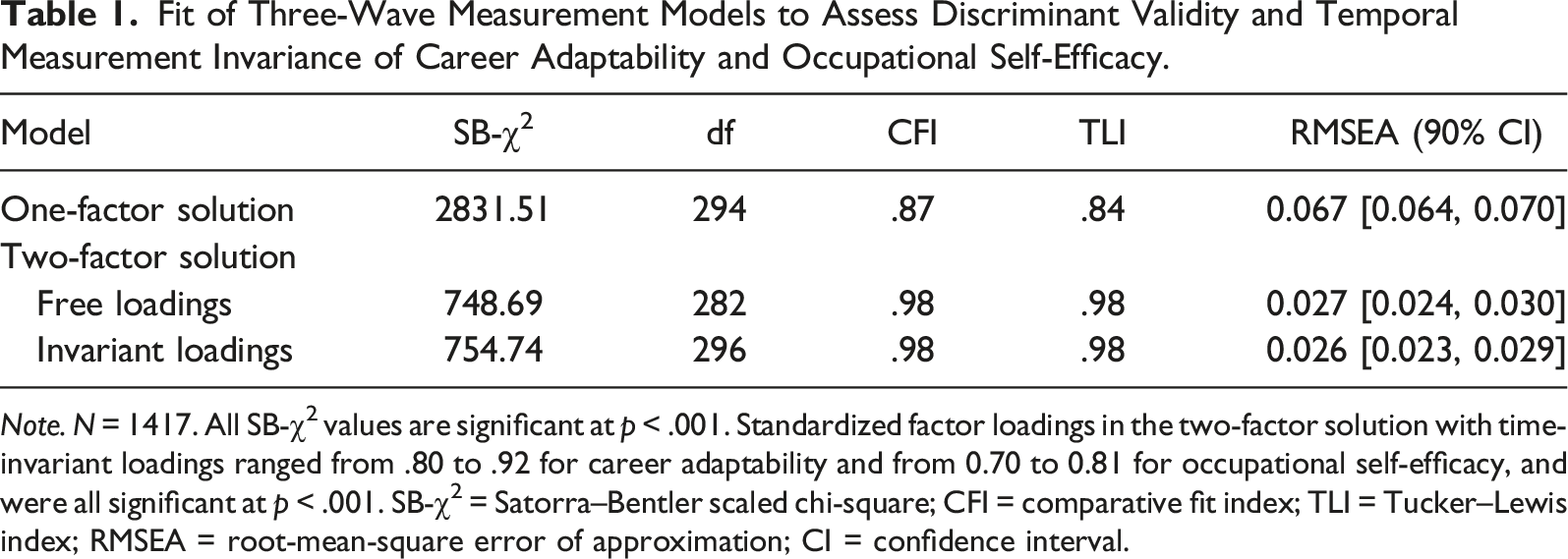
Note. N = 1417. All SB-χ2 values are significant at p < .001. Standardized factor loadings in the two-factor solution with time-invariant loadings ranged from .80 to .92 for career adaptability and from 0.70 to 0.81 for occupational self-efficacy, and were all significant at p < .001. SB-χ2 = Satorra–Bentler scaled chi-square; CFI = comparative fit index; TLI = Tucker–Lewis index; RMSEA = root-mean-square error of approximation; CI = confidence interval.
Preliminary Results: Temporal Measurement Invariance
Configural and metric measurement invariance across time constitute prerequisites of cross-lagged panel analysis (Finkel, 1995; Little et al., 2007; Vandenberg & Lance, 2000). Configural invariance implies the equivalence of the pattern of fixed and free factor loadings across time (Widaman et al., 2010), for which the excellent fit obtained for the previously specified two-factor solution fitted on the three-wave data has already provided evidence (see Table 1). To assess metric invariance (i.e., weak factorial invariance; Widaman et al., 2010), we specified a model equivalent to the two-factor solution but with equality constraints placed on the factor loadings of the same indicators across measurement occasions. Results indicate that, compared to the unconstrained two-factor solution, model fit did not decrease significantly, ∆SB-χ2(14) = 5.22, p = .983. Thus, findings indicate support for metric invariance of measures of career adaptability and occupational self-efficacy over time.
Preliminary Results: Correlations
Means, Standard Deviations, and Intercorrelations of Study Variables.
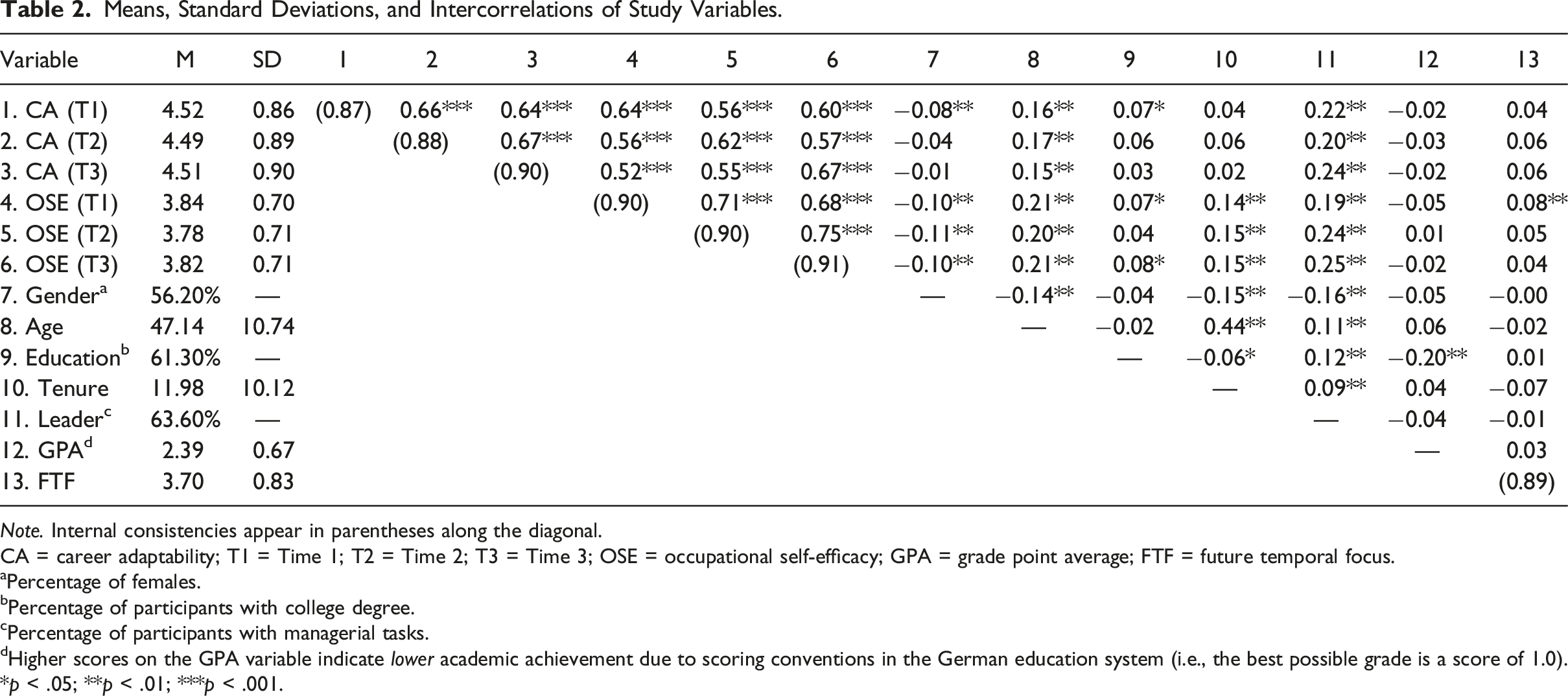
Note. Internal consistencies appear in parentheses along the diagonal.
CA = career adaptability; T1 = Time 1; T2 = Time 2; T3 = Time 3; OSE = occupational self-efficacy; GPA = grade point average; FTF = future temporal focus.
aPercentage of females.
bPercentage of participants with college degree.
cPercentage of participants with managerial tasks.
dHigher scores on the GPA variable indicate lower academic achievement due to scoring conventions in the German education system (i.e., the best possible grade is a score of 1.0).
*p < .05; **p < .01; ***p < .001.
Cross-Lagged and Autoregressive Effects
To test our assumption of reciprocal associations between career adaptability and occupational self-efficacy, we applied SEM and specified cross-lagged panel models that incorporated (a) autoregressive effects (capturing the temporal stability of individual differences in repeatedly measured constructs), (b) cross-lagged effects (representing the reciprocal relationships between both latent constructs when controlling for autoregressive effects), (c) correlated cross-sectional disturbance terms (indicating the remaining shared variance of both constructs not accounted for by autoregressive and cross-lagged effects), and (d) cross-sectional correlations of both constructs (at T1 because here the model variables are exogenous). Thus, cross-lagged parameters can be interpreted as predicting change in the respective criterion variable (Finkel, 1995; Hamaker et al., 2015). We ran structural models separately for time lags of 3, 6, and 9 months, each time using data from two of the three longitudinal assessments (i.e., T1 and T2 data for the 3-month lag, T2 and T3 data for the 6-month lag, and T1 and T3 data for the 9-month lag). In all analyses, we retained (a) the equality constraints placed on factor loadings of the same indicators across time (metric measurement invariance) and (b) the specification of cross-wave autocorrelated uniquenesses.
We applied the strategy to estimate three separate models because calculating one overall model puts unnecessary estimation complexity on the analysis and the three separate models exactly match the pre-defined research question and can be more intuitively understood. In the case of a model with three time points, several model comparisons with path restrictions need to be made (we do this below in the exploratory part). For example, for a straightforward and unconfounded comparison between the time-lagged effects from T1 to T2 and from T2 to T3, the effects of T1 on T3 need anyway to be excluded from the model. Otherwise, the model would give insights into competing effects from T1 versus T2 on T3. Although this would be interesting, it was not the main research goal of the paper to analyze competing effects. However, having the time point within the model and at the same time restricting its effects did not make sense to us and would make the estimation more error prone.
Estimates of Two-Wave Latent Cross-Lagged Models Incorporating Career Adaptability and Occupational Self-Efficacy, Separated by Time Lag.

Note. Standardized robust maximum likelihood parameter estimates. All cross-sectional correlations, autoregressive effects, and correlations of latent disturbance terms are significant at p < .001. CA = career adaptability; OSE = occupational self-efficacy.
aN = 1417.
bN = 955.
*p < .05; **p < .01; ***p < .001.
Results From Scaled Difference Chi-Square Testing to Compare the Reciprocal Model Against Competing Unidirectional Models.
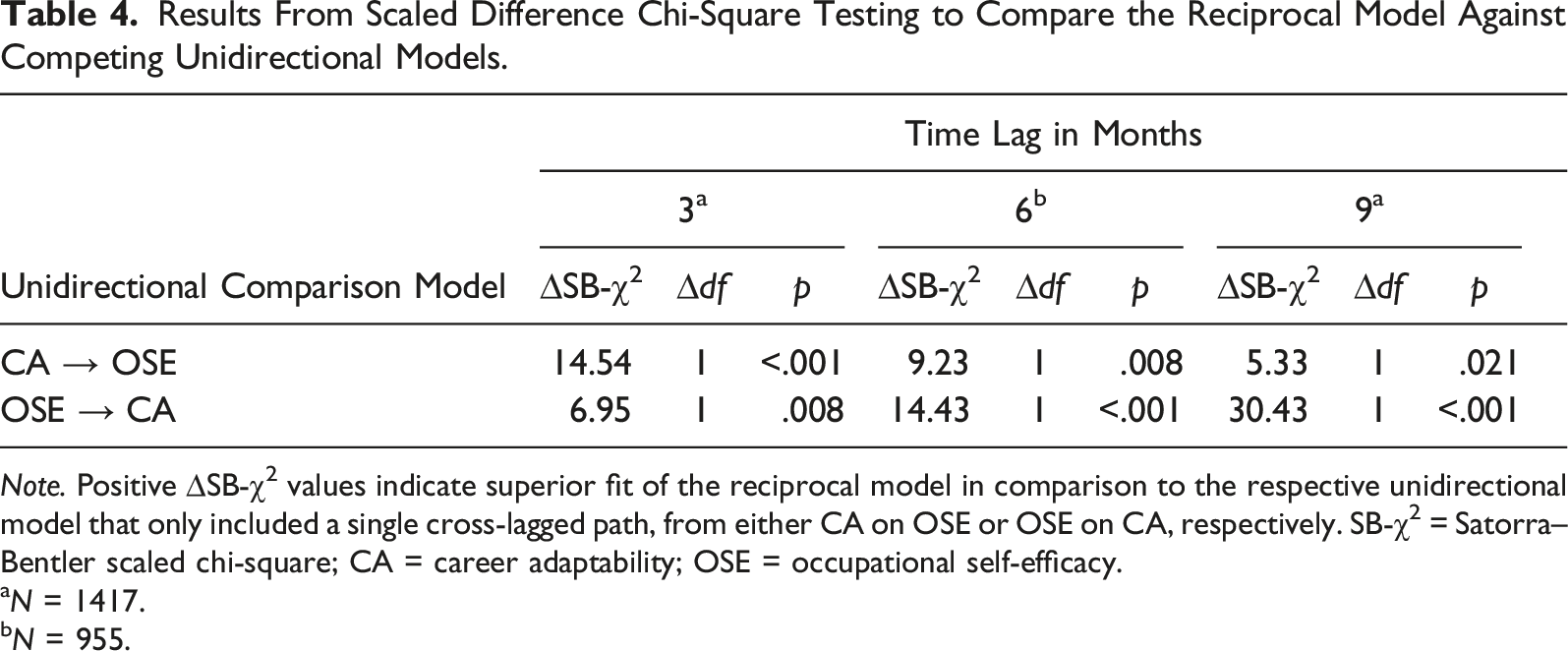
Note. Positive ∆SB-χ2 values indicate superior fit of the reciprocal model in comparison to the respective unidirectional model that only included a single cross-lagged path, from either CA on OSE or OSE on CA, respectively. SB-χ2 = Satorra–Bentler scaled chi-square; CA = career adaptability; OSE = occupational self-efficacy.
aN = 1417.
bN = 955.
Exploratory Results: Reciprocal Effects in Dependence of Varying Time Lags
To investigate Exploratory Research Question 1 in more detail, we also modeled a cross-lagged panel model that included all three time points and constrained the cross-lagged effects between the same variables to be the same across time. The unconstrained effects across the varying time lags were virtually the same compared to the three separate model tests that included the pairwise time points.
We started to compare the time lags with the most apparent differences identified in the single models before (see Table 3, i.e., career adaptability T1 → occupational self-efficacy T2 = career adaptability T1 → occupational self-efficacy T3 and occupational self-efficacy T1 → career adaptability T2 = occupational self-efficacy T1 → career adaptability T3; 3-month time lag compared to 9-month time lag). We compared the constrained (equal effects across different time lags) and the unconstrained model (free parameters across different time lags) with the Satorra–Bentler-scaled difference chi-square test.
Results showed that the effect of occupational self-efficacy T1 on career adaptability T2 (3-month time lag) was not statistically different compared to the effect of occupational self-efficacy T1 on career adaptability T3 (9-month time lag), ∆χ2 = 1.85, Δdf = 1, ns. However, the effect of career adaptability T1 on occupational self-efficacy T2 (3-month time lag) was smaller compared to the effect of career adaptability T1 on occupational self-efficacy T3 (9-month time lag), ∆χ2 = 4.85, Δdf = 1, p < .01. The comparisons between effects related to shorter time lag differences (see Table 3) did not reveal further significant differences. In sum, the longer period of 6 months is only meaningful for the change in occupational self-efficacy so that career adaptability exerts larger change effects over a more extended period.
Exploratory Testing of the Boundary Conditions of Sex, Age, Education, Organizational Tenure, and Being a Leader
To investigate whether differences in sociodemographic and work-related variables possibly affect the size of the cross-lagged effects we observed, we compared pairs of multigroup models. Therefore, the sample was split into two groups by a range of different grouping variables. Each pair of multigroup models included an unconstrained model, in which unstandardized cross-lagged coefficients were estimated freely, and a constrained model, in which cross-lagged coefficients were constrained to be equal across groups. We conducted Satorra–Bentler scaled difference chi-square tests to compare the respective nested models within each pair. All multigroup analyses were run separately for each time lag (i.e., 3, 6, and 9 months). In total, we ran 30 multigroup models (time lag × grouping variable × constrained/unconstrained = 3 × 5 × 2) and accordingly compared 15 pairs of models against each other. Results indicated no significant differences in model fit within any of the pairs, with one exception: Education had a marginal significant moderation effect on the effect of career adaptability on occupational self-efficacy in the model that applied a 9-month time lag (∆χ2 = 5.80, ∆df = 2, p = .06). That is, for a longer time lag (i.e., 9 months), the association between career adaptability and occupational self-efficacy was no longer reciprocal for college graduates (compared to non-college graduates).
Discussion
This study had the aim to investigate the longitudinal and reciprocal relationships between career adaptability and occupational self-efficacy. In summary, our findings demonstrate that career adaptability and occupational self-efficacy, two core career self-management constructs that originate from distinct lines of vocational theorizing, are empirically distinguishable and reciprocally related across time. Further, our results indicate that these effects occur across 3-, 6-, and 9-month periods, implying that each of the respective intervals serves as an appropriate period to examine the development of career self-management on a between-person level. Additional analyses showed that the time-lagged effects do not substantially vary with the duration of the time lag. Finally, our findings suggest that the strength of the reciprocal relationships of career adaptability with occupational self-efficacy is independent of sociodemographic and work-related differences (e.g., holding a university degree or not, being a leader or not) as well as other personal differences (i.e., future temporal focus).
Theoretical Contributions
Our joint longitudinal examination of core career self-management constructs denoting individuals’ agentic capacity contributes to the literature in multiple ways. First, our study adds to the emerging body of research that has provided initial developmental insights into how such constructs unfold. The nature of vocational phenomena is inherently dynamic, and thus the current paradigmatic trend to investigate precursors, manifestations, and outcomes of agency and career self-management in career pursuits (Brown & Lent, 2016) requires longitudinal approaches to derive a closer approximation to causal inferences. To overcome the limitations of static models, we followed recent change-oriented research on career adaptability and occupational self-efficacy and replicated and extended the pertaining literature. In line with Hirschi et al. (2015), who performed a partial test of the career construction model of adaptation among university students and meta-analytical findings (Stead et al., 2022), we found support for the assumption that career adaptability prospectively predicts occupational self-efficacy. Our study significantly extends this finding by (a) replicating it among a large sample of working adults, (b) carrying out a more stringent empirical test of the presumed causal relation by controlling for the temporal stability of prior self-efficacy, and (c) challenging the sentiment that the impact of career adaptability on occupational self-efficacy is unidirectional. In broader terms, recent explorations of the development of adolescent career adaptability (Negru-Subtirica & Pop, 2016; Negru-Subtirica et al., 2015) and employees’ occupational efficacy beliefs (Spurk & Abele, 2014) suggested the need to reconsider the notion that the emergence of both career self-management constructs is a unidirectional process (Savickas & Porfeli, 2012; Spurk et al., 2020).
By empirically corroborating our anticipated reciprocal model, we extend the lines of research devoted to career adaptability and career-related self-efficacy by demonstrating the utility of a cross-theoretical change-oriented approach to promote our understanding of career self-management constructs. To the best of our knowledge, our study is the first to demonstrate that career-related self-efficacy can also foster change in career adaptability. This finding implies social cognitive career mechanisms, such as broadly specified self-efficacy beliefs for occupational functioning, promote the emergence of career adaptability. To facilitate the interpretation of our reciprocal model, we provided a conceptual discussion of how the study of career self-management is in line with two up to here separately investigated theoretical traditions: career construction theory (Savickas, 2013) and social-cognitive career theory (Lent & Brown, 2013). Thus, our study contributes to the compelling discourse about how career construction and social cognitive career theory interrelate (McIlveen & Midgley, 2015). Study results lend further empirical weight to this theoretical contribution by showing that regardless of sociodemographic characteristics and other controls (such as sex, education, organizational tenure, future temporal focus, and GPA), career adaptability and occupational self-efficacy are reciprocally related across time.
Moreover, the temporal stability estimates we obtained for our study variables warrant closer examination. Individual differences in occupational self-efficacy have been shown to be moderately stable among college graduates who had just entered the labor market (0.62–0.66 across 2-year lags; Spurk & Abele, 2014), whereas they are substantially less stable among university students (0.36–0.42 across 6-month lags; Hirschi & Herrmann, 2013). The stability parameters we found in this study (0.53–0.70 across several months) mirror Spurk and Abele’s (2014) results but emerge from a far more heterogeneous sample regarding participants’ chronological age. However, we did not find occupational self-efficacy to be more stable in our relatively mature-aged sample suggesting that career-related self-efficacy beliefs may not be adequately conceived of as dispositional or trait-like. Individual differences in career adaptability emerged as similarly stable in our study and, interestingly, have been found to be comparably high even among university students (0.71 across a 6-month lag; Praskova et al., 2014). Differences in career adaptability might stabilize earlier than differences in occupational self-efficacy, although such comparisons across studies of different subgroups and samples remain tentative but may nonetheless be informative for future research.
Finally, a descriptive comparison of the standardized cross-lagged parameters we obtained when inspecting a 3-month lag suggests that self-efficacy predicts change in career adaptability to a slightly stronger extent (0.20) than career adaptability predicts change in self-efficacy (0.12). However, this pattern appeared to shift towards the opposite when longer time lags were examined. For a time lag of 6 months, the difference in cross-lagged effects became smaller and was even reversed when inspecting a 9-month interval (see Table 3). In other words, as more time had elapsed, the relative importance of occupational self-efficacy as an antecedent of career adaptability appeared to decline in comparison to the growing predictive power of career adaptability for positive change in occupational self-efficacy. Additional tests regarding Research Question 1 further showed that the prediction of the change in occupational self-efficacy over a 9-month period is stronger compared to a 3-month period. This difference was not statistically significant for the prediction of change in career adaptability by occupational self-efficacy. A reason for this time-related pattern might be that occupational self-efficacy seems to be more stable than career adaptability, especially across a three- and 6-month period. Hence, it may need more time and more effort to change such beliefs. This finding also has direct implications for past and future career construction research that treated occupational self-efficacy as adaptive response of career adaptability (Hirschi et al., 2015). Our study suggests that empirical studies might miss to identify or underestimate such effects if the time lag is too short, i.e., below 6 months. The moderation analyses regarding Research Question 2 showed no meaningful group differences, except for one marginally significant test regarding education. Specifically, we found that for a longer time lag (i.e., 9 months), the association between career adaptability and occupational self-efficacy was no longer reciprocal for college graduates (compared to non-college graduates). This finding points to the importance of consideration of different time lags in studying reciprocal relationships between career adaptability and occupational self-efficacy.
Practical Implications
In essence, our findings suggest that central counseling target concepts emerge in a mutually interrelated rather than isolated manner across periods of several months. Consequently, career practitioners who wish to bolster their clients’ capacity to self-direct their vocational trajectories should not exclusively adopt a predominantly social cognitive (Sheu & Lent, 2015) or a career construction perspective (Koen et al., 2012; Savickas, 2012). Instead, it may be more prudent to aim at instigating a virtuous circle of heightened career adaptability and occupational self-efficacy by simultaneously targeting these career self-management constructs.
However, it is important to note that empirical tests of the long-term and relative impact that cross-theoretical intervention strategies may exert still have to be provided. For example, which interventions foster career adaptability and occupational self-efficacy directly and which interventions foster one of them directly but presumable the other indirectly. A cost-benefit ratio of different intervention strategies still needs to be evaluated.
Limitations
Despite several methodological strengths (e.g., drawing from multi-wave data to test our hypothesized reciprocal model repeatedly with different time lags and using a large and heterogeneous sample to ensure adequate statistical power to detect cross-lagged effects and facilitate generalizability), some limitations need to be addressed. First, it is important to note that although cross-lagged panel analysis is a powerful and well-established tool to examine reciprocal associations across time (Selig & Little, 2012), we acknowledge that methodological extensions of this modeling technique are beginning to emerge. Hamaker et al. (2015) proposed a multilevel cross-lagged model that disentangles within- and between-person variability (through the inclusion of a random intercept). However, as the primary goal of this study was to establish evidence for reciprocal structural associations between career adaptability and occupational self-efficacy on a between-person level, we see the here selected approach as an optimal match to the research question.
Second, we used an online panel sample comprising paid respondents. Possible concerns about the validity and generalizability of our data are mitigated by the results emerging from thorough methodological examinations of the respective sampling method. For example, Goodman et al. (2013) demonstrated that differences between participants recruited via online panel sampling versus traditional sampling are limited and appear to be outweighed by a broad range of similarities in response behavior.
Third, our findings should be interpreted with respect to the sociocultural context in which our study was conducted. Research has yet to determine the extent to which the conceptualization, operationalization, and emergence of the career self-management underpinnings of vocational functioning is culturally (non)invariant. However, increasingly globalized labor markets (Buchholz et al., 2011) and the universal nature of the notion of human agency (Bandura, 1992, 2009) suggest that individual agentic capacity to manage one’s career is similarly relevant in cultures beyond the Western context.
Future Research
Most importantly, we argue that it should become a paramount concern for scholars to explore which structurally directed models best describe the processes linking the self-management components of vocational behavior. We emphasize that more longitudinal field studies of career adaptability and occupational self-efficacy are needed. So far, only a handful of studies (cf. our review above) have investigated how career adaptability and occupational self-efficacy develop. Further, working populations with varying ages need to be considered more often to promote a genuinely comprehensive understanding of the emergence of precursors of vocational agency across the lifespan. Future explorations of career adaptability and occupational self-efficacy should adopt various change- and process-oriented methodological approaches to further advance our understanding of how these constructs emerge and how they impact vocational functioning.
A crucial frontier for vocational psychologists to push in the pursuit of advancing more temporally sophisticated notions of career development and self-management is to link dynamic within-person and prospective change-focused designs (cf. this study) with specific episodes of individuals’ vocational adjustment to shifting occupational demands or crises. Moreover, the mechanisms through which agentic capacity gives rise to functional vocational actions and, in turn, increments in well-being and career success may become more strongly apparent under conditions of, for instance, occupational transitions, unemployment (Koen et al., 2010), organizational change (Klehe et al., 2011), or career stagnation.
Conclusion
The embeddedness of contemporary vocational experience trajectories in increasingly volatile contexts is associated with increased self-management demands for individuals (Savickas et al., 2009; Sullivan & Arthur, 2006; Sullivan & Baruch, 2009). The notion of career self-management provides a helpful overarching frame to organize the various theoretical traditions and research streams dedicated to studying psychological precursors of individuals’ behavioral efforts to successful career development (Brown & Lent, 2016). This study suggests that two of the most widely acknowledged correlates of career self-management, career adaptability and occupational self-efficacy, are reciprocally associated across time. Our findings underscore the need for future research to align distinct theoretical perspectives on vocational functioning and elaborate explicit change assumptions for career self-management constructs. We hope to stimulate further, methodologically diverse inquiries into these exciting avenues of change-oriented vocational research.
Footnotes
Declaration of Conflicting Interests
The author(s) declared no potential conflicts of interest with respect to the research, authorship, and/or publication of this article.
Funding
The author(s) received no financial support for the research, authorship, and/or publication of this article.
