



Abstract
Psychology of working theory (PWT) posits that having decent work, or work that meets the minimum necessary standards to promote adequate work lives, predicts whether one’s self-determination needs are met (autonomy, competence, and relatedness). While this proposition is well supported in the literature, examining moderators of these relations would advance theory by identifying who is able to benefit from decent work. Therefore, the current study examined workplace relational civility (WRC) as a potential moderator of decent work and self-determination needs among a large sample of working adults. Results were consistent with previous literature in that higher levels of decent work predicted greater self-determination need fulfillment. Furthermore, WRC significantly moderated the relations from decent work to relatedness and competence. Specifically, decent work had a stronger relation to both needs when WRC was low, suggesting that people working in relationally toxic work environments derive greater benefit from decent work.
Introduction
In the world of work, most people strive to find a “good job”. Although people may define this differently based on individual values, interests, and goals, at the core of every “good job” are the basic tenets of decent work, such as having a living wage, access to healthcare, and value alignment (ILO, 2022). Vocational psychologists have highlighted the importance of decent work by identifying both its important benefits, as well as the consequences of its absence. The presence of decent work is associated with the ability to meet needs for survival, social contribution, and self-determination which consequently promote both general and work-related well-being (Duffy et al., 2019). It also plays a key role in advancing positive approaches to work, which helps to promote autonomous work motivation (Ferraro et al., 2017). However, the lack of decent work has been associated with poverty, lack of workplace safety, workplace discrimination, and other adverse outcomes (ILO, 2022). In an ideal world, every worker would have access to the basic human right of decent work. However, due to contextual factors such as systemic injustices (e.g., social marginalization, economic constraints), the ability to secure decent work is not guaranteed for all workers. As such, continued research on the topic of decent work is important to understanding its complexities and pinpointing ways to improve access to decent work for all workers.
Self-determination is one key benefit of decent work. Results from recent research studies have suggested that self-determination acts as an underlying mechanism through which decent work can promote meaningful work (Allan et al., 2016), as well as psychological outcomes (e.g., well-being, happiness), behavioral outcomes (e.g., performance productivity, effort), and organizational outcomes (e.g., commitment, engagement) (Manganelli et al., 2018). Results of these studies indicate that when workers’ need for self-determination is met, they overall have positive experiences in the workplace and contribute to their organizations.
While the connection between decent work and self-determination is well-established, little is known about the role that moderating variables may play in this association. Identifying potential moderators is necessary to advance theory by identifying for whom this relationship between decent work and self-determination exists. Specifically, we aim to investigate the potential moderating effects of relational workplace civility, or the extent to which people receive positive interpersonal treatment in the workplace. As theory and research concerning decent work progress, establishing the boundary conditions of its key propositions represents an important direction for research. In addition to advancing research and theory, identifying potential moderators is also important for building workplace environments that promote a better sense of self-determination for all workers, and thus helping workers to receive the important psychological, behavioral, and organizational outcomes of decent work.
Decent Work and Psychology of Working Theory
According to the Bureau of Labor Statistics, those living in the United States who are employed full-time spend more than 8 hours a day working (Bureau of Labor Statistics, 2021). Given this central role of work in people’s lives, the ability to secure employment that can fulfill fundamental human needs is crucial. Decent work is defined by the International Labour Organization (ILO; 2012) as the minimum necessary standards to promote sufficient work lives and includes safety, access to healthcare, compensation, free time and rest, and organizational values supported by one’s family values (Duffy et al., 2016). As such, work that meets these baseline criteria would qualify as decent work.
Psychology of working theory (PWT) delineates the circumstances that give rise to decent work and its outcomes (Blustein, 2006; Duffy et al., 2016). This theory was initially developed in response to mainstream career perspectives (e.g., Super, 1980; Holland, 1997) that largely focused on individuals with relative work volition, or the perceived ability to control one’s work life. However, to acknowledge the reality that decent work is inaccessible for many workers (International Labour Organization, 2022), Blustein and colleagues developed PWT, which centers individuals who have often been neglected in prevailing theoretical perspectives on work, such as lower SES individuals and those facing racism, sexism, and other forms of social marginalization (Blustein, 2006; Duffy et al., 2016). According to PWT, environmental level factors such as economic constraints and marginalization significantly impact whether someone has access to decent work. Specifically, those with financial barriers or who experience social oppression are less likely to secure decent work, while those who are afforded more privileges in these domains are more likely to secure decent work (Blustein, 2006). In turn, decent work allows people to meet their basic needs, such as survival needs, social connection needs, and self-determination needs, which subsequently promote work fulfillment and overall well-being (Blustein, 2006). Overall, the question of whether a person’s work experience qualifies as “decent” has great bearing on both the quality of their work lives as well as the ongoing ripple effects on their personal lives (Duffy et al., 2019).
The importance of the PWT as a theory for understanding a variety of workers’ lives has been substantiated through research on several specific populations over the past few decades. For instance, research has shown that PWT is applicable for groups such as Korean emerging adults (Kim et al., 2019), sexual minorities (Douglass et al., 2017), and women of color (Kim et al., 2022). In each of these studies, PWT has served as an appropriate framework for enhancing scholarly understanding of individuals’ workplace experiences, particularly in the attainment of decent work. Many studies in the PWT literature have underscored the inverse relationship between lifetime marginalization/economic constraints and decent work, highlighting how groups who experience more direct or indirect marginalization in their lifetimes have less access to decent work due to lower levels of work volition, or perceived control over their work decisions (Kim et al., 2022). Overall, the PWT literature has continued to emphasize the important role of decent work in promoting key workplace needs, one of which is self-determination.
Self-Determination
Workers with access to decent work can enjoy benefits that extend beyond the concrete, ostensible rewards of financial stability and a favorable number of vacation days. According to PWT, decent work also leads to intangible, yet still crucial, outcomes such as social connection and self-determination. In the PWT model, self-determination is well-supported as an outcome of decent work, and decent work can predict one’s ability to meet self-determination needs (Blustein & Duffy, 2020; Duffy et al., 2016). The inclusion of self-determination needs in PWT is conceptually based on self-determination theory (SDT) (Blustein, 2006). According to SDT, workers are motivated and achieve well-being when their basic psychological needs are satisfied (Deci et al., 2017). Specifically, people’s needs for autonomy, competence, and relatedness, which together comprise self-determination, are both innate and essential. Autonomy refers to workers’ desire to have a sense of choice and freedom, competence describes workers’ desire to feel effective in their environmental reactions, and relatedness refers to individuals’ need to feel connected to others (Deci & Ryan, 2000).
Originally, researchers developed SDT as a human motivation theory, but it has since been applied to other fields, including vocational psychology (Blustein, 2006; Allan et al., 2016). In the context of the workplace, when these self-determination needs are achieved, they predict psychological growth, internalization, and well-being (Van den Broeck et al., 2016). Research has also indicated that SDT needs can enhance the personal growth and well-being of employees, which in turn, contributes to the effectiveness of organizations (Gagne et al., 2014). Drawing from this literature, PWT proposed self-determination as a mediator between decent work and meaningful work (Duffy et al., 2016). As such, when self-determination needs are fulfilled, workers can move above and beyond decent work and into work that provides a personal sense of meaning, which is a common aspiration for across multiple socioeconomic groups (Autin & Allan, 2020). Furthermore, the study that validated the self-determination needs scales found that each of the three needs were significantly correlated with life satisfaction (Autin et al., 2019), further emphasizing the importance of self-determination as well as decent work as its foundation. Overall, self-determination is a crucial element in providing employees with a sense of empowerment, agency, and ultimately meaning in their own work lives.
The Role of Workplace Relationships
Although the existing literature demonstrates the predictive relationship between decent work and self-determination (Duffy et al., 2019), it is necessary to understand for whom, and under what conditions, decent work predicts the fulfillment of self-determination needs. Workers’ relationships with others in the workplace may explicate the relationship between decent work and self-determination.
Considerable diversity could exist among the three components of self-determination (connection, autonomy, and competence) depending on the quality of workplace relationships. For instance, given the central role of workplace supervisors in dictating professional opportunities that allow for the promotion of agency, as well as encouragement and support that fosters feelings of competence, it follows that positive workplace relationships may improve self-determination. Additionally, previous literature has established a connection between positive relationships and well-being in the workplace (Di Fabio, 2014) as well as negative relationships (e.g., bullying) and outcomes such as self-doubt and poor health (Lee & Brotheridge, 2006). Furthermore, Ryan and Deci (2000) articulate evidence for the “dramatic power of social contexts to enhance or hinder the organismic tendency to integrate ambient social values and responsibilities” (p. 76), emphasizing the importance of contexts that support self-determination needs. This civil treatment may also enhance the positive benefits of decent work by adding an element of emotional/interpersonal safety to the existing foundation of physical safety in decent work. With both tangible and intangible benefits of safety established, workers’ self-determination needs may be more likely fulfilled. Conversely, workers who endure a poor relational workplace environment would likely not experience the same level of enhancement from decent work. While they may receive basic, concrete benefits of a stable job, negative relationships with coworkers, supervisors, or customers could create a psychologically unsafe environment that prevents workers from obtaining a sense of agency that is necessary for self-determination needs to be fulfilled (Allan & Blustein, 2022).
One theoretical approach that underscores these ideas is the relational theory of working (Blustein, 2011). According to this theory, work is inextricably linked to relationships, whether that is with coworkers, clients, or the beneficiaries of work. As such, relational experiences at work can influence the overall work experience in both positive and negative ways (Blustein, 2011). One way of tapping into relational workplace experiences is by understanding the extent to which workers treat one another with civility. In a workplace characterized by relational civility, workers will treat one another with kindness, dignity, and respect for social norms (Di Fabio & Gori, 2016). The construct of workplace civility, developed by Di Fabio and Gori (2016), is based on related relational principles, such as relational decency (respect for self and others), relational culture (politeness, kindness, courteousness), and relational readiness (sensibility and concern towards others). Although the constructs of decent work and workplace civility may be ostensibly related, relationality can vary tremendously at differing levels of decent work experiences. For instance, an employee with stable employment, fair hours, and a livable wage – all of which are important attributes of decent work – may experience a negative interpersonal work environment due to factors such as workplace bullying or being the subject of workplace rumors, both of which can harm a person’s sense of dignity at work (Al-Abediea & Alib, 2020; Vega & Comer, 2005). Conversely, an employee with a precarious job may have strong relationships with coworkers, customers, or supervisors. In the current literature, no known studies have examined the self-determination outcomes of those with discordant experiences of decent work and workplace relationships. Given the centrality of workplace relationships detailed in the relational theory of working, determining for whom these connections between decent work and self-determination are strongest would be important in advancing theory that can be understood and applied to workers with a variety of different relational workplace experiences. Our study would provide unique insight into how the connection between decent work and self-determination, previously established in the literature, may differ for workers’ depending on how they are treated at work. These relational experiences have rarely been studied on the back-end of the PWT model and may provide important insight into workers’ experiences, particularly the key role of interpersonal treatment.
Based on previous research, it is possible that workplace relational civility may function as a moderator between decent work and the fulfillment of self-determination needs. Although one may assume that positive workplace relationships are a given for those with decent work, relationships are not part of the definition of decent work. As previously described, decent work is a work condition that includes factors such as safety, free time/rest, access to healthcare, and organizational value alignment (Duffy et al., 2016), but it does not encompass interpersonal relationships beyond highlighting the absence of abuse as a part of decent work. As such, many individuals may have a job that qualifies as decent work but they may also experience a poor relational climate. Moreover, the possibility of workplace relational civility as a moderator in PWT is substantiated through recent PWT research, and there have been calls for more studies exploring workplace environment as a new variable in the PWT model (England et al., 2020). Accordingly, one recent study in a sample of Chinese workers tested a similar construct (labor relation climate) as a moderator between decent work and psychological safety. Their results indicated that labor relation climate moderated this relationship, such that the relationship between decent work and psychological safety was enhanced when the level of labor relations climate was high (Huang et al., 2022). Another study in a sample of employed individuals who identified as transgender or gender non-conforming indicated that workplace protections from discrimination moderated the association between some marginalization variables and vocational/well-being outcomes. Specifically, the negative association between victimization and work volition was stronger for those without workplace protections, highlighting the vulnerability of those without protections (Tebbe et al., 2019). Although workplace protections are more structural than behavioral, the presence of such protections may indicate a positive workplace climate, pointing to the potential moderating effects of related variables. Altogether, these findings suggest that within the PWT model, workplace climate, including relationships, could serve as a potential moderator between decent work and its positive outcomes including self-determination. Specifically, based on the existing literature, we predict that positive workplace relational climates would enhance the relationship between decent work and self-determination.
The Present Study
In the present study, our aim was to explore workplace relational civility as a moderator of decent work and SDT need fulfillment. We were specifically interested in studying people who are struggling in some ways at work, which is consistent with the PWT approach and a social justice ethos. In our conceptualization of self-determination, we specifically examined the three components outlined by Deci and Ryan (2000) – relatedness, autonomy, and competence – due to their salience in the PWT literature (e.g., Allan et al., 2016). Specifically, we tested workplace relational civility (WRC) as a moderator of decent work and each of these self-determination variables in three separate multiple regression models. Our primary research questions were: 1) Is there an association between decent work and self-determination? And 2) Does WRC moderate the relationship between decent work and self-determination need fulfillment?
In relation to the research questions, we hypothesized the following: 1) there will be a significant association between decent work and self-determination, in that higher levels of decent work predict higher levels of self-determination (Duffy et al., 2019), and 2) WRC will significantly moderate the association between decent work and each of the three self-determination needs. Specifically, given the connection between workplace contexts and self-determination and its potential capacity to enhance or diminish the effects of decent work, we predicted that higher levels of WRC would enhance the effect of decent work on the fulfillment of self-determination needs.
Methods
Participants
This study was comprised of 422 participants with a mean age of 36.05 (SD = 10.746). In terms of gender, 271 identified as a man (64.2%), 145 identified as a woman (34.4%), and three identified as another gender (.7%). In terms of race, 317 identified as white/European American (75.1%), 48 participants identified as Black or African American (11.4%), 29 identified as Asian/Asian American (6.5%), 25 identified as Hispanic/Latinx (5.9%), nine identified as American Indian/Native American (2.1%), five identified as Asian Indian (1.2%), one identified as Arab American/Middle Eastern (.2%), and four identified as “other” (0.9%). Participants had the option to select more than one racial identity. In terms of sexual orientation, 349 participants identified as exclusive heterosexual (82.7%), 45 identified as bisexual (10.7%), 15 identified as exclusively homosexual (15%), five identified as “other” (1.2%) and 5 marked “prefer not to say” (1.2%). Of this sample, 101 participants were students at the time of the survey (23.9%), while 318 participants were not students (75.4%). The students in the sample were graduate/professional students and responded “yes” to the question “are you a graduate/professional student?” However, all students in the sample were employed at least part-time, thus making them eligible for the study. Additionally, 122 participants (29.3%) identified as self-employed as an independent contractor, independent consultant, or freelance worker, and 295 participants (69.9%) did not identify as self-employed. Participants reported their highest degree obtained as some high school (n = 2, .5%), high school graduate (n = 40, 9.5%), trade/vocational school graduate (n = 22, 5.2%), some college (n = 89, 21.1%), college graduate (e.g., BA, B.S.) (n = 212, 50.2%), and professional school graduate (e.g., M.BA, Ph.D., M.D., etc.) (n = 54, 12.8%). Participants household annual incomes were less than $25,000 (n = 62, 14.7%), $25,000-$50,000 (n = 148, 35.1%), $51,000-$75,000 (n = 94, 22.3%), $76,000-$100,000 (n = 60, 14.2%), $101,000-$125,000 (n = 22, 5.2%), $126,000-$150,000 (n = 13, 3.1%), $151,000-$175,000 (n = 6, 1.4%), $176,000-$200,000 (n = 7, 1.7%), $201,000 + (n = 4, .9%), and “I don’t know” (n = 1, .2%).
Procedure
After receiving Institutional Review Board (IRB) approval, we used Amazon’s Mechanical Turk (MTurk) to recruit participants. This platform is frequently utilized by social science researchers to collect data and pay participants for their contribution (Blustein et al., 2020; Duffy et al., 2017). The study was introduced with the following statement: “You are being asked to participate in a research study to understand people’s experience of working in the United States, particularly those who are struggling in obtaining stable work.” To participate in the study, participants were required to meet the following inclusion criteria: 1) 18 years old and above, 2) currently employed at least part-time, and 3) currently living and working in the U.S. Participants who met these criteria completed a Qualtrics survey. Prior to beginning the survey, participantre asked to read and acknowledge a consent form that outlines the risks and benefits, compensation, procedures, and information about voluntary participation in the study. After acknowledging the consent form, participants were able to begin the survey. The survey completion took anywhere between 15 and 25 min, and participants were compensated $3 for their time.
Initially, a total of 503 participants completed the survey during the summer of 2019. However, to remove individuals who responded randomly to questions, we eliminated 13 participants who responded incorrectly to three validity items intended to check participants’ attention (e.g., “Please select strongly agree”). Additionally, we created two new validity items by calculating score discrepancies between items that should yield consistent responses (e.g., “I am not properly paid for my work” and “I am rewarded adequately for my work”) (DeSimone et al., 2015). We eliminated 51 participants with differences in scores greater than four points. We also removed 20 participants who only answered demographic questions and 10 who did not answer any items on the decent work and precarious work scales.
Instruments
Self-Determination
The Work Needs Satisfaction Scale (WNSS; Autin et al., 2019) includes five different subscales to address multiple work-related outcomes: survival, social contribution, competence, relatedness, and autonomy. The later three subscales were developed in accordance with theory and research on self-determination theory. In our current study, we used the relatedness, autonomy, and competence subscales of this measure, corresponding to each of the three self-determination needs. In the full 20-item scale, each of the subscales consisted of four items. Each item is answered on a seven-point Likert scale (1 = “strongly disagree” to 7 = “strongly agree”) with higher scores indicating greater experiences of self-determination. Each of the items began with the prompt “My work allows me to” followed by a suffix assessing self-determination needs: relatedness (e.g., “feel like I belong”) autonomy (e.g., “do tasks the way I want”) and competence (e.g., “feel like I am good at my job”). Item scores are averaged to obtain subscale totals. Internal consistency was demonstrated for each of the subscales: relatedness (⍺ = .93) autonomy (⍺ = .82) and competence (⍺ = .93). Additionally, these scales demonstrated discriminant, convergent, and concurrent validity (Autin et al., 2019).
Decent Work
The Decent Work Scale (DWS; Duffy et al., 2017) is a 15-item scale that measures the extent to which workers experience decent work. Each item is assessed on a seven-point Likert scale indicating how often the respondent experiences the items (1 = “strongly disagree” to 7 = “strongly agree”). Total scores are calculated by adding items together with higher scores indicating greater experiences of decent work. The authors of this instrument operationalized decent work according to the ILO standards, which is defined in terms of the five aspects of decent work: “a) physically and interpersonally safe working conditions (e.g., absent of physical, mental or emotional abuse) (b) hours that allow for free time and adequate rest (c) organizational values that compliment family and social values (d) adequate compensation and (e) access to adequate healthcare” (p. 206) (Duffy et al., 2017). The scale developed by Duffy et al. (2017) is comprised of five three-item subscales that correspond to each of the five items that encompass the definition of decent work. The first subscale assesses participants’ safe working conditions (e.g., “I feel physically safe interacting with people at work”), the second subscale assesses participants’ access to healthcare (e.g., “I get good healthcare benefits from my job”), the third subscale assesses adequate compensation (e.g., “I am rewarded adequately for my work”), the fourth subscale assesses free time and rest (e.g., “I have free time during the work week”), and the fifth subscale assesses complimentary values (e.g., “The values of my organization match my family values). For the DWS total score, internal consistency in the scale development study was excellent (⍺ = .86). For each of the subscales, the reliability was as follows: Safe Working Conditions (⍺ = .79), Access to Healthcare (⍺ = .97), Adequate Compensation (⍺ = .87) Free Time and Rest (⍺ = .87), and Complementary Values (⍺ = .95). The authors also demonstrated multiple aspects of validity in their samples including convergent and discriminant validity as well as predictive validity of related constructs such as job satisfaction, work meaning, and withdrawal intentions (Duffy et al., 2017).
Workplace Relational Civility
The WRC Scale (WRCS; Di Fabio & Gori, 2016) is a 13-item scale that measures the extent to which workers experience caring and civil interactions for themselves and others in their work environment. Overall, high degrees of relational civility indicate respect and concern for oneself and others as well as civil behaviors (e.g., treating others with dignity and adhering to social norms to create a collaborative and harmonious environment (Di Fabio & Gori, 2016). item is assessed on a five-point Likert scale indicating the extent to which the respondent feels each statement is true for their experiences in workplace relationships (1 = “not at all”, 5 = “a great deal”). Based on the relational nature of WRC, the WRCS is a “mirror” scale. It consists of a Part A and Part B; Part A assesses the respondent’s own perspective and Part B assesses the perspective of others (e.g., “I was sensitive about the difficulties of others” in Part A; “Others were sensitive about my difficulties” in Part B). Additionally, each of the mirror scales consisted of three subscales: relational readiness, relational culture, and relational decency. According to the scale’s original study, these three factors are the principal dimensions of workplace relational civility as a construct.
The authors originally tested validity and reliability for this scale in the Italian version, and they have published a version in English as well (Di Fabio & Gori, 2016) which was utilized for the current study. To our knowledge, the current study is the first to utilize this scale in a U.S. based sample. Internal consistency was demonstrated in both Part A and Part B of the mirror scale (Part A ⍺ = .87; Part B ⍺ = .92). Our study only utilized Part B of the WRCS. For our study, we only used Part B because we wanted to capture the relational workplace environment and its impact on the worker, rather than the workers’ impact on the environment. For Part B, each of the subscales demonstrated internal consistency: Relational readiness (⍺ = .86), relational culture (⍺ = .88), and relational decency (⍺ = .85). Based on a confirmatory and exploratory factor analysis, the data was a good fit for the model, indicating construct validity. Additionally, the WRCS showed strong correlations with related scales, indicating convergent validity (DiFabio & Gori, 2016). Validity and reliability of this scale was also demonstrated in subsequent studies that also only used Part B of the mirror scale (Gori & Topino, 2020). Total scores are calculated by adding items together with higher scores indicating more workplace civility.
Analytic Procedure
To investigate the role of WRC as a moderator in the association between decent work and self-determination needs, we conducted three separate regression analyses corresponding to each of the three self-determination needs as dependent variables (relatedness, autonomy, and competence). For each of these regression analyses, we entered the variables in two steps. In Step 1, we entered decent work and WRC as predictors, and in Step 2, we entered the WRC and decent work interaction term. We transformed decent work and WRC into z-scores prior to calculating the interaction term to reduce multicollinearity. For each model, we tested whether the interaction term explained significant additional variance.
Results
Preliminary Analysis
Demographics of Study Participants.

Means and Correlations Between All Study Variables.
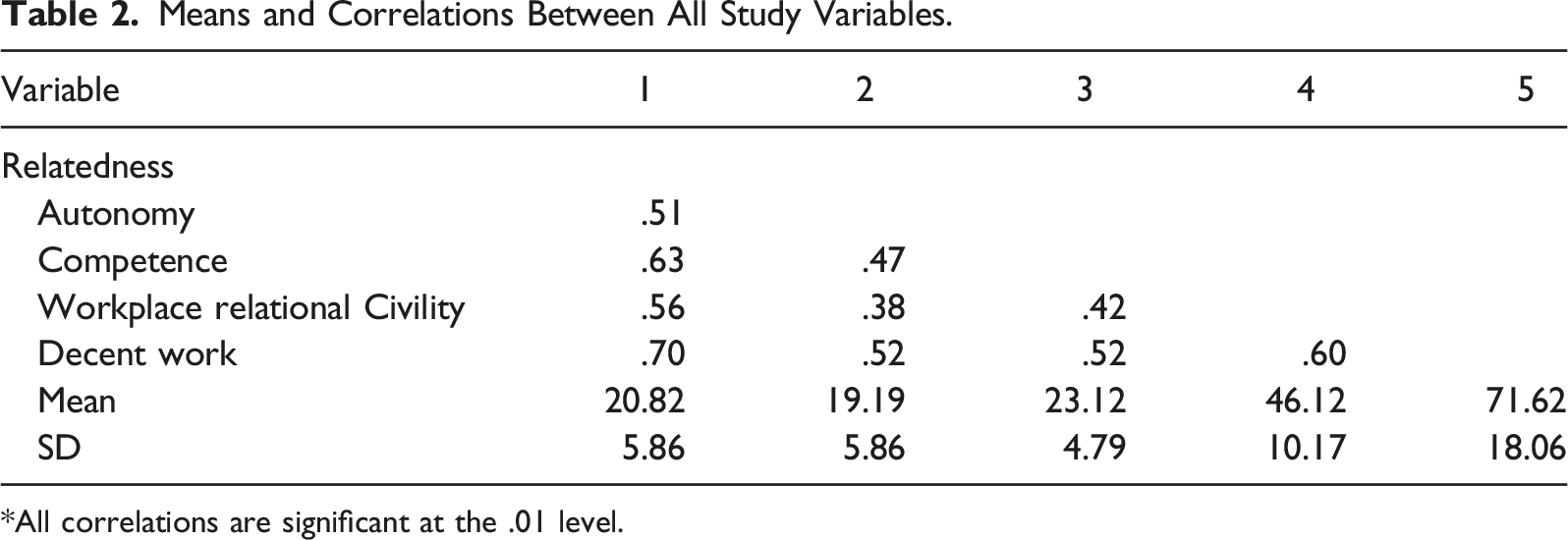
*All correlations are significant at the .01 level.
Moderation Analysis
Results from Regression Analysis Testing WRC as a Moderator.
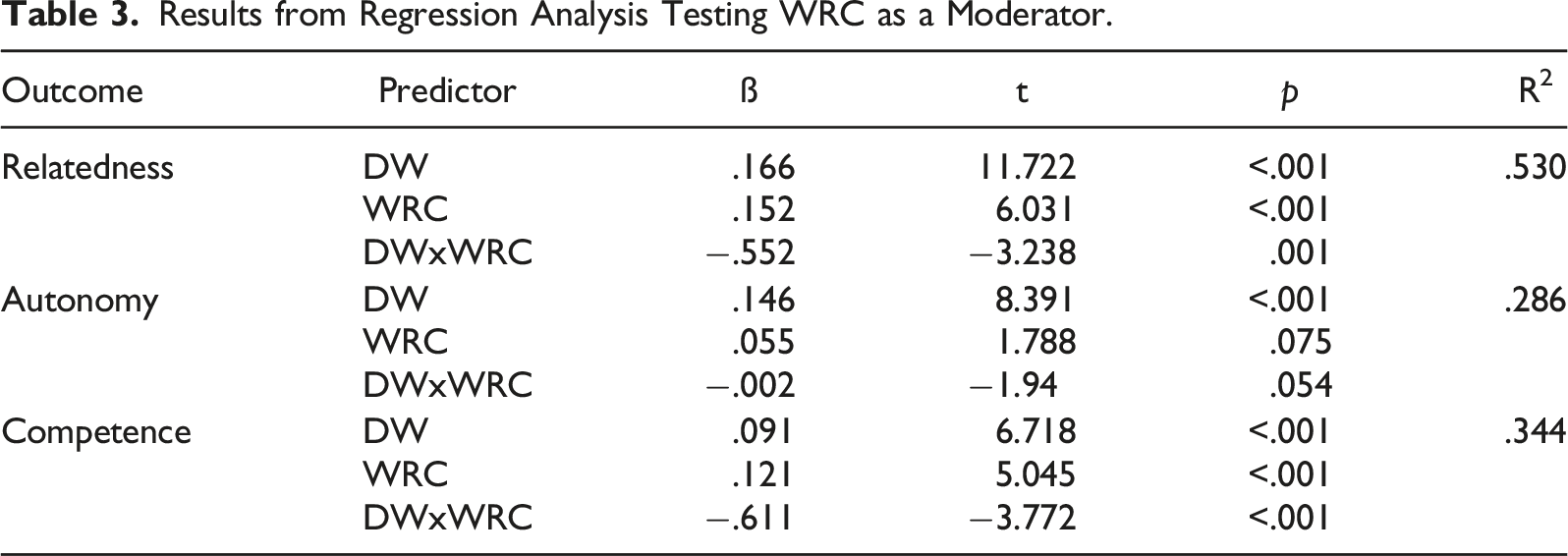
As such, results indicated that WRC had a significant moderating effect in two out of the three outcomes: relatedness and competence. In the relatedness model, the positive association between decent work and relatedness was stronger when participants reported lower levels of WRC (see Figure 1). Similarly, in the competence model, the positive association between decent work and competence was stronger when participants reported lower levels of WRC (see Figure 2). In the autonomy model, the positive association between decent work and autonomy did not significantly differ based on the degree of participants’ experience of WRC. Graph of WRC as a moderator of the relationship between Decent Work and Relatedness. Graph of WRC as a moderator of the relationship between Decent Work and Competence.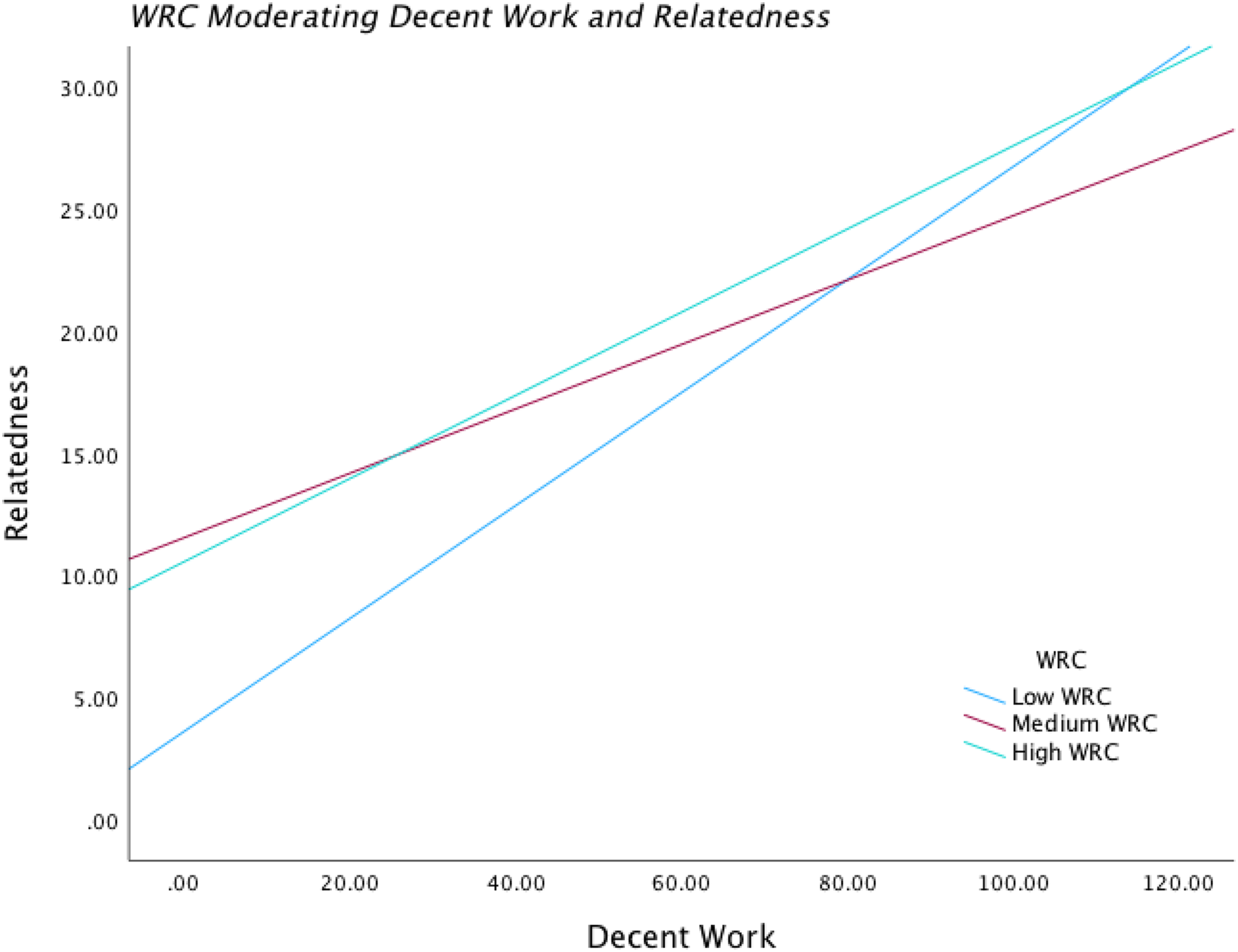

In order to determine whether there were significant impacts of gender (female/male) and race (white/people of color) age, and income, additional regression analyses were run. These four variables were added to each of the original regression analyses to test for significance. In the regression analysis with competence as the outcome variable, no significance was noted for gender, race, or income but age (t = 3.066 p = .002) was significant in the model. In the model with relatedness as the outcome variable, none of the demographic variables were significant in the model. Additionally, in the autonomy model, none of these demographic variables were significant. When these demographics variables were added to the model, the moderating effect of WRC was still significant for both the competence and relatedness regression analysis, whereas the model was still approaching significance in the autonomy model.
Discussion
The purpose of the current study was to identify the role of WRC in understanding the predictive relationship between decent work and self-determination needs. First, consistent with existing literature in the PWT model and supporting our first hypothesis, we found a significant, positive association between decent work and self-determination needs. Second, partially supporting our second hypothesis, we found that WRC moderated the relationship between decent work and self-determination for two out of the three self-determination needs (relatedness and competence). The second moderation was partially supported because the moderation effect was significant for just two of the three variables. These moderations also followed the same pattern – when WRC was low, the positive relationship between decent work and self-determination was stronger, and when WRC was high, this relationship was weaker.
Our study replicates results from prior research. First, consistent with PWT, our study suggests that self-determination is a significant outcome of decent work (Duffy et al., 2017). Additionally, our study’s findings about the significance of WRC as a moderator in this relationship is consistent with prior research pointing to the important role of workplace relationships in shaping outcomes related to well-being in the workplace (Huang et al., 2022; Tebbe et al., 2019; England et al., 2020). Previous researchers (e.g., England et al., 2022) have called for studies that focus on investigating workplace relationships as a moderator. Our study adds a unique contribution to the literature by pinpointing for whom the connection between self-determination and decent work is the strongest. Specifically, contrary to what we expected, participants who experienced less workplace civility seemed to benefit the most from decent work. For individuals who are treated with a lower degree of civility at work, the ability to access conditions of decent work may become crucial for promoting their self-determination needs, whereas for those who are treated with greater levels of relational civility in the workplace, the self-determination benefits of decent work might be less drastic. Essentially, when people have a poor relational environment, decent work seems becomes even more important for promoting self-determination need satisfaction.
When examining these findings in light of previous literature in the psychology of working, our results underscore the importance of civil treatment as a key source of support for workers. Previous studies in the PWT field have indicated that social support serves as a potential moderator at the model’s front end, between decent work predictors and decent work (e.g., Masdonati et al., 2022). Beyond this role, our results suggest that relational support may play an important role at the back end of the model as well, as an important feature that promotes positive outcomes like self-determination. This is consistent with self-determination research positing that work environments characterized by psychological unsafety may inhibit self-determination needs from being met (Allan & Blustein, 2022). In turn, the presence of relational support and the subsequent fulfillment of self-determination needs may enhance workers’ sense of well-being (DiFabio & Kenny, 2018; Deci et al., 2017). When integrated with prior literature, this study highlights the importance of relational civility for workers, especially in providing relational comfort to mitigate the lack of decent work. The idea that positive treatment within the workplace can bolster self-determination needs in the absence of decent work underscores a core aspect of the relational theory of working (Blustein, 2011) -- relationships are a key ingredient in determining how people manage the challenges of work.
Overall, the results of this study suggest that fair relational treatment in the workplace is a critical need for workers, especially in contributing to the fulfillment of self-determination needs. While decent work provides tangible benefits which can promote self-determination, our study suggests that these more intangible, relational conditions of working are also crucial, thus adding a deeper understanding of the powerful role of relationships in the workplace.
Implications for Practice
Study findings have several practical implications for both clinicians working with clients as well as organizations. For mental health providers, it is crucial to understand that work life and personal life are inextricably connected, and even without the context of formal career counseling, workplace issues are likely to arise in traditional therapy. Further, given the inherently relational experience of working, it is likely that issues involving workplace relationships may come up for clients. As such, knowledge about the important role of relational workplace climates in promoting self-determination outcomes, especially when the individual is not experiencing decent work, is important for providers. In counseling, clients and practitioners may engage in discussions about both the deficits and resources in their current workplace environment and identifying ways to capitalize on the resources, especially those that are relational.
Additionally, this study’s findings have implications for organizations. For instance, employers should be aware of how decent work and workplace relational climate operate to promote positive outcomes for employees. Knowing that decent work has a stronger association with self-determination need fulfillment for workers who face less relational civility, employers could try to enhance the components of decent work and ensure they are available for all workers. Organizations such as workers’ unions can be powerful tools for ensuring that all workers receive benefits of decent work at their place of employment. Employers should also take note of the powerful impact of a positive relational climate in the workplace and make efforts towards promoting encouraging relationships among staff, as well as clients or customers (e.g., building a collaborative rather than competitive workplace culture, mentoring programs, enabling HR systems that support employees’ relational wellness). Along these lines, interventions such as workplace climate surveys could be useful to assess the interpersonal environment in the workplace and respond accordingly with interventions such as those listed above. Additionally, employers could include creative interventions to bolster the workplace relational climate including utilizing an open-door policy or undergoing trainings related to workplace relational climate. Some recent studies (e.g., Alan et al., 2023) have shown positive results from a training intervention to bolster positive relationships in the workplace. The findings from our study may inform future interventions of this nature. Further, these findings would also be informative for HR professionals who often are asked to solve complex relational issues in the workplace. In effect, we are arguing that workers need both decent work and relational civility among other resources to create working conditions that are supportive and fair and that promote self-determination.
Future Directions
One of the key findings from the current study is the important role of the workplace relational environment as an outcome of decent work. While many studies are focused on psychological outcomes (e.g., mental health, well-being, self-determination), future studies should continue examining the interpersonal environment within the workplace. Specifically, in advancing PWT literature, future research could also examine the connections between the relational environment and other outcomes (e.g., work fulfillment) in order to understand what specific benefits are most strongly gained from a positive relational environment. In addition, the informative nature of the findings suggests the usefulness of adding conceptually related constructs to PWT in a way that explores the full complexity of the relationships, as reflected in the results reported in this study. Additionally, future studies may also test interventions for promoting workplace relational civility and assess outcomes to determine how this essential need can be promoted in the workplace in an evidence-based way.
Limitations
The current study has some limitations. First, this study used self-report measures to assess experiences with decent work, self-determination, and workplace relational conflict. As such, participants’ scores on each of these measures are vulnerable to potentially skewed perceptions of one’s own experiences (e.g., overreporting or underreporting). Additionally, the cross-sectional nature of this data makes it more difficult to determine the directionality of these results. Based on theory and prior research, we can infer that decent work is predictive of self-determination and WRC would serve as a moderator; however, without longitudinal data, determining causality is uncertain. This is especially the case because of the COVID-19 pandemic that occurred since this time. However, despite this limitation, we believe that this study is still useful for understanding the complexities of individuals’ work experiences. Further, this data may serve as a useful comparison for future data collection on similar constructs to compare pre and post pandemic work experiences.
Conclusion
In addition to emphasizing the previously established relationship between decent work and self-determination, the current study inserts the role of the relational work environment into our understanding. By looking at the role of workplace civility, we can gain a greater understanding of its role as an important factor when considering how effective decent work interventions could be more effective for people who are low in workplace relational civility. When an employee is treated with hostility by coworkers or supervisors, these negative relationships may cause them to feel less autonomy, less competent at their job, and less connection with others. However, when one experiences workplace incivility at a job with otherwise good benefits that meets criteria for decent work, the effects of decent work may be enhanced. These findings highlight the important role of decent work, especially in a world where being treated well by others at work is not always a guarantee.
Footnotes
Declaration of Conflicting Interests
The author(s) declared no potential conflicts of interest with respect to the research, authorship, and/or publication of this article.
Funding
The author(s) received no financial support for the research, authorship, and/or publication of this article.
