



Abstract
An abundance of research on self-determination theory has shown that satisfaction of basic needs for autonomy, competence, and relatedness among adolescents promotes the experience of optimal career-related outcomes such as academic motivation and engagement. However, few studies have explored how satisfaction of these needs promotes identification with particular careers, and less attention has been paid to the role of relatedness satisfaction in these developmental processes compared to autonomy and competence. We addressed these issues in the current study by examining the relationship between relatedness and identification as a research scientist. Five latent classes of scientific research identity development were identified using growth mixture modeling: (a) strong positive growth, (b) moderate positive growth, (c) weak positive growth, (d) no growth, and (e) strong negative growth. Results of logistic regression analyses indicated that need for relatedness was a significant positive predictor of membership in the strong positive growth class relative to the no growth class. Implications for identity development as a research scientist and the social and motivational influences undergirding this process are discussed.
Keywords
Introduction
The formation of a personal identity involves a process of categorizing oneself in terms of roles and internalizing the meanings and expectations of those roles into the self (Stets & Burke, 2000). These roles become increasingly rooted in relationships during the teenage years as adolescents begin to form more intimate bonds with their peers, become members of various social groups, and generally ascribe greater importance to identifying themselves with others. The distinction between personal and social identity development is often much less pronounced during this period because although adolescents may strive to maintain their uniqueness, they are likely to view the world and behave in ways that are consistent with the perspective of the groups to which they belong. It can be argued that the fundamental need to form enduring social bonds (Baumeister & Leary, 1995) is perhaps the most influential determinant of identity development during adolescence. The roles that adolescents assume become increasingly differentiated as a result of maturation in cognitive, emotional, and physical functioning as well. Growth in these areas allows for greater exploration and mastery of one’s environment, thus affording adolescents the ability to engage in career-related activities that inform vocational identity development (Chávez, 2016).
Vocational psychology researchers who have examined adolescent identity issues have often applied global theories of identity development to the domain of work in efforts to better understand general career exploration and decision-making processes (Luyckx et al., 2010; Negru-Subtirica et al., 2015). Much of this research has largely drawn from Marcia’s (1966, 1993) identity status theory, which posits four identity types: (a) diffusion, (b) foreclosure, (c) moratorium, and (d) achievement. Individuals are theorized to begin in the diffusion stage, which is characterized by low exploration and commitment, and ideally proceed to the most adaptive stage of achievement where exploration and commitment are high. Studies involving adolescents have generally supported this sequence (e.g., Klimstra et al., 2010; Porfeli et al., 2011; Skorikov & Vondracek, 1998), and linked vocational constructs (e.g., career indecision) to the statuses in ways that accord with theoretical expectation (e.g., Luyckx et al., 2010; Vondracek et al., 1995). The domains that influence and are influenced by a well-established vocational identity also extend beyond the realm of work. For example, Hirschi (2012) reported a positive association between adolescent vocational identity and general well-being, while Negru-Subtirica and Pop (2018) documented evidence of a bidirectional relationship between adolescents’ vocational and academic identity development. Thus, vocational identity tends to be correlated with other salient identities and influences overall psychological functioning in beneficial ways (Porfeli et al., 2011; Skorikov & Vondracek, 1998). Indeed, striving to achieve a clear vocational identity during adolescence is a development task that is associated with the formation of a positive overall self-concept (Skorikov & Vondracek, 2007).
Although these findings are important to be sure, researchers have tended to focus on general vocational identity development (e.g., Gushue, Clarke, et al., 2006; Gushue, Scanlan, et al., 2006; Jantzer et al., 2009; Li et al., 2019) rather than studying these processes within specific career domains. This may be due to the fact that many adolescents have not had sufficient exposure to particular careers to internalize a stable image of themselves performing in a vocational role. In other words, adolescents may have little to identify with by this point in their development because their learning experiences and interactions with role models are typically limited to family members and teachers in formal academic settings. To the extent that adolescents can learn from adults performing in particular career roles (e.g., work-based learning; Alfeld et al., 2013; Kenny et al., 2010; Lapan et al., 2003), and share a collective identity with others in line to pursue those same careers, they can begin to narrow (Gottfredson, 2002) or expand their career options and make more informed decisions. For students developing preliminary interests in science careers, learning from scientists and peers who are conducting genuine research can help them form a concept of themselves as functioning in a similar capacity. In the present study we address the dearth of research on domain-specific vocational identity development by focusing our attention on the development of adolescents’ identities as research scientists in the context of an authentic research experience marked by collaboration, social support, and a shared sense of community. Scientific research identity is operationally defined in the current study as a self-concept characterized by an assimilation of the values, roles, and behaviors associated with conducting scientific research. Authentic research represents scientific inquiry that is hypothesis-driven, thus it offers a sharp contrast to more structured, course-based research in which outcomes are often predetermined (Spell et al., 2014). Such an experience of engaging in authentic research also reflects an approximation of work-based learning insofar as the activities entailed within resemble those which a scientist would carry out in an actual research setting.
Social Motives and Scientific Identity Development
The career development of scientists has a rich focal history in the vocational psychology literature, with descriptions of the characteristics of scientists dating back to the seminal work of Anne Roe (1953, 1961). It was during this period that lay conceptions of the scientist as having a solitary nature were first empirically documented (Mead & Metraux, 1957), and though such notions no longer reflect the contemporary collaborative nature of science (e.g., Allen et al., 2018; Hall et al., 2018), the belief that scientists tend to be “loners” continues to persist as an intractable stereotype held by both children (e.g., Sharkawy, 2009) and adults (e.g., Bruun et al., 2018; Cheryan et al., 2013). Such stereotypical beliefs represent one source driving the proliferation of research on the social-motivational factors underlying students’ decisions to pursue careers in science. Some researchers have examined science career choice behaviors by framing their investigations from a goal congruity perspective (Diekman et al., 2011) – that is, the degree to which people pursue goals that are concordant with one’s interests and values (Sheldon & Elliot, 1999), such as communion with others (i.e., communal goals) and self-direction (i.e., agentic goals).
Despite the explanatory power of the goal congruity perspective, studying these issues from diverse theoretical viewpoints can help scholars converge on a fuller understanding of the interpersonal motivations underlying research engagement. Self-determination theory (SDT; Deci & Ryan, 1985; Deci & Ryan, 2000; Ryan & Deci, 2000) may be a useful framework for broadening such analyses. According to SDT, individuals are theorized to experience a higher quality of motivation when they perceive themselves to be the cause of their own behavior as opposed to feeling controlled by others or contingencies in the environment. To this end, satisfaction of innate needs for autonomy (internal locus of causality), competence (feeling of efficacy), and relatedness (feeling connected to others) should manifest in the most self-determined form of self-regulation – intrinsic motivation – whereas more controlling forms of regulation (i.e., extrinsic motivation and amotivation) are presumed to result when these needs are not satisfied. Satisfaction of these needs has been linked not only to more adaptive motivation, but other important outcomes such as classroom engagement (e.g., Jang et al., 2012) and psychological well-being as well (e.g., Reis et al., 2000).
SDT research within the academic/career development realm has tended to focus on the relations of needs and motivation types to academic outcomes such as performance, engagement, persistence intentions, and self-efficacy (Howard et al., 2021). Identity has emerged as an equally important construct of interest in this area of research because it shares in common with SDT a focus on the internalization of adaptive attitudes that promote psychosocial functioning (Ryan & Deci, 2003). Identity development involves the assimilation of roles and practices in a way that mirrors the internalization of values that occurs within the more autonomous SDT form of external regulation referred to as identification (Ryan & Deci, 2000). Research has shown that both general need satisfaction (e.g., Luyckx et al., 2009) and need satisfaction in the context of family relationships (e.g., Erçelik & Dost-Gözkan, 2022) facilitate general identity development. Luyckx et al. also found that relatedness not only influences identity development, but identity development has a positive reciprocal effect on relatedness need satisfaction as well, thus lending compelling support to the notion that identity is firmly rooted in both personal and social conceptions of the self (Albarello et al., 2018). These findings illustrate the importance of social cohesion in shaping identity development. Need for relatedness, which is operationally defined for the purpose of the present study as a need to feel connected to and supported by program participants and faculty, is particularly important to science career development because research is increasingly conducted collaboratively and in the context of cross-disciplinary teams (Hall et al., 2018). However, there are two issues in the literature that warrant attention. First, relatedness is considered perhaps the most essential determinant of identity formation (Ryan & Deci, 2003) and may even be a more potent predictor of science identity than autonomy need satisfaction (Chiu, 2023), yet researchers have tended to highlight the latter form of need satisfaction as the predominant motivational process in student learning (e.g., León et al., 2015). Indeed, there is some evidence to suggest that need for relatedness is more strongly associated with science identity than needs for either competence or autonomy (Skinner et al., 2017) but otherwise there has been surprisingly little research linking basic psychological needs to science identity. The paucity of research on the unique role of relatedness in shaping identity thus suggests this is an issue in need of further investigation. Second, research has mainly centered on the relationship between need satisfaction and general identity development, with fewer studies examining whether these basic needs serve as a foundation for domain-specific identity development. Some studies have linked SDT motives to science identity among both college students (e.g., Smith et al., 2014) and adolescents (Deemer et al., 2022), but scholars have yet to determine whether psychological needs themselves influence the growth of science identity over time.
Present Study
The purpose of the present study was twofold. First, we set out to determine whether students participating in the Summer Science Program (SSP) increasingly identify as scientific researchers over time. SSP strives to create a community of practice (Wenger, 1998) characterized by collaboration, intellectual curiosity, and mutual support. These elements of the SSP learning environment are thought to engender in students an esprit de corps that facilitates satisfaction of their needs for social connection and shapes their identification with the scientific community. Exposure to such role models affords students an opportunity to engage in the important developmental process of seeing themselves functioning in an impactful fashion in the future, and reconciling any discrepancies that may exist between their “possible selves” (Markus & Nurius, 1986) and current self-conceptions. We assumed an exploratory perspective by attempting to establish whether different scientific identity growth trajectories could be identified for various subgroups of students. Thus, our second aim was to examine whether perceptions of relatedness in the program were predictive of scientific identity growth both within the overall sample, and within any subgroups emerging from our analyses. We hypothesized that (a) scientific identity would exhibit unconditional growth over the course of the program, and (b) perceptions of relatedness at time 1 (T1) would be a significant predictor of latent class membership in at least one of the emergent subgroups demonstrating a positive identity growth trajectory. Given that women have been historically underrepresented in the physical sciences (Eccles, 2007), we also examined latent class frequencies by gender and project type as an exploratory analysis.
Method
Participants
Eight hundred eighty-eight high school students participated in the study. A total of 102 participants provided demographic information prior to entering the program but provided no responses to the substantive measures. These cases were removed from the data set, resulting in a final N of 786. A slight majority of participants identified as male (49.9%), 49.6% identified as female, and .5% reported a nonbinary gender identity. With regard to race/ethnicity, most participants identified as East Asian (34.9%), followed by White/European American (23.1%), Indian (13.9%), multiracial (7.7%), Hispanic/Latino/Latina (7.1%), Black/African American (3.2%), Southeast Asian (3.1%), Arabic/Middle Eastern (1.4%), Native American (.1%), and Pacific Islander (.1%). A small percentage of participants (.6%) identified as “other,” and 4.8% preferred not to disclose their race/ethnicity.
Measures
Relatedness Need Satisfaction
The eight-item Relatedness subscale of the Basic Need Satisfaction at Work Scale (BNSWS; Deci et al., 2001) was used to measure participants’ perceptions of the degree to which the program satisfied students’ needs for social connection. The BNSWS was originally designed to assess need satisfaction at work but we adapted the relatedness items such that they tapped perceptions of social connectedness within the SSP program. An original item states “I get along with people at work” while the adapted item states “I get along with people in this program.” Items are rated on a Likert scale ranging from 1 (not at all true) to 7 (very true). Need for relatedness scores at T1 demonstrated good internal consistency reliability (α = .83).
Scientific Research Identity
We used the six-item Scientific Identity Scale (SIS; Chemers et al., 2011) to measure participants’ identification with scientific research. We adapted the items such that the term “scientist” was replaced with the term “researcher.” An original item example states “Being a scientist is an important reflection of who I am” while the adapted version states “Being a researcher is an important reflection of who I am.” Participants rate SIS items on a five-point Likert scale ranging from 1 (strongly disagree) to 5 (strongly agree). Cronbach’s alpha coefficients were .86, .87, and .90 for T1, T2, and T3, respectively.
Procedure
Data were collected from six cohorts of students participating in SSP (https://summerscience.org) between 2017 and 2022. SSP is an annual residential science enrichment program in which high school students engage in authentic research in astrophysics, biochemistry, or genomics over a period of 39 days. Prospective students are admitted to the program through a formal application process and they may choose only one research project to engage in. Students in the astrophysics project use mathematical and astronomical techniques to determine the orbit of an asteroid whereas biochemistry students use bioinformatic tools and wet lab biochemical methods to characterize an enzyme from a fungal crop pathogen with the end goal of developing a fungicide. The genomics project, which was added to the SSP curriculum in 2021, involves conducting research on the evolution of antibiotic resistance. The curriculum for each project remained the same through the entirety of the study. Prominent individuals from academic and corporate settings also provide guest lectures on scientific, ethical, and career development topics. Institutional review board (IRB) approval was obtained from the first author’s institution prior to initiating data collection. Parents of students under the age of 18, as well as students who were 18 years or older, provided their written consent to participate in the study. Data were collected within each offering of the program at 11-day intervals across three measurement occasions using an online survey. We measured identity at 11-day intervals because these measurement occasions were thought not to interfere with particular program activities (e.g., field trips). This interval length was thought to be sufficient for identity change to occur because students are exposed to robust socializing agents (i.e., faculty and fellow students) via concentrated instruction and close collaboration in a very specific career domain. Students were delivered a link to a webpage at each measurement occasion which summarized their rights and responsibilities as participants and afforded them the opportunity to rescind their assent to continuing in the study. Those who provided their assent were directed to a portal which contained the survey.
Results
Latent growth curve modeling operates on the assumption that all individuals in a sample belong to a single homogeneous population, however, this may be an untenable assumption because there are often subpopulations of individuals that have particular growth trajectories.
We used growth mixture modeling (GMM; Muthén, 2004) in the present study to account for the possibility that there are different patterns of growth in scientific identity over time. All analyses were conducted using Mplus 7.4 statistical software (Muthén & Muthén, 2016). The following fit statistics were used to assess model fit and determine the optimal number of latent classes: (a) Akaike Information Criterion (AIC), (b) Bayesian Information Criterion (BIC), (c) Vuong-Lo-Mendell-Rubin (VLMR) likelihood ratio test (Lo et al., 2001), (d) bootstrap likelihood ratio test (BLRT), and (e) entropy statistic. Smaller values of AIC and BIC indicate better model fit. Likelihood ratio tests involve assessing the degree of improvement in model fit when comparing models with different numbers of latent classes. Entropy values range from 0 to 1, with higher values indicating greater accuracy in assignment of class membership. Entropy values of .80 and higher indicate acceptable classification accuracy (Clark, 2010), therefore we used this value as a criterion for model retention. The analyses were conducted using robust maximum likelihood estimation, 500 initial stage random starts, 50 final stage optimizations, and 50 iterations in the first step of the optimization process. Because multivariate outliers can exert an undue influence on latent class formation (Peel & McLachlan, 2000), we identified 16 cases with significant Mahalanobis distance values (p < .001) and removed them from the data set.
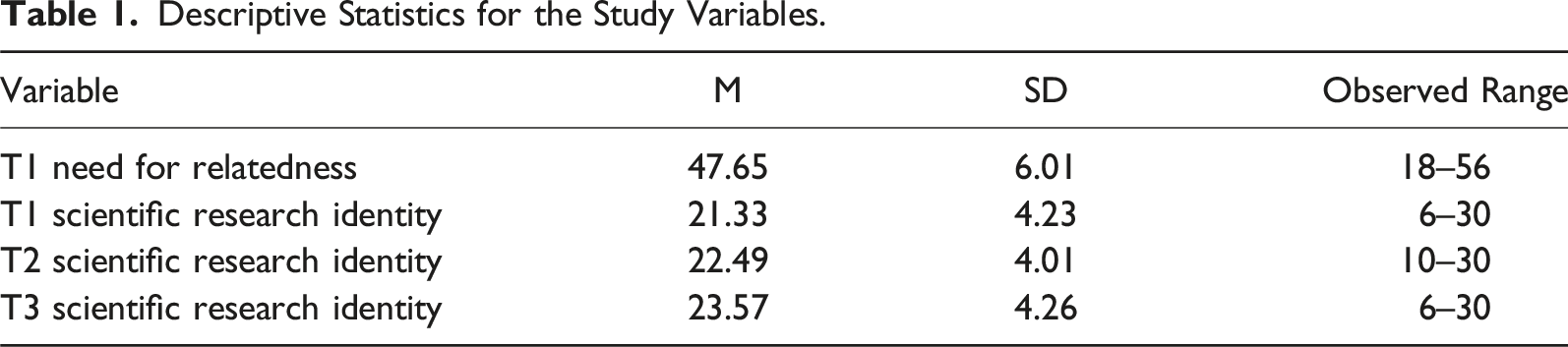
Descriptive Statistics for the Study Variables.
Fit Statistics for Six Growth Mixture Models of Scientific Research Identity Development.

Note. AIC, Akaike information criterion; BIC, Bayesian information criterion; BLRT, bootstrap likelihood ratio test; VLMR LRT, Vuong-Lo-Mendell-Rubin likelihood ratio test. Bolded print indicates the chosen model for analysis.
Classification Probabilities for Most Likely Latent Class Membership.

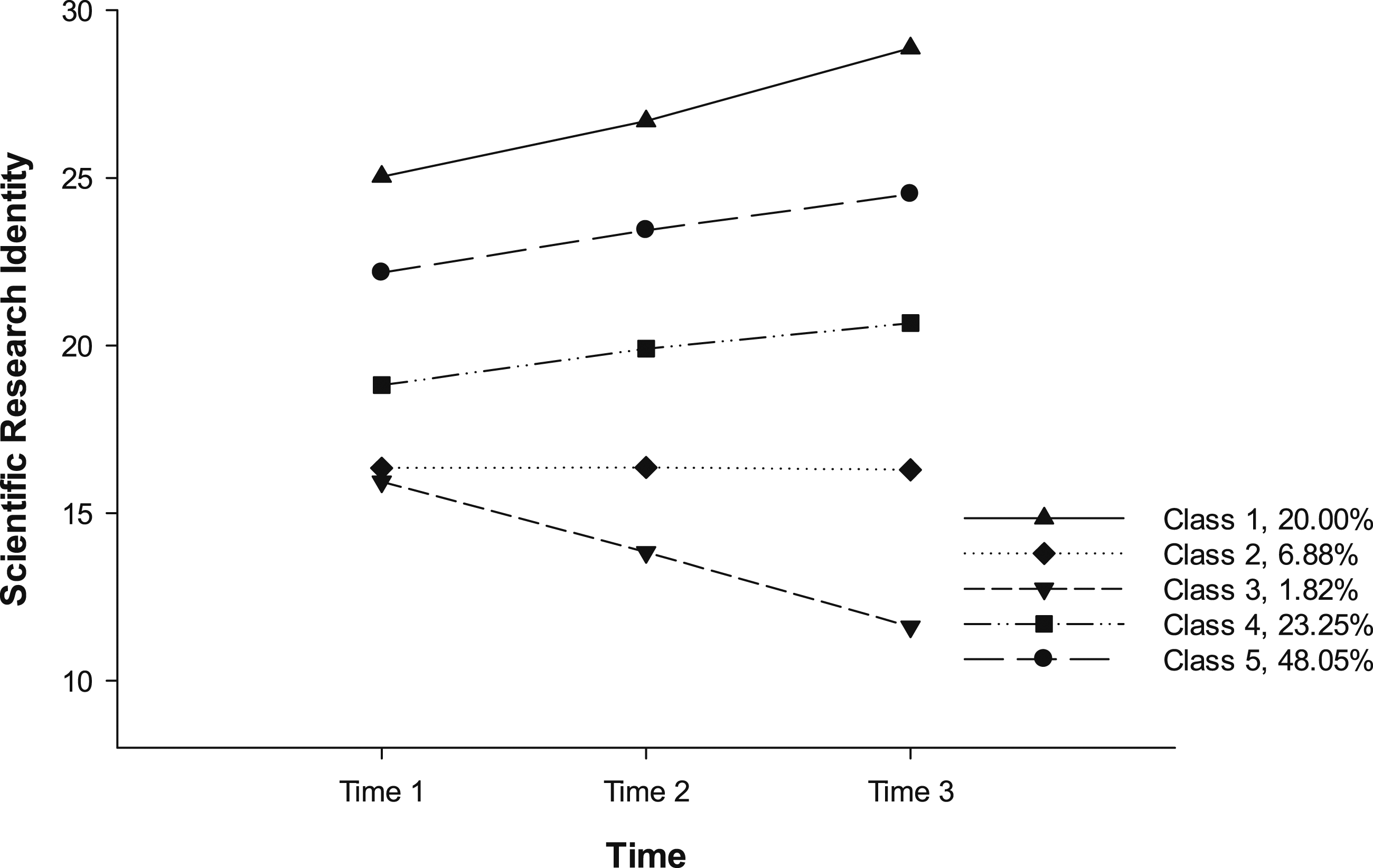
Growth trajectories for five latent classes of scientific research identity development.
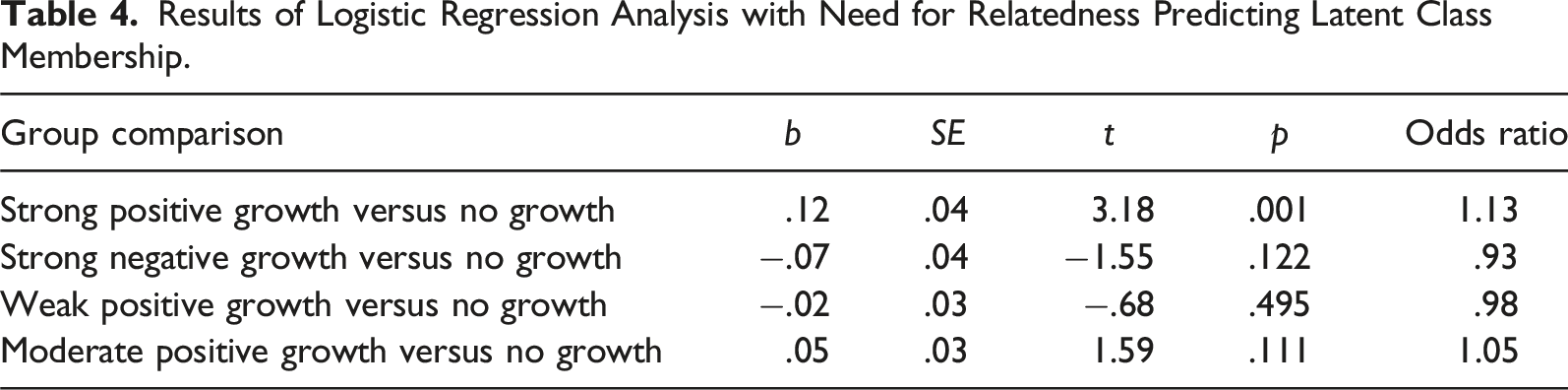
Results of Logistic Regression Analysis with Need for Relatedness Predicting Latent Class Membership.
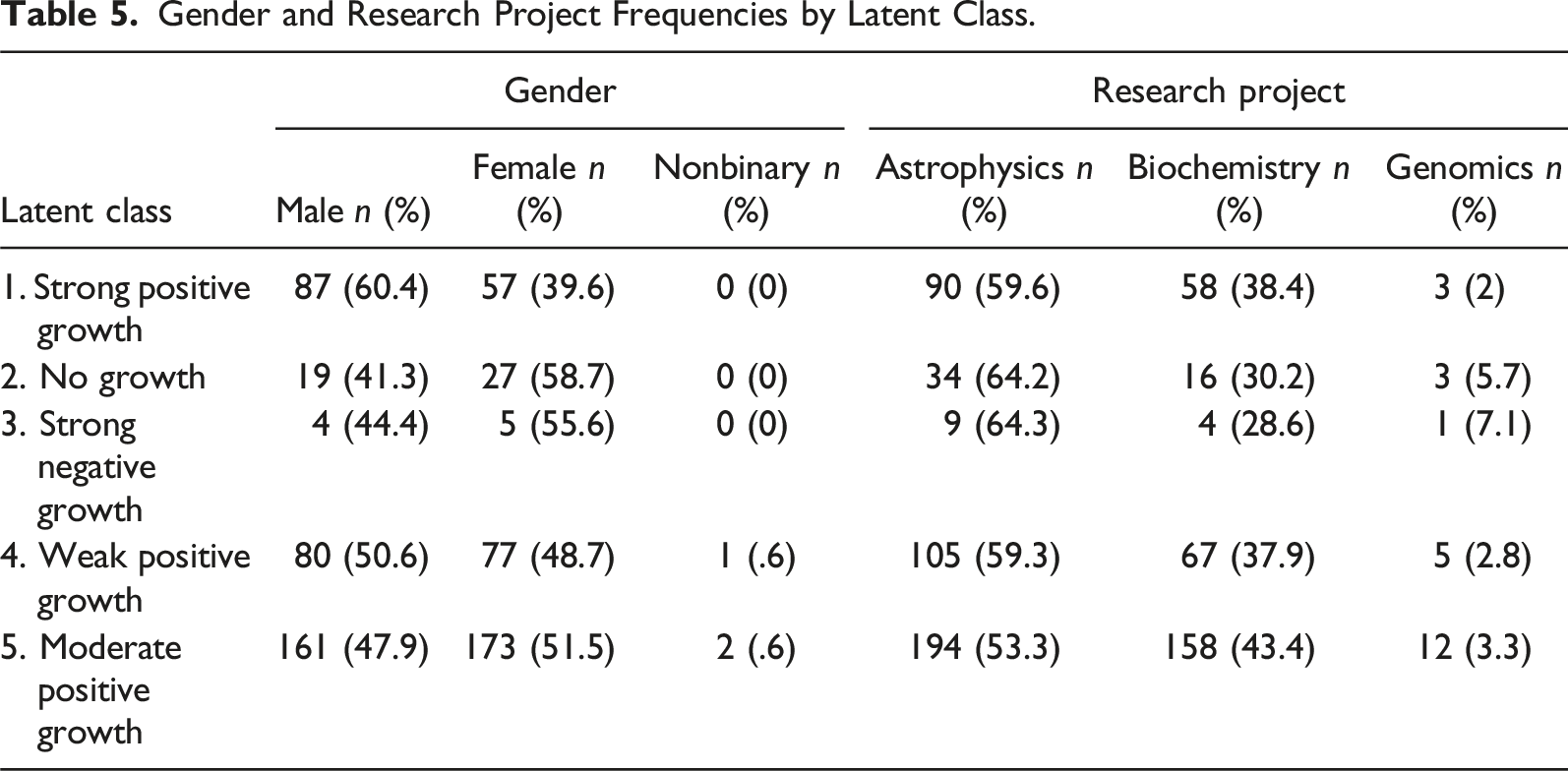
Gender and Research Project Frequencies by Latent Class.
Discussion
The study of vocational identity development has historically focused on broad process dimension constructs that reflect decisional states (e.g., exploration, commitment) rather than the assimilation of prospective roles in particular careers. Further, researchers have tended to examine the intrapersonal origins of identity development among adolescents (Albarello et al., 2018) despite the fact that socializing factors also play an equally important role in this process. The current research attempted to address these issues by focusing on the interpersonal bases of adolescents’ identities as research scientists.
The results of this study provided support for our first hypothesis, as the growth trajectory for the overall sample with regards to identification as a researcher was positive and significant across three measurement occasions. The finding that participants increasingly conceived of themselves as functioning in the role of a scientific researcher is consistent with prior research demonstrating growth in more generalized forms of academic (e.g., Klimstra et al., 2010) and vocational (e.g., Hirschi, 2012; Li et al., 2019) identity development among adolescents. We cannot directly attribute this growth to the effects of SSP because that this was not a controlled study, therefore efforts to employ control or comparison groups in future research would be needed if causal inferences are to be made.
The finding of five latent classes via growth mixture modeling permitted a more detailed analysis of which groups of students reported increased identification with scientific research and which groups did not. Supporting our second hypothesis, need for relatedness was a positive predictor of latent class membership as participants who perceived a higher sense of social connection with others were more likely to be categorized as a member of the strong positive growth group compared to the no growth group. Participants who experienced the most rapid development of self-identification thus perceived the program as allowing them to develop satisfying relationships with others. It is also interesting to note that not only did this group experience the strongest rate of growth, they also reported higher initial levels of scientific research identity than any of the other groups. Conversely, over 71% of the sample experienced either moderate or weak research identity development, yet relatedness was not predictive of membership in either of these groups. This suggests that a certain threshold of research identity may first need to be reached before the relationship between social connectedness and one’s self-conception as a research scientist can be strengthened.
Further supporting this interpretation is the finding that participants in the no growth and negative growth classes started with essentially the same level of research identification at T1, thus removing initial research identity as a potentially confounding variable, yet their trajectories diverged over time. Relatedness was not a significant predictor of differential membership in these groups considering that students were only slightly less likely to belong in the negative growth group versus the no growth group as a function of this factor. Relatedness may therefore not be sufficient to determine growth trajectories for students with the corresponding levels of identification observed at T1. Instead, it may be that needs for autonomy and competence better account for the observed divergence of these groups. Perhaps students’ identification with research declined because they did not perceive themselves to be developing their research skills, or because they could not carry out their research in a way that was free of coercion from others. Even when students reported a high level of T1 identification, satisfaction of relatedness needs did not robustly differentiate between membership in the strong positive versus no growth groups despite its statistical significance as a predictor. The influence of relatedness on identity development may be conditioned upon the extent to which students perceive their competence and autonomy needs to have also been met, suggesting an interactive relationship among these variables. Exploring these relations was beyond the scope of this study but it likely would be worthwhile to explore them in future studies.
The threshold effect interpretation described above implies that a strong foundational science identity, established through prior academic experiences, is necessary if one is to use the benefits of social affiliation to build more a more specialized science career identity. It is possible that some participants were predisposed to identifying highly with research prior to entering the program but we operated on the assumption that they had not been exposed to authentic research in their high school science classes, therefore they should presumably have little real-world experience on which to formulate a research identity. Alternatively, the characteristics of the program itself may have facilitated the development of a strong baseline research identity between the time of entering the program and the first measurement occasion 11 days later. In future studies it may be worthwhile to control for basic science identity prior to program entry in order to account for prior science attitudes as a possible source of research identification. Such studies may reveal a threshold effect in which communities of practice require some level of initial interest to achieve a positive outcome for adolescents.
A secondary analysis of the demographic characteristics of the latent classes indicated that a majority of participants in each group were involved in the astrophysics project, and females outnumbered males in three of the five groups. Male participants outnumbered female participants in the strong positive growth and weak positive growth groups whereas females outnumbered males in the no growth, moderate positive growth, and strong negative growth groups. However, results of a chi-square test of independence indicated there were no differences in proportions of participants classified by gender or research project type when comparing the comparably-sized strong positive and weak positive growth groups. Astrophysics participants were just as likely as biochemistry participants, and females were just as likely as males, to experience robust identity development. Given that need for relatedness was positively associated with strong research identity development, these finding offers partial evidence to counter the stereotypical belief that physics is a branch of science best suited for solitary individuals who have no interest in working collaboratively with others (Bruun et al., 2018).
Our results align with related findings indicating that environments in which there is an emphasis on collaboration and helping others are associated with greater science motivation (Brown et al., 2015) and interest in science careers (Steinberg & Diekman, 2017; Thoman et al., 2015) among college students. However, it remains an open question as to whether satisfaction of needs for autonomy and competence play a role in determining the course of research identity development. Individuals who feel coerced into behaving in a particular way are not free to express their interests and values in ways that are consistent with their conceptions of self (Ryan & Deci, 2003). Autonomy may provide an important foundation for the satisfaction of relatedness needs in identity development contexts because people cannot fully engage with others on social and intellectual levels if they feel that certain contingencies in their environments limit their ability to form relationships. Competence need satisfaction may function in a somewhat similar way in that strong self-efficacy beliefs are likely to be essential to generating the domain interest (Lent et al., 1994) needed to facilitate personal identification with scientific research. The importance of career decision-making self-efficacy to the formation of a vocational identity has been well-documented in the literature (Gushue, Clarke, et al., 2006; Gushue, Scanlan, et al., 2006) and socially-based operationalizations of self-efficacy have been shown to influence individual science interest and career intentions (Deemer et al., 2017). Both individual and collective perceptions of competence may influence social identification through motives to enhance self-esteem and feel accepted by others (Luhtanen & Crocker, 1992; Stets & Burke, 2014). Examining more closely the structural relations among autonomy, competence, and relatedness needs relative to scientific identity would be an important avenue for future research. For instance, autonomy may function as a temporal precedent of relatedness need satisfaction while competence may interact with relatedness to produce optimal identification states.
Limitations
There are three limitations in the present study that should be mentioned. First, as mentioned previously, growth in scientific identity cannot be attributed to the effects of the program itself because a control/comparison group was not incorporated into the research design. Future research comparing SSP to science enrichment programs that are similar in content, scope, and duration would permit stronger inferences of causality in this regard. Second, measurement of identity across three time points limits the extent to which inferences can be drawn about the nature of the identity growth process. Measuring identity development across four or more time points would allow for estimation of nonlinear growth trends, thus permitting a more focused analysis of the points at which identification may increase or decrease more sharply. Finally, we were not able to fully establish temporal precedence of relatedness to the identity growth process because data for these variables were collected concurrently at T1. This limits the degree to which relatedness can be inferred as exerting a causal influence on research identity development. Researchers wishing to replicate the current study should consider measuring need for relatedness entirely as a temporal antecedent of identity within the framework of growth curve modeling, cross-lag panel modeling, or other related longitudinal designs.
Implications and Conclusion
The current findings have implications for career development interventionists and researchers that extend beyond the realm of scientific research. The authenticity of the research conducted by adolescents in SSP reflects a form of learning that would occur in an actual workplace, thus exposing them to the daily activities of a research scientist. This experience highlights the importance of engaging adolescents in work-based learning provided they are developmentally prepared to understand and execute tasks in simulated work situations that incorporate robust mentoring by experienced practitioners. Such experiences should help adolescents better clarify their vocational interests and aid them in making more informed career decisions. We recognize that our findings only represent short-term changes in domain-specific identity; more work is needed to link this bounded growth to more enduring changes in global vocational identity.
In sum, the current study illustrates the contribution of social bonds to the development of scientific research identity. Prior research had emphasized autonomy and competence-related constructs (e.g., self-efficacy) as the primary facilitators of this process but as we have shown, adolescent satisfaction of the need for relatedness appears to be associated with promoting a specific form of vocational identity. We encourage investigators to consider extending this line of research to vocational domains other than science. Because learning to develop and manage relationships is a critical developmental task in adolescence, understanding how such processes relate to other vocational identities would do much to advance career development research in this population.
Footnotes
Declaration of Conflicting Interests
The author(s) declared no potential conflicts of interest with respect to the research, authorship, and/or publication of this article.
Funding
The author(s) received no financial support for the research, authorship, and/or publication of this article.
