



Abstract
In this article, the authors explored the associations between suicide rates and a large number of sociocultural indexes, within the sociological framework provided by Durkheim and taking into account recent sociological theories. The analyses were performed on a sample of 87 nations and a subsample of posttraditional societies. The authors found strong positive (linear) correlations between suicide rates and measures of secularization, and curvilinear relationships between measures of individualization and suicide rates. Negative associations were found between suicide rates and measures of individualization in a subsample of posttraditional countries. Following the postmodernization and reflexive modernization theories, the authors argue that a new form of individualization is in place in secular–rational societies. This form of individualization exercises a negative effect on suicide rates through its positive influence on social integration and regulation.
Keywords
Introduction
In 1897, Durkheim proposed a sociological theory of suicide that is still influential in contemporary research. According to Durkheim (1897/1970), two interrelated social processes were happening in modern societies in the late 1800’s: social disintegration and social deregulation. Those two processes were due mainly to the weakening of religious, familiar and political societies’ traditional strength.
Social disintegration and social deregulation end up in extreme individualism and anomie. People belonging to individualist societies are more prone to suicide as reasons to live are less compelling when values and purposes transcending the individual are rejected. People belonging to anomic societies frequently experience unfulfilling feelings because sentiments (like ambition and frustration) are not socially regulated. Individualism and anomie are considered as typical of (or even embedded in) modern societies. Criticizing those aspects of modern societies, Durkheim did not mean to reject modernity itself: he proposed the revaluation of the corporations (occupational associations) as an institutional solution for the effects of the disintegration of traditional societies.
In Durkheim’s opinion, in the very traditional societies, suicide can be explained by an excessive subordination of the individual to the society and by fatalism (which are considered the opposite of social disintegration and deregulation).
Durkheim’s theoretical framework has been widely applied in empirical studies in suicidology. Such studies employing measures of cross-national socioeconomic factors have shown a consistent relationship between suicide rates and measures of economic development, like GNP per capita, percentage of agricultural workers, and population growth (see, for example, Conklin & Simpson, 1987; Lester, 1996; Zhang, 1998; or Stack, 2000a, 2000b for a review).
Douglas (1967) pointed out that the relations between suicide rates and sociological indexes (such as divorce rates) cannot prove Durkheim’s theory, because the very factors that explain suicide rates are cultural values (i.e., individualism and ambition) of the national society, which are not directly assessed in Durkheim’s work.
To be able to test Durkheim’s theory using current data, we firstly reviewed cross-national literature on cultural indicators and suicide and then we created a database with cultural and socioeconomical indicators. Employing this database, we performed correlational analyses between suicide rates and a large number of socioeconomical and cultural indicators. These findings will be presented in the following section. In the final section, we provide a discussion of the results of our research, taking into account Durkheim’s theory of suicide and postmodernization and reflexive modernization theories.
Cross-National Research on Culture and Suicide
Schwartz (1992, p. 4) stated that “values (1) are concepts or beliefs, (2) pertain to desirable end-states or behaviours, (3) transcend specific situations, (4) guide selection or evaluation of behaviour and events, and (5) are ordered by relative importance.”
Currently a few reliable cross-national indexes of cultural values are available. The most comprehensive national scores and the most effectively employed are the dimensions by Hofstede (1980, 2001a), Schwartz (1994, 2006), and Inglehart (1997).
Hofstede’s (1983) empirical analysis on cross-national data collected in late 1960s on IBM employers resulted in four basic cultural dimensions (pp. 336-337):
Individualism-collectivism: “a preference for a loosely knit social framework in society in which individuals are supposed to take care of themselves and their immediate families only as opposed to (. . .) a preference for a tightly knit social framework in which individuals can expect their relatives, clan or other in-group to look after them, in exchange for unquestioning loyalty.”
Power distance: “the extent to which members of a society accept that power in institutions and organizations is distributed unequally.”
Masculinity–femininity: “a preference for achievement, heroism, assertiveness, and material success as opposed to (. . .) a preference for relationships, modesty, caring for the weak and the quality of life.”
Uncertainty avoidance: “the degree to which the members of a society feel uncomfortable with uncertainty and ambiguity, which leads to support beliefs promising certainty and maintain institutions protecting conformity.”
Schwartz (1994, 2006) studied samples of teachers and university students in more than 70 nations since the late 1980s and derived seven cultural orientations:
Intellectual autonomy: the emphasis on personal creativity and freedom of thought.
Affective autonomy: the tendency to pursue individual pleasure and variety in life.
Embeddedness: the cultural orientation to maintaining the status quo and restraining actions that might disrupt in-group solidarity or the traditional order.
Egalitarianism: a vision of all people as morally equal independently from prescriptive roles and class status, and cooperating for a common pursuit.
Hierarchy: cultural hierarchy relies on hierarchical systems of ascribed roles to insure responsible, productive behavior. It defines the unequal distribution of power, roles, and resources as legitimate.
Harmony emphasizes on adaptation to natural and social conditions instead of changing them.
Mastery is the polar cultural response of harmony. It encourages active self-assertion to master, direct, and change the natural and social environment to attain group or personal goals.
Since the 1980s, Inglehart (1997; Inglehart & Baker, 2000) studied national representative samples through the World Values Survey 1 (WVS, 2000) and found two factors explaining more than 70% of the variance in the surveys:
Traditional versus secular–rational: This dimension contrasts societies with a strong emphasis on religious beliefs, national identity, authoritarian education, and that tend to emphasize the male dominance in the economic and political life to societies oriented toward rational organization, motivation toward achievement, and secular legal system;
Self-expression versus survival: Societies that emphasize self-expression values give high priority to self-expression; have participatory orientations toward society and politics; support gender equality; are relatively tolerant of foreigners, homosexuals, and other out groups; and rank high on interpersonal trust. Societies that emphasize survival values, however, tend to have the opposite preferences in each of these areas.
Obviously there is a considerable overlap between the dimensions individuated by the three authors. For instance, Schwartz found significant associations between his affective autonomy, intellectual autonomy, and egalitarianism dimensions and Hofstede’s individualism (Schwartz, 1994) as well as Inglehart’s survival versus self-expression values (Schwartz, 2006). Hofstede (2001a) found significant relationships between individualism and both Inglehart’s dimensions.
Previous cross-national studies (e.g., Allik & Realo, 1997; Eckersley & Dear, 2002; Lester, 1993, 1997, 1998, 2003; Minas & Klimidis, 2006 [personal communication, April 14, 2007]; Rudmin, Ferrada-Noli & Skolbekken, 2003) that employed cultural values supported a positive relationship between individualism and suicide rates, as it was predicted by Durkheim but with a few exceptions (e.g., Lester, 1988, 2005). Those exceptions might be due to sampling effects: the positive relationship between suicide and individualism was found in studies with a broad and geopolitically heterogeneous group of nations, whereas those finding a negative association are based on a small number of economically developed nations.
Studies showing the effect of sampling were published by Lester and Stack (1989) and Zhang (1998). The former compared samples of all available nations with samples of only developed countries and found different associations between suicide and quality of life. The latter observed different factors for suicide in the sample of developing countries compared to the sample of developed ones.
Cross-national studies on suicide rates employing measures of cultural values have been most frequently based on Hofstede’s dimensions. Only Allik and Realo (1997) also added Schwartz’s dimensions and observed a positive relationship with mastery, which is another cultural factor associated with suicide rates according to Durkheim.
To date, to the best of our knowledge, Inglehart’s dimensions have not been examined in cross-national studies on suicide rates; thus this is the first study of this kind. The closest studies were carried out by Cutright and Fernquist (2004) and Stack and Kposowa (2011). The former employed the construct of “culture of suicide” (rather than indicators of cultural values) and found a positive association between tolerance for suicidal behavior and suicide rates in 50 American states. Stack and Kposowa (2011) studied associations between self-expression and suicide attitudes (rather than suicide rates) in samples of black males in 10 nations.
In the current study, we employed all the three sets of cultural indicators indicated earlier on (i.e., Hofstede, Inglehart, & Schwartz) to explore commonalities and divergences in their association with suicide rates.
Advances in Sociological Theory of Society
Inglehart (1997, 2000; Inglehart & Baker, 2000) maintains that it is possible to find a new cultural shift within the most developed countries, as in those societies, people are relieved from scarcity of resources and their survival is relatively secure. In this kind of society, new values are rising (such as tolerance of diversity, and priority of well-being over economic growth) and the centralized bureaucratic/rational political organization of the society is losing the support of the public. Inglehart calls this cultural shift postmodernization, a term which recognizes a discontinuity from the process of modernization. Inglehart was able to distinguish cultural aspects of modernization and postmodernization processes through the two distinct dimensions derived from the data collected with his World Values Survey (WVS) that were indicated before: the traditional versus secular–rational values dimension contains items referring to process of cultural modernization whereas the survival versus self-expression dimension refers to the process of cultural postmodernization. The nations involved in this new cultural phase are called postmodern societies. Welzel, Inglehart, and Deutsch (2005) in their study on the relationships between self-expression values, social capital, and civic benefits statistically demonstrated that this cultural pattern makes citizens more eager to build networks, to associate for prosocial actions, more aware of political issues and ready to engage in unconventional political actions, such as petitions.
The term postmodern society in the words of Inglehart is oriented toward a cultural dimension, whereas the concept introduced by Bell (1973) of postindustrial society focuses more on the social structure. Bell defines postindustrial societies as those where the majority of the labor force is employed in the service sector.
Citizens in postindustrial societies are considered as more educated and relationally skilled, and Inglehart (1997) demonstrated a strong positive relationship between self-expression values and percentage of service workers.
Beck (Beck & Beck-Gernsheim, 2001; Beck, Boss, & Lau, 2003) distinguishes traditional from posttraditional societies, but also first modern societies from second modern societies. Second modern societies (e.g., Germany, United Kingdom, and Japan) are characterized by a new step, the reflexive modernization process. In other words, second modern societies are remodernizing starting from an already modern institutional system. From a cultural point of view, Beck (Beck & Beck-Gernsheim, 2001) maintains that a new individualization is appearing in these second modern societies, thanks to modern institutions like the welfare state and the legal system that guarantee personal choices and individual rights. Although the form of autonomy of the first modern societies “( . . . ) is crucially bounded on several sides by patterns of collective life that are heavily reminiscent of pre-modern structures that determined one’s status by birth” (Beck et al., 2003, p. 4), this kind of individualization is a new collective experience of self-made biographies, through which individuals in the second modernity face the issue of the multiplication of life contexts, personalization of life styles, and loss of class identity.
Study Aims
According to Inglehart, Beck, and Bell studies, a group of countries is now beginning a new cultural and social phase, with different “rules” and patterns compared to traditional and modern societies. With this study, we intended to explore if suicide rates would be affected by this new phase and, more specifically, if:
the Durkheimian explanations are confirmed by indexes of socioeconomic development and culture in the sample of all the nations available;
the Durkheimian explanations are confirmed by indexes of socioeconomic development and culture in a sample of posttraditional societies, as defined by Inglehart (Inglehart & Baker, 2000).
To answer these questions, we performed correlation analyses, looking also for nonlinear relationships in the broader sample. Then we tested if the correlations observed in this sample were confirmed in the posttraditional societies subsample.
Method
On the basis of the literature on cross-national correlates of suicide rates and the sociological theories of Beck (Beck & Beck-Gernsheim, 2001, Beck, Boss, & Lau, 2003) and Inglehart (1997, 2000; Inglehart & Baker, 2000; Welzel et al., 2005), we created a database of national indexes collected from a number of sources.
Suicide rates were found in the WHO database (2008). We included in the database 87 nations that reported their suicide rates between the years 1997 and 2005, six nations that reported suicide rates between the years 1990 and 1996, and two countries with suicide rates prior to 1990 (Egypt, 1987 and Jordan, 1979). Nations with suicide rates later than 1997 were used only for comparisons on the cultural indexes, which are considered relatively stable traits of nations (Hofstede, 2001a). For all other analyses, only the 87 countries with more recent suicide statistics (i.e., 1997 and later) were used.
GNP per capita and percentages of agricultural, industrial, and service workers were taken from the World Bank statistics database (World Bank, 2005). Percentage of urban population, average rate of population change, fertility rate, life expectancy at birth, mortality under age 5 (per 1,000), percentage of population under age 15, percentage of population above age 60, and divorce rates were from the United Nations database (UN Statistics Division, 2004). Rates of school years attendance of population above 15 were from UNESCO (2004). The number of televisions per 1,000 people and number of internet users per 1,000 people were from CIA World Factbook (2000). The mean national scores of WVS items referring to religious beliefs and behaviors, acceptance of suicide and euthanasia, and cumulative percentage of sociotropic, 2 utilitarian, recreational, and religious association members were calculated from WVS 2000 data set, following Inglehart’s work (Welzel et al., 2005). The index of happiness which aggregates data from different cross-national surveys from 1995 to 2005 was from the World Database of Happiness (2008). Inglehart’s dimensions scores were taken from Inglehart and Norris (2003).
Scores of Hofstede’s dimensions were published by Hofstede (2001b) whereas Schwartz’s (personal communication, August 29, 2007) cultural values orientation scores were provided directly by the author.
Following Beck’s theory, we distinguished between traditional (e.g., Egypt) and posttraditional societies (this latter include industrial and postindustrial societies, like Ukraine and Norway).
First, we performed Pearson’s correlations between suicide rates and socioeconomic and cultural indexes, also looking for nonlinear relationships. We then selected all the nations with score higher than 0 on the traditional/secular–rational dimension and performed Pearson’s correlations between suicide rates and socioeconomic and cultural indexes for this subsample. 3
Other statistics like multilinear regressions and factor analyses were impossible to perform due to the scarce overlap between the different variables we employed.
Results
Table 1 shows the relationships between suicide rates and socioeconomic variables in the general sample. By and large, these followed what was expected from previous studies. Socioeconomic indexes typical of traditional societies (i.e., average population rate of change, fertility, mortality under age 5, percentage of population under age 15) were in inverse relationship with suicide rates. Measures of socioeconomic development (i.e., years of school attendance, divorce rates, percentage of population above 60, percentage of industrial workers) were positively associated with suicide rates. A number of variables usually associated with suicide rates in previous studies were not found in relationship with suicide rates in this study: GNP per capita, percentage of urban population, and life expectancy at birth. GNP per capita, according to Durkheim’s theory and previous cross-national studies (e.g., Simpson & Conklin, 1989; Zhang, 1998) was expected to be significantly correlated with suicide rates, as poverty is considered a protective factor against suicide by these authors. GNP per capita was found in a (nonsignificant) negative correlation with suicide rates in the posttraditional sample.
Pearson’s Correlations Between Suicide Rates and Socioeconomic Indexes in the General Sample

= significant at 0.05 level. ** =significant at 0.01 level.
Percentages of service workers and of memberships in recreational, church, and utilitarian associations were not associated with suicide rates. Conversely, percentage of memberships in sociotropic associations was negatively correlated with suicide rates.
In regards to the cultural indexes (Table 2), we found positive correlations between individualism, intellectual autonomy, affective autonomy, secular–rational values, acceptance of euthanasia, and suicide rates.
Pearson’s Correlations Between Suicide Rates and Cultural Indexes in the General Sample

= significant at 0.05 level ** = significant at 0.01 level
Other variables were negatively correlated with suicide rates: embeddedness, average happiness, egalitarianism, and WVS items measuring religious belief and behaviors such as “I believe in God” and “I pray/meditate daily” (for a specific study on religiosity measures and suicide at a cross-national level, see Colucci & Lenzi, in press). Apart from egalitarianism, all other cultural orientations (e.g., hierarchy, harmony, uncertainty avoidance) not pertaining to individualization were not correlated with suicide rates. Among variables not correlated with suicide rates, we found self-expression values, which are an index of the postmodern form of individualization (Inglehart, 1997).
We also looked for nonlinear relationships between suicide rates and individualism and autonomy. We found a significant quadratic model (F = 3,540, p = .036) for individualism. Affective autonomy (F = 5.102, p =.01) and intellectual autonomy (F = 4.732, p =.013) were also in significant quadratic relationships with suicide rates. In other words, the top of individualism and autonomy corresponds to medium suicide rates. In fact, as illustrated in Figure 1, there is a cluster of very developed nations, like Australia, United Kingdom, Italy, Denmark, and Netherlands, which have a high score in the individualism index but with relatively low or moderate suicide rates.
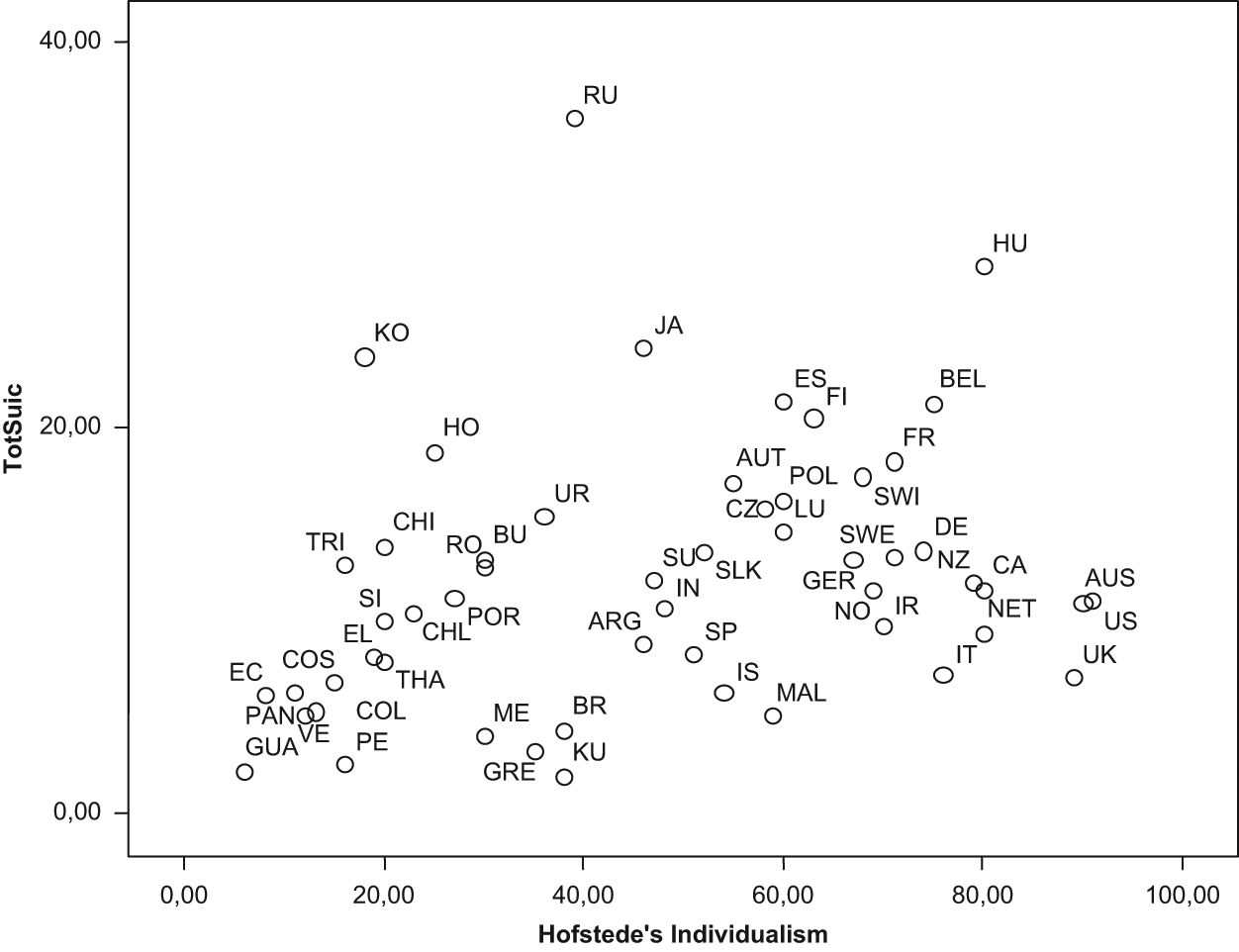
Scatter plot for the relationship between levels of individualism and suicide rates
The quadratic relationship between self-expression values and suicide rates was not significant. Linear, quadratic, and exponential descriptions of the relationship between secular–rational values and suicide rates were all significant at p < .001. As shown in Figure 2, although the nations with high traditional values have low suicide rates, the nations with very high secular–rational values can have either high or low suicide rates.
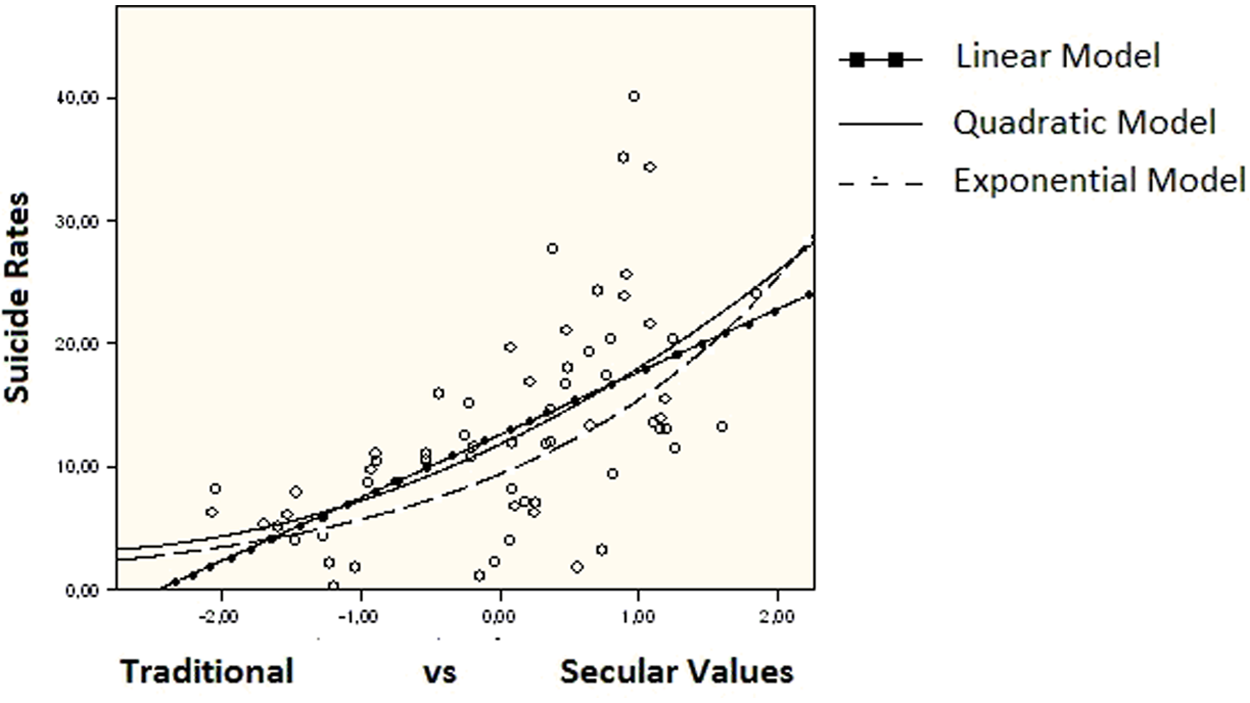
Scatter plot for the relationship between traditional versus Secular–rational values and suicide rates
To clarify which sociocultural variables are correlated with suicide rates in posttraditional societies, we selected the 39 nations with a score higher than 0 in the traditional versus secular–rational dimension (in other words, the nations that scored higher in secular values), and performed Pearson’s correlations within this subsample (Table 3). This sample includes nations from various geocultural groups (see Inglehart & Baker, 2000): English speaking, Catholic Europe, Protestant Europe, ex-communist, and Confucian countries. Their economies are based on services or industrial production and, according to Beck’s terminology (Beck & Beck-Gernsheim, 2001, Beck et al., 2003), they are posttraditional societies, belonging either to first or second modernity.
Association Between Sociocultural Variables and Suicide Rates in the Posttraditional Sample
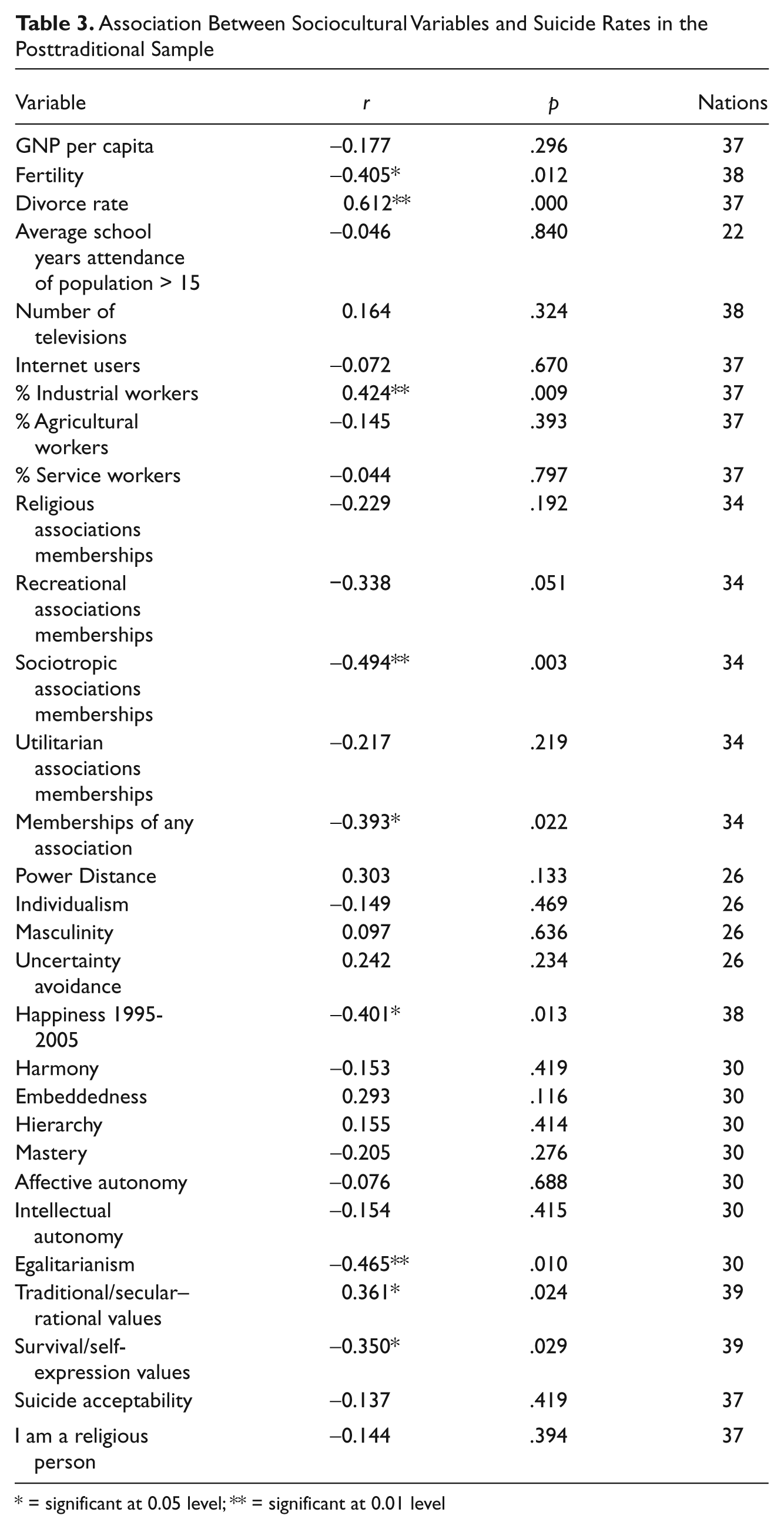
= significant at 0.05 level; ** = significant at 0.01 level
Within this sample, the percentages of industrial workers, fertility, and divorce rates maintained their relationships with suicide rates. At the opposite, school years attendance, number of televisions and internet users were not correlated with suicide rates.
Also many cultural measures lost their correlations with suicide rates whereas individualism, intellectual autonomy, affective autonomy, and suicide acceptability were in negative but nonsignificant correlation with suicide rates. Embeddedness was in positive (nonsignificant) correlation with suicide rates.
Relationships between suicide rates and WVS single items referring to religious beliefs and behaviors were not significant, whereas traditional versus secular–rational values kept the positive correlation with suicide rates.
However, strong negative correlations between egalitarianism, self-expression, index of happiness, sociotropic, and any other association memberships and suicide rates were observed.
In other words, our statistical analyses showed a consistent tendency toward an inverse relationship between measures of individualism/autonomy and suicide rates in second modern societies, from positive to negative.
This trend is also observable looking at the curvilinear relationship between individualism and suicide rates we found in the whole sample (see Figure 1).
Although the modern model of individualization was characterized by competitiveness, the reflexive modern form of individualization is characterized by prosocial orientation and social participation.
The preventive role of cooperation and participation toward common goals on suicide rates is demonstrated by the negative associations between sociotropic memberships, self-expression values, egalitarianism, and suicide rates, which were especially strong in the sample of bureaucratic and secular societies.
Discussion
As shown in this study, the theoretical framework of sociologists like Inglehart, Bell, and Beck allows us to shed some light on the relationship between cultural indexes and suicide rates in our whole sample and in the subsample of posttraditional societies. Inglehart’s traditional versus secular–rational values dimension (an index of the first modern individualization) showed a positive correlation with suicide rates, whereas the survival/self-expression dimension (an index of the second modern individualization) showed a negative correlation with suicide rates in posttraditional societies.
Many characteristics of modern culture, that have been underlined in the sociological literature from Durkheim’s to our time, such as competition, autonomy from traditional boundaries, and detachment from religious beliefs, might still be having an impact on suicide rates. However, new orientations observed more recently, for example, by Inglehart (1997) and Beck (Beck & Beck-Gernsheim, 2001; Beck et al., 2003) seem to give a negative contribution to suicide rates in posttraditional societies. In this concluding section, we will discuss the relationships between measures of individualization and suicide rates referring to recent sociological works by Bauman (1999), Beck (Beck & Beck-Gernsheim, 2001; Beck et al., 2003), and Inglehart (1997; Inglehart & Baker, 2000; Welzel et al., 2005).
Bauman (1999) described the first modern individualization phase as a loss of traditional ascribed roles, which were replaced by prescribed new ones. 4 He labels the strategy for the social construction of meanings that is given from above (for example, God and the Crown) as heteronomous, which is typical of traditional societies. Bauman defined as autonomous the strategy for the social construction of meanings where individuals choose their source of identity and meaning (e.g., work achievements and children education). This strategy is typical of first modern societies. But even in first modern societies people are not fully emancipated, as they are culturally orientated and socially motivated to belong to a social position that is prestructured.
In second modern societies the multiplication of life contexts and possibilities allows individuals to build their own biography and lifestyles fusing various sources of identification. This allows the coexistence of many different roles and the creation of new personal patchworks (Bauman, 1999; Beck & Beck-Gernsheim, 2001; Beck et al., 2003).
Following Durkheim’s example, we are required to distinguish social integration from social regulation. In this way, in parallel with Bauman’s autonomous–heteronomous antinomy, which refers to the kind of social construction of meaning that allows social integration, we introduce the mononomic–polynomic antinomy, which refers to the social regulation type. Mononomic regulation provides an ascriptive or prescriptive status in societies, along with an absolute rule structure. This means people are stuck to their defined roles and the individuals are oriented to strive to achieve and maintain one role in society, as the loss of their social position gives way to anomie. Polynomic regulation motivates individuals to create new positions and to shift from many contexts and roles, where they might behave differently (e.g., from domestic life to workplace, from leisure activities to political activism, and so on). This construct could be measured, for example, by exploring how many different life contexts people experience during a period of time, or how many jobs they change, or tolerance/acceptance toward deviant and anticonformist behaviors.
Traditional societies combine heteronomous identification strategy with mononomic regulation. However, in first modern societies the social integration is autonomous, but the social regulation is still mononomic. The novel element of second modern societies is the polynomic regulation, which is combined with autonomy.
Inglehart’s “traditional versus secular–rational values” dimension and Schwartz’s “embeddedness versus autonomy cultural orientation” dimensions both recall the heteronomy–autonomy opposition, whereas Inglehart’s “survival versus self-expression” dimension and Schwartz’s “hierarchy versus egalitarianism cultural orientations” dimension resemble the mononomic–polynomic antinomy.
As Durkheim suggested, a heteronymous strategy is indeed a protective factor against suicide, as demonstrated by the strong positive relationship between traditional versus secular–rational values and suicide rates in our research. But as demonstrated in the same analysis, suicide rates are lower when polynomic social systems appear in autonomous societies than in societies where autonomous social integration is combined with mononomic regulation.
In fact, the combination between high secular–rational values and low self-expression values is typical of the ex-communist nations (see Inglehart, 1997; Inglehart & Baker, 2000), which have the highest suicide rates, whereas secularized societies with high self-expression and egalitarianism, like Netherlands, Spain, United Kingdom, and Norway, have lower suicide rates. Traditional societies like Latin American and some South Asian nations (like Thailand and Uzbekistan) usually have very low suicide rates. However, we must not overlook the possibility that self-expression values might have also indirect effects on suicide rates (for instance, by affecting acceptability of suicide as observed by Stack & Kposowa, 2011) and more research is required to further understand the relationship between self-expression values and suicide.
In conclusion, our work confirms and further develops Durkheim’s theory, giving at the same time support to Inglehart’s thesis on the importance of distinguishing modern from postmodern societies. Our work is also in line with Inglehart’s findings on the relevance of sociotropic association memberships and self-expression values, as a form of social capital adapt for the empowerment of collective life in secular and bureaucratic societies.
Limits and Suggestions
Although this study was based on statistical data from a wide selection of countries, this was restricted to countries where the suicide rates and the cultural indexes were available. Some countries, such as those in Africa, were not sufficiently represented in our sample.
The second obvious limitation of our study is its macroscopic approach, which does not allow for observation of an issue at subcultural and individual levels or particular national cases.
In this study, we looked at national rates to test a general theory. It is, however, possible that further comparison of specific subsamples (e.g., former communist countries versus Catholic Southern European countries) and analysis of age differences in suicide trends would reveal other factors that could explain our findings. For instance, the work by Eckersley (2009, 2011) offers indicators and trends that do not support a positive view of postmodern social changes, such as mental illness and perception of today’s life. In a previous work, Eckersley also showed an increase of youth suicide rates in many societies during the period of postmodernization (Eckersley & Dear, 2002). In particular, data from developing/low-income countries shows alarming increases of suicide among young people and indicates suicide as a leading cause of deaths (Patton et al., 2009). We recommend further studies on the countries were complete data are available to understand age differences. Unfortunately, less than a third of world’s population has complete national registration data for cause-specific deaths (Patton et. al., 2009) and many of those are low-income countries, thus the finding arising from this study might not apply to developing/low-income countries. We would expect, also based on the previous work by Zhang (1998), to find different relationships between the cultural indexes analyzed in this study and suicide rates in developing versus developed countries and this hypothesis should be the objective of a following study.
More community-level studies are required to explore cultural factors affecting suicide rates in specific cultural or subcultural groups, rather than focusing only on the nations without considering internal variations. For instance, it would be important to test the effects of second modern social changes on social categories with special need such as elderly, people with disabilities, migrant and refugee populations.
Specific factors, like incidence of alcohol assumption, antidepressants use, and other behaviors can partly contribute to suicide rates variation. Future studies should also control for individual level variables of this kind.
Future cross-national research could consider implementing a longitudinal design to observe temporal developments in the culture-suicide association, as well as the employment of other indexes of postmodernization and remodernization processes.
As a final note, together with this sort of cross-cultural quantitative analyses, in-depth qualitative studies are necessary to understand the impact of culture on suicide. This study, above all, confirms the importance to “situate” suicide and suicide prevention in its ethnocultural context and to consider sociocultural values and cultural meanings when developing suicide prevention strategies, as observed in the existing literature (see Colucci, 2006, 2009; Colucci & Martin, 2007a, 2007b).
Footnotes
Acknowledgements
The authors would like to dedicate this work to Steven Klimidis, who left them not long ago: “Thanks for your statistical advices and your friendship Stivi, we miss you.” Thanks to Professor Schwartz for access to his cultural values scores, and to the psychology statistic centre of University of Padua (Italy) for their inputs on the data analyses.
The author(s) declared no potential conflicts of interest with respect to the research, authorship, and/or publication of this article.
The author(s) received no financial support for the research, authorship, and/or publication of this article.