



Abstract
The current meta-analysis examines cross-national differences in justice-work attitude and behavior associations to identify underlying justice motives, that is, when and why people pay attention to justice. A three-level meta-analysis with 54,100 participants from 36 countries was conducted. Income inequality and cultural values were used as moderators after statistically controlling for unreliability of measures. Systematic cross-national differences in justice effects were found. Associations of justice with other work variables are stronger if there is greater income inequality, people expect their leaders and institutions to foster commitment and loyalty (institutional collectivism) and individuals identify with their close in-groups (in-group collectivism). This suggests that belongingness (collectivism) and control (income inequality) motives are important. Implications for justice theories and cross-cultural research are discussed.
Research in organizational justice has burgeoned over the last two decades. A number of studies have demonstrated the positive benefits of fairness for organizational and personal outcomes (Cohen-Charash & Spector, 2001; Colquitt, Conlon, Wesson, Porter, & Ng, 2001). Acting fairly is associated with staff who are more motivated and committed (Lind, 2001), show greater organizational citizenship behavior (Blader & Tyler, 2009; Fassina, Jones, & Uggerslev, 2008) and less counterproductive behaviors (Greenberg, 1993a, 2002). This progress in identifying effects of justice has been accompanied by questions about (a) the universality of these effects and (b) the reasons why people react so positively when they are being treated fairly. Are there cultural differences in justice effects? Various studies have demonstrated that justice effects are not uniform across different national contexts (e.g., Brockner et al., 2001; Farh, Earley & Lin, 1997; Fischer & Smith, 2006; Lam, Schaubroeck & Aryee, 2002; Tyler, Lind, & Huo, 2000). However, these studies have only compared two or a few national samples. To date no study has examined cross-cultural differences in justice effects across more than a dozen studies. There appears to be some variability, yet, how strong or consistent are cultural differences in justice effects? The first aim is therefore to report on the cross-cultural variability of justice effects. Second, how can we understand when justice matters and why? Are justice effects and their cultural variability driven more by self-interest and instrumental concerns or by more relational, social, or moral concerns (Cropanzano, Byrne, Bobocel, & Rupp, 2001; Greenberg, 2001)? I provide a framework that links justice motives to a revised theory of human needs (Kenrick, Griskevicius, Neuberg, & Schaller, 2010).
The questions of universality of justice effects and justice motives to date have been discussed separately, but examining them jointly can provide some intriguing insights into the psychology of justice as well as cultural processes. Variability in justice effects across a larger set of national samples than previously attempted may provide indications of why some people care more about justice than others and in what contexts, thereby uncovering some of the salient motives underlying justice processes across the (industrialized) world.
The focus of the current analysis is therefore to shed some light on these questions by examining the stability of justice effects across different national contexts in which different motives and needs are culturally salient. I will focus on distributive, procedural, and interpersonal justice in relation to organizational citizenship behavior, satisfaction, organizational commitment, withdrawal cognitions (turnover intentions), and trust. Only these three justice dimensions and specific outcomes variables could be included due to the available primary data. To measure the cultural context, I will draw on a recent and well-validated study of cultural dimensions in the context of the Global Leadership and Organizational Behavior Effectiveness (GLOBE) research project (House, Hanges, Javidan, Dorfman, & Gupta, 2004). The framework is tested with a three-level v-known meta-analysis, heeding calls for more multilevel studies in cultural research.
Organizational Justice
Justice perceptions can be distinguished with at least three different components. Distributive justice is concerned with the perceived fairness of outcomes. Procedural justice is the perceived fairness of the process by which outcomes are determined. Interactional or interpersonal justice is concerned with the enactment of procedures and the interpersonal treatment and communication by management to employees. 1
These three dimensions have differential relations with organizational outcome variables. Leventhal (1980) argued that distributive justice is most salient among the three justice dimensions and therefore shows the strongest relationship with other variables. This so-called distributive dominance model has received little empirical support (Colquitt et al., 2001). Sweeney and McFarlin (1993) proposed a two-factor model. They differentiated that distributive justice is self-referenced and should therefore relate most strongly to “personal” or person-referenced outcomes such as job satisfaction, whereas procedural justice is more strongly related to general evaluations of the system and should show strongest relationships with organizational outcomes. Finally, an agent-system model was first outlined by Bies and Moag (1986) and more fully described by Masterson, Lewis, Goldman, and Taylor (2000). Drawing on social exchange theory, interpersonal justice should be most strongly related to agent-referenced outcomes, whereas procedural justice should be strongest related to system-referenced (organization-focused) outcomes. Both models received some empirical support (Cohen-Charash & Spector, 2001; Colquitt et al., 2001), but not consistently. For example, the agent-system model seems to underestimate the effects of interpersonal justice. Interpersonal justice appears to have strong effects even on personal and system-oriented behavioral variables. In contrast, the two-factor model did not discriminate well between behavioral variables. To date, no research has examined whether justice motives affect these models differently; therefore, I will not further differentiate between different outcome variables in the following discussion.
Why Do People Care About Justice?
Why do justice perceptions relate to these organizational variables? The possible motives underlying justice effects have been extensively debated in the literature (e.g., Colquitt, Greenberg, & Scott, 2005; Cropanzano et al., 2001; Folger, 1998; Gillespie & Greenberg, 2005; Greenberg, 2001; Lind & Tyler, 1988, Thibaut & Walker, 1975). The three most popular approaches have been the instrumental approach (emphasizing a human concern with control over outcomes, for example, Folger, 1977); the relational or group-value approach (emphasizing identity-concerns such as self-worth, esteem, and acceptance by others as communicated by fair treatment; Lind & Tyler, 1998; Tyler & Lind, 1992) and the moral virtue or deontic approaches (people care about justice because it reinforces basic values of human dignity and worth; Folger, 1998). More recently, fairness heuristic theory (FHT, Lind, 2001) and uncertainty management theory (UMT, Lind & van den Bos, 2002; van den Bos & Lind, 2002) postulate that individuals are concerned about possible exploitation in their relationships with groups and authorities and monitor justice as a means of gauging whether they can trust particular groups and authorities (see, for example, Jones & Martens, 2009). Both theories assume that humans have a need for predictability and uncertainty reduction.
Evidence suggests that there are different justice motives, but that specific justice motives may relate to several justice dimensions (e.g., Barry & Shapiro, 2000; Jones, Scarpello, & Bergmann, 1999; Kim & Leung, 2007; Shapiro & Brett, 1993). Procedural justice as the most commonly studied justice dimension, for example, has strong links to both instrumental control and noninstrumental belonging motives (e.g., Barry & Shapiro, 2000; Shapiro & Brett, 1993). The debate has therefore shifted to a discussion of the relative ordering of these needs (e.g., Colquitt et al., 2005; Cropanzano et al., 2001; Gillespie & Greenberg, 2005), with an emerging consensus around a number of basic needs or goals that drive concerns with justice. These are then translated into more specific needs or goals during particular interactions with decision makers, explaining why there is mixed empirical evidence concerning these needs. Gillespie and Greenberg (2005) see belonging as the most important motive, whereas Colquitt et al. (2005) add security (including both trust and uncertainty) as a second basic motive. These two basic goals may then be expressed in terms of control, esteem, or morality concerns within more specific justice-related events and encounters (i.e., at lower levels of the goal hierarchy). Although the motives are distinct, they jointly influence justice-related concerns.
Justice Motives and Human Needs
Motives are therefore important for understanding why justice matters (Cropanzano & Greenberg, 1997, p. 336). What is not clear is how these motives map onto human needs. Maslow (1954) introduced what is without doubt the most widely cited classification of human needs. He distinguished between five different types of needs, ordered in form of a pyramid, starting from basic physiological needs, then safety, love, esteem, and finally self-actualization needs. One of the more controversial proposals has been that basic needs take priority and only once lower level needs are satisfied, individuals move up in the hierarchy and become motivated by the next higher need. Recently, Kenrick et al. (2010) reorganized this pyramid based on new evidence from evolutionary biology, anthropology, and psychology. Removing self-actualization and separating belonging motives into various subcomponents (finding sexual mates, relating to close ingroup/ family members vs. more distal individuals), Kenrick et al. suggest that there are seven basic human needs or motives: immediate physiological needs, self-protection, affiliation, status/esteem, mate acquisition, mate retention, and parenting. These needs are seen as overlapping rather than strictly hierarchical, that is, needs are partly driven by human development goals (e.g., mate acquisition, mate retention, and parenting) and are therefore sequential, but lower order needs can always take top priority at any stage.
To date, justice motives have not been explicitly linked to broader categories of human needs as discussed by Kenrick et al. (2010). As organizational justice is concerned with professional relationships in work settings, the needs associated to mating and parenting are most likely less relevant. The most commonly discussed motive in justice research is belonging, which maps quite closely onto the revised affiliation need (Kenrick et al., 2010). Control needs discussed in the justice literature are closest related to self-protection needs, as these cover essential needs to protect oneself beyond immediate physiological survival. The secondary motive discussed by Colquitt et al. (2005; see also Lind, Tyler, & Huo, 1997) is esteem. This seems to relate to the revised esteem/status need, as here the standing within a hierarchy is the central concern. Trust motives as another secondary justice motive emerge in close relationships and consequently are intimately linked to affiliation needs (Kenrick et al., 2010). Finally, uncertainty reduction (Lind et al., 2001; Van den Bos & Lind, 2001) may map onto various needs, including self-protection, affiliation, and esteem. Reduction of uncertainty may be important in relation to various needs, but may not be a unique need in itself. Similarly, morality (Folger, 1998) does not clearly relate to any functional need. Similar to the previous inclusion of self-actualization needs by Maslow (1954), moral motives may be implicated in various social needs (affiliation, esteem, mate acquisition, mate retention, and parenting) but to date there is little evidence that there is a distinct need for morality. Therefore, several of the commonly discussed justice motives can be conceptually mapped onto this hierarchy of human needs, whereas some motives discussed in the justice literature (morality, uncertainty) may be less clearly differentiated in terms of distinct needs.
Human Needs and Contextual Salience
To the extent the justice effects may map on human needs, these effects can be expected to be stronger or weaker depending on the context, as different contexts allow for different satisfaction and salience of needs (Kenrick et al., 2010). Hence, individuals in different cultural contexts may exhibit different justice-work attitude relations as they have different needs and therefore pay differential attention to violations of various justice dimensions. Drawing on work examining attitude-behavior relations (e.g., Cohen, Shariff, & Hill, 2008; Fazio & Powell, 1997; Glasman & Albarracin, 2006) showing that attitude accessibility strengthens the attitude-behavior link, I argue that the salience or accessibility of needs and motives related to justice within a cultural context strengthens the link between justice perceptions and work outcomes. If individuals are working within a cultural environment in which certain motives such as belonging are central in people’s life, then the link between justice and work outcomes should be strengthened if justice is related to a need for affiliation or belonging.
Previous cross-cultural research has focused mainly on cultural differences in preferences for specific distributive rules (equity, equality, vs. need) or different procedural principles (e.g., neutrality, lack of bias, voice). As reviews by Leung (2005) and Fischer (2008) indicate, differences in the preference for such rules and principles are related to cultural dimensions of individualism-collectivism and power distance (Hofstede, 1980). Less is known about the effects of justice. Most researchers have focused on power distance (e.g., Begley et al., 2002; Brockner et al., 2001; Lam et al., 2002; Lim & Leung, 2007). Some authors (Brockner et al., 2001) have argued that in high-power distance contexts, justice does not matter as much as people do not expect justice (a normative explanation); others interpreted the same pattern as suggesting that procedural justice in high-power distant cultures does not provide informative value about inclusion and respect in groups as people are firmly integrated in hierarchies already (an uncertainty explanation). Yet other authors have argued that the effect runs in the opposite direction, with individuals endorsing power distance values showing stronger procedural justice effects as they need to monitor potential exploitation by distant supervisors (a control explanation). Similarly, collectivism-related dimensions have been studied. Some evidence has been reported that individualism-collectivism, independent-interdependent self-construals and related value dimensions at the individual level (openness to change, traditionality) change justice-work attitude relations (e.g., Brockner et al., 2005; Farh et al., 1997; Fischer et al., 2006). Again, findings in both directions were observed, with some people finding that collectivist values strengthen procedural justice effects as experienced justice affirms basic moral values held by collectivists (Brockner, De Cremer, van den Bos, & Chen, 2005), whereas others were reporting that more modern (individualistic) values strengthen justice effects (Farh et al., 1997). Hence, previous research has primarily focused on power distance and collectivism, but has shown conflicting results (see Fischer, 2008, for a more detailed review). One contribution of the present article is a more explicit consideration of justice motives and how these can be linked to these dimensions of culture.
Dimensions of Culture and Human Need Salience
Cultural differences can be categorized along different dimensions. The dimension that has attracted most research is individualism-collectivism (Hofstede, 1980; Kirkman, Lowe, & Gibson, 2006). Here, I am using institutional and in-group collectivism values (Gelfand, Bhawuk, Nishii, & Bechtold, 2004). Institutional collectivism measures the degree to which institutions within a society encourage and reward collective action. This includes concerns about being accepted by other group members and whether group goals and interests are being given priority by institutions over individual goals within a society. The in-group dimension is more closely related to traditional aspects of individualism-collectivism, focusing on the degree to which individuals feel pride, loyalty, and interdependence with their closest kin (Triandis, 1995). In essence, collectivism is about affiliation, with in-group collectivism relating to affiliation concerns with close others, whereas institutional collectivism is related to affiliation to more distal institutional settings. Individuals who value belonging to close and distant others, may pay closer attention to justice information that shows that individuals are valued and respected within their respective groups. In line with this argument, the group value model (GVM; Lind & Tyler, 1988) proposes that individuals care about procedural justice because it communicates important information about ones belonging to a group. A secondary concern is the affirmation of social and moral values of the group itself (see also Brockner, Chen, Mannix, Leung, & Skarlicki, 2000; Brockner et al., 2005). Both procedural and interactional justice provide information about the evaluation of individual group-members by the decision maker, that is, through the existence of fair and consistent procedures and the interpersonal treatment of employees in the enactment of these procedures. Hence, these two dimensions have the clearest information value whether affiliation needs have been met. I predict that procedural and interactional justice effects will be strengthened in more collectivistic settings.
Hypothesis 1a: Institutional and in-group collectivism values moderate the relationship between procedural justice and work outcomes, such that stronger correlations are found in countries emphasizing collectivism values.
Hypothesis 1b: Institutional and in-group collectivism values moderate the relationship between interpersonal justice and work outcomes, such that stronger correlations are found in countries emphasizing collectivism values.
Power distance has also been extensively studied (see above). Power distance has been defined as the extent to which societies accept and endorse authority, power differences, and status privileges (Carl, Gupta, & Javidan, 2004). The relational model of authorities (Tyler & Lind, 1992) suggested that the individuals are concerned about the relative standing or status within their groups. In high-power distance contexts, individuals are particularly concerned about their status, which should make status needs more salient. Interactional and procedural justice in particular provide information about the relative standing of an employee within a group. Therefore, to the extent that individuals are motivated and interested in increasing their social status within groups, they may pay more attention to procedural and interactional justice effects.
Hypothesis 2a: Power distance values moderate the relationship between procedural justice and work outcomes, such that stronger correlations are found in countries emphasizing power distance values.
Hypothesis 2b: Power distance values moderate the relationship between interpersonal justice and work outcomes, such that stronger correlations are found in countries emphasizing power distance values.
As discussed above, uncertainty mechanisms have been implicated in a number of theories recently. Uncertainty avoidance as a cultural dimension is defined as the degree to which cultures emphasize orderliness, structure, consistency, and formalized procedures in the daily lives of individuals (de Luque & Javidan, 2004). The cultural dimension of uncertainty avoidance has been shown to produce similar effects as situational manipulation of uncertainty in experimental settings (Fischer & Derham, 2010). Although uncertainty avoidance may be related to a number of human needs rather than being a single need by itself (see above), it would still be important to examine its effect on justice correlations. As uncertainty can be experienced in relation to procedures, treatments, and outcomes, I predict in line with UMT that justice effects in general will be strengthened if individuals in a society value uncertainty avoidance. UMT was developed in organizational settings in the modern societies, but similar processes have been observed in small-scale traditional societies (Scott, 1976).
Hypothesis 3a: Uncertainty Avoidance values moderate the relationship between procedural justice and work outcomes, such that stronger correlations are found in countries emphasizing uncertainty avoidance values.
Hypothesis 3b: Uncertainty avoidance values moderate the relationship between interpersonal justice and work outcomes, such that stronger correlations are found in countries emphasizing uncertainty avoidance values.
Hypothesis 3c: Uncertainty avoidance values moderate the relationship between distributive justice and work outcomes, such that stronger correlations are found in countries emphasizing uncertainty avoidance values.
Finally, self-protection needs may be important. In the current literature, material or instrumental concerns emphasized within older models of justice (Homans, 1961; Thibaut & Walker, 1975) are thought to be secondary to the more relational concerns of belongingness and trust, despite evidence to the contrary (e.g., Barry & Shapiro, 2000; Shapiro & Brett, 1993). One important dimension of interest is the extent to which economic resources are highly unequally distributed. In situations where large proportions of a population are struggling to survive, economic concerns are likely to become highly salient. In these contexts, needs of self-protection, that is, securing sufficient resources for survival, are more salient. Although individuals may be well-off and experience comfortable living conditions, the possibility to lose these resources and to fall down the social and economic ladder is a strong motivator for increasing resources that bolster one’s economic position and power for the future. In line with these arguments, in societies where income is very unevenly distributed, people are oriented toward equity distributions (e.g., Deutsch, 1975; Fischer & Smith, 2003) and individuals show greater concerns about well-being (e.g., Dahl, Elstad, Hofoss, & Martin-Mollard, 2006). Hence distributive justice effects should increase if there is greater income inequality. 2
Hypothesis 4: Income inequality moderates the relationship between distributive justice and work outcomes, such that stronger correlations are found in countries with higher income inequality.
Method
A literature search was conducted using PsycInfo between 1965 (the publication of Adams’ equity theory) and November 2007. The keywords used were “organizational/organisational justice” and “justice” or “fairness.” All the articles analyzed in the two meta-analyses by Colquitt et al. (2001) and Cohen-Charash and Spector (2001) were also included. Requests for unpublished data from non-U.S. samples were sent to the mailing list of the International Association for Cross-Cultural Psychology, the largest international association dedicated to cultural and cross-cultural research. Inclusion criteria were that studies (a) reported perceived organizational fairness at the individual level of analysis, (b) used a measure of perceived distributive, procedural, or interpersonal justice in an identifiable cultural sample, (c) reported correlations with some work-related outcome of justice, and (d) sampled working adults, or working MBA students attending evening classes. Studies with students working part-time were excluded, because past research has shown that students have markedly different justice expectations (Fischer & Smith, 2003). Experimental studies were excluded, because these studies do not represent reactions to justice in naturally occurring environments. Finally, given that the overwhelming majority of organizational justice research has been conducted within U.S. samples, I only included 50 randomly selected U.S. studies as well as any study that compared U.S. samples with non-U.S. samples. If data from multiple-nation studies was not reported separately by nation, the corresponding authors were contacted and asked to provide country-specific correlations. In cases where no reply was received from the authors within 3 months, the study was excluded. The final coded data set consisted of 604 correlations based on responses from 54,100 participants from 161 samples in 36 countries. Studies reporting multiple effect sizes were entered in separate meta-analyses.
Correlations were transformed using r-to-z transformation (Rosenthal, 1991). Sample weights were calculated using sample size.
Measures
Organisational justice measures
The focus of the study was on cross-cultural differences in justice effects. Therefore, the goal was to obtain as many studies from as many countries as possible that were maximally comparable. An initial screening of the literature revealed that it would only be possible to compare procedural, distributive, and interpersonal justice; there were not enough studies that had included informational justice. Therefore, only these three dimensions were coded. All studies used measures that were based on or adapted from existing U.S. scales. About 10% of studies combined procedural and interpersonal justice measures. In these cases, the combined scale was coded as procedural justice (since interpersonal justice has been historically considered to be part of procedural justice). All analyses reported below were repeated with these studies removed, differences in results are noted where necessary. Of the articles coded, distributive justice scales developed by Moorman (1991) and Niehoff and Moorman (1993) were most frequently used (19.3%), followed by Colquitt’s (2001) scale (17.5%) and the Price and Mueller (1986) scale (12.3%). For procedural justice, the scales developed by Moorman (1991) and Niehoff and Moorman (1993) were used most often (26.9%), followed by Colquitt (2001, 14.9%) and adaptations of Folger et al. (1989, 11.9%). Finally, for interpersonal justice, the most commonly used scales was by Moorman (1991) and Niehoff and Moorman (1993, together 32.3%) and Colquitt (2001, 32.3%).
One issue in cross-cultural research is the comparability of the instruments used. This issue can be addressed by drawing on recent multilevel frameworks (Fischer, 2009; Fontaine, 2008; Lubke, Dolan, Kelderman, & Mellenbergh, 2003). Table 1 reports the correlations between the three justice dimensions in this study as well as the correlations at the aggregate level. To test bias in the measurement of justice dimensions, one indirect indicator of equivalence is the similarity of correlations between study-level correlations and correlations based on aggregated country means (see Fontaine, 2008, for a formal discussion). To test the similarity of the correlations, I ran 1,000 bootstrap samples with random replacement for each correlation at the country level. The resultant 95% confidence intervals overlap with the confidence intervals at the study level, indicating that the correlations are not significantly different. Furthermore, comparing both sets of correlations with the results reported by Cohen-Charash and Spector (2001) and Colquitt et al. (2001) further provided little evidence of bias; the confidence intervals around the correlations do not differ significantly from each other between the meta-analyses. There is no evidence of global measurement bias in justice that can reliably be detected in the current samples.
Correlations Between Justice Dimensions at Study and Country Level.
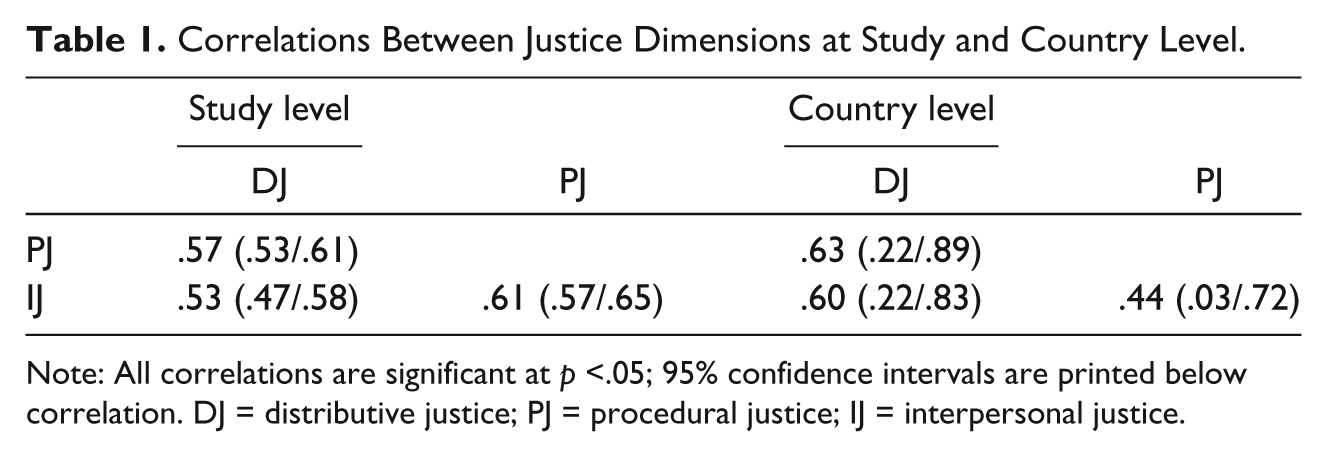
Note: All correlations are significant at p <.05; 95% confidence intervals are printed below correlation. DJ = distributive justice; PJ = procedural justice; IJ = interpersonal justice.
Outcome variables
To include as many variables across as many countries as possible, the whole data set of articles was screened to identify variables coded in the previous two meta-analyses (Cohen-Charash & Spector, 2001; Colquitt et al., 2001). The goal was to include variables that were measured in at least 10 different countries. Although this goal was not met for all sets of correlations, correlations between the three justice dimensions and satisfaction, organizational commitment, trust, withdrawal, and organizational citizenship behavior were included to provide a comprehensive picture of cross-cultural variability in research conducted so far. Therefore, the choice of these variables was driven by the availability of primary studies that have reported justice correlations in various cultural contexts.
Job satisfaction is a multifaceted attitudinal measure of satisfaction with global and specific aspects of the job. Scales measuring various specific aspects (e.g., supervisor, pay, work environment; job security; outcomes of organizational decisions, for example, Weiss, Dawis, England, & Lofquist, 1967), global direct measures (e.g., “I am satisfied with my job overall,” Brayfield & Rothe, 1951) and global indirect measures (e.g., “I would recommend this job to a friend”; Leung, Smith, Wang, & Sun, 1996) were included. No single scale was dominant and researchers often adapted or developed measures for their particular studies.
Organizational commitment is a global reaction toward the larger system. Affective commitment is the most frequently studied aspect of commitment and refers to the affective attachment to an organization, including a strong belief in and acceptance of the goals and values of one’s organization, a willingness on part of the employee to exert considerable effort on behalf of the organization; and strong identification with the organization (Allen & Meyer, 1990). Overall, 31 % used a version of the Allen and Meyer (1990) scale, 28.6 % used a version of Mowday, Steers, and Porter (1979), and the remainder used a variety of other scales.
Mayer, Davis, and Schoorman (1995) defined trust as a willingness to be vulnerable to the actions of another party based on expectations that the other will perform an action important to the person, but without an ability of the person to either monitor or control the other party. Given the noted dependency of employees on organizations, supervisors, and colleagues in organizational settings (Folger & Cropanzano, 1998), trust toward any of these targets was included in the meta-analysis. A total of 43.8% of studies focused on organizational trust, 34.4% studied trust in supervisor or authorities, and the remainder measured trust in some other parties in the organizational context (coworkers, colleagues, etc.).
Withdrawal is a general category of behaviors and behavioral intentions that includes turnover intentions, absenteeism, turnover, and neglect. Colquitt et al. (2001) argued that withdrawal is a generalized response toward the larger organization. Only a minority of studies measured actual absenteeism or turnover (1.6%), with the majority of studies relying on intentions to quit or leave the organization.
Organizational citizenship behavior (OCB) was defined by Organ (1990) as “informal contributions that participants can choose to proffer or withhold without regard to considerations of sanction or formal incentives” (p. 46). It encompasses both a positive intent to perform an act as well as the perceived positive outcome. The behavior is directed at the organization or specific members of the organizations and in its aggregate it benefits the whole organization. OCB has been measured using various scales and subcomponents (helping, altruism, conscientiousness, voice, etc.). I averaged the reported correlations across subcomponents. The majority of studies used other-ratings (either supervisor or peer-ratings, 54.4%) and the remainder used self-reports.
Nation-level variables
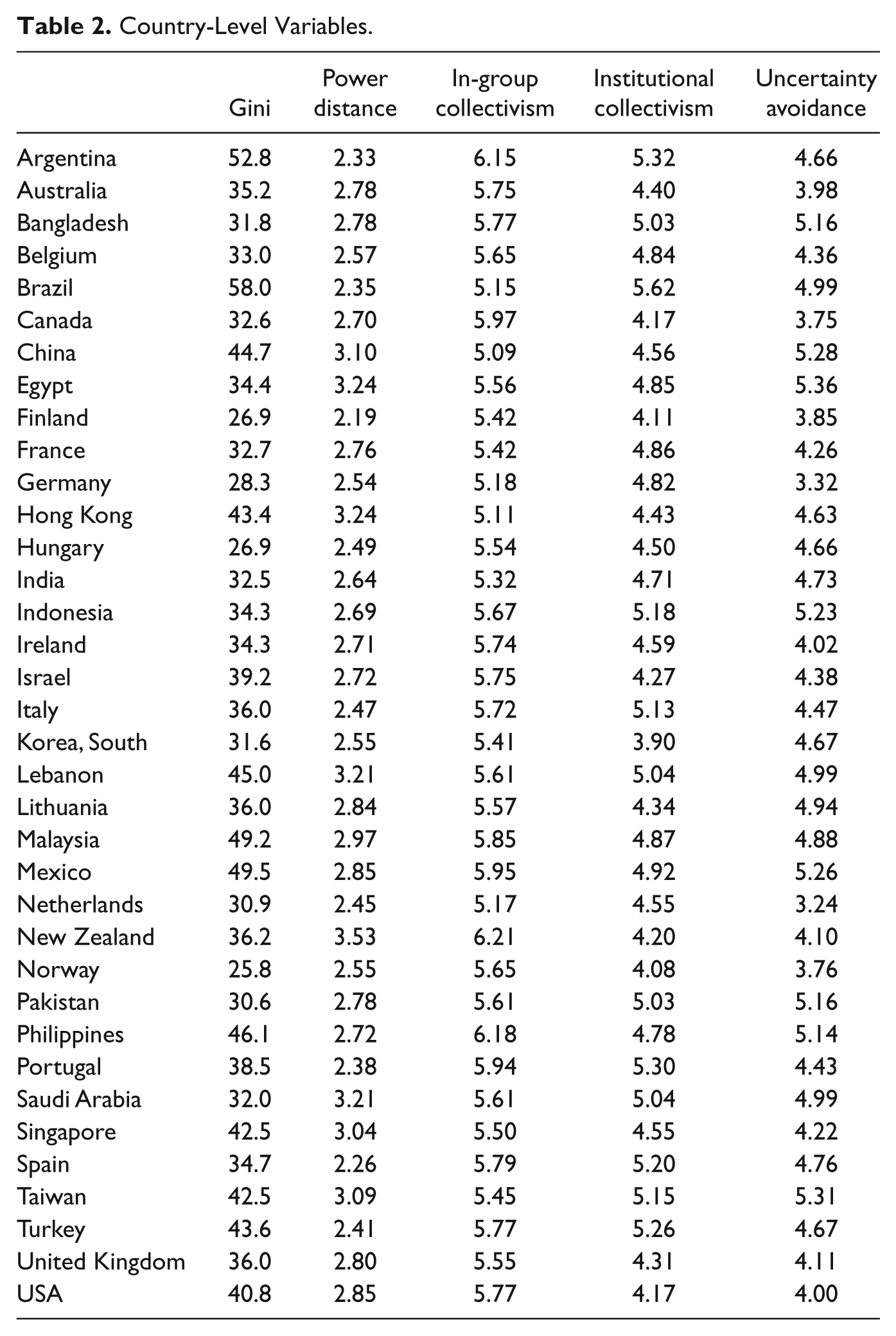
Values scores (operationalized as “How society ‘should be’”) for institutional and in-group collectivism, power distance, and uncertainty avoidance were taken from the GLOBE project (House et al., 2004). Institutional collectivism is measured using four items focusing on whether the group goals are emphasized over individual goals, whether the economic system emphasizes collective interests, whether acceptance by groups is important, and whether group cohesion is valued. In-group collectivism focuses on family and close in-groups (family members take pride in achievements of their relatives, aging parents should live with their children, children should stay with their parents till they are married). Power distance is measured with items focusing on the degree to which individuals approve that their societies maintain inequality between members in respect to power, authority, prestige, status, wealth, and material position. Uncertainty avoidance is measured with four items asking for the degree to which individuals value structure, predictability, order, and consistency and prefer rules and regulations in their daily lives. The validity of these measures is reported in House et al. (2004). These four indicators loaded on four distinct factors in secondary factory analysis (Hofstede, 2006). Among the countries included in this analysis, the highest correlation was .50 (between institutional collectivism and uncertainty avoidance). The other correlations did not exceed .30. Higher scores on all dimensions indicate a greater level of endorsement for that dimension. Missing information for Bangladesh, Belgium, Lebanon, Lithuania, Norway, Pakistan, and Saudi Arabia was substituted with the respective regional mean (e.g., Southern Asia for Bangladesh, Arab countries for Lebanon and Saudi Arabia). Analyses with and without these substituted values led to similar conclusions and only the analyses with these countries included are reported.
Income inequality was measured using the Gini index of inequality of wealth distribution (survey years between 1983 and 2004; World Bank, 2008). The score varies between 0 and 1. A score of 0 indicates no inequality with each member receiving exactly the same income, whereas a score of 1 indicates that one citizen received all the income and the rest of society receives nothing. I used the rescaled version ranging between 0 and 100 (World Bank, 2008). Mathematically, it is based on the Lorenz curve. In our sample, the Gini coefficient varied between 25.8 (Norway) and 58.0 (Brazil). Gini correlated .45 with institutional collectivism, .44 with uncertainty avoidance (both p < .01), .16 with in-group collectivism, and .15 with power distance (both ns). See Table 2 for a list of the countries and the means used in the analyses.
Country-Level Variables.
Analytical Strategies
A mixed-effects model was used, which has the advantage of combining random and fixed-effects models. Although fixed-effects models are more commonly used, their drawback is that effect sizes are seen as direct replications of each other, they assume that all studies are measuring the same effect size (i.e., that all samples are drawn from the same population) and only subject-level sampling error is allowed. In contrast, random-effects models assume that studies are random samples drawn from a population of studies, so that both subject-level sampling error and random differences between samples are considered (Lipsey & Wilson, 2001; van den Noortgate & Onghena, 2001). Random-effects models provide more adequate representations of real-world data for most meta-analytical projects (Konstantopoulos & Hedges, 2004). Mixed-effects models use a random effects approach to estimating the effect sizes, considering both subject-level sampling error and a random study-sampling component. Their major advantage is that after estimating the random component, it can be tested whether there is systematic variation in the remaining variance (Lipsey & Wilson, 2001) and this allows generalization of findings beyond the particular studies sampled.
The analysis was conducted in HLM6 (Raudenbush & Bryk, 2002), using Full Information Maximum Likelihood Estimation (see Fischer & Boer, 2011; Fischer & Mansell, 2009). This analysis takes the nested structure of the studies within countries into account and it is therefore preferred over traditional meta-analysis that ignores the dependencies due to country. Effect sizes were entered at level 1, together with variance weights in a so-called v-known analysis. Reliability estimates for justice and the various criterion variables (OCB, satisfaction, commitment, etc.) were entered at Level 2. Country-level variables (values, Gini) were entered at Level 3. Since the estimation of explained variance is debated in multilevel models and since effect size measures are not affected by interdependencies (Bliese, 2000), I used a regression approach to estimate R-squared values of the society-level variables only (using iterative maximum likelihood estimation SPSS macros written by Lipsey & Wilson, 2001).
Results
Tables 3 to 5 report the v-known analyses, separated by justice dimension. The first hypothesis concerned the moderator effects of collectivism on procedural justice-work outcome correlations. Hypothesis 1a was supported for OCB (institutional collectivism), satisfaction (in-group & institutional collectivism) and withdrawal (in-group collectivism). Justice effects were stronger for these variables in more collectivistic settings. Hypothesis 1b predicted stronger effects of collectivism on interpersonal justice-work outcome relations in more collectivistic settings. This hypothesis was supported for satisfaction (in-group collectivism). Interpersonal justice effects were stronger in more collectivistic settings. Contrary to Hypothesis 1b, correlations with commitment were weaker in more institutionally collectivist settings.
Results of v-known Multilevel Model Examining the Correlation Between Distributive Justice (DJ) and Outcome Variables.
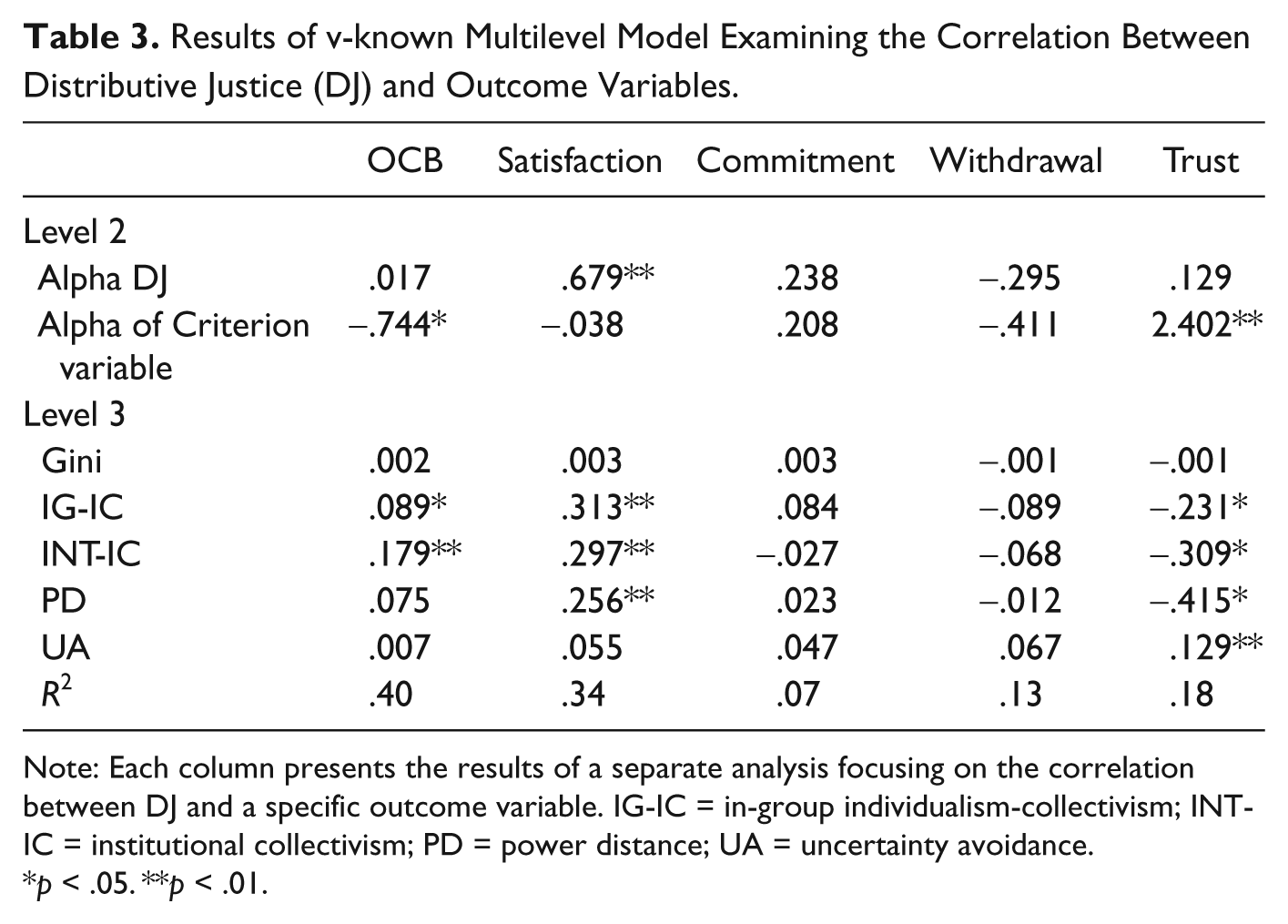
Note: Each column presents the results of a separate analysis focusing on the correlation between DJ and a specific outcome variable. IG-IC = in-group individualism-collectivism; INT-IC = institutional collectivism; PD = power distance; UA = uncertainty avoidance.
p < .05. **p < .01.
Results of v-known Multilevel Model Examining the Correlation Between Procedural Justice (PJ) and Outcome Variables.
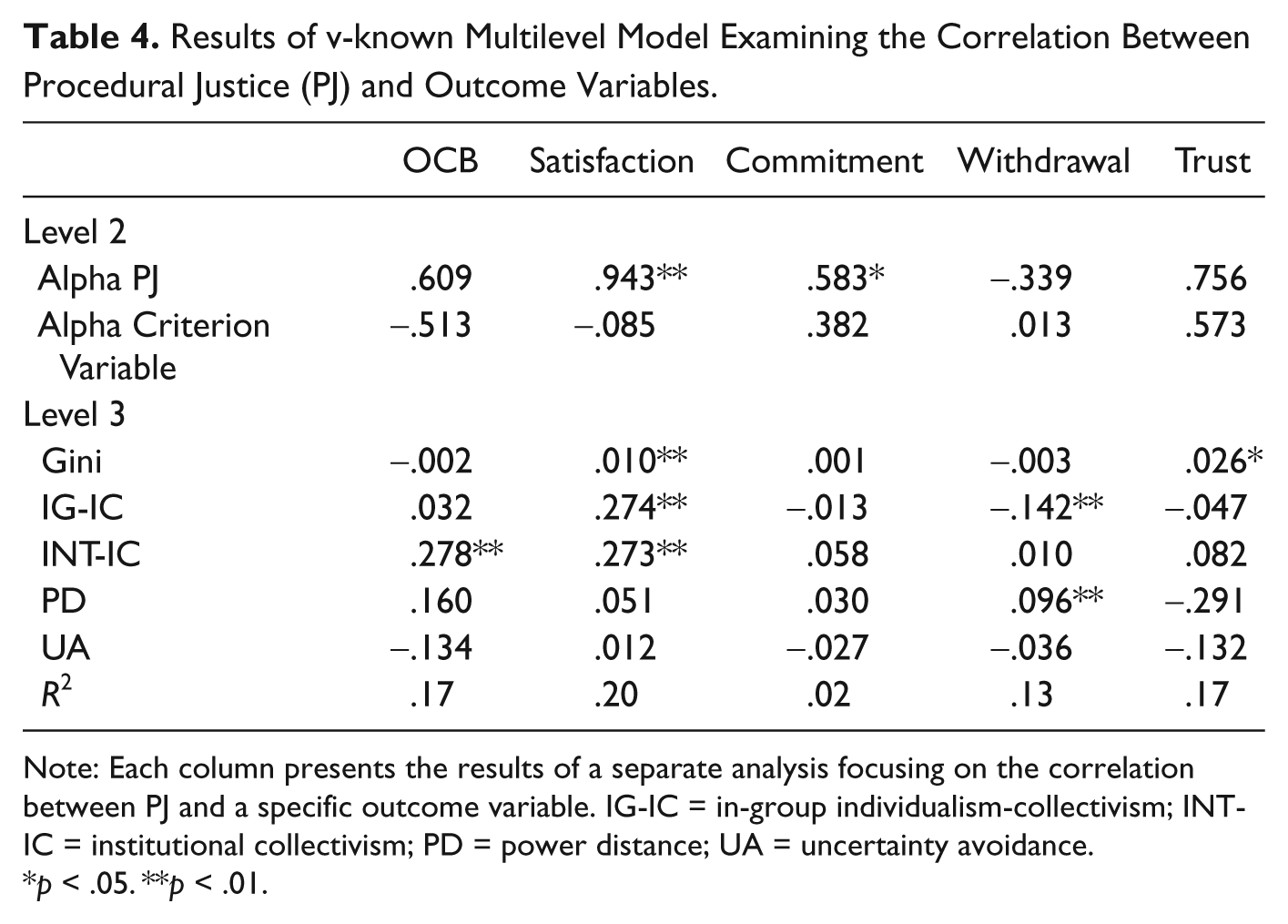
Note: Each column presents the results of a separate analysis focusing on the correlation between PJ and a specific outcome variable. IG-IC = in-group individualism-collectivism; INT-IC = institutional collectivism; PD = power distance; UA = uncertainty avoidance.
p < .05. **p < .01.
Results of v-known Multilevel Model Examining the Correlation Between Interpersonal Justice (IJ) and Outcome Variables.
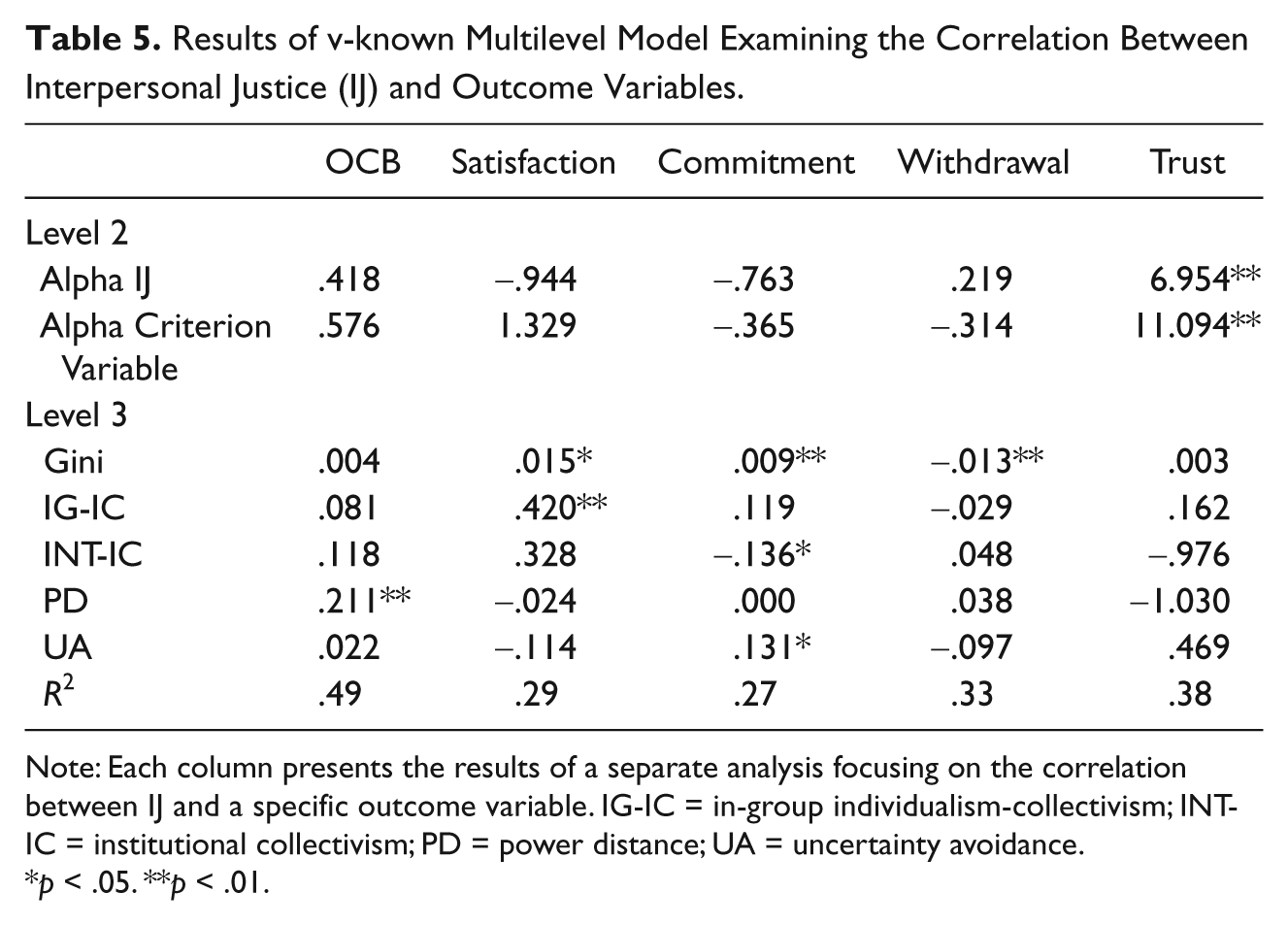
Note: Each column presents the results of a separate analysis focusing on the correlation between IJ and a specific outcome variable. IG-IC = in-group individualism-collectivism; INT-IC = institutional collectivism; PD = power distance; UA = uncertainty avoidance.
p < .05. **p < .01.
Hypothesis 2a about strengthened effects of procedural justice effects in contexts where power distance is valued was only supported in regard to withdrawal. Hypothesis 2b predicted that interpersonal justice effects are stronger in more hierarchical settings. Support for this hypothesis was found for OCB, correlations were stronger in more power distant societies.
Hypothesis 3a to 3c specified that effects of justice should be strengthened in more uncertainty avoidant contexts. Weak support for Hypothesis 3b was found as the correlation between interactional justice and commitment was stronger in more uncertainty avoidant contexts. Hypothesis 3c was partially supported as the effect of distributive justice on trust was strengthened in more uncertainty avoidant societies.
Hypothesis 4 predicted that income inequality should increase correlations between distributive justice and work variables. No support for this hypothesis was found.
Additional effects that were not directly predicted emerged. First, strong effects of collectivism on distributive justice effects were found. Distributive justice correlations with OCB and satisfaction were strengthened in more collectivistic contexts (both ingroup and institutional collectivism). A significant effect of power distance was also found for satisfaction. Individuals in countries where power distance is more valued are more satisfied if they experience distributive justice. In contrast to these effects, trust showed significantly weaker relationships with distributive justice in more collectivistic and more power distant societies. However, these effects with trust should not be overinterpreted as there were only 25 correlations from 11 countries and the zero-order correlations between the effect sizes and country-level dimensions were all below .20 (p > .10). Therefore, the significant effects in the HLM analysis are due to suppressing relationships among the country-level variables.
Another set of significant effects was found for income inequality. Procedural justice effects were strengthened for satisfaction and trust if income inequality was higher. Interactional justice effects were strengthened for satisfaction, commitment, and withdrawal. This is in line with self-protection explanations of justice.
Finally, I examined whether the relative strength of moderator effects depended on the type of outcome variable. Examining the R-squared values, the consistently weakest effects were observed for commitment (average R2 = .12). The consistently strongest effects were found for OCB (average R2 = .35), satisfaction (average R2 = .28) and trust (average R2 = .24). Assuming that all outcome variables are more system-focused than agent-focused, the stronger moderation effects observed for interpersonal justice (average R2 IJ = .35; average R2 DJ = .22; average R2 PJ = .14) was somewhat surprising, but this fits with the noted spillover effect of interpersonal justice to systematic variables (Colquitt et al., 2001).
Discussion
The study has demonstrated that (a) justice correlations vary across cultural contexts, (b) macro-economic income inequality and country-level values can systematically explain this variability, and (c) by assessing the pattern of associations with contextual variables, useful insights into the motives and concerns underlying justice effects can be found. This study therefore bridges two previously unconnected areas of inquiry and highlights that cross-cultural investigations can contribute to our understanding of theories of justice more broadly. The results portray a complex and differentiated picture of justice effects. I will discuss them in terms of human needs and justice motives.
Affiliation Needs: The Belonging Motive
One of the key findings is that the strongest support is found for the view that people care about justice because it addresses their affiliation needs. Procedural justice correlations with OCB, satisfaction and withdrawal and interpersonal justice correlations with satisfaction are strengthened in contexts where collectivism is high. Although not predicted, strong effects were also found for distributive justice. These findings suggest that distributive justice communicates similar symbolic values of belonging and inclusion to individuals. People care about fairness of outcomes for noninstrumental and relationship reasons even if the justice dimension has clear economic implications. This is a major insight into the motives underlying justice effects since distributive justice has been discussed as mainly driven by instrumental and control motives.
Both in-group and institutional collectivism moderated these relationships but probably through different mechanisms. Institutional collectivism measures the extent to which individuals think institutions should place collective interests and goals over individual interests and goals. In-group collectivism is the emotional attachment to family and close kin. The PJ-OCB relationship suggests that expectations and values attached to relationships with larger institutions in more collectivistic settings leads employees to reciprocate if they feel included and acknowledged as full members of these institutions.
Attachment to small in-groups and families also moderated justice effects. In this case it appears likely that affiliative relations to small groups (family) generalize to larger settings and authorities (e.g., examining the IJ-satisfaction relationship) since individuals are socialized into valuing and maintaining close relationships with others and therefore are more satisfied if these values are upheld. This analysis therefore supports the previous findings of Brockner et al. (2005) and confirms the general importance of needs to belong.
The Esteem Need
Based on a human needs explanation, stronger effects of interpersonal justice on OCB and also distributive justice and satisfaction were found in societies where individuals are concerned about maintaining power distance. However, procedural justice effects for withdrawal were weakened. There is only weak support for the esteem hypothesis. Concerning withdrawal, in high-power distant contexts, withdrawal may be driven by more normative concerns about staying with the organization (Fischer & Mansell, 2009) rather than justice perceptions. It may also be that esteem and affiliation needs are confounded within organizational contexts, as motivation to stay within an organization (and not being made redundant) may be the overriding central concern (see the stronger effects of collectivism) and concerns about vertical belonging (the issue of esteem and status) only becomes salient after a horizontal affiliation need has been satisfied. In line with this explanation, higher status individuals have been found to show more pronounced procedural justice effects (Diekmann, Sondak, & Barsness, 2007).
Self-Protection Needs
The results demonstrate a relative consistent and stable effect of income equality for procedural and interpersonal justice. This is the more surprising aspect, as distributive justice was not influenced by income inequality. Fair procedures ensure fair outcomes in the long run, so it can be expected that they would increase positive work outcomes such as satisfaction and trust. Similarly, interpersonal justice increases commitment and satisfaction and decreases withdrawal intentions in countries where income is unequally distributed. These findings also fit anthropological observations of Malaysian workers in multinational organizations (Ong, 1988). Therefore, these findings support previous research that both procedural and interactional justice also have important instrumental concerns (e.g., Shapiro & Brett, 1993).
These findings also demonstrate that meta-analyses can generate new findings by pointing out important moderator variables that went unnoticed in previous research. The current findings suggest that material concerns are important for employees if they are located in a context in which relative income inequalities are salient. Future research could pay more attention to these instrumental and materialistic concerns in addition to relational and belonging concerns, especially considering the current economic crisis.
Uncertainty Motives
Examining the potential effect of a concern with uncertainty did not show strong effects. It is possible that uncertainty avoidance at the culture-level (as operationalized and measured by the GLOBE study) is not specific enough to pick up these uncertainty effects. Current studies have shown the effect of uncertainty through experimental methods in Western contexts (Lind & van den Bos, 2002; Van den Bos & Lind, 2002). It may be that uncertainty is not a strong motive in other non-Western context. However, as discussed above, uncertainty avoidance may not be a distinct need in itself, but may play into various other needs. Future research could examine interactions between various needs and uncertainty. Unfortunately, the relatively small number of samples did not allow an exploration of these effects.
Limitations and Future Directions for Research
This meta-analysis like all other meta-analyses is limited by the quality and availability of primary studies. The number of countries in which empirical studies have been conducted is rather limited. This also limits the potential of any meta-analysis to examine any meaningful effects. Nevertheless, even with the limited number of studies available some important contextual effects were uncovered. This is an important contribution to organizational research on justice. Given the limited number of countries and studies available for some comparisons, the true effects of cultural and economic variables might have been underestimated in the current analyses. Future studies should broaden the number of contexts included in research and also the number of work-related variables considered.
A second limitation is that the motives underlying justice effects were inferred rather than directly measured or manipulated. The national dimensions may be too broad, unspecific, or insensitive to pick up variance associated with some of the motives and therefore underestimated the relevance of certain motives. This is a particular issue for power distance and uncertainty avoidance. One option is to use more specific measures of context to estimate changes in justice effects. A second option is to conduct studies in selected contexts that differ in the salient motives (e.g., economic inequality versus egalitarian context; across time points of group formation which should relate to the experienced levels of group belonging). A third option would be to manipulate the motives directly in experimental research. For example, it may be possible to increase or decrease uncertainty about procedures (Lind & van den Bos, 2002) or prime individual versus collective concerns (Oyserman & Lee, 2008). Experiments would also allow a direct measurement of the intervening process variables. Another option for future work would be to identify individual difference variables directly related to these concerns and motives and to then treat these as moderators (e.g., Thau, Bennett, Mitchell, & Marrs, 2009).
A final issue is the equivalence of instruments across cultural contexts. I ran a preliminary test of the equivalence of justice measures overall. These findings suggest that there are no systematic and large problems with these justice measures. However, it is (a) possible that specific instruments are biased in individual studies and (b) I did not examine the scales measuring outcomes. To examine correlations across nations (as in this study), issues of structural equivalence (can we use the same items to measure justice?) and metric equivalence (do the items have the same factor loadings across cultural groups?) need to be addressed. No study to date has addressed this question across a large number of samples. Translation problems are also likely to introduce bias. The problem is that if scales are biased, no significant effects of context variables across a larger number of cultures can be found (Fontaine, 2005; van de Vijver & Fischer, 2009; van de Vijver & Leung, 1997). The emergence of significant contextual effects therefore provides indirect support for equivalence, indicating that observed differences are not random and are not attributable to bias or translation problems (Fontaine, 2008; Schmitt, Allik, McCrae, & Benet-Martinez, 2007). Concern about bias in the current study exists for correlations involving commitment (see also Fischer & Mansell, 2009), withdrawal, and trust. Researchers are urged to pay greater attention to issues of equivalence and bias in future studies (van de Vijver & Leung, 1997).
Implications for Practitioners
The findings provide further evidence that managers need to not only pay attention to issues of justice but also outline boundary conditions where attention to justice might not actually increase positive work outcomes substantively. The baseline assumption is that having fair and just procedures, being interpersonally fair, and distributing rewards in a fair and consistent manner is effective regardless of cultural context. However, these effects are stronger where (a) there is greater income inequality, (b) people expect their leaders and institutions to foster commitment and loyalty (institutional collectivism), and (c) individuals identify strongly with their close in-groups (in-group collectivism). In the recent situation of economic downturn, income inequalities are likely to rise, which will make issues of justice more salient for employees. Although organizations might feel that attention to employees and their concerns is a lesser priority, due to reduced labor mobility and a greater available pool of skilled employees, the motivation of employees could also decrease, hurting organizations financially. If expectations for leaders and institutions are high, organizations have to deliver, as not doing so would break the underlying moral concerns and values implicit in their relationship with employees.
In summary, justice effects vary, depending on the salient contextual conditions and the needs and motives that are stimulated by each context. However, justice matters, regardless of context.
Footnotes
Declaration of Conflicting Interests
The author declared no potential conflicts of interest with respect to the research, authorship, and/or publication of this article.
Funding
The author received partial financial support for the research from Victoria University of Wellington, New Zealand and a Marsden Fast Start Grant administered by the Royal Society of New Zealand.