



Abstract
We test a theoretical model that explains the development of materialistic beliefs and compulsive buying. The model uses the life course framework, a paradigm that has recently been given attention in the marketing literature. To address the calls of prior consumer researchers, we investigate how these consumption orientations develop in 3 country contexts: the United States, France, and Brazil. We assess the level of measurement invariance and evaluate the model. Findings support family resources playing a mediating role between childhood family disruptions and young adulthood consumption orientations; they are relatively consistent across countries and suggest that some life course explanation of the two consumption orientations may be similar across diverse cultural settings.
There has been a long-standing interest to understand the development, manifestation, and consequences of “dark side” consumption orientations such as compulsive buying and materialism (Burroughs & Rindfleisch, 2002; Hirschman, 1992). Understanding how these consumption outcomes develop is of interest to public policy makers and consumer researchers because, for example, behaviors such as compulsive buying have been associated with other addictive disorders such as binge eating (Faber, Christenson, De Zwaan, & Mitchell, 1995), depression (Edwards, 1992), and unmanageable debt (Ryan & Dziurawiec, 2001).
Recent research has begun to pave a fruitful new path to understanding how these orientations develop by incorporating the role prior life events play in developing materialistic beliefs and compulsive buying later in life (Rindfleisch et al., 1997). However, research in this area is in need of an integrative, unified framework across various research disciplines so that various complementary and competing perspectives on how consumption outcomes are formed can be systematically compared and empirically tested. The marketing field has recently been exposed to one such accepted framework—the life course framework (Moschis, 2007). However, this framework has been rarely applied empirically to investigate how maladaptive consumption outcomes may be affected by childhood and adolescent life experiences.
In addition, the life course framework is not discipline or country specific; it is widely used internationally and across disciplines (e.g., Elder, Johnson, & Crosnoe 2003; Mortimer & Shanahan, 2003). Thus, it can be used as a framework to investigate possible cross-country similarities and differences in how consumption orientations develop from life event experiences. Prior research on how “dark side” consumer orientations develop has been typified by studies focusing on only one country at a time, usually employing U.S. samples. However, researchers in the areas of materialism and compulsive consumption have called for a need to investigate cross-country differences (Burroughs & Rindfleisch, 2002; Rindfleisch, Burroughs, & Denton, 1997). Despite the interest in this research area, little attention has addressed cross-country differences from a life course perspective.
This research addresses the limited empirical application of the life course framework and scarce multicountry investigation to materialism and compulsive buying. We empirically test a theoretical model based upon the life course framework to partly explain compulsive buying behaviors and materialistic values in young adult consumers in France, Brazil, and the United States. We develop a model that specifies family resources as a mediator between disruptive family events experienced during adolescence and consumption outcomes held as a young adult. The proposed model is tested using the three country samples with the analytical technique multigroup structural equation modeling (SEM). He, Merz, and Alden (2008) observed that measurement invariance was only assessed in 28% of cross-country studies in top marketing publications from 2000 to 2005 and note that “this raises questions about the validity of many cross-national empirical marketing studies” (p. 80). We therefore assess the degree of metric invariance between the measures, a critical step necessary to assess the validity of the measures in this cross-country study that helps determine the extent to which the life course paradigm is a viable research framework for cross-country research.
The Life Course Paradigm
The general framework presented here reflects an integration of life course perspectives from a variety of fields, including sociology (de Jong Gierveld & Dykstra, 1993; Elder et al., 1996), psychology (Pearlin & Skaff, 1996), and consumer behavior (Rindfleisch et al., 1997). Sherrod and Brim (1986) note that these various disciplinary approaches within the life course framework are complementary, with each perspective merely casting the research lens upon different mechanisms that link earlier life events to the development of behavioral patterns.
Briefly, the elements of the life course paradigm can be classified into three main categories: (a) events experienced at a specific point in time (T 1) in the person’s life course, (b) processes triggered by these events, and (c) outcomes that occur at later points in time (T 2), which are the consequences or outcomes of the processes and T 1 events (Moschis, 2007).
The life course paradigm has been adopted by consumer researchers in response to the criticism that most explanations of consumer behavior are silent on the influence of events and circumstances that shape and develop consumption behaviors later in life (Elder, 1998; Moschis, 2007). For example, this criticism may also be levied to many studies of compulsive buying because the focus of study tends to be on explanatory constructs that are merely associative with compulsive buying at a simultaneous point in time, such as excitement seeking (Mendelson & Mello, 1986) and locus of control (Hirschman, 1992). Considerably less attention is paid to antecedent life conditions that may actually drive compulsive buying tendencies (for such an example, see DeSarbo & Edwards, 1996), although there are notable exceptions (Rindfleisch et al., 1997; Roberts, Gwin, & Martinez, 2004; Roberts, Manolis, & Tanner, 2003, 2006).
Within the life course framework, three dominant processes—stress, socialization, and human capital development—are postulated to be the mechanisms that shape how consumption activities and beliefs are formed as a result of prior life events (cf. Moschis, 2007). The stress mechanism is thought to take effect because disruptive life events create psychological disequilibrium (i.e., stress) and a person will, in turn, change consumption patterns to adapt and find ways to reduce stress. The socialization process is postulated to take effect because life events such as childhood traumas, parental divorce, or other disruptive events change the relationships of the young person with various socialization agents that, in turn, systematically affect the development of patterns of consumption behaviors. Finally, the human capital mechanism suggests that prior life events will affect an individual’s access to different resources, skills, and knowledge, thereby influencing the development of subsequent consumption behaviors and knowledge structures. All three perspectives take into account structural factors (e.g., culture, country, gender) that define a person’s life context in which he or she is embedded. Thus, the life course perspective is an over-arching framework that can include different theories that explain why the same life event (e.g., family divorce) can have different effects on a person’s response because of different mechanisms and contextual life factors.
Model
We use the life course framework to investigate materialism and compulsive buying. The consumption belief materialism refers to “a set of centrally held beliefs about the importance of possessions in one’s life” (Richins & Dawson, 1992, p. 308). It consists of three components: acquisition centrality (subdimension centrality), acquisition as a pursuit of happiness (subdimension happiness), and possession-defined success (subdimension success; Richins & Dawson, 1992). Thus, a central focus of materialists’ lives is the acquisition of possessions (centrality). Also, materialists believe that possessions play a pivotal role in life satisfaction and well-being (happiness). Finally, materialists use possessions and consumption as a benchmark to judge their own and others’ success (success; Richins & Dawson, 1992).
Compulsive buying is a subset of compulsive consumption referred to as “a response to an uncontrollable drive or desire to obtain, use, or experience a feeling, substance, or activity that leads an individual to repetitively engage in behavior that will ultimately cause harm to the individual and/or others” (O’Guinn & Faber, 1989, p. 148). The theoretical model presented investigates the factors that may explain how life events affect materialism and compulsive buying. In line with the life course paradigm, disruptive family events affect two processes (provision of tangible and intangible family resources) during teenage years, with cultural factors viewed as contextual variables that moderate the effects of these two mechanisms on the two consumption-related orientations (Moschis, 2007), as shown in Figure 1. In this section, we review relevant research that leads to the hypotheses regarding the causes and consequences of the two process variables (H1 to H3), and in the section that follows we develop hypotheses concerning the contextual (cultural) effects on the relationships between family resources and the two consumption orientations (H4 to H7).
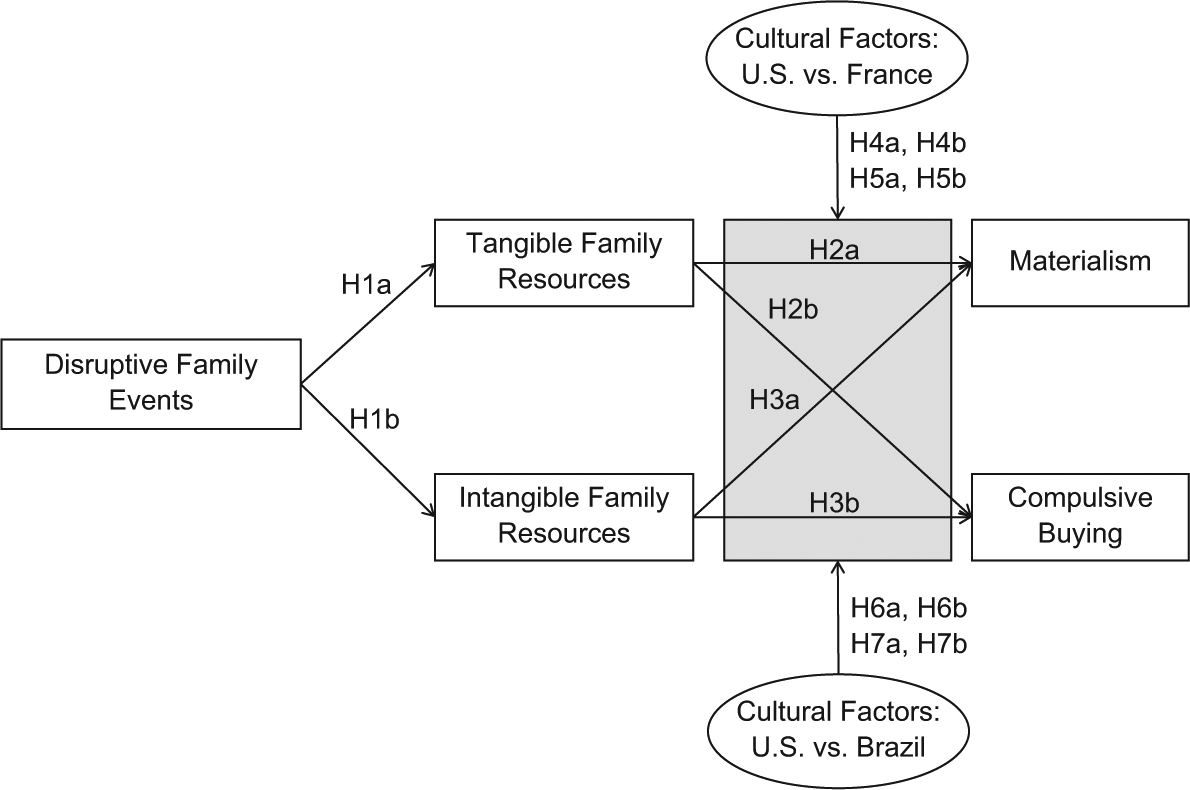
Theoretical model.
Prior consumer research has demonstrated that youths in disrupted families, especially those adolescents living with divorced parents, hold stronger materialistic attitudes (Roberts et al., 2003) and exhibit stronger materialistic orientations as young adults (Rindfleisch et al., 1997). However, the hypothesized relationship between disruptive families on compulsive buying has been equivocal, supported by the Rindfleisch et al.’s study (1997) but not by Roberts et al.’s (2003) study. These and other studies (Roberts et al., 2004, 2006) do not conclusively show the mechanisms that link family disruptions to materialism and compulsive buying.
Substantial evidence in several disciplines suggests that most of the effects of family disruptions on the development of undesirable, antisocial, or maladaptive behaviors are indirect, operating through the mechanisms of stress, socialization, and human capital (e.g., Amato & Sobolewski, 2001; Elder et al., 1996). Stress theory suggests that change in family structure is stressful because it affects the nurturing and support provided by parents (i.e., weakening of emotional bonds and security), which are commonly viewed as definitions of intangible resources (Rindfleisch et al., 1997) that encourage problem behavior. Reduction in financial resources associated with major disruptions, such as divorce (Hill, Yeung, & Duncan, 2001), creates economic stress on parents and children due to reduction in available spending money and arguments over its use for acquisition of material objects (Coger et al., 1994; Hill et al., 2001; Uhlenberg & Mueller, 2003), which commonly define tangible resources (Rindfleisch et al., 1997).
Social control theory views adult supervision and monitoring of children’s behaviors as important means by which children are kept from engaging in undesirable behaviors. The fewer the number of adults present in the child’s immediate environment, or the more distant the adults’ relationship to the child, the weaker the social control. In their effort to compensate for loss of control, parents in disrupted homes stress conformity and adopt coercive and harsh parenting strategies (e.g., using anger and violence) and other behaviors that have been shown to undermine effective socialization (Uhlenberg & Mueller, 2003). Economic hardship theory views income and socioeconomic status (SES) in general as mechanism that affects human capital. Family disruptions, especially loss of a parent, results in degraded SES, which has adverse effects on child’s development (Conger, Ge, Elder Jr., Lorenz, & Simons, 1994). A great deal of research has established that low income as well as significant drop in income creates stress in children due to arguments over the use of fewer tangible resources that results in the child’s perception of lessen support from their parents (decrease in intangible resources), leading to lower self-esteem and problem behavior (Hill et al., 2001).
The three theories within the life course paradigm (e.g., Elder et al., 1996; Hill et al., 2001; Uhlenberg & Mueller, 2003) suggest how specific mechanisms may affect the development of materialistic values and compulsive buying tendencies. First, the use of materialistic possessions in the face of self-doubt and insecurity (psychological disequilibrium; Chang & Arkin, 2002) suggests materialistic orientations are a coping mechanism to family stressors resulting from limited resources, in line with the life course mechanism of stress (Rindfleisch et al., 1997). In a similar vein, socioeconomic deprivation and scarcity of tangible resources may elevate the importance of material possessions as a means of enhancing self-esteem.
Furthermore, degraded social position may delay capital development. For example, within the life course paradigm, parenting practices are seen as one of the determinants of child’s level of self-control that regulates impulsive behaviors (Simons, Johnson, Cogner, & Elder, 1998). Research shows variability in capital development due to neurological deficit affected by psychological and social factors that moderate biological development (Elder, 1998; Sherrod & Brim, 1986), and such neurological deficits lead to susceptibility to peer influences that promote impulsive behavior among teens (Burnett, Sebastian, Kandos, & Blakemore, 2010; Ernst & Fudge, 2009; Litt, Pirouz, & Shiv, 2011; Steinberg, 2008). It is believed that the triadic circuit controlling impulsive behavior is actively maturing during adolescence (Ernst & Fudge, 2009; Litt et al., 2011; thus vulnerable to disruption during late development). To the extent that aversive family events have negative social, psychological, and economic consequences on the child (e.g., decreased frequency of positive family interactions, lower self-esteem, opportunities in handling money), they may delay development. Thus, the delayed development of human capital is likely to make children more susceptible to impulsive choices that are precursors to compulsive behaviors (Pechman et al., 2005; Uhlenberg & Mueller, 2003). Kasser, Ryan, Zax, and Sameroff (1995) as well as Conger et al. (1994) present studies which show that controlling family environments are likely to rear children that are aggressive, antisocial, and oriented toward manipulative and hedonically gratifying behaviors. Parents of a relatively low SES and those who value conformity more than self-expression may encourage their children to value more the demands and structures of others rather than their own true desires (Kasser et al., 1995). Children in these families may attach greater importance on material possessions as signals of communicating a more positive or successful self to others.
To summarize, while the negative relationship between family disruptions and reduced tangible and intangible resources is well-established in several disciplines, there is limited research that has addressed the links between family resources and the two consumption orientations. Rindfleisch et al. (1997) found support only for a negative link between family resources and compulsive buying, and it was intangible resources that had the greatest negative impact on materialism. Roberts et al. (2003) found a negative link to one of the three dimensions of materialism (happiness), while Roberts et al. (2004) identified intangible resources as having a negative influence on compulsive buying. Thus, it is hypothesized that:
Hypothesis 1 (H1): Family disruptions lead to decreases in (a) tangible and (b) intangible resources.
Hypothesis 2 (H2): Experience of reduced tangible resources during adolescent years is associated with stronger (a) materialistic values and (b) compulsive buying tendencies in early adulthood.
Hypothesis 3 (H3): Experience of reduced intangible resources during adolescent years is associated with stronger (a) materialistic values and (b) compulsive buying tendencies in early adulthood.
Cross-Country Differences
Recognizing that different cultural values and habits toward material possessions may impact how different drivers affect materialisms and compulsive buying, we investigate whether differences between French, American, and Brazilian consumers exist. French and American consumers come from economically developed, Western cultures. Despite this similarity, it has been recognized that the behaviors of American and French consumers are markedly different (Green & Langeard, 1975). In addition, it is possible differences between these cultures exist based on pervasive value structures regarding material objects. Specifically, it has been noted that within the United States the overriding cultural theme of the American Dream creates an atmosphere that encourages the acquisition and display of material objects to signal success and power (Hall & Hall, 1990), while the French tend to relatively eschew the public display of money and possessions. For example, Lamont (1992) noted that in a cross-country comparison of 160 United States and French upper–middle class consumers that French men “were often uncomfortable with probes concerning their “success.” This notion itself sounding uncouth in French” (Lamont, 1992, p. 65), while signals of and concern for SES were highly salient among the United States. If differences in such values exist between the two countries, one would expect the negative link between family resources and materialism and compulsive buying to be more suppressed in the French culture, since the stress-alleviating process of the consumption orientations would be countered by additional stress of embracing materialistic beliefs and behaviors in a cultural setting that does not extol the public manifestation of materialistic possessions. Hence, we hypothesize that
Hypothesis 4 (H4): In comparison to U. S. consumers, for French consumers there will be: (a) a weaker negative relationship between tangible resources and materialistic values, and (b) a weaker negative relationship between tangible resources and compulsive buying.
Hypothesis 5 (H5): In comparison to U.S. consumers, for French consumers there will be: (a) a weaker negative relationship between intangible resources and materialistic values, and (b) a weaker negative relationship between intangible resources and compulsive buying.
It has been noted that the Brazilian culture has close similarities in terms of family structure compared to other Latin American countries such as Mexico (Roberts et al., 2004). As a collectivistic Latin American country, Brazilian consumers tend to possess values different from those of consumers in individualistic countries such as the United States. Differences in cultural values have been cited as reasons for differences in family structures that have been observed over the years. For example, six decades ago, Willems (1952, p. 345) observed that “the structural isolation of the nuclear family in the United States contrasts with the structural integration of the nuclear family in Brazil,” an observation that appears to be valid in more recent years (Desai, 1992). For this reason, it has been noted that family disruptions in the immediate family may have less impact on a child’s perception of total family resources since the extended family is also an important source of tangible and, most importantly, intangible resources.
Furthermore, Wong and Ahuvia (1998) make a compelling argument that cultural differences between collectivistic and individualistic countries reflect different conceptions of self—that is, the independent construal of self (dominant in Western cultures) and the interdependent construal of self (commonly found in collectivistic cultures). They suggest that, because the interdependent self emphasizes social roles and public conceptions as central to one’s identity, consumers in collectivistic countries are more socially dependent. Thus, because of the collectivist orientation of Brazil relative to the more individualist orientation of the United States (Hofstede, 2001), the external social influences of extended family tangible and intangible resources may be superior at buffering (moderating) the negative effects of immediate family disruptions and reductions in immediate family resource levels, as well as upon the consequences of depletions in resources on the person’s consumption. Based on these assessments, we hypothesize:
Hypothesis 6 (H6): In comparison to U.S. consumers, for Brazilian consumers there will be: (a) a weaker negative relationship between tangible resources and materialistic values, and (b) a weaker negative relationship between tangible resources and compulsive buying.
Hypothesis 7 (H7): In comparison to U.S. consumers, for Brazilian consumers there will be: (a) a weaker negative relationship between intangible resources and materialistic values, and (b) a weaker negative relationship between intangible resources and compulsive buying.
Method
In this section, we report the steps used to test the hypotheses. First, we describe the data collection procedures. Then, a multigroup CFA is performed so that the degree of measurement invariance between the France, Brazilian, and United States samples is evaluated to determine whether cross-country comparisons can be made. Next, the structural equation models are tested. The wording and scaling for all questionnaire items are reported in the appendix.
Data Collection
The data collection procedure was similar for the three samples. The survey was self-administered in class; and the participants remained anonymous by asking them not to write their names on the questionnaire and return it to a secure location to guarantee anonymity. To reduce error that could result from sample inequivalence (e.g., Diamantopoulos, Reynolds, & Simitras, 2006) we sought respondent homogeneity by sampling consumers with fairly similar characteristics across all three countries. The United States sample consisted of 152 undergraduate students enrolled in business classes of a large, public 4-year urban university in a Southeastern state. Their age ranged from 19 to 36 (M = 26, SD = 2.8), and 56% were female A sample of 173 undergraduate French college students in a French university in Paris, enrolled in business or computer science classes ranged from 19 to 29 (M = 22, SD = 1.4) was used. Sixty-three percent of the subjects were female. Because we used the same measures in the three countries, back translation was necessary for the French survey. A translation into French was conducted by one of the authors, followed by a second translation back to the original language carried out by a bilingual PhD student. Furthermore, a bilingual English teacher checked the translated document and the original version, and confirmed that the translation was done well. Before administrating the French version, a qualitative pretest was conducted to insure that all items were well understood and reflect the original meanings of the English version.
We used the same questionnaire translation procedure in Brazil as in France. The Brazilian sample consisted of 177 students, enrolled in undergraduate business courses in a large public university located in the South of Brazil. Students’ ages ranged from 20 to 37 (M = 26, SD = 3.1), with 46% female. The translation into Portuguese was conducted by one of the authors, followed by a second translation back to the original language carried out by a bilingual PhD student. Furthermore, a bilingual English teacher checked the translated document and the original version and confirmed that the translation was done well. One of the authors went to classes (with prior permission from instructors) and students were given an option to participate in the study. The age range and gender of the Brazilian sample is consistent with the general Brazilian college-attending population (World Bank Association, 2002), and this is true for the U.S. sample as well (Bergman, 2006).
Measures
In constructing measures for the variables of our study, we relied on past research and used validated measures similar to those of previous studies. All measurement items, item standardized loadings, construct reliabilities (CR), and average variance extracted (AVE) are reported in detail in the appendix.
Materialism
The materialism scale was based on the modified material value scale (MVS) initially developed by Richins and Dawson (1992) and updated by Wong, Rindfleisch, and Burroughs (2003) for cross-cultural research. The updated scale uses an interrogative question format because it reduces the threat of yea-saying respondent behavior. Furthermore, because this study focuses on young adults or those who have yet to fully begin their careers, 6 of the 15 original items were not used because they did not reflect the life experiences of our young adult sample. For example, one dropped item referred to the respondent’s accumulation of material possessions as a measure of his or her career success. The items are shown in the appendix.
Compulsive Buying
To measure compulsive buying we used four items from the original 11-item compulsive buying scale by d’Astous, Maltais, and Roberge (1990). We selected the scale by d’Astous et al. because it had been developed and applied in other countries than the United States, and it was judged to best capture the impulse control aspect of compulsive buying (Ridgway, Kukar-Kinney, & Monroe, 2008). In addition, the d’Astous scale was judged to be suitable to young consumers (Roberts et al., 2003) as it consistently demonstrated a higher reliability in several studies using samples of young people from different cultures (d’Astous, Valence, & Fortier, 1989; Roberts et al., 2004). Seven of the 11 items in the d’Astous scale were excluded from the present study based on investigation of the performance of the items across the three cultures using exploratory factor analyses and confirmatory factor analyses. The unused items performed poorly in initial analyses. For example, most of the excluded items in the French and Brazilian samples had squared multiple correlations (SMC) less than 0.3 in the CFA. The shortened four-item scale had excellent measurement properties across the three samples in the multigroup CFA analysis of the compulsive buying scale as a single construct (χ2 = 6.545, df = 6, p = .37; RMSEA = 0.01; SRMR = 0.010; CFI = 0.99), with all items having SMC greater than 0.5.
Family Resources
Immediate family tangible and intangible resources were measured using a seven-item, five-point scale initially developed by Rindfleisch et al. (1997). Prior research has shown that the scale comprises two unique dimensions (tangible/intangible). However, in practice both Rindfleisch et al. (1997) and Roberts et al. (2003) primarily used the scale in unidimensional form. Because our study makes unique hypotheses for tangible and intangible resources, it is necessary to evaluate if the two dimension form of the family resource scale is indeed valid across the three cultures. A nested χ2 difference test is conducted between two CFA models: one with the correlation with the two factors allowed to be freely estimated and one with the correlation between the factors set to unity.
The nested confirmatory factor analysis to test for the configural fit between the two nested models (unidimensional vs. separate intangible and tangible dimensions) indicated the two dimension model fit significantly better for all three countries (χ2 = 110.36, df = 39; RMSEA = 0.061; SRMR = 0.0479; CFI = 0.951) as the chi-square difference test was highly significant (Δχ2 = 131.33, Δdf = 3, p < .0001). Item loadings ranged from 0.58 to 0.87.
It should be noted that these measures are intended to measure immediate family resources (i.e.,mother, father, and/or primary in-home caregivers), and are not intended to capture total family resources, which may include the tangible and intangible support provided by other extended family members. These measures are consistent with the hypotheses set forth in the present research.
Disruptive Family Events
Disruptive family events were measured by respondents identifying how many times before their 18th birthday they experienced six different disruptive events. These items were based on events identified in childhood development literature as being disruptive. Respondents were asked to indicate for how long in years they experienced each instance of a disruptive event. The length of time in years each event was experienced was then summed across the total number of disruptive events to form a single item index value of disruptive events. The mode for all countries was zero (no disruptions), and the mean number of summed disruptive years for United States is 10.3 years (σ = 12.9), France is 6.2 years (σ = 11.1), and Brazil is 9.2 years (σ = 12.9). The square root of this value was then taken to reduce heteroskedasticity and reduce the influence of extreme values (Cohen, Cohen, West, & Aiken, 2003). Even though this changes the scale of the disruptive event measure, this transformation does not affect our ability to use parameter estimates to evaluate the directional hypothesis specified.
Analysis
Overview of Analysis
All analyses were conducted using the SEM software MPlus 6.0 with robust maximum likelihood (MLR) estimation.
To assess measurement invariance between the three samples and determine whether or not the cross-country hypotheses can be meaningfully tested, we use a multigroup confirmatory factor analysis model. The measurement invariance assessment procedure detailed by Steenkamp and Baumgartner (1998) provides a common framework to assess measurement invariance in cross-country consumer behavior research. Correlations of study variables are reported in Table 1.
Variances and Correlations of Study Variables.
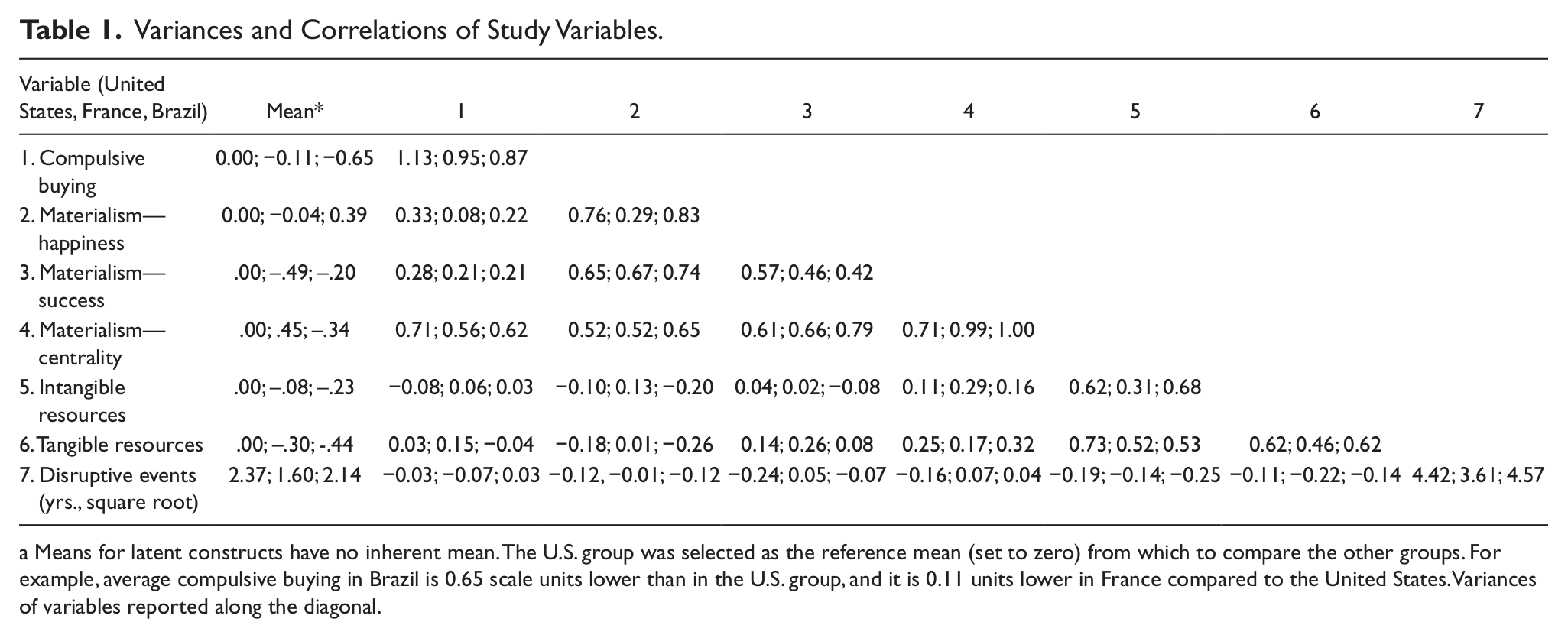
Means for latent constructs have no inherent mean. The U.S. group was selected as the reference mean (set to zero) from which to compare the other groups. For example, average compulsive buying in Brazil is 0.65 scale units lower than in the U.S. group, and it is 0.11 units lower in France compared to the United States. Variances of variables reported along the diagonal.
The level of measurement invariance required for a study is determined by the cross-group statistical comparisons required to test the research hypotheses (Steenkamp & Baumgartner, 1998). In the present case, the constructs’ metric invariance (equality across samples in item loadings) must be evaluated because the hypotheses all require comparing the regression coefficients of latent constructs on other latent. Byrne et al. (1989) notes that partial metric invariance (most but not all item loadings are equivalent across subgroups) is a satisfactory condition to make cross-group comparisons if full metric invariance is unsatisfied.
Figure 1 visually depicts the configural invariance (same pattern of zero and nonzero loadings across subgroups) structure of the measurement model. The χ2 was significant (χ2 = 735.43, df = 513; p < .001); goodness-of-fit indices meet recommended levels (RMSEA = 0.051; SRMR = 0.062; CFI = 0.93). All factor loadings were highly significant in all countries. Only 4 of the 60 standardized factor loadings were below 0.5.
With configural invariance realized, full metric invariance was assessed. There was a significant increase in χ2 between the configural and full measurement invariance models (Δχ2 = 75.67, Δdf = 28, p < .001), although fit indices suggested the model had acceptable model fit (RMSEA = 0.055; SRMR = 0.081; CFI = 0.92). Close investigation for particular items with measurement inequality indicated that two materialism items, one family tangible resource item, and two family intangible resource items were the primary source of cross-group misfit because of the equality constraint imposes across the three country groups. The materialism and tangible resource items exhibiting variance across groups did not appear to be substantively unique from the other reflective items that did demonstrate invariance. The intangible resource items that exhibited cross-group variance, “life skills and instruction” and “role modeling and guidance,” are different from the two invariant items “time and attention” and “emotional support and love” in that the two variant items focus heavily on family members providing future life direction rather than the invariant items which focused on nurturing activities that occur without specific aims for future development. These results suggest that there may be differences in how respondents from different cultures evaluate how well their family provided future life direction even if the overarching construct of intangible resources is meaningfully understood similarly across cultures.
The measurement constraints resulting in poor fit were relaxed sequentially and the overall model was then reestimated. The final model of partial metric invariance was not statistically different from the configural invariance baseline model (Δχ2 = 27.2, Δdf = 18, p = .07). Hence, partial metric invariance was supported across the United States, French, and Brazilian samples, suggesting that H4 to H7 can be tested and evaluated meaningfully. Measurement items constrained between groups and allowed to vary freely across countries are indicated in the Appendix.
In the following section, the overall structural equation model is described. Following assessment of the overall model, the results of the individual research hypothesis are reported.
Results
The models tested here modeled materialism in a manner consistent with previous research like Rindfleisch et al. (1997) and Roberts et al. (2003). Specifically, each hypothesis related to materialism was evaluated on each of its three subdimensions—happiness, success, and centrality. Furthermore, the latent error variance of materialism and compulsive buying were allowed to covary in the model because these “dark side” consumption behaviors and beliefs have additional common causes that are not included in this model.
Overall Model Fit
As is typical with complex multigroup SEM models, the overall SEM failed the stringent χ2-test (χ2 = 773.8, df = 543). However, the overall goodness-of-fit indices also suggest that this multigroup model has acceptable overall fit (RMSEA = 0.05, CFI = 0.93, SRMR = 0.07) based on suggested guidelines from the SEM literature (Bollen, 1998; Steenkamp & Baumgartner, 1998). The structural parameter estimates for the three groups are presented in Table 2. The results of H1 to H3 are summarized in Table 2 as well.
Model Structural Estimates.
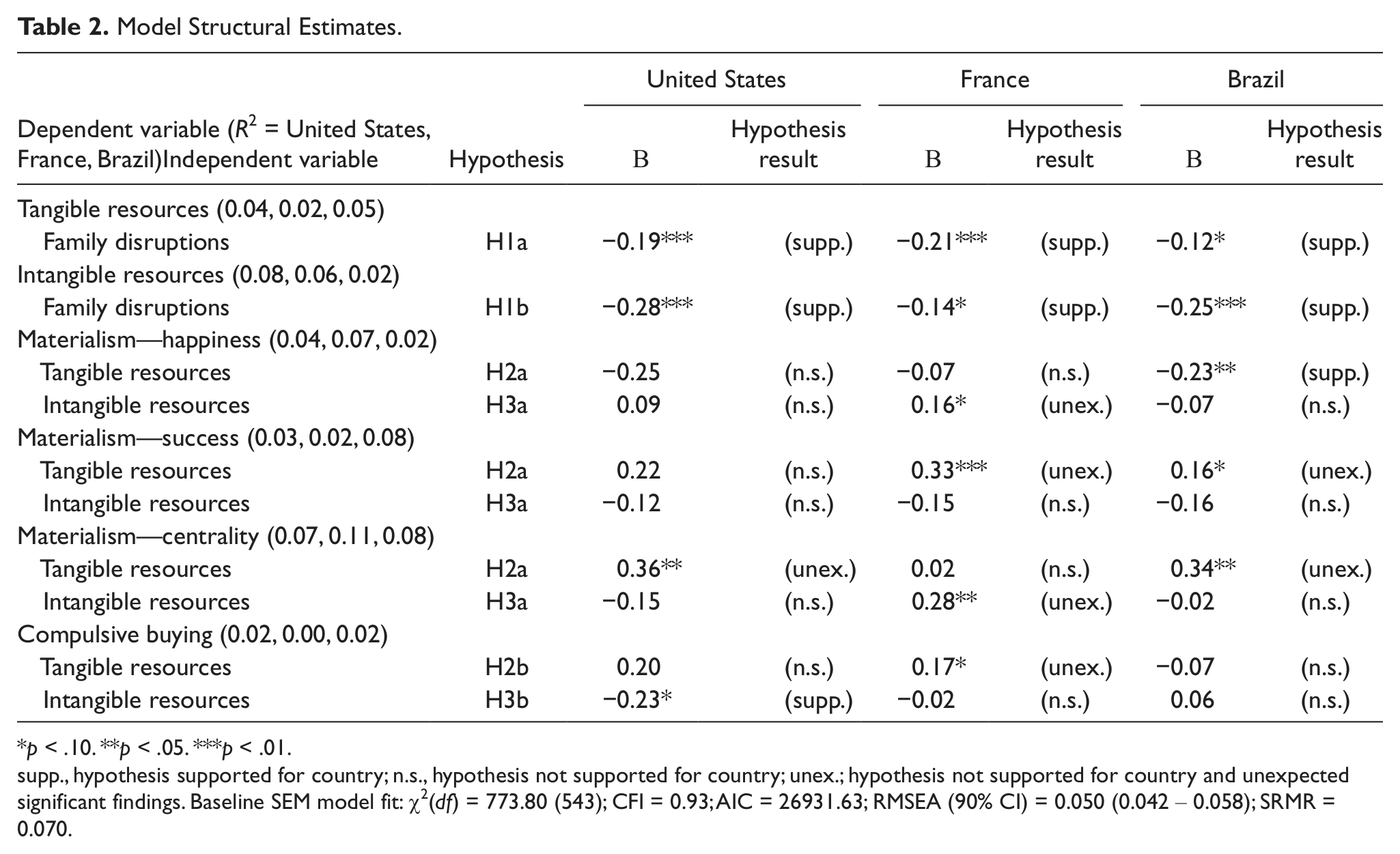
p < .10. **p < .05. ***p < .01.
supp., hypothesis supported for country; n.s., hypothesis not supported for country; unex.; hypothesis not supported for country and unexpected significant findings. Baseline SEM model fit: χ2(df) = 773.80 (543); CFI = 0.93; AIC = 26931.63; RMSEA (90% CI) = 0.050 (0.042 − 0.058); SRMR = 0.070.
Hypothesis Testing
In terms of the direct effects of disruptive events on family resources, the effect of disruptive events on tangible resources was negative and significant in the U.S. sample (–0.19, p < .01), negative and significant in the French sample (–0.21, p < .01), and negative and marginally significant in the Brazilian sample (–0.12, p < .1). The effect of disruptive events on intangible resources was significant and negative in the U.S. sample (–0.28, p < .01), negative and marginally significant in the French sample (–0.14, p < 0.1), and significant and negative in the Brazil sample (–0.25, p < .01). The pattern of results clearly shows a negative effect of disruptive events on both types of family resources; H1 is supported.
H2(a) concerns the relationship between tangible resources and materialism. The emerged relationship is significant and, contrary to our expectations, positive in the U.S. sample on the centrality subdimension (0.36, p < .05). In the French sample, the effect was positive and significant only on the success dimension (0.33, p < .01). In the Brazilian sample, the effect of tangible resources is positive and significant on centrality (0.34, p < .05) and marginally positive and significant on success (0.16, p < .1); it is negatively significant on the happiness dimension (–0.23, p < .05). In summary, contrary to findings of prior research, tangible resources tend to have a positive effect on materialistic values in terms of the success and centrality dimensions. However, the effect on the happiness subdimension tended to be negative. Thus, H2(a) is not supported.
Next, H2(b) suggested that the effect of tangible resources on compulsive buying should be negative. The emerged relationship between tangible resources on compulsive buying is positive and marginally significant in the French sample (0.17, p < .1), but is insignificant in the U.S. and Brazilian samples. Thus, H2(b) is not supported.
In H3(a) intangible resources are expected to have a negative effect on materialistic values. The data show no significant effects in the U.S. sample. There was no significant relationships between intangible resources and materialism in the Brazilian sample either. In the French sample, the effect was unexpectedly positive and significant on the centrality subdimension (0.28, p < .05) and marginally positive and significant on the happiness subdimension (0.16, p < .1). In summary, H3(a) is not supported, and in the French sample there appeared to be a positive effect of intangible resources on materialistic beliefs.
In terms of the effect of intangible resources on compulsive buying, H3(b) posits a negative relationship between the two variables. Results show the relationship is negative and marginally significant in the U.S. sample (–0.23, p < .1) but is insignificant in the Brazilian and French samples. In summary, the hypothesized effect of family resources on compulsive buying was supported in the U.S. sample only with respect to intangible resources, but there was no support in the French or Brazilian samples for the effects of either tangible or intangible resources.
We next tested differences between the French and U.S. samples. To test the cross-country difference hypotheses for H4 and H5, the respective structural paths were constrained to equality in the French and U.S. samples. A χ2 difference test was then conducted. Table 3 summarizes results of the tests and the results of H4 to H7.
Cross-Country Hypothesis Tests.
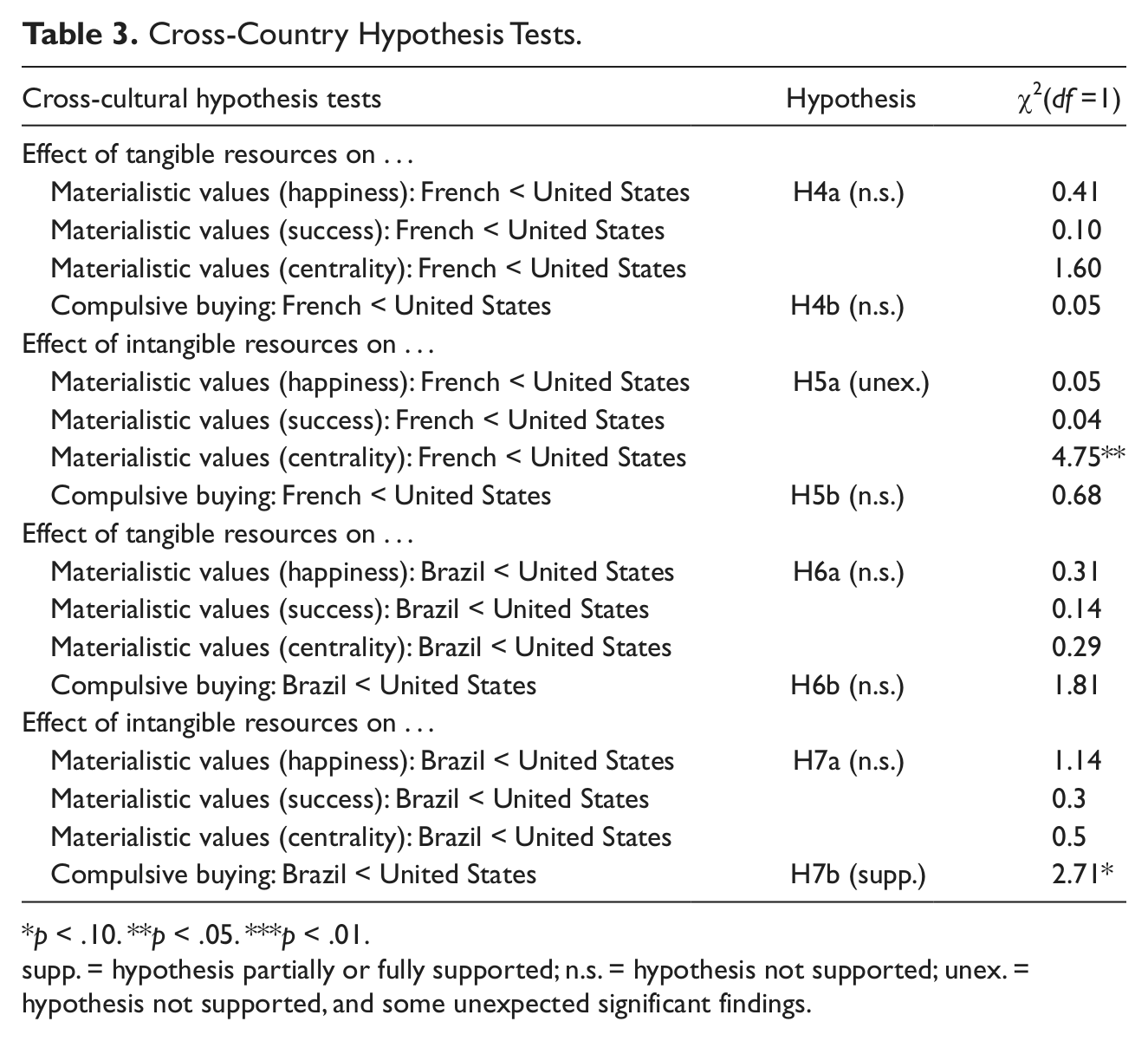
p < .10. **p < .05. ***p < .01.
supp. = hypothesis partially or fully supported; n.s. = hypothesis not supported; unex. = hypothesis not supported, and some unexpected significant findings.
H4(a) posits that the French sample, relative to the U.S. sample, will have a weaker negative effect of family tangible resources on materialistic beliefs. Although not significant, this pattern of results is observed in the case of tangible family resources and its relationship with the happiness subdimension of materialism. However, tangible resources were either not significant or unexpectedly positively related to the success and centrality subdimension of materialism in the U.S. and French groups. This unexpected patterns of results means H4(a) is unsupported. Although unexpected, there is a significant difference between the French and U.S. samples regarding the difference on the effect of intangible resources on the centrality subdimension of materialism (Δχ2 = 4.75, p < .05)—it was unexpectedly positive in the United States and nonsignificant in France. H5(a), which posits a stronger negative effect of immediate family intangible resources on materialistic beliefs, was not supported. There was no significant difference between the United States and France on the relationship between intangible resources and the happiness and success subdimensions of materialism. Furthermore, we also notice the effect of intangible resources on centrality and happiness in the French sample is actually positive, while the effect in the U.S. sample is negative (as expected). In other words, emotional support and role modeling actually seems to promote centralized materialistic beliefs among the French.
H5(b) hypothesizes different effects of intangible resources on compulsive buying. H5(b) is not supported. The hypothesized negative effect of intangible family resources on compulsive buying was significant in the U.S. sample but insignificant among French young adults. Although not significant, the pattern of findings were consistent with the hypothesis.
Next, we tested for differences between the U.S. and Brazilian samples using the same procedures as outlined earlier. There were no significant differences between Brazil and the United States in terms of the effect of family resources on materialistic beliefs, hence H6(a) and H7(a) were not supported.
H6(b) stated that tangible family resources will have a weaker negative effect on compulsive buying. This hypothesis was not supported (Δχ2 = 1.81, p > .1). The pattern of results were inconsistent with the hypothesis, as there was a positive effect in the United States but there was a nonsignificant effect in Brazil. Finally, H7(b) stated that intangible family resources would have a weaker negative effect on compulsive buying in the Brazilian sample than in the United States. This hypothesis is supported as there is a marginally significant difference (Δχ2 = 2.71, p < .1). The results support intangible resources having a more pronounced negative effect in the U.S. sample compared to the Brazilian sample.
Results Summary
In summary, the hypotheses predicting that family disruptions had a deleterious effect on family resources (H1) were supported in all countries. The predicted negative effect of tangible resources on materialistic beliefs and compulsive buying (H2) was only supported in the Brazilian group in the case of the happiness subdimension. Unexpectedly, adequate tangible resources during childhood was actually positively associated with the success subdimension of materialism and compulsive buying in the case of France and positively with the centrality subdimension in the case of the United States and Brazil. These results suggest that material resources provided in childhood can actually encourage types of materialistic beliefs across several different cultures. Further, intangible resources was not negatively significantly associated with materialistic beliefs (H3a) in the United States and Brazil, but was actually positively associated with materialistic beliefs in the case of France. The negative effect of intangible resources on compulsive buying (H3b) was supported in the United States but not France or Brazil.
The cross-country comparison hypotheses (H4 to H7) were generally insignificant and not supported. H7b was supported as the negative relationship between intangible resources and compulsive buying was more pronounced in the U.S. group. A notable unexpected finding was in regards to the significant difference intangible resources had on centrality materialistic beliefs between the United States and France. While the relationship was negative (albeit insignificant) in the United States, the effect of intangible resources was actually positive in the case of France.
Discussion and Conclusions
Before discussing the findings, we address several limitations with this current study. First, the major limitation of this study is that it uses cross-sectional data and retrospective analysis to assess how prior events influence consumption outcomes later in life. Care was taken to minimize the problems associated with retrospective measures. Specifically, disruptive events were measured using a simple recollection of whether or not the event occurred instead of asking the respondent to estimate the perceived influence of events that occurred years ago. Nonetheless, this remains a limitation of the current study. In addition, the use of a sample of university students across the three country samples means that none of the samples were likely representative of all young adults in the respective nation. However, the use of all university students provided a degree of sample equivalence between the countries along level of education (Sirgy et al., 1998). However, much larger samples should be collected, and there is still a need to develop improved measures that have desirable cross-country psychometric properties.
While there were sparse cross-country differences, the study illustrates how contextual variables (e.g., country) can be used within the life course framework to investigate cross-country similarities and differences in developmental linkages. In our model, there was partial support for the hypothesis that tangible family resources may actually have a positive influence on compulsive buying and subdimensions of materialism (centrality and success). Thus, there is a need for further investigation into this relationship because it contradicts prior investigations—a notable exception being the study by Roberts et al. (2004), which found a marginally significant (p < .1) positive effect of tangible family resources on compulsive buying among Mexican adolescents.
This study’s findings are consistent with prior findings that intangible family resources, like love and affection, provided by youth’s parents tend to decrease the excessive consumption orientations of materialism and compulsive behavior later in life. However, our results are not totally consistent with those of previous studies. Our data are suggestive that, in France, there may be an aspect of family emotional support and nurturing that actually promotes the embracing of materialistic beliefs. Alternatively, French parents’ provision of intangible support may deter the child’s development of skills at evaluating communications from agents that promote the importance of material possessions, such as television and peers (Moschis, 1987). In a similar vein, the provision of tangible resources may provide the child greater opportunities for consumption and discussion of acquired products with peers. These agents, in turn, may further reinforce the importance of material possessions and elevate the child’s susceptibility to peer influence on impulsive choices, a notion in line with neuroscience research (Burnett et al., 2010; Ernst & Fudge, 2009; Litt et al., 2011; Steinberg, 2008) and supported by the positive relationship between tangible resources and compulsive buying tendencies emerged in our French sample. Thus, further research should examine the extent to which other socialization agents, especially peers, mediate the effects of tangible and intangible resources on materialism and compulsive buying.
Another contribution of this study is the finding that the pattern of results across the three samples was surprisingly similar. While the moderate sample size in each of the three samples may underpower the current investigation to detect cross-country differences, it is noteworthy that the life course framework used to guide the present study was not developed as a U.S.-specific model. Thus, it is reasonable that cross-country studies employing the elements specified by the life course model may in fact be relatively consistent across diverse country settings. Certainly, this observation is simply suggestive based on the limitations of this initial inquiry, but future studies of how consumption outcomes develop across countries should be conducted to assess the generalizability of the life course paradigm. An important point here is that this study is a first step toward bringing a more rigorous cross-country analysis (assessment of metric invariance) into studying the life course drivers of consumption orientations. There is a clear need to make empirical generalizations across countries, as evidenced by the numerous studies using non-U.S. samples. However, this is the first study to our knowledge that investigates simultaneously materialism and compulsive buying by making cross-country comparisons using the life course paradigm. It is our hope this study inspires additional cross-country studies of this nature.
Footnotes
Appendix
Questionnaire Items and CFA Results
| Construct/measure (average variance extracted [AVE] = United States; France; Brazil, Construct reliability (CR) = United States; France; Brazil) | United States loading | France loading | Brazil loading |
|---|---|---|---|
| Compulsive buying (AVE = 0.69; 0.60; 0.61, CR = 0.91; 0.87; 0.88) | |||
| Shopping is a way of relaxing and forgetting my problems. | 0.78 | 0.74 | 0.76 |
| I sometimes feel that something inside pushes me to go shopping. | 0.87 | .081 | 0.86 |
| There are times when I have a strong urge to buy clothing, tapes, jewelry, etc. | 0.82 | 0.76 | 0.71 |
| I often have a real desire to go shopping and buy something. | 0.84 | 0.79 | 0.77 |
| Materialism | |||
| Happiness dimension (AVE = 0.41; 0.40; 0.51, CR = 0.76; 0.75; 0.82) | |||
| Would your life be any better if you owned certain things that you don’t have? | 0.75 | 0.49 | 0.83 |
| How would you feel if you could afford to buy more things? 1 | 0.68 | 0.92 | 0.79 |
| Do you feel that you have all the things you really need to enjoy life? | 0.44 | 0.35 | 0.45 |
| Success dimension (AVE = 0.41; 0.32; 0.36, CR = 0.78; 0.71; 0.75) | |||
| How do you feel about people who own expensive homes, cars, and clothes? | 0.61 | 0.63 | 0.58 |
| How do you feel about owning things that impress people? | 0.68 | 0.51 | 0.55 |
| How do you feel about acquiring material possessions as an achievement in life? | 0.73 | 0.68 | 0.60 |
| How do you approach your life in terms of your life possessions (i.e., buying and owning things)? a | 0.54 | 0.40 | 0.67 |
| Centrality dimension (AVE = 0.51; 0.42; 0.30, CR = 0.81; 0.79; 0.71) | |||
| How much pleasure do you get from buying things? | 0.86 | 0.68 | 0.57 |
| How do you feel about having a lot of luxury in your life? | 0.55 | 0.61 | 0.53 |
| Intangible resources (AVE = 0.67; 0.50; 0.59, CR = 0.90; 0.83; 0.87) | |||
| Time and attention | 0.87 | 0.63 | 0.71 |
| Life skills and instruction a | 0.74 | 0.78 | 0.80 |
| Emotional support and love | 0.82 | 0.79 | 0.75 |
| Role modeling and guidance a | 0.82 | 0.63 | 0.80 |
| Tangible resources (AVE = 0.58; 0.50; 0.58, CR = 0.86; 0.83; 0.86) | |||
| Spending money | 0.67 | 0.65 | 0.74 |
| Food a | 0.76 | 0.70 | 0.58 |
| Clothing | 0.83 | 0.77 | 0.91 |
| Disruptive events b (percentage of respondents experiencing events reported here) | |||
| Frequent of lengthy periods in which one or both parents were absent | 35% | 34% | 33% |
| Move(s) to a new place or residence | 72% | 57% | 53% |
| The loss (other than death) or separation from family members or loved ones | 32% | 40% | 36% |
| Physical abuse by parents or close family members | 9% | 26% | 4% |
| Arguments between parents or other family members (including self) | 66% | 50% | 74% |
| Changes in the membership or composition of your family unit other than the divorce of your parents (e.g., remarriage of your parent(s), birth of your own child, etc.) | 20% | 10% | 34% |
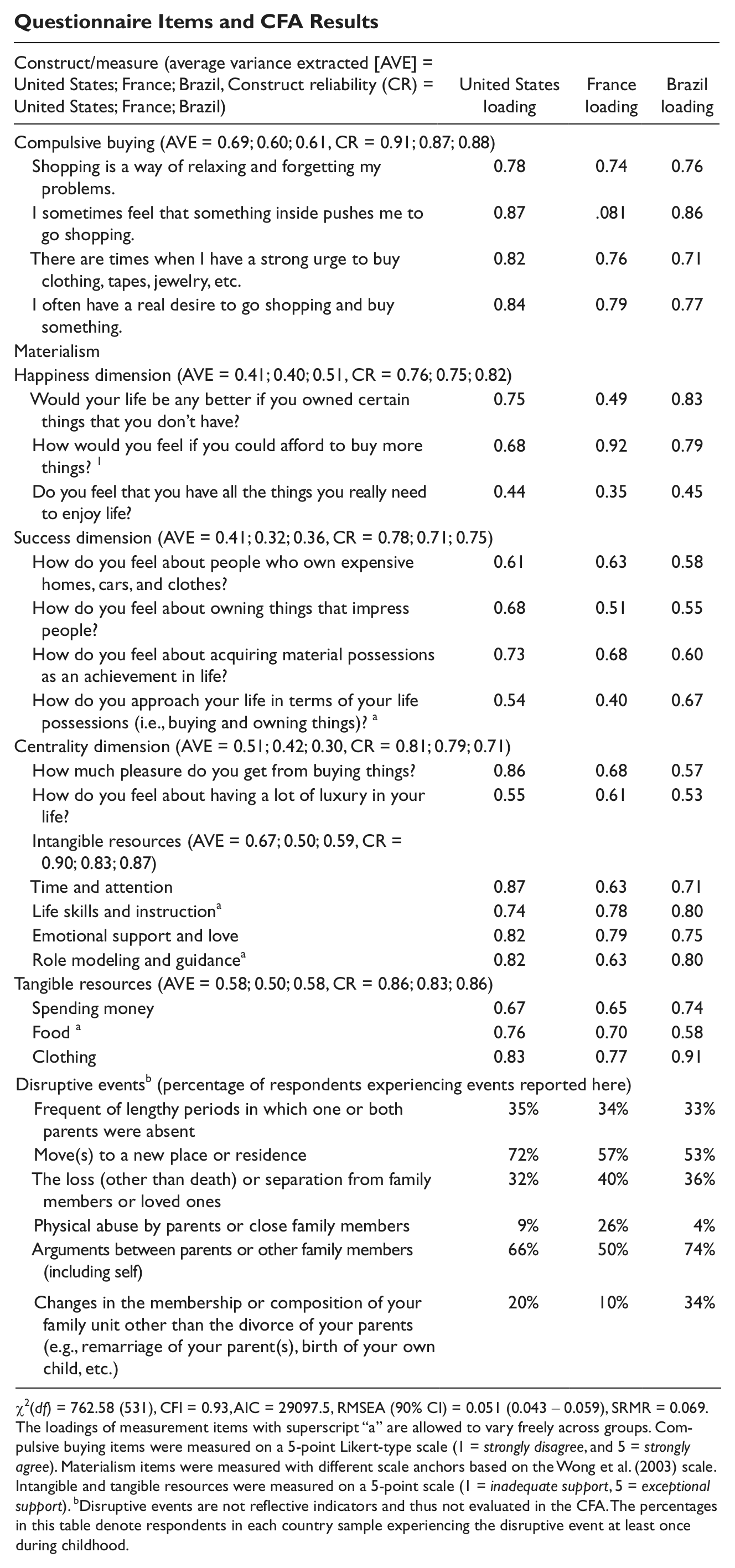
χ2(df) = 762.58 (531), CFI = 0.93, AIC = 29097.5, RMSEA (90% CI) = 0.051 (0.043 − 0.059), SRMR = 0.069. The loadings of measurement items with superscript “a” are allowed to vary freely across groups. Compulsive buying items were measured on a 5-point Likert-type scale (1 = strongly disagree, and 5 = strongly agree). Materialism items were measured with different scale anchors based on the Wong et al. (2003) scale. Intangible and tangible resources were measured on a 5-point scale (1 = inadequate support, 5 = exceptional support). bDisruptive events are not reflective indicators and thus not evaluated in the CFA. The percentages in this table denote respondents in each country sample experiencing the disruptive event at least once during childhood.
Declaration of Conflicting Interests
The author(s) declared no potential conflicts of interest with respect to the research, authorship, and/or publication of this article.
Funding
The author(s) received no financial support for the research, authorship, and/or publication of this article.