



Abstract
This article examines commonalities and differences in the value theories proposed by Ronald Inglehart and Shalom Schwartz. A systematic review of previous findings was conducted. Then, we showed, with a joint multidimensional scaling (MDS) analysis, that Schwartz’s Embeddedness versus Autonomy dimension tends to lie at the diagonal of the Inglehart Cultural Map of the World, suggesting that in order to be autonomous/open, individuals need to have both self-expressive and secular-rational values, whereas being embedded /conservative involves both traditional and survival values. Two distinct regions of Schwartz’s values (one at each level) which are missed by Inglehart’s instrument were identified. At the same time, an MDS plot revealed that, at the individual level, Inglehart’s Survival values are not captured by the Schwartz’s items included. The obtained structures at the two levels of analysis were shown to be remarkably similar (Tucker’s Φ > .90).
Keywords
Values have become the subject of a multitude of disciplines, such as personality psychology, education, organizational theory, sociology, philosophy, and cross-cultural studies. Among cultural researchers, a given society’s prevailing value emphases have become the most central feature of culture, as they are seen to shape and justify the particular beliefs, attitudes, goals, and actions of individuals and groups. In other words, everyday practices as well as institutional arrangements and policies are taken to be the expression of the underlying cultural value emphases of a society (Schwartz, 2004).
Over the years, a number of different basic (value) dimensions of cultural variation have been proposed. A well-known and well-researched set of value dimensions is that of psychologist Shalom Schwartz (1992; Schwartz, Melech, Lehmann, Burgess, Harris, & Owens, 2001), who identified 10 basic human values at the individual level, and seven at the country level (Schwartz, 1999). Ronald Inglehart (1977, 1997) proposed his own set of values, based on the disciplinary grounds of political science. He developed a bipolar Materialism—Postmaterialism (M—PM) index to explain political and societal change within nations. Later, Inglehart and colleagues (Inglehart & Baker, 2000; Inglehart & Welzel, 2005) expanded the model to the two cultural dimensions of Traditional versus Secular-Rational values and Survival versus Self-Expression.
Purpose of This Study
Inglehart’s measures comprise less abstract attitudes, beliefs, subjective well-being, and political views, and so they might be more sensitive to historical (or situational) changes and measure individual values only indirectly, whereas Schwartz assesses nonspecific motivational goals which can be distinguished from Inglehart’s political values (Schwartz, 2003). Further, Inglehart’s and Schwartz’s approaches are frequently considered to be conceptually different or even incomparable as the latter approach focuses more on individual psychological differences and the former on underlying institutional processes (see e.g., Mohler, Rammstedt, & Wohn, 2006). In our reading, both theories claim to study values that have quite similar origins and consequences. Therefore, it is worth comparing the two value measures to clarify differences, and to identify the degree to which Inglehart’s and Schwartz’s dimensions can be merged.
Our article surpasses previous studies in the field regarding the similarity of both approaches by conducting a joint analysis of their items. This has become possible at the individual level due to the inclusion of both Schwartz’s and Inglehart’s value measures in the fifth wave of the World Values Survey (WVS), while for many years, the availability of relevant data has made it possible to compare only country-level mean scores. Our primary aim is to find substantive associations between Schwartz’s and Inglehart’s items that have remained undiscovered by correlational research. Further, it is possible that there is some unique value content as yet unspecified by one of the approaches. Moreover, we are interested in the similarity between emerging individual- and country-level structures. By assessing the cross-level correlations, we shed light on the question whether the researcher should differentiate between the two levels of analysis or if the joint value structures have similarities so substantial that they can be considered to have the same psychological meaning.
Schwartz’s Theory of Basic Human Values
From the psychological perspective, values are beliefs about “desirable, transsituational goals, varying in importance, that serve as guiding principles in people’s lives” (Schwartz & Bardi, 2001, p. 269). According to Schwartz, values express motivational concerns evoked by “three universal requirements of human existence [. . .]: needs of individuals as biological organisms, requisites of coordinated social interaction, and survival and welfare needs of groups” (Schwartz, 1992, p. 4).
At the individual level, Schwartz (1992) proposed 10 basic human values which differ in their underlying motivational goals. Values have shown stable relationships across many cultures of the world and are organized into two bipolar dimensions according to which individuals differ. One dimension opposes Conservation (value types 1-3, see below) and Openness (to Change; 6-8); the other opposes Self-Enhancement (4, 5) and Self-Transcendence (9, 10). The 10 value types form a quasi-circular structure, and are defined as follows (Schwartz, 2003):
Tradition. Respect, commitment, and acceptance of the customs and ideas that traditional culture or religion provide the self
Conformity. Restraint of actions, inclinations, and impulses likely to upset or harm others and violate social expectations or norms
Security. Safety, harmony, and stability of society, of relationships, and of self
Power. Social status and prestige, control or dominance over people and resources
Achievement. Personal success through demonstrating competence according to social standards
Hedonism. Pleasure and sensuous gratification for oneself
Stimulation. Excitement, novelty, and challenge in life
Self-Direction. Independent thought and action-choosing, creating, exploring
Universalism. Understanding, appreciation, tolerance, and protection of the welfare of all people and of nature
Benevolence. Preservation and enhancement of the welfare of people with whom one is in frequent personal contact.
Recently, an alternative representation of Schwartz’s quasi-circular value structure was proposed at the diagonals of the circle, namely Social-Focused (1, 2, 10) opposing Person-Focused (5-7) values on the one dimension, and Protection (3, 4) opposing Growth values (8, 9) on the other (Fontaine, Poortinga, Delbeke, & Schwartz, 2008).
Correlational research has related Schwartz’s values to a wide set of psychological constructs, such as personality traits (Roccas, Sagiv, Schwartz, & Knafo, 2002), individual religiosity (Roccas & Schwartz, 1997; Saroglou, Delpierre, & Dernelle, 2004), clusters of behaviors (Bardi & Schwartz, 2003), and political orientations (Caprara, Schwartz, Capanna, Vecchione, & Barabaranelli, 2006), to list but a few important findings from the last two decades.
At the country level, Schwartz (1999) identified seven values organized on three higher-order dimensions, based on his argument that values represent how groups respond to three vital societal issues. The first issue involves the relationship between the individual and the group. One response is Embeddedness, which views people as largely embodied in the collectivity, and the opposite response is Intellectual and Affective Autonomy, which encourages an individual to act out one’s uniqueness and to express intellectual, behavioral, and emotional independence. The second issue concerns ways in which societies are structured so that people behave in a responsible manner, preserving the social fabric. The response to this issue is either Hierarchy, which ascribes unequal roles to keep social order, or Egalitarianism, which enables people to recognize each other as equals. And the third issue is the relationship of humankind to the natural and social world. The response to it is either Mastery, which implies change of natural and social world, or Harmony, which makes cultures strive to conform to existing environments. Spatial maps were published by Schwartz (1999, 2004, 2006), revealing meaningful groupings of cultural groups from every inhabited continent.
Recently, Schwartz (2010) contrasted the two levels of analysis, claiming that cultural and personal values should be kept strictly theoretically and statistically independent. However, Fischer and his colleagues (Fischer, 2012; Fischer & Poortinga, 2012; Fischer, Vauclair, Fontaine, & Schwartz, 2010) found striking similarities among structures across levels for the Schwartz values.
Inglehart’s Dimensions of Cross-Cultural Variation
Inglehart (1977, 1997) proposed that economic development is linked with coherent, and, to some extent, predictable changes across a wide range of political, social, and religious norms and beliefs. Value orientations are viewed as reflecting the basic life experiences of people, being internalized at an early age, and providing guidelines to master life in a given context (Inglehart & Welzel, 2005). Inglehart did not conceptualize values per se, but instead selected indicators of change in order to explain cross-cultural variation (Inglehart & Baker, 2000). 1
Inglehart’s M—PM index 2 was designed to measure peoples’ preference for self-actualization and political participation over economic and physical security. Later, M—PM was integrated into a broader Survival versus Self-Expression dimension, while adding a new Traditional versus Secular-Rational value dimension.
According to Inglehart and Baker (2000), societies that stress Self-Expression values are characterized by high levels of economic and physical security, and foster a climate of trust and self-expression. People in these societies report good health, are enthusiastic about and aware of environmental protection issues, and have high levels of personal responsibility, political activity, tolerance of diversity, and subjective well-being. Societies exhibiting a high level on the Survival pole of this dimension emphasize the opposite, and stress material values above other goals. The second dimension (Traditional vs. Secular-Rational values) reflects the “contrast between societies in which religion is very important and those in which it is not, but deference to the authority of God, Fatherland, and Family are all closely linked” (p. 25). In societies that stress Secular-Rational values, people emphasize individualistic striving rather than social conformity, do not believe in absolute standards of good and evil, and do not support deference to authority. Opposite preferences are exhibited in societies with Traditional values.
Both dimensions span a so-called Cultural Map of the World, encompassing all cultural and geographic regions on Earth (Inglehart & Welzel, 2005).
Country-level and individual-level dimensions have been assumed to be equivalent, that is, isomorphic, since analyses of pooled individual-level data produced “two clearly defined dimensions with a basic structure similar to that found at the national level” (Inglehart & Baker 2000, p. 25). This implies that the meaning of these value dimensions is simply the same at both levels. At the same time, the individual-level correlates of these dimensions have been much less examined (see Beckers, Siegers, & Kuntz, 2012; Datler, Jagodzinski, & Schmidt, 2013).
Conceptual Similarities and Previous Attempts at Comparing Inglehart’s and Schwartz’s Value Concepts
Particular hypotheses about the common and unique features of the two sets of value orientations could be anticipated based on their content, as well as the correlations found in previous studies. In the following, we review evidence from both of these perspectives, at the individual and country level of analysis.
Country Level
Inglehart and Oyserman (2004) demonstrated that Survival versus Self-Expression and Embeddedness versus Autonomy, as well as the widely used concept of Individualism versus Collectivism (Hofstede, 1980), draw on the same dimension of cross-cultural differences: an emphasis on autonomous human choice. Across 57 nations, Survival versus Self-Expression, indeed, correlated positively with Affective and Intellectual Autonomy (r = .61, .58), but negatively with Embeddedness (r = –.71) (Schwartz, 2004).
Furthermore, Dobewall and Strack (2013) rotated the Cultural Map of the World 27 degrees clockwise, and increased, with this adjustment, the correlation between Inglehart’s former Self-Expression dimension and Autonomy to a striking r = .82.
The opposition between the cultural values of Hierarchy and Egalitarianism—encompassing how people coordinate action (in agreement with their needs, because of legitimate authority or voluntary choice, based on internalized commitments as moral equals)—overlaps also conceptually with Survival versus Self-Expression (interpersonal trust, climate of tolerance, quality of life, and to a lesser degree political activism). The correlations of Survival versus Self-Expression with Egalitarianism and Hierarchy were r = .73 and –.41, respectively (Schwartz, 2004).
Schwartz (2006) added that the “contrasting feelings of interpersonal threat versus trust and the focus on material security versus environmental protection of the [S]urvival/[S]elf-[E]xpression dimension parallel a low versus high harmony orientation” (p. 152). However, these associations have not been confirmed empirically yet, which might be explained by the fact that Harmony is conceptualized as a rather passive fitting of humankind into the natural and social world, while individuals from cultures high on Self-Expression values prefer to take a more active role.
The second Inglehart dimension, namely Traditional versus Secular-Rational values, emphasizes the aspect of submission to authorities. The Traditional pole is tightly related to Schwartz’s Embeddedness values, since “in traditional societies, people’s ties to their religious, national, and family groups are the source of meaning in their lives—a core aspect of embeddedness” (Schwartz, 2006, p. 150). Whilst Secular-Rational values come with secularization of authority, a process in which, for example, the belief in science and technological progress becomes a new source of authority. Empirically, Harmony, Affective Autonomy, and Intellectual Autonomy (r = .48, .42, .55) correlated positively and Embeddedness (r = –.51) negatively with Traditional versus Secular-Rational values (Schwartz, 2004). Yet, it must be said, that Schwartz’s Embeddedness, unlike Inglehart’s Traditional values, does not include direct measures of religiosity.
The positive correlation between Harmony and Secular-Rational values comes somewhat unexpected, because there are no conceptual similarities between these two cultural orientations (cf. Schwartz, 2006). On the other hand, Hierarchy was not found to be related to Traditional versus Secular-Rational values, probably because Traditional and Secular-Rational values both address deference to authority, and differ only in the allocation of the authority. Further, Inglehart (1997) explicitly contends that the value shift from traditional societies to secular-rational ones is connected with an increase in achievement motivation (i.e., values). The reported correlational pattern opposes this concept, because the latter is an important element of Schwartz’s Mastery values, which were not correlated with the dimension of Traditional versus Secular-Rational values.
Individual Level
Inglehart and Baker (2000) did not provide specific definitions for their individual-level dimensions. Yet, individual religiosity—a core aspect of Inglehart’s theory—was repeatedly found to correlate with Schwartz’s values associated with Conservation (positively) and Openness (negatively), rather than with the second Schwartz dimension (Roccas & Schwartz, 1997; Saroglou et al., 2004). That is why it is reasonable to expect that the two value theories show commonalities also in this regard, at this level of analysis. The M—PM index opposes an individual’s need for security and short-term survival with the motivation to comply with needs that transcend material concerns (Wilson, 2005). This Inglehart index is similar to Schwartz’s Protection values (expressing concerns about wealth, resources, and societal/personal security) and Growth values (emphasizing independent thought and action, tolerance, and social caring) (Schwartz et al., 2012).
Indeed, Wilson’s (2005) findings based on a small sample of New Zealand students indicated that the M—PM index (an important component of Self-Expression) is positively related to Schwartz’s Self-Direction and Universalism values, and negatively related to the Security value type. Schwartz (2003) examined the correlations between the same variables in 11 samples from seven countries and came to the conclusion that “conservation vs. openness values might be used as parallels for [M—PM]” (Schwartz, 2003, p. 272). These comparisons indicate that one of the two Materialism items (“law and order”) reflects an emphasis on Conformity and Security (both Conservation) values, as opposed to Openness values, consistently across samples. The two Postmaterialism items (“giving people more say” and “freedom of speech”) express the opposition of Power and Security to Self-Direction and Universalism values in most of the samples. Later research has confirmed (Strack, Gennrich, & Hopf, 2008) and expanded (Held, Müller, Deutsch, Grzechnik, & Welzel, 2009) Wilson’s and Schwartz’s findings with representative German data. Using the whole Survival versus Self-Expression dimension, Held and colleagues (2009) found Self-Expression to be positively related to both Self-Transcendence and Openness values. Welzel (2010) analyzed data from the numerous countries in the fifth wave of the WVS, and came to the conclusion that stronger endorsement of Self-Expression 3 is positively associated with Openness and Self-Transcendence (especially at high levels of Self-Expression). Taking country-level differences into account using a multilevel model, Welzel (2010) proposed that “self-expression values represent an alternative operationalization of [. . .] growth values” (p. 172), where Growth is a combination of Self-Transcendence and Openness values.
Beckers, Siegers, and Kuntz (2012) compared these two approaches using a German web-based survey, which included both Schwartz’s value questionnaire and indicators of Inglehart’s M—PM and Self-Expression. Their findings were in line with the studies reviewed above: weak positive correlations between Self-Expression and Universalism and Self-Direction, and negative correlations with Tradition, Conformity, and Security emerged. After studying the links between these value dimensions and end-of-life attitudes, sexual morality, and xenophobia, they came to the conclusion that Schwartz’s value dimensions constitute a more powerful tool than Inglehart’s ones.
Datler, Jagodzinski, and Schmidt (2012) assessed the internal and the external validity of Inglehart’s and Schwartz’s value dimensions using the West German samples of the WVS and the European Social Survey. The results demonstrated that both value conceptions are able to explain a substantial share of the variation in specific attitudes and behavior, but, in contrast to Beckers and colleagues (2012), they found Inglehart’s dimensions to have higher predictive power, although Schwartz’s model was revealed to be more internally consistent.
Empirically, both Held and colleagues (2009) and Dobewall and Strack (2013) also found a weak association between Secular-Rational values and the Openness dimension. Finally, it is reasonable to assume that Schwartz’s Achievement and Benevolence are unique components in his theory compared to Inglehart’s one, since previous work did not find any correlations between these value types and Inglehart’s measures.
In sum, the literature reviewed shows a reasonably consensual view of the correlations between Inglehart’s and Schwartz’s value concepts. Much less is known about unique and common features of the underlying items. For example in Welzel’s (2010) view, Self-Expression includes components of social capital (i.e., generalized trust and collective action) as opposed to egoism. This social connotation is an aspect of autonomous human choice not theorized by Schwartz (see Vauclair, Hanke, Fischer, & Fontaine, 2011). Yet, Fischer, Milfont, and Gouveia (2011) claim that “[a]lthough values related to self-actualization needs are included in the Schwartz Value Survey (Schwartz, 1992), values related to survival needs are largely absent” (p. 255). Therefore, researchers have only begun to build upon the existing measures to create new dimensions of how cultures differ (e.g., Fischer & Boer, 2011; Vauclair et al., 2011).
The contribution of this study is to find, by way of a joint analysis of their items, the similarities and differences between these two important value theories. By clarifying the common value content that underlies both Schwartz’s and Inglehart’s dimensions and by identifying those features which make them unique, we establish the foundation for the development of novel theories and research that investigates how individuals and countries differ.
Hypotheses
Regarding the literature reviewed above, we can summarize the substantive results in the following six hypotheses.
(a) Hypotheses Related to the Country Level
(b) Hypotheses Related to the Individual Level
Method
Value Measures
Schwartz and colleagues (2001) developed the Portrait Value Questionnaire (PVQ) with 40 items especially suited to samples of young adolescents and of the elderly, as well as less educated respondents not used to abstract, context-free thinking. Survey respondents are asked to indicate, for each portrayal description of a fictitious person, whether that person was very much like them, like them, somewhat like them, not like them, or not at all like them. A shorter version of the PVQ with 21 items (the so-called Human Values Scale) has been routinely used in the ESS (European Social Survey; Schwartz, 2003). In the WVS, however, only 10 modified PVQ items were administered. Table 1 documents the value measures and the respective value types at the individual and the country levels. The low number of Schwartz items and the shortened wording imply that the 10 distinct value types may not be validly measured, as the instrument does not provide enough information on the values to discriminate reliably between them. Fortunately, there is information based on more complete measures of Schwartz’s values available for a wide range of countries—for instance, the Schwartz Value Survey (SVS). 4 In SVS, 45 items were used to compute cultural value measures (see Schwartz, 2009, for details). The participants rated each term (e.g., freedom; unity with nature) “as a guiding principle in my life” on a 9-point rating scale ranging from “supreme importance” to “opposed to my values.”
The 10 Modified Schwartz Items, as Assessed in the World Values Survey (WVS).
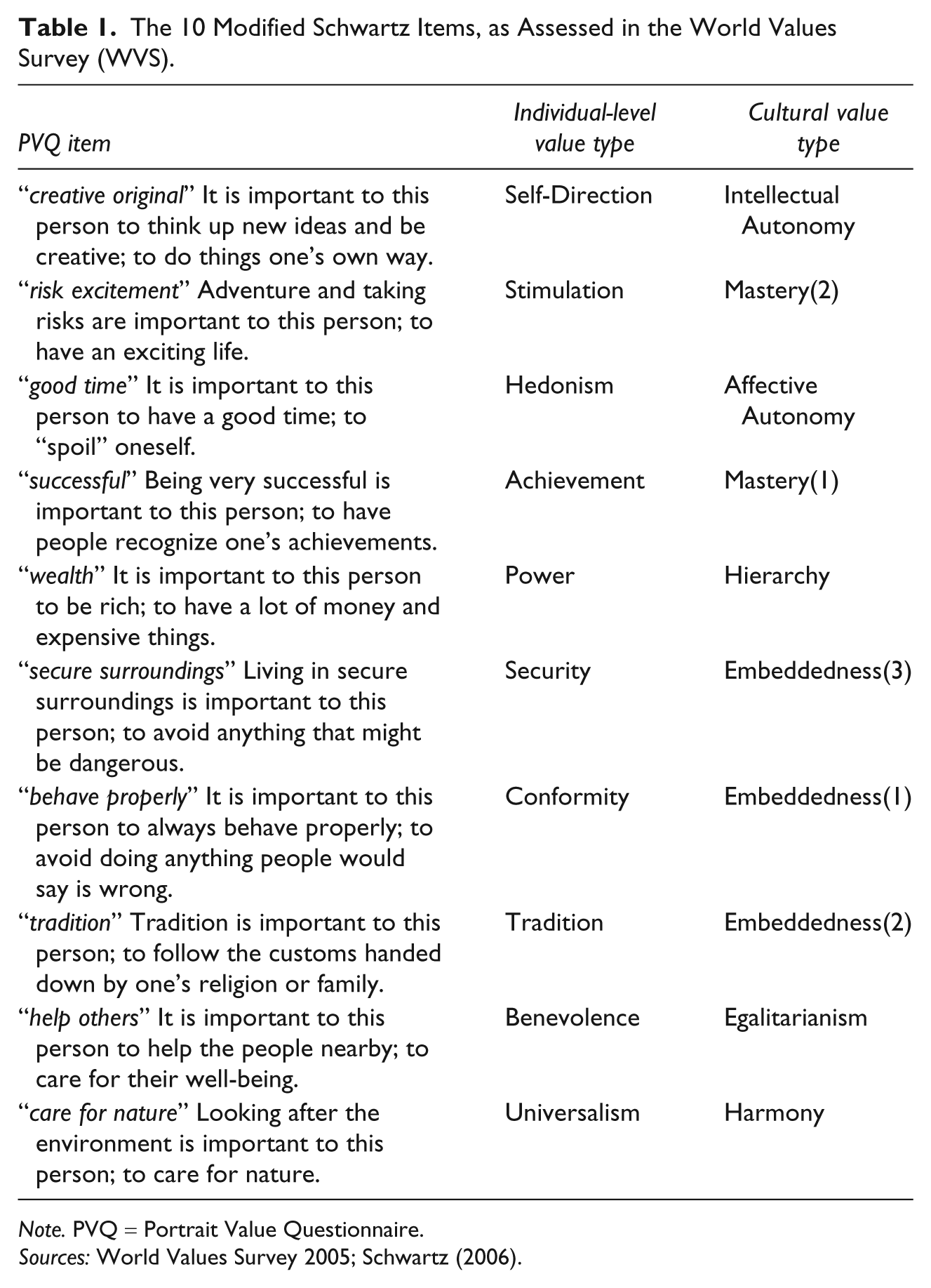
Note. PVQ = Portrait Value Questionnaire.
Sources: World Values Survey 2005; Schwartz (2006).
Inglehart (1997) initially used factor scores based on 22 variables to derive the two dimensions of the Cultural Map of the World. Without losing much of the model’s explanatory power, he later reduced these to 10 variables (eight single items and two indices; Inglehart & Baker, 2000), which are documented in Table 2.
The 10 Items for Inglehart’s Dimensions of Cross-Cultural Variation.
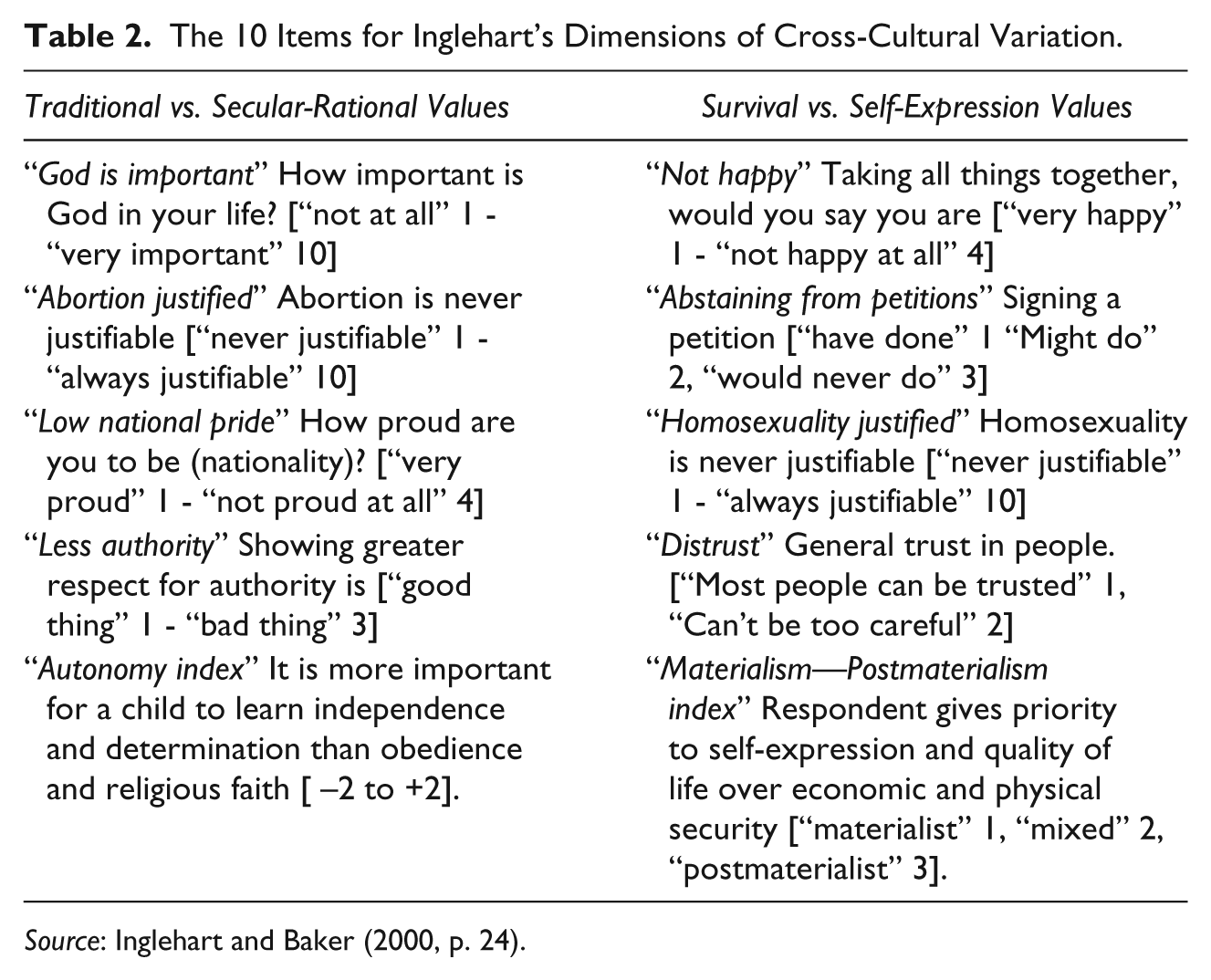
Source: Inglehart and Baker (2000, p. 24).
WVS 2005 to 2008
The fifth wave of the WVS data have been used in the present study, since it is the only international data set containing information of individuals on both Schwartz’s and Inglehart’s items. Thus, we used data from 47 national samples (with Germany split into East and West, to be coherent with the WVS literature), where all 10 variables for both models were administered, with a total sample size of 63,389 respondents. The initial sample sizes varied from 988 (West Germany) to 2,988 (South Africa) individuals per country (mean N = 988; SD = 345). Complete answers on the two scales of 10 variables were available for 46,444 individuals. Two more samples were used in order to demonstrate that our results are robust to the type of assessment required for Schwartz’s values.
Schwartz Value Survey
Schwartz and his colleagues collected SVS data from 1990 to 2005. We used the seven country-level value types from the 54 countries (N = 65,321) which were also involved in the WVS. The national sample sizes varied from 103 (Ethiopia) to 7,154 (Israel) cases (mean N = 1,210; SD = 1,525).
WVS Aggregated File
For a country-level comparison of Inglehart’s WVS measures with the SVS, we used the data of the WVS aggregated file (1981-2005) for the same countries (N = 180,534). We excluded responses surveyed before 1994 (mean N = 3,343; SD =2,444 ). The smallest number of participants came from France (N = 1,001), while the largest number came from South Africa (N = 13,255).
Data Preparation
As individuals are nested within countries, the WVS 2005 to 2008 data were decomposed into a pooled individual-level and a country-level component (see Muthén, 1994; Van de Vijver & Poortinga, 2002).
Biases in scale use, especially acquiescence—the general tendency to agree (or disagree) with all items presented—has been shown to vary cross-culturally, being stronger in traditional cultures (Smith, 2004). In our study, two types of items were included: those which are vulnerable to response style (Schwartz’s items, Inglehart’s justification of abortion and homosexuality, importance of God, unhappiness, and national pride) and those which are not supposed to be affected by such bias (Inglehart’s M—PM and Autonomy indices, as well as items with three or less scale points, namely, abstaining from petitions, distrust, and authority).
An alternative to the commonly used ipsatization (within-subject centering) is covariate correction, in which the mean rating given to all Schwartz items is treated as a covariate in all analyses conducted (our first adjustment variable). The covariate approach maintains the original distributions of responses and does not multiply the effects of error, but removes the effects of a subject’s (individual or country) differences in the mean response level (Schwartz, 2003).
The second adjustment variable was suggested by Smith (2011), who investigated communication styles in the WVS data. He identified 20 Likert-type scale items, which we used to correct for acquiescence in Inglehart’s items. This covariate variable was calculated in the following way: counting 1 for each of these items if the “strongly agree” box was ticked, 0.5 if the second most extreme answer was chosen, and 0 in all other cases. The sum of these was subsequently divided by the total number of items answered by the respondent. 5
The averages of these two adjustment variables were used to control for group biases in the use of the response scales (Schwartz, 1999; Smith, 2011). This simultaneous covariate correction procedure results in two partially controlled correlation matrices: one for each level of analysis (Appendix A1; A2).
Dimensionality Testing
Multidimensional scaling (MDS) is an alternative to factor analysis—used by Inglehart and Baker (2000)—to detect underlying dimensions, allowing researchers to interpret observed similarities or dissimilarities between the variables in a (partial) correlation matrix. MDS provides estimates of the relative distances between the items and does not require multivariate normally distributed data (Hill & Lewicki, 2006).
Results
In the following section, we describe a joint exploratory analysis of Inglehart’s and Schwartz’s items, to test whether it is possible to find common value dimensions underlying both value theories. Subsequently, we check the newly obtained dimensions for connections between their structures at the individual and country levels.
Country Level
A two-dimensional MDS representation of the relationship between Inglehart’s and Schwartz’s items at the country level, based on WVS 2005 to 2008 data, is presented in Figure 1(a; stress is .17). Schwartz’s quasi-circular structure came out relatively intact. In general, the first and second MDS dimensions reproduced Inglehart’s factors of cross-cultural variation (see Table 3). However, items located centrally in the MDS plot are less strongly associated with the underlying value dimensions (e.g., “low national pride”).
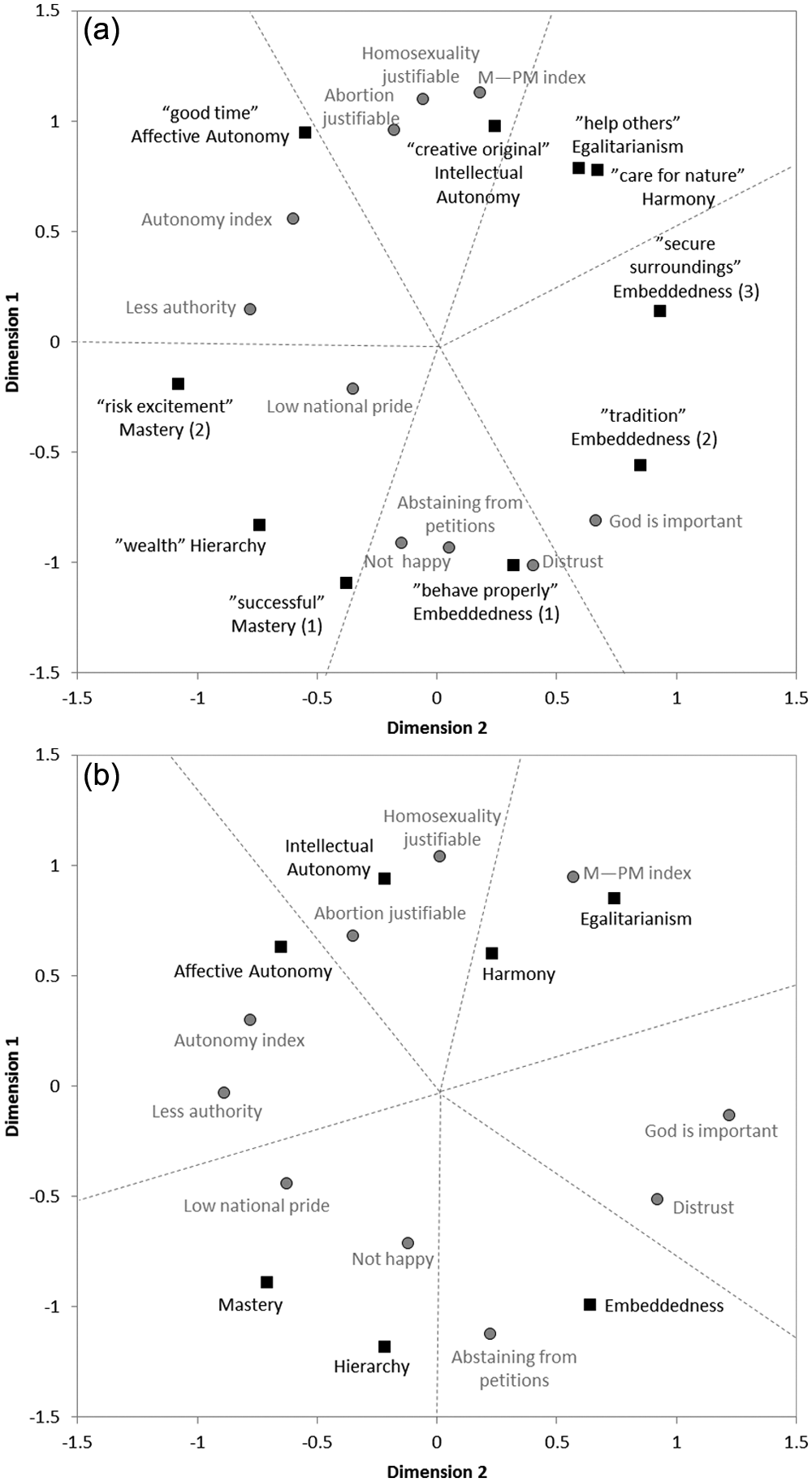
Multidimensional scaling plots at the country level based on (a) World values survey data and the (b) Schwartz values survey.
Dimension Coordinates of Joint Multidimensional Scaling of 20 Inglehart and Schwartz Items.
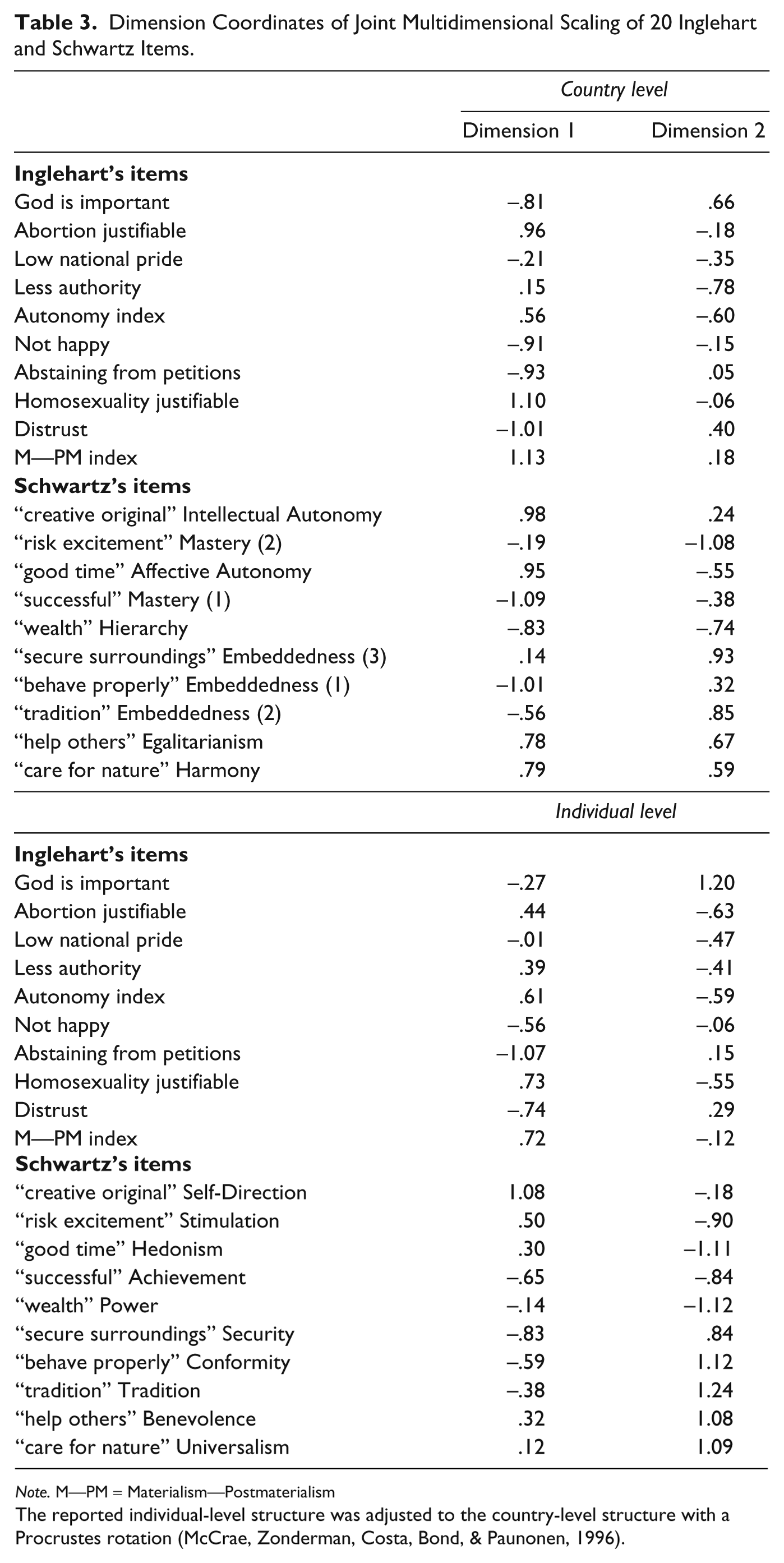
Note. M—PM = Materialism—Postmaterialism
The reported individual-level structure was adjusted to the country-level structure with a Procrustes rotation (McCrae, Zonderman, Costa, Bond, & Paunonen, 1996).
In order to make the description systematic, the plot was divided into six regions. In the lower right corner, “God is important” loaded together with the Embeddedness items of “tradition” and, at some distance, “secure surroundings.” The (opposing) upper-left corner is occupied by Schwartz’s Affective Autonomy, which shares the same region with the items belonging to Inglehart’s Secular-Rational values (“Autonomy index” and “less authority”). The “distrust” item was revealed to have a meaning similar to the “behave properly” item (i.e., Embeddedness) and initiated a lower-central region, which is defined by two more items belonging to Inglehart’s Survival pole (“abstaining from petitions” and “not happy”). The Self-Expression pole (and the “abortion justifiable” item) opposes this region, in the upper-central part of the plot. Here, the “M—PM index,” “homosexuality justifiable,” and “abortion justifiable” showed similarity in content with the Intellectual Autonomy item “creative original.” It appears that every region of the plot designated by Inglehart’s items includes at least one Schwartz item. The cultural values of Harmony and Egalitarianism merged in the upper-right corner. The (opposing) lower-left corner is defined by Mastery (1, 2) and Hierarchy cultural values.
This translates into three bipolar regions, which Schwartz (1999; 2004, 2006) would interpret as dimensions. These are Self-Expression and Intellectual Autonomy, opposing the “behave properly” item of Embeddedness; Secular-Rational, and Affective Autonomy opposing the “secure surroundings” and “tradition” Embeddedness items, as well as Inglehart’s Traditional values. We further identified an independent Schwartz Hierarchy-Mastery versus Harmony-Egalitarianism dimension.
Figure 1(b) presents, an MDS solution for the joint analysis of SVS and WVS data (stress is .14), which was conducted to demonstrate the robustness of our findings. The location of the seven cultural values generally confirms the association between Inglehart’s Secular-Rational values and Schwartz’s Affective Autonomy, as well as between Intellectual Autonomy and Self-Expression values. The strongest deviation was that Harmony changed order with Egalitarianism. The new location of Harmony indicates associations with Self-Expression values, that is, conceptually well-grounded (see Schwartz, 2006). Schwartz’s Embeddedness was located in the middle between Inglehart’s Survival and Tradition items. Overall, the relationships which we identified with the modified WVS PVQ were stable regardless of the data used. 6
Moreover, Schwartz’s and Inglehart’s originally proposed value structures were easily identifiable on the MDS plots (the respective coordinates of the analysis with SVS can be found in Appendix A3).
Individual Level
Concentrating on individuals, a two-dimensional MDS representation of the joint value structure of the WVS 2005 to 2008 data is presented in Figure 2 (stress is .13).
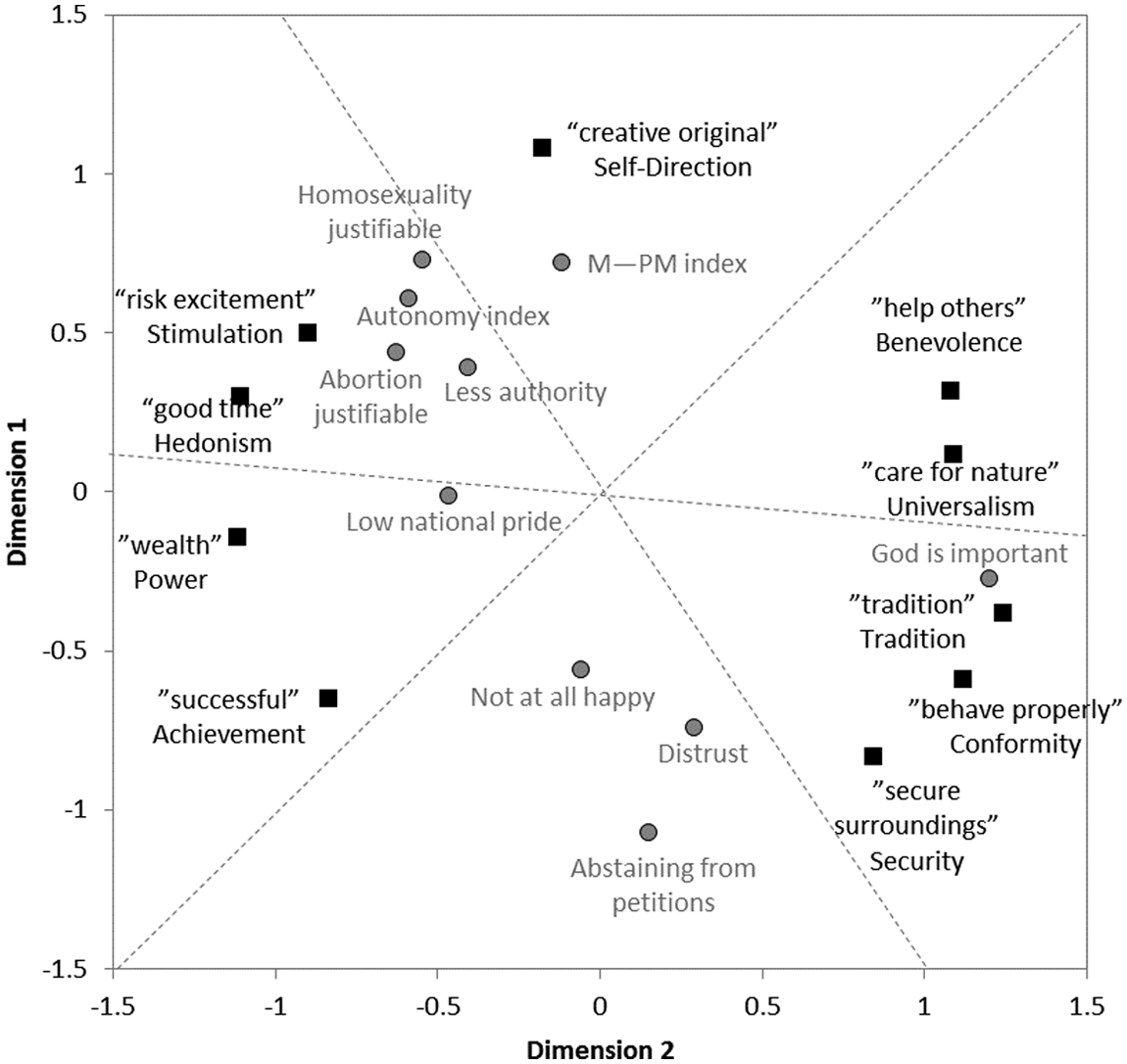
Multidimensional scaling plot of world values survey data (2005-2008) at the individual level.
We were able to identify six distinct regions on the MDS plot, which paired to form three bipolar dimensions. The first pair opposes the top region of the plot to the lower one and includes all but one Self-Expression item (although the fifth item “homosexuality justifiable” is located very close to this region on the plot), as well as Schwartz’s Self-Direction. It seems that Survival values occupy a distinct region and are not captured by any of Schwartz’s items.
The second pair opposes the upper-left region to the lower-right and includes all the Secular-Rational items and most of the Conservation versus Openness items (only excluding Self-Direction). It merely demonstrates a merger of Traditionalism and Conservation as well as Openness and Secular-Rational values.
The third pair consists of the lower-left and upper-right regions of the plot, opposing the Self-Enhancement to the Self-Transcendence items only.
Summing up, at the individual level, there might, surprisingly, be only one dimension of shared value content—Traditional versus Secular-Rational values and Schwartz’s Conservation versus Openness—which might be explained by the present sample being more diverse than in earlier studies. The other opposing regions demonstrate a weaker than expected relatedness—Inglehart’s Survival versus Self-Expression dimension only includes one Schwartz item (Self-Direction), which alone is highly unlikely to define a whole dimension. However, these two Inglehart dimensions were located adjacent to each other on the MDS plot, an issue which we discuss below. The final dimension is independent of the other theory: Schwartz’s Self-Enhancement versus Self-Transcendence dimension is not represented by any of Inglehart’s items.
Our aim was to stress the common and unique content behind these 20 items, not to reduce them to the initial value dimensions. However, looking at the entire pattern of coordinates, we can see that item locations, to a great extent, follow the Schwartz value circle—spanning on the Self-Enhancement versus Self-Transcendence and the Conservation versus Openness dimensions. One can further find both Inglehart dimensions with only minor deviations from the proposed structure also in individual-level data (see Table 3).
Assessment of the Similarity of Value Structures Across Levels
Finally, it seems reasonable to ask whether the structures of values at country and individual levels are similar. Table 3 lists dimension coordinates of WVS 2005 to 2008 data separately for each level. Van de Vijver and Poortinga (2002) employed a special type of multilevel factor analysis to test for similarity of structures across levels. Value structures of MDS configurations can be compared empirically by correlating the loadings obtained at different levels, which are also called Tucker’s Ф values or coefficients of congruence (Lorenzo-Seva & ten Berge, 2006). This procedure identifies shifts in the psychological meaning of variables due to aggregation. This approach is a test for cross-level isomorphism, or structural equivalence, indicated by a Tucker’s Φ of > .95. As mentioned above, Fischer and colleagues (Fischer, 2012; Fischer & Poortinga, 2012, Fischer et al., 2010) found a partial isomorphism at the very edge of the identity of structures across levels for the Schwartz values. Inglehart and his colleagues (Inglehart & Baker, 2000; Inglehart & Welzel, 2005) simply assumed isomorphism of their value dimensions. Indeed, after excluding some diverging countries, the cross-level correlations for Inglehart’s M—PM index were found to be very high (van de Vijver & Poortinga, 2002).
As in MDS the orientation of axes is arbitrary (Hill & Lewicki, 2006), we adjusted the reported individual-level structure to the country-level structure with a Procrustes rotation (McCrae et al., 1996), so that the axes would be most similar, but without changing the relative distances between the items. The MDS configurations showed some dimensional agreement (Table 4), with a Tucker’s Φ of .82 for Dimension 1 and .89 for Dimension 2.
Cross-Level Correlations of Multidimensional Scaling Dimensions.

Note. *p < .001.
It appeared rational to follow the approach described by van de Vijver and Poortinga (2002), who excluded the most divergent items from the analysis to increase cross-level correlations, which otherwise would be overly affected by particular outliers. The analyses suggested that there were items with poor fit: namely, “less authority,” “risk excitement,” and “secure surroundings.” After omitting these three items from the MDS results, structural equivalence correlations increased to .91 for Dimension 1 and .93 for Dimension 2. Even though Tucker’s Ф is quite a liberal indicator, we revealed a remarkable amount of structural invariance across levels. But the similarity of structures across the two levels fails to fulfill the criteria for a strict isomorphism.
General Discussion
To shed more light on the major issue of the similarity of the widely used value theories of Inglehart and Schwartz, we demonstrated how they relate to each other in joint analyses of their items.
Country Level
Hypothesis 1 has been confirmed, with some refinements. Indeed, Schwartz’s Embeddedness coincided with Inglehart’s Survival values, and was opposed to Intellectual Autonomy and Self-Expression values. The refinement is that only Intellectual Autonomy coincided with Self-Expression, and not with Affective Autonomy or any Embeddedness values; however, the specific component of Embeddedness varied across the samples. Given that different measures (WVS PVQ; SVS) and participants (representative; student and/or teacher) were used, we found broad similarity in the results. Thus, it is reasonable to claim that the respective value content of the two theories strongly parallels. This common value dimension taps cross-cultural differences in creativity and emphasizes autonomous human choice on the one side and conformity and materialism on the other (see also Fischer & Boer, 2011, who used a combined index for Autonomy/Self-Expression/Individualism as a reliable country-level indicator).
As was hypothesized, Egalitarianism was also located close to Self-Expression, but this cultural value seems to belong to a distinct region (see below).
Hypothesis 2 was predominantly confirmed as well. Items belonging to Traditional versus Secular-Rational values appear to share more than the expected content with facets of Embeddedness and Affective Autonomy. This result differs from our hypothesis, which claims that, in addition, Intellectual Autonomy and Harmony coincide with this Inglehart dimension.
Therefore, at the country level, Embeddedness appeared to be closely related to both Traditional and Survival values. Inglehart assumed that Survival and Traditional values are different, whereas Schwartz claims that Embeddedness is a single value type. As Schwartz’s values are more general in nature than Inglehart’s, these results may imply that Embeddedness includes two particular subtypes of values, namely, Survival and Traditional authority, which appear in different economic and social situations and have different consequences for societal development. So, although Inglehart’s Traditional and Survival values are very similar, differing only by presence of a higher authority (like religion), they can be viewed as two expressions of more fundamental and abstract Embeddedness values. The opposed poles merged with different Schwartz value types: Self-Expression with Intellectual Autonomy and Affective Autonomy with Secular-Rational values. Following the same logic, these Inglehart values may be seen as two different facets of Autonomy. As a historically earlier phenomenon connected with modernization, Secular-Rational values based on Affective Autonomy may be seen as the independence of affect and feelings from communal ties. The “We” takes its first steps toward becoming an “I.” This might be a precondition for this raising of self-expressive values (e.g., subjective well-being), which, however, is then essentially based on Intellectual Autonomy as a part of a historically more recent value shift (postmodernism). 7 Consequently, Inglehart’s measures were nested one-dimensionally (in Figure 1[a] somewhat more than in Figure 1[b]) within an accurately reproduced quasi-circular Schwartz structure (see also Dobewall & Strack, 2013). The findings might be best interpreted in a way that Schwartz’s Embeddedness versus Autonomy dimension lies at the diagonal of Inglehart and Welzel’s (2005) Cultural Map of the World.
Most importantly, a recent study showed that Self-Expression values may have a social element (Welzel, 2010). We found that this Inglehart dimension goes together with Intellectual Autonomy, which provides new insight into the meaning of Schwartz’s Autonomy values: that is, they are not necessarily egocentric values, but self-directed yet social values. This adds to Vauclair and colleagues’ (2011) identification of a new value type of Self-Fulfilled Connectedness between Schwartz’s Autonomy and Egalitarianism, which contains values that represent profound attachment to others, as well as attributes of self-fulfillment. Values of Self-Fulfilled Connectedness indeed correspond to the approximate location of where we found Self-Expression and Intellectual Autonomy to collapse (Figure 1). True individualism seems to include a component of mature self-responsibility (Realo, Koido, Ceulemans, & Allik, 2002), or, as Allik and Realo (2004) put it, “the autonomy and independence of the individual may be perceived as the prerequisites for establishing voluntary associations, trusting relationships, and mutual cooperation with one another” (p. 45).
Hypothesis 3 was fully confirmed and the results even expanded the unique value content. It seems that Schwartz’s cultural values of Hierarchy–Mastery versus Harmony–Egalitarianism are not replicated in the Inglehart items. We argue that these cultural values are correlated with Inglehart’s dimensions (see Schwartz, 2004), but they seem to describe something different, which is not captured by Inglehart’s value concept. There were two minor exceptions: the conceptually unrelated “low national pride” item was found to be related to Mastery. At the same time, our study is the first that has been able to confirm empirically that Harmony, indeed, weakly relates to Self-Expression, indicating that they share an emphasis on generalized trust and protection of existing environments.
Individual Level
Concentrating on individuals, our findings challenge the thesis that Inglehart’s Self-Expression overlaps with Schwartz’s Growth (Hypothesis 4). In our reading, there is an overlap between Self-Expression and Self-Direction but Inglehart’s items measuring Survival values, in particular, tend to capture value content which is not covered by Schwartz’s items, at least those included in the WVS (see Schwartz et al., 2012, who differentiate, in their refined theory, 19 more finely-tuned value types). They have a distinct region on the plot, which points to the uniqueness of these value measures. This finding supports Fischer and colleagues’ (2011) claim that there is a content domain of Survival values covered by Inglehart’s items that is underrepresented among Schwartz’s measures. Another explanation for the lack of coverage is theoretical, as Schwartz’s measures are not supposed to measure nonvalue items (unhappiness, distrust, and abstaining from signing petitions), which represent the Survival pole.
Hypothesis 5 was supported. The MDS loadings intermixed Inglehart’s Traditional and Secular-Rational values with Schwartz’s items belonging to the Conservation and Openness values (except for Self-Direction). The content of “secularization of authority” (Inglehart & Welzel, 2005, p. 29) seems to describe the same motivational distinction as the Conservation versus Openness dimension. Therefore, these two sets of value content may be interpreted as replicating each other, but the strength of the association was unexpected, as earlier work (e.g., Held et al., 2009) found a much weaker relationship between Secular-Rational values and the Openness dimension.
However, examining the overall pattern of MDS coordinates, Inglehart’s items lay along a single axis within Schwartz’s value circle, which started between Stimulation and Self-Direction, and ended close to the Security and Tradition items. This suggests that, included in a more general Schwartz framework, Inglehart’s items form a single dimension, which parallels the Conservation versus Openness dimension. It implies that in order to be open, a person needs to have both self-expressive and secular-rational values, whereas conservatism involves both traditional- and survival orientations. This reasoning is not new, as Kagitcibasi’s (1996) individual-level concept of an autonomous-relational self organizes self-construals on two distinct dimensions, which are agency (i.e., one’s capacity for autonomous action) and interpersonal distance (i.e., the importance of relatedness with others).
The last hypothesis stated that Schwartz’s Achievement and Benevolence are reflected neither by Inglehart’s items nor his dimensions. The results confirmed this, but on an even a larger scale than theorized: Self-Enhancement versus Self-Transcendence value items formed a distinct region on the MDS plot. Even though the Survival versus Self-Expression dimension was earlier found to be somewhat correlated with both of Schwartz’s dimensions, Self-Enhancement versus Self-Transcendence captures value content which is not assessed by the other theory. This is not surprising, since Schwartz aimed to develop a comprehensive set of basic individual values whilst Inglehart selected value indicators primarily for explaining social and political change.
At both levels, we were able to generally confirm Inglehart’s and Schwartz’s originally proposed dimensions. The commonalities and unique components, which we have reported, were not entirely the same across the two levels. Strict cross-level isomorphism or structural equivalence between levels was not supported by our findings, but a remarkable cross-level similarity was nevertheless found, even though two sets of items of the different theoretical backgrounds were analyzed. Thus, we presented empirical evidence that country- and individual-level analyses provide unique insight into both theories of basic (value) dimensions on which individuals and countries differ, meaning that Schwartz (2010) but also Fischer (e.g., Fischer, 2012) are right in differentiating between the two levels, while also having to consider substantial similarities.
Regarding the overlap of mental representations of values (Schwartz) and attitudes (Inglehart; who uses nonvalue items with the exception of the M— PM index and the importance rating regarding individual religiosity) in one system, which is well supported in Boer and Fischer (2013), but also when looking at Saucier’s (2000) “isms,” it can be seen that social attitudes are systematically underpinned by values and therefore mirror the value structure. Boer and Fischer (2013), however, used attitude-value correlations, being unable to uncover degrees of uniqueness and commonality in the underlying structures. Hence, using a joint analysis of items based on the Inglehart’s attitude approach and Schwartz’s value approach to culture goes beyond previously established links between attitude and value structures.
Limitations
The first qualification is that it remains possible that theoretically assumed structures of values vary in practice across countries. Earlier studies generally confirmed Inglehart’s structure (van de Vijver & Poortinga, 2002; Welzel, 2010), but the invariance across countries of Inglehart and Baker’s (2000) dimensions has never been tested (see Ippel, Gelissen, & Moors, 2013, on the invariance of the M—PM index). For human values, Schwartz (1992, 1999) confirmed the universality of his quasi-circular structure, however, the degree of invariance decreased as less value items were assessed (Davidov, Schmidt, & Schwartz, 2008; see also Morselli, Spini, & Devos, 2012, concerning the equivalence of the WVS PVQ). For the purpose of this exploratory study, the invariance of the originally proposed value constructs is less important, as we were interested in their overall relationship as part of a joint analysis of the underlying items. We consequently assumed, but did not test, the stability of the value structures across the WVS 2005 to 2008 countries. Future work should address this issue, which is beyond the scope of the current study. The alternative, an exclusion of some—less economically developed—countries with a deviating value structure (see Fontaine et al., 2008; Strack & Dobewall, 2012) would decrease the coverage of the data but only slightly affect the overall results. This would unnecessarily reduce the N at the country level, making results at this level less stable.
The second limitation concerns the choice and preparation of the 10 modified PVQ items included in the WVS 2005 to 2008. The merging of adjacent value types such as, for example, Benevolence and Universalism indicated that one item for each value type cannot fully capture all varieties of a segment of the value circle as the instrument has a different wording, different modes of survey, and higher acquiescence (Rudnev, 2011). We repeated our analysis at the country level with the data of the SVS and were able to confirm the robustness of our findings.
Conclusion
This article contributes to the existing literature in many ways: by presenting joint analyses of Schwartz’s and Inglehart’s value measures, by identifying common content and unique features underlying both theories, and by enriching the debate about the similarity of value structures across levels of analysis.
We provided empirical evidence of (a) a substantial overlap between the two theories but also (b) their complementary contribution to important social and personal issues. Further, we show that (c) country- and individual-level analyses, while disclosing very similar value structures, provide unique insights into both sets of basic (value) dimensions of individual and cultural variation. Most importantly, Inglehart’s and Schwartz’s theories are neither mutually inclusive nor redundant, rather they provide meaningful extensions of each other, which is an important insight for researchers in cross-cultural psychology, as well as the political and social sciences. Focusing on items, the results of this study help us to move a little closer to understanding the value component of culture.
Footnotes
Appendix
Dimension Coordinates of Joint Multidimensional Scaling of Inglehart’s 10 WVS Items and 7 SVS Cultural Values.
| Dimension 1 | Dimension 2 | |
|---|---|---|
|
|
||
| God is important | −.13 | 1.22 |
| Abortion justifiable | .68 | −.35 |
| Low national pride | −.44 | −.63 |
| Less authority | −.03 | −.89 |
| Autonomy index | .30 | −.78 |
| Not happy | −.71 | −.12 |
| Abstaining from petitions | −1.12 | .22 |
| Homosexuality justifiable | 1.04 | .01 |
| Distrust | −.51 | .92 |
| M—PM index | .95 | .57 |
|
|
||
| Harmony | .60 | .23 |
| Embeddedness | −.99 | .64 |
| Hierarchy | −1.18 | −.22 |
| Mastery | −.89 | −.71 |
| Affective Autonomy | .63 | −.65 |
| Intellectual Autonomy | .94 | −.22 |
| Egalitarianism | .85 | .74 |
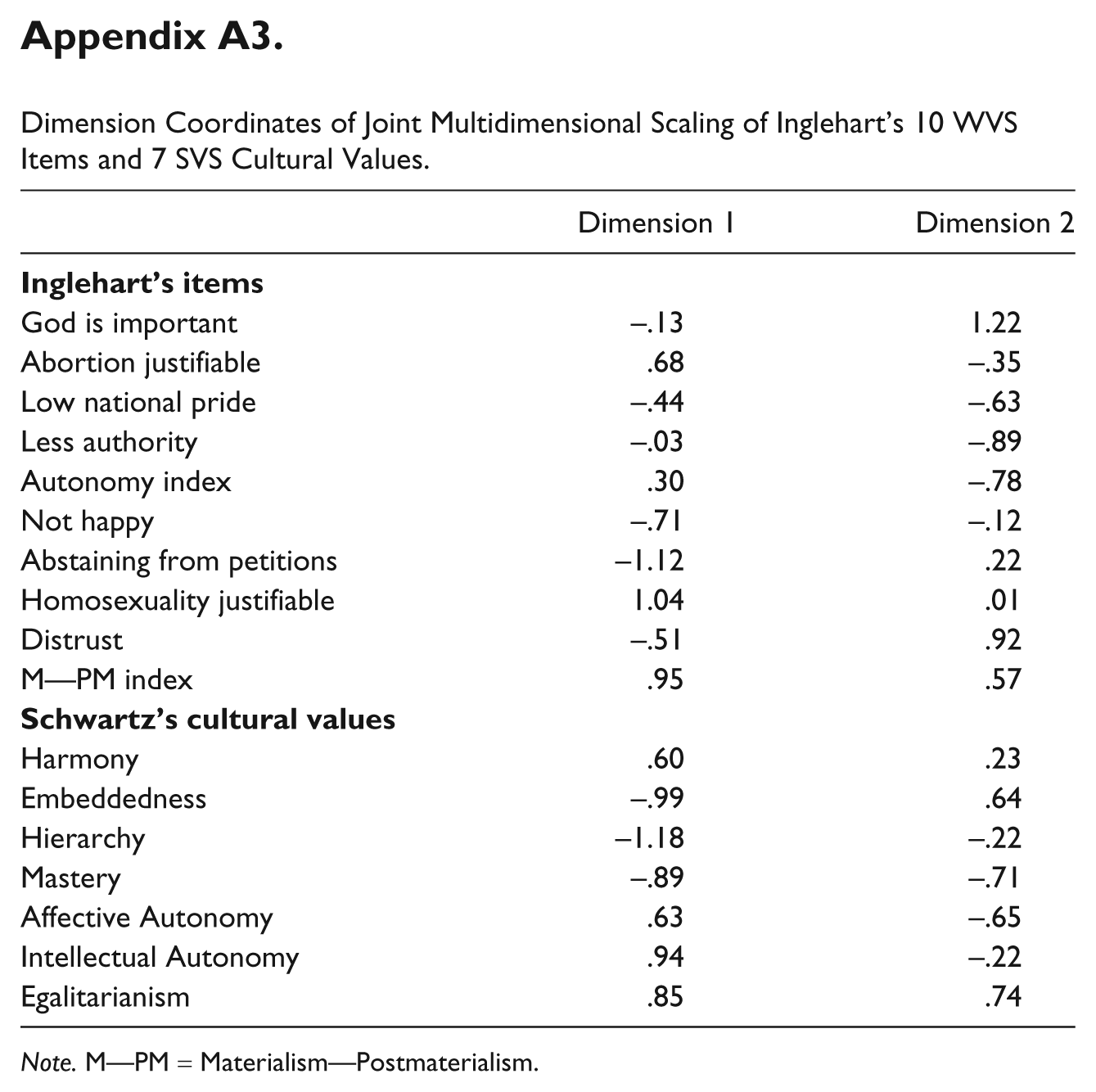
Note. M—PM = Materialism—Postmaterialism.
Acknowledgements
The authors would like to thank the anonymous reviewers for their insightful comments, as well as Diana Boer, Ronald Fischer, Vladimir Magun, Anu Realo, Delaney Michael Skerrett, Micha Strack, Christin-Melanie Vauclair, and Christian Welzel for their comments on earlier versions of the manuscript.
Declaration of Conflicting Interests
The authors declared no potential conflicts of interest with respect to the research, authorship, and/or publication of this article.
Funding
The authors disclosed receipt of the following financial support for the research, authorship, and/or publication of this article: This article was supported by the European Social Fund’s Doctoral Studies and Internationalization Program, DoRa. The work of the second author is an output of a research project implemented as part of the Basic Research Program at the National Research University Higher School of Economics (HSE). This author is also grateful for the support of the Laboratory for Comparative Social Research of the HSE.