



Abstract
This study examined responses to questions oriented toward revealing the development of perspective taking. The sample comprised 180 three- to nine-year-old children in four traditional communities (in Belize, Kenya, Nepal, and American Samoa). Ten scenarios that asked the children about knowledge of handedness and also what was visible from their own and from another person’s perspective were used. In all groups, the proportion of correct answers improved with age. Degree of industrialization—which had predicted better cognitive performance in other testing with these same children—was also a predictor of perspective taking on some of the items. Discussion includes possible interpretation of the results.
This research discusses the development of perspective-taking skills in children 3 to 9 years of age in four traditional cultural communities. The development of perspective taking is fundamental to cognitive and social functioning. This capability enables the understanding of another’s point of view and, as such, it is a critical component of social cognition and related capabilities such as theory of mind and understanding of intentionality. Perspective taking is also pivotal to cultural learning. According to Tomasello, Kruger, and Ratner (1993), “In cultural learning, learners do not just direct their attention to the location of another individual’s activity; rather, they actually attempt to see a situation the way the other sees it—from inside the other’s perspective, as it were” (1993, p. 496).
Piaget (1928) introduced the study of the development of visual perspective taking in his research on egocentrism in young children. For Piaget, the changes in thinking that occur when children are able to adopt perspectives other than their own are critical to the transition from the preoperational to the concrete operational stage. These changes in thinking reflect the understanding that objects (including people) can be viewed from different vantage points and that each vantage point provides unique, albeit partial, information about an object (Flavell, 1992). Research on visual perspective taking has found significant changes in this ability in the preschool years, and Flavell and his colleagues introduced two developmental levels of visual perspective taking to describe these changes (Flavell, Everett, Croft, & Flavell, 1981; Masangkay et al., 1974). Children at Level 1, who are around 2.5 years of age, are capable of nonegocentric visual perspective taking on simple tasks. These children can understand that another person can see something that the child does not see. Children at Level 2, which appears between 4 and 5 years of age, possess more complex perspective-taking skills. They understand that the same object can be viewed from different vantage points and, also, that these different views yield different information. For example, a child at Level 2 understands that a picture positioned on a table and facing the child will appear upside down to the person sitting on the opposite side of the table.
Although there has been extensive research on the development of visual perspective taking in Western communities, there has been little study of this process in non-Western settings. An early study by LeVine and Price-Williams (1974) examined left–right orientation among 4- to 11-year-old Hausa children in Nigeria, a type of inquiry that in some formulations is related to Level 2 perspective taking. These researchers found that Hausa children developed understanding of left–right orientation about features of their own body and about features of another’s body early in the school years, which is about the same age found among children in Western communities. In a follow-up study in which they discussed their results in relation to research involving children in Western settings, Price-Williams and LeVine (1974) commented that the performance by the Hausa children may have resulted from early training in differentiating the left and right hands as part of a specific cultural practice (Islamic toilet training).
In this research, we concentrate on two aspects of the development of perspective taking, the ability to take the visual perspective of another person and the understanding of left–right orientation. We examined the performance of children in four traditional, non-Western societies on several tasks using data collected by R. H. Munroe and R. L. Munroe in 1978-1979 in communities of Garifuna in Belize, Logoli in western Kenya, Newars in Nepal, and Samoans in American Samoa (Gowdy, Munroe, & Munroe, 1989; Munroe, Shimmin, & Munroe, 1984). The four communities differed geographically and linguistically and, at the time of data collection, had no contact with each other. Some of the tasks tapped Level 1 reasoning by asking children if another person can see an object that the child sees but is blocked from the other person’s view by a barrier, and vice versa. There were also several tasks pertaining to children’s understanding of left–right body orientation regarding the self and another person; these tasks draw on the type of knowledge implicated in Level 2 perspective taking. Because the children in this study range from 3 to 9 years of age, they cover the ages when development in these skills has been reported in Western samples. Based on the findings reported by LeVine and Price-Williams (1974), we expected age-related differences with older children showing greater skill than younger children, on these tasks.
In the larger data set from which this segment has been extracted, Gauvain and Munroe (2009) reported a strong association between children’s cognitive performance on a variety of measures and the presence of features associated with industrial and postindustrial societies, such as books, electricity, television sets, and ownership of a motor vehicle. Children in American Samoan and Belizean (Garifuna) communities, which exhibited numerous facets of the industrial world, outperformed those in the Nepalese (Newar) and Kenyan (Logoli) samples where there were far fewer of these features. This difference in performance existed even when the Samoan and Belizean children’s somewhat higher educational levels were statistically controlled. We expected the same trend to appear in the present data set, namely, an earlier appearance of perspective-taking competence among the Samoan and Belizean sample children than among Nepalese and Kenyan children. We expected this community-related pattern to be due to differential experience with materials that incorporate this type of perspective taking, such as the various points of view offered in books and other forms of media, including television programs.
As to education itself, children in three of the sites attended primary school and stayed there once they were of age, but in Nepal there was a subset of 8 older children (among 24) who were not school-goers and had never attended school. (A single older child in Kenya had never gone to school.) Schooling’s relation to cognitive performance has been positive in some cross-cultural studies, not in others (Cole, 2005), and our interest was to investigate the outcome for perspective-taking performance among the children in relation to years in school.
To sum up, we expected higher perspective-taking scores among older children than younger ones, and better performance for the Samoan and Belizean children than for the Nepalese and Kenyan samples. Although the contribution of educational level to cognitive development was also a subject of interest, we made no definite prediction due to conflicting evidence in prior research.
Method
Participants
A total of 180 children from the four communities (American Samoans, n = 47; Garifuna, n = 47; Logoli, n = 45; Newars, n = 41) participated in the study. After an initial village census, sample children were chosen primarily on the basis of age; boys and girls in the four categories of 3, 5, 7, and 9 years of age whose birthdates most nearly matched each other within communities were invited to participate. The final sample included 39 three-year-olds (20 boys), 46 five-year-olds (23 boys), 48 seven-year-olds (24 boys), and 47 nine-year-olds (24 boys).
Schooling varied by community. The Samoans followed an age-graded system, with all the 7-year-olds being second graders and all 9-year-olds being fourth graders. The Garifuna typically began school at age 5, but soon began spreading over several grade levels, ahead and late relative to the usual age-graded system, though all “older” children (7- to 9-year-olds) were attending school. Logoli children exhibited the largest spread in grade levels, and a majority was below expected level for age. All older Logoli sample children attended school with the exception of one 7-year-old boy. Newar children began schooling at relatively late ages and the modal grade for all those in attendance was first grade. Among older children, 8 of the 12 girls were not attending school, a unique factor in the distribution of educational access in the four samples due to preferential treatment of male children.
Measure of Community Industrialization
Community industrialization was measured by tallying, within each participating home in the sample communities, the possession of seven communicative and literacy-based appurtenances and other economically advantageous resources typically considered indices of societal industrialization. Typical elements included radios, books, electricity, and running water. As reported in a previous study (Gauvain & Munroe, 2009), the highest mean scores for these features were achieved in Samoa (82% possession of the seven items in the households of 48 children), the second highest in Belize (51%), the third in Nepal (39%), and the lowest in the Kenyan community (28%). We used this rank ordering of the communities in the present analyses.
Testing Procedure
The perspective-taking items were administered as part of a battery of tests (Gauvain & Munroe, 2009). A female and male experimenter indigenous to each community administered the measures to the children in the child’s native language. Both experimenters were present throughout the testing session. Children of 5 to 9 years of age were tested in a central location in each community, and those of 3 years of age were tested in or near their homes using the same procedure and under conditions that provided as much privacy as possible.
Perspective taking was assessed with a series of 10 questions involving an experimenter, the child, and a small doll. Six questions pertained to left–right body orientation and four questions asked, under varying conditions, whether the child or experimenter could see the doll. For the left–right body orientation questions, the experimenter first asked the child to hold up his or her hands and, in turn, the experimenter asked the child to identify his or her right hand (Question 1) and his or her left hand (Question 2). Next the experimenter, facing the child, held up her own hands and asked the child to identify the experimenter’s right hand (Question 3) and then her left hand (Question 4). Then the experimenter turned her back to the child and raised her hands facing outward and asked the child to identify the experimenter’s right hand (Question 5) and then left hand (Question 6). The remaining four questions involved the doll. The experimenter introduced the doll and held it so that it was visible to the child but blocked from the view of the experimenter. Then the child was asked, first, if he or she could see the doll (Question 7) and, second, if the experimenter could see the doll (Question 8). The experimenter held the doll so that it was visible to the experimenter but blocked from the child’s view, and the child was asked if he or she could see the doll (Question 9), and then if the experimenter could see the doll (Question 10).
For each question, the child was asked to answer only “yes” or “no” or to point, and each response was coded as correct (value = 1) or incorrect (value = 0). For the analyses, the items were organized into 5 sets, as follows: the first two questions involving the child’s own hand were combined (Child Hands), the two questions involving the experimenter showing her hands when facing the child were combined (Experimenter Facing Child), the two questions involving the experimenter showing her hands with her back to the child were combined (Experimenter Back to Child), the two questions in which the doll was visible to the child but not the experimenter were combined (Doll Visible), and the two questions in which the doll was not visible to the child were combined (Doll Not Visible). These groupings resulted in 5 different scores for each child, with each score ranging from 0 to 2.
Plan of Analysis
Correlational analysis was used to examine the interrelations of the dependent variables and to determine if child age and the presence of community features associated with industrialization were related to children’s performance on the perspective-taking questions. Then, partial correlations were used to determine if experience in school contributed to this performance. Children’s mean scores on the questions were then analyzed with Analysis of Variance to test for differences by age and cultural community. To explore any significant group differences, pairwise comparisons, using Tukey’s Honestly Significant Difference (HSD) tests, were conducted.
Results
A preliminary t-test comparing males and females disclosed no overall sex differences and the data were collapsed on this dimension.
Correlation results, reported in Table 1, indicate strong positive relations between child age and performance on questions about left–right orientation of their own hands and perspective-taking questions that involved the doll. The correlations also suggest relations between the presence of community features associated with industrialization and three sets of questions: those involving the experimenter’s hands and those posed when the doll was visible to the child. Intercorrelations among the dependent variables suggest some relation among these items, with 4 of the 10 correlations significant, which indicates that these items are tapping similar understanding, but that they are not completely redundant.
Correlations Among Dependent Variables and Between the Dependent Variables and Child Age and Community Industrialization.

p < .10. *p < .05. **p < .01. ***p < .001.
To examine if schooling explained children’s performance, we correlated years in school with performance on the perspective-taking questions controlling for child age. The pattern and magnitude of the correlations were unchanged from those shown in Table 1, which suggests that performance on these questions is not explained by children’s experience in school.
Before proceeding with other analyses, however, we want to report the performance of the eight older Nepalese girls (four each at ages 7 and 9) who, unlike older sample children in the other culture groups, had never attended school. Briefly put, these girls were poorer in performance on the “Doll Visible” variable, t(22) = 2.77, p < .02, which in essence means they did not discern well that the doll, visible to them, could not be seen by the experimenter due to a barrier. There was also a tendency for the unschooled girls to misapprehend which of the experimenter’s hands (left or right) was raised when her back was turned to the child, t(22) = 1.82, p < .10. These are not compelling differences.
Child Age
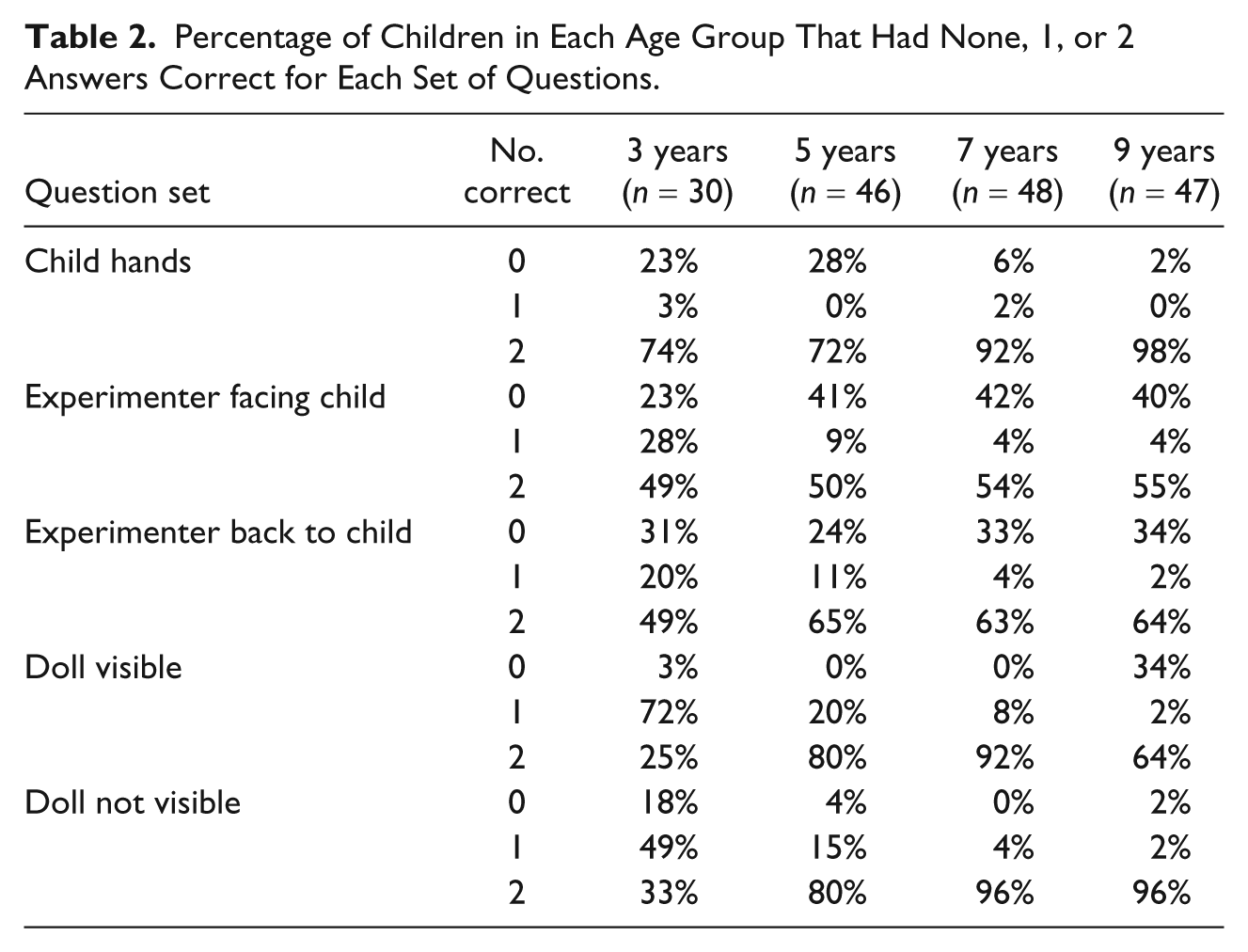
Table 2 shows the percentages of children in each age group who answered the questions in each set correctly and Table 3 shows the mean scores for the sets of questions for each age group. As seen in the tables, most of the children understood and were able to answer questions pertaining to their own hands, with older children more successful than younger children, F(3,164) = 6.07, p < .001, η2 = .10. Follow-up t-tests revealed that 9-year-olds performed better than 3- and 5-year-olds, t = −.44, p < .01, and t = −.52, p < .05, respectively, and 7-year-olds performed better than 5-year-olds, t = −.42, p < .05.
Percentage of Children in Each Age Group That Had None, 1, or 2 Answers Correct for Each Set of Questions.
Mean (and SDs) for Perspective-Taking Variables by Child Age.
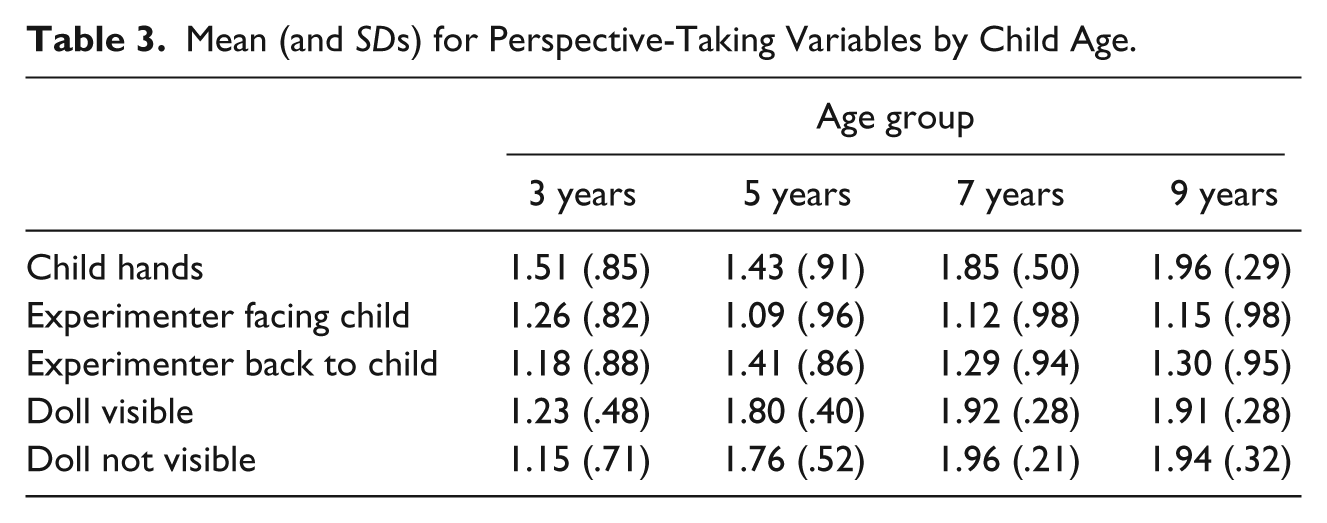
Older children also performed better on questions involving the doll, F(3,164) = 39.28, p < .001, η2 = .42 (Doll Visible), and F(3,164) = 24.67, p < .001, η2 = .31 (Doll Not Visible). Post hoc tests revealed that 3-year-old children performed less well than all the other children on these questions, with t-values ranging from −.57 to −.80, all p < .001. There were no age effects for questions involving the experimenter’s hands, facing child, F(3,164) = .22, ns; back to child, F(3,164) = .33, ns.
Community Industrialization
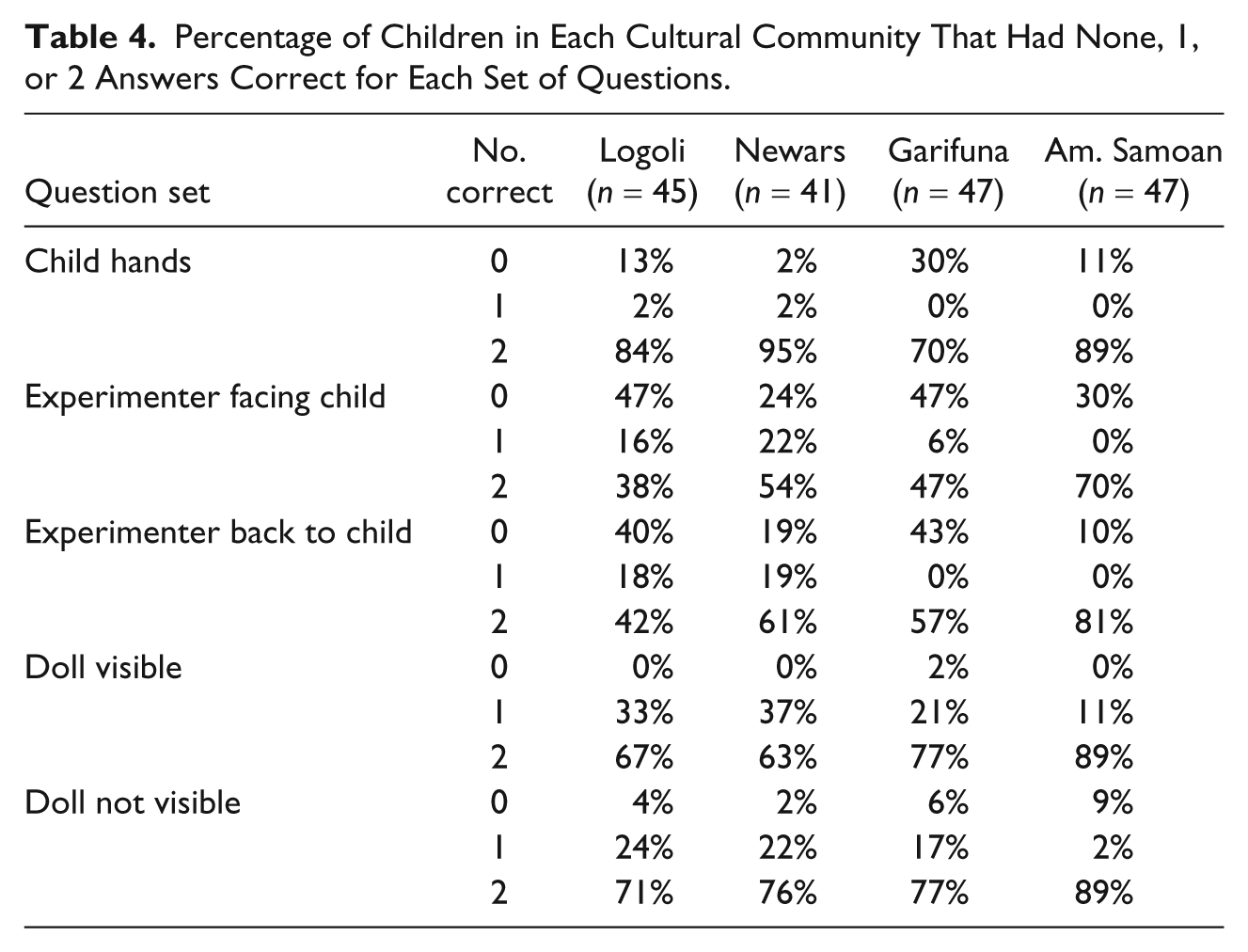
Table 4 shows the percentages of children in each cultural community who answered the questions in each set correctly and Table 5 shows the mean scores for the five question sets per group. There were main effects for culture on four of the five sets of questions and all but one of these differences reflected better performance among children from the most industrialized community in the sample, American Samoa.
Percentage of Children in Each Cultural Community That Had None, 1, or 2 Answers Correct for Each Set of Questions.
Means (and SDs) for Perspective-Taking Variables by Cultural Community.
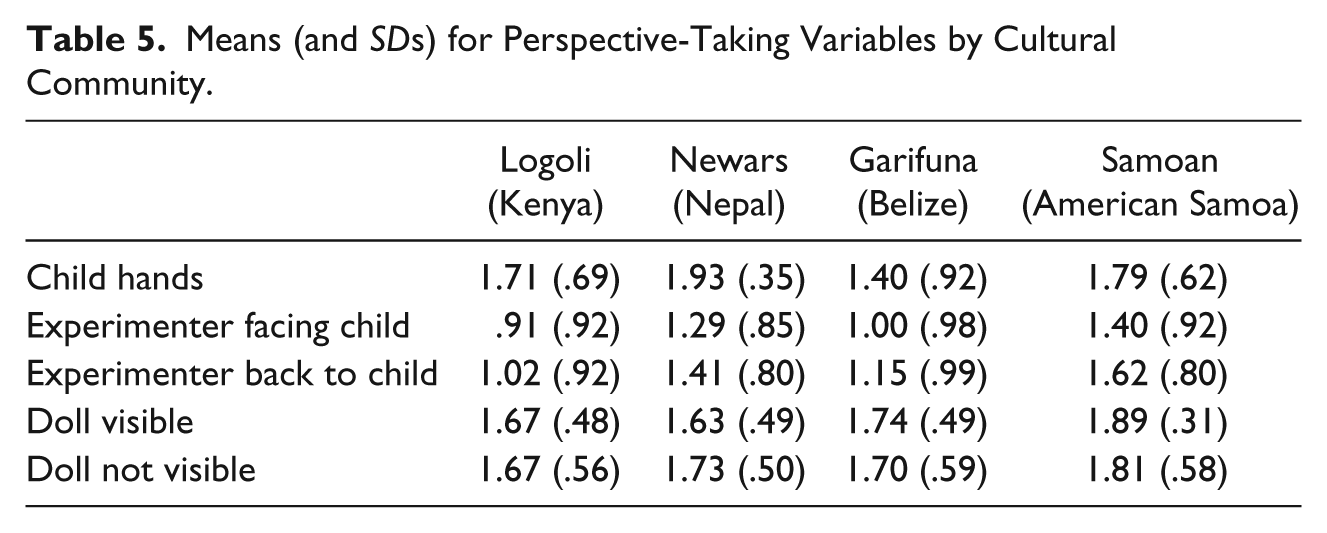
There was a difference for questions involving children’s own hands, F(3,164) = 5.07, p < .01, η2 = .08. Post hoc tests indicated that Samoans, t = .39, p < .05, and Newars, t = .52, p < .01, performed better than Garifuna on these questions. However, the sole Age × Culture interaction appeared for this variable, F(9,164) = 2.33, p < .01, η2 = .08. Although better performance among the Samoans is consistent with our hypothesis regarding community industrialization, the high rate of performance among the Newars, evident in Table 4, may reflect early training that distinguishes the right hand for eating and the left for hygiene.
There were also culture group differences on questions involving the experimenter’s hands, as follows: Experimenter Facing Child, F(3,164) = 2.70, p < .05, η2 = .05, and Experimenter Back to Child, F(3,164) = 4.17, p < .01, η2 = .07. Post hoc tests indicated that Samoans performed better than Logoli on both sets of questions (experimenter facing child, t = −.49, p < .05; experimenter’s back to child, t = −.59, p < .01). The culture groups also differed on the questions posed when the doll was visible to the child, F(3,164) = 7.28, p < .001, η2 = .12, with Samoans performing better than the Newars, t = −.26, p < .05, and somewhat better than the Logoli on these questions, t = −.23, p < .10. The culture groups did not differ on the questions posed when the doll was not visible to the child, F = 0.96, ns.
Discussion
These findings appear to be consonant with the Western evidence that at approximately age 5 an important transition occurs in children’s visual perspective-taking. At age 3, children performed poorly on the questions posed when the doll was visible or not to the child, but at 5 years of age, children began to perform better on these questions, and this skill was maintained with the older children.
The predicted positive effect of community industrialization was upheld to the extent that the sample with the highest rate of features associated with industrialization, the Samoans, outperformed all other community samples. These patterns did not appear to be explained by children’s experience with schooling (aside from the somewhat poorer performance of the unschooled older Nepalese girls). Finally, the only age difference in questions on left–right body orientation appeared on items referring to the children’s own hands, and this effect was qualified by an Age × Culture interaction. This interaction reflects better performance by the Samoan children, which we hypothesized reflects community change associated with industrialization, and the Newar children, a finding that we expect reflects specific cultural practices relevant to learning about left–right handedness.
In this research we have attempted to link ontogenesis, or individual development over the life span, and sociogenesis, or changes at the level of the social group or community. On a daily basis, changes in a community, such as the incorporation of features of industrialized societies, affect the work people do, the way children are cared for and educated, and the nature and strengths of the links between the community and the world beyond. Thus, when a community changes, children’s lives inside and outside the home also change as the children are exposed to different modes of acting and interacting. As a result, community-wide changes have direct relevance to processes of human development, including cognitive growth. It is important to stress that we are not suggesting that these types of changes make people smarter; rather, they evoke patterns of acting and interacting that have bearing on what and how people engage in intelligent activity as well as how cognitive skills develop. Specifically in terms of the incorporation of features of industrialized societies, we expect that these changing patterns align individual performance with the types of skills that are valued in and promoted by settings in which industrialized features are commonplace. Differential experience with materials that incorporate perspective-taking skills, such as books and other media representations that often involve various points of view, as well as specific cultural practices pertaining to handedness, may be especially significant in the community-related patterns we report.
To restate, our aim in this analysis is not to apply the oft-criticized, and now mostly defunct, comparative approach of describing differences between more traditional and Western (or more industrialized) communities on some dimension of cognitive development, in this case perspective taking. Our purpose is pragmatic: We seek to devise a way of understanding and discussing how changes in a community are also changes in cognition and cognitive development. It is of course known that people living around the world participate in diverse activities. It is also understood that participation in these activities—or practices—is the basis on which cognition is formed and expressed (Cole, 1996; Rogoff, 2003). What we have attempted to do here and elsewhere (Gauvain & Munroe, 2009, 2012) is to describe this intricate relation by examining natural patterns of change across cultural settings. To this end, we contend that societal changes that introduce a cultural community to elements common in industrial and postindustrial societies have consequences for cognitive development because these features change the community and the mind as well via the practices and tools with which the mind engages as it develops. In other words, changing skills do not operate in isolation; they are connected to a larger spectrum of skills that define the existing and potential course of the community and culture itself.
Footnotes
Acknowledgements
The design of the experimental setup, training of the experimenters, and supervision of the testing were carried out by the late Ruth H. Munroe. We express our gratitude to the children and the local experimenters who participated in the project. Tara Callaghan and Michael Kuehlwein were especially helpful in supplying information.
Declaration of Conflicting Interests
The author(s) declared no potential conflicts of interest with respect to the research, authorship, and/or publication of this article.
Funding
The author(s) disclosed receipt of the following financial support for the research, authorship, and/or publication of this article: The field research was supported by a grant to Robert L. Munroe and Ruth H. Munroe from the National Science Foundation.