



Abstract
Political trust is important to any culture, but there has been a noticeable decline in political trust around the world. In search for the origin of political trust and ways to enhance political trust, institutional theorists have largely focused on perceived competence of political institutions in Western democracies and neglected another dimension of political institutions’ character—benevolence. The lack of empirical evidence from Arab countries also raises questions about the generalizability of the institutional theories developed in Western democracies. Following previous research on legal institutions, I extended institutional theories of political trust and found that both perceived competence and benevolence of political institutions facilitated political trust in Arab countries, using the archival data from the Arab-Barometer (2006-2007). Given the limited research on political trust in Arab countries or authoritarian regimes and the ongoing search for a global, multilevel theory of trust, the current research makes a contribution to the literatures on political trust and trust at large.
Political trust refers to as an evaluative psychological state toward political institutions (Stokes, 1962) based on how well the government is operating in comparison with citizens’ normative expectations (Miller, 1974; see Hetherington, 1998). Different from social or interpersonal trust, political trust is based on systems, rules, and procedures (Newton, 2008). Political trust is important to any culture as it connects citizens with political institutions representing them (Bianco, 1994; Mishler & Rose, 2001, 2005). It facilitates the functioning of democracy (Chanley, Rudolph, & Rahn, 2001), increases institutional legitimacy (Tyler, 2001), and reduces the need for decision justification (Tyler, 1998). Yet, political trust has been noticeably declining around the world (Dogan, 2005; Hetherington, 1998; Putnam, 1995, 2000). In response to this global decline in political trust, social scientists devote their attention to understanding its origin and providing suggestions for handling this “trust crisis.”
Two theoretical traditions—cultural theories and institutional theories—have generated heated debates over the origin of political trust. Many researchers agree that both cultural and institutional factors can predict political trust (Campbell, 2004; Mishler & Rose, 2001, 2005). Cultural theorists argue that political trust is exogenous in that it is rooted in social capital (e.g., generalized trust and civic engagement) outside the political domain (Gary & Verba, 1963; Inglehart, 1988; Newton & Zmerli, 2011; Putnam, 1995, 2000). Generalized trust and civic engagement reinforce each other, increase social embeddedness, and facilitate political trust (Putnam, 1995, 2000). “Interpersonal trust lies at the heart of attitudes toward institutions … People who do not trust their peers will have difficulty trusting the leaders and institutions that represent them” (Lagos, 2001, p. 144). Institutional theorists, on the other hand, contend that political trust is endogenous as it is a consequence of citizens’ perception of institutional performance (e.g., Miller & Listhaug, 1990). Miller and Listhaug (1990) claimed that political trust reflects evaluations of whether or not political authorities and institutions are performing in accordance with normative expectations held by the public … In brief, an expression of trust in government (or synonymously political confidence and support) is a summary judgment that the system is responsive and will do what is right even in the absence of constant scrutiny. (p.358)
Simply put, political trust “stems from how people perceive political institutions to work, thus reflecting evaluations of regime performance in relation to citizen demands” (Luhiste, 2006, p. 478).
Institutional theories seem to have received more consistent empirical support than cultural theories in various parts of the world, including the United States (Brehm & Rahn, 1997; Newton & Norris, 2000), Canada (Newton & Norris, 2000), Europe (Luhiste, 2006; Mishler & Rose, 2001, 2005; Newton & Norris, 2000), East Asia (Suh, Chang, & Lim, 2012), and Latin America (Ross & Escobar-Lemmon, 2011). Even among democracies, political trust in new and established democracies differs (Denters, Gabriel, & Torcal, 2007). Yet, little evidence on political trust in authoritarian regimes of Middle East and North Africa has been presented. Different from the United States, Canada, and European, East Asian, and Latin American democracies, Arab countries have “no such thing as democracy or democratization” (Albrecht & Schlumberger, 2004, p. 372). Thus, whether institutional theories are able to predict political trust in Arab countries remains unknown. Against this background, the current research seeks to extend institutional theories and examine the culturally universal determinants of political trust in Arab countries.
Extended Institutional Theories of Political Trust
The existing institutional theories have their limitations. They largely focus on the competence aspect of political institutions as a determinant of political trust (e.g., Mishler & Rose, 2001). However, the character of political institutions entails more than one dimension. Cejudo (2007) noted that “[t]rust in institutions is a product not only of institutional design but also of institutional performance” (p. 590). The institutional design may construe the aspect of political institutions’ character that is separate from competence. Whether political institutions are designed to benefit the society at large or not can significantly affect citizens’ political trust. Tyler (1997, 2001) proposed two dimensions—competence and benevolence—of individuals’ evaluations of legal institutions (the police and courts). Competence refers to “the ability to solve problems effectively,” whereas benevolence refers to “having a concern about treating citizens with dignity and respect and being sincerely interested in their needs, problems, and concerns” (Tyler, 2001, p. 240). Tyler and his colleagues (e.g., Tyler, 1997, 2000; Tyler & Wakslak, 2004) have consistently shown that citizens (mainly in the United States) react to their evaluations of legal institutions’ intentions (i.e., whether they believe that legal institutions are benevolent and caring) and the perceived benevolence of legal institutions increases institutional legitimacy and citizens’ voluntary deference to legal institutions.
Like legal institutions, the character of political institutions, which are broader than legal institutions, should entail competence and benevolence as well. Citizens evaluate not only how well political institutions address various issues and problems but also how much political institutions care about citizens’ well-being and interests. Perceived benevolence of political institutions presumably is an important determinant of political trust in democracies. It is likely to be even more important to political trust in authoritarian regimes of the Arab world, as the authoritarian political institutions’ goodwill and intentions are questioned (Jamal, 2007). Accordingly, both perceived competence and benevolence of political institutions are likely to facilitate political trust in Arab countries.
Method
Sample
The archival data for analysis were from Tessler et al.’s Arab-Barometer (2006-2007). The Arab-Barometer was a multinational social survey designed to assess citizen attitudes about public affairs, governance, and social policy in the Arab region and identify determinants of these attitudes. Although citizens in six countries, including Algeria, Morocco, Jordan, Lebanon, Palestine, and Yemen, were surveyed regarding political trust, only three countries—Algeria, Morocco, and Yemen—were included in the final sample. Including the other three countries—Jordan, Palestine, and Lebanon—would diminish cross-cultural measurement equivalence, leading to biased results. Therefore, Jordan, Lebanon, and Palestine were excluded from the analysis. However, the results for Jordan, Lebanon, and Palestine were also provided but their interpretation requires caution.
Measures
Measurement equivalence
Given the multinational nature of the data, their psychometric properties must exhibit the same structure across countries (Berry, 1980). I tested measurement equivalence across the three Arab countries. Some researchers recommended that an omnibus test of the cross-group equality of the covariance structure should be conducted first (see Vandenberg & Lance, 2000). However, considering the inconsistencies of the test (Byrne, 1998), many researchers deem this test unnecessary (Avery, Tonidandel, Thomas, Johnson, & Mack, 2007; Vandenberg & Lance, 2000). Therefore, I only tested the configural invariance and metric invariance. The configural equivalence test addresses whether the factor structures are the same across groups, and if configural invariance is established, the metric equivalence test follows to address whether factor structure coefficients are invariant across different groups (Steenkamp & Baumgartner, 1998; Vandenberg, 2002; Vandenberg & Lance, 2000). Metric invariance is a necessary condition for comparing correlations across different groups (Davidov, 2008). When full invariance is rejected (i.e., significant Δχ2), partial invariance with two or more items per construct possessing metric invariance must be established to support measurement equivalence (Steenkamp & Baumgartner, 1998; Yoo, 2002). Table 1 presents the results of the measurement equivalence tests using multigroup confirmatory factor analysis (Vandenberg & Lance, 2000).
Measurement Equivalence Tests of Political Trust and Perceived Competence and Benevolence of Political Institutions in Algeria, Morocco, and Yemen.
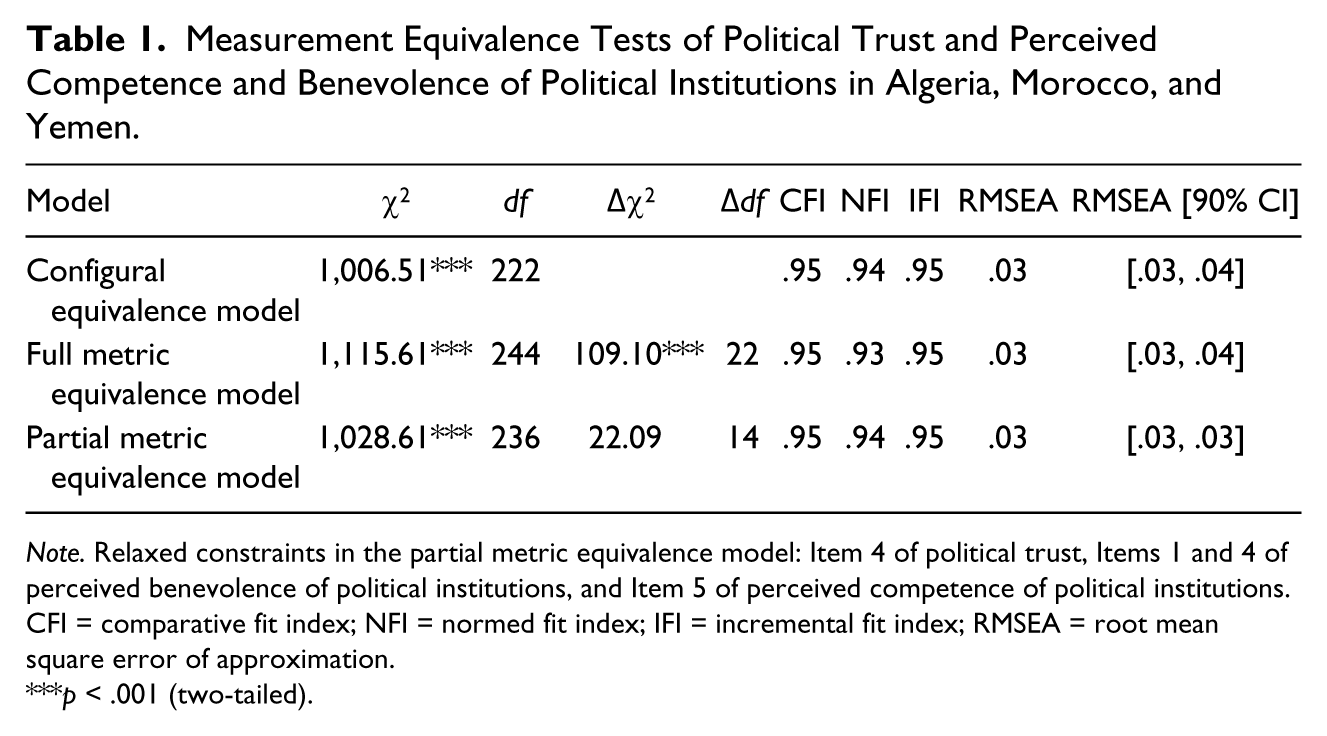
Note. Relaxed constraints in the partial metric equivalence model: Item 4 of political trust, Items 1 and 4 of perceived benevolence of political institutions, and Item 5 of perceived competence of political institutions. CFI = comparative fit index; NFI = normed fit index; IFI = incremental fit index; RMSEA = root mean square error of approximation.
p < .001 (two-tailed).
Dependent Variable
Political trust
Respondents indicated the level of their political trust with five items on a 4-point scale from 1 (a great deal of trust) to 4 (none at all), including “prime minister,” “the courts,” “parliament,” “the police,” and “political parties.” The item “the police” was dropped according to the result of the partial metric equivalence test. After reverse-scoring the responses to the remaining four items, I averaged them into a single index (αAlgeria = .85, αMorocco = .85, αYemen = .79), with a higher score indicating stronger political trust.
Main Independent Variables
Perceived competence
Respondents indicated their agreement with five statements regarding how well or badly their current political institutions were handling five issues on a 4-point scale from 1 (very good) to 4 (very bad), including (a) “managing the economy,” (b) “creating jobs,” (c) “narrowing the gap between rich and poor,” (d) “improving basic health services,” and (e) “dealing with deteriorating moral values.” The last item was dropped according to the partial metric equivalence test results. In addition, an original item “addressing educational needs” in the survey was excluded because it significantly decreased the configural equivalence test result. After reverse-scoring the responses to the remaining four items, I averaged them into a single index (αAlgeria = .76, αMorocco = .80, αYemen = .81), with a larger score indicating higher perceived competence of political institutions.
Perceived benevolence
Respondents indicated their agreement with three statements regarding the perceived benevolence of the political institutions in their respective countries on a 4-point scale from 1 (strongly agree) to 4 (strongly disagree). The statements were as follows: (a) “Government officials are knowledgeable of citizens’ needs”; (b) “Our political leaders care about ordinary citizens”; (c) “Government officials seriously consider citizens’ opinions”; and (d) “Our government creates conditions for people to be able to prosper through their own efforts.” The first and last items were dropped according to the result of the partial metric equivalence test. After reverse-scoring the responses to the remaining two statements, I averaged them into a single index (αAlgeria = .89, αMorocco = .74, αYemen = .82), with a larger score indicating higher perceived benevolence of political institutions.
Control Variables
Civic engagement
Respondents indicated whether they were “a member of any organization or formal groups” (recoded as 1 = No, 2 = Yes), including political parties, living cooperatives or local societies, religious organizations, sport and entertainment clubs, cultural organizations, associations or workers’ unions, farmer unions, professional unions or associations, economic organizations or associations, entrepreneurial organizations, parent-teacher associations, or other voluntary organizations.
Generalized trust
Respondents provided a dichotomous response (recoded as 1 = You must be very careful in dealing with people, 2 = Most people can be trusted) to the question “Generally speaking, would you say that most people can be trusted?” This measure has shown stability, strong validity, satisfactory reliability, and robust predictive value (Bjørnskov, 2006; Ferrin & Gillespie, 2010; Neville, 2012; Uslaner, 2002).
Religiosity
Religiosity is an important predictor for trust in institutions (Devos, Spini, & Schwartz, 2002), and therefore, it was included as a control variable. Respondents indicated their religiosity in general on a 3-point scale (recoded as 1 = not religious, 2 = in between, 3 = religious). This single-item measure (Roccas & Schwartz, 1997; Schwartz & Huismans, 1995), correlated with various measures of religious beliefs and observance, allowed respondents with different religious beliefs to express their perception of themselves as religious (Devos et al., 2002).
National pride
Previous research has found that citizens’ national pride is positively related to political trust (Andrain & Smith, 2006; Kim, 2010). Therefore, national pride was included as a control variable. Respondents indicated how proud they were to be a member of their respective countries on a 4-point scale (recoded as 1 = not proud at all, 2 = somewhat not proud, 3 = somewhat proud, 4 = very proud).
Internet use
Media (e.g., Internet use) can help shape citizens’ political trust (Kim, 2010). Respondents indicated the frequency of their use of the Internet on a 5-point scale (recoded as 1 = I do not use the Internet, 2 = several times a year, 3 = at least once a month, 4 = at least once a week, 5 = daily or almost daily).
Support for democracy
Citizens’ support for democracy in their respective countries may influence their political trust (Jamal & Tessler, 2008). Respondents indicated the extent to which people thought democracy was suitable for their respective countries on a 10-point scale from 1 (completely unsuitable) to 10 (completely suitable).
Perception of national economy
Negative perception of national economy leads to political distrust (Citrin & Green, 1986; Hetherington, 1998). Respondents rated the current overall economic condition of their respective countries on a 4-point scale (recoded as 1 = very bad, 2 = bad, 3 = good, 4 = very good).
Perception of personal economy
Citizens’ perception of personal economy influences their perception of political institutions and shapes their political trust (Córdova & Seligson, 2009; Matsubayashi, 2007). Respondents rated their family’s current economic situation on the same 4-point scale as that of national economic condition.
Local area safety
Respondents rated the safety in their respective cities/towns/villages on a 4-point scale (recoded as 1 = very unsafe, 2 = unsafe, 3 = safe, 4 = very safe).
Demographics
Respondents also provided basic demographic information, including age, sex (1 = male, 2 = female), literacy (0 = illiterate, 1 = literate), employment status (1 = employed, 2 = unemployed), and marital status (1 = single, 2 = married).
Results
Table 2 presents the results of ordinary-least-squares regression with the continuous dependent variable—political trust. Missing data were deleted listwise. Among all the control variables, only perception of national economy was positively related to political trust in Algeria, Morocco, and Yemen with almost identical magnitudes (.24 ≤ β ≤ .26, ps < .001). Perception of personal economy was positively related to political trust in Algeria (β = .13, p < .01) and Yemen (β = .09, p < .05) but not in Morocco (β = −.03, n.s.), whereas local area safety was positively related to political trust in Algeria (β = .11, p < .01) and Morocco (β = .12, p < .001) but not in Yemen (β = .08, n.s.). In Algeria (β = .13, p < .001) and Morocco (β = .07, p < .05), females tended to have higher political trust than men, whereas in Yemen (β = −.14, p < .01), females tended to have lower political trust than men.
Perceived Competence and Benevolence of Political Institutions as Facilitators of Political Trust in Arab Countries.
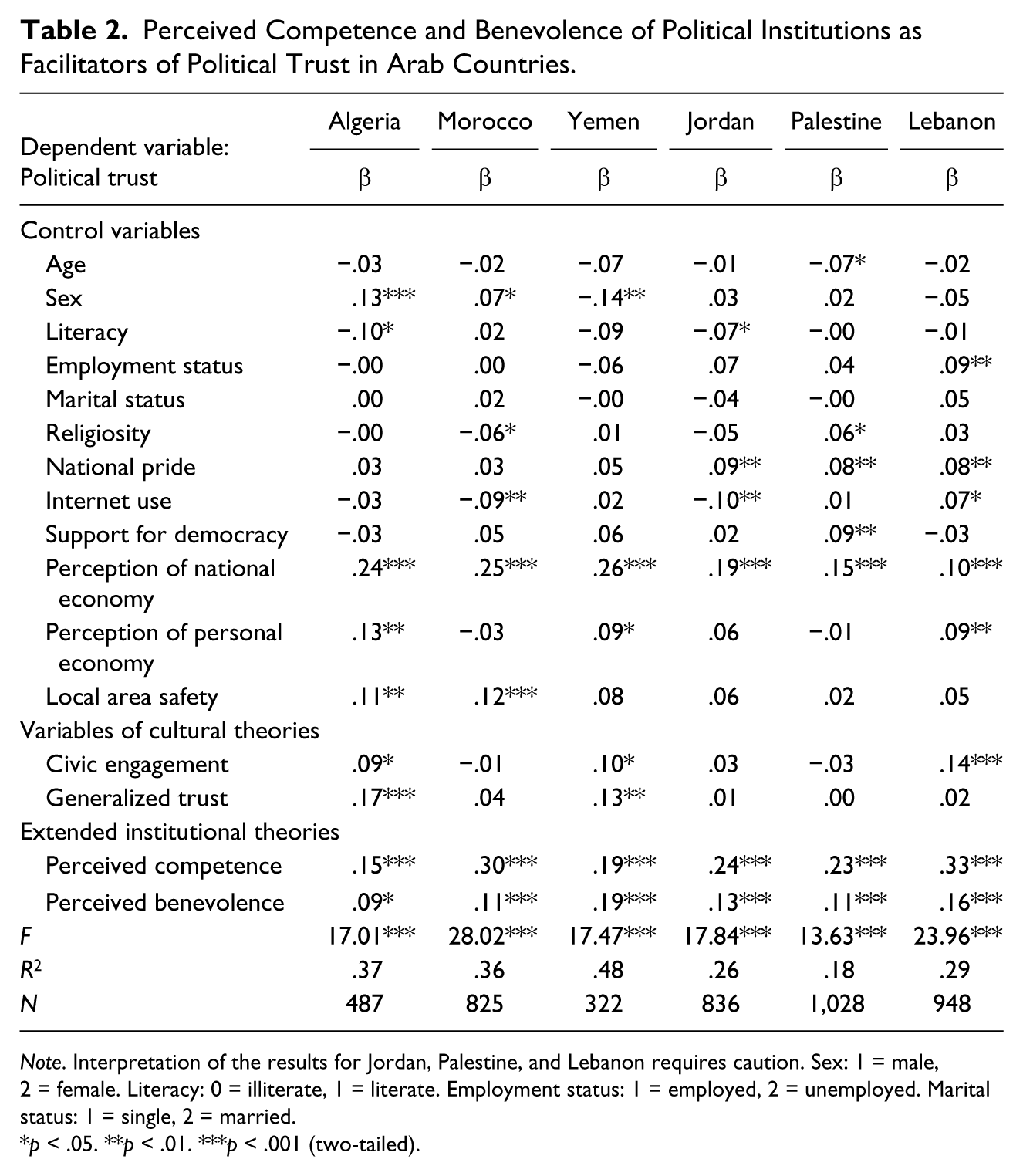
Note. Interpretation of the results for Jordan, Palestine, and Lebanon requires caution. Sex: 1 = male, 2 = female. Literacy: 0 = illiterate, 1 = literate. Employment status: 1 = employed, 2 = unemployed. Marital status: 1 = single, 2 = married.
p < .05. **p < .01. ***p < .001 (two-tailed).
As expected, with the effects of all the control variables on political trust accounted for, perceived competence of political institutions was positively related to political trust in Algeria (β = .15, p < .001), Morocco (β = .30, p < .001), and Yemen (β = .19, p < .001), and so was perceived benevolence of political institutions in Algeria (β = .09, p < .05), Morocco (β = .11, p < .001), and Yemen (β = .19, p < .001). The result patterns of perceived competence and benevolence of political institutions were replicated in Jordan, Palestine, and Lebanon, though caution is required for interpretation. Although cultural theories of political trust were not of interest in this study, they showed some predictive value. Generalized trust was positively related to political trust in Algeria (β = .17, p < .001) and Yemen (β = .13, p < .01), and so was civic engagement in Algeria (β = .09, p < .05) and Yemen (β = .10, p < .05). However, these result patterns were not replicated in Morocco, Jordan, or Palestine. Taken together, these results supported the hypothesis.
Discussion
The existing institutional theories of political trust suggest that political trust is endogenous and stems from perceived competence of political institutions. Yet, institutional theorists neglect a second dimension of political institutions’ character—benevolence. Citizens form their trust not only based on political institutions’ competence in addressing various issues and problems but also based on political institutions’ benevolence toward citizens. Citizens trust benevolent political institutions with goodwill and benign intentions and distrust callous political institutions with ill-will and wicked intentions. In the current research, I have extended institutional theories, arguing that both perceived competence and benevolence of political institutions are culturally universal facilitators of political trust. The theory is grounded in Tom Tyler’s research on these two dimensions of legal institutions. Yet, institutional theories have been examined largely in Western democracies. Systematic research on political trust and other political attitudes in Arab world is still in its infancy (Tessler & Jamal, 2006). Whether institutional theories of political trust can be applied to Arab countries or authoritarian regimes has been left unexamined for long.
Using the archival data from the Arab-Barometer (2006-2007), I found that perceived competence and benevolence of political institutions indeed facilitated political trust in Arab countries—Algeria, Morocco, and Yemen—above and beyond the effects of generalized trust, civic engagement, and other factors. Although the results were replicated in another three Arab countries—Jordan, Palestine, and Lebanon, interpretation of the results needs caution given the concern of cross-cultural measurement inequivalence. Consistent with previous research that has identified a weak linkage between generalized trust and political trust (Kaase, 1999; Newton & Norris, 2000) and a nonsignificant or negative relationship between civic engagement and political trust (Brehm & Rahn, 1997; Newton & Norris, 2000), the current research did not render strong support for the predictive validity of cultural theories in the included Arab countries.
Worth stressing, although the current research is not the first to propose competence and benevolence as the two dimensions of institutions’ character, it is the very first to demonstrate that perceived competence and benevolence of political institutions are two culturally universal facilitators of political trust in Arab countries. Among the range of factors included in the study, perceived competence and benevolence of political institutions are the only two factors that consistently predicted political trust in the included Arab countries, except for citizens’ perception of national economy. As previous research has shown, negative perception of national economy leads to political distrust (Citrin & Green, 1986; Hetherington, 1998). The psychological mechanism underlying this link is citizens’ attribution of bad national economy to political institutions (Peffley & Williams, 1985). Perceived competence of political institutions directly reflects the attribution mechanism, predicting political trust above and beyond citizens’ perception of national economy. Increasing political institutions’ performance on a range of issues is time and resource consuming. As a complementary method, political institutions can demonstrate their goodwill and care about citizens’ well-being and opinions. This method may be more efficient in enhancing political trust. Despite the inherent limitations associated with archival data (e.g., common source bias and common method bias), “[a]ppreciation of the important gains made” in this study “should thus be tempered by an understanding of the challenges and limitations that remain” in research on Arab countries (Tessler & Jamal, 2006, p. 437).
The current research also contributes to the development of a global, multilevel theory of trust. Trust researchers have been searching for such a theory to predict trust at different levels in different cultures. The stereotype content model (Cuddy, Fiske, & Glick, 2008; Fiske, Cuddy, & Glick, 2007; Fiske, Cuddy, Glick, & Xu, 2002) shows that individuals’ perception or evaluation of other individuals and groups falls into two dimensions—competence and benevolence. The stereotype content model has been replicated across cultures, showing that competence and benevolence are the two culturally universal dimensions of social perception or evaluation of individuals and groups (Cuddy et al., 2009). They are the two culturally universal predictors of interpersonal trust (Ferrin & Gillespie, 2010). Although much less research has focused on perception of institutions, Tom Tyler and colleagues’ work on legal institutions in Western democracies paves the way for this line of inquiry. The question that follows is whether perceived competence and benevolence of political institutions are the two culturally universal facilitators of political trust as well. The current research speaks to this question and has provided evidence from multiple Arab countries.
Footnotes
Declaration of Conflicting Interests
The author(s) declared no potential conflicts of interest with respect to the research, authorship, and/or publication of this article.
Funding
The author(s) received no financial support for the research, authorship, and/or publication of this article.