



Abstract
The present study aims to provide insights into the leadership–innovation relationship on the national level by considering national-level contingency factors. We argue that the impact of a prevailing leadership style on innovation is mediated by economic and political factors and innovation-related cultural practices. Moreover, it is argued that the educational level of a country is related to the prevailing leadership style and economic factors. We propose a model and test its explanatory power with a sample of 55 countries using variance-based structural equation modeling. The results show that the prevailing leadership style has no direct relationship with national innovation but is mediated by the abovementioned factors. The results also show that the level of education within a country is positively related to participative leadership and negatively to team-oriented leadership. Furthermore, the level of education is directly related to economic and political factors and indirectly to national innovation.
Introduction
The general importance of innovation is widely discussed. Research from different scientific disciplines has shown that education and knowledge (Amabile, 1996), leadership (Deschamps, 2003; Friedrich, Mumford, Vessey, Beeler, & Eubanks, 2010; Krause, 2004), national culture (Rinne, Steel, & Fairweather, 2012; Shane, 1993; Taylor & Wilson, 2012), as well as economic, institutional, and political factors (Grupp, 2010; Institut Européen d’Administration des Affaires (INSEAD), 2011; Peng, 2002) are important factors influencing innovation throughout different levels of analysis (i.e., individual, organizational, and national). However, little is known about the relationships between these factors, their possible interactions, and their effects on innovation on the national level. We approach this question by theoretically deriving and empirically testing a model that integrates these factors and analyzes their relative influence on national innovativeness.
Culturally endorsed implicit theory of leadership (House, 2004) argues that the acceptance and effectiveness of specific leadership styles depends on national culture (Dorfman, Javidan, Hanges, Dastmalchian, & House, 2012). This means that differences between the acceptance as well as the outcomes of specific leadership styles and characteristics exist among countries, and they may influence the level of innovation in a country. National cultural practices, economic and political factors, and the level of education in a country are additional important contingency variables of this relationship.
Our research aims to answer the following questions: What is the relationship between endorsement of participative and team-oriented leadership in a country and the country’s level of national innovativeness? How exactly is this relationship influenced by the country’s level of education, national cultural practices, and economic and political factors? To answer these questions, we develop hypotheses and test them empirically on a sample of 55 countries.
We empirically demonstrate that the level of education in a country is positively related to the endorsement of participative and negatively related to the endorsement of team-oriented leadership in the respective country. Furthermore, the level of education is directly related to economic and political factors and indirectly (mediated) to national innovativeness. Endorsement of participative leadership itself is directly related to innovation supportive national cultural practices and indirectly (mediated) to national innovativeness. However, neither leadership nor education is directly linked to national innovativeness.
Theory
Our conceptual model is summarized in Figure 1. First, we explain the central constructs of our model, namely, culturally endorsed leadership styles, national cultural practices, and innovation on the national level. Then we explain the other key components of our model and develop specific hypotheses about the relationships between them.
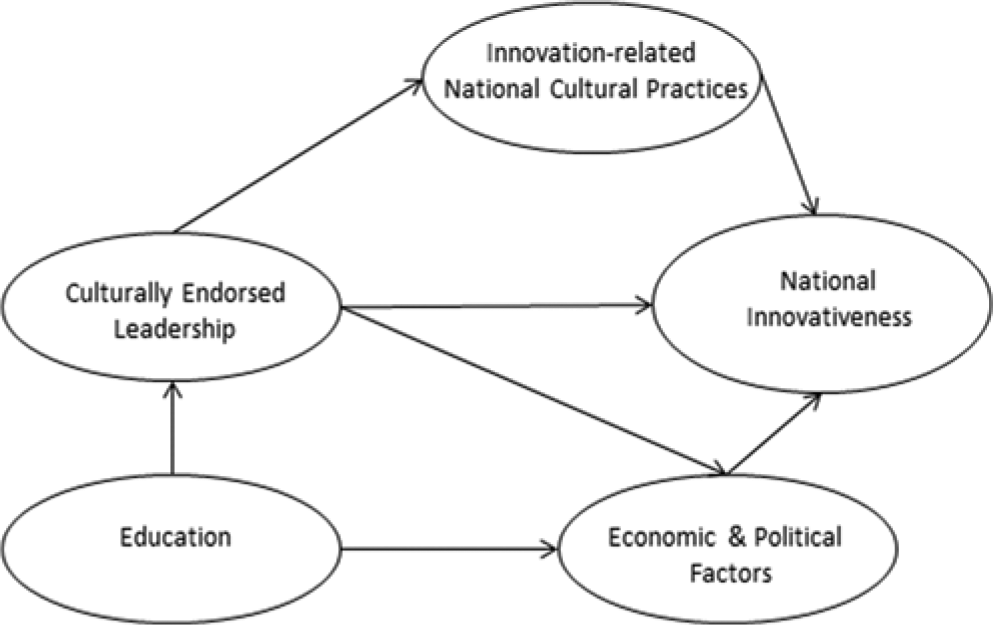
Conceptual model.
Culturally Endorsed Leadership Theories
Culturally endorsed implicit leadership theory (House, 2004) is an extension of implicit leadership theory (Lord & Maher, 1993). Implicit leadership theory states that individuals hold a set of beliefs about attributes, personality characteristics, skills, and behaviors that contribute to or impede leadership. This means that leadership is in the “eye of the beholder” (Dorfman, Hanges, & Brodbeck, 2004, p. 670); it is a social label that is used if the personalities, attributes, and behaviors match the observer’s beliefs about leaders (Lord & Maher, 1993). Culturally endorsed implicit leadership theory (House & Aditya, 1997) upgrades the traditional definition to the societal level and states that societies have specific implicit preferences regarding what is considered “acceptable” and what are the characteristics of “outstanding” leadership (Den Hartog, House, Hanges, Ruiz-Quintanilla, & Dorfman, 1999). This is because members of a society share mental models and implicit theories about the function of leadership (Javidan, Dorfman, Howell, & Hanges, 2010; Lord & Maher, 1993; Shaw, 1990). Culturally endorsed implicit leadership theory argues that individual beliefs, convictions, and assumptions concerning appropriate and effective leadership styles are influenced by national cultural characteristics (Dorfman et al., 2004). One of the main results of the GLOBE study is that national culture, in particular cultural values (Dorfman et al., 2004), determines which kind of leadership is considered appropriate and is assumed to be efficient in a country (House & Javidan, 2004). Consequently, the effectiveness and acceptance of specific leadership styles and management practices should vary from one country to the next (House & Javidan, 2004).
The GLOBE study identified 21 primary leadership dimensions (House, Javidan, Hanges, & Dorfman, 2002), which were then consolidated into six higher-order leadership dimensions: (a) Charismatic/value-based leadership consists of the primary dimensions: visionary, inspirational, self-sacrificial, integrity, decisive, and performance-oriented; (b) team-oriented leadership consists of the primary dimensions: team collaborative, team integrator, diplomatic, malevolent (reversed), and administrative; (c) participative leadership consists of the primary dimensions: autocratic (reversed) and non-participative (reversed); (d) humane-oriented leadership consists of the primary dimensions: human orientation and modesty; (e) autonomous leadership consists only of one primary dimension, namely, autonomous; (f) self-protective leadership consists of the primary dimensions: self-centered, status consciousness, conflict inducer, face saver, and procedural. 1
Based on the constructs measured with the GLOBE leadership dimensions and theoretical considerations explained in detail in the subsequent paragraphs, we focus exclusively on participative and team-oriented leadership in this study.
Participative and Team-Oriented Leadership
The GLOBE study defines participative leadership as “a leadership dimension that reflects the degree to which managers involve others in making and impeding decisions” (Javidan, Dorfman, de Luque, & House, 2006, p. 73). The core elements of this dimension are participation and involvement. In general, participative leadership was found to be favored in all cultures, but with considerable variations. In particular, the cultural clusters Germanic Europe (Austria, Germany, the Netherlands, and Switzerland), Anglo (Australia, Canada, Ireland, New Zealand, South Africa, the United Kingdom, and the United States), and Nordic Europe (Denmark, Finland, and Sweden) endorse participative leadership (Chhokar, Brodbeck, & House, 2009). These countries are reported to value high performance orientation and gender egalitarianism and to tolerate uncertainty (Dorfman et al., 2004).
In contrast, team-oriented leadership is defined as “a leadership dimension that emphasizes effective team building and implementation of a common purpose or goal among team members” (Javidan et al., 2006, p. 73). Here, the central element is the team. Team-oriented leadership is also favored and considered effective in all cultures investigated, with a particular preference in Southern Asia (India, Indonesia, Iran, Malaysia, the Philippines, and Thailand), Confucian Asia (China, Hong Kong, Japan, Singapore, South Korea, and Taiwan), Eastern Europe (Albania, Georgia, Greece, Hungary, Kazakhstan, Poland, Russia, and Slovenia), and Latin America (Argentina, Bolivia, Brazil, Colombia, Costa Rica, Ecuador, El Salvador, Guatemala, Mexico, and Venezuela; Chhokar et al., 2009). Societies that rank high on uncertainty avoidance and in-group collectivism values are likely to value team-oriented leadership (Dorfman et al., 2004).
National Cultural Practices and National Innovation
Culture is defined as a set of “basic and shared practices and values that help human communities to find solutions to problems of external adaption and internal integration” (Schein, 2004, p. 17). The former helps the community to survive, the latter to stay together as a group. Overall, culture is the product of the interaction of group members. National culture refers to this concept on the country level. It can be seen as an inner pattern of thinking, behaving, and potential acting. This “software of the mind” (Hofstede, 2009, p. 1) has mainly been acquired in early childhood by different forms of socialization and contains most of our core values. Thus, national culture is relatively stable and resistant to change. The GLOBE cultural practice dimensions describe norms of behavior (Stephan & Uhlaner, 2010) and interaction among individuals in different countries. Cultural practices act as informal institutions (Peng, 2002), which regulate and often constrain human interactions (North, 1991; Scott, 1999). They represent observable manifestations of the national cultural environment.
Innovation is basically about renewal, modernization, and change (King & Anderson, 2002). By definition, an innovation is something new, intended (West & Farr, 1996), with an often uncertain, risky, and unpredictable outcome (Angle, 2000). These attributes seem to be contradictory to the stable and conservative nature of culture at first glance. There is a substantial body of knowledge about factors influencing innovation on the individual (Miron, Erez, & Naveh, 2004), the group (cf. review by Huelsheger, Anderson, & Salgado, 2009), and the organizational level (M. Smith, Busi, Ball, & Van der Meer, 2008). National cultural practices influence all of these innovation-relevant levels.
Education and Leadership
In addition to the cultural roots found by the GLOBE study, the level of education is related to the country-specific endorsement of specific leadership attributes. The level of education at the national level is linked to the qualifications, knowledge, maturity, and abilities of the country’s citizens. Previous research showed that these factors influence which kind of leadership style is accepted and effective (Amabile, 1988; Hersey, Blanchard, & Johnson, 1996; Kerr & Jermier, 1978; Reddin, 1977). As explained earlier, a core element of the GLOBE dimension participative leadership is involvement of others in decision making (Javidan et al., 2006). However, to be useful, this involvement requires knowledge and qualification from the ones intended to be involved. If this knowledge and qualification do not exist, neither acceptance of this involvement by the followers is likely nor will it lead to beneficial results. In addition, as the overall leadership approach is not accepted by the followers, no follower commitment will be reached, thereby mitigating this desired effect of participative leadership. Therefore, we argue that
In contrast, for team-oriented leadership, the core characteristics lie in team building and the implementation of common purposes and goals (Javidan et al., 2006). Teams are specific forms of small groups. In teams, members (should) have a common purpose, interdependent roles, and complementary skills (Yukl, 2002). As a special form of groups, they also fulfill another purpose of groups—that is, providing safety and decreasing uncertainty for their members (Hogg, Hohman, & Rivera, 2008). One positive aspect, inherent in the heterogeneity of teams, is that lack of knowledge, skills, and abilities of certain team members can be substituted by other team members who can provide these resources (Drach-Zahavy & Somech, 2002). From a skeptical perspective, however, teams provide the possibility of free-riding for members who lack motivation or the required attributes to a certain degree (Van der Heijden, Potters, & Sefton, 2009), especially if there are no mechanisms implemented to avoid this potential team’s dysfunction. In teams, other characteristics such as trust, openness, helpfulness, and supportiveness are equally and, sometimes, even more important than pure knowledge and qualifications (Costa, Roe, & Taillieu, 2001). This makes it plausible that lower levels of education in a country tend to be more closely related with the endorsement of team-oriented leadership than with the endorsement of participative leadership. Therefore, we assume that
Education, Economic and Political Factors, and Innovation
The level of education in a country is also linked with economic and political factors, such as GDP per capita and political stability. In simple words, 2 there is a positive relationship between the level of education, economic and political effectiveness, and wealth in a country. These factors are also empirically highly correlated (Fagerberg, Srholec, & Knell, 2007; INSEAD, 2011).
We assume the direct link between education and national level innovation to be weaker than that between education and economic factors. This assumption is based on the consideration that the level of education in a country does not necessarily lead to innovation. Although education, learning, and knowledge are considered as key variables for creative thinking and innovation (Leonard & Sensiper, 1998; Nonaka, 1994; Scholl, 2010), research at the individual and team level (cf. reviews and meta-analyses by Anderson, De Dreu, & Nijstad, 2004; Huelsheger et al., 2009) has shown that turning creative ideas into innovations depends on additional factors, such as economic resources and environmental stability and support (Fagerberg & Srholec, 2008). We argue that an analogous relationship exists at the national level and that national economic resources, political stability, and government effectiveness act as the equivalents of the individual- and team-level contingency variables found by previous research. Therefore, we hypothesize,
Overall, we argue that countries with a highly educated workforce can achieve higher economic wealth and, subsequently, have more available and dispositional resources to invest and venture into innovations. As economic factors are influenced by education (due to a higher educated workforce) and influence the education–innovativeness relationship (by providing resources and scope for trial and error) at the same time, we consider them as being conceptual mediators (Baron & Kenny, 1986) between education and innovation at the national level. Combining these arguments, we state the following hypothesis:
Leadership and Innovativeness
In line with extensive previous research, we argue that participative leadership is positively related to national innovativeness. Participative leadership involves efforts to encourage and facilitate involvement by others when making decisions (Yukl, 2002). This involvement increases the probability to have decisions approved and implemented. Varieties of participative leadership include consultation, delegation of task, and the resources and necessary decision-making responsibilities to accomplish these tasks. Forms of participative leadership can be classified according to the amount of influence and participation the leader accepts (Yukl, 2002). A recent study has shown that a relationship between cultural endorsement of participative leadership in organic organizations and the tendency to continuous improvement and learning at the organizational level exists (Huang, Rode, & Schroeder, 2011). This finding supports our argument.
We base our argument on two theoretical models: the motivational model (Conger & Kanungo, 1988) and the exchange-based model (Blau, 2008). The motivational model is based on the assumption that participation in decision making increases intrinsic motivation (Spreitzer, 2007; Thomas & Velthouse, 1990). The exchange-based model assumes that participative leadership implicitly conveys the message that the superior has confidence in and concern and respect for the subordinates, which, in turn, relates to higher levels of trust in the supervisor (Dirks & Ferrin, 2002) and perceived justice (Colquitt, Conlon, Wesson, Porter, & Ng, 2001; Tremblay & Roussel, 2001), which leads to a higher level of job performance (Zallars & Tepper, 2003).
These two factors, motivation (Amabile, 1996) and trust (Krause, 2010; Scholl, 2010), are essential in the context of innovation. Motivation per se is not enough, and will not last for long, in the absence of trust. As innovations by definition contain elements of uncertainty, the importance of trust is even augmented. Therefore, we argue that
Team-oriented leadership emphasizes effective team building and implementation of a common purpose or goal among team members (Dorfman et al., 2004). The focus of this leadership style is therefore clearly on teams. Previous research reported several positive and negative connections between teams and innovation, resulting in inconsistent findings (Hüttermann & Boerner, 2011). Positive relationships between teams and innovation have been reported because diversity in teams leads to more and new ideas. The diversity can be, for example, educational (Shin & Zhou, 2007), functional (Gebert, Boerner, & Kearney, 2006), cultural (Stahl, Maznevski, Voigt, & Jonsen, 2009), and gender, or age related (Kirkman, Tesluk, & Rosen, 2004). According to information-decision-making perspectives, the differences in expertise, knowledge, and viewpoints increase the development of creative and innovative solutions (Van Knippenberg, Dreu, & Homan, 2004). At the same time, negative links between teams and innovation have been reported due to the tendency of teams for conformity or groupthink, or to have less contact with team’s outsiders, which lowers the probability to create new ideas (West & Anderson, 1996). Diversity in teams can also lead to a dysfunctional level of conflict that makes implementation of innovations more difficult (De Dreu, 2006).
Overall, a large amount of contingencies, moderator and mediator variables, influence the team–innovation link. This fact suggests that the relationship between cultural endorsement of team-oriented leadership and national-level innovation is weaker than for endorsed participative leadership. While endorsement of participative leadership tends to be positively linked to national innovativeness, team-oriented leadership tends to be so only under specific circumstances. Therefore, at the national level, a positive relationship between cultural endorsement of team-oriented leadership and innovation depends on a fortunate combination of several contingency factors. Contrarily, the negative factors inherent in teams (i.e., conformity, groupthink, free-riding, social loafing) are more likely to be present. Therefore, we argue,
Leadership, Cultural Practices, and Innovation
The GLOBE study posits that cultural endorsement of leadership is largely dependent on national cultural values (House et al., 2002). We assume that culturally endorsed leadership not only depends on national culture but also influences it. Specifically, we propose that cultural endorsement of leadership depends on national cultural values (House et al., 2002), while simultaneously influencing national cultural practices. A sizable number of studies suggest that culture can be conceptualized as a contingency variable (Dorfman et al., 1997). This means that national culture has an influence not only on what kind of leadership is culturally endorsed but also on the relationship between specific leadership styles and their outcomes (Aycan, 2008). If a specific leadership style is endorsed in a country, this style is also accepted. Therefore, the probability rises that this style is executed and, in being so, influences “the way things are done” (Triandis, 2004, p. xv) in this county, which is equivalent to cultural practices. Essentially, this means that cultural endorsement of specific leadership styles should also be related to certain cultural practices.
Conceptually, this is analogous to what Schein (2004) showed at the organizational level: Leaders create, manage, and change culture by reinforcing the adaption of their own beliefs, values, and assumptions. Subsequently, based on success or failure, some practices are accepted and others are not, leading to cultural practices. The GLOBE “as is” practice dimensions reflect these cultural practices; therefore, a relationship between culturally endorsed leadership dimensions and cultural practices is likely. Previous research on the relationship between national culture and innovation has shown that particularly the GLOBE cultural practice dimensions future orientation, in-group collectivism, institutional collectivism, performance orientation, and uncertainty avoidance are linked to the national level of innovation (Rossberger & Krause, 2013).
Analogous to lower levels of aggregation, endorsement and execution of participative leadership in a country are assumed to increase involvement in the decision-making process resulting in higher overall commitment. This higher commitment increases performance-orientation practices (Javidan, 2004). Performance-orientation practices are positively related with national innovation. They comprise such elements as a higher need for achievement, which leads to a positive disposition to challenges and improvements. This achievement orientation is related to concepts such as knowledge, progress, work, freedom, taking initiative (Osgood, May, & Miron, 1975), personal success, competency (Schwartz & Bilsky, 1987), and a higher internal locus of control (P. B. Smith, Trompenaars, & Dugan, 1995). High performance-oriented societies tend to desire to do things better and tend to be more innovative (Javidan, 2004).
In addition, the higher possibility to exert an influence that is inherent in participative leadership increases internal locus of control (P. B. Smith et al., 1995), resulting in more planning, which is reflected in higher practices of future orientation (Trompenaars & Hampden-Turner, 2010). High future orientation is associated with the general assumptions of the world being open and changeable, as opposed to being closed and predetermined. This results in more planning and goal-setting. These goals tend to be of higher valence, resulting in more generation and implementation of new ideas. Overall, future orientation practices are positively related to national innovation as they include such factors as planning, developing, and acting according to strategies as well as the capacity and willingness to imagine future contingencies, formulate future goals, and develop strategies to reach them (Trompenaars & Hampden-Turner, 2010).
Cultural endorsement of participative leadership also influences practices of collectivism in societies. Participative leadership tends to be more closely related to low in-group collectivism (respectively, high individualism) than to high in-group collectivism. In-group collectivism practices are negatively related to national innovation. This is explained by strong interdependence of group members and goals, which makes it difficult to generate and implement new ideas (Gelfand, Bhawuk, Nishii, & Bechtold, 2004). High in-group collectivism societies have more rigid group structures and hierarchies, which makes the exchange of ideas difficult (Shane, 1993), lowers the willingness to change, and increases the danger of group thinking (Husted & Allen, 2008). Empowerment, a central component of participative leadership (Lee & Koh, 2001; Spreitzer, 2007), decreases rigid structures and hierarchies. In addition, the combination of participation and empowerment decreases the possibility of groupthink (Janis, 1972).
In contrast to in-group collectivism, we assume that cultural practices related to institutional collectivism (Gelfand et al., 2004) are increased by cultural endorsement of participative leadership. The general endorsement and practice of participation in decisions in society may increase the trust in institutions and society by higher perceived justice because of the possibility to participate (Colquitt et al., 2001). This trust, in combination with empowerment, internal locus of control, and a general orientation to performance, shifts the focus from smaller communities such as families (in-group collectivism) to larger communities (institutional collectivism). Consequently, in a society where participative leadership is not endorsed, people will focus on smaller, and trust more controllable, communities such as families. Overall, institutional collectivism practices are positively related to national innovation. In opposition to in-group collectivism, this dimension contains elements of “patriotism and nationalism” (Taylor & Wilson, 2012, p. 234), which can be beneficial to innovation on a national level.
Cultural endorsement of participative leadership is also linked to uncertainty avoidance practices, which represent the level of rule orientation in society (Venaik & Brewer, 2008). Uncertainty avoidance practices are positively related to national innovation. Traditionally, high uncertainty avoidance has been associated with seeking structure and orderliness, sticking to formalized procedures, and trying to decrease uncertainty by laws, accounting, planning, and extended usage of control systems (Hofstede, 2009). This leads to low tolerance for new and different ideas (de Luque & Javidan, 2004), which is detrimental to innovation. However, this consideration is based on the Hofstede dimension that is conceptually similar to the GLOBE value dimension. The GLOBE practice dimension of uncertainty avoidance measures conceptually opposite behavioral norms. 3 High GLOBE uncertainty avoidance (practice) countries tend to have established rules and laws, which results in a more stable environment and decreases the need for inhabitants to focus too much on basic needs. This gives them freedom to experiment (Venaik & Brewer, 2008), to be creative, and to take the risk of trial and error. This increases freedom of innovation and supports national innovation. In addition, based on a balance-theoretical perspective on innovation management (Gebert, Boerner, & Kearney, 2010; Gebert, Boerner, & Lanwehr, 2003, 2004), we argue that the open, democratic, and power-sharing aspects of participative leadership require some institutionalized rules to be effective. This may be one reason why endorsement of participative leadership is often linked to high uncertainty avoidance practices in countries. Participation requires a fundament of working rules to be efficient.
Overall cultural endorsement for participative leadership is linked to innovation-supportive national cultural practices that are characterized by a tendency to high institutional collectivism, high future orientation, high performance orientation, and high uncertainty avoidance combined with low in-group collectivism. Based on this argumentation, we posit,
In addition, previous research has shown that it is characteristic for low innovation countries to exhibit a tendency to lower institutional collectivism, future orientation, performance orientation, and uncertainty avoidance, and higher in-group collectivism (Rossberger & Krause, 2013).
Cultural endorsement of team-oriented leadership focuses primarily on team building and team leadership (Dorfman, 2004). As teams are a special form of small groups, team-oriented leadership is linked to higher in-group collectivism practices (Gelfand et al., 2004). As explained above, high in-group collectivism practices are negatively related to national innovation. This higher focus on smaller groups is related to a decreasing valence of larger groups, institutions, and society, resulting in lower institutional collectivism practices. Another argument that supports these considerations relates to the question of which entity provides greater security: the (small) group or the society. Overall, if institutional collectivism is low, this may have negative effects on society-wide efforts in science and technology, which results in lower innovation.
Team orientation has several other positive and negative attributes. One negative aspect is that teams allow free-riding (Delton, Cosmides, Guemo, Robertson, & Tooby, 2012) and social loafing (Karau & Williams, 1993). In teams, the aggregated performance tends to be more important than the individual performance; weak performers can “hide” in the team. This can decrease the level of performance-orientation practices. Societies with low performance orientation focus more on social ties (Osgood et al., 1975), emphasize tradition, and value harmony and loyalty (Javidan, 2004), and indirect and subtle communication (Hall, 1973). All of these factors are negatively related to innovation.
In addition, as individual performance and behavior have a less direct relationship to outcomes, the internal locus of control is lower, resulting in less future orientation practices (Ashkanasy, Gupta, Mayfield, & Trevor-Roberts, 2004). If future orientation is low, people undervalue future outcomes and tend to spend time on dysfunctional activities (Ashkanasy et al., 2004). This results in less planning and goal-setting. As fewer goals exist, and the ones that exist are of lower value, less time and effort are spent on the generation and subsequent implementation of the smaller number of new ideas. The result is less innovation.
Overall, team-oriented leadership focuses on smaller groups and teams as the primary social unit. The team itself represents a type of social control (White, 1992) that makes formal rules and laws, as represented by uncertainty avoidance practices, less important. If there are no working rules and laws this results in a less stable environment. This decreases freedom for experimentation (Venaik & Brewer, 2008), to be creative, and to take the risk of trial and error. Subsequently, freedom for innovation is lower and national innovation decreases.
Combining the above arguments, we hypothesize,
Innovation-supporting cultural practices constitute an environment that is characterized by low hierarchies and less rigid structures (Gelfand et al., 2004; Shane, 1993); high individualism; little groupthink, reflected in low in-group collectivism; a certain degree of patriotism and collective action (Taylor & Wilson, 2012), reflected in high institutional collectivism; and the tendency to plan, have, and set goals (Trompenaars & Hampden-Turner, 2010), emerging from an internal locus of control, reflected in high future orientation. This is combined with achievement orientation (Javidan, 2004), a positive disposition to challenges (Schwartz & Bilsky, 1987) and improvements, reflected in high performance orientation, and a stable environment with cultural practices, which makes it possible to take risks and provides freedom to trial and error (Venaik & Brewer, 2008), reflected in high uncertainty avoidance.
We propose that such an environment will also positively influence the culturally endorsed leadership and national innovativeness link itself, whereas the opposite cultural scenario will have a negative influence. Particularly, as national cultural practices are influenced by culturally endorsed leadership (as leaders create, manage, and change culture) and influence the culturally endorsed leadership–innovativeness relationship (by influencing the cultural inclination to innovation) at the same time, we consider them as being conceptually mediators (Baron & Kenny, 1986) at the national level.
Leadership and Economic and Political Factors
Previous research supported the existence of a relationship between cultural endorsement of participative or team-oriented leadership and economic and political factors at the national level (Chhokar, 2009; House, 2004). Countries that endorse participative leadership tend to be relatively developed and stable; countries that endorse team-oriented leadership tend to be less developed and stable. We arrive at the same conclusion when combining the argumentations that resulted in H1a (the level of education in a country is positively related to the endorsement of participative leadership style), H1b (the level of education in a country is negatively related to the endorsement of team-oriented leadership style), and H2a (the level of education in a country is positively related to favorable economic and political factors).
Particularly, aspects connected to participative leadership such as encouragement to take efforts, involvement in decision making (Yukl, 2002), motivation (Spreitzer, 2007), and the tendency to continuous improvement (Huang et al., 2011) support the positive relationship between endorsement for participative leadership and innovation-supporting economic and political factors. In addition, aspects of team-oriented leadership such as groupthink (Janis, 1972), free-riding (Delton et al., 2012), and social loafing (Karau & Williams, 1993) support the existence of a negative relationship between cultural endorsement of team-oriented leadership and innovation-supporting economic and political factors. Therefore, we argue that
Figure 2 depicts the hypothized relationships.

Model and hypotheses.
Method and Empirical Data
Empirical Data
We investigate the relationship between cultural endorsement of participative and team-oriented leadership, economic and political factors, education, cultural practices, and innovation at the national level. This requires operationalizing all constructs at an equal level of analysis, that is, the national level. Switching the levels would lead to either ecological fallacy or reversed ecological fallacy. Ecological fallacy occurs when analyzing individuals based on data of societies; reversed ecological fallacy occurs when investigating societies based on individual-level data (Hofstede & McCrae, 2004). We avoid this by using national-level data only.
To test our model, we triangulate two different and independent data sets, namely, data from the GLOBE study as well as from the Global Innovation Index, both reported in the original data sources. 4 This results in a sample of N = 55 countries. Table 1 gives an overview of the countries included in our study.
Countries Included in the Analysis.
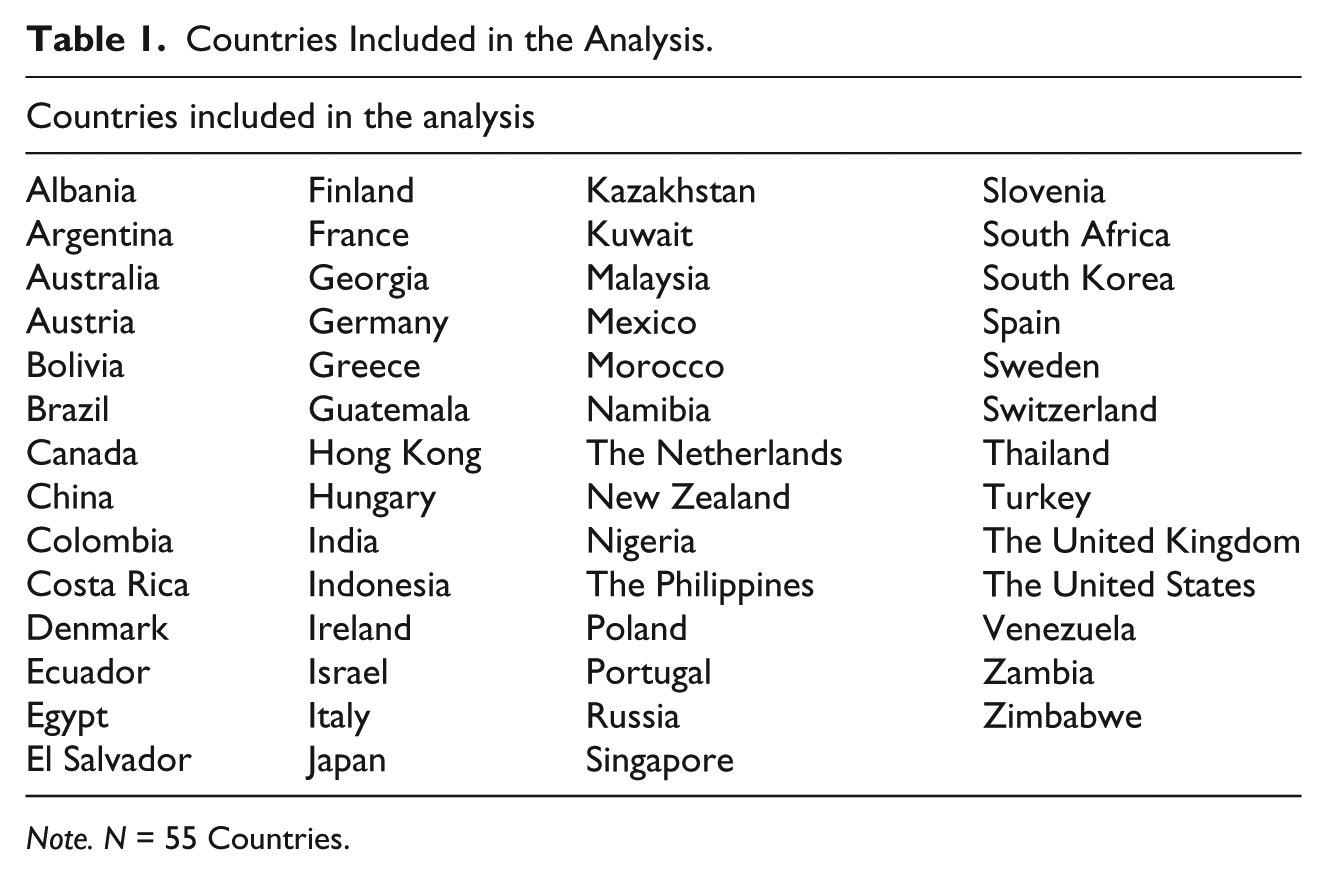
Note. N = 55 Countries.
The GLOBE study project does not report the exact numbers of respondents polled per particular country, but an average of 251. Therefore, the data for culturally endorsed leadership and national cultural practices is based on approximately 8,000 observations. In addition, by choosing two separate and disassociate data sources, we eliminate the danger of common method- and common source bias (see Podsakoff, MacKenzie, & Lee, 2003).
Measurement of Innovation-Relevant Leadership Dimensions and Cultural Practices
As a measure of culturally endorsed leadership and cultural practices, we use data reported in the GLOBE study, which collected data from 17,370 respondents, from 951 organizations in 62 countries. In contrast to the well-known study by Hofstede, the GLOBE study explicitly differentiates between cultural values and practices and reports separate data for the two manifestations of national culture.
In our study, we use two of the GLOBE primary leadership dimensions (Dorfman et al., 2004): participative leadership, measured by the primary dimension of non-participative reversed items, and team-oriented leadership, measured by the primary dimension of Team 1: collaborative team orientation. The participative leadership measure consists of four reversed items describing four leader attributes: non-delegator, micromanager, non-egalitarian, and individual-oriented (Hanges & Dickson, 2004). The team-oriented leadership measure consists of six items describing four leader attributes: group-oriented, collaborative, loyal, and consultative (Hanges & Dickson, 2004). In addition, we include the innovation-related cultural practice dimensions of future orientation, in-group collectivism, institutional collectivism, performance orientation, and uncertainty avoidance (Rossberger & Krause, 2013) as mediator variables of the leadership–innovation relationship. The cultural practice dimensions were measured with three to five items each. Table 2 summarizes the items of the culturally endorsed leadership and the national cultural practice dimensions.
Items and Indicators.

Note. PISA = Program for International Student Assessment; PPP = Purchasing Power Parity; ICT = information and communication technology.
Measurement of National Level of Education, Economic Factors, and National Innovativeness
To measure the level of national innovation, we use data from the Global Innovation Index. The Global Innovation Index was launched by INSEAD (2011) to find metrics, measurements, and approaches to capture the “whole picture of Innovation” (p. 3). It integrates “hard and soft data” (2010, p. 344), that is, economic data and survey results from international organizations, such as the World Bank and the United Nations. The index is regarded conceptually, methodically, and statistically as the most comprehensive measure of innovation at the country level. We segmented the index and extracted the two of the seven components that are the most accepted and frequently used in innovation research: scientific outputs, consisting of knowledge creation, knowledge impact, and knowledge diffusion; and creative outputs, consisting of creative intangibles and creative goods and services (INSEAD, 2011).
In addition, we extracted the data for education and economic and political factors from this data source. Economic factors are operationalized by economic wealth, measured by GDP per capita, and the political environment is operationalized by factors such as political stability and government effectiveness. Educational factors are operationalized by measures of the level of education and tertiary education. The education factor consists of indicators such as national expenditures in education, Program for International Student Assessment (PISA) scales in math and science, and school life expectancy. The tertiary education factor includes measures such as number of graduates in sciences and engineering. Table 2 summarizes the national-level indicators for education, economic and political factors, and innovation.
We test our hypotheses and our model by using partial least square (PLS) equation modeling. We chose to do so because of two reasons: first, the sample size of N = 55 countries is too small for the application of covariance-based structural equation models (i.e., LISREL approach). Therefore, the application of variance-based structural equation modeling is necessary. Second, the PLS approach allows reflective and formative measurement simultaneously in one model. Theoretical and statistical considerations suggest that this is the case in our model. We use the software SmartPLS (Ringle, Wende, & Will, 2005) to test our model.
Results
Similar to covariance structure analysis (i.e., LISREL approach), the variance-based PLS approach allows extensive model testing. However, the process of model evaluation is primarily divided into two steps: evaluation of the outer and of the inner model. The outer (measurement) model specifies the relationships between the indicator variables and the latent variables, whereas the inner (structural) model specifies the relationships between the latent variables themselves. The overall quality of the model is derived from both measurements, and a two-step approach of reporting is recommended (Chin, 2010; Götz, Liehr-Gobbers, & Hildebrandt, 2010). Table 3 shows the correlations between the indicator and the latent variables used in the model.
Correlations Between GLOBE Cultural Practice and Leadership Dimensions, Education, Political and Economic Factors, and Innovation.
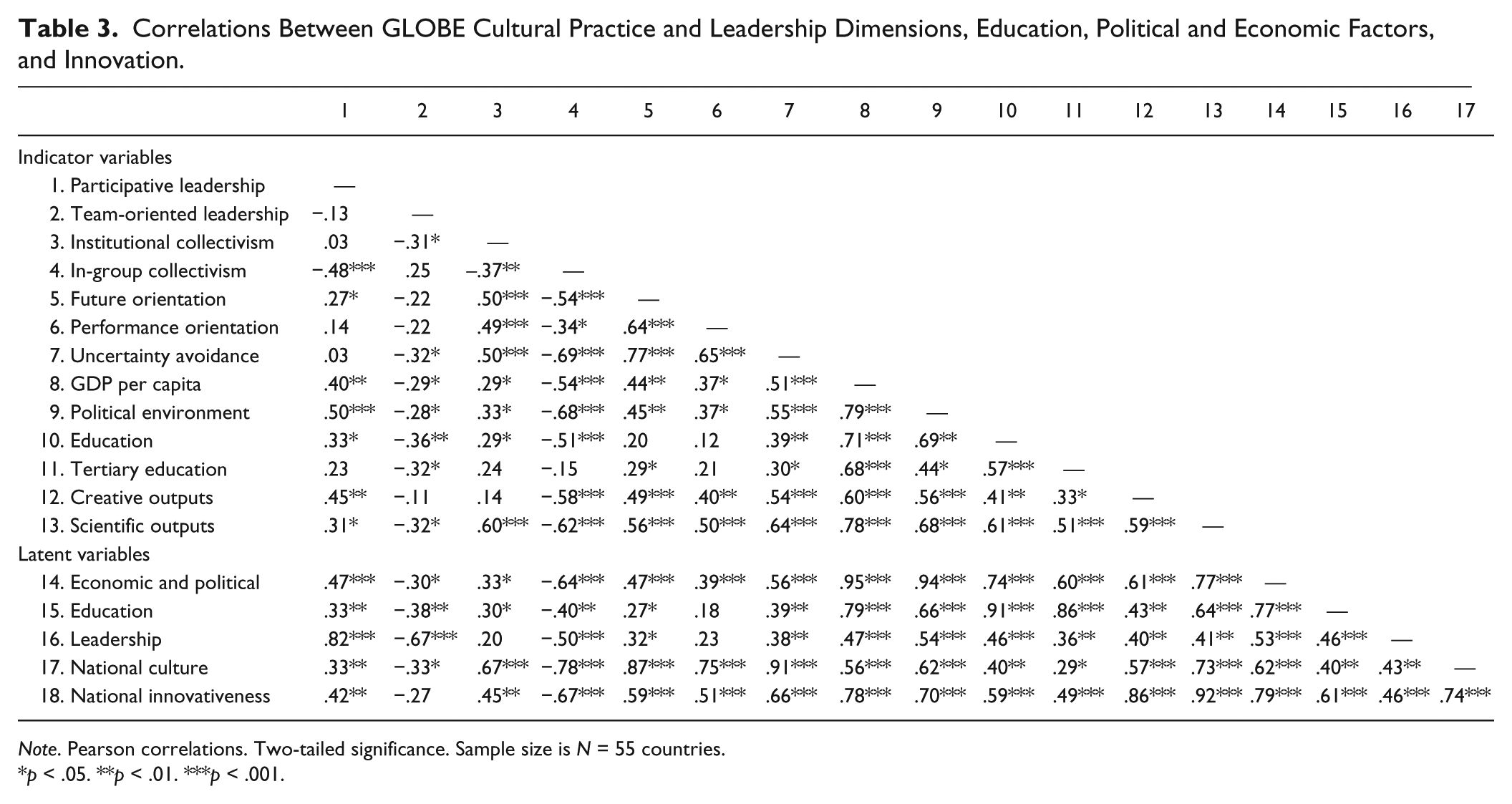
Note. Pearson correlations. Two-tailed significance. Sample size is N = 55 countries.
p < .05. **p < .01. ***p < .001.
Evaluation of the Measurement Model
We operationalized four of our five latent variables, namely, education, economic and political factors, national cultural practices, and national innovativeness as reflective constructs, and cultural endorsement of participative and team-oriented leadership as a formative construct. Table 4 gives an overview of the measurement of the constructs.
Measurement of Constructs.

For the reflective constructs, all indicator loadings, except institutional collectivism, are above the recommended value of .70. All loadings were also significant at least at the 1% level running 1,000 bootstrap samples; therefore, indicator reliability can be assumed. The significant relationships of institutional collectivism also convinced us to keep the dimension in our model despite the low factor loading. We tested construct reliability by using composite reliability (CR). For all constructs, the CR is between .72 and .92, that is, above the recommended threshold of .70; therefore, construct reliability is assured. Table 5 exhibits the results of the fit of the measurement model.
Result About the Fit of Measurement Model and R2 for the Endogenous Construct of the Final Model.

Note. AVE = average variance extracted; CR = composite reliability.
Discriminant validity is measured with the average variance extracted (AVE) parameter. The AVE values of our model are between .62 and .85, that is, well above the recommended threshold of .50. To ensure discriminant validity, the square roots of the AVE values have to be greater than the values in the corresponding rows and columns of the correlation matrix of the latent constructs (Fornell & Larcker, 1981). Our model also fulfills these criteria; therefore, discriminant validity can be assumed (see Table 6). In addition, cross loadings show that all indicators load highest on their corresponding construct and every construct loads highest on its own items. Overall, discriminant validity is assured.
Correlation Matrix of the Latent Constructs With Root of AVE in the Diagonal.
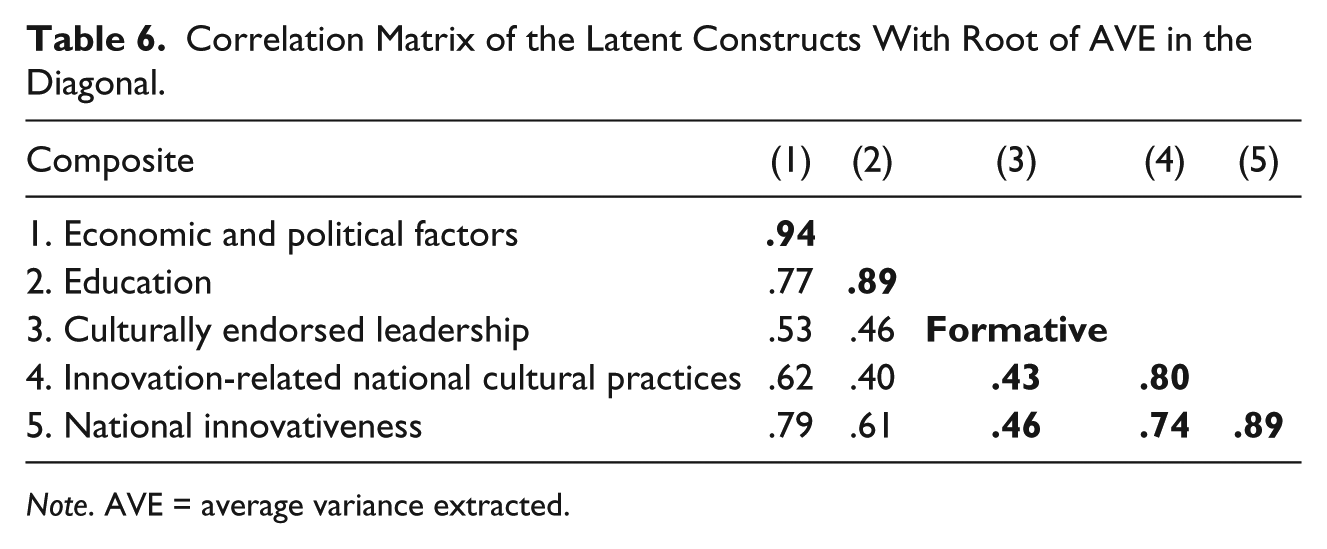
Note. AVE = average variance extracted.
Evaluation of the Structural Model
The R2 measure of the endogenous construct on national innovativeness is .74, which is considered substantial (Henseler, Ringle, & Sinkovics, 2009; Schloderer, Ringle, & Sarstedt, 2009). The significance of the path models has been tested by running 1,000 bootstrap samples. The path coefficients between culturally endorsed leadership and national cultural practices (β = .43, p < .001), between culturally endorsed leadership and economic factors (β = .22, p < .001), between the level of national education and culturally endorsed leadership (β = .46, p < .001), between the level of national education and economic factors (β = .63, p < .001), between economic factors and national innovativeness (β = .53, p < .001), and between national cultural practices and national innovativeness (β = .43, p < .001) are all significant. Interestingly, the direct path between culturally endorsed leadership and national innovativeness (β = .03, n.s.) is insignificant.
The mediation effect of national culture has been tested by combining the bootstrapping method with the Sobel test (1982, 1986) as recommended particularly for small sample sizes (Preacher & Hayes, 2004, 2008). The Sobel test determines whether the influence of the proposed mediator has significant influence based on the regression coefficient between the independent variable and the mediator and between the mediator and the dependent variable, and the standard errors of these two relationships. Both methods, bootstrapping and the Sobel test, have supported the proposed mediation effects of economic and political factors (H2b, Sobel test value 5.19 [p < .01]) and national cultural practices (H4c, Sobel test value 4.08 [p < .01]). Figure 3 and Table 7 illustrate the results of the structural model.
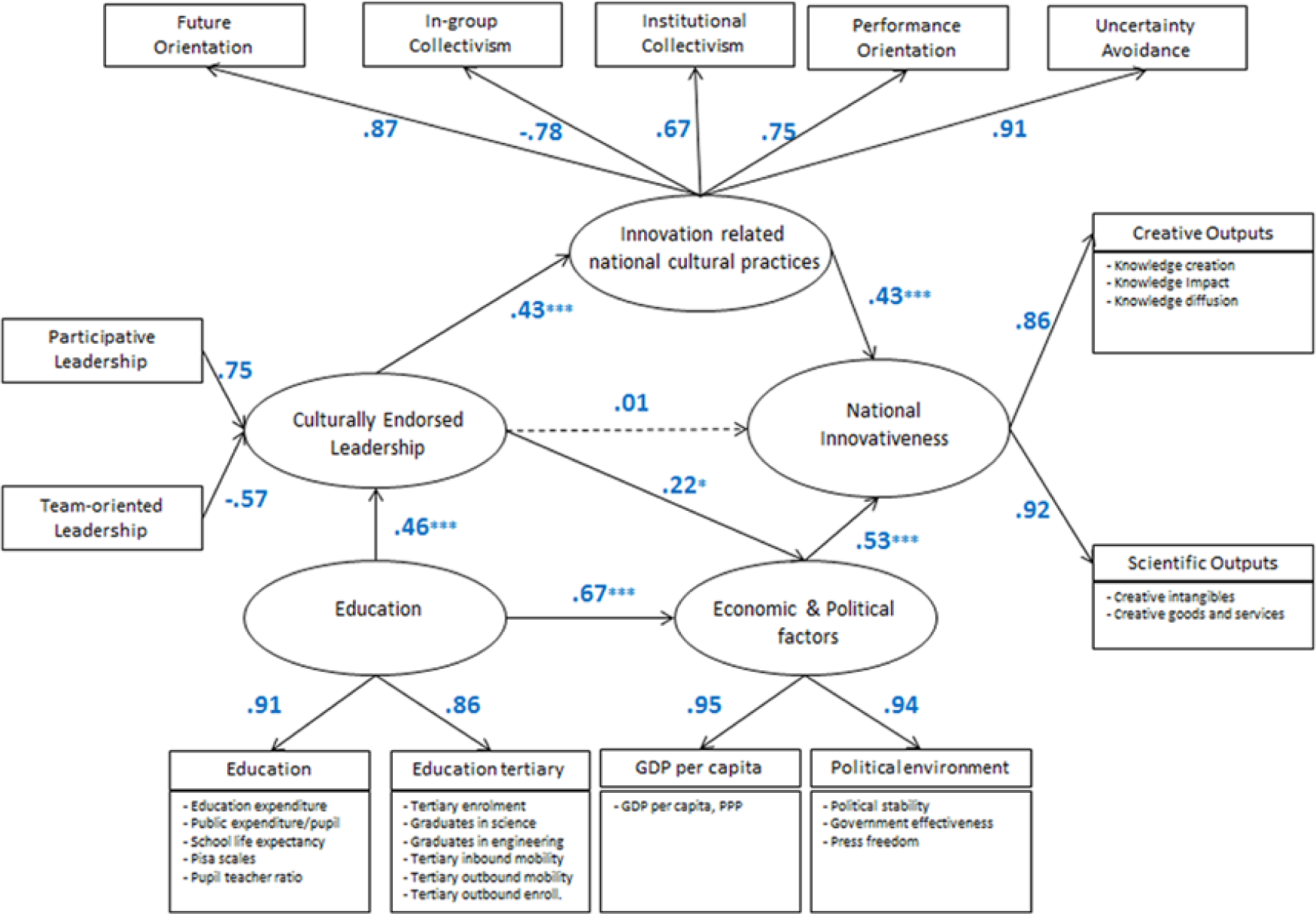
Structural Model - Leadership, Contingency Factors and National Innovation.
Model Results and Significance.

p < .05. **p < .01. ***p < .001.
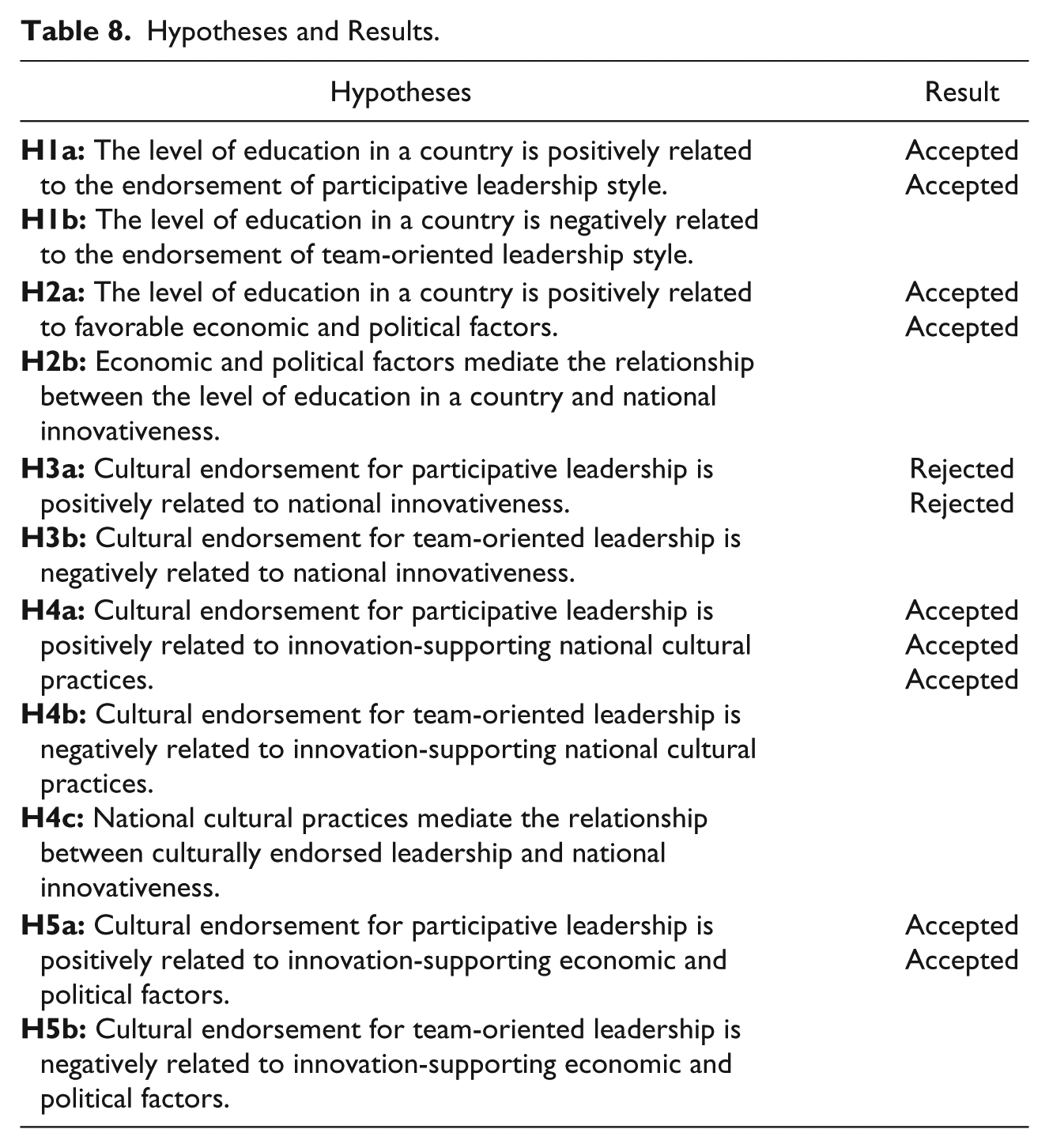
Overall, these findings support 9 of our 11 hypotheses. Countries with higher levels of education do indeed show higher endorsement of participative leadership than of team-oriented leadership. Contrariwise, countries with lower levels of education do indeed tend to endorse team-oriented leadership rather than participative leadership. This is in line with H1a and H1b. The level of education is significantly and positively related to economic and political factors. Economic and political factors are significantly and positively related to national innovativeness and mediate the relationship between education and innovation. Therefore, we accept H2a, H2b, and H2c. Endorsement of participative and team-oriented leadership is not directly related to national innovativeness, which is why we reject H3a and H3b. However, the assumed indirect (mediated) effects are supported.
Higher endorsement of participative leadership and lower endorsement of team-oriented leadership are positively related to innovation-supportive national cultural practices. Consequently, higher endorsement of team-oriented and lower endorsement of participative leadership show a negative relationship with innovation-supportive cultural practices. Therefore, we corroborate H4a and H4b. Innovation supportive national cultural practices mediate the culturally endorsed leadership–national innovation relationship and are positively related to national innovativeness. We accept H4c. Finally, H5a and H5b can be accepted as there is a significant relationship between endorsed leadership styles and economic and political factors. Table 8 summarizes the hypotheses and the results.
Hypotheses and Results.
Discussion
The study provides three insights: First, there is indeed a relationship between cultural endorsement of leadership and national innovativeness. Countries that endorse participative leadership tend to be more innovative than those that endorse team-oriented leadership. However, the culturally endorsed leadership dimensions appear not to be directly related to innovation but rather mediated via innovation-related cultural practices and economic and political factors. Second, the level of education appears to be an important contingency variable. Our analyses suggest that it influences which leadership style is accepted and is efficient in a country, and that it is directly related to the economic and political factors necessary for national innovation to occur.
These findings have also practical implications. They suggest that the leadership style that is culturally appreciated and may, according to the GLOBE study, work best in a specific country, may not be the appropriate one in the context of innovation. If the goal is to increase innovation, it may require executing a leadership style that is not appreciated and accepted in specific countries. Resistance may be due to the following.
First, countries that do endorse team-oriented leadership and reject participative leadership (e.g., Mexico, Indonesia, and Albania) tend to be those countries that do not support innovation too much anyhow. They tend to have innovation-detrimental cultural practices, fewer resources, and a lower level of education. Overall, the whole contingency environment is not beneficial to innovation. Second, people will not accept participative leadership as it does not match their implicit theories about what leadership should look like. This makes it difficult to stimulate change, especially in combination with the corresponding innovation-detrimental environment. Third, even if the participative leadership approach finds acceptance, the probability that this approach would lead to the desired results is low due to the lower level of education. Participative leadership requires the appropriate people to be efficient and effective. Overall, this constellation is similar to a vicious circle, which is difficult to break. Nevertheless, in the following, we provide suggestions for intervention.
At the national level, the possibility of intervention is necessarily political and therefore difficult, specifically as economic and political factors themselves represent contingency variables of the system. However, focused political intervention is still a reasonable approach. Considering education, intervention should pay special attention to subjects that influence the acceptance and endorsement of participative leadership and, at the same time, help to create an innovation-supportive cultural environment. Therefore, education has, besides “hard” subjects, to include “soft” aspects that foster people’s self-reliance, tolerance, creativity, and flexibility. Both types of subjects are necessary to increase acceptance as well as the effectiveness of participative leadership. Such an educational basis will also make it easier for people in leadership positions to establish innovation-supporting cultural practices.
At the organizational level, the focus is clearly on leadership. However, our model shows that leadership is just one of the necessary variables to adjust, as its efficiency largely depends on the other contingency variables. This implies that it is dangerous to apply recommendations made in innovation management and leadership literature at an international level. For example, we cannot affirm that participative leadership automatically is beneficial to innovation at the organizational level. In organizations, the same mechanism applies: The people must possess the right educational background, the organizational cultural environment must support it, and the necessary resources must be available.
This may apply to other antecedents of innovation mentioned in literature as well. For example, delegating degrees of freedom and autonomy may not work if the necessary knowledge and skills are missing because of a lack of education. At the same time, applying the culturally endorsed leadership approach (the one people demand and accept) will not lead to the required changes necessary for innovation. If innovation requires leadership that violates culturally accepted norms, high sensitivity of the leader is required. Leaders have to find a balance between what is necessary and what interventions are still in the range of acceptance. This will be a demanding task as these will often be borderline interventions.
In addition to leadership, personnel selection is also a viable instrument to influence a subset of context variables inside the company. Particularly, in countries with low levels of innovation, it is essential for companies to hire individuals who have above average profiles regarding the innovation-related factors mentioned. This makes an innovation-specific focus on personnel selection especially valuable in countries with low levels of innovation.
Limitations and Further Research
Our study also carries certain limitations. Our model is, like every model, an abstraction of reality. Therefore, it cannot include all possible variables. This means that there are more contingency variables influencing national innovation than the ones we have included in our model. However, our model offers a foundation for further research. In addition, the importance of the contingency variables may alternate from country to country, but overall, the ones included in our model should be of influence in most countries. Another possible limitation and point of criticism may be the high level of aggregation of our data. This, however, is determined by our research approach and the resulting level of analysis. Investigating country-level relationships requires country-level data.
Finally, the sample size of 55 countries can be considered a point of criticism. The sample size forced us to use variance-based structural equation modeling (PLS approach) instead of using covariance-based modeling (LISREL approach). This results in the restriction that we cannot include recursive relationships in our model. Variance-based modeling, which is basically the combination of regression analyses, does not allow this. However, some of the relationships in reality may be recursive: For example, the level of education does not only influence economic factors in a country but is also influenced by economic factors, as in rich countries, more resources are available to be invested in education than in poorer countries. The same is true for most relationships in our model, particularly in the long run. However, we are confident that the direction we have provided is an appropriate one.
We would suggest, as a possibility of further research, to test our model in countries that have not been part of the GLOBE study. The instruments for measuring cultural practices and endorsement for leadership are available online at the GLOBE website (The GLOBE Foundation), and the innovation and economic indicators are provided by the Global Innovation Index or can be found via secondary data analysis.
Footnotes
Declaration of Conflicting Interests
The author(s) declared no potential conflicts of interest with respect to the research, authorship, and/or publication of this article.
Funding
The author(s) received no financial support for the research, authorship, and/or publication of this article.