




Abstract
Athletic contests constitute an important aspect of human affairs. However, the evolutionary origins of athletic behavior, that is, behavior which is associated with participating in and watching athletic contests, are rather obscure, as they do not seem to contribute directly to increasing survival or reproductive success. This article argues that athletic behavior has been shaped in ancestral times jointly by intrasexual selection forces, where men look for potential allies, and intersexual selection forces, where men look for spouses for their female relatives. On the basis of this evolutionary framework, a number of hypotheses are derived: First, men are more interested than women in taking part in and watching sports. In addition, men are more interested than women in taking part in and watching competitive sports than non-competitive sports, and are more interested in team sports than individual sports. Finally, men and women differ in their motives for participating in sports, while the sex differences in athletic behavior between men and women are consistent across different cultures. Evidence from a sample composed of 37 different countries provides support for all hypotheses.
Keywords
Introduction
Sports constitute an important aspect of human affairs. Almost all TV news programs devote time to discuss sports and most newspapers have a sports section. In addition, vast amounts of resources are allocated to organizing and running athletic contests. For instance, the 2004 Olympic Games in Athens cost 15 billion euros, while the 2008 Olympic Games in Beijing cost 40 billion euros. People have a strong interest in watching these athletic contests, which results in exorbitant amounts being paid for broadcasting rights (Guttmann, 1986).
Although athletic behavior, that is, behavior associated with taking part in and watching athletic contests, constitutes an important aspect of human conduct, in evolutionary terms, its purpose is enigmatic at first: Individuals allocate considerable amount of resources (e.g., time, money, energy) so as to take part in athletic competitions without obvious fitness benefits (i.e., an increase in their survival and reproductive success). Similarly, individuals spend resources (i.e., time, ticket costs) so as to be able to watch athletes competing. Nevertheless, the evolutionary benefits from such behavior are not obvious: How can an individual’s fitness increase by spending time and money to watch athletes competing to run faster than each other?
As not all human activities are connected to fitness, it can be argued that the purpose of sports has little to do with promoting survival and reproduction. Still, given the considerable cost involved and the wide prevalence of sports, athletic behavior is unlikely to have been evolutionary neutral. Accordingly, several evolutionary hypotheses have attempted to account for athletic behavior, but, as the present article argues, these have several limitations. Accordingly, by building on previous theories, a more comprehensive theoretical framework is developed which, in turn, is used to generate testable hypotheses.
The Evolution of Sports
Intersexual Competition Under Female Choice
Athletic competitions usually take place in large modern cities where most people live. Yet, the human mind evolved in a context which is very different from our own (Lee & DeVore, 1968). Because evolutionary change requires many generations to take place evolutionary patterns from earlier times persist today despite drastic environmental changes in recent times (Tooby & Cosmides, 1990). Consequently, the observed athletic behavior should had been shaped in the early period of human evolution when humans based their subsistence on hunting and gathering, approximately two million years ago until approximately 10,000 years ago (Lee & DeVore, 1968; Tooby & Cosmides, 1990). Accordingly, evolutionary theorizing has been focused on identifying the evolutionary forces working in ancestral human societies, and which are likely to have had an impact in shaping behavior associated with sports.
To begin with, evolution favors traits that enable survival (natural selection) and mating success (sexual selection). Sports do not seem to promote survival, indicating that sexual selection is more likely to have been an evolutionary force responsible for shaping athletic behavior (Miller, 2000; Zahavi & Zahavi, 1997). Sexual selection—that is, the evolutionary forces that give rise to traits that enable an organism to attract and retain mates (Darwin, 1871)—can be divided into intrasexual selection, which involves the evolution of traits that are used to defeat or intimidate same sex rivals, and intersexual selection, which involves traits that enable an individual to be selected by the opposite sex (Andersson, 1994).
It has been argued that intersexual selection is primarily responsible for the evolution of athletic behavior (Miller, 2000; Zahavi & Zahavi, 1997). In particular, women divert more parental investment to their children (9 months of gestation, breastfeeding, etc.), and thus become the scarce reproductive resource to which men strive to gain access (Trivers, 1972). This places women in a position where they can exercise mate choice, and when they do so they tend to prefer men with qualities that increase their fitness (Buss, 2003).
As good athletic ability correlates with a number of factors that are of interest to women in a mate, such as fighting ability, it pays for women to prefer as mates men with superior athletic ability, and it pays for men to demonstrate these abilities to women (Miller, 2000; Zahavi & Zahavi, 1997). A tendency to display athletic abilities by participating in contests where athletes compete in a standardized fashion enables men to signal their abilities, protecting themselves at the same time from cheaters (Zahavi & Zahavi, 1997). This is possible because athletic contests involve considerable physical strain, so men with limited physical abilities, will not be able to compete, enabling the ones with superior athletic capacity to stand out as winners. On this basis, it has been proposed that a tendency to participate in athletic contests has evolved to enable men to reliably signal their unobserved athletic abilities to women (De Block & Dewitte, 2009; Miller, 2000; Zahavi & Zahavi, 1997; see also Llaurens, Raymond, & Faurie, 2009, for an example of how ritual fighting can be used by women when choosing mates).
One prediction that follows from this hypothesis is that proven athletes should enjoy a high level of mating success, which appears to be so (Faurie, Pontier, & Raymond, 2004; Schulte-Hostedde, Eys, & Johnson, 2008; Snyder, Kirkpatrick, & Barrett, 2008). The second prediction from this hypothesis is that there should be a sex difference, with women being more interested in watching male athletic contests than men are, because this will enable them to evaluate the characteristics of potential mates. This prediction is not supported by empirical evidence, and what is observed is actually the opposite: Men are much keener to watch athletic contests than women, talk about sports more frequently, and are more knowledgeable about the rules and history of sports (Dietz-Uhler, Harrick, End, & Jacquemotte, 2001; Guttmann, 1986; James & Ridinger, 2002; Rhoads, 2004).
It could be argued of course that women are primarily interested in the social status that men gain from winning athletic competitions, something that can be evaluated without actually watching these competitions. Accordingly, men may be motivated to participate in sports to climb the social hierarchy and make themselves more appealing to women. This can certainly be a motive for taking part in athletic competitions, but the question of audience still remains unanswered: If men engage in athletic competitions to climb the status hierarchy and appeal to women, and women were interested in how well men do in this, then it would make sense for women to watch closely athletic competitions where status hierarchies are established instead of trying to assess this indirectly.
Similarly, women are attracted by well-built male bodies (Buss, 2003), which means that men may engage in sports to make their bodies appealing and thus become more attractive to women. This argument can account for why men do sports such as weight lifting, but it does not account for the great majority of sports that are competitive in nature such as football, rugby, boxing, and so on. If men’s primary motive for participating in sports was to build attractive bodies, then they would simply engage in physical exercise and would not be motivated to engage in competitive sports that can lead to body deformities (e.g., a broken nose), as well as the risk of potential temporary (e.g., broken bones) or permanent injuries (e.g., damage to the spinal cord).
Intrasexual Competition, Intersexual Competition, and Parental Choice
In view of the shortcomings of the female choice hypothesis, it has been proposed that intrasexual competition rather than intersexual competition has been primarily responsible for shaping athletic behavior. That is, it has been argued that sports have evolved as a way to provide men with opportunities to evaluate the qualities of potential allies and rivals (Lombardo, 2012). In particular, another pathway for men to gain mating access to the opposite sex is to exclude other competitors by force and monopolize women (Andersson, 1994). Doing so depends to a large extent on building good alliances and avoiding powerful rivals (see also McDonald, Navarrete, & Van Vught, 2012).
It makes sense, then, for men to be more interested than women in watching other men taking part in athletic contests, to gain information about potential allies and rivals (Lombardo, 2012). It also makes sense for men to compete in front of a male audience, because if they do well people will favor them as allies and will avoid them as rivals. Although intrasexual competition is likely to be one constituent component of the evolutionary forces that have shaped athletic behavior, it is not the only one: Intersexual selection also has a significant role.
In particular, in intersexual competition, men compete to be selected by women on the basis of desirable traits. Still, the mate choices of daughters do not find the agreement of their parents, who tend to desire different traits in a prospective in-law (Apostolou, 2008; Buunk, Park, & Dubbs, 2008; Perilloux, Fleischman, & Buss, 2011). This disagreement motivates parents to control their daughters’ mate choices to choose sons-in-law who best match their own preferences (Apostolou, 2010b). In pre-industrial societies, parents are successful in doing so, with arranged marriage being the primary mode of long-term mating (Apostolou, 2007, 2010b). Moreover, male parents dominate over female ones and become in effect the primary decision makers in marriage arrangements (Apostolou, 2010b). As modern pre-industrial societies resemble ancestral ones, these patterns of mating were most likely present during the greatest part of human evolution (Apostolou, 2010b; Lee & DeVore, 1968), a hypothesis that is supported by phylogenetic (Walker, Hill, Flinn, & Ellsworth, 2011) and historical evidence (Apostolou, 2012).
Overall, athletic behavior most likely evolved in a context where marriages were arranged and male parents exercised considerable influence over their daughters’ mating behavior, choosing husbands for them. In this case, intersexual competition takes the form of men competing to be selected by other men as spouses for their daughters, sisters, and other female relatives. This indicates that the hypothesis that athletic behavior evolved to facilitate honest communication between men and women is not plausible, and a more realistic one is that it evolved to facilitate honest communication between men. From this evolutionary framework, several hypotheses on athletic behavior can be derived.
Hypotheses on Athletic Behavior
Deaner et al. (2012) argued that men have a far greater inborn motivation than women to participate in sports. They based their hypothesis predominantly on the fact that during human evolutionary history men have been substantially more likely than women to engage in contests, and empirical evidence from contemporary societies pointing to the same direction (Deaner & Smith, 2013; Ellis et al., 2008; Guttmann, 2004). This predisposition is likely to the outcome intersexual and intrasexual selection forces exercised predominantly on men to reliably signal their athletic abilities to other men. In particular, research on in-law preferences indicates that when parents exercise choice they desire, among other things, good hunting ability, high resource generating capacity, high social status, and good health (Apostolou, 2010a), traits that correlate with athletic ability. In addition, men compete with each other to be selected by other men not only as in-law but also as allies. However, women do not have to compete as intensively to be selected by parents as daughters-in-law or as allies. Overall, men are predicted to be more interested than women in taking part in athletic competitions.
Moreover, men engage in sports to demonstrate their abilities in relation to other men. That is, because men look for allies and sons-in-law among different candidates, such a candidate should not only be interested solely in demonstrating that he has good athletic skills but also in showing that he has better athletic skills than other men. Therefore, men should be interested in competing with other men rather than simply engaging in physical activity (Deaner et al., 2012). This leads to the hypothesis that men will be more interested than women in taking part in competitive sports (e.g., football) than in non-competitive sports (e.g., jogging).
Also, in intrasexual competition, men build alliances with other men to effectively compete against their rivals (Chagnon, 1992). That is, men who are willing and able to ally with other men have an advantage over those who choose to compete on their own, because the latter will be outnumbered. Accordingly, men are expected to be predisposed to form coalitions to pursue a common goal, which is usually to beat their rivals (McDonald et al., 2012). In sports, this takes the form of teams of men competing against other teams of men to win a contest. Women, on the other contrary, do not form such coalitions—or do this more rarely—as intrasexual selection forces are much weaker on them. On these grounds, it is predicted that men will be more interested than women in participating in team sports than in individual sports.
In addition, it is men who need to find good allies and avoid powerful rivals, and also to find sons-in-law for their daughters. Consequently, evolutionary pressures are exercised on men to become interested in the signals of athletic ability shown by other men. That is, a predisposition to be interested in watching other men competing should be favored by evolution because it enables individuals to gain useful information on future allies, rivals, and in-laws. On these grounds, it is predicted that men have a stronger interest than women in watching sports.
Furthermore, as male spectators are primarily interested in how a man fares in comparison with other men, it is predicted that men are more interested than women in watching competitive sports, rather than non-competitive sports. In the same vein, effective participation in team sports can signal desirable qualities such as ability to work with others and role acceptance (Schulte-Hostedde, 2008, see also Deaner et al., 2012). This information is beneficial for men who look for allies, as a successful alliance requires teamwork. Similarly, this information is beneficial for male parents who look for sons-in-law to incorporate into their own team (i.e., their family). On this basis, it is predicted that men should be more interested than women in watching team sports than individual sports.
Athletic behavior is also associated with other benefits, including meeting other people, enhancing looks, improving health, and so on. This indicates that both sexes will be willing to participate in athletic events, but their motives for doing so will differ. For instance, men would be primarily motivated to participate in sports by actually competing with other men, whereas women will hold other motives, such as improving their looks (for a more extensive discussion on motivation in sports, see Gill & Deeter, 1988; Vallerand & Losier, 1999).
Finally, one key prediction of this framework is that the above-mentioned hypotheses should hold across different cultures. That is, it has been argued that evolutionary pressures have shaped male and female minds differently, which indicates that the hypothesized sex differences in athletic behavior should be consistently found across different cultures.
Method
Participants
The sample used in this study consisted of 49,729 participants (27,423 women and 22,270 men) from 37 different countries. The mean age of male participants was 45.9 (SD = 17.4) and the mean age of female participants was 45.8 (SD = 17.3). The sample size was not equal across countries ranging from 307 participants in Israel (Arab) to 2,769 in Australia. For most countries, however, the sample was greater than 1,000 participants. Moreover, in all countries, the sample was roughly balanced between men and women. In addition, 54.5% of the participants were married, 17.8% were widowed, 27.1% had never been married, and 0.6% were living together as a couple. Finally, participants in the sample had completed a mean of 11.9 (SD = 3.8) years of schooling. Note that while many countries can be described as having a national culture, some countries have more than one important cultural units. However, for the purposes of this research, I am assuming that the country data will exhibit the hypothesized evolutionary pattern.
Materials
For the purpose of this research, data from the International Survey Programme (ISP) were used. The ISP is a continuing annual program of cross-national collaboration on surveys, covering topics that are deemed to be important for social science research. At present, 48 countries around the world are represented in the program. Every survey includes questions about general attitudes toward various social issues, including the legal system, gender, and the economy. Special topics have been included, such as the Leisure Time and Sports 2007 survey, which aims to address issues such as the meaning of time and leisure and its relation to work and other spheres of life, as well as sport/game activities and subjective functions of sport and games. The data used in the analysis come from this special topic (International Social Survey Programme Research Group, 2009).
The survey instrument was composed of 98 questions, which were primarily focused on assessing how people spend their free time and what motivates them in pursuing specific leisure activities. The instrument has been translated and participants in different countries completed it in their native language. This survey was chosen because it included questions that are directly relevant to the hypotheses of this study, such as how frequently one participates in athletic activities. In addition, the survey was applied in 37 countries, allowing us to test the hypothesis that there is cross-cultural consistency in the predicted sex differences.
Results
Men Have More Interest Than Women in Participating in Sports
Two questions enable us to test the hypothesis that men are more interested than women in participating in sports. In particular, participants were asked to indicate whether in their free time they participate in sports, and if over the past 12 months they had participated in a sports team. Participants’ responses were recorded on a 5-point Likert-type scale (1 = at least once per week, 5 = never). For the purpose of this analysis, we ran a series of ANCOVAs, where the dependent variable was the participants’ responses and the independent variables were their sex and age. We used this analysis because age is likely to have an effect, so it is necessary to keep this variable constant to control for any confounding effects.
The analysis was initially performed on the whole sample and to examine cross-cultural consistency, it was repeated separately in each country in the sample. This last step included multiple comparisons, which may result in the inflation of the alpha (α) level and thus committing a Type I error. For this reason, Bonferroni correction for alpha inflation can be applied to reduce the alpha level by dividing it with the number of comparisons (.05 / 37 = .0013). Still, as this is the first time that this kind of analysis has taken place and we do not want to miss any important differences, we base the results on unadjusted alpha level. However, when a p value is below Bonferroni adjusted alpha, it is reported in italics.
The results are presented in Table 1, where it can be seen that overall men reported engaging more frequently in sports than women, but the small effect size indicates that the overlap is considerable. Also, there is substantial cross-cultural variability; this effect was detected in 16 countries, but was not detected in 21 out of the 37 countries. In the cases where it was not detected, the difference of the means was in the predicted direction (men reported a greater interest than women), and given the small effect size, it is likely that a bigger sample in these countries would produce significant results. Moreover, there was considerable variability between the countries in which the difference was present, with effect sizes ranging from 0.10 (Mexico) to 1.10 (Cyprus). Finally, for five countries, a difference was found in the opposite direction, with women reporting being more interested than men in doing physical exercise.
Sex Differences in Sports Participation.
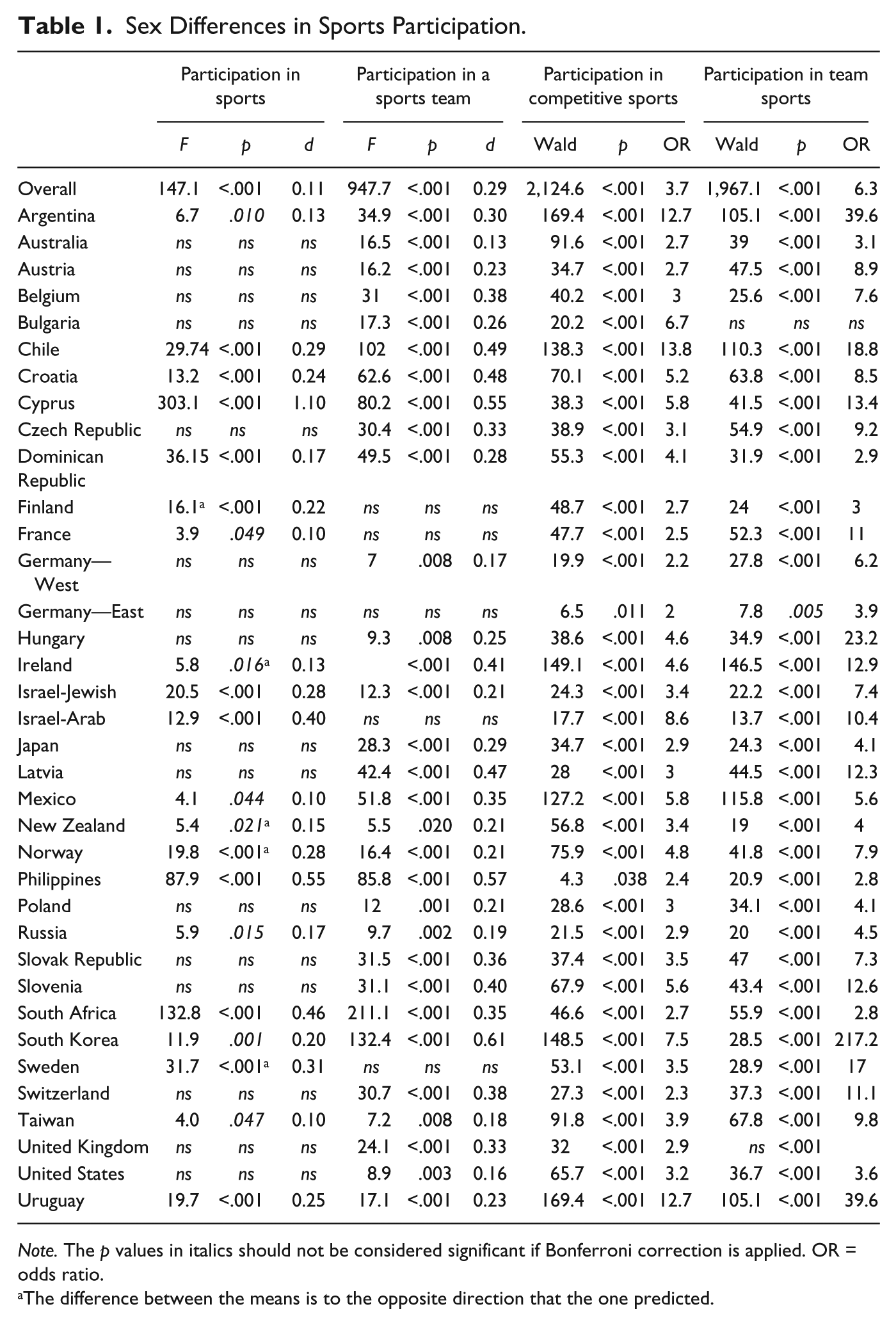
Note. The p values in italics should not be considered significant if Bonferroni correction is applied. OR = odds ratio.
The difference between the means is to the opposite direction that the one predicted.
The sex difference is more apparent when it comes to participating in a sport team. In particular, for the whole sample, men reported that they participate in sports teams more frequently than women. There is cross-cultural consistency in this finding, with the difference being detected in 32 of the 37 countries. Also, in the five cases where no significant results were produced, the mean differences were in the predicted direction. Finally, there is variability across countries, with effect sizes ranging from 0.13 (Australia) to 0.61 (South Korea).
The evolutionary framework predicts that there will be differences in sports participation between age groups. For instance, younger men who are at the beginning of their reproductive careers are likely to be more interested than older ones in displaying their athletic abilities. To examine whether there is a difference between age cohorts, a new variable was created that splits the sample as three age groups, namely 15 to 30, 31 to 50, and 51 and above. A two-way ANOVA was performed, with participation in sports entered as the dependent variable and the sex of the participant and the age cohort entered as the independent variables. The results indicate a significant main effect of age cohort, F(2, 49075) = 171.21, p < .001,
Men Are More Interested Than Women in Participating in Competitive Sports
To test the hypothesis that men are more interested than women in participating in competitive sports, we analyzed participants’ responses regarding which sport they more frequently engage in. Overall, 44 different sports were reported. We attempted to classify these into competitive—that is, sports where participants aim to win a contest competing directly against others—and non-competitive—that is, sports that do not involve direct competition against others. Based on these definitions, two independent researchers were recruited (a man and a woman, both post-graduate students) and were asked to classify these sports in these two categories. The overall agreement of the two assistants was high (Spearman’s ranked order correlation = .93). The non-competitive category included sports such as jogging, dancing, body building, and aerobics, while the competitive category included sports such as basketball, volleyball, and tennis.
For the purpose of this analysis, binomial regression was used, where the type of sport (competitive/non-competitive) was entered as the dependent variable and participants’ sex and age were entered as the independent variables. The analysis was initially performed for the whole sample and subsequently for each country separately. The results are presented in Table 1. We can see that there is a significant overall difference, with men being 3.7 times more likely than women to participate in competitive sports than in non-competitive sports. This difference is cross-culturally consistent, having been detected in all countries in the sample. There is also cross-cultural variability, with the odds ratios ranging from 2 (East Germany) to 12.7 (Uruguay).
We also examined whether there were age cohort effects. Toward this end, binomial regression was applied where the type of sport entered as the dependent variable and the age cohort as the independent variable. The analysis was repeated for male and female participants. The results indicate a significant effect of the age cohort for men (p < .001), with 15- to 30-year-olds to be 5.7 times more likely and 31- to 50-year-olds to be 2.2 times more likely to participate in competitive sports, than participants in the 51 and above age group. A significant effect was also found for women (p < .001), but with the differences between cohorts to be smaller. In particular, 15- to 30-year-olds are 2.9 times more likely and 31- to 50-year-olds are 1.9 times more likely to participate in competitive sports, than those who are 51 and above age group.
Men Are More Interested Than Women in Participating in Team Sports
As before, to test the hypothesis that men are more interested than women in participating in team sports than in individual sports, we analyzed participants’ responses regarding which sport they more frequently engage in. Sports were classified into team sports—that is, sports that involve a group of athletes cooperating with each other for the purpose of winning a competition—and individual sports—that is, those in which athletes engage in physical activity on their own. As before, two independent assistants were asked to classify participants’ responses in the two designated categories (i.e., team and individual sports). The assistants’ classifications were in good agreement (Spearman’s ranked order correlation = .94).
For this analysis, binomial regression was used, with the type of sport (team/individual) entered as the dependent variable and participants’ sex and age entered as the independent variables. The analysis was performed initially for the whole sample and subsequently for each country separately. The results are presented in Table 1.
From this table, we can see that there is a significant overall difference, with men being 6.3 times more likely than women to participate in team sports than in individual sports. This difference, with the exception of Bulgaria, is cross-culturally consistent as it was detected in all countries in the sample. There is also cross-cultural variability, with the odds ratios ranging from 3 (Finland) to 217.2 (South Korea).
Men Are More Interested Than Women in Watching Sports
Participants were asked to indicate whether in their free time they watch sports by going physically to the place where the event takes place (e.g., to a stadium). Participants’ responses were recorded on a 5-point Likert-type scale (1 = every day, 5 = never). To examine whether there are sex differences in this dimension, we run a series of ANCOVAs with participants’ responses as the dependent variable and sex and age as the independent variables. The analysis was performed initially for the whole sample and then for each country separately. The results are presented in Table 2.
Sex Differences in Watching Sports.

Note. The p values in italics should not be considered significant if Bonferroni correction is applied. OR = odds ratio.
The difference between the means is to the opposite direction that the one predicted.
From Table 2, it can be seen that men watch athletic events more frequently than women, with the overall effect size being moderate. This finding is cross-culturally consistent, as this sex difference was detected in all countries in the sample, with the only exception being the United States where no significant difference was found and the Cyprus where the difference was in the opposite direction. Finally, there was variability across countries with effect sizes ranging from 0.21 (Australia) to 0.99 (Israel-Jewish).
We also attempted to examine whether this effect was found in watching sports on TV. In particular, participants were asked to indicate which sport they were more frequently watching on TV. In answering this question, participants could either indicate a specific sport, or that they did not watch any sports. Thus, this variable was recoded in having two categories: participants who indicated that they watched sports and those who indicated that they did not watch sports on TV. For the statistical analysis, binomial regression has been applied with watching sports on TV (yes/no) entering as the dependent variable and participants’ sex and age entering as the independent variables. The analysis was performed first for the whole sample and then for each country separately. The results are presented in Table 2.
From this table, we can see an overall significant effect of sex, with men being 3.4 times more likely than women to indicate that they watch sports on TV, than that they do not. With only three exceptions (i.e., Ireland, New Zealand, United Kingdom), this effect was found in all the countries in the sample. There is also variability across countries with odds ratios ranging from 2 (South Africa) to 15.5 (Cyprus).
Men Are More Interested Than Women in Watching Competitive Sports
To examine whether men are more interested than women in watching competitive than non-competitive sports, we analyzed participants’ responses in the question inquiring about the sport more frequently watched on TV. Participants’ responses were open-ended, thus we classified sports into competitive and non-competitive, using the procedure discussed in the “Men Are More Interested Than Women in Taking Part in Competitive Sports” section. The overall agreement of the two assistants was high (Spearman’s ranked order correlation = .91)
For the purpose of this analysis, binomial regression was used where the type of sport (competitive/non-competitive) was entered as the dependent variable and participants’ sex and age were entered as the independent variables. The analysis was performed initially for the whole sample and subsequently for each country separately. The results are presented in Table 2.
From this table, we can see that men are 2.3 times more likely than women to watch competitive sports on TV, than non-competitive sports. In 20 countries, this difference was not significant, whereas in 17 countries, significant differences were found. In the countries where a significant effect was found, there is also variability with Odds Ratios ranging from 2.2 (Austria) to 39.6 (Uruguay).
Men Are More Interested Than Women in Watching Team Sports
As done previously, to examine whether men are more interested than women in watching team than individual sports, we analyzed participants’ responses for the question inquiring about the sport which is more frequently watched on TV. Sports were classified into competitive and non-competitive ones, using the procedure discussed in the “Men Are More Interested Than Women in Participating in Team Sports” section. The two assistants were in good agreement between them in their classifications (Spearman’s ranked order correlation = .94).
For this analysis, binomial regression was used, where the type of sport (team/individual) were entered as the dependent variable and participants’ sex and age were entered as the independent variables. The analysis was performed initially for the whole sample and subsequently for each country separately. The results are presented in Table 3.
Sex Differences in Watching Team Sports and in Motivation for Athletic Behavior.

Note. The p values in italics should not be considered significant if Bonferroni correction is applied. OR = odds ratio.
From this table, we can see that men are 2.2 times more likely than women to watch team sports on TV, than to watch individual sports. This effect was present in 33 countries, but it was not found in four countries in the sample. There was also variability with Odds Ratios ranging from 1.5 (Argentina) to 11.8 (Cyprus).
Men Have Different Motives Than Women for Taking Part in Sports
Participants were asked to rate four motives for taking part in sports, namely to compete against others, to look good, to meet other people, and to enjoy physical or mental health. Participants’ responses were recorded on a 4-point Likert-type scale (1 = very important, 4 = not at all important). To examine whether men and women differ in their motives, a series of ANCOVAs was performed with participants’ responses as the dependent variable and the sex and the age of the participants as the independent variables. The analysis was performed initially for the whole sample and then for each country separately. The results are presented in Table 3.
From this table, it can be seen that male participants indicated significantly more than female ones that one of their primary motives for engaging in sports is to compete with each other, with the effect size being small to moderate. This effect was found in all countries in the sample. There was some variability, with effect sizes ranging from 0.19 (Austria and Cyprus) to 0.70 (Poland).
There was also a significant sex difference, albeit smaller, with women indicating significantly more than men that their motive for engaging in sports is to improve their looks. This effect was found in 24 of the 37 countries, and in 13 countries, no significant results were produced. Among the countries where sex differences were found, there is some variability, with effect sizes ranging from 0.13 (Chile) to 0.52 (Finland).
Finally, with respect to the motive of meeting other people, there is an overall significant result, however, the effect size is minuscule (d = 0.04), which indicates that in this dimension, the two sexes practically overlap. This is also the case for the physical or mental health motive, where the effect size is even smaller (d = 0.03).
Discussion
The theoretical framework put forward in this article builds on Zahavi and Zahavi’s (1997) hypothesis that sports in which individuals compete in a standardized fashion, enable the honest communication of unobserved physical abilities. This argument is placed in an ancestral context, where mate choice is regulated and where men strive to find allies for themselves, as well as spouses for their daughters. The proposed framework has here generated seven hypotheses which have been empirically supported; across different countries, men are more interested than women in participating and watching sports, and similarly, men are more interested than women in participating and watching competitive than non-competitive sports and team sports than individual sports, while the two sexes differ in their motives for engaging in athletic activities.
For the participation in sports, the sex difference is small, indicating that there is considerable overlap between men and women. However, the reported effect size can be misleading because it involves all athletic activities. When these activities are distinguished in competitive versus non-competitive or in team versus individuals ones, the effect sizes increase considerably. This is consistent with the evolutionary framework presented here, which indicates that men are interested in participating in sports to signal that they are team players and they have better athletic abilities than other men.
Although some evolutionary models (e.g., Miller, 2000) can account for several of these findings, such as men’s higher willingness to participate in sports, they fail to account for others, such as the lower willingness of women to watch sports. Other evolutionary models can account for the latter findings (e.g., Lombardo, 2012), but these models do not incorporate evidence which indicates that during the human evolutionary time, mate choice was regulated (Apostolou, 2010b, 2012; Walker et al., 2011). On the basis of this evidence, the present work identifies parental choice to be an evolutionary force which most likely played an important role in shaping athletic behavior. In the proposed framework then, athletic behavior has been shaped jointly by intrasexual forces where men choose other men as allies and intersexual forces where men choose other men as in-laws.
This framework can also generate hypotheses, which can better distinguish it from other evolutionary frameworks. For instance, men who have daughters would be more interested in watching sports where men compete with each other than men of similar characteristics (age, time available for leisure, etc.), but who have no daughters. Future empirical work needs to explore this and other hypotheses that can be generated from this framework.
Athletic competitions can enable the reliable communication of information on physical abilities between men. Still, sports are not the only way for men to do so. For instance, in foraging societies, men can observe the hunting performance of other men and prefer as allies and sons-in-law those who are doing best. However, although individuals are expected to use multiple sources of information to assess the physical abilities of other men, athletic competitions can be useful when individuals look for allies and sons-in-law in more distant groups (this is particularly important when it comes to in in-law choice, where inbreeding needs to be avoided). In such a scenario, because individuals do not come in frequent contact with out-group members, the latter’s physical abilities are likely to be unknown to the former. Athletic contests can then solve the problem of reliably communicating information on physical abilities between those who do not know each other well. For instance, in Olympic Games in Ancient Greece, men from all over Greece were gathered in one place (i.e., in Olympia in Peloponnesus) to compete in front of other men from all over Greece.
Sports participation is unlikely to have a monocausal explanation. In particular, it is argued here that evolutionary forces have shaped men so as to be more interested than women in participating and in watching sports. Other biological factors may also contribute indirectly to the observed sex differences. For instance, due to intrasexual competition, men have become physically stronger and have more stamina than women. In turn, this means that men may be better than women in activities that require physical strength and stamina such as sports, and because they are better, they are also more willing to engage in these.
Furthermore, other factors such as socioeconomic forces may also contribute to the observed sex differences. For instance, Whiteside and Hardin (2011) suggested that as a result of social norms, women prefer watching sports like gymnastics, where beauty and style, but not aggression, are important. Economic factors may also play a role. For example, in most Western countries, women are expected to hold a job as well as to look after their children. This may result in less time becoming available to women for doing or watching sports. Actually, in a study based on a European sample, women reported lack of time as one of the reasons for not participating in athletic activities (Special Eurobarometer 334, 2010).
Evolutionary arguments make a strong case for explaining cross-cultural consistency, but they are less successful in explaining cross-cultural variability. Here, in accordance with the evolutionary hypotheses, men across different countries indicate a higher interest in participating in and watching athletic competitions than women. But there is also considerable cross-cultural variability. That is, these differences are not found in all countries, and in some countries, the effect sizes are small or moderate, whereas in others, they are large. Such variability is not inconsistent with the evolutionary framework because the expression of evolutionary mechanisms is contingent on the prevailing conditions of a given environment. For this reason, it is important to attempt to identify which cultural factors augment and which suppress these sex differences.
One such factor is likely to be the degree of economic development of a given country. For instance, in countries where there is high financial security and a good social protection system that guards people against future misfortunes, less emphasis will be placed on the economic prospects of a spouse and more on his or her looks. This will motivate both men and women to engage in physical exercise and sports as a means of enhancing their appearance. Such an effect should be stronger in women, given that men place greater emphasis on the looks of their partners (Buss, 2003). This perhaps explains why in many Scandinavian countries opposite sex differences are observed, with women being more interested than men in doing physical exercise.
Other factors that may affect sex differences’ cross-cultural variability in sports participation include a culture of equal rights, stronger feminism versus a traditional perception of sex roles. To use one example, in countries where the feminist movement is strong, sex differences in sports participation and attendance are likely to decrease. For instance, the gender inequality index estimated by the United Nations (United Nations Development Program, 2013) is double for Cyprus (0.0134), where men indicate a stronger interest in doing sports, than it is for Norway (0.065), where the sex difference is reversed. Last but not least, as people age, their physical abilities deteriorate, which may have an effect in their ability to participate in sports. Cultures that promote a healthier living (e.g., better food quality, better health care) may reduce the effects of senescence and thus, of the ability to participate in sports. This means that older men and women will be more likely to engage in sports in these cultures, reducing the sex differences in sports’ participation, which is more apparent in younger age cohorts. Overall, identifying the multitude of cultural factors that are likely to interact with our evolved predispositions for sports participation is an endeavor that future research should undertake.
Several benefits are derived from using this specific data set, including a large sample size and data from different countries. It is also beneficial that the instrument was constructed and the data collected without the hypotheses of this study in mind. Nonetheless, there are also several limitations. To begin with, this sample is based predominantly on Western European societies. Other non-Western societies may have different views of sports. The proposed theoretical framework predicts that the sex differences found here will also be present in these societies as well, a prediction awaiting confirmation by future research (see Deaner & Smith, 2013, for a recent attempt). Moreover, this study is based on self-report evidence; thus, it cannot control for discrepancies between what participants say they do and what they actually do. Also, while it is found that men and women differ in their motives for participating in sports, this study examines only four of these motives, and therefore a more detailed investigation is needed.
In addition, the hypothesis that men are more interested than women in watching competitive than non-competitive sports could only be tested for sports that people watch on TV. This may also introduce a bias; for instance, in many countries, TV channels may prefer to broadcast only competitive sports (e.g., football). Women in these countries who prefer non-competitive sports may then respond that they do not watch any sports on TV, whereas women who prefer competitive sports may indicate that they do. Thus, comparisons are made between men who prefer competitive sports and women who prefer competitive sports, which could potentially account for some of the non-significant results. Last, the proposed theoretical framework does not integrate all evolutionary theories on sports. For instance, it has been argued that sports may function to build skills necessary for activities, such as warfare and hunting (Carroll, 2000). Future theoretical and empirical work needs to assess the relative merits of these hypotheses in the understanding of the evolution of sports.
To conclude, athletic behavior constitutes an important aspect of human conduct and this article has attempted to provide a more comprehensive theoretical framework for understanding its evolutionary origins. It has been argued that intrasexual and intersexual selection forces operating in ancestral times have shaped a strong interest in men for participating and watching athletic competition. Several hypotheses have been derived, tested, and supported in a cross-cultural sample.
Footnotes
Acknowledgements
I would like to thank three anonymous reviewers for their constructive criticisms and suggestions, which enabled the improvement of this work. I would also like to thank Marianna Zacharia and Nicholas Frantzides for their help during the preparation of this manuscript.
Declaration of Conflicting Interests
The author(s) declared no potential conflicts of interest with respect to the research, authorship, and/or publication of this article.
Funding
The author(s) received no financial support for the research, authorship, and/or publication of this article.