



Abstract
The personality stereotypes of two Finno-Ugric ethnic groups, Erzians and Mokshans, who live together with Russians in the Republic of Mordovia, Russian Federation, were studied. As in previous studies, we found little support for the idea that ethnic personality stereotypes describe accurately, or even in an exaggerated manner, actual personality dispositions to think, feel, and behave in a characteristic way. The mean self-reported personality traits of participants were mostly identical, irrespective of the ethnic group they belong to. Erzians’ personality stereotypes about a typical Mokshan and, in turn, Mokshans’ stereotypes about a typical Erzian were socially less favorable compared with the way in which both ethnic groups perceived a typical Russian and, especially, a representative of their own ethnic group. As both in-group and out-group personality stereotypes were largely unfounded, there was no support for the primordial or essentialist account of ethnic stereotypes. The main function of the polarization of personality stereotypes may, thus, be symbolic self-identification and differentiation from other very similar ethnic groups.
Keywords
Personality Stereotypes
Personality traits are not only ascribed to individuals but also to groups of people. For example, it is commonplace to speak about the personality of Brits, the French, or Finns as if there is one person who could represent the whole nation or ethnos. Usually, people have rather strong opinions about those nations or ethnic groups with which they have personal, or at least historical, experience (Boster & Maltseva, 2006; Madon et al., 2001). These collective and strongly converging portraits of nations or ethnic groups may include a wide range of characteristics, including intelligence, appearance, habits, or even achievements in their social life. However, it is also possible to employ a narrower definition of national stereotypes according to which the character of a country is constrained by personality traits as they are routinely described by psychologists. For instance, the majority of personality psychologists agree that the human enduring tendencies to feel, think, and behave in a characteristic way can be effectively summarized by five independent factors, usually called neuroticism, extraversion, openness, agreeableness, and conscientiousness (McCrae & Costa, 2013). In this study, thus, we speak about national stereotypes of personality traits, not other attributes by which one ethnic group can be, in principle, distinguished from other groups.
Many stereotypes are accurate. For example, it appears to be a common knowledge that a typical Dutch person is taller than an average French person. Indeed, anthropological statistics show that the average Dutch individual (male) is 184 cm tall whereas the stature of the average French individual is 176 cm. This 8 cm difference is large enough to be recorded accurately in stereotypes. However, not only physical stereotypes may be accurate (Judd & Park, 2005). In most cultures studied, men are, on average, more dominant and eager to look for excitement than women; women, in turn, exceed men in agreeableness (Costa, Terracciano, & McCrae, 2001; Schmitt, Realo, Voracek, & Allik, 2008). As it turns out, people can correctly judge sex and age differences in personality in their stereotypes about a typical man or woman of a certain age from their own culture (Chan et al., 2012). Conversely, beliefs about national character seem to belong to the category of inaccurate stereotypes (Terracciano et al., 2005). In the study by Terracciano and colleagues (2005), it was demonstrated that beliefs about personality traits of a typical member of one’s own nation were essentially unrelated to the assessed mean levels of the same traits. In most of the 49 cultures studied, beliefs about national character were unfounded and did not converge with actual descriptions of personality of members of that culture. Later studies have confirmed that beliefs about national character are generally inaccurate, obviously having other purposes than providing a precise statistical summary of actual personality trait-level distributions (Allik, Mõttus, & Realo, 2010; Allik et al., 2009; Hřebíčková & Graf, 2013; McCrae, Terracciano, Realo, & Allik, 2007; Realo et al., 2009).
According to a classical definition, a stereotype is an exaggerated belief associated with a category. Its function is to justify (rationalize) our conduct in relation to that category (Allport, 1954/1978). One possible implication of this definition is that all stereotypes, while supposedly having a “kernel of truth,” are nonetheless inflated and amplified representations of those real traits (Judd & Park, 2005). As the exaggeration of actually existing traits was the predominantly studied mechanism of stereotype formation, yet these were revealed to be largely unfounded when it comes to national character stereotypes, a new approach for their explanation was required. One potential mechanism was discovered when Canadian autostereotypes were compared with American autostereotypes (Terracciano et al., 2005). Although the United States and Canada have very similar observed mean personality profiles, the stereotypes about a typical American and Canadian are diametrically opposed. The national stereotypes about emotionally stable and humble Canadians are in a sharp contract with Americans, who are typically portrayed as dominating and arrogant. This polarization of personality stereotypes parallels the divergence observed in value orientations adopted by these two countries (Adams, 2003). Because the underlying personality profiles summarized from the ratings of actual individuals are practically identical for the United States and Canada, one or both of the stereotypes must be inaccurate. One plausible explanation is that the Canadian personality stereotype is copied from the American; Canadians have strong opinions about their dominant neighbor and construct their own stereotype mainly by inverting everything they believe about Americans. This principal mechanism of polarization was later confirmed in studies of small nations neighboring large dominant countries such as Russia (Realo et al., 2009) or Germany (Hřebíčková & Graf, 2013). For example, Finns, Estonians, and Latvians have constructed their autostereotypes largely by reversing the traits they attribute to a typical Russian. Because a typical Russian is commonly portrayed as aggressive, extraverted, and relatively lazy, a typical Finn, Estonian, or Latvian is assumed to be a mirror image of a typical Russian—peaceful, extremely introverted, and very hard-working (Realo et al., 2009).
However, diametrically polarized stereotypes can also divide a single nation. It is almost common knowledge that all Italians are easygoing, sing O sole mio while riding gondolas, and leave less important things for domani. As it turns out, when Italians themselves were surveyed, this stereotype was attributed only to Southern Italians, irrespective of whether they lived in Southern or Northern Italy (McCrae et al., 2007). At the same time, a typical Northern Italian was perceived as the direct opposite to their Southern counterpart: A representative Northerner was perceived as introverted, slightly disagreeable, but very hard-working and self-disciplined. Evidently, at least one of these two stereotypes is wrong as the mean scores of Northern and Southern Italians’ self-ratings were almost exactly identical (McCrae et al., 2007). In reality, both stereotypes are inaccurate because neither showed resemblance with the personality traits as they were actually measured: They were almost identical for all Italians, irrespective of their place of residence. Thus, an imaginary Southerner was revealed to represent all Italians and a typical Northerner is thereby simply constructed on the basis of this image by inverting all personality traits.
These examples demonstrate that polarization is one regularly used mechanism for devising personality stereotypes (Campbell, 1967). There are many well-described cases of the reciprocal polarization of ethnic stereotypes. In many of these cases, there are quite obvious economic, political, or religious reasons for the polarization. For example, Lambas are an ethnic group of people living in the West Africa. They consider colonists, especially the miners, who come from many other places, dishonest, shrewd, and arrogant. Reciprocally, a prevailing stereotype of Lambas, held by even ethically close groups, is that they are primitive, shy, and lazy (Siegel, 1989). Furthermore, the most frequently advanced explanation of the antipathy often felt toward the Armenians of Fresno County, California, was that they were dishonest, lying, and deceitful, although more objective indicators did not support these beliefs (LaPiere, 1936). However, in many cases, there are no obvious differences in economic or social conditions between two cohabitating ethic groups. For example, to the Italians living in a small provincial U.S. town, the Swedes who were living there appeared to be slow, dull, and uninteresting. To the Swedes, in turn, the Italians were crude, immoral, and ill-mannered. At the same time, both groups took real pride in their Americanism (Mack, 1954). What is much less clear is how reciprocal stereotypes evolve when there is no open conflict between these ethnic groups (cf. Campbell, 1967; LeVine & Campbell, 1971).
It is understandable that smaller nations invent their reciprocal stereotypes to resist dominance by a powerful neighbor by enlarging real or imaginary differences. The question is whether this polarizing mechanism works or not when two neighbors have a similar physical appearance, basically the same language, religion, and even historical experience. The peaceful split between Czechs and Slovaks into two separate countries can be still rationalized by the quite opposing stereotypes these two nations have of each other (Hřebíčková & Graf, 2013; Kourilova & Hrebickova, 2011). Furthermore, many years after unification, distinctive personality stereotypes of Eastern and Western Germans were still very much alive in spite of the fact that not a single significant difference was discovered between the mean personality scores of thousands of East and West German participants (Angleitner & Ostendorf, 2000). Consequently, distinctly opposing stereotypes can emerge between two very close groups that can be discriminated by only relatively insignificant attributes. We propose that two ethnic groups—the Erzians and Mokshans—are an extremely informative case for the study of personality stereotypes.
Erzians and Mokshans
Three major ethnic groups—Erzians, Mokshans, and Russians—live in the Republic of Mordovia, Russian Federation, in the Basin of the Volga River. Russians form a majority of the population (60%); Erzians and Mokshans together compose only 33% of the Mordovian population. The capital Saransk has approximately one third of the Republic’s population. Although anthropologically Mokshans, like Udmurts, have some physical traits similar to Turkish and Iranian populations, and Erzians are closer to the Central European substrate (Mark, 1970), genetically they form a compact cluster that locates them between other Volga-Uralic ethnic groups and Russians (Zhivotovsky, Akhmetova, Fedorova, Zhirkova, & Khusnutdinova, 2009). Unlike Russian, the Erza and Moksha languages belong to the Finno-Ugric subgroup of Uralic languages along with the Mari language, which is the closest relative to them. There are about 700,000 and 350,000 speakers of the Erza and Moksha languages, respectively (Taagepera, 1999). Due to differences in phonology, lexicon, and grammar, Erza and Moksha are not mutually intelligible (Raun, 1988) to the extent that the Russian language is often used for intergroup communications. Linguists have compared the Erza and Moksha languages with Estonian and Finnish, another pair of Finno-Ugric languages, proposing that the former are even closer to each other. About 60% of Erzians and Mokshans say that they do not understand each other’s languages, whereas practically all of them are fluent in Russian (Bogatova, 2004). The Russian lexical influence is overwhelming in both Erza and Moksha (Raun, 1988). As bilingual parents, under urban conditions in particular, do not always transfer a Finno-Ugric language to their children, the number of native speakers is diminishing (Lallukka, 2001). Because the Erzian and Mokshan languages form the most distinctive part of their ethnic identity, with the vanishing language, ethnic identity is also vanishing (Lallukka, 2001). If the existing demographic trends continue, then the last speakers of either Erza or Moksha, who together form the third largest Finno-Ugric group of people (after Hungarians and Finns), would disappear by the year 2135 (Lallukka, 2001).
As Erzians and Mokshans usually do not use word Mordvin themselves, it was suggested to use Moksherza instead of the name given by others (Mokshin, 1992; Taagepera, 1999). There is a suspicion that the imposed Mordovian name is just another tool of Russification (Bogatova, 2013). Erza is spoken in the northern and eastern and northwestern parts of Mordovia and adjacent regions of Nizhniy Novgorod, Penza, Samara, Saratov, Orenburg, Ulyanovsk, Tatar Stan, and Bashkortostan. Moksha is the majority language in the western part of Mordovia and the capital Saransk. Although Erzians and Mokshans appear to have separated from one another at least 1,000 years ago, the literary forms of these two languages were created only in 1922 and 1923, respectively; both use the Cyrillic alphabet for practical reasons. Also, most religious Erzians and Mokshans are orthodox.
There seems to be some tension between Erzians and Mokshans. In his book, Rein Taagepera wrote that “according to the Erzian stereotype, the Mokshans are wily; while the Mokshans see Erzians as naïve. Stereotypes often fail to fit reality, of course, but their existence is psychological reality that complicates reality” (Taagepera, 1999, p. 150). Some sociologists have noticed that Erzians and Mokshans tend to display greater social distance between themselves than they do with Russians (Bogatova, 2004). For example, 90.9% Erzians said that they feel close or very close to Russians but only 61.6% said that they feel close or very close to Mokshans. Similarly, 84.7% of Mokshans sympathized with Russians and only 51.8% of them said that they feel close or of very close to Erzians. Interestingly, Russians living in Mordovia felt more sympathy toward Erzians (74.0%) than to Mokshans (43.7%; Bogatova, 2004). The same pattern of attitudes was previously reported in another study (Balyaev, 1999). Thus, there seems to be some friction between Erzians and Mokshans which could be attributed to cultural, linguistic, or even political circumstances. Some observers think that the political situation could contribute to this strain because native Erzians and Mokshans have little say in their own Republic although some important public positions are usually assigned to them (Taagepera, 1999). In contrast to Khanty-Mansia, which produces 90% of all natural gas pumped in Russia, the Mordovian Republic is a heavily subsidized region, where more than half of expenditures come from the federal budget (Lallukka, 2001). It has been noted that the central government often plays these two groups against each other: In the early 1980s, the Erzians seemed to have many prestigious nominations, whereas in the mid-1990s, the Mokshans had been more successful (Taagepera, 1999). If these observations are correct, they obviously violate the conditions for optimal intergroup contacts: equal status, common goals, cooperation, and authority support (Allport, 1954/1978). However, there is no indication that any of the national movements of either the Erzians or Mokshans are directed against each other (Bogatova, 2013).
Polarization is one of several known and sufficiently well-studied mechanisms of stereotype formation (McCrae et al., 2007; Terracciano et al., 2005). However, it is not known how exactly geographic, ethnic, and cultural factors contribute to the process of stereotype polarization. There are several recent studies aimed to understanding how personality stereotypes develop in a configuration of two proximate ethnic groups such as East and West Germans, Slovaks and Czechs, or northern versus southern Italians (Angleitner & Ostendorf, 2000; Hřebíčková & Graf, 2013; Hřebíčková & Kourilova, 2012; Kourilova & Hrebickova, 2011; McCrae et al., 2007). It seems to be relevant to continue this list with a study of the relationship between Erzian and Mokshan ethnic groups who speak languages that belong to an entirely different Finno-Ugric language family. Previous sociological studies have witnessed a certain tension between these two ethnically proximate groups to an extent that they both seem to feel more sympathy toward another cohabiting group, Russians (Balyaev, 1999; Bogatova, 2004). However, there is no information how this tension is reflected in national stereotypes of personality.
Role of Stereotypes in Ethnic Conflicts
According to mainstream theory, one of the main functions of stereotypes is justification of ethnic or racial prejudices (Allport, 1954/1978). It may imply that, if a stereotype portrays a distinctive group of people in a less socially favorable way, then it is easier to rationalize animosity and hostility toward this group (Tajfel, 1982). Traits that are portrayed in stereotypes are often seen as an essential or even primordial attributes of the targeted group. This view seems to agree with a primordialist account of ethnic conflicts, which argues that ethnic groups and nationalities exist because there are traditions of beliefs and actions toward primordial objects, such as biological features, and, especially, territorial location (Horowitz, 1985; Huntington, 1996). As primordial thinking categorizes ethnic groups in terms of family resemblance, those who do not belong to the immediate family are perceived as strange, potentially dangerous, or even subhuman. Psychologists would call this view essentialism: For any specific group of people, there is a set of attributes, such as language or personality traits, that makes the group what it is (Haslam, Bastian, & Bissett, 2004; Prentice & Miller, 2007).
Many social scientists deny the primordial or essentialist concept of ethnic conflict because they argue that the foundation of ethnic quarrels is always institutional, political, and economic inequality (Esteban, Mayoral, & Ray, 2012). Nevertheless, an examination of the history of internal conflicts in the second half of the 20th century led to the conclusion that in-country violent challenger-incumbent contests have been ethnicized, replacing ideological conflicts motivated by the left–right ideologies (Brubaker & Laitin, 1998). Scholars are convinced that ethnic diversity, and, especially, ethnic polarization is a major and direct cause of civil conflicts and violence (Fearon & Laitin, 2003).
Even if ethnic identity stereotypes play some role in civil conflicts, these stereotypes themselves are most likely socially constructed (Fearon & Laitin, 2000). Strong support for a social constructionist view is the accumulating amount of evidence that national character stereotypes are unfounded, and, in general, do not describe the average personality scores of culture members, either in an accurate or even exaggerated manner (Allik et al., 2010; Allik et al., 2009; Hřebíčková & Graf, 2013; McCrae et al., 2007; Realo et al., 2009). As a rule, national character stereotypes of in-groups or out-groups are not even distorted copies of actually existing personality traits. Although they are enduring, they are rarely, if ever, based on observations of real behavior. Researchers acknowledge that, for a deeper understanding of ethnic conflicts, it is necessary to gather data at a finer level than that of those that ethnographers and political scientists usually possess (Esteban et al., 2012). This study is a response to this call. We register both auto- and heterostereotypes of personality of three coalesced ethnic groups in an attempt to understand how these stereotypes emerge and what their role could be in interethnic relations.
Method
Participants and Measures
Three hundred students of the N. P. Ogarev Mordovia State University, Saransk, Republic of Mordovia, Russian Federation, volunteered to take part in this survey. They were divided equally between the three ethnic groups based on their own self-identification. One hundred participants identified themselves as Erzians (M age = 21.4 ± 1.6 years, 76% women), another hundred as Mokshans (M age = 19.5 ± 1.6 years, 73% women), and the last hundred students as Russians (M age = 19.6 ± 1.5 years, 70% women).
Participants repeatedly answered a short 30-item National Character Survey (NCS; Terracciano et al., 2005), each time with slightly different instructions. The NCS consists of 30 bipolar scales with two or three adjectives or phrases at each pole of the scale. For example, the first item measuring a trait called N1: Anxiety asks how likely it is that the assessed target is anxious, nervous, and worried versus at ease, calm, and relaxed. These 30 items correspond to facets of the NEO Inventories, with six items for each of the Big Five personality dimensions: neuroticism (N), extraversion (E), openness (O), agreeableness (A), and conscientiousness (C) (McCrae & Costa, 2010). The study was conducted in group format and several participants were instructed simultaneously. The instructions were formulated as follows: This project is a continuation of two international surveys of national character which were carried out in more than 40 countries. In these surveys people express their opinions about characteristic traits of different nationalities. In this particular study we are interested in your opinions about Mokshans, Erzians, and Russians. Please estimate a typical Russian, Mokshan, Erzian, and yourself personally on the characteristics provided.
To minimize the effect of order in which the different instructions were carried out, two different instruction orders were applied in a random order. Since we did not discover differences between these two sequences, we expected that the order in which different tasks were executed had negligible effect on the final results.
Standardization of Measures
Ratings of different targets are usually correlated (Allik et al., 2010; Allik et al., 2009). When a participant judges personality traits of a typical member of his or her own ethnic group, this is predictable, to a certain extent, from how participants judge their own personality. One major concern is how to eliminate or minimize what is called “stereotype accuracy” of personality judgments (Cronbach, 1955). Besides knowledge that is specific to each particular target, each response also contains information about a “generalized other” or knowledge about the relative frequency or popularity of possible responses. For this reason, it is more informative to analyze differential rather than raw personality scores. The most convenient method was to use, as a reference, the mean NCS scores of self-ratings that were obtained from the 10,862 participants who took part in the Russian Character and Personality Survey (RCPS; Allik et al., 2010; Allik et al., 2009). From the obtained personality scores, the corresponding mean RCPS value was subtracted and the resulting difference was divided by the respective RCPS standard deviation. These normalized scores were then multiplied by 10 and the obtained product was, dependent of its sign, added or subtracted from 50. In other words, all self-ratings were presented in T-scores, where 50 corresponds to the mean value of the RCPS data and 10 points on the scale corresponds to the RCPS standard deviation.
Similarly, we standardized all stereotype judgments. In the RCPS projects, 3,702 participants from all across the Russian Federation answered the NCS questionnaire with the instruction to describe a typical Russian. The mean scores and standard deviations of these ratings were used for the standardization of all stereotype judgments, which were transformed into respective T-scores.
As a comparison, we also used social desirability data collected from the 3,673 participants from the RCPS project who were asked to answer the 30-item NCS following the instruction: We would like to know which answer to the inventory items would be most desirable when one is trying to gain the approval of other people. In other words, please try to describe an ideal person with the desirable personality characteristics. (Allik et al., 2010, p. 64)
Results
The self-descriptions of all three ethnic groups—Russians, Erzians, and Mokshans—were all very similar. Figure 1 demonstrates the mean profiles for Russians, Erzians, and Mokshans expressed in T-scores, where 50 corresponds to the mean of the 10,862 self-ratings of citizens of the Russian Federation of approximately of the same age studied during the RCPS project. As most of the data do not deviate more than 4 units from 50 (one standard deviation corresponds to 10 units), it is relatively safe to say that none of the three samples deviates remarkably from the RCPS mean score. Presenting profiles is a standard and preferable format of presenting personality data (McCrae & Costa, 2010). This also signifies that the differences between the three ethnic groups are not entirely systematic. The mean profile of Erzians’s self-reports was correlated with the profile of Russians (r = .51, p = .004) and with Mokshans (r = .46, p = .01), showing a modest resemblance between shapes in these two pairs of profiles. We used here and in all following cases the Pearson product–moment correlation instead of Cohen’s r (Cohen, 1969) or the intraclass correlation (McCrae, 2008) because the correlated profiles were already normalized. A one-way ANOVA revealed that only the means of A2: Straightforwardness were significantly different, F(2, 294) = 9.73, p = .00008. Mokshans who participated in this survey perceived their frankness and sincerity relatively lowly compared with Erzians and Russians. According to the NEO manual, those with low scores on this scale are more inclined to manipulate others through flattery, craftiness, or deception (McCrae & Costa, 2010). Thus, it may not only be the Erzian stereotype that Mokshans are cunning and sneaky (Taagepera, 1999); Mokshans perceive themselves as less sincere and inclined to scheme.
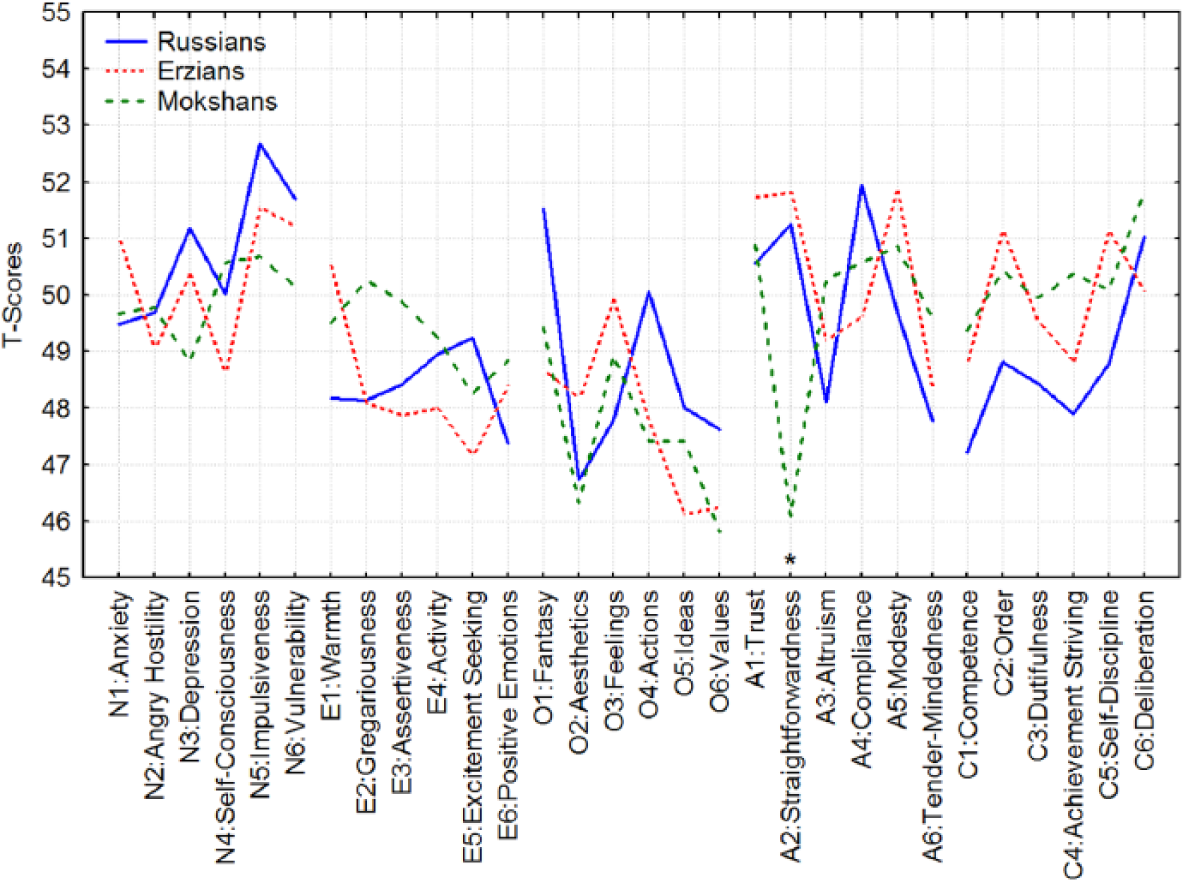
Self-rated personality traits of Russians, Erzians, and Mokshans.
There was less agreement in the perception of the typical Erzian, Mokshan, and Russian by these three groups. Figure 2 demonstrates mean ratings of a typical Erzian as perceived through the eyes of Russians, Mokshans, and Erzians themselves. In this and all following figures asterisks indicate the scales on which differences between the means of the three groups were significant at the p < .01 level. Because, in the raw ratings, different sources of information are confounded, the ratings of a typical Erzian, as we have already explained, were normalized relative to the ratings of a typical Russian, as collected from across the Russian Federation during the RCPS project (Allik et al., 2010; Allik et al., 2009). Thus, the T-scores in Figure 2 show deviations from the profile of the typical Russian perceived globally. The Mordovian Russians who participated in this survey perceived a typical Russian fairly much in the same way as their compatriots from Kamtchatka to Karelia who participated in the RCPS project. Deviations from the mean value 50 were small (1 point is one tenth of a standard deviation) and erratic (in both directions), indicating no systematic pattern, except perhaps a slight tendency to perceive a typical Russian as less extraverted and open to new experiences than as generally perceived. As expected from the in-group enhancement bias, Erzian participants estimated a typical representative of their ethnos much more favorably than Russians and Mokshans did. According to their collective self-portrait, Erzians are warm, open to fantasies, extremely agreeable, and conscientious. When we compared the collective Erzian self-portrait with the social desirability ratings that were collected during the RCPS project (Allik et al., 2010), the Pearson product–moment correlation showed that these two profiles are moderately correlated: r = .49, p = .006. It is notable that Russians and Mokshans estimated a typical Erzian in a remarkably similar manner. These two profiles (blue and green) had a strikingly similar shape: r = .81, p < .000001. The largest discrepancy between the Erzian autostereotype and the way in which Mokshans perceived a typical Erzian was with regard to agreeableness. Mokshan participants seemed to believe that a typical Erzian is less trusting, straightforward, altruistic, tender-minded, and complainant than in the eyes of Erzians themselves. There is no doubt that the Mokshan view of Erzians was not particularly sympathetic because their response profile correlated negatively with the previously collected social desirability ratings (r = −.54, p = .002). Thus, a typical Erzian was not a very likable person in the perception of Mokshan participants.

Personality profiles of a typical Erzian in the eyes of Russians, Erzians, and Mokshans.
One can expect that a certain animosity between Erzians and Mokshans might be reciprocal. Figure 3 demonstrates what the three groups of participants think about a typical Mokshan. Mokshans themselves perceived a typical representative of their ethnos as relatively high on extraversion, openness, agreeableness, and conscientiousness and low on neuroticism. The Erzian participants, on the contrary, think of a typical Mokshan as extremely introverted and disagreeable. This profile was negatively related to social desirability ratings (r = −.60, p = .00005). Russian participants’ views bear more resemblance to the Erzian than Mokshan view as their profiles were correlated (r = .67, p = .00005). This indicates that Erzians dislike Mokshans as much Mokshans appear to dislike Erzians. In other words, in-group favoritism and out-group derogation were symmetric.

Personality profiles of a typical Mokshan in the eyes of Russians, Erzians, and Mokshans.
Finally, we present, in Figure 4, profiles of a typical Russian as he or she was perceived from the viewpoint of the three groups of participants. Unlike the two previous cases, there is much more harmony in these three profiles. Only on three agreeableness scales (A2, A5, and A6) were the differences between means of the three groups significant at the 1% level (the asterisks in Figure 4). The best agreement was between the two profiles of how Erzians and Mokshans perceive a typical Russian (r = .64, p = .0001). There was also good consonance between how Erzians perceive a typical Russian and the Russian autostereotype (r = .53, p = .003). But Mokshans’ view was not radically different from the view of Russians themselves (r = .46, p = .011). None of these three profiles was positively related to the social desirability ratings of personality traits. Nevertheless, Russians who participated in this study were inclined to perceive their typical representative as slightly more agreeable than was the perception of both Erzians and Mokshans. Mokshan participants, in turn, did not judge the modesty and tender-mindedness of a typical Russian particularly highly.
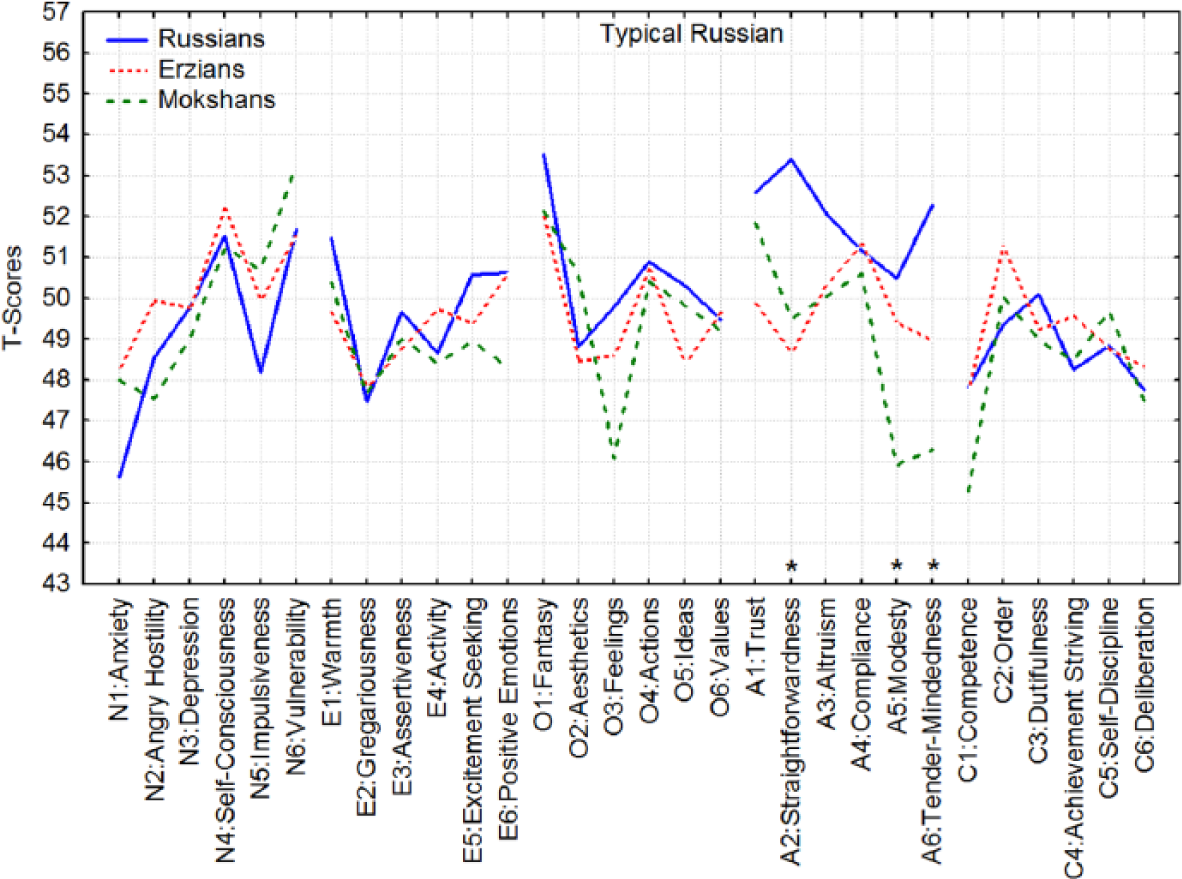
Personality profiles of a typical Russian in the eyes of Russians, Erzians, and Mokshans.
In Figures 2 to 4, we have nine different stereotypes, of which three are autostereotypes and six are heterostereotypes; all are standardized relative to the RCPS typical Russian data. Which pair of these nine profiles has the highest resemblance? The highest level of congruence between two profiles (r = .86, p < .000001) was observed between Russians’ images of a typical Erzian and those of a typical Mokshan. From the point of view of the Russian participants, there was not much difference in the personality traits of a typical Erzian and those of a Mokshan. Interestingly, Erzian and Mokshan autostereotypes were also strikingly similar (r = .85, p < .000001): They both stressed the same set of traits to make their own image socially more favorable.
Finally, what can be said about the accuracy of autostereotypes? Correlations between all stereotype and self-rating personality profiles are shown in Table 1. Mokshans’ self-rated personality traits (see Figure 1, green line) were moderately correlated (r = .51, p = .004) with what Mokshan respondents thought about their typical representative (see Figure 3, green line). For example, Mokshans’ self-rated straightforwardness (A2) was relatively low and so was the score that a typical Erzian received from them in the autostereotype judgment task. Erzian participants’ self-descriptions and autostereotypes were marginally correlated (r = .38, p = .038), but Russians living in Mordovia had no resemblance between the shapes of their self-rating and autostereotype profiles (r = .25, p = .185).
Correlations Between Different Stereotype and Self-Rating Personality Profiles.

Note. Statistically significant correlations at p < .01 level are shown in bold. Correlations between autostereotypes and self-ratings are shown in italics.
We are not aware of any exact criterion that allows us claiming that national character stereotypes accurately describe the expression of personality traits in real people. It is obvious that if the correlation between stereotype and self-ratings is approaching 1 then we can talk about almost perfect agreement. Also, the lack of significant correlation indicates that national character stereotypes are not founded on actually observed personality traits. We are much less certain when the correlations lie between these two extremes. Although the correlation around .5 is statistically significant, it talks only about modest similarity between these profiles. As only Mokshans’ autostereotype was correlated with their self-ratings, it is relatively fair to say that there was only a modest support for national character stereotype accuracy in general. It is very unlikely that participants correctly observed how individuals of their own or the other ethnic groups feel, think, or, behave, or on the basis of these observations, made more or less accurate statistical inferences about the average trait levels in these groups.
Discussion
It is satisfying that this study generally confirmed previous observations (Balyaev, 1999; Bogatova, 2004) that there is a certain amount of antagonism between two very close ethnic groups, the Erzians and Mokshans, living side by side in the Republic of Mordovia. They seem to feel less sympathy for each other than for the third large ethnic group, Russians, with whom they cohabitate. Erzians and Mokshans not only perceive the personality traits of their own ethnic group in a more favorable light but they also reciprocally see each other in a slightly derogative manner. For example, Mokshan participants perceived a typical Erzian as a person who is deceptive and reluctant to get involved in the problems of others. Erzians, in turn, looked at Mokshans as people who are relatively cold, secretive, avoid the company of others, and are inclined to manipulate other people’s thoughts and feelings. Both ethnic groups had a much better opinion of Russians and saw them pretty much in the same way that they saw themselves. Interestingly, Russians who live in Mordovia hardly saw any difference between a typical Erzian and Mokshan, portraying their personality inclinations in a remarkably similar manner.
As the polarization of personality stereotypes was more or less aligned with the favorability and unfavorability axis, it may contain a clue about the particular causes of many social conflicts (Esteban et al., 2012). As we saw, Erzian and Mokshan participants portrayed their own typical ethnos member slightly more favorably than any of the two out-group members but they both did not see Russians in a derogative manner. As we have already mentioned, Russians were perceived in relatively neutral tones. We have not witnessed any open conflicts between Erzians and Mokshans as yet (Bogatova, 2013), but the polarization of personality stereotypes is a sign of possible risk (Campbell, 1967). On a large scale, peaceful and even cooperative relations between ethnic groups are far more prevalent than occasional conflicts or even violence (Fearon & Laitin, 1996). It seems to be a universal rule that all groups, including those that are formed on ethnic bases, are subjected to motivational forces associated with the need for self-identity and differentiation from others (Brewer, 1993). Groups that provide an optimal balance between the need for assimilation and the need for differentiation appear to be the most appealing (Leonardelli, Pickett, & Brewer, 2010). It is, however, important to note that the in-group favoritism that underlies ethnocentric attachment does not necessarily mean any out-group derogation (Brewer, 2007). Thus, it is possible that, like any other ethnic group, Erzians and Mokshans have a favorable view of themselves and do not necessarily derogate each other. However, if other requirements for intergroup communication are fulfilled—equal status, common goals, cooperation, and authority support (Allport, 1954/1978)—then the effects of polarized stereotypes can be neutralized. Without additional sociological investigation, it is difficult to claim for sure, but some or many of these requirements are fulfilled and may guarantee a relatively peaceful situation.
Many researchers hold a view that personality traits are enduring dispositions to feel, think, and behave that are deeply rooted in human biology. If personality stereotypes reflect somehow these largely inherited dispositions then it may provide food for primordialist or essentialist views according to which radical polarization of personality stereotypes may be fixed into “flesh and blood.” However, this view is difficult to maintain because the actually measured mean personality traits of Erzians, Mokshans, and Russians living in Mordovia were virtually identical. The only detectable difference worth reporting was on the A2: Straightforwardness subscale where Mokshan respondents, unlike Erzians and Russians, scored relatively low. If this is not a statistical fluke or some kind of response bias, then Mokshan respondents seemed to think that, in comparison with an average college-age citizen of the Russian Federation, they are more inclined to manipulate others’ thoughts and feelings. Remarkably, this trait has corresponding projections into the stereotypes of a typical Mokshan held by Erzians, Russians, and Mokshans themselves. As this only statistically significant difference is less than what one would expect by chance, we can conclude cautiously that there was very little agreement between personality stereotypes and actually measured personality dispositions. This means that, on the most part, all in-group and out-group stereotypes measured in this study are more like “pictures in our head” (Bottom & Kong, 2012) that are not based on firsthand information on personality traits but have been somehow constructed and maintained. Personality stereotypes can be understood as collectively shared knowledge based on secondhand information that usually compensates for the absence of personal experience or absence of differences between real personality traits. On the societal level, stereotypes are nurtured by different social and cultural institutions (family and marriage), practices, and customs. Exposure to other cultures comes also from books, films, and the mass media. For the average person, information about personality stereotypes also comes through more private channels of communication, such as stories, jokes, and gossip (McCrae et al., 2013). This secondhand information about national or ethnic character is usually inaccurate because the stated personality differences simply do not exist. On average, Mokshans are not more antagonistic and reticent than the average Erzian or Russian.
Unfortunately, on the basis of personality stereotypes alone, it is impossible to reconstruct the exact mechanisms with which these stereotypes are built. From the fact that in-group and out-group stereotypes are polarized into pairs, we can suppose that the same social construction mechanisms are involved in creating both of them. Grouping personality stereotypes into pairs makes them similar, remotely at least, to totemism, in which a given group of people, usually kin, is thought to have a spiritual connection or a kinship with another physical being, such as an animal or plant, often called a “totem,” serving as their emblem or symbol (Comaroff, 1987). Initially, anthropologists attempted to explain totemistic systems through their utilitarian functions. For example, totems could serve the function of a culinary classification: which animals or plants are edible and which are not. But, as was noticed by Claude Lévi-Strauss (1962/1969), natural species are chosen for an emblem not because they are “good to eat” but because they are “good to think” (p. 162). British anthropologist Radcliffe-Brown (1951) noticed that what is most important is not natural species per se, but the system of attributes by which one plant or animal is distinguished from others. One kin can call themselves “people without legs” as they think that their ancestors were snakes who slithered on the ground. They may be opposed to the “children of sky,” whose totem is the eagle and who could once glide freely in the air. “River people” think of themselves as descendants of the crocodile, which lives in the water. Even two bird-people may be different because terrestrial birds are different from “birds of above” (Lévi-Strauss, 1962/1969). It is interesting to notice that Erzians and Mokshans had, not that long ago, the common belief that the original mother of their ethnos was a duck: the same duck, which, according to the common Finno-Ugric myth, created the world by diving to the bottom of the sea to get material for the building of Earth (Deviatkina, 2011). Anthropologists seem to agree that totems reflect some universal properties of thinking that categorize things according to distinctive features: below–above, black–white, weak–strong, raw–cooked, and so on.
There is no direct analogy between personality stereotypes and totemistic thinking. Nevertheless they seem to share a similar thinking pattern. As personality stereotypes do not seem to have serious social consequences, at least in Mordovia, it is possible that they serve primarily symbolic functions needed for self-identification and differentiation from another ethnic group that is confusingly similar. Although the in-group is categorized as extraverted, another ethnically close and hardly distinguishable out-group is classified as introverted. Similarly, if an in-group is thought of as open, friendly, and hard-working, a targeted out-group is stereotyped as closed, antagonistic, and somewhat lazy. However, the polarization of these personality stereotypes may not have profound consequences. Perhaps, like totems, personality stereotypes are primarily “good to think,” rather than “good to act.” Almost every handbook of social psychology starts with a description LaPiere’s (1934) classic experiment, which demonstrated that even strong racial or ethnic attitudes do not necessarily predict actual behavior. Although attitudes are not necessarily stereotypes, it is still informative that in the early 1930s, more than 90% hotel managers in the United States said that they did not offer services to Chinese guests in spite of the fact that only 6 months earlier they all did, ignoring the high degree of discrimination and hostile stereotypes against Asians at that time (LaPiere, 1934).
On the basis of the collected data alone, it impossible for us to say what the main function of personality stereotypes is. There is little doubt that the polarization of stereotypes facilitates ethnic self-identification and differentiation from other very similar ethnic groups. However, more research is needed to decide whether this polarization has a mainly symbolic function or if there are more serious consequences.
Footnotes
Acknowledgements
We are very grateful to Niina Aasmäe and Delaney Skerrett for comments and suggestions concerning this article.
Declaration of Conflicting Interests
The author(s) declared no potential conflicts of interest with respect to the research, authorship, and/or publication of this article.
Funding
The author(s) disclosed receipt of the following financial support for the research, authorship, and/or publication of this article: This research was supported by the Estonian Ministry of Education and Research (Institutional Research Grant IUT02-13) and a Primus grant (3-8.2/60) from the European Social Fund to Anu Realo.
Author Biographies
 ). His current research interests include child animism, implicit theory of mind, national character, face attractiveness, covert face recognition, and Vygotsky’s theory of mental development.